In October 2026 the Bank of Thailand brought a 'Bangkok Blueprint' against fraud and scams at the IMF–World Bank meetings. This film explains how online scams actually work: the four signs that give almost every scam away, the six persuasion levers scammers pull, the slow 'pig butchering' con, deepfake video calls, the money mules that move stolen money in minutes, the scam compounds where trafficked workers are forced to run the schemes, and the defences banks, governments and you can use. Spot the red flags on a fake message, pull the levers yourself, and freeze a money trail before it disappears.
Your phone buzzes. Your bank says a strange payment has left your account, and you must act now.
This month, as finance leaders from around the world meet in Bangkok, Thailand's central bank is putting a plan against exactly this crime in front of them: the Bangkok Blueprint.
To see why the world needs one, start with how a scam really works.
Your account has been used for a suspicious transfer. Verify now or it will be frozen.a typical fake message, invented for this film
built by the Bank of Thailand with the IMF and World Bank, two global finance bodies
a shared plan against fraud, scams and cyber risk
meant to be adapted by each country
The Bangkok BlueprintOne message, millions of phones Scam messages are sent in bulk; it only takes a few replies to pay off. AI-generated illustration.
Prologue · The news
The Bangkok Blueprint
According to Nation Thailand (13 October 2026), the Bank of Thailand developed the Bangkok Blueprint with the IMF and the World Bank as a framework to help countries address fraud, scams and cyber risks, and planned to present it at the 2026 Annual Meetings in Thailand. Governor Vitai Ratanakorn said research on these threats is still limited, and that Thailand’s role should not be taken to mean it has already solved them.
This film is education about common scam patterns, not legal or financial advice. If you think you have been scammed, contact your bank and the police straight away; in Thailand the 1441 hotline runs 24 hours.
How to use: pick a chapter or press ← →; drag to rotate. Most steps have buttons you can press.
America's consumer watchdog, the Federal Trade Commission, boils almost every scam down to four signs.
They pretend to be from an organisation you know. They say there is a problem, or a prize.
They pressure you to act immediately. And they tell you to pay in a specific way: a transfer, cryptocurrency, gift cards.
The message on screen shows all four. Try another message: the same four signs appear.
PRETEND: a name you trust
PROBLEM or PRIZE
PRESSURE: act now
PAY in a specific way
The four Ps
gift cards
“send the numbers on the back”
crypto
“only crypto will do”
wire
money-transfer services
Never pay anyone who insists onToo urgent to be true Real deadlines are rare; fake ones are everywhere. AI-generated illustration.
Chapter I · The hook
The four signs
The FTC lists four signs: scammers pretend to be from an organisation you know (caller ID can be faked); they say there is a problem or a prize; they pressure you to act immediately, sometimes threatening arrest or a lawsuit; and they tell you to pay in a specific way, such as gift cards, cryptocurrency or a money-transfer service.
The FTC’s advice: do not give personal or financial information in response to a request you did not expect, and contact the organisation through a number or website you look up yourself.
The 3D scenes are schematic: the phone, the messages, the people and the money flows are invented to illustrate the patterns, not copied from real cases.
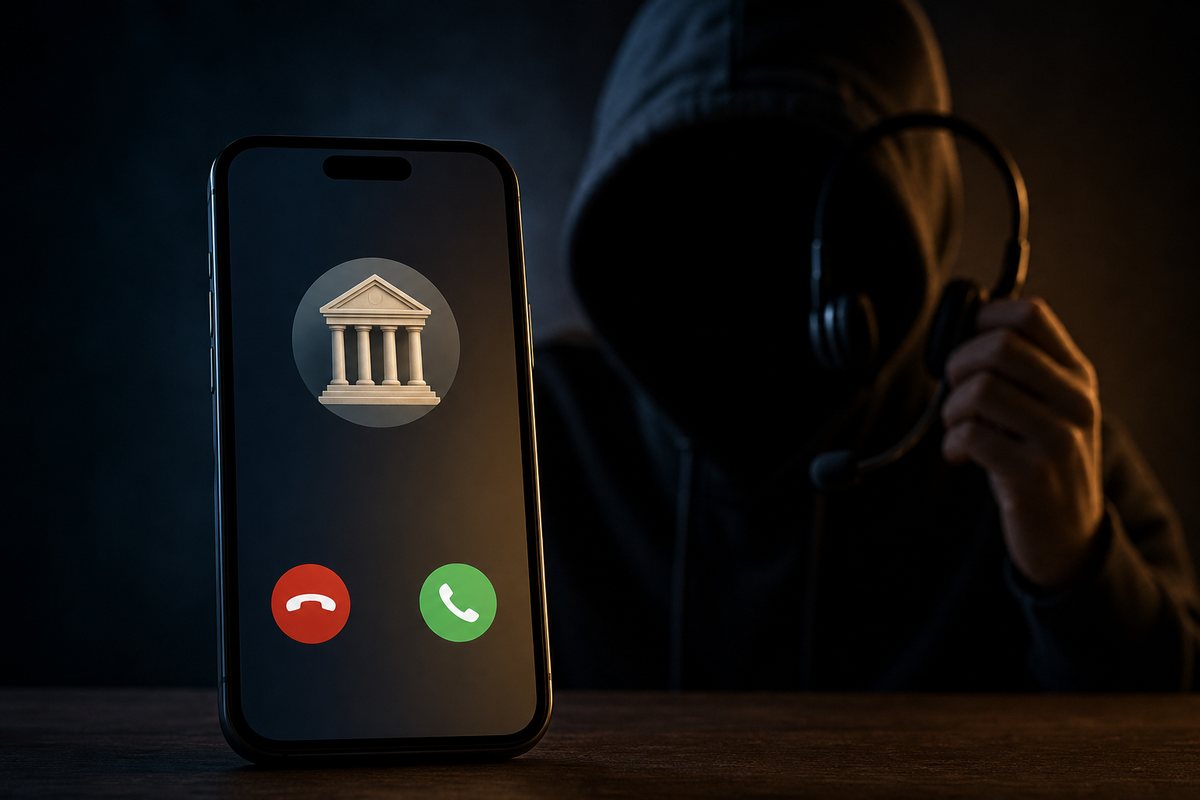
The first sign does the most work. A name you trust switches off your guard: your bank, a delivery company, the police, the tax office.
And the name on the screen proves nothing. Caller ID can be faked, and a sender's name in a text or an email can be copied in seconds.
The FTC says it will never tell you to move your money to protect it. Treat that request from anyone claiming to be a bank or the police as a red flag.
In Thailand, one July 2026 week of police figures shows how well it works: impersonation scams caused more losses than any other kind.
“This is your bank calling” Impostors borrow the authority of a familiar name. AI-generated illustration.
the number on caller ID
a sender name on a text or email
logos and a website that looks right
What can be faked
5,588
scam reports in one week
฿71.75 m
lost to impersonation, the costliest type
Thailand, 28 June – 4 July 2026
Chapter I · The hook
Impersonation
According to Thailand’s Anti Cyber Scam Center, reported through the ThaiPoliceOnline system, the week of 28 June to 4 July 2026 brought 5,588 complaints and losses of 207.73 million baht. Fraud in buying goods and services was the most common type (4,400 cases), but impersonation caused the largest losses, 71.75 million baht.
The FTC notes that caller ID can be faked, and that honest organisations generally will not ask for personal or financial information by call, email or text.
The 3D scenes are schematic: the phone, the messages, the people and the money flows are invented to illustrate the patterns, not copied from real cases.
Then comes the clock. Your account will be frozen in ten minutes. The parcel goes back today. The offer ends at midnight.
Pressure is there to stop you from checking. Scammers may insist you stay on the line, or threaten arrest, so you never pause to ask someone else.
So the simplest defence is to break the clock. Press pause. A real bank will still be there in ten minutes.
“frozen in 10 minutes”
“last chance today”
“a warrant for your arrest”
Classic deadlines
Honest businesses will give you time to make a decision.US Federal Trade Commission
Break the clock Hang up and call back on a number you find yourself. AI-generated illustration.
Chapter I · The hook
Why pressure works
The FTC says scammers want you to act before you have time to think: they may insist you stay on the phone, or threaten arrest, a lawsuit or the loss of a licence. Its advice is to resist the pressure, and to stop and talk to someone you trust, because describing the situation to another person can reveal the scam.
The 3D scenes are schematic: the phone, the messages, the people and the money flows are invented to illustrate the patterns, not copied from real cases.
Behind those signs sit old shortcuts in the human mind. Psychologists who study persuasion describe six, and fraud investigators see scammers pull every one.
Reciprocity: a small gift makes you feel you owe something. Authority: we obey uniforms and titles. Social proof: fake reviews and testimonials.
Commitment: one small yes leads to bigger ones. Liking: flattery and shared interests. Scarcity: only today, only for you.
None of this makes victims foolish. These shortcuts usually serve us well. Scams turn them against us.
reciprocity: “a free gift for you”
authority: “this is the police”
social proof: “10,000 happy investors”
Levers 1–3
commitment: “just fill in this survey”
liking: “we have so much in common”
scarcity: “only 3 places left”
Levers 4–6
…create a false sense of urgency or rarity.Montgomery County Police fraud unit, on scarcity
Chapter II · The playbook
The six principles of influence
The six levers are the principles of influence described by the psychologist Robert Cialdini. The Montgomery County (Maryland) Police fraud unit explains how each is used: free gifts to create a sense of debt (reciprocity), posing as officials or experts (authority), fake testimonials and reviews (social proof), small first commitments that lead to larger demands (commitment and consistency), flattery and mirroring (liking), and false deadlines or limited availability (scarcity).
The 3D scenes are schematic: the phone, the messages, the people and the money flows are invented to illustrate the patterns, not copied from real cases.
Some scams are slow. It starts with a message to the wrong number, a friendly apology, then weeks of chat. Sometimes it turns romantic.
Then the new friend shares a secret: a crypto platform that only goes up. The app shows your money growing, and a small withdrawal works, to build trust.
So you put in more. When you try to take out the big sum, you are locked out. The profits were only numbers on a fake website.
The FBI's rule of thumb: any message you did not start, from someone you have never met, that ends up talking about money, is a red flag.
The scheme is known by a Chinese phrase, sha zhu pan: pig butchering. The victim is fattened up first.
a “wrong number” message
weeks of friendly chat
a “sure thing” investment
fake gains, then a lockout
The script
Anyone that guarantees that an investment will be successful should be an immediate red flag.FBI, as reported by NBC
$8.6 bn
lost to investment scams: the largest category
$7.2 bn
of it in crypto investment scams
FBI internet crime report, 2025
Chapter II · The playbook
Pig butchering
NBC, reporting the FBI’s warnings, describes the steps: an opening message that looks like a misdial, rapport and sometimes romance, a move to a cryptocurrency “opportunity”, fake trading platforms or apps that show large profits and allow small withdrawals, and finally a lockout after a large investment. The name comes from the Chinese phrase sha zhu pan.
According to Help Net Security’s summary of the FBI IC3 report for 2025, investment fraud caused $8.6 billion in reported losses, and crypto-related investment scams $7.2 billion.
Now artificial intelligence adds new tricks. In early 2024, a finance worker at the engineering firm Arup in Hong Kong joined a video call with his chief financial officer and several colleagues.
They looked and sounded right. He made fifteen transfers, about twenty-five million US dollars. Every face on that call except his own had been faked.
Arup confirmed that fake voices and images were used. In 2025, the FBI's report counted AI for the first time: about twenty-two thousand complaints.
So when a call asks for money, check through another channel, even if you can see the face.
Jan 2024 a “confidential” request, then a video call
15 transfers HK$200 m, about US$25.6 m
May 2024 Arup named as the victim
The Arup caseA call full of copies Schematic: the people shown are invented. AI-generated illustration.
~22,000
complaints linked to AI
~$893 m
in losses
AI in the FBI report, 2025
Chapter II · The playbook
Deepfake video calls
CNN reported in May 2024 that Arup was the company behind a case Hong Kong police had disclosed in February: an employee sent HK$200 million (about US$25.6 million) in 15 transactions after a video call with people he believed were the CFO and other staff, all deepfake re-creations. He had first suspected a phishing email; the call convinced him. Arup said its systems were not compromised.
The FBI IC3 report for 2025 included its first section on AI: about 22,000 complaints linked to nearly $893 million in losses (Help Net Security summary).
The 3D scenes are schematic: the phone, the messages, the people and the money flows are invented to illustrate the patterns, not copied from real cases.
Once the money moves, the race is on. It rarely goes straight to the scammer. It jumps through a chain of borrowed or rented bank accounts, called mule accounts.
Each hop splits it and makes it harder to trace. At the end it may become cryptocurrency or cash, and leave the country.
That is why scammers care how you pay. Transfers, crypto and gift cards are fast and hard to reverse. Thailand says it has suspended more than a million mule accounts.
In four months it also blocked more than three hundred thousand illegal web addresses, most of them gambling sites.
a real bank account
used to pass on stolen money
each hop makes the trail harder to follow
A mule account
bank transfers: instant
crypto: crosses borders, hard to reverse
gift cards: the code is the money
Why scammers want these
1.18 m
mule accounts suspended
฿1.79 bn
scam losses in Dec 2025, down from ฿2.21 bn a year earlier
Thailand, to February 2026
Chapter III · The money trail
Mule accounts
According to Thailand’s Minister of Digital Economy and Society, Chaichanok Chidchob (reported by NNT in February 2026), more than 1.18 million mule accounts had been suspended. Police figures put scam losses at 1.792 billion baht across 31,198 cases in December 2025, compared with 2.209 billion baht in December 2024. From 1 October 2025 to 1 February 2026, 304,631 illegal URLs were blocked, 259,385 of them gambling sites.
The FTC warns never to pay anyone who insists on gift cards, cryptocurrency or a wire transfer. The FTC also reports that consumers lost more money through bank transfers and cryptocurrency than through all other payment methods combined.
The 3D scenes are schematic: the phone, the messages, the people and the money flows are invented to illustrate the patterns, not copied from real cases.
How big is all this? Nobody knows exactly, because many victims never report. But the reported numbers alone are huge.
In the United States alone, the FBI counted almost twenty-one billion dollars lost to internet crime in 2025. And that is only what people reported.
And more than a third of the people who reported a fraud to the FTC in 2024 actually lost money, up from about a quarter the year before.
The most reported crime type was phishing: messages built to steal passwords and codes.
FTC, all fraud, 2024
12.5
FBI, internet crime, 2025
20.9
of which investment fraud
8.6
Reported losses, US$ billions (different agencies: do not add)
38%
of people who reported fraud lost money (27% in 2023)
email
the most common first contact
FTC, 2024
191,561
phishing and spoofing complaints
1 m+
complaints in total
FBI, 2025: most reported
Chapter III · The money trail
Reported losses
The FTC reported that US consumers reported losing more than $12.5 billion to fraud in 2024, up 25%, with investment scams ($5.7 billion) and impostor scams ($2.95 billion) the largest categories; 38% of people who reported fraud said they lost money. The FBI’s IC3 report for 2025 recorded $20.877 billion in losses from more than one million complaints; phishing and spoofing were the most reported type (191,561 complaints).
The two US figures come from different agencies and definitions and overlap; they should not be added together. Both count only what was reported.
The 3D scenes are schematic: the phone, the messages, the people and the money flows are invented to illustrate the patterns, not copied from real cases.
Who is typing those messages? Often, people who are not there by choice.
In 2023 the UN Human Rights Office said credible sources suggest at least a hundred and twenty thousand people in Myanmar, and around a hundred thousand in Cambodia, may be held and forced to run online scams.
They come from across Asia, Africa and Latin America, and many are well educated. The UN's position is clear: they are victims, not criminals.
In 2025 the UN Office on Drugs and Crime warned the industry, worth just under forty billion dollars a year in profits by its estimate, is spreading to other continents.
120,000+
may be held in Myanmar
~100,000
estimated in Cambodia
UN Human Rights Office, 2023
They are victims. They are not criminals.Jeremy Laurence, UN Human Rights Office spokesperson, 2023
A compound at night Schematic scene; no real place is shown. AI-generated illustration.
Africa: raids in Nigeria, Zambia, Angola
Latin America: links in Brazil and Peru
also South Asia, the Middle East, Pacific islands
Spreading, says UNODC
Chapter IV · Behind the screen
Scam centres and forced criminality
The UN Human Rights Office report of 29 August 2023 said credible sources suggest at least 120,000 people in Myanmar may be held and coerced into running online scams, with estimates of around 100,000 in Cambodia; Laos, the Philippines and Thailand are named as main destination or transit countries, each with at least tens of thousands involved. Victims, mostly men but also women and adolescents, come from across Southeast Asia, mainland China, Hong Kong, Taiwan, South Asia, Africa and Latin America.
UNODC’s April 2025 report, as reported by AP, estimates that hundreds of industrial-scale scam centres make just under $40 billion a year in profits, and describes their spread to Africa, Latin America and other regions. These are estimates; the true numbers are hard to measure. The map is schematic.
Defence means slowing the money down. In 2023 the Bank of Thailand told banks to stop sending links by text message or email, so a link that claims to be from your bank is a warning sign.
It also required a face scan for transfers above fifty thousand baht, or above two hundred thousand in a day.
And speed matters on the victim's side too. Thailand's 1441 hotline runs day and night, and can usually suspend a suspect account within about ten minutes.
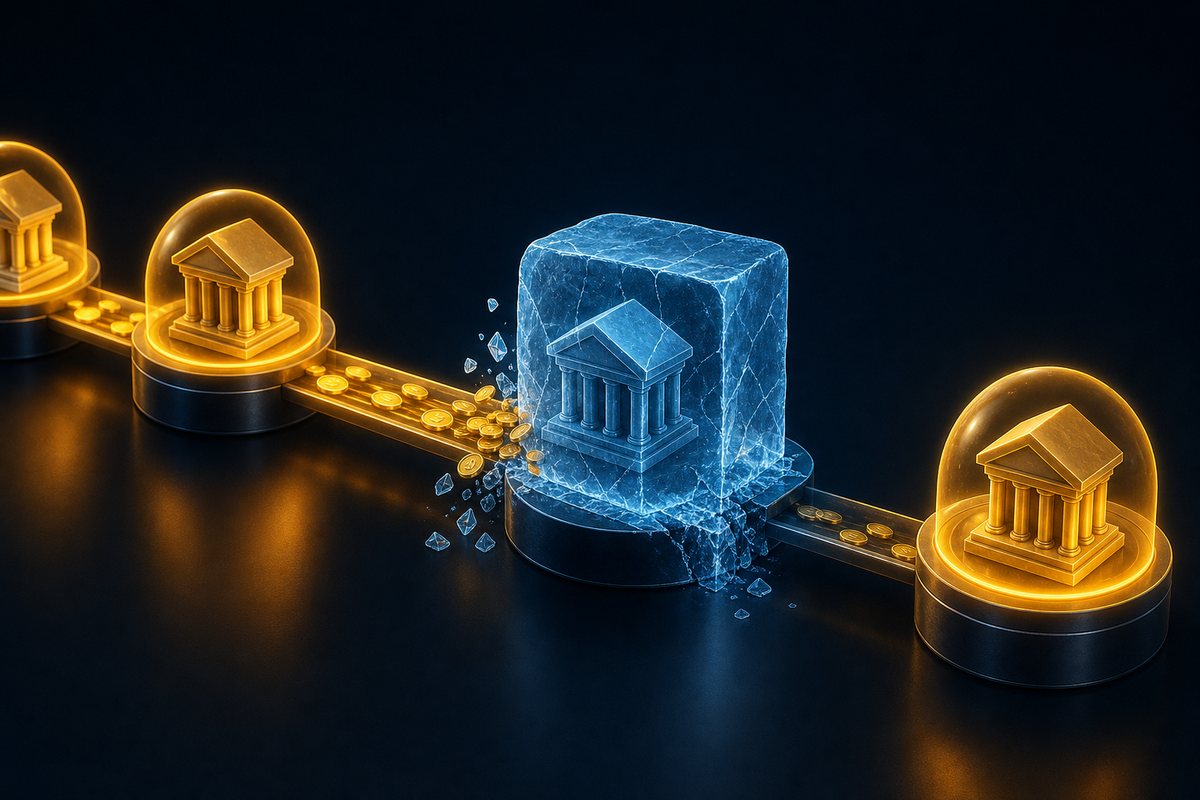
Watch the trail stop when the account is frozen.
no links by text or email from banks
one mobile-banking username per device
a 24-hour fraud hotline at every bank
Bank of Thailand rules, 2023
฿50,000
per transfer
฿200,000
per day
Face scan required above
1.18 m
phone calls to the hotline
348,006
accounts suspended
~฿19 bn
losses prevented, by its own count
1441 hotline, first year (Nov 2023 – Oct 2024)Freeze The sooner a victim calls, the more money can be held. AI-generated illustration.
Chapter V · Defence
Bank rules and the 1441 hotline
The Bangkok Post reported in 2023 that the Bank of Thailand required facial scans for transfers above 50,000 baht per transaction or 200,000 baht per day, limited mobile banking to one username per device, banned financial institutions from sending links by SMS and email, and required a 24-hour fraud hotline. Thailand’s Anti Online Scam Operation Center (AOC), run by the Ministry of Digital Economy and Society with partners, opened the 1441 hotline on 1 November 2023.
According to the government’s Public Relations Department, in its first year the hotline received 1,176,512 calls, suspended 348,006 suspicious accounts, typically within 10 minutes, and prevented about 19 billion baht in losses.
The 3D scenes are schematic: the phone, the messages, the people and the money flows are invented to illustrate the patterns, not copied from real cases.
No single rule stops scams, so the Bangkok Blueprint stacks layers.
Stop scams before they start, and have laws ready for them. Get agencies working together. Build banking products that are harder to abuse. Spot strange activity fast and respond. And chase the money to get it back.
The governor, Vitai Ratanakorn, said research on these threats is still limited, and that Thailand has not solved the problem either.
It is meant to be adapted, country by country, because scams cross borders faster than laws do.
prevention
legislation
cooperation between agencies
financial product design
detecting irregularities and responding
tracing and recovering funds
The six areas
It would help countries that may only just be encountering these problems.Vitai Ratanakorn, Governor of the Bank of Thailand, via Nation Thailand
Many layers Each layer catches what the one before missed. AI-generated illustration.
Chapter V · Defence
The Bangkok Blueprint
Nation Thailand reported that the Blueprint covers prevention, legislation, cooperation between agencies, financial product design, processes for detecting irregularities and responding to incidents, and tracing and recovering lost funds. It is intended as an adaptable, long-term reference. Governor Vitai said illicit money comes not only from scams and fraud but also from corruption, and described the threats as global, structural problems affecting the United States, Latin America and Asia.
This film describes the Blueprint as reported; it does not assess how well it will work.
The 3D scenes are schematic: the phone, the messages, the people and the money flows are invented to illustrate the patterns, not copied from real cases.
Back to that message. A scam is a script, and it only works if you follow it. Three habits break it.
Stop: you never have to decide in ten minutes. Check: contact the bank or office through a number you find yourself, never one in the message.
And talk: tell someone you trust. Saying it out loud is often enough to hear how strange it sounds.
And if it has already happened, there is no shame in it. Call your bank and the police straight away; in Thailand, call 1441. The sooner you call, the more can be held.
The scammer's greatest weapon is your hurry. Take it away.
STOP: real deadlines are rare
CHECK: a number you look up yourself
TALK: tell someone you trust
Three habitsTake back the time All stills and illustrations in this film are AI-generated.
bank
call its official hotline at once
1441
Thailand, 24 hours
If it already happened
Epilogue · Sources
How online scams work
The patterns in this film are documented by consumer-protection agencies, police and UN bodies: impersonation, urgency, unusual payment methods, persuasion techniques, money mules and industrial-scale scam centres. Loss figures count only what victims report, and estimates of forced labour and profits are estimates.
The habits in the epilogue follow the FTC’s published advice. This film is education, not legal or financial advice.
The 3D scenes are schematic: messages, people, charts and money flows are invented. All stills and illustrations are AI-generated and show no real people or brands.