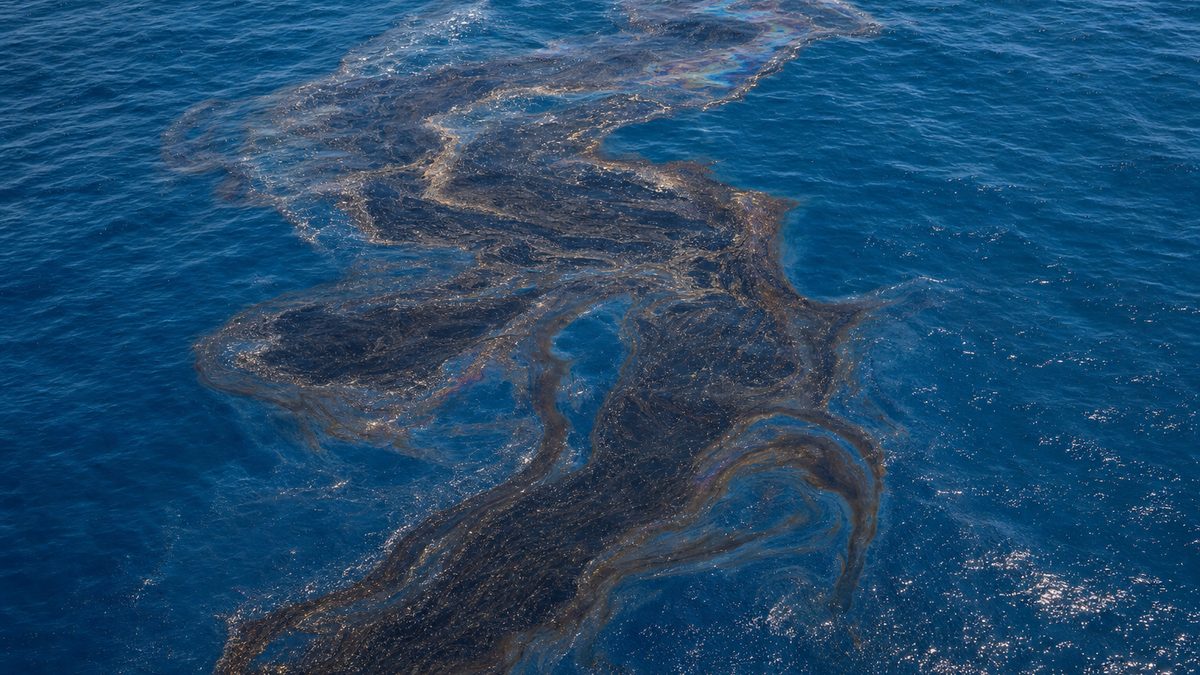
In late October 2026, oil from a tanker damaged near the Strait of Hormuz washed onto beaches in the United Arab Emirates. This film explains what happens next whenever oil meets the sea: what crude oil is made of and why most of it floats, how a slick spreads and why it shines like a rainbow, how evaporation, waves, sunlight and bacteria break it down, how booms, skimmers, controlled burns and dispersants work and what each one costs, what the Torrey Canyon, Exxon Valdez, Gulf War, Deepwater Horizon and Rayong spills taught, and how radar satellites spot slicks from space.
Interactive 3D film10 min1967 to 2026Published 31 October 2026
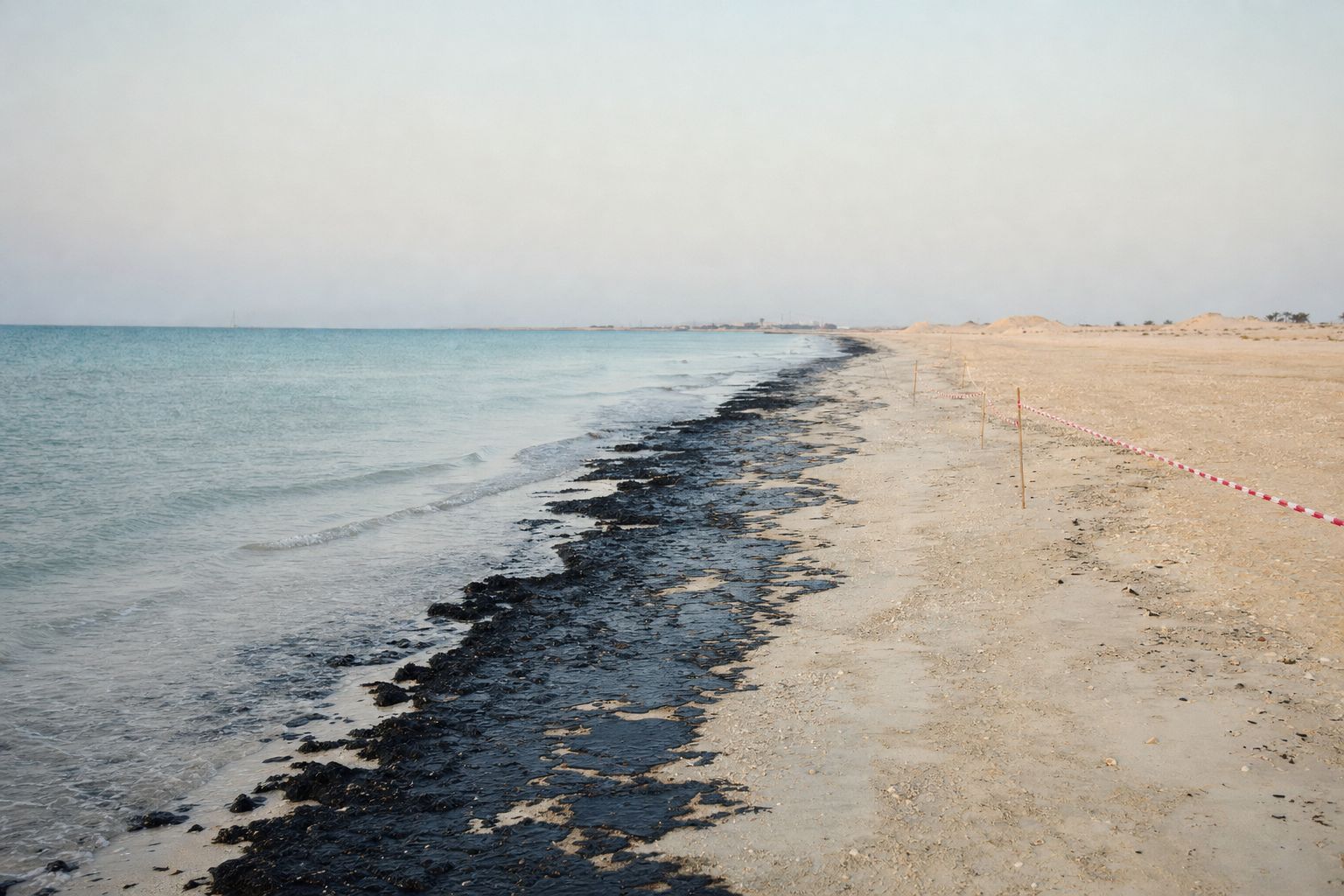
A dark line of oil along a white beach. In late October 2026, oil from a tanker damaged amid attacks on shipping near the Strait of Hormuz washed ashore in the United Arab Emirates, and beaches were closed.
What actually happens when oil meets the sea? Why do some spills vanish in days, while others are still on the shore years later? And how do people get the oil back?
The tide line Washed-up oil marks where the highest wave reached. AI-generated still.
23 Oct UAE ministry reports a tanker spill; Umm Al Quwain beaches shut
28 Oct Ras Al Khaimah beaches closed until further notice
As reported
What crude oil is made of
How the sea breaks it down
Booms, burns and dispersants
Lessons from five big spills
In this film
Prologue
Oil on the UAE coast
Euronews (23 October 2026): the UAE Ministry of Climate Change and Environment said it had detected a tanker oil spill affecting the beaches of Umm Al Quwain, north of Dubai; the beaches were closed and teams began containment and clean-up. The spill came amid attacks on vessels in Gulf waters during what Euronews describes as the war between Iran and the United States. Neither report said who damaged this tanker. Al Jazeera (28 October 2026): beaches in Ras Al Khaimah were closed until further notice as the spill from a damaged tanker reached the coast. The reports did not give the amount of oil spilled.
The geopolitics of the strait are told in the PlanetPast film on the Strait of Hormuz; this film is about the oil itself.
The 3D scenes are simplified teaching models, not to scale. Slick sizes, shares and timings on screen are illustrative unless a source is named.
Crude oil is not one substance. It is a highly variable mixture of many hydrocarbons: molecules made of carbon atoms in chains and rings, with hydrogen around them.
Small molecules are light and evaporate easily. Long chains and big clusters of rings are heavy, thick and sticky. Every crude, from every oil field, has its own mix, and that mix decides what happens after a spill.
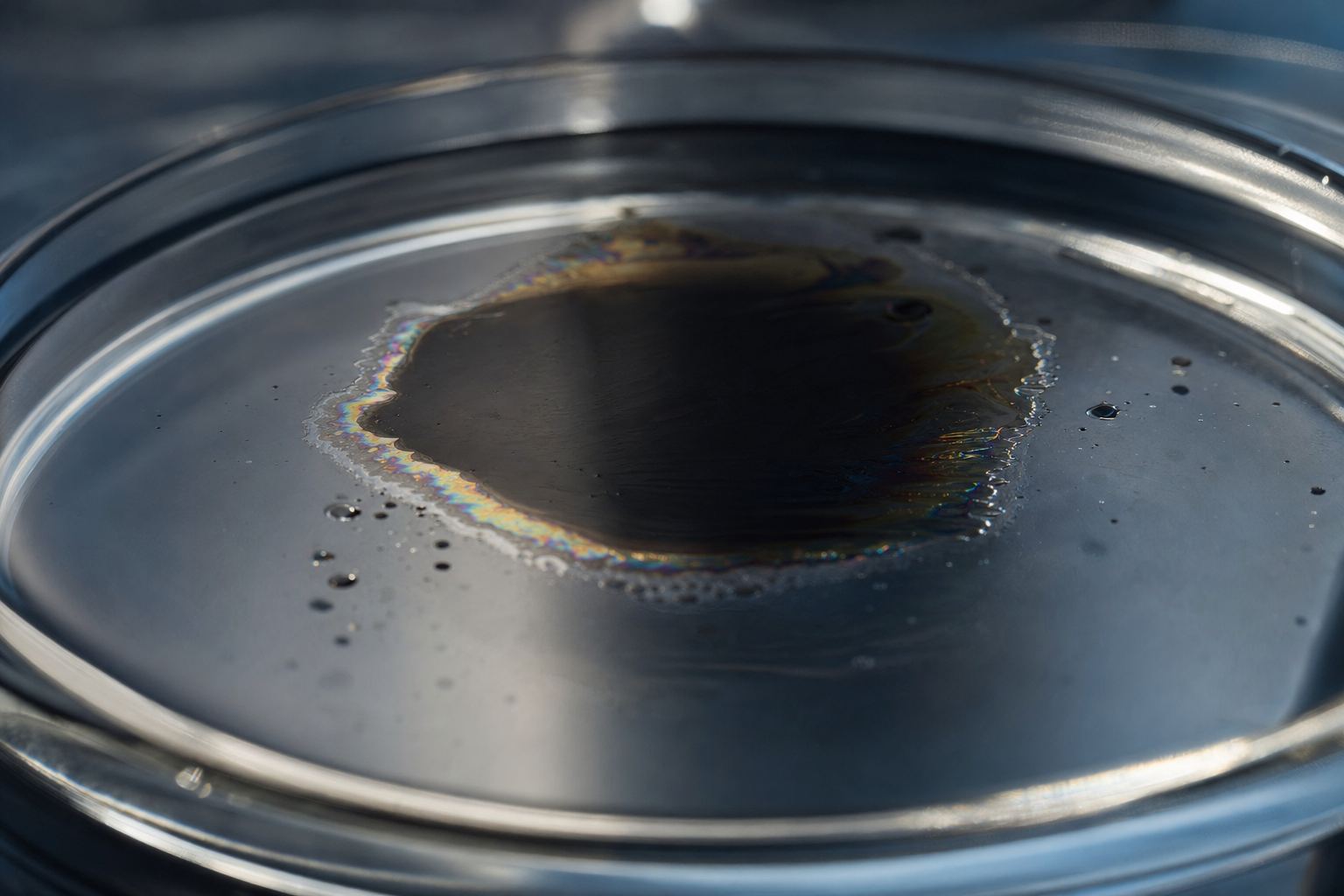
One drop A drop of crude meets seawater and starts to spread. AI-generated still.
Volatile light compounds
Waxes and resins
Asphaltenes and bitumens
From light to heavy (WCMRC)
days
for petrol, kerosene and diesel to almost vanish
little
of a heavy fuel oil evaporates
Two ends of the mix (ITOPF)
Chapter I · What oil is
A mixture of hydrocarbons
Western Canada Marine Response Corporation: crude oil is a highly variable mixture of hydrocarbons; its components range from very volatile light compounds to heavy ones, including bitumens, asphaltenes, resins and waxes, and each deposit has its own composition. Light compounds evaporate; the heavy fraction stays behind and can form a stable emulsion.
Try it: switch between a light and a heavy mix of molecules.
The 3D scenes are simplified teaching models, not to scale. Slick sizes, shares and timings on screen are illustrative unless a source is named.
Most oils float, because they are less dense than seawater. The oil industry measures this with a number called API gravity, worked out from the oil's density compared with water.
The higher the API number, the lighter the oil. Above ten, an oil is lighter than fresh water. Petrol is far above that; the heaviest fuel oils come close to the line.
Very few oils sink at once. But weathered oil can grow nearly as dense as seawater, and when it picks up sand it can settle on the seabed in shallow water.
API=SG141.5−131.5
SG
specific gravity: the oil’s density ÷ water’s density
API gravity
Petrol
~60
Light crude
~35
Heavy fuel oil
~12
Fresh water
10
Floats or sinks? (API > 10 floats)
very few
oils sink when first spilled
tar mats
oil plus sediment on shallow seabeds
Sinking (ITOPF)
Chapter I · What oil is
Why most oil floats
Kimray: API gravity = 141.5 ÷ specific gravity − 131.5, where specific gravity is the fluid’s density divided by water’s; a fluid with an API gravity above 10 floats on water, below 10 it sinks. ITOPF: very few oils sink; weathered oil can approach the density of seawater, and oil that binds to sediment can form dense tar mats on nearshore seabeds, especially in shallow water. The API values on the bars are typical round figures for illustration.
Try it: drop each oil into seawater and see where it settles.
The 3D scenes are simplified teaching models, not to scale. Slick sizes, shares and timings on screen are illustrative unless a source is named.
On the water, oil starts to spread the moment it is spilled. Within a few hours the slick breaks up into long bands, lined up with the wind.
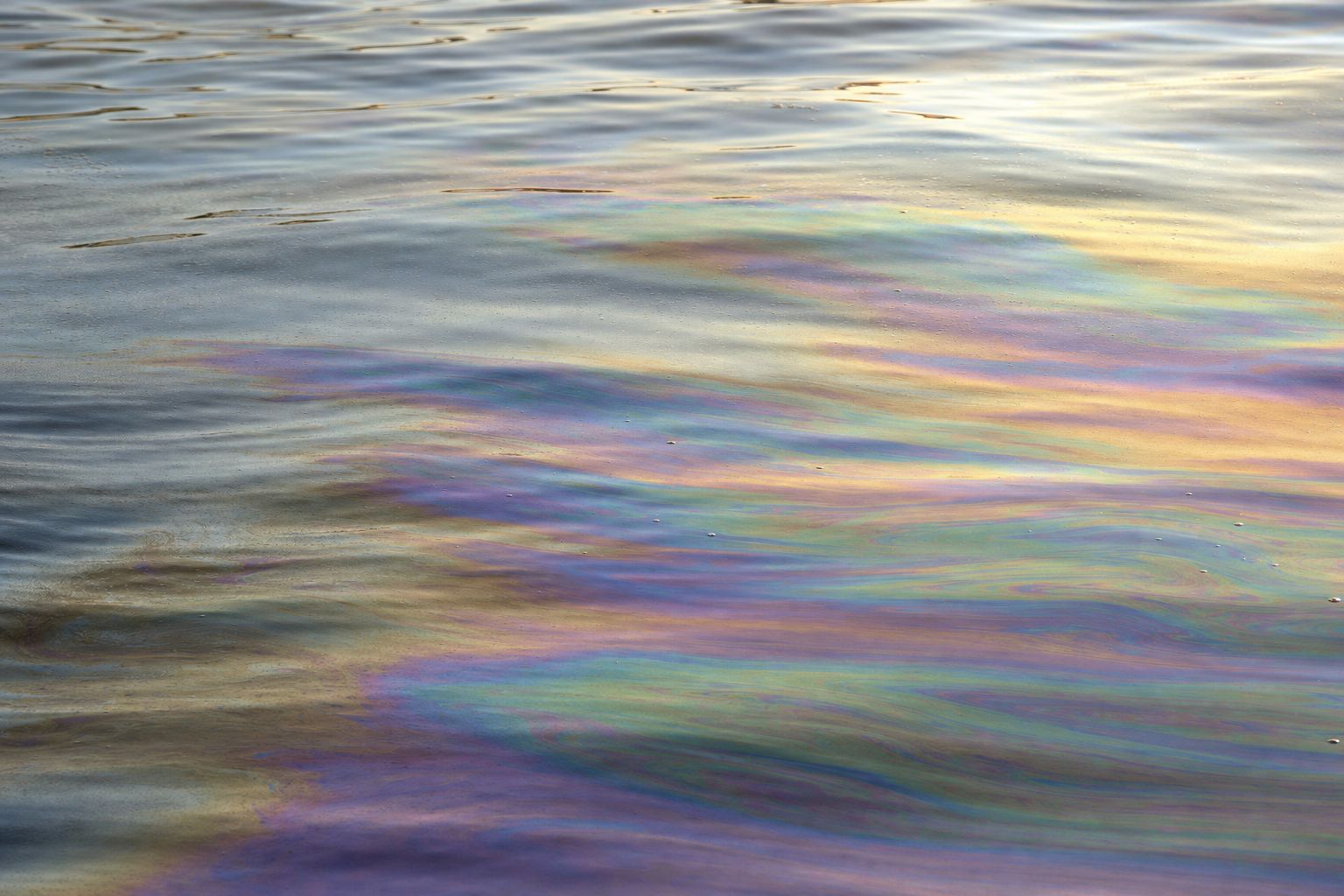
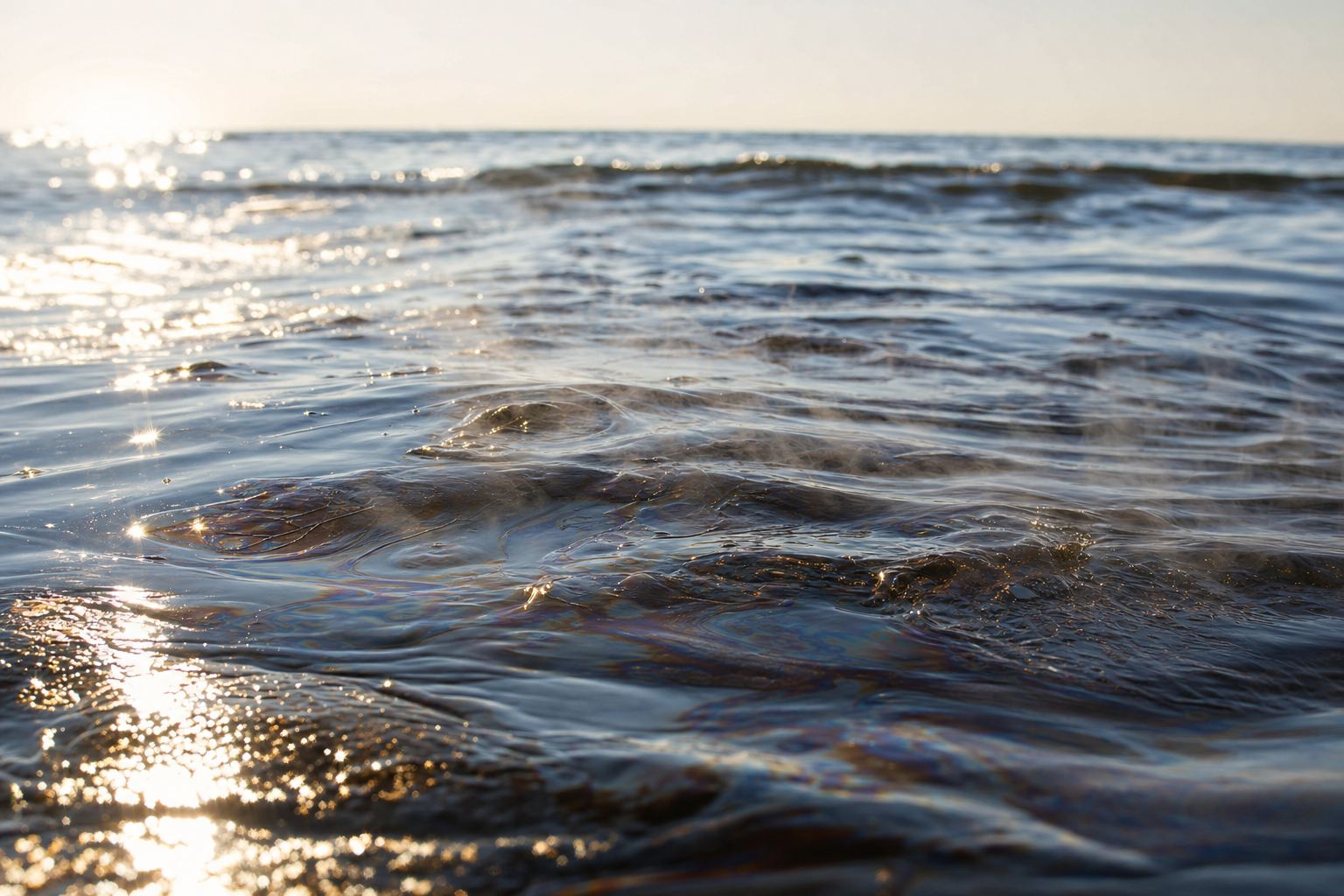
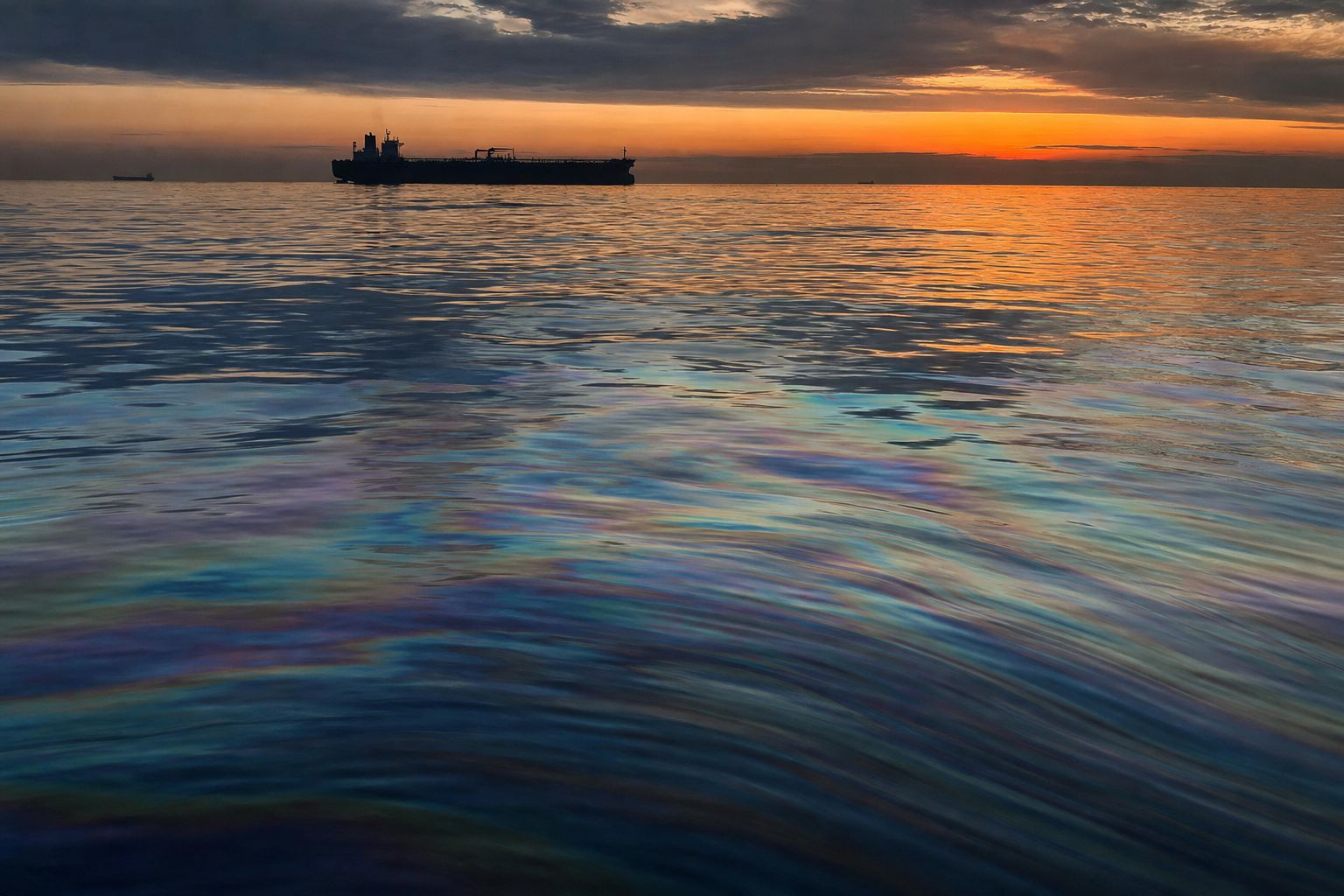
How thick is it? Observers in aircraft judge from the colour. A silvery sheen is thinner than a third of a micrometre, a thousandth of a millimetre. Rainbow colours mean up to five micrometres.
Only above about fifty micrometres does oil show its own dark colour. The rainbow is the same effect as on a soap bubble: light bouncing off the top and the bottom of a very thin film.
A thin sheen Swirls of interference colour on calm water. AI-generated still.
1 Sheen
0.04–0.3
2 Rainbow
0.3–5
3 Metallic
5–50
4 Patchy true colour
50–200
5 True colour
> 200
Bonn Agreement code (North Sea countries’ pollution pact)
Light reflects from both faces of the film
The two reflections add or cancel by colour
Codes 4–5 are the oil’s own colour
Codes 1–3 are optical effects
1 µm
= 0.001 mm
1 litre
spread 1 µm thick covers 1,000 m²
For scale
Chapter II · A slick spreads
Reading a slick by its colour
ITOPF: spreading begins as soon as oil is spilled; slicks typically start to break up after a few hours and often form bands or windrows parallel to the wind. Bonn Agreement oil appearance code: 1 sheen, 0.04–0.30 µm; 2 rainbow, 0.3–5.0 µm; 3 metallic, 5–50 µm; 4 discontinuous true oil colour, 50–200 µm; 5 continuous true oil colour, more than 200 µm. Codes 1 to 3 are optical effects and 4 and 5 are true colours; the categories have no sharp boundaries.
The Bonn Agreement is the North Sea countries’ agreement on fighting pollution; its aerial observers use this code. ITOPF is an organisation founded in 1968, after the Torrey Canyon spill, to advise on oil spills.
Try it: pick a thickness and see the colour the slick takes.
The 3D scenes are simplified teaching models, not to scale. Slick sizes, shares and timings on screen are illustrative unless a source is named.
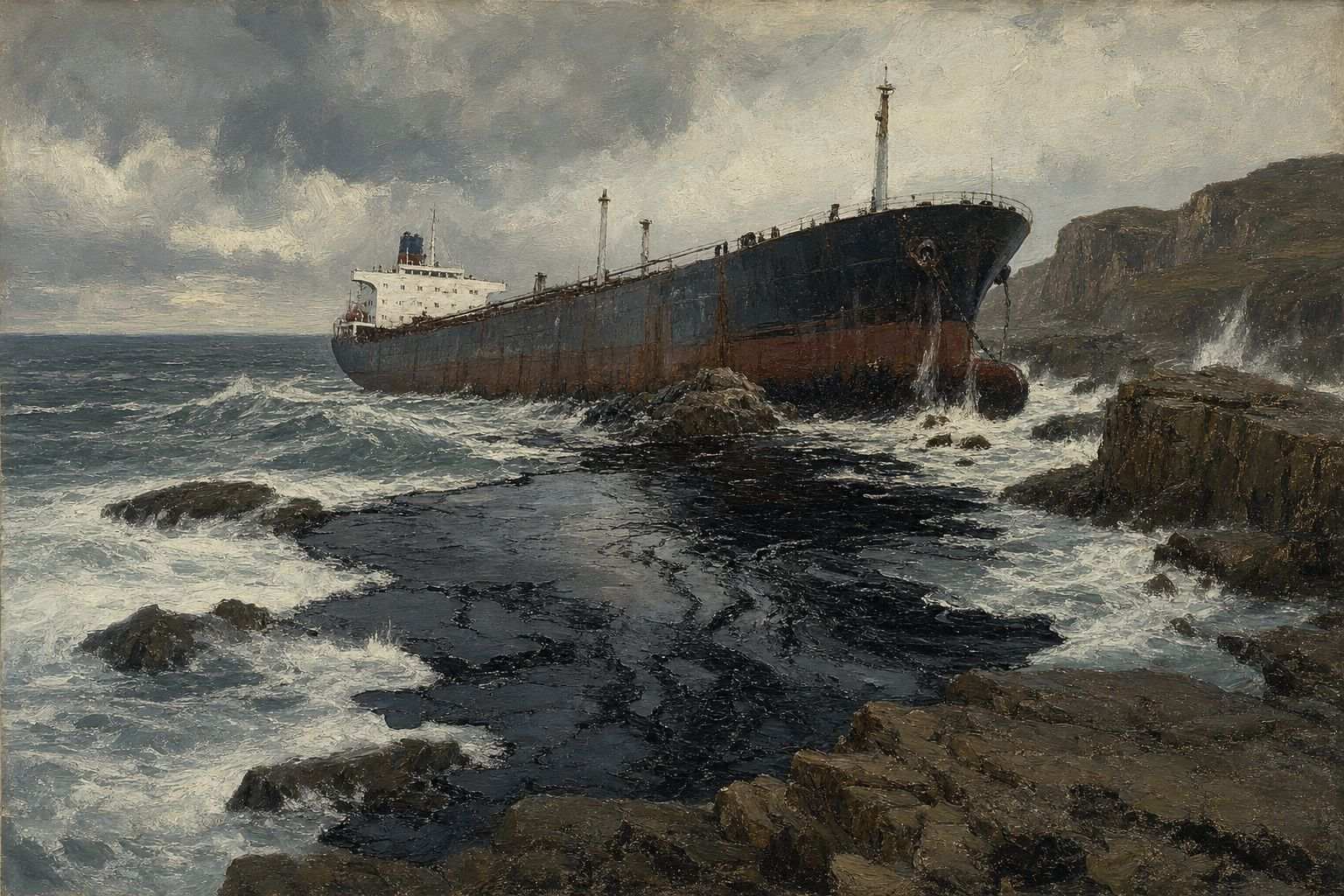
The first tanker spill to catch the world's attention came in March 1967, when the Torrey Canyon ran onto a reef off Cornwall, in England, carrying about one hundred and nineteen thousand tonnes of crude.
Over about twelve days the whole cargo was lost. Responders sprayed huge amounts of early dispersants and solvent cleaners, far more toxic than today's products, and the wreck was finally bombed to burn the oil.
Oil still reached England and France and killed thousands of seabirds. The lesson stuck: a cure can do more harm than the spill.
Aground on a reef A painting-style scene of a tanker on rocks; not the real ship. AI-generated still.
18 Mar
runs aground on Pollard Rock
~119,000 t
of Kuwait crude, all lost
~12 days
for the cargo to escape
Torrey Canyon, 1967 (ITOPF)
Early dispersants: toxic, often undiluted
Burning the slick failed
Bombing the wreck only partly worked
What went wrong (ITOPF)
1968 ITOPF founded to advise on spills
after International Oil Pollution Compensation Funds
today dispersants far less toxic, used with care
What it changed (ITOPF)
Chapter II · A slick spreads
Torrey Canyon, 1967
ITOPF: the Torrey Canyon ran aground on Pollard Rock on the Seven Stones Reef near Land’s End on 18 March 1967, carrying about 119,000 tonnes of Kuwait crude, all of which was lost over about 12 days. It was the first major tanker incident to reach public notice. Early dispersants and solvent cleaners were used heavily and often undiluted; they were far more toxic than today’s products, and many of the spill’s harmful effects were linked to them. Burning the slick failed and the government ordered the wreck bombed, which only partly worked; oil reached south-west England, the Channel Islands and Brittany, killing thousands of seabirds. ITOPF was founded in 1968, and the spill led to the International Oil Pollution Compensation Funds.
The 3D scenes are simplified teaching models, not to scale. Slick sizes, shares and timings on screen are illustrative unless a source is named.
From the first minute, the sea starts changing the oil. Scientists call this weathering, and the fastest part of it is evaporation.
In a temperate climate, the parts of oil that boil below about two hundred degrees Celsius tend to evaporate within the first day. Petrol, kerosene and diesel can almost vanish within a few days.
Heavy fuel oil hardly evaporates. Even in strong winds, usually more than seventy percent of it is still floating or on the beach a week later.
Light ends leave first Heat shimmer over a fresh film of oil. AI-generated still.
< 200 °C
boiling point of what goes in the first 24 h
> 90%
of a small diesel spill evaporates or disperses in hours to days
Evaporation (ITOPF, NOAA)
Diesel
< 10%
Heavy fuel oil
> 70%
Left on the water after a week (illustrative)
Chapter III · The sea goes to work
Evaporation
ITOPF: in temperate climates, components with a boiling point below 200 °C tend to evaporate within the first 24 hours; gasoline, kerosene and diesel can evaporate almost completely within a few days, while little evaporation occurs from heavy fuel oil. NOAA: over 90% of the diesel in a small marine spill is evaporated or naturally dispersed within hours to days; even in high winds, usually over 70% of a heavy fuel oil spill remains as floating or beached oil for a week or longer.
Try it: run the clock for an hour, a day or a week, for light or heavy oil. The shares are illustrative.
The 3D scenes are simplified teaching models, not to scale. Slick sizes, shares and timings on screen are illustrative unless a source is named.
Waves do two other things. They break part of the slick into tiny droplets that mix into the water below. This natural dispersion works best on light oil in rough seas.
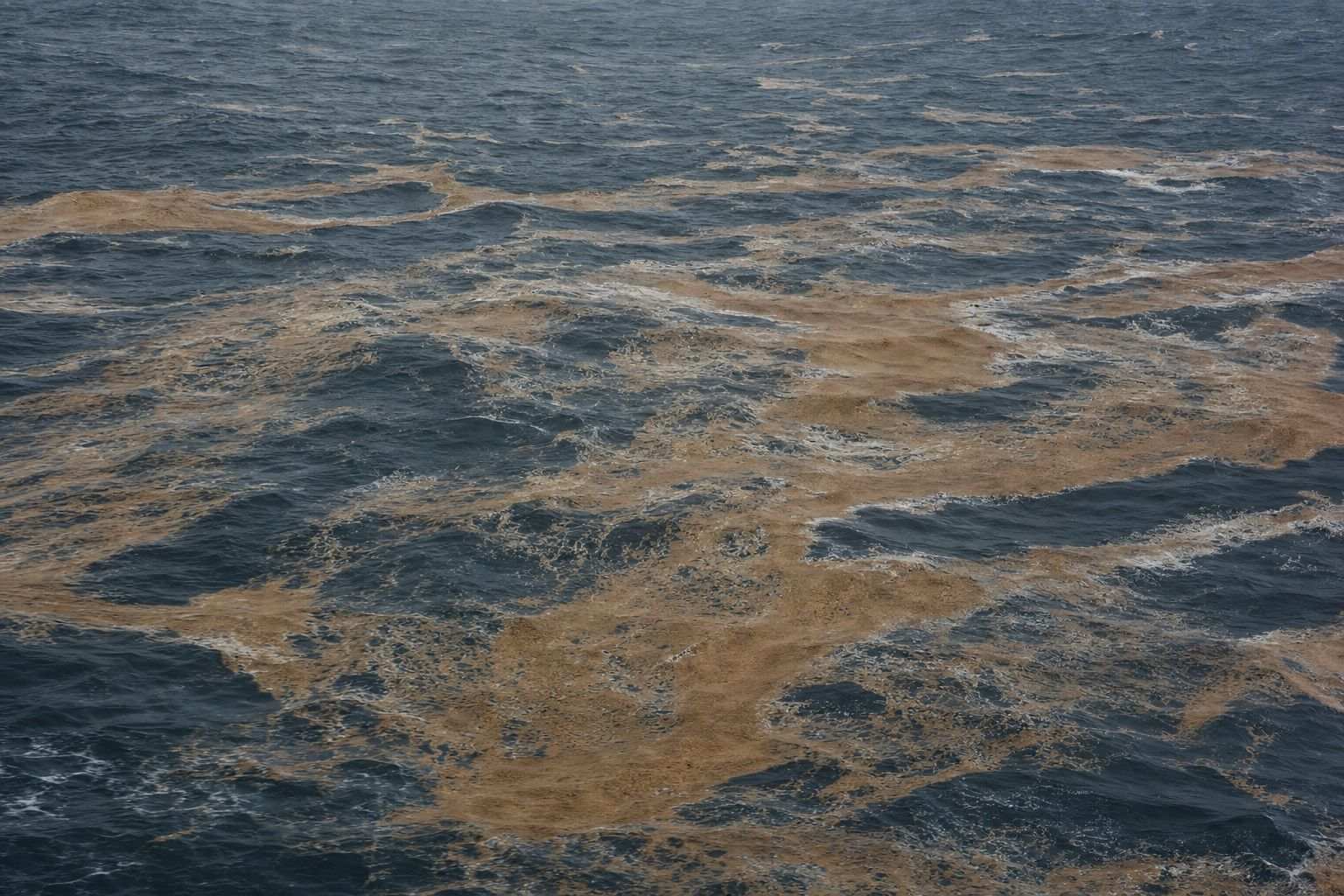
And they beat seawater into the oil, making a thick brown emulsion that responders call chocolate mousse. It can make the mess three to four times bigger, and it can last for months.
Dissolving is much slower: evaporation is ten to a thousand times faster, so only a small share of a spill dissolves in the sea.
Breaking waves tear off droplets
Small droplets stay in the water
Large droplets float back up
Natural dispersion (ITOPF)“Chocolate mousse” Streaks of brown water-in-oil emulsion on a choppy sea. AI-generated still.
3–4×
bigger than the oil alone
up to 75%
water, in an Alaska North Slope crude mousse
> 0.5%
asphaltenes (the heaviest, ring-rich part): stable for months
Mousse (ITOPF, WCMRC)
10–1,000×
evaporation is faster
benzene, toluene
the few soluble parts
Dissolving (ITOPF)
Chapter III · The sea goes to work
Dispersion, mousse and dissolving
ITOPF: waves break slicks into droplets; small droplets stay suspended while larger ones resurface, and dispersion is fastest for light, low-viscosity oil in rough seas. Water-in-oil emulsions are viscous, more persistent than the original oil, and can increase the volume of pollutant three to four times; oils with more than 0.5% asphaltenes form stable emulsions that can last many months. Evaporation is 10 to 1,000 times faster than dissolution, which is one of the less significant processes. WCMRC: an Alaska North Slope crude mousse can hold up to 75% water. US EPA: water-in-oil emulsions, called chocolate mousse, can persist for months or years.
Try it: switch between a calm and a rough sea.
The 3D scenes are simplified teaching models, not to scale. Slick sizes, shares and timings on screen are illustrative unless a source is named.
What is left breaks down slowly. Sunlight helps oxygen attack the oil, but even in strong sun a thin film loses no more than about a tenth of a percent a day.
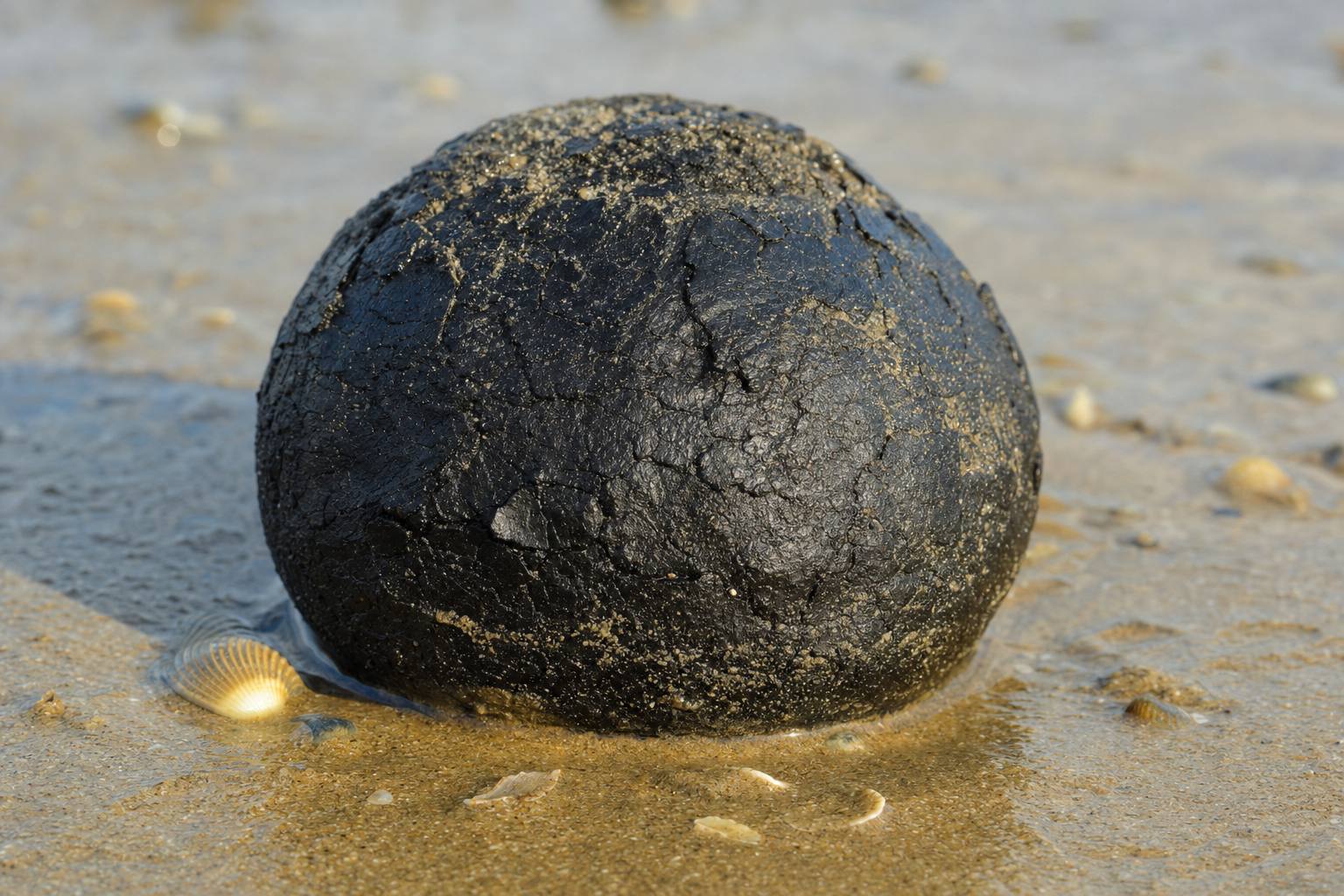
Thick, weathered oil forms tar balls, with a hard crust around a softer core, that can wash ashore long after a spill.
In the end, much of the work is done by bacteria. Microbes such as Alcanivorax, rare in clean seawater, multiply after a spill and feed on the oil, as long as the water holds enough oxygen, nitrogen and phosphorus.
They are old hands: oil has always seeped naturally from the seabed.
≤ 0.1%
of a thin film broken down per day, even in strong sun
Photo-oxidation (ITOPF)A tar ball A cracked crust over a softer, less weathered inside. AI-generated still.Oil-eating bacteria An illustration of rod-shaped cells on an oil droplet. AI-generated still.
Oxygen
Nitrogen and phosphorus
Warmth
Oil–water contact: small droplets help
What oil-eating microbes need (ITOPF)
~180 million
gallons a year seep from the seabed worldwide
~210 million
gallons a year from human activity
Natural seeps (US National Research Council, 2002)
Chapter III · The sea goes to work
The slow end
ITOPF: sunlight promotes oxidation, but even in strong sun thin films break down at no more than 0.1% per day; thick, viscous oil and emulsions oxidise into tars, and tarballs have a solid outer crust around a softer, less weathered interior. Biodegradation by marine microbes depends on nitrogen and phosphorus, temperature and oxygen, and happens only at the oil–water interface, so dispersion helps by increasing the surface area. Wang & Shao (2013): Alcanivorax is present in low numbers in unpolluted seawater, increases after an oil spill, degrades alkanes, and is believed to play an important role in the natural bioremediation of spills worldwide. US National Academies, summarising the 2002 Oil in the Sea report: about 180 million gallons a year enter the sea worldwide from natural seeps, and about 210 million from extraction, transport and consumption.
Try it: add bacteria and watch them gather on the droplets.
The 3D scenes are simplified teaching models, not to scale. Slick sizes, shares and timings on screen are illustrative unless a source is named.
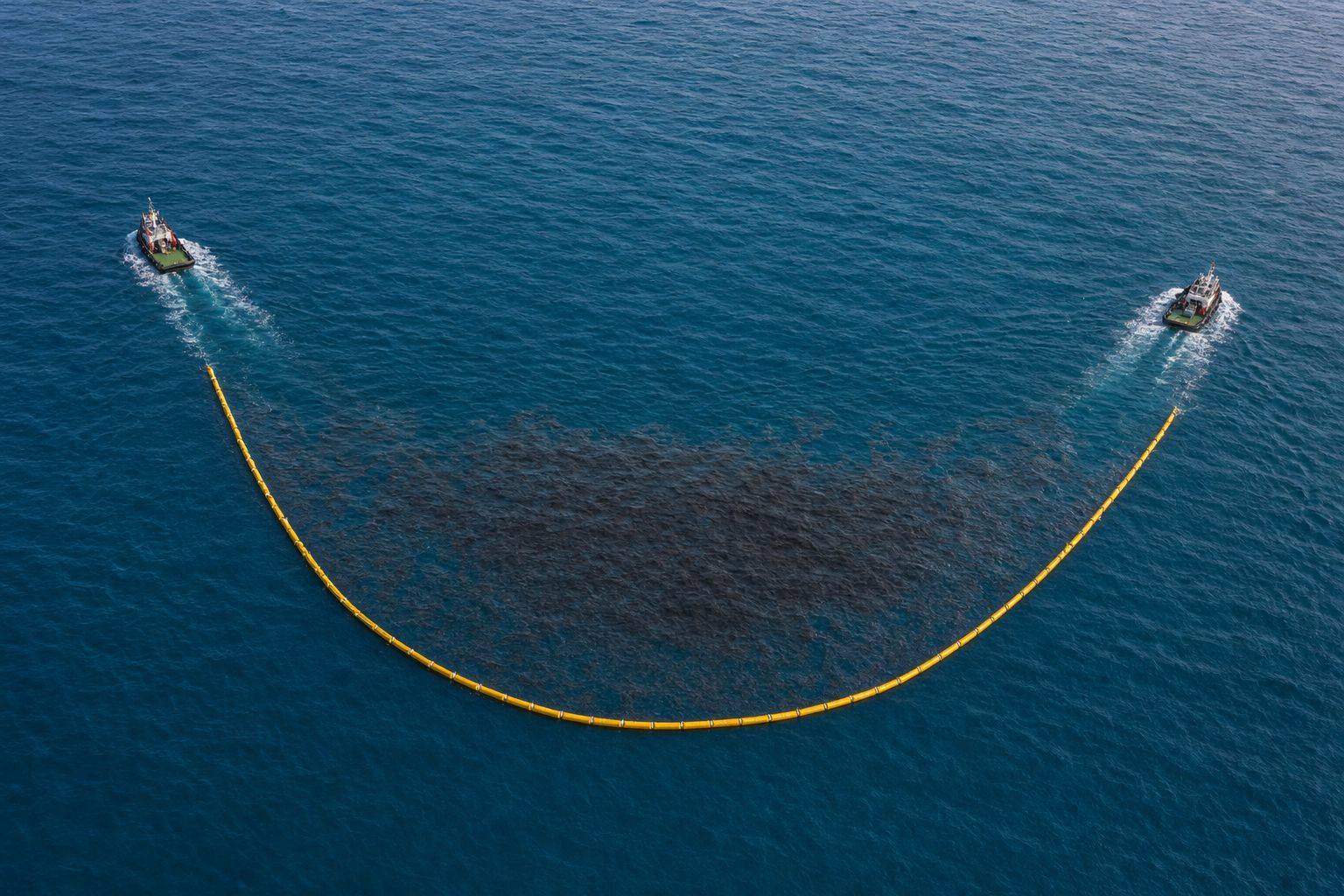
People try to help. The first tool is the boom: a floating barrier with a part above the water to stop splashing, and a skirt below to stop oil slipping underneath.
Booms have a weakness. If the water flows across them faster than about zero point seven knots, a third of a metre a second, oil is dragged under the skirt. Set at an angle, a boom can still steer oil aside.
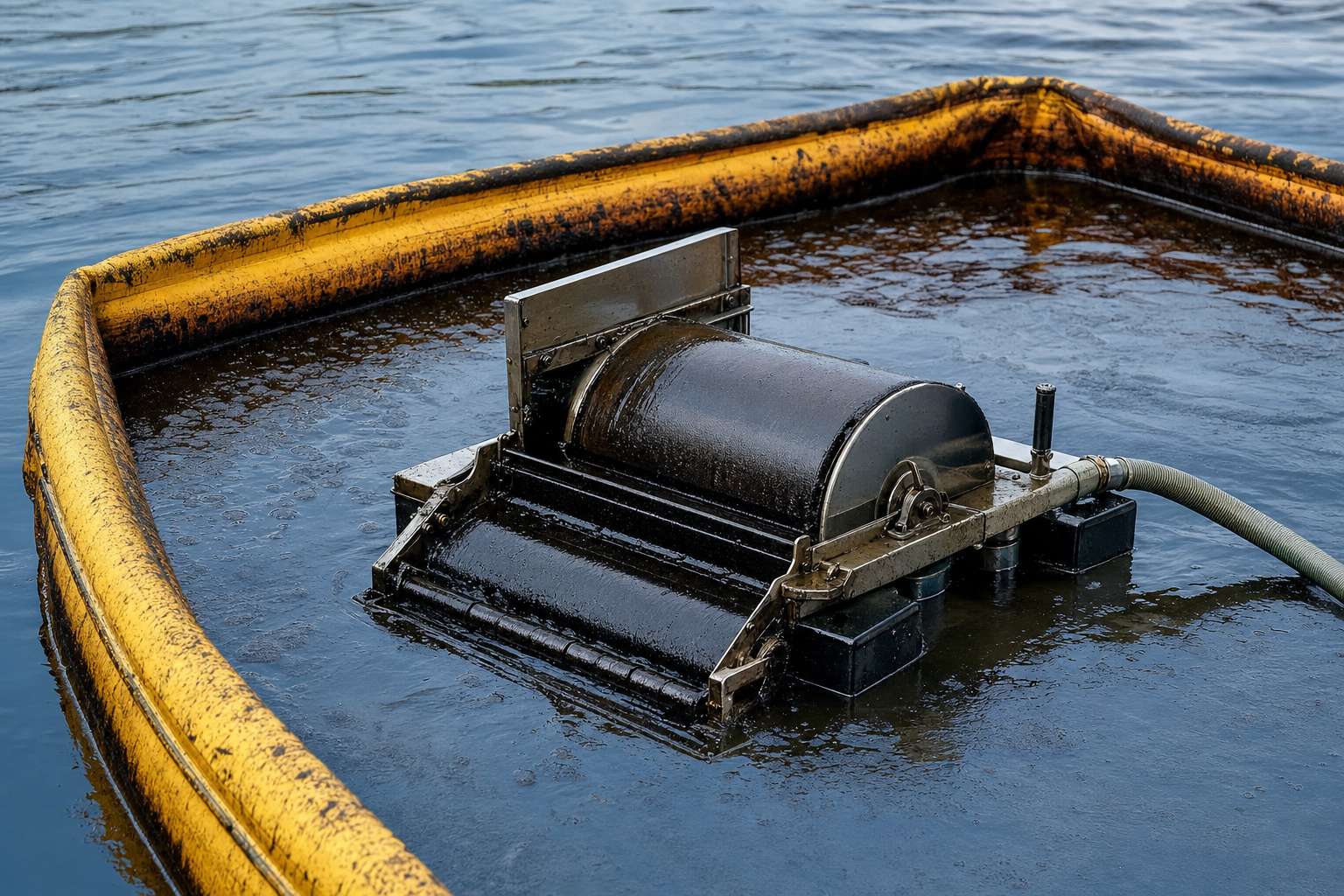
Inside the boom, skimmers lift oil off the surface into tanks. They work best on calm water and thick oil, and much less well in waves.
Towing a boom Two boats pull a boom into a U to gather oil. AI-generated still.
1 knot
45°
1.5 knots
28°
2 knots
20°
3 knots
13°
Steepest boom angle that still works (ITOPF)
Droplets torn off and carried under
Oil drains down the skirt
Waves splash oil over the top
Strong current lifts or sinks the boom
How a boom fails (ITOPF)A drum skimmer Oil sticks to a turning drum and is scraped into a hose. AI-generated still.
Chapter IV · Fighting back
Booms and skimmers
ITOPF Technical Information Paper 3: a boom has freeboard above the water to prevent splash-over and a skirt below to stop oil escaping underneath; most conventional booms let oil escape when the current at right angles to them exceeds about 0.35 m/s (0.7 knots), through entrainment, drainage or critical accumulation; deflecting oil with a boom set at an angle is more feasible than containing it, at no more than about 45° to a 1-knot current, 28° at 1.5, 20° at 2 and 13° at 3 knots. NOAA Ocean Service: skimmers mounted on boats remove oil from the sea surface and often work with booms. AMSA: mechanical recovery is constrained by sea state and slick thickness.
Try it: speed up the current, angle the boom, or start the skimmer.
The 3D scenes are simplified teaching models, not to scale. Slick sizes, shares and timings on screen are illustrative unless a source is named.
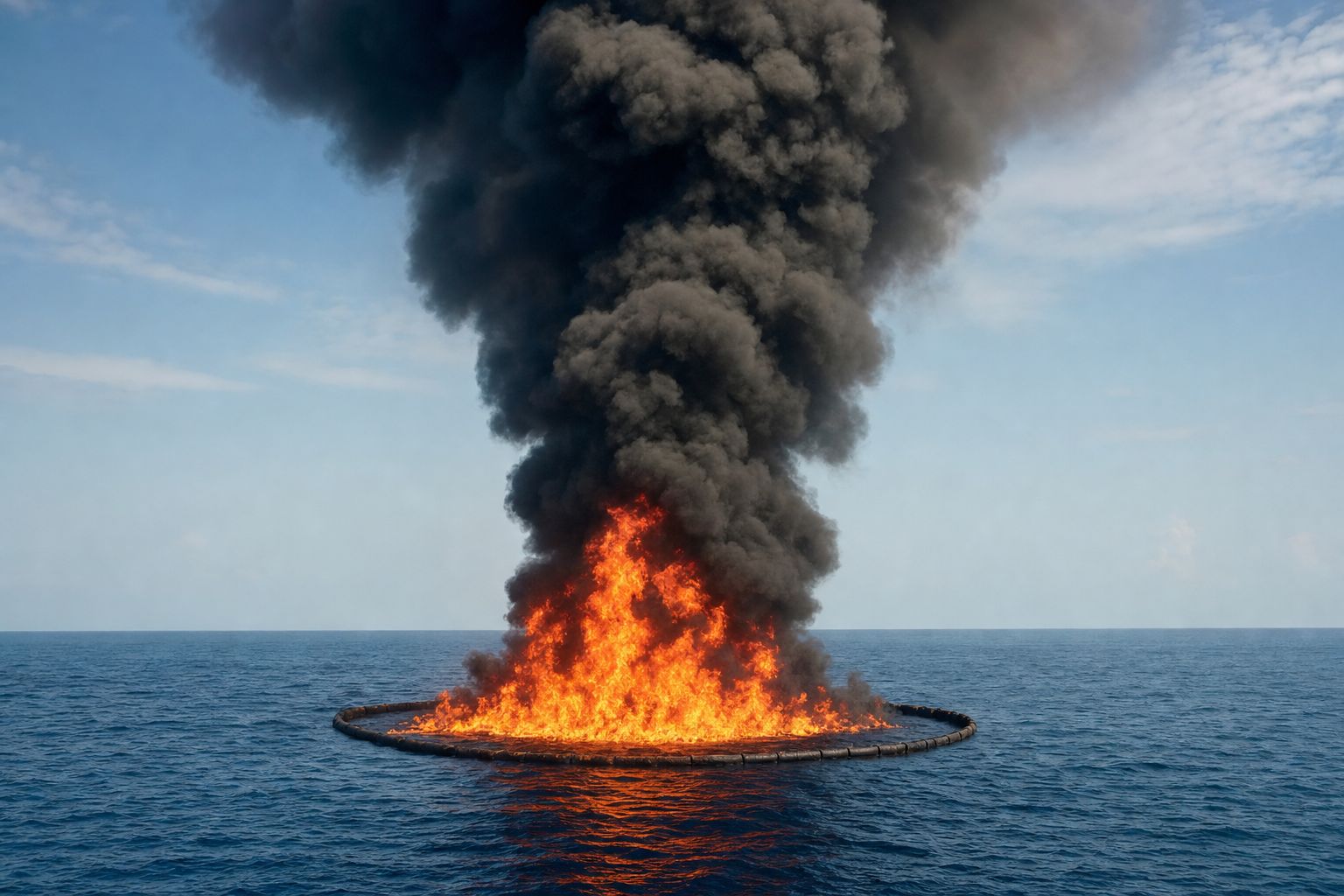
Fresh oil can also be burned where it floats, gathered inside a fire-resistant boom. In a 1993 test off Newfoundland, burning removed fifty to ninety-nine percent of the collected oil, but it sends up a plume of black smoke.
Dispersants are chemicals that work a little like washing-up liquid. They help waves break the slick into tiny droplets that stay in the water, where microbes can reach them more easily.
They work on light, fresh oil and fail on thick oil. And they move oil from the surface into the water, so every use is a trade-off that has to be judged case by case.
A controlled burn Flames inside a curved fire boom; smoke rises and drifts away. AI-generated still.
50–99%
of collected oil burned, 1993 test off Newfoundland
982 °C
measured at the top of the boom
In-situ burning (National Geographic)
Surfactants: one end likes oil, one likes water
Droplets small enough not to float back
More surface for bacteria to work on
How dispersants work (AMSA)
> 2,000 cSt
viscosity (how thick it flows, in centistokes) where dispersants can stop working
3–5×
mousse volume: often too thick to treat
When they fail (AMSA)
Chapter IV · Fighting back
Burning and dispersants
NOAA Ocean Service: in-situ burning sets fire to freshly spilled oil, usually while it floats; dispersants are chemicals that break slicks into small droplets. National Geographic (2010): oil is gathered in a U-shaped fire-resistant boom and ignited; a 1993 experiment off Newfoundland removed 50 to 99 percent of the collected oil, with temperatures of 982 °C at the top of the boom; NOAA’s Charlie Henry said the black smoke plume would be the biggest environmental impact. AMSA: dispersants contain surfactants; small droplets are effectively neutrally buoyant and can enhance biodegradation; they work best on lighter, thinner oils, early, in more energetic seas, and become ineffective above roughly 2,000 to 2,500 cSt; mousse can increase oil volume three to five times and be too thick to treat.
NOAA OR&R: dispersants reduce floating oil that threatens birds and shorelines, but shift exposure to animals living in the water column; every response technology involves trade-offs. Figures for how much mousse swells vary by source (ITOPF 3–4 times, AMSA 3–5 times).
Try it: burn the slick, or spray dispersant, and compare what is left and where it goes.
The 3D scenes are simplified teaching models, not to scale. Slick sizes, shares and timings on screen are illustrative unless a source is named.
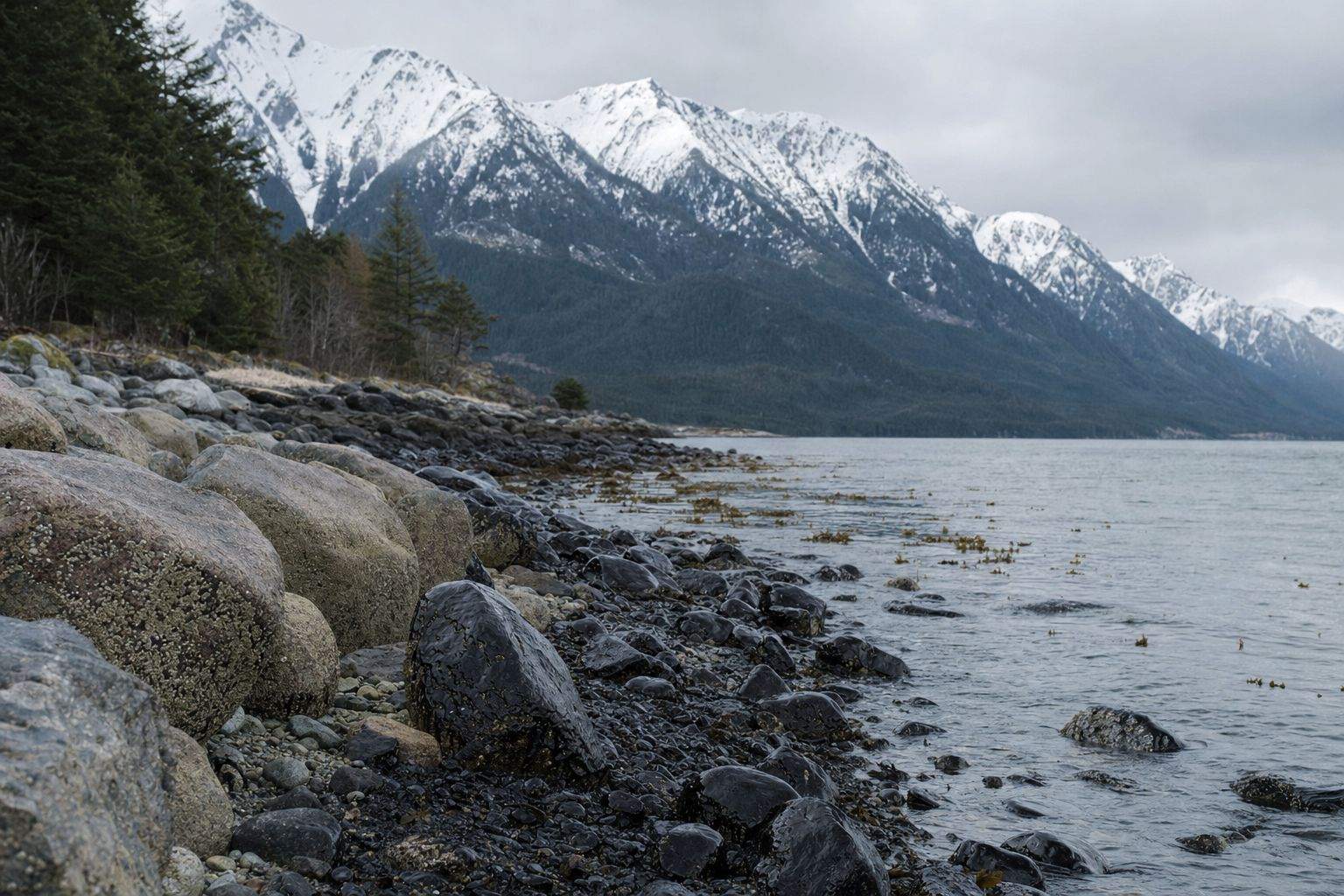
In March 1989 the tanker Exxon Valdez spilled about eleven million gallons of crude in Alaska. Oil coated rocky shores, and studies found that blasting shores with hot, high-pressure water at first hit shore life harder than leaving the oil alone.
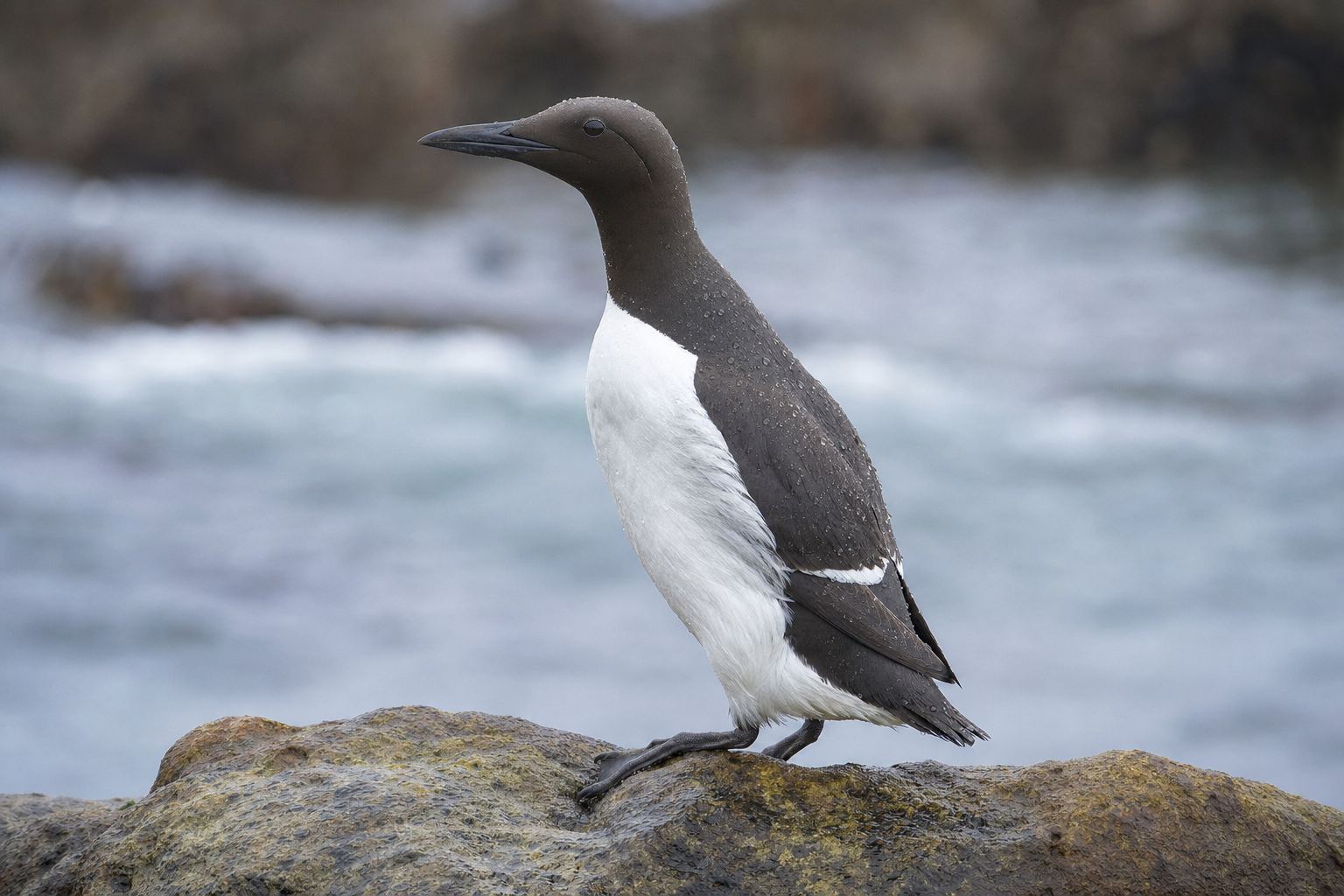
For a seabird, oil mats the feathers so they no longer keep water out, and in cold water the bird can die of the cold.
In January 1991, during the Gulf War, oil poured into the Gulf from Kuwait's coast. The US-led coalition said Iraqi forces released it on purpose; Iraq denied it and blamed American air strikes. Estimates range from two to eleven million barrels; about four million is a commonly cited figure.
An oiled rocky shore Oil at the high-tide line of a cold northern coast. AI-generated still.
24 Mar 1989
Alaska
11 million
gallons spilled
~262,000
barrels
Exxon Valdez (NOAA)What oil takes away Clean feathers shed water like this; oiled ones cannot. AI-generated still.
Private researchers
2–4
Government researchers
4–6
Early Pentagon figure
~11
Gulf War spill: estimates (Wikipedia)
US officials: a deliberate act by Iraq
Iraq, to the UN: US air strikes hit two Iraqi tankers
Oil reached the Saudi coast
Who said what (Wikipedia)
Chapter V · Lessons from big spills
Exxon Valdez and the Gulf War
NOAA Office of Response and Restoration: the Exxon Valdez spilled 11,000,000 gallons (about 262,000 barrels) in Alaska on 24 March 1989. NOAA Office of Response and Restoration: hot, high-pressure washing can injure and kill plants and animals in the treated zone; after the Exxon Valdez spill, oiled sites that were hot-water washed initially suffered more severe declines in population than oiled sites left unwashed. NOAA Ocean Service: oil coats feathers so they no longer repel water, and birds in cold water can die of hypothermia. Wikipedia, Gulf War oil spill: oil entered the Gulf in late January 1991, mainly from the Sea Island terminal off Kuwait, and reached the Saudi coast; US officials called it a deliberate act by Iraq, while Iraq denied this and told the United Nations that American air strikes had caused oil to leak from two Iraqi tankers; the Pentagon’s early estimate of about 11 million barrels was later revised down, government researchers estimated 4 to 6 million and private researchers 2 to 4 million, and about 4 million barrels is often given.
Try it: switch between the two places on the globe.
The 3D scenes are simplified teaching models, not to scale. Slick sizes, shares and timings on screen are illustrative unless a source is named.
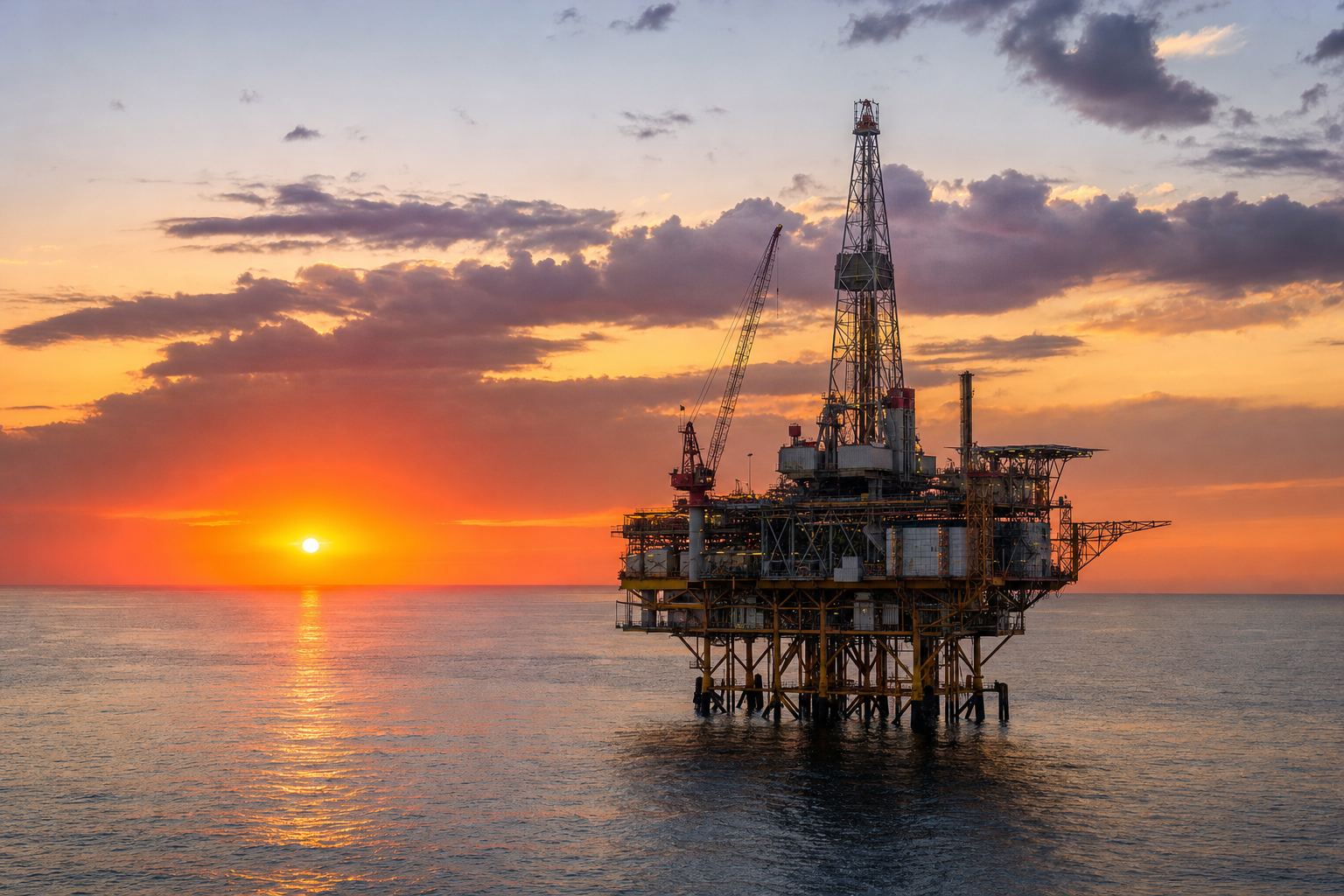
The largest spill in US waters came from below. In April 2010 the Deepwater Horizon rig exploded in the Gulf of Mexico, and oil poured from the well on the seabed: about three point one nine million barrels in all, according to NOAA.
Every tool was used at once: thousands of kilometres of boom, four hundred and eleven controlled burns, and dispersant injected deep underwater, right at the leaking well.
An offshore rig A drilling platform far out at sea; not the real rig. AI-generated still.
Deepwater Horizon 2010
134
Ixtoc 1, 1979 (in Mexican waters)
126
Hawaiian Patriot 1977
31
Exxon Valdez 1989
11
Largest spills in US waters (NOAA)
411
controlled burns
~265,000
barrels burned
770,000+
gallons of dispersant at the seabed
The response (The Maritime Executive)
Chapter V · Lessons from big spills
Deepwater Horizon, 2010
NOAA Office of Response and Restoration: Deepwater Horizon, 20 April 2010, Gulf of Mexico, 133,980,000 gallons (3,190,000 barrels), the largest by volume in its list of spills affecting US waters since 1969; Ixtoc 1 (1979, 126 million gallons) occurred in Mexican waters but reached US waters (*). The Maritime Executive: the response included 411 controlled burns removing about 265,450 barrels, at least 770,000 gallons of dispersant applied subsea, and about 3.8 million feet of hard boom and 9.7 million feet of soft boom (several thousand kilometres in all). The Maritime Executive gives about 4.9 million barrels discharged; NOAA’s list uses 3.19 million.
The 3D scenes are simplified teaching models, not to scale. Slick sizes, shares and timings on screen are illustrative unless a source is named.
Thailand knows this too. In July 2013 about fifty thousand litres of crude leaked from a pipeline some twenty kilometres off Rayong, and oil reached Ao Prao beach on Ko Samet.
In January 2022 another pipeline broke off Rayong. Oil reached Mae Ramphueng beach, the governor declared a disaster zone, and responders used booms, skimmers and dispersants.
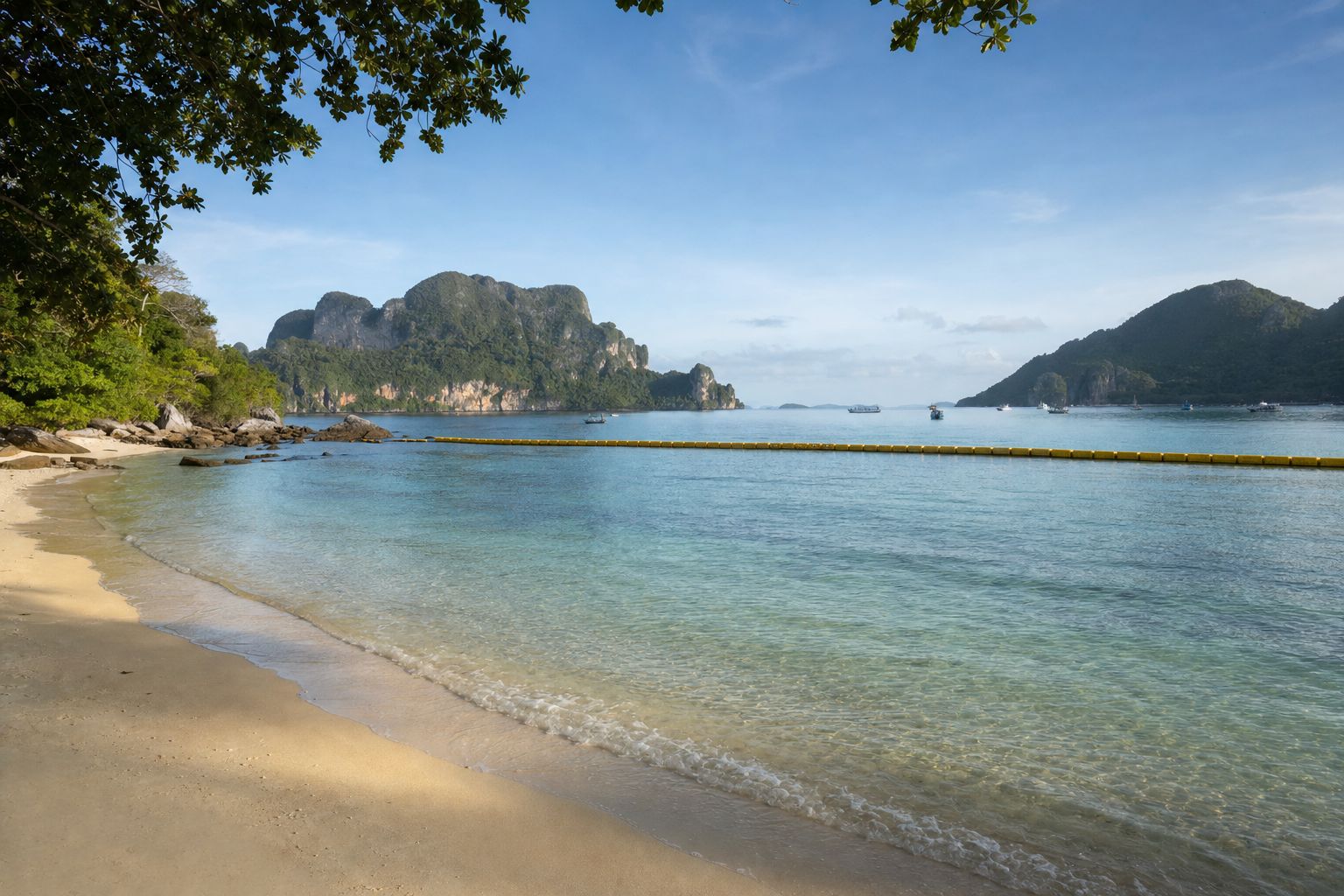
Protecting a bay A boom laid off a tropical beach. AI-generated still.
Jul 2013 ~50,000 litres (≈ 310 barrels) from a pipeline; Ao Prao, Ko Samet (Al Jazeera)
Jan 2022 a loading-buoy pipeline breaks; Mae Ramphueng (The Maritime Executive)
Two Rayong spills
~40,000
gallons (≈ 950 barrels if US gallons), per The Maritime Executive
disaster zone
declared by the Rayong governor
2022, as reported
Chapter V · Lessons from big spills
Rayong, 2013 and 2022
Al Jazeera (30 July 2013): about 50,000 litres of crude leaked from a pipeline operated by PTT Global Chemical, about 20 km off the coast of Rayong; oil reached Ao Prao beach on Ko Samet on 29 July, and soldiers and workers removed oil from sand and water. The Maritime Executive (February 2022): a pipeline on a refinery’s loading-buoy line, operated by Star Petroleum, broke off Rayong in late January 2022, spilling about 40,000 gallons; oil reached Mae Ramphueng beach, the Rayong governor declared a disaster zone, officials used booms, skimmers and dispersants, and Star Petroleum agreed to pay for the clean-up.
Try it: switch between the two spills.
The 3D scenes are simplified teaching models, not to scale. Slick sizes, shares and timings on screen are illustrative unless a source is named.
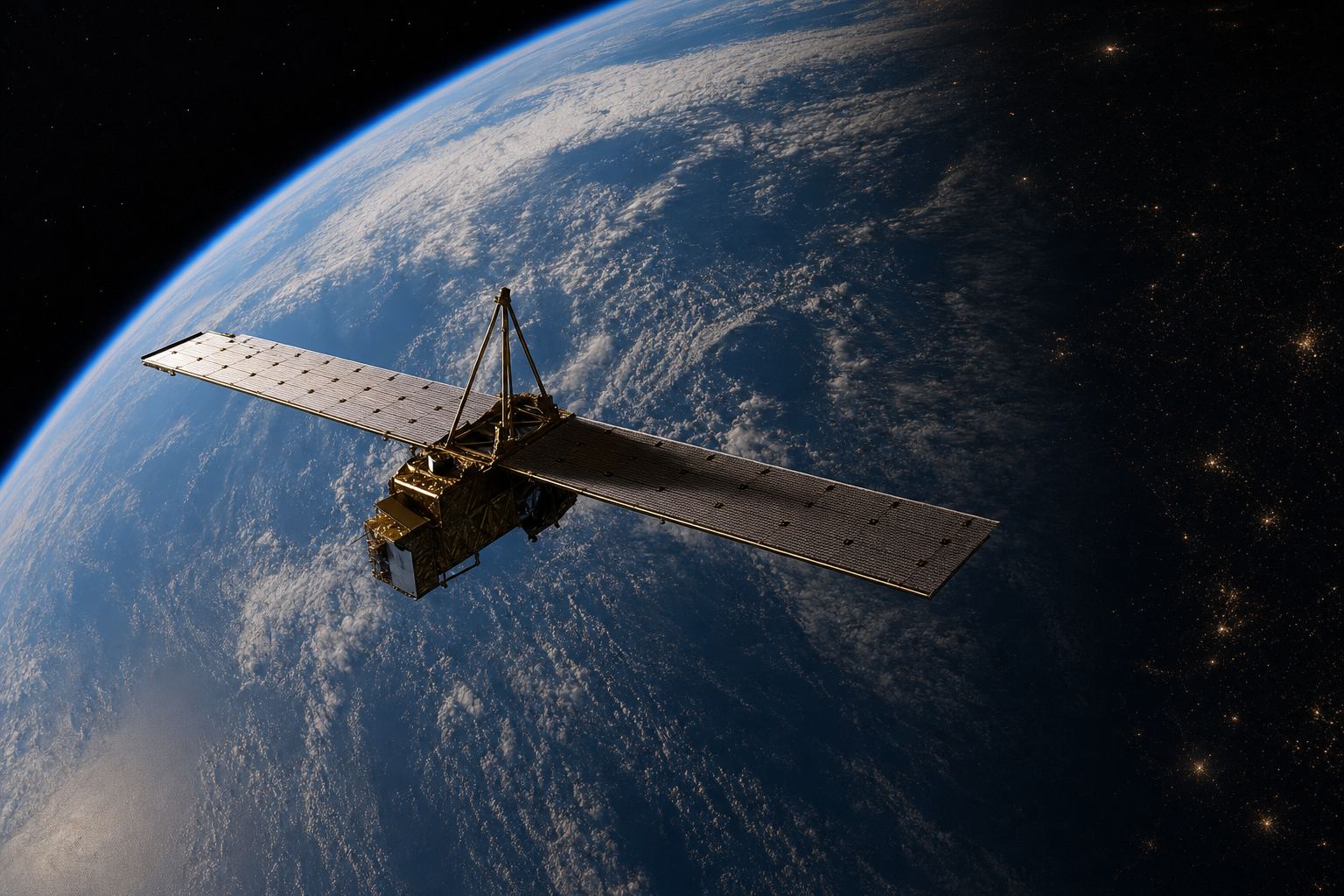
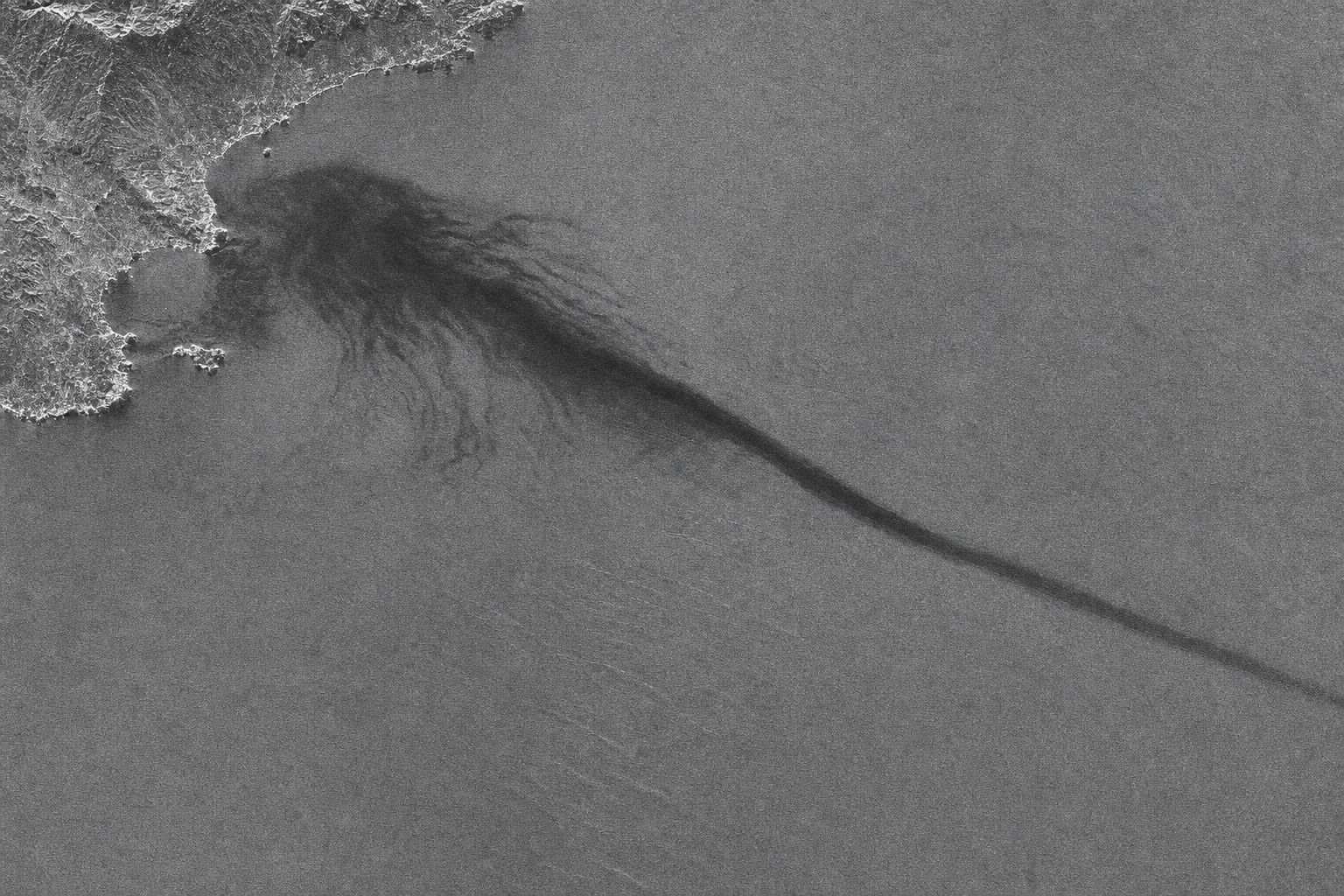
Today many spills are first spotted from space. Radar satellites send microwave pulses down to the sea and measure the echo from tiny ripples raised by the wind.
Oil smooths those ripples, so a slick shows up as a dark patch on a grey sea, by day or night and through cloud.
It needs some wind, roughly two to fifteen metres a second. And calm water, ice or natural films can look the same, so a dark patch is only a possible spill until someone checks.
A radar satellite A flat antenna panel sends pulses and listens for echoes. AI-generated still.What the radar sees A radar-style picture: grey speckle with a smooth dark streak. AI-generated still.
~2–3 m/s
below this wind, slicks are hidden
~15 m/s
above this, detection gets harder
Limits (EMSA)
Calm patches of sea
Ice
Natural biological films
Some current patterns
Look-alikes (EMSA)
Chapter VI · Seen from space
Spotting slicks by radar
European Maritime Safety Agency: synthetic aperture radar pulses are reflected by short capillary waves raised by the wind, giving a grey background for clean sea; oil smooths the surface and weakens the returned signal, so it appears dark, while ships and platforms appear bright. Detection needs enough wind: below about 2–3 m/s the effect is hidden, and above about 15 m/s detection becomes harder. Currents, ice and biological slicks can also look dark, so detections are reported as possible spills that need checking. SAR works day and night and through cloud.
Try it: switch between the eye and the radar, then add a look-alike.
The 3D scenes are simplified teaching models, not to scale. Slick sizes, shares and timings on screen are illustrative unless a source is named.
So when oil meets the sea, a race begins. The light parts evaporate within days, waves mix some into the water, and the rest thickens into mousse and tar that microbes slowly eat.
So what now for the closed beaches of the UAE? It depends on what this film has shown: how heavy the oil is, how rough the sea is, and what kind of coast it reaches. And responders have only hours to act, because oil spreads thin and starts to change on the very first day.
That is why the same amount of oil can be gone in a week from one coast, and still be found on another years later.
Spreads into a thin slick: hours
Light parts evaporate: about a day
Waves disperse and emulsify: days
Tar and microbes: weeks to years
What happens to spilled oil
1967 Torrey Canyon, Cornwall
1989 Exxon Valdez, Alaska
1991 Gulf War spill, Kuwait
2010 Deepwater Horizon, Gulf of Mexico
2013 · 2022 Rayong and Ko Samet, Thailand
2026 UAE coast, near Hormuz
Spills in this film
The oil: light or heavy (Chapter I)
The sea: calm or rough (Chapter III)
The coast: sand, rock or mangrove
The first hours of the response (Chapter IV)
What decides the outcomeA sheen at dusk The same physics, on any sea. AI-generated still.
Epilogue
Sources and notes
This film draws on ITOPF, the US National Oceanic and Atmospheric Administration (NOAA), the US EPA, the US National Academies, the Australian Maritime Safety Authority, the European Maritime Safety Agency, the Bonn Agreement, WCMRC, a review in Frontiers in Microbiology, and news reports from Euronews, Al Jazeera, National Geographic and The Maritime Executive. Figures for the Gulf War spill are contested and are given as a range. All stills and pictures are AI-generated illustrations, not photographs of the events; the 3D scenes are simplified teaching models.