In 2026 the United States proposed a civil nuclear cooperation agreement with Saudi Arabia, and the debate turned on one process: uranium enrichment. To follow it you need the physics underneath. This film explains what holds a nucleus together, how fission was discovered in 1938, where its energy comes from, how a chain reaction grows or dies, why reactors need slow neutrons and enriched fuel, how control rods keep the chain steady, and how heat becomes electricity. Fire a neutron, tune the chain yourself and move the control rods.
Interactive 3D film9 min1938 to 2026Published 17 October 2026
In 2026 the United States proposed an agreement to help Saudi Arabia build nuclear power plants, and senators prepared to vote on it.
Much of the debate turned on one industrial process: enriching uranium. To understand why that word matters so much, we have to go inside the atom, to the nucleus, and to the moment it splits.
Nuclear power makes large amounts of electricity without burning anything: its uranium fuel is split, not set alight. That is why many countries want it, and why the rest of the world watches closely who builds it.
sent to Congress in late August 2026
a 90-day review; a vote expected before mid-December
civil nuclear power cooperation
The proposed US–Saudi “123 Agreement”
critics: the deal does not bar enrichment or reprocessing of used fuel
Saudi crown prince: the kingdom does not want nuclear weapons, unless Iran gets them
administration: it contains the safeguards the law requires
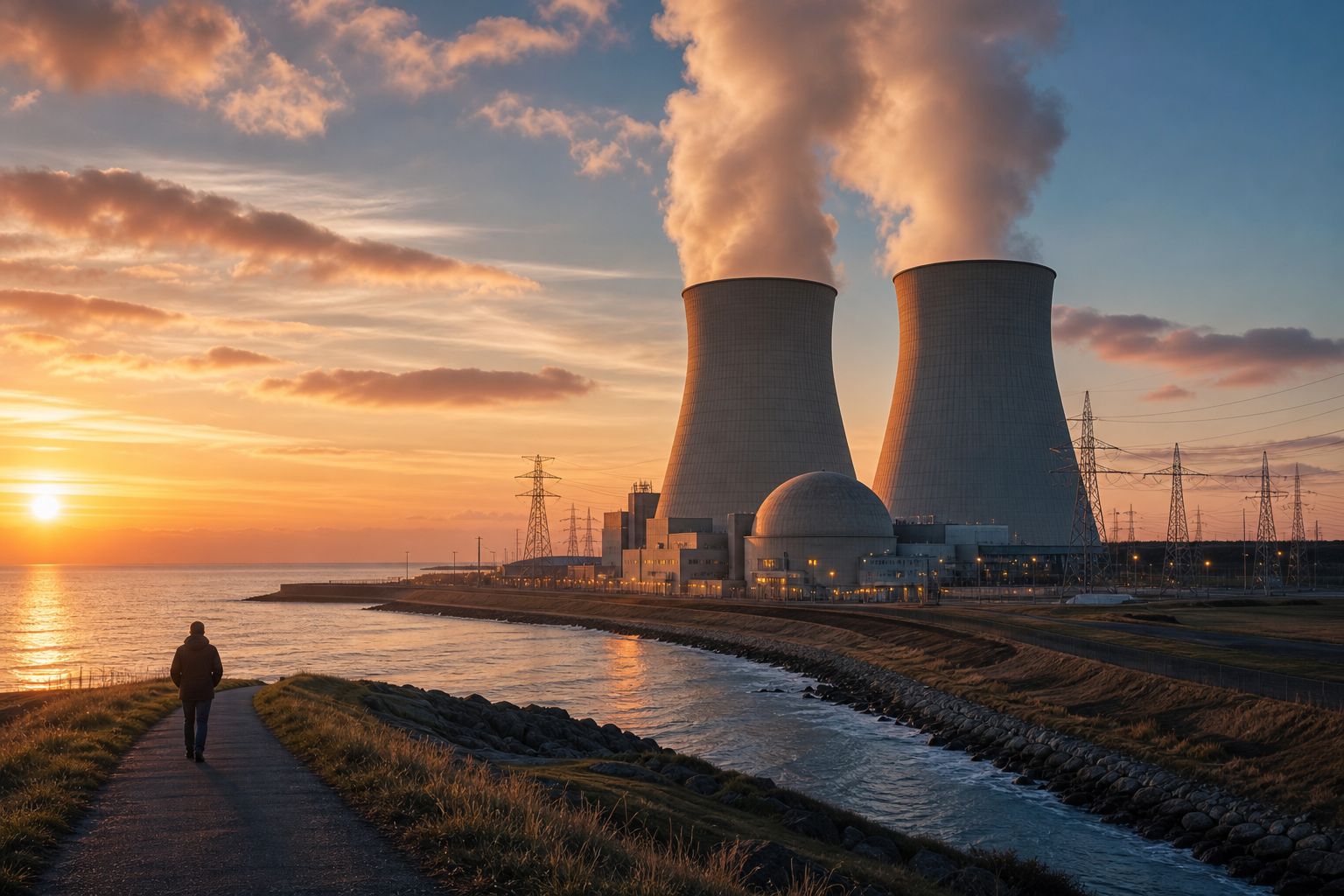
Two positions (Reuters)A nuclear power station The towers release water vapour; the reactor sits inside the domed building. AI-generated still.
Prologue · The news
A 123 Agreement
According to Reuters, President Trump sent a proposed civil nuclear cooperation agreement with Saudi Arabia (a “123 Agreement”) to Congress in late August 2026, starting a 90-day review. Lawmakers in both parties asked for more information. Some Democratic lawmakers and nonproliferation advocates argue the deal does not bar Saudi Arabia from enriching uranium or reprocessing spent fuel (chemically separating uranium and plutonium from it), unlike the UAE’s 2009 agreement. The administration says it includes the nonproliferation measures required by law. According to Reuters, Crown Prince Mohammed bin Salman has said Saudi Arabia does not want nuclear weapons, but would develop them if Iran obtained them.
This film does not take a side in that debate. It explains the physics both sides are arguing about.
How to use: pick a chapter or press ← →; drag to rotate. Many steps have buttons you can press.
At the centre of every atom is a nucleus, a tiny cluster of protons and neutrons. The protons all carry positive charge, so they push each other apart.
What holds them together is the strong nuclear force, far stronger than that electric push, but it only reaches to the nearest neighbours.
In a very large nucleus like uranium, with ninety-two protons, the repulsion builds up across the whole nucleus, and the strong force only just wins.
A heavy nucleus A nucleus is 10,000 to 100,000 times smaller across than its atom. AI-generated illustration.
electric repulsion: every proton pushes on every other
strong force: very strong, but very short range
Two forces
92
protons
143
neutrons
Uranium-235
Chapter I · The nucleus
What holds a nucleus together
A nucleus is held together by the strong nuclear force, which acts only between neighbouring nucleons, against the electrostatic repulsion of the protons, which acts across the whole nucleus. In the heaviest nuclei the balance is delicate. Uranium-235 has 92 protons and 143 neutrons (92 + 143 = 235).
The 3D nuclei, neutrons and reactor are simplified teaching models, not to scale.
A chemist’s puzzle, solved by a physicist in the snow.
In December 1938, in Berlin, the chemists Otto Hahn and Fritz Strassmann fired neutrons at uranium and found barium among the products, an element roughly half uranium's size.
Hahn wrote to his former colleague Lise Meitner, who had fled Nazi Germany. Over Christmas, with her nephew Otto Frisch, she worked out what had happened.
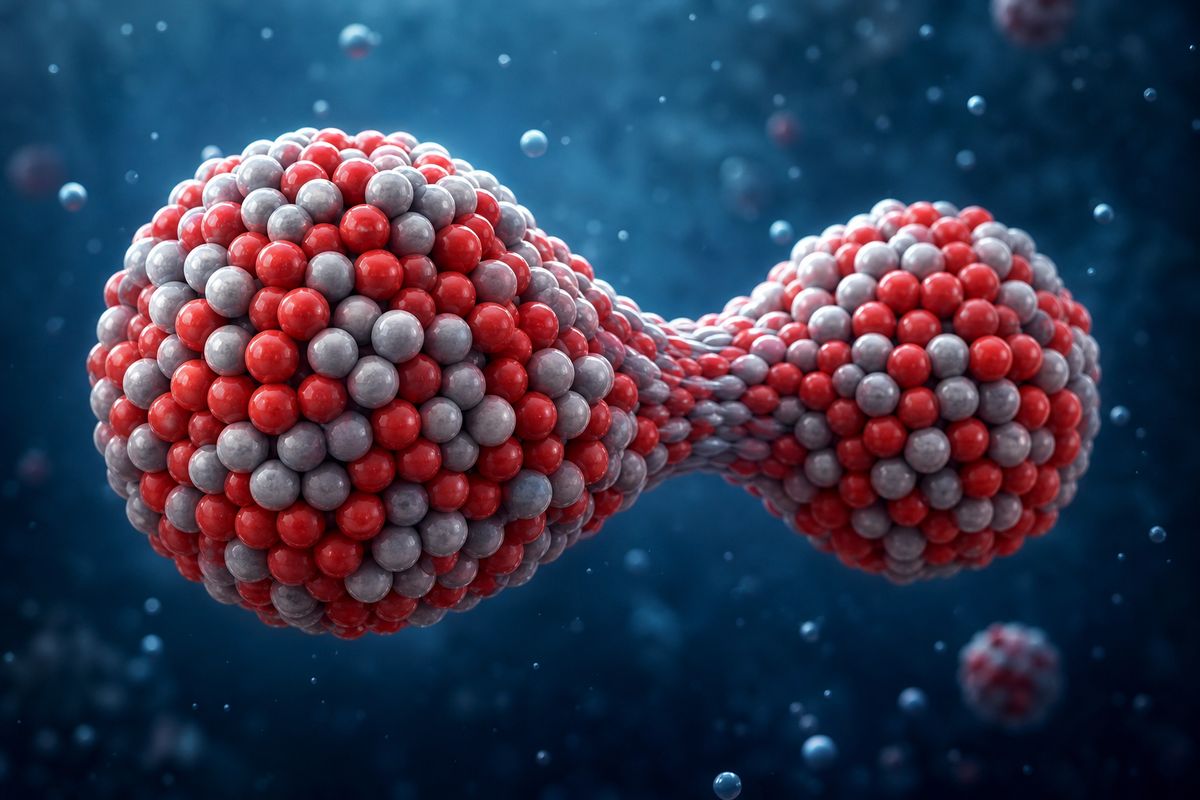
The neutron had made the uranium nucleus wobble like a drop of liquid, stretch, and split in two. Frisch borrowed a word from biology for it: fission.
Dec 1938 Hahn and Strassmann find barium
Christmas 1938 Meitner and Frisch explain it, in Sweden
Jan 1939 their paper sent to Nature
1944 Nobel Prize in Chemistry to Hahn alone
From barium to a Nobel Prize (APS)
a nucleus behaves a little like a drop of liquid
an extra neutron sets it wobbling
it stretches, pinches in the middle, and parts
The liquid-drop picture
fissionOtto Frisch, after “binary fission”, the way a cell divides
Chapter I · The nucleus
The discovery of fission
APS News: in December 1938 Otto Hahn and Fritz Strassmann found what appeared to be isotopes of barium among the products of neutron bombardment of uranium. Hahn sent the result to Lise Meitner; over Christmas, in Sweden, she and Otto Frisch used the liquid-drop model to conclude the nucleus had split. Frisch named the process fission, after binary fission in biology. Hahn received the 1944 Nobel Prize in Chemistry; Meitner was not recognised.
The 3D nuclei, neutrons and reactor are simplified teaching models, not to scale.
Meitner noticed something else. Add up the two fragments and they weigh a little less than the uranium nucleus did, about one fifth of a proton less.
By Einstein's E equals m c squared, that missing mass becomes about two hundred million electron volts of energy, carried off mostly as the speed of the flying fragments, which becomes heat.
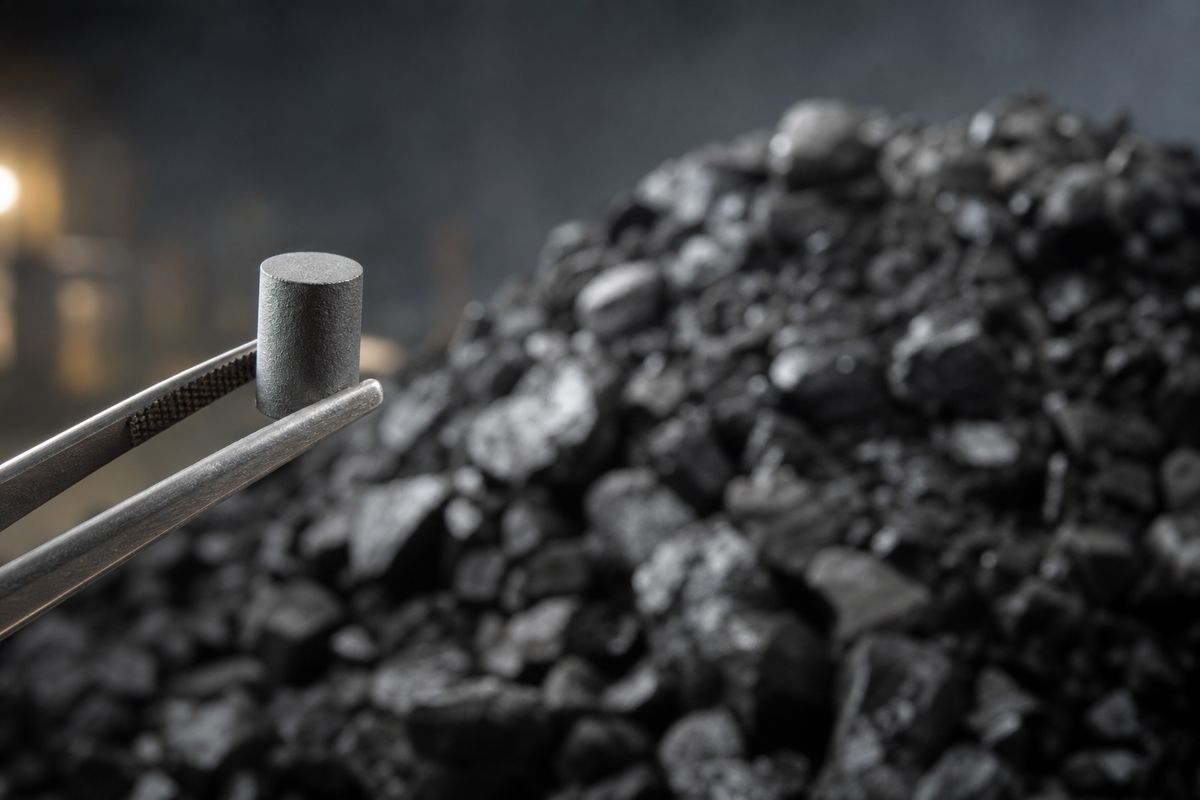
Per atom, that is millions of times more than burning one carbon atom in coal. Press split.
E=Δmc2≈200MeV
Δm
mass lost: about 1/5 of a proton
c
speed of light
One fuel pellet A pellet the size of a fingertip gives as much energy as about one ton of coal. AI-generated still.
1 ton
of coal
149 gal
of oil
One uranium fuel pellet = (Ameren)
Chapter I · The nucleus
The energy of fission
APS News: Meitner and Frisch calculated that the two fragments would be lighter than the original nucleus by about one-fifth of a proton’s mass, which by E = mc² corresponds to about 200 MeV. The UK Nuclear Technology Education Consortium explains this by the higher binding energy per nucleon of the fragments. A chemical reaction such as burning carbon releases a few electron volts per molecule. Ameren states that one uranium fuel pellet provides as much energy as one ton of coal or 149 gallons of oil.
The 3D nuclei, neutrons and reactor are simplified teaching models, not to scale.
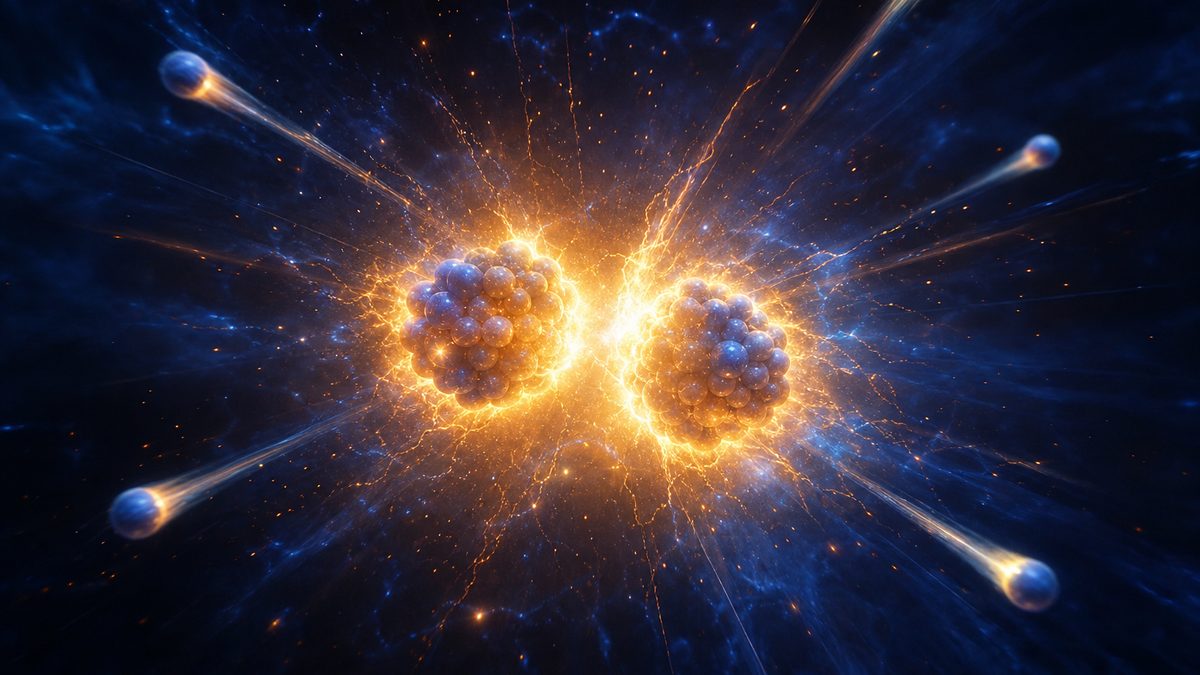
Fission has one more surprise. When the nucleus splits, it also throws out two or three free neutrons.
Each of those can strike another uranium nucleus and split it, releasing more neutrons, which split more nuclei. This is a chain reaction.
Physicists soon saw that such a chain could release energy on a scale never seen before. Everything now depends on controlling it. Fire a neutron and watch.
2–3
new neutrons
2
fragments, usually unequal
Per fission of U-235n+235U→141Ba+92Kr+3n
n
a neutron
141Ba,92Kr
a textbook example of the fragments
enough fissile nuclei close together
neutrons that hit them before escaping or being absorbed
A chain needs
2¹⁰ = 1,024
fissions after ten rounds
If every fission caused two more
Chapter II · The chain
The chain reaction
Several prompt neutrons are emitted in each fission; for uranium-235 the average is between two and three. If at least one of them goes on to cause another fission, the reaction sustains itself. The equation shown is one common outcome; fission produces many different pairs of fragments.
The 3D nuclei, neutrons and reactor are simplified teaching models, not to scale.
Only one kind of uranium splits easily, and it prefers slow neutrons.
There is a catch. Natural uranium is mostly uranium-238, which rarely splits. Only about seven atoms in every thousand are uranium-235, the kind that splits easily.
And uranium-235 is far more likely to split when the neutron arriving is slow. Neutrons from fission are fast.
So most reactors surround the fuel with a moderator, usually water or graphite. Neutrons bounce off its light nuclei, slowing down like a cue ball, until they are slow enough to be captured and cause fission. Ordinary water does have one drawback: it also swallows some neutrons.
U-238
99.3%
U-235
0.7%
Natural uranium (NRC)
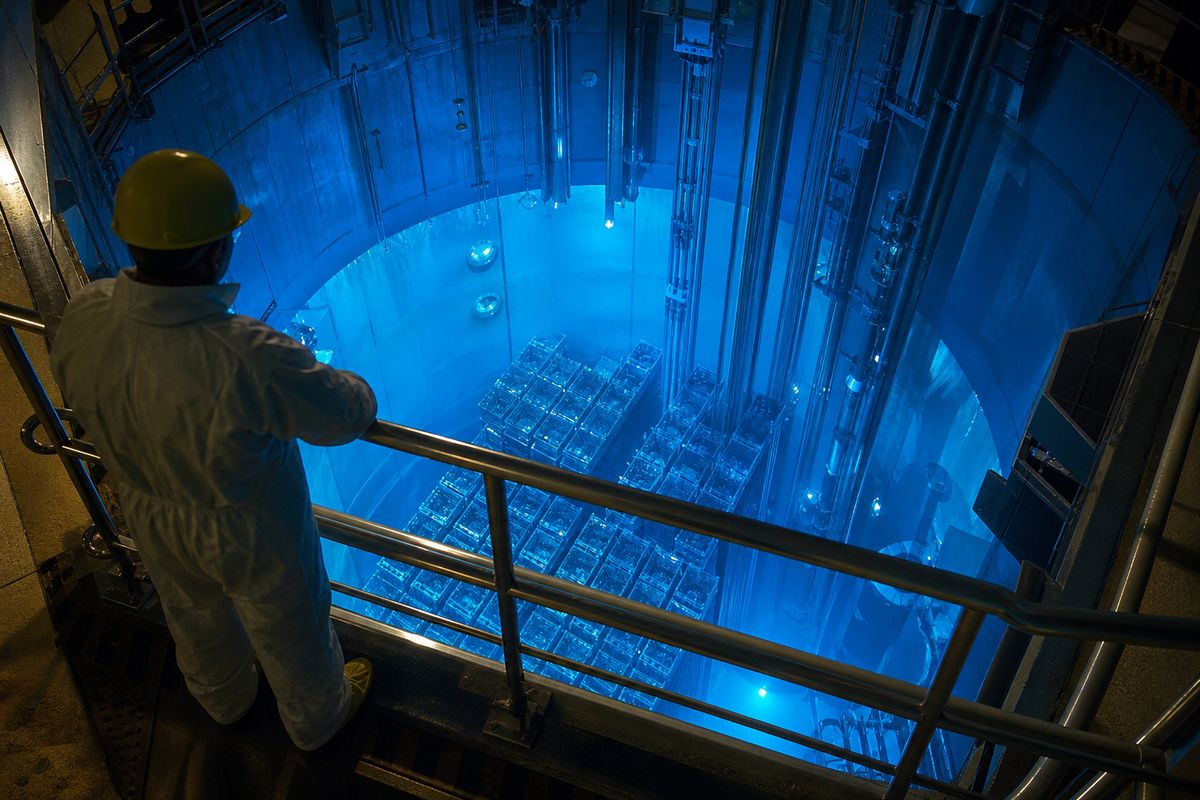
Water as moderator In a research reactor pool the same water slows neutrons, cools the core and shields people. AI-generated still.
ordinary (light) water: most power reactors
graphite: the first reactors
heavy water: absorbs very few neutrons
Moderators
fast
neutrons born in fission
thermal
slowed to the speed of the surrounding atoms: dozens of bounces (over a hundred in graphite)
Fast vs slow
Chapter II · The chain
Isotopes and moderation
Natural uranium is about 99.3% uranium-238 and 0.7% uranium-235 (NRC). The UK Nuclear Technology Education Consortium explains that light materials such as water or carbon slow fission neutrons to thermal energies, where uranium-235 is far more likely to fission; heavy water is ideal because it rarely absorbs neutrons.
The 3D nuclei, neutrons and reactor are simplified teaching models, not to scale.
Engineers describe a chain with one number, k: how many of the neutrons from one fission go on to cause another.
If k is below one, the chain dies away. If it is above one, it grows. A power reactor is run at exactly one, so every fission causes one more, and the power stays steady.
Nature helps: a small share of neutrons come out seconds late, from the fragments, which slows any change enough for operators and machines to respond. Try the three settings.
k < 1: subcritical, the chain fades
k = 1: critical, steady power
k > 1: supercritical, power rises
The multiplication factor k
k = 1
the normal working state of every reactor; not an emergency
“Critical”
emitted by some fission fragments as they decay
a small fraction of all neutrons
they give time to control the power
Delayed neutrons
Chapter II · The chain
Criticality
The effective multiplication factor k is the ratio of neutrons in one generation to the previous one. Control rods keep k close to unity, and because a fraction of neutrons are delayed, there is enough time to control the neutron flux when k is close to one (UK Nuclear Technology Education Consortium).
The 3D nuclei, neutrons and reactor are simplified teaching models, not to scale.
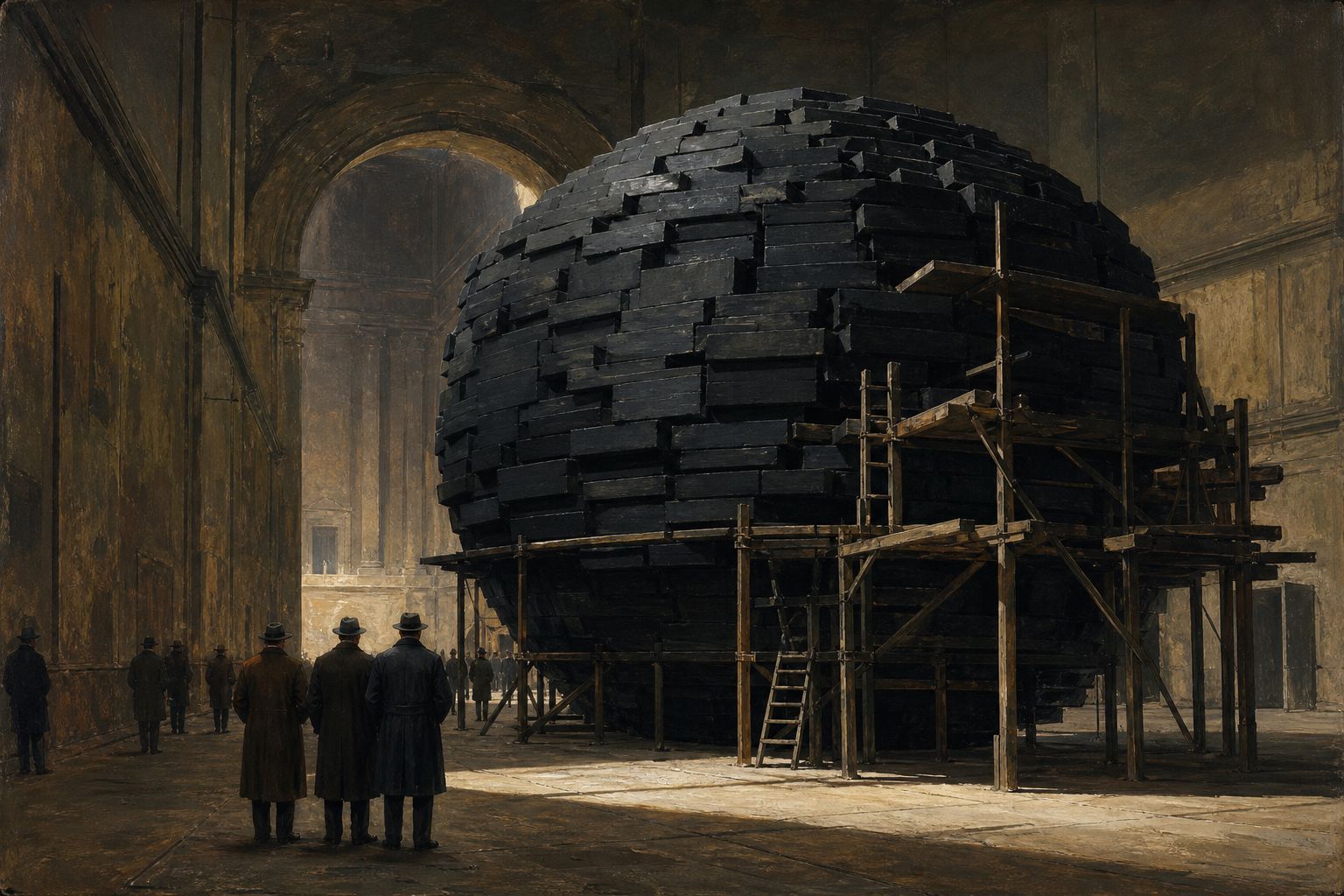
The first man-made chain reaction ran on the second of December 1942, on a squash court under the stands of a sports field at the University of Chicago.
Enrico Fermi's team stacked blocks of graphite, the moderator, with lumps of uranium set inside. As control rods, strips that soak up neutrons, were slowly pulled out, the neutron count climbed, and held: the chain was sustaining itself. Then the rods went back in, and the chain stopped, as planned.
2 Dec 1942
first self-sustaining chain reaction
Chicago Pile-1 (Atomic Heritage Foundation)
graphite blocks: the moderator
uranium inside some blocks: the fuel
rods that soak up neutrons: the brake
a cadmium solution on standby, just in case
What it was made ofThe pile An illustration, not a photograph of the real pile. AI-generated.
Chapter II · The chain
Chicago Pile-1
Atomic Heritage Foundation: Chicago Pile-1 achieved the first self-sustaining nuclear chain reaction on 2 December 1942, in a squash court beneath the West Stands of Stagg Field at the University of Chicago. Designed and run by Enrico Fermi, it was a pile of graphite blocks, some holding uranium; a crew stood ready with a cadmium solution in case the reaction ran out of control.
It was part of the wartime Manhattan Project; this film covers the physics of controlled reactors.
The 3D nuclei, neutrons and reactor are simplified teaching models, not to scale.
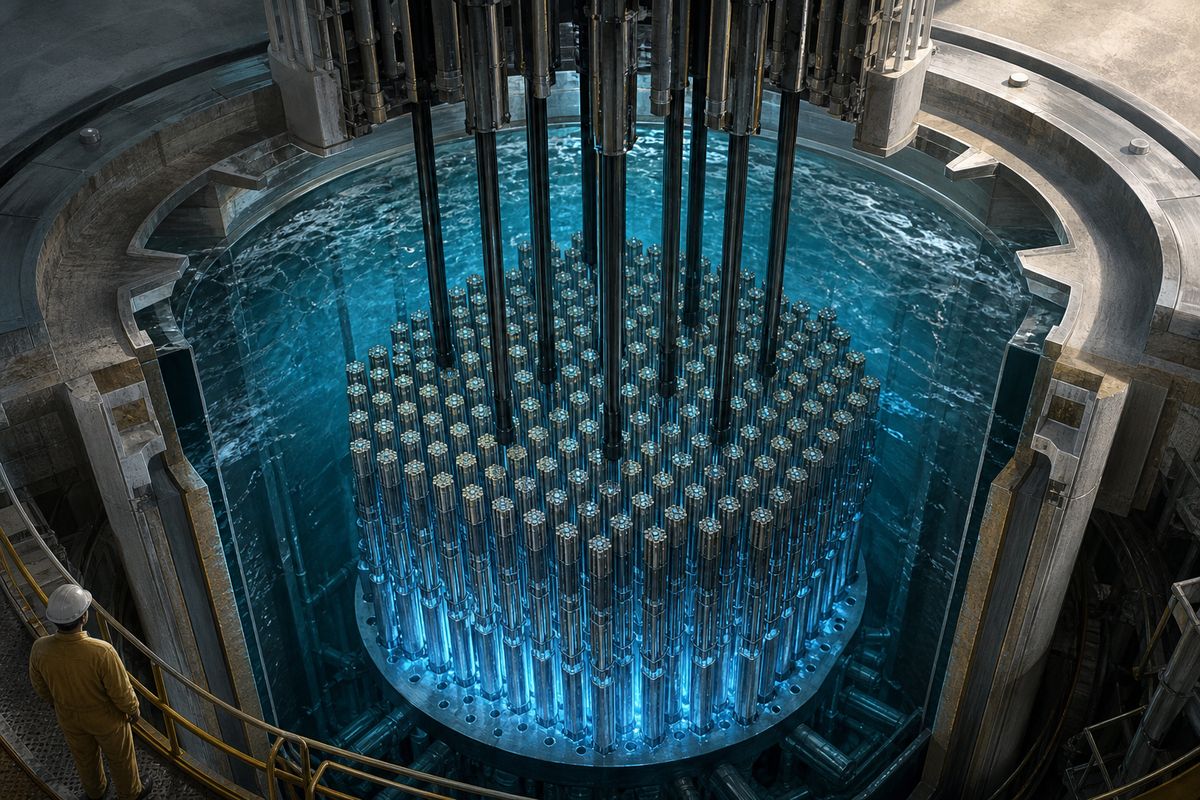
A modern power reactor core holds thousands of thin metal tubes filled with ceramic uranium pellets, grouped into fuel assemblies and standing in water.
Between them slide control rods, made of materials such as boron or cadmium that swallow neutrons. Push them in and k falls; pull them out and k rises.
Drop them all the way in, and the chain reaction dies away within seconds, though the fuel keeps giving off heat. Move the rods yourself.
150–200
fuel assemblies in the core
A pressurized water reactor (NRC)Control rods Rods enter the core between the fuel rods. Schematic, AI-generated illustration.
insert control rods
boron dissolved in the water (pressurized water reactors)
built in: if the water boils away, fewer neutrons are slowed (light-water reactors)
Three ways to slow the chain
Chapter III · The reactor
Fuel and control rods
NRC: a pressurized water reactor core contains between 150 and 200 fuel assemblies. Control rods are made of neutron-absorbing materials such as boron or cadmium and are used to keep k close to unity (UK Nuclear Technology Education Consortium).
The 3D nuclei, neutrons and reactor are simplified teaching models, not to scale.
After all that physics, a nuclear plant makes electricity the way a coal plant does: by boiling water.
In the most common design, water under high pressure carries heat from the core to a steam generator; the high pressure keeps it from boiling, just as a pressure cooker does. There it boils water in a second, separate loop.
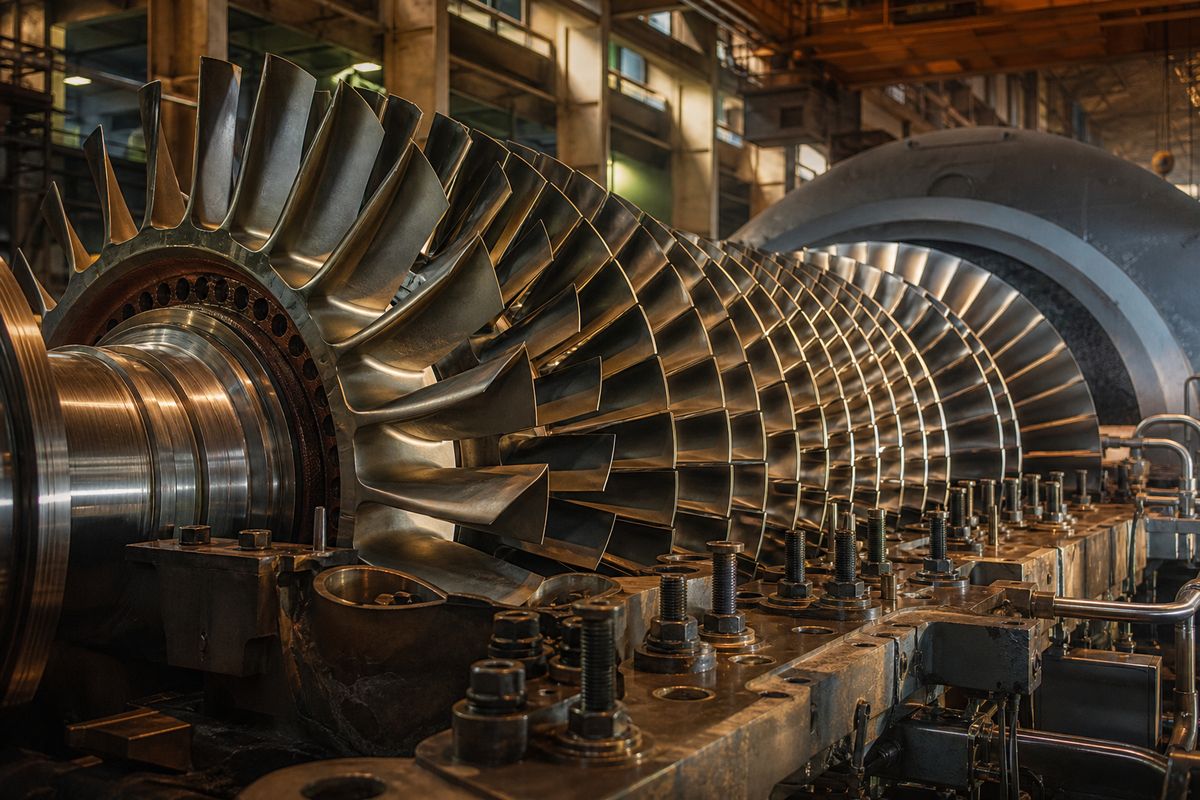
The steam spins a turbine and generator, then is cooled back to water and pumped round again. The cooling towers release mostly water vapour.
primary loop: pressurized water through the core
steam generator: heat passes to a second loop
turbine and generator: electricity
condenser: steam back to water
Pressurized water reactor (NRC)The turbine The same kind of machine turns in coal, gas and nuclear plants. AI-generated still.
Chapter III · The reactor
How a PWR makes electricity
NRC: in a pressurized water reactor, the core heats pressurized water in the primary loop, which carries the heat to a steam generator; there it boils water in a secondary loop. The steam drives the turbine and generator, is condensed back to water, and is pumped back. Emergency pumps can be powered by onsite diesel generators if offsite power is lost.
The 3D nuclei, neutrons and reactor are simplified teaching models, not to scale.
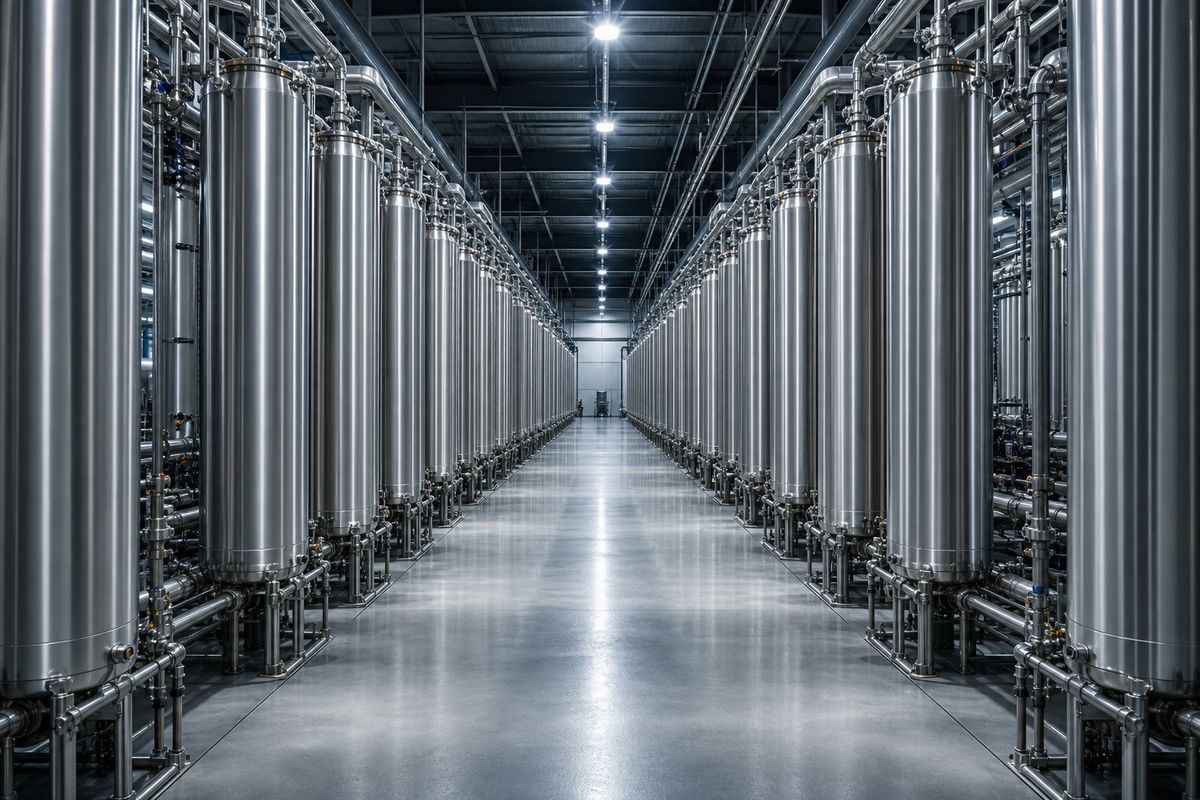
With ordinary water as the moderator, natural uranium cannot keep a chain going, because the water swallows too many of the few neutrons. The fuel must first be enriched, raising the share of uranium-235 from under one percent to about three to five percent.
The usual method spins uranium gas in long lines of fast centrifuges, which separate the two isotopes by their tiny difference in mass. Try both fuels.
The same machines, run further, could make material for weapons. That is why who may enrich uranium, and under what inspections, is at the centre of agreements like the one in the news.
natural uranium
0.7%
power reactor fuel
3–5%
Share of uranium-235 (NRC)
A centrifuge hall Thousands of centrifuges work in series, each nudging the mix a little. AI-generated still.
UAE, 2009: agreed not to enrich or reprocess
Saudi proposal: no such commitment, critics say
the administration: required safeguards are included
In the 123 Agreement debate (Reuters)
Chapter IV · Fuel and debate
Enrichment
NRC: natural uranium is about 0.7% uranium-235; for practical use as fuel in commercial reactors its concentration must be raised to 3 to 5 percent, typically in gas centrifuge enrichment plants, which spin the gas uranium hexafluoride (UF6). Reuters reported that critics of the proposed US–Saudi agreement object that it does not bar enrichment or reprocessing (separating plutonium from spent fuel), both possible paths to a weapon, unlike the UAE’s 2009 agreement; the administration says the deal includes the nonproliferation measures required by law.
Reactors using heavy water or graphite as moderator, such as CANDU designs, can run on natural uranium.
The 3D nuclei, neutrons and reactor are simplified teaching models, not to scale.
The first nuclear power plant to feed an electricity grid opened at Obninsk, near Moscow, in June 1954. It sent out just five megawatts.
Today there are about four hundred and forty reactors in the world, together around four hundred thousand megawatts. In 2025 they produced about nine percent of the world's electricity. Every one of them runs on the same physics as the Chicago pile: neutrons, a moderator and control rods.
27 Jun 1954
first connected to the grid
5 MW
of electricity
Obninsk (ANS)
443
operable reactors
~400,000 MW
capacity (400 GW)
~9%
of world electricity in 2025
World today (World Nuclear Association)
fissile fuel
a moderator (in most designs)
neutron absorbers for control
Same three ingredients
Chapter IV · Fuel and debate
Nuclear power today
The American Nuclear Society: Obninsk reached criticality on 9 May 1954 and was connected to the grid on 27 June 1954; its graphite-moderated, water-cooled reactor was rated at 30 MW thermal and 5 MW electric. The World Nuclear Association counts 443 operable reactors with about 400 GWe of capacity, generating about 9% of the world’s electricity in 2025.
The 3D nuclei, neutrons and reactor are simplified teaching models, not to scale.
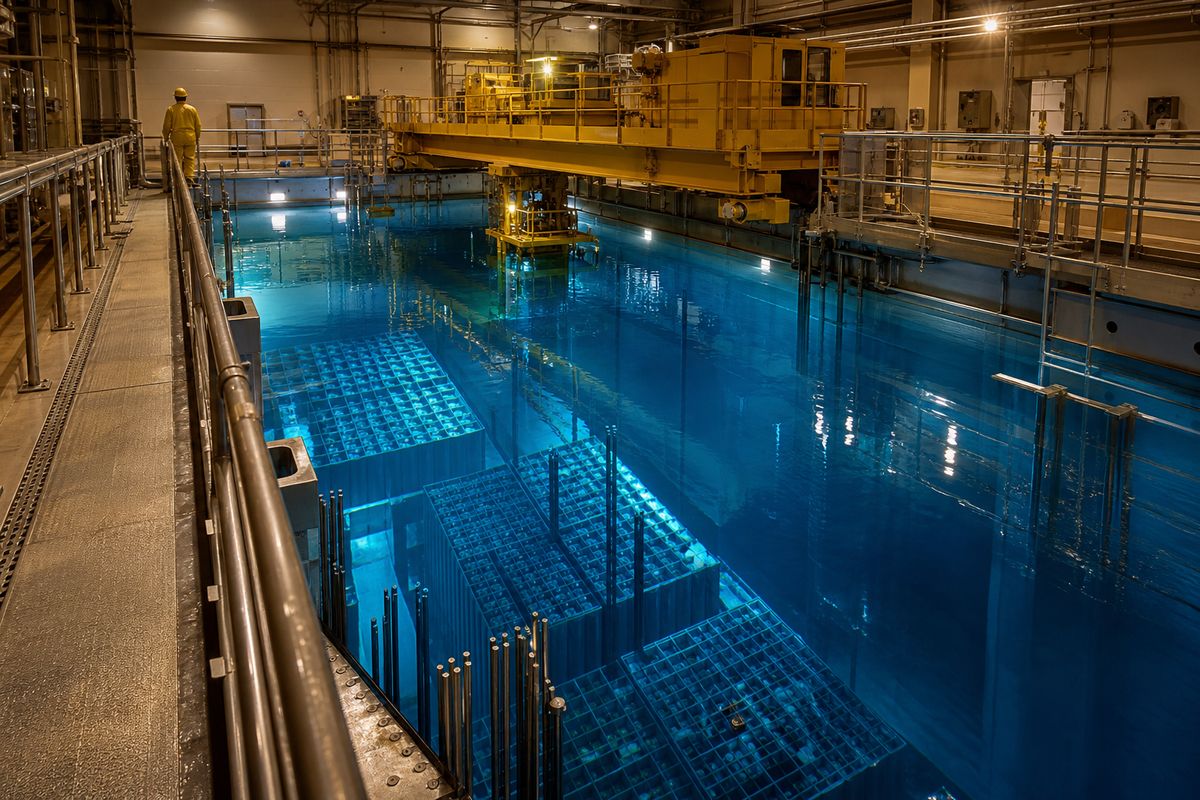
The fragments left by fission are unstable. They keep decaying for decades and longer, giving off radiation and heat even after the chain reaction has stopped.
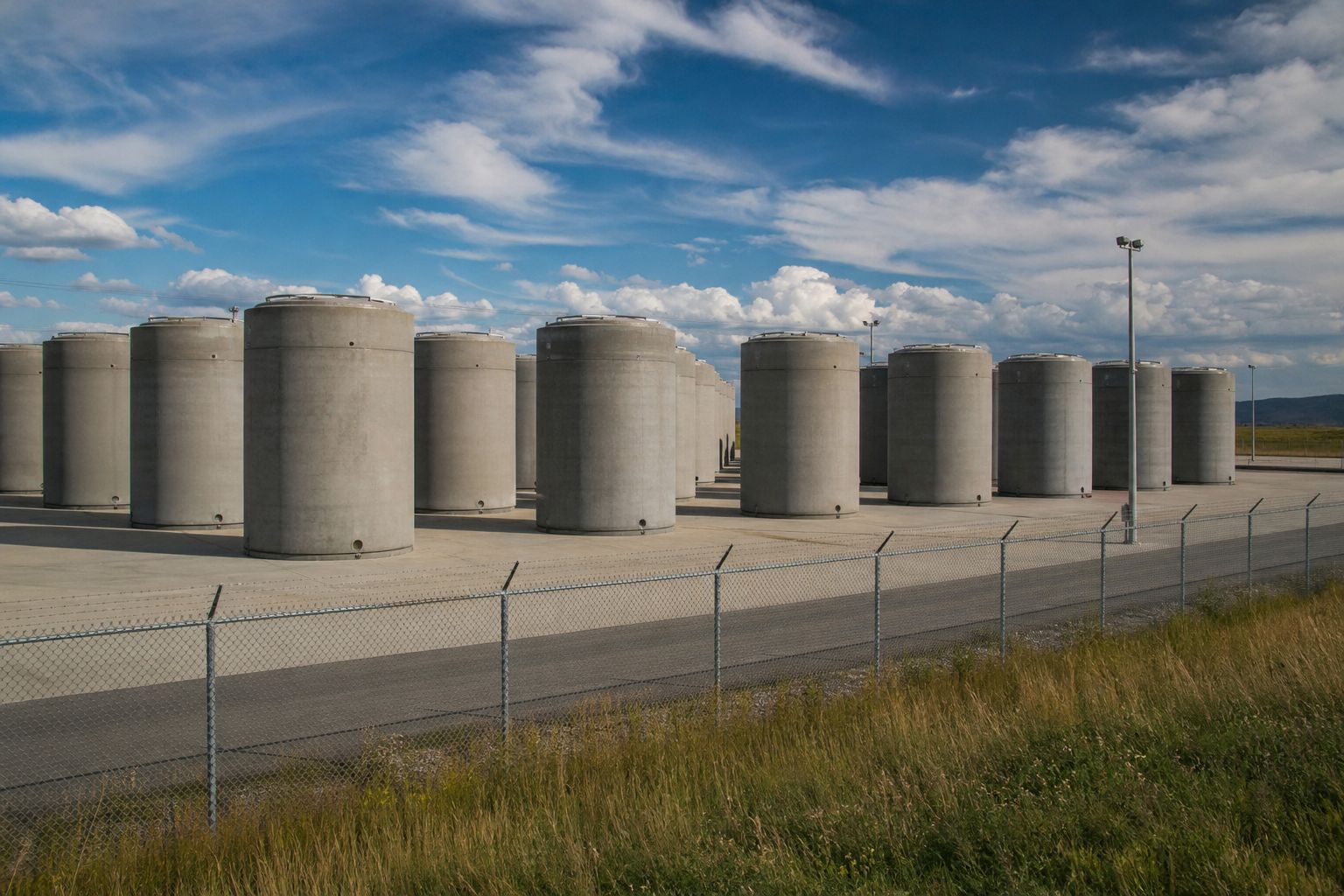
So used fuel is first stored under several metres of water, which cools it and blocks the radiation. Later it can be moved into thick steel and concrete casks, cooled by air alone. Where to keep it for the long term is still being debated in many countries. For now, most of it stays where it was made, at the power plants.
A spent fuel pool NRC pools keep about 20 feet (6 m) of water above the fuel. AI-generated still.
pools: water cools and shields
dry casks: sealed metal inside concrete or steel
casks need no fans or pumps; air flows through vents
Two stages of storage (NRC)Dry casks Casks stand on concrete pads inside the plant’s protected area. AI-generated still.
Chapter IV · Fuel and debate
Spent fuel
NRC: spent fuel still produces a lot of radiation and heat that must be managed. It is stored in pools with about 20 feet of water above the fuel, which cools it and shields radiation, and later in dry casks with a sealed inner metal cylinder inside a thick metal or concrete shell, cooled by natural air circulation; a typical cask gives off about as much heat as a home heating system.
Long-term disposal policy differs from country to country; this film does not assess it.
The 3D nuclei, neutrons and reactor are simplified teaching models, not to scale.
A neutron arrives, a nucleus splits, a little mass becomes a lot of energy, and two or three neutrons fly on.
Everything else, the moderator, the control rods, the enrichment plants and the agreements, is about deciding how many of those neutrons are allowed to keep the chain going. In a power plant, the answer is exactly one. Whether more countries should build that machine, and who may make its fuel, is for voters and governments to decide. The physics is the same for everyone.
1938 fission discovered and explained
1942 first chain reaction, Chicago
1954 first grid power, Obninsk
2025 443 reactors, ~9% of electricity
2026 US–Saudi agreement under review
MilestonesExactly one All stills and illustrations in this film are AI-generated.
split
release
slow
control
The chain, in four words
Epilogue · Sources
How nuclear fission works
Fission, the chain reaction, moderation, criticality and reactor design are established physics and engineering, described by the NRC, university course material and historical sources. The US–Saudi agreement was under congressional review when this film was made; the film reports each side’s position without judging it.
The 3D nuclei, neutrons and reactor are simplified teaching models, not to scale. All stills are AI-generated.