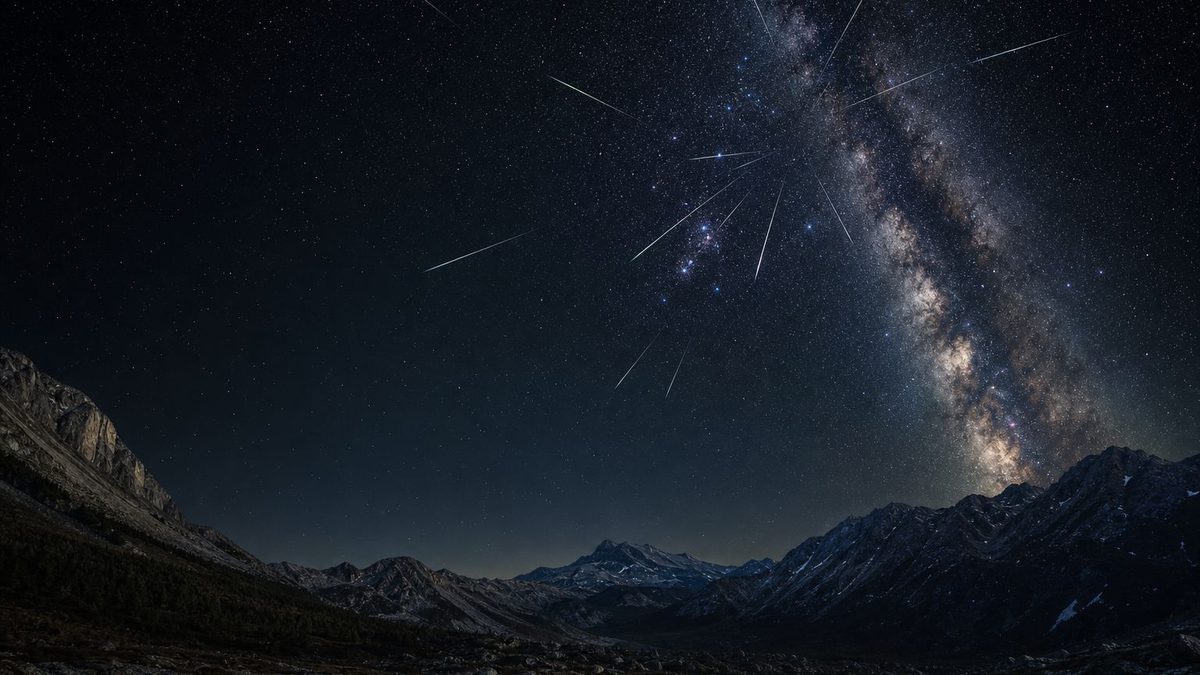
The Orionid meteor shower peaks around 21–22 October 2026, and every one of its shooting stars is a speck of dust from Halley's Comet. This film explains how it works: what a comet is, how Halley predicted its return, what the Giotto probe found in 1986, how dust spreads into a stream that Earth crosses twice a year, why a grain of sand flashes so brightly at 66 km per second, why all the meteors seem to fly out of one point, why you see fewer than the forecasts promise, the great storms of 1833 and 1966, and how to watch. Run a year of Earth's orbit, change a grain's speed, switch to the view from the ground, and work out how many meteors your own sky will show.
Interactive 3D film9 min1705 to 2061Published 21 October 2026
Look up after midnight on a clear night this week, and every few minutes a streak of light will flash across the sky and vanish.
Each one is a speck of dust, most no bigger than a grain of sand, shed by the most famous comet of all: Halley's Comet.
Around 21 and 22 October 2026 the Orionid shower peaks, at about fifteen to twenty an hour from a dark site. This is how a comet's crumbs become shooting stars.
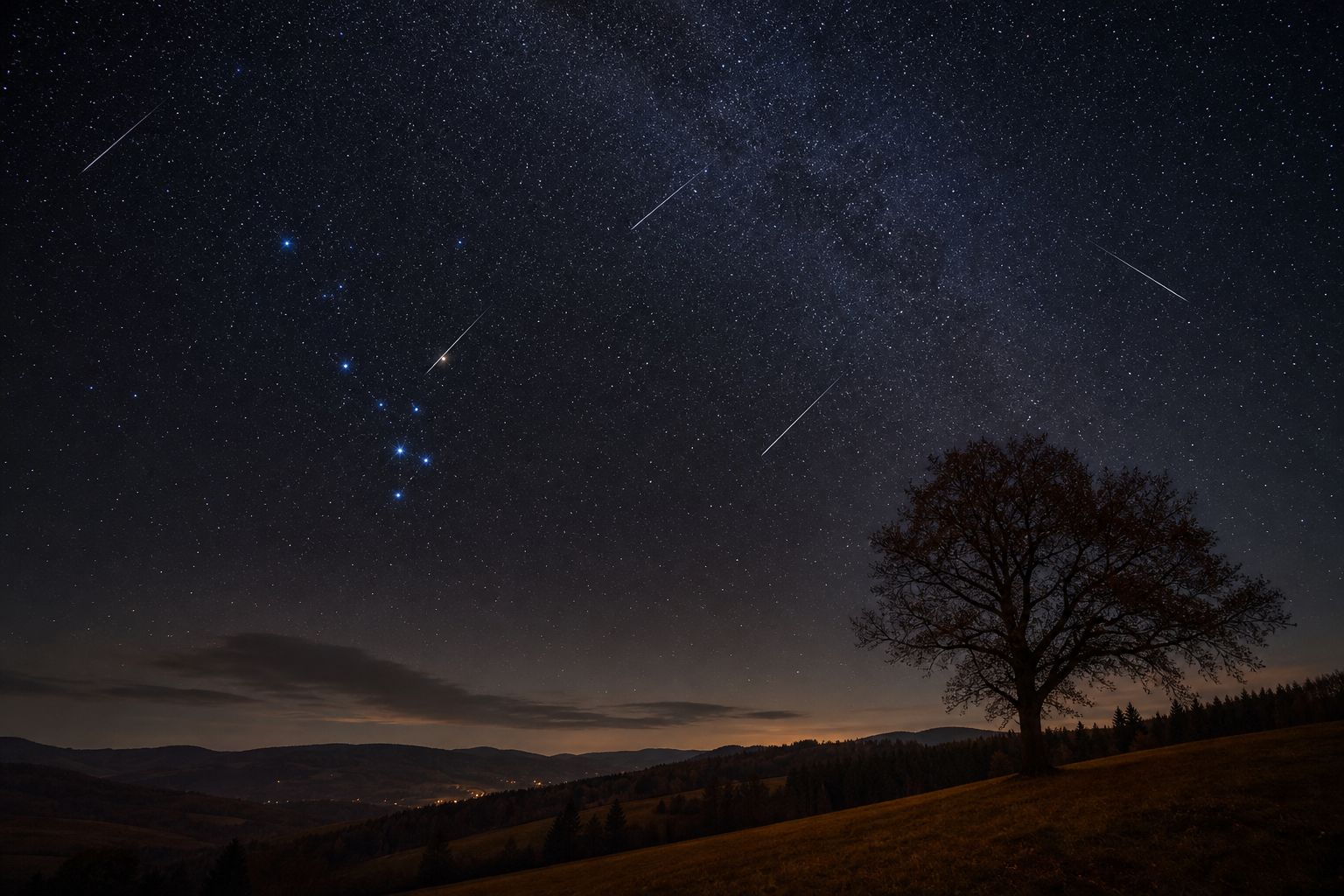
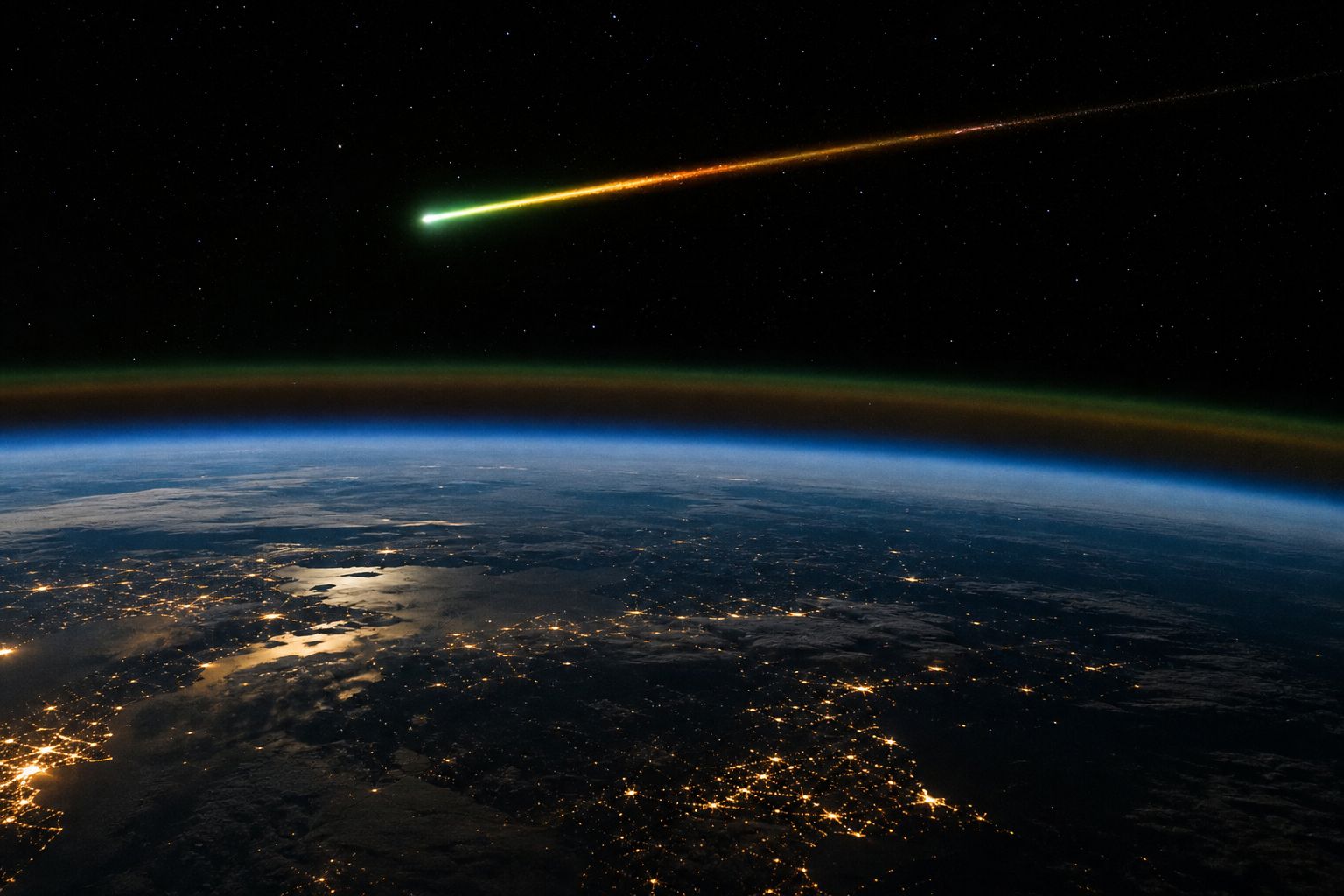
A shooting star Showers are named after the constellation their meteors seem to come from: here, Orion. AI-generated still.
~76 years
once around the Sun
1986
last pass by the Sun
2061
next return
The parent comet: 1P/Halley (NASA)
2 Oct – 7 Nov
active
21–22 Oct
peak nights
66 km/s
entry speed
Orionids 2026, best case (AMS, NASA)
Prologue · The news
The 2026 Orionids
Space.com (16 October 2026) reports that the Orionids peak around 21–22 October 2026 and that one observer may see 15 to 20 an hour; the Farmers’ Almanac gives 15 to 25 an hour under a dark rural sky for the pre-dawn hours of 21–22 October, and NASA says about 10 to 20 an hour. The American Meteor Society lists the shower as active from 2 October to 7 November, with a zenithal hourly rate of 20, a speed of 66 km/s and Comet 1P/Halley as its parent. The radiant lies in Orion, just north of the bright star Betelgeuse.
How to use: pick a chapter or press ← →; drag to look around. Several steps have buttons you can press.
The 3D orbits, comet, sky and trails are simplified teaching models, not to scale.
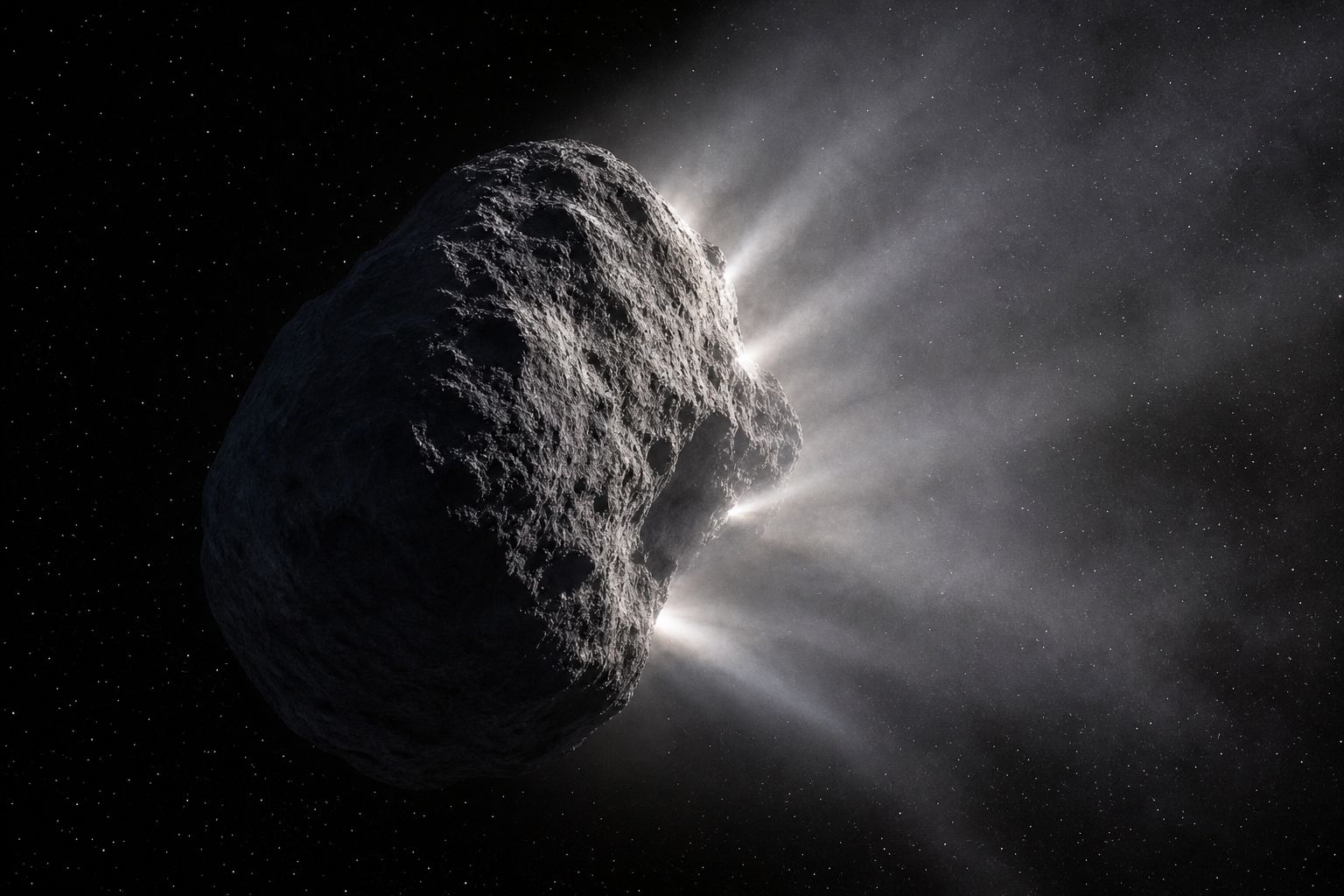
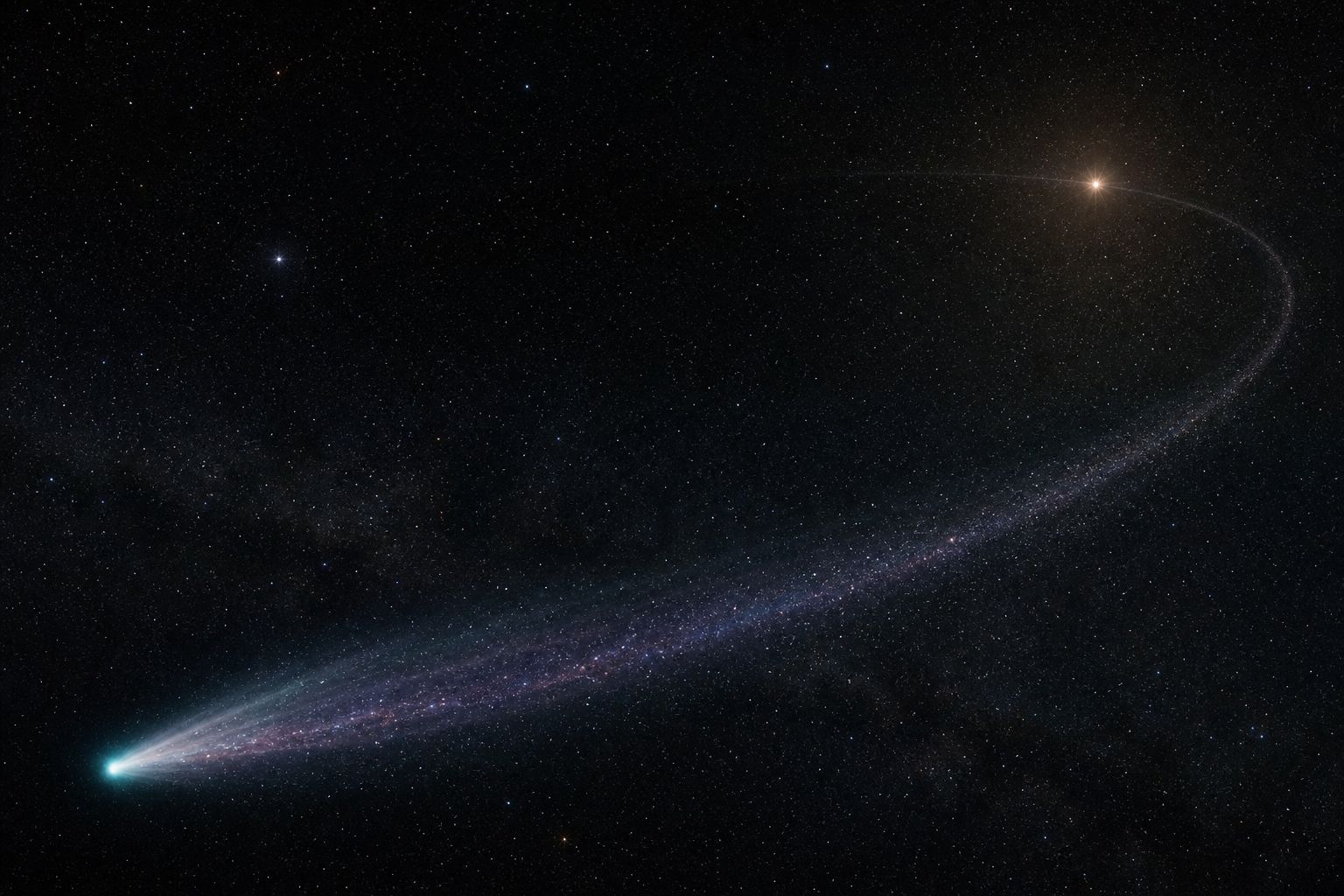
A comet's solid heart, its nucleus, is a lump of ice and dust a few kilometres across. In 1950 Fred Whipple proposed that it is an icy conglomerate, a model nicknamed the dirty snowball.
Far from the Sun it stays frozen and dark, much like an asteroid. Close to the Sun, sunlight warms it and the ice turns straight into gas, skipping the liquid stage. This is called sublimation.
The gas streams off and carries dust with it, making the glowing head. The solar wind pushes the gas into a long tail, and the comet loses a little of itself on every pass.
A comet nucleus Jets rise only from the warm, sunlit side. AI-generated still.
< 20 km
usual size
~75%
ices, mostly water
~25%
dust and rock
Comet nuclei (Swinburne University)
coma: a cloud of gas and dust around the nucleus
tails: always point away from the Sun
heavier grains: left drifting along the orbit
What sunlight makes
Chapter I · Dirty snowballs
The dirty snowball
Swinburne University’s astronomy encyclopedia explains that Fred Whipple proposed in 1950 that a comet nucleus is a mix of ices, dust and rock, a model later supported by spacecraft flybys. Wikipedia’s Halley article adds that pressure from the solar wind pulls the coma’s ions out into a long tail, and that sublimation of the dirty ice releases dust that travels with the gas. Nuclei are usually under 20 km across and roughly 75% ices, mainly water, with about 25% dust and rock. Far from the Sun the nucleus is inactive and looks much like an asteroid. Near the Sun, sunlight heats the surface and the ice turns directly to gas (sublimation); the gas drives the coma and the tails and carries small dust grains with it.
The 3D orbits, comet, sky and trails are simplified teaching models, not to scale.
Most comets are seen once and never again. But in 1705 Edmond Halley, using Isaac Newton's laws, noticed that comets seen in 1531, 1607 and 1682 followed almost the same path.
He argued that they were one comet, returning about every 76 years, and predicted that it would be back around 1758.
On Christmas Day 1758 a German farmer and self-taught astronomer, Johann Georg Palitzsch, spotted it.
It passed the Sun in March 1759, later than a simple repeat because Jupiter's and Saturn's pull held it back, just as Alexis Clairaut and his colleagues had calculated.
Working out an orbit Halley published the work in 1705 as a “Synopsis of the Astronomy of Comets”. AI-generated still.
1531 a comet is seen
1607 another, on the same path
1682 and another
1705 Halley: the same comet, due in 1758
One comet, many visits (Wikipedia)
25 Dec 1758
seen in the predicted place
Prohlis
his farm, now part of Dresden
The sighting (Wikipedia)
13 Mar 1759
closest to the Sun
618 days
delay from Jupiter and Saturn
The return (Wikipedia)
Chapter I · Dirty snowballs
Halley’s Comet
In his 1705 Synopsis of the Astronomy of Comets, Edmond Halley used Newton’s laws to conclude that the comets of 1531, 1607 and 1682 were one object returning about every 76 years, and predicted its return for 1758. Johann Georg Palitzsch, a German farmer who taught himself astronomy, first saw it on 25 December 1758 from his farm at Prohlis, now part of Dresden; it passed perihelion, its closest point to the Sun, on 13 March 1759, 618 days later than a simple repeat would give because of the pull of Jupiter and Saturn, a delay computed in advance by Alexis Clairaut, Jérôme Lalande and Nicole-Reine Lepaute. Its period has varied between about 74 and 80 years; NASA notes that it returned as Halley predicted. Its orbit is retrograde: it goes round the Sun the opposite way to the planets. The earliest certain record of the comet is Chinese, from 240 BC.
The orbit on screen is squashed to fit: Halley’s far end is about 35 times Earth’s distance from the Sun.
The 3D orbits, comet, sky and trails are simplified teaching models, not to scale.
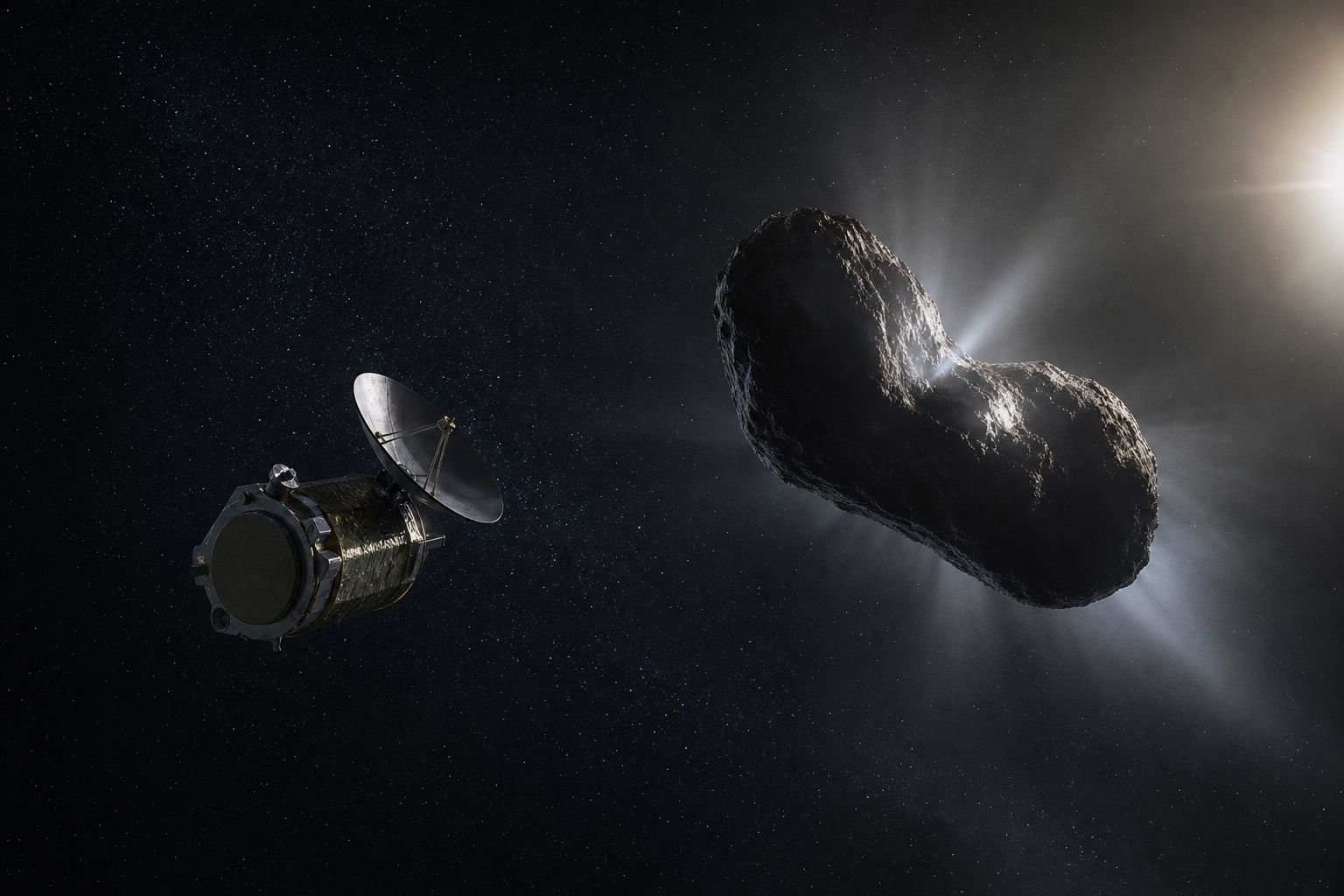
On its last visit, in 1986, spacecraft went to meet it. In March, Europe's Giotto probe flew through the cloud around the comet and passed within about 600 kilometres of its heart.
It found a peanut-shaped nucleus about 15 kilometres long and blacker than coal. Only about a tenth of the surface was active, yet its jets threw out some three tonnes of material every second.
Thousands of dust grains struck Giotto, and one knocked it out of line for a while. Grains like these are what we see as meteors.
A probe meets a comet Giotto returned 2,112 images before dust disrupted its link to Earth. AI-generated still.
15 × 7–10 km
peanut-shaped
~10%
of the surface active
3 t/s
thrown out by 7 jets
Halley’s nucleus (ESA)
water
~80%
carbon monoxide
~10%
carbon dioxide
~2.5%
Gas from the jets, by volume (ESA)
Chapter I · Dirty snowballs
The Giotto flyby
ESA reports that its Giotto spacecraft passed within 596 km of Halley’s nucleus during the night of 13–14 March 1986. The first of about 12,000 dust impacts came 122 minutes before closest approach, and a particle estimated at 0.1 to 1 gram knocked the spacecraft out of alignment; 2,112 images were returned. The nucleus was about 15 km long and 7–10 km wide, peanut-shaped and “blacker than coal”; only about 10% of its surface was active, and seven jets threw out about three tonnes of material per second. Water made up about 80% by volume of the gas, with about 10% carbon monoxide and 2.5% carbon dioxide. Soviet Vega 1 and 2 and Japan’s Suisei and Sakigake also visited the comet.
The 3D orbits, comet, sky and trails are simplified teaching models, not to scale.
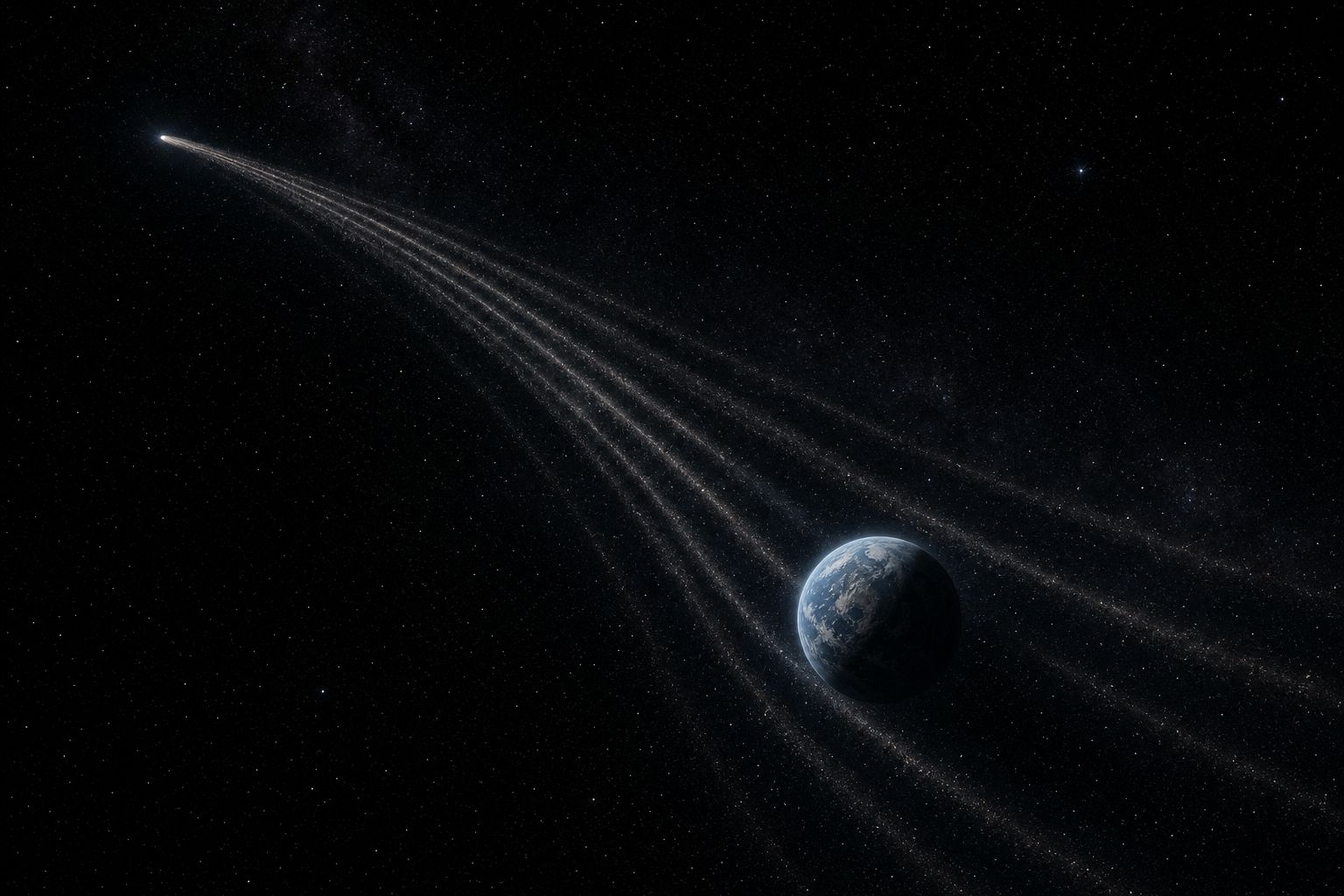
Each time Halley's Comet rounds the Sun, it leaves dust behind. The grains do not fall away. They keep orbiting the Sun on almost the same path as the comet.
Over many returns the dust spreads out along the whole orbit, a thin, invisible river of grit stretched around the Sun.
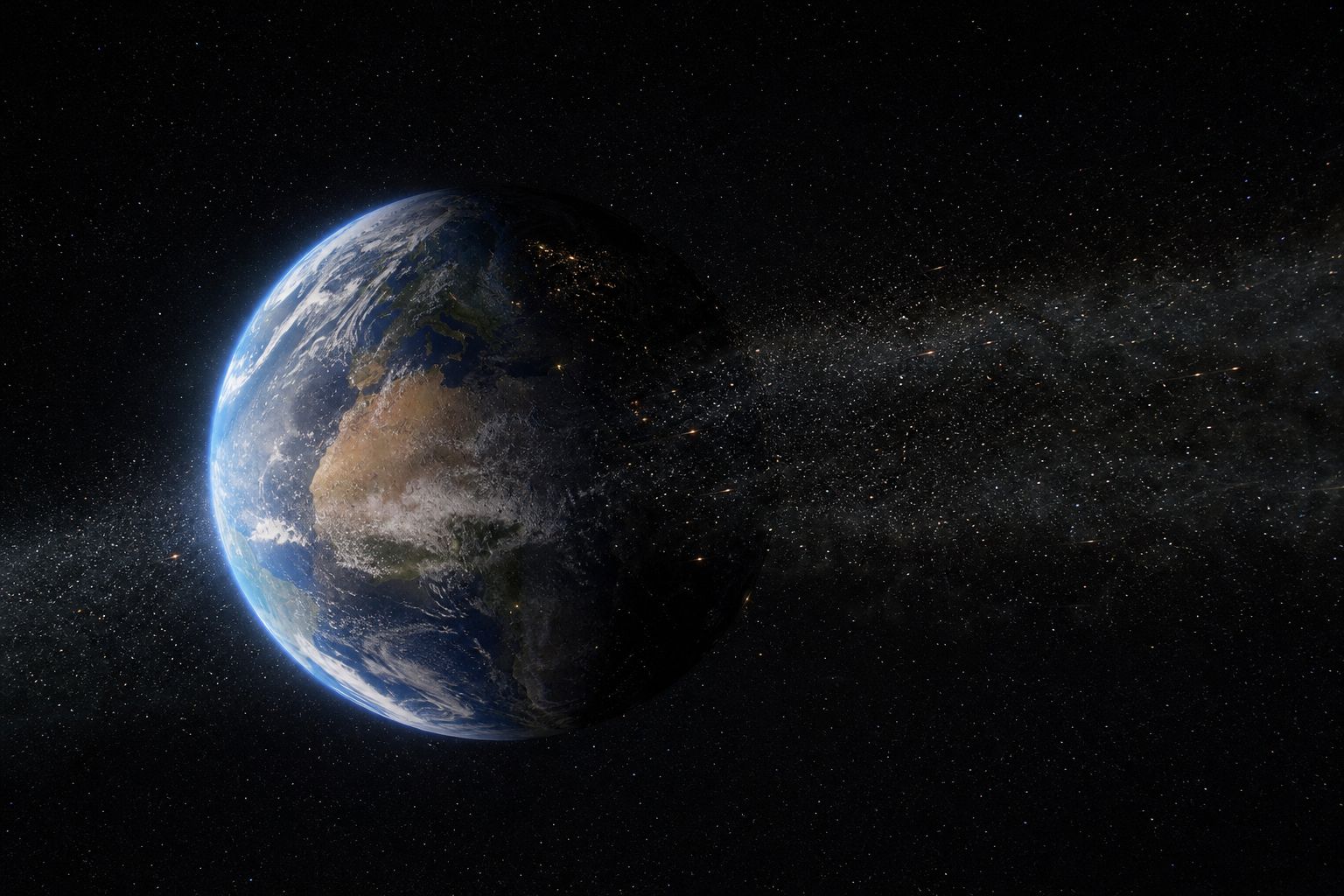
Earth's orbit passes close to that river, and Earth comes back to the same point of its orbit on the same date each year. So it meets the dust on the same dates every year. Press Run a year.
A dusty wake The heavier grains drift slowly away from the comet but stay on its orbit. AI-generated still.
sand to pea
size range of most shower meteoroids
every year
Earth passes through such trails
A stream around the Sun (NASA)
~23 million km
the gap between Earth’s orbit and the comet’s own path today
wider
the dust stream: older grains have spread far enough to reach Earth
A near miss (Wikipedia: Orionids)
Chapter II · A river of dust
Meteoroid streams
NASA explains that when a comet comes near the Sun, its dust spreads into a trail along its orbit; every year Earth passes through such trails, and the bits burn up in the atmosphere as a meteor shower. Because Earth returns to the same place in its orbit each year, a given shower recurs on about the same dates. Wikipedia’s Orionids article notes that Earth today passes about 0.154 astronomical units (23 million km) from Halley’s present orbit, so what we meet is dust that has spread away from the comet’s current path.
Run a year: Earth goes once round its orbit in a few seconds. It glows where it crosses the stream.
The 3D orbits, comet, sky and trails are simplified teaching models, not to scale.
Halley's path comes close to Earth's in two places, so we cross its dust twice a year.
In early May we meet it for the first time: the Eta Aquariids, seen best in the hours before dawn, and better from south of the equator.
In late October we meet it again: the Orionids. Same comet, same dust, two showers.
Into the stream The stream is not a narrow line: Earth spends weeks inside its outer edges. AI-generated still.Before dawn in May North of the equator, the Eta Aquariids usually give only 10–30 an hour (AMS). AI-generated still.
Eta Aquariids, May
50
Orionids, Oct
20
Best-case meteors per hour (ZHR, AMS)
Chapter II · A river of dust
Eta Aquariids and Orionids
Because Halley’s orbit comes close to Earth’s in two places, the comet is the parent of two showers: the Eta Aquariids in early May and the Orionids in late October (NASA; Wikipedia). The American Meteor Society gives the Eta Aquariids a zenithal hourly rate of 50 and a speed of 65.4 km/s, and notes that they are a strong shower from the southern tropics, while from the equator northward they usually give only medium rates of 10–30 per hour just before dawn; Wikipedia’s Eta Aquariids article says they are best seen from the equator to 30° south, because for northern observers the radiant stays low and rises only a few hours before dawn; the Orionids have a rate of 20 and a speed of 66 km/s. A 2020 study in Astronomy & Astrophysics finds the Eta Aquariids usually two to three times stronger than the Orionids.
The 3D orbits, comet, sky and trails are simplified teaching models, not to scale.
Out in space, a grain like this is called a meteoroid. Most meteoroids in a shower are somewhere between a grain of sand and a pea.
When one plunges into the air and burns up, the streak of light is a meteor, a shooting star. A very bright one, brighter than Venus, is a fireball.
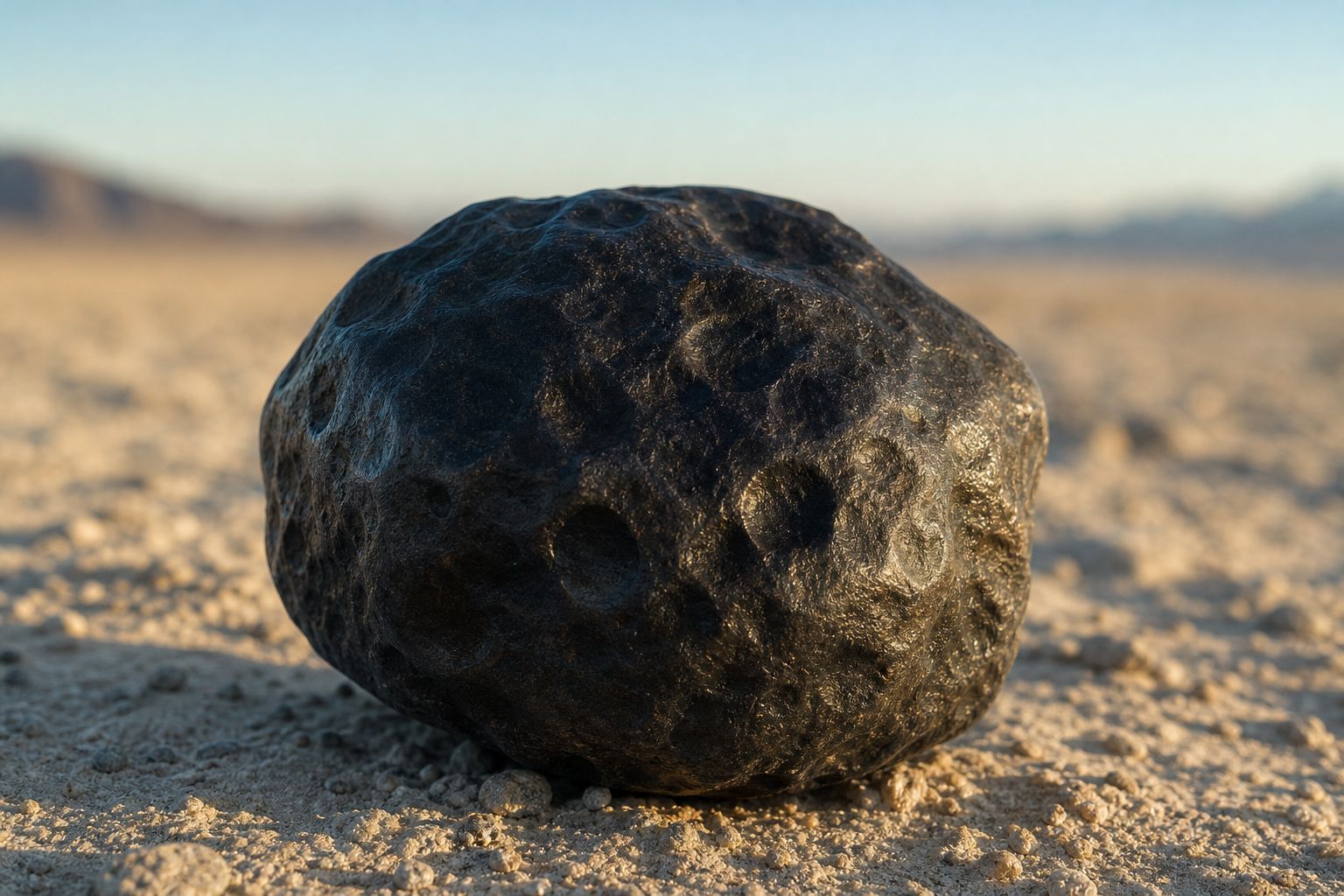
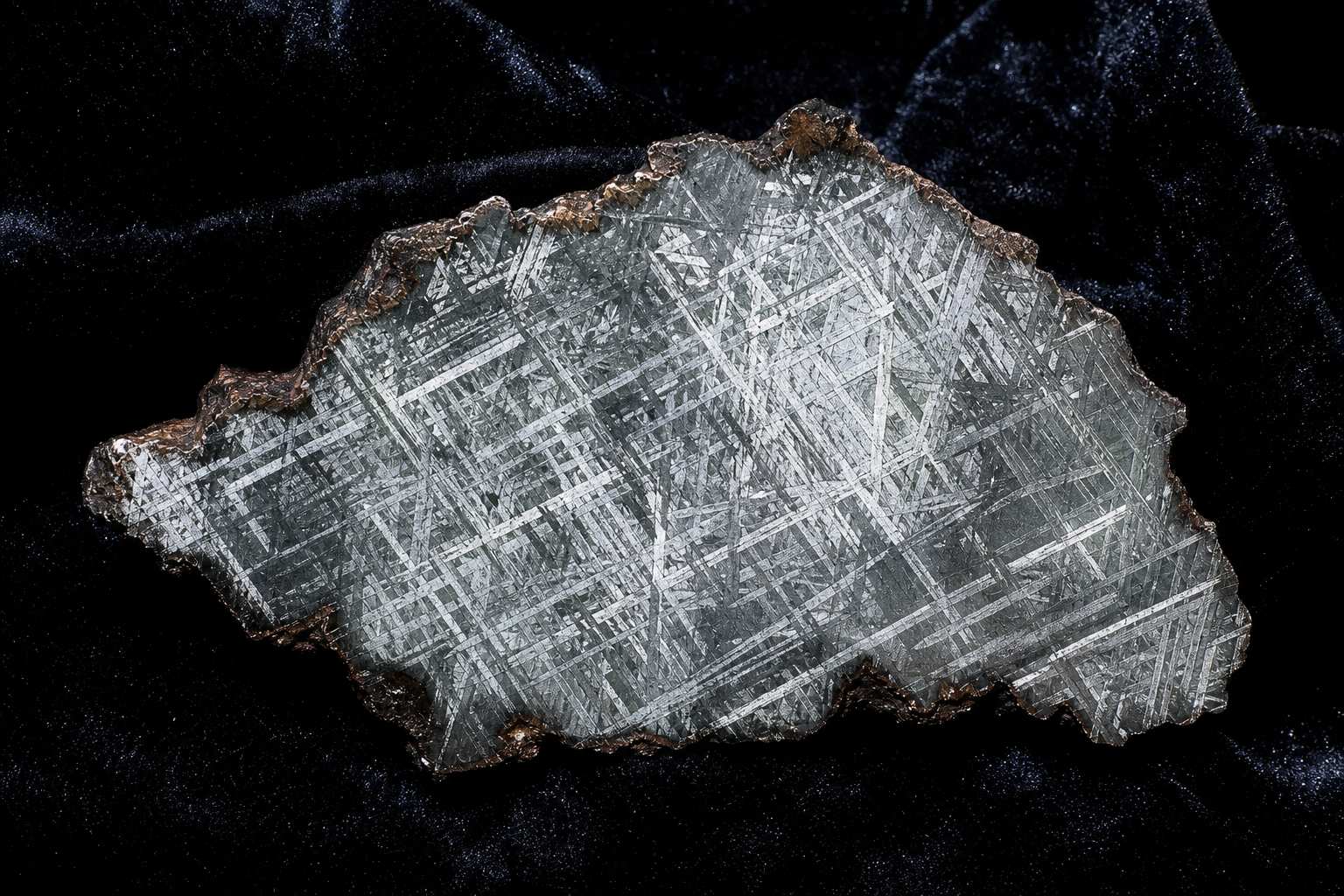
If a piece survives all the way to the ground, it is a meteorite. Shower grains are far too small for that. Almost all meteorites come from asteroids, not comets.
~44,000 kg
of meteoritic material
Falling on Earth every day (NASA)
18 km/s
entry speed
23 km
height where it blew apart
1,600+
people injured
A giant fireball: Chelyabinsk, 2013 (NASA)A meteorite Thumbprint-like dimples form as the surface melts and ablates on the way down (Britannica). AI-generated still.Inside an iron meteorite Of more than 50,000 meteorites found, about 99.8% come from asteroids (NASA). AI-generated still.
Chapter III · Into the air
Meteoroid, meteor, meteorite
NASA defines a meteoroid as a space rock, from a dust grain to a small asteroid, while it is still in space; a meteor as the light it makes when it enters a planet’s atmosphere at high speed and burns up (a “shooting star”); a fireball as a meteor brighter than Venus; and a meteorite as a meteoroid that survives its passage and reaches the ground. Most meteoroids in meteor showers are between the size of a grain of sand and a pea. About 44,000 kg of meteoritic material falls on Earth each day. More than 50,000 meteorites have been found; about 99.8% come from asteroids, over 60 from Mars and nearly 80 from the Moon.
The 3D orbits, comet, sky and trails are simplified teaching models, not to scale.
How can a grain of sand make such a bright light? Speed. Halley orbits the Sun the opposite way to Earth, so we meet its dust almost head on, at about 66 kilometres per second.
At that speed, each gram carries about as much energy as half a kilogram of TNT. The air ahead of the grain is squeezed and heated so violently that the grain boils away, atom by atom.
Those atoms and the air glow, usually between about 120 and 80 kilometres up, and leave a thin trail of electrically charged gas behind.
High above the clouds Entry speeds run from about 11 to 72 km/s; the Orionids are near the top (Boston University; AMS). AI-generated still.E=21mv221(0.001kg)(66000m/s)2≈2.2MJ
m
mass: one gram
v
speed
Energy of motion One gram of TNT releases 4,184 J by convention, so 2.2 MJ is about 520 grams’ worth.A glowing train Fast meteors can leave a glowing train lasting seconds to minutes (NASA). AI-generated still.
75–120 km
where they light up (full range, all speeds and sizes)
50–95 km
where they are gone (full range)
≤ 1 mm
most meteors you see: the small end of “sand to pea”
Where meteors glow (Wikipedia; EarthSky)
Chapter III · Into the air
Ablation and the ionised trail
Boston University’s Center for Space Physics describes meteoroids ablating at 70–120 km altitude while moving at 11–72 km/s: the meteoroid heats to thousands of degrees and vaporises, collisions between the ablated atoms and air molecules strip off electrons, and an elongated cylinder of ionised plasma, the meteor trail, is left behind; excited atoms give off the light. Wikipedia’s Meteor article notes that meteors become visible about 75–120 km up and usually disintegrate at 50–95 km, that it is not friction as such that heats the body: the air in front of it is compressed and heated (ram pressure), and for the smallest grains the heat comes from countless collisions with air molecules, and that most visible meteoroids are 1 mm or smaller. EarthSky adds that faster meteors begin to glow higher. The energy figure is a calculation: ½ × 0.001 kg × (66,000 m/s)² ≈ 2.2 million joules, and one gram of TNT is defined as 4,184 joules.
The buttons change the speed and the grain size. The glow in the model is scaled with the grain’s energy: a toy model, slowed down.
The 3D orbits, comet, sky and trails are simplified teaching models, not to scale.
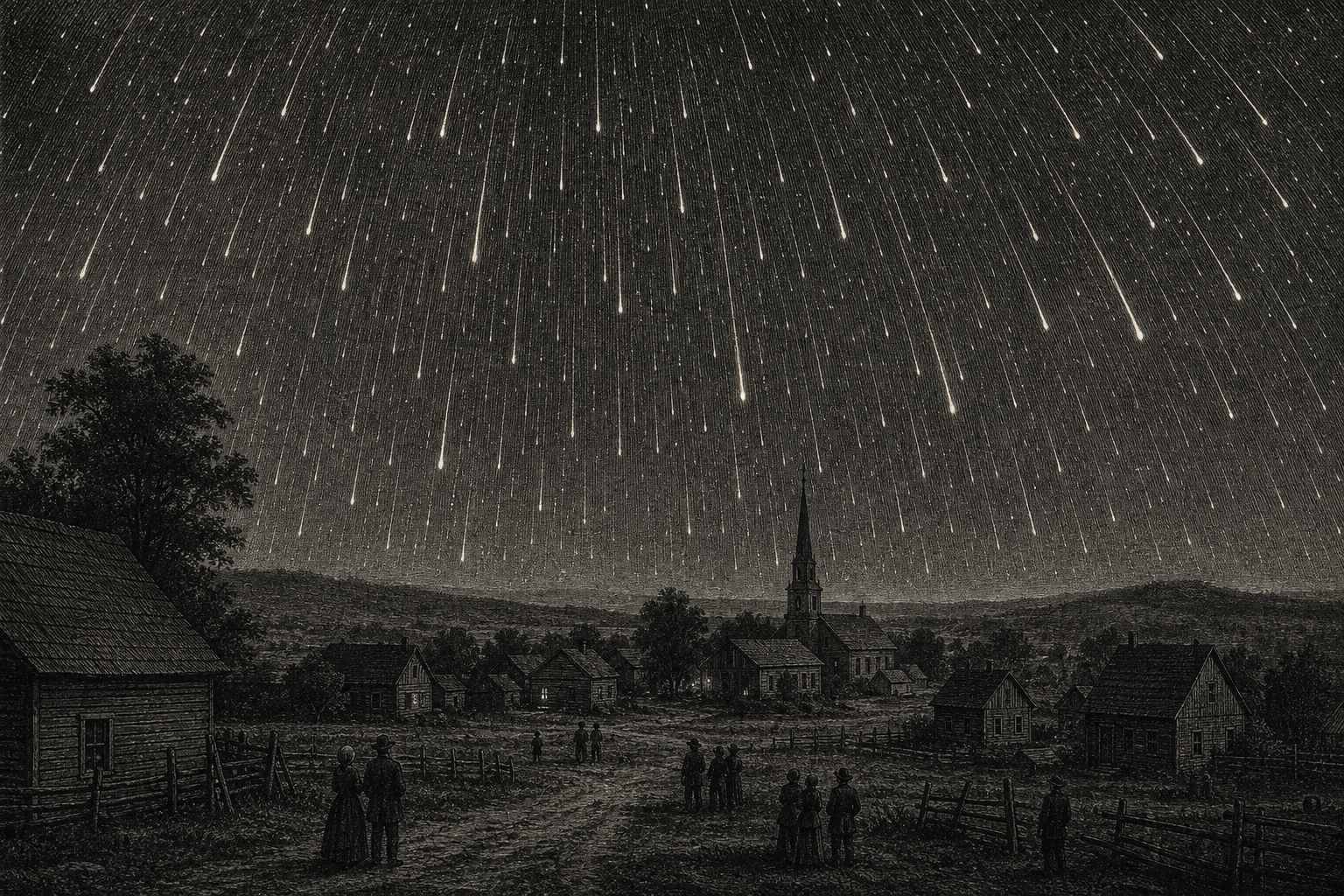
During a great meteor storm in November 1833, the Yale professor Denison Olmsted noticed something odd: the meteors all seemed to fly out of one spot in the constellation Leo.
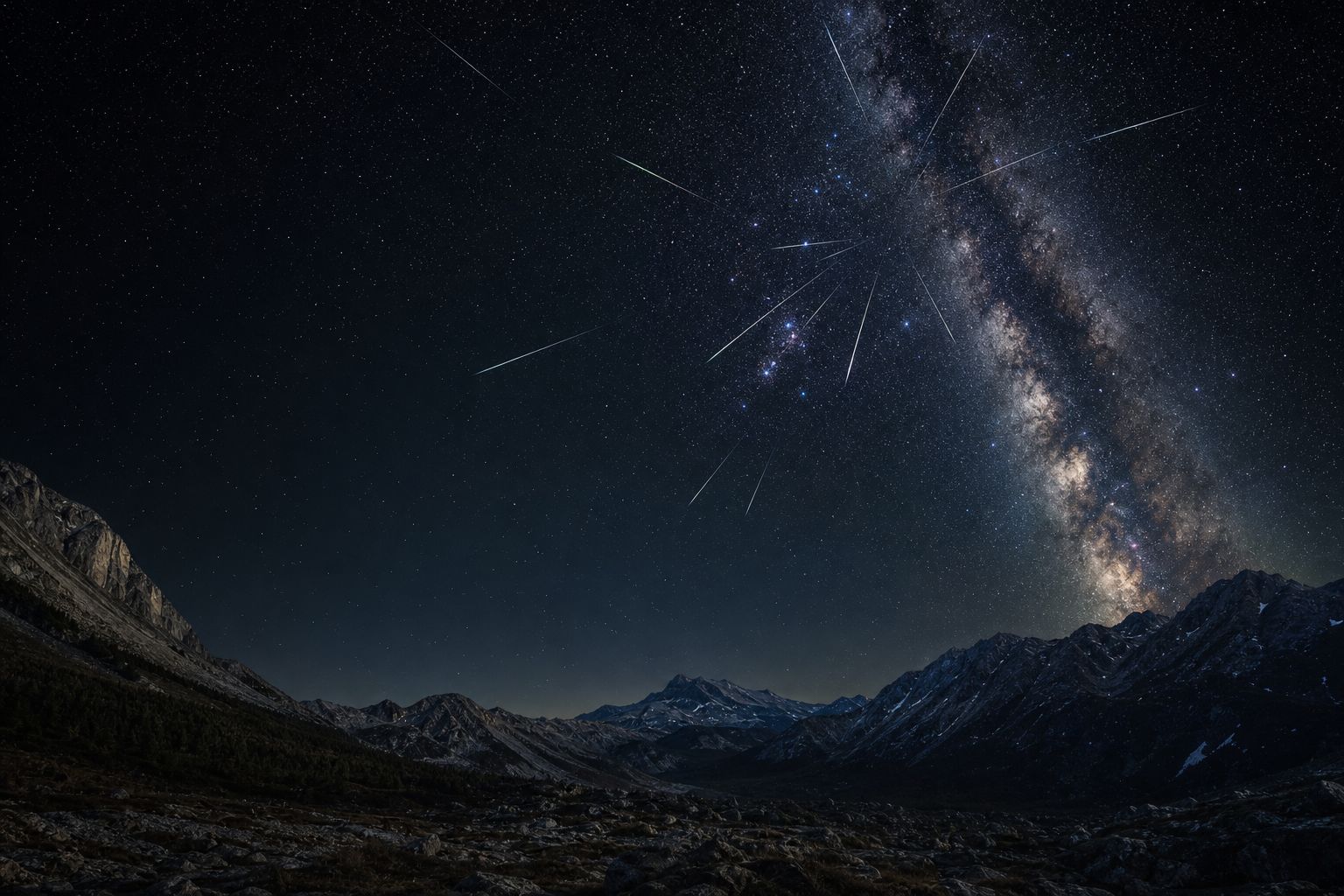
That spot is called the radiant, and the reason is perspective. The grains in a stream travel side by side, on parallel paths, like the rails of a railway.
Parallel lines coming toward you seem to spread out from one distant point, just as rails seem to meet at the horizon.
13 Nov 1833
seen across eastern North America
Jan 1834
Olmsted publishes: a cloud of particles in space
The 1833 storm (AMS; Wikipedia: Leonids)Parallel lines The rails never meet; the vanishing point is in our eyes. AI-generated still.Spokes from one point Meteors near the radiant look short; those far from it look long (NASA). AI-generated still.
Chapter IV · One point in the sky
The radiant
The American Meteor Society’s history recounts that Denison Olmsted, a Yale professor, watched the Leonid storm of 13 November 1833 and collected reports from the eastern half of North America; Wikipedia’s Leonids article adds that in January 1834 he published that the meteors radiated from a point in Leo and proposed that they came from a cloud of particles in space. EarthSky explains the radiant as perspective: meteors enter the atmosphere on parallel paths, which appear to converge, like railroad tracks that seem to meet in the distance though they stay parallel. NASA notes that showers are named after the constellation of the radiant, and that meteors near it look shorter because of foreshortening.
The buttons switch between a side view of the parallel paths and your view from the ground.
The 3D orbits, comet, sky and trails are simplified teaching models, not to scale.
Astronomers rate a shower by its zenithal hourly rate, or ZHR: how many meteors one person would see in an hour, under a perfectly dark sky, with the radiant straight overhead. For the Orionids it is about 20.
Real skies are never that good. The lower the radiant, the fewer grains strike the air above you. And light pollution hides the faint meteors, which far outnumber the bright ones.
So most people count far fewer than the ZHR, especially under a city sky.
20
ZHR: the best case
10–20
really seen at the peak, normal year
Orionids (AMS)
dark sky + radiant high → close to the ZHR
radiant low → fewer grains reach the air above you
city glow → the faint meteors vanish
In plain wordsCity glow Astronomers note the faintest visible star; “a meteor count is meaningless without it” (Sky & Telescope). AI-generated still.N≈ZHR×sinh×r−(6.5−m)
h
height of the radiant above the horizon
m
faintest star you can see
r
about 2.5 for the Orionids
Seen per hour (simplified) Each step fainter in brightness brings about 2.5 times more meteors.
Chapter V · Counting meteors
The zenithal hourly rate
Sky & Telescope defines the zenithal hourly rate as the number of meteors one observer would see per hour if the radiant were at the zenith and the sky were dark enough to show stars of magnitude 6.5; counts depend heavily on light pollution and on the altitude of the radiant. In the full formula used by meteor astronomers, the count is corrected by r raised to the power (6.5 − limiting magnitude), where the population index r is the ratio of meteors down to one magnitude fainter to those down to a given magnitude, and by 1 / sin of the radiant’s height. A 2020 study in Astronomy & Astrophysics lists population indices of about 2.5–2.6 for the Orionids. The American Meteor Society gives the Orionids a ZHR of 20 and says that in a normal year they produce 10–20 shower meteors per hour at maximum.
The calculator uses the simplified formula above with r = 2.5. Real counts also depend on clouds, obstructions and the observer.
The 3D orbits, comet, sky and trails are simplified teaching models, not to scale.
Usually a shower is a gentle drizzle. But sometimes Earth runs into an especially dense ribbon of dust, and the drizzle becomes a storm.
The Leonids, dust from comet Tempel–Tuttle and the same shower Olmsted watched, did this in 1833. People across eastern North America saw the sky fill with meteors; one estimate puts the peak above 100,000 an hour.
In November 1966, observers at Kitt Peak in Arizona estimated about 40 meteors every second: some 144,000 an hour.
~33 years
roughly how often they come
70 km/s
the fastest yearly shower
Leonid storms (Wikipedia: Leonids)The night of 12–13 November 1833 Olmsted gathered reports from across the eastern half of North America (AMS). AI-generated still.
240,000+
meteors in nine hours, by a later estimate
12–13 November 1833 (Wikipedia: Leonids)
Orionids, normal year
20
Leonids, 1999–2002
3,000
Leonids, 1966
144,000
Meteors per hour (AMS; Wikipedia; Live Science)
Chapter VI · Storms
Meteor storms
Wikipedia’s Leonids article describes the storm of 12–13 November 1833 over North America east of the Rocky Mountains: one estimate of the peak is over one hundred thousand meteors an hour, and a later estimate puts the total at over 240,000 during the nine hours of the storm. The Leonids, whose parent is comet 55P/Tempel–Tuttle (AMS), produce storms about every 33 years and are the fastest annual shower at about 70 km/s. Live Science reports that in November 1966 thirteen amateur astronomers at Kitt Peak, Arizona, estimated about 40 meteors per second, or 144,000 per hour, at 4:54 a.m. Mountain Time. The 1999, 2001 and 2002 storms reached up to about 3,000 meteors per hour.
The bars are not drawn to one scale for the smallest values; the numbers are what matter.
The 3D orbits, comet, sky and trails are simplified teaching models, not to scale.
Why only in some years? Each return of a comet lays down its own narrow trail of dust, and over time the planets' gravity slowly shifts these trails. Only now and then does a dense one cross Earth's path.
In 1999 David Asher and Robert McNaught modelled every Leonid trail separately, and timed the bursts of activity to within about ten minutes.
Halley's dust has its strands too. On 21 October 2006 the Orionids' hourly rate, the ZHR, jumped above 100 as Earth passed through several of them.
Trails side by side Each ribbon was shed on a different pass and has drifted a little differently. AI-generated still.
1833 Leonid storm
1866 Leonids: thousands an hour in Europe
1966 Leonid storm, ~144,000 an hour
1999 trail-by-trail forecasts
2006 Orionid outburst, over 100 an hour
Storms and outbursts (Wikipedia; AMS)
2–4×
usual activity in occasional outbursts
Halley’s two showers (A&A 2020)
Chapter VI · Storms
Dust trails and forecasts
Wikipedia’s Leonids article explains that the breakthrough in forecasting came in 1999, when David Asher and Robert McNaught (and, independently, Esko Lyytinen) modelled the stream from each passage of the comet separately and predicted bursts of activity timed to within ten minutes; earlier work at Kazan University by Kondrat’eva and Reznikov had shown that storms could be predicted. Wikipedia’s Orionids article reports an outburst with a zenithal hourly rate of over 100 on 21 October 2006, caused by Earth passing through several meteoroid streams. A 2020 study in Astronomy & Astrophysics finds that the Eta Aquariids and Orionids show occasional outbursts two to four times their usual level.
The 3D orbits, comet, sky and trails are simplified teaching models, not to scale.
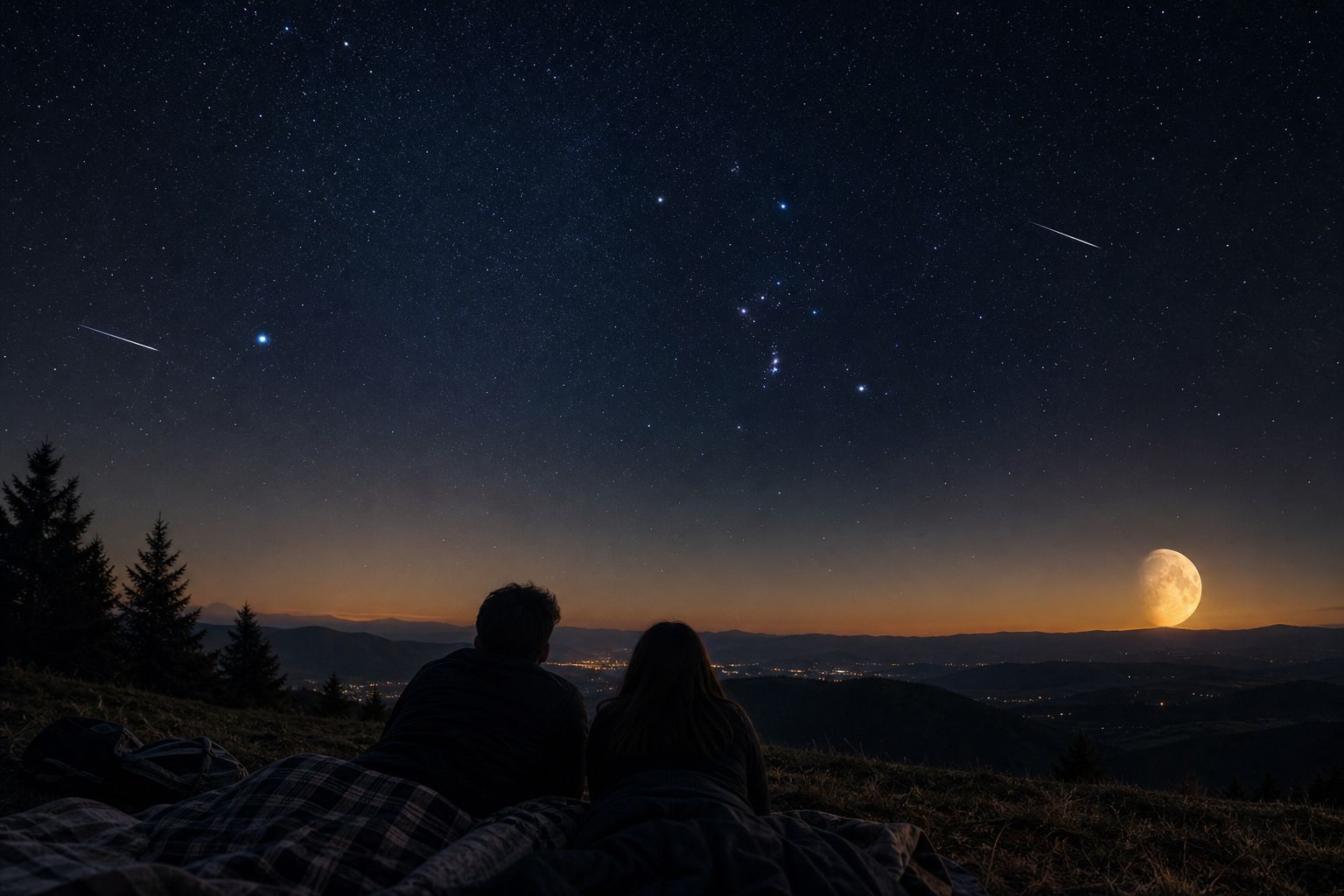
To watch the Orionids you need no telescope or binoculars: just your eyes, a dark place away from city lights, and patience. Give your eyes up to half an hour to adjust to the dark.
Orion rises in the east late in the evening and climbs until dawn, so the best hours come after midnight. In 2026 a bright Moon lights the evening, but it sets in the small hours, leaving dark sky before dawn.
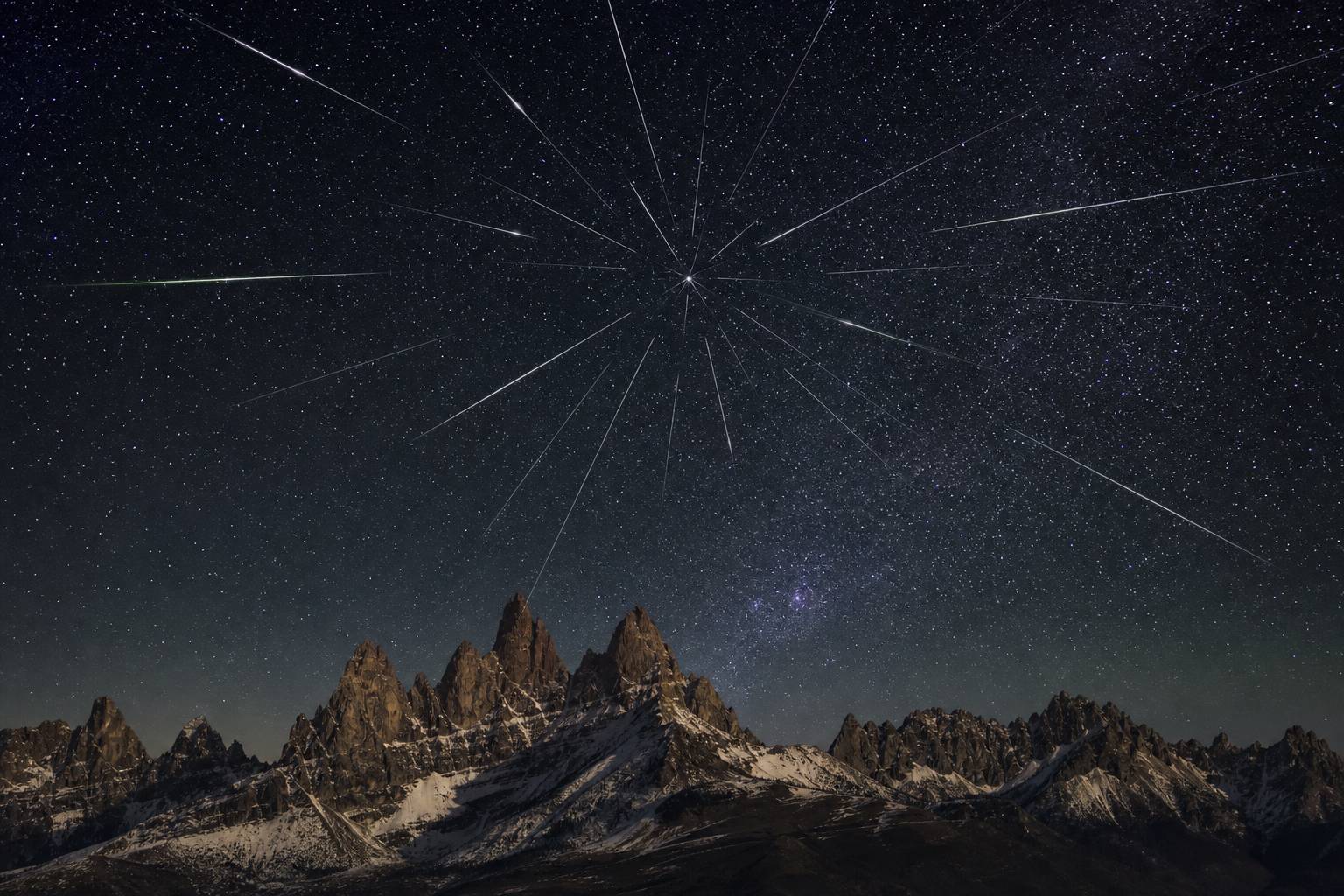
Lie back and take in the whole sky, not just Orion. Meteors near the radiant look short; the long ones streak far from it.
A night out NASA suggests lying flat, feet toward the southeast in the Northern Hemisphere, northeast in the Southern. AI-generated still.
~80%
lit, waxing gibbous
~2–3 a.m.
moonset, local time
25–26 Oct
full Moon
The Moon at the 2026 peak (AMS; Space.com; Catalina)
after ~11 p.m. Orion clears the eastern horizon
~2 a.m. the Moon sets
~5 a.m. Orion highest, in the south
Thailand: ~10:30 p.m. NARIT: watching can begin; best after midnight
The peak night (Space.com, US daylight time; NARIT for Thailand)
look 45–90° away from the radiant
stay until dawn: rates rise as Orion climbs
the name comes from the radiant’s constellation, not from where the meteors land in the sky
Watching tips (NASA; EarthSky)
Chapter VII · Watching
How to watch the Orionids
NASA advises finding an area well away from city or street lights, lying flat on your back with your feet toward the southeast (Northern Hemisphere) or northeast (Southern Hemisphere), and letting your eyes adapt for less than 30 minutes; the shower is best viewed after midnight and lasts until dawn, and looking 45–90 degrees away from the radiant shows longer meteors. Space.com says Orion clears the eastern horizon after about 11 p.m. local daylight time and is highest in the south around 5 a.m.; in 2026 a waxing gibbous Moon sets shortly after 2 a.m., with full Moon on 25–26 October. The Farmers’ Almanac puts the Moon at about 80% lit, setting around 3 a.m., and the American Meteor Society also gives 80%. For Thailand, Thai PBS reported NARIT’s guidance (for 2025) that the Orionids can be watched from about 10:30 p.m., rising in the east, best after midnight. Times vary with your location.
The buttons show the sky at about 11 p.m., 2 a.m. and 5 a.m. for a mid-northern latitude. Schematic.
The 3D orbits, comet, sky and trails are simplified teaching models, not to scale.
Halley's Comet itself turned at the far end of its orbit in December 2023, about 35 times farther from the Sun than Earth. It is on its way back, and will pass closest to the Sun on 28 July 2061.
When it rounds the Sun in 2061, it will shed fresh dust for meteor showers that people not yet born will watch.
So tonight, look up. Each streak is a grain of comet dust, older than any of us, ending its long journey in a flash.
240 BC first certain record, China
1705 Halley predicts its return
1758 it comes back
1833 Olmsted explains the radiant
1986 Giotto meets the nucleus
2023 turns at the far end of its orbit
2061 next return (predicted)
Halley and its dust
9 Dec 2023
aphelion: farthest from the Sun
~35 AU
times Earth’s distance from the Sun
The far end of the orbit (EarthSky; Wikipedia)Meteors over the mountains All stills and illustrations in this film are AI-generated.
Epilogue · Sources
How meteor showers work
Comets as icy bodies that shed dust near the Sun, meteoroid streams, the radiant as a perspective effect, ablation in the upper atmosphere and the zenithal hourly rate are established science, described by NASA, ESA, the American Meteor Society and the sources below. EarthSky reports that Halley reached aphelion on 9 December 2023; its next perihelion, 28 July 2061, is a prediction. Rates for any one night are forecasts: real counts vary.
a comet sheds dust near the Sun
the dust spreads into a stream around the orbit
Earth crosses the stream on the same dates every year
each grain flashes about 80–120 km up
The 3D orbits, comet, sky and trails are simplified teaching models, not to scale. All stills are AI-generated.