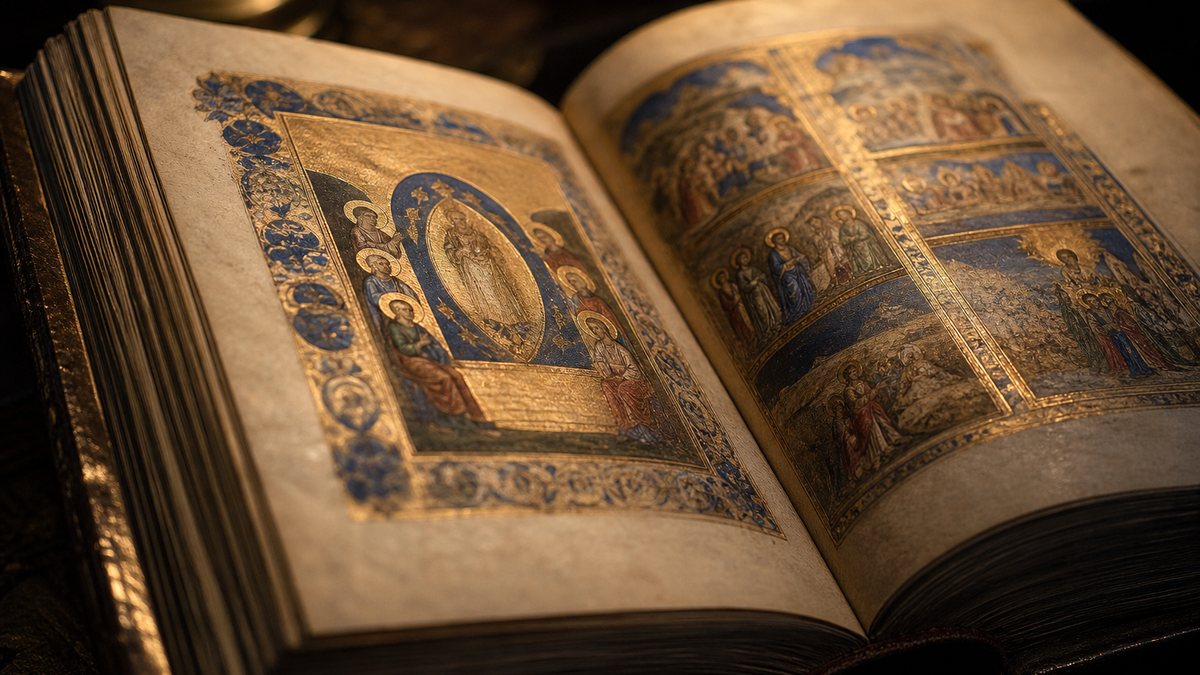
In September 2026 scientists reported genomes of the sheeppox virus recovered from the pages of the York Gospels, a book about a thousand years old that is still used in ceremonies at York Minster. This film explains how such a book was made: papyrus before it, and the Pergamon tradition; how a skin became parchment, and how many animals a great Bible took; iron gall ink and quill pens; the work of scribes; pigments from lapis lazuli to vermilion and gold leaf, and the woman of Dalheim with ultramarine in her teeth; how eraser crumbs and DNA now reveal the animals and the people who handled the York Gospels; the new sheeppox study; and how paper and printing took parchment’s place.
Interactive 3D film9 minc. 2900 BC to 2026Published 15 November 2026
A book about a thousand years old has just told scientists something new. Its pages are animal skin, and in three of them a team led from University College Dublin found the DNA of sheeppox, a disease of sheep.
The book is the York Gospels, still used in ceremonies at York Minster, in the north of England. Most of its pages are calfskin. So how did a sheep virus get there?
To find out, we need to know how a book like this was made. Let us start before the book.
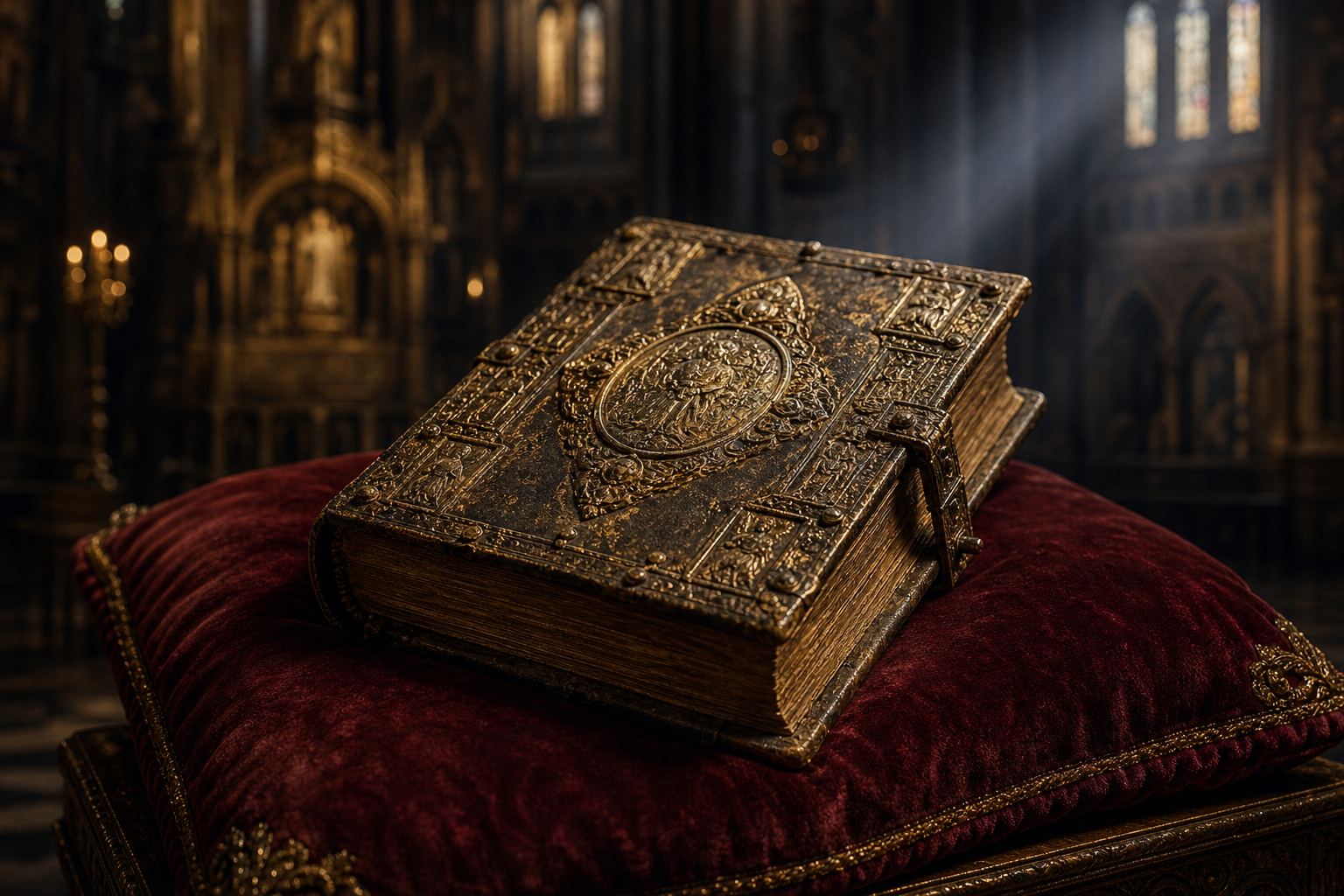
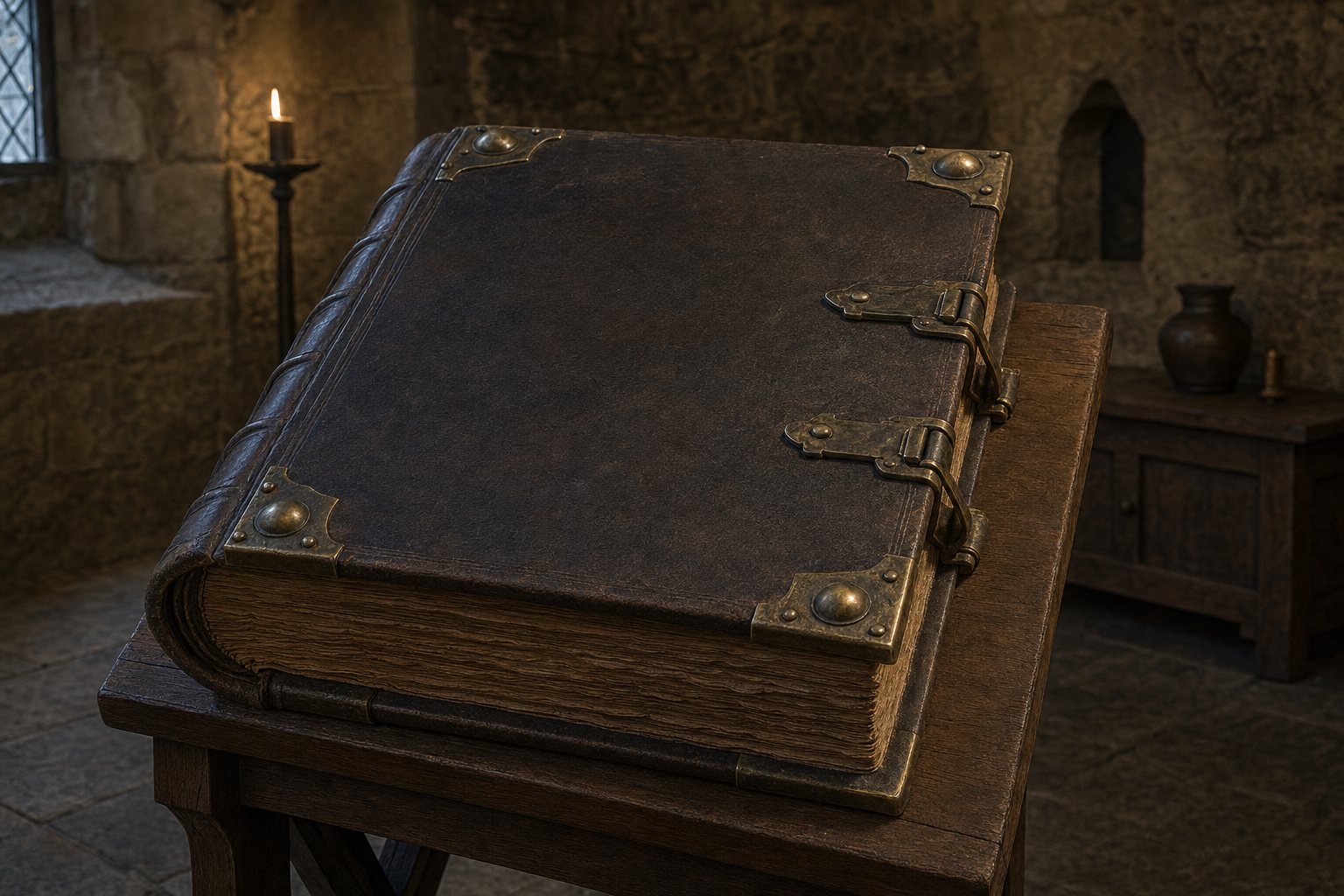
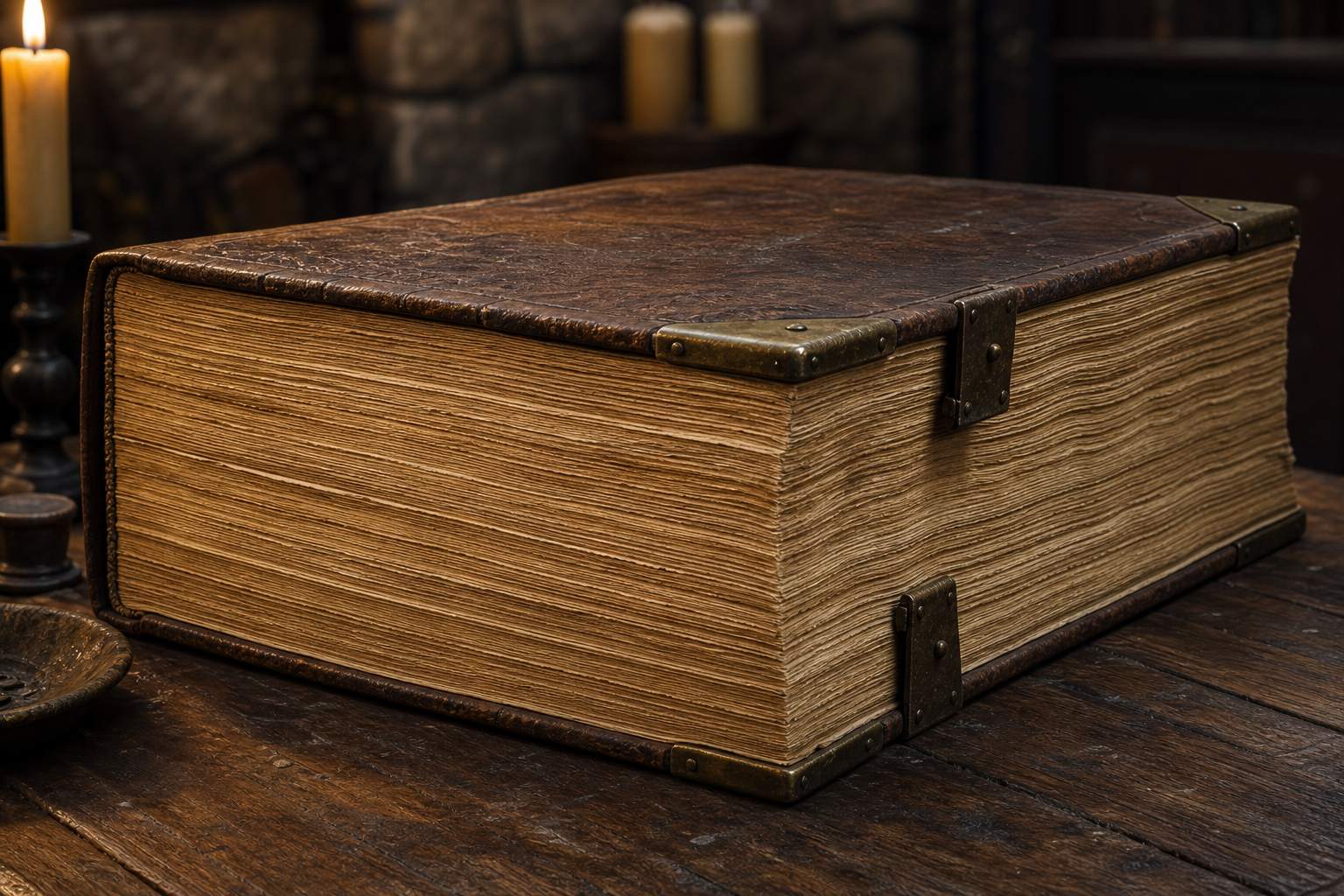
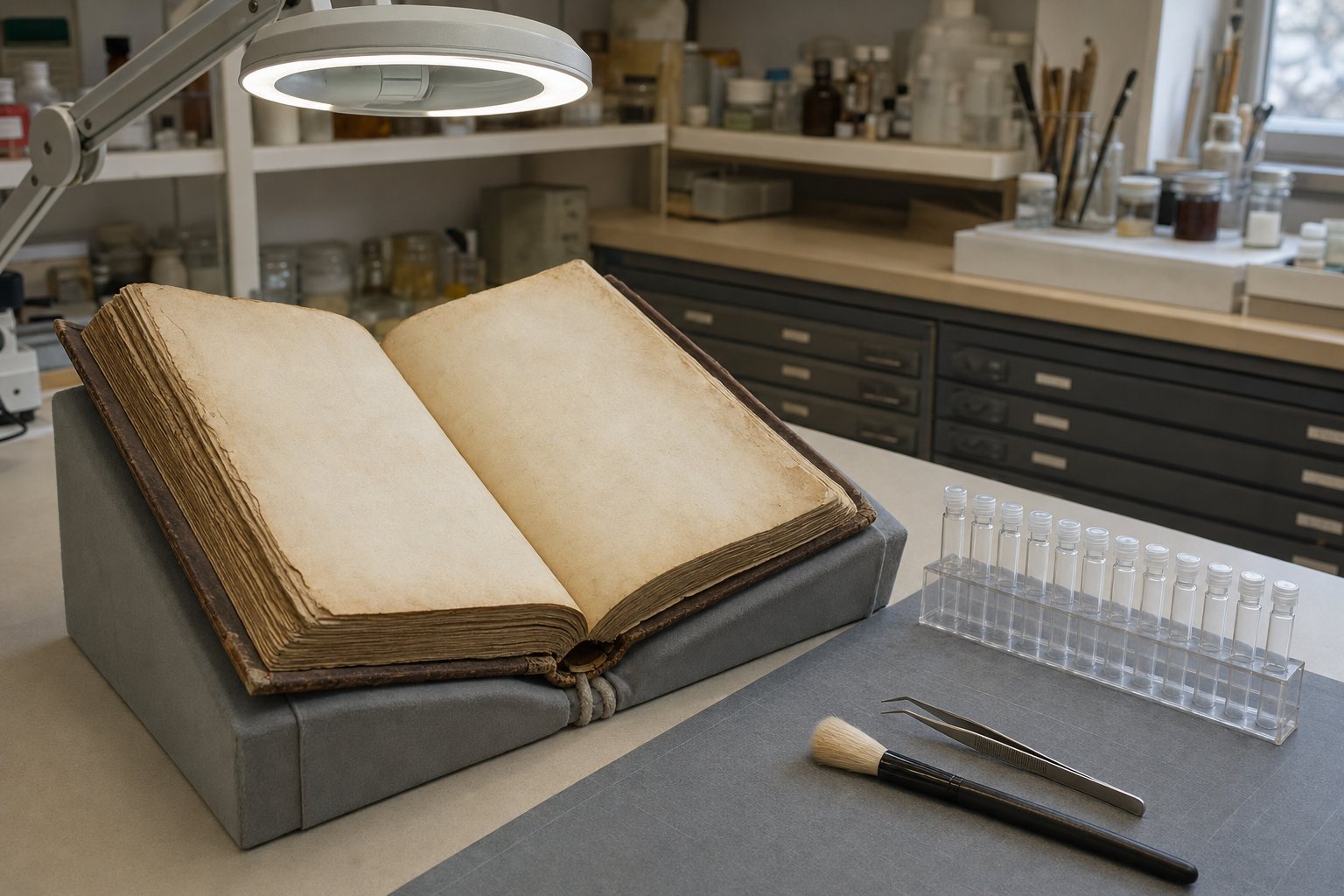
The York Gospels An old gospel book on a cushion: the real one was made around the year 1000, and oaths were later written into it. AI-generated illustration.Boards, brass and clasps The clasps are not decoration: they hold the skin flat, because parchment curls as the air changes. AI-generated illustration.
21
ancient sheeppox genomes
3
pages of the York Gospels with the virus
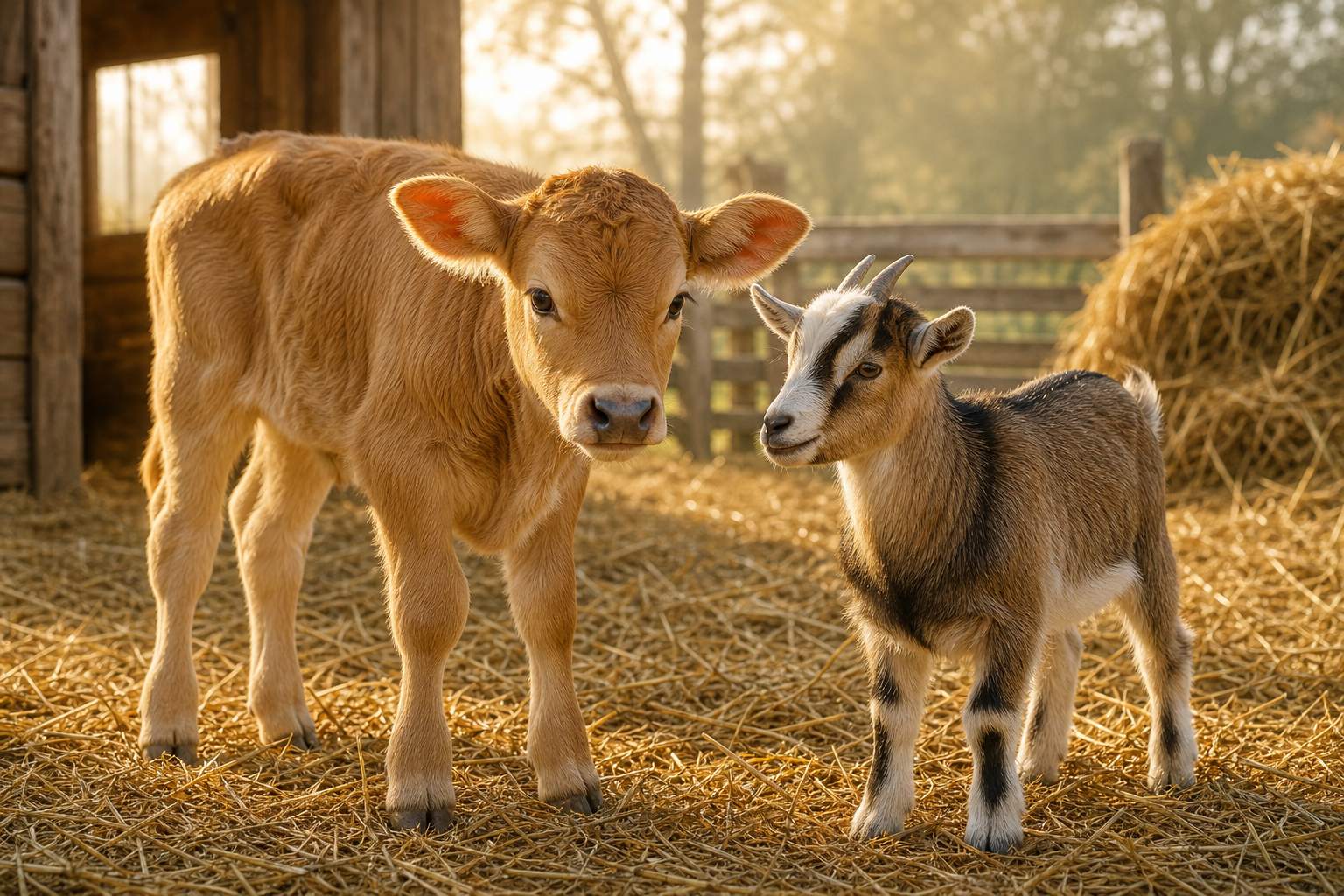
Science Advances, September 2026The source of the pages Sheep on an English hillside: sheeppox is a disease of sheep and goats, and is not known to infect people. AI-generated illustration.
Prologue
The news
Archaeology Magazine and the Helmholtz Centre for Infection Research (September 2026): L’Hôte et al., Science Advances 12(36), eaeh3571, recovered 21 new ancient sheeppox virus genomes from Bronze Age sheep teeth and from parchment, including three pages of the York Gospels. The study was led from University College Dublin. Euronews: sheeppox is not known to infect humans. Royal Society Open Science (2017) and York Minster: the York Gospels, probably written at Canterbury around the year 1000, contain oaths of the Minster’s clergy added in the 14th–16th centuries, and the book is still used in ceremonies.
Press the button to open the book and see how its pages are gathered.
The 3D scenes are simplified teaching models, not reconstructions of real books or workshops.
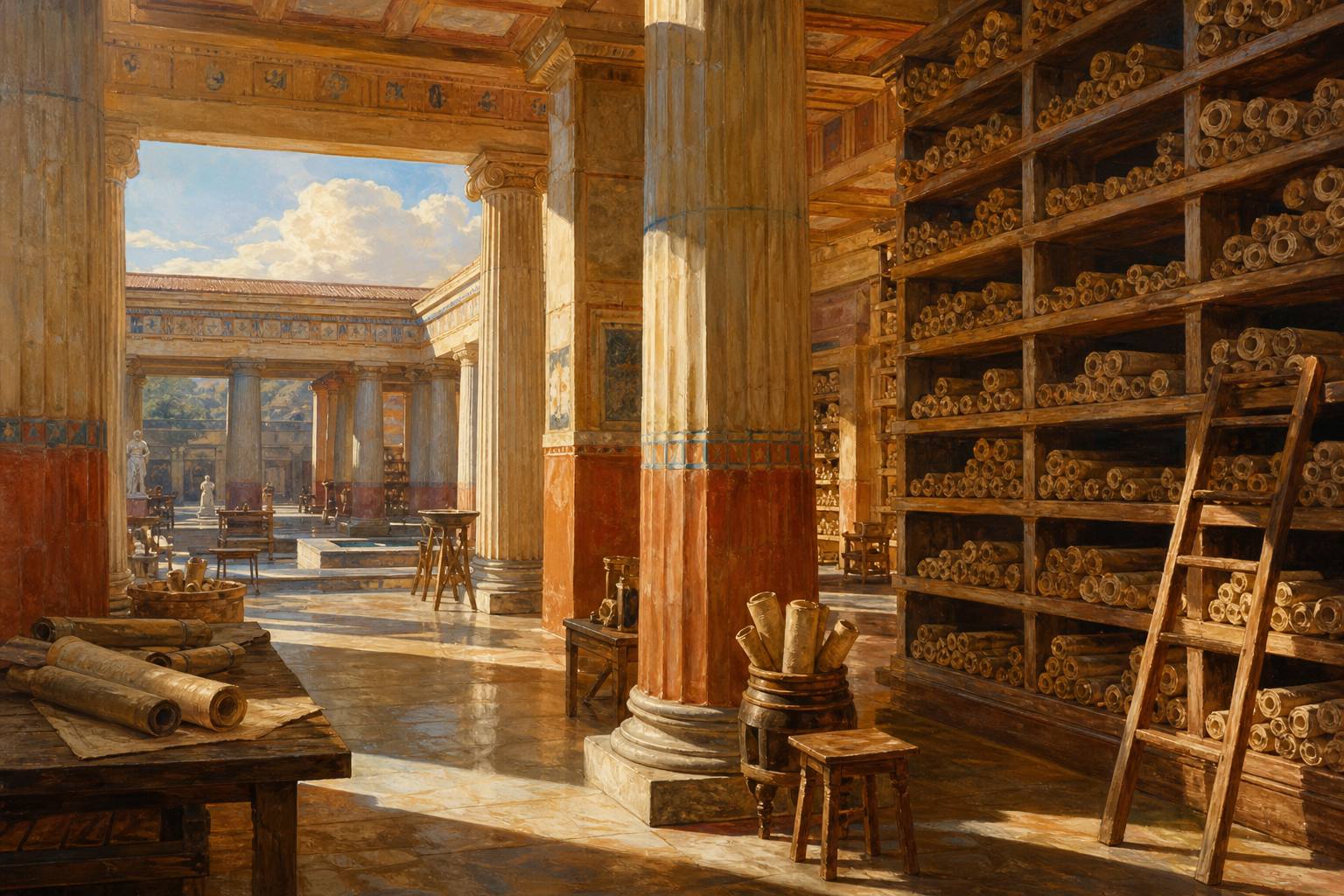
For thousands of years, the Mediterranean wrote on papyrus. Strips of a Nile reed were laid side by side, a second layer crossed over them, and the whole sheet pressed and dried. The oldest known roll is about 4,900 years old.
Why switch to skin? A story told by the Roman writer Pliny says that Egypt banned papyrus exports, so the city of Pergamon invented parchment instead.
Historians doubt it: people in the Near East already wrote on leather. Pergamon more likely improved the craft. But the name stuck: parchment comes from the Latin pergamentum.
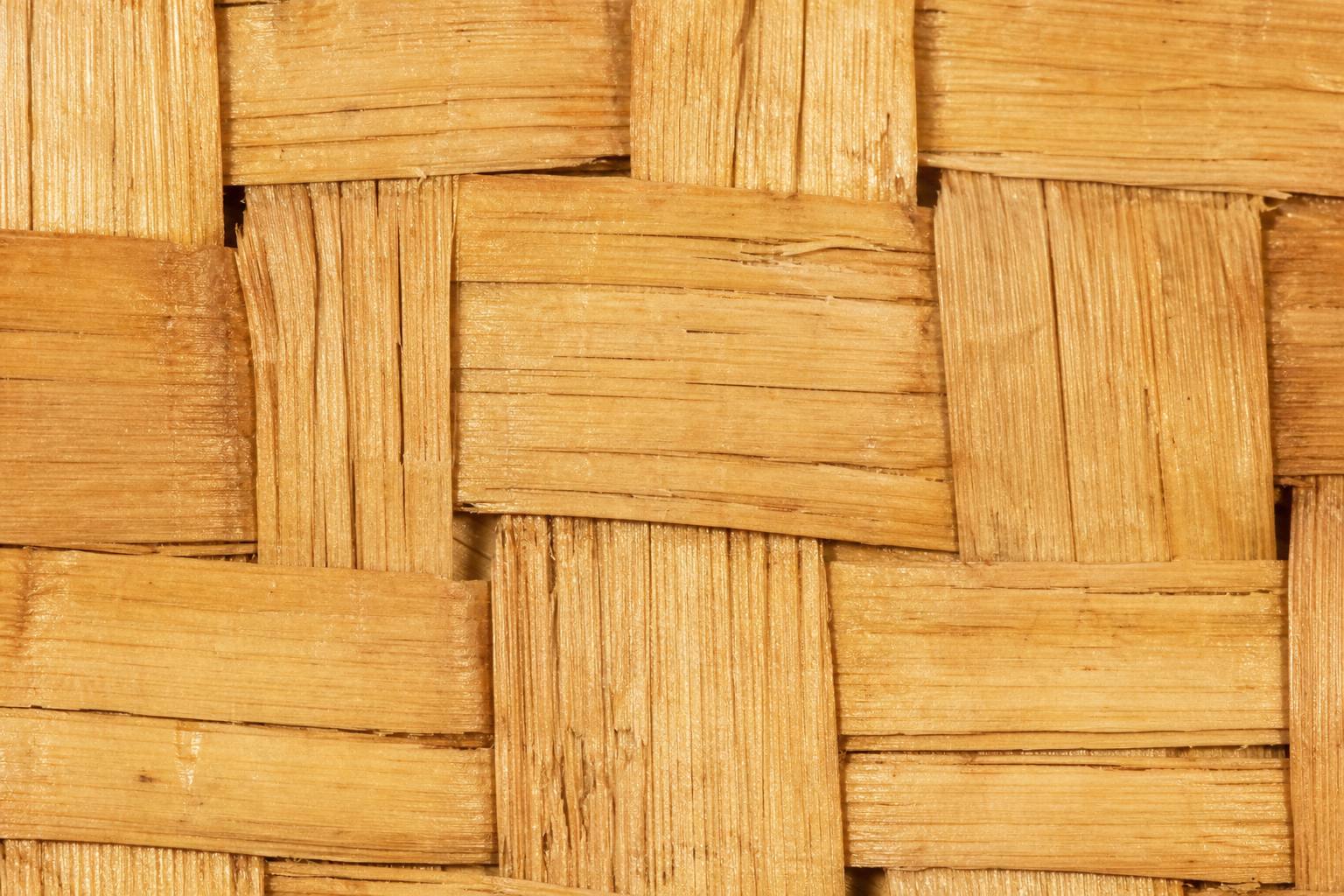
Papyrus, up close The two layers of strips still show, one running across, one running down. AI-generated illustration.
c. 2900 BC
oldest known roll, Saqqara
20
sheets in a common roll
Papyrus (Metropolitan Museum)The library of Pergamon An imagined library of scrolls: Pergamon’s rivalled Alexandria’s, which is where Pliny’s story starts. AI-generated illustration.
pergamentum
Latin: “of Pergamon”, whence “parchment”
The word
Chapter I · Before the book
Papyrus and Pergamon
Metropolitan Museum of Art: the earliest known papyrus roll was found at Saqqara and dates to about 2900 BC; strips of pith were laid in a vertical layer and a horizontal layer, pressed and dried; a common roll had 20 sheets; papyrus remained in use until about the 11th century AD. World History Encyclopedia: Pliny the Elder, citing Varro, says Ptolemy banned papyrus exports and parchment “was invented” at Pergamon under Eumenes II (reigned 197–159 BC); scholars such as Casson call this a misconception, since leather was already used for writing in the Near East. Cambridge University Library: “parchment” comes from the Latin pergamentum, after Pergamon. “About 4,900 years” is the film’s own arithmetic from 2900 BC.
Lay the strips, cross them, and press the sheet.
The 3D scenes are simplified teaching models, not reconstructions of real books or workshops.
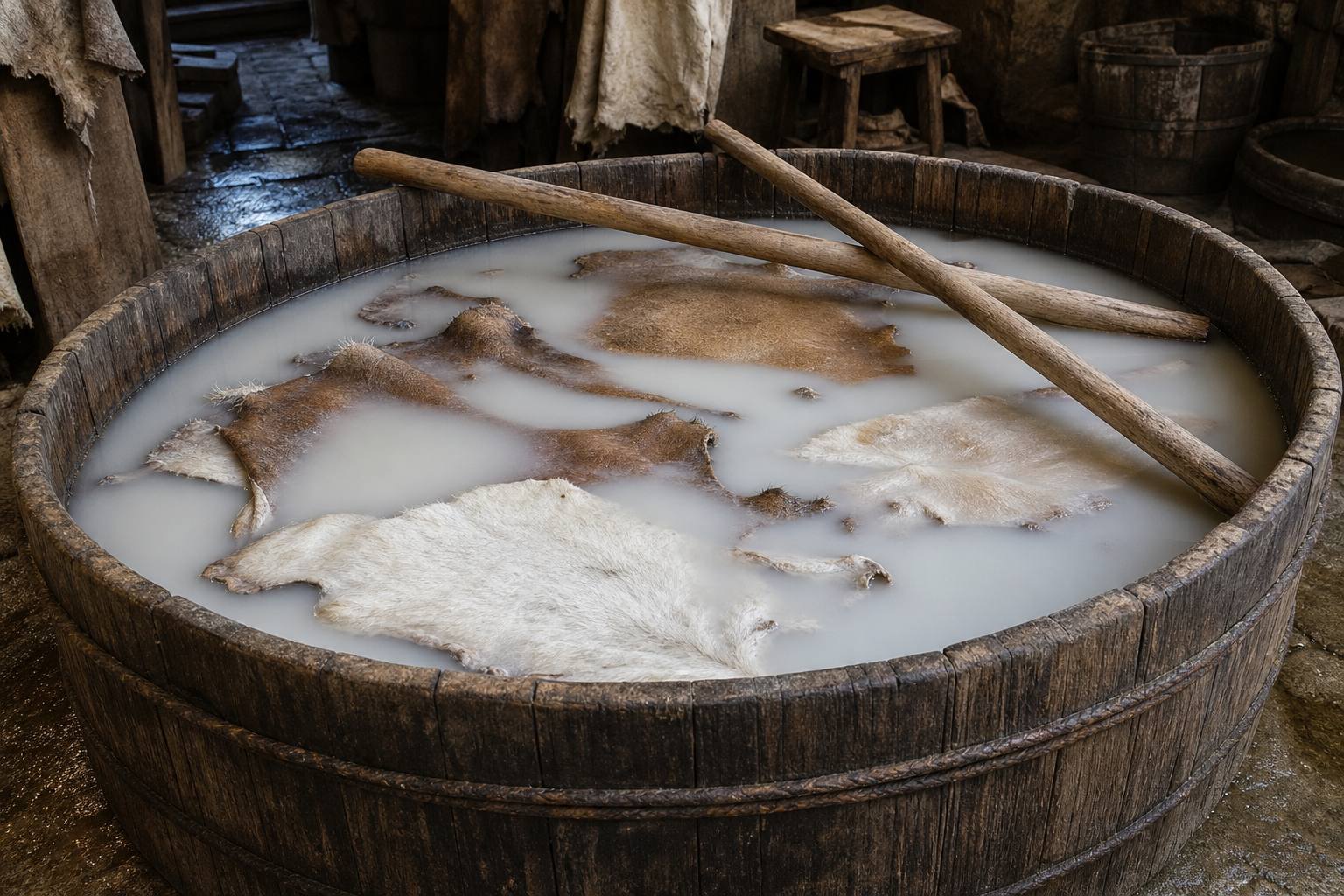
Parchment was made from the skins of calves, sheep and goats. First the skin was washed, then soaked for days in lime, which loosens the hair and breaks down fat. Remember that lime bath.
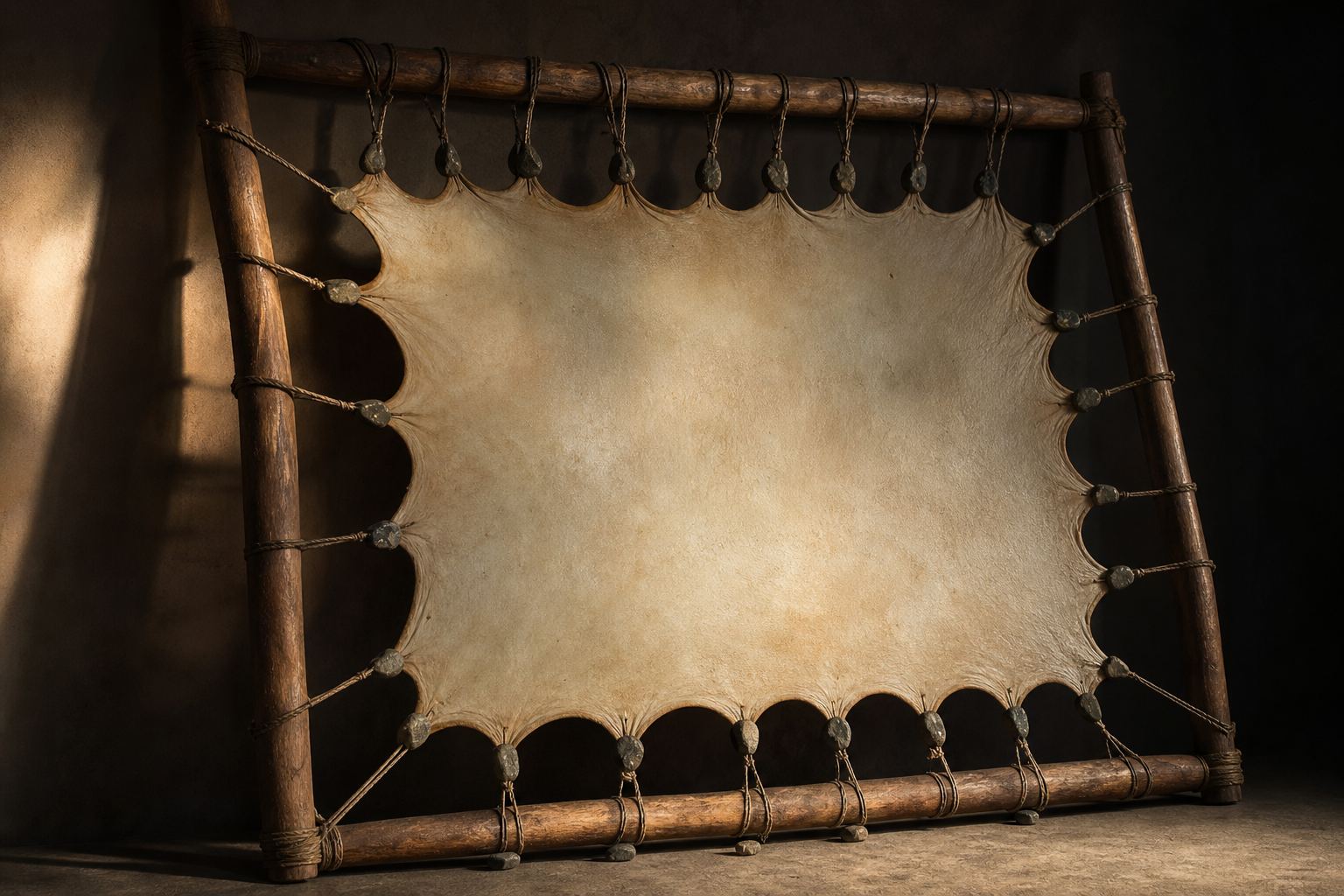
The hair was scraped off. Then the wet skin was tied by its edges to a wooden frame and stretched tight, and scraped again with a crescent-shaped knife. The tension thins it evenly.
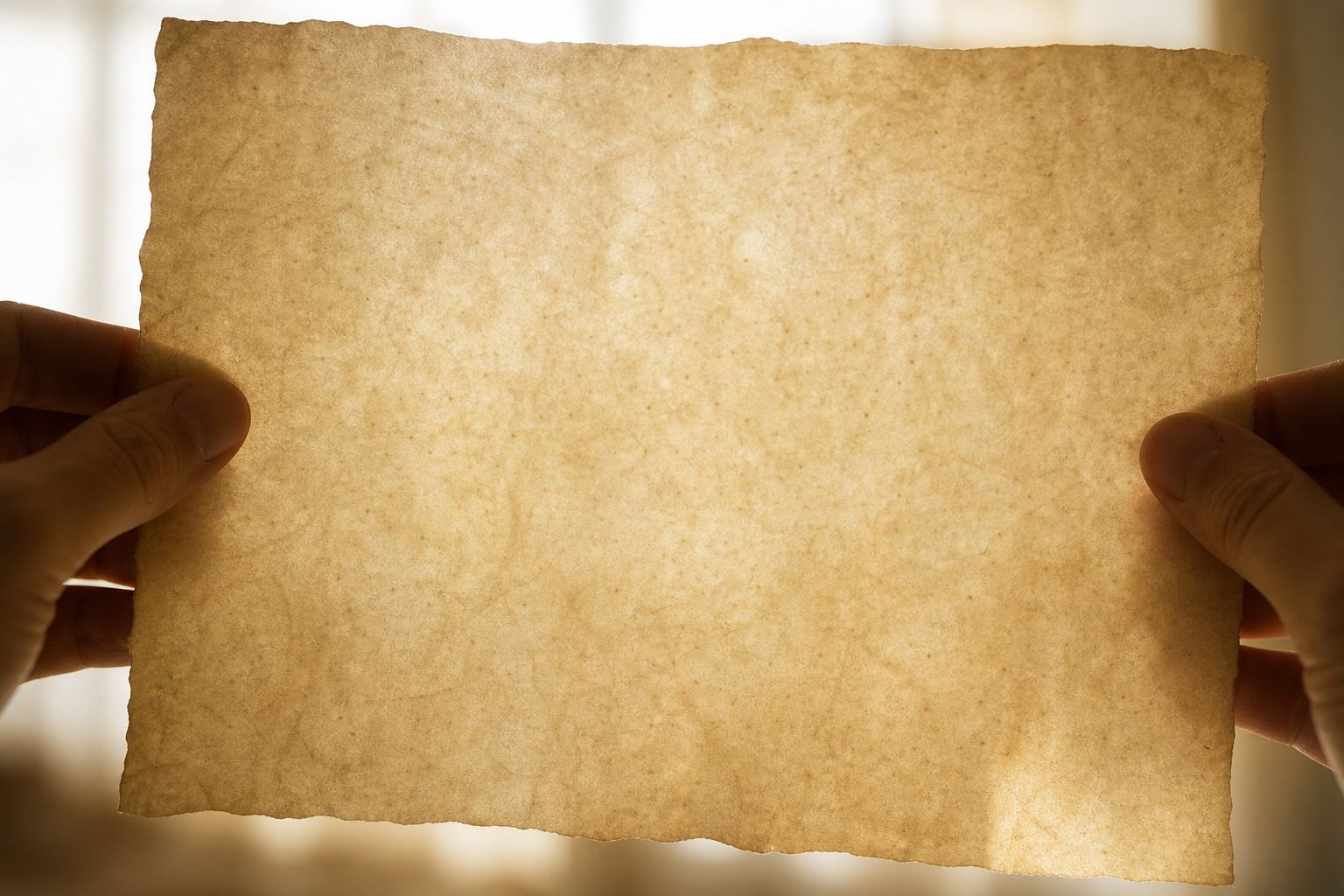
It dried under tension, and was rubbed with pumice or chalk. What is left is not leather, which is tanned, but a thin, stiff, pale sheet.
The lime bath Skins soak in milky lime water; workers moved them with poles to keep the lime off their own skin. AI-generated illustration.On the frame Small pebbles wrapped into the edge of the skin give the cords something to grip. AI-generated illustration.
wash
soak in lime; scrape off the hair
stretch on a frame
scrape with a crescent knife
dry under tension; rub with pumice
Five stagesParchment against the light Hair follicles can still show as tiny dark dots on the finished sheet. AI-generated illustration.
Chapter II · From skin to page
Making parchment
Cambridge University Library: the skin is washed, soaked in slaked lime (which breaks down proteins and fat; workers moved skins with wooden poles), scraped of hair, limed again, tied with “pippins” onto a wooden frame and stretched — the tension thins it evenly and aligns its fibres — scraped with a lunellum (a moon-shaped knife) and rubbed with pumice or chalk. Getty: skins of sheep, goats and calves spent several days in limewater, were stretched and scraped, thinned with a curved knife, sanded with pumice; hair follicles can show as tiny dark dots. Parchment is untanned; the contrast with tanned leather is the film’s plain statement of the difference.
Step through the stages with the buttons.
The 3D scenes are simplified teaching models, not reconstructions of real books or workshops.
A sheepskin is small: roughly forty-eight by sixty-six centimetres, enough for only a couple of large leaves. Big books needed big herds.
The Codex Amiatinus, a complete Latin Bible made in northern England and sent to Italy in 716, has over a thousand leaves. The manuscript scholar Christopher de Hamel counts 1,030 and estimates they took the skins of about 515 cattle. The book weighs over thirty-four kilograms.
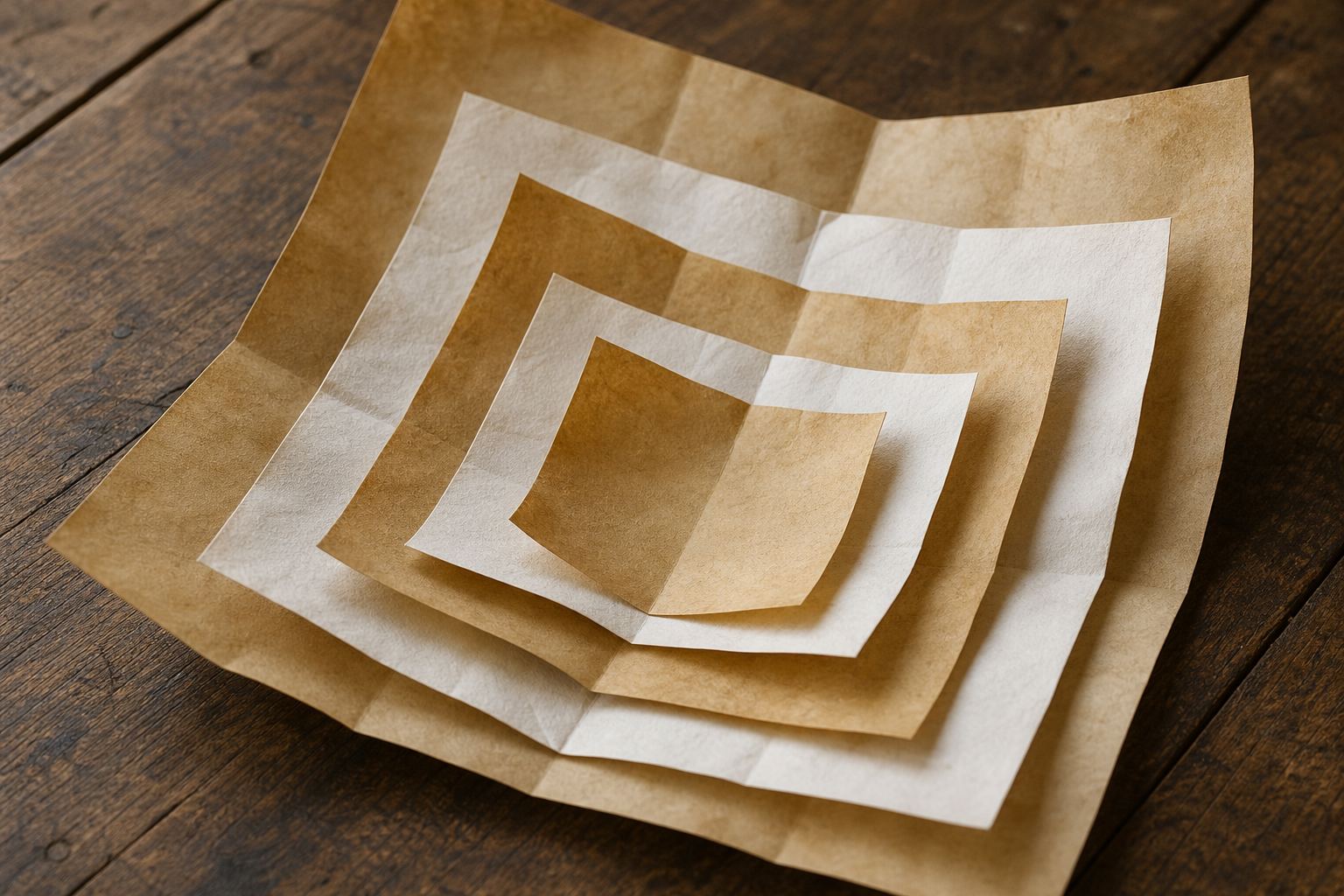
Each skin was folded and nested with others into a gathering, called a quire, of eight or ten leaves, with the darker hair sides facing each other, and the whiter flesh sides too.
Calf, sheep or goat Protein tests suggest English scribes used mostly sheep, French ones cows, Italian ones goats. AI-generated illustration.Codex Amiatinus A book as heavy as a child: 49 by 34 by 18 centimetres, now in Florence. AI-generated illustration.
1,030
leaves, by de Hamel’s count (others give 1,040)
~515
cattle, by de Hamel’s estimate
>34 kg
weight
Codex AmiatinusA quire Four or five folded sheets nested together: open the book anywhere and both pages match in colour. AI-generated illustration.
Chapter II · From skin to page
Animals and gatherings
Cambridge University Library: a sheepskin is roughly 48 × 66 cm and gives only a couple of leaves; proteomics suggests sheep were most used in England, cows in France and goats in Italy. Wikipedia, citing Christopher de Hamel (Meetings with Remarkable Manuscripts, 2016): the Codex Amiatinus, made at Wearmouth–Jarrow and taken to Italy in 716, has 1,030 leaves from about 515 cattle, measures 49 × 34 × 18 cm and weighs over 34 kg; it is in Florence. Smithsonian: “more than 1,000 animal skins”, the earliest complete Latin Bible. University of Nottingham: a quire is 4–5 folded sheets, giving 8–10 leaves; hair sides face hair sides and flesh sides face flesh sides. “As heavy as a child” is the film’s comparison.
Choose a book and watch the herd it needs; one figure stands for ten animals.
The 3D scenes are simplified teaching models, not reconstructions of real books or workshops.
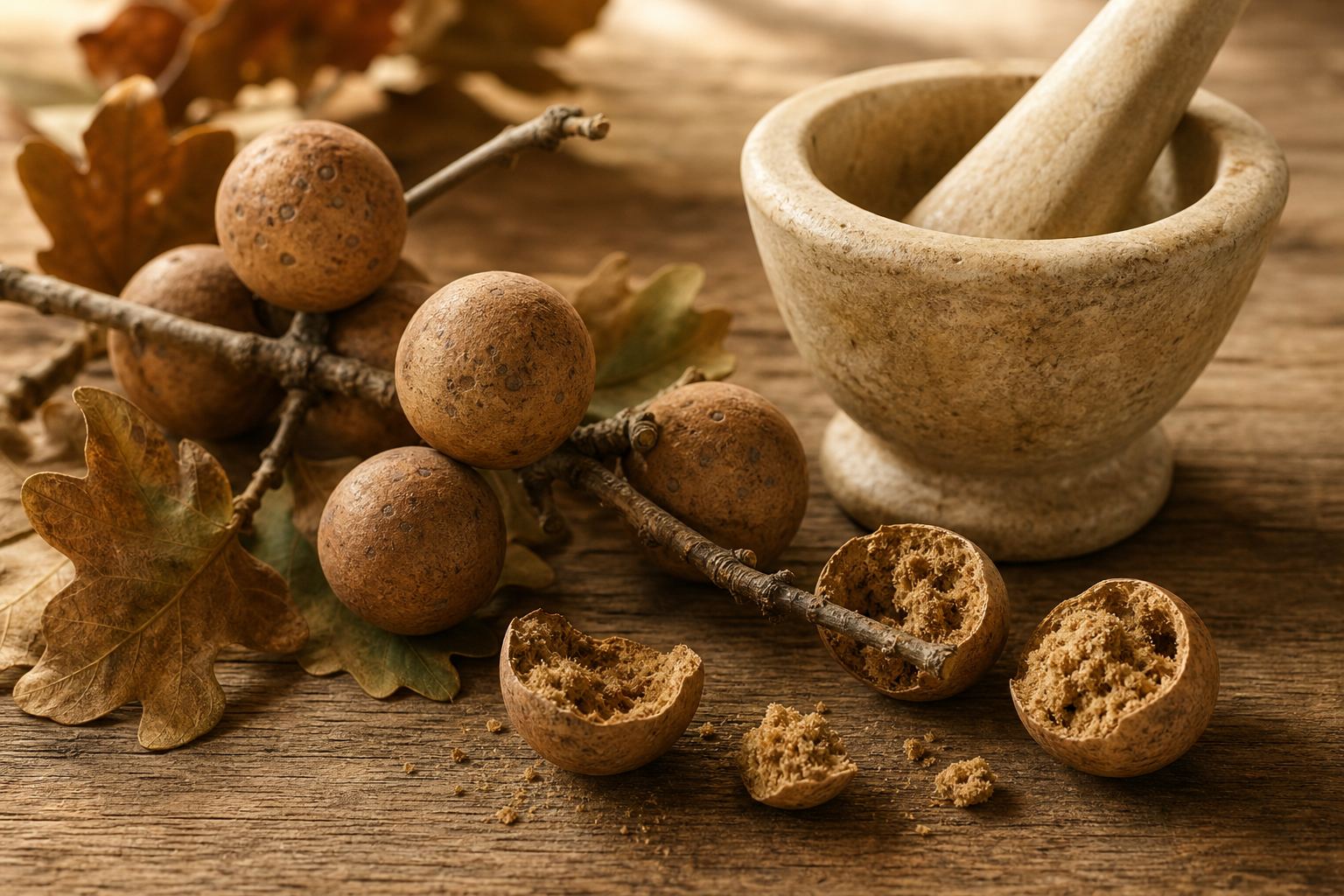
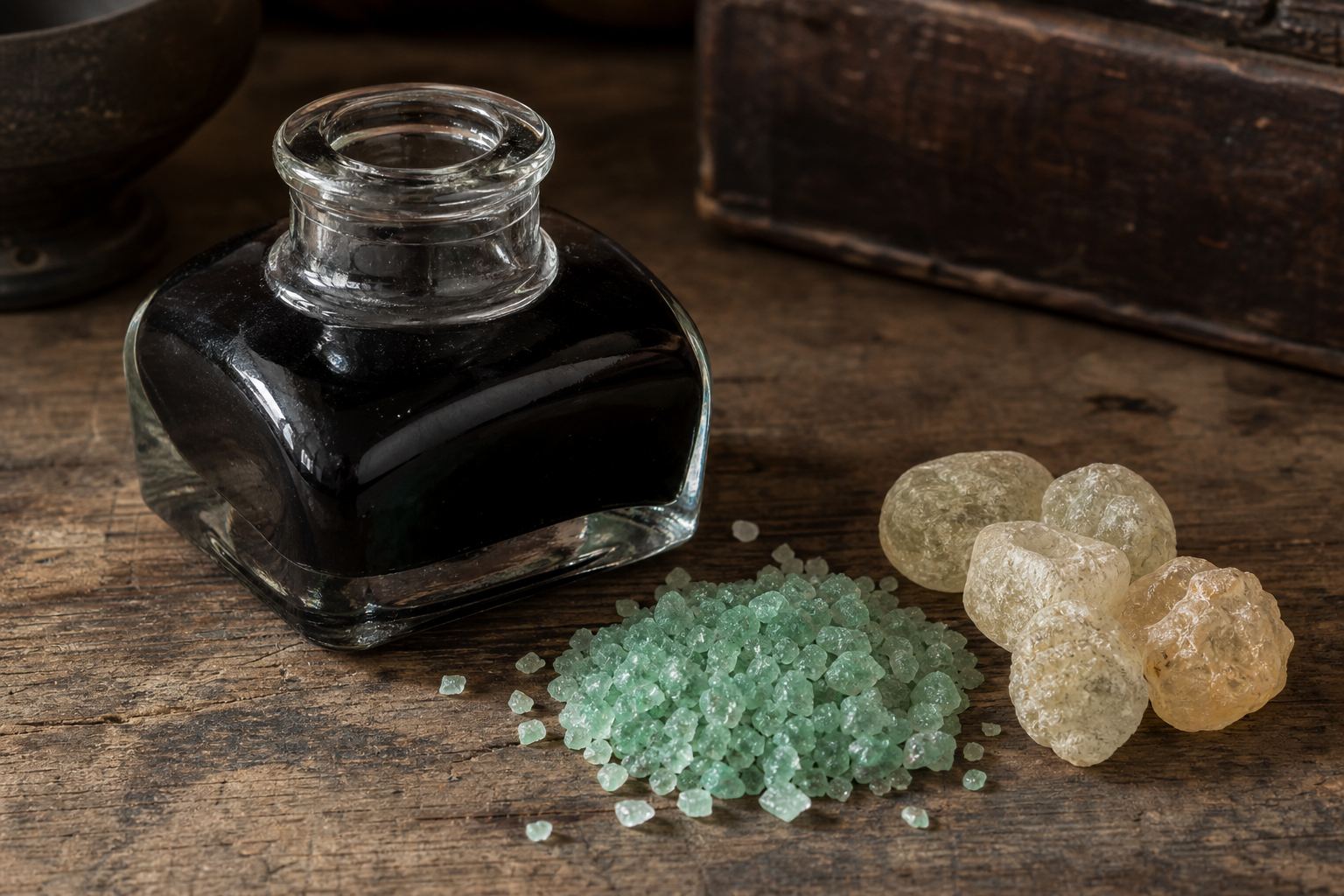
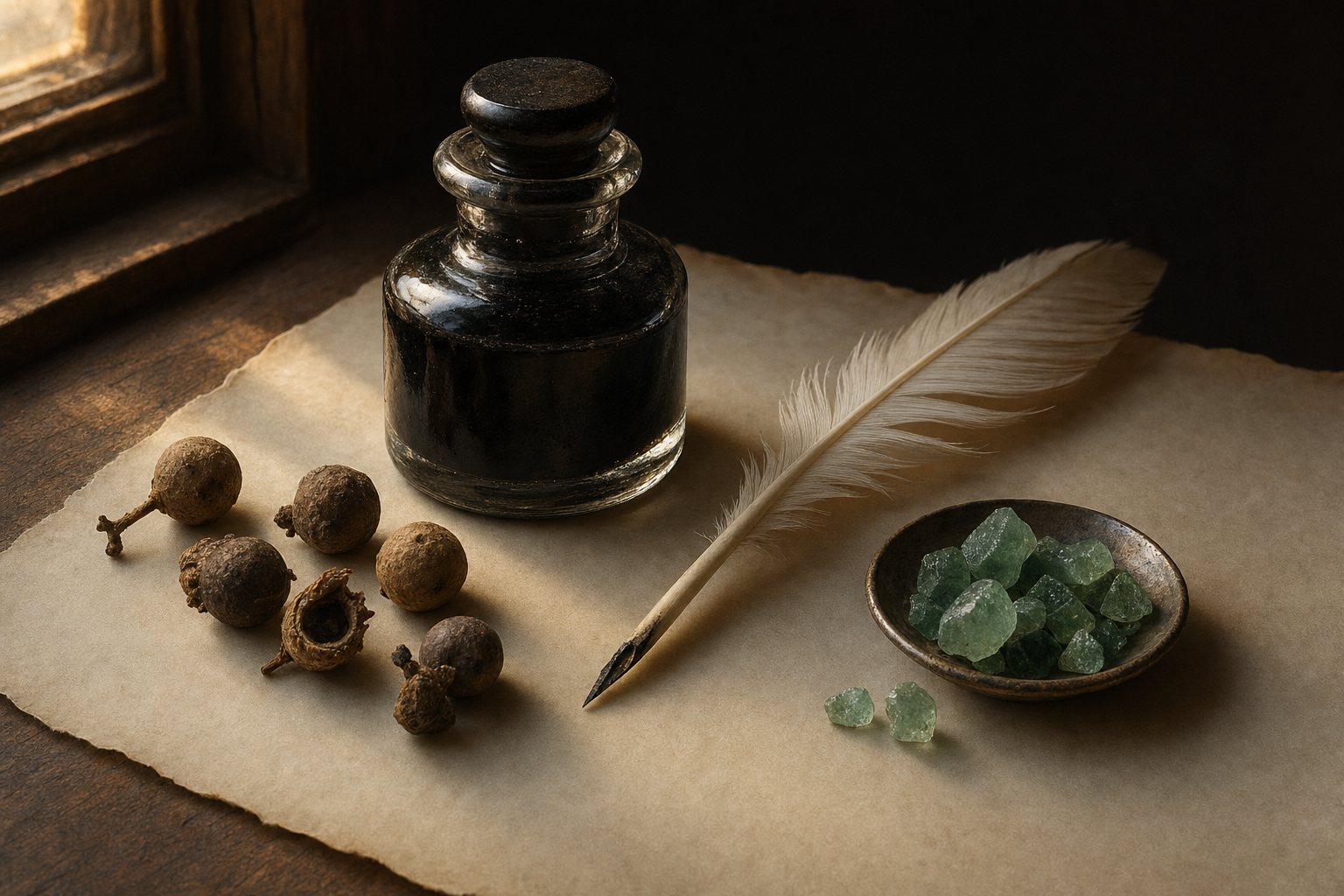
The ink was chemistry. Many medieval books used iron gall ink: crushed oak galls, round growths found on oak trees, mixed with water, iron sulfate and gum arabic.
At first the ink is pale. On the page, it reacts with oxygen in the air and turns into a black compound that will not wash away.
It has a cost. The ink is very acidic, and over the centuries it can eat into the page. Older carbon ink, soot and gum, sits on top of parchment and can rub off.
Oak galls Galls are rich in tannins: gallotannic acid is what reacts with iron to make the black. AI-generated illustration.The other ingredients Green iron sulfate crystals and gum arabic, which thickens the ink so it holds on the page. AI-generated illustration.iron(II) gallate+O2→iron(III) gallate (black)Simplified: the iron in the ink gains oxygen and the colourless compound becomes a black, insoluble one.
c. 2500 BC
carbon ink in use
c. AD 200s
iron gall ink comes into use
Two inks (Royal Society of Chemistry)What the recipe needs Iron gall ink bites into the surface rather than sitting on it, which is why it cannot simply be wiped away. AI-generated illustration.
Chapter III · Ink and quill
Iron gall ink
Royal Society of Chemistry: iron gall ink is made from oak galls (a source of gallotannic acid), water, iron(II) sulfate and gum arabic; the colourless iron(II) gallate oxidises in air to a black, insoluble complex; the ink is very acidic and damages paper and parchment over the centuries; it came into use around the 3rd century AD. Carbon ink — carbon, water and gum — was in use from about 2500 BC; without gum it rubs off parchment.
Add the ingredients, then write a stroke and watch it darken.
The 3D scenes are simplified teaching models, not reconstructions of real books or workshops.
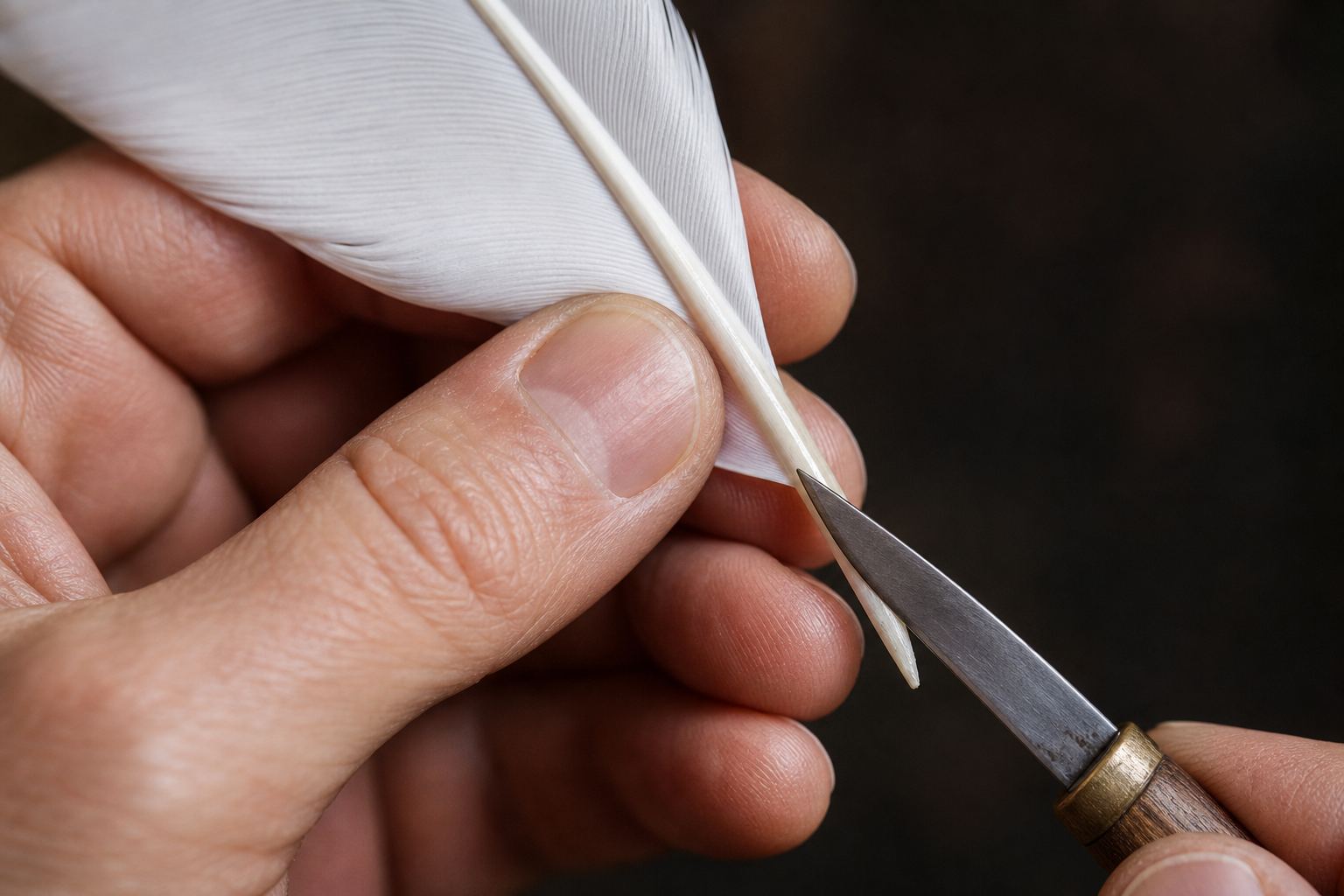
The pen was a quill, a goose or swan feather cut to a point. The scribe’s other hand held a small knife: to sharpen the quill, to scrape away mistakes, and to hold the page steady.
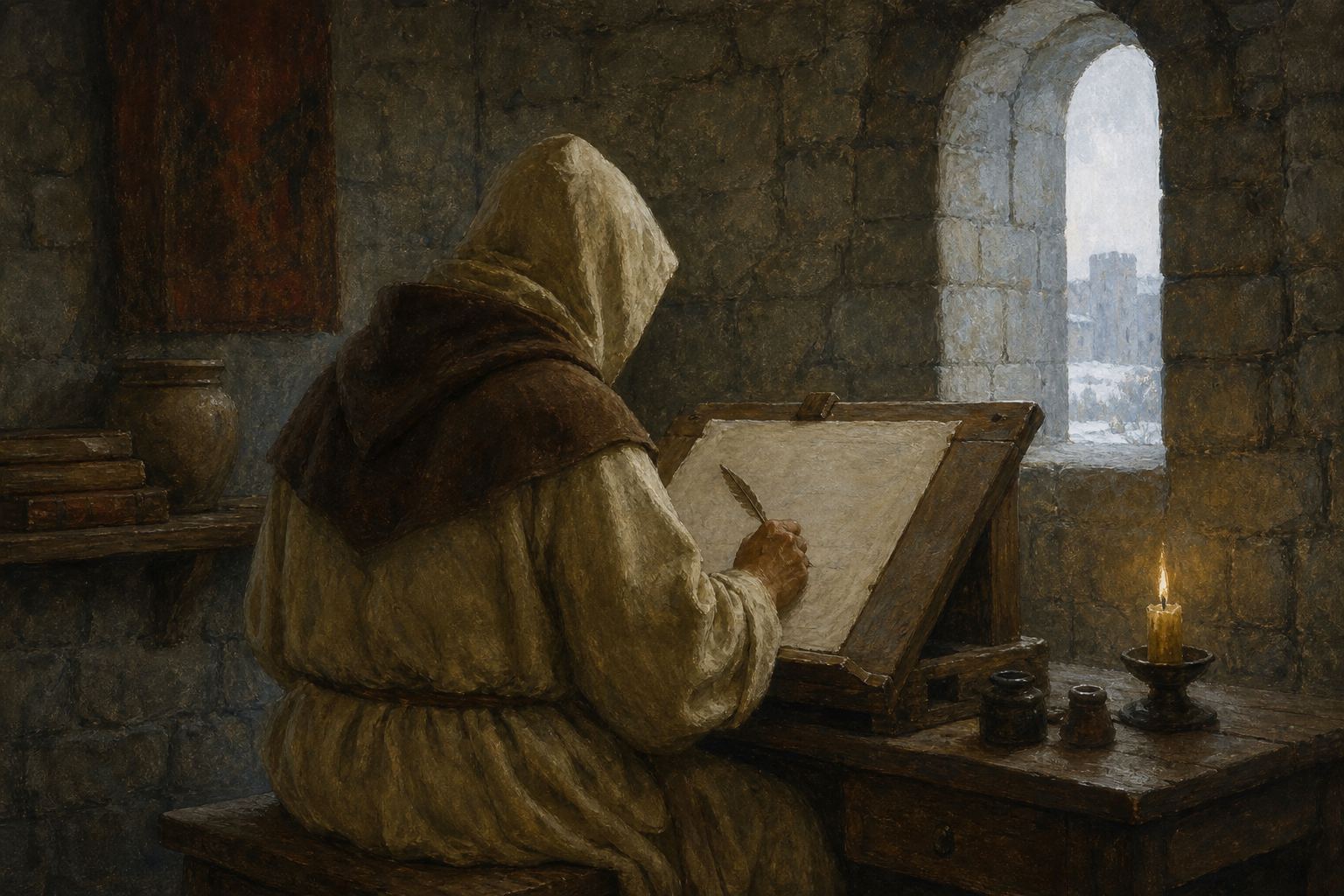
The scribe copied from another book, the exemplar, set on a stand. Headings and instructions, called rubrics, were often written in red ink.
It was hard work. A tenth-century scribe in Spain, Florentius, wrote that copying “mists the eyes, curves the back, breaks the belly and the ribs.”
Cutting a quill A small knife shapes and splits the nib; a scribe re-cut it many times a day. AI-generated illustration.Copying A scribe at a sloping desk in a cold stone room: weights held the pages of the exemplar open. AI-generated illustration.
“It mists the eyes, curves the back, breaks the belly and the ribs.”Florentius of Valeránica, 10th century, quoted by the British Library
Chapter III · Ink and quill
Quills and scribes
Getty: quills were goose or swan feathers; a knife sharpened the quill, scraped away mistakes and held the page steady. British Library: scribes copied from an exemplar set on a stand, its pages held down by weights; red ink was used for rubrics; in the 10th century Florentius of Valeránica wrote that copying “mists the eyes, curves the back, breaks the belly and the ribs”.
Write a line, then switch to red for a heading.
The 3D scenes are simplified teaching models, not reconstructions of real books or workshops.
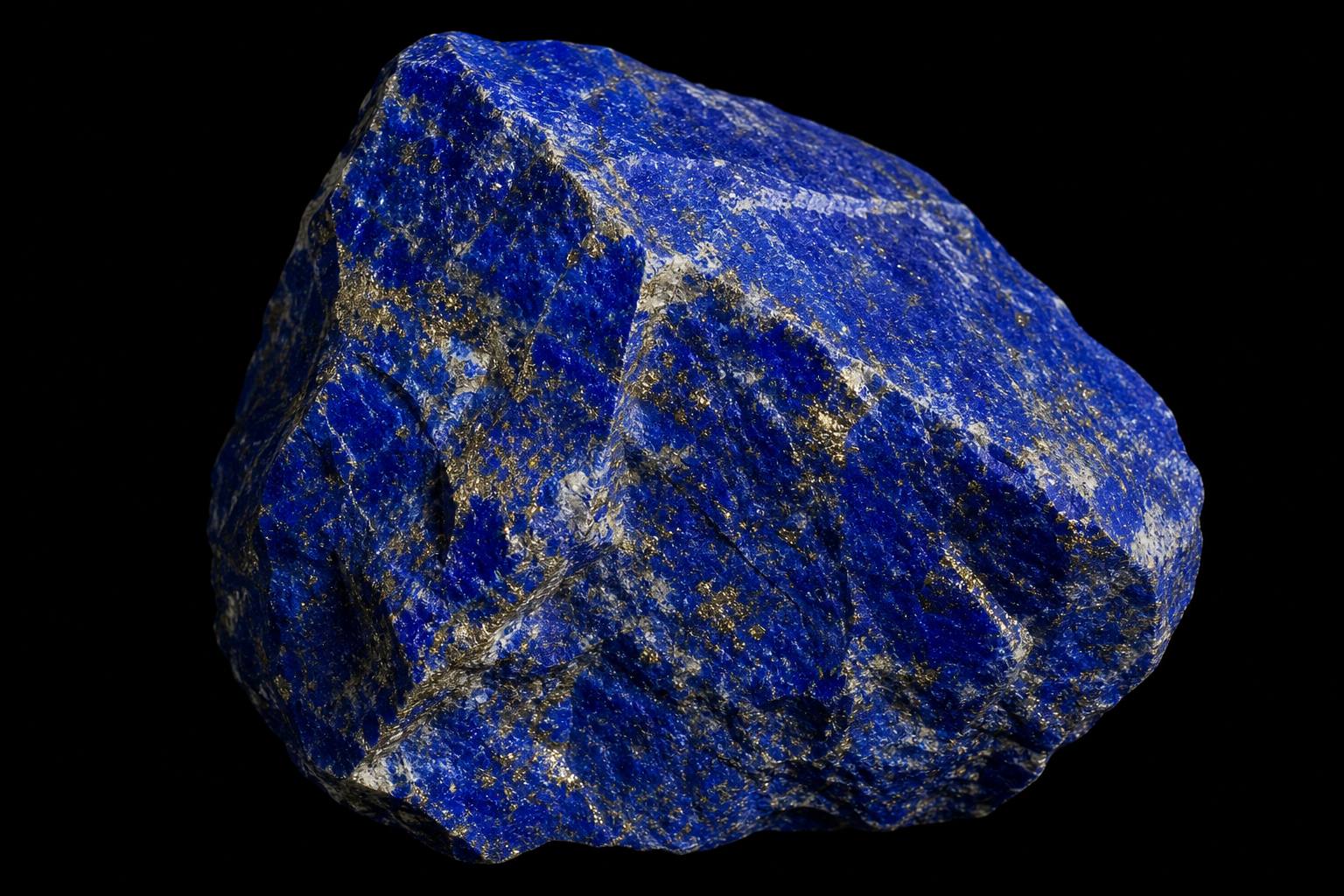
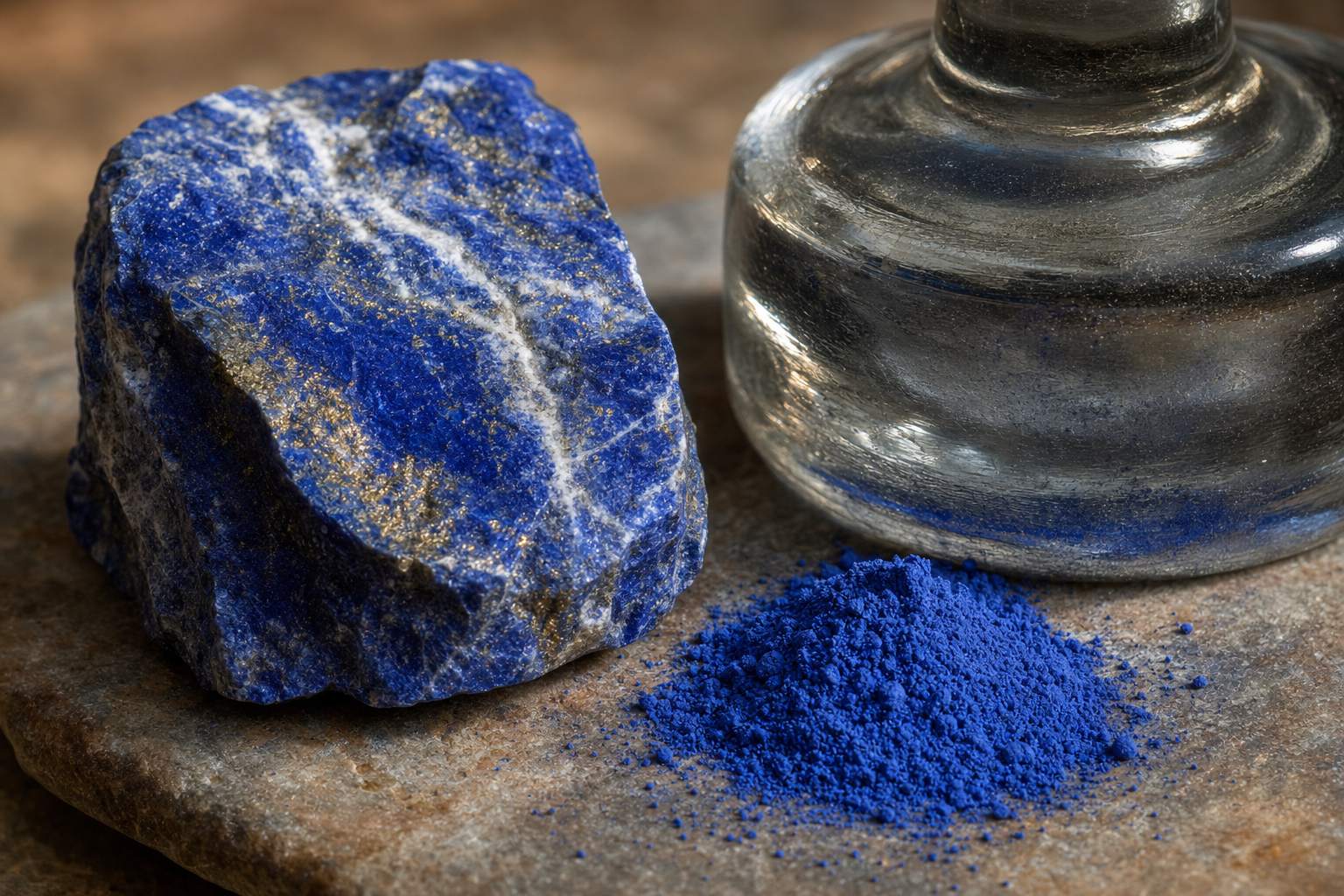
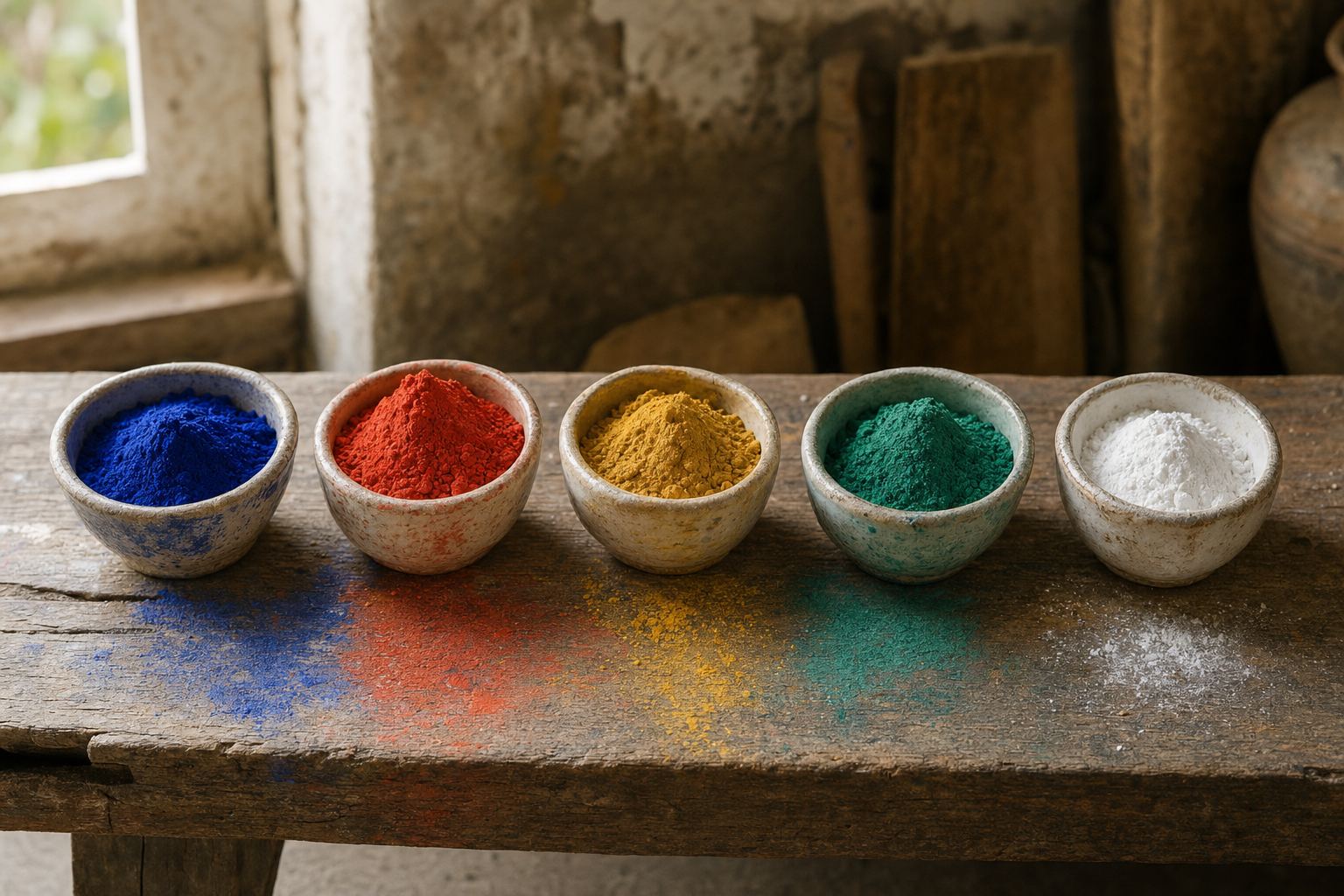
Then came colour. The finest blue, ultramarine, was ground from lapis lazuli. The best stone came from one region of Afghanistan, at Sar-e-Sang in the Hindu Kush; in Europe it was simply said to come from across the sea.
Red vermilion was mercury sulfide. Green verdigris came from copper treated with acid, and slowly eats the page. The common yellow, orpiment, contains arsenic.
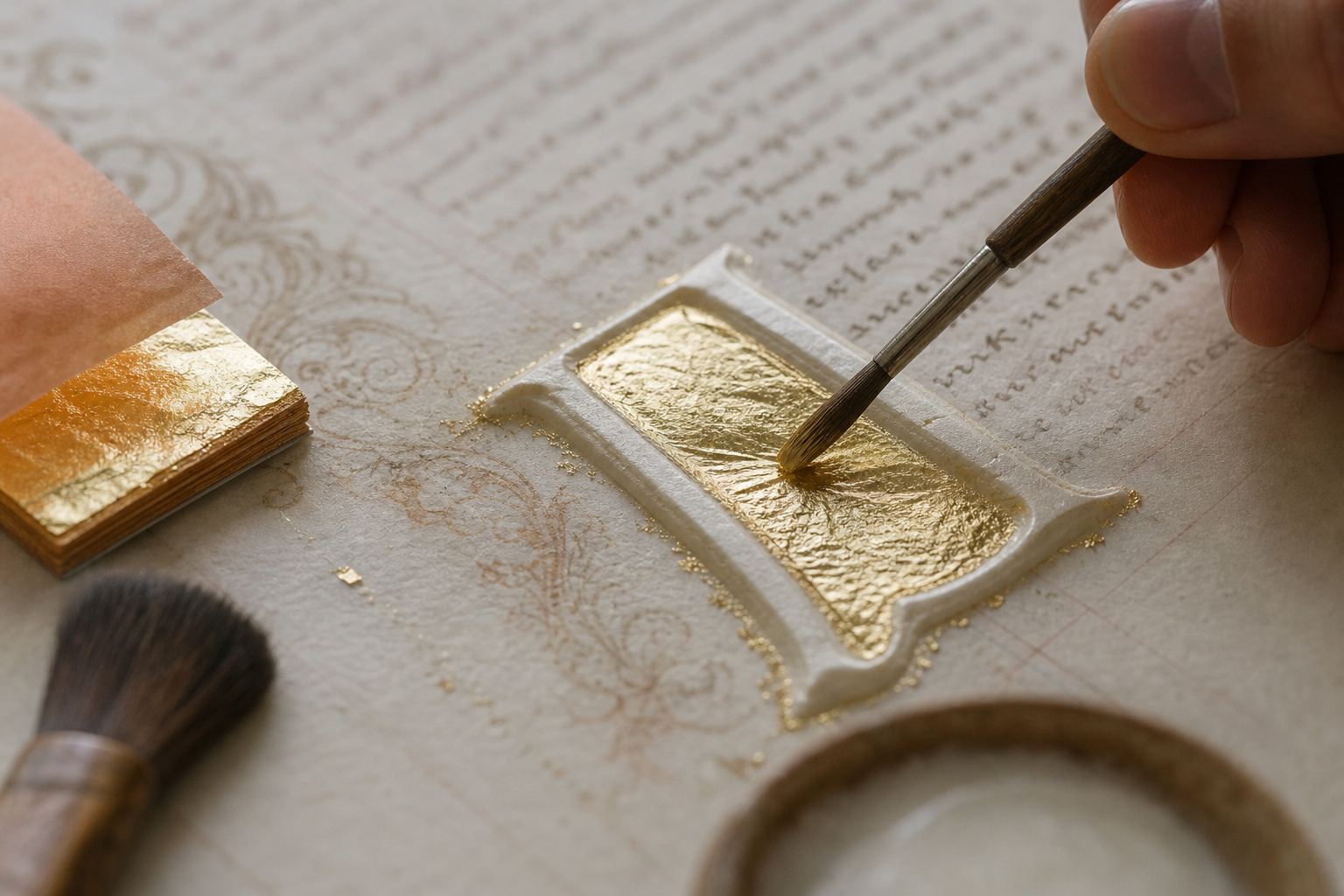
And gold was laid on as thin leaf, over a raised cushion of gesso, so that it stood up from the page and caught the light.
Lapis lazuli The blue mineral is lazurite; the gold flecks are pyrite, which had to be washed out. AI-generated illustration.
1
source of the finest lapis
ground, washed, repeated
to separate the purest blue
Sar-e-Sang, Hindu Kush
ultramarine: lapis lazuli, Afghanistan
vermilion: mercury sulfide
verdigris: copper and acid; corrodes
orpiment: arsenic sulfide
lead white, red lead; madder, brazilwood
A medieval paletteGround from a stone The stone came overland from Afghanistan; ground into ultramarine it could cost more than its weight in gold. AI-generated illustration.Gold on gesso The text was written first; then the gold went down, and only then the paint. AI-generated illustration.
Chapter IV · Blue and gold
Pigments
Cambridge University Library, The Moving Word: ultramarine came from lapis lazuli from a single mine region in Afghanistan, known in Europe only as coming from “across the sea”; vermilion is mercury sulphide; verdigris is copper treated with acid and corrodes the page; lead white and red lead discolour and flake; orpiment, an arsenic sulphide, was the most common yellow; organic dyes included madder and brazilwood; gold was applied as leaf or as “shell gold”. Bodleian Libraries: Sar-e-Sang in the Hindu Kush holds the only reserves of the highest-grade lapis; painters ground the stone and washed it repeatedly (levigation). Getty: gold leaf was laid on gesso or bole, and text was written before painting began.
Pick a colour to see what it was made from, and what it costs the page.
The 3D scenes are simplified teaching models, not reconstructions of real books or workshops.
Who did this work? We often imagine monks. In 2019, scientists studying a skeleton from a women’s religious community at Dalheim, in Germany, found something unexpected.
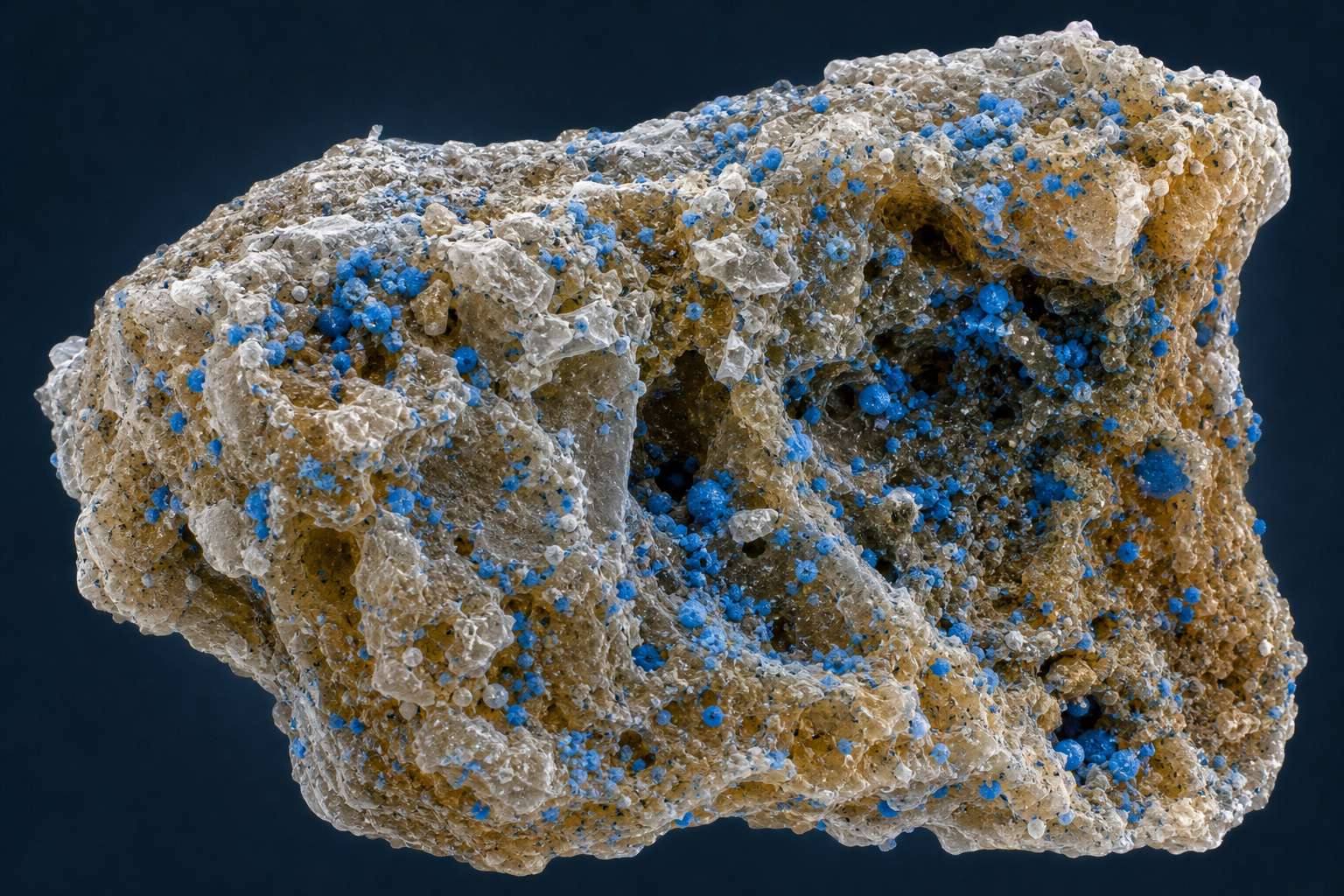
In the hardened plaque on her teeth were more than a hundred tiny particles of lazurite, the blue mineral of lapis lazuli. She died between about 997 and 1162, aged around forty-five to sixty.
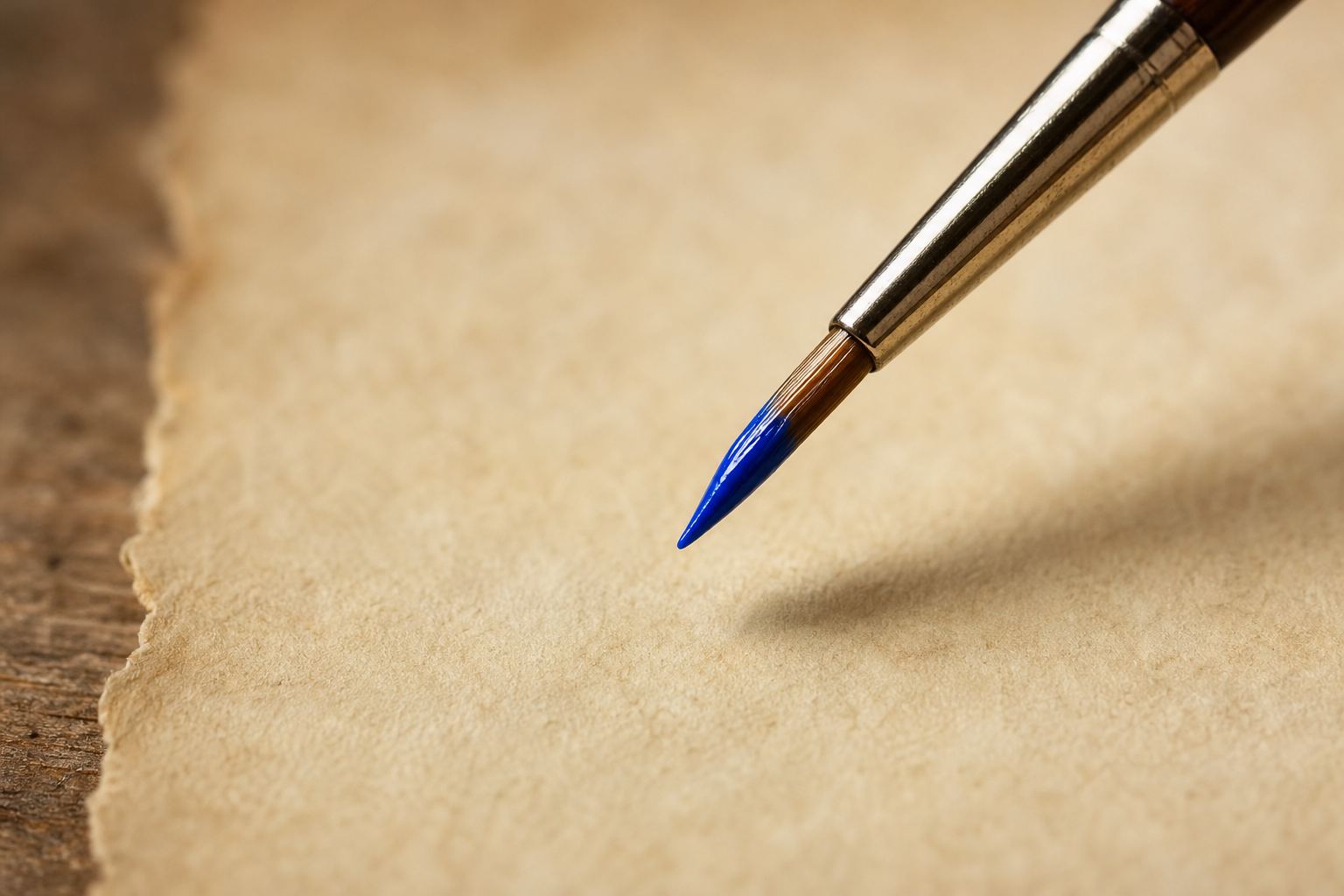
The likeliest reading, the team wrote, is that she painted manuscripts, and licked her brush to a point. Ultramarine, at the time, was as costly as gold.
Under the microscope Dental calculus traps what passes through the mouth, and keeps it for a thousand years. AI-generated illustration.
100+
lazurite particles
997–1162
radiocarbon date
45–60
age at death
Individual B78, Dalheim (Science Advances, 2019)The colours on the bench Several of them are poisons: lead white is lead, and vermilion is a compound of mercury. AI-generated illustration.A pointed brush A fine brush loaded with ultramarine: licking it to a point would leave traces in the mouth. AI-generated illustration.
Chapter IV · Blue and gold
The woman of Dalheim
Radini, Warinner et al., Science Advances 5(1), eaau7126 (9 January 2019): individual B78 from the cemetery of a women’s religious community at Dalheim, Germany, aged about 45–60 and radiocarbon dated to AD 997–1162, had more than 100 lazurite particles in her dental calculus; the authors consider the most likely explanation that she painted manuscripts and licked her brush to a point; ultramarine was “as expensive as gold”. The paper discusses other possibilities, such as preparing pigment powder or consuming it as medicine, which it considers less likely.
Zoom into the plaque to find the blue.
The 3D scenes are simplified teaching models, not reconstructions of real books or workshops.
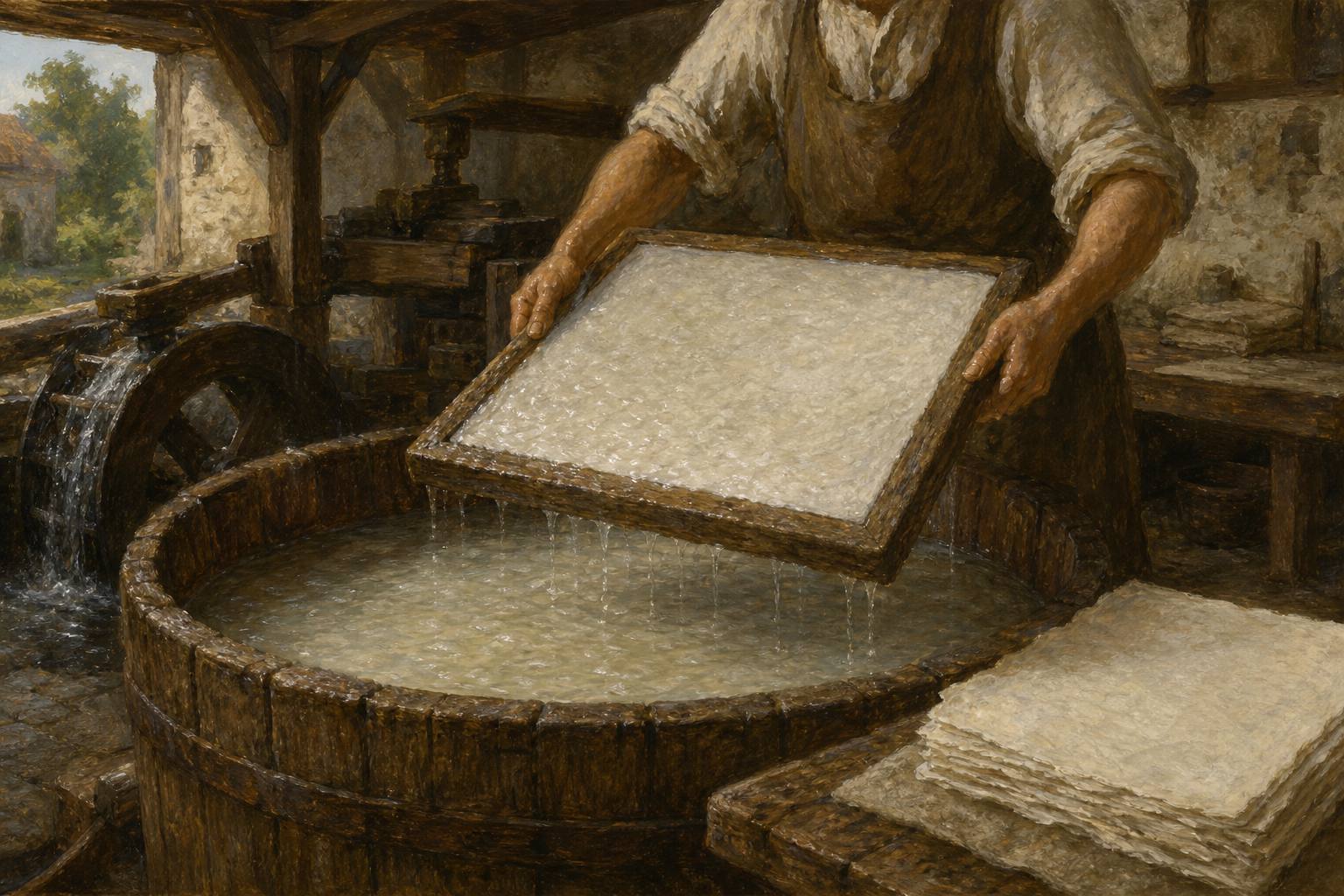
Paper, invented in China, reached the Islamic world and then Spain. Around 1150 the geographer al-Idrisi wrote that the town of Xàtiva made paper like none elsewhere in the civilised world.
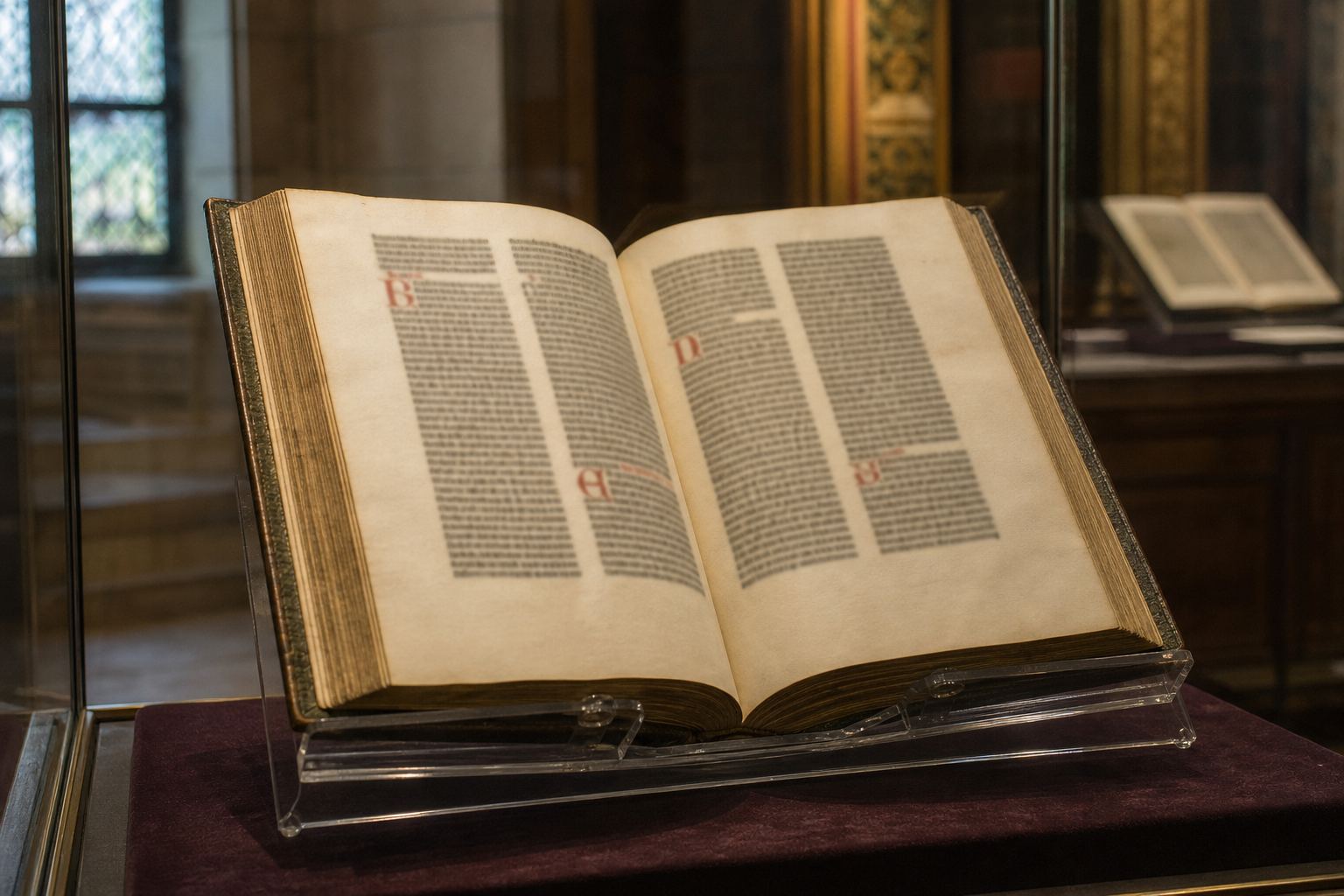
Then, around 1455 in Mainz, came Gutenberg’s printed Bible. Of about 180 copies, roughly 145 were printed on paper and about 35 on vellum, fine calfskin parchment.
Only three complete vellum copies survive, in Washington, Paris and London. Skin did not vanish, but after print, the book of skin became the exception.
A paper mill A mould lifts a thin layer of fibre from a vat of pulp: one sheet at a time, but no animals needed. AI-generated illustration.An early printed Bible Two columns of type, with red initials added by hand afterwards, as in a manuscript. AI-generated illustration.
~180
copies printed
~35
on vellum
3
complete vellum copies today
The Gutenberg Bible (Library of Congress)
Chapter V · Paper and print
Paper and print
Metropolitan Museum: paper from China had become the most popular writing material in the Arab world by about the 8th century. History of Information: about 1150 al-Idrisi wrote that Xàtiva made paper “such as cannot be found anywhere else in the civilized world”. Library of Congress: the Gutenberg Bible was printed in Mainz around 1455, about 180 copies, some 145 on paper and 35 on vellum; 49 survived into the 20th century, 21 of them complete; only three complete vellum copies exist, at the Library of Congress, the Bibliothèque nationale de France and the British Library.
Run the press and watch the sheets pile up.
The 3D scenes are simplified teaching models, not reconstructions of real books or workshops.
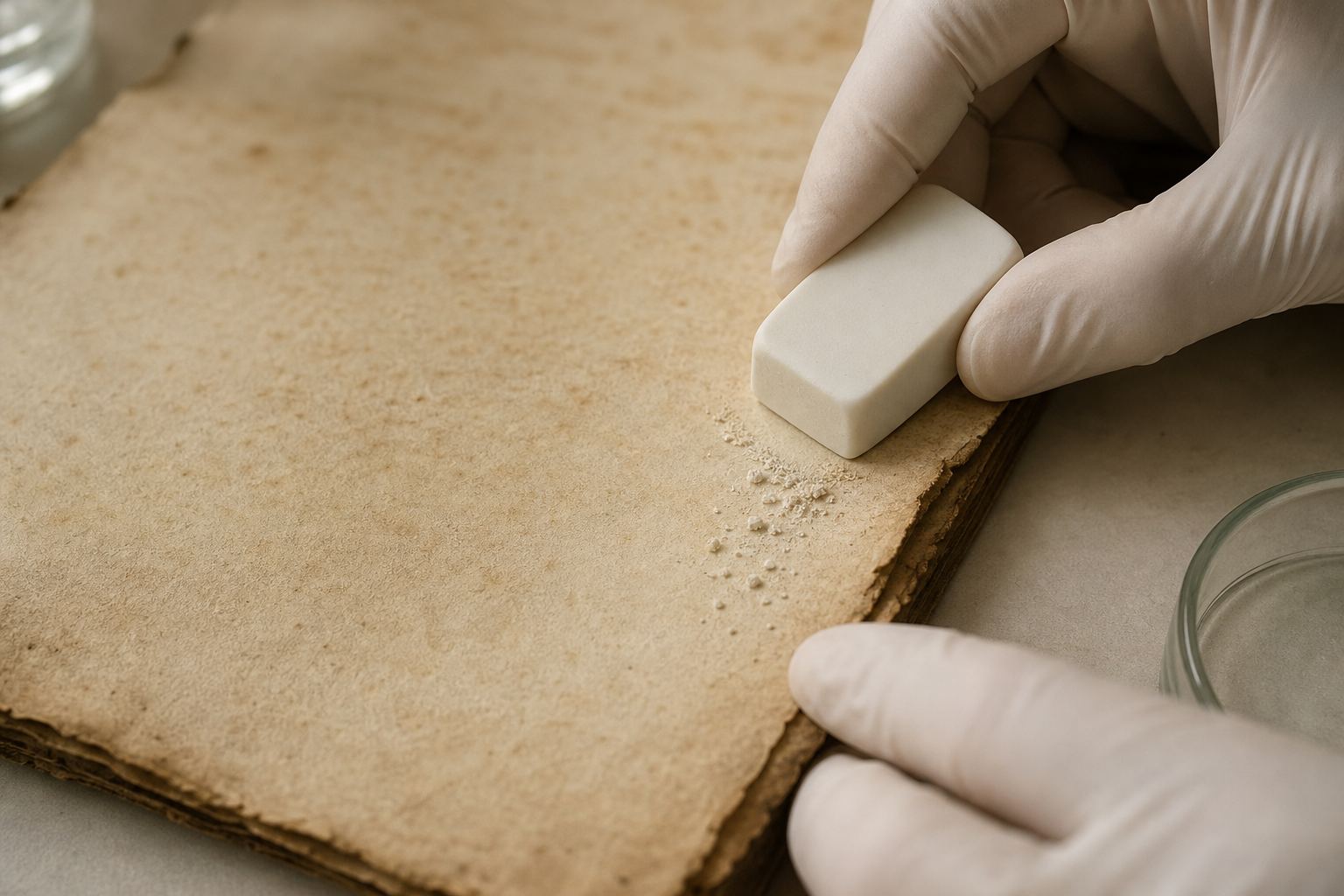
How do you test a precious page without harming it? In 2015 a team from the University of York showed that rubbing parchment gently with an ordinary plastic eraser picks up its proteins on the crumbs, enough to tell calf from sheep or goat.
In 2017 they turned it on the York Gospels. The original book was calfskin, and of the five calves whose sex could be read, four were female.
About one in nine of the DNA readings was human, and the pages holding the oaths had among the most. A thousand years of hands left their mark.
Eraser sampling The crumbs pick up protein by static charge; nothing is cut from the page. AI-generated illustration.Nothing is cut from the page The sample comes from the rubber used to clean the leaf, not from the leaf itself, so the book is left whole. AI-generated illustration.York Minster The book was probably written in Canterbury around the year 1000 and brought to York around 1020. AI-generated illustration.
11.1%
of DNA reads human, on average
4 of 5
sexed calves were female
86
pages tested for protein
The York Gospels (Teasdale et al., 2017)
Chapter VI · What the pages remember
Biocodicology: reading the biology of books
ScienceDaily on Fiddyment et al., PNAS (2015): rubbing parchment with a PVC eraser collects protein by electrostatic charge; mass spectrometry of the crumbs identifies the species. Teasdale et al., Royal Society Open Science (2017), “The York Gospels: a 1000-year biological palimpsest”: protein was tested on 86 folios and DNA on 8; the original book is calfskin with one sheepskin bifolium; four of the five calves whose sex could be read were female; human DNA averaged 11.1% of reads (4.2–20.8%), about twice the control documents, and the folio holding the oaths had among the highest; skin bacteria were also present. The paper suggests handling and oath-swearing; it does not show that the pages were kissed. University of York and York Minster: the book was probably written at Canterbury around 1000 and brought to York by Archbishop Wulfstan around 1020. “About one in nine” is the film’s rounding of 11.1%.
Rub the margin, collect the crumbs, then read what they hold.
The 3D scenes are simplified teaching models, not reconstructions of real books or workshops.
This year’s study screened 754 samples and pieced together 21 ancient sheeppox genomes. The oldest came from a sheep’s tooth found in Kazakhstan, from around 1700 BC: probably the oldest poxvirus genome yet recovered.
Others came from book pages: the York Gospels, a Cambridge glossary from about 800, and letters of St Paul from about 700. The virus had changed little over thousands of years.
Some positive pages were calfskin or goatskin. The authors suggest, among other explanations, rare infections across species, or contamination in shared lime baths. It is one new study, and the first of its kind.
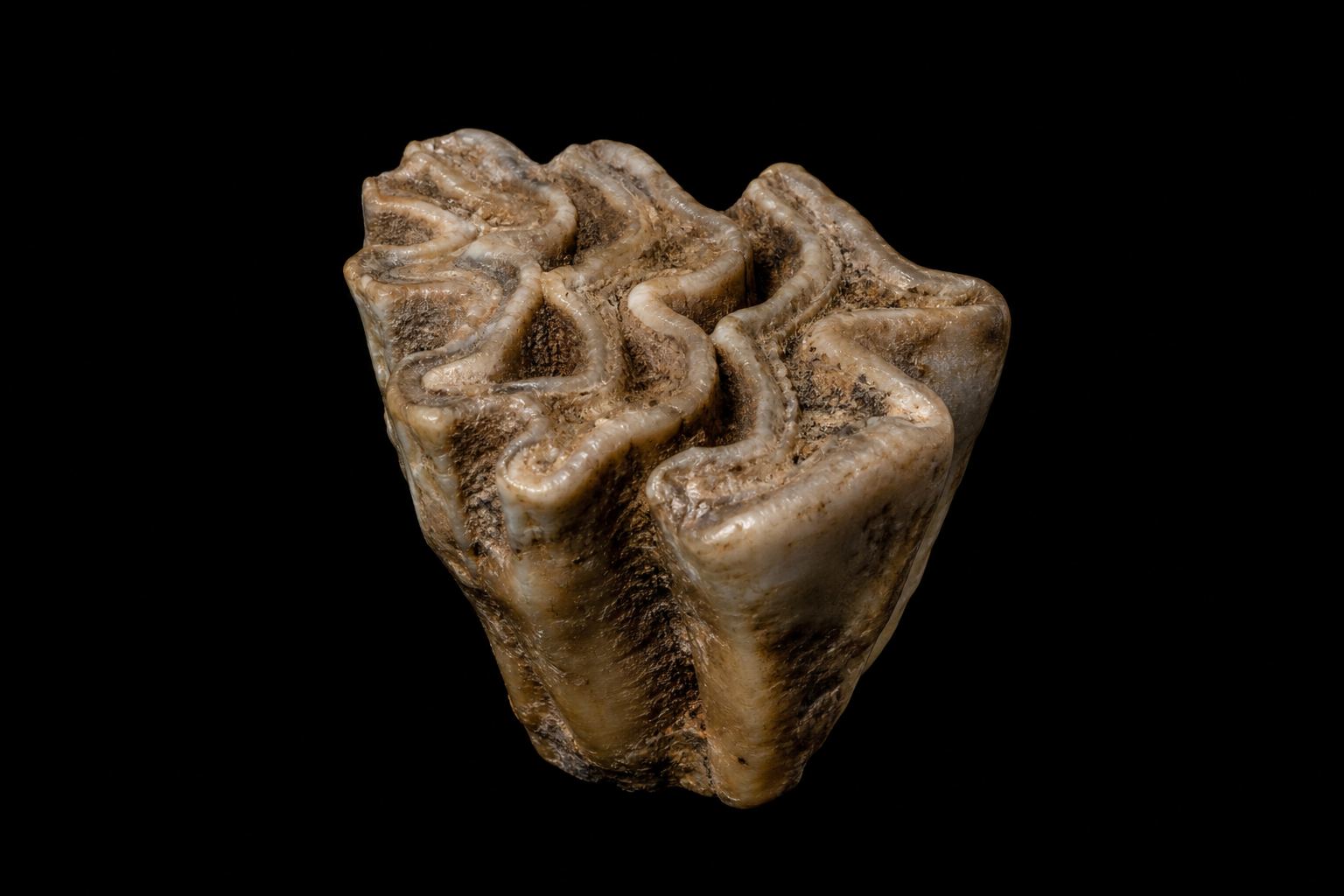
A Bronze Age tooth A sheep molar of the kind dug up at Myrzhik, Kazakhstan, dated 1875–1645 BC. AI-generated illustration.
754
samples screened
18
positive folios (17 parchment, 1 paper)
21
new ancient genomes
L’Hôte et al., Science Advances, 2026Reading the genome A sequencer reads millions of short DNA fragments; software fits the viral ones back together. AI-generated illustration.
York Gospels: 2 pages, + 1 bound in later
Corpus Glossary, c. 800
Epistles of St Paul, c. 700
Yale Speculum historiale: 4 leaves
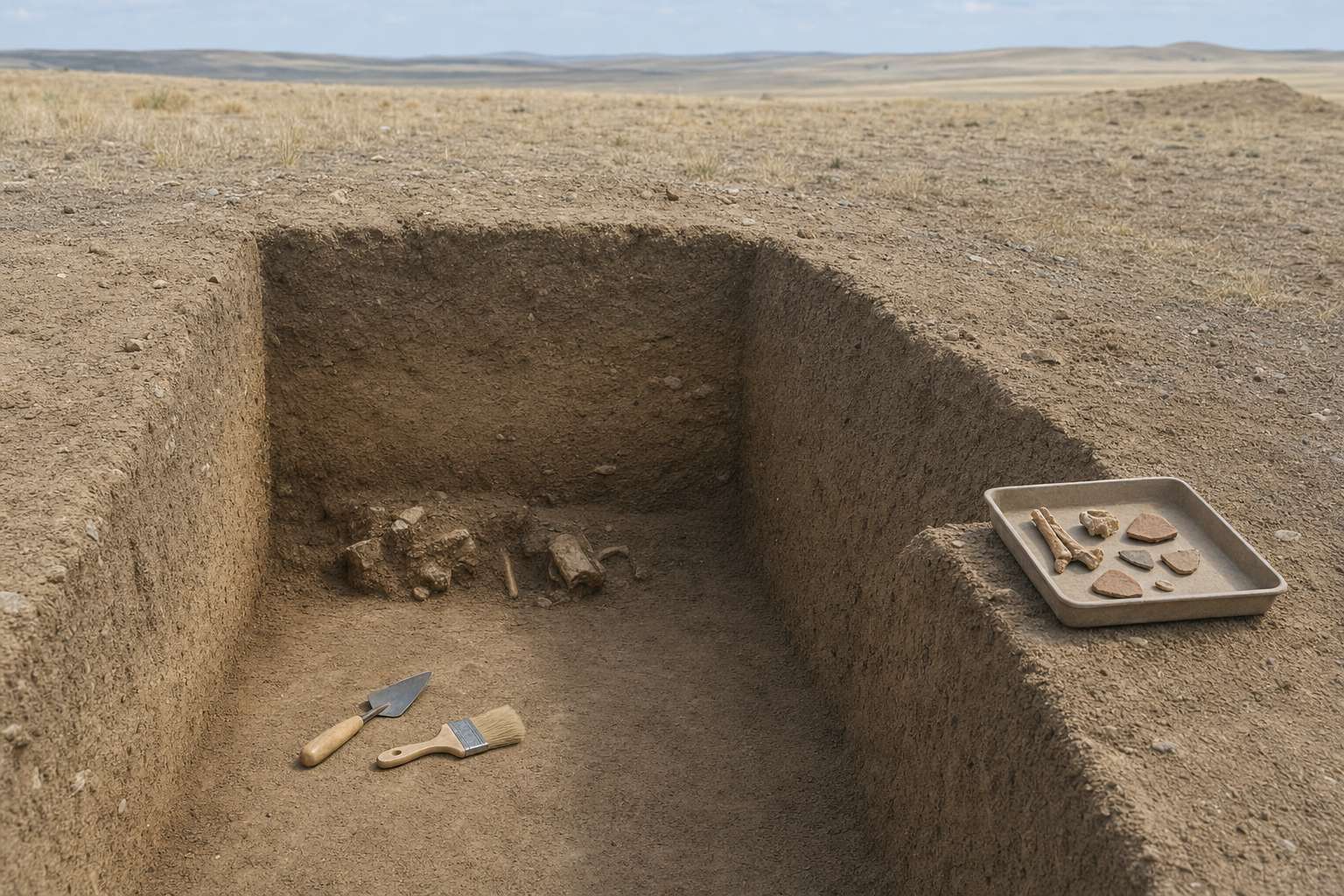
Pages with sheeppox DNADates from the ground Bones from a dated layer give places and years that a single manuscript on its own cannot. AI-generated illustration.
Chapter VI · What the pages remember
The sheeppox study
L’Hôte et al., Science Advances 12(36), eaeh3571 (September 2026), “Three thousand five hundred years of sheeppox virus evolution inferred from archaeological and codicological genomes”, led from University College Dublin: 754 samples screened; 18 positive folios (17 parchment — 10 calfskin, 4 goatskin, 3 sheepskin — and 1 paper); 21 new ancient genomes, the oldest from a sheep molar at Myrzhik, Kazakhstan, dated 1875–1645 BC, which the authors believe is the oldest poxvirus genome recovered so far. Positive manuscripts include the York Gospels (3 pages), the Corpus Glossary (CCCC MS 144, about AD 800), the Epistles of St Paul (Trinity College Cambridge B.10.5, about AD 700) and four leaves of Yale’s Speculum historiale. The genome stayed stable; calf and goat positives may reflect rare cross-species infection, contamination in shared lime baths, transfer from neighbouring sheepskin leaves, or sheep-derived materials such as gelatin (ScienceBlog). Sources differ on the age (3,500, over 3,700 or about 3,800 years); the film uses “around 1700 BC”. Sampling used eraser crumbs. This is a single new study.
Light up the oldest genome, the book genomes, and the two explanations for the calfskin pages.
The 3D scenes are simplified teaching models, not reconstructions of real books or workshops.
A medieval book holds two stories: the words its scribes wrote, and the record of the animals, the people and even the diseases that made it.
For a thousand years we read only the first. Now we are learning to read the second.
c. 2900 BC oldest known papyrus roll
197–159 BC Pergamon, by Pliny’s story
716 Codex Amiatinus sent to Italy
c. 1000 the York Gospels written
c. 1455 Gutenberg’s Bible
2017 the York Gospels’ DNA read
2026 sheeppox genomes from parchment
Books of skin, in seven datesStill in the building it was made for Parchment outlasts paper: it takes damp and handling that would have destroyed a paper book long ago. AI-generated illustration.Still in use A thousand years on, the York Gospels is still used in the cathedral’s ceremonies. AI-generated illustration.
Epilogue · Sources
Sources
Every fact in this film comes from the sources below. Pliny’s Pergamon story is told as a tradition that historians doubt. Estimates (515 cattle, the age of the oldest sheeppox genome) are given with whose estimate they are. The 2026 sheeppox findings come from a single new study. The 3D scenes are schematic. The chapter stills and pictures are AI-generated illustrations, not photographs of real manuscripts, people or places.