By 22 October 2026 the United States had confirmed 4,588 measles cases, about twice as many as in all of 2025, and in November the Pan American Health Organization reviews whether the country still counts as measles-free. This film explains the fundamentals: a virus that floats in a room for up to two hours and spreads before anyone knows they are ill; the fever, spots and rash, and the complications that put about one in five unvaccinated patients in hospital; the “immune amnesia” that wipes out part of the body’s memory of other germs; the reproduction number and why about 95% coverage is the line that stops outbreaks; the vaccine, from the 1954 lab to the MMR shot; and what “elimination” means, how Canada lost it in 2025, and what an outbreak in southern Thailand in 2018 showed. Health education, not medical advice.
Interactive 3D film10 min1846 to 2026Published 28 October 2026
A person with measles leaves a room. For up to two hours afterwards, the air they left behind can still infect the next person who walks in.
In 2026 that virus is surging in the United States. By the twenty-second of October the country had confirmed 4,588 cases, about twice as many as in the whole of 2025.
In November, the Pan American Health Organization will review whether the United States still counts as having eliminated measles. How does one virus spread so easily, and what stops it?
The largest outbreak A clinic waiting room. Pennsylvania’s outbreak, the biggest of 2026, had 1,338 cases in 44 counties by 22 October. AI-generated illustration.
2025, whole year
2,289
2026, to 22 Oct
4,588
Confirmed US measles cases (CDC)
How the virus travels
What it does to the body
Immune amnesia
The 95% rule, and the vaccine
In this film
Prologue
A surge in 2026
Medical Daily (23 Oct 2026), citing CDC: 4,588 confirmed US measles cases in 2026 as of 22 October, against 2,289 in all of 2025; Pennsylvania’s outbreak had reached 1,338 cases across 44 counties. Contagion Live (16 Oct 2026): 96% of cases were outbreak-linked, about 10% of patients were hospitalised, and about 96% were unvaccinated or of unknown status. PAHO will review the elimination status of the United States and Mexico at its commission’s meeting in November 2026.
Death counts differ by source and date: Medical Daily reports 3 nationally on the CDC list, while Pennsylvania has reported more. This film therefore gives no single national death figure for 2026.
This film is health education, not medical advice. Questions about vaccines or symptoms belong with a doctor or a clinic.
The virus, the room, the crowd of dots and the bars are teaching models: shapes, colours and the simulation are schematic, not to scale, unless a number is given with a source.
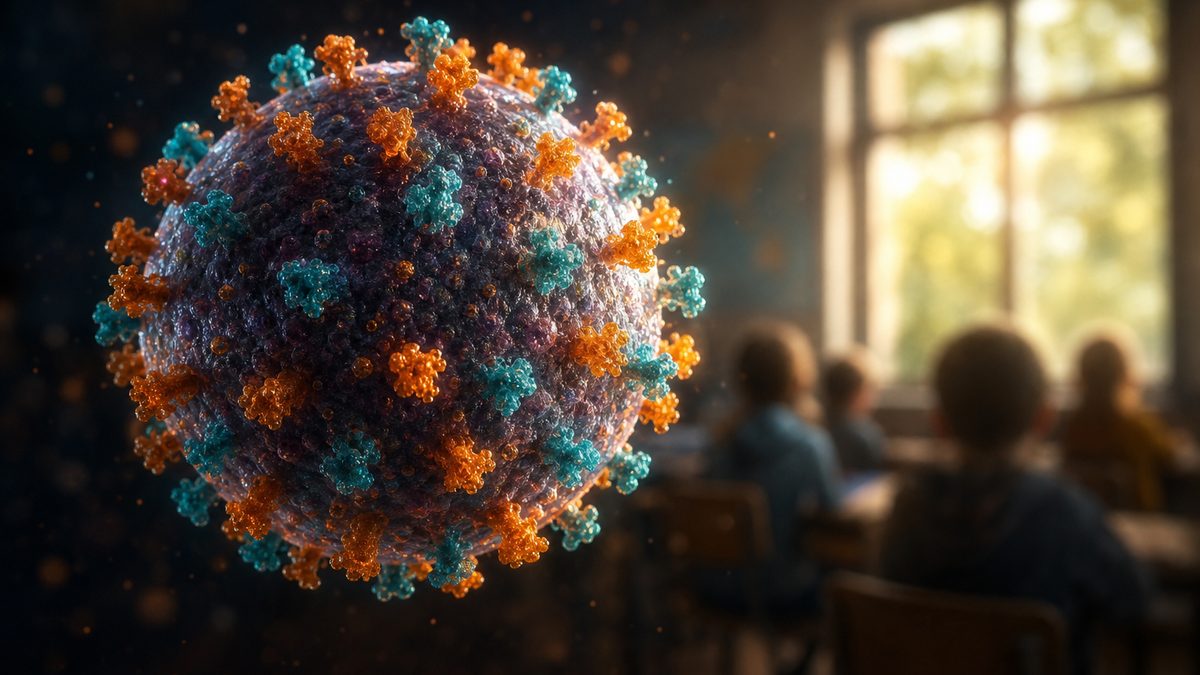
Measles is caused by a virus less than a thousandth of a millimetre across: a strand of genetic material wrapped in a fatty envelope.
Two proteins on its surface do the work. The H protein latches on to a docking point on a human cell, and the F protein merges the virus with the cell, so its genes can get inside.
Outside the body it is fragile: heat, sunlight and acid destroy it quickly. Its real strength is the way it travels.
120–250 nm
diameter of one particle
Morbillivirus
genus, in the family Paramyxoviridae
Measles virus (CDC)
H (hemagglutinin): binds to the cell
F (fusion): merges the membranes
Try the buttons to highlight each one
Two surface proteinsFragile outside the body Sunlight on a windowsill. The CDC lists heat, sunlight, acidic pH, ether and trypsin as inactivating the virus. AI-generated illustration.
Chapter I · A virus in the air
A small, fragile virus
CDC Pink Book: measles virus has a genome of single-stranded, negative-sense RNA and is 120 to 250 nm in diameter. Two envelope proteins matter most: the F (fusion) protein, responsible for fusion of virus and host-cell membranes, and the H (hemagglutinin) protein, responsible for binding to receptors on host cells. The virus is rapidly inactivated by heat, sunlight, acidic pH, ether and trypsin. CDC Yellow Book: it is a morbillivirus in the family Paramyxoviridae.
The 3D virus is a schematic model; the number and arrangement of spikes are not real.
The virus, the room, the crowd of dots and the bars are teaching models: shapes, colours and the simulation are schematic, not to scale, unless a number is given with a source.
Measles spreads through the air. When an infected person coughs or sneezes, they release droplets so tiny that they float.
In a closed room, those particles can stay infectious for up to two hours after the person has left. Someone who walks in later, and never meets the patient, can still catch it.
Up to nine in ten people who are not immune, and are close to an infected person, will catch it. Press the button to send the patient out, and watch the air.
Coughing
Sneezing
Tiny droplets that stay aloft
How it gets into the airAn empty room Light catching dust in an empty classroom. Measles particles are far too small to see; this only suggests air that looks clean but is not. AI-generated illustration.
9 in 10
non-immune close contacts who become infected, at most
Close contacts (CDC)
Chapter I · A virus in the air
Two hours in the air
CDC: measles spreads mainly when an infected person coughs or sneezes; the virus can remain in the air of a room for up to two hours after the infected person leaves, and up to 90% of people close to that person who are not immune will also become infected. CDC Pink Book: transmission by aerosolised droplet nuclei in closed areas has been documented for up to two hours after a person with measles occupied the area.
Try it: send the patient out of the room. The scene’s clock runs fast (one second ≈ ten minutes) and the fading of the particles is a schematic, not a measurement.
The virus, the room, the crowd of dots and the bars are teaching models: shapes, colours and the simulation are schematic, not to scale, unless a number is given with a source.
The timing makes it worse. After someone is exposed, the virus multiplies quietly for about eleven or twelve days before the first symptoms appear.
A person is contagious from four days before the rash appears to four days after it. So for days, they can pass measles on while feeling as if they have a cold, or before they feel ill at all.
By the time the rash makes the diagnosis obvious, many of the people around them have already been exposed.
Day 0 Exposure
≈ day 11–12 Fever, cough, runny nose, red eyes
≈ day 14 (7–21) Rash appears
Rash + 4 days No longer contagious
A typical course (CDC)
4 + 4 days
before and after the rash, about nine days in all
The contagious window
Early signs look like a common cold
The rash comes days later
Contacts are exposed in the meantime
Why it slips throughBefore anyone knows A shared family meal. Households, schools and clinics are where most exposures happen before a diagnosis. AI-generated illustration.
Chapter I · A virus in the air
Contagious before it shows
CDC Pink Book: the incubation period from exposure to the first symptoms (the prodrome) averages 11 to 12 days. The rash appears on average 14 days after exposure, with a range of 7 to 21 days (Pink Book). CDC: infected people can spread measles from four days before through four days after the rash appears, so they may spread it before they know they are sick.
The timeline in the scene shows typical days; individual cases vary.
This film is health education, not medical advice. Questions about vaccines or symptoms belong with a doctor or a clinic.
The illness usually begins with a high fever, a cough, a runny nose and red, watery eyes. Doctors often remember them as the three Cs: cough, coryza and conjunctivitis.
A few days later, tiny white spots can appear inside the cheeks. These Koplik spots are found only in measles.
Then comes the rash. It starts at the hairline, spreads down over the face and body to the hands and feet, and fades in the same order.
In 1846 the physician Peter Panum described the incubation period of measles, and showed that people who recover are protected for life.
Cough
Coryza: a runny nose
Conjunctivitis: red, watery eyes
Fever can reach 40.6 °C
The “three Cs” (a teaching shorthand)A child at home with a fever Koplik spots appear 2 to 3 days after symptoms begin, the rash 3 to 5 days after (CDC). AI-generated illustration.
First Hairline, face, upper neck
Over ≈ 3 days Down the body to hands and feet
After 5–6 days Fades, head first
How the rash moves
Lifelong
immunity after recovering from measles
Peter Panum, 1846
Chapter II · The illness
Fever, spots, rash
CDC Yellow Book: the prodrome brings fever (which can reach 40.6 °C), cough, coryza (runny nose) and conjunctivitis. CDC Pink Book: Koplik spots on the mucous membranes are considered unique to measles; the rash begins at the hairline, involves the face and upper neck, spreads down to the hands and feet over about three days, lasts five to six days and fades in the same order it appeared. CDC: Koplik spots appear two to three days after symptoms begin and the rash three to five days after. In 1846 Peter Panum described the incubation period and lifelong immunity after recovery (Pink Book).
“The three Cs” is a common teaching shorthand, not an official term.
This film is health education, not medical advice. Questions about vaccines or symptoms belong with a doctor or a clinic.
For most people measles is miserable, and then it passes. For some it is dangerous. In the United States, about one in five unvaccinated people who catch it ends up in hospital.
Up to one child in twenty gets pneumonia, the most common cause of death from measles in young children. About one in a thousand gets encephalitis, a swelling of the brain.
Of every thousand children infected, one to three die. And years later, a rare and fatal brain disease called SSPE can appear, most often in those infected before the age of two.
Hospitalised (all ages)
≈ 200
Pneumonia (children)
≤ 50
Encephalitis (children)
≈ 1
Deaths (children)
1–3
Out of 1,000 unvaccinated cases (CDC)
A children’s ward Across all ages, the CDC Yellow Book puts pneumonia at 1–6% of measles cases. AI-generated illustration.
7–10 years
after infection, when it appears
7–11 in 100,000
estimated risk per case
SSPE (CDC)
Chapter II · The illness
When measles is dangerous
CDC: about 1 in 5 unvaccinated people in the US who get measles is hospitalised. As many as 1 in 20 children with measles gets pneumonia, the most common cause of measles death in young children; about 1 in 1,000 children develops encephalitis (swelling of the brain); nearly 1 to 3 of every 1,000 children who become infected die from respiratory and neurological complications. Subacute sclerosing panencephalitis (SSPE) is rare and fatal, develops 7 to 10 years after infection, and is more likely in those infected before age two.
Try it: the 1,000 dots stand for 1,000 unvaccinated children with measles; the buttons light up how many, on CDC’s figures, face each outcome. The dot positions are random.
This film is health education, not medical advice. Questions about vaccines or symptoms belong with a doctor or a clinic.
Measles does something else, which scientists measured only recently. It attacks the immune system itself.
Your body keeps a memory of the germs it has met, in the antibodies and the cells that make them. In 2019, Harvard researchers tested blood from seventy-seven unvaccinated Dutch children before and after they caught measles.
Measles had erased between eleven and seventy-three percent of each child’s range of antibodies. The vaccine did not do this. A second study that year found matching damage in the cells that make antibodies.
Scientists call it immune amnesia. An earlier study of child deaths suggested measles can raise the risk from other infections for two to three years.
Antibodies recognise germs met before
Memory B cells can make them again
Built up from past infections and vaccines
Immune memoryAntibodies Y-shaped antibodies. The study measured each child’s antibodies with a blood test called VirScan. AI-generated illustration.
11–73%
of each child’s antibody repertoire erased
77
children tested before and after
Mina et al., Science, 2019
2–3 years
of weaker resistance to other infections, suggested by mortality data
After measles (Mina et al., 2015)
Chapter III · Immune amnesia
A virus that erases memory
Mina et al., Science 366:599–606 (2019): using the VirScan antibody test on blood from 77 unvaccinated Dutch children collected before and about two months after a 2013 outbreak, measles removed 11% to 73% of each child’s antibody repertoire; MMR vaccination had no such effect, and the result was confirmed in macaques (Harvard Gazette). Petrova et al., Science Immunology (2019): B-cell receptor sequencing showed depleted memory B-cell clones and an incompletely rebuilt naive B-cell pool after measles; in ferrets, measles erased vaccine immunity to influenza.
Mina et al., Science 348:694–699 (2015): in high-income countries before and after mass vaccination, deaths from other childhood infections tracked measles incidence with a two-to-three-year lag, which the authors read as measles weakening resistance for that long. Try it: infect the cluster at the two ends of the measured range, or vaccinate it instead. The colours and the number of cells are schematic.
The virus, the room, the crowd of dots and the bars are teaching models: shapes, colours and the simulation are schematic, not to scale, unless a number is given with a source.
Epidemiologists measure how contagious a disease is with a number called R0, the basic reproduction number: the average number of people one case infects when nobody around is immune.
For measles it is usually quoted as twelve to eighteen; the World Health Organization says one person can infect up to eighteen others. A review of fifty-eight estimates from eighteen studies found that the real figure varies from place to place.
Watch what fifteen means. One case becomes fifteen, and fifteen become two hundred and twenty-five, in just two rounds of illness.
R0≈12 to 18
R0
basic reproduction number: average new infections from one case when nobody is immune
Crowded places A busy station concourse. How many people one case reaches depends on contacts, so R0 differs between settings. AI-generated illustration.
1
first case
15
after one round
225
after two rounds (15 × 15)
If R0 = 15 and nobody is immune
Chapter IV · The arithmetic of spread
The basic reproduction number
R0 is the average number of secondary infections caused by one case in a population where everyone is susceptible. WHO: one person with measles can infect up to 18 others. Measles’ R0 is commonly quoted as 12 to 18, but a systematic review of 58 estimates from 18 studies (Guerra et al., Lancet Infectious Diseases, 2017) found a much wider spread, because it depends on how many contacts people have.
The scene uses R0 = 15 as a round number inside the quoted range. Real outbreaks overlap, and people recover; the two-round fan is a simplified picture.
The virus, the room, the crowd of dots and the bars are teaching models: shapes, colours and the simulation are schematic, not to scale, unless a number is given with a source.
There is a way to break the chain. If enough people are immune, each case finds too few people to infect, and the outbreak dies out. This is called herd immunity.
The share needed is one minus one over R0. With an R0 of twelve, that is about ninety-two percent. With eighteen, about ninety-four.
That is why the World Health Organization says outbreaks are prevented when at least ninety-five percent of people have had two doses, in every country and every community.
An average can hide a gap. Try the coverage buttons, then the low pocket: one under-vaccinated neighbourhood is enough for an outbreak, even when the overall figure looks good.
Immune people are dead ends for the virus
Each case infects fewer than one other
High coverage is needed everywhere, not just on average
Herd immunitypc=1−R01
pc
share of people who must be immune
R0
basic reproduction number
R0 = 12
91.7%
R0 = 15
93.3%
R0 = 18
94.4%
Threshold for each R0 (1 − 1/R0)
Neighbourhoods, not averages Rooftops of a small town. WHO asks for 95% coverage in every community because the virus travels between people who meet, not between statistics. AI-generated illustration.
Chapter IV · The arithmetic of spread
The threshold
Quanta Magazine: the herd-immunity threshold is 1 − 1/R0, which for measles, with R0 of 12 to 18, gives roughly 92% to 95%. WHO: outbreaks are prevented by at least 95% coverage with two doses of measles vaccine, in every country and all communities.
Try it: choose a coverage level, then release one case. The simulation is a teaching toy, not a forecast: each case meets 12 random people nearby, two doses protect 97% of the vaccinated (CDC’s figure), and the “low pocket” puts one neighbourhood at 60% while the town averages about 95%.
The virus, the room, the crowd of dots and the bars are teaching models: shapes, colours and the simulation are schematic, not to scale, unless a number is given with a source.
Before a vaccine, nearly everyone caught measles. In the United States about half a million cases and five hundred deaths were reported every year, and the real number of infections was three to four million.
In 1954, during an outbreak at a boarding school near Boston, John Enders and Thomas Peebles grew the virus in the laboratory, from a sick student named David Edmonston.
A weakened form of that virus became the first measles vaccine, licensed in 1963. In 1968 Maurice Hilleman made an even weaker strain, and in 1971 it was combined with mumps and rubella vaccines as MMR.
≈ 500,000
reported cases a year
≈ 500
reported deaths a year
3–4 million
estimated real infections a year
United States before 1963 (CDC)
≈ 30 million
cases a year
> 2 million
deaths a year
The world before the vaccine (WHO)Growing a virus Glass culture flasks in a 1950s laboratory. Enders and Peebles grew measles in human and monkey kidney cells. AI-generated illustration.
1954 Virus isolated (Edmonston strain)
1963 First vaccine licensed (Edmonston B)
1968 Hilleman’s further-weakened strain
1971 Combined MMR vaccine
The measles vaccine (WHO, CDC)
Chapter V · A vaccine
From a schoolboy to a vaccine
CDC Pink Book: before 1963 about 500,000 cases and 500 measles deaths were reported each year in the US, with an estimated 3 to 4 million infections; John Enders and Thomas Peebles isolated the virus in human and monkey kidney tissue culture in 1954; the first live, attenuated vaccine (Edmonston B strain) was licensed in the US in 1963. WHO: the virus was isolated during a boarding-school outbreak, from the student David Edmonston; Maurice Hilleman developed a further-attenuated strain in 1968, and the combined measles, mumps and rubella (MMR) vaccine followed in 1971.
WHO estimates that before vaccination, measles caused about 30 million cases and more than 2 million deaths a year worldwide.
The virus, the room, the crowd of dots and the bars are teaching models: shapes, colours and the simulation are schematic, not to scale, unless a number is given with a source.
Two doses of the MMR vaccine are about ninety-seven percent effective at preventing measles. One dose is about ninety-three percent.
Around the world, the World Health Organization estimates that measles deaths fell from about 780,000 in 2000 to about 95,000 in 2024, and that vaccination averted nearly fifty-nine million deaths in that time.
Trust has been tested. In 1998 a paper claimed a link between MMR and autism. It was found to be fraudulent and was retracted.
Coverage is still short of the goal. In 2025, eighty-four percent of the world’s children received a first dose, and seventy-seven percent a second.
93%
one dose
97%
two doses
MMR effectiveness against measles (CDC)
2000
≈ 780,000
2024
≈ 95,000
Estimated measles deaths worldwide (WHO)
The vaccine Vaccine vials in a clinic. One MMR shot protects against measles, mumps and rubella together. AI-generated illustration.
84%
first dose
77%
second dose
95%
the goal, in every community
World coverage, 2025 (WHO)
Chapter V · A vaccine
What the vaccine has done
CDC: one dose of MMR is about 93% effective against measles and two doses about 97%. WHO fact sheet: measles deaths fell from about 780,000 in 2000 to about 95,000 in 2024, and vaccination averted nearly 59 million deaths between 2000 and 2024; in 2025, 84% of children received a first dose and 77% a second. WHO: a 1998 paper in The Lancet that claimed a link between MMR and autism was fraudulent and was later retracted.
Global figures are WHO model estimates. The 3D bars are drawn to the same scale as each other.
This film is health education, not medical advice. Questions about vaccines or symptoms belong with a doctor or a clinic.
An average can hide a gap; elimination can be lost.
No country is beyond its reach. In 2018, measles spread in Thailand’s far south. In Yala province alone, 341 cases and five child deaths were reported in about five weeks.
Across most of Thailand coverage was about ninety-five percent, health officials said, but Pattani, Yala and Narathiwat lagged behind. One reason was a rumour that the vaccine contained pork; Muslim scholars and officials answered that Muslim children can be vaccinated. It was the pocket, not the average, that counted.
341
cases
5
child deaths
2,149
cases in all Thailand in September
Yala, 1 Sept to 9 Oct 2018 (BenarNews)Thailand’s far south A village road among rubber trees. Yala and Narathiwat, two of the three lagging provinces, border Malaysia. AI-generated illustration.
95% across most of the country hid provincial gaps
A rumour lowered local uptake
The outbreak followed the gap
What 2018 showed
Chapter VI · Keeping it out
Southern Thailand, 2018
BenarNews (10 Oct 2018): in Yala province, 341 measles cases and five child deaths were reported between 1 September and 9 October 2018, and 2,149 cases nationwide in September. Dr Tanarak Plipat of the Department of Disease Control said coverage in most of the country was about 95% but lagging in Pattani, Yala and Narathiwat; the report says many Muslim parents cited religious concerns, and Dr Winai Dahlan of Chulalongkorn University’s Halal Science Center described a rumour that the vaccines contained pig ingredients, saying “there is no such vaccine that cannot be given to Muslim people”.
These figures come from a news report at the time, not from an official dataset. The scene repeats the low-pocket simulation from Chapter IV.
The virus, the room, the crowd of dots and the bars are teaching models: shapes, colours and the simulation are schematic, not to scale, unless a number is given with a source.
A country counts as having eliminated measles when no single chain of the virus has kept spreading inside it for twelve months or more. Cases can still arrive from abroad, and outbreaks can still flare and die out.
The United States reached that point in 2000. Canada lost it in November 2025, after an outbreak of more than five thousand cases, and with it the Americas lost their measles-free status.
In the United States, the share of kindergarten children with two MMR doses fell from 95.2 percent in 2019 to 2020, to 92.4 percent in 2025 to 2026, below the line the arithmetic asks for. Exemptions from school vaccine requirements rose to 4.2 percent.
Almost all of this year’s cases were in people who were unvaccinated or whose status was unknown. In November, PAHO’s commission reviews the United States and Mexico.
2000 US: transmission interrupted
Oct 2024 Canada: outbreak begins in New Brunswick
Nov 2025 Canada and the Americas lose status
Nov 2026 PAHO reviews the US and Mexico
Measles elimination in the Americas (CDC, PAHO)School An empty school corridor. CDC’s coverage figures count children entering kindergarten. AI-generated illustration.
2019–20
95.2%
2023–24
92.7%
2024–25
92.5%
2025–26
92.4%
Kindergartners with 2 MMR doses (CDC)
4.2%
with an exemption, a record
92.4%
with two MMR doses
Kindergarten, 2025–26 (CDC)
≈ 96%
unvaccinated or vaccination status unknown
59%
under 20 years old
US cases in 2026, to mid-October (CDC)
Chapter VI · Keeping it out
Elimination, and how it is lost
PAHO: elimination means the absence of uninterrupted circulation of the same genotype and lineage of measles virus for 12 months or more. CDC Pink Book: interruption of indigenous transmission was declared in the United States in 2000. PAHO (10 Nov 2025): endemic transmission was re-established in Canada after an outbreak that began in New Brunswick in October 2024 and exceeded 5,000 cases, so the Americas lost regional elimination status. CDC SchoolVaxView: 92.4% of US kindergartners had two MMR doses in 2025–26, with exemptions at 4.2%; Patient Care (citing CDC): coverage was 95.2% in 2019–20, 92.7% in 2023–24 and 92.5% in 2024–25.
PAHO (2 Mar 2026): the review period for the United States starts on 20 January 2025 and for Mexico on 1 February 2025; the commission meets in November 2026. Contagion Live (16 Oct 2026): about 96% of 2026 US cases were unvaccinated or of unknown status, and 59% were under 20. The 3D bars start at 90% to make the differences visible.
A virus that floats in the air, spreads before anyone feels ill, and erases part of the body’s memory. Against it: a vaccine about ninety-seven percent effective after two doses, and one number, ninety-five.
Somewhere tonight an empty room still holds the air of someone who coughed in it an hour ago. Whether the next person to walk in falls ill depends, more than anything, on that ninety-five.
1846 Panum: incubation and lifelong immunity
1954 Virus grown in the lab
1963 First vaccine
2000 US eliminates measles
2019 Immune amnesia measured
2026 US cases double; status under review
Measles, in six dates
97%
protection after two MMR doses (CDC)
95%
coverage that prevents outbreaks (WHO)
Two numbers to rememberThe room from Chapter I Measles caused about 95,000 deaths worldwide in 2024, WHO estimates. AI-generated illustration.
Stills and pictures are AI-generated
The virus, room and simulations are schematic
Health education, not medical advice: ask a doctor or clinic
About this film
Epilogue · Sources
Sources
Every fact in this film comes from the sources below. The chapter stills and pictures are AI-generated illustrations. The virus model, the room, the dots and the outbreak simulation are schematic teaching models, not data or forecasts. Figures for 2026 change weekly; each is given with its date. This film is health education, not medical advice: questions about vaccination or symptoms belong with a doctor or a clinic.