On 11 October 2026 NASA’s Perseverance rover passed Opportunity’s record for the farthest drive on another world. This film explains how a Mars rover works: the first rovers on the Moon and Mars, the planet they drive on, the sky-crane landing, six-wheeled rocker-bogie suspension, nuclear and solar power, why no one can drive it with a joystick, how it now plans its own route, and what it is searching for in Jezero crater. Land a rover, drive over a rock, survive a dust storm and set the signal delay.
Interactive 3D film10 min1970 to 2026Published 23 October 2026
A robot with nobody inside has just set the distance record for driving beyond Earth. On the eleventh of October 2026, its two thousand and sixth Martian day, NASA's Perseverance rover drove ninety-one metres and took the title.
Its odometer read 45.22 kilometres, just past the 45.16 that Opportunity took almost fifteen years to cover. Perseverance did it in five and a half.
Nobody on Earth can steer it live. So how do you land a car on Mars, keep it powered, and drive it from tens to hundreds of millions of kilometres away?
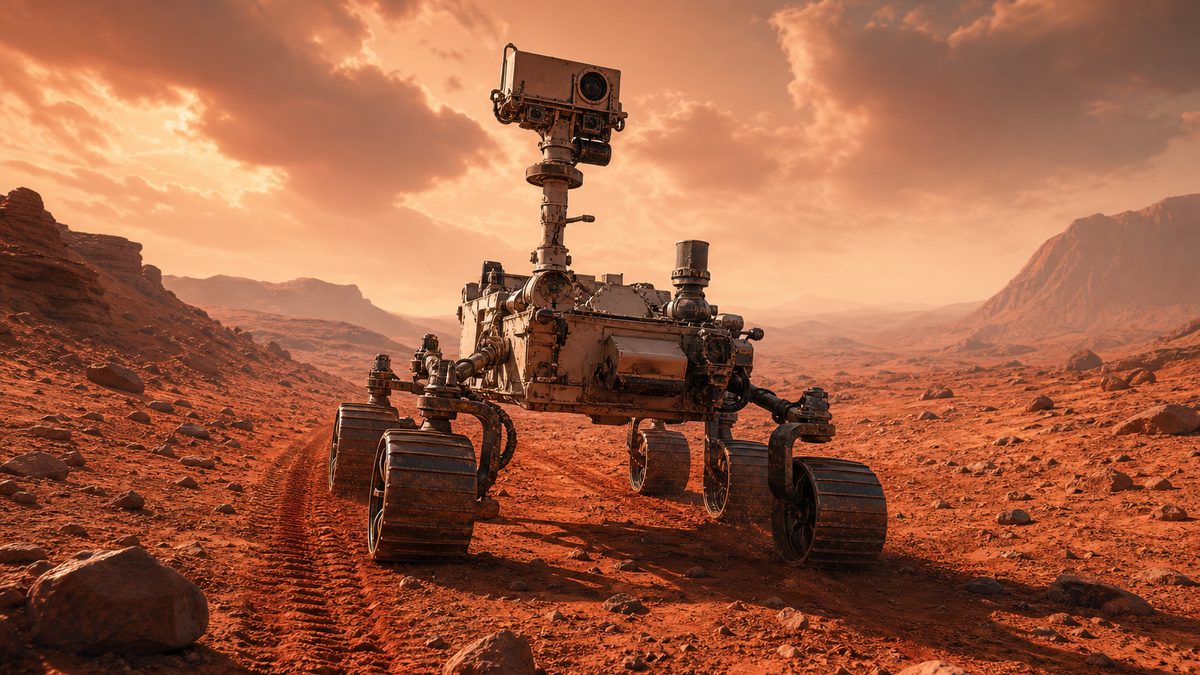
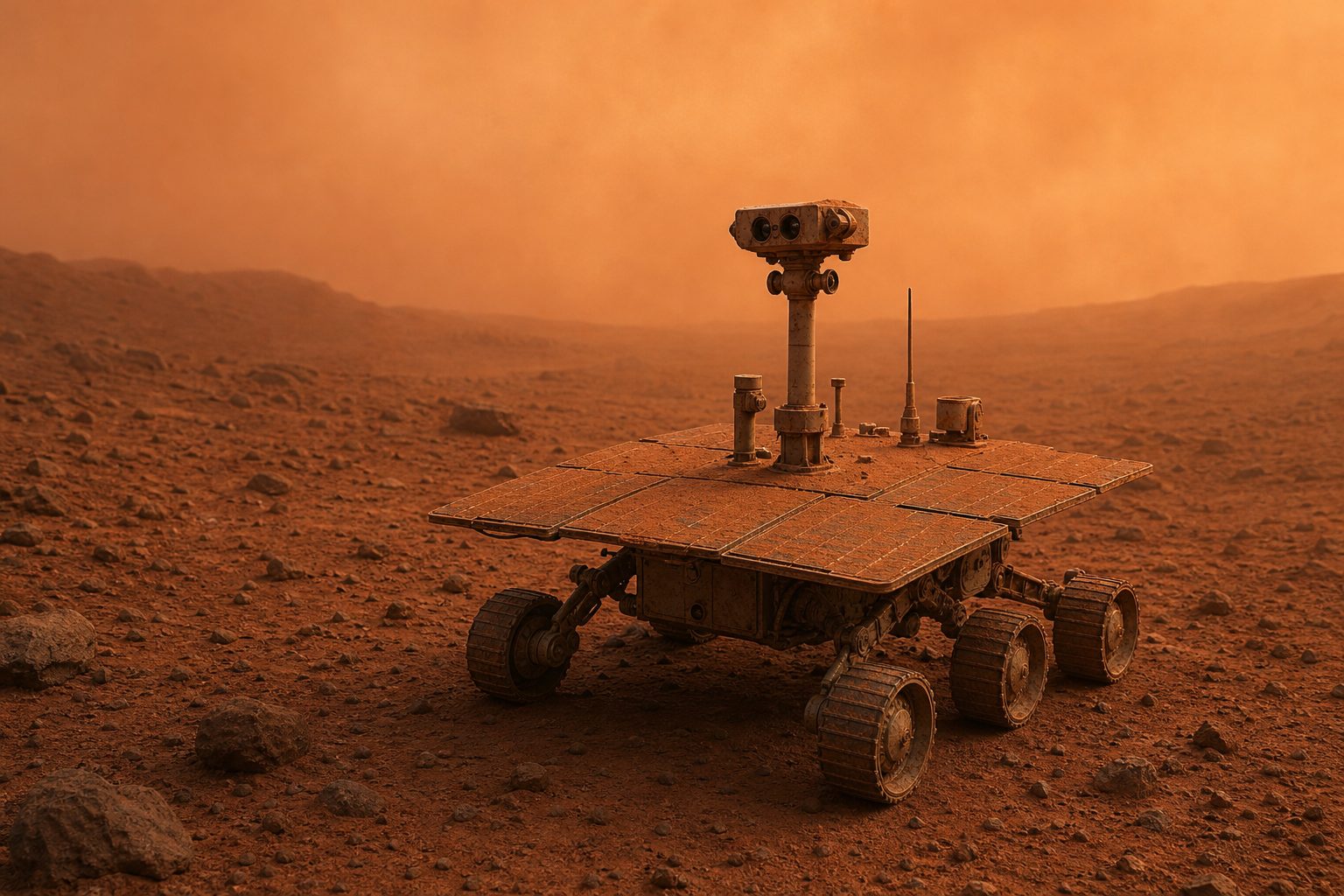
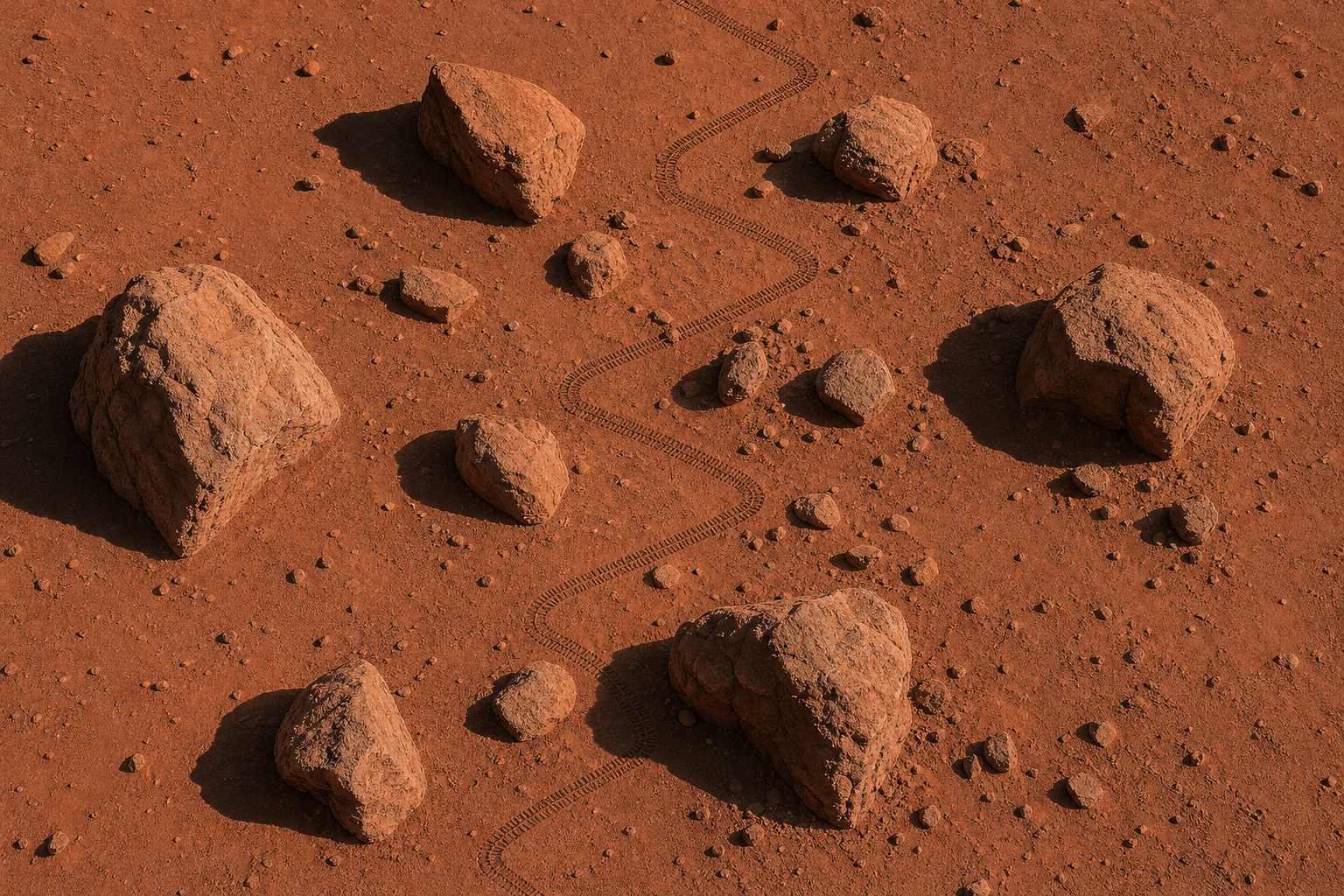
Tracks on Mars A rover crossing a dusty plain, as imagined. AI-generated still.
45.22 km
Perseverance, in about 5½ years
45.16 km
Opportunity, 2004–2018
The record, 11 Oct 2026
91.31 m
the record-breaking drive
Sol 2,006 (Martian day 2,006)
Prologue
A new off-world record
EarthSky and Sci.News, citing NASA: on 11 October 2026 (sol 2,006), a 91.31 m drive took Perseverance to 45.22 km (28.10 miles), past the 45.16 km (28.06 miles) driven by Opportunity between 2004 and 2018. NASA said Perseverance covered in five and a half years a distance that took Opportunity almost 15. NASA’s Photojournal graphic compares off-world driving distances as of 11 October 2026. The distance from Earth to Mars varies a great deal; the figure in the narration is a round order of magnitude.
The 3D rovers, terrain and planets are simplified teaching models, not to scale.
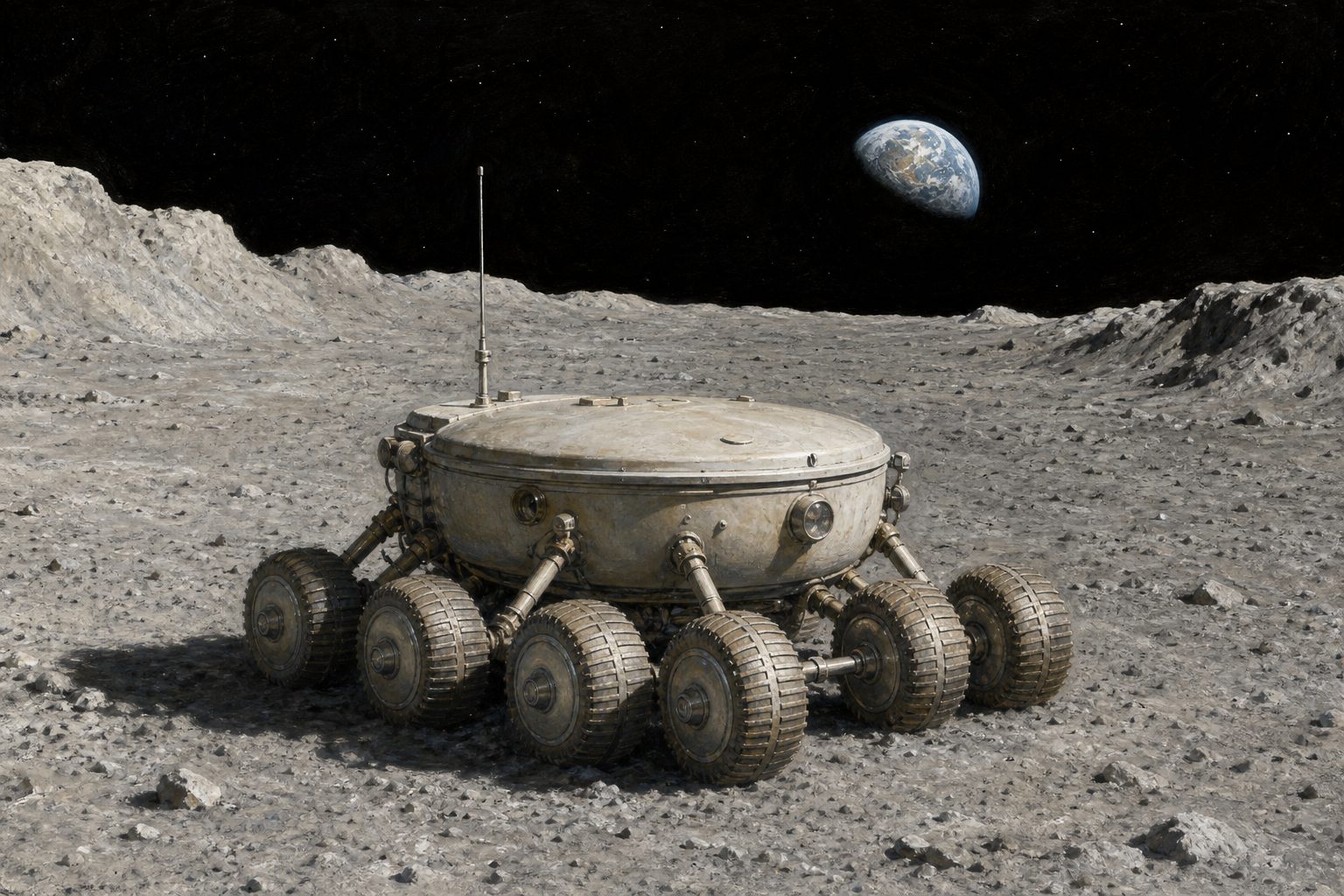
The first rover on another world was Soviet. Lunokhod 1 landed on the Moon on the seventeenth of November 1970, and a five-person team near Moscow drove it by remote control for more than ten kilometres.
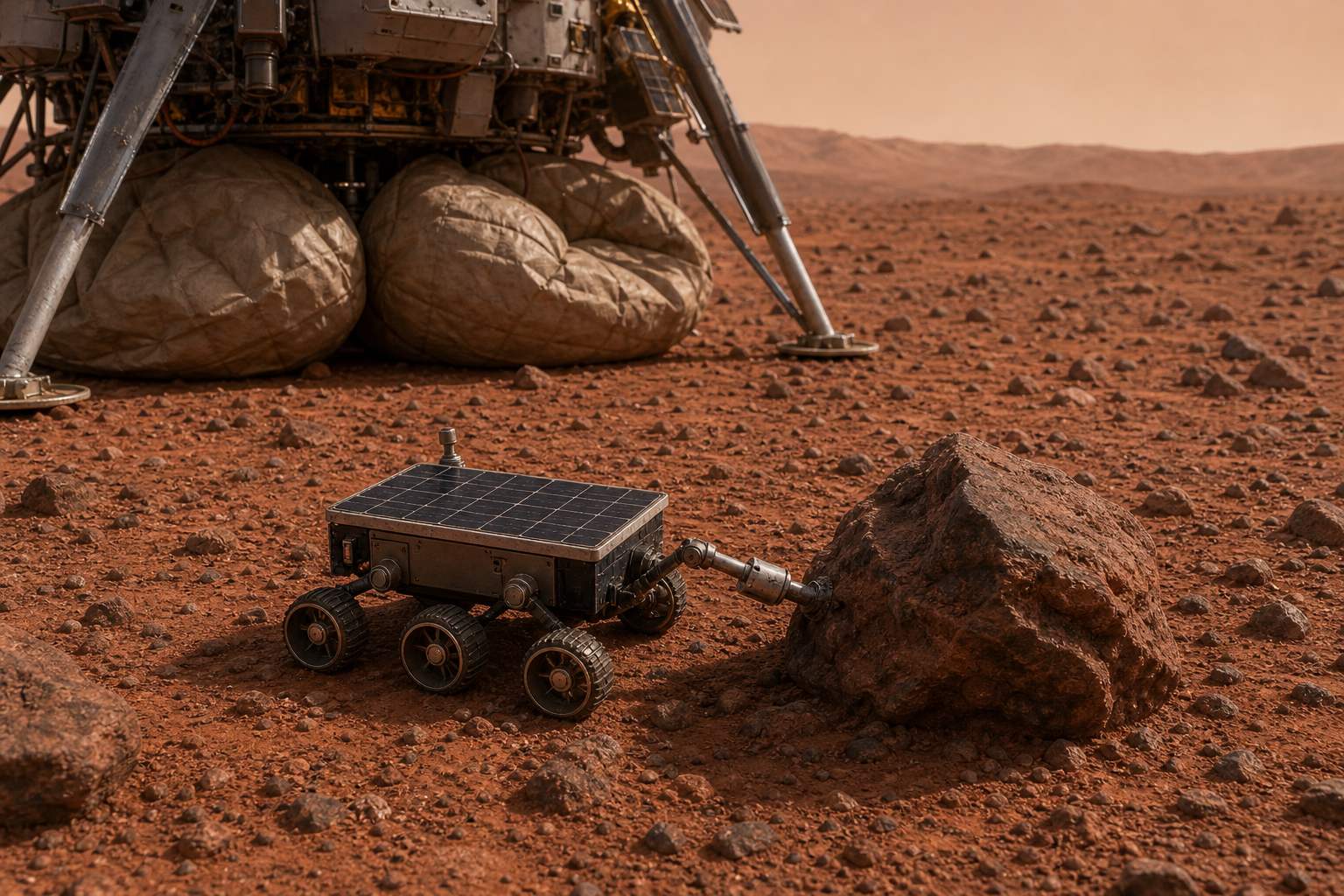
Mars came next. NASA's Mars Pathfinder landed on the fourth of July 1997, and the next day its rover, Sojourner, rolled off. It weighed eleven and a half kilograms, ran on about fifteen watts of sunlight, and drove only about a hundred metres.
But it already drove itself between commands, spotting obstacles with lasers and cameras and steering around them.
Lunokhod 1, 1970 An eight-wheeled rover with a tub-shaped body, as imagined. AI-generated still.
8
wheels
~10.5 km
driven on the Moon
5
drivers on Earth
Lunokhod 1Sojourner, 1997 A rover the size of a microwave oven beside its lander. AI-generated still.
11.5 kg
mass
~100 m
total distance
83 days
Martian days active (planned: 7)
Sojourner
Chapter I · First wheels
Lunokhod and Sojourner
Space.com: the Soviet Luna 17 spacecraft landed Lunokhod 1 on the Moon on 17 November 1970, the first successful rover to explore another world; operators in the Soviet Union, a five-person team at the deep space centre near Moscow, drove it more than 10 km (about 10.54 km in total, according to NASA). Wikipedia’s Sojourner article: Mars Pathfinder landed on 4 July 1997 and the rover was deployed on 5 July; it had a dry mass of 11.5 kg, about 0.22 m² of solar cells giving up to roughly 15 W, drove about 100 m, was active for 83 sols against a plan of 7, received commands once per sol, and could drive to a waypoint by itself, using lasers and cameras to detect and avoid obstacles.
The 3D rovers, terrain and planets are simplified teaching models, not to scale.
In January 2004, twin solar-powered rovers, Spirit and Opportunity, landed on Mars. Each was designed to work for about ninety Martian days.
Engineers expected dust to smother the solar panels. Instead, Martian winds kept wiping them clean, and Opportunity kept driving for almost fifteen years.
In June 2018 a dust storm wrapped the whole planet and blotted out the Sun. Opportunity fell silent, and in February 2019 NASA declared its mission over.
25 Jan 2004
landing, in Eagle crater
~90 days
Martian days of designed lifetime
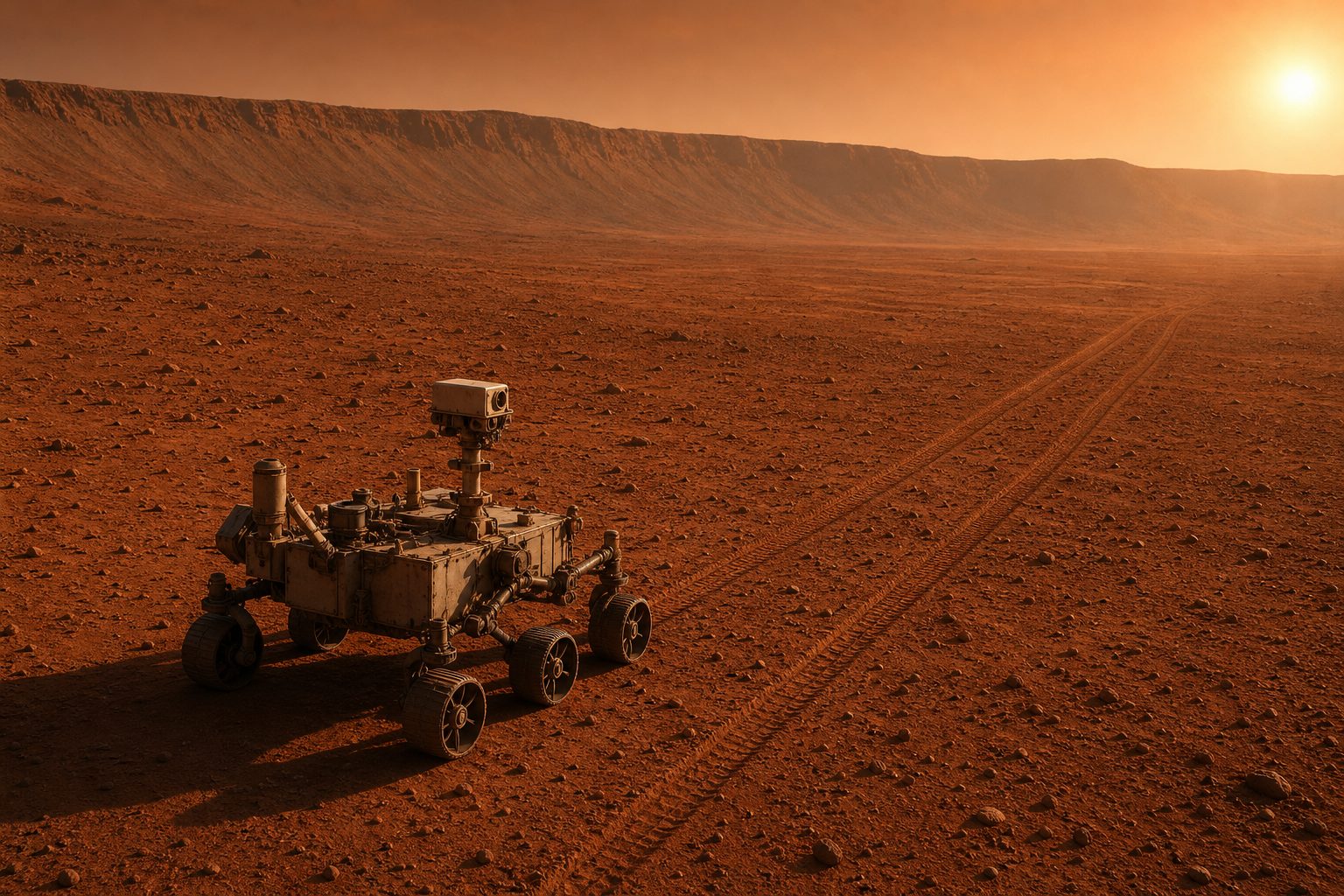
OpportunityDust on the panels A solar rover under a hazy sky, as imagined. AI-generated still.
10 Jun 2018 Last contact, as a global dust storm builds
2018–19 More than a thousand recovery commands
13 Feb 2019 Mission declared over
The end of Opportunity
Chapter I · First wheels
Fifteen years on solar power
Sky & Telescope: Opportunity landed in Eagle crater on 25 January 2004; it was designed to last about 90 sols but operated for about 15 years. Engineers expected dust to drain its solar power, but windstorms periodically cleaned the panels. The team last heard from it on 10 June 2018, as a planet-wide dust storm built; after more than a thousand recovery commands, NASA declared the mission over on 13 February 2019. Opportunity drove 45.16 km. Spirit drove 7.7 km (Sci.News).
The 3D rovers, terrain and planets are simplified teaching models, not to scale.
Mars is a hard place to drive. A day there, called a sol, lasts twenty-four hours, thirty-nine minutes and thirty-five seconds, and gravity is about thirty-eight percent of Earth's.
The surface averages about minus fifty-three degrees Celsius, and the air presses down with less than one hundredth of Earth's pressure.
That thin air is the first problem. It is too thin to slow a heavy spacecraft gently, but thick enough to heat it until it glows.
24 h 39 m 35 s
a Martian day
38%
of Earth’s gravity
One sol
Earth
100%
Mars
<1%
Surface air pressure Average surface temperature on Mars: about −53 °C.
Too thin for parachutes alone
Thick enough to heat a capsule
Heavy rovers can’t bounce in on airbags
The landing problem
Chapter II · Getting there
The planet
NASA JPL’s “Mars at a glance”: the length of a Martian day is 24 hours, 39 minutes, 35 seconds (1.027 Earth days); surface gravity is about 38% of Earth’s; surface atmospheric pressure is less than 1/100th of Earth’s average; and the surface temperature averages −53 °C. The sky-crane article notes that Curiosity and Perseverance were too heavy for the airbags used by earlier rovers.
The 3D rovers, terrain and planets are simplified teaching models, not to scale.
Perseverance launched on the thirtieth of July 2020 and reached Mars on the eighteenth of February 2021. A heat shield took most of the heat as the capsule plunged into the atmosphere.
About four minutes after entry, at roughly eleven kilometres up, a parachute opened. At about one point nine kilometres, the rover and its rocket-powered descent stage dropped free of the shell.
Then came the sky crane. From about twenty metres up, eight thrusters lowered the rover on cables about six and a half metres long. On touchdown the cables were cut, and the descent stage flew off to crash at a safe distance.
Run the landing yourself.
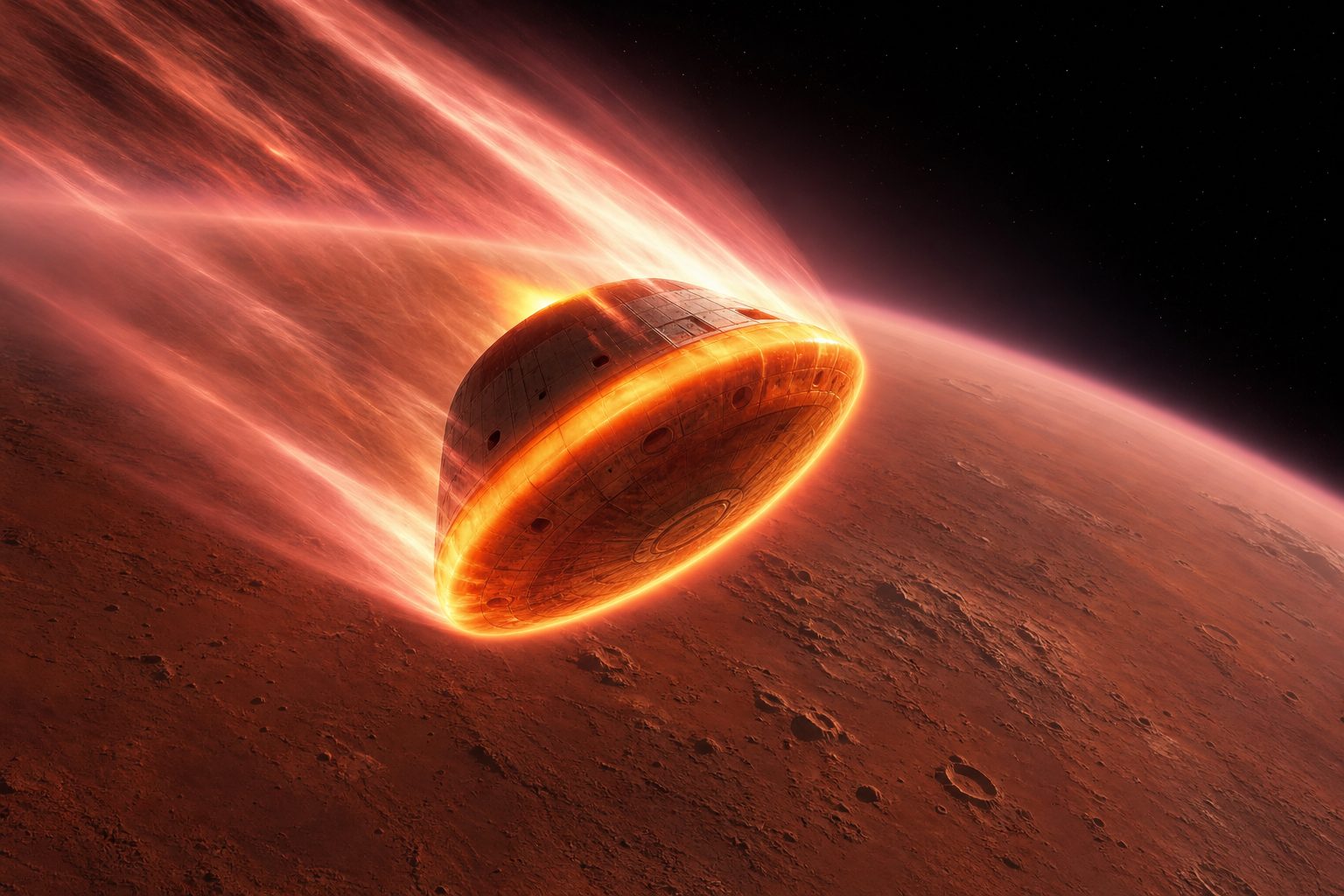
Entry A capsule’s heat shield glowing in the Martian atmosphere. AI-generated still.
Entry Heat shield faces the fire
~240 s · ~11 km Parachute opens
~1.9 km Rover and descent stage drop free
~20 m Sky crane lowers the rover
Touchdown Cables cut; stage flies away
Perseverance, 18 Feb 2021
8
throttleable thrusters
~6.4 m
cables
~12 s
of lowering before touchdown
Sky crane
Jezero
a crater about 45 km wide
18 Feb 2021
touchdown
Where it landed
Chapter II · Getting there
From the sky to the ground
NASA: Perseverance launched on 30 July 2020 and landed on 18 February 2021 in Jezero crater. The sky-crane article (Wikipedia): the spacecraft enters inside an aeroshell whose heat shield is later jettisoned; Perseverance’s parachute opened about 240 seconds after entry at roughly 11 km; the rover and descent stage separated from the backshell at about 1.9 km; the descent stage, with eight hydrazine thrusters, lowered the rover from about 20 m up, roughly 12 seconds before touchdown, on cables about 6.4 m long; cable cutters then released it and the descent stage flew away to crash at a safe distance.
Try it: “Run the landing” replays the sequence; heights are not to scale.
Perseverance is three metres long and weighs about a tonne. It rolls on six aluminium wheels, each about half a metre across, with its own motor and forty-eight cleats.
The wheels hang on a rocker-bogie: linked arms that pivot, so every wheel stays on the ground and the rover can climb over a rock as big as a wheel without tipping.
Safety comes before speed: its top speed on flat, hard ground is a hundred and fifty-two metres an hour, slower than a person walking.
Now compare the rocker-bogie with a rigid frame.
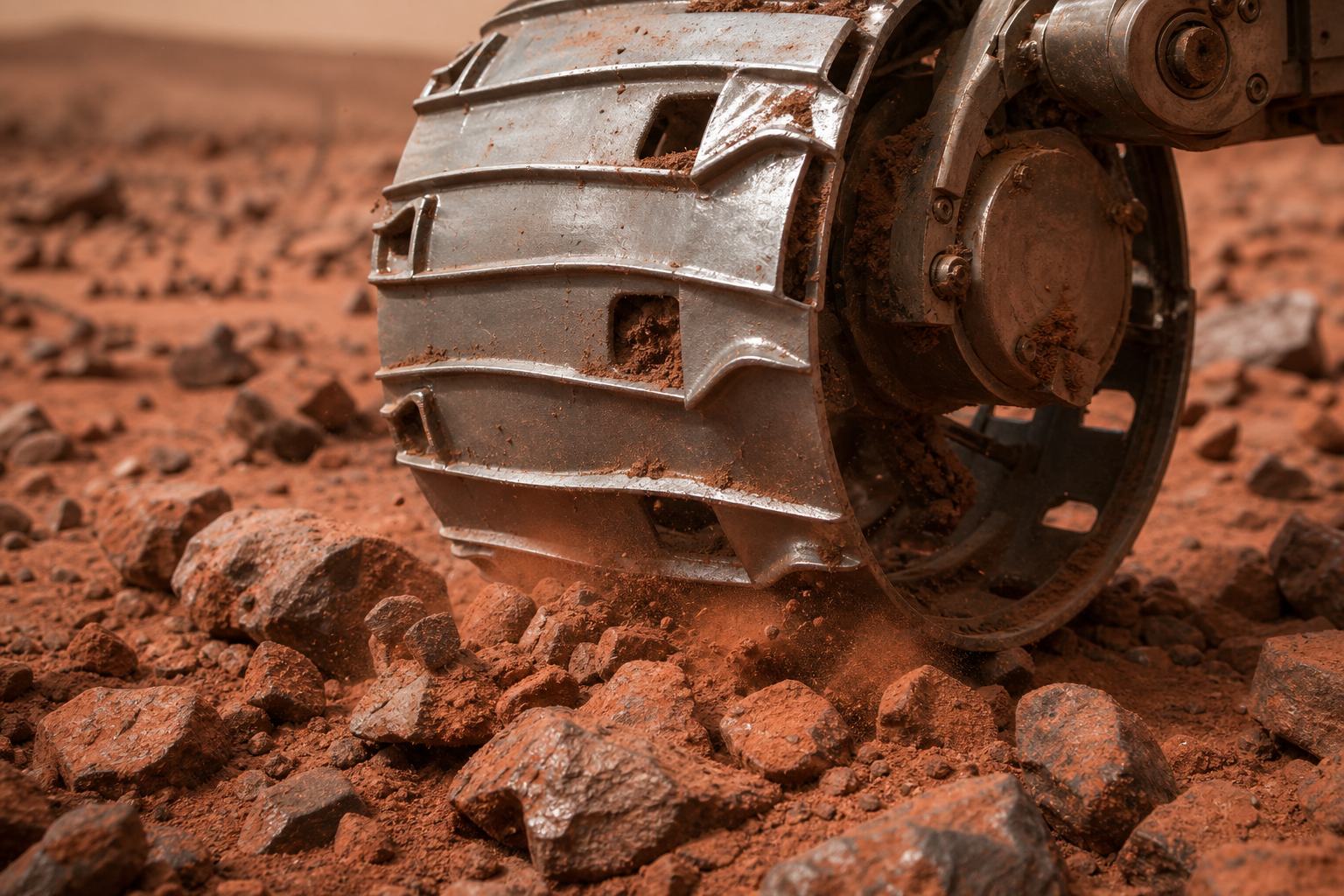
One of six An aluminium wheel with curved cleats on sharp rocks. AI-generated still.
1,025 kg
mass
3 m
length
52.5 cm
wheel diameter
Perseverance
Arms pivot so all six wheels keep contact
Crosses obstacles as large as a wheel
Rocker-bogie
152 m/h
on flat, hard ground: just under 0.1 mph
Top speed
Rocker-bogie: all six wheels stay down
Rigid frame: wheels lift, the body tilts
Try it
Chapter III · A car built for Mars
Wheels and suspension
NASA’s rover components page: Perseverance has a mass of 1,025 kg and is 3 m long, 2.7 m wide and 2.2 m tall. It has six aluminium wheels, each with its own motor, 52.5 cm in diameter with 48 grousers (cleats). Its rocker-bogie suspension lets it cross obstacles or depressions as large as one wheel. Its top speed on flat, hard ground is just under 0.1 mph (152 metres per hour).
Try it: with a rigid frame the front wheel climbs, the others lift and the body tilts; the rocker-bogie keeps all six down. Simplified.
The 3D rovers, terrain and planets are simplified teaching models, not to scale.
Sunlight failed Opportunity in the end. Perseverance carries its own heat source instead. A generator holds four point eight kilograms of plutonium dioxide.
As the plutonium decays it gives off heat, and the generator turns that heat into about a hundred and ten watts of electricity, day and night, dust or no dust. Two batteries cover the peaks.
Its output falls a few percent a year, over a design life of fourteen years.
Now send a dust storm, and compare a solar rover with a nuclear one.
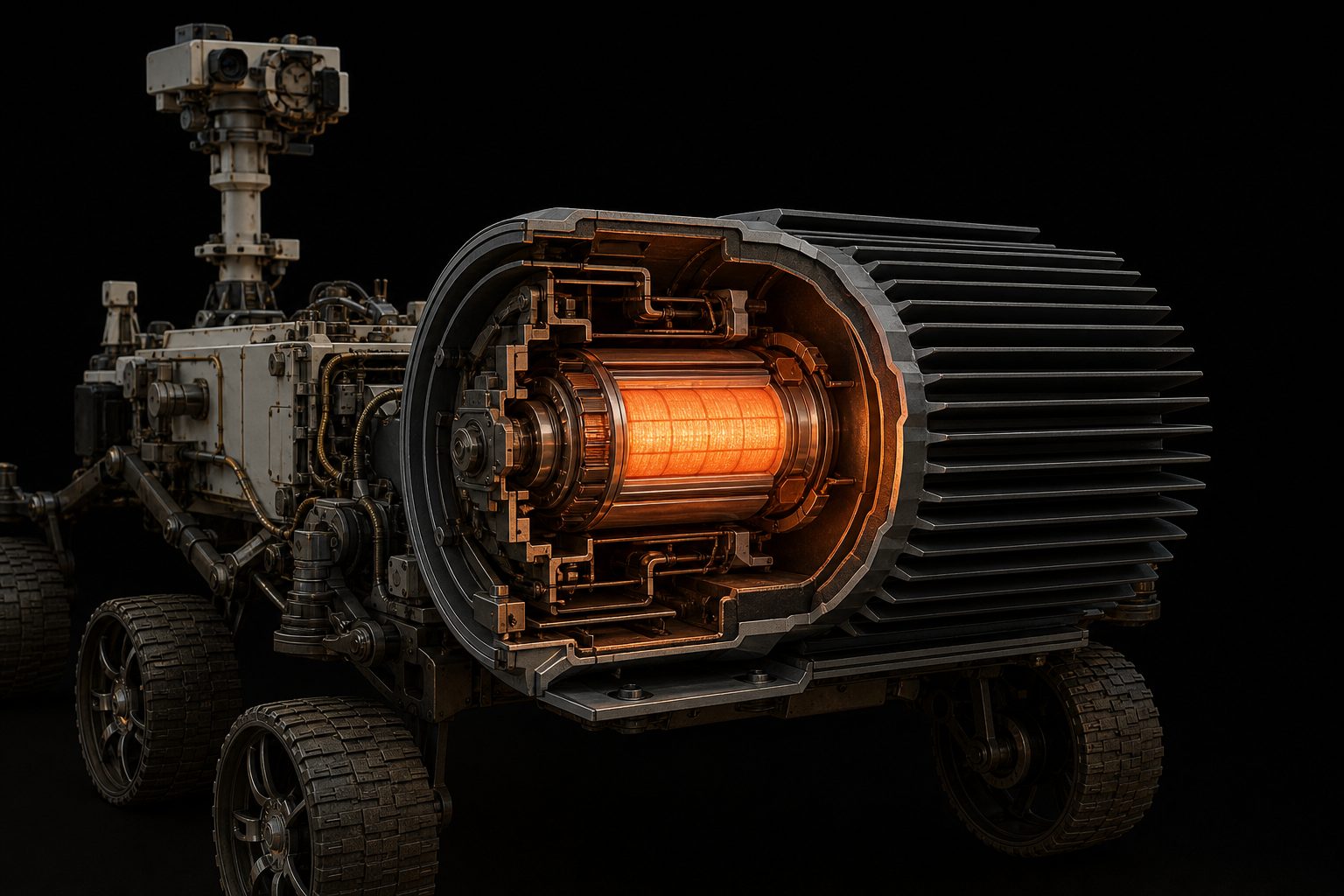
The generator A finned radioisotope generator at the back of the rover. AI-generated still.
~110 W
at launch
4.8 kg
plutonium dioxide
14 years
operational lifetime
MMRTG (a nuclear battery)
Solar: light, but dust and night cut it
Nuclear: steady day and night
Nuclear output fades slowly with the years
Solar or nuclear?
Chapter III · A car built for Mars
Power
NASA’s rover components page: Perseverance’s Multi-Mission Radioisotope Thermoelectric Generator (MMRTG) uses 4.8 kg (10.6 pounds) of plutonium dioxide as its heat source and produces about 110 watts at launch, declining a few percent per year, with an operational lifetime of 14 years; two lithium-ion batteries meet peak demands. Opportunity, by contrast, depended on solar panels (Sky & Telescope).
Try it: the solar rover’s power in the readout is illustrative, not a measured figure.
The 3D rovers, terrain and planets are simplified teaching models, not to scale.
Radio travels at the speed of light, but Mars is far. Depending on where the two planets are in their orbits, a signal takes about four to twenty-five minutes to cross, each way.
So a joystick is useless. By the time a driver saw a cliff edge on a screen, the rover would already have gone over it.
Instead, teams on Earth plan each sol's work in advance and send it as a list of commands, then wait for the rover to report back.
Move Mars closer or farther, and watch the delay.
Mars at its closest
~4
Mars at its farthest
~25
One-way signal time ESA’s range; a round trip takes twice as long.
~8–50 min
for a question to go and its answer to return
Ask and waitPlanning a sol A control room with terrain maps, as imagined. AI-generated still.
Read yesterday’s images and data
Plan drives and science
Upload the command list
Wait for the rover’s report
A sol, from Earth
Chapter IV · Driving blind
Minutes of delay
ESA: depending on where Mars is in its orbit, it can take anywhere from four to 25 minutes for a signal to reach it. Rovers are therefore driven by sequences of commands planned in advance rather than in real time; Sojourner already received its commands once per sol (Wikipedia), and planners on Earth set the waypoints that Perseverance drives between (EarthSky).
Try it: switch Mars between its closest and farthest; the pulse crosses at a scaled-down speed.
The 3D rovers, terrain and planets are simplified teaching models, not to scale.
Perseverance can now do much of the driving itself. Planners on Earth pick waypoints. As it rolls, it photographs the ground with its cameras, builds a three-dimensional map of hazards, and picks its own path between them.
The team calls it thinking while driving. Sojourner judged its path from twenty measured points on the ground; Perseverance weighs six hundred thousand, and can cover up to four hundred and twelve metres in a sol.
More than ninety percent of its distance has been driven this way, against about five percent for Spirit and Opportunity.
Compare a pre-planned route with AutoNav.
6 hazard-avoidance cameras (HazCams)
2 navigation cameras (Navcams)
2 computers, one always a spare
The rover’s eyesA self-chosen path Tracks weaving between boulders. AI-generated still.
Sojourner, 1997
20
Perseverance
600,000
Points used to judge a path Bar lengths are true to scale: Sojourner’s 20 is too small to see.
>90%
Perseverance
~5%
Spirit and Opportunity
Share of distance driven autonomously
Chapter IV · Driving blind
Thinking while driving
EarthSky, citing NASA: Perseverance images the terrain as it moves, builds a 3D hazard map and plots its own route between waypoints set by planners on Earth, which the team calls “thinking while driving”. It can cover up to 412 m (1,351 ft) in one sol; more than 90% of its distance has used AutoNav, compared with about 5% for Spirit and Opportunity; Sojourner assessed its path using 20 measurement points, Perseverance processes 600,000. NASA’s component page lists six HazCams, two Navcams and two identical computers, one always a spare.
Try it: a pre-planned route stops at hazards it did not know about; AutoNav reroutes. The grid on screen is schematic.
Perseverance landed in Jezero, a crater forty-five kilometres wide that scientists believe once held a lake, fed by rivers that left a delta of sediment behind.
Its job is to look for signs of ancient microbial life, and to seal promising rocks in tubes. It brought forty-three sample tubes, and has collected twenty-nine samples of rock and regolith, the loose dust and broken rock that covers the ground.
The samples are meant for possible return to Earth by a future mission. One, called Sapphire Canyon, from a rock nicknamed Cheyava Falls, may hold potential biosignatures, clues that past life may have been there, but NASA says they need more study.
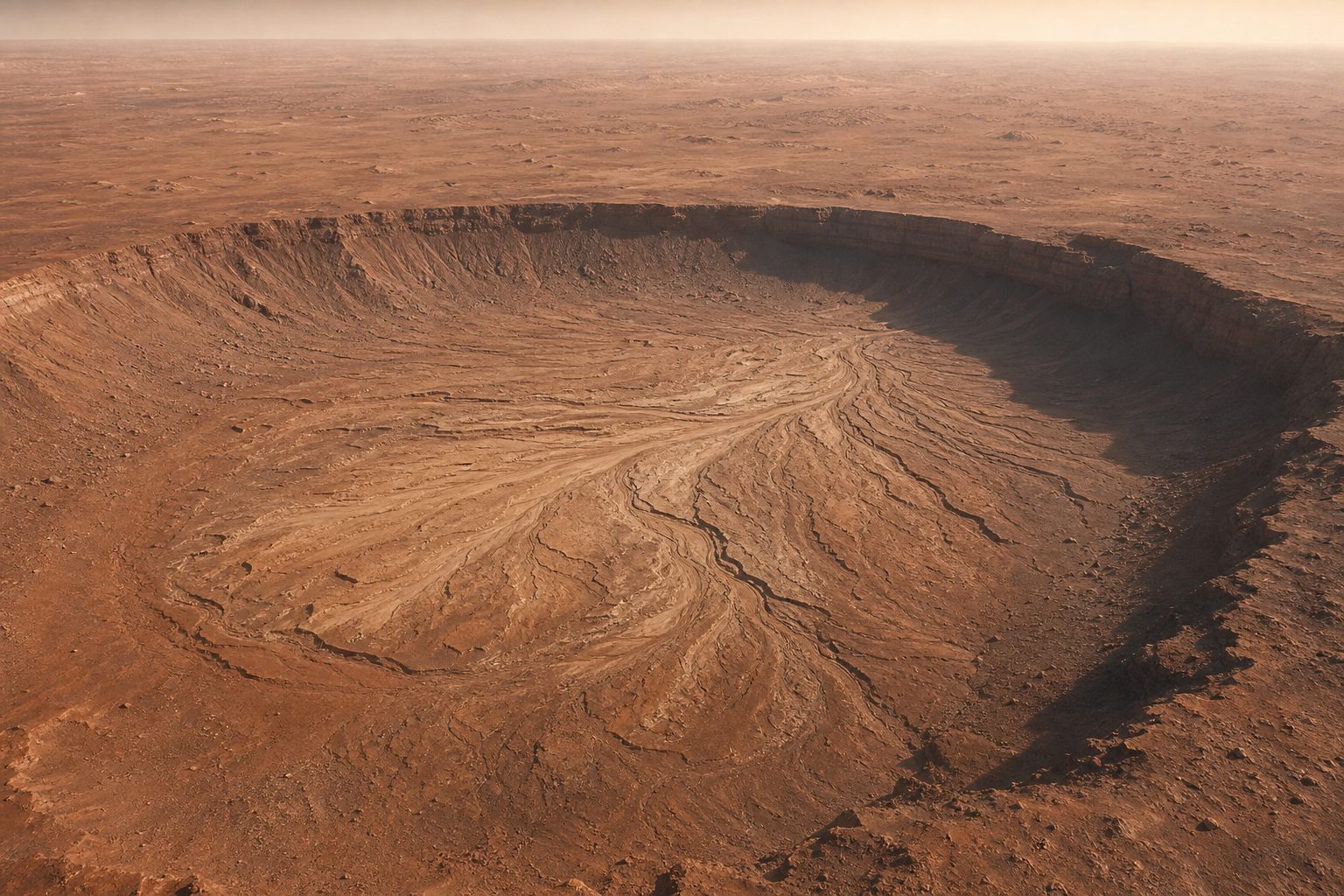
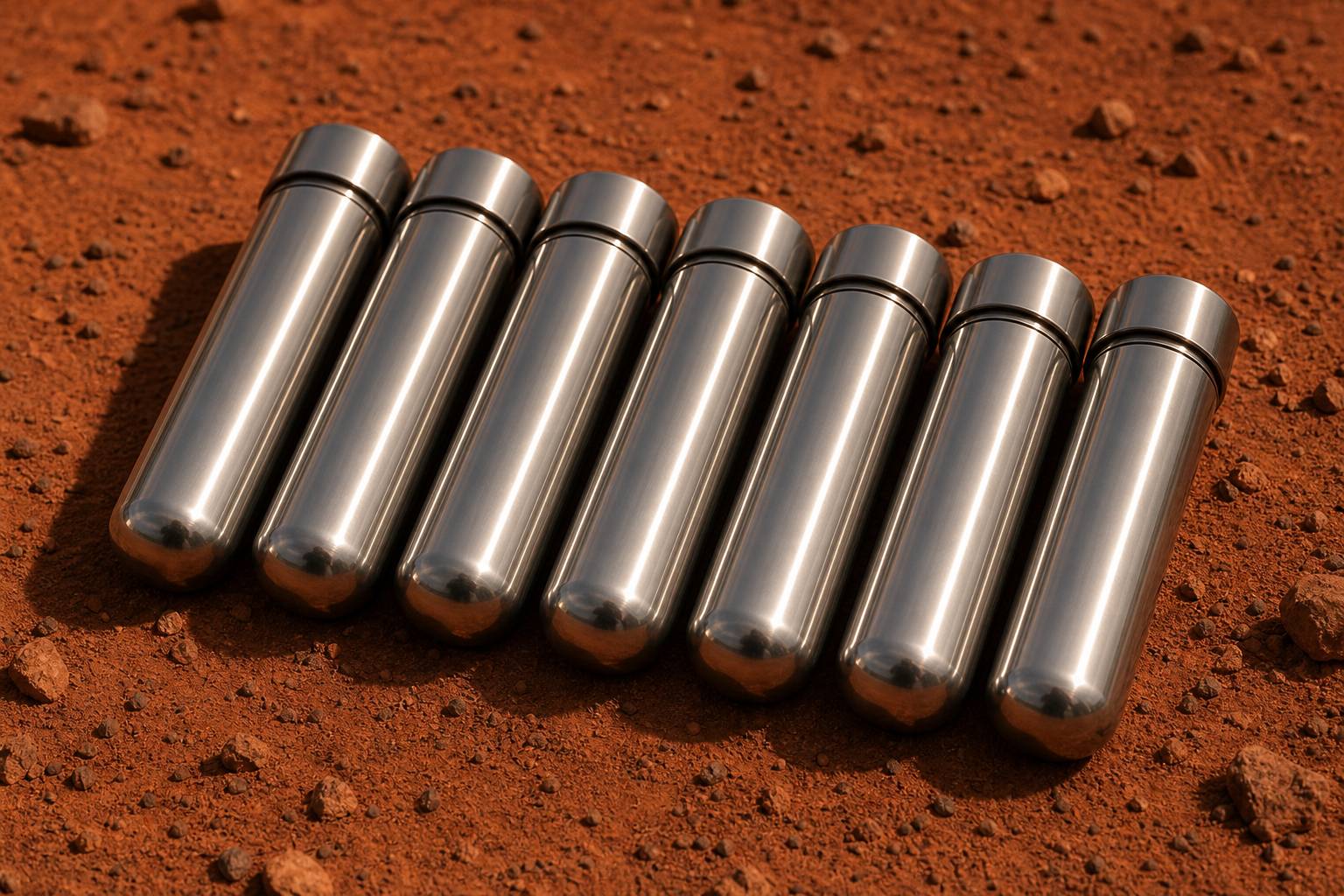
A dried delta An ancient river delta inside a crater, as imagined. AI-generated still.Sealed tubes Sample tubes sealed for possible return to Earth. AI-generated still.
43
sample tubes brought to Mars
29
rock and regolith samples collected
Samples
potential biosignatures … clues that suggest past life may have been present, but that require more data or further studyNASA, on the “Sapphire Canyon” sample
Sealed in tubes on Mars
Waiting for a possible future return mission
The samples now
Chapter V · What it is looking for
Jezero and the samples
NASA: Jezero crater is about 45 km wide, on the western edge of Isidis Planitia; scientists believe it once held a lake fed by river channels, and it contains an ancient river delta. The rover is seeking signs of ancient life and collecting samples of rock and regolith for possible Earth return by a future mission; the “Sapphire Canyon” sample from a rock nicknamed “Cheyava Falls” may contain potential biosignatures, though more data or study is needed. NASA’s component page lists 43 sample tubes; EarthSky reports 29 rock and regolith samples collected as of October 2026.
A potential biosignature is a feature that might have a biological origin but needs more study; it is not a discovery of life.
The 3D rovers, terrain and planets are simplified teaching models, not to scale.
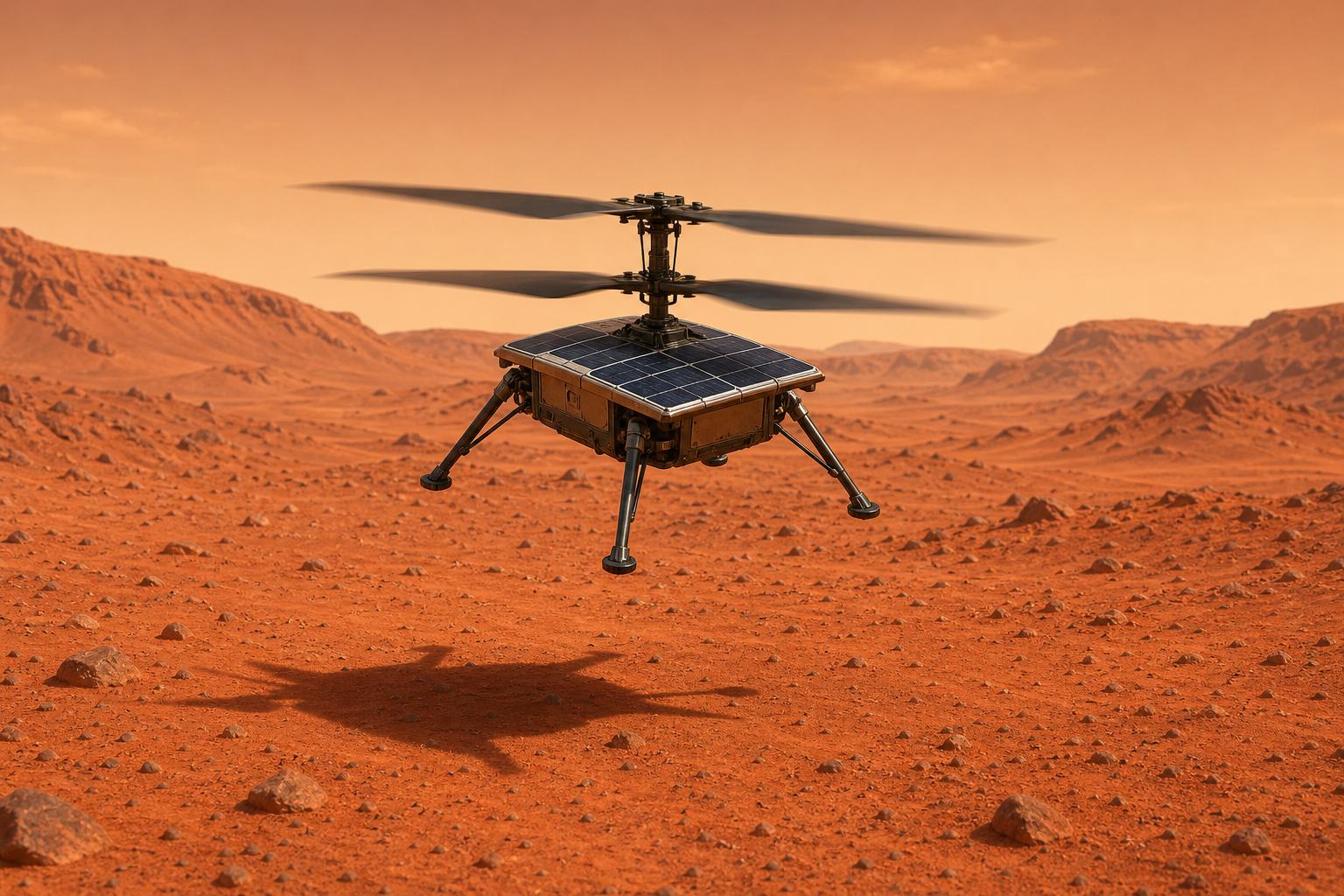
Perseverance did not travel alone. Under its belly rode Ingenuity, a small helicopter. On the nineteenth of April 2021 it became the first aircraft to fly on another planet.
It went on to make seventy-two flights. On the last, in January 2024, it lost part of a rotor blade and could no longer make enough lift in the thin air.
Future rovers may send scouts like it ahead, to look over the next hill.
Ingenuity A twin-rotor helicopter over Martian dunes, as imagined. AI-generated still.
19 Apr 2021
first powered flight on another planet
72
flights in total
Ingenuity
Flight 72, January 2024
About a quarter of one blade lost
Not enough lift in thin air
Why it stopped
Chapter V · What it is looking for
A helicopter on Mars
NASA: Ingenuity rode to Mars on Perseverance’s belly, completed 72 flights and was the first aircraft to achieve powered, controlled flight on another planet. NASASpaceflight: its first flight was on 19 April 2021; after flight 72 in January 2024 it was found to have lost about 25% of one rotor blade and could no longer generate enough lift in Mars’ thin atmosphere. The idea of future scouts is the film’s illustration, not a mission announcement.
The 3D rovers, terrain and planets are simplified teaching models, not to scale.
Here is the table it now tops. Spirit drove seven point seven kilometres, Lunokhod 1 about ten and a half, and the Apollo 17 astronauts thirty-five point seven in their lunar rover in 1972.
Curiosity, the rover sent before Perseverance and still working, has passed thirty-eight kilometres. Lunokhod 2 reached thirty-nine in 1973, and Opportunity forty-five point one six, the record until this month.
Perseverance is heading for a site called Idubi, off the crater's western rim, where scientists hope to find traces of ancient hydrothermal systems, places where hot water once flowed through rock. Its mission is extended to about the end of 2028.
Spirit
7.7 km
Lunokhod 1
10.54 km
Apollo 17 (crew)
35.7 km
Curiosity (so far)
38.07 km
Lunokhod 2
39 km
Opportunity
45.16 km
Perseverance (11 Oct 2026)
45.22 km
Distance driven on other worlds Curiosity and Perseverance are still driving.
60 m
Perseverance’s lead over Opportunity on 11 Oct
Margin
Idubi, in the Lac de Charmes region off the western rim
Then south toward Rainbow Falls
Extended mission to about end-2028
Next
~2028
end of the first mission extension
Still driving
Chapter V · What it is looking for
The distance table
Sci.News, citing NASA (October 2026): Perseverance 45.22 km, Opportunity 45.16 km, Lunokhod 2 39 km (1973), Curiosity more than 38.07 km, Apollo 17 crew 35.7 km (1972), Spirit 7.7 km; Lunokhod 1 drove about 10.54 km according to NASA (Space.com). EarthSky: the rover is heading to Idubi, an area off Jezero’s western rim nicknamed Lac de Charmes, where scientists hope to find evidence of ancient hydrothermal systems; Sci.News adds that it will then head south toward Rainbow Falls, and the first mission extension runs to about the end of 2028. The 60 m margin is 45.22 minus 45.16 km.
The 3D rovers, terrain and planets are simplified teaching models, not to scale.
In fifty-six years, rovers have gone from a tub-shaped car on the Moon steered live by five people to a robot that lands itself on a sky crane, runs on plutonium heat and picks its own path.
Its drivers still choose where it goes. But the minutes of silence between Earth and Mars mean that, more and more, the rover decides how to get there.
1970 Lunokhod 1 on the Moon
1997 Sojourner, first on Mars
2004 Spirit and Opportunity
2021 Perseverance and Ingenuity
2026 New off-world distance record
Rovers on other worlds
Earth
chooses the waypoints
Rover
chooses most of the path
Who decides what
Stills are AI-generated, not NASA photographs
3D rovers and terrain are schematic
About this film
Epilogue · Sources
Sources
Every fact in this film comes from the sources below. The chapter stills and pictures are AI-generated illustrations, not NASA photographs. The 3D rovers, terrain and planets are simplified teaching models, not to scale. Distances are as reported on 11–13 October 2026; Perseverance and Curiosity are still driving.