PlanetPast
EN

Chemistry · Technology

How Lithium-Ion Batteries Work

Ions Inside, Electrons Outside

On 20 October 2026 the Chinese carmaker Chery unveiled a solid-state battery cell it rates at 400 watt-hours per kilogram, and on 21 October Dongfeng said its semi-solid battery is scheduled for mass adoption in 2027. This film explains the lithium-ion battery they are trying to improve: how a cell stores energy, with lithium ions moving inside through the electrolyte while electrons travel through the outside circuit; the three steps by Stanley Whittingham, John Goodenough and Akira Yoshino that led to the first commercial cells in 1991 and the 2019 Nobel Prize; how energy density rose and prices fell; why lithium metal grows dendrites and what thermal runaway is; and what a solid electrolyte changes, with company claims shown as claims.

Interactive 3D film10 min1800 to 2027Published 28 October 2026

Watch the interactive filmRead in ไทย

Prologue

Chemistry · Technology

Ions inside, electrons outside

What is in the battery in your pocket?

The battery in your phone, and in almost every electric car, is a lithium-ion battery. On the twentieth of October 2026, the Chinese carmaker Chery showed a new kind of cell that it says holds about one and a half times as much energy per kilogram as the best cells the IEA listed in 2023.

A day later, Dongfeng said its own semi-solid battery is scheduled for mass adoption in 2027. Both are betting on solid-state batteries, which replace one part of today’s design.

To see what they are changing, and why it is hard, we first need to see how a lithium-ion battery works.

400
Wh per kg, claimed
120–260
Wh per kg, lithium-ion cells (IEA, 2023)
−40 to 100 °C
claimed working range
Chery’s Rhinoceros S cell (company figures)
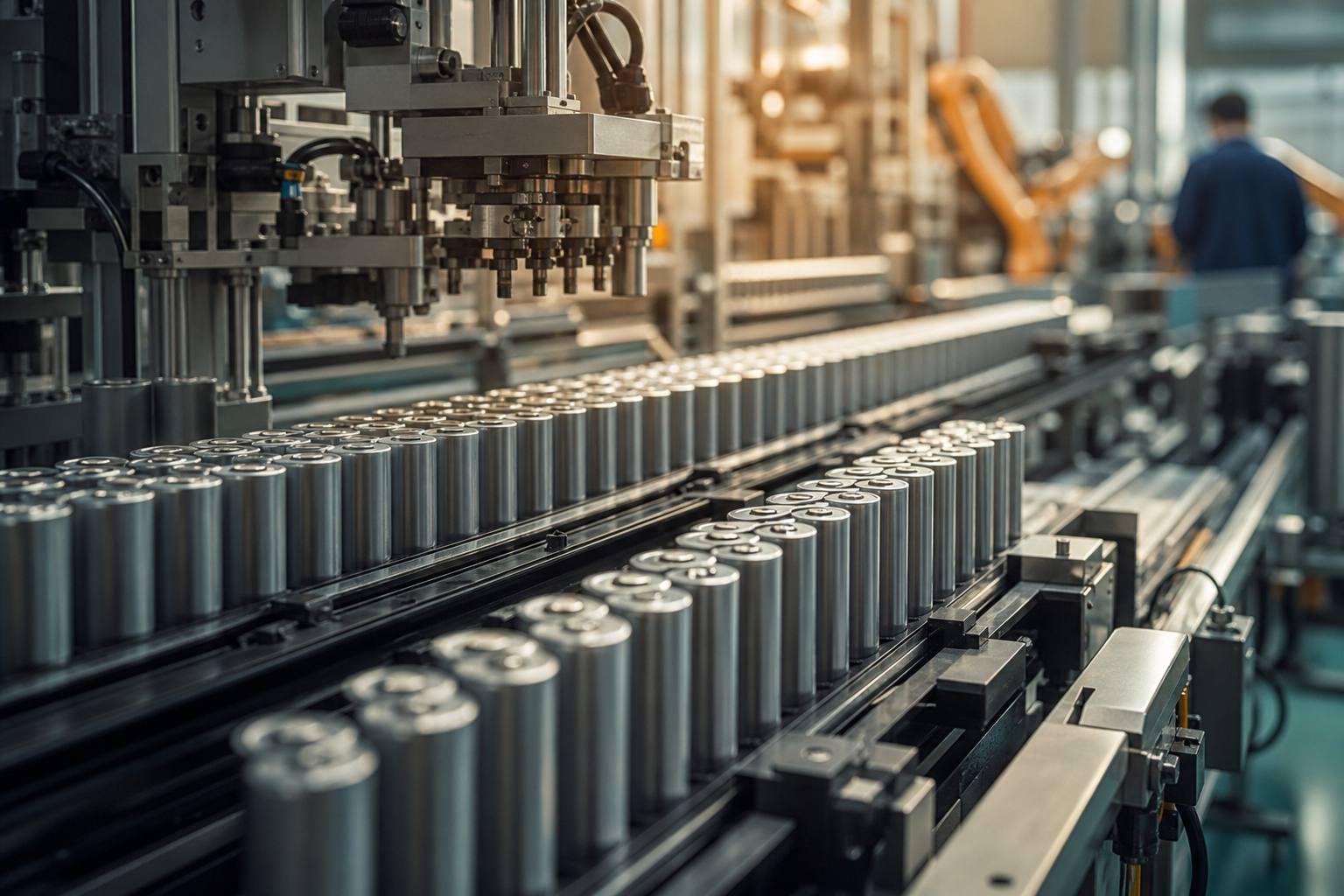
Cells on a line Battery cells on an assembly line. Dongfeng says it aims to deliver 50,000 vehicles with its own solid-state batteries by 2027. AI-generated illustration.
  • Three steps to the first cell
  • How a cell charges and discharges
  • Denser and cheaper
  • Dendrites and thermal runaway
  • What “solid-state” changes
In this film
Prologue

The announcements

EnergyTrend (26 Oct 2026): at its Global Innovation Conference in Wuhu on 20 October, Chery unveiled the Rhinoceros S solid-state cell, rated at 400 Wh/kg, which it says “operates across a temperature range of -40°C to 100°C” and “passed the 200°C hot-box test”; its pilot line is planned for 2027. On 21 October Dongfeng’s Feng Changjun said its fast-charging semi-solid battery is “scheduled for mass adoption in 2027” and that a 400 Wh/kg all-solid-state battery is at the prototype stage. Dongfeng aims to deliver 50,000 vehicles with its in-house solid-state batteries by 2027.

Company figures are the companies’ own claims; none had been independently verified in the reports cited here.

IEA Global EV Outlook 2023: lithium-ion batteries range from 120 to 260 Wh/kg; 400 is about 1.5 times the top of that range.

Battery-Tech.net notes that Chery “did not provide the test duration, state of charge, or sample configuration” for the 200°C test, which was internal.

Sources: EnergyTrend / TrendForce (26 Oct 2026): Chery and Dongfeng solid-state battery roadmaps; Battery-Tech.net (Oct 2026): Chery solid-state pilot line, 2027; International Energy Agency: Global EV Outlook 2023, trends in batteries


Chapter I · Inside the cell

Chapter I

Inside the cell

Four parts and two paths

Here is a lithium-ion cell, opened up. On one side is the anode, made of graphite, a form of carbon stacked in layers. On the other is the cathode, a metal oxide.

Between them is a liquid electrolyte, a lithium salt dissolved in organic solvents, which lets ions through. A thin separator full of tiny pores keeps the two electrodes from touching. The electrolyte carries ions but does not conduct electrons, so their only path is the outside circuit.

That split is the whole trick: ions inside, electrons outside. Whatever you are powering sits on the electrons’ path.

  • Anode: graphite
  • Cathode: metal oxide
  • Electrolyte: lithium salt in solvent
  • Separator: porous film
Four parts (Argonne, Wikipedia)
Rolled up Thin electrode sheets being unrolled. In a cylindrical cell, electrodes and separators are wound into a “jelly roll”. AI-generated illustration.
Li⁺
inside, through the electrolyte
e⁻
outside, through the wire
Two paths
Chapter I · Inside the cell

The parts of a cell

Argonne: lithium-ion cells typically have a cathode of cobalt, manganese and nickel oxides and an anode of graphite; the electrodes store the lithium. Wikipedia: the electrolyte is a lithium salt in organic solvents; the separator keeps the electrodes apart so they do not short, while ions move through the electrolyte; cylindrical cells wind positive electrode, separator and negative electrode into one long “jelly roll”.

The 3D cell, ions, electrons, bars and heat gauge are simplified teaching models, not to scale.

Sources: Argonne National Laboratory: Science 101, Batteries; Wikipedia: Lithium-ion battery (construction, electrolyte, voltages, safety)

When the battery powers something, it discharges. Lithium ions leave the graphite, cross the electrolyte and settle into the cathode, while the same number of electrons travel around the circuit.

Charging pushes them back. The charger drives electrons into the anode, and the ions return to the graphite layers to meet them.

Nothing is burned and the electrodes are not used up, so the cycle can be repeated hundreds of times. Try it: charge and discharge the cell yourself.

LiC6→C6+Li++e−\text{LiC}_6 \rightarrow \text{C}_6 + \text{Li}^{+} + e^{-}CoO2+Li++e−→LiCoO2\text{CoO}_2 + \text{Li}^{+} + e^{-} \rightarrow \text{LiCoO}_2
→ cathode
discharging: powering a device
→ anode
charging: from the charger
Which way the ions go
One cycle A phone on charge. Each charge and discharge is one cycle, and capacity slowly fades with use (Wikipedia). AI-generated illustration.
Chapter I · Inside the cell

Charge and discharge

Argonne: during discharge, lithium ions move through the electrolyte from the anode to the cathode, while the reactions release electrons that power the device; charging reverses the process, and the cycle can be repeated hundreds of times. Wikipedia: graphite in its fully lithiated state is LiC₆, and the cobalt-oxide cathode becomes LiCoO₂; the half-reactions on screen are idealised, for a lithium-cobalt-oxide cell, one of several chemistries; real cells cycle only part of the lithium.

Try it: press Discharge or Charge and follow the ions inside and the electrons outside.

The 3D cell, ions, electrons, bars and heat gauge are simplified teaching models, not to scale.

Sources: Argonne National Laboratory: Science 101, Batteries; Wikipedia: Lithium-ion battery (construction, electrolyte, voltages, safety)

Chapter II · Three steps

Chapter II

Three steps

Why lithium, and why it took three chemists

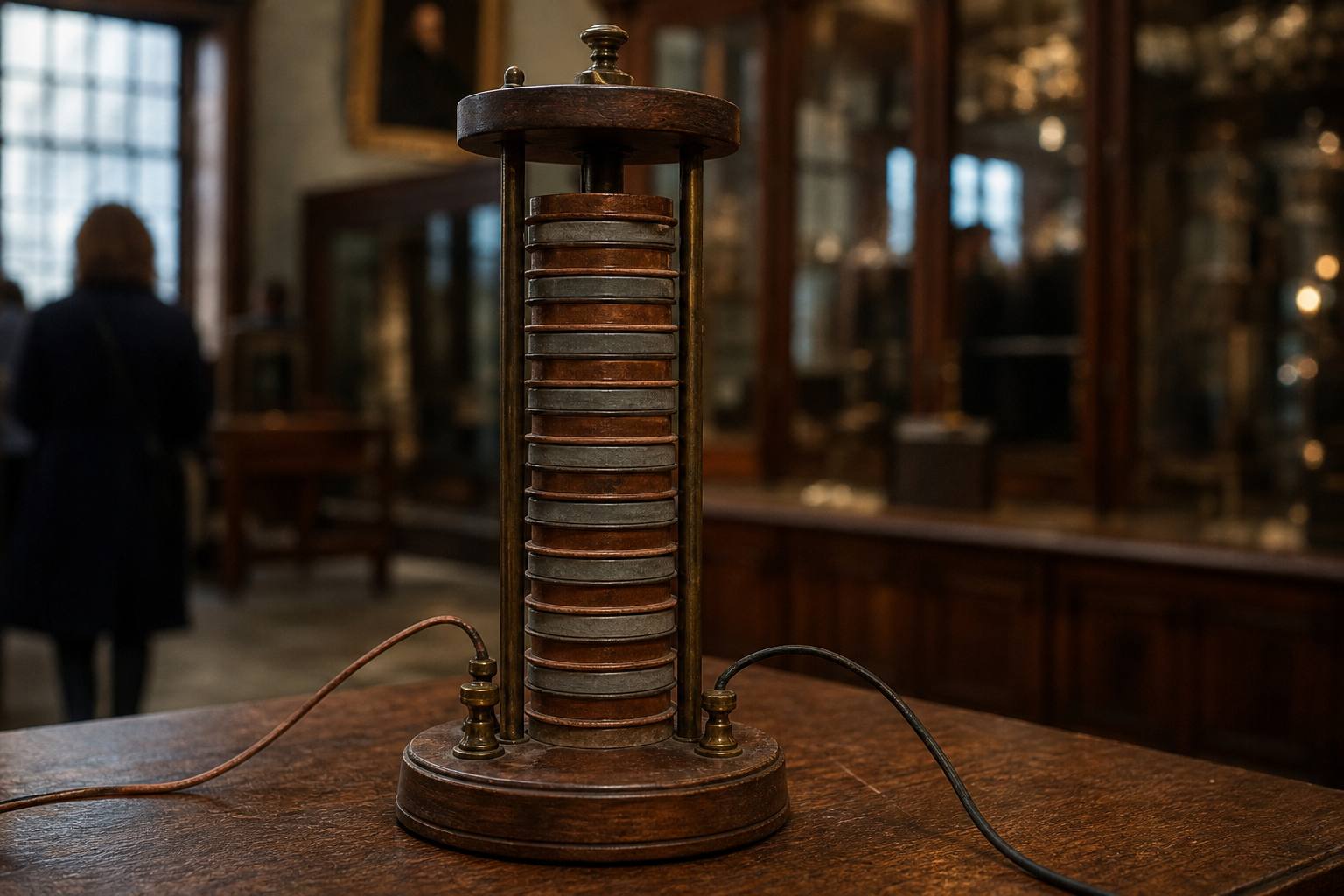
Every battery is a controlled chemical reaction. Around 1800, Alessandro Volta built one of the first, a stack of metal discs called the voltaic pile.

The idea has not changed. One material, the negative electrode or anode, gives up electrons easily; another, the cathode, takes them in. Join the two with a wire and electrons flow through it, doing work, while charged atoms, called ions, move inside the battery to balance the charge.

Lithium is a natural choice. It is the lightest metal, about half as dense as water, and in the Nobel committee’s words, it has a strong drive to release electrons. The more eagerly the anode gives electrons away, the harder they are pushed round the circuit.

A voltaic pile Pairs of metal discs stacked in a column, as in Volta’s design. The volt, the unit of voltage, is named after him. AI-generated illustration.
  • Anode (negative): gives electrons while discharging
  • Positive electrode (cathode): takes them
  • Electrolyte: lets ions through
  • Outside circuit: carries electrons
Every battery has
0.53 g/cm³
density; water is 1
−3.05 V
how strongly it gives up electrons: among the strongest of any element
Lithium (KVA, 2019)
Li→Li++e−\text{Li} \rightarrow \text{Li}^{+} + e^{-}
Li+\text{Li}^{+}
lithium ion: travels inside
e−e^{-}
electron: travels outside
Chapter II · Three steps

Why lithium

Royal Swedish Academy of Sciences, scientific background (2019): Volta’s pile dates from around 1800; lithium is the lightest metal, with a density of 0.53 g/cm³ and a standard reduction potential of −3.05 V versus the standard hydrogen electrode, which makes it attractive for high-voltage, light batteries. Nobel press release: lithium “has a strong drive to release electrons”. Argonne: during discharge, lithium ions move through the electrolyte from anode to cathode while the reactions release electrons that power the device.

The 3D cell, ions, electrons, bars and heat gauge are simplified teaching models, not to scale.

Sources: Royal Swedish Academy of Sciences (2019): Lithium-ion batteries, scientific background on the Nobel Prize in Chemistry 2019 (PDF); Nobel Prize in Chemistry 2019: press release (Royal Swedish Academy of Sciences); Argonne National Laboratory: Science 101, Batteries

In the 1970s, amid an oil crisis, the chemist Stanley Whittingham looked for energy technologies free of fossil fuels. He found a material, titanium disulphide, a compound of titanium and sulphur, built in layers that lithium ions could slip in between.

Chemists call this intercalation. The ions move in and out while the host material barely changes, so the reaction can run backwards. In 1976 his rechargeable cell, with an anode of lithium metal, gave a little over two volts.

But metallic lithium is fiercely reactive. With repeated charging it grew tiny metal spikes that could short-circuit the cell and start a fire.

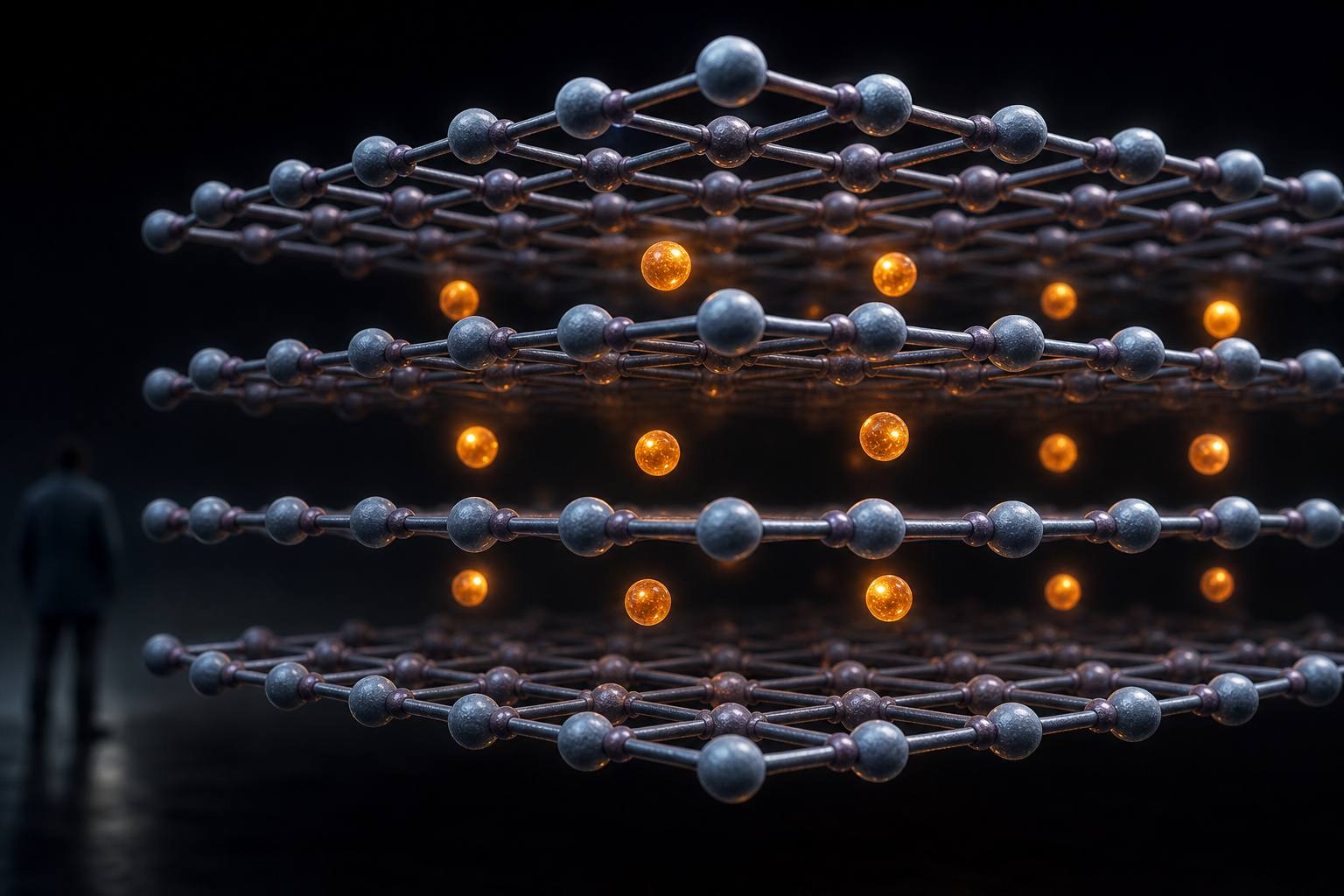
A layered host A model of a layered crystal. The same trick, ions parked between layers, is used by the graphite in today’s anodes. AI-generated illustration.
  • Ions slip in between the layers
  • The host barely changes
  • So the reaction can run backwards
Intercalation
1976
working rechargeable cell
2.5 V
cell voltage
Whittingham’s cell (KVA)
Chapter II · Three steps

Whittingham’s battery

Nobel press release: in the oil crisis of the 1970s, Whittingham developed a cathode “made from titanium disulphide”, giving “just over two volts”, but metallic lithium in the anode made the battery too explosive to be viable. KVA background: a working rechargeable cell was demonstrated in 1976, with a TiS₂ cathode and a cell voltage of 2.5 V; lithium dendrites formed on the metal surface over repeated charge-discharge cycles and could short-circuit the cell, a fire hazard. Intercalation means ions entering a layered host, with little change to its structure.

The 3D cell, ions, electrons, bars and heat gauge are simplified teaching models, not to scale.

Sources: Nobel Prize in Chemistry 2019: press release (Royal Swedish Academy of Sciences); Royal Swedish Academy of Sciences (2019): Lithium-ion batteries, scientific background on the Nobel Prize in Chemistry 2019 (PDF)

In 1980, John Goodenough predicted that a metal oxide, a compound with oxygen, would give a higher voltage than a sulphide. He tried cobalt oxide, with lithium ions tucked inside it.

It produced as much as four volts, and higher voltage means more energy from the same material. Cathodes made from oxides of nickel, manganese and cobalt are still typical today.

One problem remained. The other electrode was still lithium metal: still reactive, still prone to those spikes.

Titanium disulphide, 1970s≈2.5
Cobalt oxide, 1980≤4
Cell voltage, volts (KVA, Nobel committee)
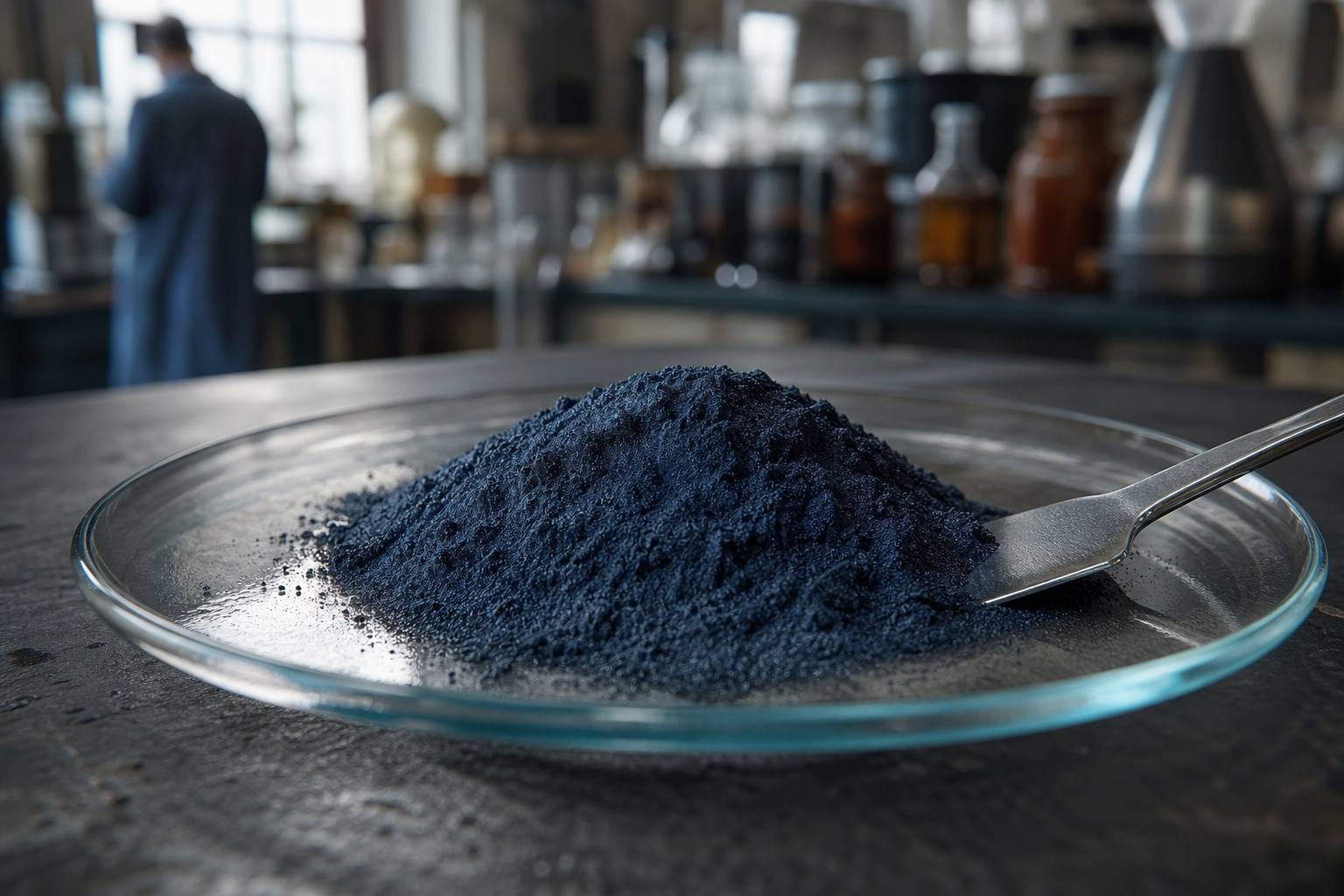
An oxide powder Dark metal-oxide powder of the kind that stores lithium in a cathode. Argonne lists cobalt, manganese and nickel oxides as typical. AI-generated illustration.
  • Anode: reactive lithium metal
  • Risk: spikes and short circuits
Still unsolved in 1980
Chapter II · Three steps

Goodenough’s cathode

Nobel press release: Goodenough predicted the cathode would have even greater potential if made from a metal oxide instead of a metal sulphide; in 1980 he showed that “cobalt oxide with intercalated lithium ions can produce as much as four volts”. KVA background: the LiₓCoO₂ cathode was reported in 1979–1980. Argonne: lithium-ion cathodes typically consist of cobalt, manganese and nickel oxides.

The 3D cell, ions, electrons, bars and heat gauge are simplified teaching models, not to scale.

Sources: Nobel Prize in Chemistry 2019: press release (Royal Swedish Academy of Sciences); Royal Swedish Academy of Sciences (2019): Lithium-ion batteries, scientific background on the Nobel Prize in Chemistry 2019 (PDF); Argonne National Laboratory: Science 101, Batteries

In 1985, Akira Yoshino replaced the lithium metal with petroleum coke, a carbon material left over from oil refining that can hold lithium ions between its layers. Now neither electrode contained pure lithium metal.

The lithium only ever travels as ions, back and forth between two hosts. The result was light and hard-wearing, and the first lithium-ion batteries went on sale in 1991. Later cells switched to graphite, another form of carbon.

Each of the three chemists had fixed a problem left by the one before, and in 2019 they shared the Nobel Prize in Chemistry.

  1. 1976 Whittingham: layered TiS₂ cathode
  2. 1980 Goodenough: cobalt oxide cathode
  3. 1985 Yoshino: carbon anode, no lithium metal
  4. 1991 On sale
Three steps (Nobel committee, KVA)
Early 1990s electronics A handheld video camera of the early 1990s. The first commercial cells stored about 80 watt-hours per kilogram (KVA). AI-generated illustration.
“They have laid the foundation of a wireless, fossil fuel-free society.”Royal Swedish Academy of Sciences, 9 October 2019
Chapter II · Three steps

The first commercial battery

Nobel press release: in 1985 Yoshino created the first commercially viable lithium-ion battery, using “petroleum coke, a carbon material” in the anode instead of reactive lithium; the result was “a lightweight, hardwearing battery”, and lithium-ion batteries “first entered the market in 1991”. The 2019 prize went jointly to John B. Goodenough, M. Stanley Whittingham and Akira Yoshino. KVA background: the first commercial cells reached about 80 Wh/kg.

The 3D cell, ions, electrons, bars and heat gauge are simplified teaching models, not to scale.

Sources: Nobel Prize in Chemistry 2019: press release (Royal Swedish Academy of Sciences); Royal Swedish Academy of Sciences (2019): Lithium-ion batteries, scientific background on the Nobel Prize in Chemistry 2019 (PDF)

Chapter III · Denser, cheaper

Chapter III

Denser, cheaper

Three decades of improvement

Engineers judge batteries partly by energy density: how much energy each kilogram holds. The first commercial lithium-ion cells stored about eighty watt-hours per kilogram.

In 2023, the International Energy Agency put lithium-ion batteries at about 120 to 260. Chery’s claimed 400 would be above that range, and Battery500, a research group funded by the US government, aims for 500.

Cell figures are not pack figures. In a car, the casing, wiring and cooling around the cells add weight, so a whole pack holds less per kilogram.

1 Wh
the energy to run a 1-watt device for an hour
1 kWh
1,000 Wh
What a watt-hour is
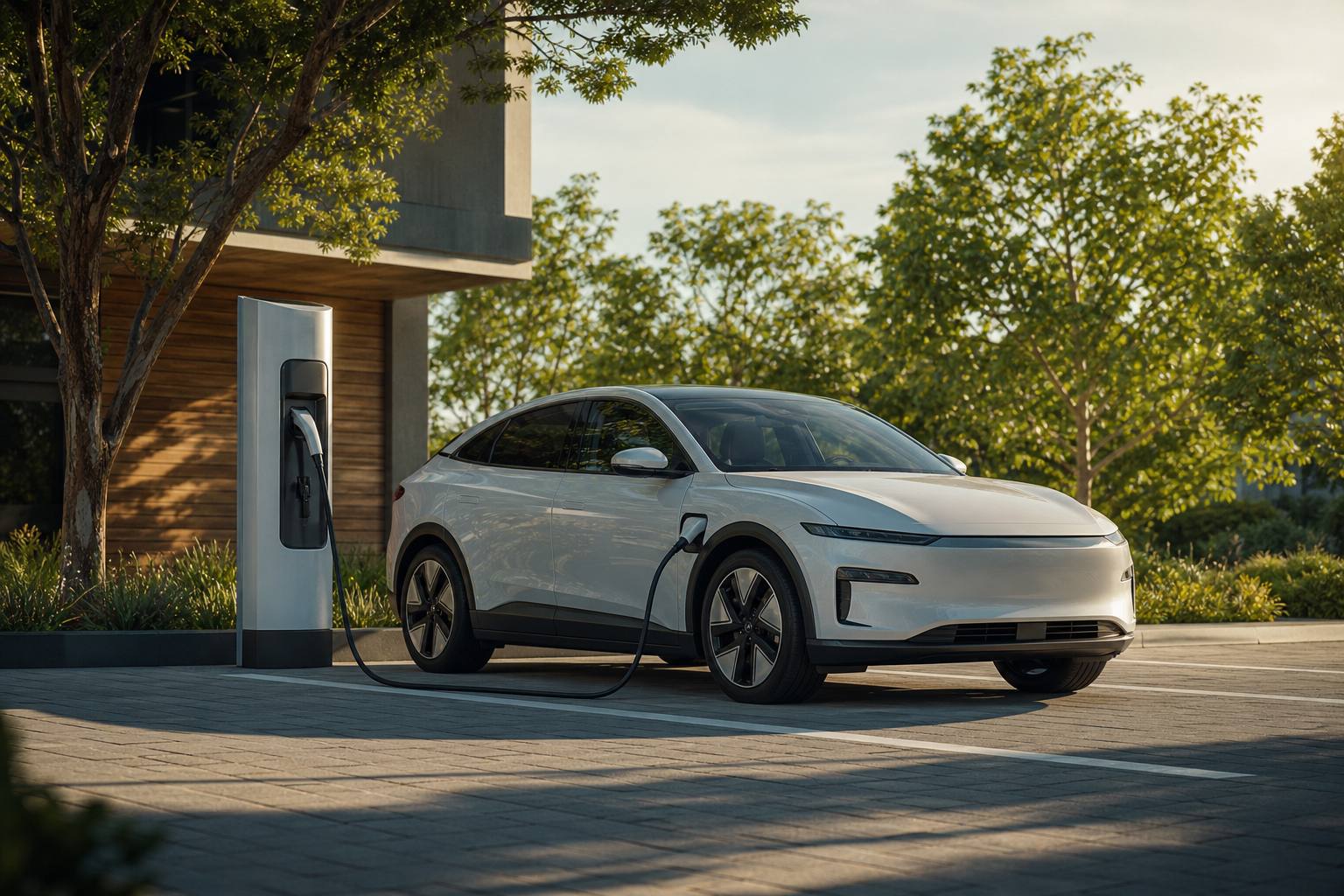
Same chemistry, bigger scale An electric car at a charger. Sodium-ion batteries, a cheaper alternative, range from 75 to 160 Wh/kg (IEA). AI-generated illustration.
  • Cost per kilowatt-hour
  • Number of cycles
  • Charging speed
  • Safety and temperature range
Energy is not everything
Chapter III · Denser, cheaper

Energy density

KVA background: the first commercial cells reached about 80 Wh/kg. IEA Global EV Outlook 2023: lithium-ion batteries range from 120 to 260 Wh/kg, and sodium-ion batteries from 75 to 160 Wh/kg. PNNL: the Battery500 consortium aims for specific energy “up to 500 Wh kg⁻¹” and 1,000 charge-discharge cycles. Chery’s 400 Wh/kg is a company claim for a cell (EnergyTrend).

Company figures are the companies’ own claims; none had been independently verified in the reports cited here.

The 3D cell, ions, electrons, bars and heat gauge are simplified teaching models, not to scale.

Sources: Royal Swedish Academy of Sciences (2019): Lithium-ion batteries, scientific background on the Nobel Prize in Chemistry 2019 (PDF); International Energy Agency: Global EV Outlook 2023, trends in batteries; Pacific Northwest National Laboratory: Battery500 Consortium; EnergyTrend / TrendForce (26 Oct 2026): Chery and Dongfeng solid-state battery roadmaps

Cost fell even faster. According to BloombergNEF, a battery pack cost over 1,100 dollars per kilowatt-hour in 2010. By 2019 it was 156, and in 2025 the average was 108.

One cheaper option is a different cathode. Lithium iron phosphate, or LFP, first reported in 1997, uses no nickel or cobalt. It stores less energy than nickel-based cathodes, but in 2025 LFP packs averaged 81 dollars, against 128 for nickel-manganese-cobalt.

By 2022, the IEA found, LFP was already in just under a third of electric-car batteries.

−87%
fall in pack prices, in 2019 dollars
BloombergNEF, 2010–2019
  • LFP: iron and phosphate, cheaper, less energy per kg
  • NMC: nickel, manganese, cobalt, more energy per kg
Two common cathodes
NMC60%
LFP<30%
NCA≈8%
Electric-car batteries by cathode, 2022 (IEA; NCA = nickel-cobalt-aluminium)
Chapter III · Denser, cheaper

Prices and chemistries

BloombergNEF via InsideEVs (2019): pack prices fell 87% in real terms from over $1,100/kWh in 2010 to $156/kWh in 2019. BloombergNEF (2025, in 2025 dollars): the average pack price fell 8% to a record low of $108/kWh; LFP packs averaged $81/kWh and NMC packs $128/kWh. IEA (2023): in 2022, NMC held 60% of the EV battery market, LFP just under 30% and NCA about 8%; LFP’s energy density tends to be lower than NMC’s. KVA background cites the 1997 paper by Padhi and colleagues in Goodenough’s group that introduced LiFePO₄.

The 3D cell, ions, electrons, bars and heat gauge are simplified teaching models, not to scale.

Sources: InsideEVs (Dec 2019): BloombergNEF, battery prices fall to $156/kWh in 2019; BloombergNEF (Dec 2025): Lithium-ion battery pack prices fall to $108 per kilowatt-hour; International Energy Agency: Global EV Outlook 2023, trends in batteries; Royal Swedish Academy of Sciences (2019): Lithium-ion batteries, scientific background on the Nobel Prize in Chemistry 2019 (PDF)

Chapter IV · The limits

Chapter IV

The limits

Spikes and heat

Graphite is only a host: it holds lithium but adds weight. Researchers at Berkeley Lab say replacing it with lithium metal could extend an electric car’s range by thirty to fifty percent.

That brings back Whittingham’s old enemy. Over many charge cycles, tiny tree-like defects called dendrites grow on the lithium.

If a dendrite reaches the cathode, it short-circuits the cell. Taming it is one aim of programmes such as Battery500, which wants a thousand charge cycles. Reset it and grow it again yourself.

+30–50%
possible gain in driving range
Lithium metal anode (Berkeley Lab)
Dendrites Branching metal growth, illustrated. Real dendrites are microscopic and grow gradually, cycle after cycle. AI-generated illustration.
500
Wh per kilogram
1,000
charge cycles
Battery500 goals (PNNL)
Chapter IV · The limits

Dendrites

Berkeley Lab (2020): scientists have tried to replace graphite anodes with lithium metal, which extends driving range by 30–50% but “shortens the battery’s useful life due to lithium dendrites”, “tiny treelike defects that form on the lithium anode over the course of many charge and discharge cycles”; dendrites “short-circuit the cells in the battery if they make contact with the cathode”. PNNL: Battery500 pursues lithium-metal anodes, aiming for up to 500 Wh/kg and 1,000 cycles, and works on dendrite formation.

Try it: press Grow and watch a dendrite cross the separator in this schematic.

The 3D cell, ions, electrons, bars and heat gauge are simplified teaching models, not to scale.

Sources: Berkeley Lab News Center (20 Jul 2020): lithium metal anodes and dendrites; Pacific Northwest National Laboratory: Battery500 Consortium

The other danger is heat. Normally a cell warms only a little and sheds that heat. But an internal short, overcharging or extreme temperatures can tip it into thermal runaway: an uncontrollable, self-heating state.

The cell then makes heat several times faster than it can lose it. UL researchers describe temperatures climbing more than twenty degrees a minute and peaking above three hundred, with venting gas, smoke and sometimes fire.

The liquid electrolyte in these cells is flammable, which is one reason carmakers want a solid one. Try it: reset, then add heat one press at a time.

  • Internal short, e.g. a damaged separator
  • Overcharge
  • External short circuit
  • Extreme heat or cold
Triggers (UL Research Institutes)
>20 °C/min
rate of temperature rise
>300 °C
peak temperature
Runaway, as UL describes it
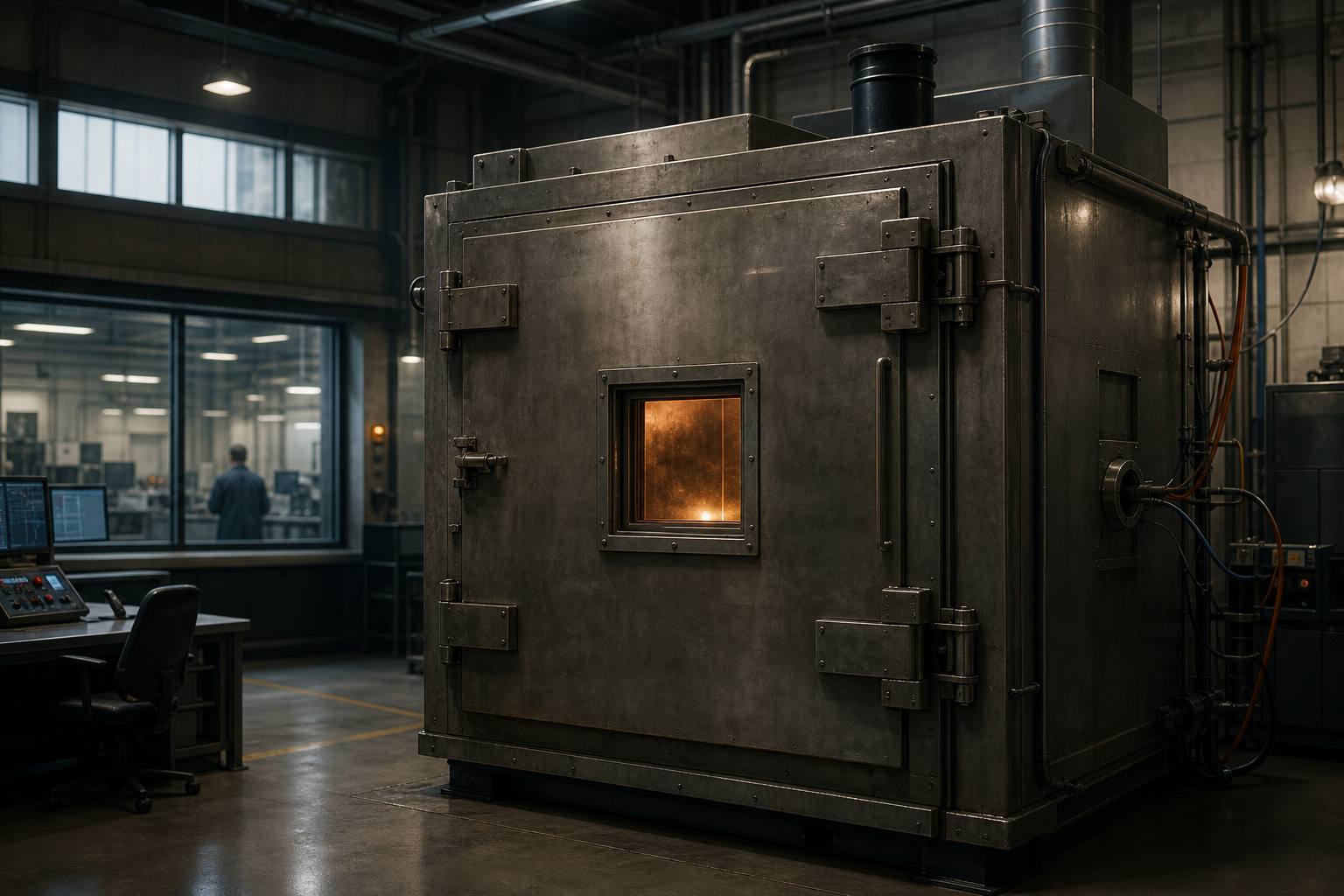
Testing for it A steel test chamber in a battery safety lab. Cells are deliberately abused in such chambers to study how they fail. AI-generated illustration.
Chapter IV · The limits

Thermal runaway

UL Research Institutes: in thermal runaway a cell “enters an uncontrollable, self-heating state”, generating heat several times faster than it dissipates; temperature rises at more than 20 °C per minute and peaks above 300 °C, with gas or electrolyte venting, smoke or fire. Causes include an internal short circuit when cell defects compromise the separator, overcharge, repeated overdischarge followed by charging, an external short circuit, and high- or low-temperature environments. Wikipedia: lithium-ion batteries have a flammable liquid electrolyte.

Safety: never puncture, crush or heat a lithium battery, and use the charger made for it.

Try it: add heat and watch the two arrows, heat made and heat lost, in this schematic.

The 3D cell, ions, electrons, bars and heat gauge are simplified teaching models, not to scale.

Sources: UL Research Institutes: What is thermal runaway?; UL Research Institutes: What causes thermal runaway?; Wikipedia: Lithium-ion battery (construction, electrolyte, voltages, safety)

Chapter V · Going solid

Chapter V

Going solid

Promise, claims and dates

A solid-state battery replaces the liquid electrolyte with a solid one. Researchers at Argonne National Laboratory say this could bring better energy density, safety and lifespan.

Chery says its cell pairs a sulphide solid electrolyte with a cathode rich in nickel. But sulphide electrolytes break down in humid air, so factories need extremely dry rooms, which makes production costly.

And solids do not flow, so keeping every layer in close contact is another hurdle, one Chery itself names.

  • Lithium-ion today: liquid electrolyte
  • Semi-solid: some liquid remains
  • All-solid-state: no liquid
Liquid, semi-solid, solid
A dry room A battery lab with sealed glove boxes. Argonne says sulphide cells need rooms with a dew point below −40 °C: extremely dry air, not a cold room. AI-generated illustration.
contact
between solid layers
pack
integration and management
Chery’s own priorities (Battery-Tech.net)
Chapter V · Going solid

What solid-state changes

Argonne: solid-state batteries “use solid electrolytes instead of the liquid ones found in regular lithium-ion batteries” and could offer “better energy density, safety and lifespan”; sulphide electrolytes such as LPSCl break down in humidity and oxygen, and making cells with them “requires maintaining a dry room below -40 C (-40 F), which makes production costly” (the figure refers to the dryness of the air, a dew point). EnergyTrend: Chery’s 400 Wh/kg route uses a sulphide solid electrolyte with a high-nickel ternary cathode. Battery-Tech.net: Chery names “material-interface contact, pack integration, and its Dedicated Management System” as engineering priorities.

Try it: charge and discharge the cell with its solid electrolyte.

Company figures are the companies’ own claims; none had been independently verified in the reports cited here.

The 3D cell, ions, electrons, bars and heat gauge are simplified teaching models, not to scale.

Sources: Argonne National Laboratory: Solid-state batteries get a boost with new protective coating; EnergyTrend / TrendForce (26 Oct 2026): Chery and Dongfeng solid-state battery roadmaps; Battery-Tech.net (Oct 2026): Chery solid-state pilot line, 2027

Semi-solid cells, like the ones Dongfeng plans for 2027 and Chery plans to put in cars by the end of 2026, still keep some liquid. All-solid cells keep none.

Chery’s figures are its own, and its solid-state pilot line opens in 2027. A pilot line is a development step, not mass production.

In June 2026, the chairman of the battery maker CATL put solid-state progress at level four on a nine-level scale, where nine means ready for mass production.

  1. Q4 2026 Chery: semi-solid cells in cars
  2. 2027 Chery: solid-state pilot line, on-board tests
  3. 2027 Dongfeng: semi-solid mass adoption
  4. 2027 CATL, BYD: small-volume all-solid use
Announced timelines (company statements)
“Pilot operation is not customer delivery or mass production.”Battery-Tech.net, October 2026
4 of 9
level 9 = ready for mass production
cost
also reliability and manufacturing yield
Solid-state maturity (CATL, via CnEVPost)
Chapter V · Going solid

When?

CnEVPost (3 Sep 2026): Chery plans to install solid-liquid hybrid batteries in vehicles in Q4 2026, with all-solid-state vehicle validation from 2027; in June 2026, CATL chairman Robin Zeng said progress was “only at level 4” on a 1–9 scale where 9 means ready for mass production; CATL and BYD target small-volume all-solid-state use in vehicles in 2027; challenges include “cost, reliability, and manufacturing yield”. EnergyTrend: Dongfeng’s semi-solid battery is “scheduled for mass adoption in 2027”; Chery’s pilot line is planned for 2027. Battery-Tech.net: “Pilot operation is not customer delivery or mass production.”

Company figures are the companies’ own claims; none had been independently verified in the reports cited here.

The 3D cell, ions, electrons, bars and heat gauge are simplified teaching models, not to scale.

Sources: CnEVPost (3 Sep 2026): Chery targets 2027 vehicle validation of solid-state battery; EnergyTrend / TrendForce (26 Oct 2026): Chery and Dongfeng solid-state battery roadmaps; Battery-Tech.net (Oct 2026): Chery solid-state pilot line, 2027

Epilogue

From Volta’s stack of discs to a cell that may hold four hundred watt-hours per kilogram, the principle has stayed the same: ions inside, electrons outside.

What changes is the materials. So the next time you read a battery headline, ask two questions. Is the number for a cell or a whole pack? And is it a pilot line, or cars people can buy?

  1. c. 1800 Volta’s pile
  2. 1976 Whittingham’s rechargeable cell
  3. 1980 Goodenough’s oxide cathode
  4. 1991 Lithium-ion on sale
  5. 2025 $108 per kWh
  6. 2027 Solid-state pilot lines planned
The battery, in six dates
  • Cell or pack?
  • Pilot line or mass production?
  • Company claim or independent test?
Reading a battery headline
  • Stills and pictures are AI-generated
  • The 3D cell is a simplified model
  • Company figures are claims, not independent tests
About this film
Epilogue · Sources

Sources

Every fact in this film comes from the sources below. Company figures (Chery, Dongfeng, CATL) are reported as the companies stated them and had not been independently verified in the reports cited. The chapter stills and pictures are AI-generated illustrations; the 3D cell, ions, electrons, dendrite and heat gauge are simplified models, not to scale.

Safety: never puncture, crush or heat a lithium battery, and use the charger made for it.

Sources: EnergyTrend / TrendForce (26 Oct 2026): Chery and Dongfeng solid-state battery roadmaps; Battery-Tech.net (Oct 2026): Chery solid-state pilot line, 2027; CnEVPost (3 Sep 2026): Chery targets 2027 vehicle validation of solid-state battery; Nobel Prize in Chemistry 2019: press release (Royal Swedish Academy of Sciences); Royal Swedish Academy of Sciences (2019): Lithium-ion batteries, scientific background on the Nobel Prize in Chemistry 2019 (PDF); Argonne National Laboratory: Science 101, Batteries; Wikipedia: Lithium-ion battery (construction, electrolyte, voltages, safety); International Energy Agency: Global EV Outlook 2023, trends in batteries; InsideEVs (Dec 2019): BloombergNEF, battery prices fall to $156/kWh in 2019; BloombergNEF (Dec 2025): Lithium-ion battery pack prices fall to $108 per kilowatt-hour; Berkeley Lab News Center (20 Jul 2020): lithium metal anodes and dendrites; Pacific Northwest National Laboratory: Battery500 Consortium; UL Research Institutes: What is thermal runaway?; UL Research Institutes: What causes thermal runaway?; Argonne National Laboratory: Solid-state batteries get a boost with new protective coating