On 10 November 2026 Reuters reported that Microsoft was urging the US administration not to ban Chinese-made optical transceivers, the modules that turn data into flashes of laser light inside AI data centres. This film explains the established physics behind that news: light as photons whose energy sets their colour, atoms that absorb and emit light, Einstein’s 1917 idea of stimulated emission, why a laser needs a population inversion and a pump, how two mirrors build a beam, the maser of 1954 and the Schawlow–Townes paper of 1958, Theodore Maiman’s ruby laser of 16 May 1960, the helium–neon and semiconductor diode lasers, why laser light is one colour, in step and narrow, how a transceiver uses infrared lasers in glass fibre, and what lasers do today, from ranging the Moon and LIGO to cutting, eye surgery and the safety classes that protect eyes.
Interactive 3D film9 min1905 to 2026Published 11 November 2026
Some AI data centres use millions of small laser modules, and this week they are back at the centre of an argument in Washington.
They are optical transceivers: they turn electrical signals into flashes of laser light, and back again.
Reuters reports that US officials fear Chinese-made ones could be used to steal data; Microsoft, people familiar with the matter say, and the trade group ITI warn a ban could slow data-centre building.
So what is a laser?
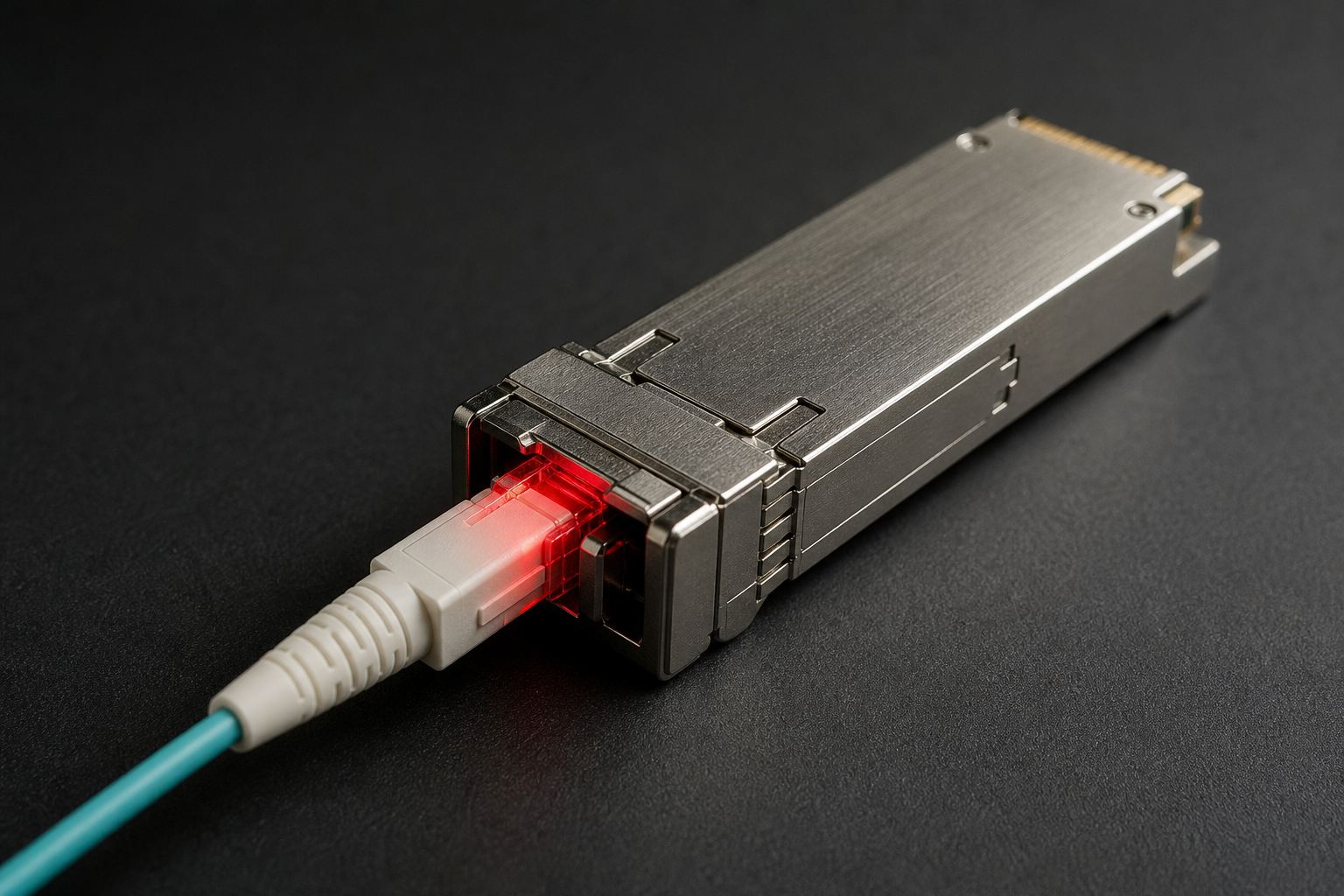
An optical transceiver A plug-in module with a glass fibre in its front. The red glow is for show: data-centre lasers are infrared, invisible to the eye. AI-generated illustration.
~2/3
of the world optical transceiver market is held by Chinese makers (Counterpoint Research)
35 + 134
Microsoft data centres in the US being built, and planned (Cleanview)
Reuters, 10 November 2026
the FCC is said to be drafting the ban; it has not commented publicly
an administration official: reports on the list are “baseless speculation”
a Senate bill would keep them out of sensitive government systems
Where things stand (as reported)
Prologue
The news
Reuters (via Business Recorder, 10 November 2026), citing three people familiar with the matter: Microsoft has been pressing the US administration not to bar imports of new Chinese models of optical transceivers, which move data over fibre-optic cables inside data centres. Officials fear Beijing could use them to steal data, install malware or disrupt service; the FCC is working on the ban but has not addressed it publicly. Microsoft met White House science and National Security Council officials in September; it declined to comment, and its position is attributed to three people familiar with the situation. The White House, the FCC and the Chinese embassy in Washington did not immediately respond to requests for comment. The trade group ITI warned a ban could “grind” the data-centre rollout to a halt. Morgan Stanley said the ban might cover transceivers of 3.2 terabits per second.
Daily Caller News Foundation (10 November 2026): an administration official said any reporting about additions to the covered list should be regarded as “baseless speculation”. Senators McCormick, Gallego, Cornyn and Fetterman introduced S. 5548 to keep Chinese-made optical transceivers out of the most sensitive government systems. Newsweek (August 2026): transceivers convert electrical signals into pulses of light and back. This film takes no position on the policy.
The 3D scenes are simplified teaching models, not to scale: real photons are not little balls, and real atoms have many more levels.
Start with light itself. In 1905, Einstein proposed that light comes in tiny packets of energy, which we now call photons.
A photon’s energy depends on its frequency, how fast the light wave wiggles. Shorter waves wiggle faster and carry more energy.
Our eyes read that energy as colour. Red photons carry the least energy we can see, violet about twice as much.
Beyond red lies infrared, invisible to us. Remember it: that is where the data-centre lasers work.
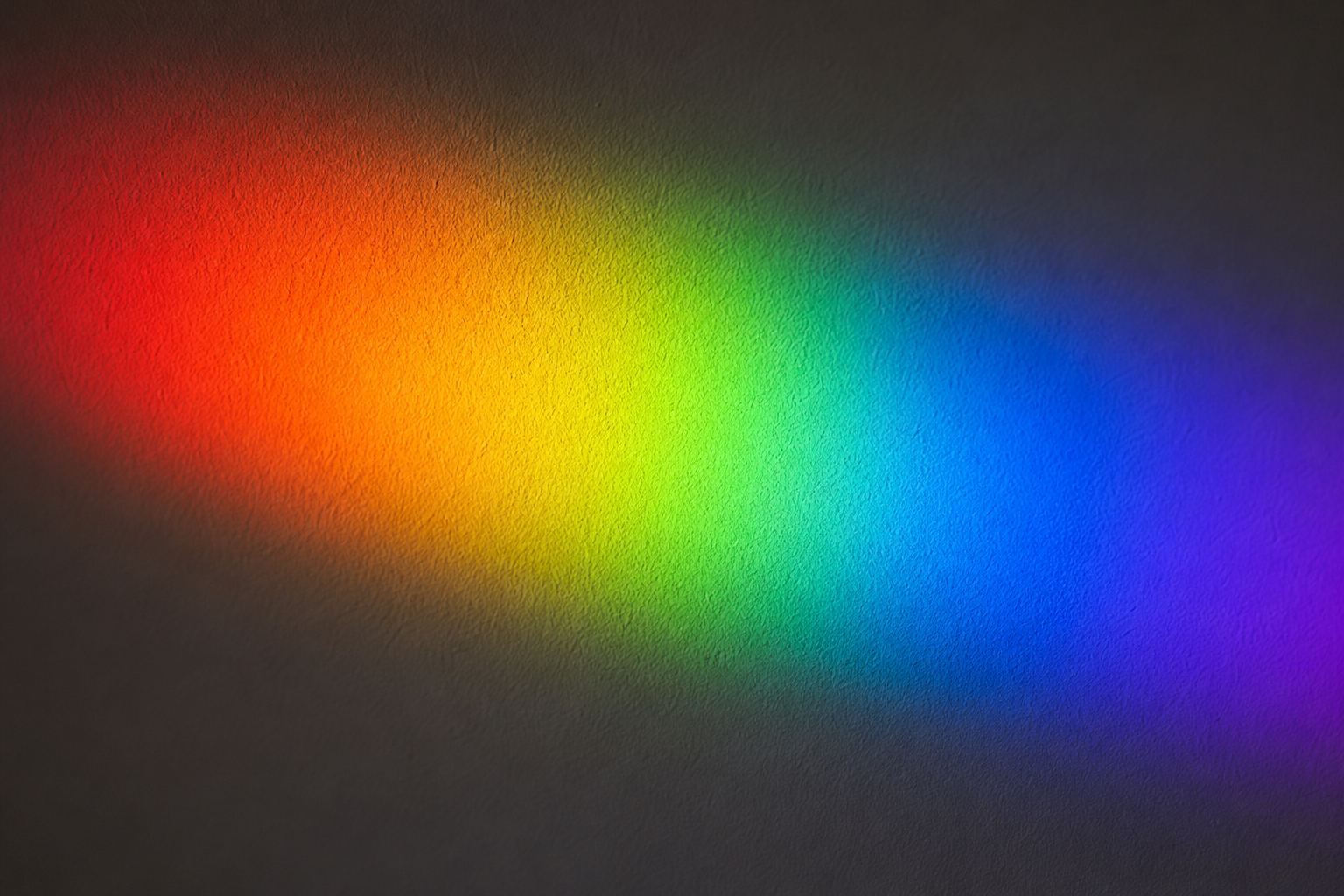
The visible spectrum White light spread out by a prism, from red to violet. AI-generated illustration.E=hfE=λhc≈λ1240eV⋅nm
f
frequency: waves per second
λ
wavelength, in nanometres (billionths of a metre)
h
Planck’s constant
Photon energy
violet, 405 nm
3.06
red, 694 nm
1.79
infrared, 1,550 nm
0.80
Energy per photon (computed from E = 1240/λ)
>700 nm
infrared: our eyes cannot see it, but glass fibre and sensors can use it
Beyond red
Chapter I · Packets of light
Photons and colour
Physics World: in March 1905 Einstein proposed that light consists of discrete quanta whose energy is set by the frequency; he used it to explain the photoelectric effect, for which he later won the Nobel Prize. OpenStax College Physics: a photon’s energy is E = hf; with hc = 1240 eV·nm the energy follows straight from the wavelength, and visible photons run from 1.63 eV (red) to 3.26 eV (violet), a factor of two.
Try the colour buttons in the scene: the wave shortens and the photon energy rises.
The 3D scenes are simplified teaching models, not to scale: real photons are not little balls, and real atoms have many more levels.
Light is made by atoms. An atom’s electrons can only sit at certain energy levels, like the rungs of a ladder.
Absorb a photon with exactly the right energy, and an electron jumps up a rung. The atom is now excited.
It does not stay that way. On its own, at a random moment, it drops back and throws out a photon in any direction.
This is spontaneous emission. It is how a glowing gas tube shines: countless atoms, each flashing whenever it likes.
bottom line: the ground state
top line: the excited state
gold dot: an electron
In the scene
ΔE = hf
the photon carries away exactly the gap between the rungs
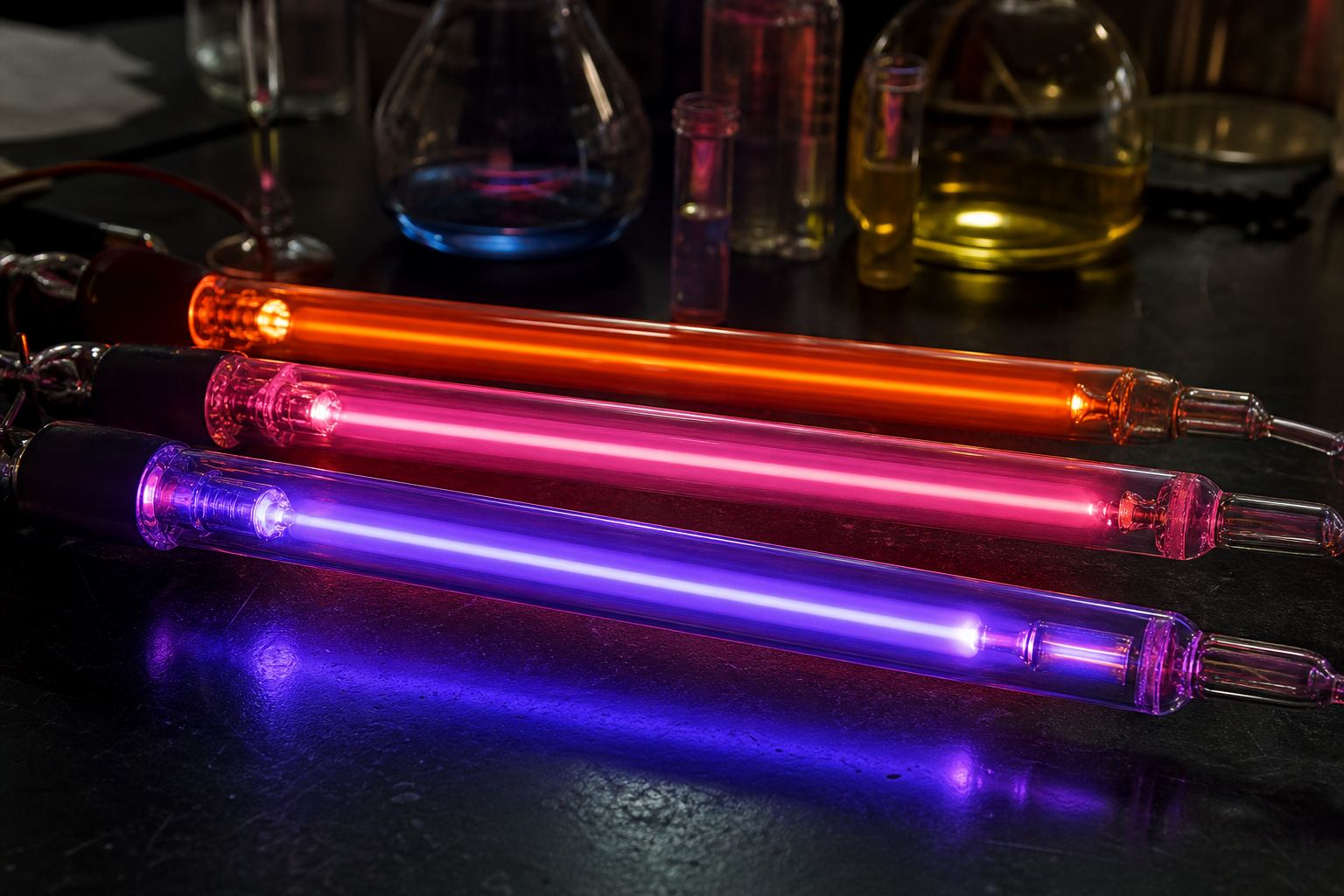
Same rung, same colourGas tubes Each gas glows in its own colours, set by its own energy levels. AI-generated illustration.
Chapter I · Packets of light
Absorption and spontaneous emission
Britannica: in the ground state an atom’s electrons sit in the lowest orbits; when they absorb energy they move outward and the atom is excited, a state that is typically unstable, and photons are usually emitted spontaneously as the electrons drop back. APS News: atoms absorb only photons of the right wavelength. A San José State University note on Einstein’s 1917 paper lists absorption and spontaneous emission as the two processes known before his third.
The 3D scenes are simplified teaching models, not to scale: real photons are not little balls, and real atoms have many more levels.
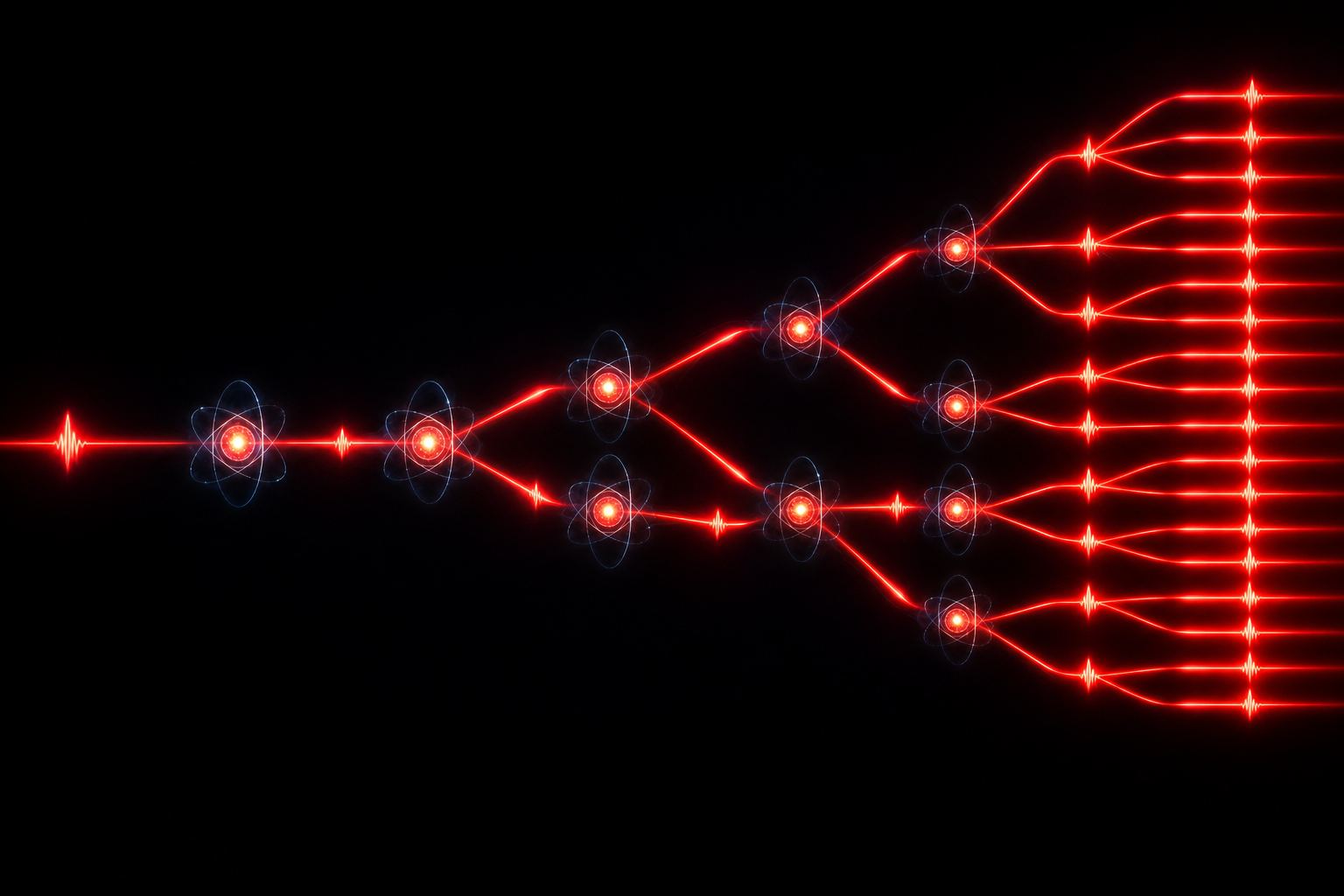
In 1917 Einstein added a third process. A passing photon can trigger an excited atom to release its photon early.
The new photon is a copy: same energy, same direction, and in step with the first, its wave rising and falling together with it.
One photon goes in, two come out. That is amplification, and it is the S and E in the word laser: stimulated emission.
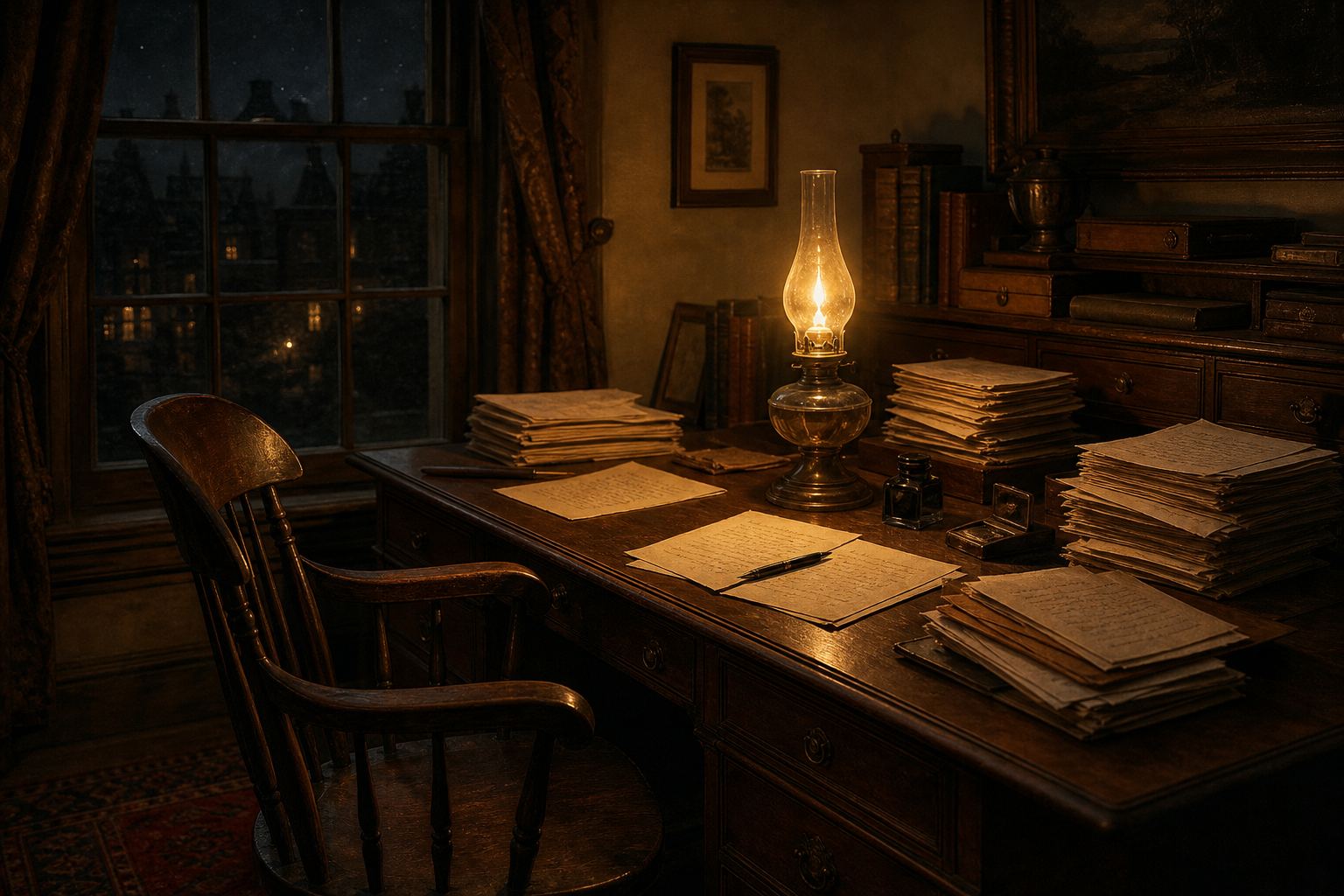
Einstein needed it to make Planck’s law, the maths of light from hot objects, work. Nobody built anything with it for more than thirty years.
Berlin, 1917 A scientist’s desk of the period. Einstein worked out the idea on paper; no experiment came with it. AI-generated illustration.
same frequency, so same colour
same direction
same phase: crests line up
A perfect copy (APS)
L·A·S·E·R
Light Amplification by Stimulated Emission of Radiation
The acronym
1917 Einstein’s paper, needed for Planck’s law of hot-body light
1953–54 the first working device: the maser
From idea to device
Chapter II · Einstein’s copy machine
Stimulated emission
APS News (This Month in Physics History): in a 1917 paper Einstein proposed that a stray photon of the right wavelength can make an excited atom release its photon, and that the photons then travel in the same direction with identical frequency and phase. RP Photonics: the paper was “Zur Quantentheorie der Strahlung”; the power of the incoming light is amplified, the physical basis of lasers. San José State University: Einstein showed that with stimulated emission he could derive Planck’s law for the light of hot bodies (black-body radiation), and without it got a law that does not fit experiment.
The 3D scenes are simplified teaching models, not to scale: real photons are not little balls, and real atoms have many more levels.
There is a catch. Normally almost all atoms sit on the bottom rung, and they swallow photons instead of copying them.
To amplify light, more atoms must be up than down. Physicists call it a population inversion: the crowd turned upside down.
Heat alone can never do it: at any temperature, the bottom rung stays more crowded. Energy has to be pumped in, with a flash of light or an electric current.
Pump hard enough and one stray photon sets off an avalanche: two, four, eight, all copies of one another.
more atoms down: absorption wins, light fades
more atoms up: copying wins, light grows
Who wins?
light
a flash lamp or another laser
current
an electric discharge or a current through a chip
Ways to pump (Britannica)An avalanche of copies Each copy can trigger another, so the light grows along its path. AI-generated illustration.
Chapter II · Einstein’s copy machine
Population inversion
RP Photonics: absorption and stimulated emission are equally likely for a given pair of levels, so net gain is possible only when the upper level holds more atoms than the lower; in thermal equilibrium the lower level always holds more, so gain never occurs. Britannica: heat alone cannot produce an inversion; something must excite the atoms selectively, by an electric current or a light source that “pumps” the laser.
Press Pump in the scene and watch the top rung fill, then the avalanche.
The 3D scenes are simplified teaching models, not to scale: real photons are not little balls, and real atoms have many more levels.
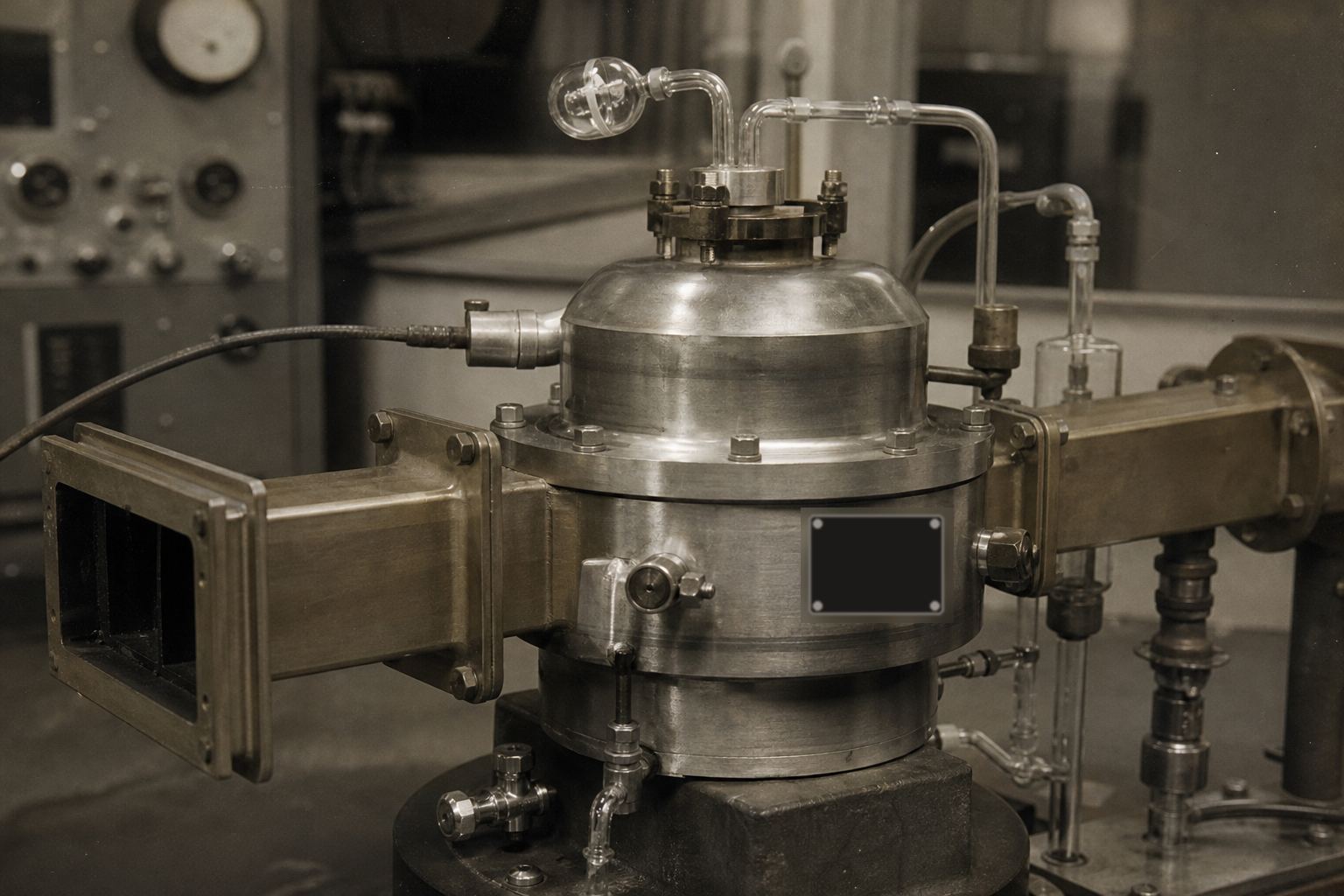
The first device to use the idea worked with microwaves, not light.
At Columbia University, Charles Townes and his team sent excited ammonia molecules into a metal box tuned to one microwave frequency.
By 1954 it worked. They called it a maser: microwave amplification by stimulated emission of radiation.
Microwave plumbing Masers were built from metal cavities and waveguides, pipes that carry microwaves. AI-generated illustration.
Microwave Amplification
by Stimulated Emission of Radiation
a laser is the same idea with light
M·A·S·E·R
½
Charles H. Townes
¼ + ¼
Nikolay Basov and Aleksandr Prokhorov
Nobel Prize in Physics 1964 (shared later)
Chapter III · Two mirrors
The maser
Britannica: Charles H. Townes demonstrated a working device at the end of 1953 that focused excited ammonia molecules into a resonant microwave cavity, where they emitted a pure microwave frequency; maser stands for “microwave amplification by the stimulated emission of radiation”. AIP History: graduate student James Gordon and postdoctoral researcher Herbert Zeiger worked on it with Townes at Columbia. NobelPrize.org: the 1964 prize went half to Townes and a quarter each to Nikolay Basov and Aleksandr Prokhorov “for fundamental work in the field of quantum electronics”, which led to oscillators and amplifiers based on the maser–laser principle.
The 3D scenes are simplified teaching models, not to scale: real photons are not little balls, and real atoms have many more levels.
To do the same with light, you need a way to send the avalanche through the same atoms again and again.
In 1958, Townes and Arthur Schawlow proposed the answer in the journal Physical Review: a mirror at each end.
Photons running along the line between the mirrors bounce back and forth, gathering copies on every pass. Those heading sideways escape.
One mirror lets a little light through, and that leak is the beam. Make it too leaky, and the light dies out before it can build.
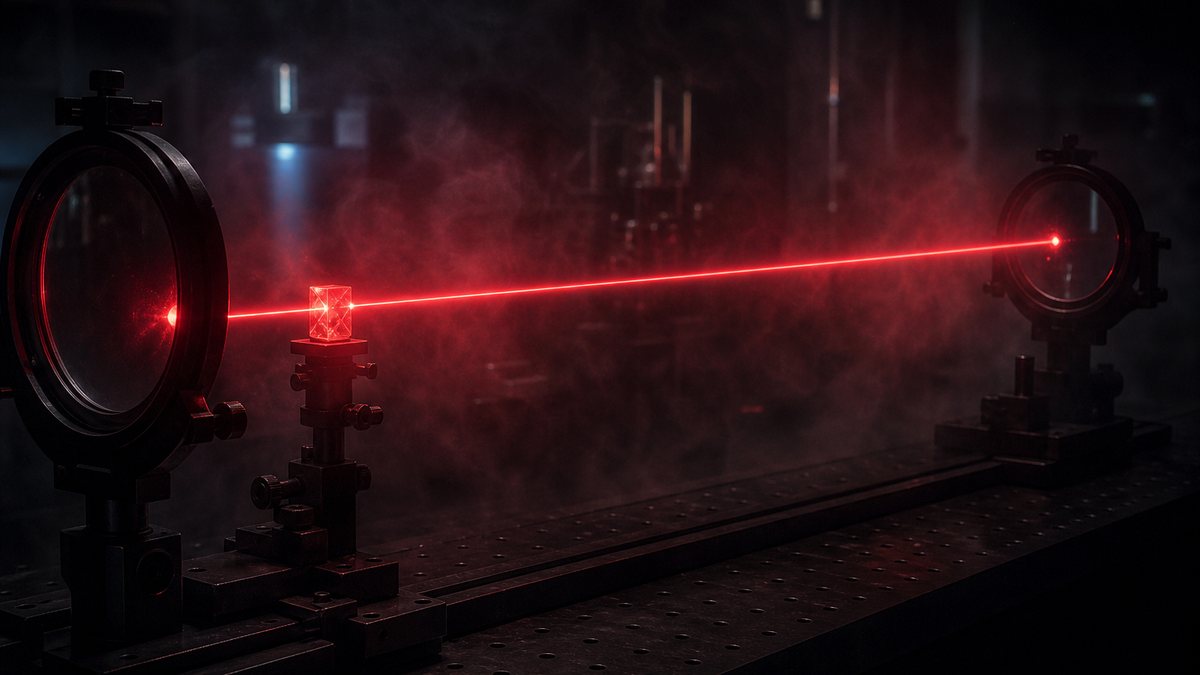
A resonator Two mirrors face each other with the light-amplifying material between them. AI-generated illustration.
gain medium: atoms that copy light
pump: the energy source
cavity: two mirrors, one partly see-through
A laser’s three parts
95%
reflected: light builds up, a steady beam leaks out
50%
reflected: in this model, too much escapes each pass
Try the output mirror
Chapter III · Two mirrors
The optical cavity
APS News: Townes and Schawlow proposed placing mirrors at each end of the lasing cavity so that photons bounce through the medium and are amplified; their paper appeared in the December 1958 Physical Review, before anyone had built a working device. Britannica: the resonator is a pair of facing mirrors; one or both transmit a fraction of the light, which escapes as the beam; without mirrors and a resonant cavity, a laser would just be an optical amplifier.
Use the mirror buttons in the scene. The percentages are illustrative; real output mirrors depend on how strongly the medium amplifies.
The 3D scenes are simplified teaching models, not to scale: real photons are not little balls, and real atoms have many more levels.
Then came a race to build one. On 16 May 1960, at Hughes Research Laboratories in Malibu, California, Theodore Maiman got there first.
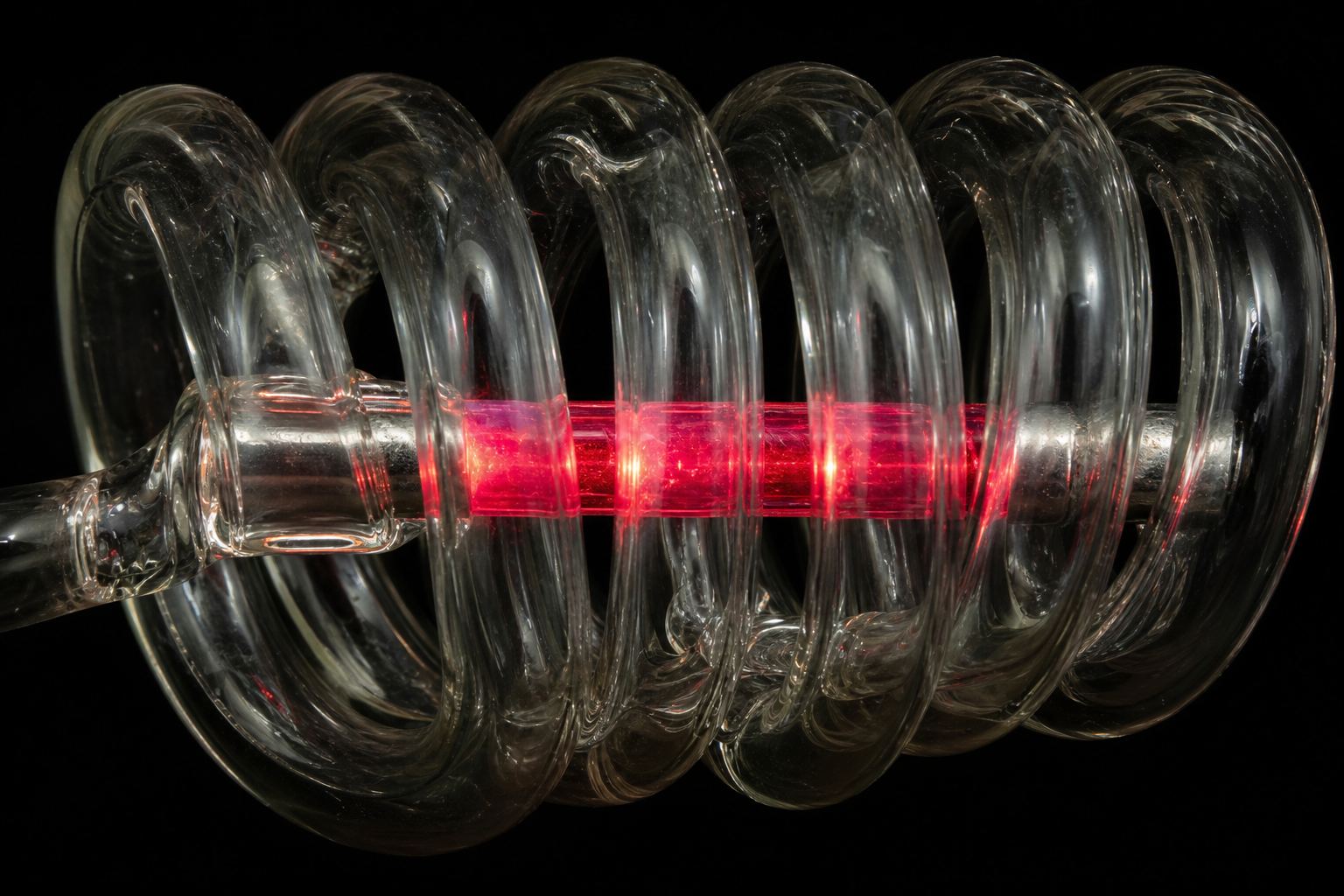
His laser was a pink ruby crystal, about one by two centimetres, with silvered ends for mirrors, inside a coiled photographer’s flash lamp.
The flash pumps atoms in the ruby up. They drop to a resting level and wait there long enough to build an inversion.
Then the crystal fired a burst of deep red light, at 694 nanometres.
Ruby in a flash lamp Maiman used synthetic ruby, which has fewer impurities than natural stones. AI-generated illustration.
1 · pumped to a short-lived high level
2 · falls to a long-lived “waiting” level
3 · stimulated down to the ground state
A three-level laser (Britannica)E≈694.31240≈1.79eV
694.3
nanometres, measured at Hughes (HRL)
Energy of one ruby photon
Chapter IV · The first lasers
The ruby laser
American Physical Society (Historic Sites): on 16 May 1960 at Hughes Research Laboratories in Malibu, California, Maiman produced a short burst of coherent light; he found that artificial rubies, with fewer impurities, worked very well. HRL Laboratories: he used a 1 × 2 cm piece of pink ruby with parallel silvered ends, a hole scratched in one coating to let the light out, inside a small helical xenon photographic flash lamp; it emitted at 694.3 nm. Britannica: the ruby laser is a three-level laser: excited to a short-lived high state, it drops to a metastable state that holds the energy long enough to build an inversion, then emits red pulses. Why a third level: RP Photonics notes that absorption and stimulated emission are equally likely between one pair of levels, so pumping with light of the laser’s own colour could never push more atoms up than down; pumping to a higher level that drains into the waiting level gets round this. The crystal looks pink, but the laser light is red.
Press Fire the flash in the scene.
The 3D scenes are simplified teaching models, not to scale: real photons are not little balls, and real atoms have many more levels.
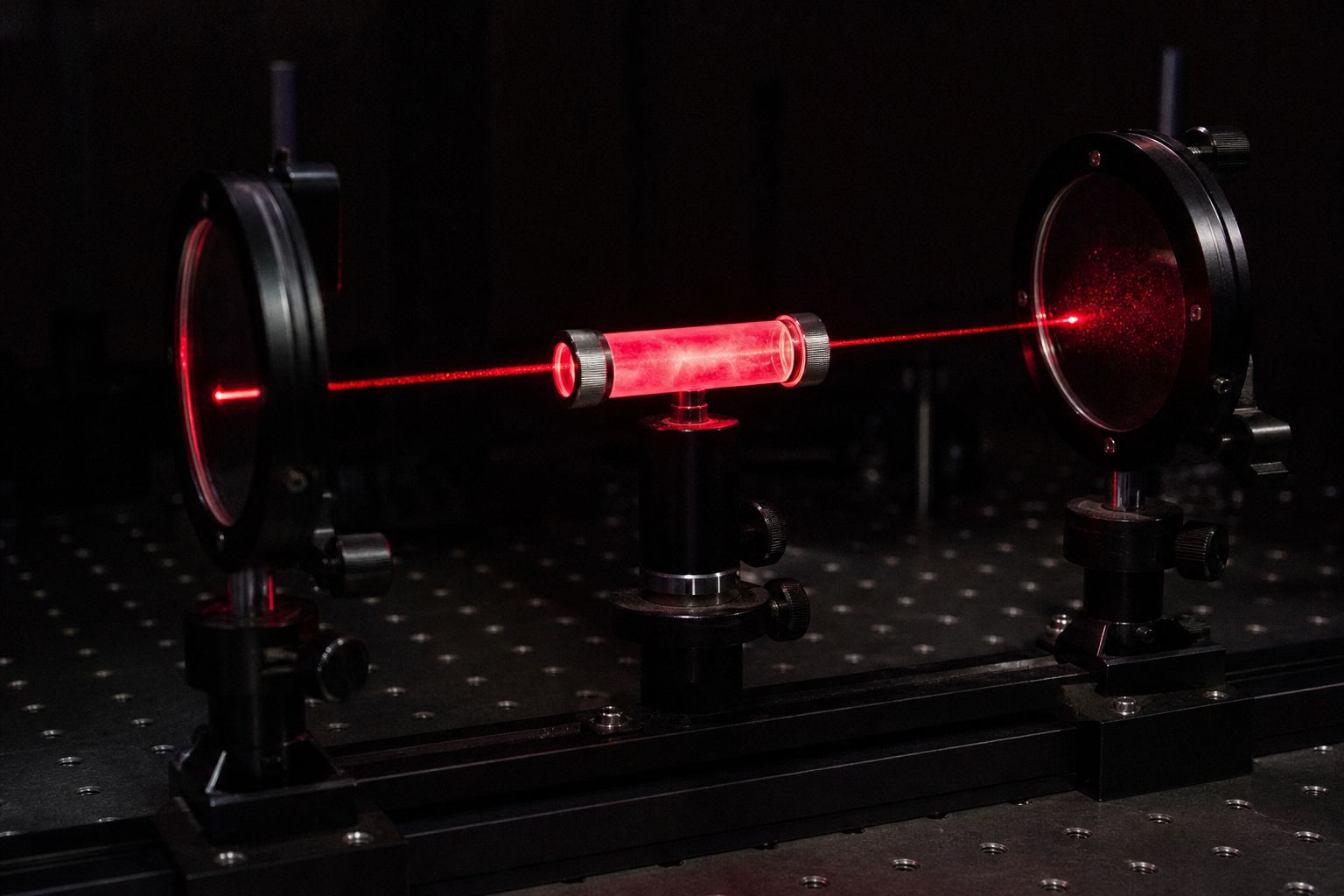
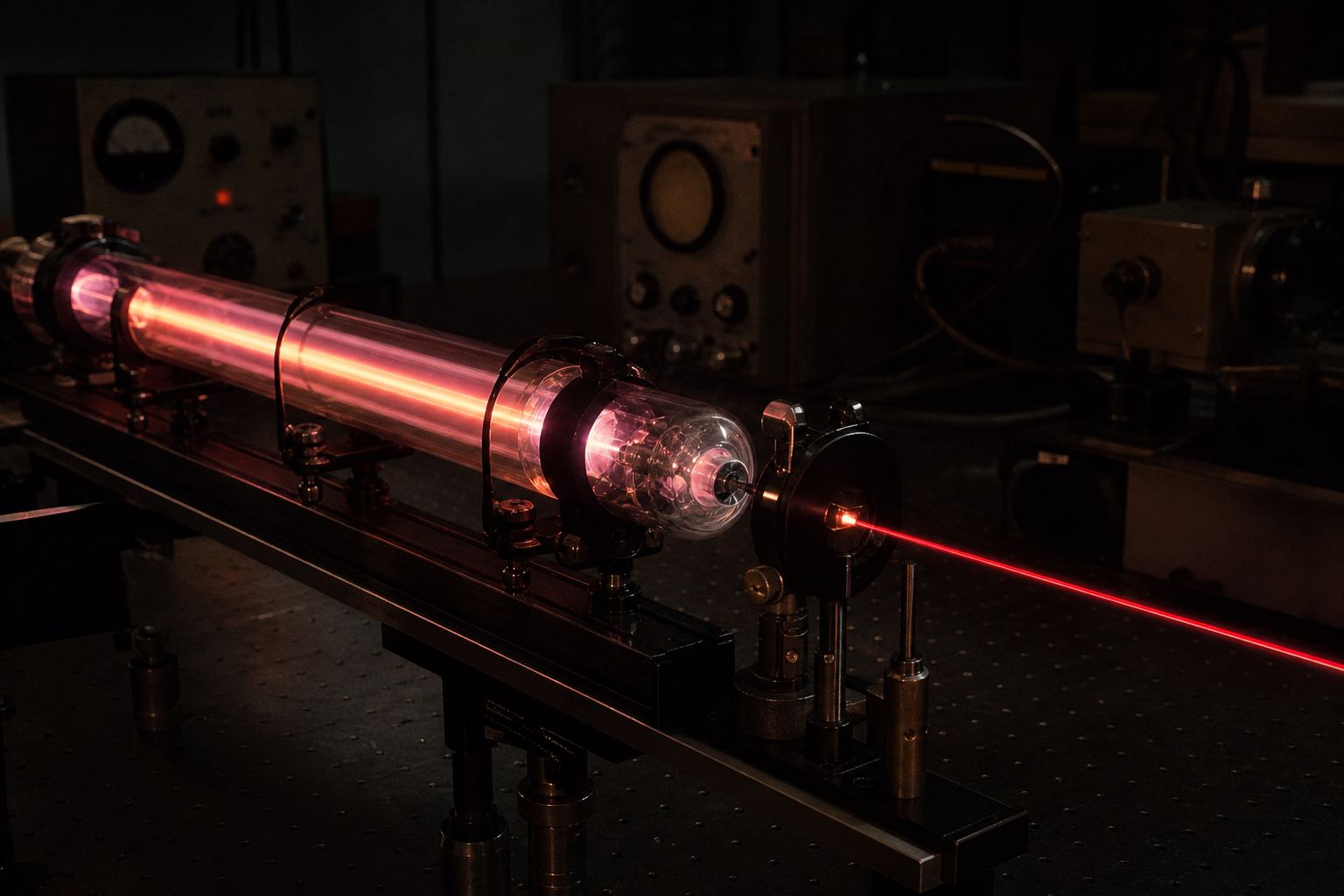
Months later, at Bell Labs, Ali Javan, William Bennett and Donald Herriott made a laser from a glowing mix of helium and neon gas.
The ruby fired in pulses; this one shone continuously, though in invisible infrared. A red version, at 633 nanometres, followed in 1962.
The word laser itself came from Gordon Gould, a graduate student, who wrote it in his notebook.
A helium–neon laser An electric discharge through the gas is the pump; mirrors close each end of the tube. AI-generated illustration.
May 1960 ruby, pulsed, 694.3 nm (Hughes)
late 1960 helium–neon, continuous, 1,150 nm infrared (Bell Labs)
1962 helium–neon, red, 632.8 nm (White and Rigden)
The first years
Some rough calculations on the feasibility of a LASERGordon Gould, title of his notebook entry (National Inventors Hall of Fame)
Chapter IV · The first lasers
Gas lasers and the word
AIP History and Britannica: Ali Javan, William Bennett and Donald Herriott at Bell Laboratories operated the first continuous-beam laser, using helium and neon, in December 1960, in the infrared. Optics & Photonics News (Optica): their device worked at 1.15 µm in late 1960; White and Rigden’s 632.8 nm helium–neon laser of 1962 was the first continuous visible laser. Britannica: Gordon Gould, a Columbia University graduate student, coined the word laser. National Inventors Hall of Fame: his notebook entry “Some rough calculations on the feasibility of a LASER: Light Amplification by Stimulated Emission of Radiation” is the first use of the acronym.
The 3D scenes are simplified teaching models, not to scale: real photons are not little balls, and real atoms have many more levels.
Why is laser light so unlike a bulb’s? Because every photon in the beam is a copy of the ones before it.
So it is one colour: a very narrow range of wavelengths.
It is coherent: the waves rise and fall in step, like soldiers marching rather than a crowd milling about.
And it is directional. Only light running between the mirrors survives, so the beam leaves narrow and spreads very little.
bulb: many colours; laser: one
bulb: waves out of step; laser: in step
bulb: every direction; laser: one
Bulb vs laser
in phase
the copies match the original in phase, wavelength and direction (Britannica)
CoherentA narrow beam Not perfectly parallel: diffraction makes every beam spread a little. AI-generated illustration.
Chapter IV · The first lasers
Monochromatic, coherent, directional
Britannica: stimulated photons match the original in phase, wavelength and direction, so they are coherent with one another; laser light is limited to a narrow range of wavelengths, often called monochromatic; and it is concentrated in a narrow beam whose collimation is not perfect, because diffraction makes it spread a little.
Switch between Bulb and Laser in the scene.
The 3D scenes are simplified teaching models, not to scale: real photons are not little balls, and real atoms have many more levels.
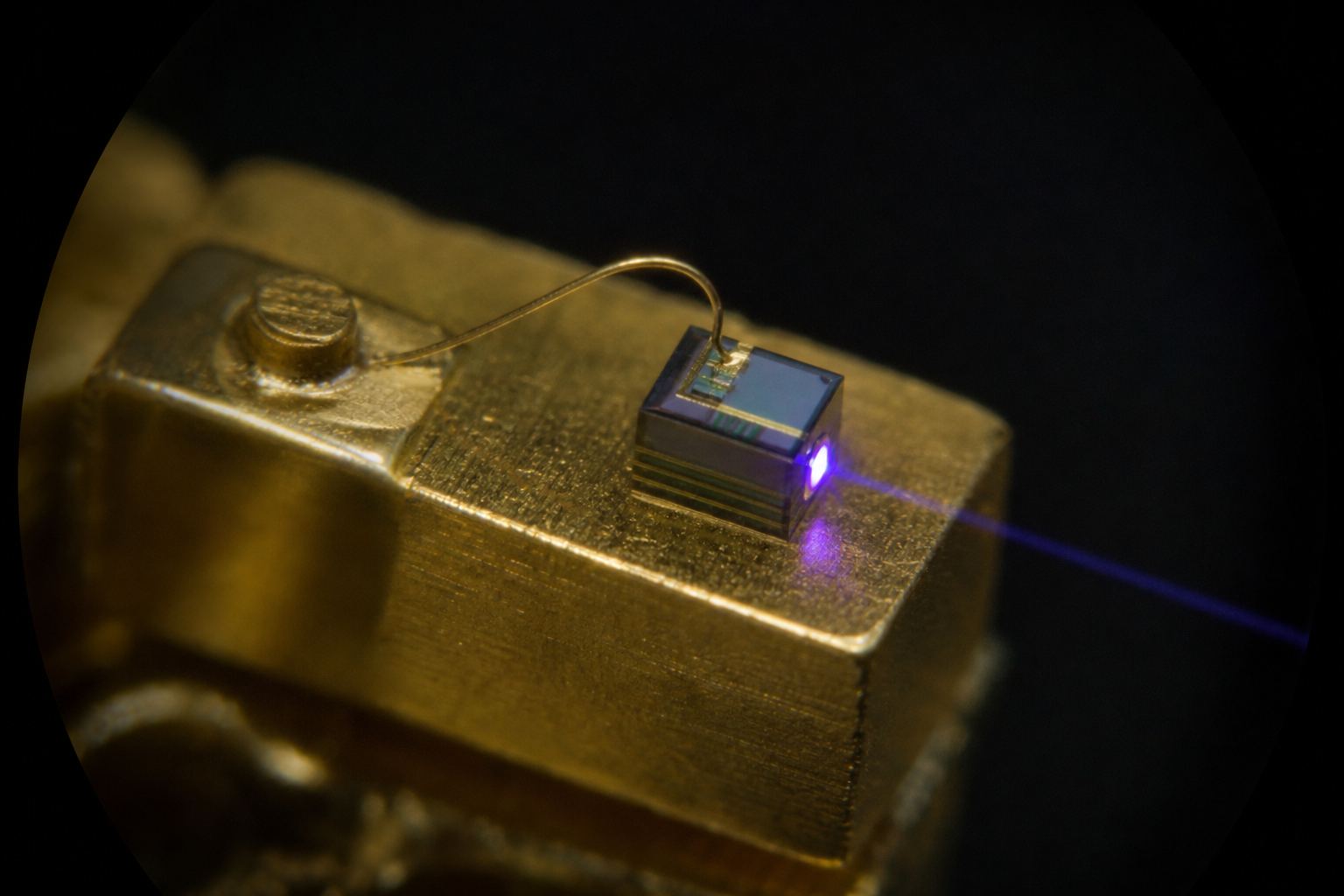
Many lasers today are tiny chips. In 1962, according to Britannica, Robert Hall’s team at General Electric made the first semiconductor laser.
A current pushes electrons, and holes, the gaps where electrons are missing, into a thin layer. When they meet, they give up energy as photons.
The current is the pump. The chip’s own cleaved edges, split cleanly along the crystal, act as the two mirrors.
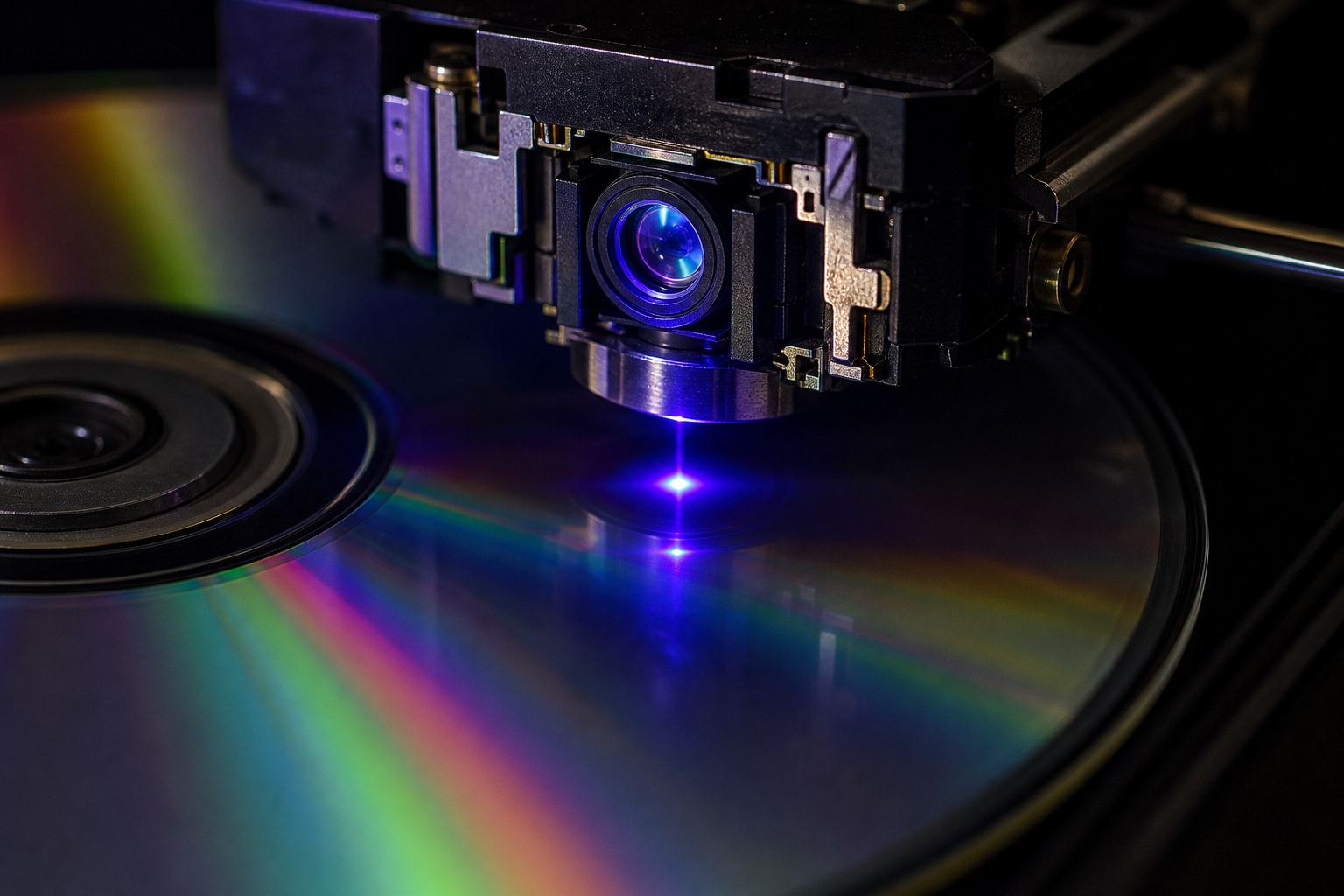
Change the material and you change the colour: infrared for CDs, red for DVDs, blue-violet for Blu-ray.
A laser diode chip The light leaves from one edge of the chip, through the partly reflecting facet. AI-generated illustration.
CD
780
DVD
650
Blu-ray
405
Disc-reading lasers
Shorter wave, smaller spot A shorter wavelength focuses to a smaller spot, so more data fits on a disc. AI-generated illustration.
Chapter V · Lasers on a chip
The laser diode
Britannica credits Robert N. Hall and coworkers with the first semiconductor laser, in 1962, at the General Electric Research and Development Center in Schenectady, New York. LibreTexts (Introduction to Physical Electronics): forward bias drives electrons into the gain region, where they recombine with holes and emit photons; stimulated emission builds the light up; the crystal is cleaved along a lattice plane and the cleaved facet acts as an imperfect mirror, so some light leaks out as the beam. arXiv 1310.1551: CDs and DVDs use infrared and red lasers at 780 nm and 650 nm, Blu-ray 405 nm; a shorter wavelength gives a smaller focused spot and so more data.
The 3D scenes are simplified teaching models, not to scale: real photons are not little balls, and real atoms have many more levels.
Now back to the news. A transceiver is a transmitter and a receiver in one small module.
On one side, a diode laser switches on and off billions of times a second, turning electrical ones and zeros into flashes in a glass fibre.
On the other side, a light detector turns the flashes back into electricity.
Longer links use infrared at 1,310 or 1,550 nanometres, two windows where glass is very clear.
The fastest models, at 3.2 terabits a second, are the ones a ban might cover, according to Morgan Stanley.
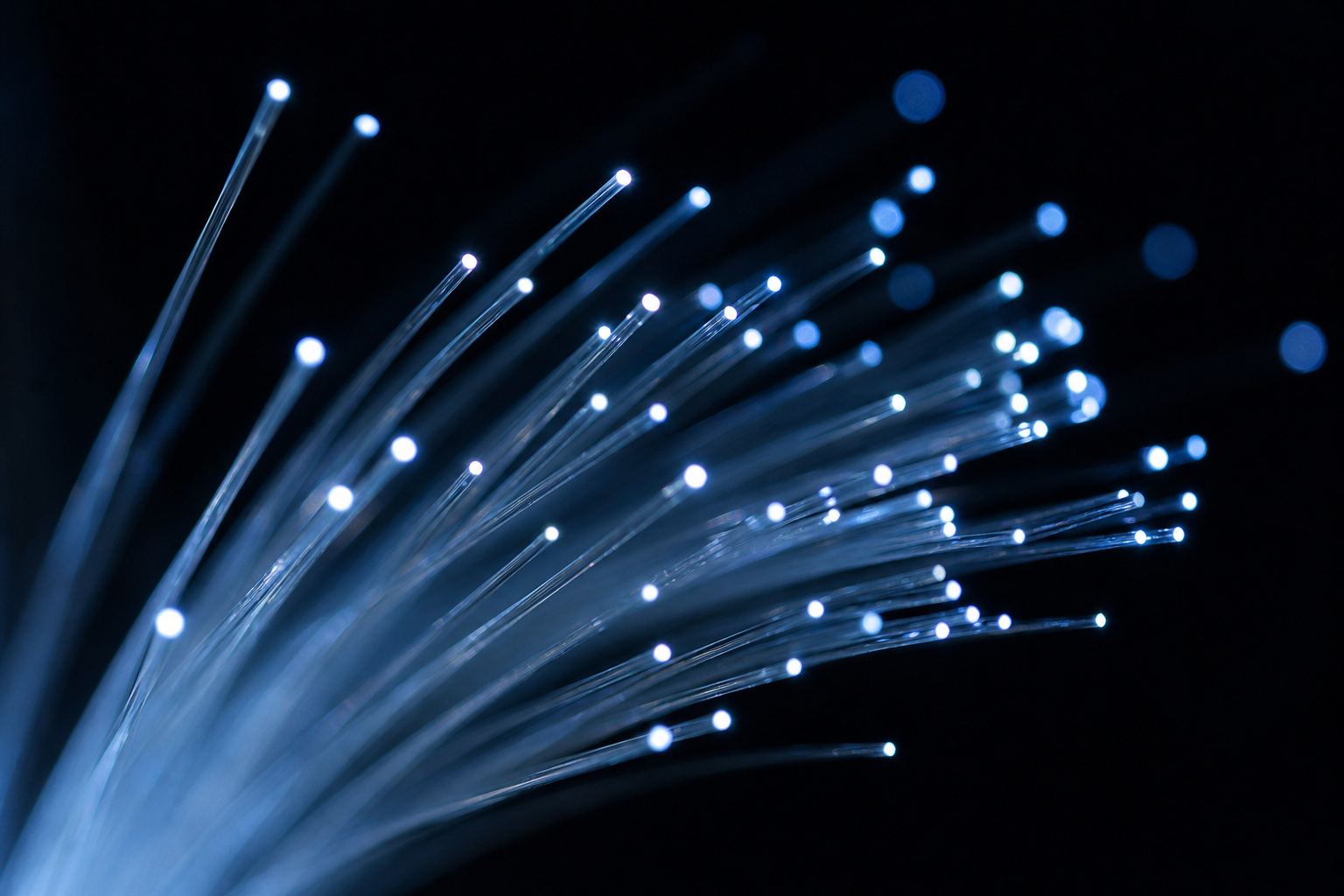
Glass fibres Each fibre is thinner than a hair and guides light along its core. AI-generated illustration.
inside a building: 850 nm, a few hundred metres
longer links: 1,310 or 1,550 nm, tens of kilometres
Which light for which link (L-P)
1,310 nm
≤0.31
1,550 nm
≤0.17
Light lost per km in low-loss fibre (Corning SMF-28 ULL)
3.2 Tb/s
the class a ban might cover; volume production expected from 2028
Morgan Stanley, via Reuters
Chapter V · Lasers on a chip
Inside a transceiver
Newsweek: transceivers convert electrical signals into pulses of light and back again, providing the high-speed optical links between AI chips. L-P Knowledge Center: laser diodes are the heart of optical modules; VCSELs at 850 nm reach about 300 m at 10 Gb/s, DFB lasers at 1,310 and 1,550 nm 40 km or more, EMLs around 1,550 nm up to 80 km. Fiber Optics For Sale: silica fibre has a theoretical loss minimum near 1,550 nm, where falling scattering meets rising infrared absorption. Corning’s SMF-28 ULL datasheet: at most 0.30–0.31 dB/km at 1,310 nm and 0.16–0.17 dB/km at 1,550 nm (3 dB means half the light is lost). The film simplifies the transmitter as a laser switching on and off; some modules, such as EMLs (electro-absorption modulated lasers), keep the laser on and switch the light with a modulator (L-P). Reuters: Morgan Stanley said the ban might cover 3.2 Tb/s transceivers, whose production is not expected to ramp up until 2028. Fibre links themselves are the subject of How Undersea Cables Work.
Press Send data in the scene to watch bits become flashes and come back as current.
The 3D scenes are simplified teaching models, not to scale: real photons are not little balls, and real atoms have many more levels.
Because a laser beam stays narrow and keeps one colour, it makes a superb measuring tool.
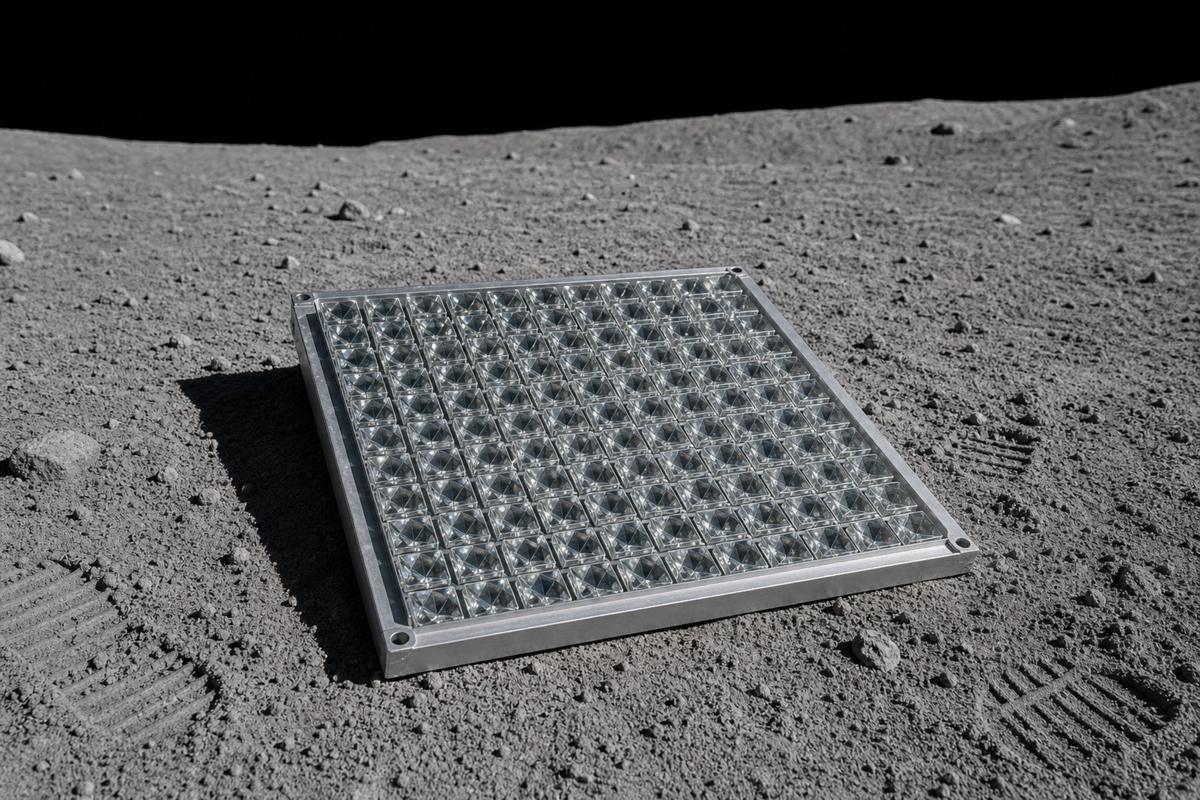
Apollo astronauts left mirror arrays on the Moon. Timing laser pulses that bounce back gives the distance to within a few millimetres.
It shows the Moon moving away from us by 3.8 centimetres a year.
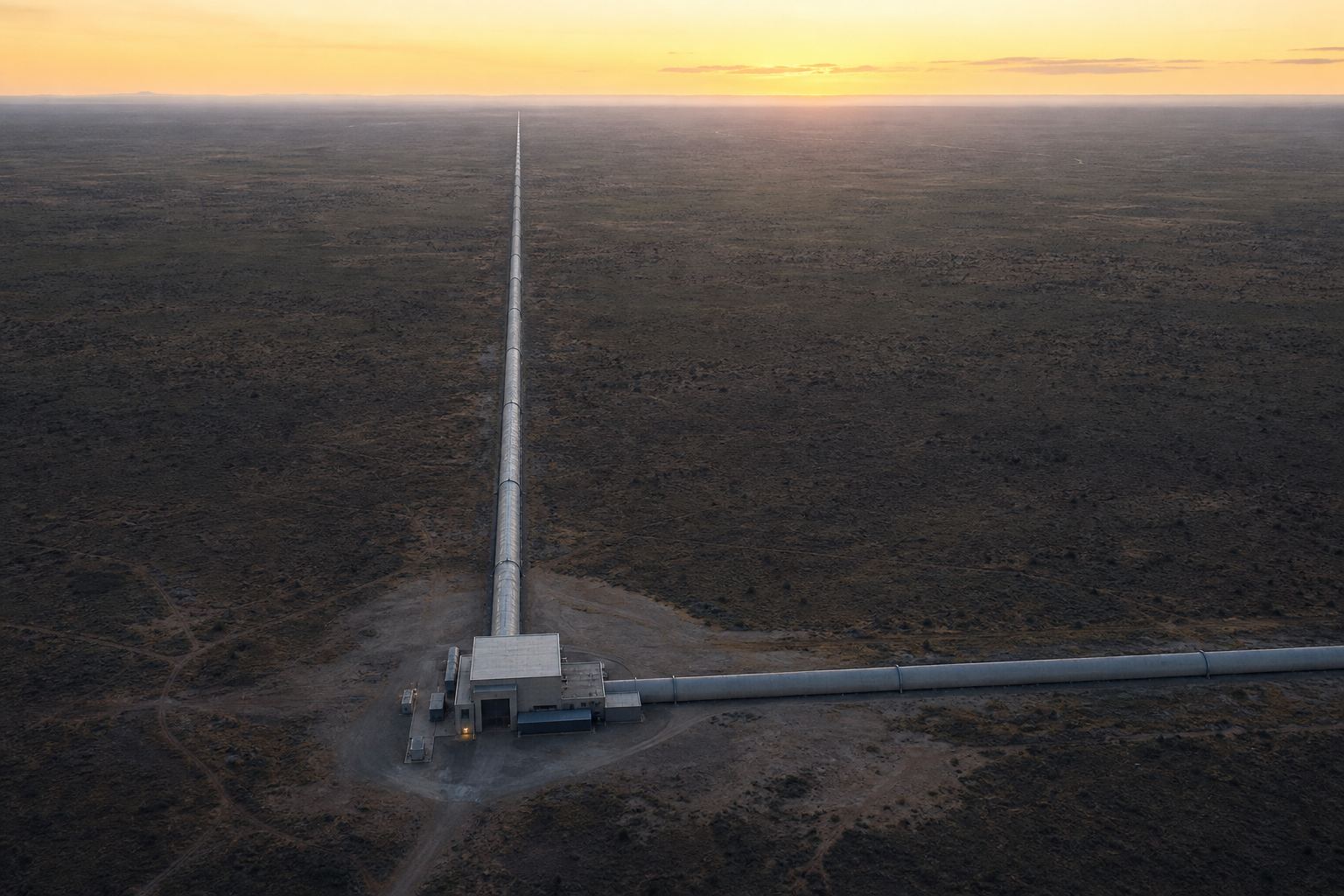
And LIGO sends laser light down two four-kilometre arms to detect gravitational waves, which change the arms’ length by a thousand times less than a proton.
A reflector on the Moon The Apollo 11 and 14 arrays hold 100 glass corner prisms each; Apollo 15’s holds 300. AI-generated illustration.
+3.8 cm
added to the Earth–Moon distance each year, read from laser timing
NASA JPLA gravitational-wave detector One beam is split down two arms at right angles and recombined to compare their lengths. AI-generated illustration.
Chapter VI · What lasers do
Measuring with lasers
NASA JPL: the Apollo 11 and 14 arrays have 100 quartz glass corner-cube prisms each and Apollo 15’s has 300; lunar laser ranging times pulses that bounce off them to measure the distance to within a few millimetres, and shows the Earth–Moon distance growing by 3.8 cm a year. NOAA: lidar, light detection and ranging, uses a pulsed laser to measure ranges, and NOAA uses it for more accurate shoreline maps. Caltech LIGO: its interferometers have 4 km arms; a mirror at the vertex splits one beam into the two arms and the returning beams are recombined, to sense a change in distance 1,000 times smaller than a proton. Lunar ranging also appears in Why We See One Side of the Moon.
Press Fire a pulse in the scene. Distances and timing in the scene are not to scale.
The 3D scenes are simplified teaching models, not to scale: real photons are not little balls, and real atoms have many more levels.
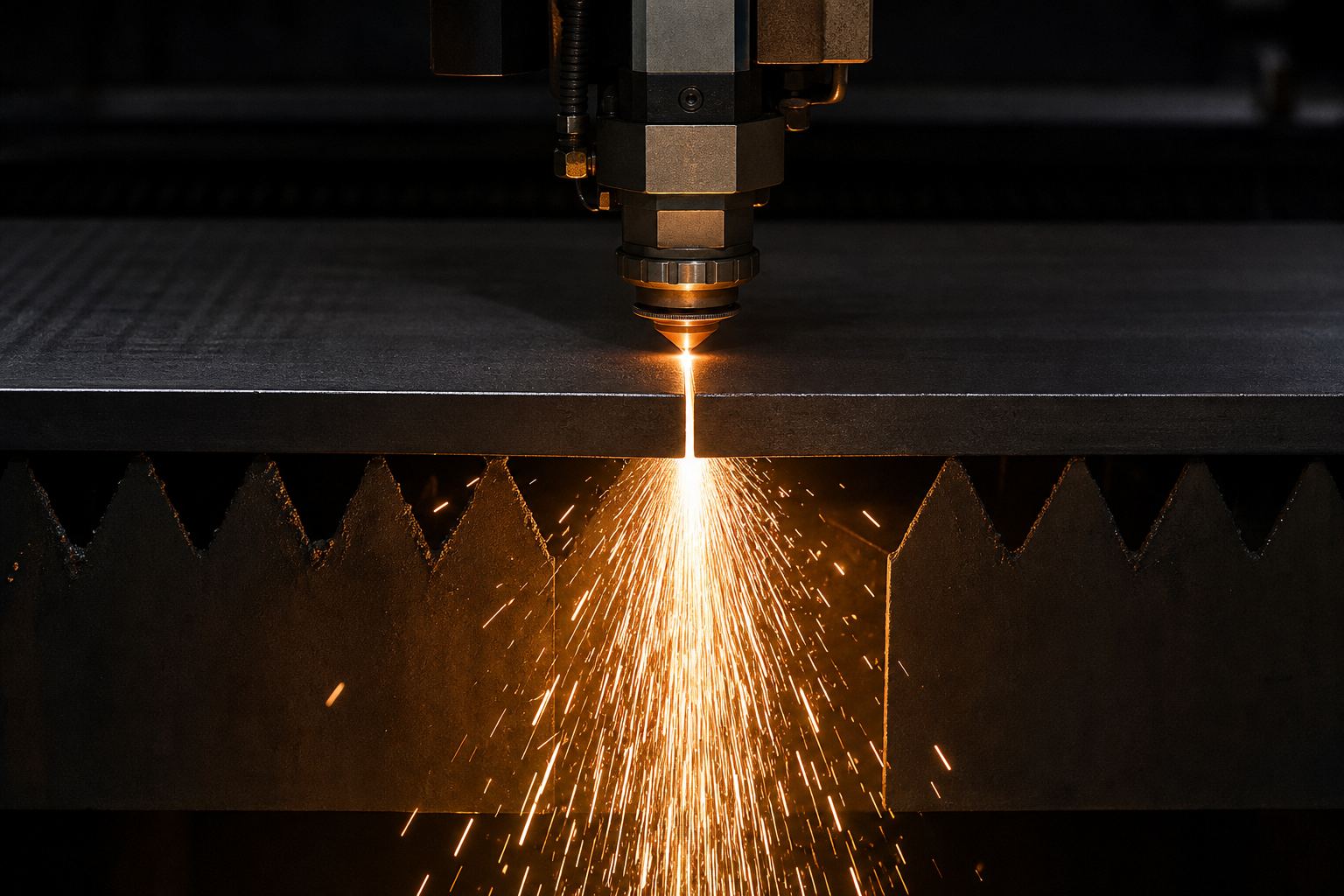
Focus a powerful beam to a small spot and it melts metal. A jet of gas blows the melt away, leaving a clean, narrow cut.
In medicine, very short, intense pulses, honoured with the 2018 Nobel Prize in Physics, are used in millions of corrective eye surgeries every year.
Laser cutting A jet of gas running with the beam ejects the molten metal from the cut. AI-generated illustration.
10.6 µm
typical wavelength, deep in the infrared, about 15 times longer than red light (TWI)
CO₂ cutting laserAn eye-surgery laser Pulse technique by Gérard Mourou and Donna Strickland. Education only: choices about treatment are for a doctor. AI-generated illustration.
Chapter VI · What lasers do
Cutting and surgery
TWI: a lens or mirror concentrates the beam into a small spot with enough power density to melt material, and a co-axial gas jet ejects the molten material to form the cut; CO₂ lasers typically emit at 10.6 µm. NobelPrize.org (2018): Gérard Mourou and Donna Strickland shared half the prize for a method of making high-intensity, ultra-short optical pulses, now used in the millions of corrective eye surgeries conducted every year. This is general information, not medical advice.
The 3D scenes are simplified teaching models, not to scale: real photons are not little balls, and real atoms have many more levels.
That power is why lasers carry warning classes. On laser labels, Class 1 is considered safe; Classes 3B and 4 are an immediate danger to the eyes.
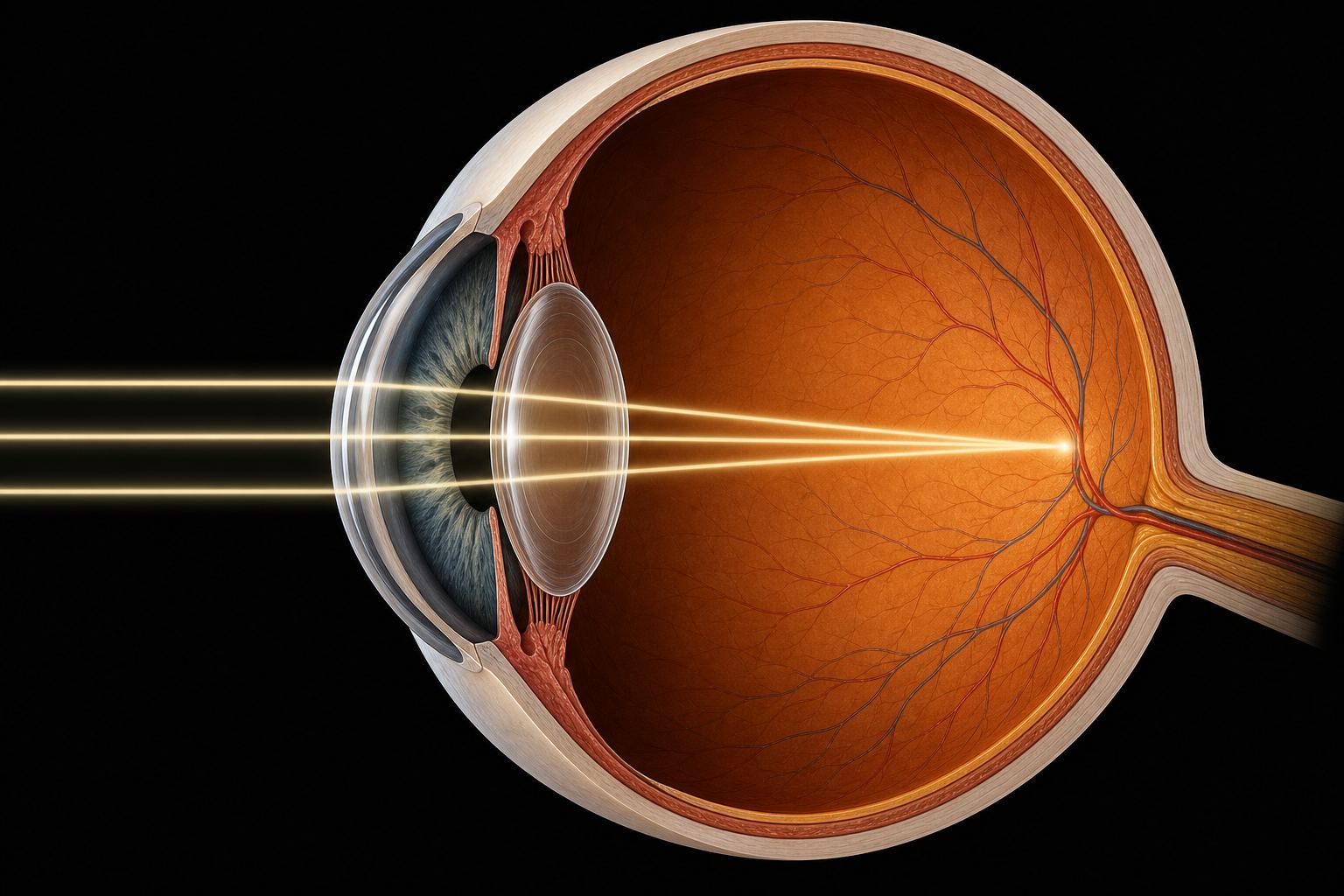
The eye itself makes it worse: its cornea and lens focus a beam onto a tiny spot of the retina, raising its strength up to 100,000 times.
Even a pointer of five thousandths of a watt could cause eye damage under some conditions. Never aim one at anyone’s eyes.
1 (I): enclosed or very weak, e.g. laser printers
2 (II): under 1 mW, visible; blinking protects (barcode scanners)
3R (IIIa): about 1–5 mW, e.g. laser pointers
3B (IIIb) and 4 (IV): immediate eye hazard; 4 also skin and fire
Laser classes (UC Berkeley; older US names in brackets, FDA)Into the eye Lawrence Berkeley National Laboratory: a low-divergence beam can be focused to a spot 10 to 20 microns across. AI-generated illustration.
<0.2 s
a typical blink reflex, which pointer limits take into account
Scientific American
Chapter VII · Mind your eyes
Laser safety
US Food and Drug Administration: Class I is considered non-hazardous (examples: laser printers, CD and DVD players); Classes IIa and II become hazardous when viewed directly for long periods (barcode scanners); Class IIIa can be momentarily hazardous when viewed directly (laser pointers); Class IIIb is an immediate skin and eye hazard from the direct beam; Class IV is an immediate skin and eye hazard from the direct or reflected beam and may be a fire hazard. Lawrence Berkeley National Laboratory: the focusing of the cornea and lens can increase the irradiance on the retina by up to 100,000 times, for visible and near-infrared light (400–1,400 nm). UC Berkeley EHS: current classes run 1, 1M, 2, 2M, 3R (formerly 3A, roughly 1–5 mW, e.g. pointers), 3B (roughly 5–500 mW) and 4 (over 500 mW). Scientific American: exposure limits indicate a 5 mW laser could cause eye damage; people blink in under 0.2 s on average, which the limits allow for, and no one should deliberately stare into a laser. This is general information, not medical advice; anyone worried about an eye injury should see a doctor.
The 3D scenes are simplified teaching models, not to scale: real photons are not little balls, and real atoms have many more levels.
Who may sell the newest ones in America is now for regulators to decide; the FCC has not commented in public.
Whoever makes them, inside each one a photon is still being copied, again and again, between two mirrors.
1905 Einstein: light quanta
1917 Einstein: stimulated emission
1954 Townes’s maser
1958 Schawlow and Townes: the mirrors
1960 Maiman’s ruby laser; helium–neon
1962 the diode laser
2026 the transceiver dispute
From an idea to a moduleBetween two mirrors Where the story began: racks wired with glass fibre, each link lit by a small laser. AI-generated illustration.
pump: an electric current
gain: electrons meeting holes in a thin layer
mirrors: the chip’s cleaved edges
Inside every transceiver laser
Epilogue · Sources
Sources
Every fact in this film comes from the sources below. The news is reported as Reuters and the Daily Caller News Foundation reported it, with each side’s argument in its own terms; the film takes no position on the policy. The chapter stills and pictures are AI-generated illustrations, not photographs of real devices, places or people. The 3D scenes are simplified teaching models, not to scale, and the mirror percentages in the cavity scene are illustrative. The health and safety notes are general education, not medical advice.