On 19 November 2026 Anthropic's shares began trading on Nasdaq after one of the largest initial public offerings on record. This film explains what an IPO is, using that listing as one example among many: what a share is and how the Dutch East India Company first sold them to the public in 1602, why companies go public and what it costs them, primary and secondary shares and dilution, underwriters, the registration statement and the quiet period, the roadshow and book-building, how the price is set and why first-day prices so often jump, the lock-up, direct listings and SPACs, famous examples from Ford in 1956 to Saudi Aramco in 2019, and how a company goes public in Thailand. It is education about how markets work, not investment advice.
Interactive 3D film9 min1602 to 2026Published 20 November 2026
On the nineteenth of November 2026, shares of the AI company Anthropic began trading on Nasdaq, under the ticker ANT.
CBS News and Yahoo Finance reported a price of eighty-three dollars a share and about eighty-one billion dollars raised, which both called a record.
It is the latest of many companies to make an initial public offering, an IPO: the first sale of its shares to the public.
Who picked that price? Where does the money go? And why can a new share jump, or fall, on its very first day?
The opening bell Exchanges mark a listing with a ceremony; the real test is the first trade that follows. AI-generated illustration.
ANT
ticker on Nasdaq
$83
IPO price per share
~$81.3 bn
raised in the IPO itself; CBS puts the total with a separate private sale near $107 bn
19 November 2026, as reported by CBS News and Yahoo Finance
what a share is
why companies go public
how the price is set
the first day, and other routes
In this film · education, not financial advice
Prologue
The news
CBS News and Yahoo Finance (19 November 2026): Anthropic priced its IPO at $83 a share, above an earlier range of $70–78, and raised about $81.3 billion by selling 980 million Class A shares; trading on Nasdaq began on Thursday 19 November under the ticker ANT, and Fox Business reported that the shares opened that day at $111.50. CBS adds that a separate $26 billion private placement brings the company’s total fundraising to about $107 billion, which explains why some reports give the larger figure. Both outlets describe the IPO as the largest on record.
Anthropic is one example here, told like any other. The rest of the film is about how every IPO works.
This film is education about how markets work. It is not investment advice and makes no prediction about any company or share.
The 3D scenes are simplified teaching models: pies, order books and routes are schematic, and the numbers on them are illustrative unless a source is named.
Picture a bakery. If its owner splits the business into a hundred equal pieces, each piece is a share.
Own ten shares and you own a tenth of the bakery: a tenth of any profits paid out, and usually a tenth of the votes.
A share promises no money back. If the bakery thrives, your piece is worth more. If it fails, it can be worth nothing.
Selling pieces like this lets a business raise money without borrowing it.
One business Ovens, recipes, customers and future profits: a share is a claim on all of it together, not on any one loaf. AI-generated illustration.
10%
of the company
10%
of dividends paid out
10 shares of 100
a loan: repaid with interest, win or lose
a share: no repayment, a slice of whatever comes
Shares versus a loanProof of ownership Shares were once paper certificates; today most exist only as entries in electronic records. AI-generated illustration.
Chapter I · A piece of a company
What a share is
A share is a unit of ownership in a company. Holders share in profits that the company chooses to pay out as dividends and, for most common shares, vote on matters such as electing the board. Unlike a loan, a share carries no promise of repayment; its value rises and falls with the business.
Press the buttons to cut the bakery into 4 or 100 shares, and to pick out ten of them.
The 3D scenes are simplified teaching models: pies, order books and routes are schematic, and the numbers on them are illustrative unless a source is named.
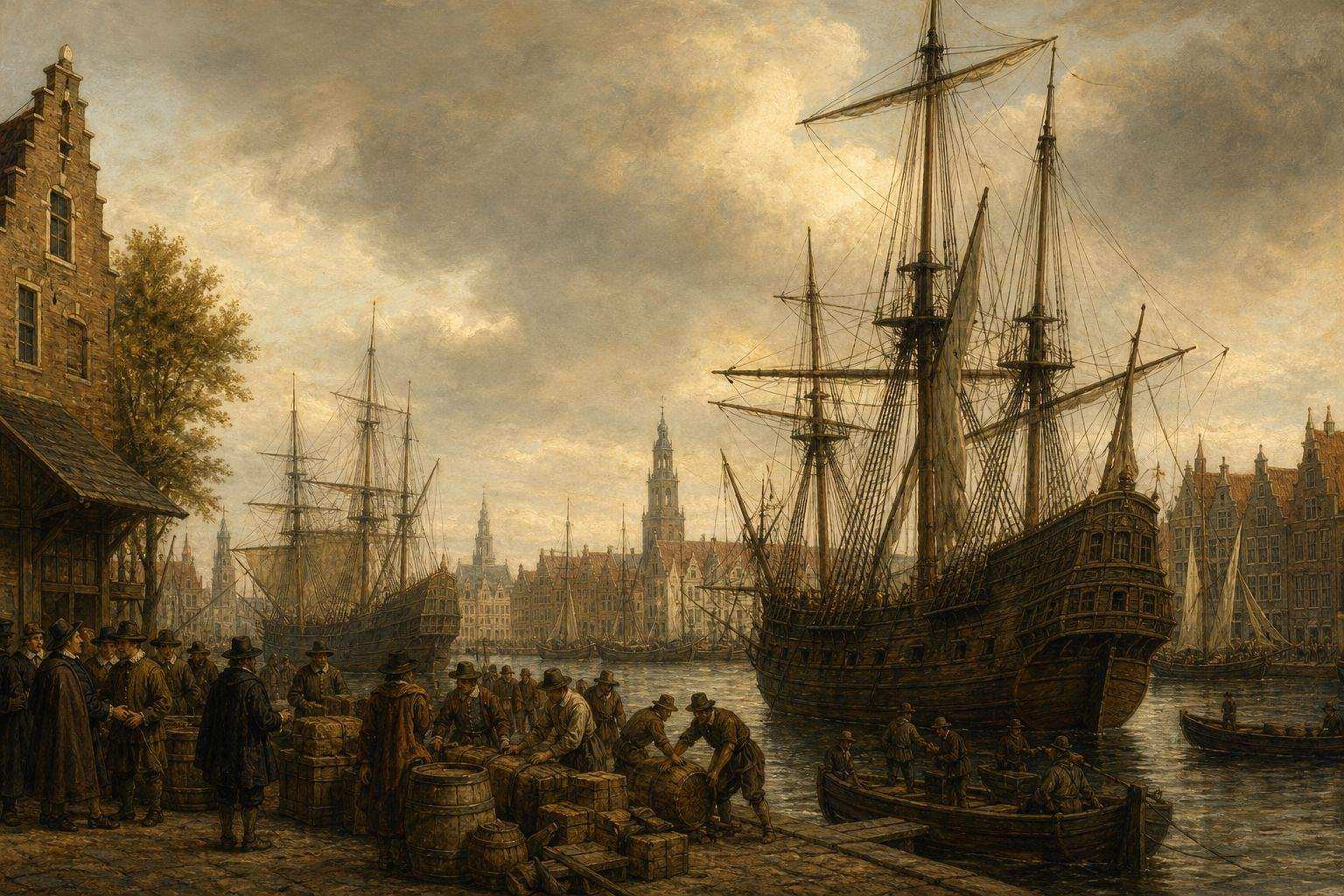
The idea is old. In 1602 the Dutch government merged six trading companies into one: the United East India Company, the VOC.
Its charter said that anyone living in the Dutch lands could buy shares. That August, 1,143 people signed up.
The company raised about six point four million guilders, more than half of it in Amsterdam.
Shares could be passed on through the company's bookkeeper, so investors could sell. Amsterdam's exchange dates its own start to that trading.
All the residents of these lands may buy shares in this Company.VOC charter, Article 10, 1602 (as quoted by Euronews)
Signing up Subscriptions were written into the company’s books: no minimum stake was required to take part. AI-generated illustration.
6.4 m
guilders in all
57%
from Amsterdam
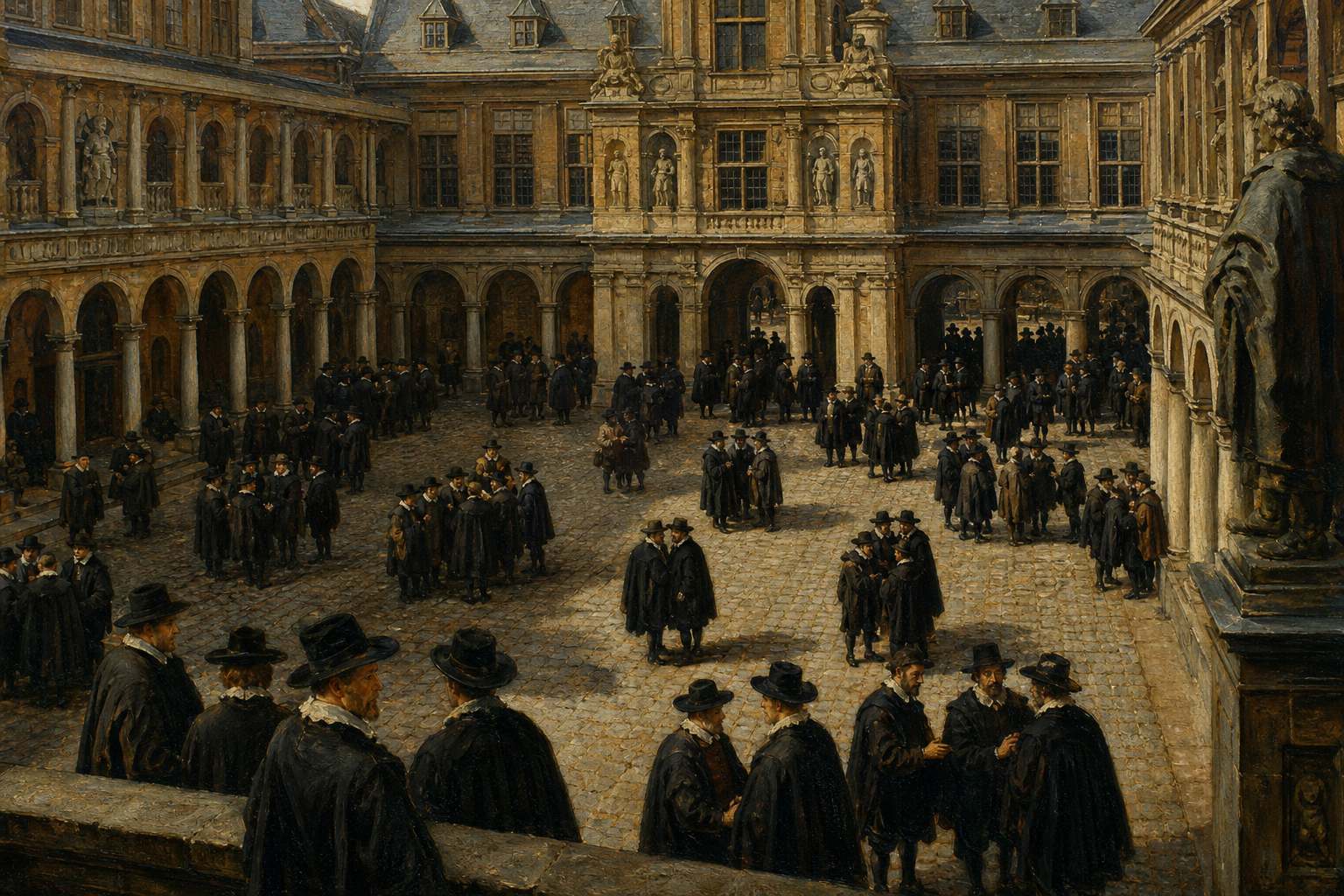
The VOC’s first capitalA place to trade Merchants met in an open courtyard exchange to deal in goods and, soon, in shares. AI-generated illustration.
Chapter I · A piece of a company
The VOC, 1602
World History Encyclopedia: the States General merged six trading companies into the VOC, granting a 21-year charter on 20 March 1602 with 6.4 million guilders’ capital, 57% of it from Amsterdam; Article 10 of the charter allowed members of the public to buy shares, and there were 1,143 investors in the August 1602 subscription. Euronews: shares could be transferred through the chamber’s bookkeeper, which allowed a secondary market, that is, trading between investors after the shares were first sold. Euronext credits the VOC with starting the Amsterdam exchange.
Press “Chambers” to split the capital by city, and “Trade a share” to pass one from hand to hand.
The 3D scenes are simplified teaching models: pies, order books and routes are schematic, and the numbers on them are illustrative unless a source is named.
Most companies are private. Their shares belong to founders, staff and a few investors, and outsiders cannot simply buy them.
A public company's shares trade on a stock exchange, where almost anyone can buy them.
Companies go public to raise money, to let early investors and staff sell, and to have shares they can use to buy other companies.
The price is openness. A US public company reports every quarter, files an audited report every year, and announces big events as they happen.
a handful of owners
shares hard to sell
few public reports
Private company
raise capital, now and later
make shares easier to sell
pay for acquisitions in shares
reward employees
Reasons to go public (Britannica, SEC)Reporting, for ever Forms 10-Q, 10-K and 8-K: every one is public, and read by investors, rivals and journalists alike. AI-generated illustration.
7%
fee paid to the underwriters, the banks that run the sale, by over 90% of mid-sized US IPOs, 1995–98 (Chen & Ritter)
The bill for the sale itself
Chapter II · Going public
Private and public
Britannica Money: many companies go public to raise capital or to broaden their access to it; other reasons cited by the SEC include making stock easier to sell, using shares for acquisitions and paying employees. Investor.gov: a US public company files an annual report on Form 10-K with audited financial statements, quarterly reports on Form 10-Q for the first three quarters, and current reports on Form 8-K to announce major events. Chen & Ritter (2000), Journal of Finance: more than 90% of US IPOs raising $20–80 million paid underwriters a gross spread of exactly 7% in the late 1990s.
In Thailand a company must be a public limited company to list on the SET or the mai (SET listing rules). “Private” here means not listed; both kinds are private-sector businesses.
Press “Private” or “Public” to see who can own the shares.
The 3D scenes are simplified teaching models: pies, order books and routes are schematic, and the numbers on them are illustrative unless a source is named.
An IPO can sell new shares, created by the company. The money goes to the company, and every old owner's slice shrinks as a percentage: dilution.
It can also sell existing shares, from current owners. Then the money goes to them, not to the company.
When Ford went public in 1956, the Ford Foundation sold 10.2 million of its shares. None of that money went to Ford.
Google, in 2004, did both: about 1.2 billion dollars to Google, and 473 million to those selling.
primary: new shares, money to the company
secondary: existing shares, money to the sellers
Two kinds of shares in an IPO
60% → 48%
founder’s stake after 25 new shares on 100
60 → 60
the founder still holds the same number of shares
Dilution, in the scene’s exampleFord, 1956 Goldman Sachs led what it calls the largest US common stock offering to that date. AI-generated illustration.
to Google (new shares)
~1,200
to sellers (existing shares)
473
Google’s IPO, 2004: where $1.67 bn went
Chapter II · Going public
Primary, secondary, dilution
Investor.gov: most large IPOs sell only new shares to raise capital, but in some offerings existing shareholders also sell, and the proceeds of their sales do not go to the company. Nasdaq.com (Motley Fool): on 17 January 1956 the Ford Foundation, which held 88% of Ford’s common stock, sold 10.2 million Class A shares, and none of the money went to Ford. Financial History magazine: the shares were offered to the public at $64.50 a share, through a syndicate of 722 underwriting firms that bought them at $63. 10.2 million × $64.50 = $657.9 million, the figure Goldman Sachs gives for the largest common stock offering in the US to that date. CNN Money (2004): Google’s IPO raised $1.67 billion, of which $1.2 billion went to Google and $473 million to executives and investors selling shares.
Press “New shares” to grow the pie and watch the old slices shrink in percentage, or “Old shares” to see the same pie change hands. The pie’s area stands for the number of shares.
The 3D scenes are simplified teaching models: pies, order books and routes are schematic, and the numbers on them are illustrative unless a source is named.
Going public takes months. The company hires investment banks, called underwriters, to manage the sale and find buyers.
In the United States it files a registration statement with the Securities and Exchange Commission, the SEC, usually on a form called the S-1.
Inside is the prospectus: the business, its finances, its risks, and the terms of the sale. Anyone can read it.
The SEC checks what is disclosed, but does not judge whether it is a good investment.
Until the SEC declares the filing effective, the company must watch what it says. Anything that could stir up interest in the shares may count as an offer. This is the quiet period.
Months of drafting Lawyers, accountants and bankers draft the filing together; amended versions are filed as S-1/A. AI-generated illustration.
what the company does
audited financial results
risk factors
how many shares, and the price range
What the prospectus covers
The staff does not evaluate the merits of any IPO.US SEC, Investor Bulletin: Investing in an IPO
at least from the filing until it is declared effective
“offer” is read broadly: anything that might stir public interest
ordinary business news is still allowed
The quiet period (Investor.gov)
Chapter III · The paperwork
The filing
Investor.gov, Investing in an IPO: underwriters are the investment banks that manage and sell an IPO; a company registers the offering with the SEC, usually on Form S-1 (amendments are S-1/A), and the registration statement and prospectus are public on EDGAR. SEC staff review does not evaluate the merits of an IPO, and a registration being declared effective is not an approval. Investor.gov glossary: the quiet period lasts at least from the filing of a registration statement until the SEC declares it effective; because the SEC and courts read “offer” broadly, to include communications that might generate public interest in the issuer or its securities, the company must take care with what it says, though factual business information may still be released.
Press “Next stage” to move the company along the road.
The 3D scenes are simplified teaching models: pies, order books and routes are schematic, and the numbers on them are illustrative unless a source is named.
Next comes the roadshow: managers and bankers present the company to big investors, such as pension and investment funds.
The underwriters ask each one how many shares they would buy, and at what price.
The answers go into a list called the book, so this is called book-building.
Stacked up, they draw a picture of demand: few buyers at a high price, many more at a lower one.
On the road Presentations to fund managers, city after city and now often online, over a week or two. AI-generated illustration.
who: a fund, an insurer, a bank client
how many shares
up to what price
One line in the book
most
go to institutions and wealthy clients, says the US SEC
Who usually gets IPO shares
Chapter IV · Setting the price
Roadshow and book-building
Britannica Money: before an IPO, company management usually travels in a “road show” to attract potential investors. AccountingTools: book-building is how the underwriter finds the price, by polling major institutional investors on how many shares they want and at what price, then compiling the answers. Investor.gov: underwriters gather indications of interest, and often allocate most IPO shares to institutional and high-net-worth clients.
Press “Take orders” to fill the book again. The bars show how many shares are wanted at each price or above.
The 3D scenes are simplified teaching models: pies, order books and routes are schematic, and the numbers on them are illustrative unless a source is named.
Often on the evening before trading starts, the company and its banks choose the price.
Anthropic chose eighty-three dollars, above the range of seventy to seventy-eight it had first set out.
Set it too high, and some shares go unsold, or the price sinks once trading begins.
Set it too low, and buyers rush in and the price jumps on day one. The company sold for less than people would pay: bankers call it money left on the table.
On average, the price is set low. Jay Ritter of the University of Florida has tracked over nine thousand US IPOs since 1980.
The average first-day rise is nineteen percent. It goes to the investors who got shares at the IPO price, mostly big institutions.
Why set it low? Ritter and Ivo Welch offer one reason: a lower price rewards big investors for revealing how much they really want.
the book is closed
company and banks agree one price
shares are allocated to buyers
Pricing night
too high: unsold shares, a falling price
too low: a jump, and less money for the company
Two ways to get it wrong
9,345
IPOs counted
19.0%
average first-day return
64.6%
the average in the 1999–2000 dot-com boom
$250 bn
left on the table in all
US IPOs, 1980–2025 (Ritter)The first-day pop The rise is measured from the IPO price to the first day’s close, so most buyers who join later never see it. AI-generated illustration.
investors who reveal strong demand get more shares or a lower price
demand above supply lets the banks choose who gets shares
the biggest first-day jumps seem too large for this alone
Why the price is often set low (Ritter & Welch, 2002)
Chapter IV · Setting the price
The price and the pop
Investor.gov: the company and the underwriters decide the offering price, a negotiated estimate of the company’s value. Jay R. Ritter, Initial Public Offerings: Updated Statistics (University of Florida, 5 November 2026): for 9,345 US IPOs from 1980 to 2025 the average first-day return is 19.0%, and the money left on the table totals $250.1 billion; in 1999–2000 the average was 64.6%. Ritter & Welch (2002), A Review of IPO Activity, Pricing, and Allocations: one explanation for underpricing is that in book-building underwriters must offer investors who indicate a willingness to buy at a high price some combination of more shares and underpricing, to induce them to reveal their demand; they add that underpricing creates excess demand that lets underwriters place shares with chosen clients, and that the largest first-day rises seem too large to be explained this way alone. Investor.gov: most IPO shares are often allocated to institutional and high-net-worth clients, so they are the ones who buy at the IPO price. Examples of pricing the evening before: Google priced on a Wednesday and traded on Thursday (CNN, 2004); Anthropic priced at $83, above its earlier range of $70–78, ahead of its Thursday debut (CBS News, Yahoo Finance, 2026).
Press “Too high”, “About right” or “Too low” to set the price against the book. The demand in the scene is made up for teaching.
This film is education about how markets work. It is not investment advice and makes no prediction about any company or share.
The 3D scenes are simplified teaching models: pies, order books and routes are schematic, and the numbers on them are illustrative unless a source is named.
Sometimes the book overflows. In December 2019 Saudi Aramco, the state oil company, sold one and a half percent of itself at 32 riyals a share.
Orders for the first three billion shares came to four point six five times what was on offer.
So the banks used an over-allotment option, nicknamed the greenshoe, to sell 450 million more shares.
The total reached 29.4 billion dollars, then the largest IPO ever.
An oil giant Aramco listed at home, on the Saudi exchange Tadawul, where trading began on 11 December 2019. AI-generated illustration.
4.65×
orders for the first 3 bn shares
6.2×
for the institutional tranche
Aramco’s book, 2019
initial offer
3,000
greenshoe (extra shares)
+450
Shares sold, millions
Chapter IV · Setting the price
Aramco and the greenshoe
The National (2019): Aramco’s shares were allocated at 32 riyals; the offer for the initial 3 billion shares was 4.65 times oversubscribed, and the institutional tranche 6.2 times. Goldman Sachs, as stabilising manager, exercised the over-allotment (greenshoe) option for 450 million more shares, already allocated during book-building, lifting the stake sold from 1.5% to 1.725% and the IPO to $29.4 billion, above Alibaba’s $25 billion in 2014. Voice of America: trading began on Tadawul on 11 December 2019, and the total was a record at the time.
Press “Greenshoe” to add the extra shares. Bar heights follow the reported figures; the order bar is drawn from the 4.65× ratio.
The 3D scenes are simplified teaching models: pies, order books and routes are schematic, and the numbers on them are illustrative unless a source is named.
Google tried another way to find its price: an auction.
Bidders said how many shares they wanted and the most they would pay. The highest bids won, until all the shares were taken.
Then every winner paid the same price: the lowest winning bid, even those who had offered more.
Google sold 19.6 million shares at eighty-five dollars. Many investors stayed away, CNN reported, put off by the unfamiliar method.
An open auction Bids came in online through the underwriters; bidders first needed an account and a bidder ID. AI-generated illustration.
each bid: shares wanted, top price
highest bids fill the offer
all winners pay the lowest winning bid
The rules of the auction
$85
price per share
$108–135
first range, later cut
$1.67 bn
raised
Google, August 2004
Chapter IV · Setting the price
Google’s auction
CNN Money (29 April 2004): in Google’s auction each bid gave a number of shares and a price; the winning bids were the highest ones that added up to the shares offered, and every winner paid the IPO price, the lowest winning bid, even if they had bid higher. Bidders needed an account with an underwriter and a bidder ID. CNN Money (18 August 2004): Google priced 19.6 million shares at $85, the low end of a range already cut from $108–135 to $85–95, raising $1.67 billion; many potential investors were put off by the auction.
Press “Run the auction” to sort the bids and find the price everyone pays.
The 3D scenes are simplified teaching models: pies, order books and routes are schematic, and the numbers on them are illustrative unless a source is named.
Then trading opens to everyone, and the first price can be far from the IPO price.
It can go wrong. Facebook priced its shares at thirty-eight dollars in May 2012, raising about sixteen billion.
On the day, a software problem at Nasdaq delayed the start by half an hour, and over thirty thousand orders were stuck for more than two hours.
The shares closed at 38.23, barely above the offer, and fell below it the next trading day.
Matching engines An exchange is computers: they collect the opening orders and find the price that matches the most of them. AI-generated illustration.
$38
IPO price
$42.05
first trade
$38.23
first-day close
Facebook, 18 May 2012
30,000+
orders stuck
2+ hours
before they cleared
The glitch (SEC, via CBS News)
18 May 2012 closes at $38.23
21 May 2012 closes at $34.03, below the offer
2013 Nasdaq settles with the SEC: $10 m
After the debut
Chapter V · The first day and after
Facebook’s first day
Associated Press (May 2012): Facebook priced its IPO at $38 on 17 May, raising about $16 billion; the shares opened at $42.05 on 18 May, closed at $38.23, and on Monday 21 May fell to $34.03, below the offer price. CBS News (2013): a software malfunction delayed the listing by half an hour and left more than 30,000 orders stuck in Nasdaq’s system for over two hours; Nasdaq agreed to pay a $10 million penalty to settle SEC charges, the largest ever against an exchange at the time.
Press “Glitch” to jam the matching gate and “Fix it” to clear the queue.
The 3D scenes are simplified teaching models: pies, order books and routes are schematic, and the numbers on them are illustrative unless a source is named.
Not every share can be sold on day one. Founders, staff and early investors usually sign a lock-up.
For a set time, typically 180 days, they promise not to sell.
When it ends, many more shares can come up for sale at once, and the price can come under pressure as insiders take profits.
Until then, the shares trading each day are often only a small part of the company.
Locked up A lock-up is a contract with the underwriters, not a law; its terms are set out in the prospectus. AI-generated illustration.
180 days
per the US SEC; Britannica gives three to six months
A typical lock-up
shares sold in the IPO: free to trade
insiders’ shares: locked for months
Aramco floated 1.725% of itself
The float
Chapter V · The first day and after
Lock-ups
Investor.gov: in an IPO, existing shareholders may agree with the underwriters not to sell for a set period, typically 180 days. Britannica Money: insiders are usually restricted from selling for about three to six months, and when that period ends, selling can put pressure on the share price.
Press “Lock-up ends” to free the insiders’ shares, and “Day one” to lock them again.
This film is education about how markets work. It is not investment advice and makes no prediction about any company or share.
The 3D scenes are simplified teaching models: pies, order books and routes are schematic, and the numbers on them are illustrative unless a source is named.
In a direct listing, no new shares are sold and no money is raised. Existing shares simply start trading.
Spotify did this in New York in 2018. With no underwriters, buy and sell orders set the first price.
A SPAC starts from the other end. A shell company with no business of its own lists first, and the money it raises is held in a trust.
It then has about two years to find a private company to merge with, which becomes public through the deal. Investors who dislike the deal can ask for their money back.
A direct listing Spotify sold no new shares and raised no money; its existing shares simply began to trade. AI-generated illustration.
$132.00
reference price published by the exchange
$165.90
opening price, set by orders
Spotify, NYSE, 3 April 2018
IPO: new money, banks set the price
direct listing: no new money, orders set the price
SPAC: a listed shell buys a private firm
Three doors comparedA shell, waiting SPAC stands for special purpose acquisition company. If no deal is done in time, investors get their share of the trust back. AI-generated illustration.
Chapter VI · Other doors
Direct listings and SPACs
Harvard Law School Forum (2018): Spotify went public on 3 April 2018 through a direct listing on the New York Stock Exchange, selling no shares and with no underwriters or lock-ups; the NYSE published a reference price of $132.00, and the opening price of $165.90 was set from buy and sell orders collected from broker-dealers. Investor.gov: a SPAC, a special purpose acquisition company, is typically a shell company when it goes public; its IPO money is held by a third party, it typically has two years to complete a merger with a private company (the de-SPAC), after which the combined company is public, and investors can redeem their shares, for example if they do not like the proposed deal, or receive their pro rata share if it liquidates.
Press “IPO”, “Direct listing” or “SPAC” to send a company down each route.
The 3D scenes are simplified teaching models: pies, order books and routes are schematic, and the numbers on them are illustrative unless a source is named.
Thailand's stock exchange made its first trade on the thirtieth of April 1975, with ten listed companies.
Today a Thai company that wants to go public files a registration statement and a draft prospectus with Thailand's own SEC, which must approve the offer.
That approval checks the company's set-up and what it discloses. It is not a promise that the company will make money.
At the same time, the Stock Exchange of Thailand reviews its application to be listed.
There are two boards: the main SET, which asks for a three-year track record, and the mai, the Market for Alternative Investment, with lower entry rules for smaller, growing firms.
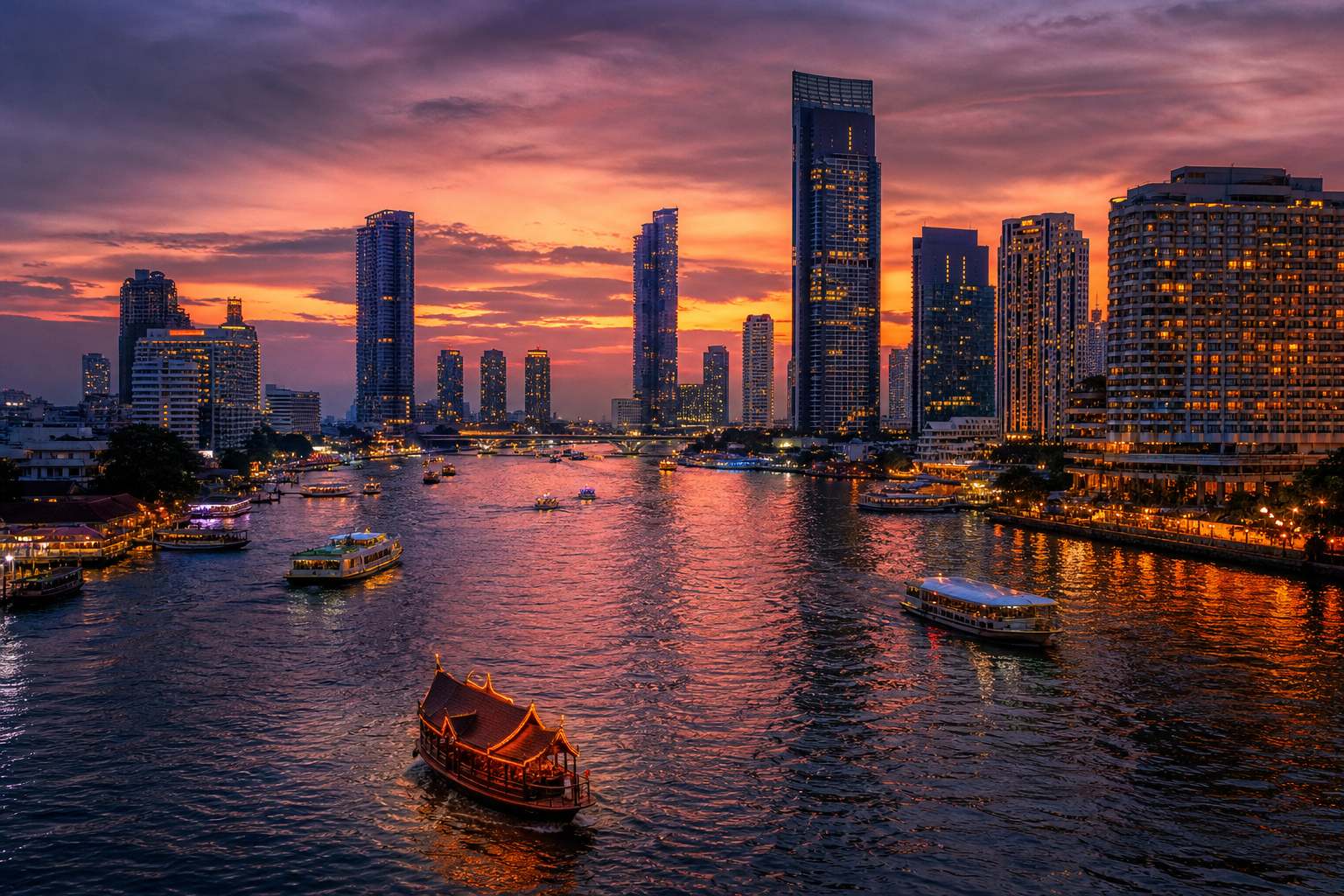
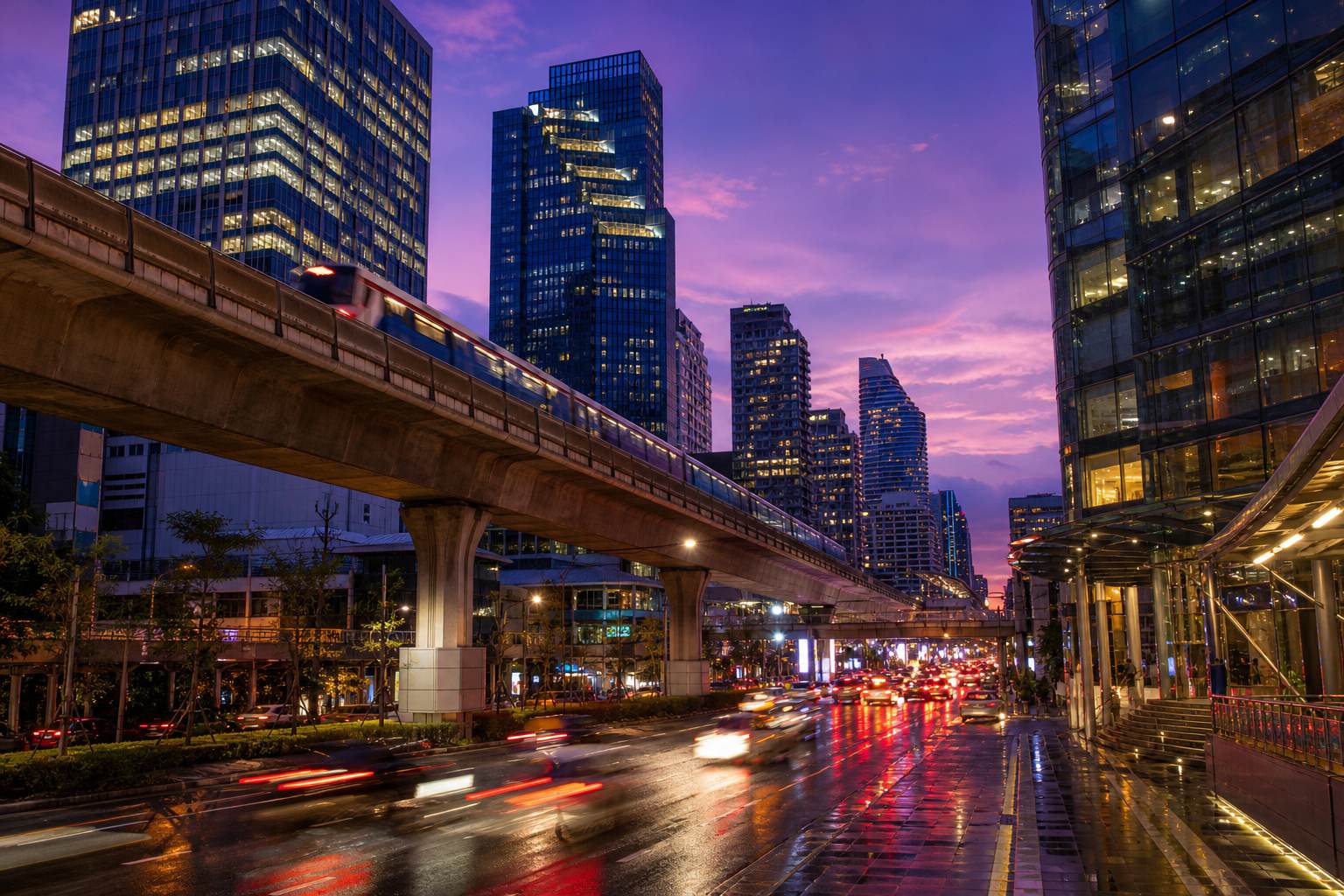
Bangkok The first shares traded in 1975 were Bangkok Bank’s; that day 15,380 shares changed hands, worth 1,977,712 baht. AI-generated illustration.
Thailand’s SEC: approves the offer of shares
SET: approves the listing
the filing becomes effective, then the sale
Two reviews at once
Passing these criteria does not guarantee that, after raising funds, the company will always make a profit.Thailand’s SEC, “IPO shares: what they go through before a public offer” (InfoQuest, 2023; translated)
SET
3 years
mai
2 years
Track record needed (Bangkok Post)
Two boards For a SET listing a company needs, for example, 50 million baht of net profit over recent years; for the mai, 10 million in the past year. AI-generated illustration.
Chapter VI · Other doors
IPOs in Thailand
Bangkok Post, Thailand Journey: the exchange’s first trade was on 30 April 1975 with 10 listed companies; Bangkok Bank shares were the first traded, and 15,380 shares worth 1,977,712 baht changed hands that day. Baker McKenzie: an offer of new shares needs approval from the SEC Office; the registration statement and draft prospectus are filed through the Digital IPO system, and SET approvals are typically granted in the same period. Thailand’s SEC (via InfoQuest, 10 April 2023): the SEC Office decides whether a company may offer shares to the public, judging qualitative criteria such as its shareholding structure, directors and management, and seeing that it discloses material information fully; passing these criteria does not guarantee that the company will always make a profit after raising funds. SET listing rules: an applicant must be a public limited company; mai stands for Market for Alternative Investment. Tilleke & Gibbins: the Securities and Exchange Act makes false statements in IPO registration statements and draft prospectuses a liability. Bangkok Post: the SET requires a three-year track record and, for example, at least 50 million baht of combined net profit over two or three years; the mai, with lower thresholds, a two-year track record and, for example, 10 million baht of net profit in the past year.
Press “SET” or “mai” to route a company to each board. Requirements are simplified; the full rules have several alternative tests.
The 3D scenes are simplified teaching models: pies, order books and routes are schematic, and the numbers on them are illustrative unless a source is named.
From Amsterdam in 1602 to Nasdaq in 2026, the bargain at the heart of an IPO has barely changed.
A company gives up some privacy and some control. In return, strangers hand it money, and become its owners.
They share in what happens next, the good years and the bad.
And the price on the first morning only tells you what people would pay that morning, not what the company will turn out to be worth.
Where it began Amsterdam’s harbour in the age of the VOC, when shares were first offered to anyone who wished to buy. AI-generated illustration.
1602 VOC sells shares to the public
1956 Ford Foundation sells Ford shares
1975 first trade in Bangkok
2004 Google’s auction IPO
2012 Facebook’s troubled first day
2019 Saudi Aramco, $29.4 bn
2026 Anthropic lists on Nasdaq
Going public, in seven datesWhat comes next Owners of shares share in a company’s results for as long as they hold them. AI-generated illustration.
the company gives: privacy, some control
it gets: money, and many owners
The bargain
Epilogue · Sources
Sources
Every fact in this film comes from the sources below. Where they differ, the film says so: Anthropic’s IPO raised about $81.3 billion according to CBS News and Yahoo Finance, while about $107 billion includes a separate private placement (CBS); Fox Business reported that Anthropic’s shares opened at $111.50 on 19 November; the lock-up is “typically 180 days” per the US SEC and three to six months per Britannica. Anthropic is presented as one example among several; the film makes no claim about its value or its prospects. This is education about how markets work, not investment advice. The 3D scenes are schematic teaching models with illustrative numbers unless a source is named. The chapter stills and pictures are AI-generated illustrations, not photographs of the real places, people or events.