In October 2026, researchers in England reported that honeybees win a larger share of contests for flowers than wild pollinators. This film explains the animal behind the headline: a colony of one queen and tens of thousands of sister workers whose jobs change with age, wax comb built in hexagons, the waggle dance that tells nestmates the direction and distance of food, how nectar becomes honey, why pollinators matter for food, the honey bees of Asia and the mite that jumped from them, and what the new study does and does not show.
Interactive 3D film10 minPublished 24 October 2026
Honey bees, and the wild bees that share their flowers.
On the same flowers, honeybees were winning. Over two years, on the edge of Cambridge in England, researchers watched bramble and ivy flowers for ninety-three hours, and counted every contest for a flower.
Where honeybees were many, other pollinators were fewer, and the honeybees won a larger share of their contests than the others did.
Why would one kind of bee do so well? To find out, we start with the animal itself: one of the most familiar insects on Earth, and one of the strangest.
5
sites, 2 years
93 h
of watching flowers
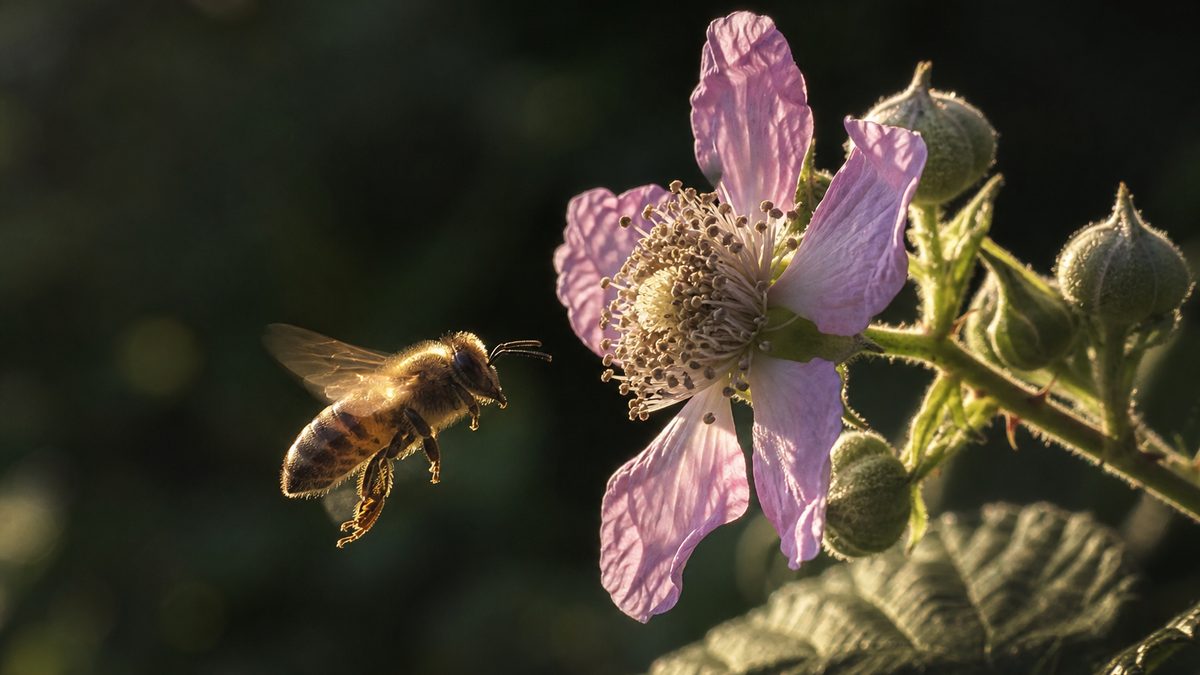
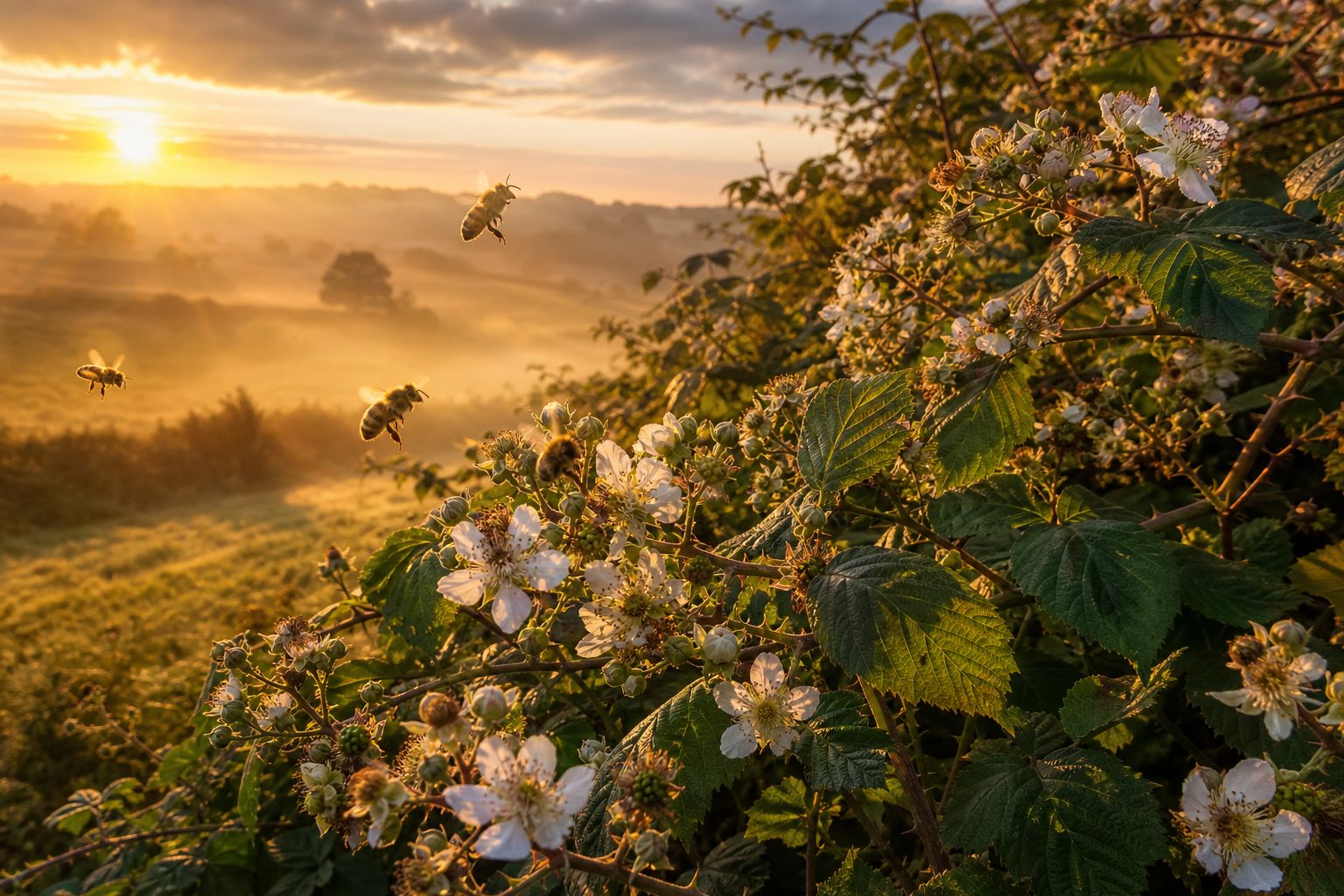
The study (Anglia Ruskin University)Bramble in flower A honey bee on a bramble blossom, one of the two plants watched. AI-generated still.
honeybees
won a larger share of encounters than other visitors
Who won (Anglia Ruskin, Ecological Entomology, Oct 2026)
The colony and its jobs
Comb, dance and honey
Pollinators, and sharing flowers
In this film
Prologue
The study
ScienceDaily (22 October 2026), from Anglia Ruskin University: Victoria Buckle and colleagues tracked pollinators over two years at five sites in and around Cambridge, England, each within 300 metres of an established honeybee colony, watching bramble (Rubus fruticosus) and ivy (Hedera helix) for 93 hours. Visitors were grouped as honeybees, bumblebees, solitary bees, hoverflies or others, and each encounter was scored as a win, a loss or a share. Sites with more honeybees generally had fewer other pollinators, and honeybees won a larger share of their encounters. The study is in Ecological Entomology (2026).
The 3D bees, comb, flowers and map are simplified teaching models, not to scale; counts on screen are illustrative unless a source is named.
A honey bee colony is a family. At its centre is one queen, the mother of nearly everyone in the hive. She can lay a couple of thousand eggs a day.
Around her live twenty to sixty thousand workers, and every one of them is female: a sister. In summer there are also a few hundred males, the drones, whose task is to mate with a young queen from another colony.
The queen decides which is which. A fertilised egg becomes a female; an unfertilised egg becomes a male. Tap each kind of bee.
1,500–2,500
eggs a day, about her own body weight
up to 7 yrs
lifespan
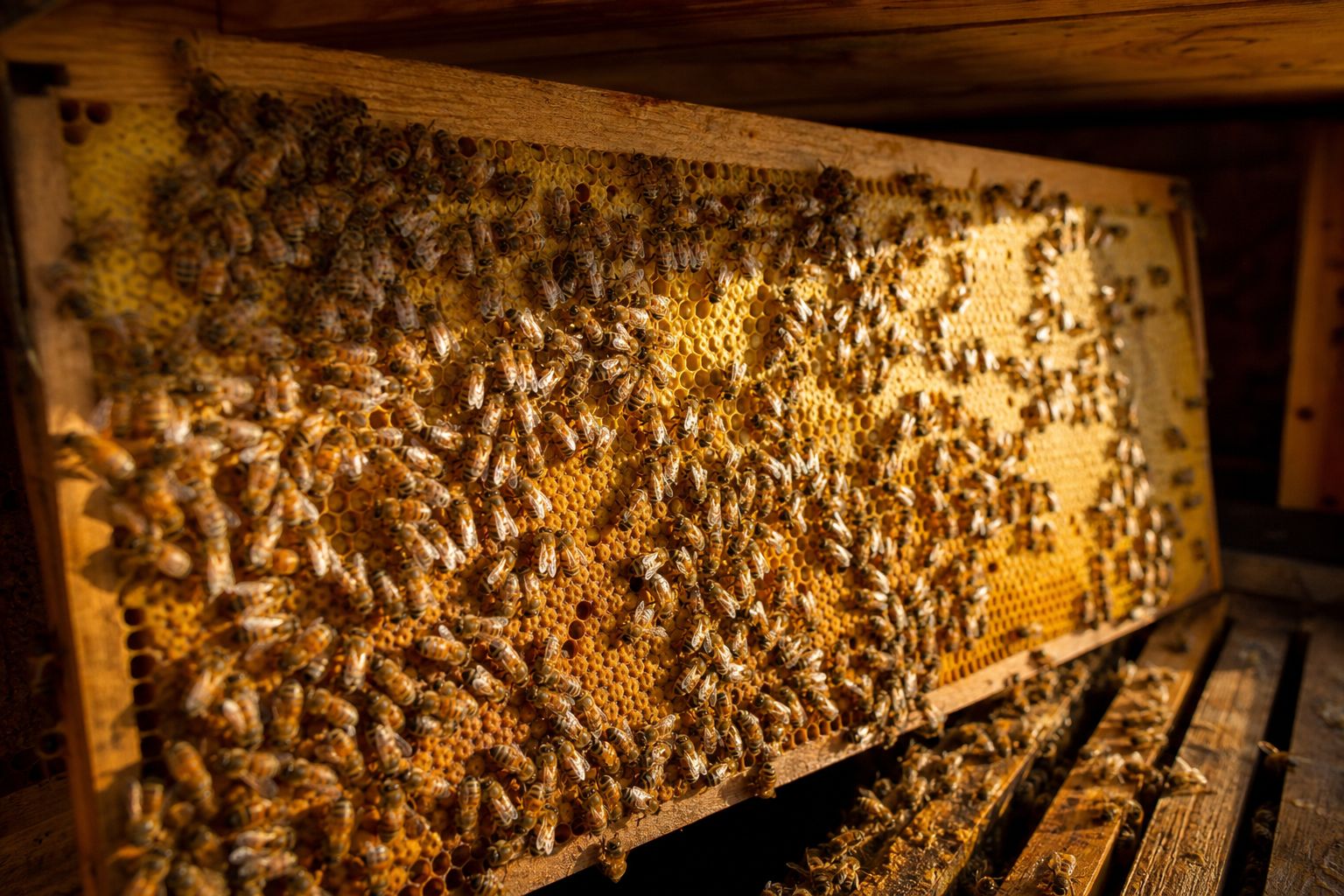
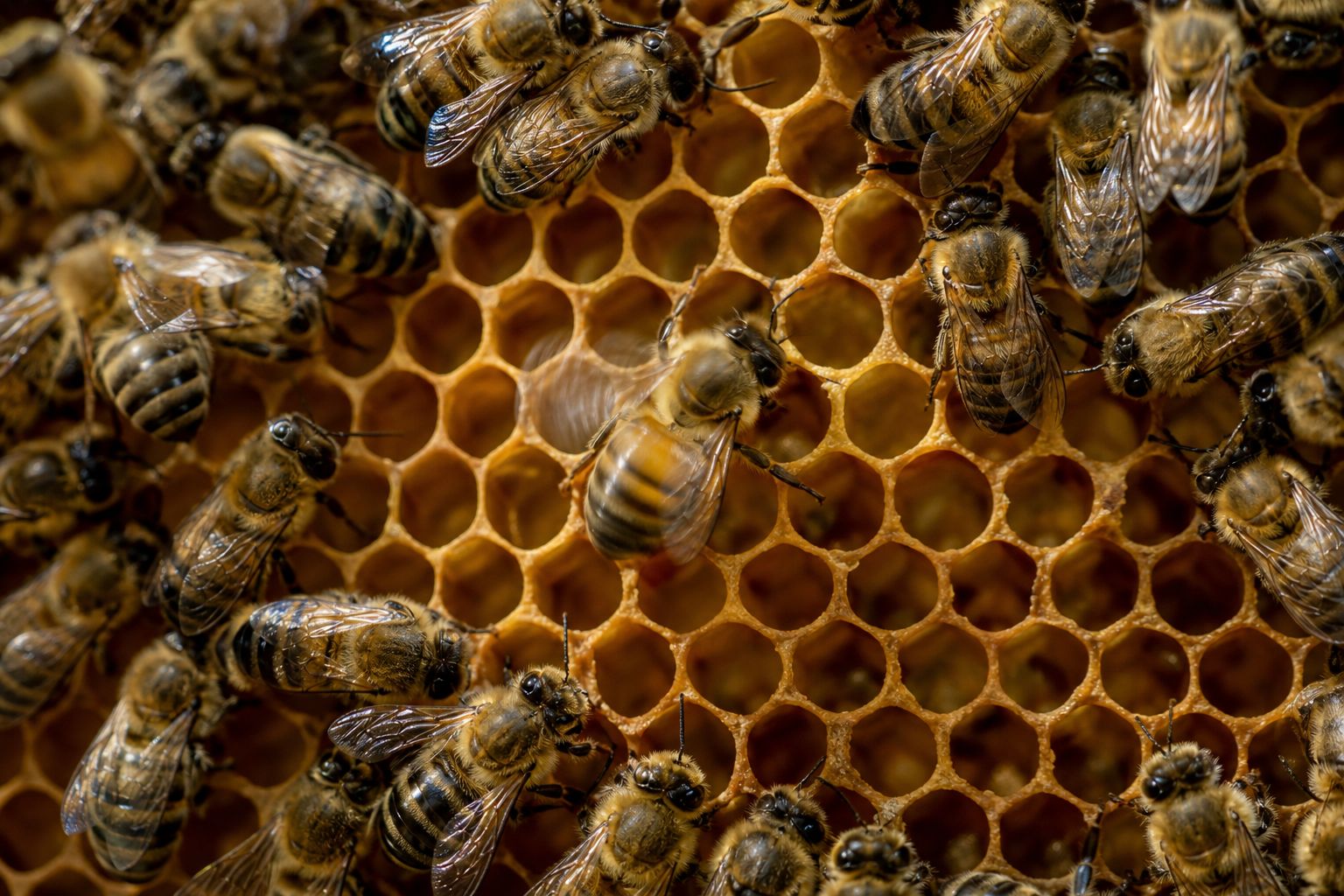
The queen (UC Riverside, Univ. of Arizona)A frame from a hive Workers crowd over the comb; the queen is usually hidden among them. AI-generated still.
Queen
1
Drones (summer)
300–600
Workers
20,000–60,000
Who lives in a hive (UC Riverside)
Fertilised egg → female (worker or queen)
Unfertilised egg → male (drone)
Drones are reared in larger cells
Who becomes what (Univ. of Sussex)
Chapter I · The colony
Queen, workers, drones
UC Riverside (CIBER): a colony has one queen, 20,000 to 60,000 workers and, in the active season, 300 to 600 drones; the queen can live up to seven years and stores several million sperm. University of Arizona Extension: she lays about 1,500 to 2,500 eggs a day, roughly her own body weight; drones mate with a virgin queen from another hive. University of Sussex: the queen chooses whether each egg is fertilised (female) or unfertilised (male).
The 3D bees, comb, flowers and map are simplified teaching models, not to scale; counts on screen are illustrative unless a source is named.
A worker's job changes as she ages. In her first days she cleans cells. From about day five she is a nurse, feeding the larvae and the queen.
Around day ten she takes nectar from returning foragers and stores it. Around day twelve her wax glands are ready, and she builds comb. From about day fifteen she guards the entrance.
And from about day twenty-four she flies out to forage, for the rest of her life. In summer that life lasts about six weeks; bees raised for winter can live four to six months. Step through her life.
day 1 Cleans cells
~day 5 Nurse: feeds larvae and queen
Early jobs (Univ. of Arizona)
~day 10 Receives and stores nectar
~day 12 Builds comb
~day 15 Guards the entrance
~day 24 Forager, for life
Middle age (Univ. of Arizona)
~days
ages are approximate and shift with the colony’s needs
A schedule, not a rule
Summer worker
5–6
Winter worker
17–26
How long a worker lives (extension.org)
~3 weeks
old when a worker starts to forage
Foraging (Univ. of Sussex)
Chapter I · The colony
A life in jobs
University of Arizona Extension: from day one a worker cleans her own cell, then makes wax and royal jelly, caps brood and tends the young and the queen; about day 5 nurse bees feed larvae and the queen; about day 10 workers receive nectar from foragers and store it as honey, fan and remove debris; about day 12 the wax glands are fully developed and they build comb; about day 15 they guard the entrance and take orientation flights; about day 24 they become full-time foragers for the rest of their lives. Summer workers average about six weeks. Bee Health (extension.org): workers live about 5 to 6 weeks in the active season and about 4 to 6 months over winter.
Try it: the highlighted bee shows the job at each age; the comb is schematic.
The 3D bees, comb, flowers and map are simplified teaching models, not to scale; counts on screen are illustrative unless a source is named.
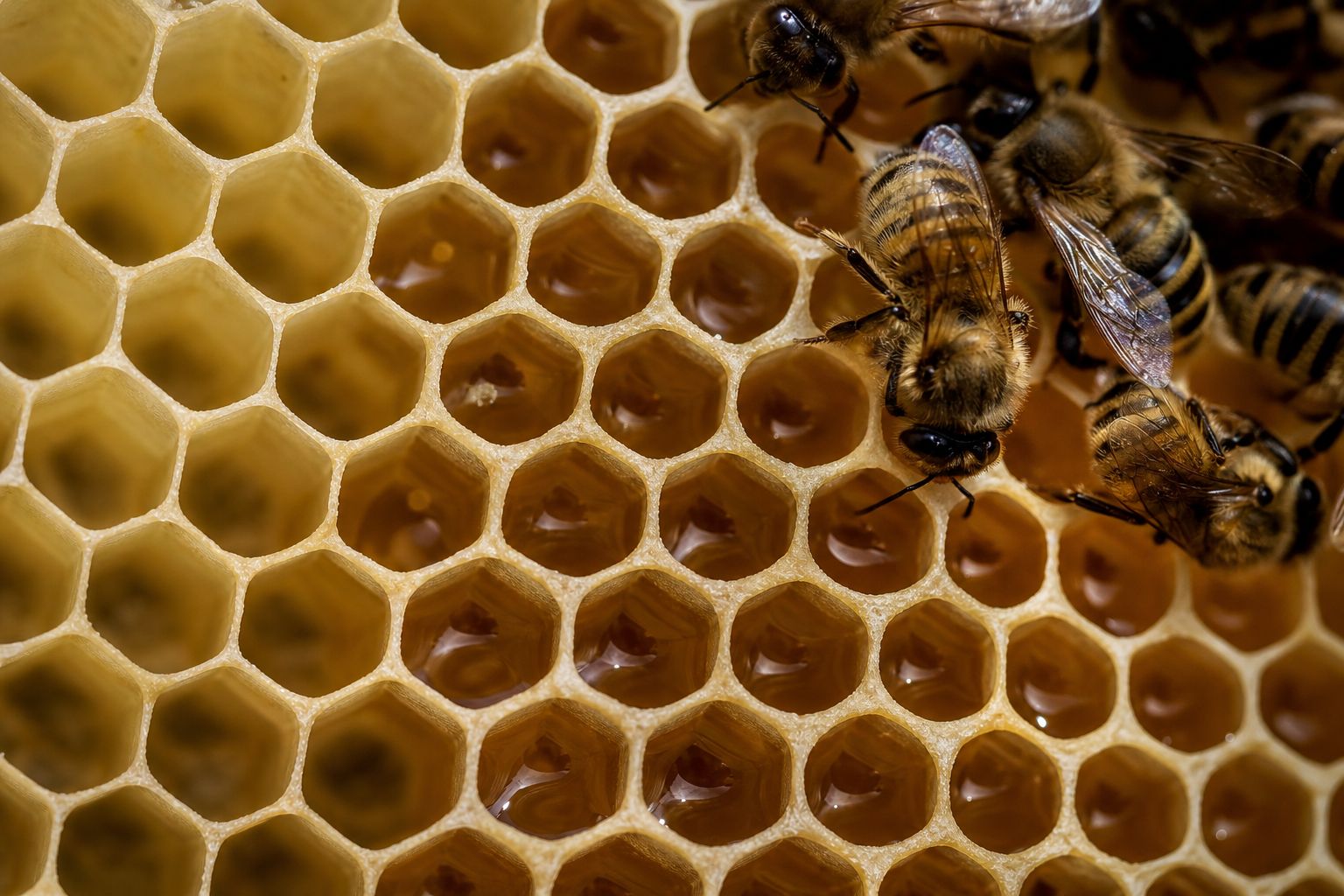
Workers make wax themselves, from glands on the underside of the abdomen, and shape it into cells, side by side, in sheets of comb.
The same cells serve as cradles for the young and as jars for food. Honey is stored above the brood, and the brood area is kept at about thirty-four degrees, even in winter.
Look closely at any cell. It has six sides.
Secreted by glands on the abdomen
Shaped into hexagonal cells
Made by young workers (~day 12)
Where wax comes from (Univ. of Sussex)
34 °C
brood area, even in winter
above
where honey is stored, over the brood
Inside the hive (Univ. of Sussex)Fresh comb Pale new wax; cells darken as they are reused. AI-generated still.
~3,500
cells on a frame of a managed hive
One frame (Univ. of Arizona)
Chapter II · Wax and comb
Wax and comb
University of Sussex: workers secrete wax from glands on their abdomen and shape it into hexagonal cells; honey is stored above the brood, and the brood area is kept at 34 °C even in winter; colonies live on their honey stores through winter. University of Arizona Extension: a frame holds about 3,500 cells, and wax glands are fully developed at about day 12.
The 3D bees, comb, flowers and map are simplified teaching models, not to scale; counts on screen are illustrative unless a source is named.
Only three shapes with equal sides and equal angles can cover a flat surface with no gaps: triangles, squares and hexagons. Circles leave gaps between them.
Of the three, for the same area, the hexagon needs the shortest walls, so it uses the least wax. In 1999, the mathematician Thomas Hales proved that no way of dividing a flat surface into equal areas uses less wall than the honeycomb.
Compare the shapes, and watch the length of wall.
Equilateral triangle ✓
Square ✓
Regular hexagon ✓
Circle ✗ (gaps)
Shapes that tile a plane
Triangle
4.56
Square
4.00
Hexagon
3.72
Perimeter of one cell of area 1 (geometry)
P=83A≈3.72APerimeter of a regular hexagon of area A
Any partition of the plane into regions of equal area has perimeter at least that of the regular hexagonal honeycomb tiling.Thomas C. Hales, The Honeycomb Conjecture (1999)
Chapter II · Wax and comb
The honeycomb conjecture
Thomas C. Hales, “The Honeycomb Conjecture” (arXiv, 1999; Discrete & Computational Geometry, 2001): gives the first general proof that any partition of the plane into regions of equal area has perimeter at least that of the regular hexagonal honeycomb tiling. For cells of area 1, the wall length per cell is about 4.56 for equilateral triangles, 4 for squares and 3.72 for regular hexagons; a circle needs 3.54 but circles cannot fill the plane without gaps.
Try it: each tiling has the same cell area; the counter shows wall per cell.
Bar values are computed from geometry: 3·√(4/√3), 4, √(8√3) and 2√π for area 1.
A forager that finds a rich patch of flowers comes home and dances on the comb. She runs straight ahead, waggling her body, circles back, and does it again, up to a hundred times.
The Austrian scientist Karl von Frisch worked out what it means, and shared the 1973 Nobel Prize with two other researchers of animal behaviour. The angle of the straight run gives the direction of the food, measured from the direction of the sun.
On the vertical comb, straight up stands for the sun: a run straight up means fly toward the sun, straight down means fly away from it. Try moving the flowers.
up to 100
waggle runs, for a highly rewarding patch
One dance (Univ. of Sussex)A dance in the dark hive Followers keep close to the dancer and track her movements. AI-generated still.
von Frisch
shared with Konrad Lorenz and Nikolaas Tinbergen
Nobel Prize, 1973
Up the comb = toward the sun
Down = away from the sun
60° right of up = 60° right of the sun
Reading the angle
paint-marked bees
trained to feeders at different distances and angles
How he found out (Univ. of Sussex)
Chapter III · The dance
Direction
University of Sussex: Karl von Frisch (1886–1982) discovered the honey bee dance language and shared the 1973 Nobel Prize for Physiology or Medicine with Konrad Lorenz and Nikolaas Tinbergen for research on animal behaviour. The angle of the dancer’s body on the vertical comb encodes direction relative to the sun: straight up means the flowers lie toward the sun, straight down means directly away from it, and an angle to the right or left is measured the same way. Foragers that found highly rewarding patches can perform up to 100 waggle runs; bees also dance for water, tree resin and nest sites.
Try it: the left shows the dance on the comb, the right the flight from the hive; the drawing is schematic.
The 3D bees, comb, flowers and map are simplified teaching models, not to scale; counts on screen are illustrative unless a source is named.
The length of the waggling gives the distance. Roughly, one second of waggling means about one kilometre.
The bees that follow the dance, young bees and foragers that have no flowers of their own yet, then fly out and search. Foragers can travel up to about ten kilometres from the hive, and about one forager in ten is a scout that finds food without any dance.
And because the sun moves across the sky, dancers shift their angle through the day. Change the distance, and watch the dance.
1s of waggling≈1kmA rule of thumb (Univ. of Sussex)
up to 10 km
from the hive (UC Riverside)
~10%
of foragers are scouts (Sussex)
Range (UC Riverside; Univ. of Sussex)
Foragers with no patch yet
Young bees
They learn the route, then search
Who follows (Univ. of Sussex)
angle shifts
with the sun’s position through the day
A moving compass
Chapter III · The dance
Distance
University of Sussex: the length of the waggle run encodes distance, about 1 second of waggling corresponding to roughly 1,000 metres; because the sun moves, bees adjust their dance angle for the time of day. Dance followers are unemployed foragers or young bees; about 10% of foragers are scouts that find patches without following dances. UC Riverside: foragers can fly up to 10 km from the nest. Von Frisch worked this out by training paint-marked bees to feeders at different distances and angles.
Try it: the waggle run lengthens with distance; the timing is a rule of thumb and varies between colonies.
The 3D bees, comb, flowers and map are simplified teaching models, not to scale; counts on screen are illustrative unless a source is named.
Nectar is mostly water, about seventy percent. Back in the hive, house bees pass it from mouth to mouth and add an enzyme, invertase, that splits its sugar, sucrose, into two simpler sugars, glucose and fructose.
Then they dry it. Bees fan their wings to drive air across the comb, and water evaporates until less than about eighteen and a half percent is left.
Finally they seal each cell with an airtight cap of wax, so the honey cannot soak up moisture and spoil. Fan the comb yourself.
~70%
water
Nectar (NC State University)sucrose+H2Oinvertaseglucose+fructoseWhat invertase does
Nectar
~70
Honey
< 18.6
Water content (NC State University)
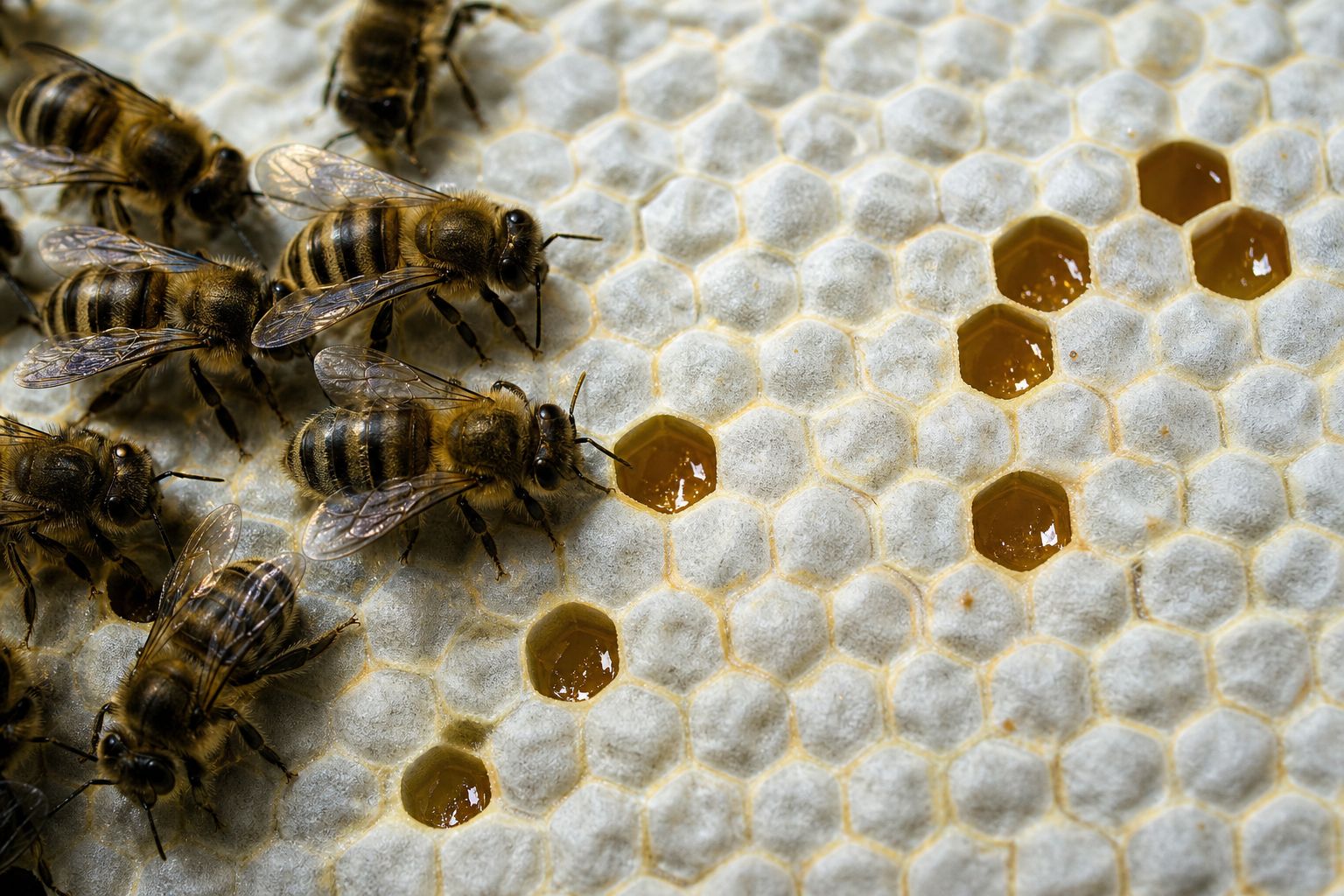
Capped honey Cells sealed with white wax caps, a few still open. AI-generated still.
Chapter IV · Making honey
From nectar to honey
NC State University: nectar is about 70% water; processor bees add the enzyme invertase each time they regurgitate the nectar, breaking sucrose into glucose and fructose; bees fan their wings to create airflow over the comb, evaporating water until the honey is below 18.6% water; they then seal the cell with an airtight wax cap, because honey without a seal can absorb moisture and become vulnerable to bacteria and fungi. IPBES: the western honey bee produces an estimated 1.6 million tonnes of honey a year.
Try it: fanning speeds up drying in the model; the time scale is schematic.
The 3D bees, comb, flowers and map are simplified teaching models, not to scale; counts on screen are illustrative unless a source is named.
While she feeds, a bee is dusted with pollen, and carries some of it to the next flower. That is pollination, and it is how many plants make seeds and fruit.
According to IPBES, a United Nations-backed panel of scientists, more than three quarters of the world's food crops rely at least in part on animals for pollination, and nearly nine in ten wild flowering plants depend on it to some extent.
Honey bees are only part of that work. There are more than twenty thousand species of wild bees, and flies, butterflies, beetles, birds and bats pollinate too.
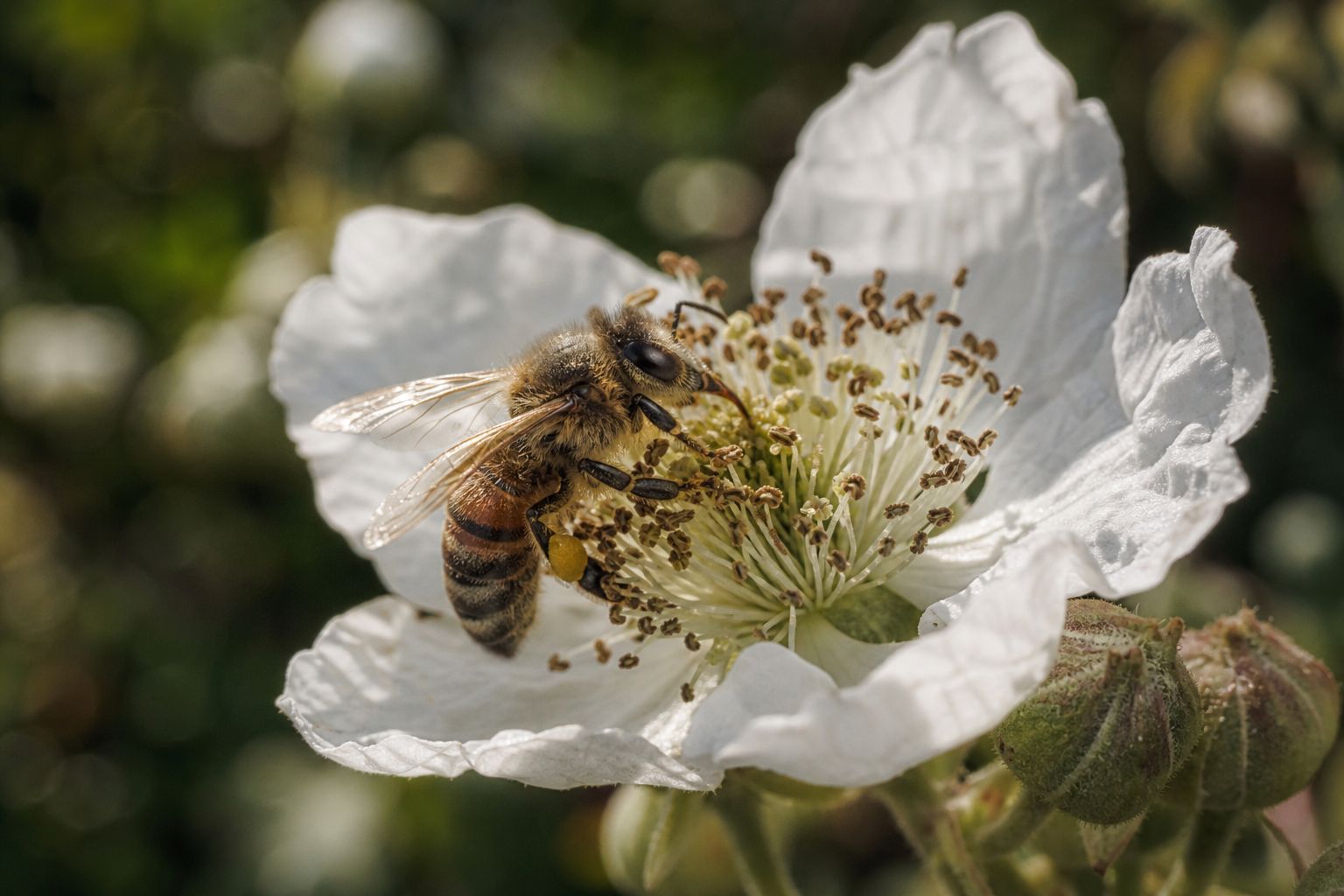
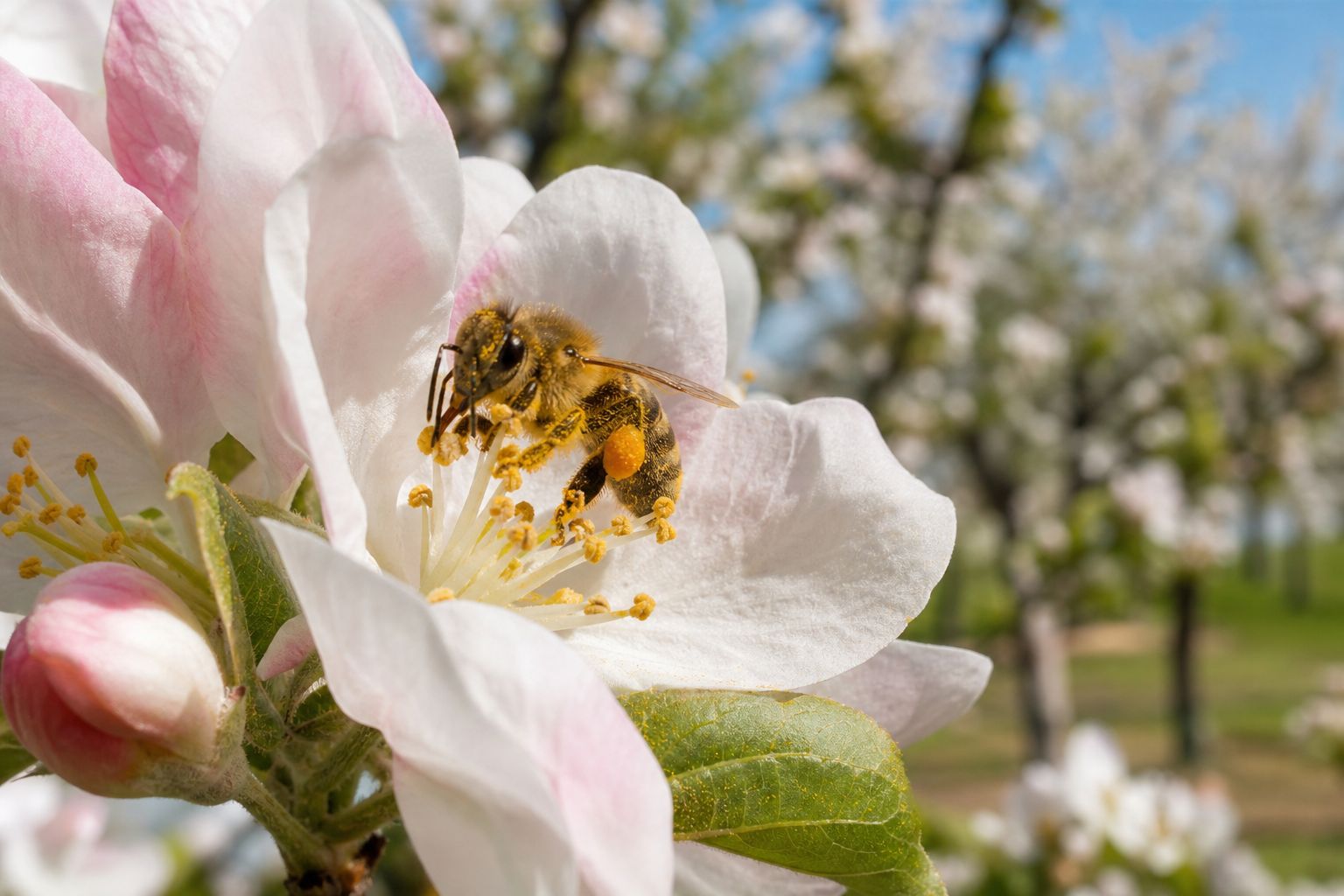
Pollen on board A bee dusted with pollen on apple blossom; pollen baskets on her hind legs. AI-generated still.
World food crops, at least partly
> 75
Wild flowering plants, to some extent
~90
Depend on animal pollination (IPBES)
$235–577 bn
of yearly food production relies directly on pollinators
What it is worth (IPBES)
> 20,000
species worldwide
Wild bees (IPBES)
Chapter V · Bees of the world
Pollination
IPBES (Intergovernmental Science-Policy Platform on Biodiversity and Ecosystem Services), pollination assessment: more than 75% of the world’s food crops rely at least in part on pollination by insects and other animals; between US$235 billion and US$577 billion of annual global food production relies directly on pollinators; nearly 90% of wild flowering plants depend at least to some extent on animal pollination; there are more than 20,000 species of wild bees. Often more than 40% of invertebrate pollinator species, particularly bees and butterflies, are threatened locally; main drivers include land-use change, intensive agriculture, pesticides, invasive species, pests and diseases, and climate change.
The 3D bees, comb, flowers and map are simplified teaching models, not to scale; counts on screen are illustrative unless a source is named.
The honey bee most beekeepers keep, the western honey bee, is one species. Asia has several others, and Thailand alone has four native ones.
The giant honey bee hangs a single open comb, up to about a metre wide, from a tall tree or a cliff. Two dwarf honey bees build a small comb around a slender branch. And the Asian honey bee nests in cavities, and is kept in hives, like the western bee, which was brought in.
Because their combs hang in the open, giant and dwarf honey bees cannot be kept in hives. Honey hunters take their honey from the wild.
Giant: Apis dorsata
Dwarf: Apis florea, Apis andreniformis
Cavity: Apis cerana (native)
Apis mellifera (introduced)
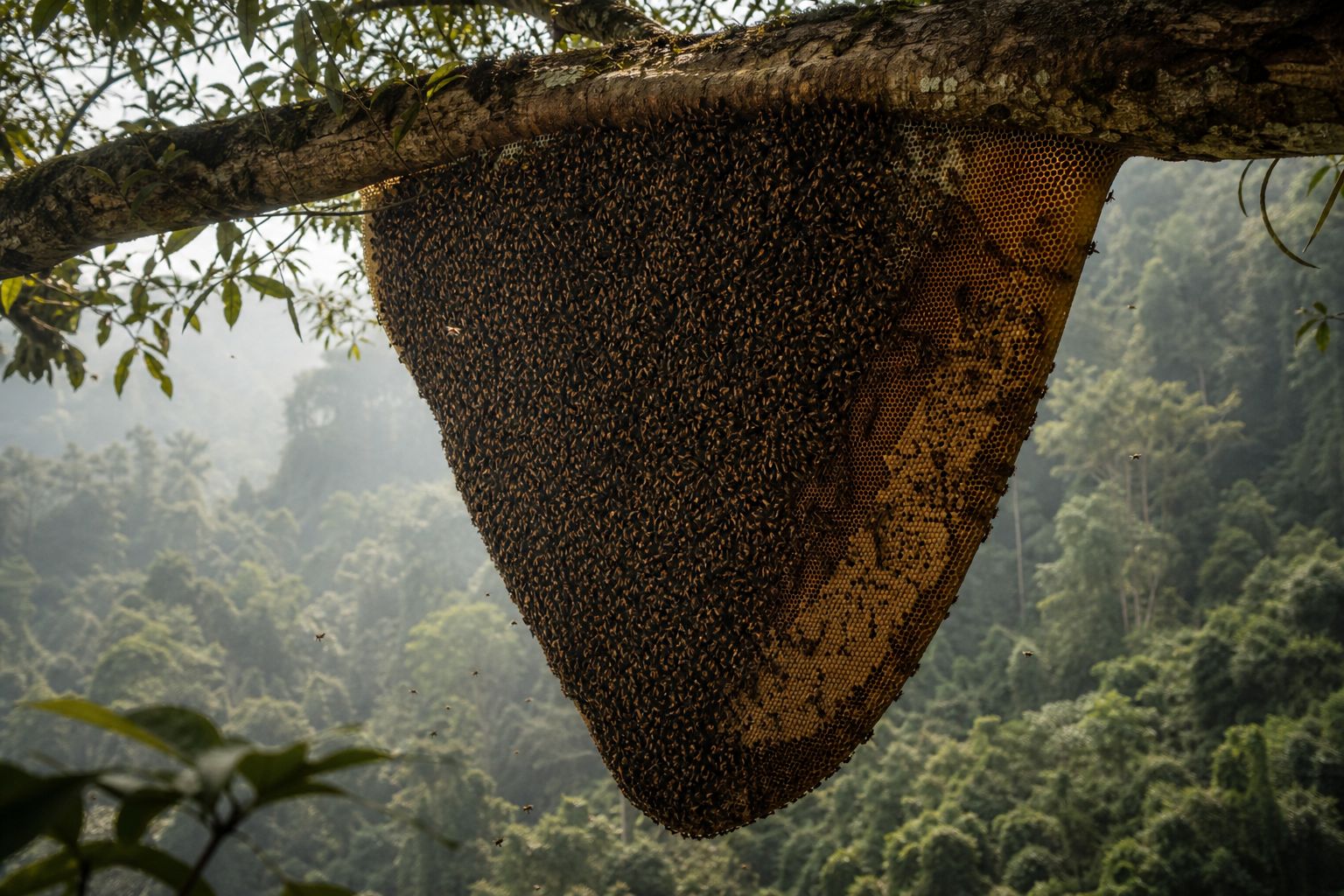
Honey bees of Thailand (Penn State Extension)A giant honey bee colony One open comb under a high branch; many colonies may share a tree. AI-generated still.
3–25 m
up, giant honey bee comb (to ~1 m wide)
1–8 m
up, dwarf honey bee comb
Where they nest (FAO)
Cavity nesters: kept in hives for millennia
Open nesters: cannot be kept long-term
Thailand requires permits for honey hunting
Kept or hunted (FAO)
Chapter V · Bees of the world
Honey bees of Asia
Penn State Extension: Thailand has four native honey bee species, Apis dorsata, A. florea, A. cerana and A. andreniformis, and one non-native, A. mellifera; A. cerana and A. mellifera are managed by beekeepers, and honey hunters collect from wild hives. FAO: the giant honey bee builds a single open comb, up to about 1 m wide, under a tree limb or cliff, usually 3 to 25 m above the ground, and one tree can hold many nests; the dwarf honey bee builds a small single comb whose top forms a crest around a slender branch, usually 1 to 8 m up; A. cerana builds several parallel combs in dark cavities and has been kept in traditional hives for thousands of years; open-nesting dwarf and giant honey bees cannot be kept long-term in hives; Thailand requires permits to hunt giant honey bee nests.
The two dwarf honey bees are grouped together here; the sizes of the 3D bees are schematic.
The 3D bees, comb, flowers and map are simplified teaching models, not to scale; counts on screen are illustrative unless a source is named.
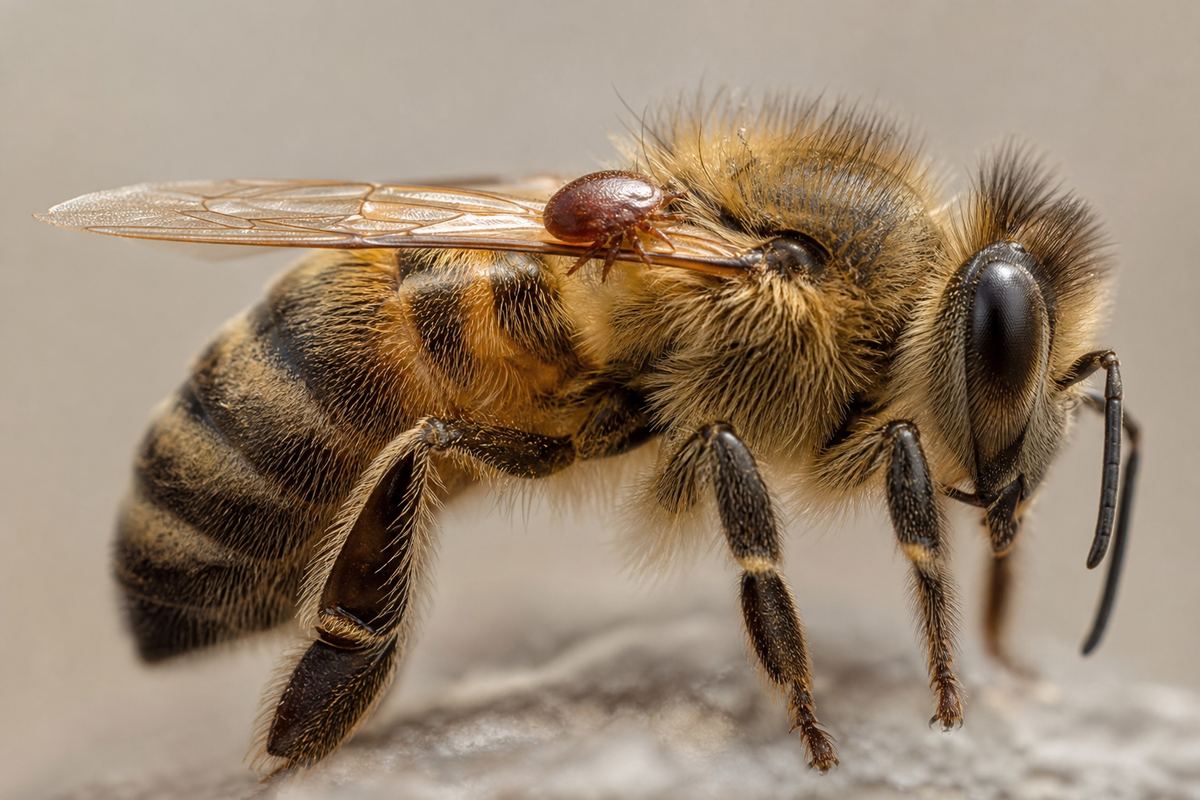
Asia also gave the western honey bee one of its most serious threats. The Varroa mite lived on the Asian honey bee, then jumped to the western honey bee, and has since spread to most countries.
Female mites ride on adult bees and breed inside brood cells just before they are capped. They feed on the bees' fat tissue as well as their blood, and spread viruses, among them deformed wing virus, that weaken whole colonies.
Even so, IPBES reports that managed hives worldwide have increased over the past fifty years, though they fell in many European and North American countries. More hives can mean more bees on the same flowers.
A Varroa mite Illustration: an adult female mite, about the size of a pinhead, on a bee. AI-generated still.
Feeds on fat body tissue
Spreads deformed wing virus
Weakens immunity, flight and homing
How it harms (Traynor et al., 2020)
most countries
Australia and some islands had not reported it by 2020
Where it is (Traynor et al., 2020)
↑ worldwide
over 50 years; ↓ in many European and North American countries
Managed hives (IPBES)
Chapter V · Bees of the world
The Varroa mite
Traynor et al. (2020), Trends in Parasitology: Varroa destructor shifted from the Asian honey bee (Apis cerana) to the western honey bee (Apis mellifera), a short history of co-evolution that leaves the relationship unbalanced; it has been reported in most countries, though in early 2020 Australia, several African countries and some islands had not reported it. Adult female mites ride on adult bees and reproduce in brood cells about to be capped; newer work shows they also feed on fat body tissue, not only haemolymph; the mite transmits deformed wing virus and the acute bee paralysis virus complex, and with other stressors contributes to colony losses. IPBES: global beehive numbers have increased over the past 50 years, but decreased in many European and North American countries.
The 3D bees, comb, flowers and map are simplified teaching models, not to scale; counts on screen are illustrative unless a source is named.
Now put it together: a colony of tens of thousands, a dance that sends sisters to the best flowers, foragers ranging kilometres. Near Cambridge, the team watched five sites, each within three hundred metres of a honeybee colony, and scored every meeting on a flower as a win, a loss, or a share.
On bramble, where honeybees were twice as dense, there were about fourteen percent fewer bumblebees. On ivy, more honeybees went with fewer solitary bees, which nest alone, and fewer hoverflies.
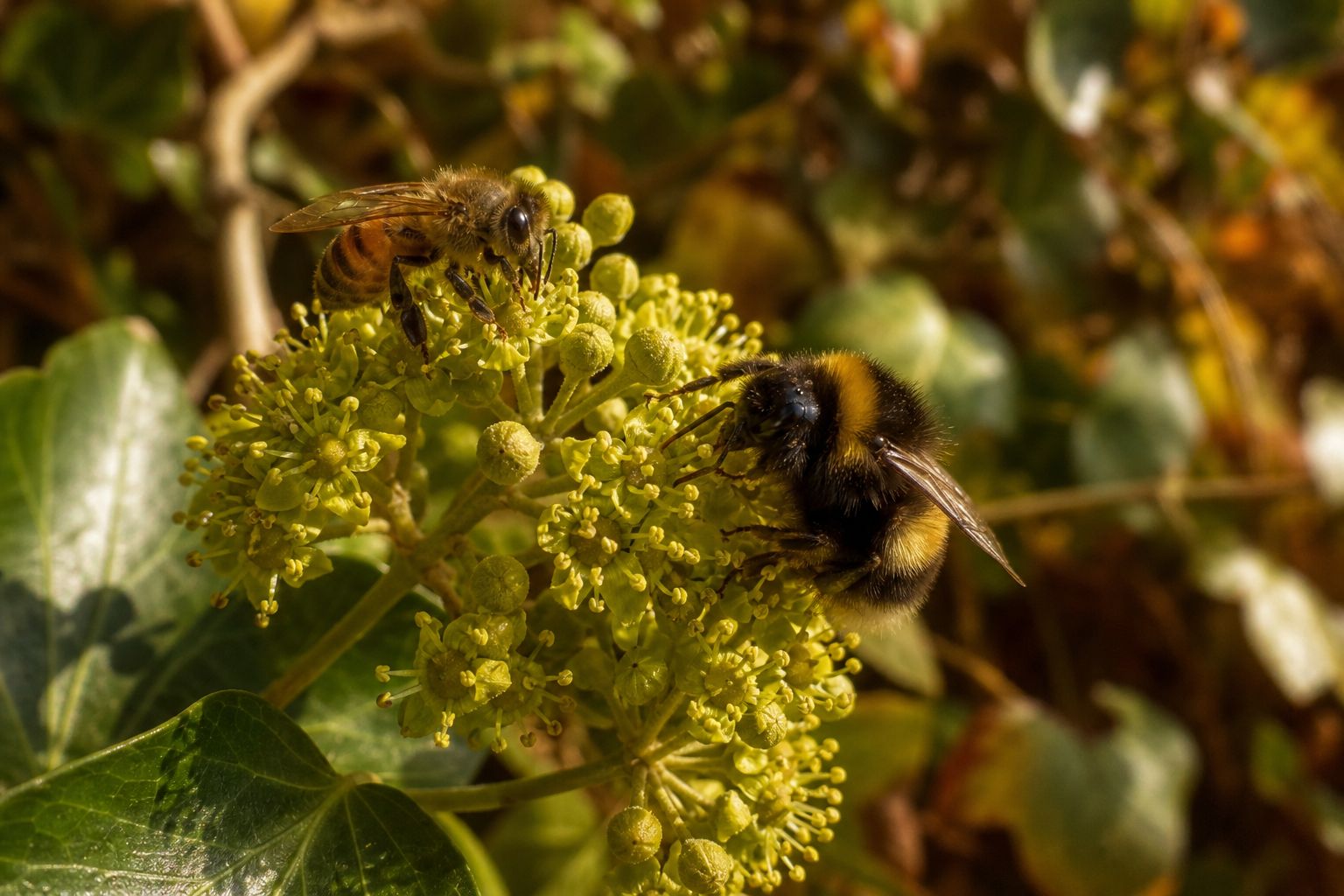
Other insects backed away from honeybees in twenty-eight percent of meetings on bramble and thirty-six on ivy. Only one regularly stood up to them: the ivy bee, a wild bee first recorded in Britain in 2001. Compare a few honeybees with many.
Win: got the flower at another’s expense
Loss: gave the flower up
Share: both fed, no conflict
How a meeting was scored
≤ 300 m
from an established honeybee colony
The sites (Anglia Ruskin)
−14%
bumblebees, where honeybee density doubled
Bramble (Anglia Ruskin)
Bramble
28
Ivy
36
Other insects backed away (Anglia Ruskin)
Ivy in autumn A honey bee and a bumblebee on the same cluster of ivy flowers. AI-generated still.
Chapter VI · Sharing the flowers
Win, lose or share
ScienceDaily (22 October 2026), from Anglia Ruskin University: each encounter was classified as a win, a loss or a share. On bramble, doubling honeybee density was associated with a 14% decrease in bumblebee abundance; on ivy, more honeybees were linked to fewer solitary bees and hoverflies. Other pollinators avoided honeybees in 28% of interactions on bramble and 36% on ivy; honeybees physically pushed aside or chased competitors in at least 20% of the encounters they won on either plant, and initiated most aggressive encounters. The non-native ivy bee, first recorded in Britain in 2001, was the only pollinator seen regularly challenging honeybees, and it sometimes won.
Try it: the meadow is a model; the counts on it are illustrative, not the study’s data.
The 3D bees, comb, flowers and map are simplified teaching models, not to scale; counts on screen are illustrative unless a source is named.
Contests were more frequent in warmer weather. The authors suggest heat may cut the nectar that flowers make, leaving less to share, but that idea was not tested here.
And this was an observational study, at five sites, on two plants, in one region: it shows a link, not proof of cause. Earlier reviews found a mixed picture. In one from 2017, of nineteen studies that measured whether wild bees survived or bred less, ten found evidence of competition.
Britain's registered beekeepers rose from about nineteen thousand in 2010 to forty-seven thousand. The lead author says the aim is not to discourage beekeeping, but to understand how competition happens, to help conserve wild pollinators.
warmer → more contests
the nectar explanation is untested
Weather (Anglia Ruskin)
Observational: a link, not a cause
5 sites, one region of England
2 plants: bramble and ivy
Limits of the study
Measured wild bees’ survival or breeding
19
Found evidence of competition
10
Mallinger et al. 2017, as summarised in a 2024 review
2010
19,000
latest year reported
47,000
Registered beekeepers, UK (via ScienceDaily)
The aim of our study was not to discourage beekeeping, but to better understand how competition happens.Victoria Buckle, Anglia Ruskin University (ScienceDaily)
Chapter VI · Sharing the flowers
A link, not a proof
ScienceDaily: competitive encounters became more frequent in warmer conditions; one proposed explanation is that heat stress reduces nectar production, presented as a possibility, not a tested result. The study is observational, at five sites in one region of England, on two plants, so its figures are associations, not proof of cause. UK registered beekeepers rose from 19,000 in 2010 to 47,000 in the most recent year reported. Oddie & Dahle (2024), Frontiers in Bee Science, summarising Mallinger et al. (2017): of 81 papers on competition, 19 tested direct effects on wild bee fitness and 10 of those found evidence of competition; most research is observational, with few experiments; that review itself finds little evidence of a direct effect on wild pollinator fitness while treating competition as a real risk.
Try it: warmer weather shows more contests in the model, as the study observed; the flowers’ nectar is drawn schematically.
The 3D bees, comb, flowers and map are simplified teaching models, not to scale; counts on screen are illustrative unless a source is named.
A honey bee colony is a city of sisters, with walls of hexagons, a dance for a map, and a pantry of honey.
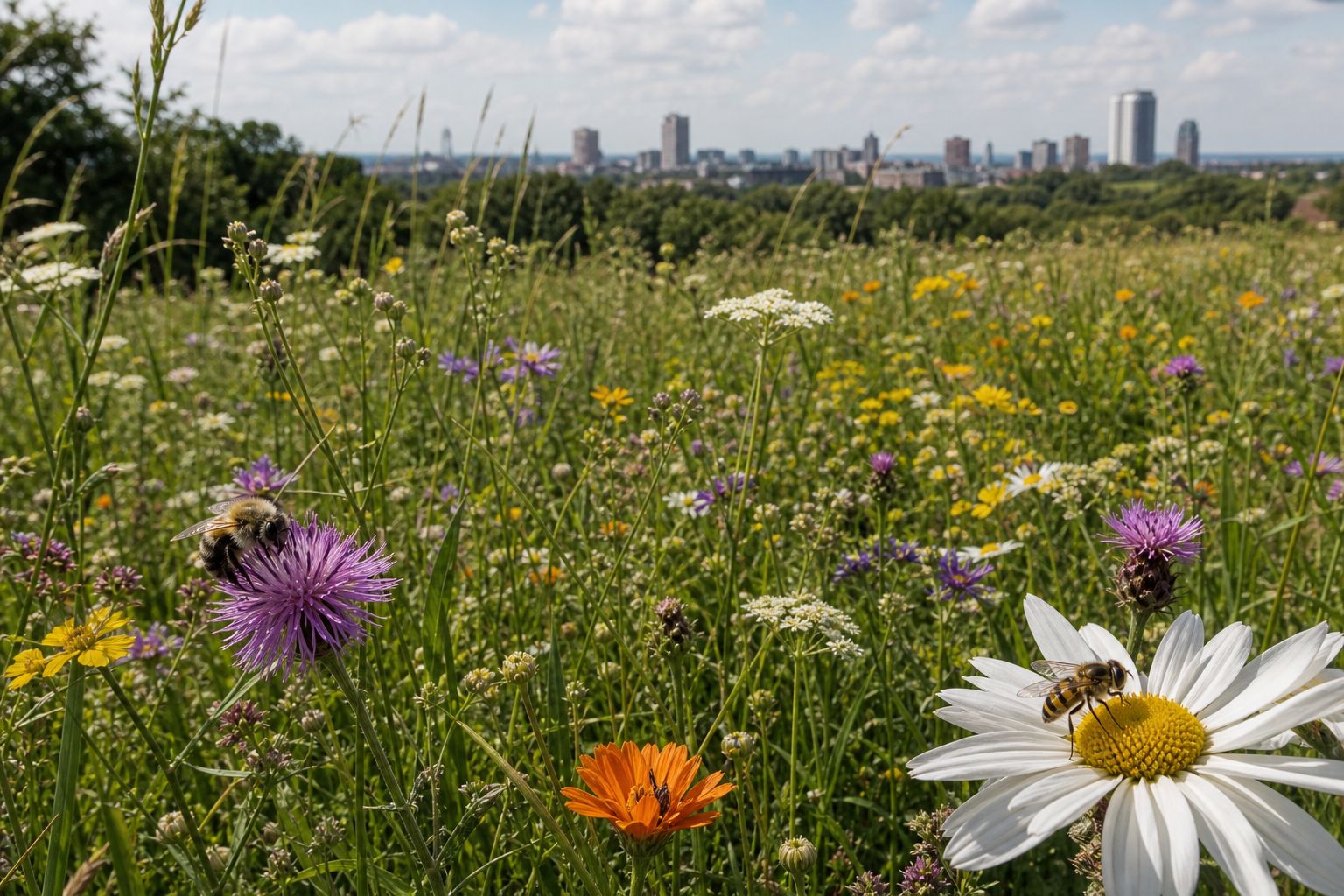
How many hives a landscape can hold, and how to share its flowers with the twenty thousand other kinds of bee, are questions scientists are still answering, one flower at a time.
A city meadow Many kinds of flowers feed many kinds of pollinators. AI-generated still.A hedgerow at dawn Bramble in flower, where the study began. AI-generated still.
Stills are AI-generated
Bees, comb and meadow are teaching models
Study figures are associations
About this film
Epilogue · Sources
Sources
Every fact in this film comes from the sources below. The new study is one observational study, reported here as such. The chapter stills and pictures are AI-generated illustrations; the bees, comb, flowers and meadow are simplified teaching models, and counts in the 3D scenes are illustrative.