In November 2026 Guinea’s government said at least ten people were killed in clashes at Balato, in the Siguiri region, over its ban on artisanal gold mining, which it imposed over polluted rivers and farmland. This film explains the established science and history behind that news: why stars cannot fuse gold and how the r-process makes it; the 2017 neutron-star merger whose kilonova showed heavy elements being made, and the open debate over other sites; why most of Earth’s gold sank into the core and how the crust got its share; how hot fluids lay gold down in quartz veins; why gold does not rust and why relativity makes it yellow; how rivers concentrate gold in placers and how panning works; the medieval gold of Bure and Bambuk and Mansa Musa’s journey of 1324; small-scale mining with mercury, its vapour and methylmercury, and the Minamata Convention; industrial cyanide leaching and the Baia Mare spill of 2000; and how much gold has ever been mined.
Interactive 3D film10 minThe 1100s to 2026Published 14 November 2026
Where gold comes from, and what it costs to dig up.
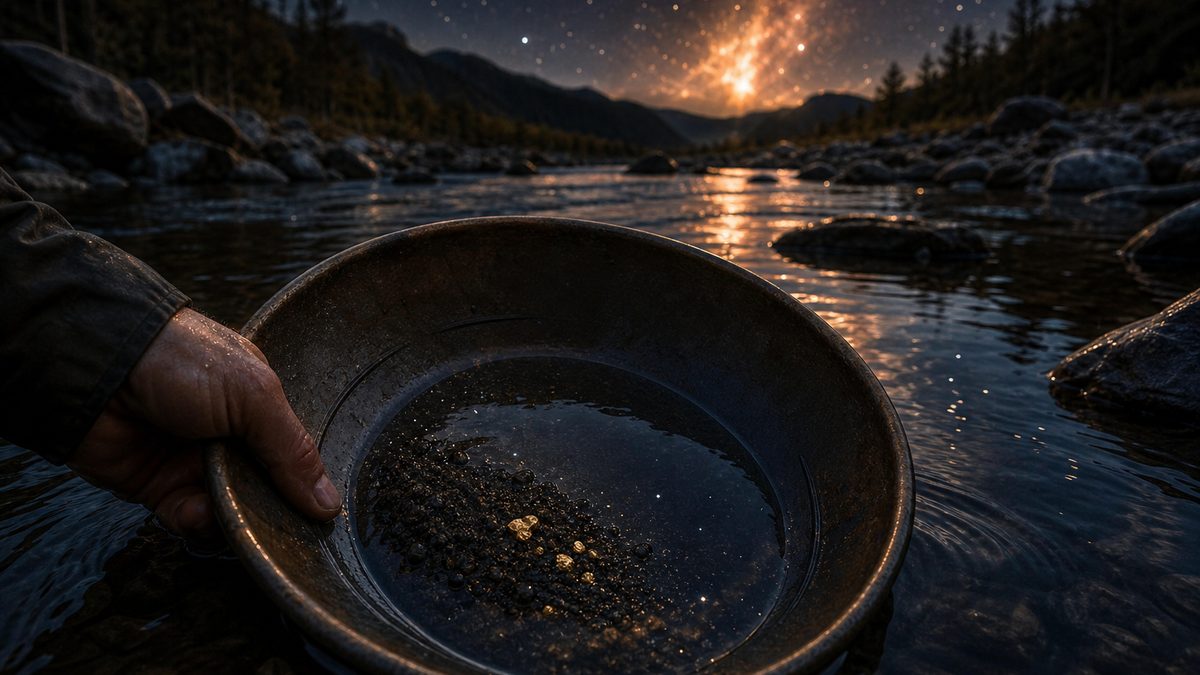
Every flake of gold in a river pan was made long before the Earth existed, most likely when the collapsed cores of dead stars collided.
Along the upper Niger in Guinea, people have panned that gold for centuries. On 2 November 2026 the government banned artisanal mining around Siguiri, citing polluted rivers and farmland.
On 11 November, according to the government, clashes between protesters and security forces at Balato killed at least ten people and injured thirteen.
This film follows that metal from the stars to the river, and asks what digging it up costs.
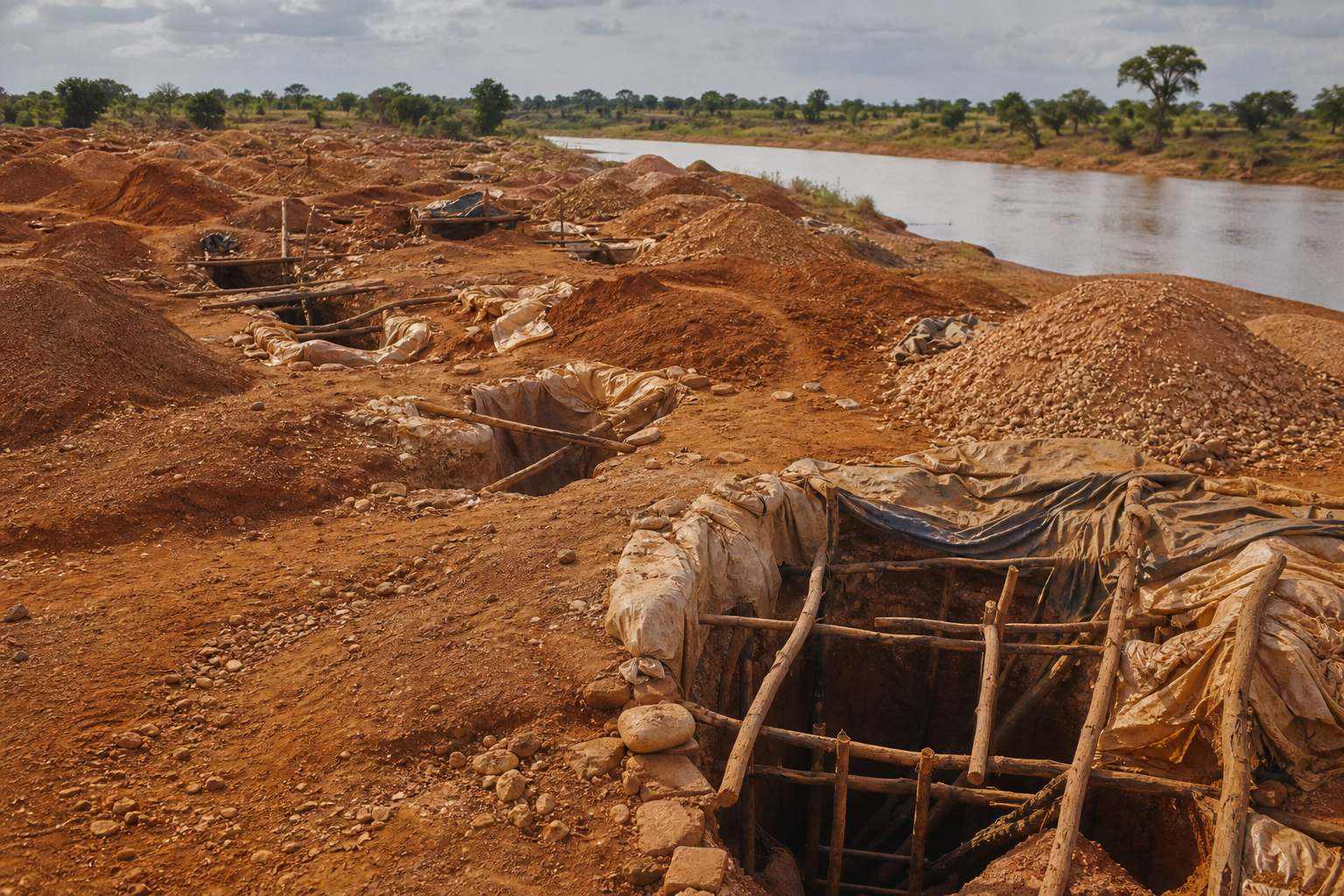
A small-scale goldfield Hand-dug pits on red laterite soil beside a river: the kind of site the ban covers. AI-generated illustration.
2 Nov
artisanal mining banned in Siguiri
300,000+
people in Guinea supported by small-scale gold mining, says UNEP
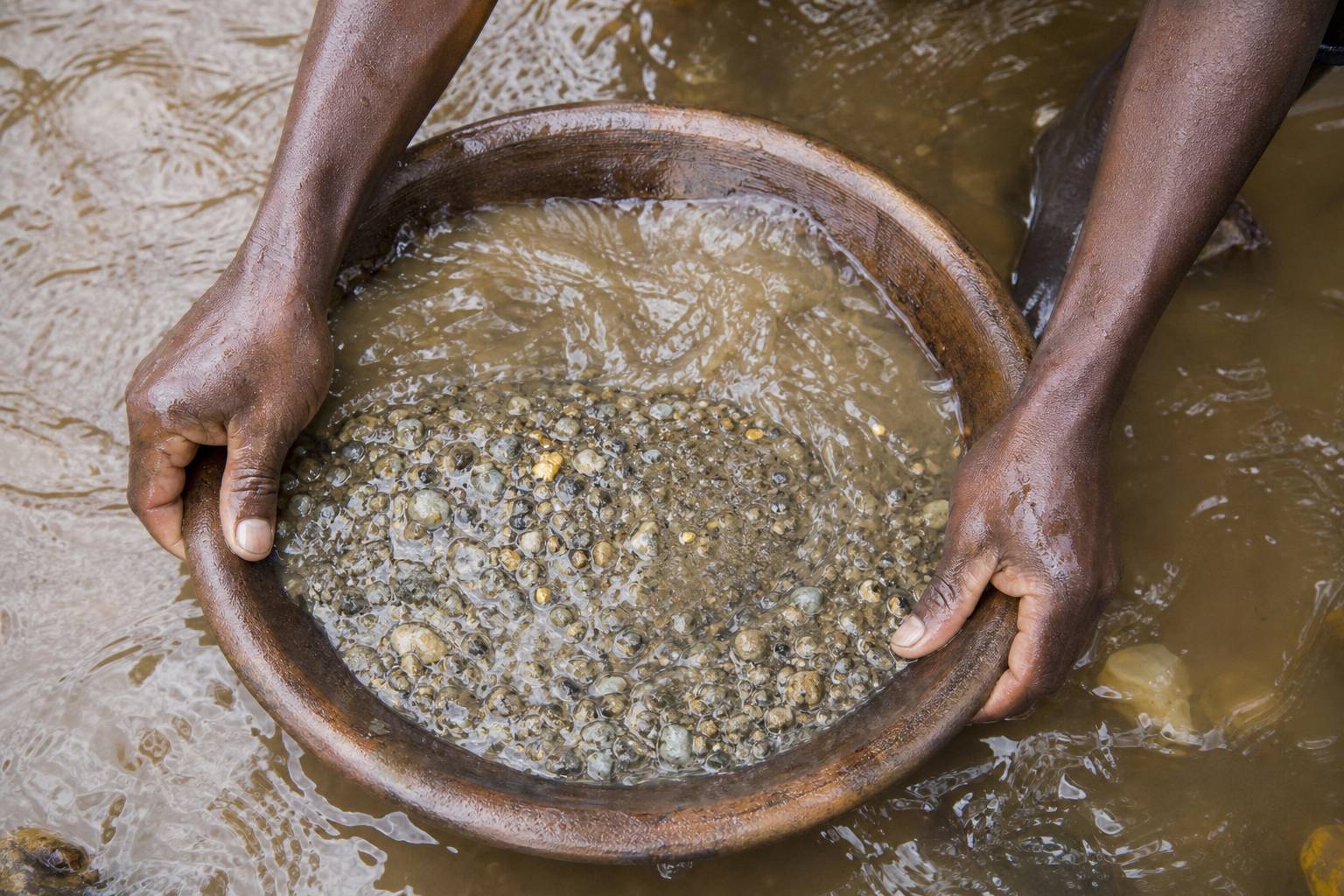
Guinea, November 2026Panning by hand A wooden bowl swirled in river water: one of the oldest ways to find gold. AI-generated illustration.
stars: where gold atoms are made
the Earth: how gold reaches the surface
chemistry: why gold never rusts
mining: pans, mercury and cyanide
In this film
Prologue
The news
Al Jazeera (13 November 2026), citing Guinea’s Ministry of Territorial Administration: at least 10 people were killed and 13 injured in clashes on Wednesday 11 November in Balato, in the Siguiri region of north-eastern Guinea, during a patrol checking a ban on artisanal gold mining; five of the dead were foreign nationals, and the injured included civilians and members of the security forces; the statement did not say who opened fire, and judicial authorities are to establish what happened. Guinea banned artisanal gold mining in Siguiri on 2 November, saying miners’ failure to follow regulations had polluted farmland, rivers and vegetation. Al Jazeera also reports that Mali and Burkina Faso say tens of thousands of their citizens have left Guinea since the ban, and that UNEP says small-scale gold mining supports more than 300,000 people in Guinea. Morning Star reports the same toll.
The film reports the toll as the government gave it. It does not go into who was responsible, which the authorities say is under investigation; it explains the gold itself.
The 3D scenes are simplified teaching models, not to scale: atoms, stars, veins and rivers are drawn to show the idea, not measured shapes.
Fusion stops at iron. Gold needs a flood of neutrons.
Gold is element 79: 79 protons in every nucleus. Stars build elements by fusing lighter nuclei, but that only pays up to iron.
Iron has the most stable nucleus of all. Fusing it releases no energy, so a star’s furnace stops there.
Heavier elements are built by neutron capture. In 1957 scientists described a rapid version, the r-process: nuclei flooded with neutrons faster than they can decay.
When the flood stops, neutrons inside the swollen nuclei turn into protons. Each new proton makes a heavier element, until some settle as gold.
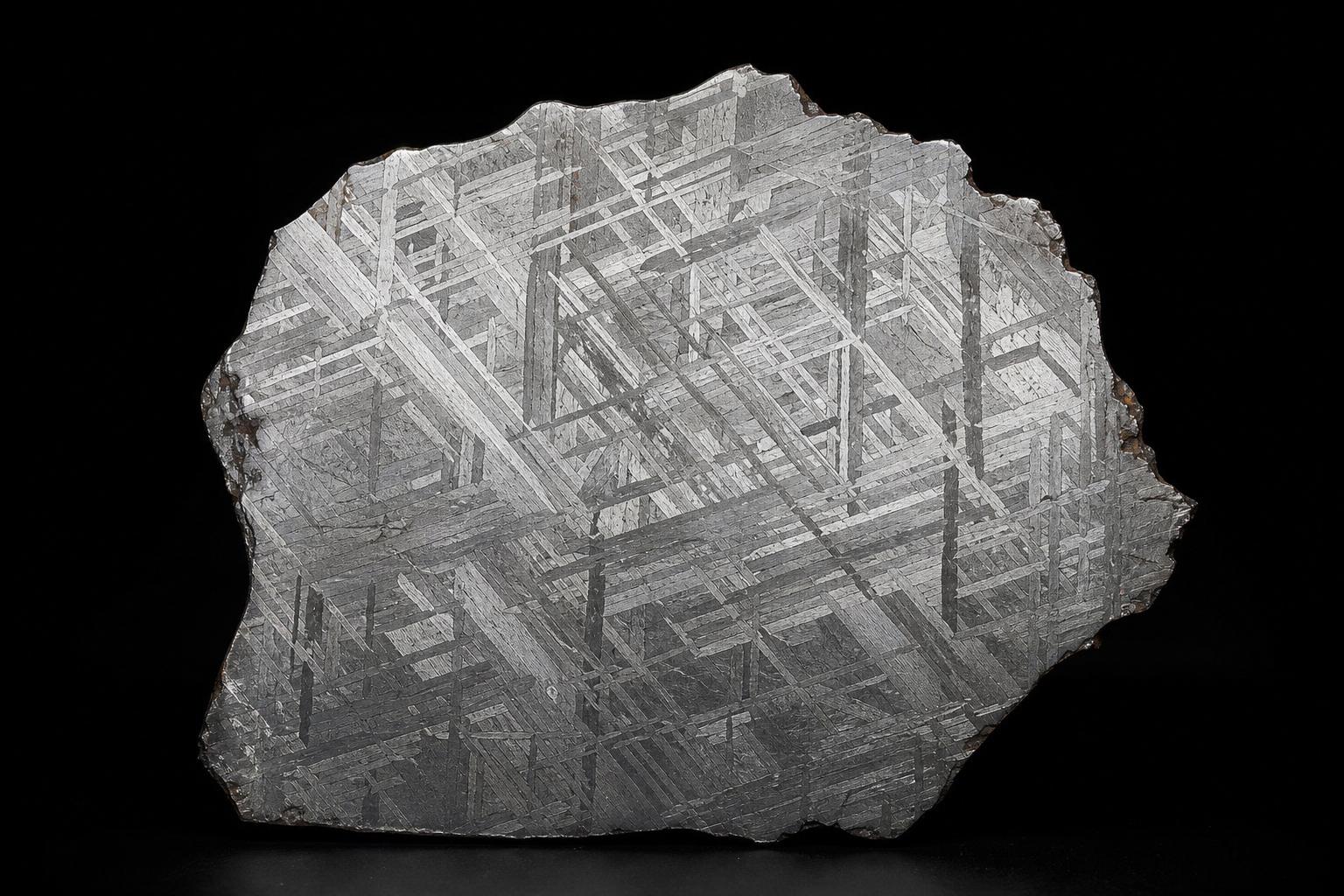
An onion of fire A massive star near the end of its life: lighter elements burn in outer shells, and an iron core grows at the centre. AI-generated illustration.The end of the line A polished slice of an iron meteorite. Iron is the heaviest element a star can make by fusion and still gain energy. AI-generated illustration.
26
protons in iron, where fusion stops paying
79
protons in gold, reached only by neutron capture
Two numbers to remember
a nucleus swallows neutron after neutron
in seconds, faster than it can decay
then decays, neutrons turning to protons, into gold and its neighbours
The r-process in three beats
Chapter I · Forged in a collision
Why stars stop at iron
NASA Goddard (Imagine the Universe): fusion continues in red supergiants until iron is formed; unlike the elements before it, iron releases no energy when fused, because iron has the most stable nucleus of all the elements; large stars also make some heavier elements by slow neutron capture. Astronomy magazine: the slow s-process mostly makes elements up to lead and bismuth; the rapid r-process makes elements as heavy as uranium, and gold, platinum and uranium come only from it. Universe Today: in the r-process seed nuclei are hit by neutrons so quickly that they build up before radioactive decay can break them down; the neutron blast is over in seconds, and the unstable products then decay to stable isotopes. D. M. Siegel (2019) dates the theory of the r-process to the papers of 1957.
“Iron has the most stable nucleus” is simplified: strictly, nickel-62 is the most tightly bound nucleus, with iron-56 close behind, and iron is the usual end of fusion because it is far more abundant (West Texas A&M University).
Iron has 26 protons and gold 79 (standard values). The button fires neutrons at a nucleus: it swells, then decays toward gold. The counts on screen are illustrative.
The 3D scenes are simplified teaching models, not to scale: atoms, stars, veins and rivers are drawn to show the idea, not measured shapes.
In 2017, telescopes watched heavy elements being made.
Where does such a flood of neutrons happen? On 17 August 2017, gravitational-wave detectors caught two neutron stars, the collapsed cores of dead stars, spiralling together and merging.
It happened about 130 million light years away, and some seventy observatories turned to look.
They saw a kilonova: a glow powered by the radioactive decay of heavy elements freshly made by the r-process.
Astronomer Edo Berger estimated it made about ten Earth masses of gold and platinum. Some researchers argue that collapsars, rare giant stars that collapse as they die, make even more; the question is still open.
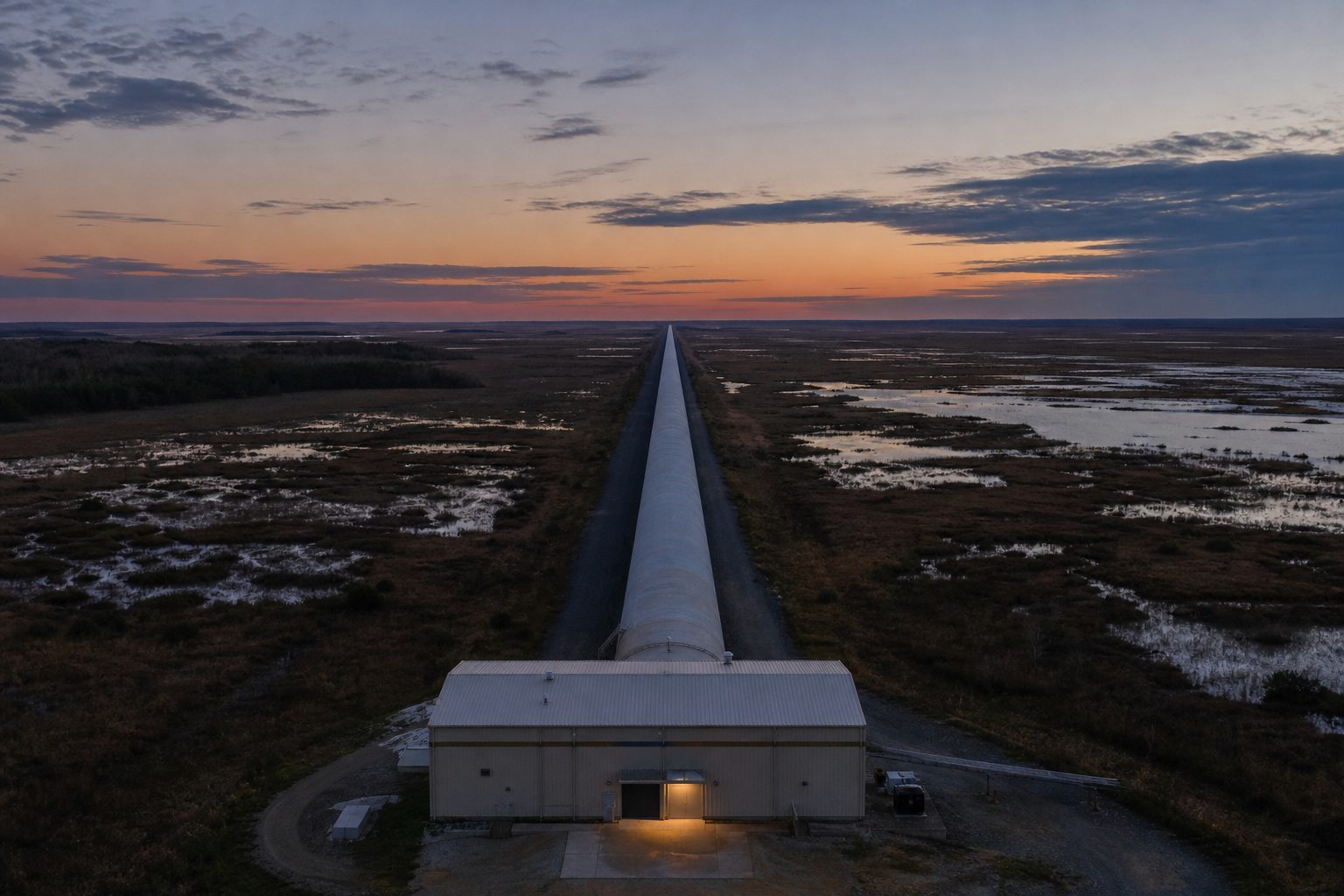
Listening for ripples A detector of this kind feels gravitational waves: ripples in space itself, sent out when heavy objects such as neutron stars whirl around each other. AI-generated illustration.
130 million
light years away, in the constellation Hydra
~70
observatories that followed it, on the ground and in space
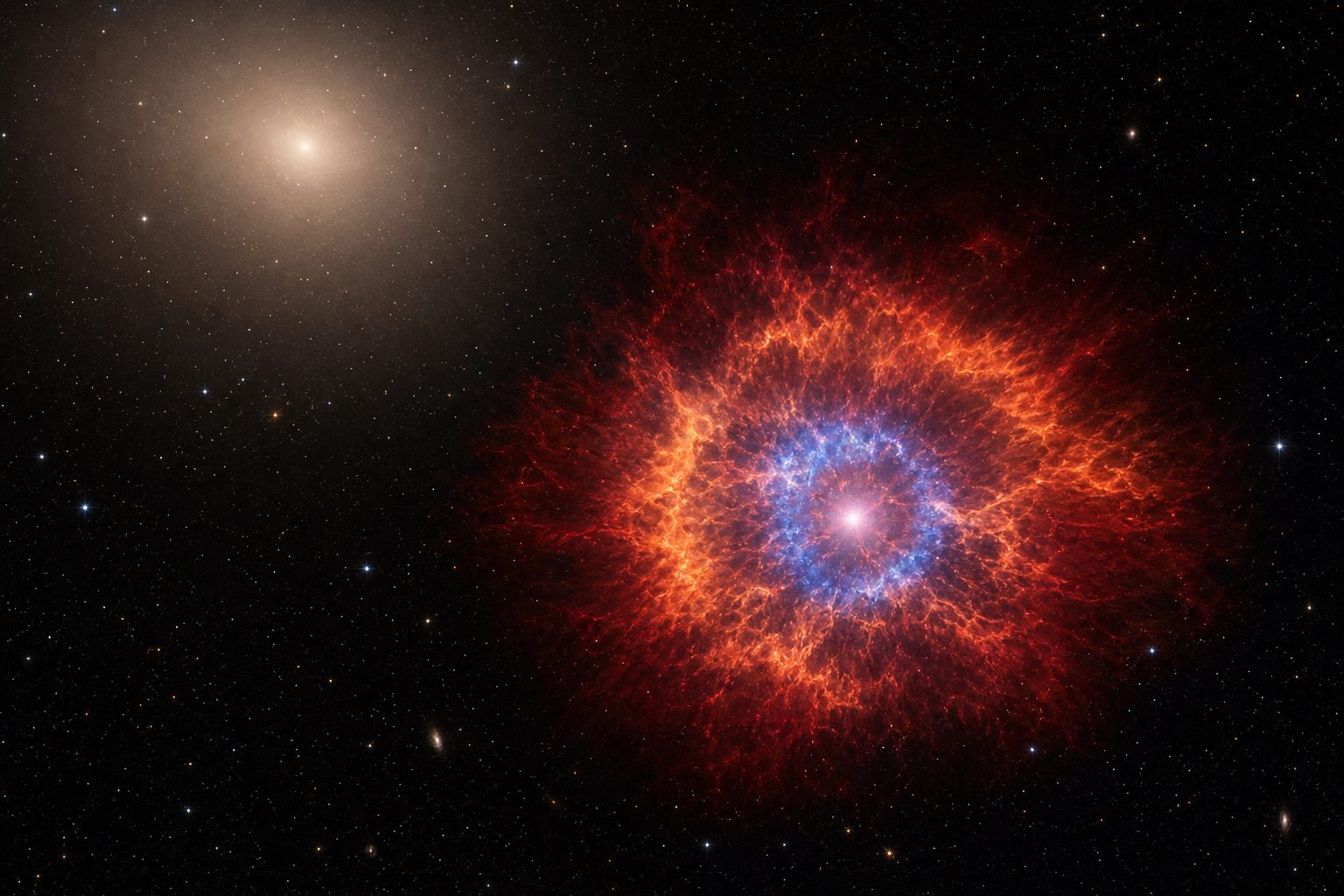
GW170817A kilonova An imagined view: the debris of the merger glowing in visible and infrared light. AI-generated illustration.
0.03–0.05
Sun masses of ejected material, from spectral models (Pian et al., Nature, 2017)
~10 Earths
of gold and platinum, Edo Berger’s estimate
How much was thrown out
Chapter I · Forged in a collision
GW170817 and its kilonova
Science News Explores and Spaceflight Now (October 2017): the gravitational waves reached Earth on 17 August 2017; the source lay in the galaxy NGC 4993, about 130 million light years away in Hydra; about 70 observatories and seven space instruments followed it; Edo Berger (Harvard) said about ten times the mass of the Earth was made in gold and platinum alone (Science News Explores quotes scientists’ range of 10 to 100 Earth masses of gold). Pian et al. (Nature, 2017): the kilonova was powered by the synthesis of large amounts of very heavy elements by rapid neutron capture; spectral models suggest 0.03–0.05 solar masses were ejected, and they caution that identifying individual elements is not secure. Siegel (2019): mergers are so far the only source with direct observational evidence of the r-process, and could in principle supply most of the galaxy’s heavy elements, but he argues that collapsars, rare collapsing massive stars, are the dominant source.
Estimates of how much gold one merger makes vary by a factor of ten between researchers, and which kind of event made most of the universe’s gold is still debated. Press the button to run the merger again.
The 3D scenes are simplified teaching models, not to scale: atoms, stars, veins and rivers are drawn to show the idea, not measured shapes.
Most of Earth’s gold is out of reach, in the core.
Gold from such events was mixed into the cloud of gas and dust that later formed the Sun and its planets.
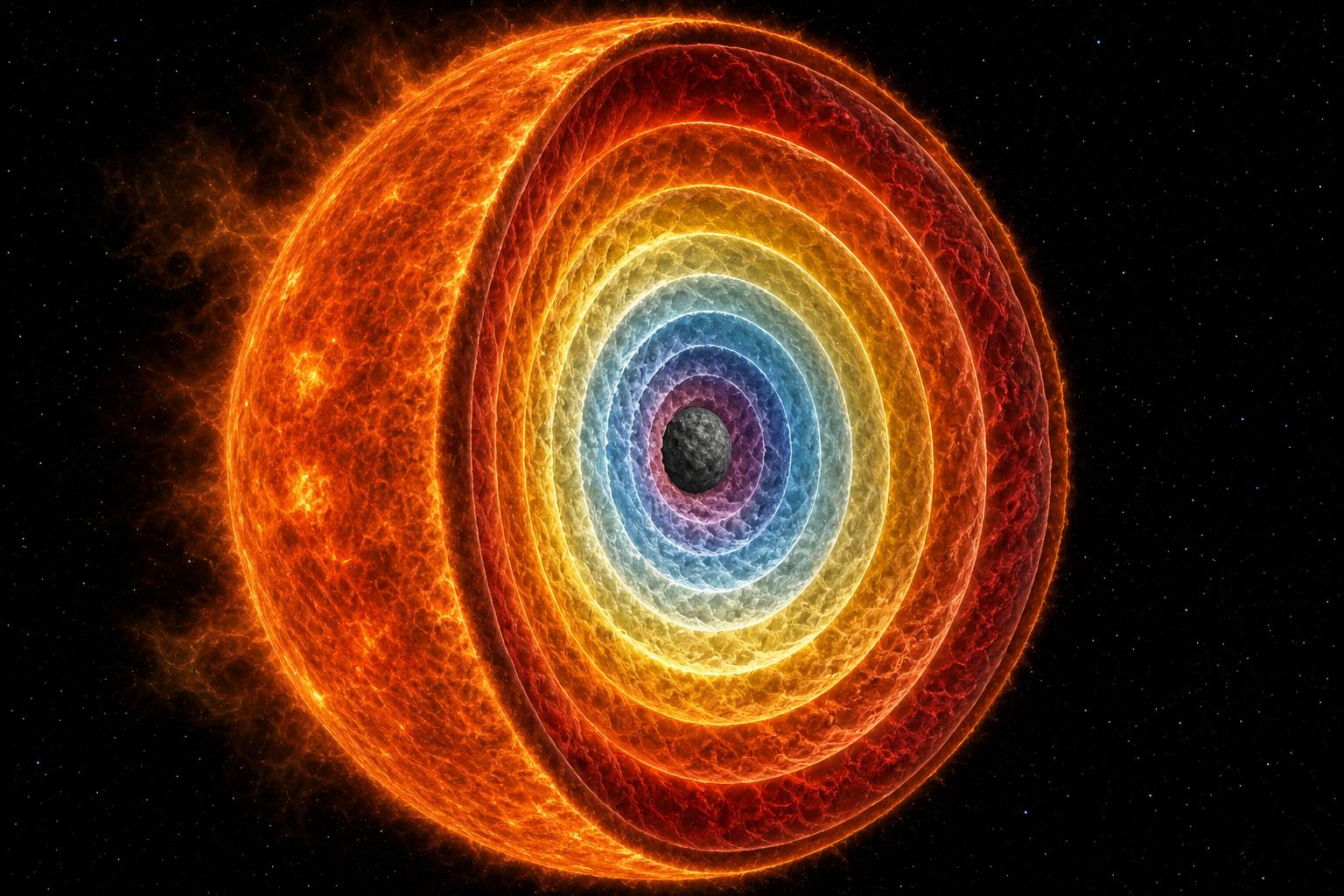
The young Earth was largely molten. Iron sank to form the core, and gold is iron-loving: it dissolves readily in molten iron, so it sank with it.
By one estimate there is enough gold in the core to coat the whole planet four metres deep. So why is any left near the surface?
In 2011 a Bristol team led by Matthias Willbold offered one answer: a late shower of meteorites brought fresh gold after the core formed. It is a leading idea, not a settled fact.
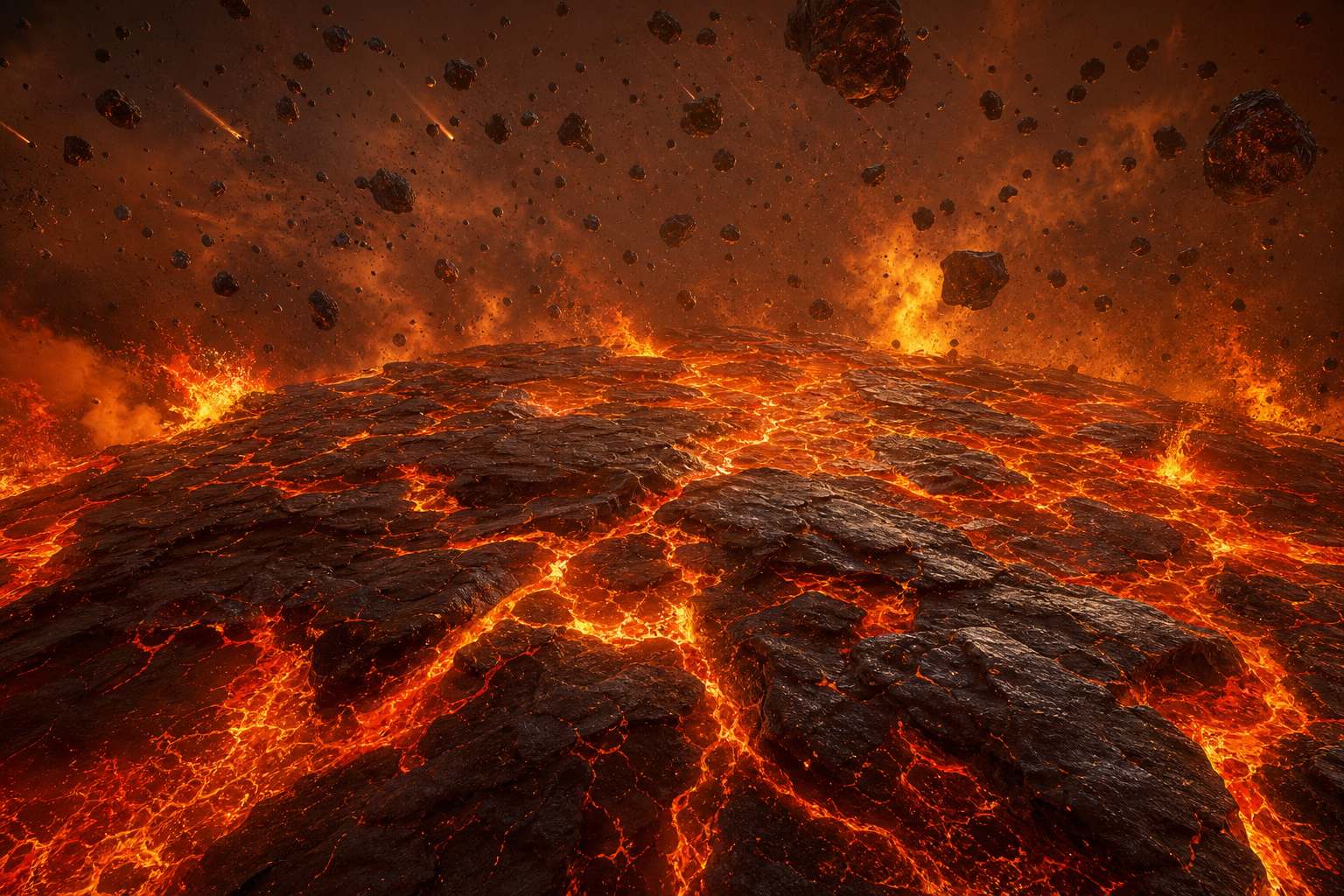
A magma ocean About 4.5 billion years ago the Earth’s surface was a sea of molten rock; heavy iron drained toward the centre. AI-generated illustration.
geologists call gold siderophile: it prefers to dissolve in iron
as the core formed, gold went with the iron
the mantle and crust were left with very little
“Iron-loving” elements
~4 m
a gold layer over the whole Earth: the estimate of what the core holds
3.8 billion yr
age of the Greenland rocks the Bristol team studied
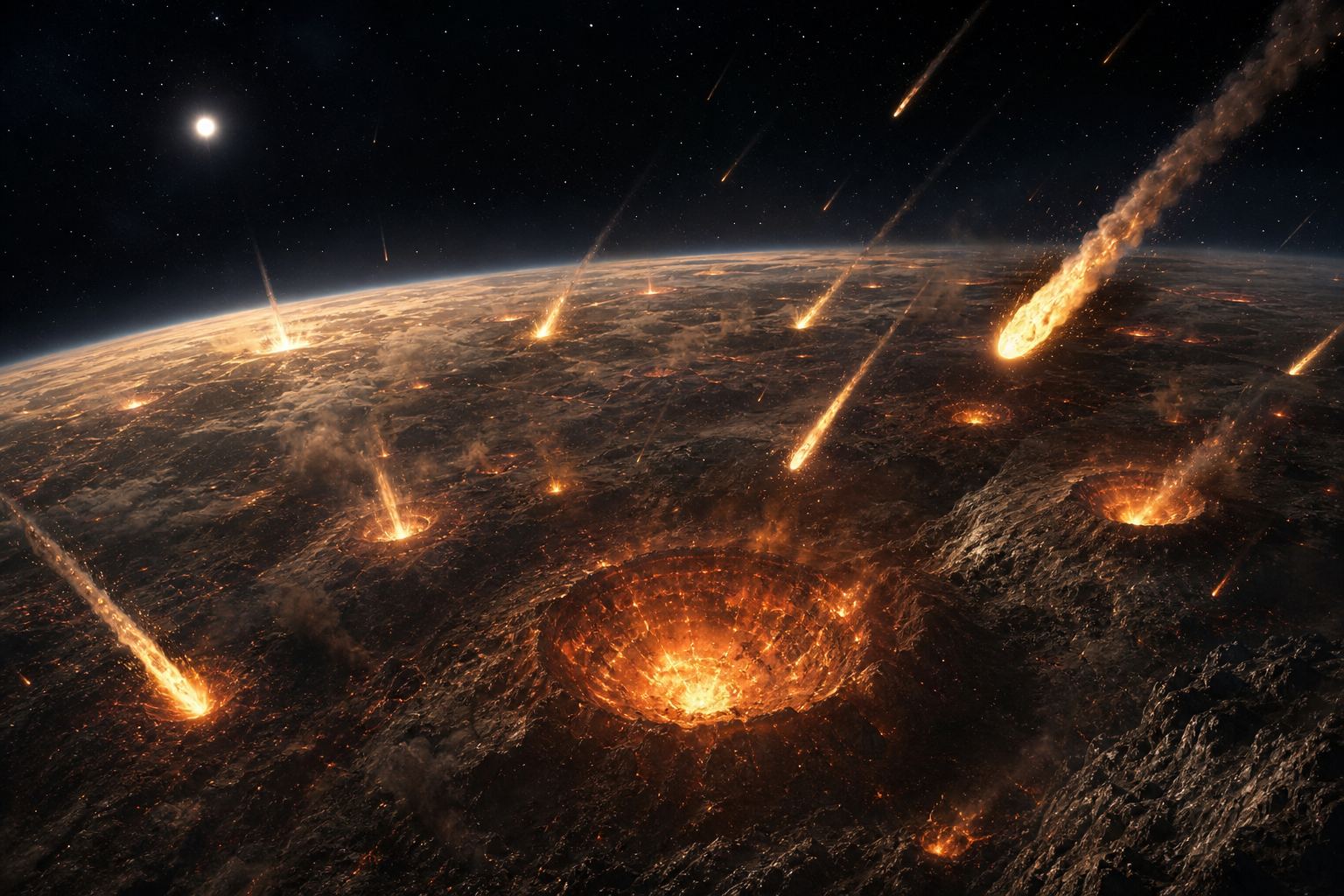
National Geographic, 2011A late bombardment In this idea, meteorites added only about half a percent to the mantle, but enough to bring back gold and platinum. AI-generated illustration.
Chapter II · Into the Earth
Where Earth’s gold went
National Geographic (September 2011), on Willbold et al. in Nature: Earth was largely molten about 4.5 billion years ago; as dense iron sank to form the core, siderophile (iron-loving) gold should have gone with it; meteorite compositions suggest the core holds enough gold to cover the globe about 4 metres deep. The team, led by Matthias Willbold of the University of Bristol, found that 3.8-billion-year-old rocks from Greenland’s Isua Greenstone Belt carry a tungsten-isotope signature from before a late bombardment, which they offer as “one possible answer”: meteorites added about half a percent of the mantle’s material, bringing gold and platinum back to the surface. Wikipedia (Gold): almost all the early Earth’s gold probably sank into the core, and most of the gold in the crust and mantle is thought to have been delivered later by asteroid impacts.
The late-bombardment explanation rests on isotope evidence from a few rock samples and is presented here as a leading hypothesis. Press the button to send in the meteorites.
The 3D scenes are simplified teaching models, not to scale: atoms, stars, veins and rivers are drawn to show the idea, not measured shapes.
Scattered through ordinary rock, gold is too thinly spread to mine. Something had to gather it: very often, hot water.
Deep in the crust, where continents collide and mountains rise, hot fluids at around 350 degrees Celsius flow up through great faults, carrying dissolved gold.
As the fluid rises and changes, it drops its load. Quartz crystallises in the cracks, and gold is laid down with it.
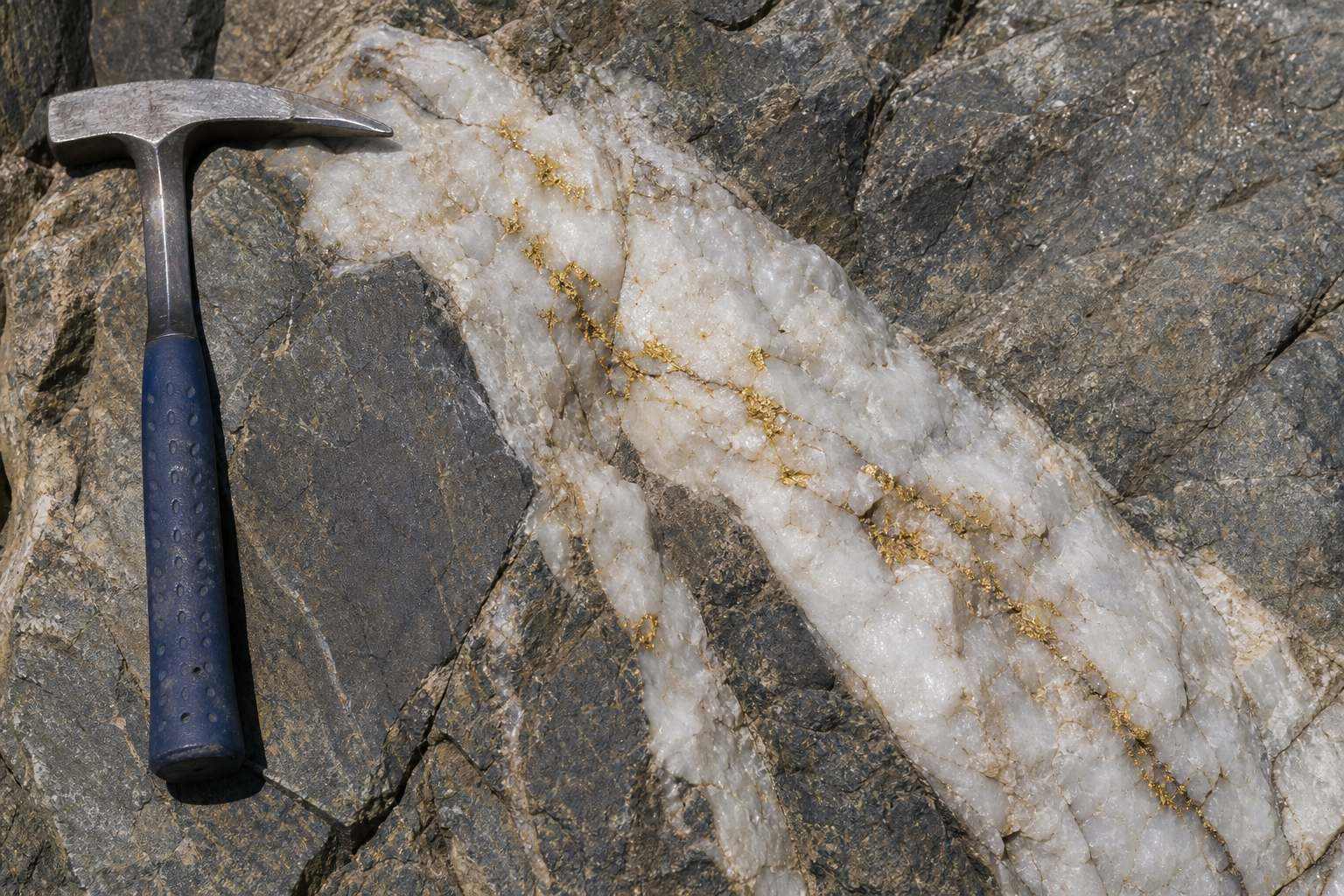
These are lode deposits: white quartz veins, from a centimetre to a metre thick, threaded with gold.
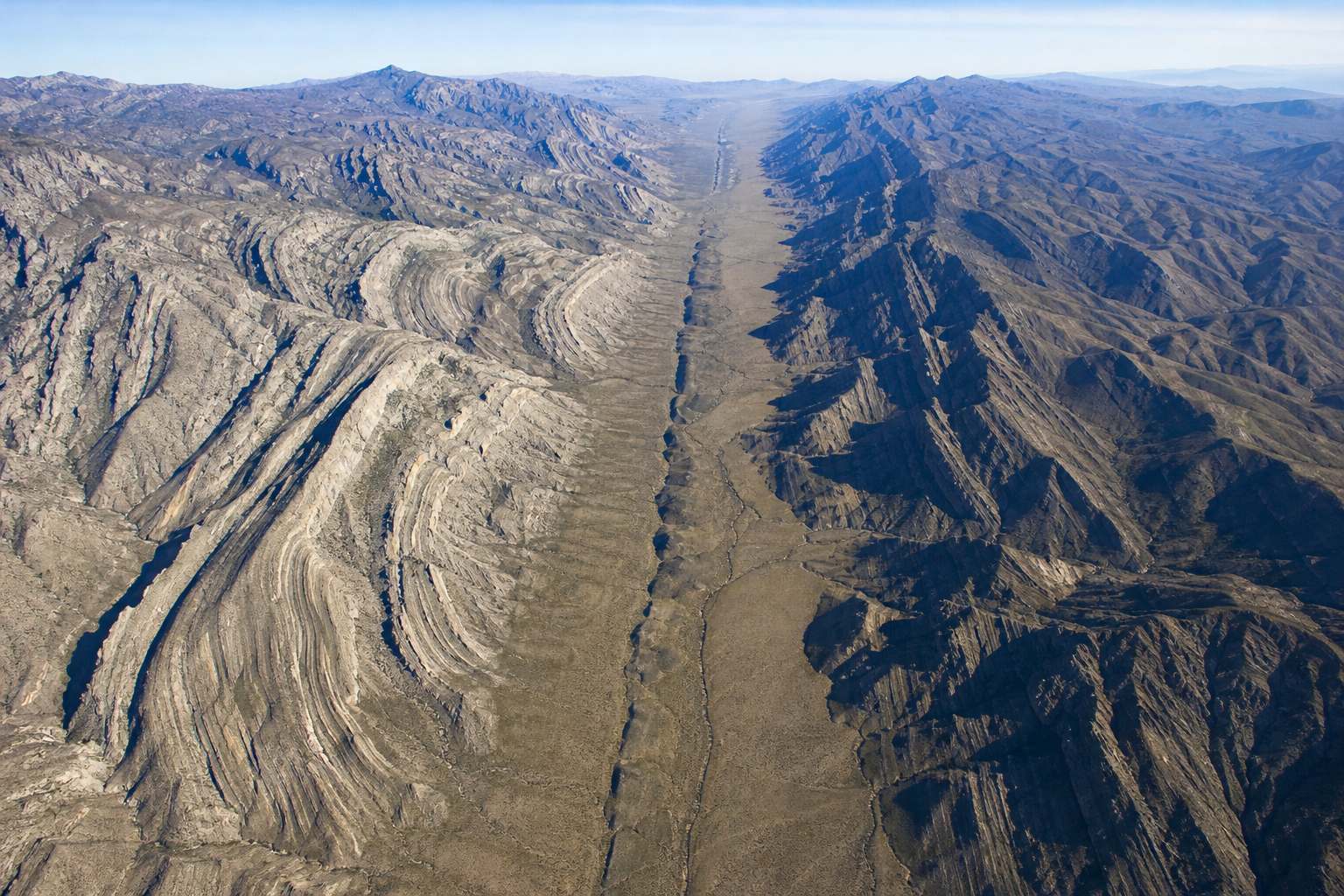
Where crust breaks A long fault valley through folded rock: deep faults like this are the pipes that carry gold-bearing fluids. AI-generated illustration.
~350 °C
temperature of the fluid when it lays down gold
4–12 km
depth at which the veins form
USGS, gold-quartz veinsA gold-bearing vein White quartz cutting dark rock, with specks of native gold; the hammer shows the scale. AI-generated illustration.
lode: gold still in the rock where it was laid down
placer: gold worn out of the rock and moved by water
Two kinds of deposit
Chapter II · Into the Earth
Lode gold
USGS Open-File Report 03-077: low-sulfide gold-quartz deposits occur in collision belts and lie near major faults, which carry the large volumes of fluid generated during collisions; the fluids are low-salinity, aqueous and rich in CO₂, at about 350 °C when they deposit gold, at depths of 4 to 12 km; gold travels as a dissolved sulfur complex; most veins are a centimetre to a metre thick, though giant vein systems run for tens of kilometres. USGS, Prospecting for gold: lode deposits are the primary deposits, laid down from mineralising solutions that dissolve metals from rock and deposit them in veins as they cool; placers are secondary deposits made when gold is eroded out of lodes and concentrated by gravity.
The button releases the hot fluid up the fault. The scene compresses millions of years into seconds; real fluids move slowly through rock, and specks of gold are usually too small to see.
The 3D scenes are simplified teaching models, not to scale: atoms, stars, veins and rivers are drawn to show the idea, not measured shapes.
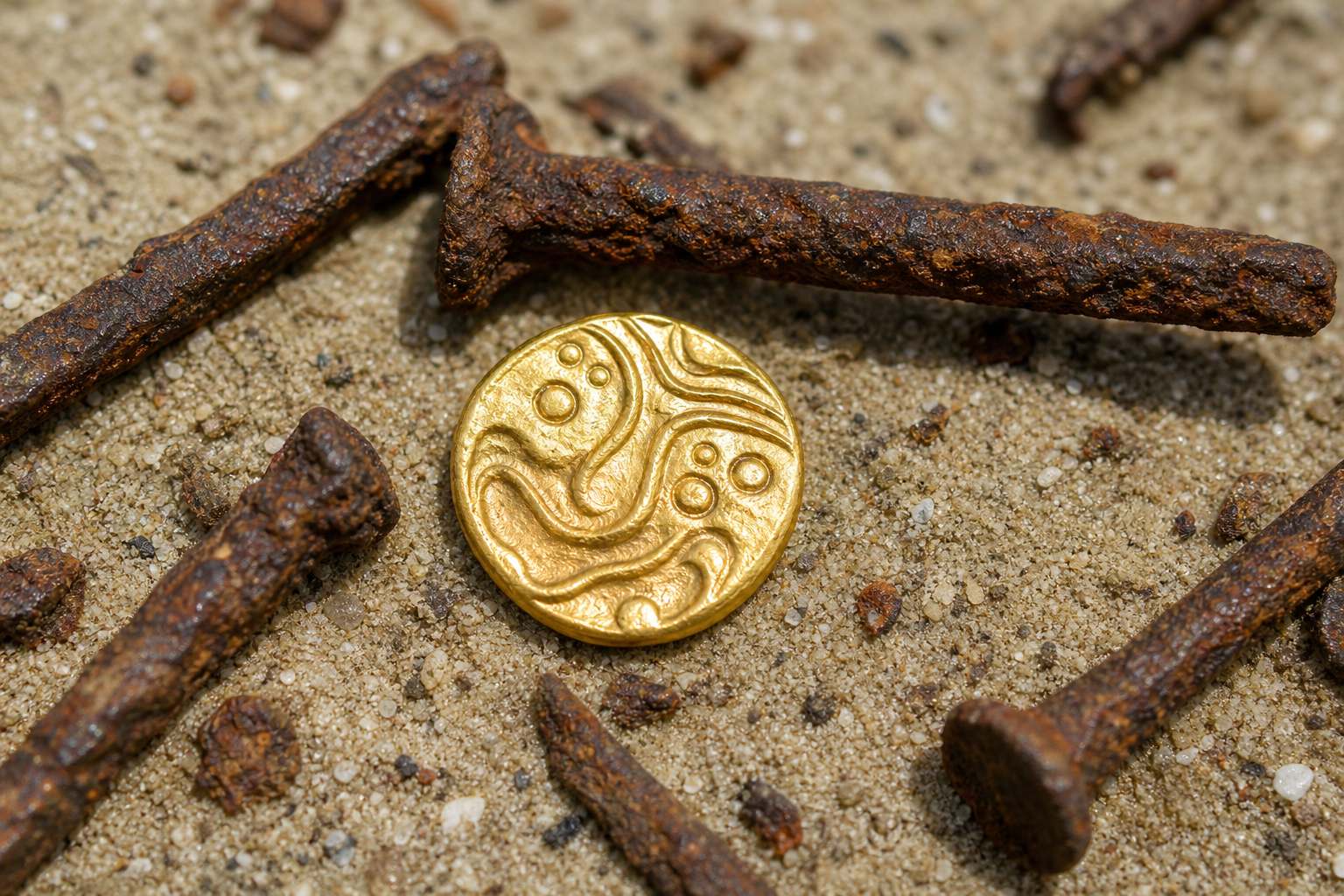
Dig up a gold coin after centuries in the sea and it can still shine. Iron lying beside it turns to rust.
Gold is one of the least reactive metals; only platinum is less reactive. Air, water and most acids leave it untouched.
Only a few things dissolve it: aqua regia, a mixture of nitric and hydrochloric acids; cyanide solutions; and liquid mercury, which soaks gold up into an alloy called an amalgam.
Remember those last two. Miners use both.
Gold beside iron An invented gold coin among rusted nails: the iron has corroded, the gold has not. AI-generated illustration.
2nd
least reactive metal in the reactivity series, after platinum
1,064 °C
melting point
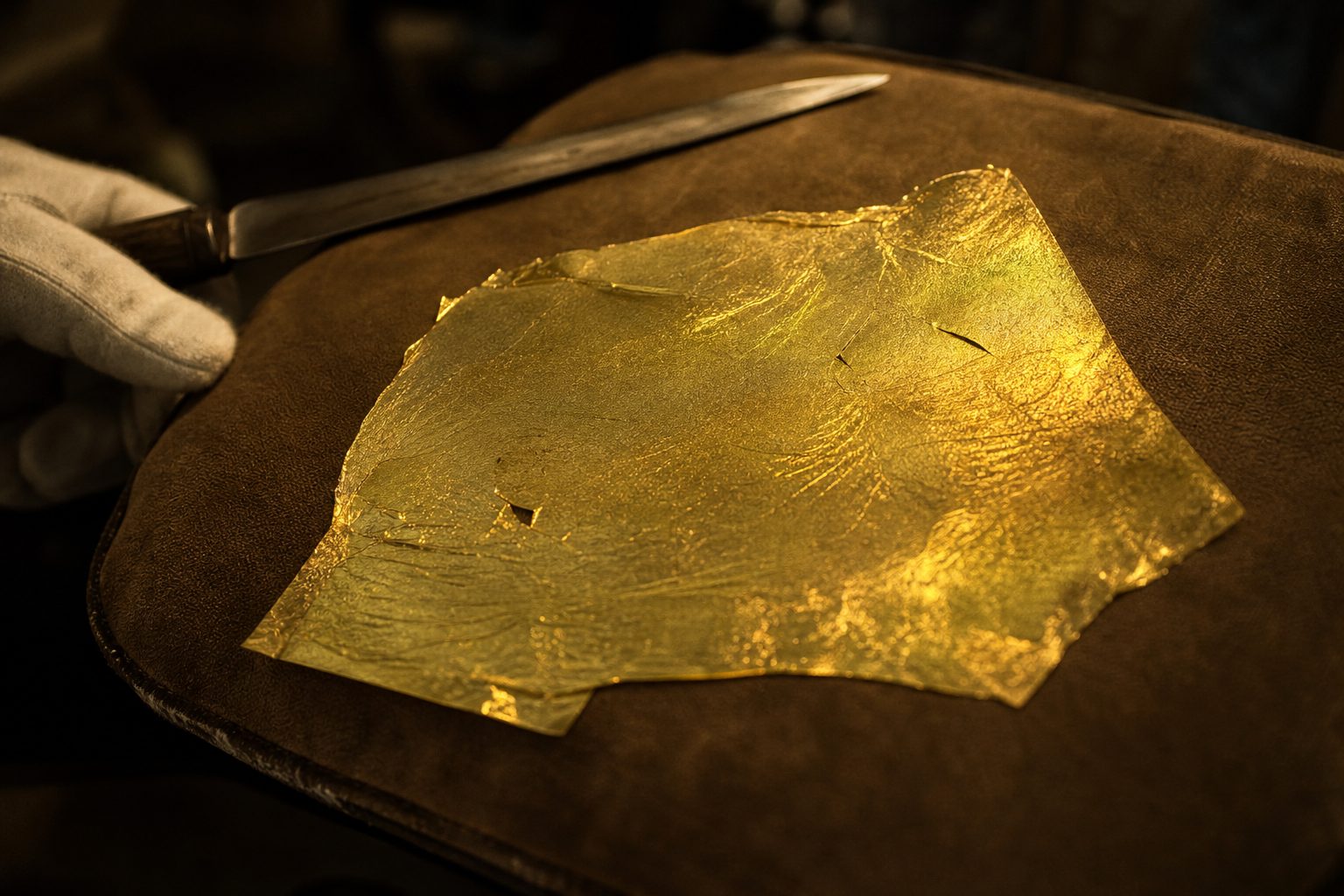
Gold, the elementGold leaf Gold is the most malleable metal: one gram can be beaten into a sheet of one square metre, thin enough to let light through. AI-generated illustration.
aqua regia: nitric + hydrochloric acid
cyanide in alkaline water: used by big mines
mercury, at room temperature: used by small-scale miners
What dissolves gold
Chapter III · The noble metal
A noble metal
Wikipedia (Gold): gold is the second lowest in the reactivity series, with only platinum ranked as less reactive; it is unaffected by most acids, though it does dissolve in aqua regia, a mixture of nitric and hydrochloric acid; it dissolves in alkaline solutions of cyanide, which are used in mining and electroplating; it readily dissolves in mercury at room temperature to form an amalgam; one gram of gold can be beaten into a sheet of one square metre, and gold leaf can be made thin enough to be semi-transparent. Wikipedia: gold melts at 1,064 °C (1,064.18 °C). Encyclopaedia Britannica: gold has atomic number 79 and specific gravity 19.3. USGS: it is the most malleable and ductile of metals.
The buttons put a gold ball and an iron ball through three tests: water and air, aqua regia, and liquid mercury. The changes are sped up and drawn simply.
The 3D scenes are simplified teaching models, not to scale: atoms, stars, veins and rivers are drawn to show the idea, not measured shapes.
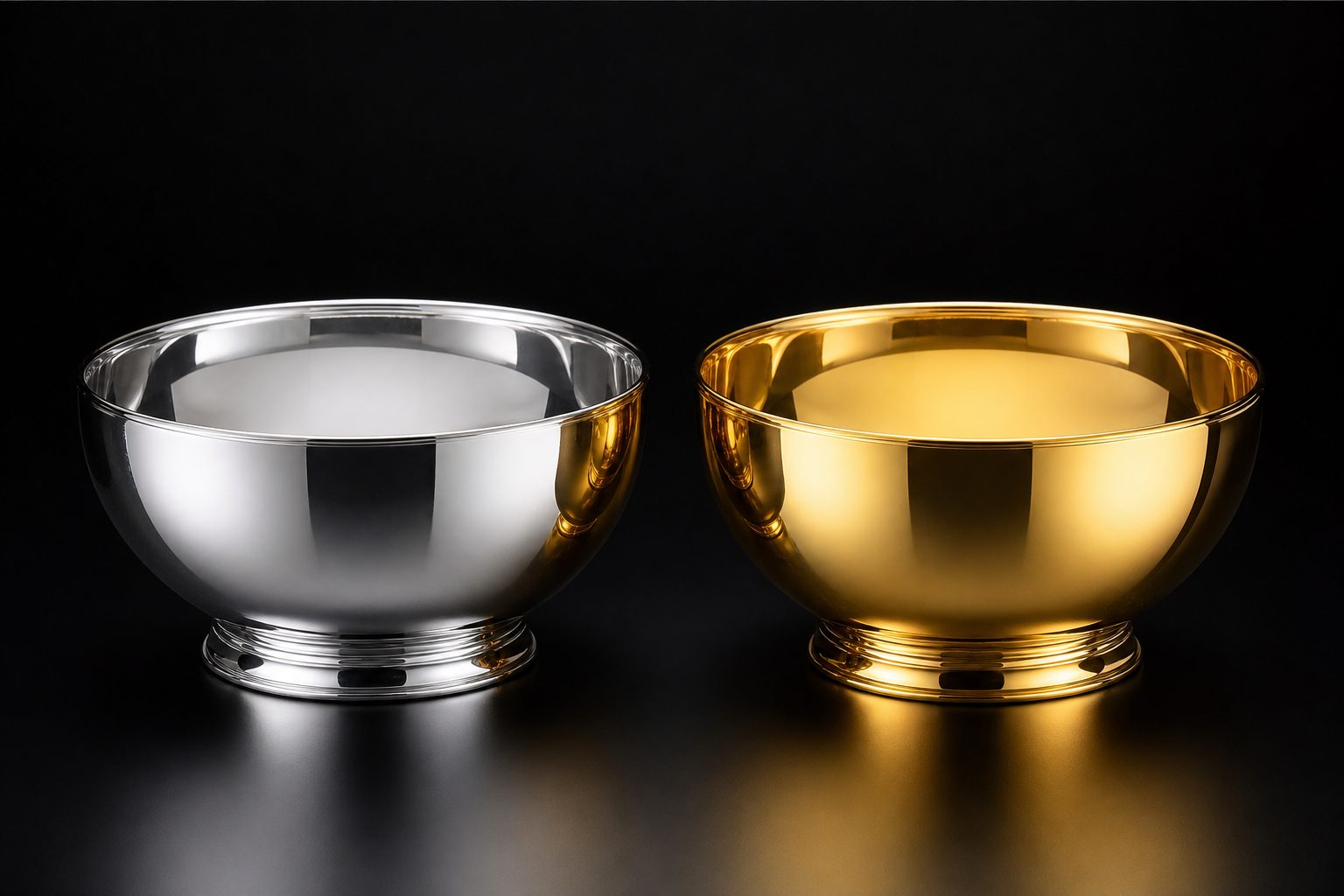
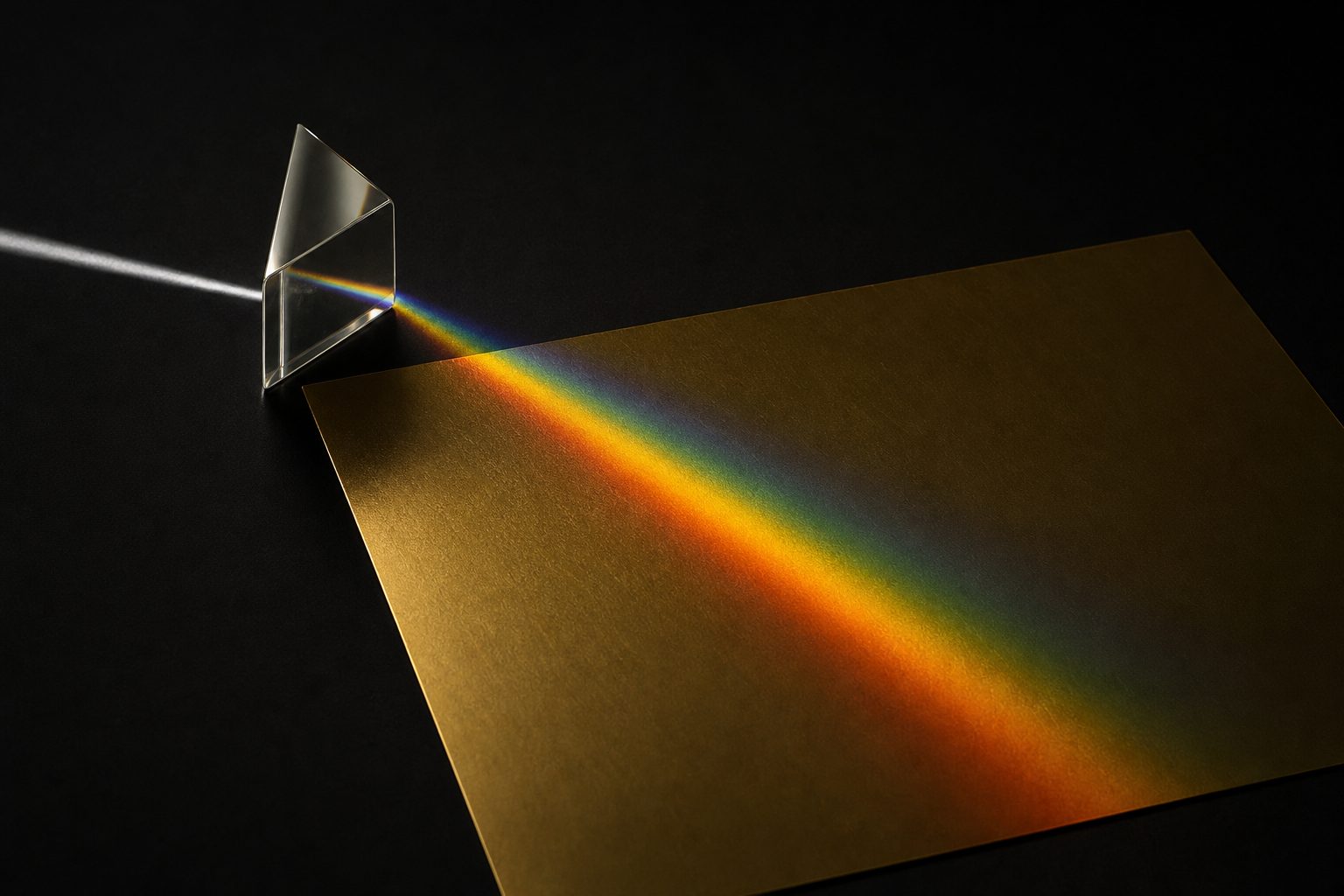
Most metals, like silver, reflect every colour almost equally and look like mirrors. Gold absorbs some blue light, so what bounces back looks yellow.
The reason is Einstein’s relativity. A gold nucleus holds 79 protons, and the electrons closest to it are pulled round at more than half the speed of light.
Moving that fast, they behave as if heavier, and the outer electrons are pulled in closer. That is what lets gold absorb blue light. Without relativity, gold would look silvery, like most metals.
Switch relativity off and on to compare.
Silver and gold Two polished bowls: silver returns every colour like a mirror, gold holds some blue back. AI-generated illustration.
79
protons pulling on the electrons
≈ 58%
of the speed of light: the innermost (1s) electrons
Inside a gold atomA missing blue A rainbow across polished gold: the blue end is the part gold absorbs most. AI-generated illustration.
silver: small effect, the 5d → 6s jump absorbs ultraviolet, metal looks white
gold: the 6s orbital shrinks, the gap narrows, the jump absorbs blue
what is left to reflect looks yellow
With and without relativity
Chapter III · The noble metal
Relativity and the colour of gold
Wikipedia (Relativistic quantum chemistry): because of relativistic effects gold is not silvery like most other metals; it absorbs blue light more than other visible wavelengths; the absorbing transition is from the 5d to the 6s orbital; because relativity contracts the 6s orbital, the transition falls in the violet-blue part of the spectrum; an analogous transition occurs in silver, but the relativistic effects are smaller; for gold (Z = 79), the 1s electrons move at about 58% of the speed of light. Royal Society of Chemistry (Education in Chemistry): the contraction of the 6s orbital peaks at gold; it lowers the 6s energy and raises the 5d level, narrowing the gap so that gold absorbs blue light and reflects golden-yellow; most d-block metals absorb ultraviolet and reflect all visible light, which is why metals such as silver look like mirrors.
“Behave as if heavier” is a simplified way of describing the relativistic effect. The orbitals are drawn as rings, which real orbitals are not; the button turns the relativistic contraction on and off.
The 3D scenes are simplified teaching models, not to scale: atoms, stars, veins and rivers are drawn to show the idea, not measured shapes.
How rivers sort gold, and how a pan does the same.
Over time, rain and rivers wear the veins away. The quartz breaks into sand, and the gold is freed as grains and flakes.
Gold is about 19 times as dense as water and seven times as dense as quartz sand. Where the current slows, it sinks first, down to the bedrock.
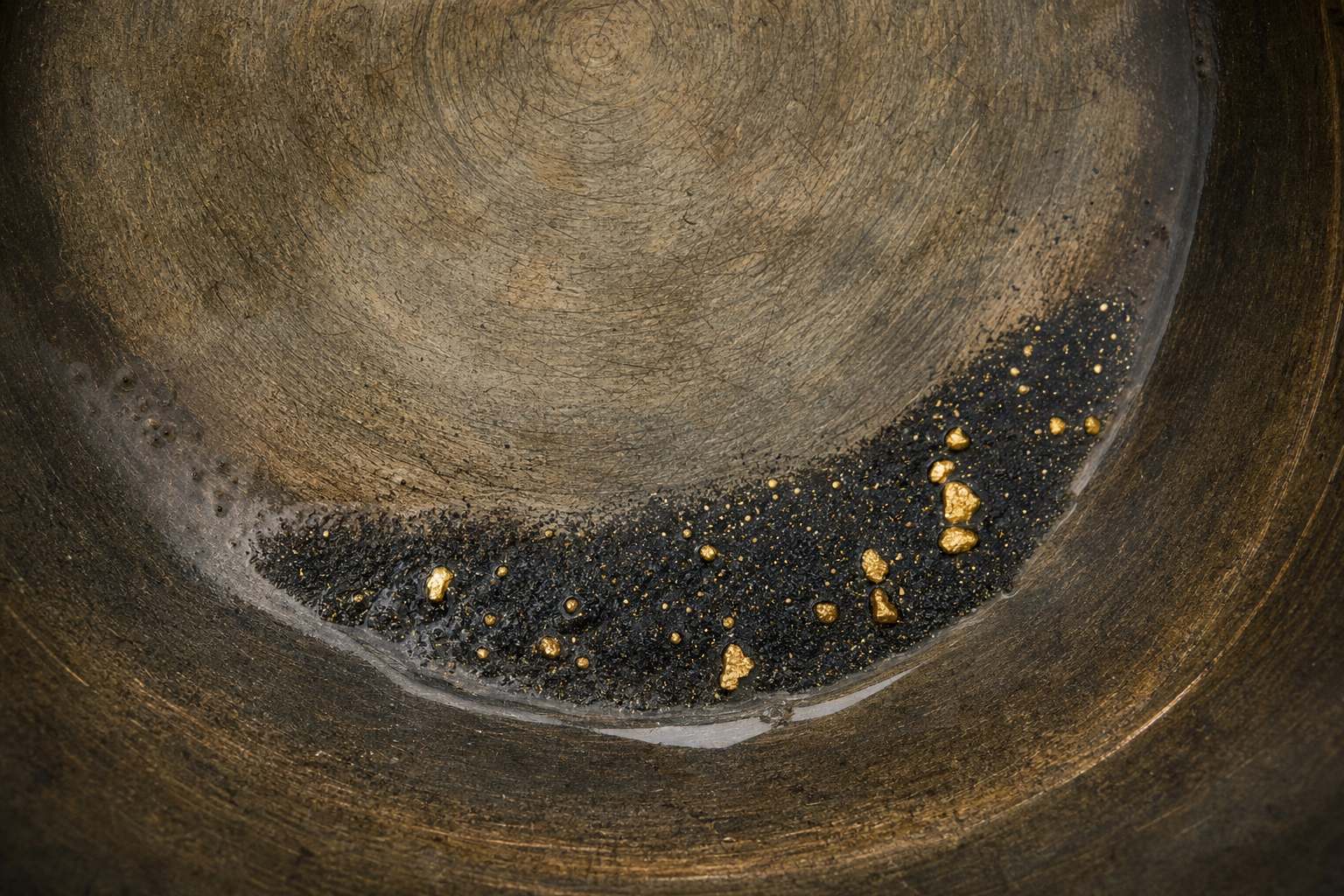
These river deposits are called placers. Panning works by the same rule: try the pan yourself.
Swirl water and gravel, and the light sand washes over the rim while the gold stays at the bottom. Medieval miners in the Bure goldfield, just north of today’s Siguiri, worked deposits like these.
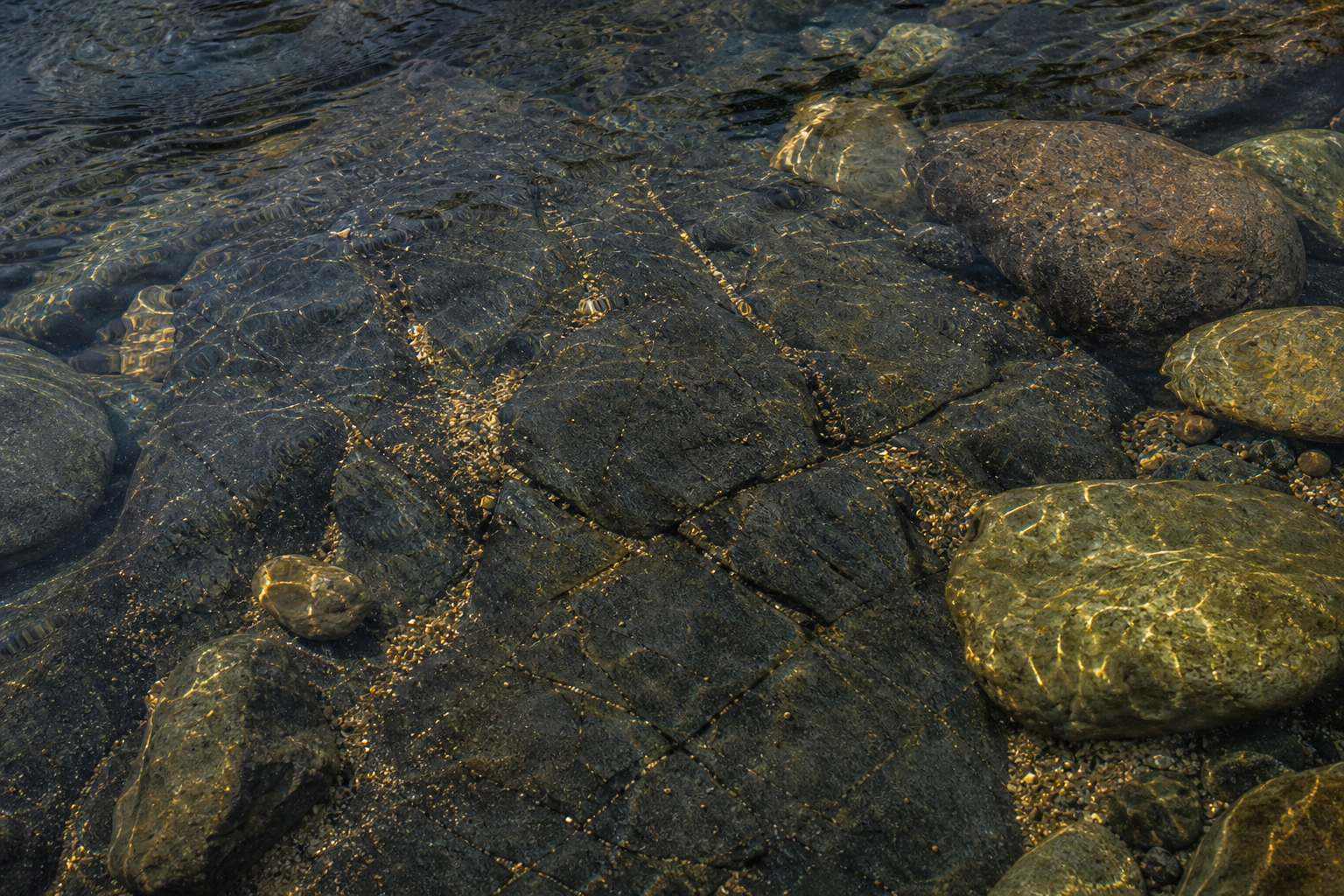
Where gold settles Flakes caught in cracks of the bedrock and behind boulders, where the current slows. AI-generated illustration.
water
1
quartz sand
2.65
lead
11.4
mercury
14.0
gold
19.3
Density, compared with water
The bottom of the pan After panning: a crescent of heavy black sand, and the brightest, heaviest flakes of all. AI-generated illustration.
a few metres
typical depth of a mine shaft
2.5–5 g
of gold from each shaft (World History Encyclopedia)
Medieval West Africa
Chapter IV · Rivers of gold
Placers and panning
USGS (Prospecting for gold): placers are concentrations of gold derived from lode deposits by erosion and decomposition of the enclosing rock; gold tends to settle on or near bedrock, and fine particles lodge where the current slows; the pan separates gold from clay, silt, sand and gravel because of its much higher density; specific gravity of gold 19.3, mercury 14.0, lead 11.4. University of Notre Dame: quartz has a specific gravity of 2.65, so gold is about 7.3 times as dense. Wikipedia (Siguiri): Siguiri is on the Niger in north-eastern Guinea, placer gold is mined there, and the Bouré (Bure) region lies to its north and north-west; Bure replaced Bambuk as a major gold producer in the 11th–12th centuries. World History Encyclopedia: West African gold was largely found in alluvial deposits and easily panned; mine shafts were usually only a few metres deep and yielded 2.5 to 5 grams of gold each.
The simulation is a toy: grains move outward according to how light they are. “Swirl” runs the pan, “New pan” loads fresh gravel.
The 3D scenes are simplified teaching models, not to scale: atoms, stars, veins and rivers are drawn to show the idea, not measured shapes.
West Africa’s gold, and a pilgrimage that shook a market.
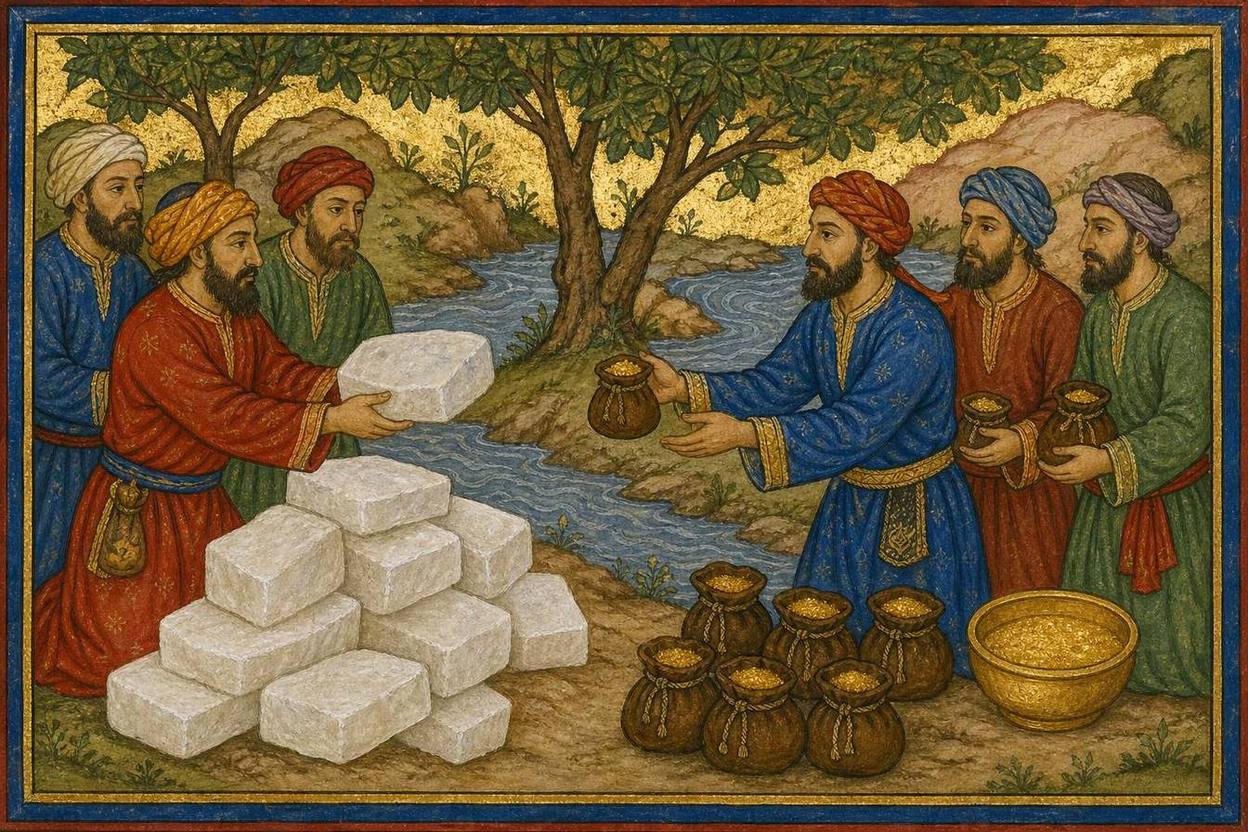
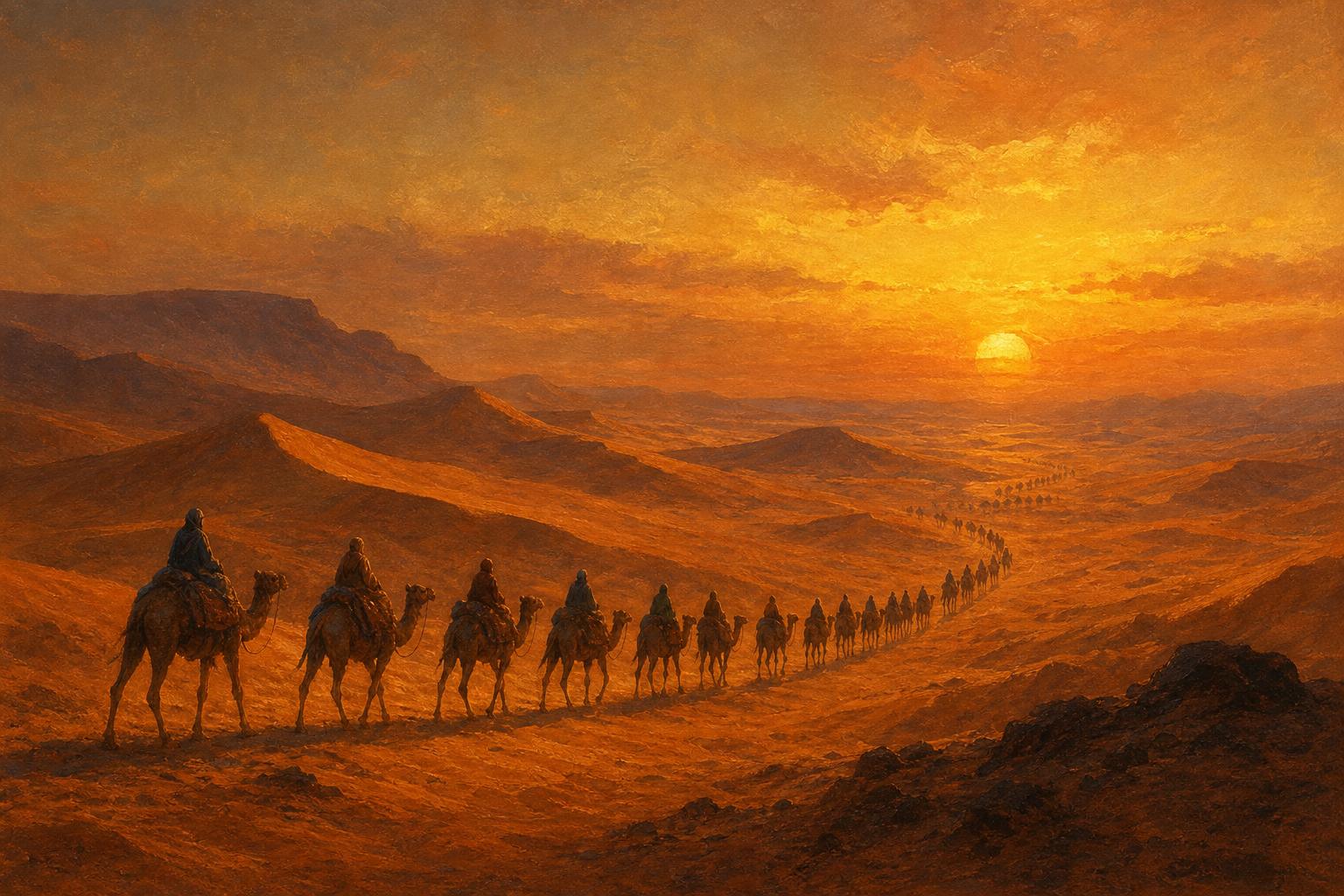
Bure’s gold, with Bambuk’s to the west, crossed the Sahara by camel caravan, traded for salt. By one historian’s account, at the trade’s peak two-thirds of the gold moving around the medieval Mediterranean came from West Africa.
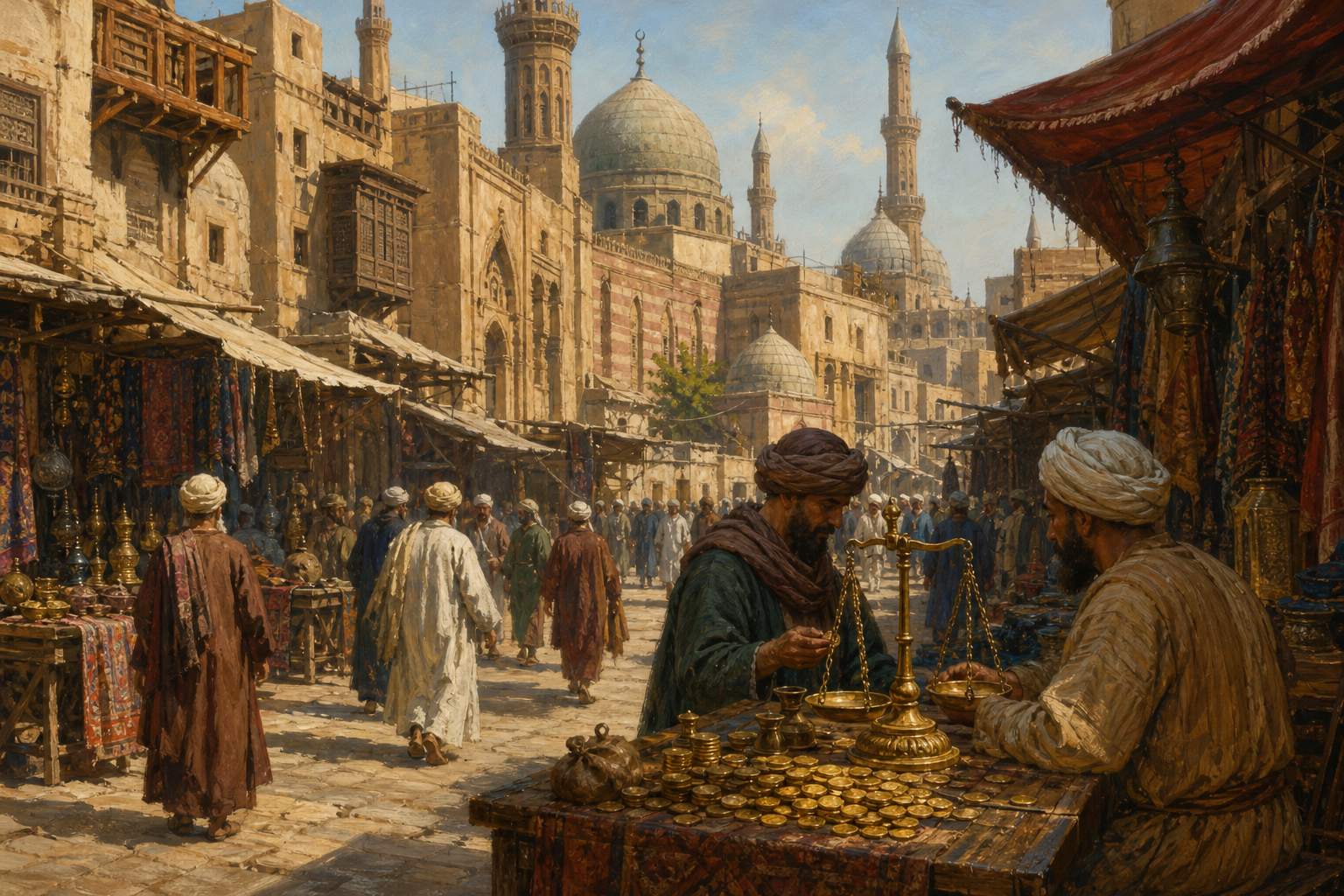
In 1324 Mansa Musa, ruler of the Mali Empire, passed through Cairo on pilgrimage with so much gold that, according to the historian al-Umari, gold there was still worth less twelve years later.
Salt for gold In the style of a medieval painting: slabs of Saharan salt traded for gold dust, scarce goods each way. AI-generated illustration.Across the Sahara A camel caravan at sunset: the route north ran through Timbuktu to North Africa and Egypt. AI-generated illustration.
60,000
people in the procession
80 camels
each carrying 300 pounds of gold; accounts differ
The caravan, as Britannica describes itCairo’s money changers By al-Umari’s account, a mithqal of gold (a unit of weight) fell from above 25 dirhams (silver coins) to 22 or less. AI-generated illustration.
Chapter IV · Rivers of gold
Mansa Musa and the gold of Mali
World History Encyclopedia (Mark Cartwright, 2019): West African gold came from the goldfields of Bambuk, where the Falémé meets the Senegal, and of Ghiyaru, Galam and Bure on the upper Niger in modern Guinea; camel caravans carried salt south across the Sahara and brought gold north; at the trade’s peak two-thirds of the gold moving around the medieval Mediterranean came from West Africa. Encyclopaedia Britannica (Mūsā I of Mali): in 1324 he left on pilgrimage with a procession of 60,000 men, including 12,000 enslaved people, and 80 camels each carrying 300 pounds of gold, and so flooded the Cairo market that its value had not recovered 12 years later. World History Commons, al-Umari: before the visit the gold mithqal stood above 25 dirhams; afterwards it fell, and “about twelve years until this day” it was 22 dirhams or less.
Accounts of the caravan differ: World History Encyclopedia cites some accounts of 100 camels carrying 300 pounds of gold dust. The figures are medieval reports, not counts.
The 3D scenes are simplified teaching models, not to scale: atoms, stars, veins and rivers are drawn to show the idea, not measured shapes.
How much gold has been mined in all of history? About 224,200 tonnes by the end of September 2026, says the World Gold Council.
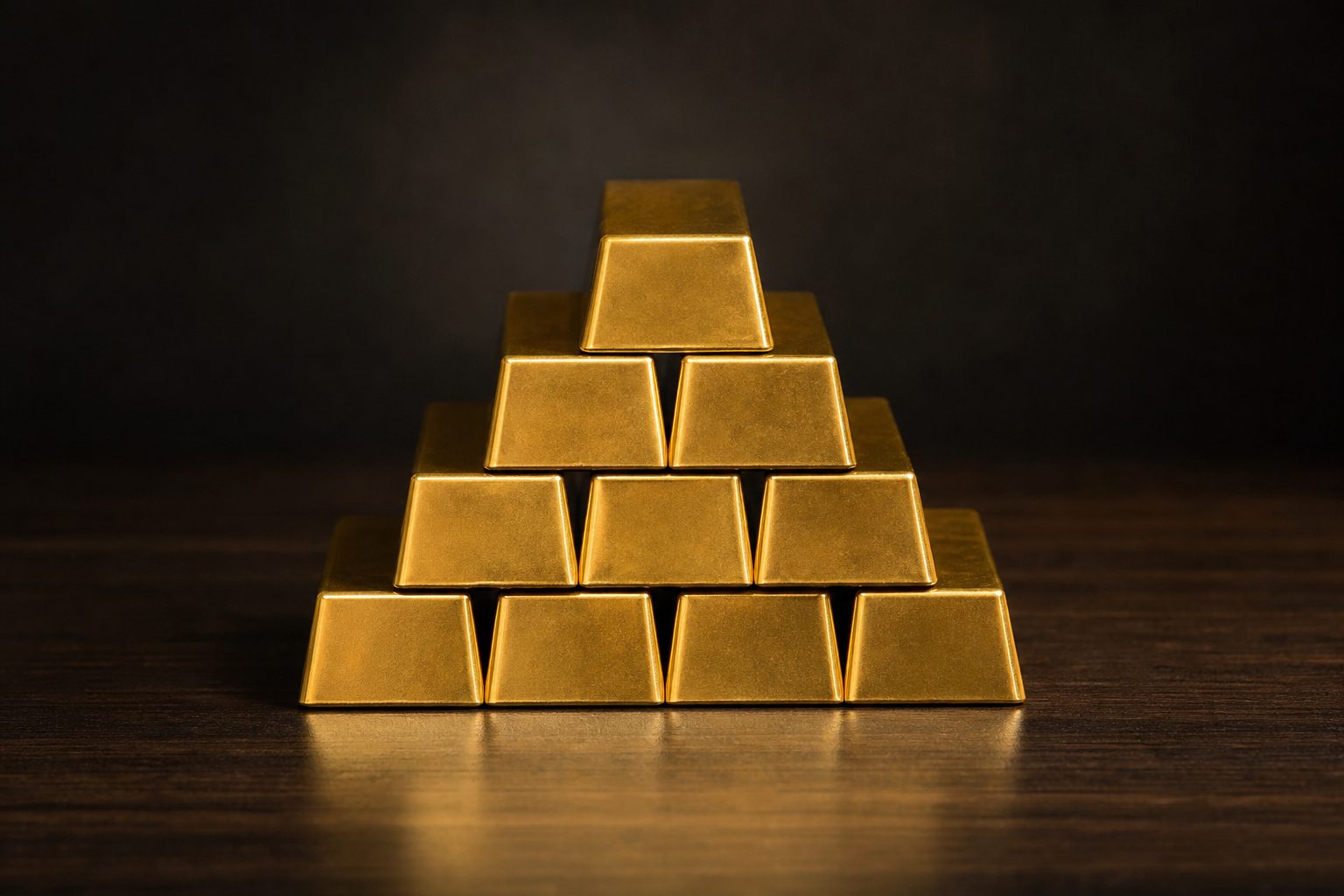
Gold is so dense that all of it would fit in a cube about 22.6 metres on each side. About two-thirds was mined after 1950.
Nearly half is jewellery; about a fifth is bars and coins, and almost as much sits in central banks.
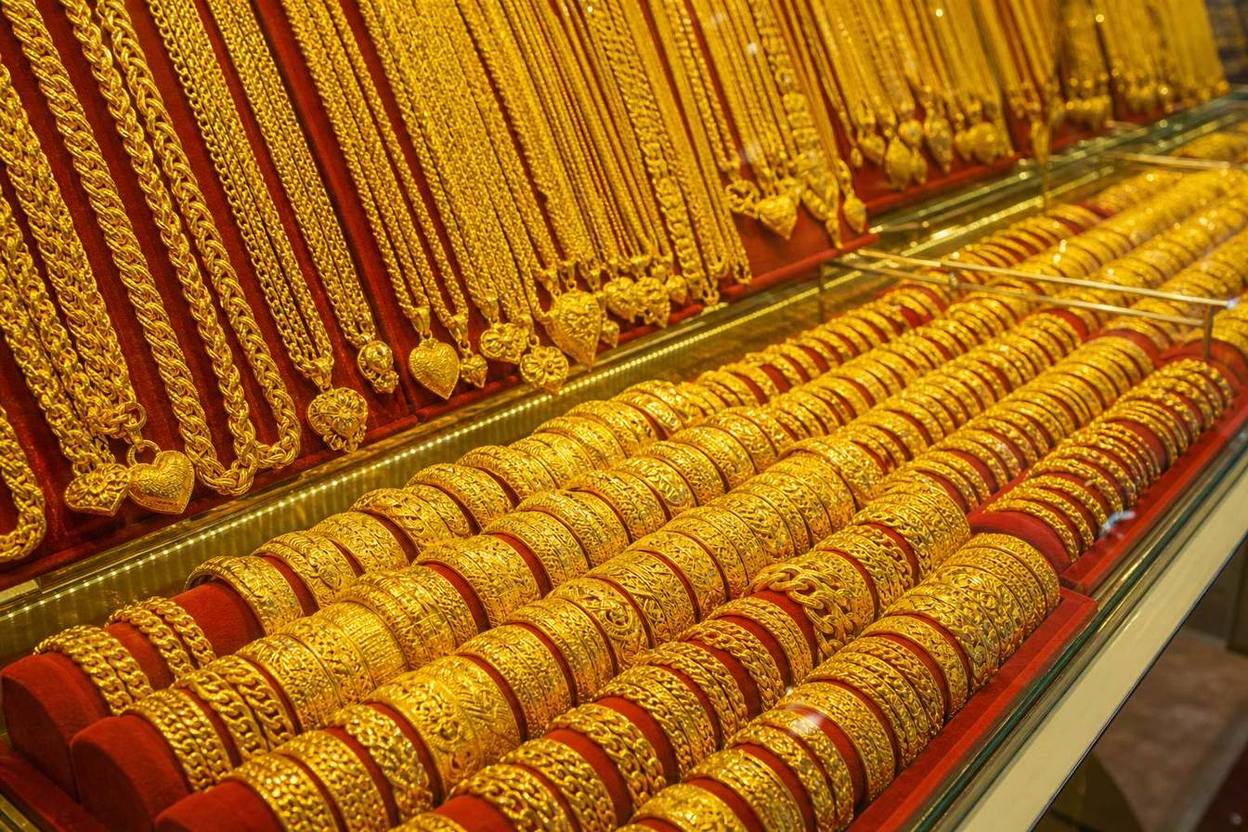
In Thailand gold is sold by the baht, a weight of 15.244 grams: all the gold ever mined weighs about 14.7 billion baht.
Gold bars Unmarked bars: about a fifth of all the gold ever mined is held as bars and coins. AI-generated illustration.
224,200 t
above-ground stock: all the gold ever mined
22.6 m
side of the cube it would fill
~⅔
mined since 1950
World Gold Council, end of Q3 2026
jewellery
98.7 (44%)
bars and coins
48.1 (21%)
central banks
39.3 (18%)
other
23.8 (11%)
Where the gold is
Sold by the baht A gold shop window of the kind found across Thailand: chains and bangles priced by the baht weight, 96.5% pure. AI-generated illustration.
Chapter V · All the gold ever mined
All the gold ever mined
World Gold Council (Goldhub, above-ground stocks): 224,200 tonnes at the end of the third quarter of 2026, of which jewellery about 98,700 t (44%), bars and coins 48,100 t (21%), central banks 39,300 t (18%) and other 23,800 t (11%), with gold ETFs and over-the-counter holdings making up the rest. World Gold Council (How much gold has been mined?): all of it would fit in a cube about 22.6 metres on each side; about two-thirds has been mined since 1950; proven below-ground reserves are about 61,000 tonnes (the US Geological Survey estimates about 66,000). BullionStar: in Thailand one baht of gold weighs 15.244 grams, at the standard 96.5% fineness. The film’s own arithmetic: 224,200 tonnes ÷ 15.244 g ≈ 14.7 billion baht; 224,200 t ÷ 19.32 t/m³ ≈ 11,600 m³, a cube 22.6 m wide.
The cube and the person beside it are to scale. The buttons show each holding as its own cube.
Today small-scale miners still work Guinea’s goldfields, and the same kind of mining goes on in more than 80 countries.
The UN Environment Programme says about 15 million people work directly in artisanal and small-scale gold mining, among them an estimated four to five million women and children.
Together they produce up to a fifth of the world’s gold.
Much of it is in grains too fine to pan. So miners add mercury: the gold dissolves into it, forming a lump of amalgam, about half gold and half mercury.
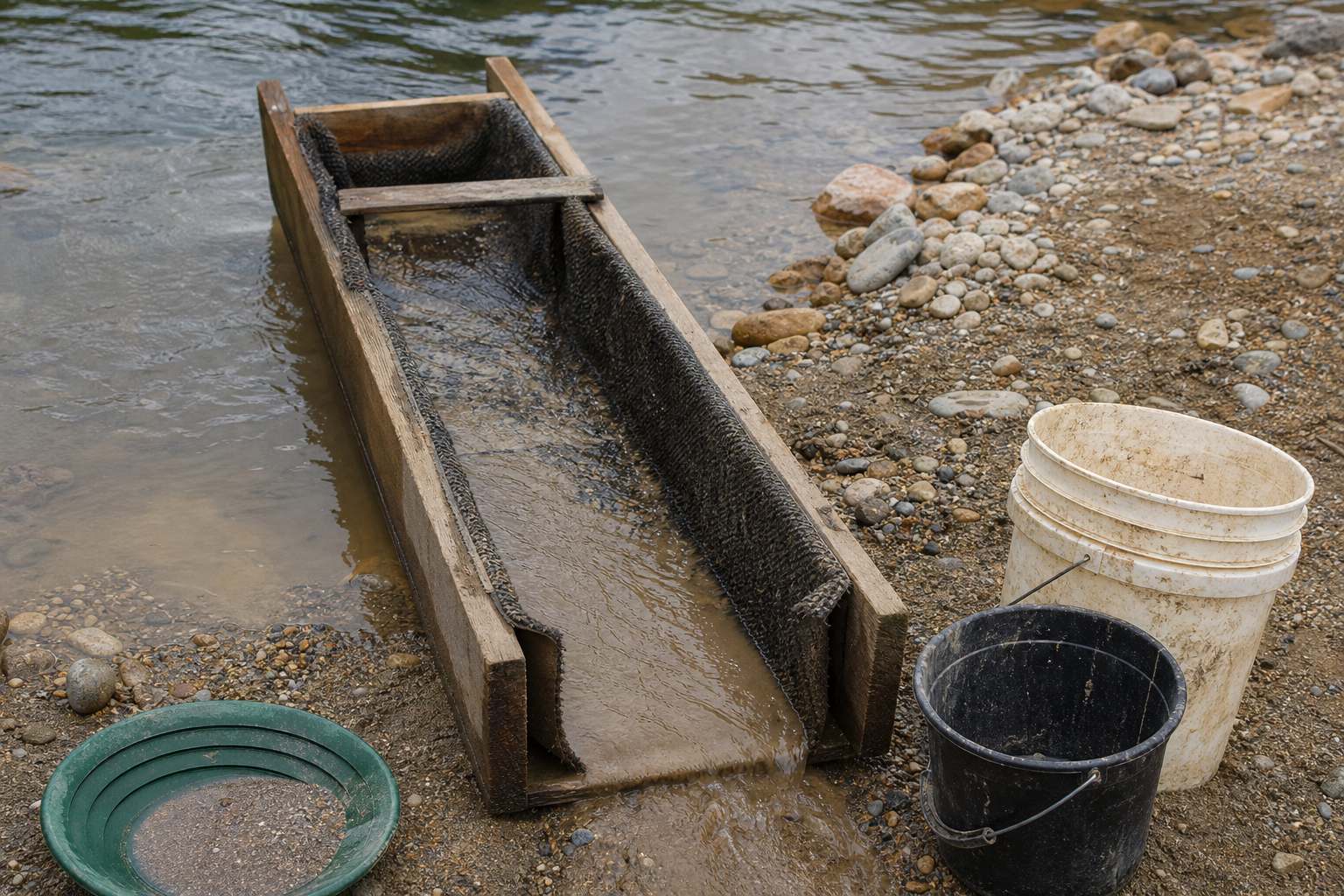
A sluice box A wooden sluice by a river: muddy water runs through, and heavy gold settles on its floor. AI-generated illustration.
~15 million
people working directly in small-scale gold mining
up to 20%
of the world’s gold
80+
countries
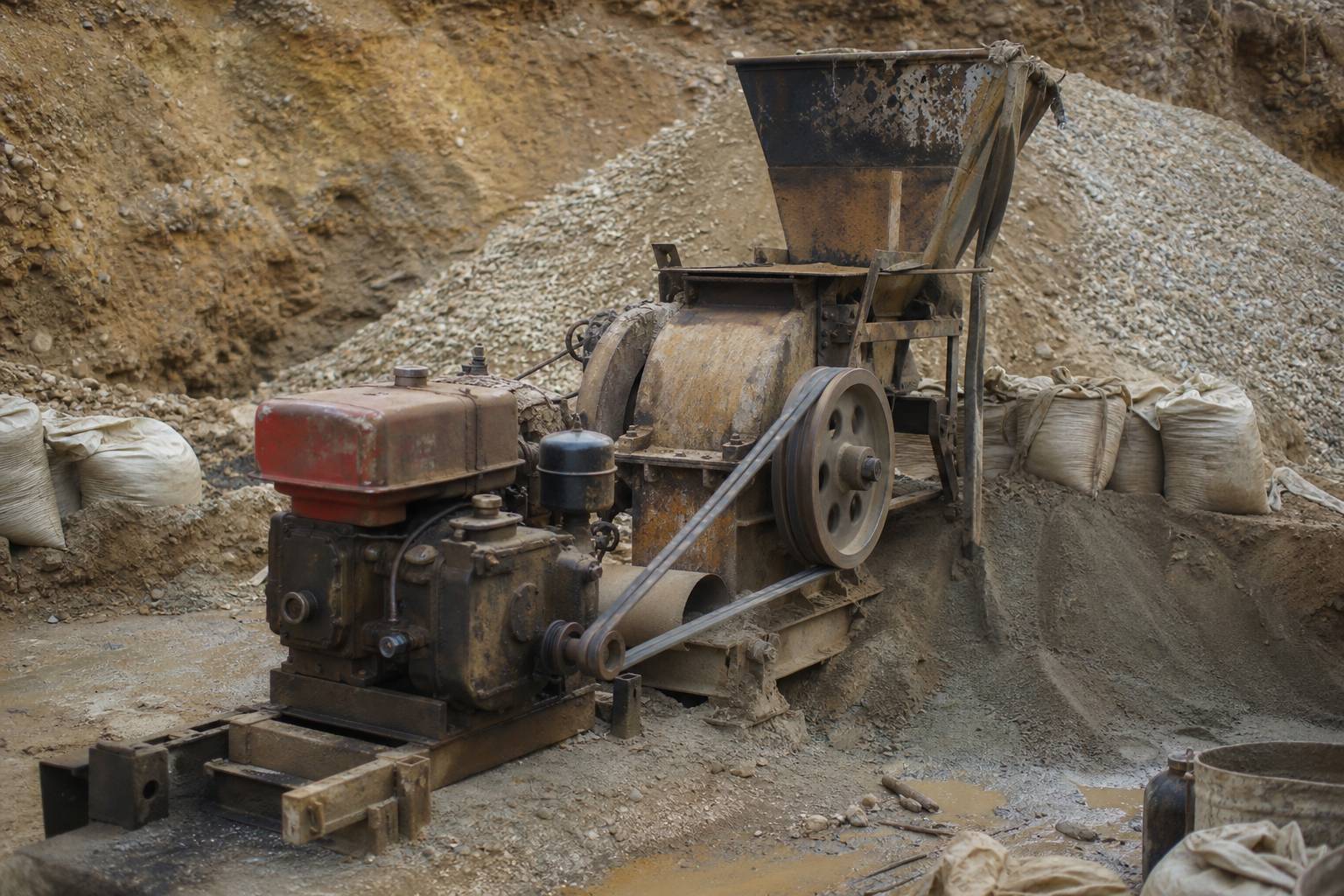
UN Environment ProgrammeCrushing the ore A small diesel crusher grinds ore so that the fine gold inside can be reached. AI-generated illustration.
on a concentrate: mercury added after the ore has been panned or sluiced
whole-ore: mercury mixed into all the crushed ore
whole-ore is the most polluting: only about 10% of the mercury joins the gold
Two ways of using mercury
Chapter VI · The mercury way
Artisanal and small-scale gold mining
UN Environment Programme: artisanal and small-scale gold mining (ASGM) directly employs about 15 million miners, an estimated 4–5 million of them women and children; it takes place in more than 80 countries and produces up to 20 per cent of the world’s gold. Zero Mercury Working Group: in concentrate amalgamation, mercury is added to concentrates to gather the fine gold particles, creating an approximately 50–50 alloy of mercury and gold; in whole-ore amalgamation mercury is added to large amounts of ore during crushing or sluicing, only about 10% of it typically forms amalgam, and it is a worst practice under the Minamata Convention.
Without mercury, the fine gold grains (yellow) wash past with the sand (grey); press “Add mercury” and they stick to the mercury bead (silver). Schematic, not to scale.
The 3D scenes are simplified teaching models, not to scale: atoms, stars, veins and rivers are drawn to show the idea, not measured shapes.
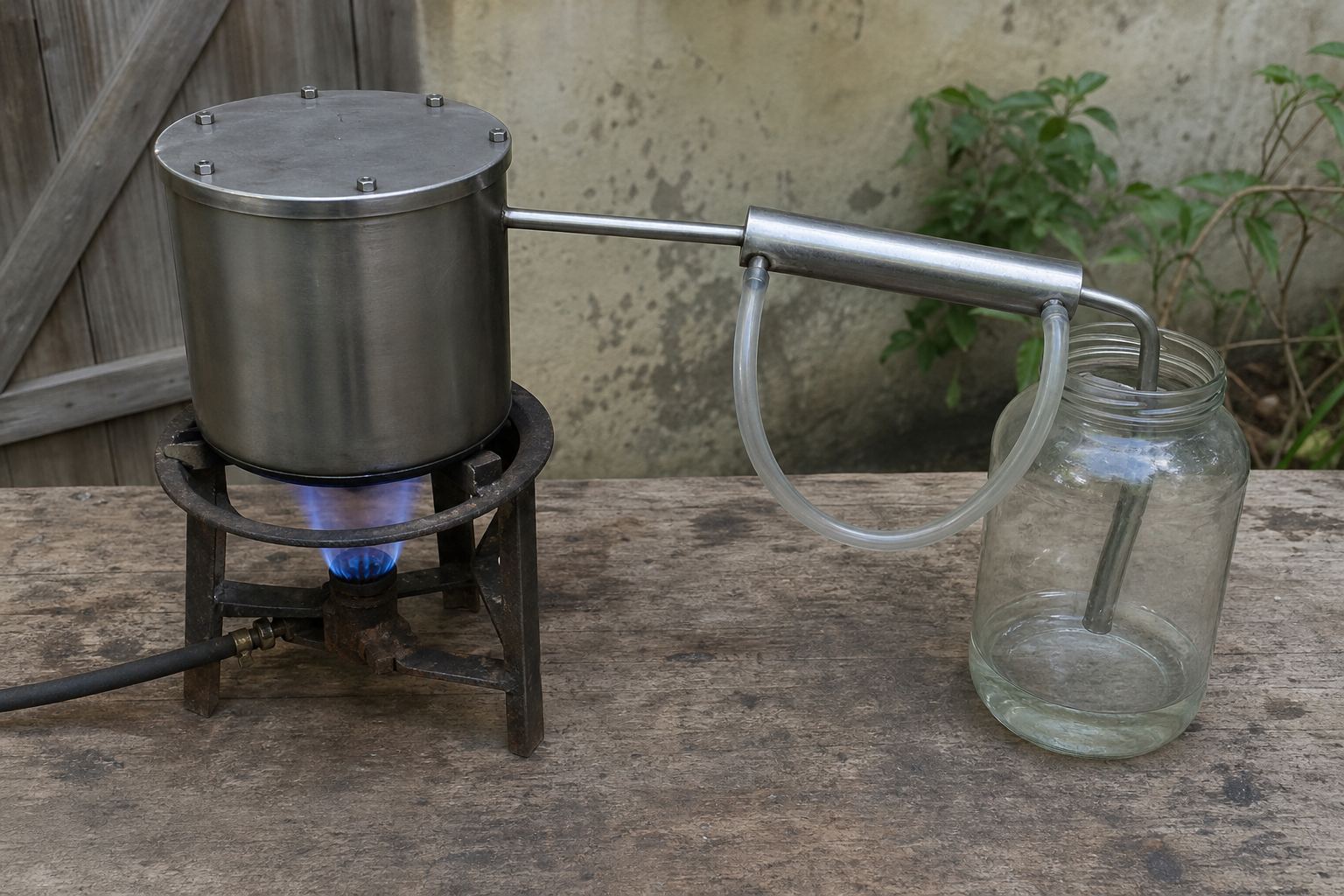
To get the gold back, the amalgam is heated, often in an open pan. The mercury boils off as vapour, leaving the gold.
That vapour is breathed in by the miners and by people nearby. The World Health Organization says inhaling mercury vapour can harm the nervous, digestive and immune systems.
The UN Environment Programme calls this kind of mining the largest source of human-made mercury in the air; the US EPA puts its share at about 38 percent. A closed retort catches most of it for reuse.
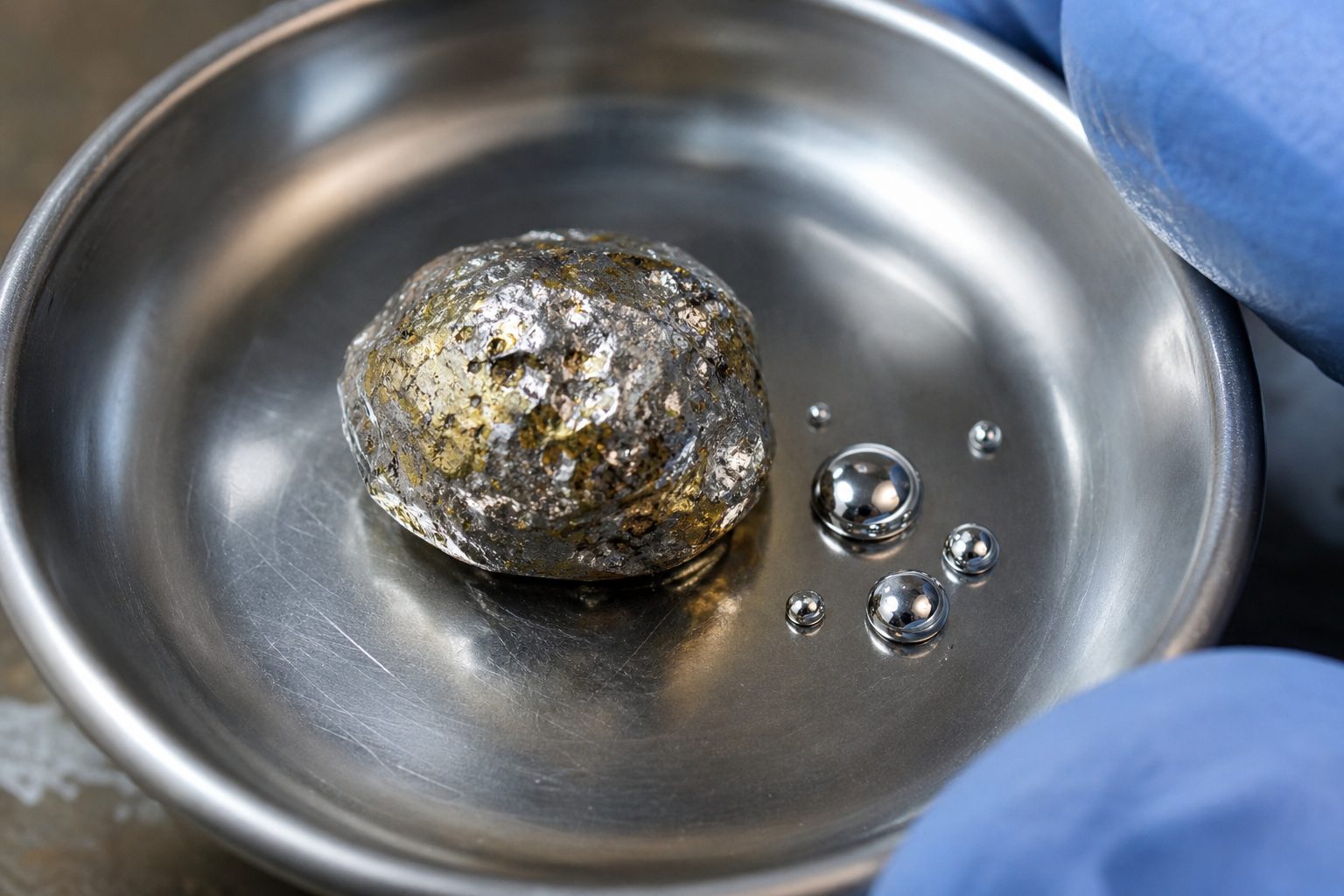
A lump of amalgam Amalgam looks like dull silver: the gold inside only shows once the mercury is driven off. AI-generated illustration.
The use of mercury in artisanal and small-scale gold mining is particularly hazardous.World Health Organization, Mercury and health, 2024
A retort A sealed cup over the flame and a cooled pipe: the vapour condenses back into liquid mercury in the jar. AI-generated illustration.
38%
of human-made mercury emissions to air (US EPA)
~95%
of mercury a retort can recycle (Zero Mercury Working Group)
Mercury and small-scale gold mining
Chapter VI · The mercury way
Mercury vapour
Zero Mercury Working Group: the amalgam is burnt in a metal pan over an open fire, mainly releasing mercury vapour that miners inhale; retorts capture the vapour and recycle about 95% of the mercury; ASGM used an estimated 872–2,598 tonnes of mercury in 2015, the largest use of mercury worldwide. US EPA: ASGM accounts for more than a third (38%) of human-caused mercury emissions to the atmosphere, most of them from burning amalgam; emissions from gold shops pose a hazard indoors and to nearby residents. World Health Organization (fact sheet, 2024, and its earlier text reproduced by Pure Earth): the inhalation of mercury vapour can produce harmful effects on the nervous, digestive and immune systems; the use of mercury in ASGM is particularly hazardous. UNEP describes ASGM as the largest source of mercury pollution, almost 40 per cent of what human activity puts into the air.
This is general education about how mercury harms health, not medical advice. Anyone worried about exposure should talk to a doctor or a local health service.
“Heat” drives the mercury off in the open; “Use a retort” closes it in and condenses it. Schematic.
The 3D scenes are simplified teaching models, not to scale: atoms, stars, veins and rivers are drawn to show the idea, not measured shapes.
Methylmercury, fish, and a treaty named after a bay.
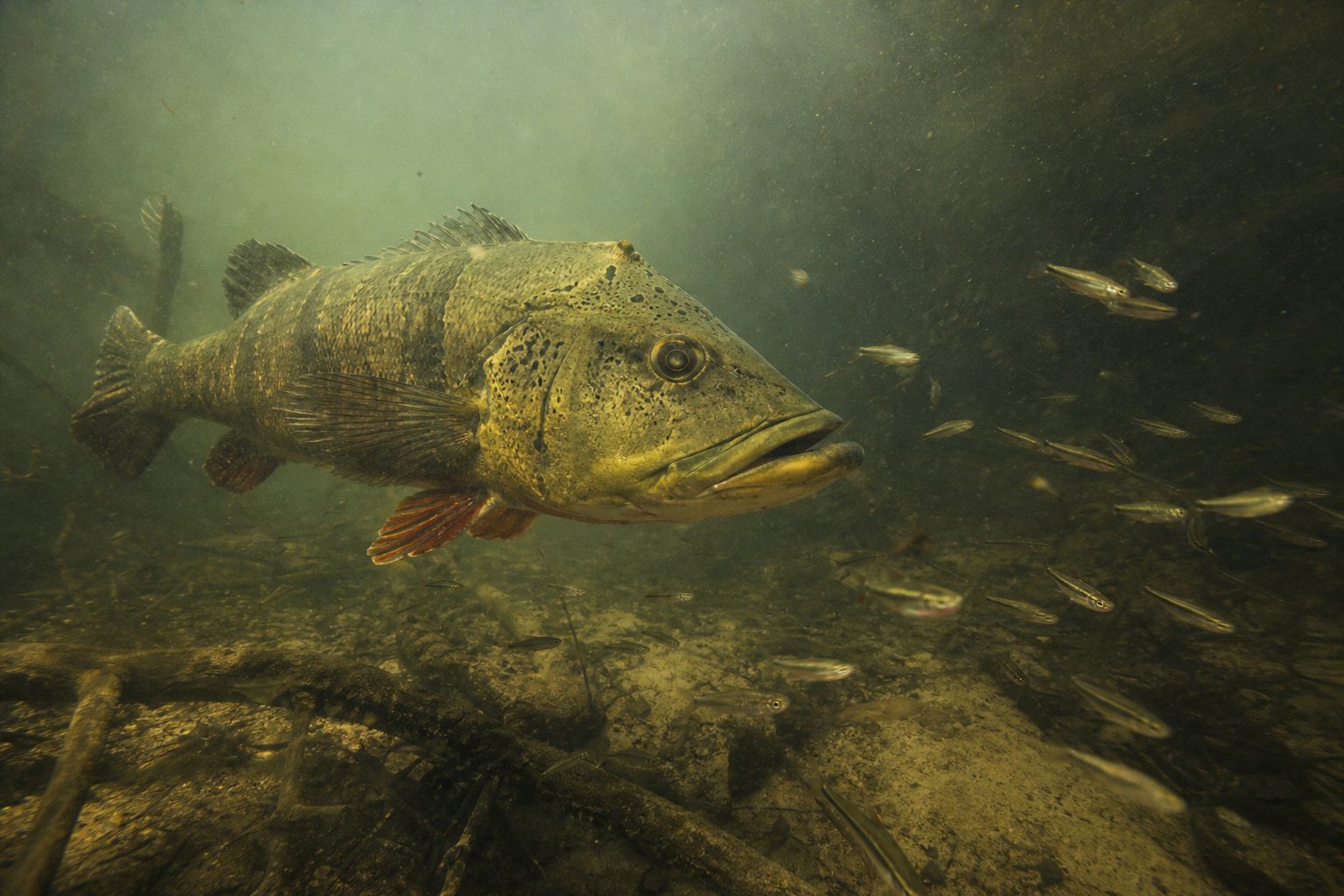
Mercury that reaches rivers does not stay put. Bacteria turn some into methylmercury, which builds up in fish; big fish that eat smaller ones carry the most.
The WHO lists mercury among the ten chemicals of greatest public health concern. Unborn babies are the most sensitive, because methylmercury can harm the developing brain.
The global treaty is named after Minamata in Japan, where mercury released into the bay poisoned people for decades. Adopted in 2013, it came into force in 2017.
Among other things, it covers mercury in small-scale gold mining.
Top of the food chain A large predatory fish: it eats many smaller fish, and their methylmercury with them. AI-generated illustration.
Mercury is considered by WHO as one of the top ten chemicals or groups of chemicals of major public health concern.World Health Organization, Mercury and health
1932–1968 methylmercury discharged into Minamata Bay, Japan
10 Oct 2013 Minamata Convention adopted at Kumamoto
16 Aug 2017 the convention enters into force
today 154 parties
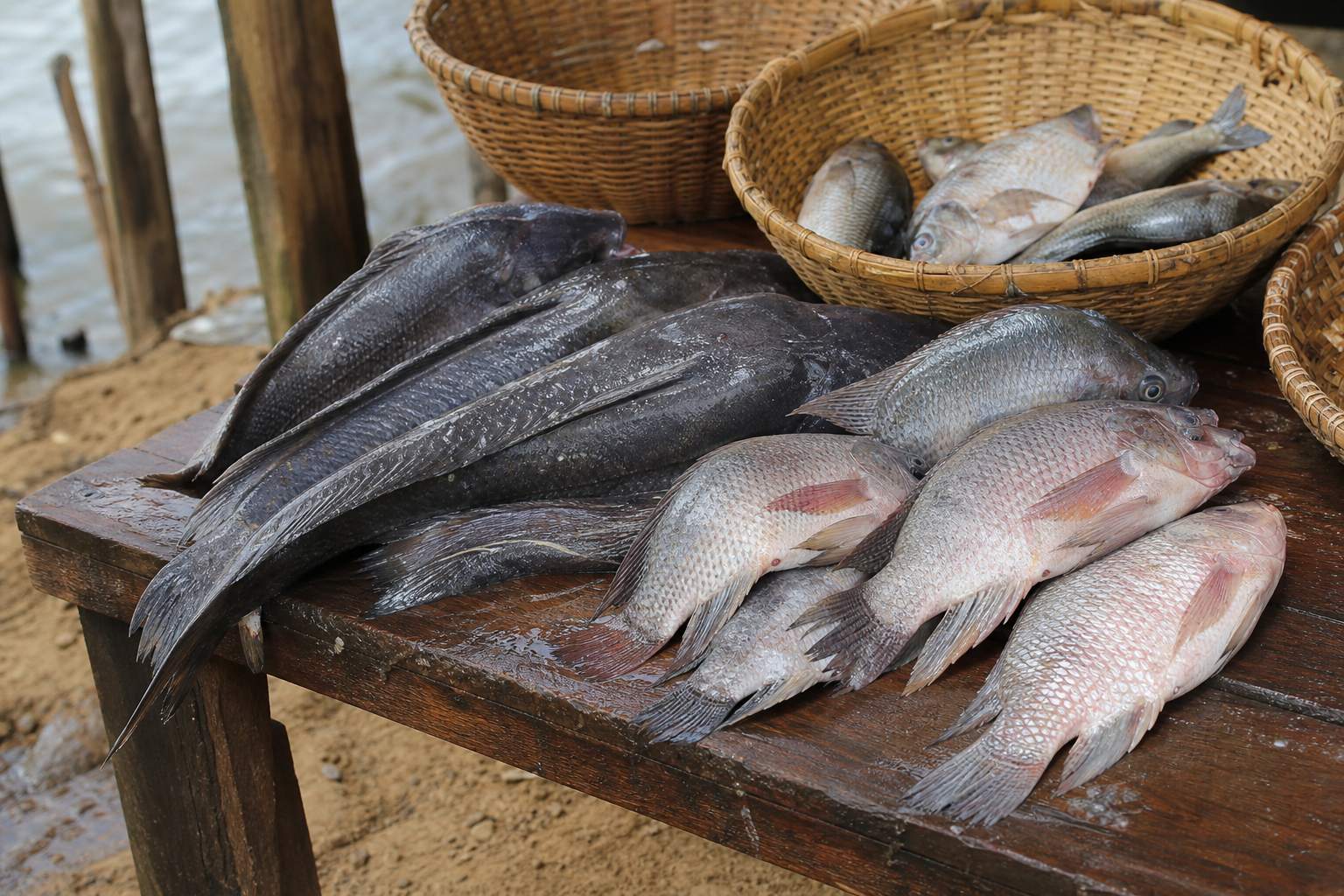
From Minamata to a treatyRiver fish for sale Fish from rivers near goldfields are an everyday food, which is why mercury in rivers matters. AI-generated illustration.
Chapter VI · The mercury way
Methylmercury and the Minamata Convention
World Health Organization (Mercury and health, 2024): people are mainly exposed to methylmercury by eating fish and shellfish; bacteria turn mercury in the environment into methylmercury, which bioaccumulates, and large predatory fish carry the highest levels; mercury is one of the top ten chemicals of major public health concern; exposure in the womb is a particular danger to the developing child. The WHO text reproduced by Pure Earth recalls the outbreak at Minamata, Japan, caused by methylmercury discharged into the bay between 1932 and 1968. Minamata Convention secretariat: the convention was adopted on 10 October 2013 in Kumamoto, Japan, entered into force on 16 August 2017 and has 154 parties; it provides for the regulation of the informal sector of artisanal and small-scale gold mining.
This is general education about how mercury harms health, not medical advice. Anyone worried about exposure should talk to a doctor or a local health service.
The dots in each fish show the idea of build-up, not measured amounts.
The 3D scenes are simplified teaching models, not to scale: atoms, stars, veins and rivers are drawn to show the idea, not measured shapes.
How big mines dissolve gold, and what happens when a dam fails.
Large mines use another chemistry. In 1887 three Scottish chemists found a way to dissolve gold in a dilute cyanide solution.
With oxygen from the air, cyanide pulls gold out of finely ground ore; zinc dust or activated carbon then recovers it.
The waste must be held behind dams. On 30 January 2000, a tailings dam at Baia Mare in Romania overflowed and breached.
A UN assessment says about 100,000 cubic metres of cyanide-laden water reached the Tisza, the Danube and the Black Sea; dead fish were reported within days.
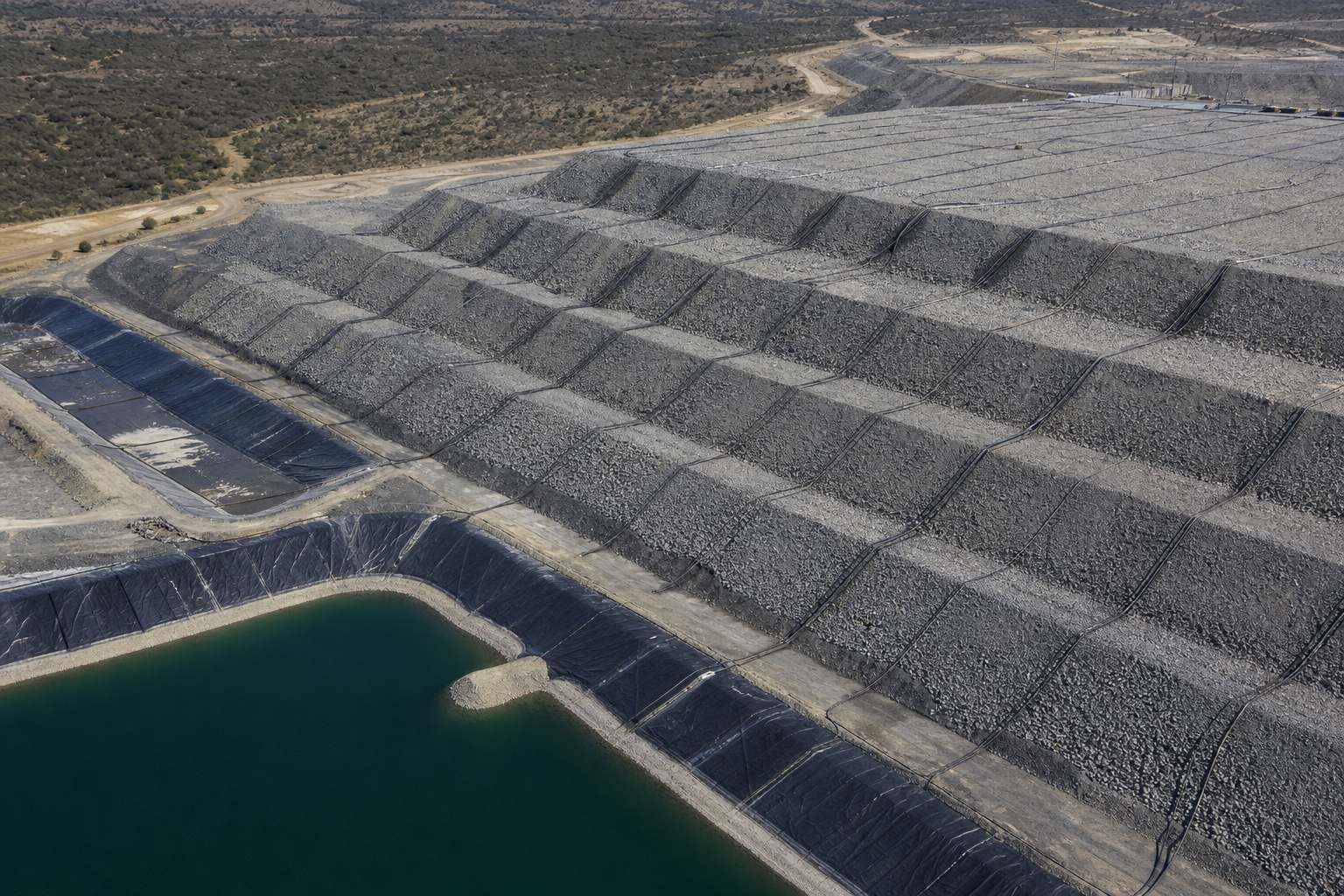
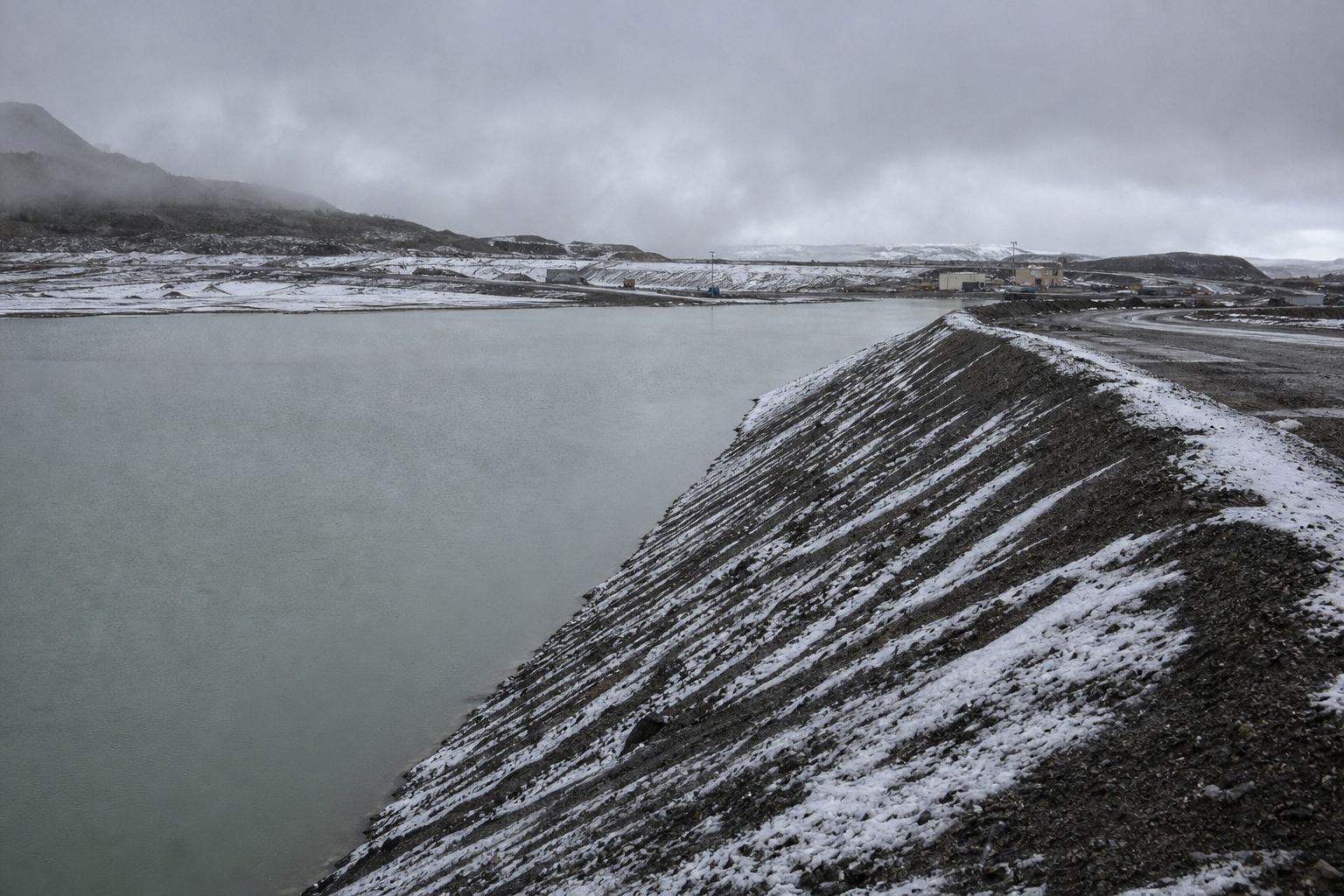
A heap leach pad Crushed ore piled in terraces and dripped with cyanide solution; the gold-bearing liquid drains into lined ponds. AI-generated illustration.4Au+8NaCN+O2+2H2O→4Na[Au(CN)2]+4NaOHThe Elsner equation Gold, sodium cyanide, oxygen and water give a soluble gold–cyanide complex.A tailings dam An earthen dam holding a pond of mine waste; at Baia Mare, snowmelt and rain filled the pond until it overflowed. AI-generated illustration.Downstream The route of the spill: Lapuș, then Someș, Tisza and Danube, to the Black Sea. AI-generated illustration.
Chapter VII · The cyanide way
Cyanide and Baia Mare
Encyclopaedia Britannica (cyanide process): developed in 1887 by the Scottish chemists John S. MacArthur, Robert W. Forrest and William Forrest; gold and silver are dissolved in a dilute solution of sodium or potassium cyanide and recovered by precipitation with zinc dust. Wikipedia (Gold cyanidation): the Elsner equation, 4 Au + 8 NaCN + O₂ + 2 H₂O → 4 Na[Au(CN)₂] + 4 NaOH; dissolved gold can also be recovered by adsorption onto activated carbon. UNEP/OCHA assessment mission (2000): on 30 January 2000 the tailings dam of the Aurul plant at Baia Mare, Romania, owned jointly by Esmeralda Exploration (Australia) and the Romanian state company REMIN, overflowed after snow, rain and a thaw, and breached over about 25 metres, releasing about 100,000 m³ of tailings water containing free cyanide and cyanide complexes into the Lapuș, then the Someș and the Tisza, and finally the Danube and the Black Sea; dead fish were first reported at Satu Mare on 2 February, and cyanide was found in eight village wells at Bozânta Mare.
Baia Mare is told here as the UN assessment mission reported it. The button breaches the model dam; the river is a schematic, not a map.
The 3D scenes are simplified teaching models, not to scale: atoms, stars, veins and rivers are drawn to show the idea, not measured shapes.
At Siguiri, the gold in the gravel is older than the Earth. Most of the planet’s gold was swallowed by the young Earth, with fresh gold probably delivered later by meteorites, then gathered by hot water and rivers.
Guinea banned mining there over polluted rivers and farmland, yet UNEP says small-scale gold mining supports more than 300,000 people in Guinea. How a river can feed its miners and stay clean is the question that remains.
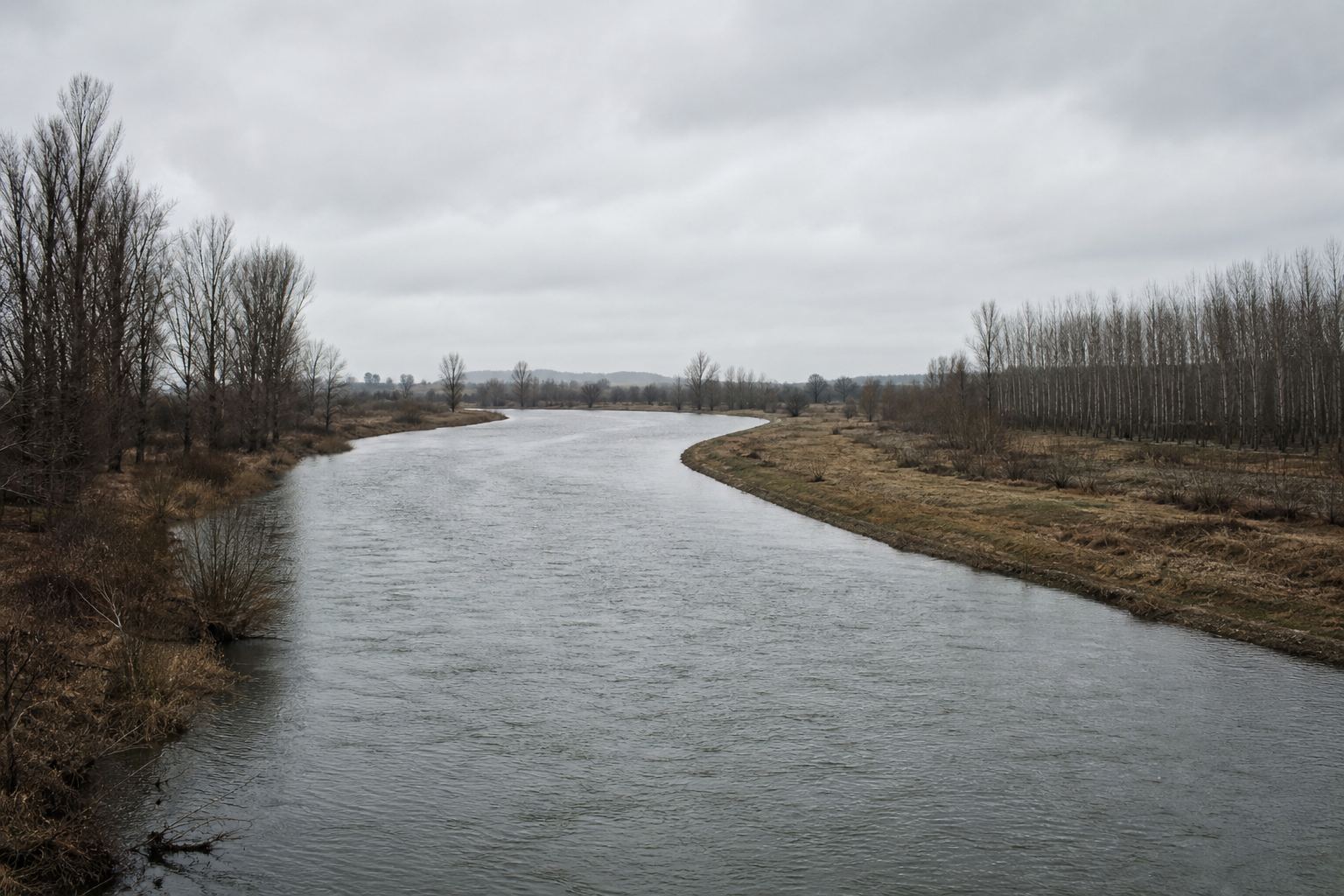
The Niger at Siguiri A river goldfield of hand-dug pits, like those along the upper Niger. AI-generated illustration.
1100s Bure, near Siguiri, becomes a major goldfield
1324 Mansa Musa’s gold floods Cairo
1887 the cyanide process
2000 Baia Mare cyanide spill
2013–17 Minamata Convention
2017 a kilonova shows heavy elements being made
2026 224,200 t mined; Guinea bans artisanal mining in Siguiri
Gold through timeStardust Gold dust in cupped hands: every grain older than the Earth. AI-generated illustration.
Epilogue · Sources
Sources
Every fact in this film comes from the sources below. The news from Guinea is reported as the government stated it, through Al Jazeera and Morning Star; who was responsible is under investigation and is not discussed. Where sources differ (how much gold one neutron-star merger made, the size of Mansa Musa’s caravan) the film says so and names who gave each figure; which cosmic events made most of the universe’s gold, and exactly how the crust got its gold, are still debated and are presented as such. Health information is general education, not medical advice. Sums the film works out itself (the baht total, the cube) are marked as its own arithmetic. The chapter stills and pictures are AI-generated illustrations, not photographs of real places, people or objects. The 3D scenes are simplified teaching models, not to scale, except the gold cube and the person beside it.