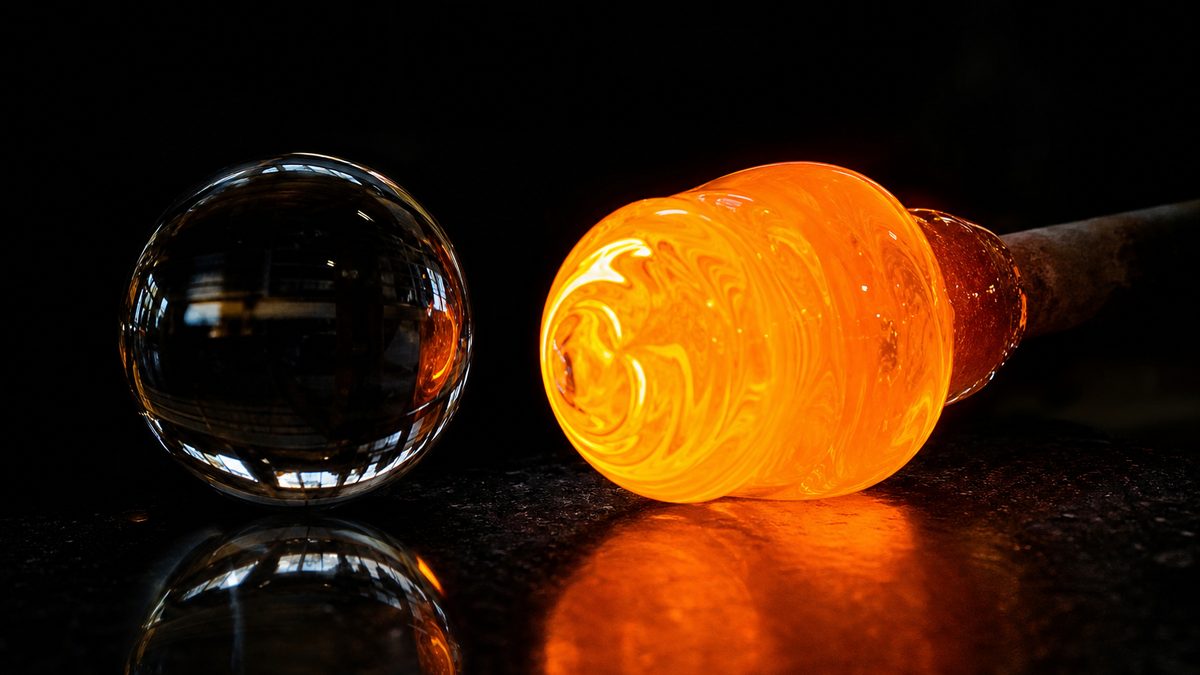
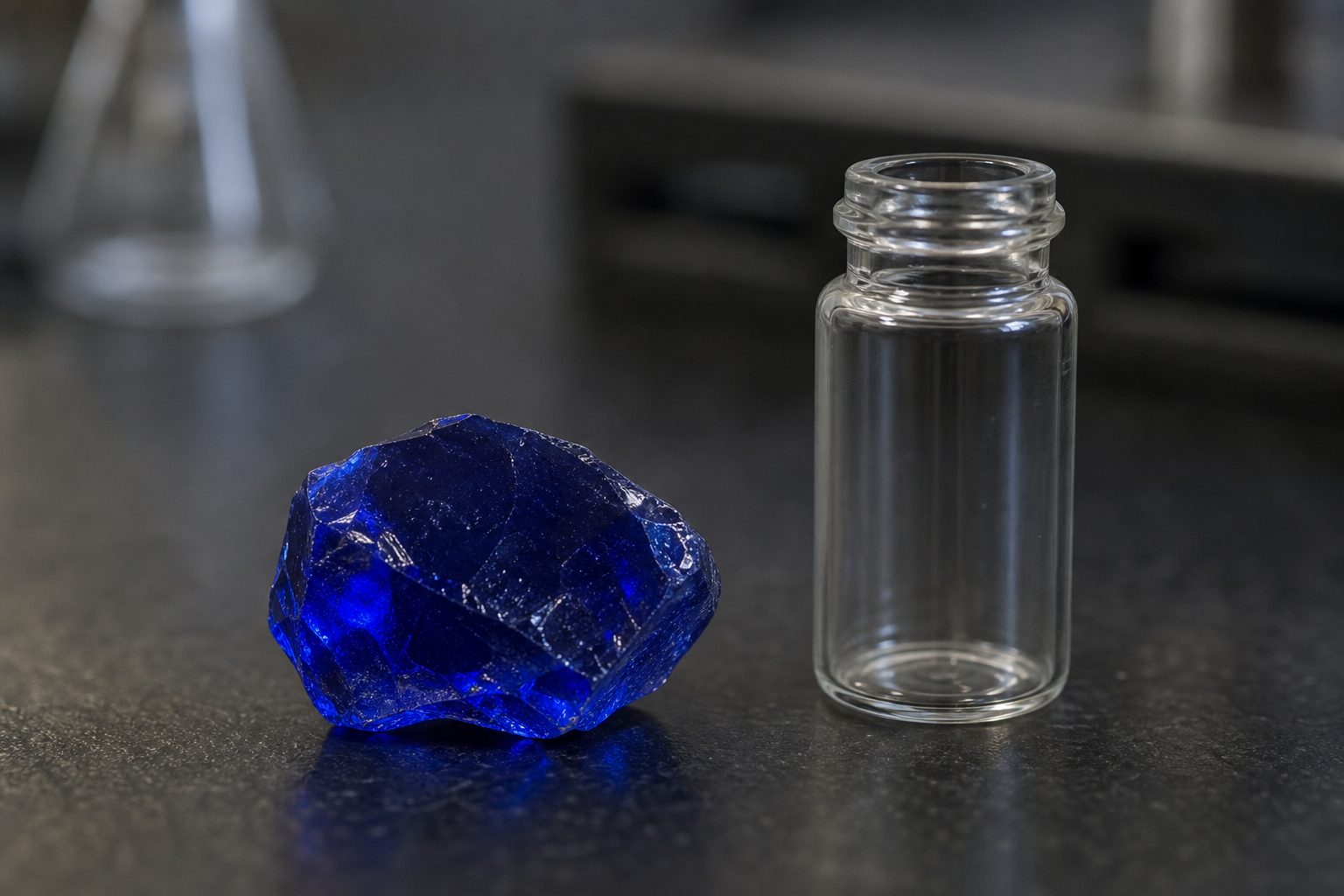
In 2026 a team led by TU Dortmund reported in Nature Materials a way to melt a new family of glasses more gently by adding a small molecule that acts as a flux. This film explains the established science that work builds on: why glass is an amorphous solid rather than a crystal, how cooling a melt fast enough freezes its disorder, why old windows are uneven but have not flowed, why glass lets light through, how soda lowers the melting point of sand, how glassmaking spread from Mesopotamia and Egypt to Rome, Venice and Iron Age Thailand, how flat glass is floated on molten tin, and why tempered glass and Prince Rupert's drops are so strong.
Interactive 3D film9 minAbout 2500 BC to 2026Published 8 November 2026
What glass is, and why it behaves the way it does.
Look at a window. It is hard enough to hold back the wind, yet light walks straight through it, as if nothing were there.
It is made mostly from sand, and sand is not see-through. So what is glass?
This year a team led by TU Dortmund in Germany reported a trick for a young family of glass, made from metal-organic frameworks: metal ions linked by organic molecules. A small extra molecule helps it melt more gently.
To see why that matters, look first at where glass keeps its atoms.
~70%
silica, the compound quartz sand is made of
Window glass (Britannica)
24 Aug 2026
paper on metal–organic framework (MOF) glasses, led by TU Dortmund
2015
MOFs first melted into glass (Cambridge)
The news (Nature Materials)A young family of glass Their cobalt glasses melted without breaking down, the team reports (Paderborn University). AI-generated illustration.
Prologue
The news
Nature Materials (accepted 16 July, published 24 August 2026; reported by ScienceDaily on 5 November 2026): a team led by Sebastian Henke at TU Dortmund, with Paderborn University, the University of Duisburg-Essen and the University of Oxford, mixed the organic molecule 1,10-phenanthroline into metal–organic framework (MOF) crystals before melting them. It acted as a flux, lowering the melting and glass-transition temperatures, and also bound to the metal atoms, rearranging the glass network. In cobalt glasses the gentler melt avoided decomposition. The sources give no temperatures.
University of Cambridge (2015): a team there first reported melting metal–organic frameworks into hybrid glasses.
The 3D scenes are simplified teaching models: atoms, light and stresses are drawn schematically and not to scale.
Start with quartz, the crystal that sand grains are made of. Its building blocks are silicon and oxygen: each silicon atom holds four oxygens, and each oxygen links two silicons.
In a crystal, those blocks repeat in a regular pattern called a lattice, the same in every direction.
Glass uses the same blocks and links, but the network is jumbled, with no pattern that repeats. Chemists call it an amorphous solid: solid, but not crystalline.
quartz: crystalline silica
silica glass: the same compound, not crystalline
every oxygen bridges two silicons
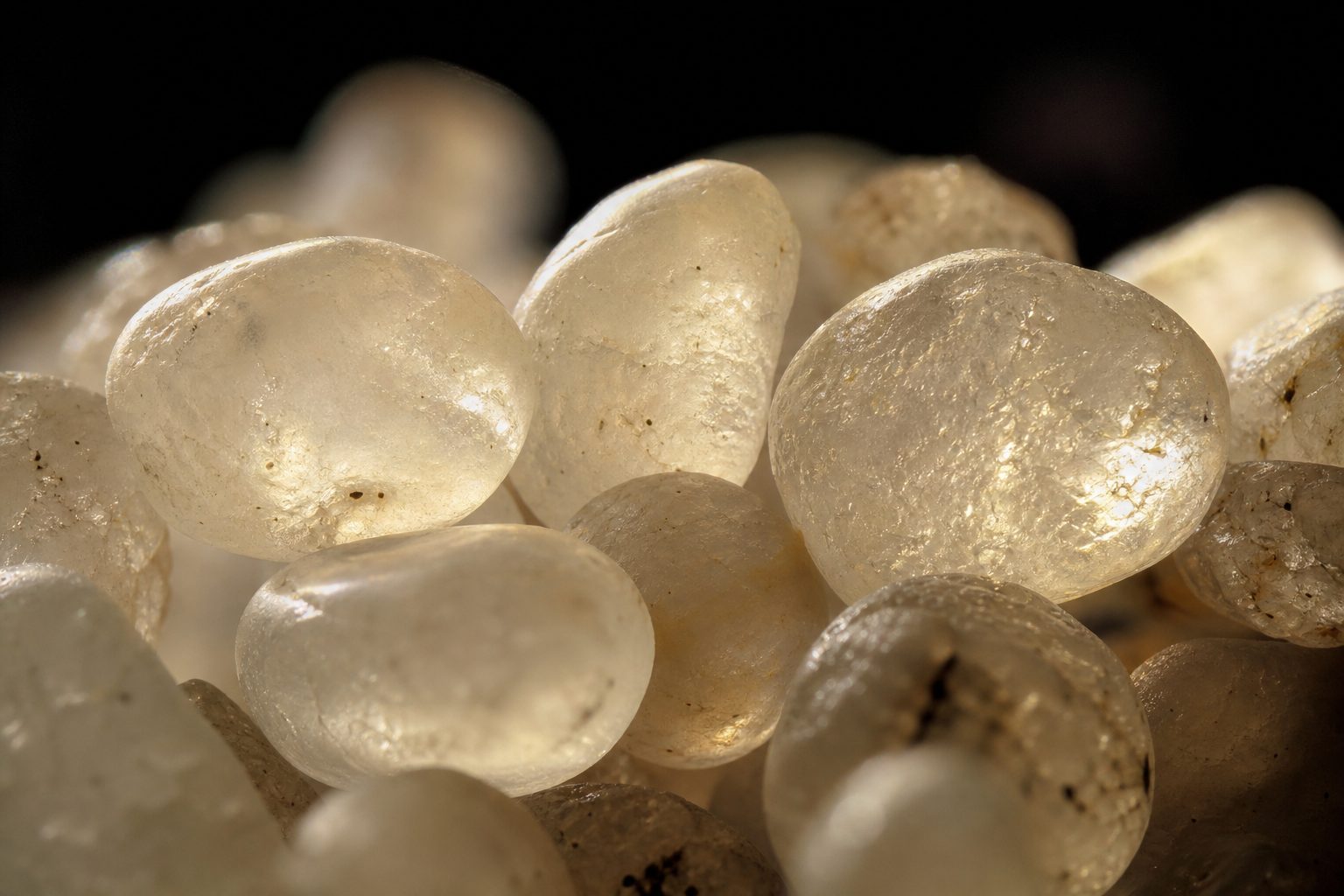
Silica, SiO₂ (Britannica)Quartz sand Pure quartz sand looks white: each grain is clear, but light bounces off millions of grain surfaces. AI-generated illustration.
sharp peaks
crystal: long-range order
none
glass: no long-range order
What spectra show (Britannica)
Chapter I · A frozen jumble
An amorphous solid
Britannica: an amorphous solid is a non-crystalline solid whose atoms are not organised in a definite lattice pattern; glass is the example. Silica glass is amorphous SiO₂, the non-crystalline form of the compound quartz is made of: each silicon bonds to four oxygens and each oxygen bridges two silicons. Crystal spectra show sharp peaks from long-range order; amorphous solids lack them.
In the 3D model the crystal is a simple diamond-like lattice, chosen because every silicon has four neighbours; real quartz is arranged differently.
The 3D scenes are simplified teaching models: atoms, light and stresses are drawn schematically and not to scale.
How does a liquid end up frozen in disorder? It depends on how fast it cools.
Cool a melt slowly, and its atoms have time to find their places and line up into crystals.
Cool it fast enough and they never get there. The liquid just thickens: its viscosity, its resistance to flowing, climbs with no sudden jump.
At last the atoms are stuck where they were. That point is called the glass transition, and the jumble is now a solid.
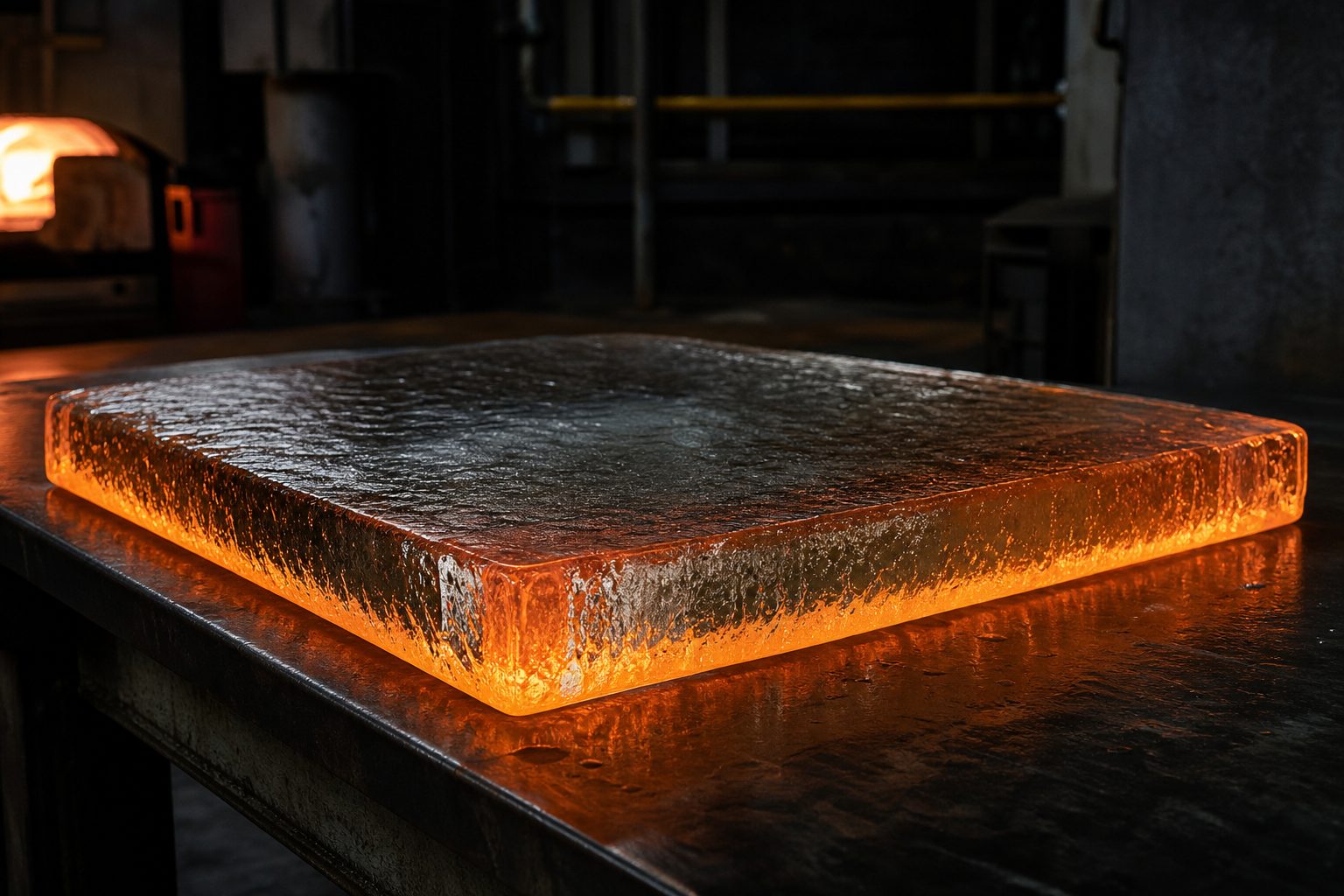
Cooling glass A cast slab stiffens from its edges inward while it still glows. AI-generated illustration.
slow
atoms line up: crystal
fast
atoms stuck in place: glass
Same melt, two endings
crystallising: an abrupt switch from liquid to solid
glass: viscosity rises smoothly, no switch
Two ways to solidify (Britannica)
~⅔
of the melting point (in kelvin), typically
The glass transition (Lehigh)
Chapter I · A frozen jumble
The glass transition
Britannica: glass is made by cooling a melt fast enough that no visible crystals form; its viscosity rises continuously through the glass transition, while crystallisation switches abruptly from liquid to solid. Lehigh University: at the glass transition a supercooled liquid can no longer rearrange on laboratory timescales, so its structure looks frozen; it is not a true phase transition. It typically sits near two-thirds of the melting point, one definition is a viscosity of 10¹² Pa·s, and it shifts only 3–5 K for each tenfold change in cooling rate.
The 3D scenes are simplified teaching models: atoms, light and stresses are drawn schematically and not to scale.
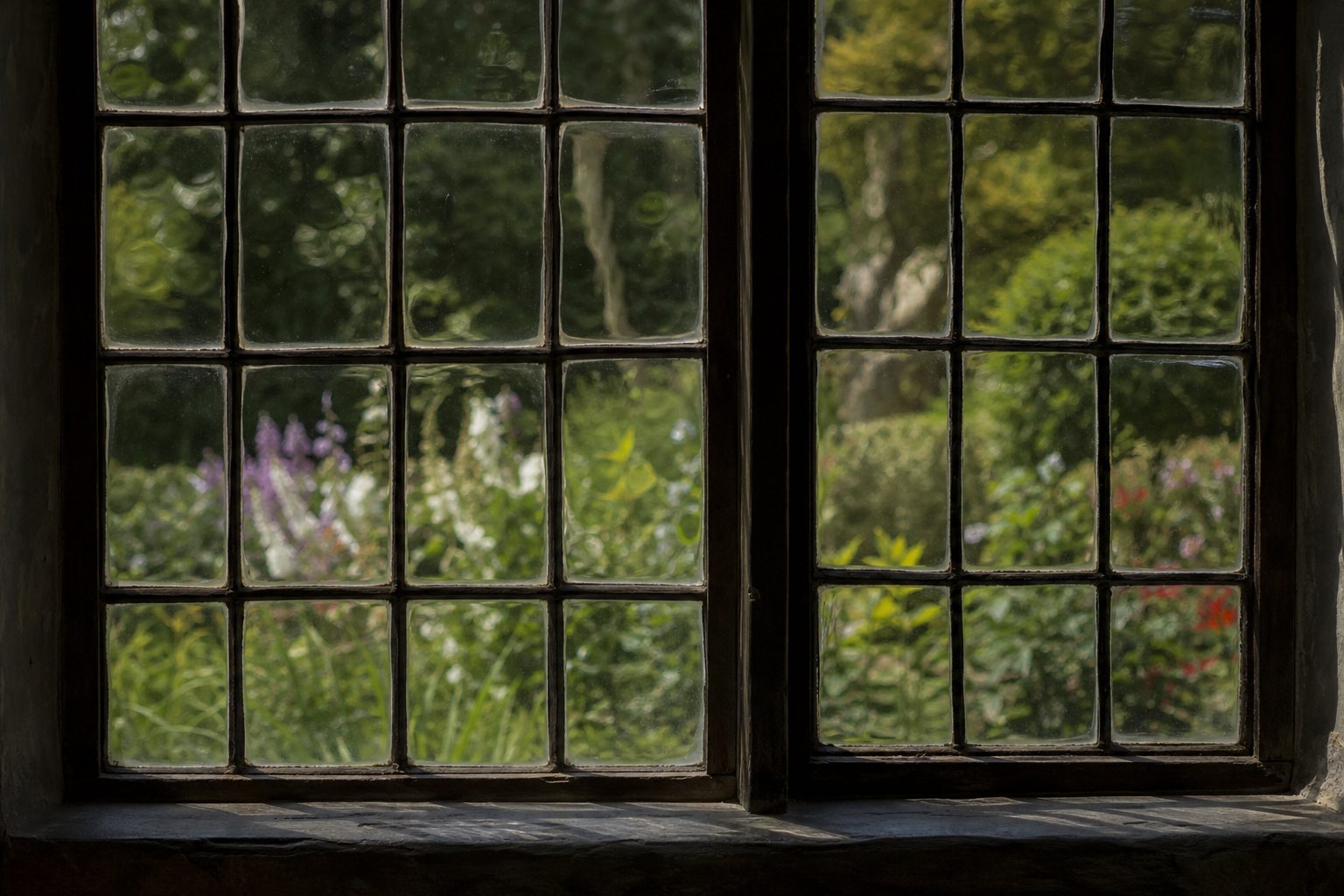
If glass is a frozen liquid, does it still flow? Old church windows are often thicker at the bottom, and people once said the glass had slowly sagged.
In 1998 the glass scientist Edgar Zanotto did the sum: at room temperature, window glass would take far longer than the age of the universe to flow noticeably.
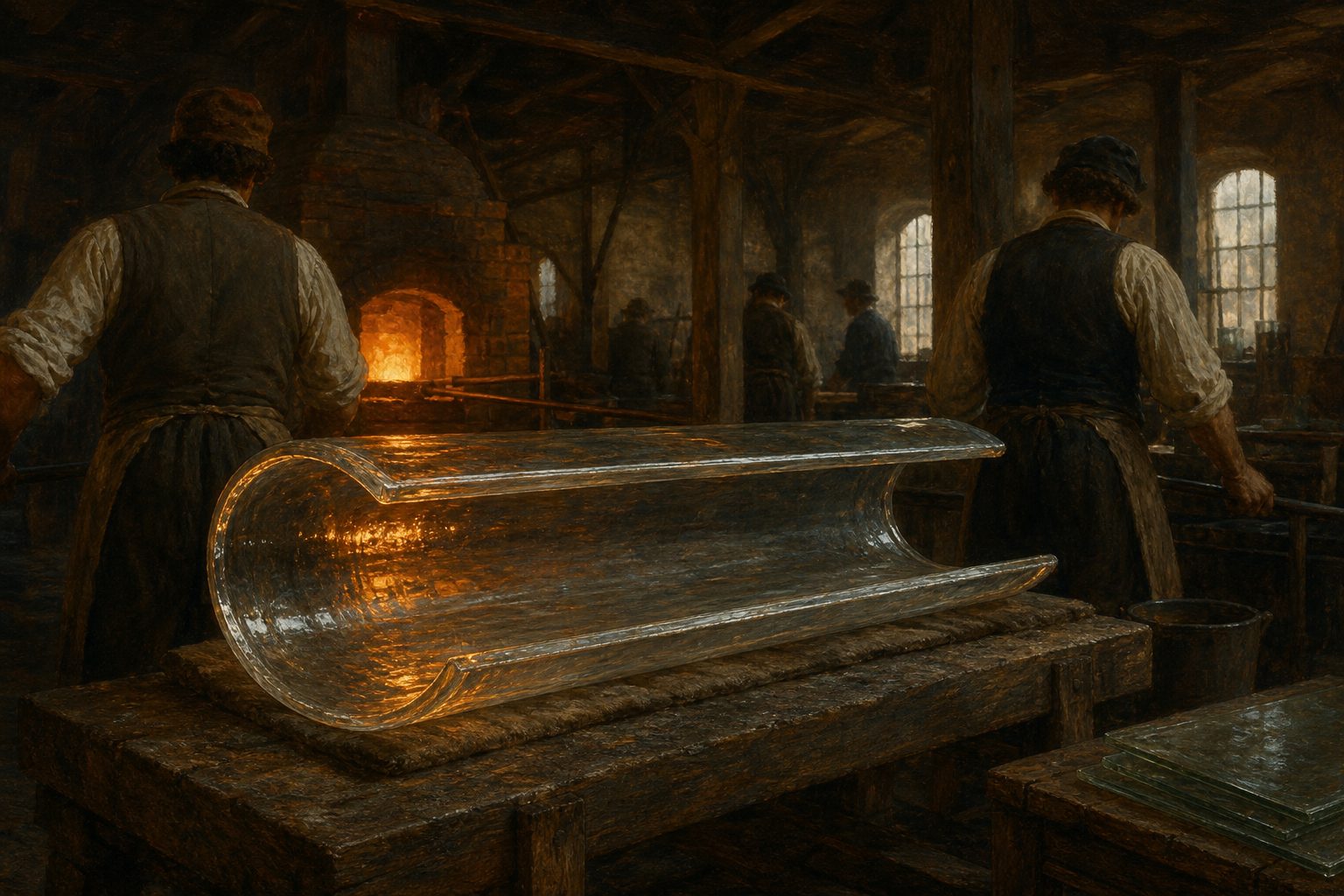
The real reason is how the panes were made: blown into a cylinder by hand, split, and flattened, so they were never even to begin with.
Wavy old panes Hand-made panes bend the view because their thickness varies across each piece. AI-generated illustration.
≥ ~10³² years
at least: relaxation time at room temperature, from germania (GeO₂) glass as a lower bound
~10¹⁰ years
age of the universe, for comparison
Zanotto, Am. J. Phys. (1998)Cylinder glass A blown cylinder was cut open and laid flat while soft, leaving one edge thicker than the other. AI-generated illustration.
Chapter I · A frozen jumble
The flowing-window myth
Zanotto, "Do cathedral glasses flow?", American Journal of Physics 66(5), May 1998 (Federal University of São Carlos): using germania glass as a lower bound, the room-temperature relaxation time is about 10³² years, and window glass would take longer still, well beyond the age of the universe (~10¹⁰ years). A later estimate by Zanotto and Gupta (1999) gives about 10²³ years. Cambridge DoITPoMS: the thicker bottoms come from how panes were made, by blowing a cylinder, splitting it and flattening it by hand.
The 3D scenes are simplified teaching models: atoms, light and stresses are drawn schematically and not to scale.
Why can we see through it? Light comes in tiny packets of energy called photons, and to absorb a photon, an electron in the material must jump to a higher energy level.
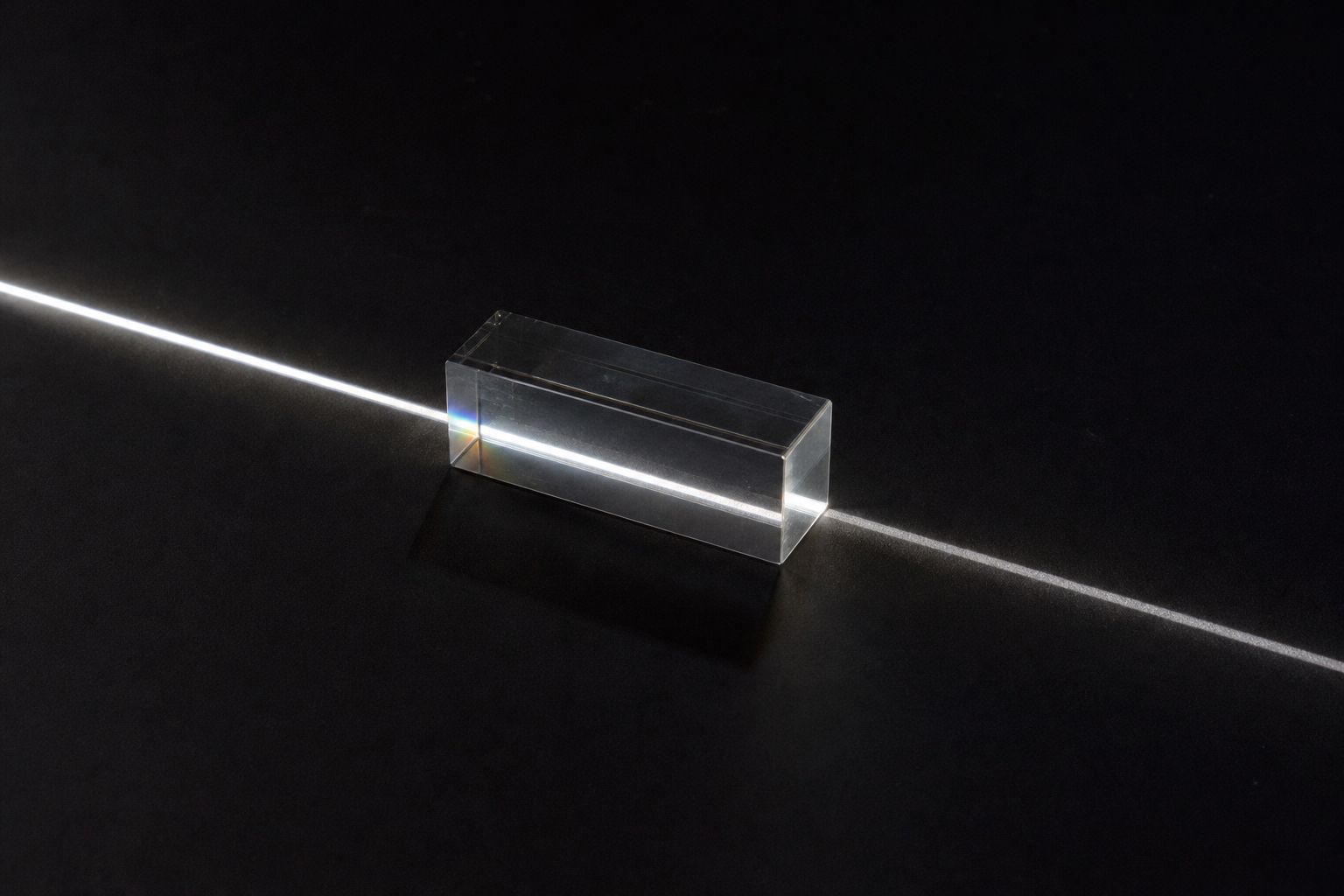
In glass, those jumps are too big for visible light. Its photons do not carry enough energy, so they pass straight through. Ultraviolet photons carry more, and are absorbed.
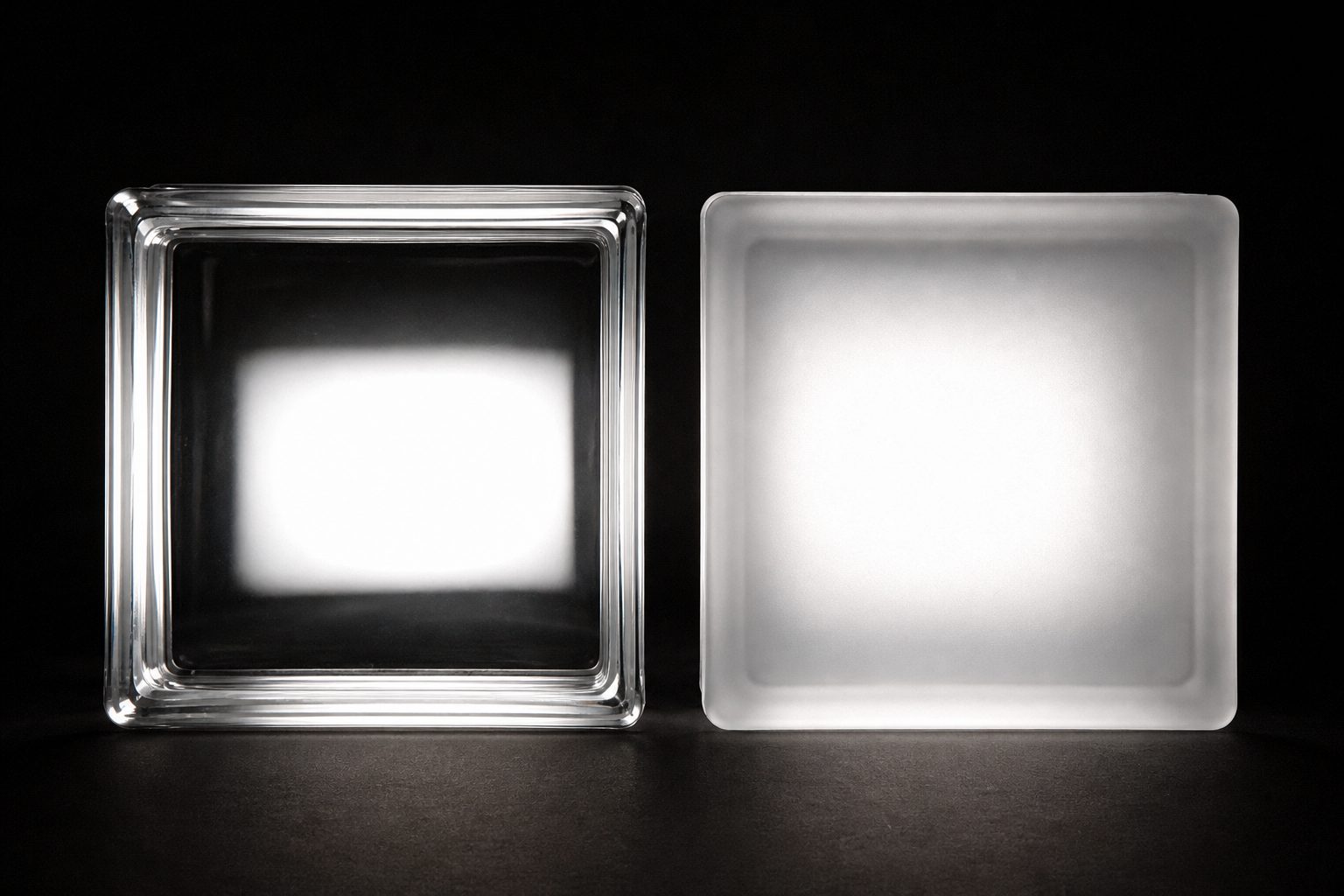
Order matters too. A block made of many tiny crystals scatters light at the boundaries between them. Glass has no such boundaries, so the beam goes on undisturbed.
Straight through A beam leaves a clear block almost exactly as it went in. AI-generated illustration.
energy gaps too large for visible photons
ultraviolet is absorbed
no grain boundaries to scatter light
Why glass is clear (Penn State)Ephoton<Egap⇒passes through
Ephoton
energy of the photon
Egap
smallest jump an electron can make
The rule for one photon (simplified) Visible photons fall short of the gap in glass; ultraviolet ones do not.Clear and frosted Roughen the surface and the same glass turns milky: light now scatters at countless tiny facets. AI-generated illustration.
Chapter II · Seeing through
Transparency
Penn State MATSE 81: in glass the energy gaps between electron levels are too large for photons of visible light, so visible light passes through while ultraviolet is absorbed. Crystalline quartz has grain boundaries and defects that scatter light, while amorphous glass is microscopically uniform.
The 3D scenes are simplified teaching models: atoms, light and stresses are drawn schematically and not to scale.
Nature made glass first: obsidian, the shiny black natural glass of some volcanoes.
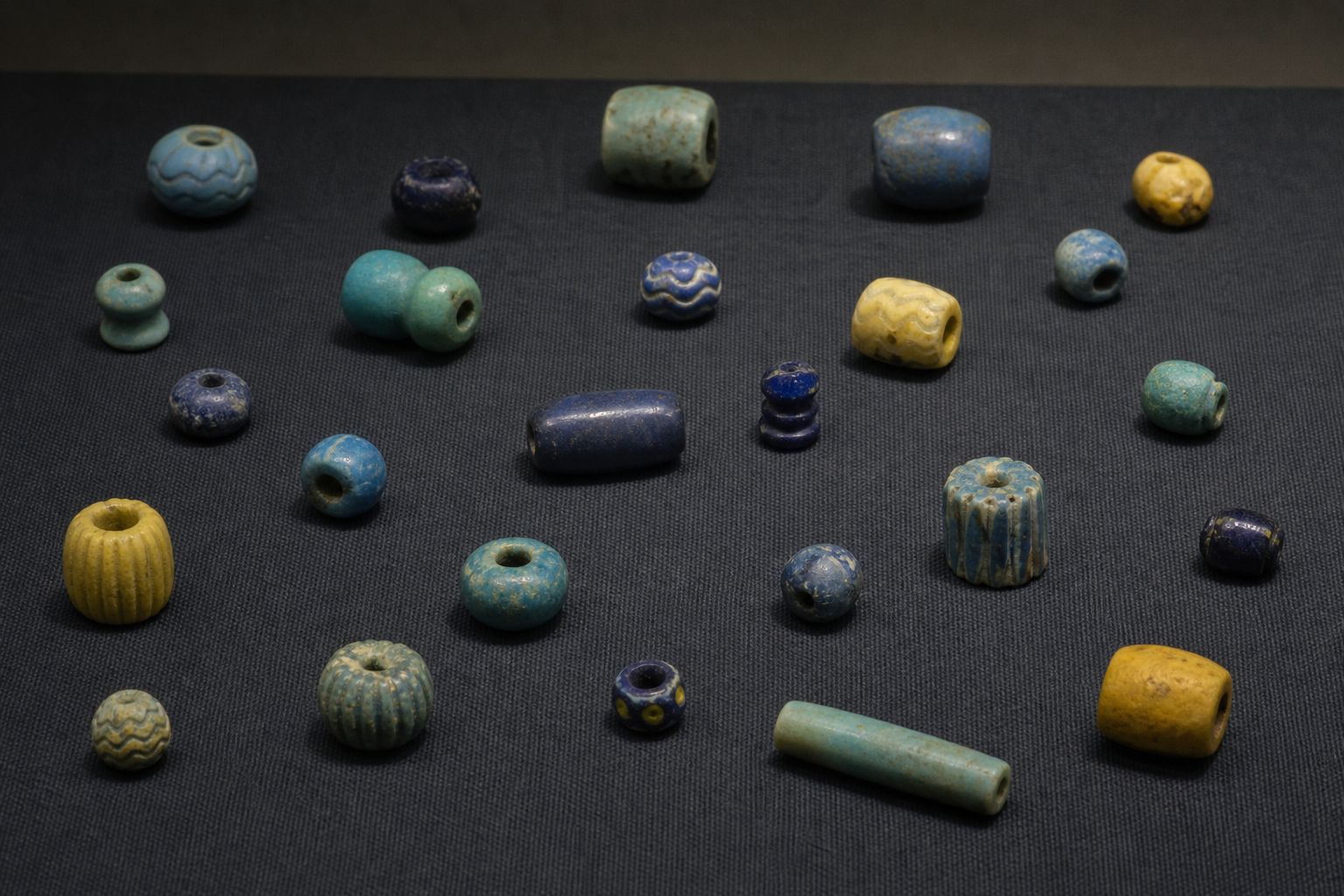
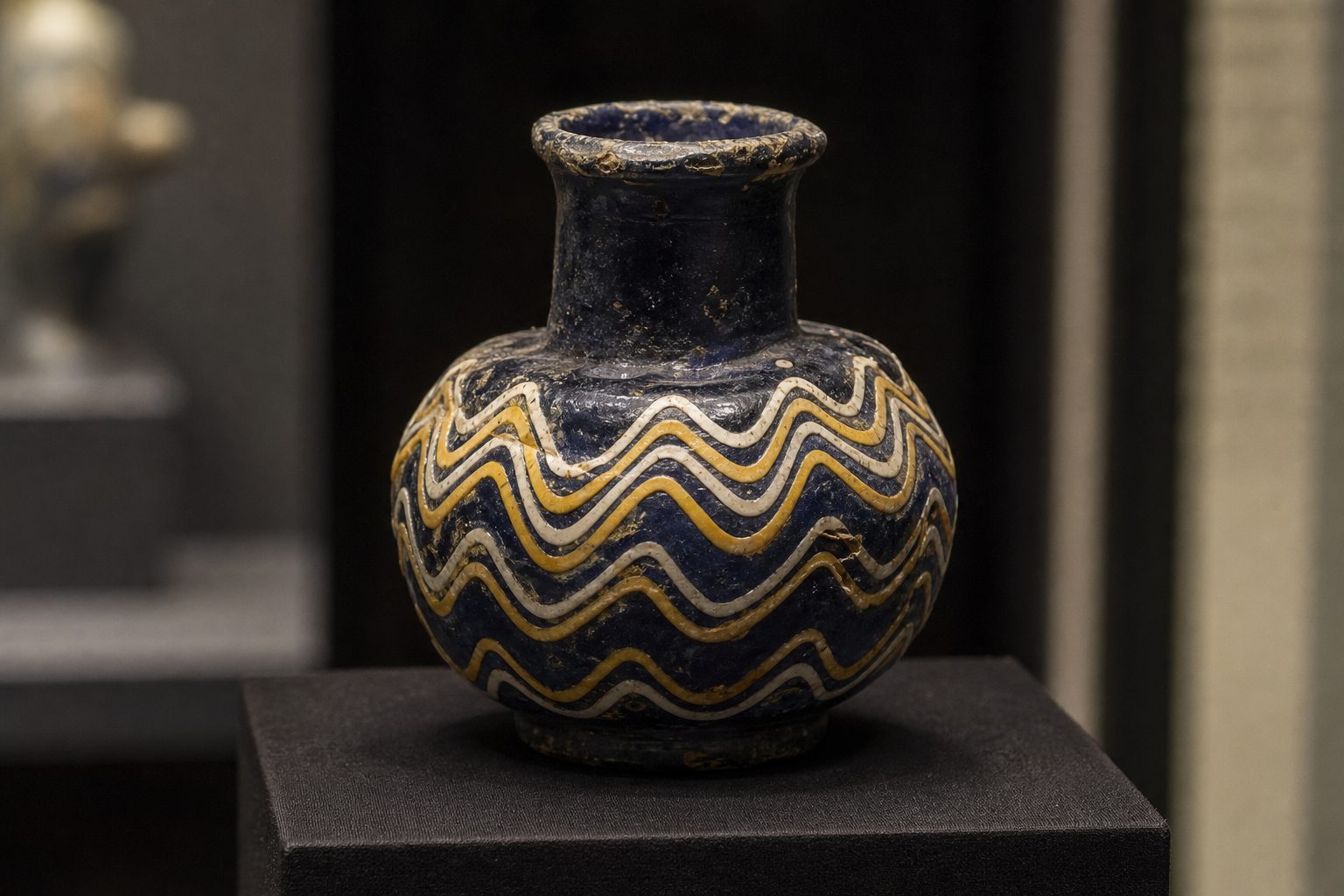
People learned to make it about four and a half thousand years ago, in Mesopotamia and Egypt, first as small beads. Vessels came roughly a thousand years later.
The ancient Egyptians had a name for it: the stone that pours.
And it does pour, if you can get it hot enough.
The first beads The earliest glass was used for beads, seals and architectural decoration (Kelsey Museum). AI-generated illustration.
~2500 BC beads, Mesopotamia and Egypt
~1500 BC first vessels spread
~50 BC glassblowing
Early glassMade around a core Early vessels were built up around a removable core and trailed with coloured threads of glass. AI-generated illustration.
Chapter III · Sand, soda and fire
The first glass
AMNH: obsidian is a natural volcanic glass of crystal-poor rhyolite, the most silica-rich lava. Kelsey Museum (University of Michigan): the earliest true glass dates to about 2500 BC in Mesopotamia, used for beads, seals and decoration, and vessels followed about a thousand years later. Britannica names Egyptian beads of about 2500 BCE as the earliest known glass objects; the Corning Museum of Glass places the first glassmaking in Mesopotamia, from sand, soda and lime. The Corning Museum blog notes that the ancient Egyptians called glass "the stone that pours".
Sources differ on whether the first glass was made in Mesopotamia or Egypt; both are named here.
But sand is hard to melt. Pure crystalline silica melts at about one thousand seven hundred degrees Celsius.
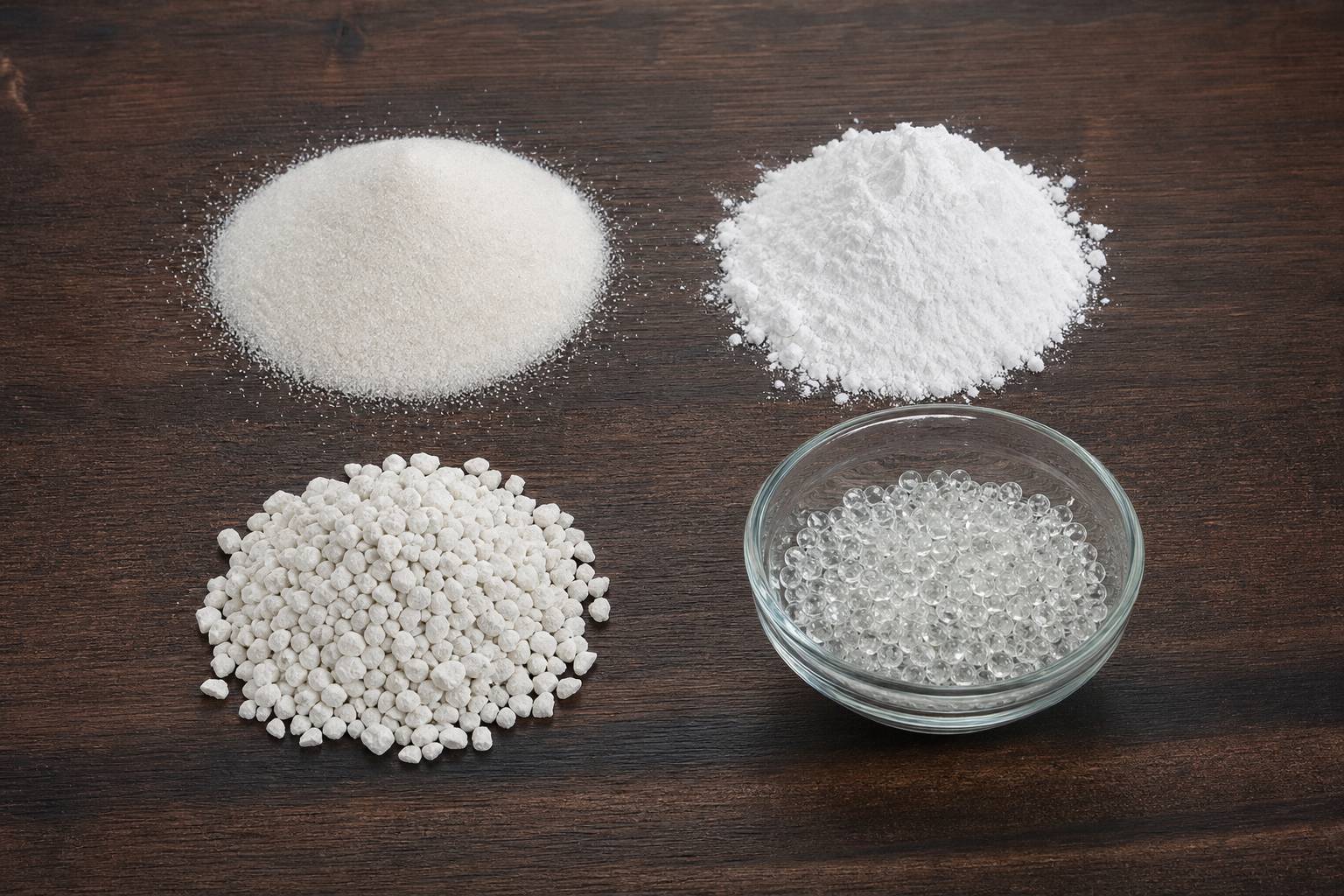
So glassmakers add a flux: a substance that lowers the melting temperature. For ordinary glass the flux is soda, sodium oxide from soda ash, and the glass softens at a temperature hundreds of degrees lower.
Too much soda, though, and water can attack the glass. Lime, calcium oxide from limestone, makes it durable again.
That is the trick the 2026 team used, with an organic molecule as the flux, one that also changes how their glass's atoms link up.
Sand, soda, lime Raw materials of ordinary glass: sand, soda ash and crushed limestone. AI-generated illustration.
~1,580 °C
fused silica glass
~695 °C
soda-lime glass
Softening point: where glass sags and can be shaped (Britannica)
silica, SiO₂
~70%
soda, Na₂O
~15%
lime, CaO
~9%
Soda-lime glass, approximate recipe (Britannica)
too much soda: water can attack it
lime and magnesia: make it durable
Durable glass (Britannica)
1,10-phenanthroline
an organic molecule mixed into MOF crystals before melting
The 2026 flux (Nature Materials)
Chapter III · Sand, soda and fire
Flux
Britannica: crystalline silica melts at 1,710 °C. Fused silica softens at 1,580 °C and soda-lime glass at 695 °C. Soda-lime glass is about 70% SiO₂, 15% Na₂O and 9% CaO: soda is a flux that lowers silica's melting temperature, and lime stabilises it. Too much soda makes glass easy for water to attack; lime and magnesia make it durable. In the 2026 study (Nature Materials) the flux was the organic molecule 1,10-phenanthroline, which also bound to the metal atoms and rearranged the network.
Crystalline silica melts at 1,710 °C; glass has no single melting point, so glassmakers quote its softening point, where it sags under its own weight and can be shaped.
The 3D scenes are simplified teaching models: atoms, light and stresses are drawn schematically and not to scale.
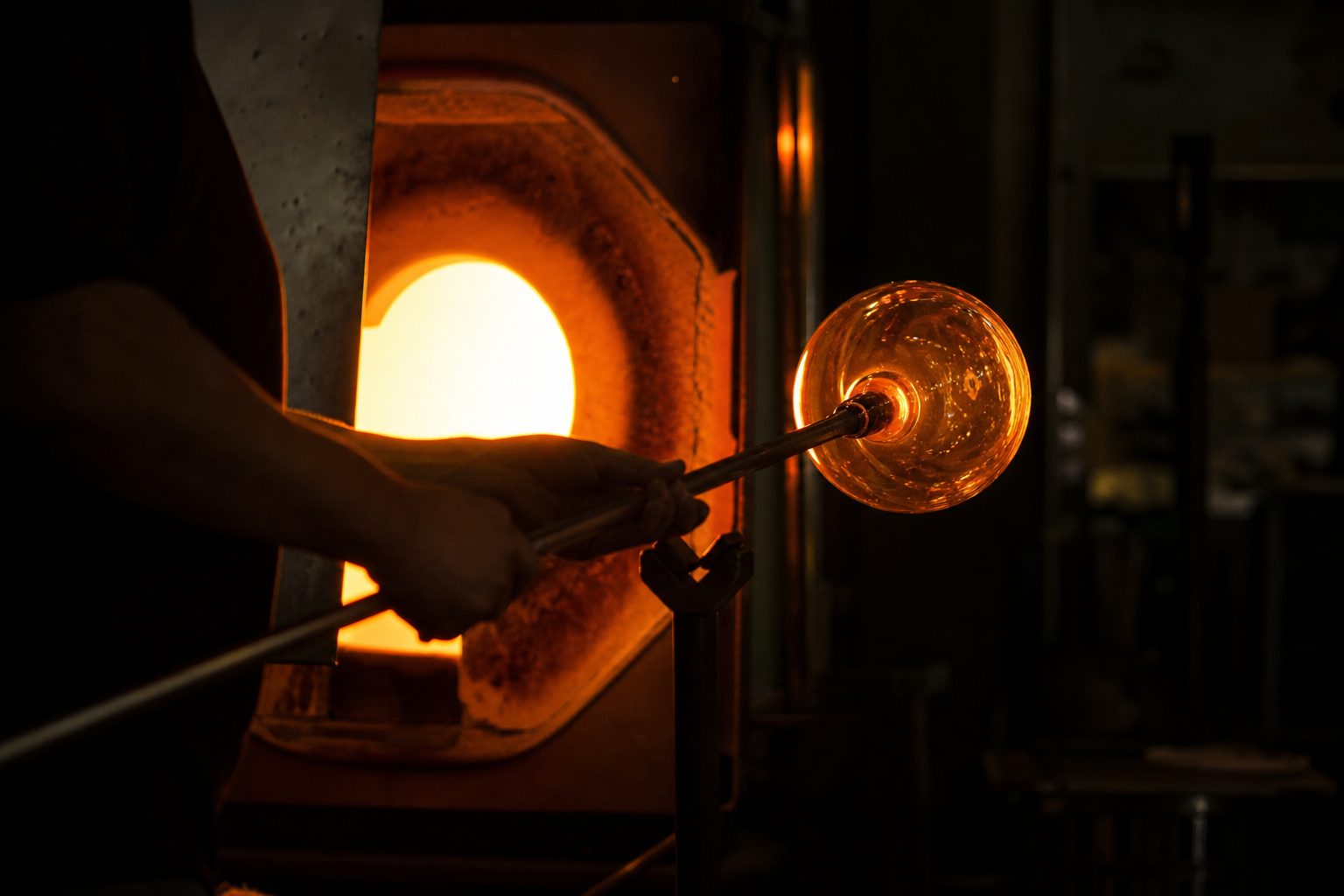
About two thousand years ago, almost certainly on the eastern shore of the Mediterranean, someone found that a gob of hot glass on a hollow pipe could be blown like a bubble.
Soon the region came under Roman rule, and Roman glassmakers went on to develop nearly all the major decorative techniques still used today.
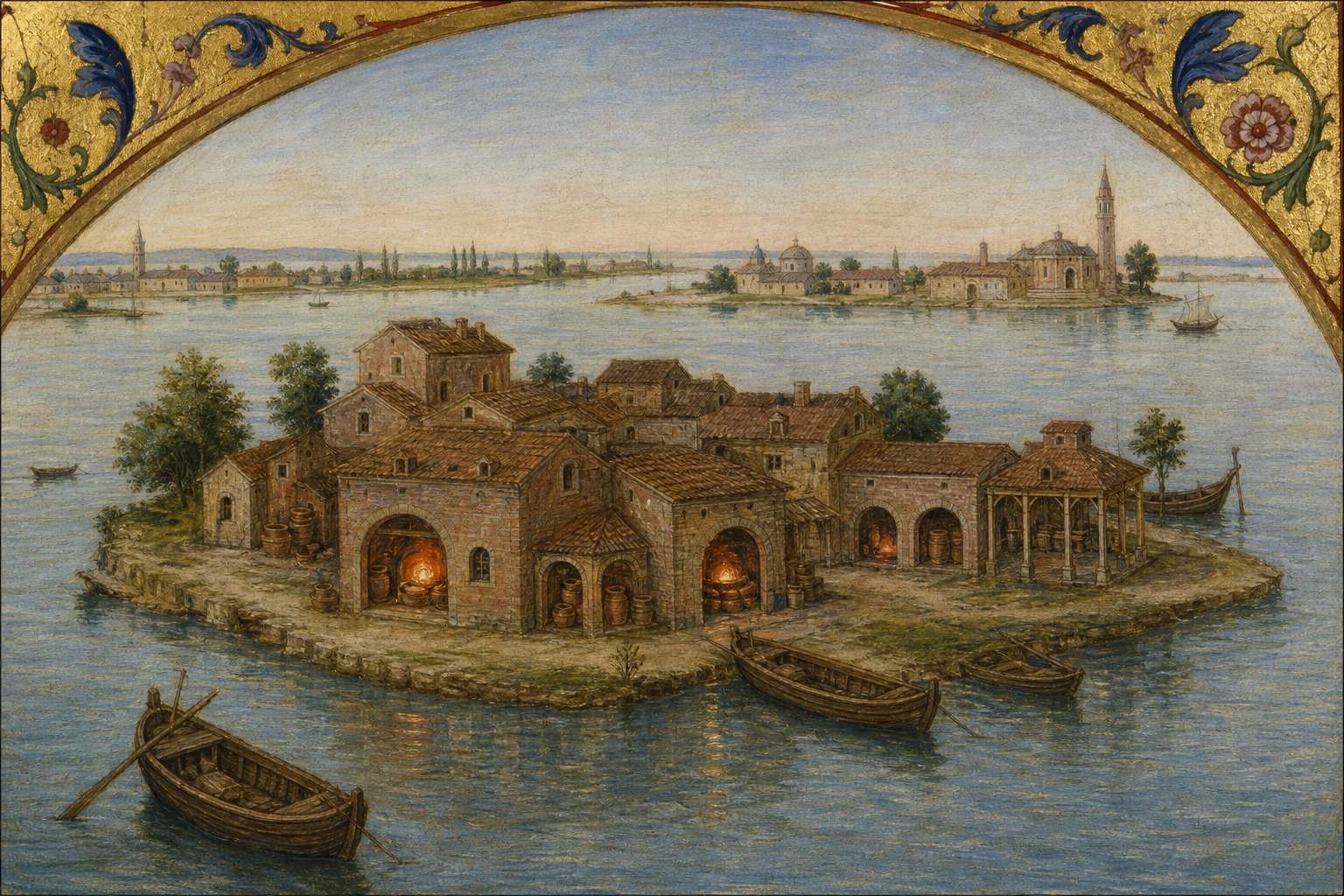
In 1291 Venice moved its glass furnaces to the island of Murano, to keep fire away from the city, and forbade its glassworkers to leave Venice.
62 BC Rome takes Syro-Palestine
~50 BC glassblowing, Syro-Palestine
1291 Venice moves furnaces to Murano
Blowing and beyond (Kelsey, Britannica)Blown glass Blowing needs a furnace kept burning continuously, so the glass stays soft (Kelsey Museum). AI-generated illustration.The glass island Murano's makers became known for clear cristallo glass, made with soda (Britannica). AI-generated illustration.
Chapter III · Sand, soda and fire
Glassblowing
Kelsey Museum (University of Michigan): glassblowing was invented about 50 BC, almost certainly in Syro-Palestine, and needed a continuously fired furnace; the earliest depiction is on a 1st-century BC lamp from Split, Croatia. Rome took Syro-Palestine in 62 BC and Egypt in 30 BC, and Roman makers developed nearly all the major decorative techniques used today. Britannica: in 1291 Venice moved its furnaces to Murano to reduce the risk of fire; glassworkers were forbidden to leave or to share their methods, and clear cristallo glass was made with soda.
The 3D scenes are simplified teaching models: atoms, light and stresses are drawn schematically and not to scale.
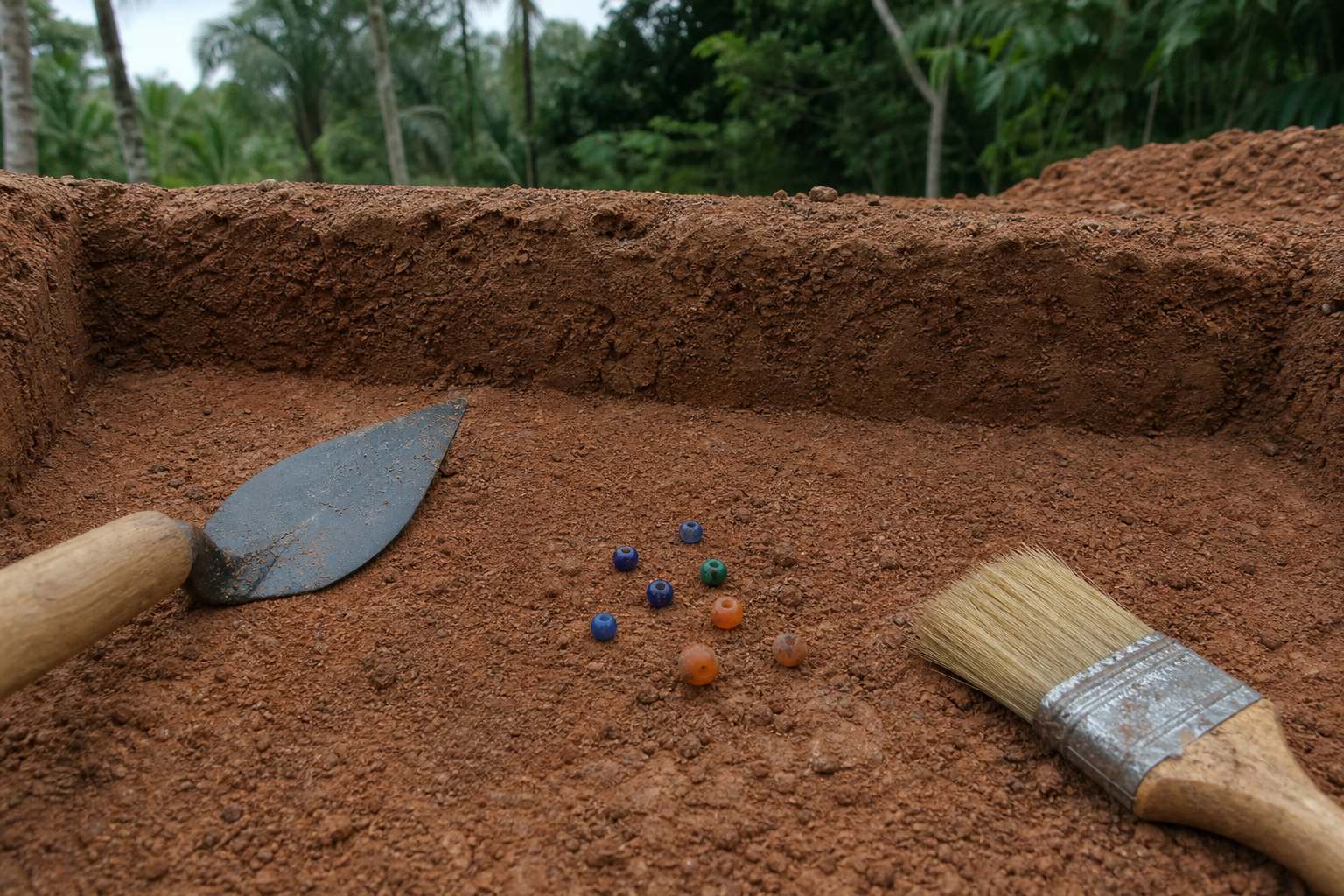
Glass travelled far. At Ban Don Ta Phet, in Kanchanaburi, archaeologists found Iron Age glass beads alongside beads of carnelian, a red-orange stone.
They date from the fourth to the second century BC, and show trade links with India.
In southern Thailand, in Chumphon, the port of Khao Sam Kaeo traded glass and stone beads with India and Vietnam from the same late centuries BC.
Glass and carnelian Etched carnelian and agate beads were found with the glass beads, evidence of links to India (bead research). AI-generated illustration.
4th–2nd c. BC
glass and etched stone beads in Iron Age burials
1975–2000
years of excavation
Ban Don Ta Phet (bead research)A port of trade Finished and unfinished beads were found at Khao Sam Kaeo; local making is documented for its stone beads. AI-generated illustration.
Chapter III · Sand, soda and fire
Glass beads in Iron Age Thailand
Cambridge University Press: Ban Don Ta Phet in Kanchanaburi is an Iron Age burial site excavated from 1975 to 2000. Bead research: its glass beads and etched carnelian and agate beads date to the 4th–2nd centuries BCE and show trade networks with India. At the port-city of Khao Sam Kaeo in southern Thailand, intensive trade in glass and stone beads linked Thailand with India and Vietnam from the late centuries BCE; complete and unfinished glass beads were found there, but local manufacture is documented for stone beads only.
The 3D scenes are simplified teaching models: atoms, light and stresses are drawn schematically and not to scale.
Before float glass, truly flat glass meant grinding and polishing it, slowly and wastefully.
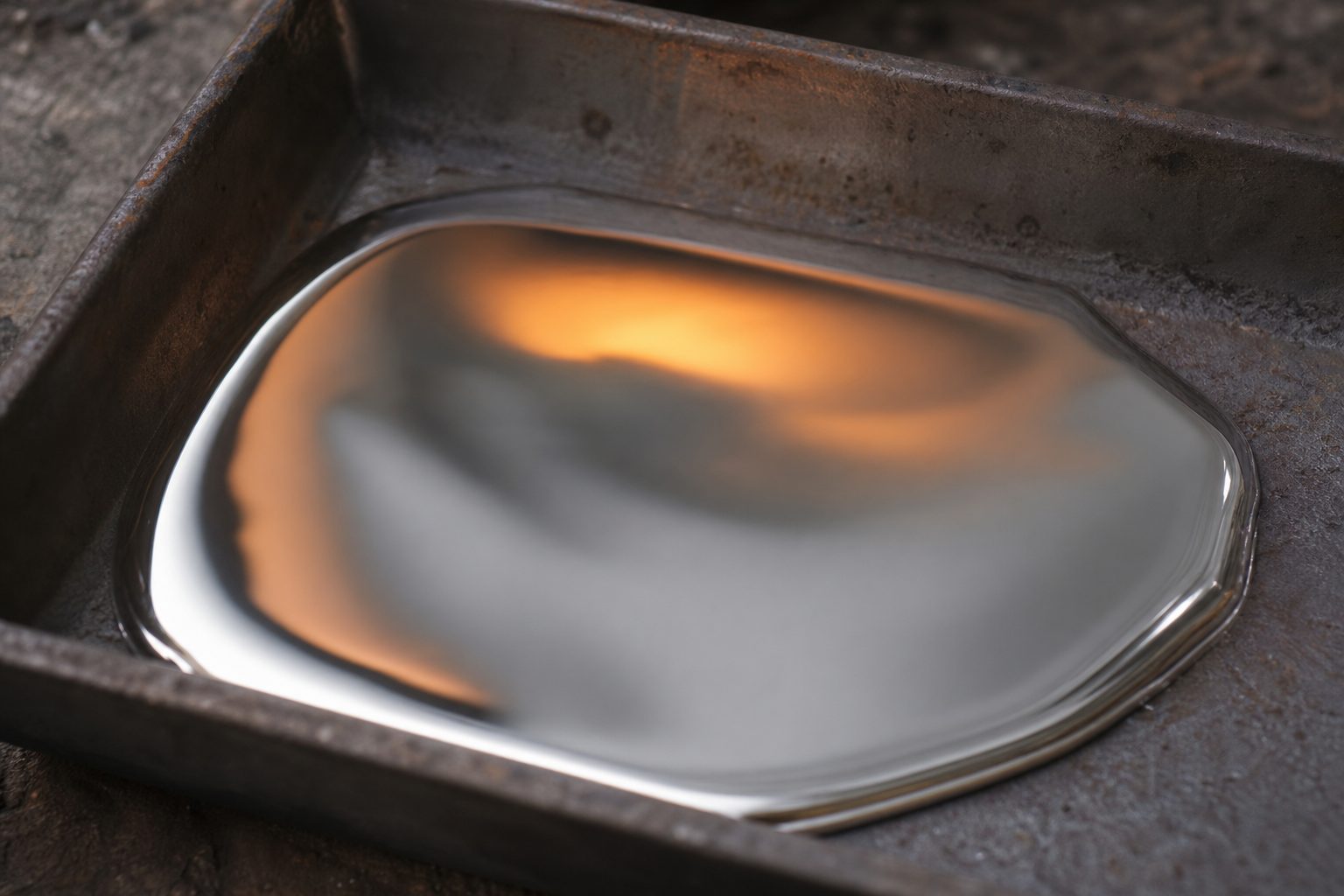
In the early 1950s Alastair Pilkington had a better idea, announced in 1959: pour the molten glass onto a bath of molten tin.
The glass floats on the metal like oil on water, and spreads into a ribbon that is flat, with both faces parallel and polished by the heat itself.
Today there are about two hundred and sixty float plants around the world.
Molten tin A bath of molten metal, mirror-smooth: the surface the glass will rest on. AI-generated illustration.
1959
process announced
1962
first licence, to PPG in the US
Float glass (Pilkington)
1962–63
after years of trials
Reliable production (Pilkington)
Chapter IV · Flat and tough
The float process
Pilkington: Alastair Pilkington had the idea in the early 1950s and the float process was announced in 1959. A ribbon of molten glass floats on a bath of molten tin, giving flat, parallel, fire-polished surfaces. It became reliable by 1962–63; the first licence went to PPG in 1962, and about 260 float plants now exist.
The 3D scenes are simplified teaching models: atoms, light and stresses are drawn schematically and not to scale.
Ordinary glass has a weakness. Heat it on one side, and that side expands while the rest does not. The strain can crack it.
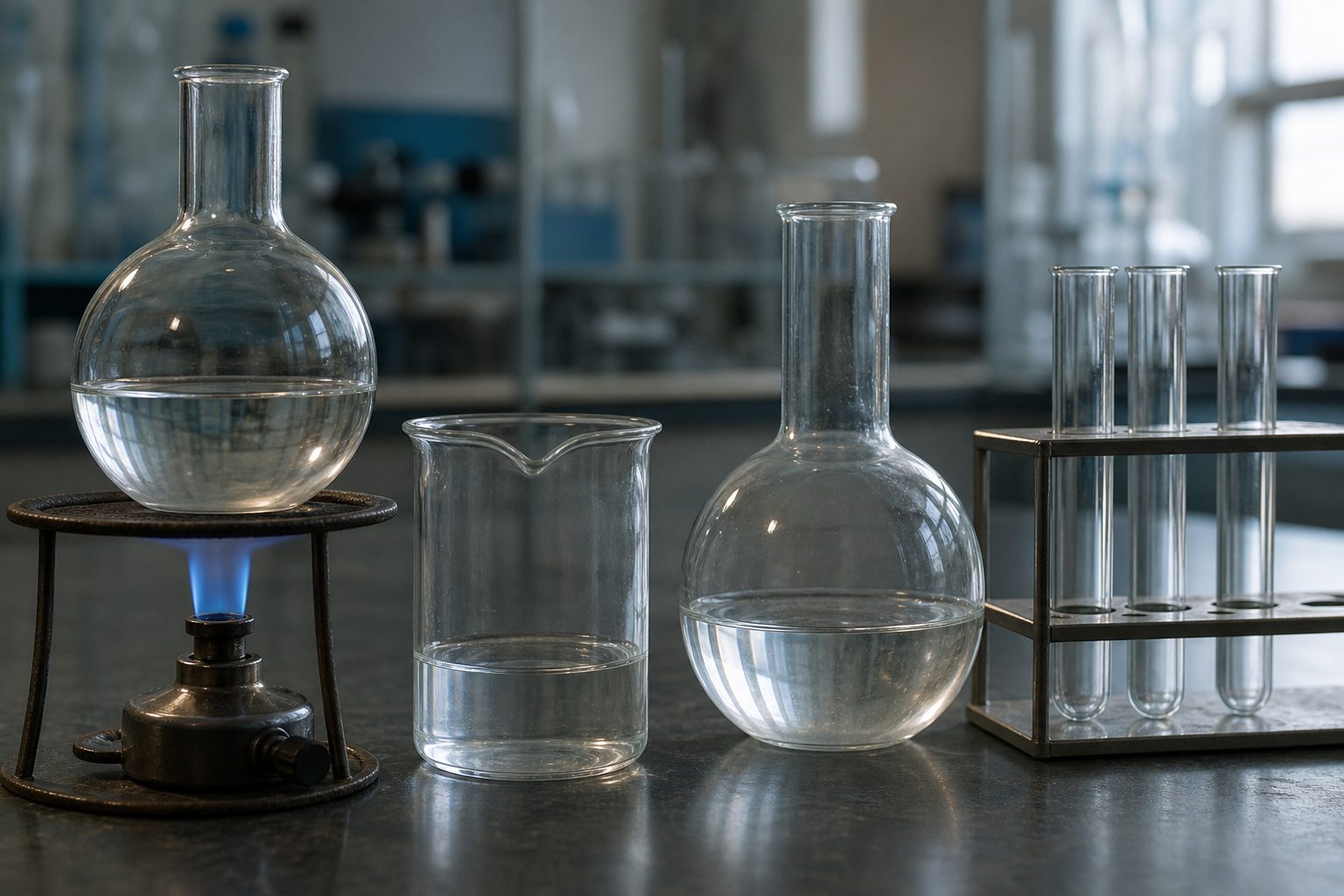
In 1893 Otto Schott, in Jena, launched a glass containing boron oxide. Borosilicate glass expands only about a third as much as soda-lime glass. Change the recipe, and you change the glass: the same lesson the 2026 team used.
Corning in the United States made its own borosilicate for railway lamps, then sold it as kitchenware from 1915. Today we meet it in lab flasks and oven dishes.
From oven to table Less soda means less expansion, and less cracking when the temperature changes (RSC). AI-generated illustration.
soda-lime glass
1
borosilicate glass
~⅓
How much it expands (Britannica)
1884
Schott and Ernst Abbe found their glass laboratory
Jena (RSC)Lab glass Pyrex is about 80% silica and 13% boron oxide, with little soda (RSC). AI-generated illustration.
Chapter IV · Flat and tough
Borosilicate glass
Royal Society of Chemistry: Otto Schott, who founded a laboratory in Jena with Ernst Abbe in 1884, launched borosilicate thermometer glass in 1893; Corning developed it first for railway lamps and launched it as kitchenware in 1915. A typical composition is about 80.6% SiO₂, 13% B₂O₃, 4% Na₂O and 2.3% Al₂O₃; less soda means less expansion and less cracking. Britannica: borosilicate glass expands about one-third as much as soda-lime glass.
The 3D scenes are simplified teaching models: atoms, light and stresses are drawn schematically and not to scale.
Glass breaks when a crack can open. So the trick to toughening it is to squeeze its surface shut.
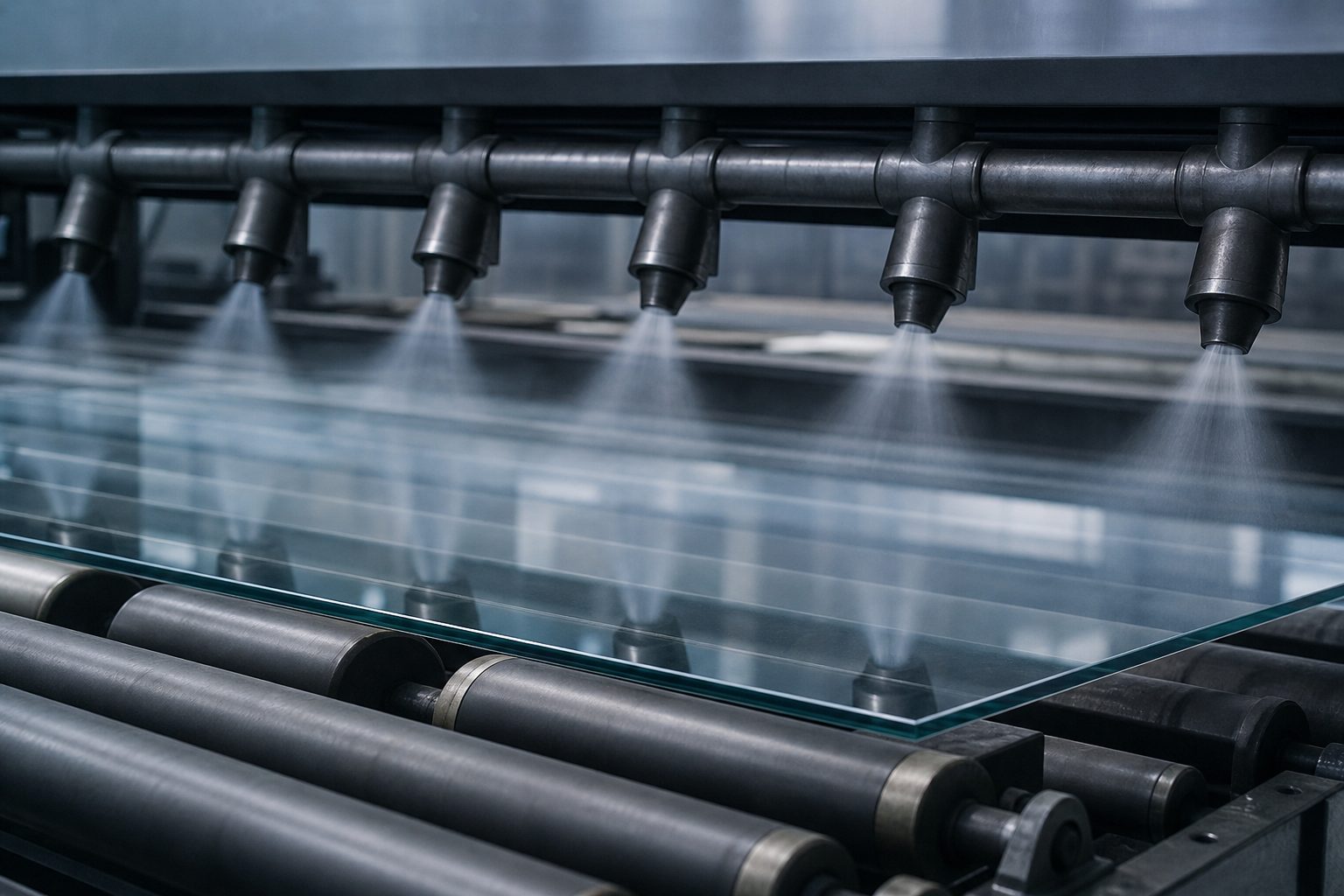
To temper a pane, it is heated above six hundred degrees, then blasted with cold air for a few seconds. The surface ends up squeezed, in compression, while the core is pulled, in tension.
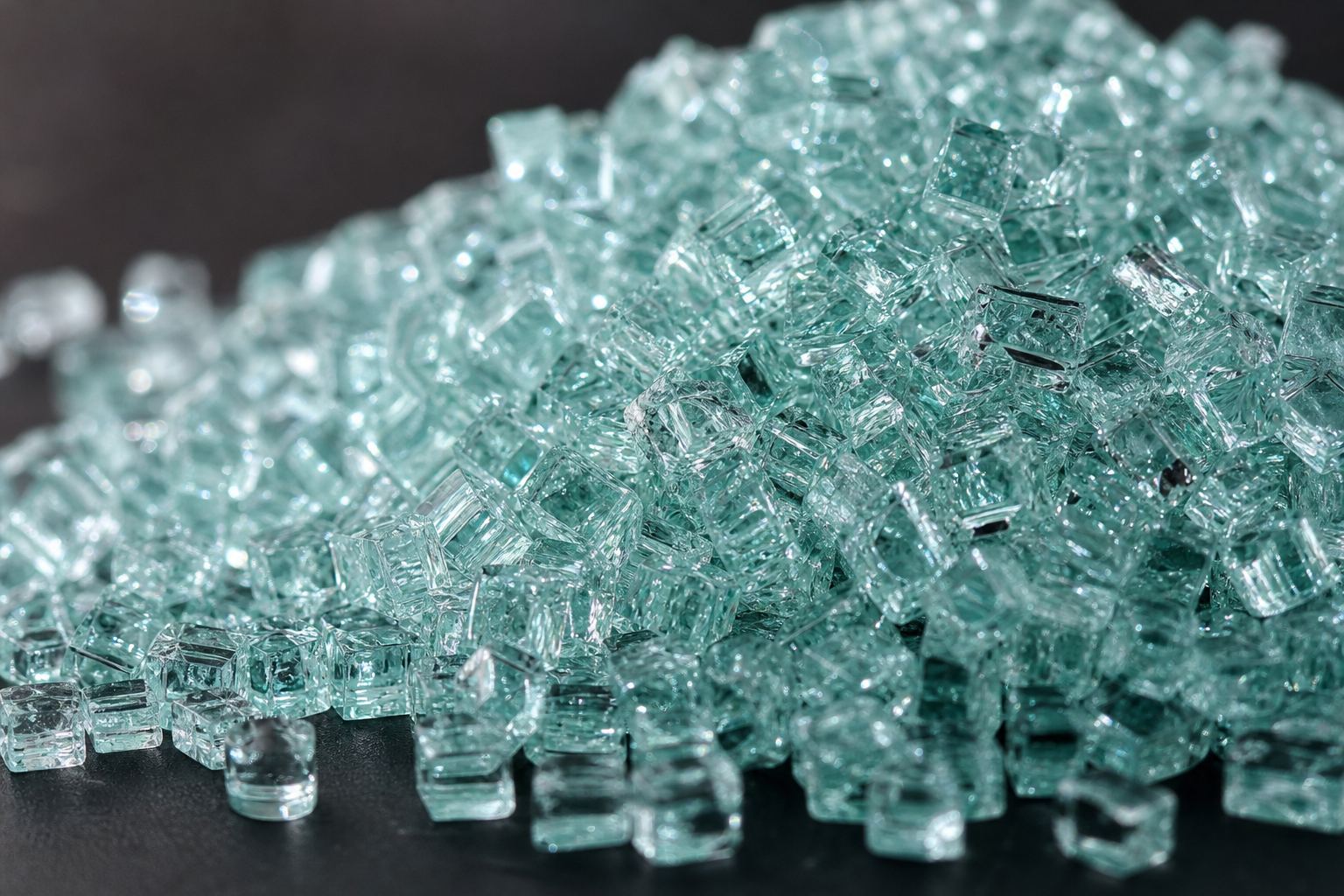
Tempered glass is about four times as strong. And when it does break, it falls into small, fairly harmless pieces.
The quench Heated above 600 °C (620 °C is standard), the pane meets seconds of cold air (Scientific American). AI-generated illustration.
surface: in compression
core: in tension
A tempered pane (Scientific American)
~6,000 psi
ordinary (annealed) glass
~24,000 psi
tempered glass
Breaking strength (Scientific American)Safety glass Tempered glass breaks into blunt, cube-like pieces instead of long shards. AI-generated illustration.
Chapter IV · Flat and tough
Tempered glass
Scientific American: tempered glass is heated above 600 °C (620 °C is the standard) and then blasted with air for a few seconds, leaving the surface in compression and the core in tension. Annealed glass breaks at about 6,000 psi and tempered glass at about 24,000 psi, roughly four times stronger, and it breaks into small, relatively harmless pieces.
The 3D scenes are simplified teaching models: atoms, light and stresses are drawn schematically and not to scale.
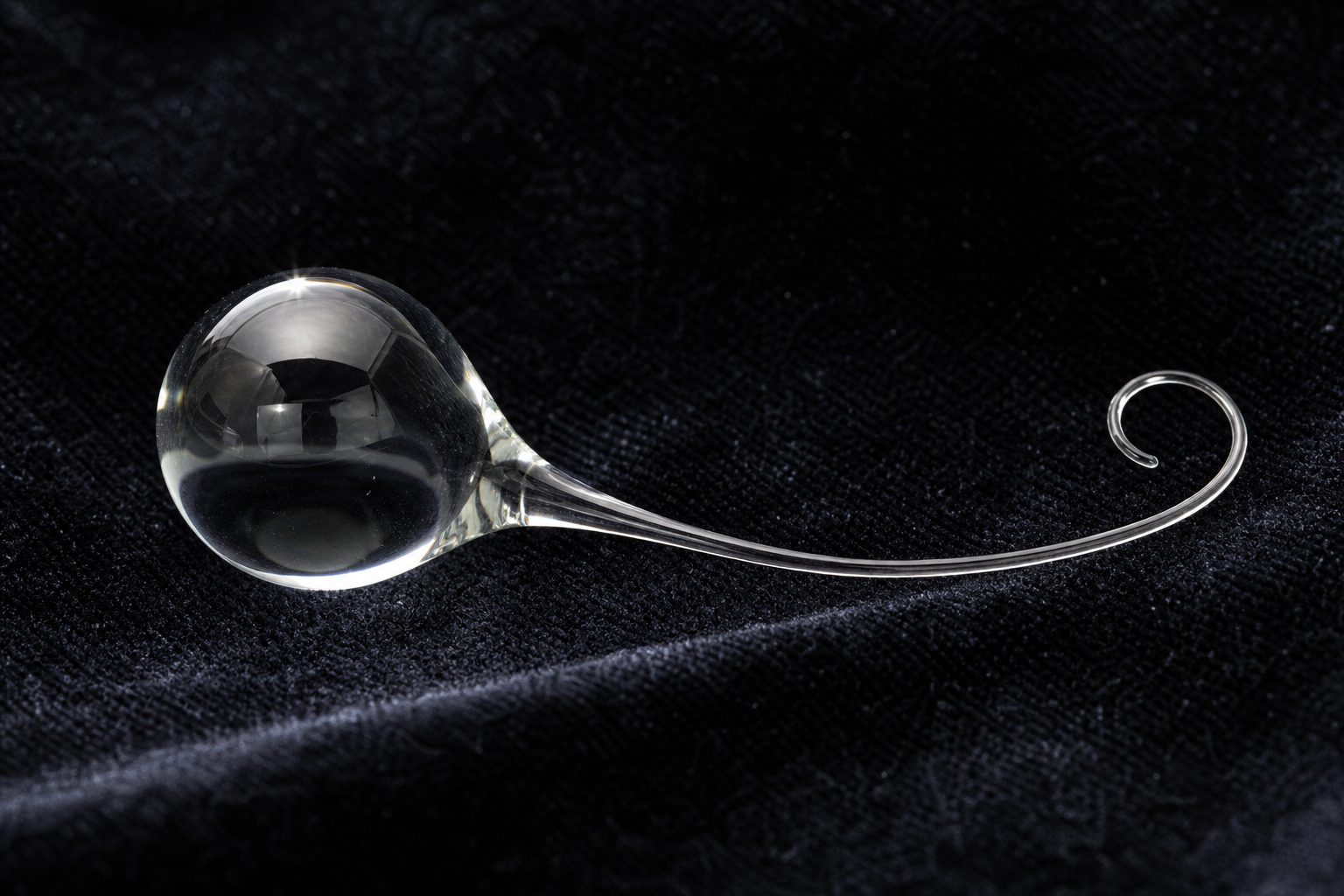
Taken to an extreme, the same idea makes a famous curiosity: the Prince Rupert's drop, a blob of molten glass dropped into cold water.
Its round head is astonishingly hard to break. In 2016 researchers measured why: its surface is squeezed with up to seven hundred megapascals of compression.
But snap the thin tail, and a crack races toward the head at more than four thousand miles an hour, and the whole drop shatters.
The drop A drop is only a few centimetres long: a round head and a hair-thin tail. AI-generated illustration.
400–700 MPa
compression in the head
up to ~50 t/in²
the same stress in tons per square inch
Measured (Applied Physics Letters, 2016)
head: squeezed, very hard to break
tail: thin, the weak point
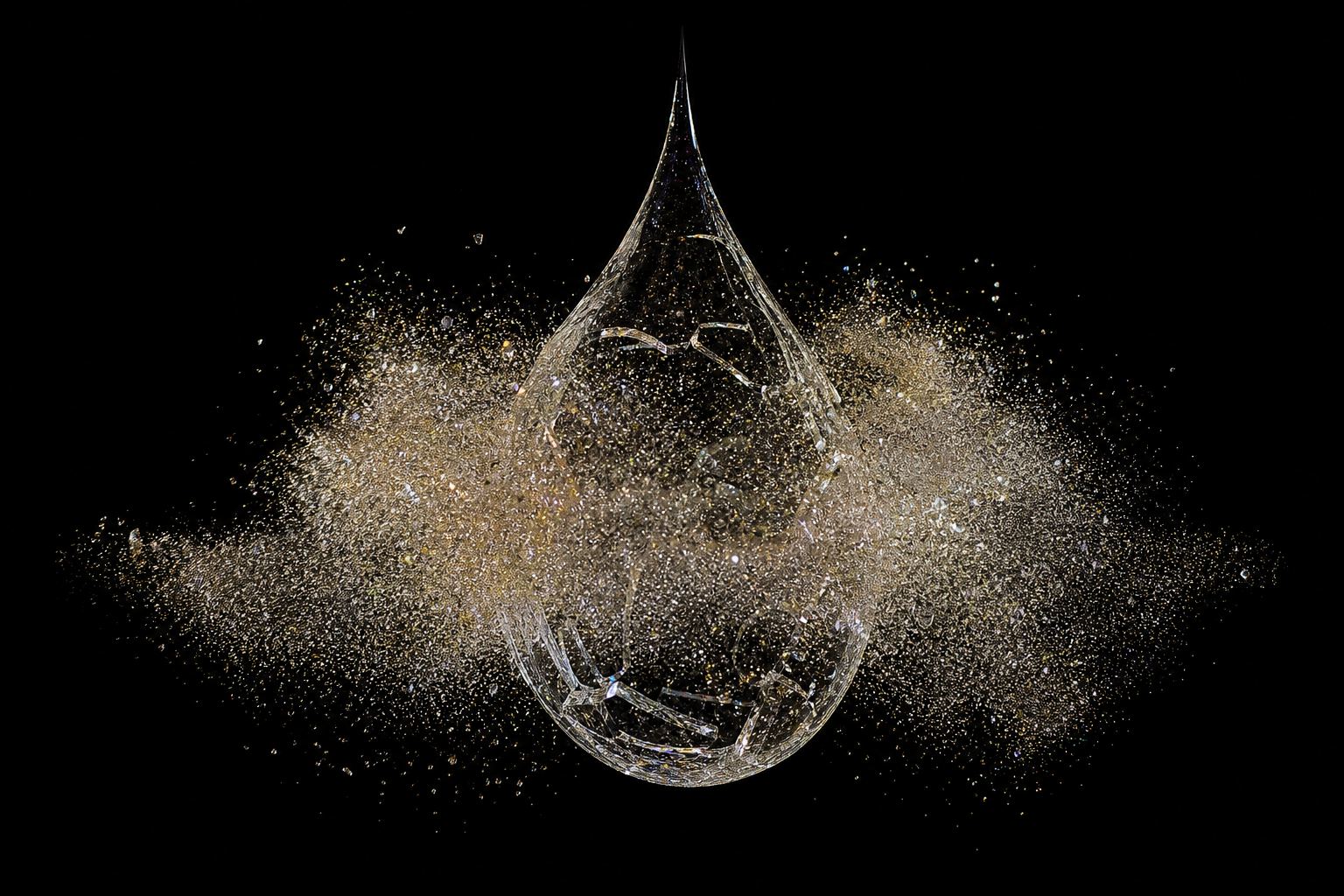
One drop, two extremesShattered The crack-speed measurement goes back to Chandrasekar and Chaudhri in 1994 (Purdue). AI-generated illustration.
Chapter IV · Flat and tough
Prince Rupert's drops
Purdue University (2017), reporting work by Tallinn University of Technology, Purdue and Cambridge published in Applied Physics Letters (2016): a drop made by dropping molten glass into cold water carries 400–700 MPa of compressive stress in its head, up to about 50 tons per square inch. Purdue also cites Chandrasekar and Chaudhri (1994), who found that cracks starting in the tail travel toward the head at more than 4,000 mph (over 6,400 km/h).
The 3D scenes are simplified teaching models: atoms, light and stresses are drawn schematically and not to scale.
Glass can even carry light along hair-thin threads: in 1970, Corning made the first optical fibre clear enough for telephone networks.
And glass can be born again. Broken glass, called cullet, can go straight back into the furnace.
Every ten percent of cullet in the mix cuts the furnace's energy by about two and a half to three percent, and saves soda too.
Glass fibres Fibres are drawn from fused silica, with small amounts of fluorine or germanium added (Britannica). AI-generated illustration.
17 dB/km
Corning's fibre, beating a target of about 20 dB/km; dB/km measures how much light is lost per kilometre
1970 (IEEE Milestone)
2.5–3%
less furnace energy per extra 10% of cullet
~1 GJ/t
saved by needing less soda ash
Recycling (CTCN, 130-furnace benchmark)
Chapter V · Born again
Fibre and recycling
IEEE Milestone: Maurer, Keck and Schultz at Corning made the first low-loss optical fibre in 1970, at 17 dB/km, against a British Post Office target of about 20 dB/km. Nobel Prize 2009: half of the physics prize went to Charles K. Kao "for groundbreaking achievements concerning the transmission of light in fibers for optical communication". Climate Technology Centre and Network: in a benchmark of 130 furnaces, each extra 10% of cullet cut furnace energy by about 2.5–3%, and needing less soda ash saves about 1.0 GJ per tonne.
The 3D scenes are simplified teaching models: atoms, light and stresses are drawn schematically and not to scale.
So glass is not really one material. It is a way for a solid to be: atoms frozen in place before they could find their pattern.
That is why chemists can make glass from metal ions and organic molecules too. The 2026 trick even worked on frameworks that normally cannot be melted, and its makers see possible uses in catalysts, sensors and batteries.
The window in front of you is made of the same stuff as sand. What else is waiting to be frozen into glass?
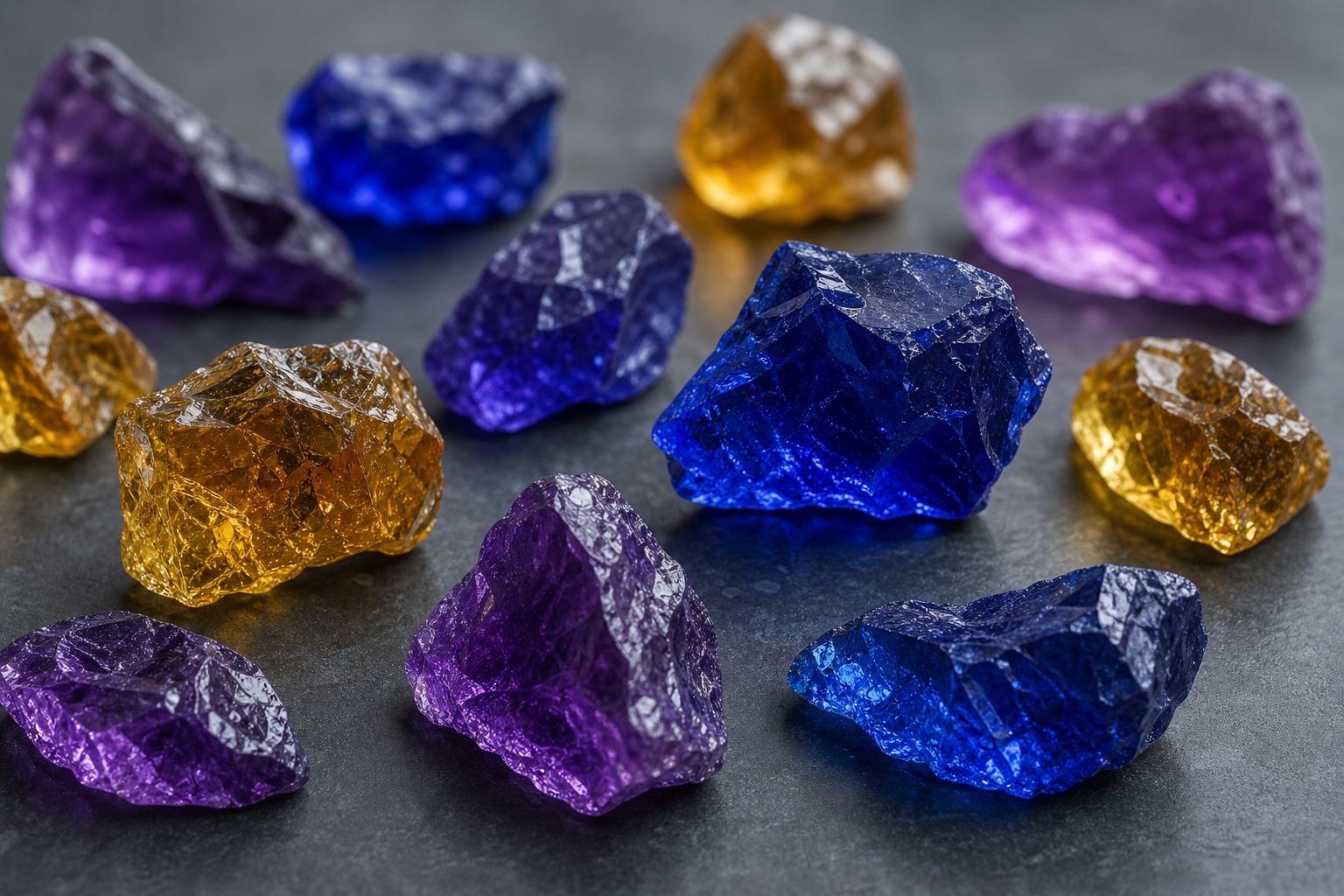
Hybrid glasses An artist's still life of hybrid glass: metal ions held in a network of organic molecules. AI-generated illustration.
catalysts and sensors
optoelectronics
gas storage and batteries
Possible uses of MOF glasses (Paderborn, Oxford)
silica glass: silicon and oxygen
MOF glass: metal ions joined by organic links
both: frozen with no repeating pattern
Two glasses (schematic in 3D)
Epilogue · Sources
Sources
Every fact in this film comes from the sources below. Where sources differ, as on whether the first glass was made in Mesopotamia or Egypt, both are named. The 2026 study is a new result in a young field and is reported here as its authors describe it. The chapter stills and pictures are AI-generated illustrations and show no real people or objects. The atoms, light, furnace, panes and drop in the 3D scenes are simplified teaching models, not to scale.