Britain lights its Bonfire Night fireworks on 5 November, remembering the Gunpowder Plot of 1605, and Diwali follows on 8 November 2026. This film explains the established chemistry behind every burst: black powder, discovered by Chinese alchemists in the 9th century, and why a mixture of saltpetre, charcoal and sulfur burns so fast; how an aerial shell is launched from a mortar and timed to burst; how heated atoms of strontium, barium, copper and sodium give off their own colours, and why blue is the hardest; where the white sparks, the bangs, the crackles and the whistles come from; and what fireworks leave behind, from smoke and perchlorate to injuries, with the cleaner chemistry chemists are working on.
Interactive 3D film8 min800s to 2026Published 4 November 2026
How black powder, paper shells and heated atoms make a firework.
On the fifth of November, Britain lights the sky for Bonfire Night. Three days later, on the eighth of November 2026, millions celebrate Diwali, and fireworks are part of that night too.
Each burst lasts a second or two. Behind it is a thousand years of chemistry: a fast-burning powder, a timed paper shell, and atoms that glow in their own colours. And one colour has always been the hardest to make: blue.
Here is how fireworks work.
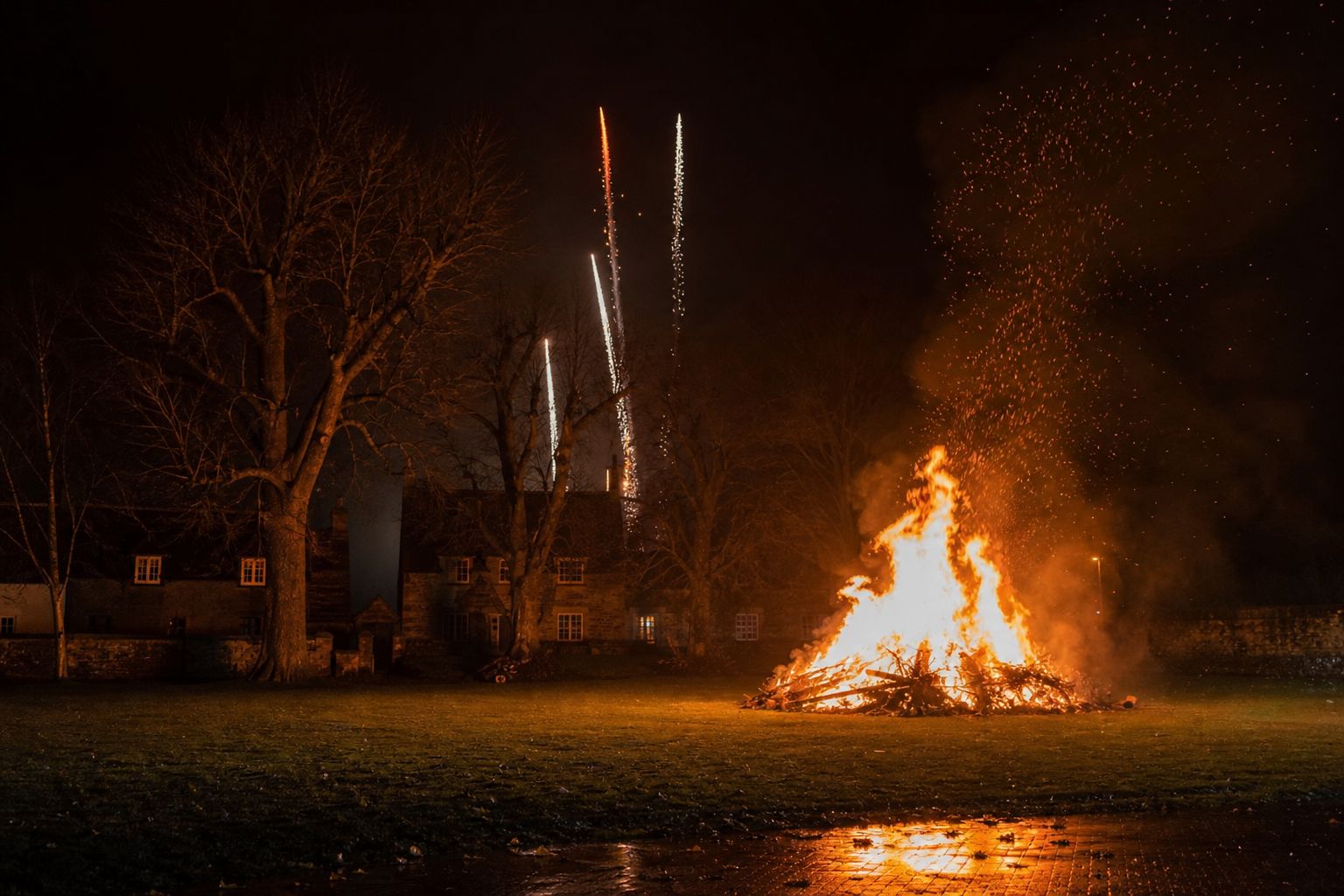
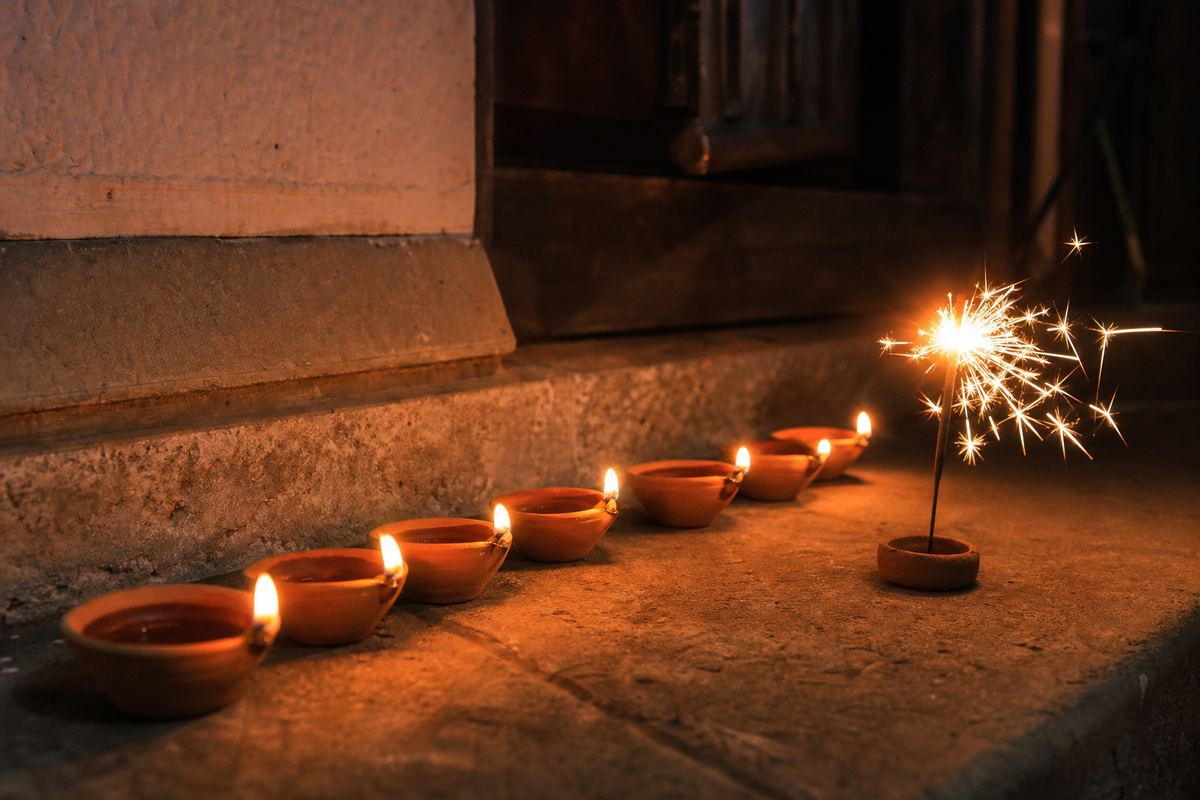
Bonfire Night A bonfire on a village green, rockets rising behind bare trees. AI-generated still.Diwali Clay oil lamps glow on a doorstep beside a fizzing sparkler. AI-generated still.
The powder that lifts a shell
Inside an aerial shell
Why atoms glow in colours
Smoke, safety and greener recipes
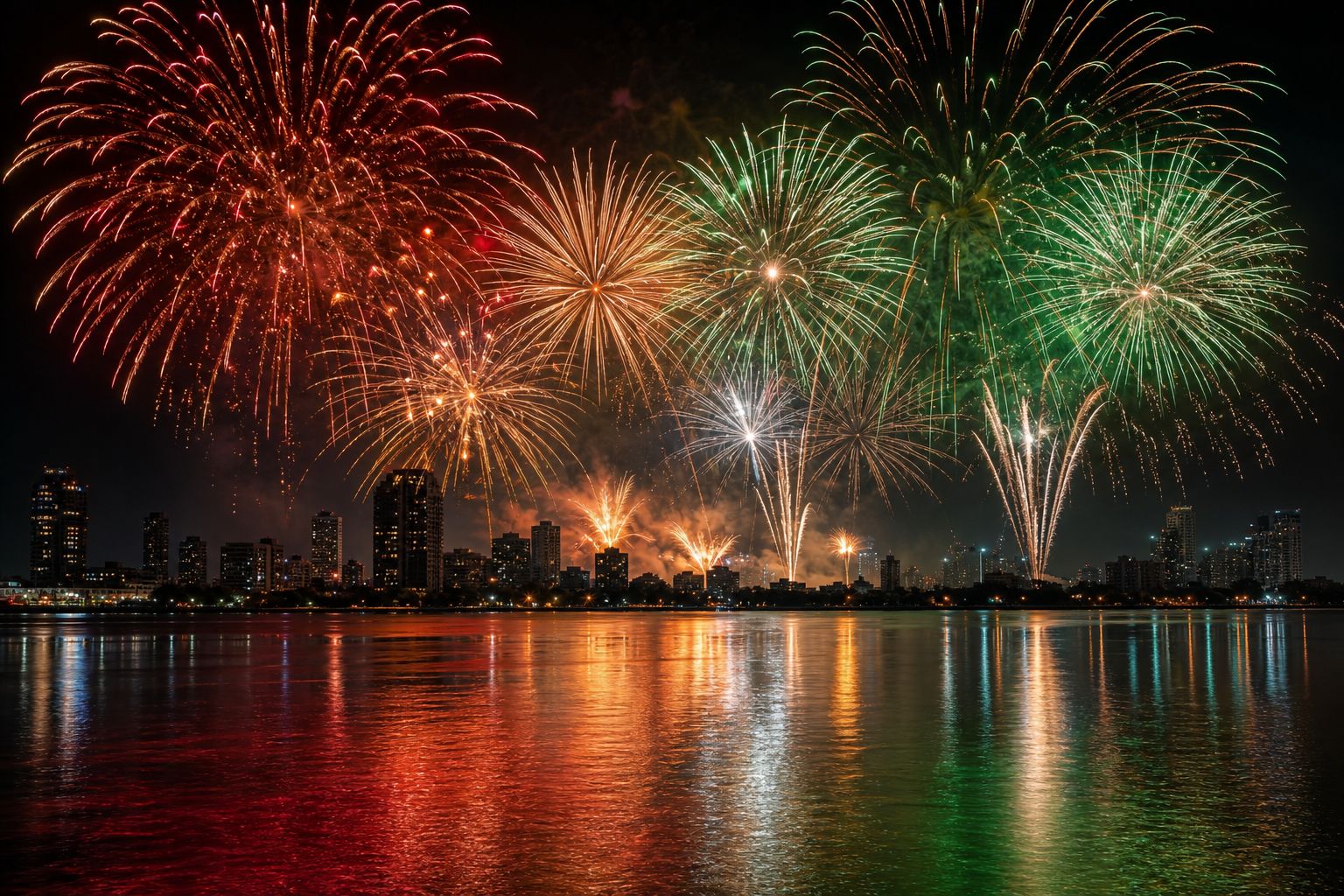
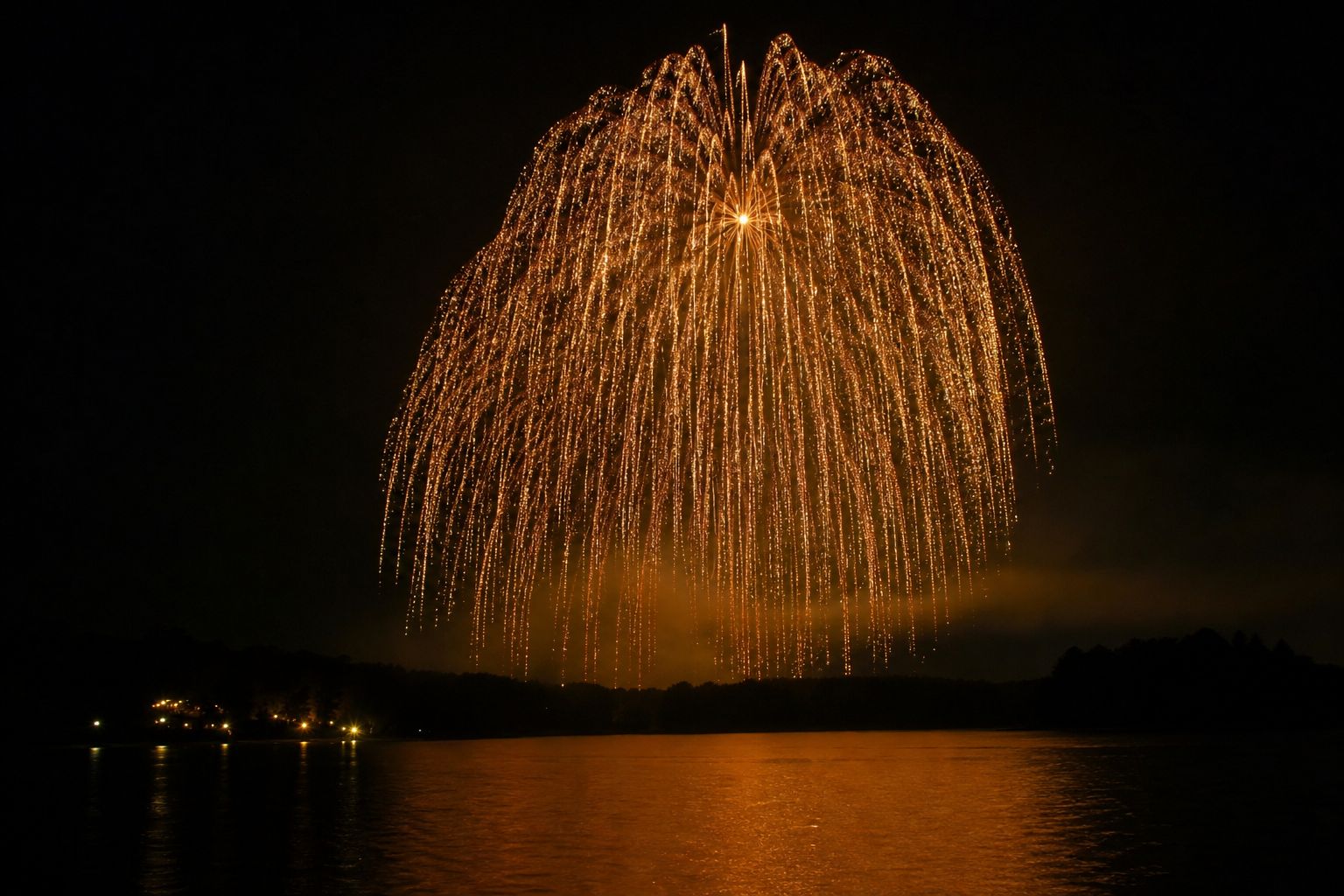
Coming upOne second of chemistry Red, green, gold and white bursts above a river. AI-generated still.
Prologue
Two nights of fire
Bonfire Night, also called Firework Night or Guy Fawkes Night, falls on 5 November in Britain (UK Parliament). The Old Farmer’s Almanac and the Farmers’ Almanac give Sunday 8 November 2026 as the main day of Diwali, whose festivities run over five days; the Almanac notes that fireworks are set off on the night of Diwali.
Some calendars give a slightly different Diwali date; the main celebration depends on the lunar calendar and the place.
This film explains chemistry; it is not a recipe. Fireworks should be handled only as their makers and local laws allow.
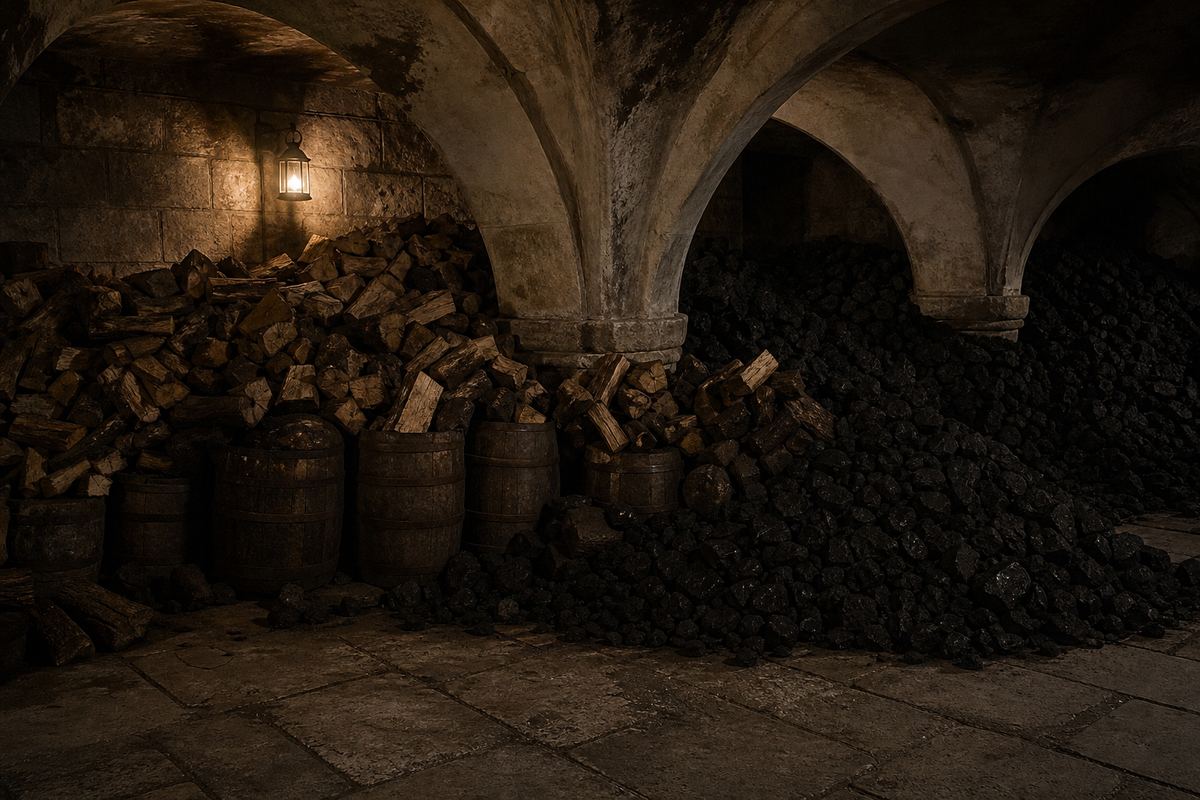
Bonfire Night remembers a powder that never went off. In November 1605, plotters hid barrels of gunpowder in a cellar beneath the House of Lords, planning to kill King James the First at the opening of Parliament.
Guy Fawkes was found guarding thirty-six barrels early on the fifth of November. Parliament then made the day a yearly thanksgiving for the King's escape, and the bonfires and fireworks grew out of it.
An undercroft, 1605 Barrels half hidden under firewood beside a single lantern. AI-generated still.
36
barrels of gunpowder found
5 Nov 1605
the plot discovered
The Gunpowder Plot (Royal Museums Greenwich)
Nov 1605 the plot is uncovered
1606 an Act makes 5 November a day of thanksgiving
today Bonfire Night, or Firework Night
From plot to festivalBonfire Night today A village bonfire, rockets climbing behind the trees. AI-generated still.
Prologue
The Gunpowder Plot
Royal Museums Greenwich describes the Gunpowder Plot as a failed attempt to assassinate King James I at the Opening of Parliament in November 1605. Guy Fawkes was discovered early on 5 November guarding the powder, and 36 barrels were found. An Act of Parliament (3 James I, cap. 1) made 5 November a day of public thanksgiving, from which the bonfires and fireworks grew. UK Parliament lists the five core conspirators as Robert Catesby, Thomas Winter, Thomas Percy, John Wright and Guy Fawkes.
The Act, usually called the Observance of 5th November Act 1605, received royal assent in 1606.
The 3D scenes are simplified teaching models, not to scale.
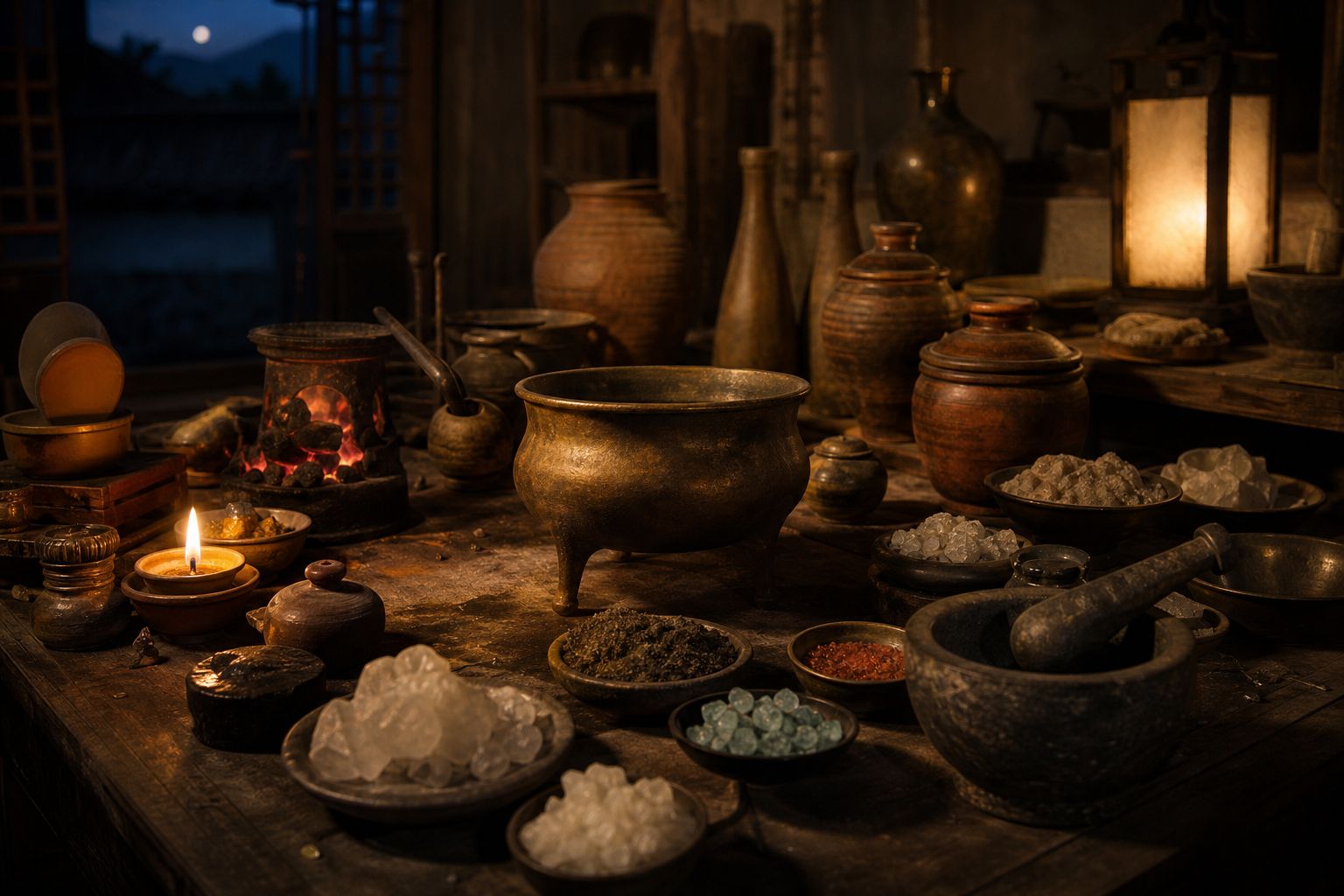
The powder itself is much older. Chinese alchemists found the recipe for black powder in the ninth century, by accident, while mixing salts in search of an elixir of life.
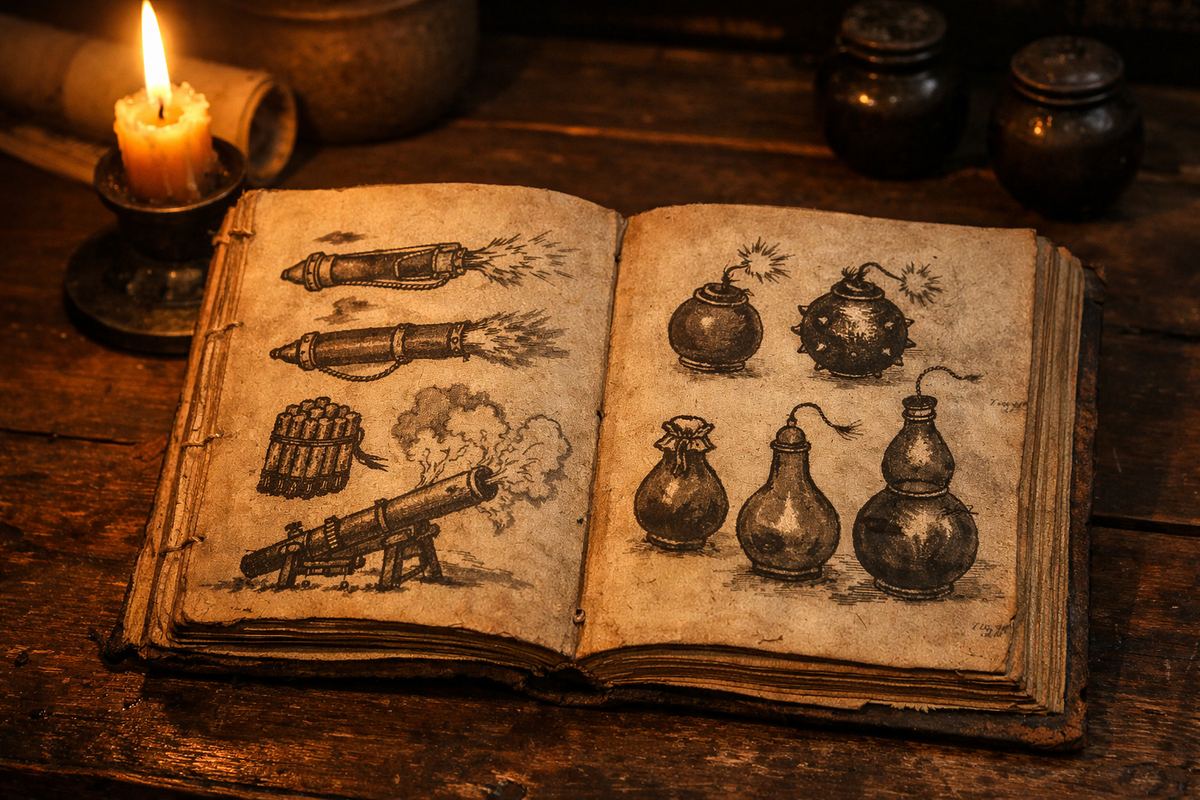
A military handbook from 1044, the Wujing Zongyao, records the earliest known formula for true gunpowder. By the thirteenth century, the secret had probably reached Europe.
Every firework still starts with some version of that mixture.
An alchemist’s bench Crucibles, jars and mineral salts by the glow of a brazier. AI-generated still.A written formula An old bound book of ink drawings of fire weapons and flasks. AI-generated still.
800s Chinese alchemists find black powder
1044 first true formula, Wujing Zongyao
1200s Roger Bacon’s first European account
How the powder travelled
Chapter I · The fire drug
The fire drug
Britannica: Chinese alchemists discovered the recipe for what became known as black powder in the 9th century CE; Europeans probably acquired it in the 13th century. The Royal Society of Chemistry says it was found by accident while experimenting with salts in search of an elixir of life, and that Roger Bacon gave the first written European account in the 13th century. Columbia University’s Asia for Educators notes that the Wujing zongyao of 1044 records the first true gunpowder formula.
This film explains chemistry; it is not a recipe. Fireworks should be handled only as their makers and local laws allow.
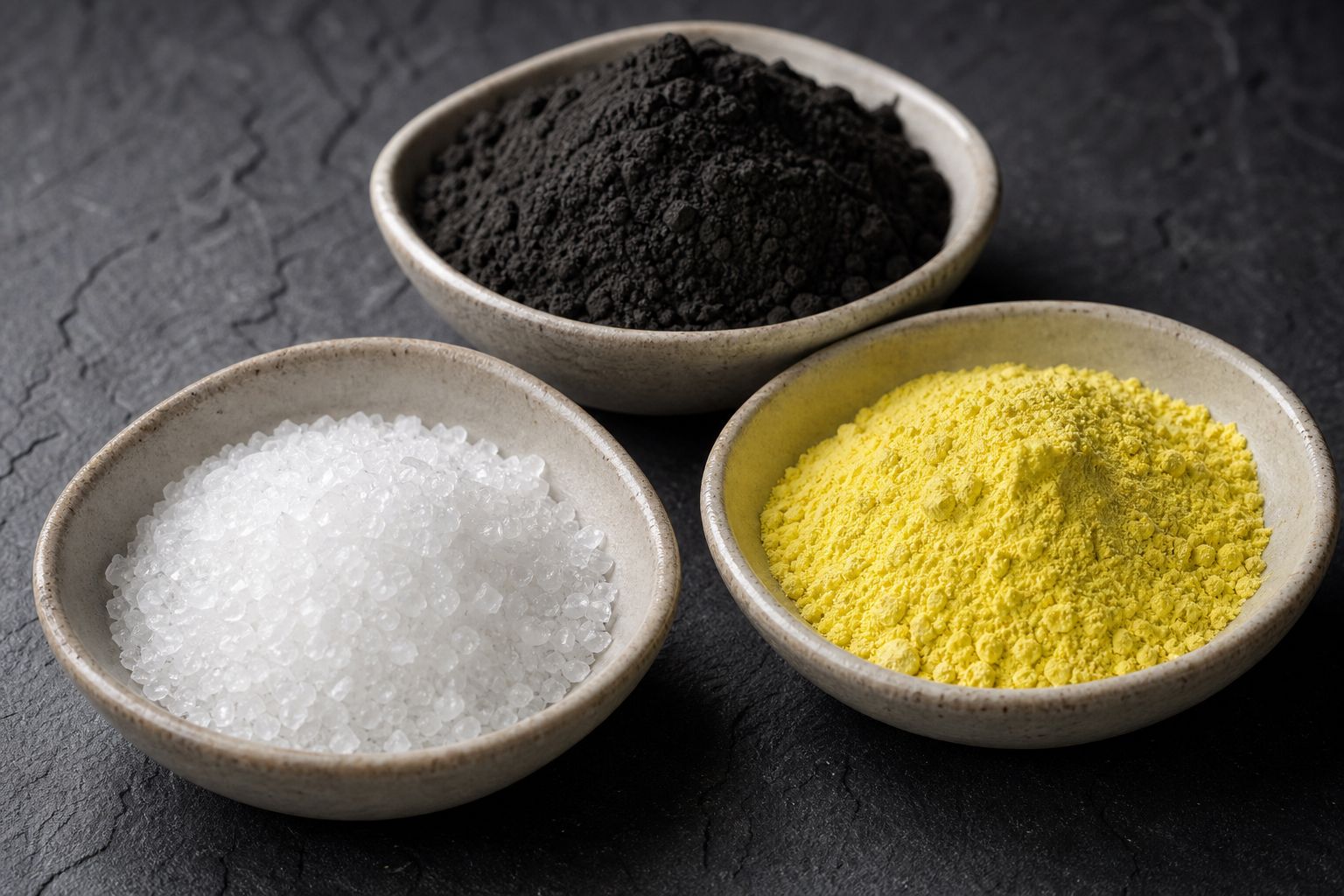
Black powder is roughly seventy-five parts saltpetre, potassium nitrate, fifteen parts charcoal and ten parts sulfur.
Charcoal and sulfur are the fuel. Saltpetre is the oxidizer: it is rich in oxygen and hands it to the fuel, so the mixture burns fast, with the oxygen already packed inside.
When it burns, about four tenths of it becomes hot gas. The rest is solid, which we see as white smoke.
Loose, in the open, the powder just flares. Sealed in a tight space, the gas has nowhere to go, and its pressure can throw a shell into the sky. Press ignite.
Three ingredients White saltpetre, black charcoal and yellow sulfur in three bowls. AI-generated still.
saltpetre (KNO₃)
~75%
charcoal
~15%
sulfur
~10%
Black powder, by mass (Britannica)
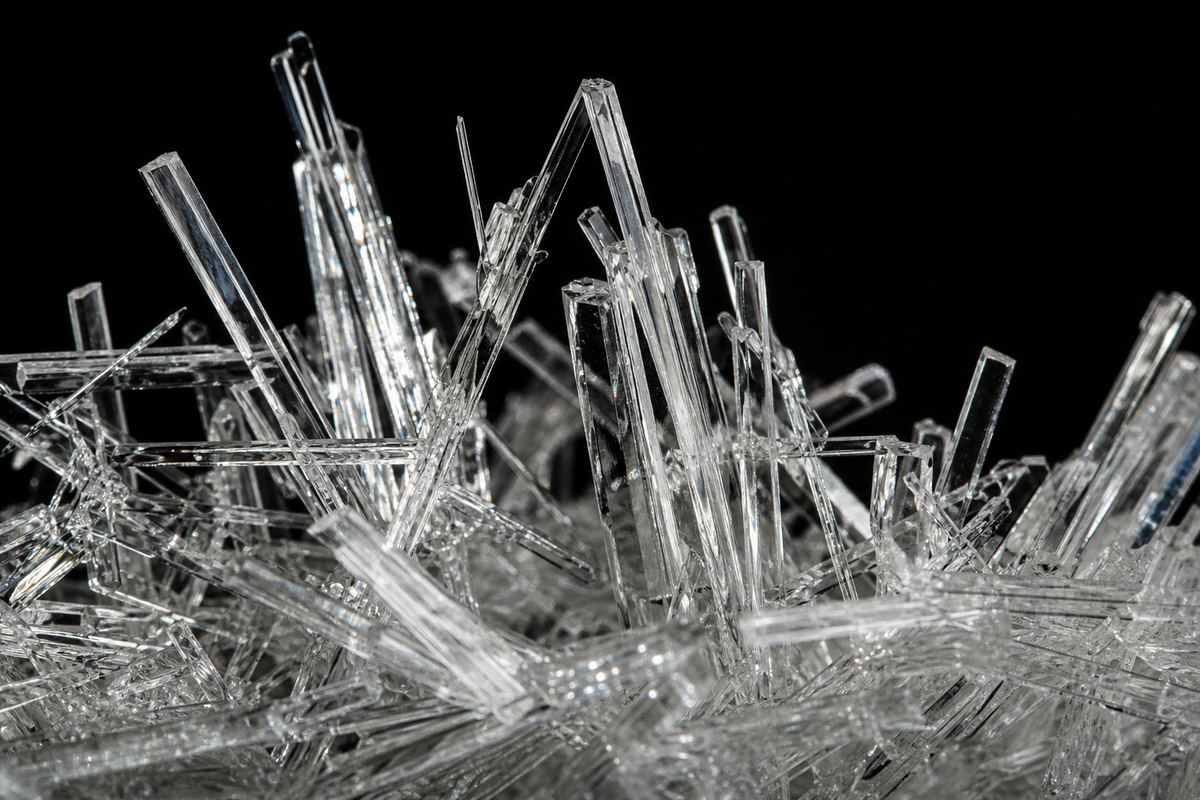
Saltpetre Needle-like crystals of potassium nitrate. AI-generated still.
~40%
becomes gas
~60%
solids: the smoke
~3 MJ
of heat per kilogram
When it burns (Britannica; ACS)
Loose in the open: a fast flare
Sealed in: pressure builds
In a mortar: it lifts the shell
Same powder, two results
Chapter I · The fire drug
Oxidizer and fuel
Britannica gives black powder as about 75% saltpetre (potassium nitrate), with charcoal and sulfur making up the rest, roughly 15 and 10 percent (one entry gives 14 and 11). On burning, about 40% of the powder becomes gas and 60% solids, seen as white smoke; the ACS gives about 3 MJ of energy per kilogram. In ACS ChemMatters’ account of a firework, the oxidizer and the fuel react to produce heat and gas, and the hot gas expands rapidly.
This film explains chemistry; it is not a recipe. Fireworks should be handled only as their makers and local laws allow.
The 3D scenes are simplified teaching models, not to scale.
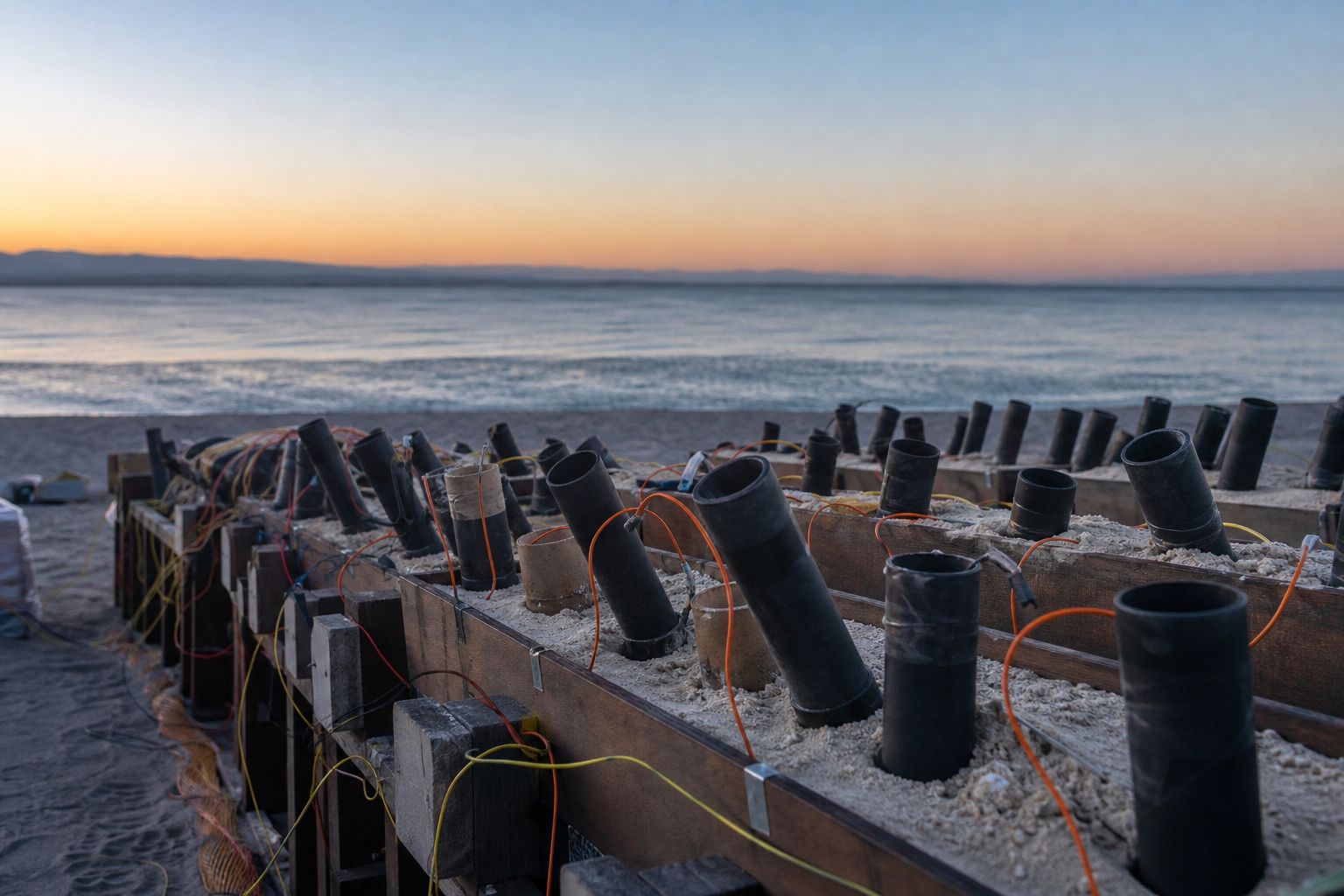
A display firework is an aerial shell: a paper ball fired from a tube called a mortar, often half buried in the ground.
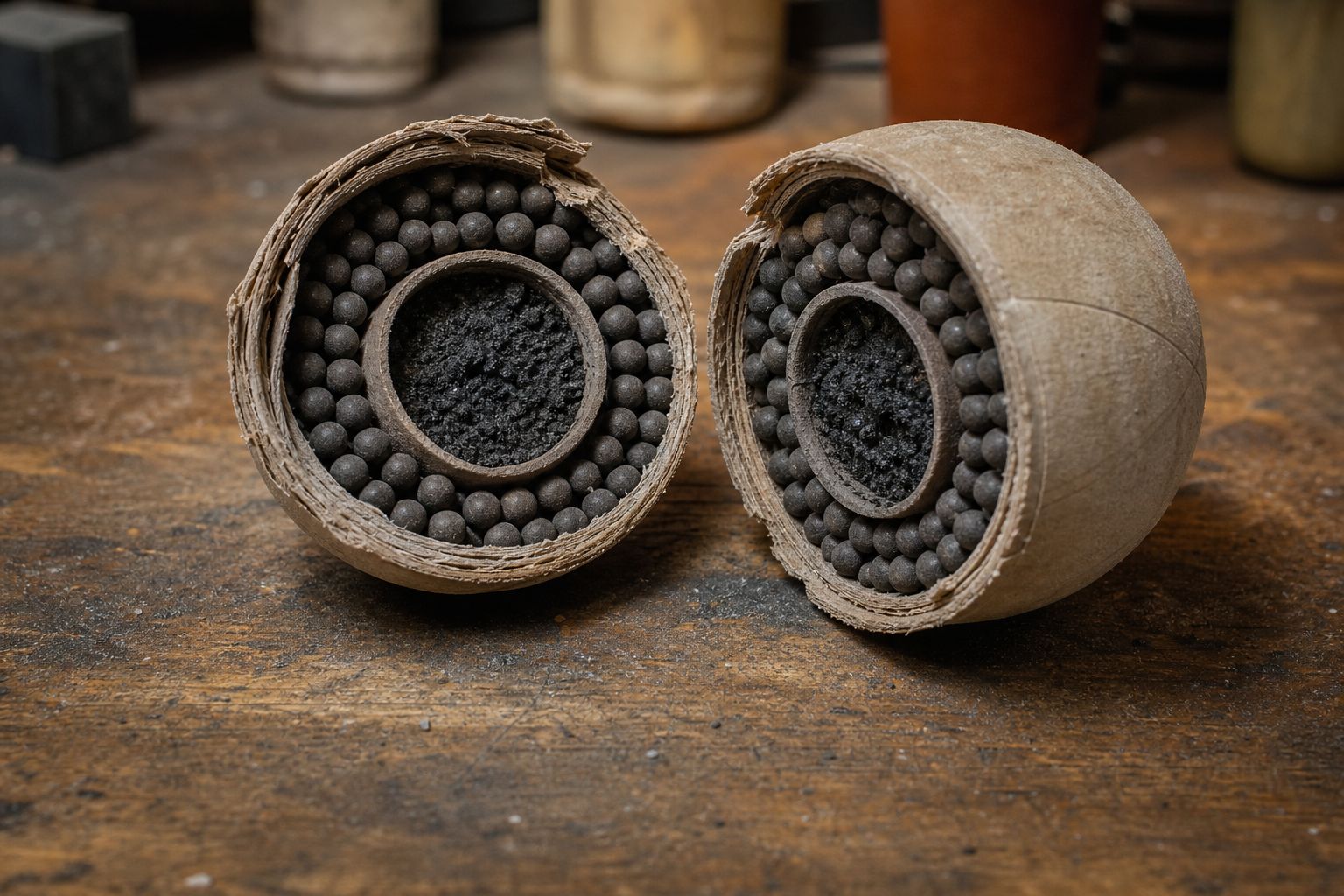
Under the shell sits a lift charge of black powder. A quick fuse lights it, and the burst of gas throws the shell high into the sky.
The same flash lights a slow, timed fuse inside. A few seconds later, near the top of the climb, it reaches the burst charge at the centre, which flings out the stars.
Press launch.
Mortars Rows of launch tubes set in sand racks at dusk. AI-generated still.
Lift charge: black powder under the shell
Quick fuse to light it
Time-delay fuse into the shell
Burst charge and stars inside
Inside the mortar (ACS ChemMatters)A shell cut open Rows of small round stars around a core of powder, in layers of paper. AI-generated still.
Chapter II · Anatomy of a shell
Anatomy of an aerial shell
ACS ChemMatters describes the shell sitting in a mortar, a tube often partly buried. A lifting charge, lit by a fast fuse, launches the shell; a time-delay fuse lights the central bursting charge a few seconds later, which throws out the stars, usually 3–4 cm across. PBS NOVA notes that the fuse timing sets the altitude of the burst.
This film explains chemistry; it is not a recipe. Fireworks should be handled only as their makers and local laws allow.
The 3D scenes are simplified teaching models, not to scale.
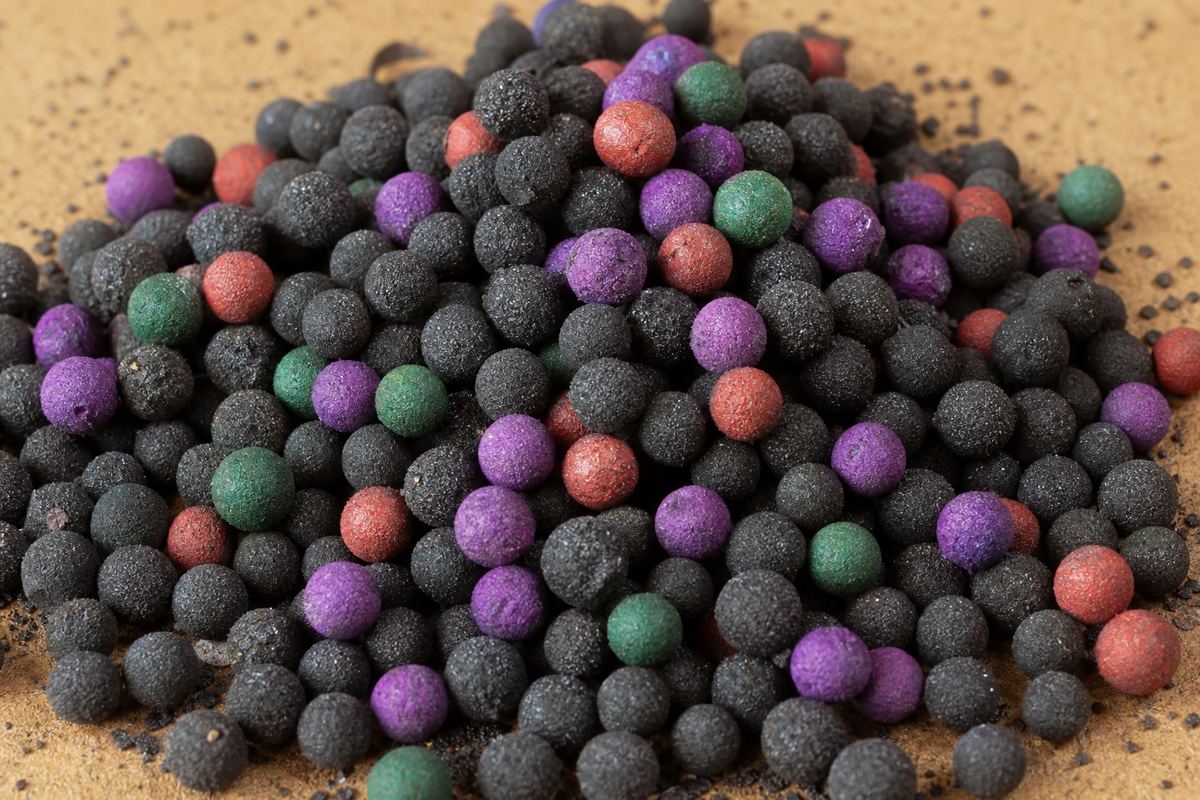
Each star is a small pellet of its own chemistry: an oxidizer, a fuel, a colour-maker and a binder that holds it together.
How the stars are packed sets the shape in the sky: a round chrysanthemum, a drooping willow, or a multibreak shell, with several compartments that burst one after another.
Try the three shapes.
Stars Pellets of different colours, each coated in black powder. AI-generated still.
Oxidizer: supplies oxygen
Fuel: burns
Colorant: a metal salt
Binder: holds it together
In every star (ACS ChemMatters)Willow Long glittering trails droop over a dark lake. AI-generated still.Many shells at once Round shells of every colour burst together over a river. AI-generated still.
Chapter II · Anatomy of a shell
Stars and shapes
ACS ChemMatters: a star combines an oxidizer, a fuel, a colorant and a binder. PBS NOVA describes patterns such as the palm, willow and chrysanthemum, and multibreak shells that burst in stages.
The 3D scenes are simplified teaching models, not to scale.
Now the colours. Heat a metal atom enough, and one of its electrons is kicked up to a higher energy level.
Think of the levels as rungs on a ladder. The electron cannot stay up there. When it falls back, it gives off the difference as a flash of light. A small drop gives red light; a bigger drop gives green, then blue.
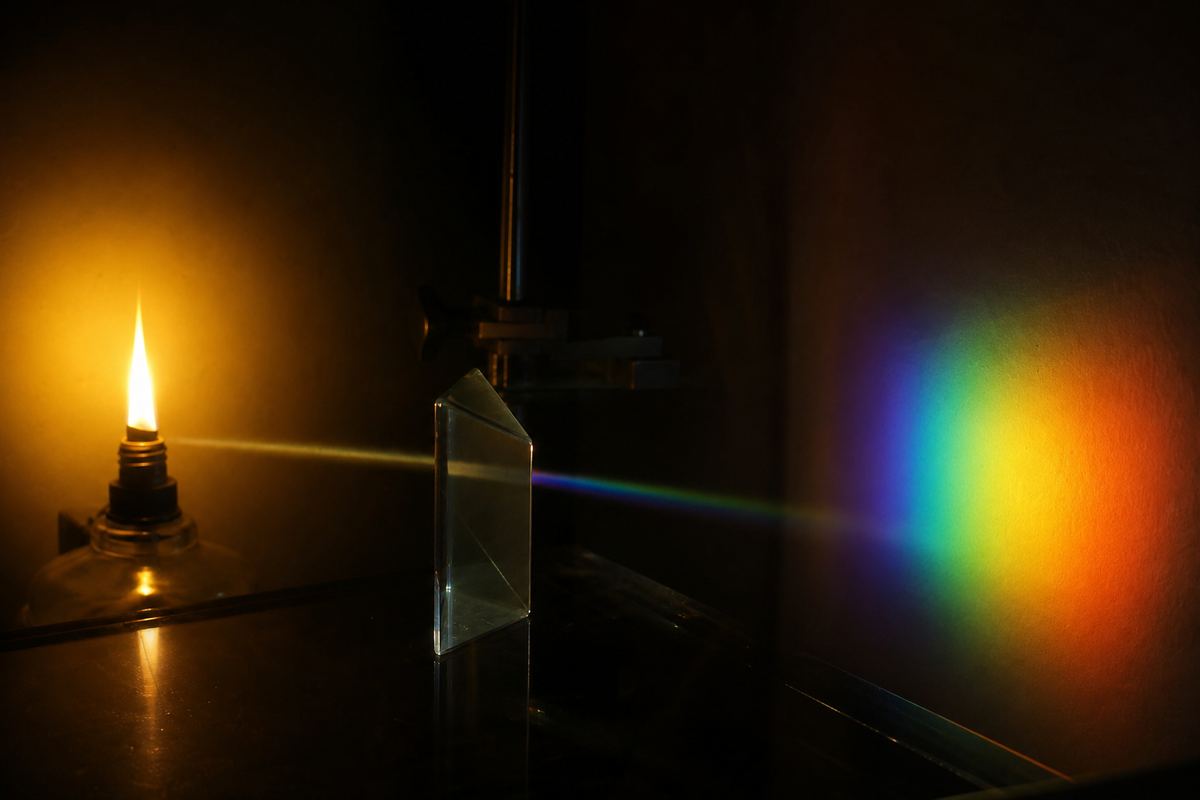
Each element has its own levels, so each gives its own colours. Sodium shines at a wavelength of about 589 nanometres: the yellow of old street lamps.
Chemists call this luminescence. Try the four elements.
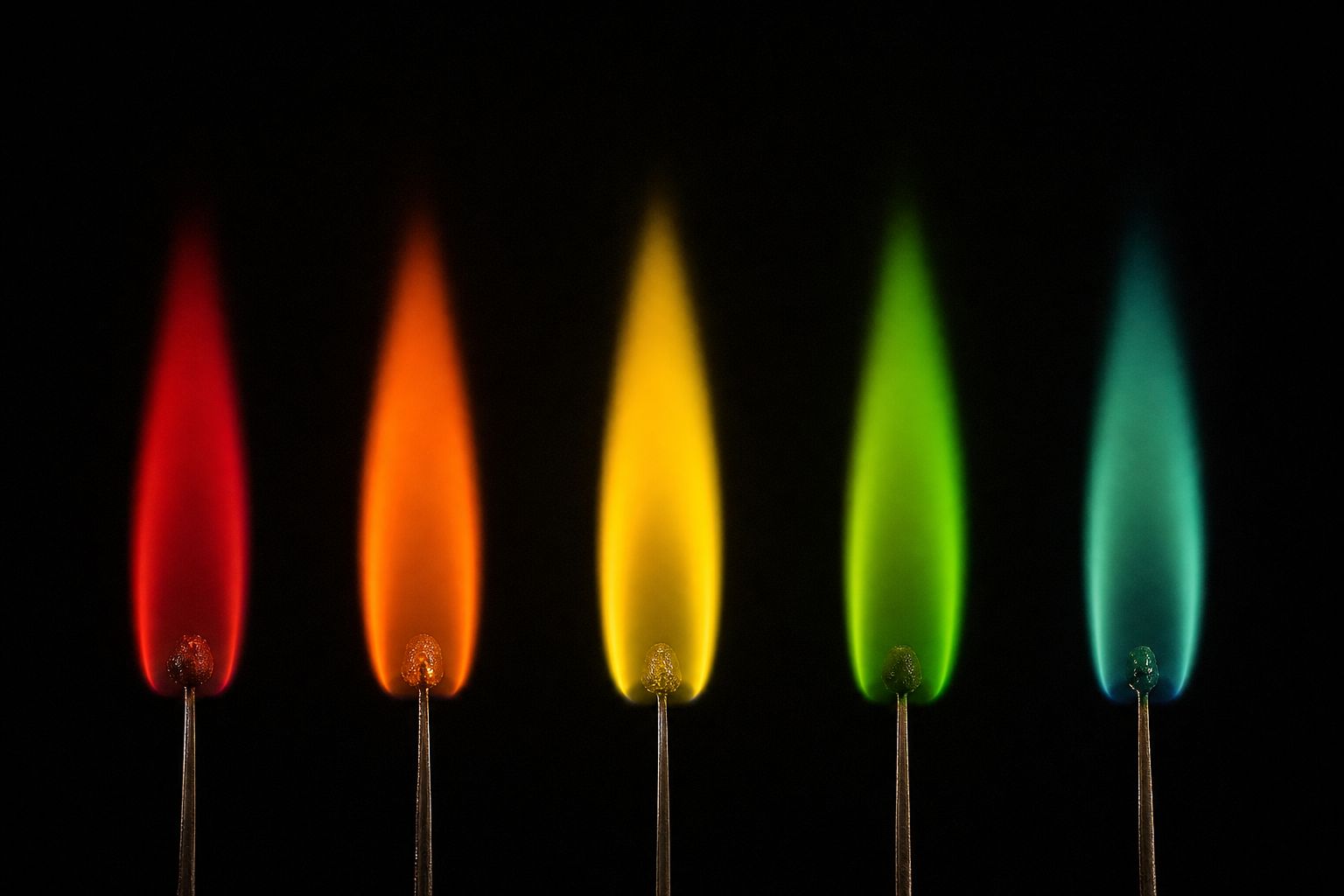
Flame tests Five metal salts colour five flames: crimson, orange, yellow, green, blue-green. AI-generated still.Ehigh−Elow=hλc
h
Planck’s constant
c
speed of light
λ
wavelength: the colour
One photon per drop
Small drop: red, long wavelength
Medium drop: yellow, green
Big drop: blue, short wavelength
Size of the drop, colour of the lightA fingerprint in light A prism spreads light into its colours beside a yellow sodium glow. AI-generated still.
588.995 nm
first line
589.592 nm
second line
Sodium D lines (HyperPhysics)
Chapter III · Colours from atoms
Luminescence
ACS ChemMatters: in luminescence, heat excites electrons to higher energy levels; when they fall back they emit light of a colour specific to the element. The energy of the emitted photon equals the difference between the two levels, E = hc/λ, so a bigger drop gives a shorter wavelength. HyperPhysics (Georgia State University) gives the sodium D lines at 588.9950 and 589.5924 nm.
The atom in 3D is a schematic: real energy levels are not rings, and the colours of strontium, barium and copper in fireworks come mostly from molecules such as chlorides formed in the flame.
So a firework maker picks colours from the periodic table. Strontium gives red, calcium orange, sodium yellow, barium green and copper blue. Mix strontium and copper, and you get purple.
Chlorine helps. In the flame, barium and copper join with chlorine into small molecules called chlorides, and it is those molecules that give the brightest green and blue. Potassium chlorate can be both the oxidizer and the chlorine source.
Fireworks were mostly orange and yellow until the 1830s, when Italian makers began using potassium chlorate. It burns hotter, and with metals like strontium and barium, it opened up the colours.
Red: strontium (Sr)
Orange: calcium (Ca)
Yellow: sodium (Na)
Green: barium (Ba)
Blue: copper (Cu)
Purple: Sr + Cu
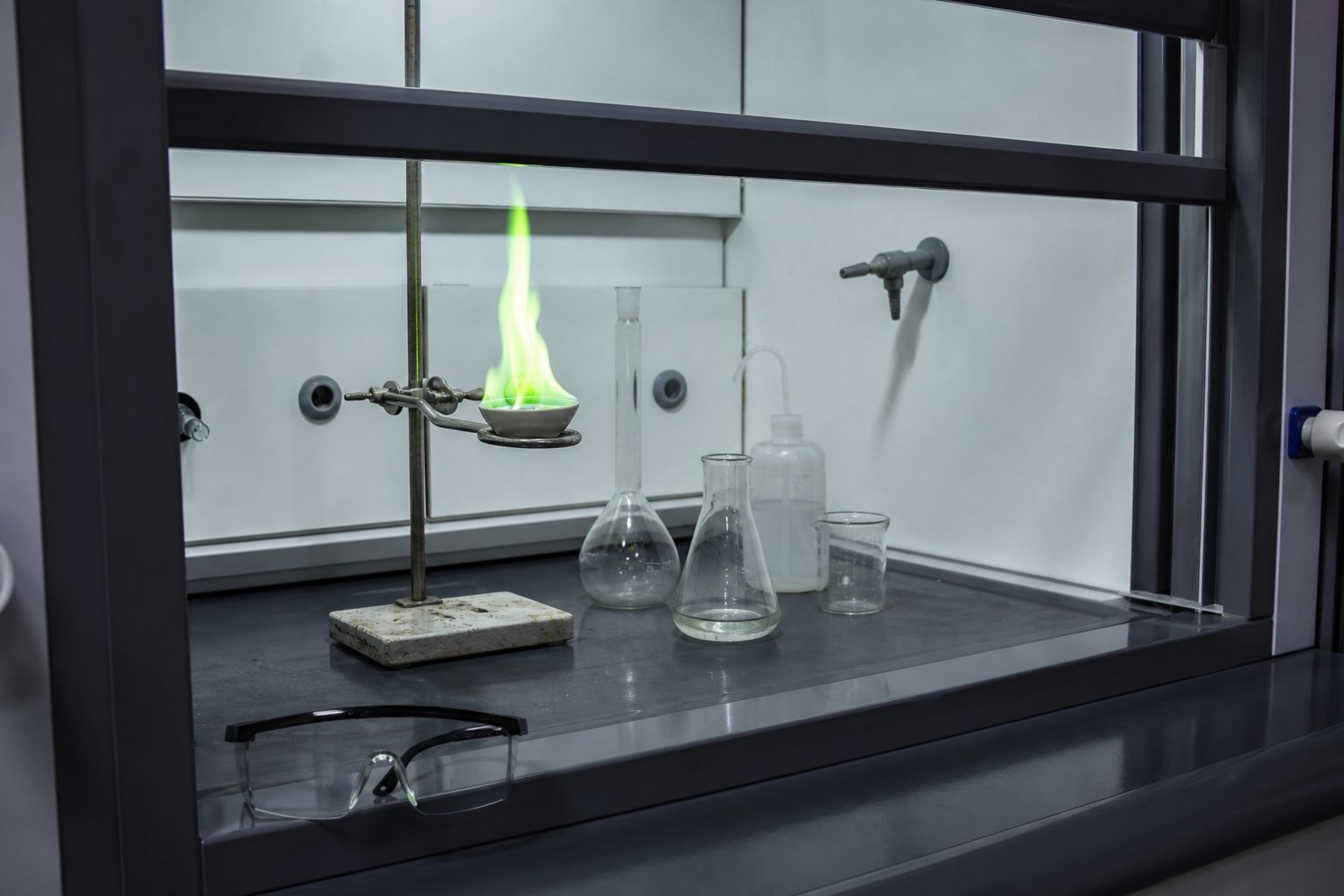
Colour and the element behind it (ACS)A green flame A barium compound burns green; in the flame it glows as barium chloride. AI-generated still.
1,700 °C
before
2,000 °C
after
Potassium chlorate, 1830s (PBS NOVA)The palette in the lab The same metals colour a row of test flames. AI-generated still.
Chapter III · Colours from atoms
A palette from the periodic table
ACS ChemMatters lists red from strontium or lithium, orange from calcium, yellow from sodium, green from barium with a chlorine donor (barium chloride), blue from copper with a chlorine donor (copper chloride) and purple from strontium plus copper. C&EN notes that potassium chlorate serves as both an oxidizer and a chlorine donor, and that most modern stars use the more stable potassium perchlorate. PBS NOVA says Italian makers adopted potassium chlorate in the 1830s, raising the burning temperature from about 1,700 to 2,000 °C; the Smithsonian notes they added metals such as strontium and barium.
This film explains chemistry; it is not a recipe. Fireworks should be handled only as their makers and local laws allow.
The 3D scenes are simplified teaching models, not to scale.
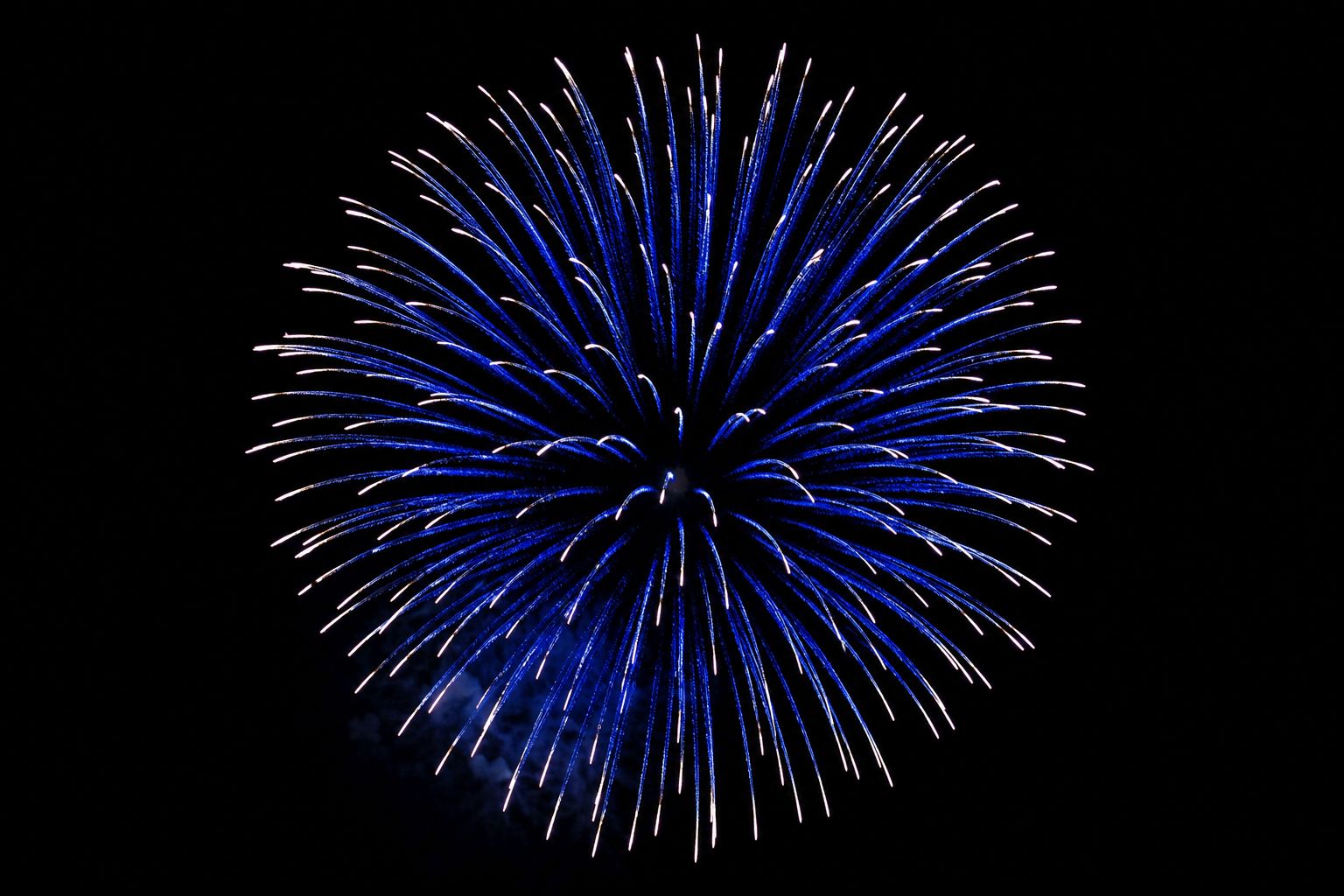
Blue is the hardest colour of all. Its light comes from a fragile copper compound in the flame.
The maker needs enough heat to make it glow, but not so much that it breaks apart. Too hot, and the blue washes out to white.
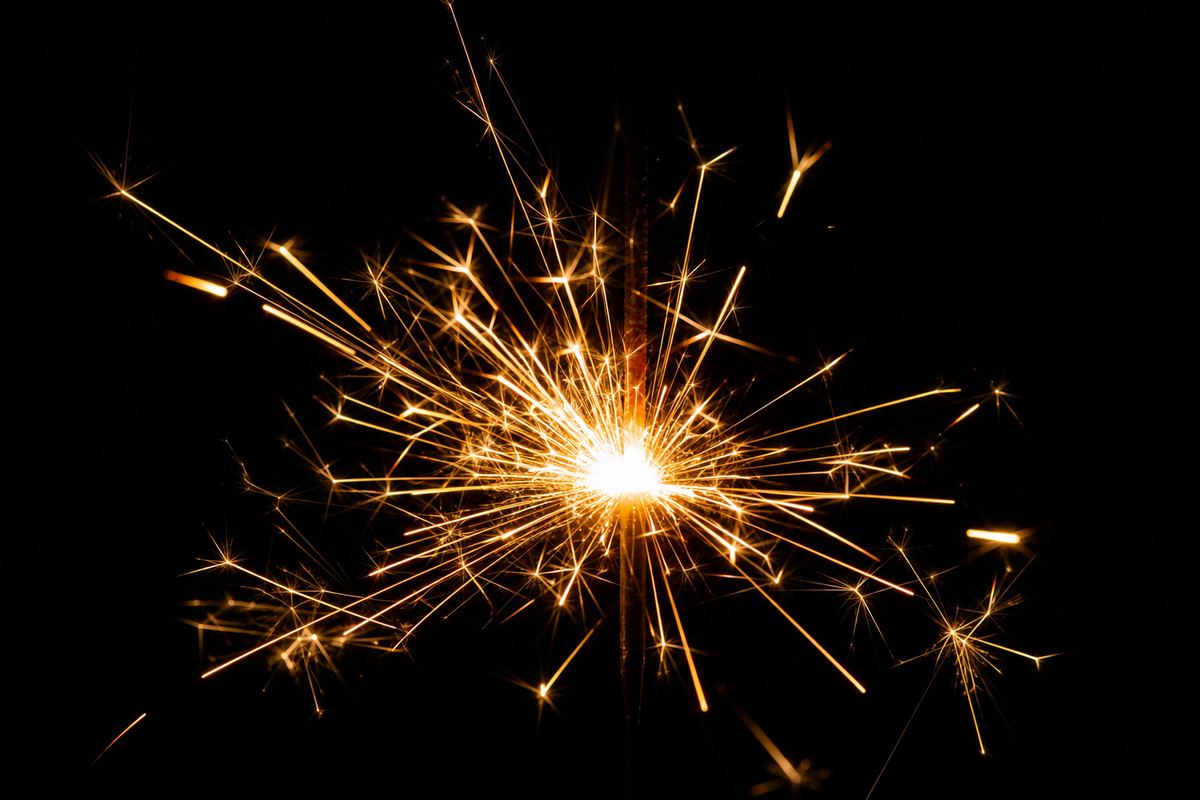
That white is a different kind of light: incandescence. Anything hot enough glows, red, then orange, then white, whatever it is made of.
Fireworks use it on purpose. Grains of aluminium, magnesium and titanium burn white-hot, making brilliant white sparks.
A rare blue A deep blue burst against a black sky. AI-generated still.
Blue is “the most difficult color to produce.”Chemical & Engineering News
C&EN (ACS)
Luminescence: each element’s own colours
Incandescence: hot matter glows red to white
Two kinds of firework lightWhite-hot sparks A sparkler’s white core throws out branching sparks. AI-generated still.
Chapter III · Colours from atoms
Why blue is hard
C&EN calls blue the most difficult colour to produce; it comes from copper chloride. PBS NOVA explains that the maker must help the colour come out without overheating it, because too much heat washes the blue out to white; Purdue chemist Paul E. Smith told Live Science that blue also struggles to stand out against a dark blue night sky. ACS ChemMatters distinguishes luminescence, light of a specific colour from excited electrons, from incandescence, in which hot matter glows from red to white as its temperature rises. The ACS lists aluminium, magnesium and titanium for white.
The 3D scenes are simplified teaching models, not to scale.
The boom is gas. The burst charge turns into hot gas so fast that it pushes the air outward faster than the speed of sound, and that shock reaches your ears as a bang.
Whistles come from fuel burning fast inside a tube, which sets the air in it ringing, like blowing across a bottle.
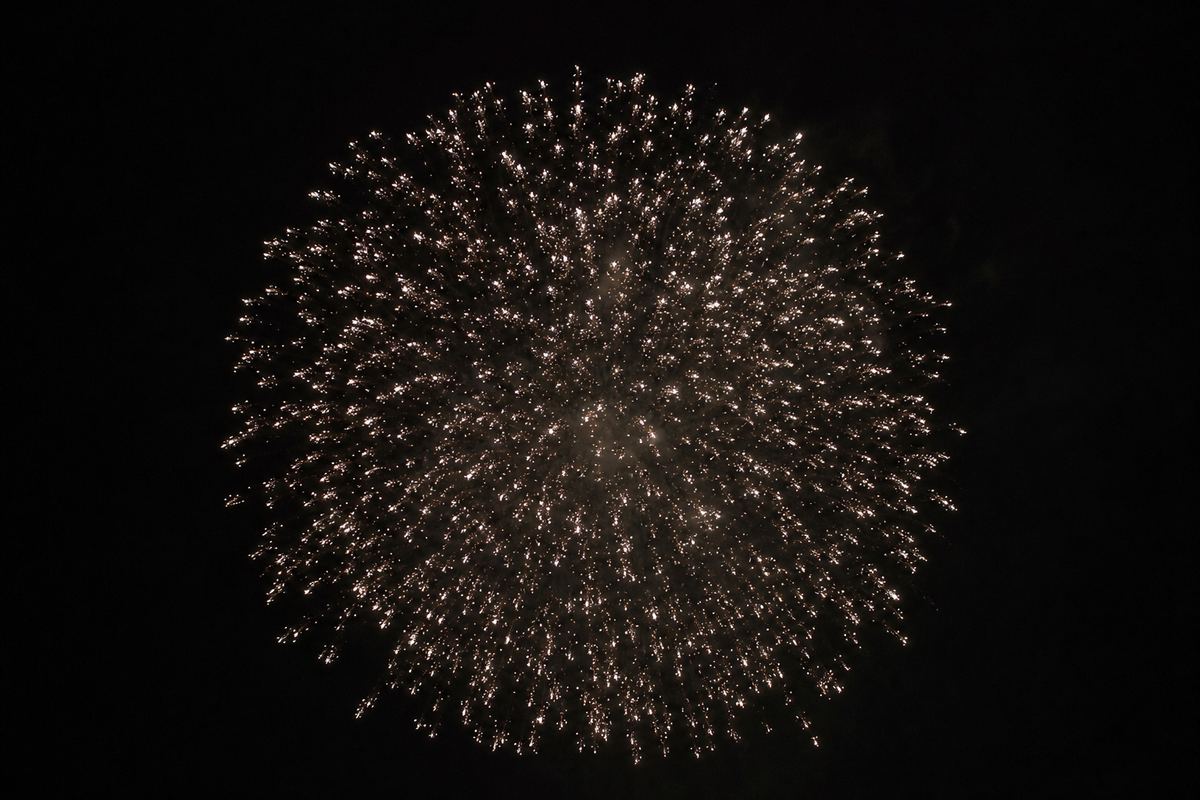
And the crackle is a cloud of tiny granules, each popping on its own. Makers once used a lead compound for it; today they use bismuth instead.
And notice the order: you see the flash first and hear the bang after, because light travels far faster than sound.
> speed of sound
how fast the gas expands
The bang (ACS ChemMatters)Before the bang Launch tubes waiting in their racks. AI-generated still.
Whistle: salts of gallic, salicylic or benzoic acid
Crackle: bismuth oxide with magnalium
Lead compounds: dropped for safety
What makes the sound (ACS)Crackle Hundreds of tiny white flashes in a ball. AI-generated still.Flash first, bang after The light of a burst reaches the shore long before its sound. AI-generated still.
Chapter IV · Bangs and whistles
Bangs, whistles and crackles
ACS ChemMatters: the boom comes from gas expanding faster than the speed of sound. ACS inChemistry: a whistle is made by fuel burning rapidly in a tube, setting up standing waves, using salts of gallic, salicylic or benzoic acid; crackling stars use granules of bismuth trioxide or subcarbonate with magnalium, which replaced lead tetroxide.
This film explains chemistry; it is not a recipe. Fireworks should be handled only as their makers and local laws allow.
The 3D scenes are simplified teaching models, not to scale.
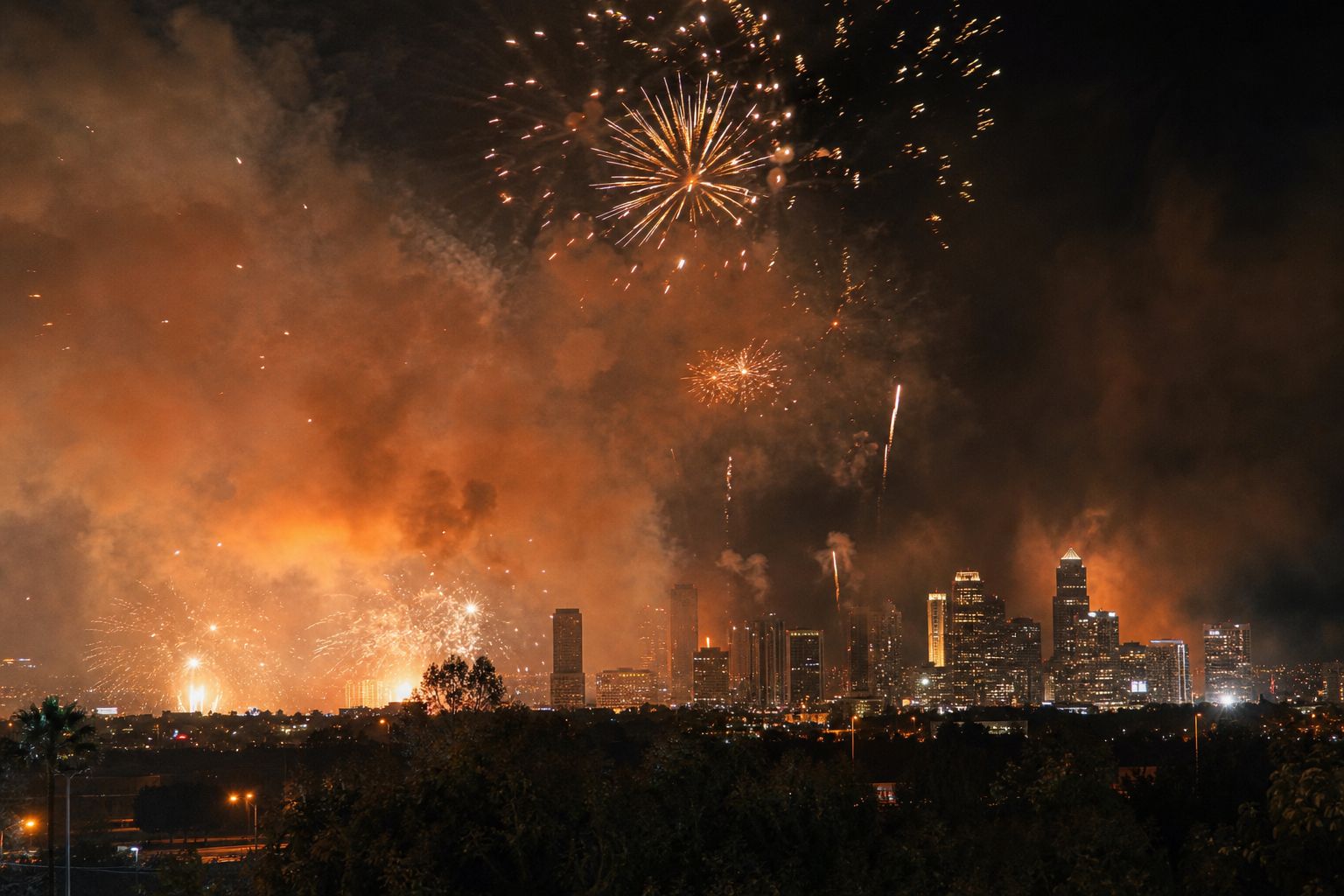
Remember the sixty percent of black powder that does not become gas? It hangs in the air as smoke and fine particles.
In Newcastle on Bonfire Night in 2018, fine particle levels went from about twenty micrograms per cubic metre in the day to almost eighty before eleven at night.
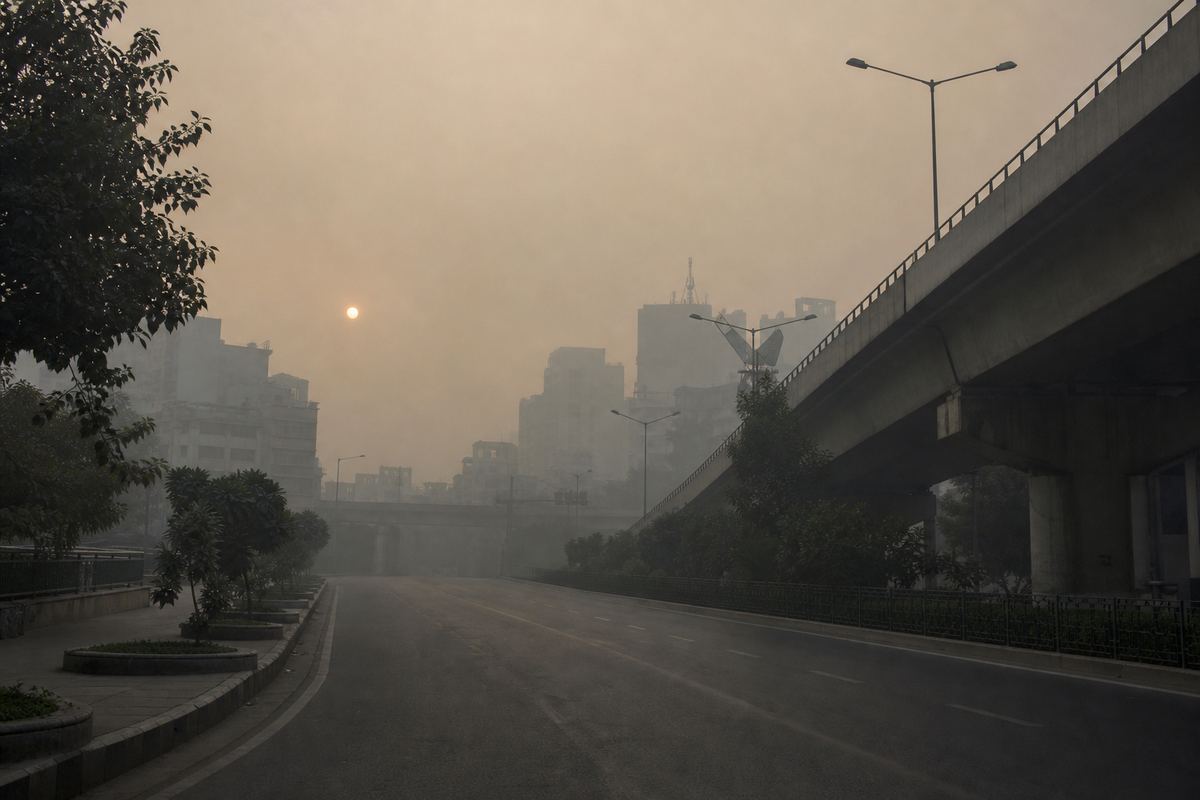
In Delhi, where autumn air is already polluted, official monitors recorded an average of 488 micrograms per cubic metre in the hours after Diwali in 2025, according to Business Today.
Perchlorate, the common oxidizer, can also reach water. The US Environmental Protection Agency says it can interfere with how the thyroid takes up iodide.
After the show Drifting smoke lit orange by streetlights. AI-generated still.
daytime
~20
just before 11 pm
~80
Newcastle, Bonfire Night 2018 (Newcastle University)
A hazy dawn A city street shrouded in grey haze. AI-generated still.
488
µg/m³ PM2.5, average in the hours after Diwali
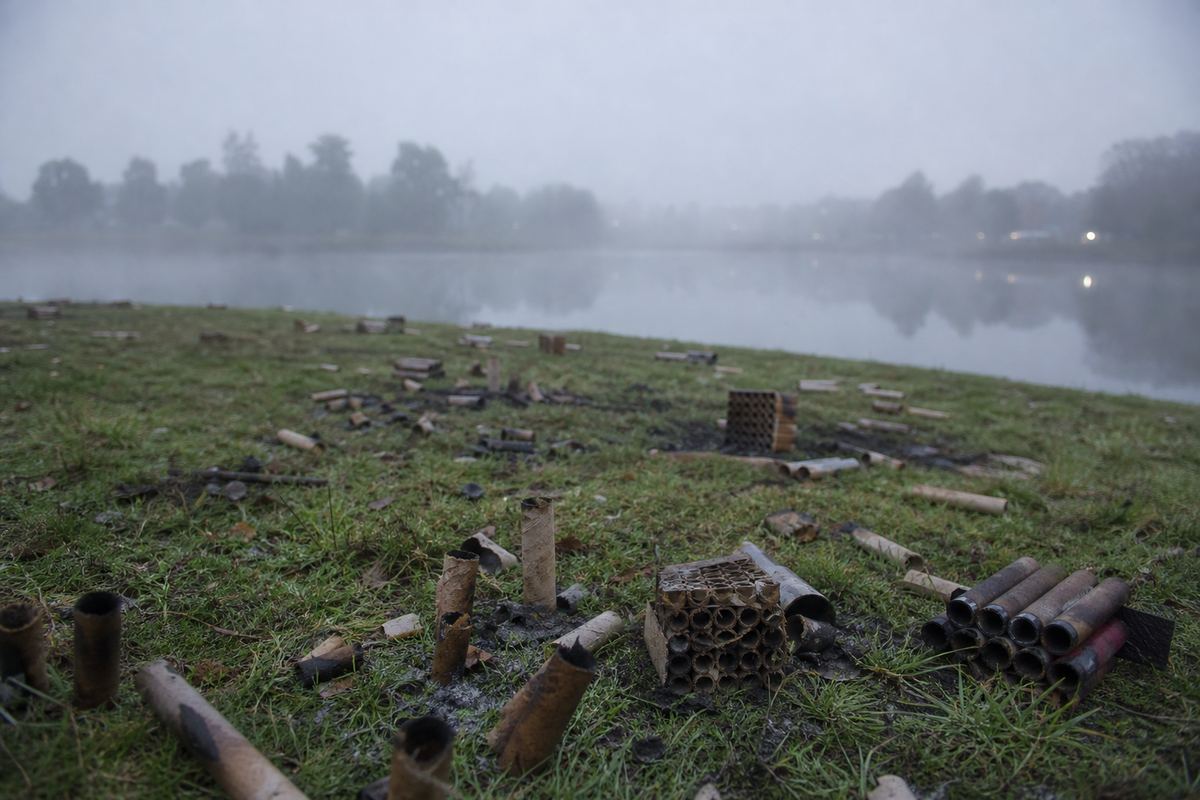
Delhi after Diwali, 2025 (CPCB/DPCC data, Business Today)The morning after Burnt tubes and spent casings on wet grass by a lake. AI-generated still.
Chapter V · What is left behind
Smoke and perchlorate
Newcastle University’s Urban Observatory recorded PM2.5 rising from about 20 µg/m³ during the day to almost 80 µg/m³ just before 11 pm on Bonfire Night 2018; Professor Phil James said a one-off is unlikely to cause long-term harm. Business Today, citing CPCB and DPCC data, reported a PM2.5 average of 488 µg/m³ in Delhi in the hours after Diwali in October 2025. The US EPA says perchlorate, used in rocket propellants, munitions and fireworks, can interfere with the thyroid gland by reducing iodide uptake, and in January 2026 proposed a drinking-water limit of 0.02 mg/L, also taking comment on 0.04 and 0.08 mg/L.
Delhi’s autumn smog has many sources besides fireworks. This is general information, not health advice.
The 3D scenes are simplified teaching models, not to scale.
Fireworks are also dangerous to handle. In the United States, the Consumer Product Safety Commission counted at least fifteen deaths and about thirteen thousand injuries treated in emergency rooms in 2025.
Stored powder is dangerous too. In July 2023, a fireworks warehouse exploded in Sungai Kolok, in Narathiwat in southern Thailand, killing twelve people and injuring more than a hundred.
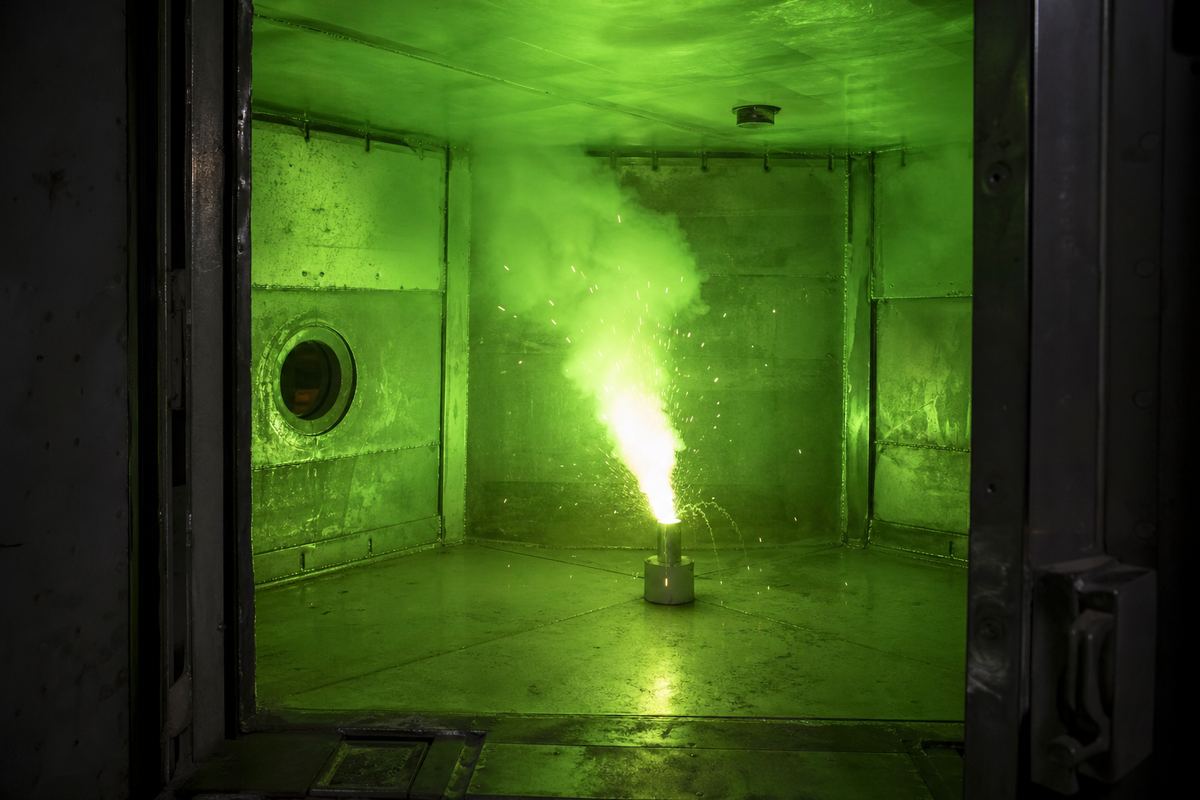
Chemists are also working on cleaner chemistry, because barium is toxic and its chlorine mixtures can form harmful by-products: green made with boron instead of barium, and new compounds that need no chlorine. There is still no good red without strontium.
15+
deaths
~13,000
emergency-room injuries
~1,300
of them from sparklers
US CPSC, fireworks in 2025
12
dead
121
injured
292
houses damaged
Sungai Kolok, Narathiwat, 29 July 2023 (Al Jazeera; Bangkok Post)Stored energy Every packed shell holds powder that needs only a spark. AI-generated still.A greener green A test flare burns green in a steel test chamber. AI-generated still.
Boron carbide green, no barium (2011)
Barium-free green from a borate compound
Casings that burn up
Red without strontium: not yet
Cleaner chemistry (US Army; C&EN)
Chapter V · What is left behind
Safety, and cleaner chemistry
The US CPSC (24 June 2026) reported at least 15 deaths and about 13,000 emergency-department-treated injuries from fireworks in 2025, about 1,300 of them from sparklers. On 29 July 2023 about 1,000 kg of fireworks and gunpowder exploded at a warehouse in Sungai Kolok, Narathiwat, killing 12 and injuring 121 and damaging 292 houses; Al Jazeera reported that welding was the likely trigger and that the warehouse appeared to be unlicensed. US Army researchers at Picatinny reported in 2011 a green flare using boron carbide instead of barium, whose chlorine-containing mixtures can form PCBs; C&EN describes barium-free greens, copper-based blues and casings that burn up, and notes there is not yet a good strontium-free red.
This film explains chemistry; it is not a recipe. Fireworks should be handled only as their makers and local laws allow.
So when the sky lights up this week, read it like a chemist: the red is strontium, the green is barium, the white is hot metal, and the boom is gas outrunning sound.
And if the sky turns deep blue, someone got the temperature just right.
800s black powder found in China
1044 first true formula written down
1605 the Gunpowder Plot
1830s potassium chlorate and metal colours
2011 boron carbide green
2026 Bonfire Night and Diwali
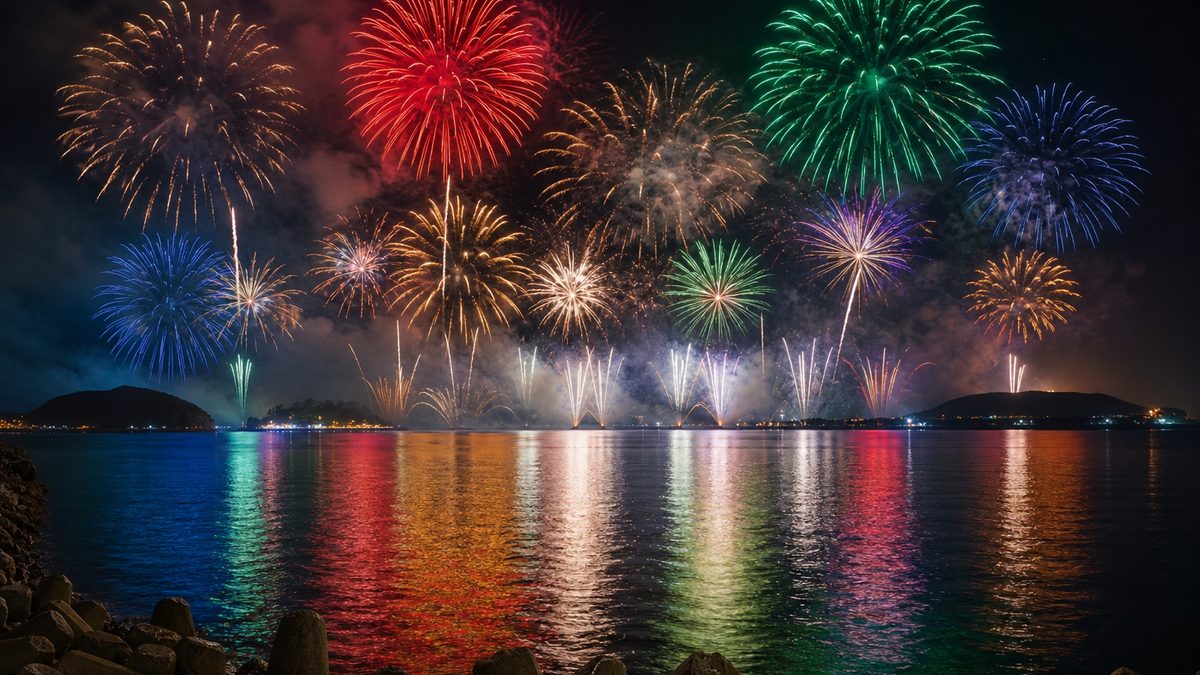
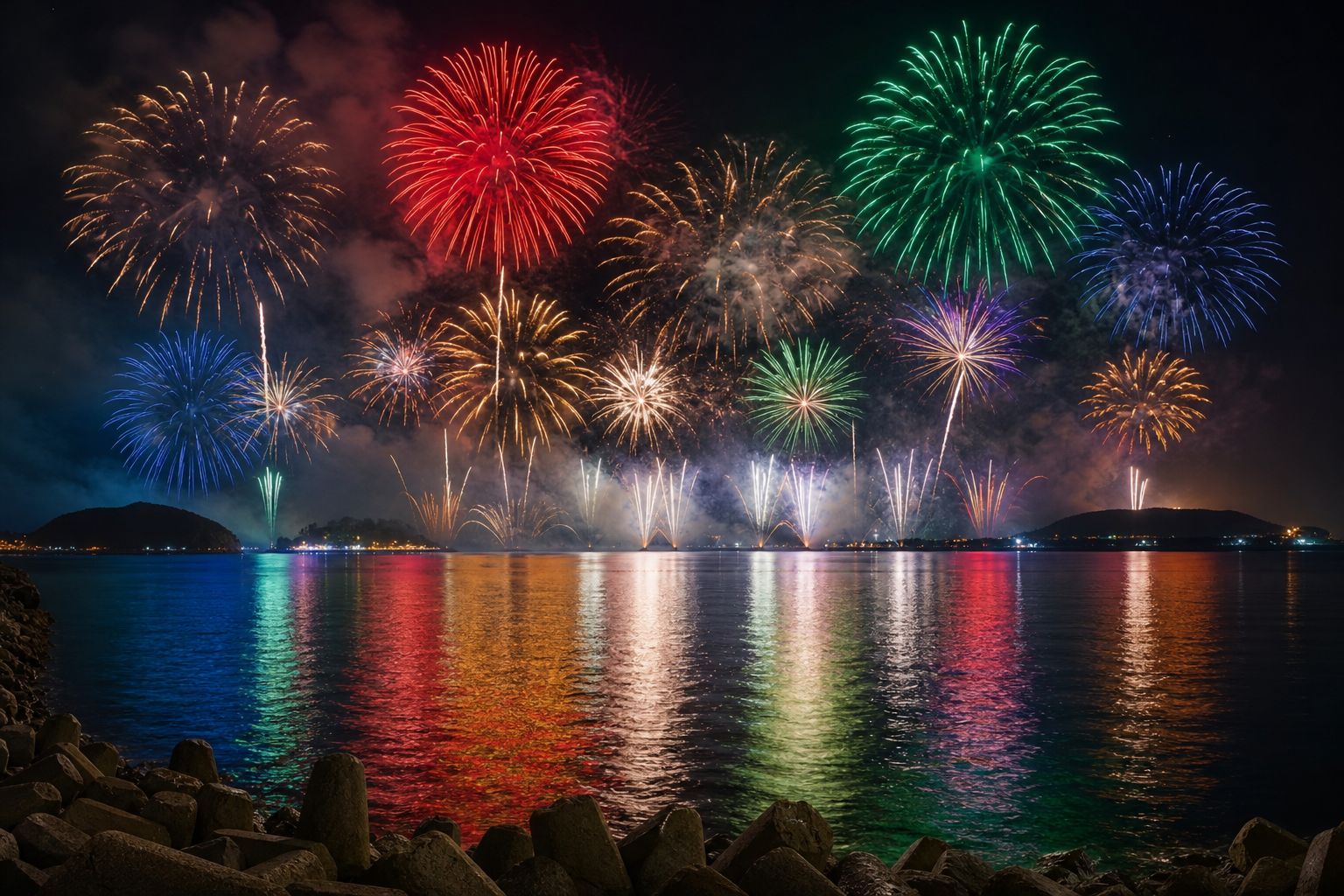
Fireworks in this filmRead the sky Red, green, blue, gold and white bursts over a calm bay. AI-generated still.Blue, done right A deep blue peony against the black. AI-generated still.
Epilogue · Sources
Sources
Every fact in this film comes from the sources below. The chapter stills and pictures are AI-generated artist’s impressions; they show no real people, places or events. The powders, the shell, the atom and the sky in 3D are simplified teaching models, not to scale. The film explains chemistry and is not a recipe; fireworks are dangerous and are regulated by law. Nothing here is health advice.