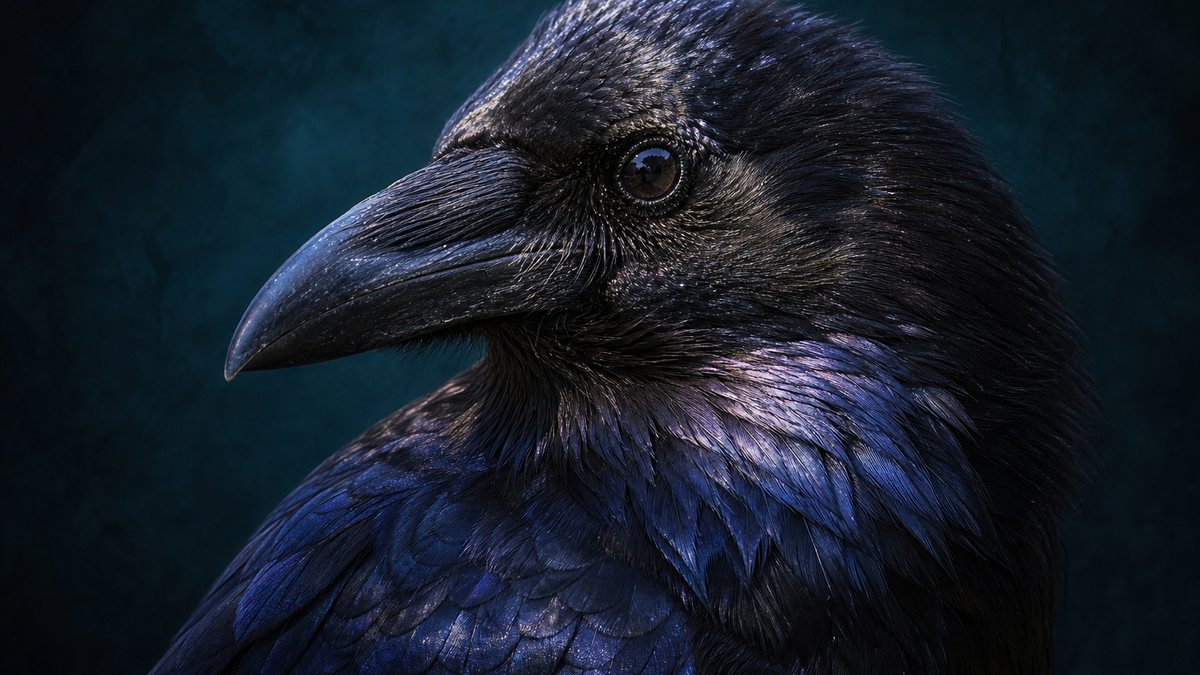
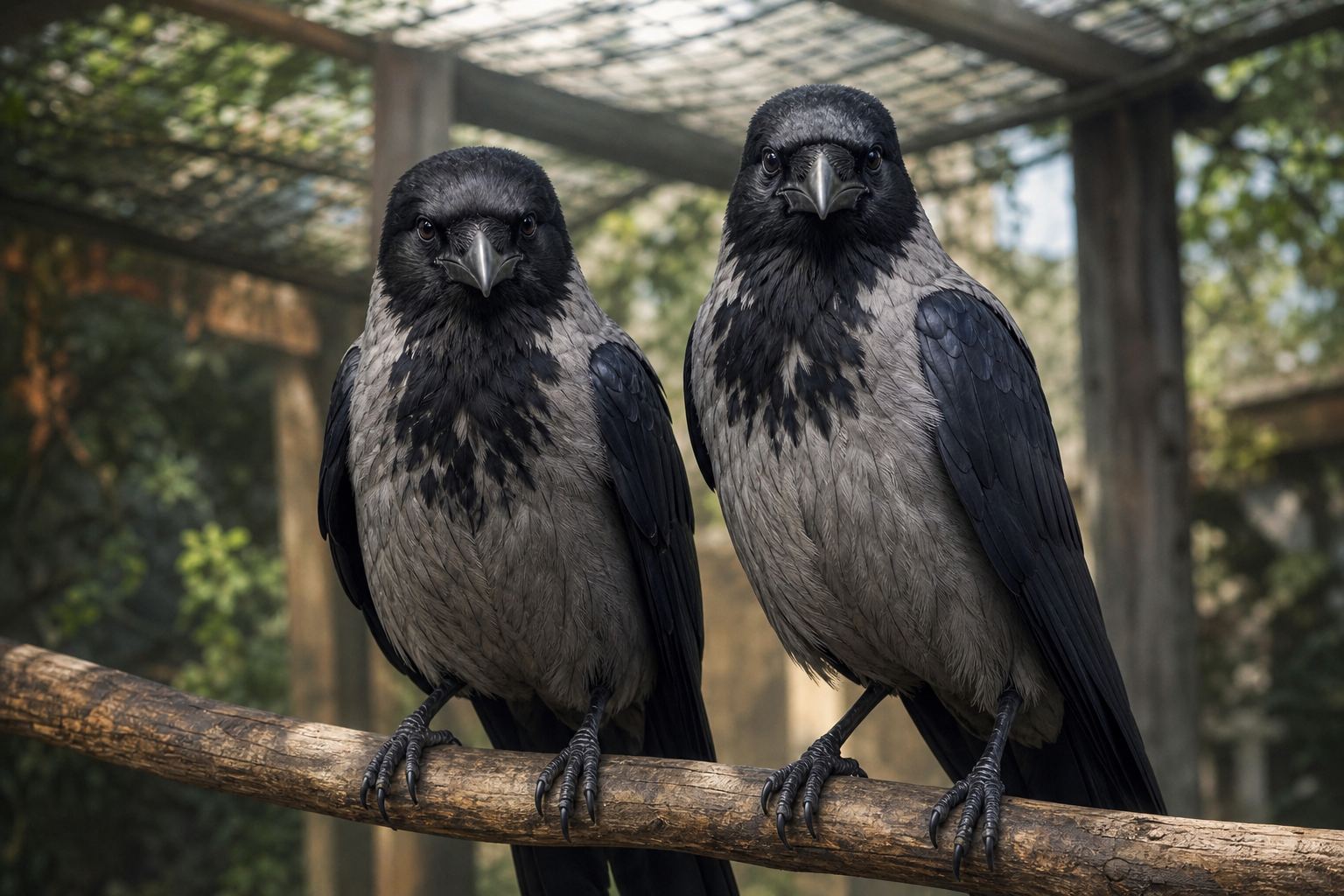
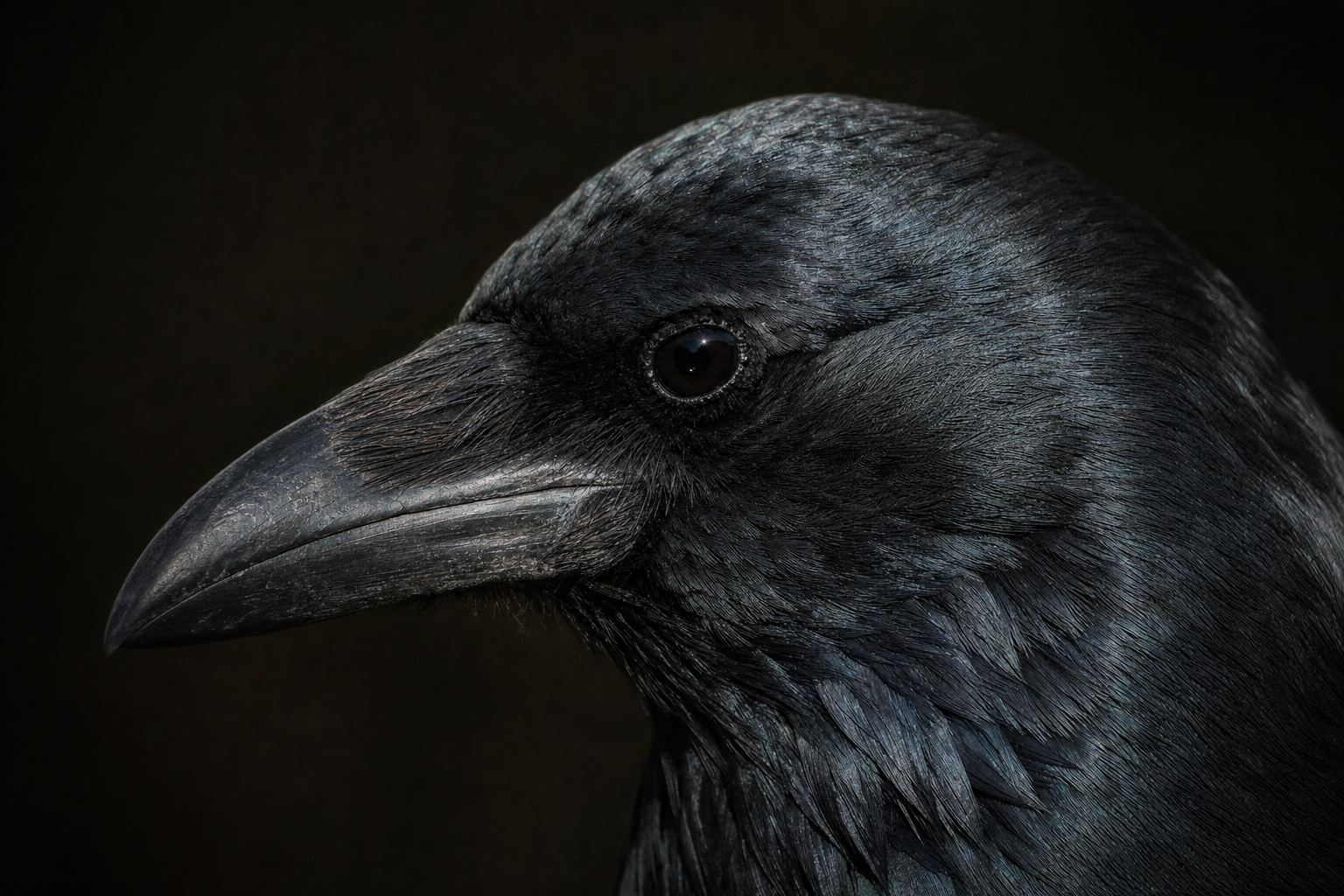
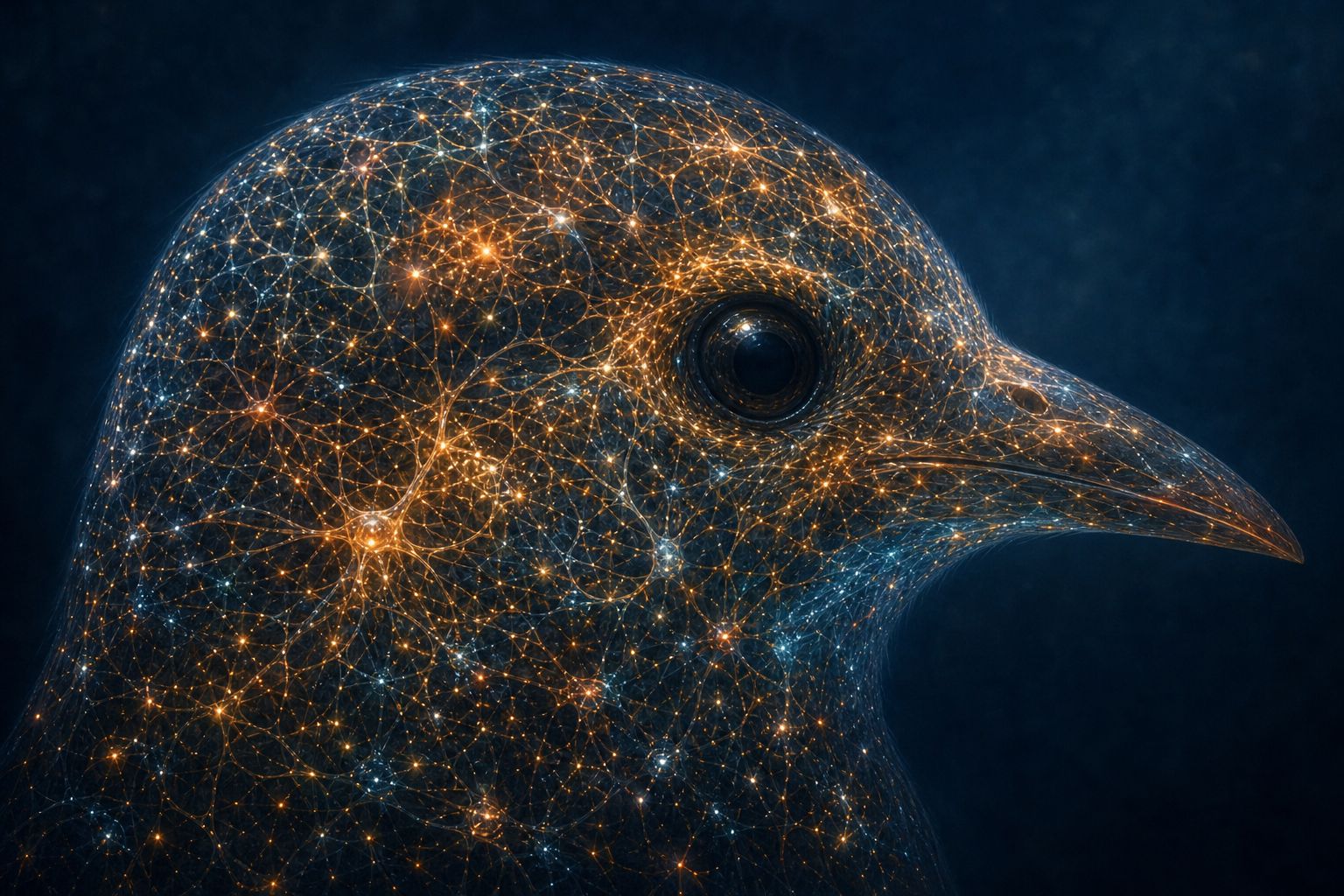
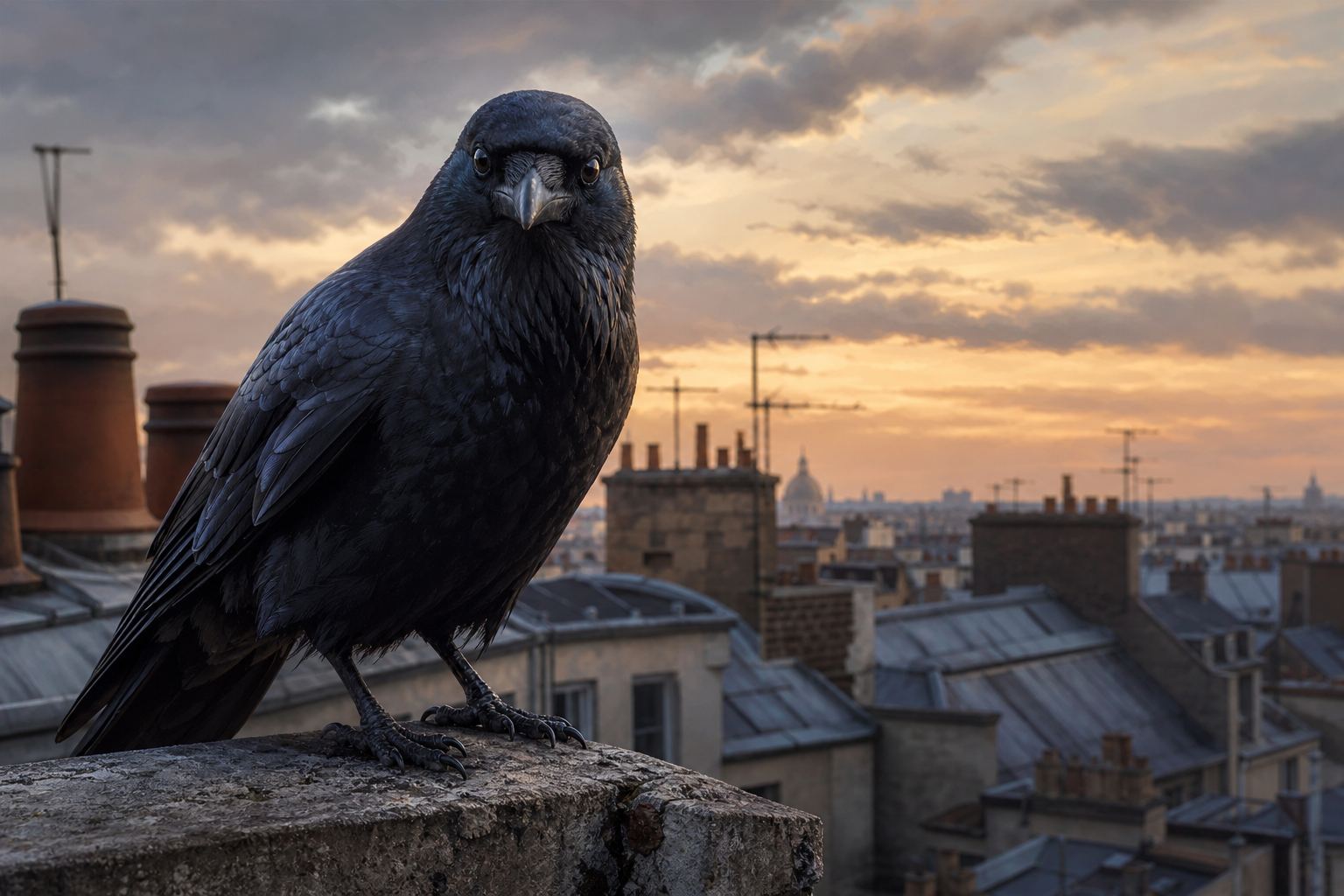
In October 2026 a study in Science reported that two carrion crows judged a field of moving dots in about a quarter of a second, while neurons in their forebrain revealed the choice even sooner. This film explains what is behind the headline: the crow family, a bird brain that is small but packed with neurons, a forebrain wired differently from ours that does similar work, crows that bend wire into hooks and use one tool to get another, crows that remember dangerous faces for years, jays that plan for tomorrow, crows with neurons for the number zero, and what the new experiment did and did not show.
Interactive 3D film9 min2002 to 2026Published 16 November 2026
Headlines this month said crows make decisions twice as fast as people.
Behind them is a laboratory in Tübingen, Germany, where two carrion crows watched a cloud of dots drift across a screen, and pecked to show which way it was moving.
On average they answered in 235 milliseconds, less than a quarter of a second. The study appeared in the journal Science in October.
The real story is more careful than the headlines, and it raises a bigger question: how does a brain the size of a walnut do this?
Crows can make decisions twice as fast as humans, scientists discoverHeadline, ScienceDaily, 12 November 2026
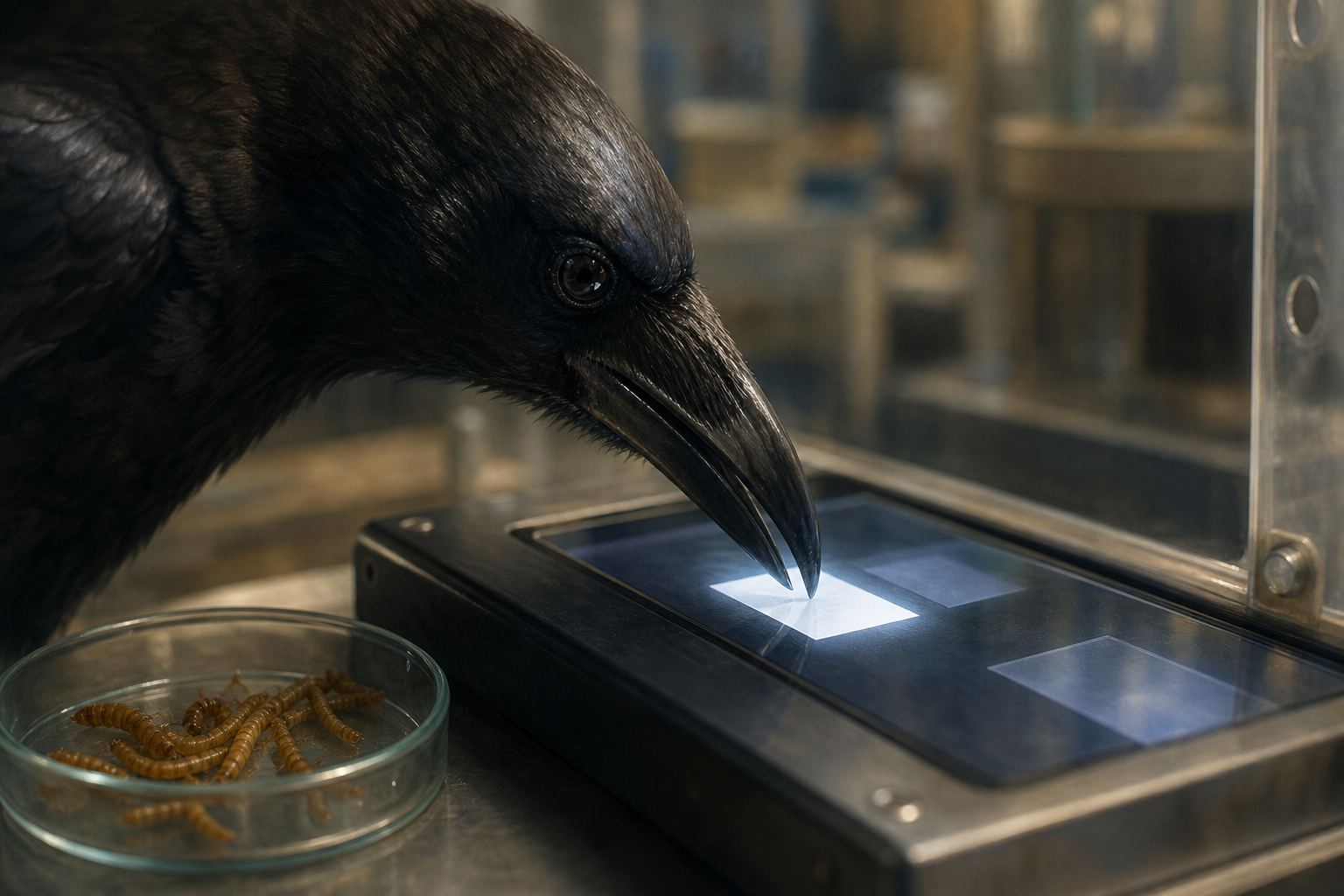
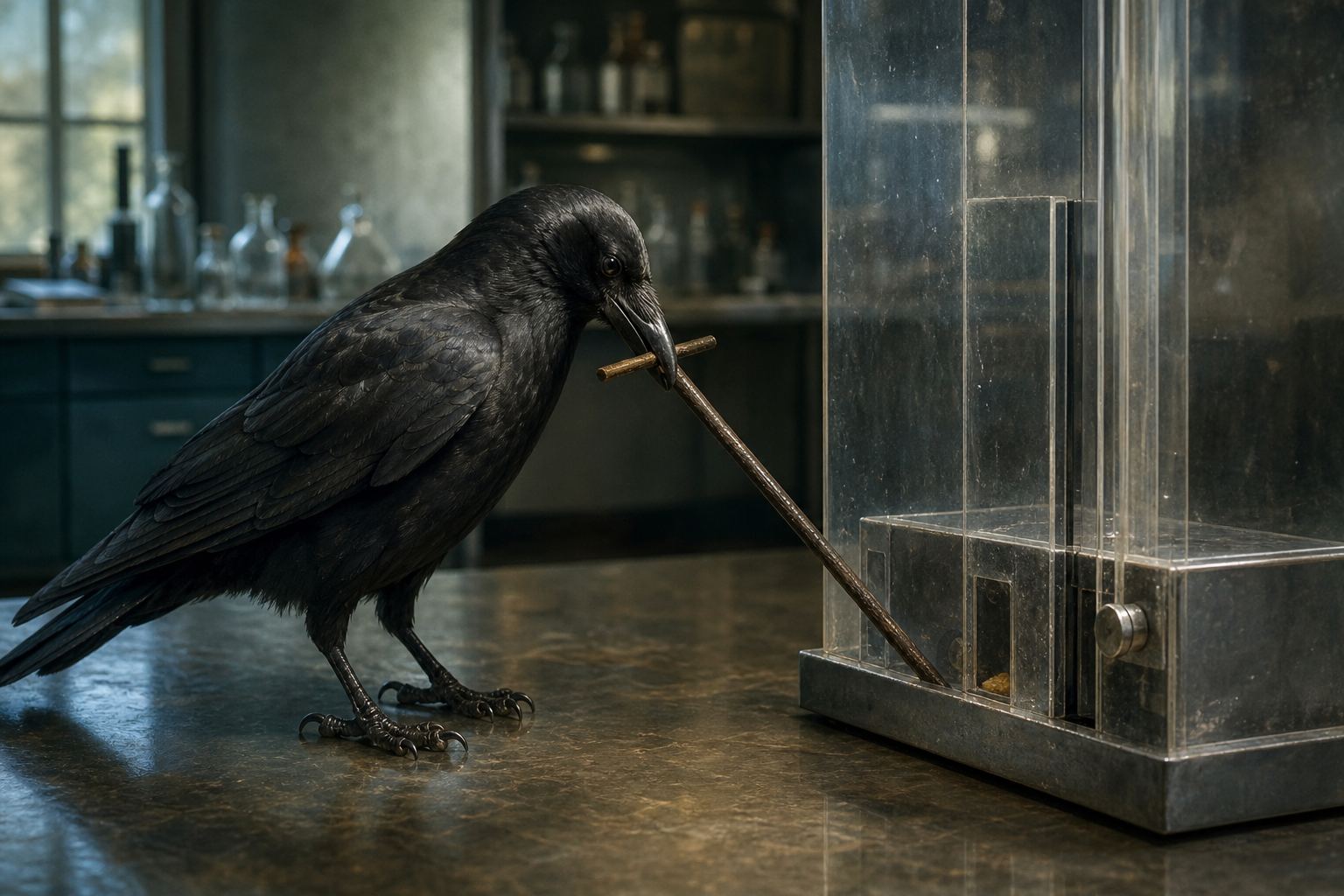
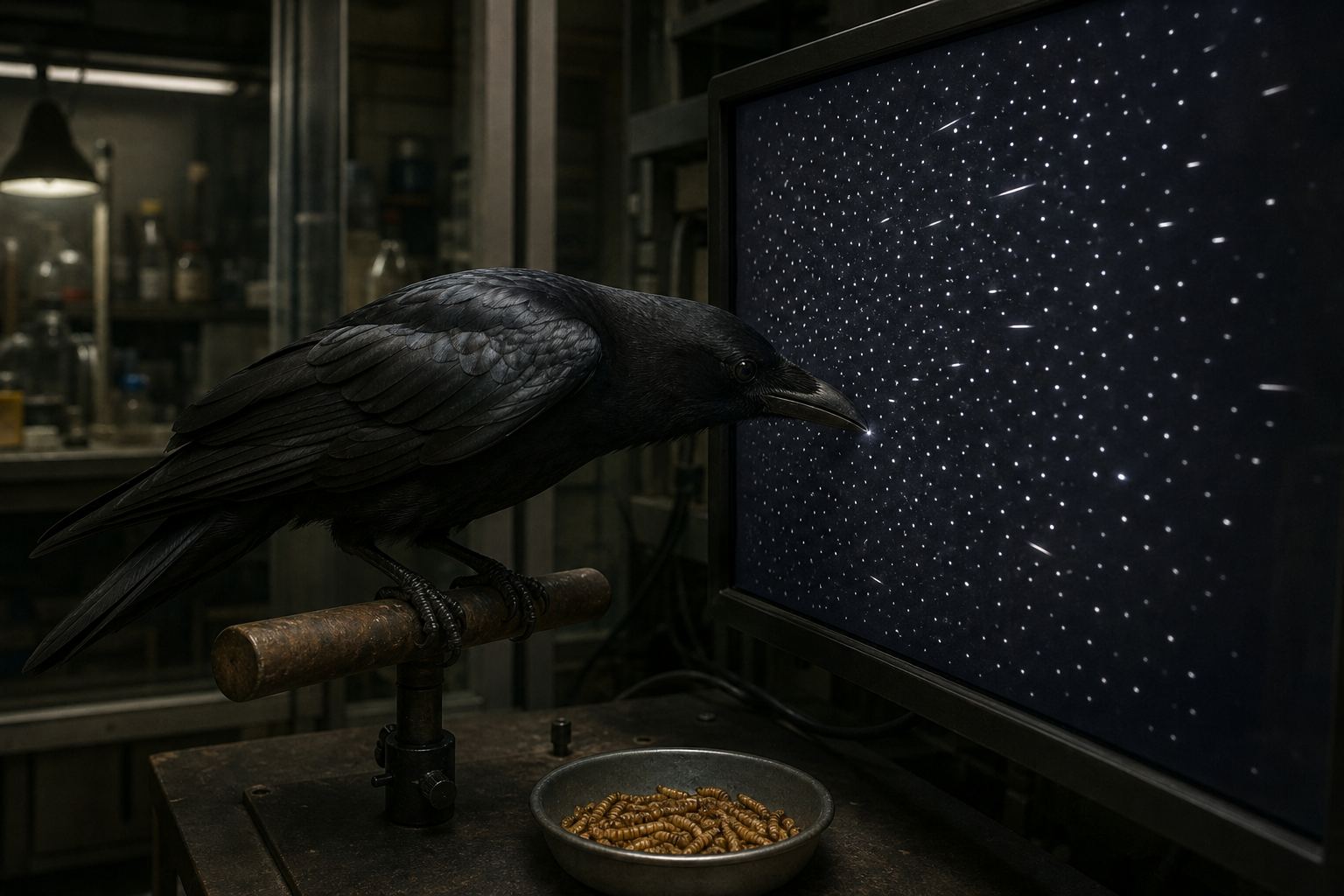
The experiment A crow at a touchscreen, with a mealworm as the reward for a right answer. AI-generated illustration.
235 ms
average answer time
2
carrion crows tested
Science
journal, 22 October 2026
The 2026 study
a small brain packed with neurons
wire hooks and tools for tools
faces remembered for years
planning, and the number zero
what the new study did and did not show
In this film
Prologue
The news
University of Tübingen, via ScienceDaily (12 November 2026), and Live Science (22 October 2026): Philipp Schmidbauer and Andreas Nieder published “Ultrarapid decision-making in an avian brain” in Science. Two carrion crows judged the direction of moving dots in 235 milliseconds on average.
Press the buttons to send the flock up or let it settle.
The 3D scenes are simplified teaching models: the birds, brains, tubes and screens are drawn schematically and not to scale.
Crows belong to the corvids, a family of birds that also includes ravens, jays and magpies.
There are more than forty species of crow alone, on every continent except South America and Antarctica.
Many live right beside us, on rooftops and in parks. So what is going on inside their heads?
40+
species of crow
5
continents with crows
27 million+
crows in the United States
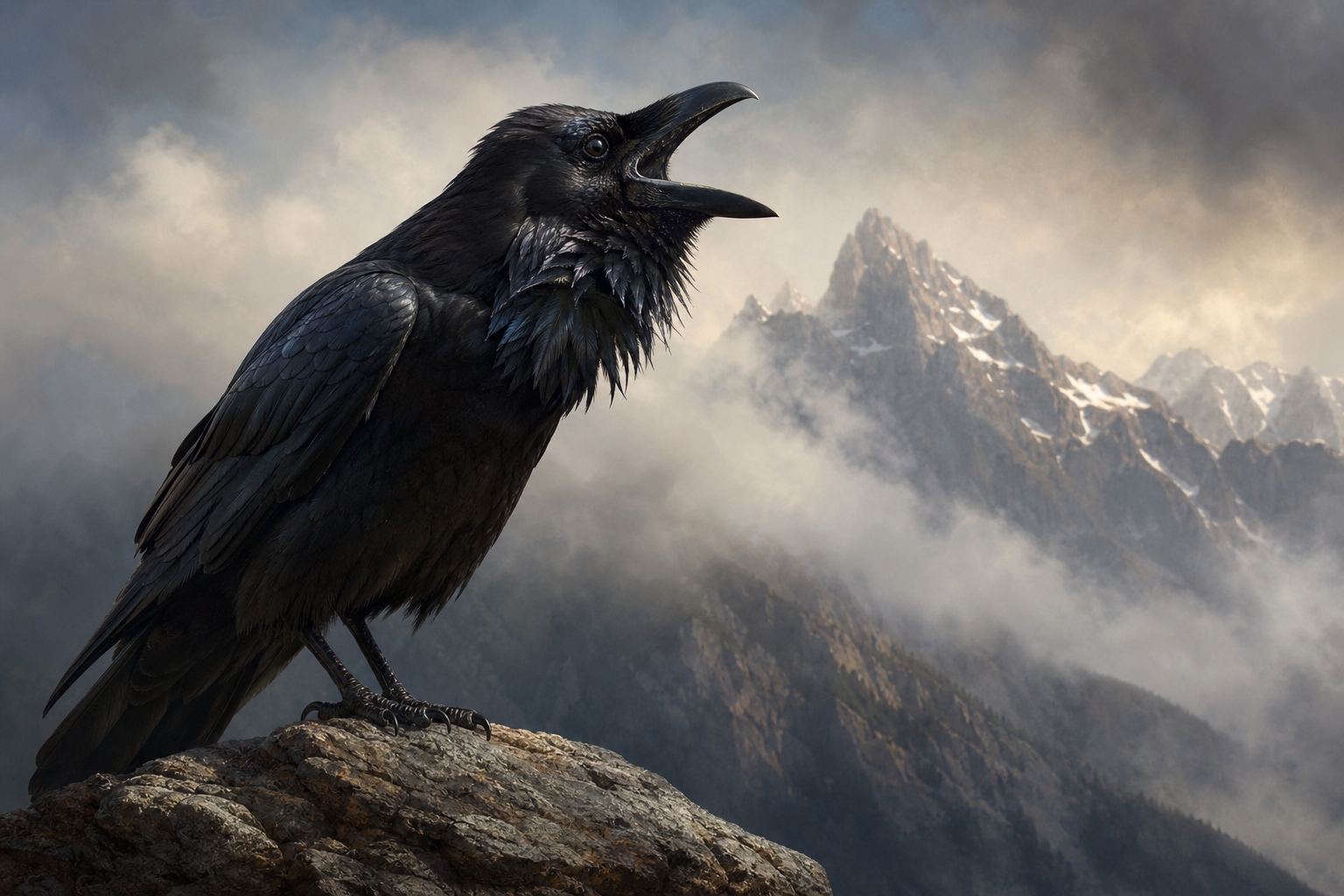
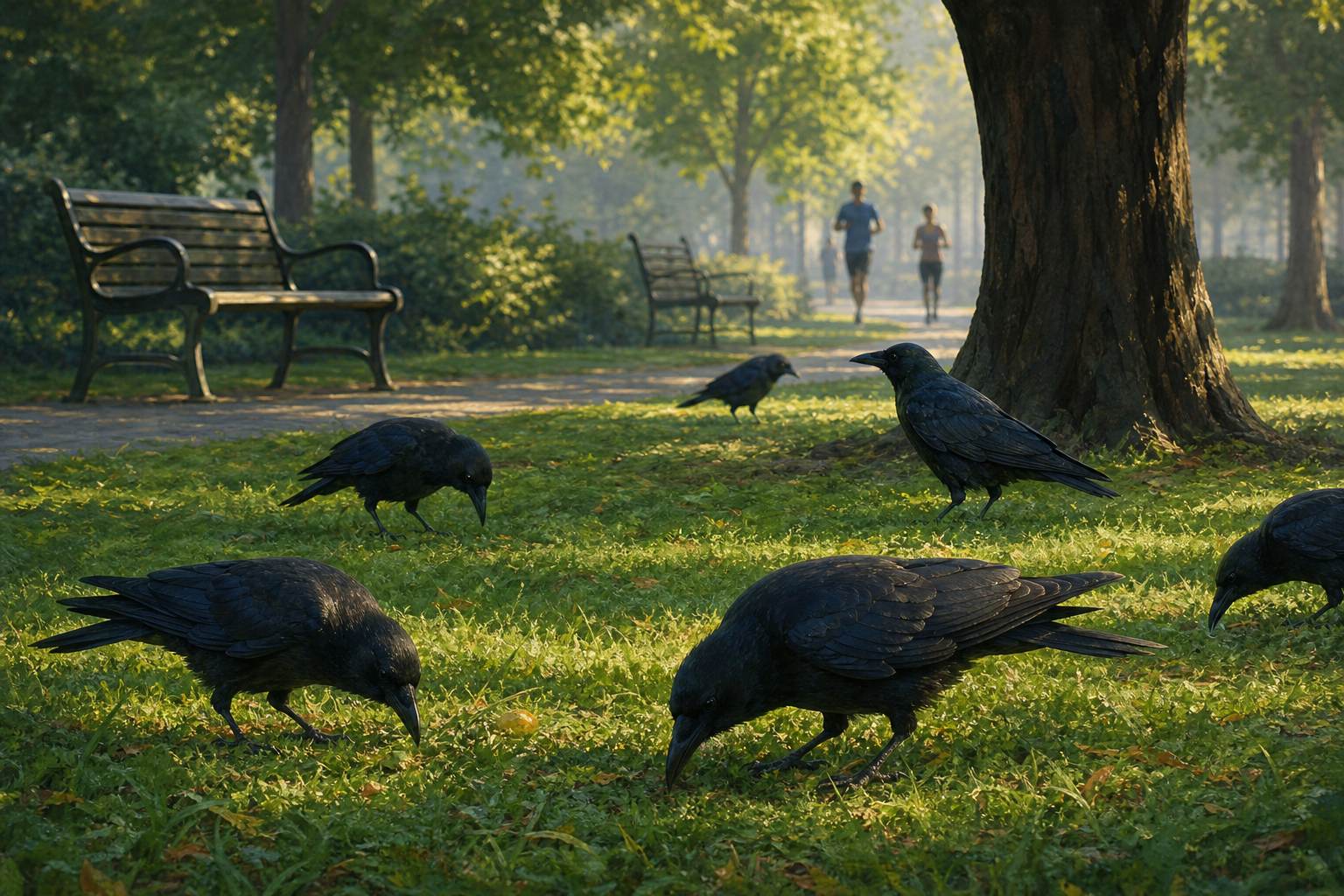
Crows in numbersThe common raven Bigger than a crow, with a wedge-shaped tail: size, tail, calls and whether they flock are how the two are told apart. AI-generated illustration.Neighbours Lawns, bins and rooftops: towns give crows food and high places to watch from. AI-generated illustration.
Chapter I · Bird brains
The crow family
Live Science: there are over 40 species of crow, found in North America, Europe, Asia, Africa and Australia, and at least 27 million crows in the United States. Crows and ravens differ in size, tail shape, calls and whether they live in pairs or flocks.
The Hawaiian crow, the ‘alalā, is extinct in the wild and is being reintroduced.
The 3D scenes are simplified teaching models: the birds, brains, tubes and screens are drawn schematically and not to scale.
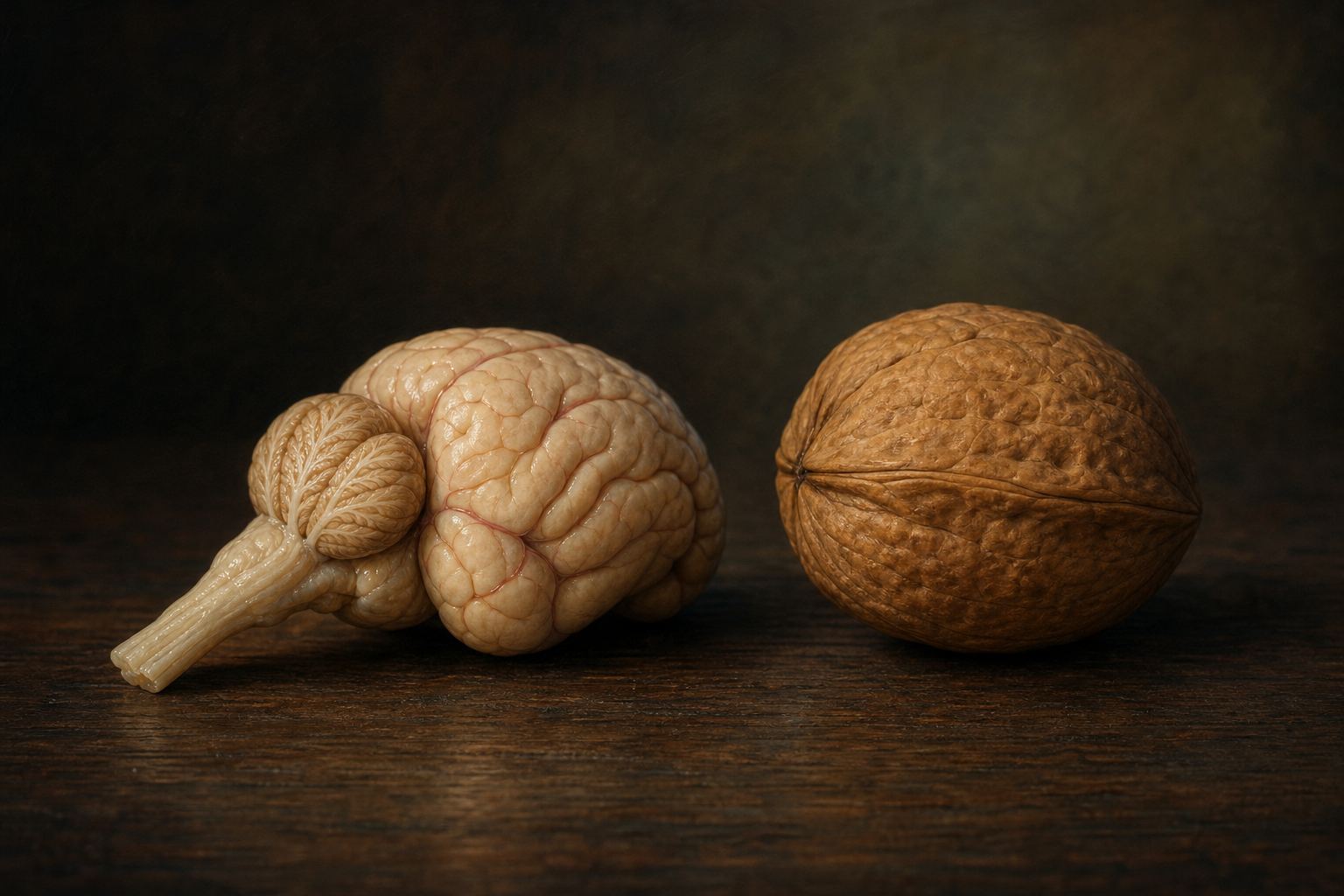
A bird's brain is, on average, about the size of a walnut. For a long time, calling someone a bird brain was an insult.
Then researchers counted the neurons, in twenty-eight species of bird.
A parrot's brain turned out to hold about as many neurons as that of a mid-sized primate, the group of animals that includes monkeys, apes and us.
Bird neurons are small and tightly packed. The forebrain of a crow holds about as many as that of a primate with a much larger brain.
About the size of a walnut A model of a small bird brain beside a walnut, the comparison science writer Jennifer Ackerman uses. AI-generated illustration.
A conceptual breakthrough.Erich Jarvis, neuroscientist not involved in the count, in Scientific American; he adds that density has not yet been proven to drive intelligence
28 bird species studied
each brain blended into a liquid of free-floating cell nuclei
nuclei counted: one whole brain in a day
teams in Prague, Vienna, Rio de Janeiro and São Paulo
How they counted
Chapter I · Bird brains
Neurons, counted
Scientific American: a study in PNAS, with senior author Suzana Herculano-Houzel, sampled 28 bird species and found that a parrot brain has about as many neurons as a mid-sized primate brain. In 2020 she noted that the corvid pallium (the bird forebrain) holds about as many neurons as primates with a much larger brain.
Press the buttons to compare a crow’s small, packed brain with a larger brain holding the same number of neurons. The point counts are illustrative, not measurements.
The 3D scenes are simplified teaching models: the birds, brains, tubes and screens are drawn schematically and not to scale.
Much of our thinking happens in the cortex, a folded sheet of neurons arranged in layers. Birds have no such sheet.
Their forebrain, the pallium, looks like clusters of neurons instead.
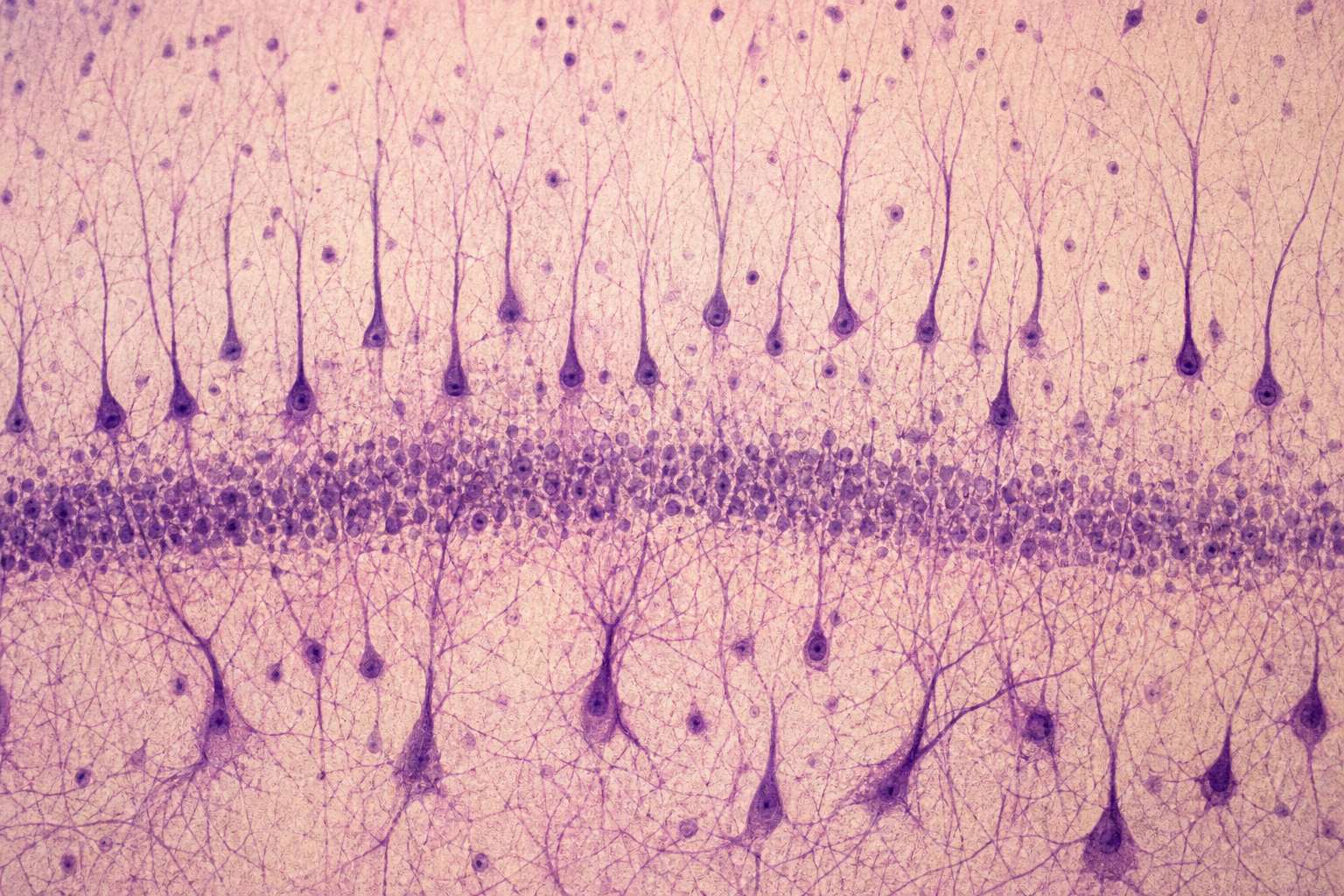
But in 2020, Onur Güntürkün's team in Bochum traced its fibres in pigeons and owls, and found circuits running in layers and columns, much like a cortex.
In crows, one region, the nidopallium caudolaterale, or NCL for short, works like our prefrontal cortex: in tests, its neurons track the rule the bird is following.
mammals: the cortex, a layered sheet
birds: the pallium, clusters of neurons
both: circuits in layers and columns
Two designsTracing the fibres Stained tissue in the style of a microscope slide. The 2020 team used polarised light to map fibres in 3D. AI-generated illustration.
NCL
nidopallium caudolaterale
rules
what its neurons track (2013)
The crow’s “prefrontal”
Chapter II · Another way to wire
A cortex-like pallium
Scientific American and AAAS/EurekAlert! (24 September 2020): Stacho, Güntürkün and colleagues at Ruhr University Bochum used 3D polarised light imaging and tracer studies in pigeons and barn owls, and found layered, columnar, cortex-like circuits in the pallium. In the same issue of Science, Andreas Nieder’s team reported that, “like the prefrontal cortex of primates”, the crow pallium shows activity that seems to match what the bird has seen. In 2013 his lab had shown NCL neurons tracking the rule a crow was applying.
The animation shows clusters first, then the layers and columns, then the NCL lighting up.
The 3D scenes are simplified teaching models: the birds, brains, tubes and screens are drawn schematically and not to scale.
Birds and mammals last shared an ancestor about 320 million years ago. It was a reptile.
So did that ancestor already have this wiring, or did each line invent its own?
In 2025, two studies in Science compared how bird and mammal brains develop, and which kinds of neurons they use.
Their answer: the circuits form differently in the two lines. Birds and mammals built these circuits separately. Biologists call this convergent evolution: different lines arriving at similar solutions.
~320 million years ago a reptile, the last shared ancestor
since then mammals evolve a layered cortex
since then birds evolve a clustered pallium
Two linesAbout 320 million years ago A small reptile-like animal in a coal-swamp forest of giant ferns and horsetails: an artist’s guess, not a known species. AI-generated illustration.
Achucarro, Spain: sensory circuits form differently in birds and mammals
Heidelberg, Germany: birds kept most types of “brake” neurons
few “accelerator” neuron types match mammals
The two 2025 studies
2 lines
similar circuits, built separately
wings
another example: birds and bats both fly
Convergent evolution
Chapter II · Another way to wire
Convergent evolution
Scientific American (2020): the last common ancestor of birds and mammals was a reptile that lived around 320 million years ago. EurekAlert!/UPV-EHU (13 February 2025): two papers in Science — Rueda-Alaña, García-Moreno and colleagues (Achucarro Basque Center for Neuroscience) and Zaremba and colleagues (Heidelberg University) — found that bird and mammal brain circuits arose independently.
Press the buttons to grow the tree again or to follow one line. The branch lengths are not to scale.
The 3D scenes are simplified teaching models: the birds, brains, tubes and screens are drawn schematically and not to scale.
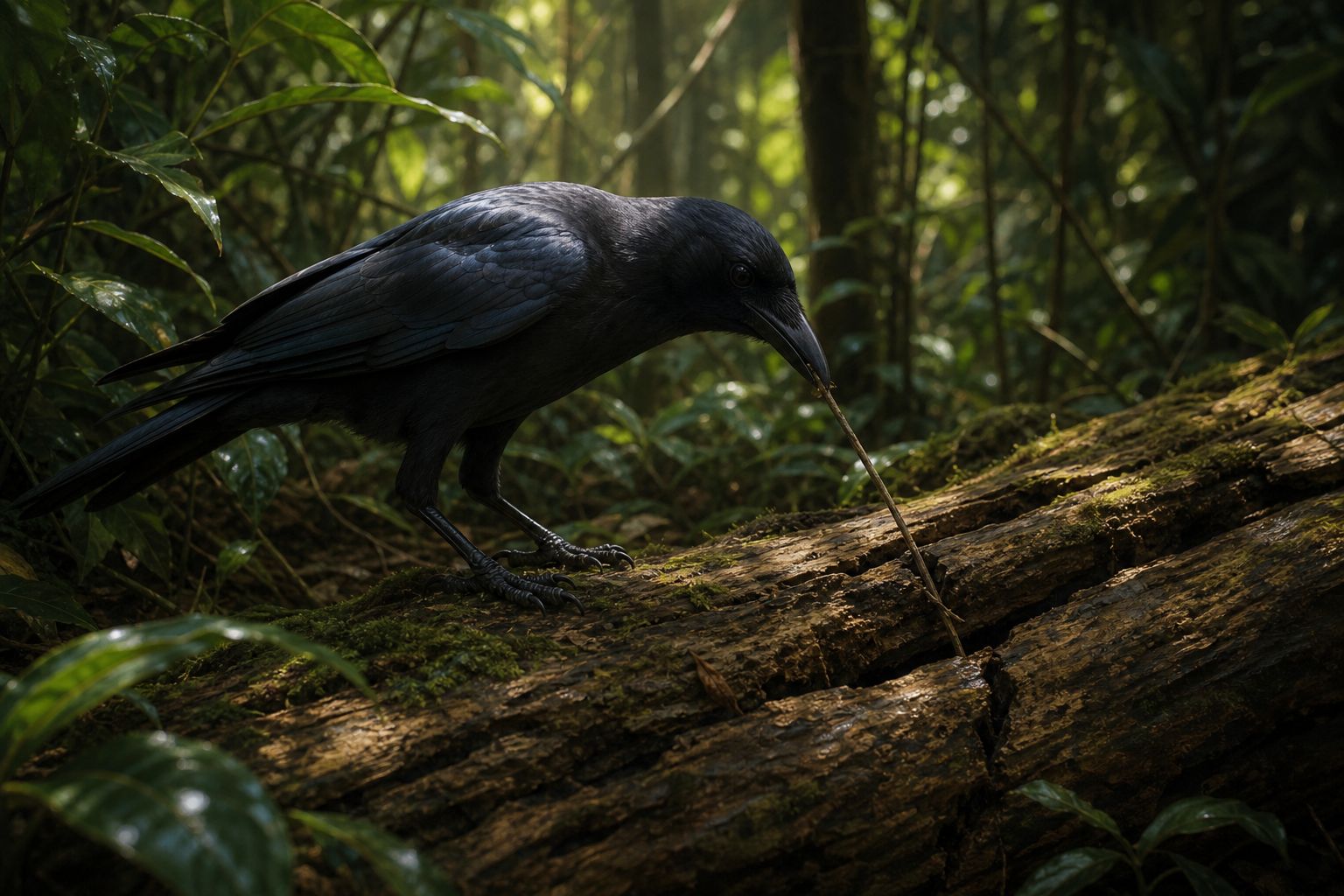
In 2002, a New Caledonian crow named Betty became famous. New Caledonia is a group of islands in the South Pacific.
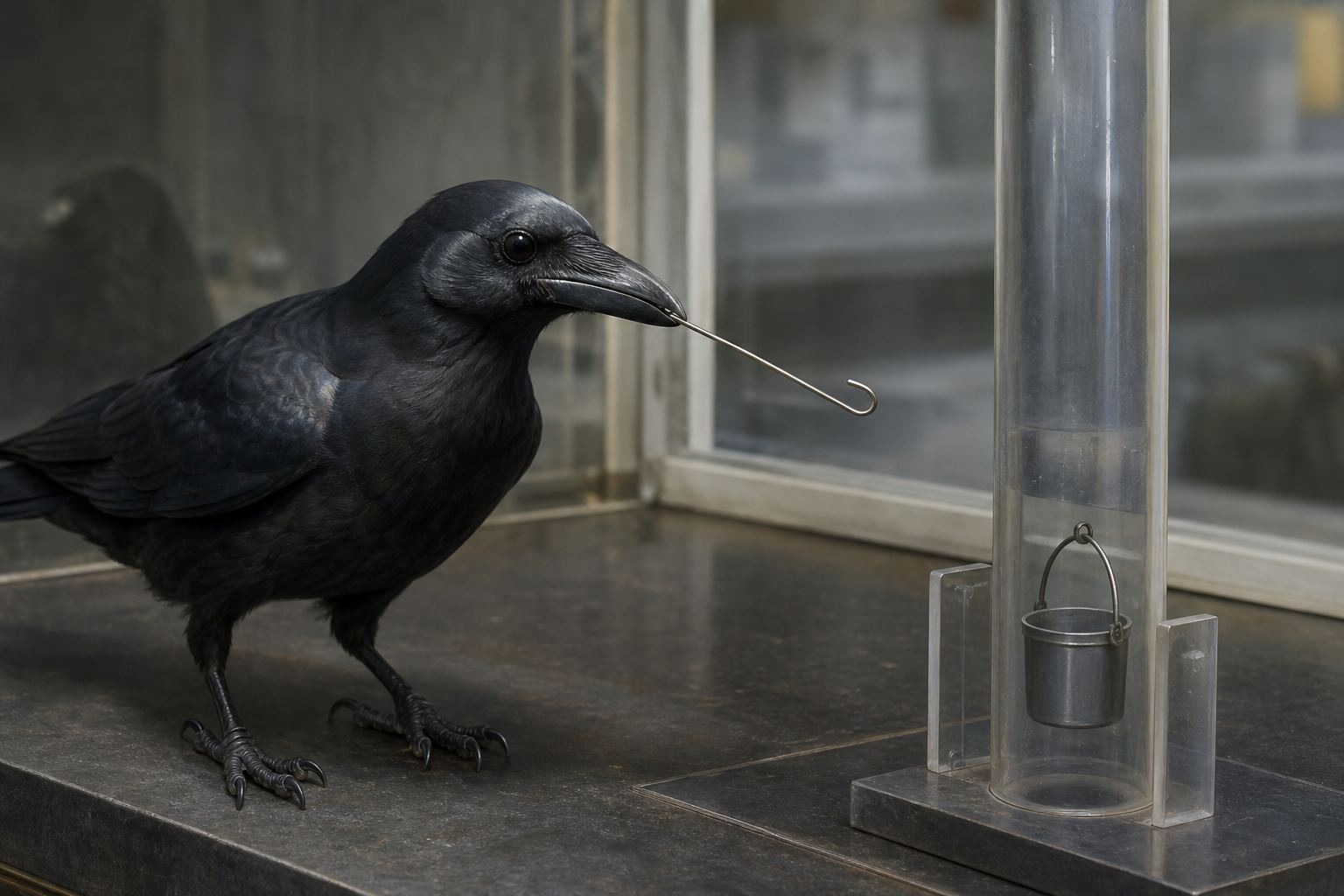
She was the first animal shown to make a hooked tool by bending a straight, pliable material.
Crows of her species also understand that dropping stones into water raises its level, a skill science writer Jennifer Ackerman compares to that of a child of five or six.
A hooked wire A New Caledonian crow beside a test tube: a bent end turns a useless straight wire into a tool that can catch a handle. AI-generated illustration.
2002
Betty’s hook made headlines
first animal
shown bending a material into a hook
A first
On par with a child five or six years old.Jennifer Ackerman, author of The Genius of Birds, on the stone-and-water task
In the wild A New Caledonian crow probing a log with a twig: Betty’s species, at work outside the lab. AI-generated illustration.
Chapter III · Tool makers
The first hook
EurekAlert! (24 October 2018, Max Planck Institute for Ornithology and University of Oxford): Betty, a New Caledonian crow, “became famous in 2002 as the first animal shown to be able to create a hooked tool by bending a pliable material.” Scientific American, interviewing Jennifer Ackerman: New Caledonian crows understand that stones displace water, on par with a child five or six years old.
Press “Bend the wire” to see why a hook works where a straight wire fails. The tube task drawn here is schematic.
The 3D scenes are simplified teaching models: the birds, brains, tubes and screens are drawn schematically and not to scale.
In 2007, researchers at the University of Auckland set a harder puzzle: food out of reach of a short stick, and a long stick shut away in a box.
Six of seven crows went for the long stick with the short one on their very first attempt. A tool to get a tool.
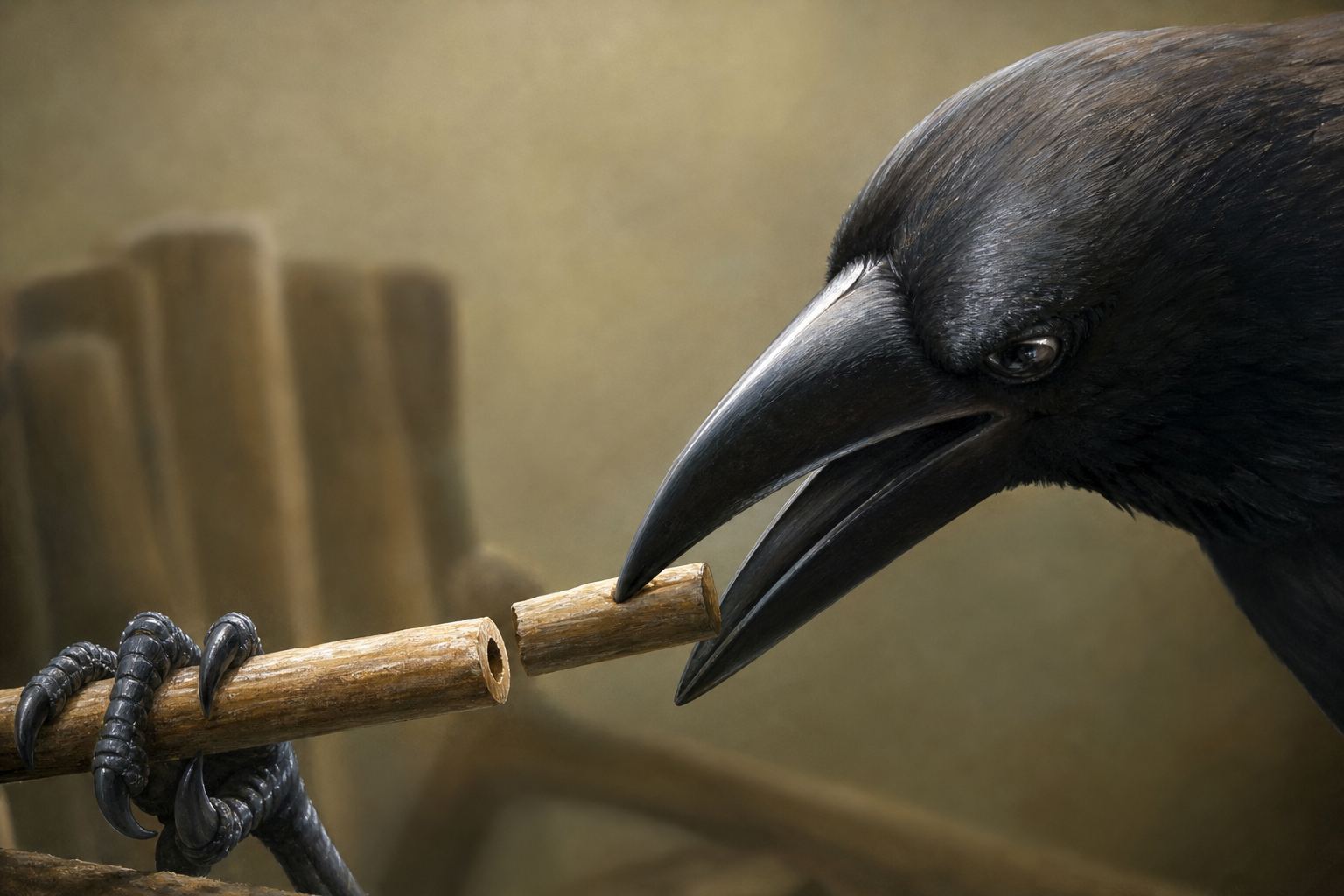
In 2018, a crow named Mango went further, fitting short pieces together into a tool of three and even four parts.
Human children, the 2018 team notes, invent new tools of their own only at about five.
Auckland, 2007 A short stick in the beak, the long one in the box, the food further still. AI-generated illustration.
6 of 7
went for the long stick at the first try, 2007
3
tools in sequence, Oxford 2009
4
parts in Mango’s tool, 2018
First tryA compound tool Short hollow sticks fitted end to end. Four of the eight crows tested combined pieces with no help. AI-generated illustration.
no firm proof of human-like planning
“does not imply” minds equal to humans or apes
children: tool use at 18 months, new tools at about 5
The researchers’ caution
Chapter III · Tool makers
Metatools and compound tools
ScienceDaily (Cell Press, 2007): Taylor, Hunt, Holzhaider and Gray at the University of Auckland reported in Current Biology that six of seven New Caledonian crows tried to get the long stick with the short stick at their first attempt. ScienceDaily (Oxford, 2009): crows used up to three tools in sequence without training. EurekAlert! (2018): in Scientific Reports, four of eight crows combined short sticks into longer tools; one, Mango, used three and four parts.
Press “Next move” to step through the puzzle.
The 3D scenes are simplified teaching models: the birds, brains, tubes and screens are drawn schematically and not to scale.
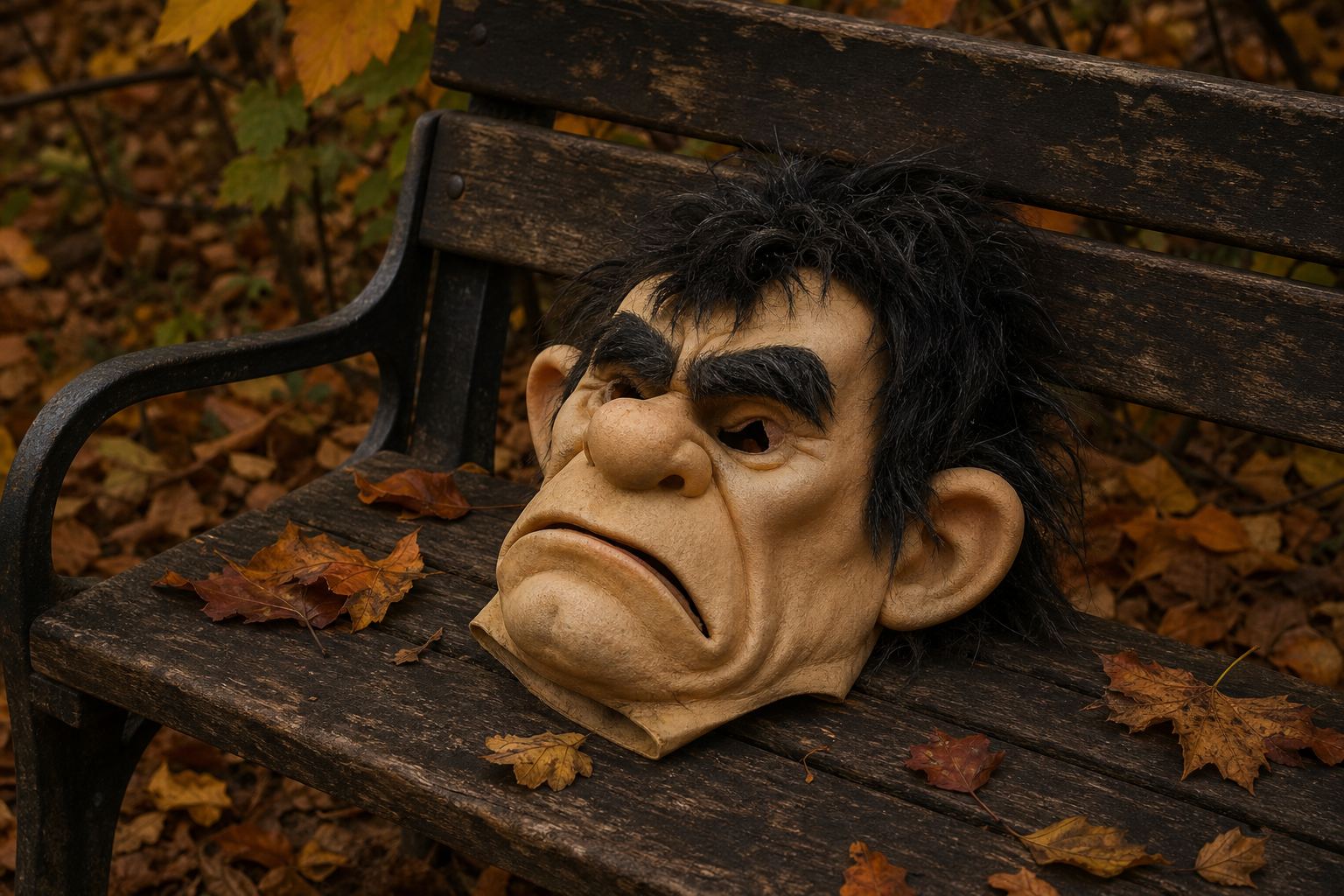
At the University of Washington in Seattle, John Marzluff's team trapped and banded wild crows while wearing one particular mask, then let them go.
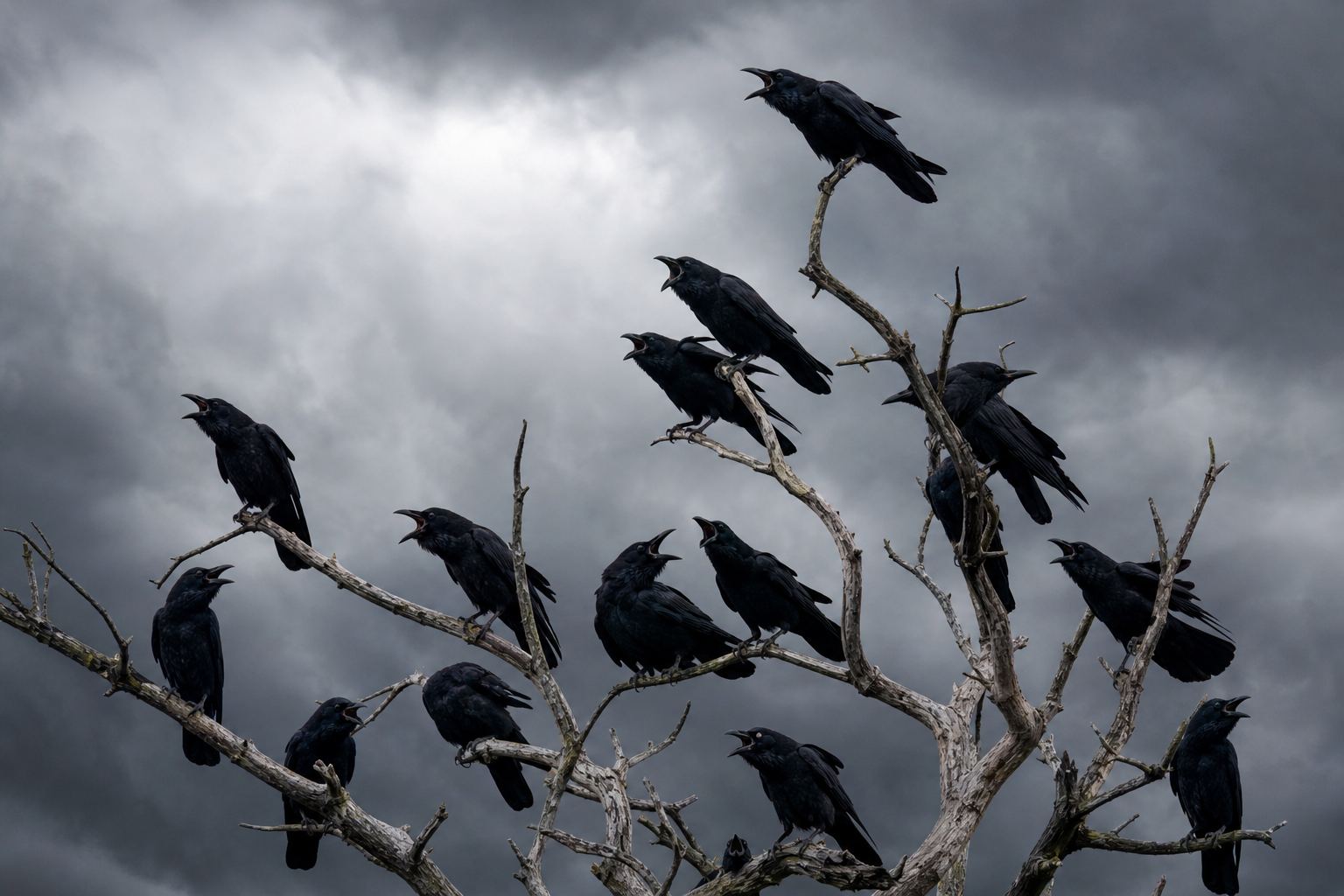
Over the next five years, crows scolded people wearing that mask, with harsh alarm calls, sometimes in mobs of thirty or more.
Crows that had never been trapped joined in. Young birds picked it up from their parents, and kept scolding the mask even when their parents were not there.
The mask A rubber mask on a park bench. Wearing the same one each time made the trapper’s face easy to test. AI-generated illustration.
5 years
of the study
30+
crows in some mobs
~50
crows scolded Marzluff a year after he last wore the mask on campus
Five years of scoldingPassed on Scolding calls from a bare tree. Birds that were never trapped learned the face from others. AI-generated illustration.
trapped crows: scolded the mask
untrapped neighbours: joined in
fledglings: scolded it alone
How the face spread
Chapter IV · Faces and the dead
Faces remembered
Live Science (28 June 2011): in a five-year study published in Proceedings of the Royal Society B, John Marzluff’s team at the University of Washington trapped and banded crows while wearing a mask. Masked people were scolded for years, by mobs of 30 or more; untrapped crows joined in, and fledglings scolded the mask without their parents present.
Press “Wear the mask” and “Take it off” to see the flock react.
The 3D scenes are simplified teaching models: the birds, brains, tubes and screens are drawn schematically and not to scale.
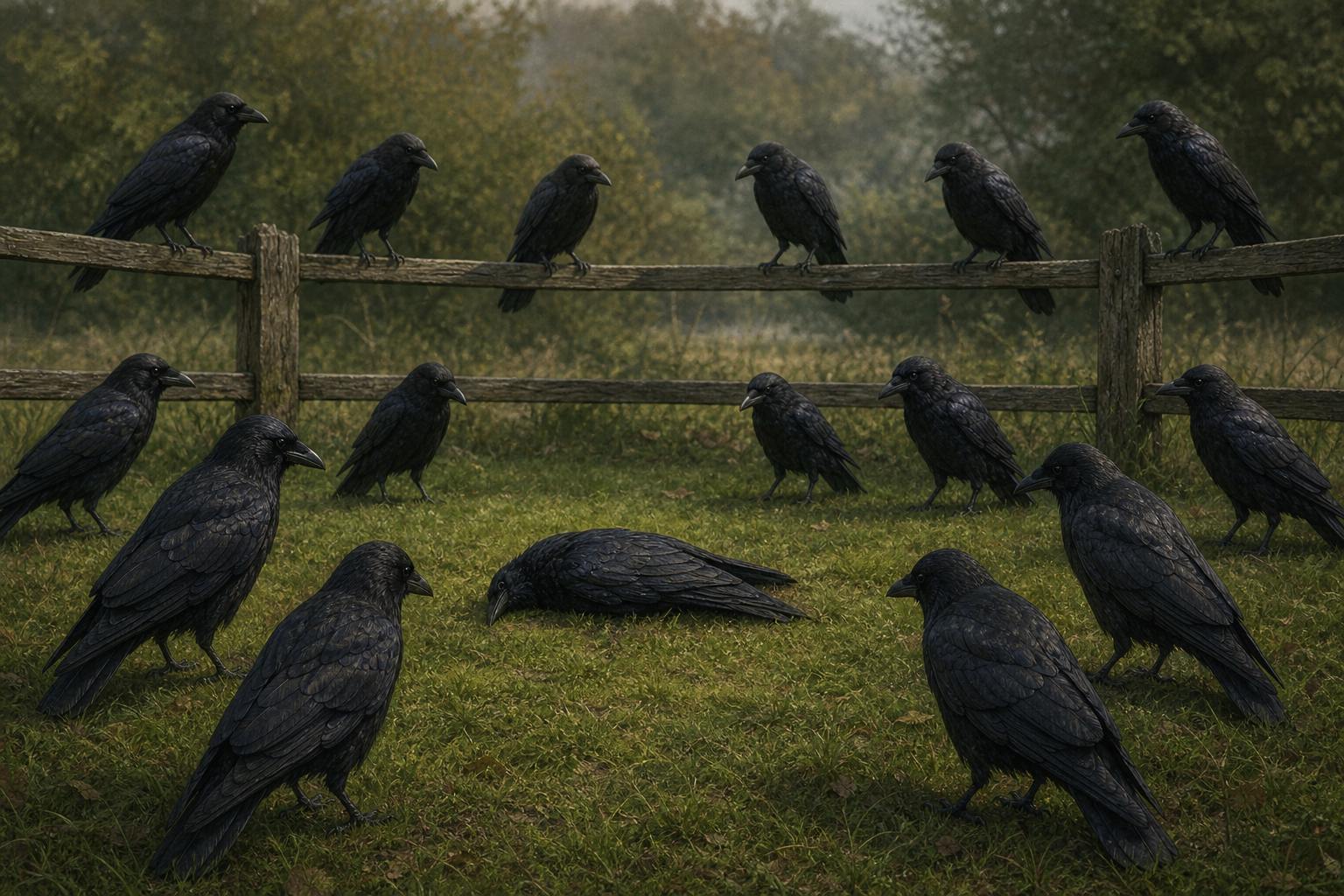
Crows also react to their dead. For a study published in 2016, masked volunteers carried a stuffed dead crow into crows' territory.
The crows gathered and scolded. A person seen holding the dead crow just once could be scolded for up to six weeks.
A dead pigeon got almost no reaction. The study suggests crows gather around their dead to learn about danger, not to mourn.
6 weeks
longest a person was scolded after one sighting
RememberedA crow “funeral” Crows on a fence and the grass, watching one lying still. Few animals pay more than passing attention to their dead. AI-generated illustration.
a dead crow: gathering and scolding
a stuffed hawk posed as if alive: scolding and mobbing
a dead pigeon: almost nothing
What set the crows off
Chapter IV · Faces and the dead
Why crows gather at their dead
Live Science (6 January 2016): in a study of American crows in the journal Animal Behaviour, masked volunteers carried a taxidermy crow, or with a stuffed red-tailed hawk posed as if alive. Crows scolded and mobbed; people seen once with a dead crow were remembered for up to six weeks; a pigeon brought almost no reaction.
The 3D scenes are simplified teaching models: the birds, brains, tubes and screens are drawn schematically and not to scale.
Crows have relatives that plan ahead. Western scrub-jays hide food to eat later.
At the University of Cambridge, Nicola Clayton's team asked whether they hide it with tomorrow in mind.
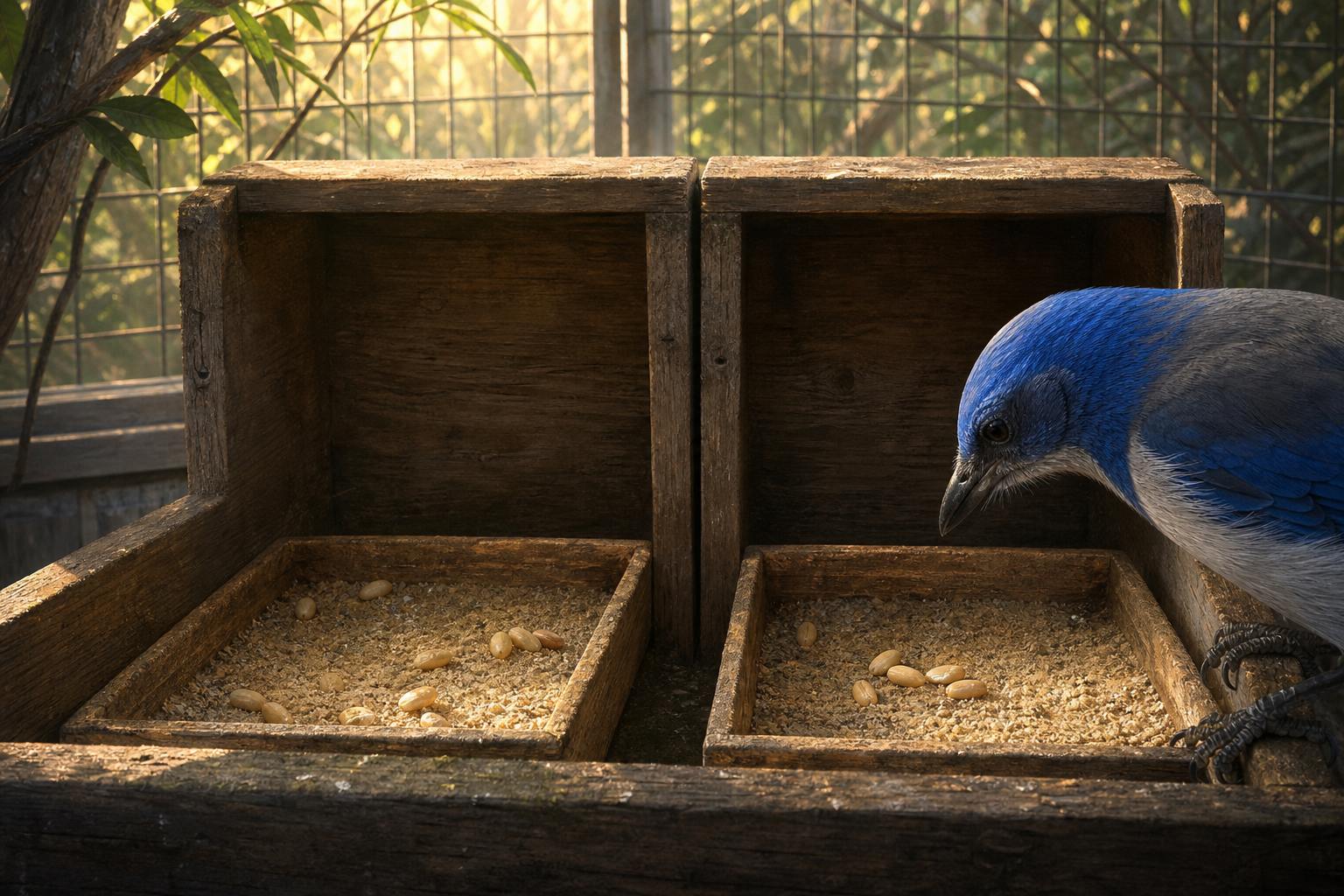
Eight jays spent their mornings in one of two rooms. In one they always got breakfast, in the other never.
Given pine nuts in the evening, they hid more of them in the room with no breakfast.
In another test, each jay hid peanuts in the room that served kibble, and kibble in the room that served peanuts, so either room would offer both. The researchers called it the first known example of an animal planning for the future.
The two rooms Trays for hiding food in two compartments side by side, the idea of the Cambridge test. AI-generated illustration.
8
western scrub-jays
2
rooms: breakfast, no breakfast
Nature
journal, February 2007
The test
room A serves peanuts → hide kibble there
room B serves kibble → hide peanuts there
result next morning: both foods in both rooms
Planning for variety
Chapter V · Tomorrow and zero
Planning for tomorrow
ScienceDaily (BBSRC, 26 February 2007): in Nature, Nicola Clayton’s team at the University of Cambridge showed that eight western scrub-jays cached more pine nuts in the compartment where they would get no breakfast, and cached each food where the other would be served, “the first known example of future planning in animals”. Scientific American (Ackerman): scrub-jays also remember what they hid, where, when, and who was watching.
Press “Evening: nuts” and “Next morning” to run the test.
The 3D scenes are simplified teaching models: the birds, brains, tubes and screens are drawn schematically and not to scale.
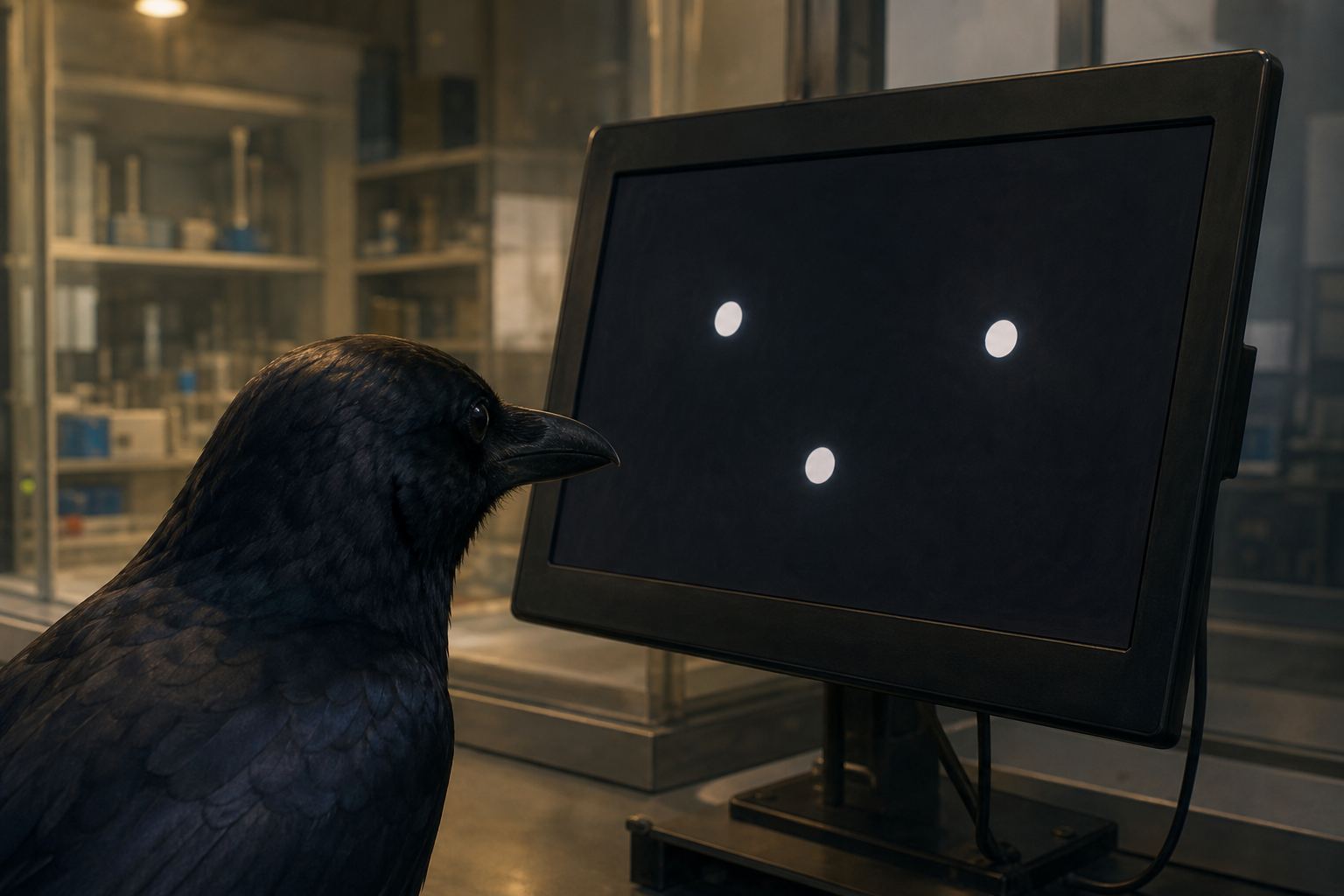
Back in Tübingen, Andreas Nieder's lab trains crows to work at touchscreens.
In 2013 they showed crows switching between two rules: is this picture the same as the last one, or different?
Neurons in the NCL, the region we met earlier, revealed which rule the bird was following.
In 2021 they showed crows sets of zero to four dots, and recorded more than five hundred neurons. Some fired most for an empty screen, and less and less as the dots increased.
To a crow, it seems, nothing is a number too.
At the touchscreen A screen of dots for a crow to judge: same as before, or different? AI-generated illustration.
“same”: pick the picture that matches
“different”: pick the one that does not
new picture sets worked too
Two rules, 2013
0–4
dots shown
500+
neurons recorded in two crows
~75%
correct on the matching task (2015)
The zero study, 2021
What utility this holds for the animals, if any, remains unclear.Andreas Nieder, to Live Science, 2021
Chapter V · Tomorrow and zero
Rule neurons and zero
ScienceDaily (University of Tübingen, 2013): Veit and Nieder reported in Nature Communications that NCL neurons in crows predicted which rule (same or different) the bird would apply. Live Science (14 June 2021): in the Journal of Neuroscience, Nieder’s team recorded more than 500 NCL neurons in two carrion crows shown zero to four dots; some neurons were tuned to zero and fired less as the number grew. A 2015 PNAS study had shown the crows matched numbers about 75% correctly.
Press 0 to 4 to change the number of dots and watch the “zero neuron”. Its response curve is illustrative.
The 3D scenes are simplified teaching models: the birds, brains, tubes and screens are drawn schematically and not to scale.
Now the new experiment. Two carrion crows watched a field of dots. Some moved together in one direction, the rest at random.
The crows pecked to report the direction, and earned a mealworm when right.
They answered in 235 milliseconds on average.
The team recorded 248 neurons in the NCL, the same rule-keeping region, and could read the coming choice from them just 70 milliseconds after the dots appeared, about 170 milliseconds before the peck.
When most dots moved together, the crows were right almost every time. Even when very few did, they still did better than guessing.
Which way? A crow leans in to a field of dots. Only a share of them drift the same way; the fewer that do, the harder the call. AI-generated illustration.
dots appear; some drift one way
peck to report the direction
right answer: a mealworm
The task
235 ms
average answer
248
NCL neurons recorded
Speed
0 ms dots appear
70 ms NCL neurons already signal the choice
235 ms average peck
One trial, in milliseconds
~100%
correct when the signal is clear
above chance
even when very few dots move together
Easy and hard
Chapter VI · A quarter of a second
Ultrarapid decisions
Live Science (22 October 2026) and ScienceDaily (12 November 2026): Philipp Schmidbauer and Andreas Nieder trained two carrion crows on a moving-dot direction task with a mealworm reward. The mean response time was 235 ms. Of 248 neurons recorded in the nidopallium caudolaterale, the coming choice could be read 70 ms after the dots appeared, about 170 ms before the peck. Accuracy was near 100% for clear signals and still significantly better than guessing for the hardest ones.
Press “Run a trial”, and switch between an easy and a hard field. The trial is slowed down so it can be seen.
The 3D scenes are simplified teaching models: the birds, brains, tubes and screens are drawn schematically and not to scale.
Earlier studies found that humans and monkeys take roughly twice as long on dot tasks.
But those were different tasks, often self-paced, with the subject choosing when to answer. So this was not a head-to-head race.
And it was two birds. Why they were so fast is not yet known, and the team says more studies are needed.
What it does show, in Andreas Nieder's words: a brain does not need a mammalian neocortex to perform sophisticated computations.
The neocortex is the layered cortex we met earlier. Crows do the work with a pallium.
crows: 235 ms on this task
humans, monkeys: about twice as long, in other studies
not the same task, not the same setup
Read the headline carefullyTwo crows A study of two birds is a strong first result, not yet a rule for every crow. AI-generated illustration.A small head, packed tight A crow's brain weighs under twenty grams, yet packs its neurons more densely than a primate's does. AI-generated illustration.
A brain does not need a mammalian neocortex to perform sophisticated computations.Andreas Nieder, University of Tübingen, to Live Science, 2026
A pallium, not a neocortex Densely packed neurons in a bird’s head: the same kind of work, done by differently arranged circuits. AI-generated illustration.
Chapter VI · A quarter of a second
The limits of the study
Live Science (22 October 2026): the study tested two birds and “did not directly compare crows to humans and monkeys performing the exact same task”; humans and monkeys took roughly twice as long in earlier, often self-paced studies. ScienceDaily (12 November 2026): the exact mechanism is unknown and more studies are needed.
Press “Race” to replay the bars. The longer bar only shows “roughly twice” from other studies; it is not a measurement from this experiment.
The 3D scenes are simplified teaching models: the birds, brains, tubes and screens are drawn schematically and not to scale.
Why were those two crows so fast? Nobody knows yet. That is the next experiment.
From hooked wire to the number zero, crows keep showing that clever circuits can be built twice, from different parts.
Next time a crow watches you from a rooftop, remember: it may remember you.
2002 Betty bends a hook
2007 tools for tools; jays plan breakfast
2011 dangerous faces remembered
2016 gathering at the dead
2020 a cortex-like pallium
2021 neurons for zero
2026 decisions in 235 ms
Crow science in seven datesWatching back In Seattle, crows picked out one masked face among passers-by for five years. AI-generated illustration.
Epilogue · Sources
Sources
Every fact in this film comes from the sources below. Where they differ (310 or 320 million years since birds and mammals split), the film uses the figure in the Science papers’ coverage. The 2026 result comes from one study of two birds and is presented as new; the comparison with humans and monkeys comes from other studies. The 3D scenes are schematic. The chapter stills and pictures are AI-generated illustrations, not photographs of the animals or people in the studies.