In autumn 2026 ESA's Euclid space telescope, built to map distant galaxies, found its first new comet, C/2026 S1 (Euclid), far above the plane of the planets. This film explains how comets work: the dark, icy nucleus Fred Whipple described in 1950, how sunlight turns ice straight into gas to make the coma, why a comet grows a curved dust tail and a straight ion tail that both point away from the Sun, how Kepler's laws and Halley's 1705 prediction tamed their orbits, where comets come from in the Kuiper belt and the Oort cloud, how a code like C/2026 S1 is read, what Giotto, Deep Impact and Rosetta found up close, and the visitors from other stars.
Interactive 3D film10 min1609 to 2026Published 20 November 2026
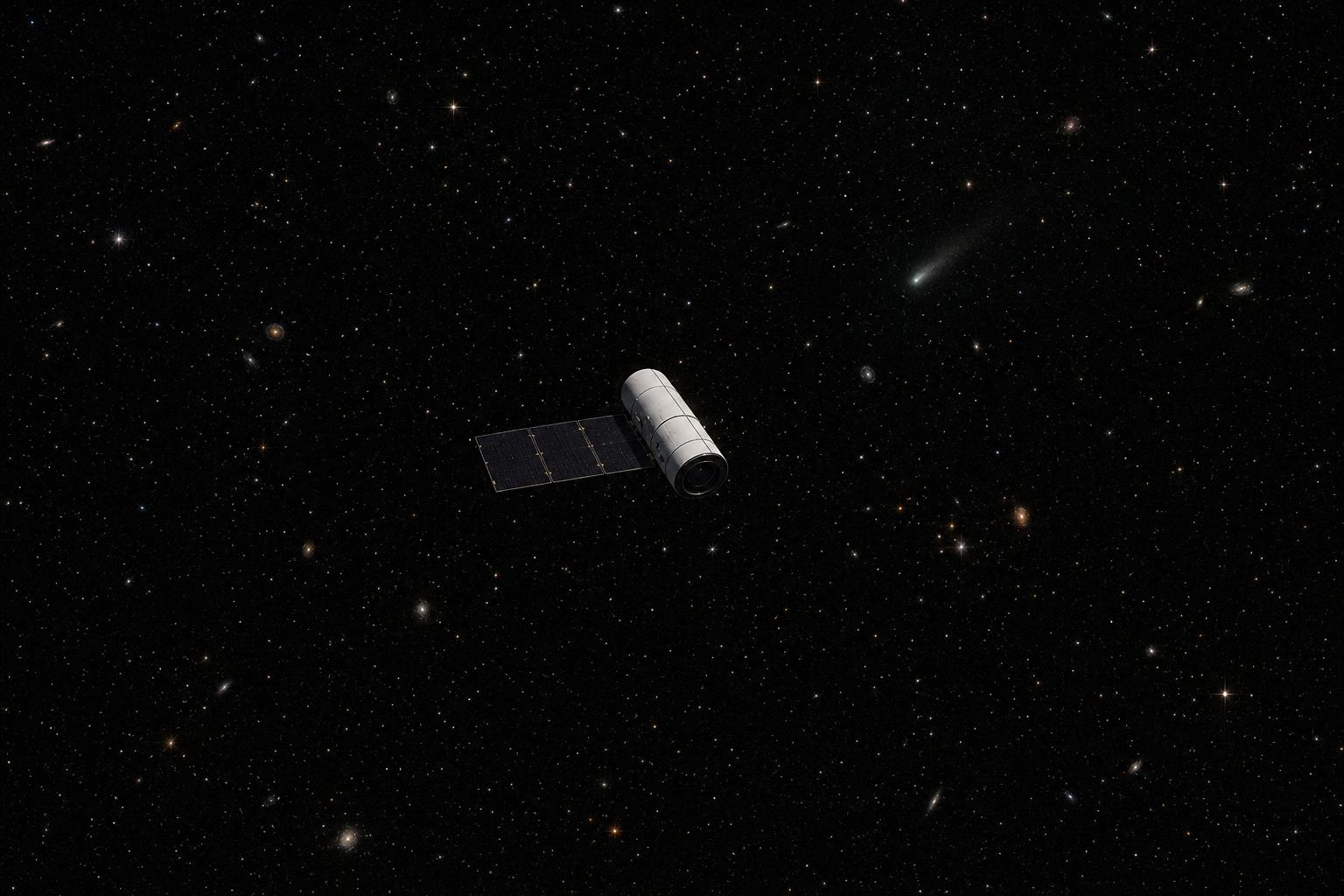
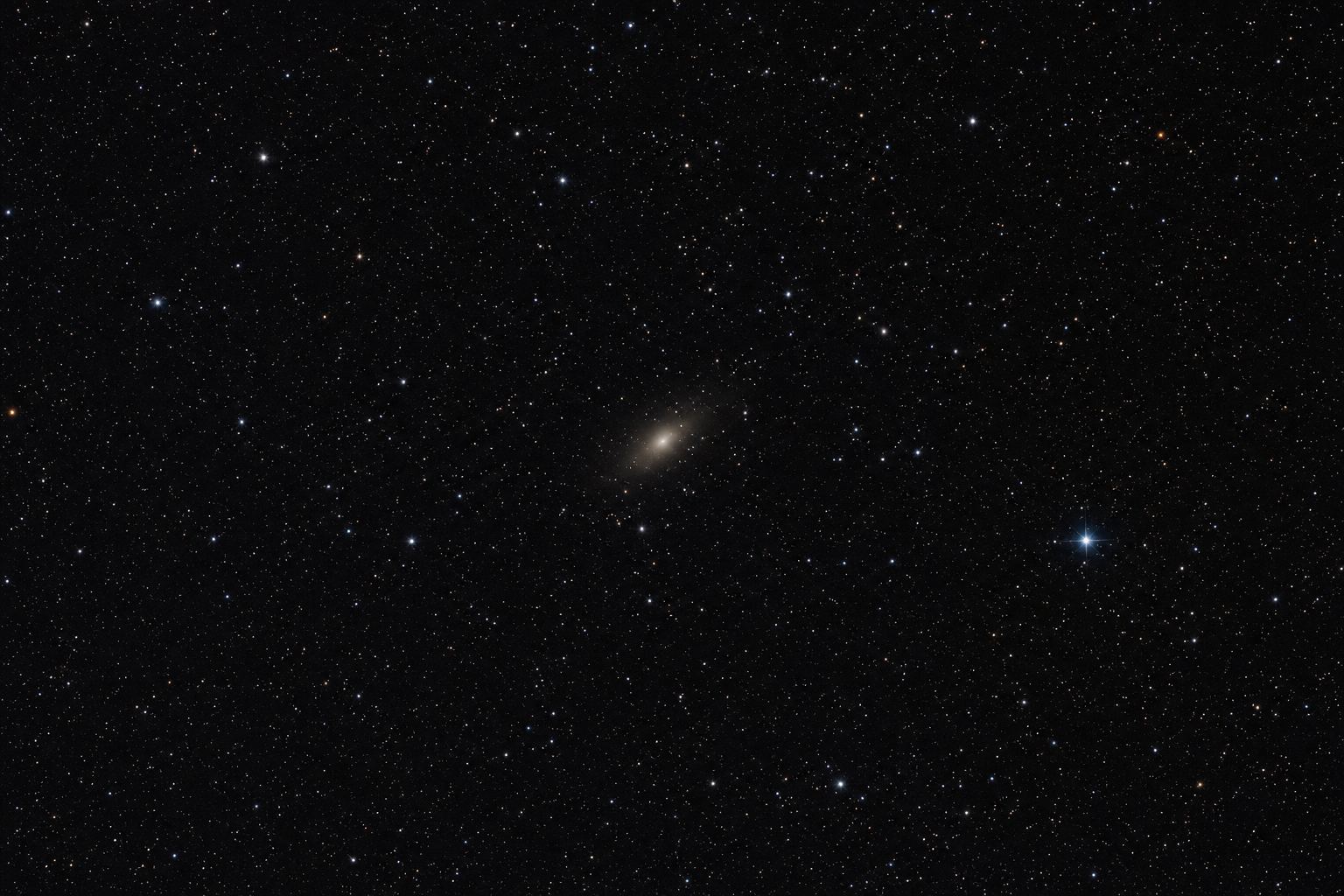
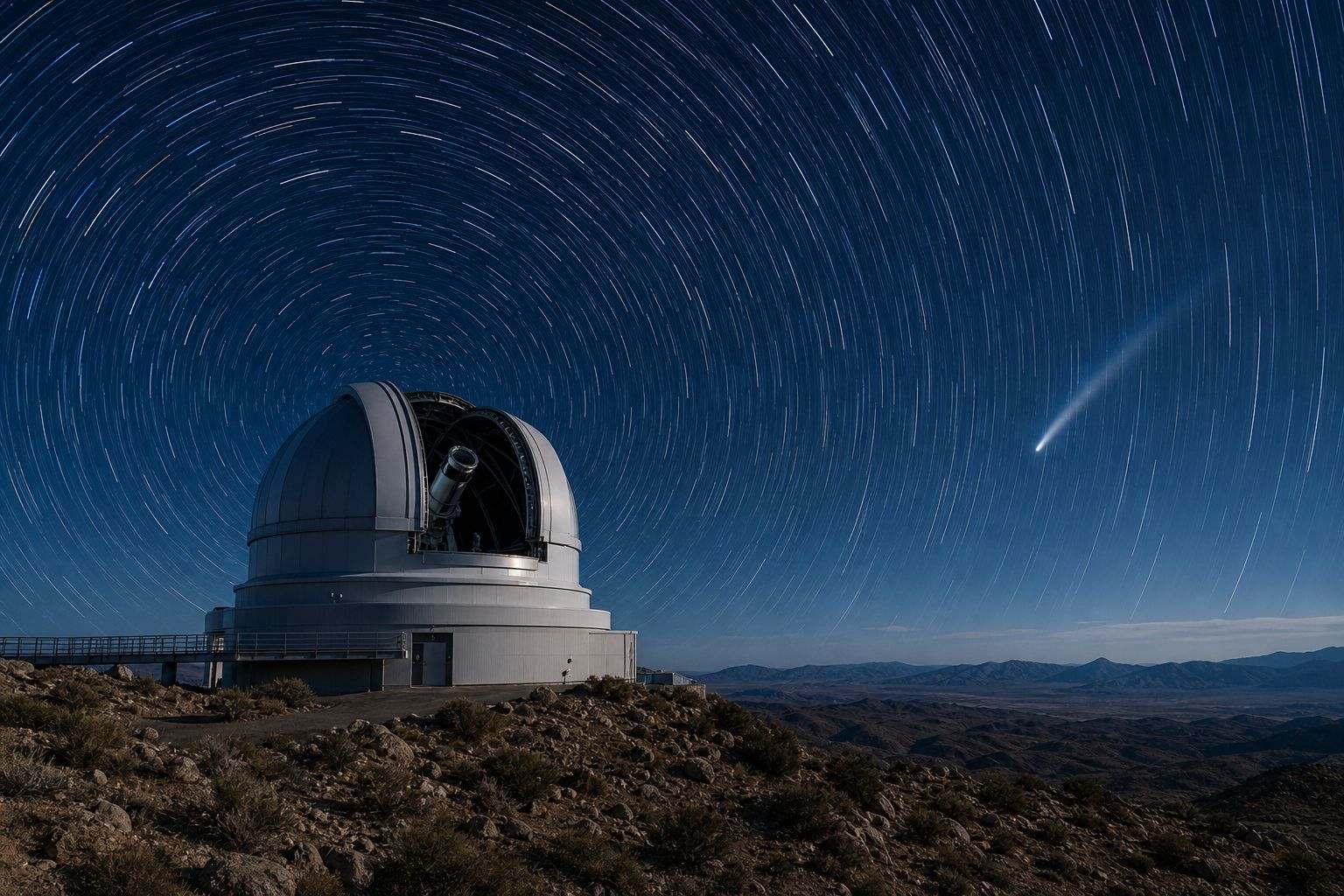
In September 2026, the Euclid space telescope, built to map distant galaxies, caught something much closer: a faint smudge moving across its pictures.
On 8 October the Minor Planet Center confirmed it as a new comet, C/2026 S1, about 1.3 billion kilometres from Earth.
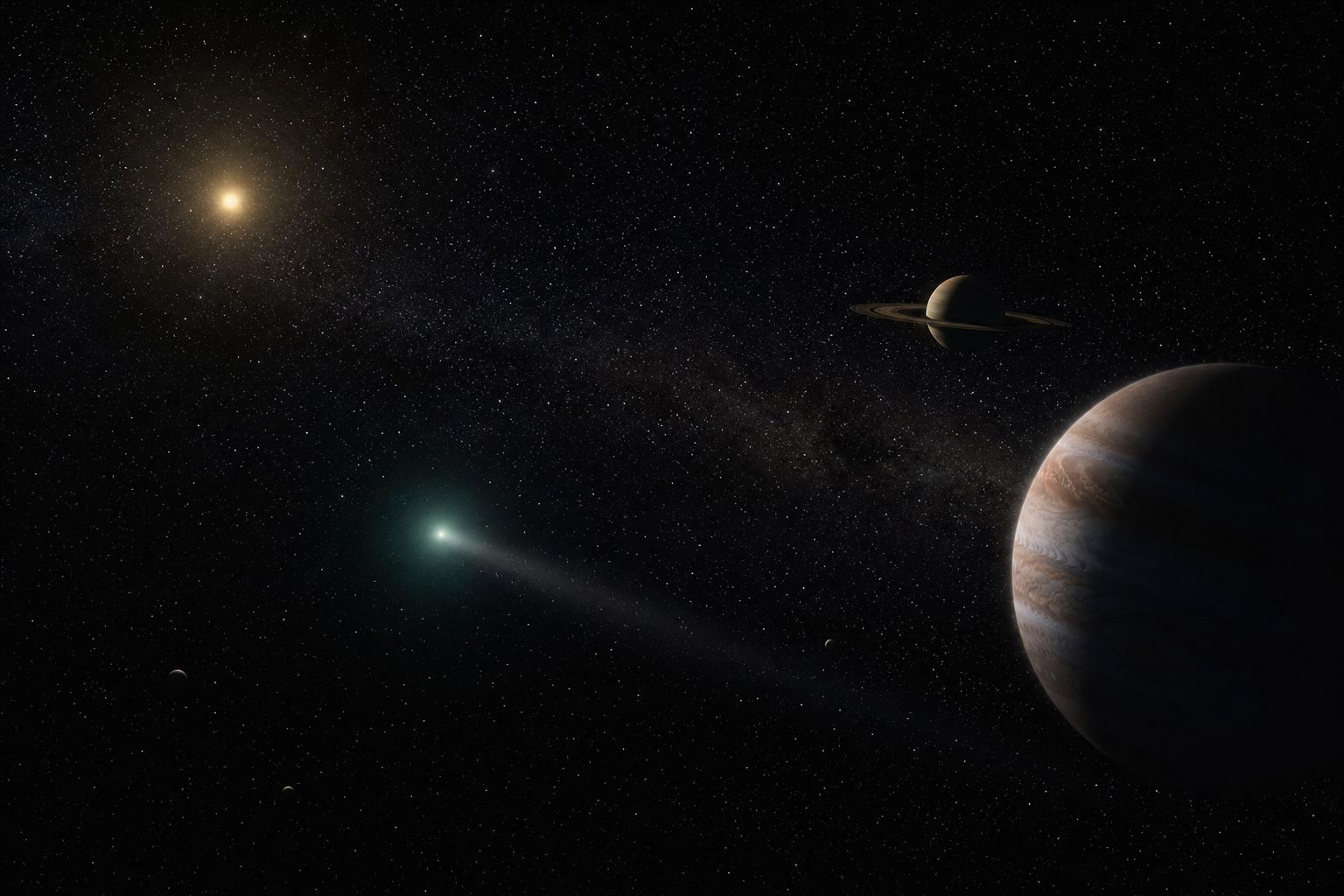
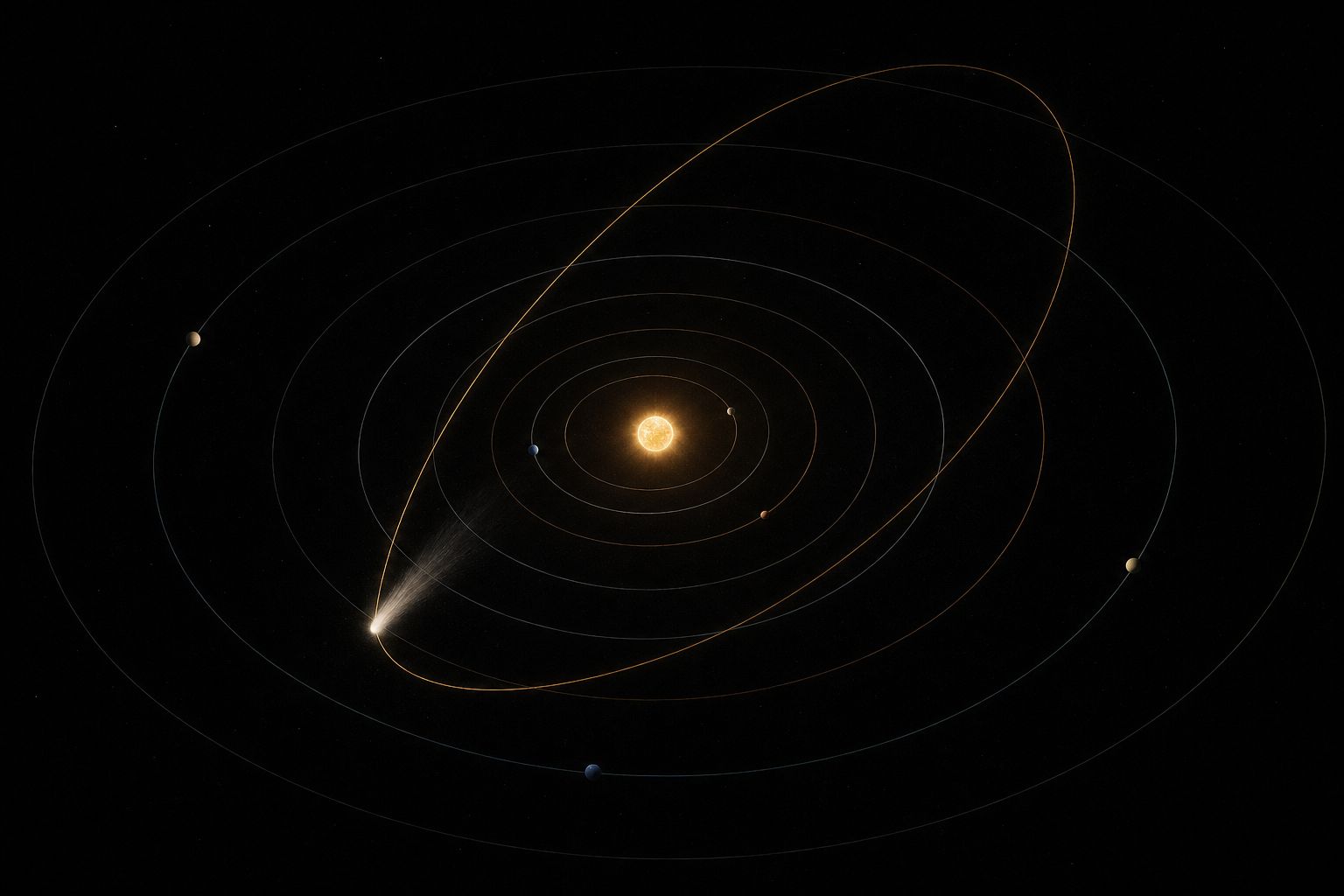
The planets all circle the Sun in one nearly flat disc. ESA says this comet lies far above it, on an orbit that takes thousands of years.
A fuzzy cloud around it gave it away. Why do comets grow clouds and tails? Why does this one come from so high above the planets? And what does its name, C/2026 S1, tell us?
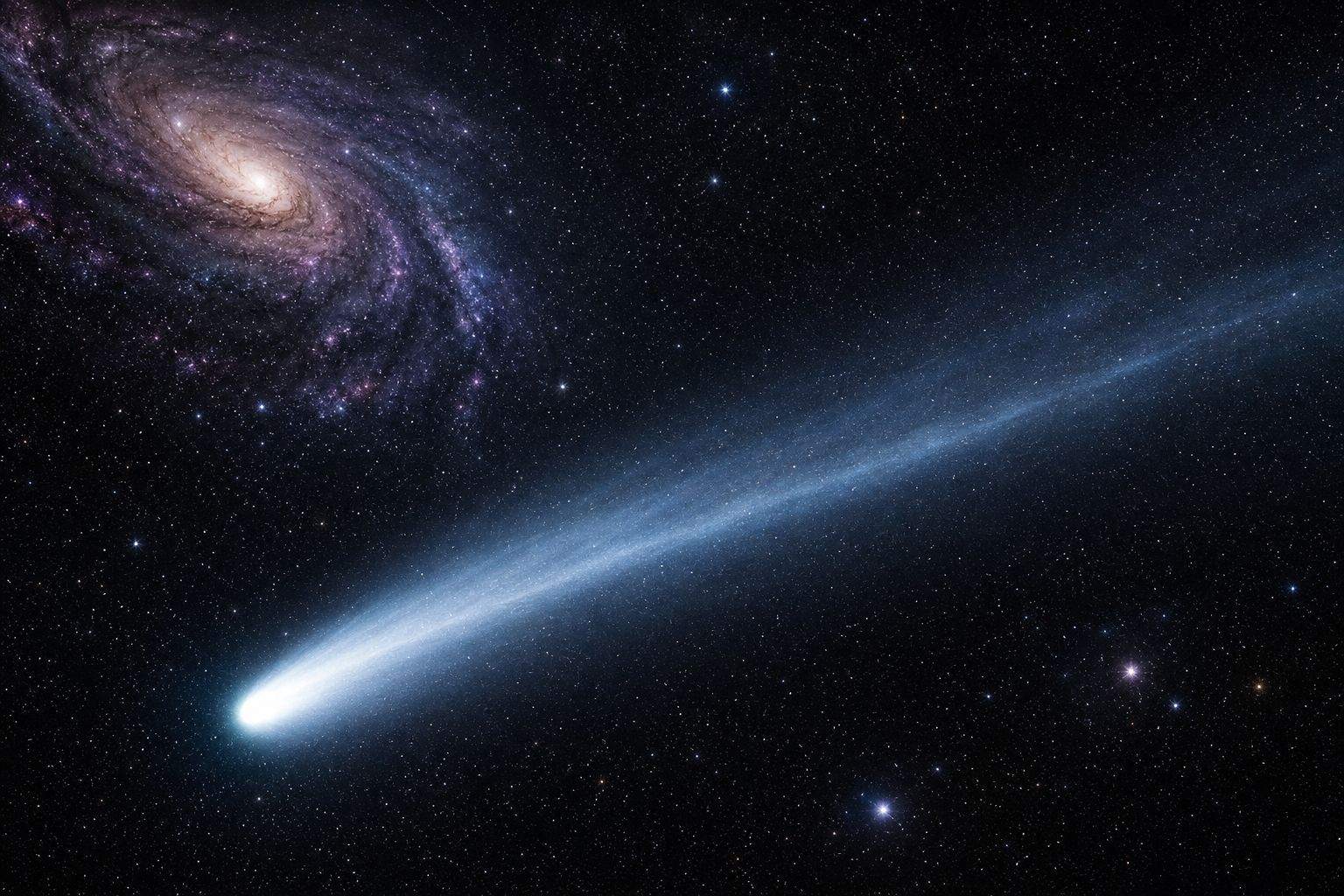
A galaxy telescope Euclid, launched in 2023, usually photographs each patch of sky only once, so a comet in its images was a lucky catch. AI-generated illustration.
I was excited to see my software flag a “streak” smeared across several images.Mikko Pöntinen, University of Helsinki doctoral student who found it, to ESA
A smudge that moves A comet gives itself away by shifting against the fixed stars from one exposure to the next. AI-generated illustration.
16–24 Sep
dates of the discovery images, 2026
~1.3 bn km
from Earth; seen from the Sun, it lies between Jupiter’s and Saturn’s orbits
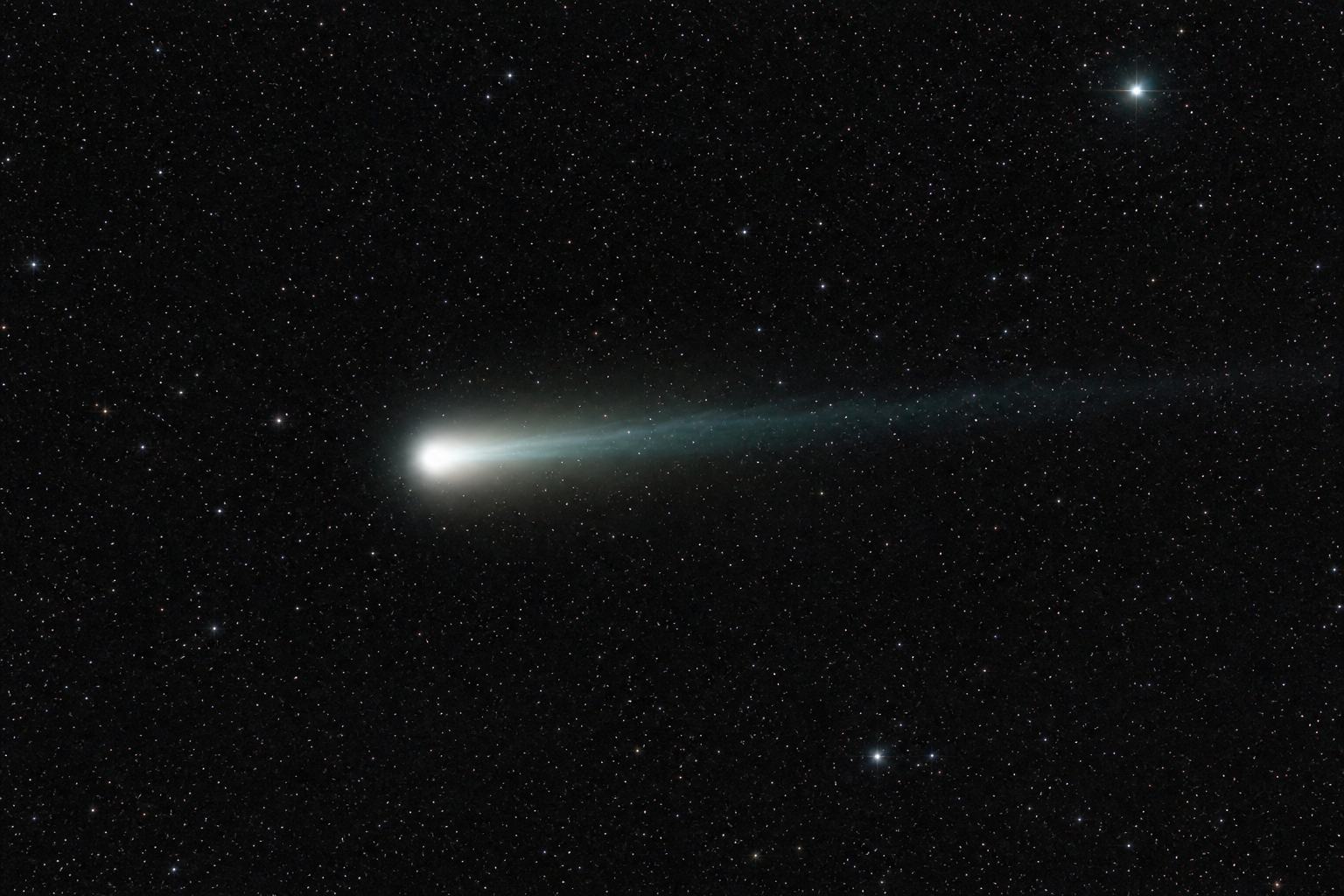
C/2026 S1 (Euclid)An active comet A cloud around a moving dot means it is shedding gas and dust: an asteroid has none. AI-generated illustration.
Space · Comets
The news
ESA (2026): Euclid took the discovery images between 16 and 24 September 2026 in the Euclid Deep Field North, five fields of view and 16 exposures in all. Mikko Pöntinen, a University of Helsinki doctoral student working for the Euclid Consortium’s Solar System Objects group, found it with software he wrote. The Minor Planet Center confirmed it on 8 October 2026. It is about 1.3 billion km from Earth, sits “straight up” as seen from the Sun, and its orbit will take thousands of years; the period will be refined with more data. Space.com featured it as its photo of the day on 16 November 2026.
Some reports give a precise orbital period; ESA gives only “thousands of years”, so the film uses ESA’s wording.
The 3D scenes are simplified teaching models: comets, tails, orbits and distances are drawn schematically and not to scale.
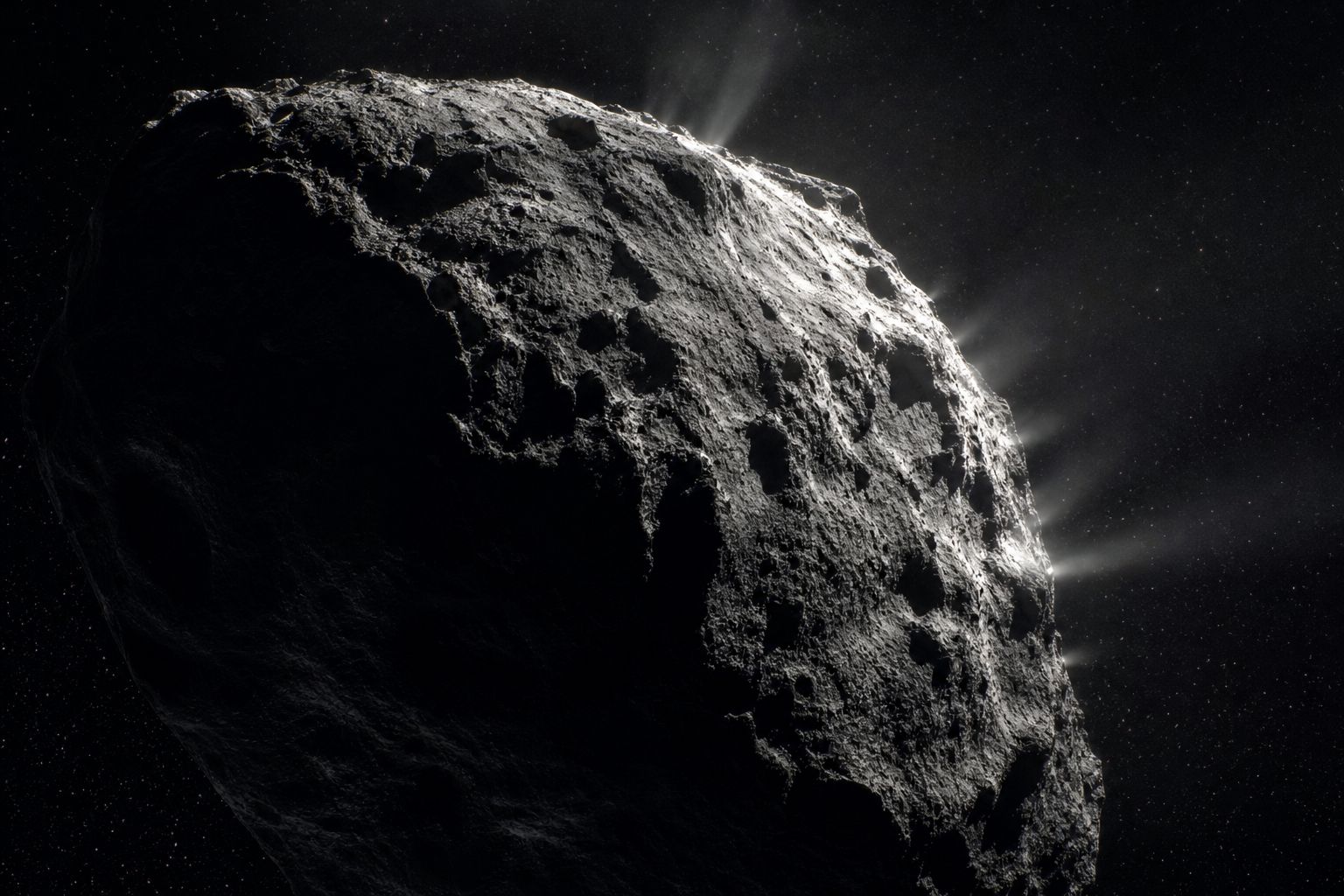
At the heart of every comet is the nucleus: a solid lump of ice and dust, often just a few kilometres across.
In 1950 the astronomer Fred Whipple described it as an icy conglomerate: frozen water, ammonia, methane and carbon dioxide, mixed with dust. The press called it a dirty snowball.
It is also very dark. Under a coating of organic material, Halley's nucleus reflects only about four percent of the sunlight that reaches it.
A comet nucleus The nucleus is the only solid part; everything else we see from Earth is the cloud and tails it gives off. AI-generated illustration.
water ice
frozen ammonia and methane
frozen carbon dioxide
dust mixed through it all
Whipple’s recipe, 1950Dirty ice NASA describes comets as mostly ice under a dark coating of organic material. AI-generated illustration.
~4%
of sunlight reflected
15 × 8 km
size (NASA)
Halley’s nucleus
Chapter I · A dirty snowball
The dirty snowball
Astronomy.com: Fred Whipple’s 1950 model described comets as “icy conglomerates” of frozen water, ammonia, methane and carbon dioxide mixed with dust; the press later called them “dirty snowballs”. NASA: comets are mostly ice with a dark coating of organic material, and nuclei are often a few miles across. Britannica: Halley’s nucleus reflects only about 4 percent of the sunlight that falls on it. NASA gives Halley’s nucleus as roughly 15 by 8 km.
The 3D scenes are simplified teaching models: comets, tails, orbits and distances are drawn schematically and not to scale.
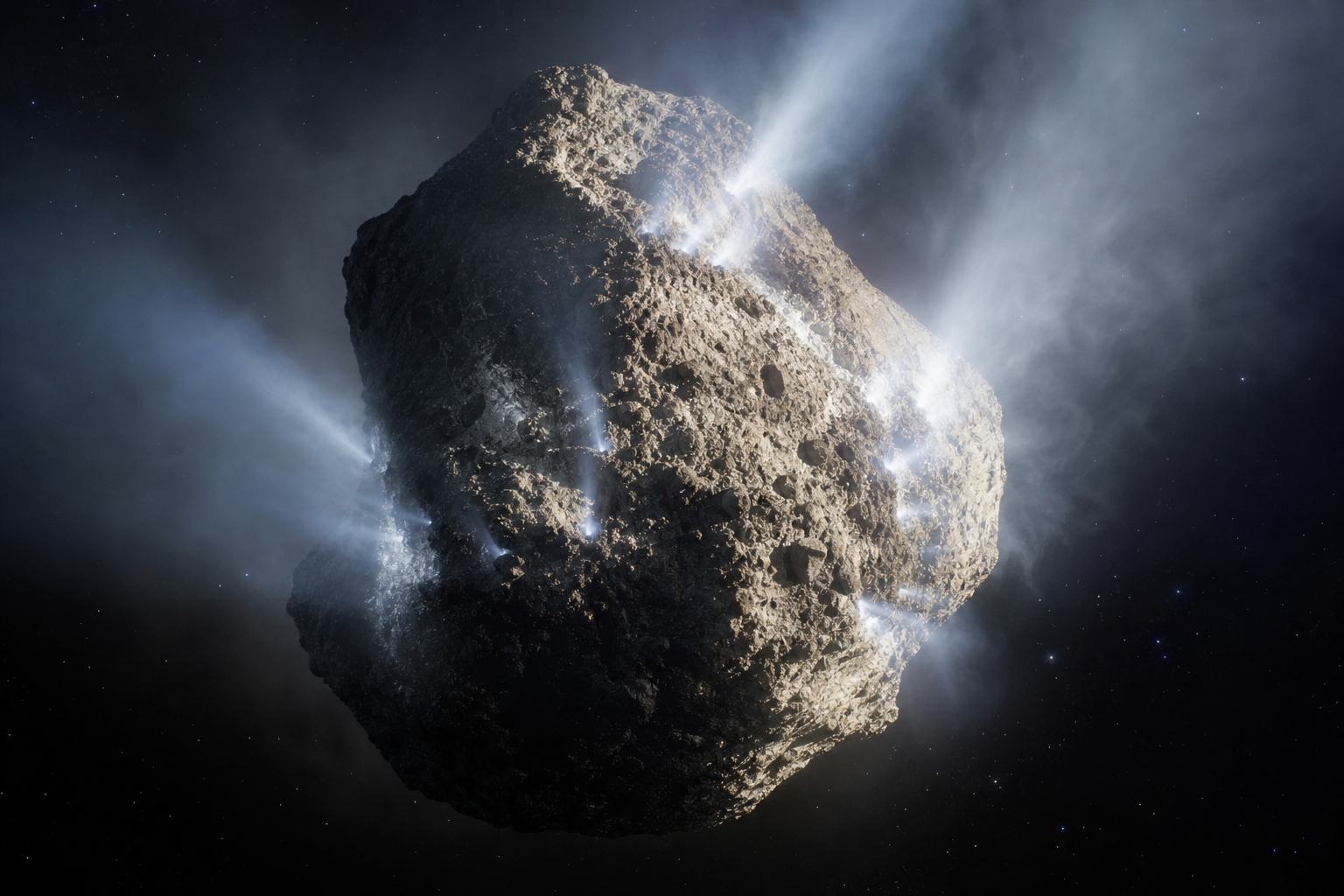
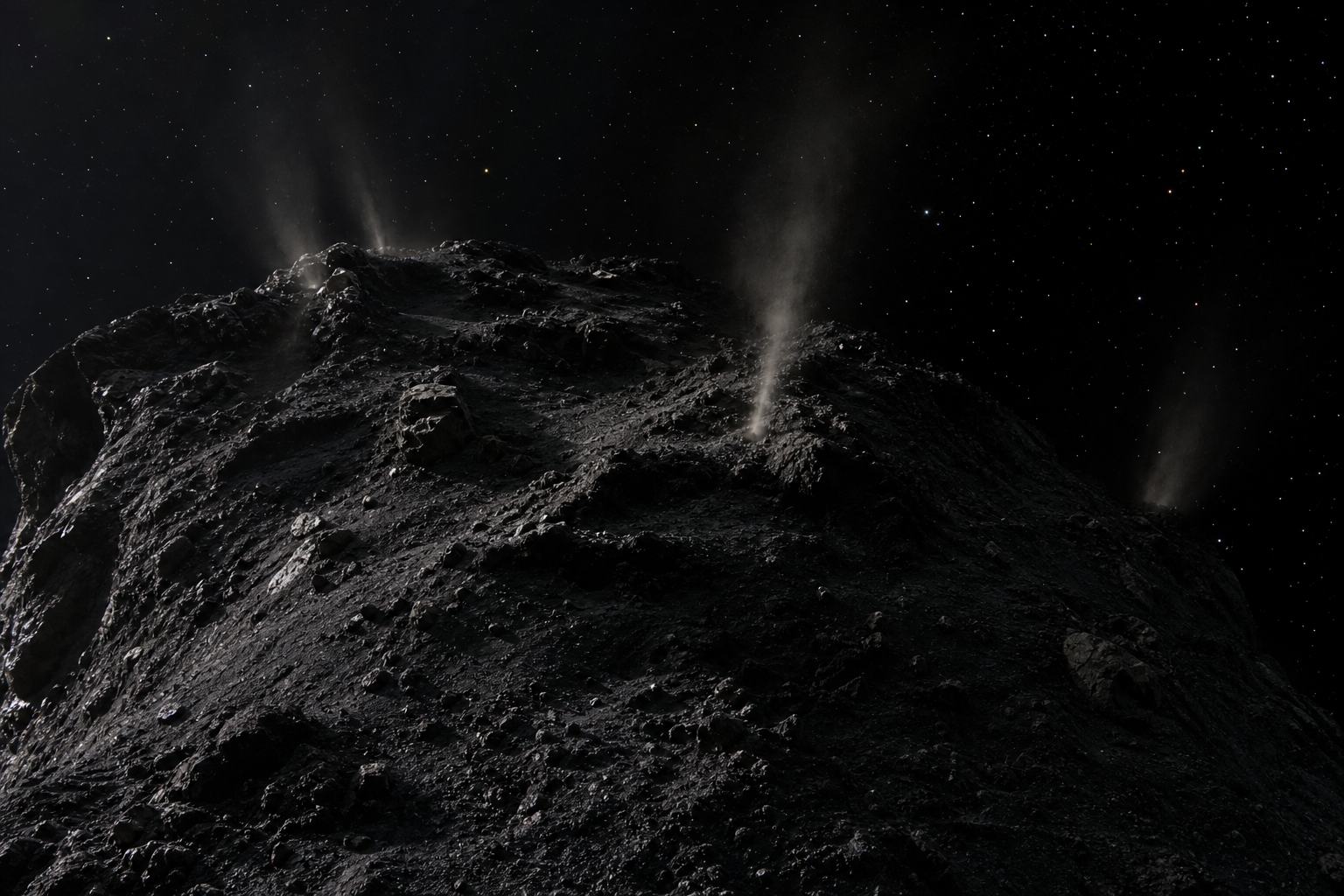
As a comet falls toward the Sun, sunlight warms it. The ice does not melt: it turns straight into gas. That is sublimation.
The gas bursts out in jets, carrying dust with it, and spreads into a huge glowing cloud around the nucleus: the coma.
A nucleus a few kilometres wide can wear a coma up to about a hundred thousand kilometres across, far wider than Earth.
The jets push the comet like small rockets, so comets do not always arrive on time.
solid → gas, skipping the liquid
the escaping gas carries dust out with it
SublimationJets Jets rise from cracks on the warm, sunlit side; the night side stays quiet. AI-generated illustration.
up to ~100,000 km
typical largest width
~12,700 km
Earth’s width, for scale
The coma (Britannica)
kept arriving at unexpected times
Whipple: its jets act like small rockets
pushing it ahead of, or behind, schedule
Encke’s Comet
Chapter I · A dirty snowball
Sublimation and the coma
Astronomy.com (on Whipple’s model): as a comet nears the Sun its ice vaporises directly into gas, producing jets of gas and dust; the jets push the comet and can speed it up or slow it down, which is why comets such as Encke’s arrived at unexpected times. Britannica: the coma is typically up to 100,000 km in diameter. NASA: the coma may extend hundreds of thousands of kilometres.
Press “Far out”, “Closer” or “Near the Sun” to move the comet and watch it wake.
The 3D scenes are simplified teaching models: comets, tails, orbits and distances are drawn schematically and not to scale.
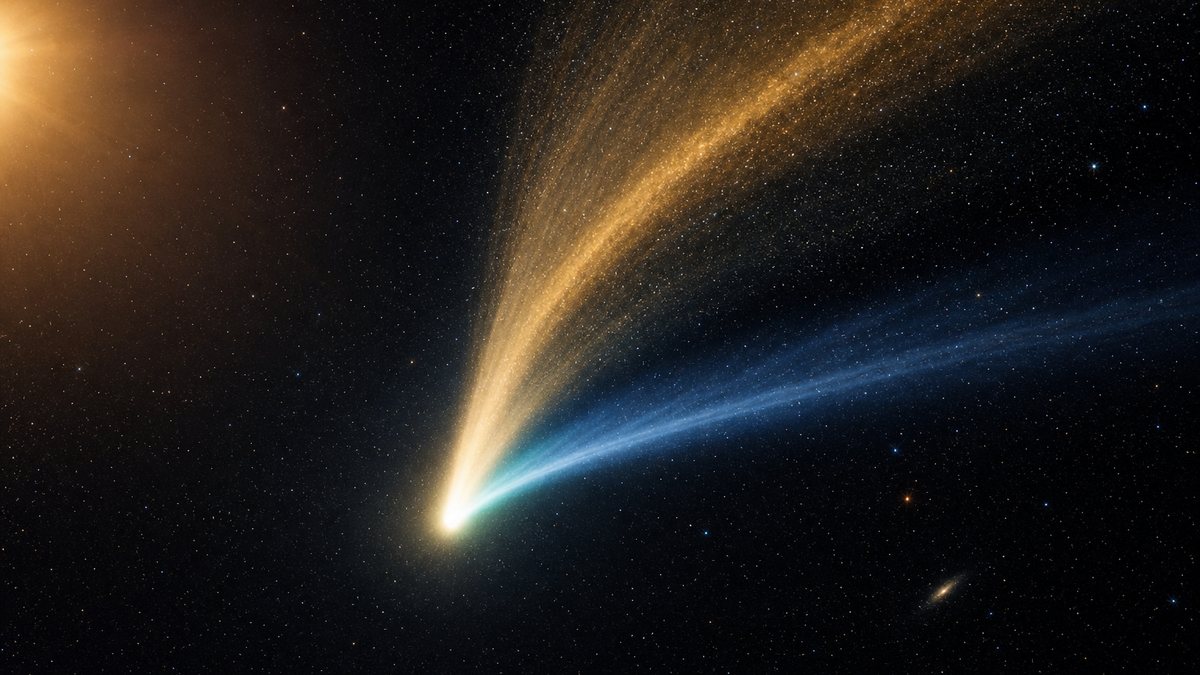
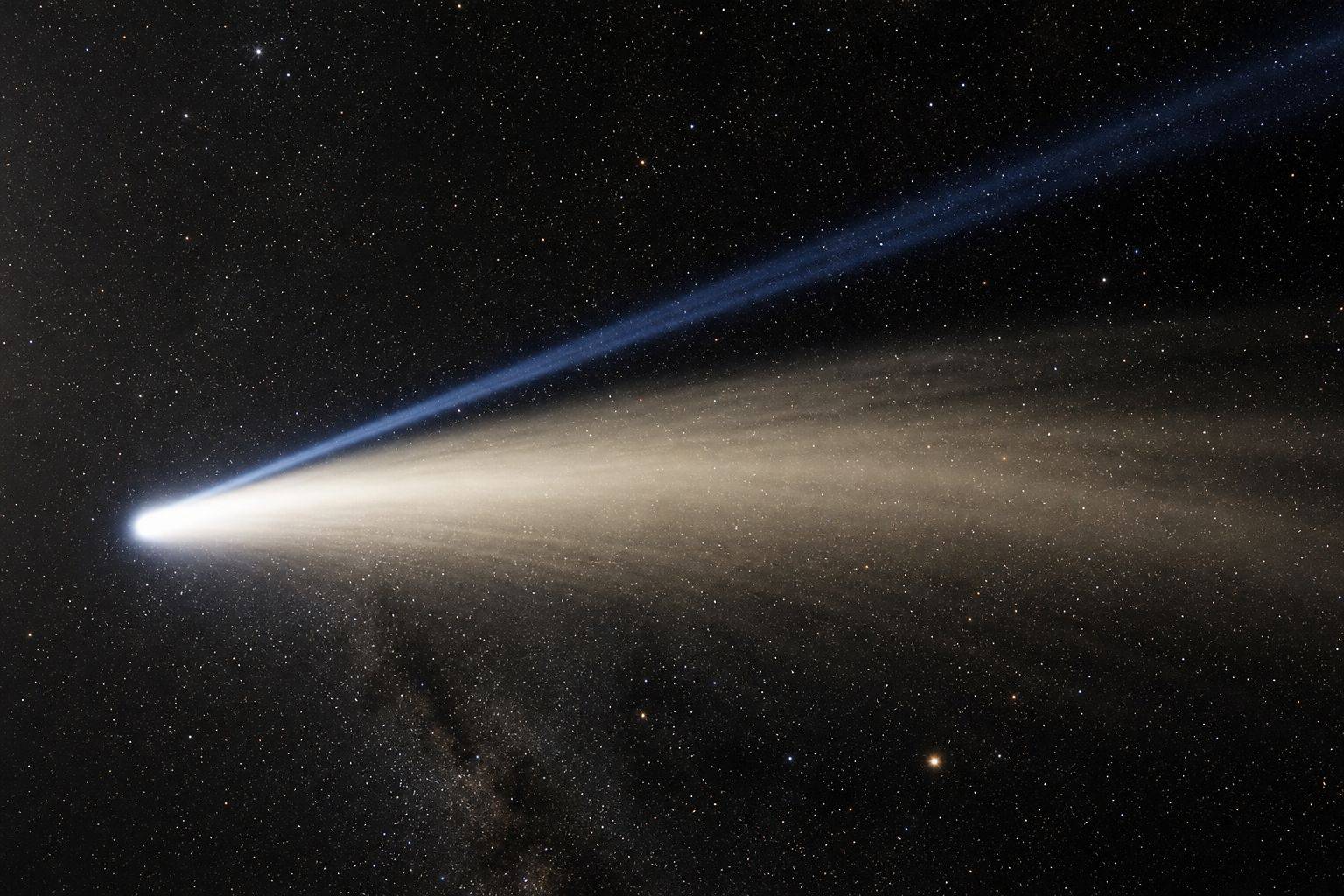
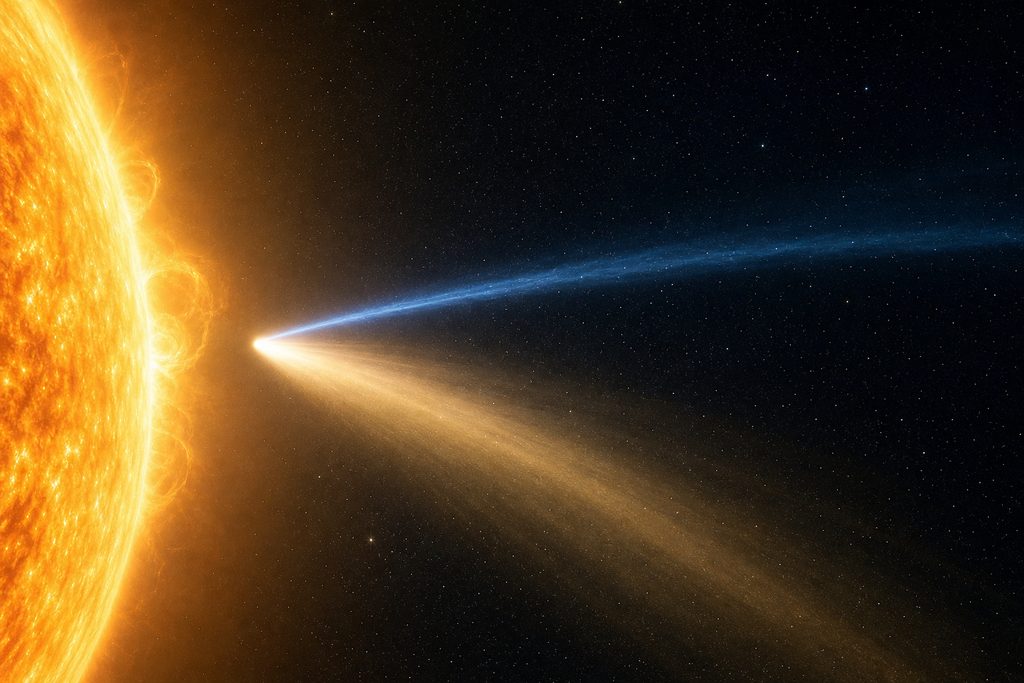
The dust tail is broad, curved and yellowish. It is sunlight bouncing off fine grains of dust, pushed gently away by the pressure of sunlight itself.
The ion tail is narrow, straight and blue. It is gas that has been electrically charged, or ionised, and it glows by itself.
Seen together, they often fan out at different angles across the sky.
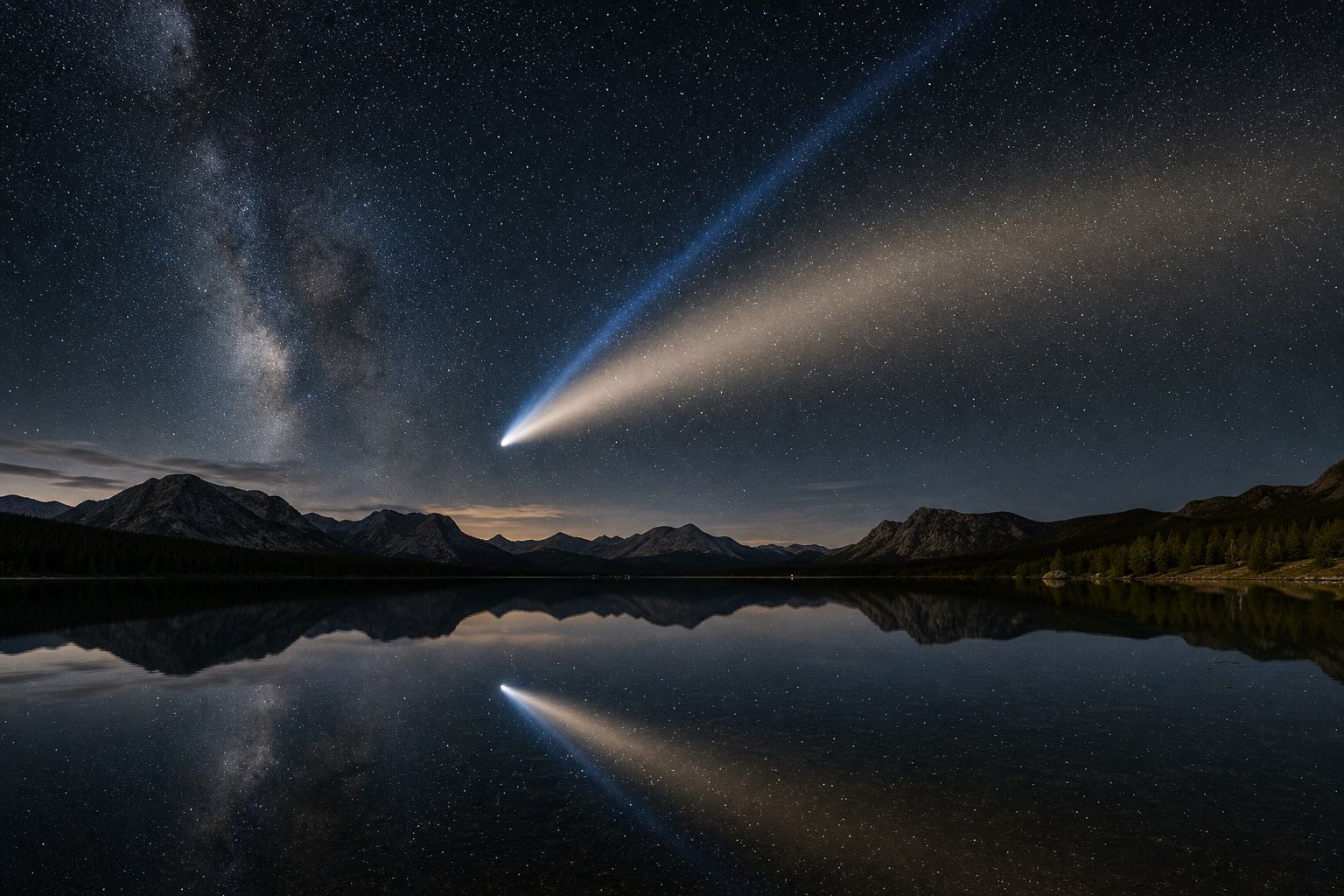
Two tails The broad, curved tail is dust; the thin, straight one is charged gas. AI-generated illustration.
broad and curved
yellow-white: reflected sunlight
pushed by radiation pressure
Dust tail
narrow and straight
blue: the glow of charged carbon monoxide, CO⁺
the most common ion, H₂O⁺, does not glow in visible light
Ion tail
Chapter II · Two tails
Two tails
NASA: comets actually have two tails, a dust tail and an ion (gas) tail. Britannica: radiation pressure pushes fine dust away from the Sun into a broad, curved, sometimes yellow tail; ionised gas forms long, narrow, straight tails pointing almost directly away from the Sun. Their blue colour comes from CO⁺; the main ion, H₂O⁺, does not glow at visible wavelengths.
Press “Dust tail”, “Ion tail” or “Both” to show each one.
The 3D scenes are simplified teaching models: comets, tails, orbits and distances are drawn schematically and not to scale.
In 1951 Ludwig Biermann found that ion tails stream away from the Sun at over four hundred kilometres a second. Something was blowing them.
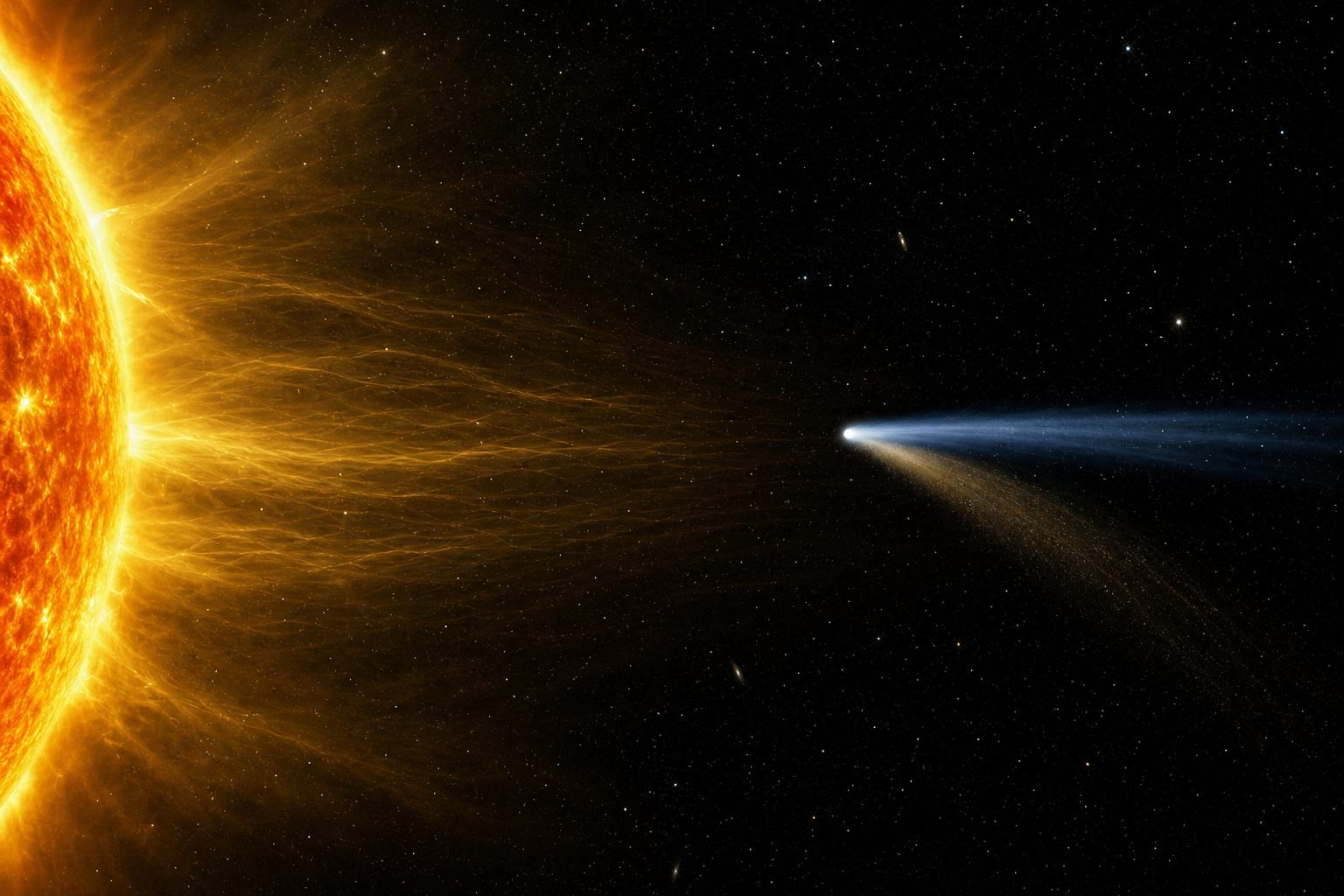
It is the solar wind: charged particles flowing from the Sun, carrying its magnetic field. It drags the ion tail out in a straight line.
Dust grains are heavier. Each one drifts on its own orbit and lags behind, so the dust tail bends along the comet's path.
So both tails always point away from the Sun. When a comet is heading back out, away from the Sun, its tails point ahead of it: it travels tail first.
> 400 km/s
speed at which ion tails stream away
Biermann, 1951The solar wind Charged gas is caught on the Sun’s magnetic field lines and swept outward with them. AI-generated illustration.
ions: follow the magnetic field → straight
dust: each grain on its own orbit → curved
bigger grains are pushed less
Why the shapes differ
3.8 AU
about 570 million km. 1 AU (astronomical unit) = the Earth–Sun distance, about 149.6 million km
Ion tails have reached
Chapter II · Two tails
The solar wind
Britannica: in 1951 Ludwig Biermann found that ion tails flow away from the Sun at speeds in excess of 400 km per second and proposed an outflow from the Sun, which pointed to the solar wind. Ionised gas is caught in the Sun’s magnetic field and streams away in the solar wind (about 400 km/s). Wikipedia (Comet tail): the ion tail is narrow and straight because it follows magnetic field lines; dust grains follow their own orbits and larger grains are less affected by radiation pressure, so the dust tail curves. Ion tails have been observed to extend 3.8 AU (about 570 million km).
Press “Solar wind off” to see what the ion tail needs, and “Solar wind on” to bring it back.
The 3D scenes are simplified teaching models: comets, tails, orbits and distances are drawn schematically and not to scale.
Comets travel on ellipses, the stretched circles that Johannes Kepler showed in 1609 the planets follow too.
The point closest to the Sun is called perihelion. Comet 67P comes within about 186 million kilometres of it.
The farthest point is aphelion. For 67P, that is about 850 million kilometres out, beyond the orbit of Jupiter.
Near perihelion the comet heats up and its tails grow long. Far out, it freezes again and the tails fade away.
An elongated orbit A planet’s orbit is nearly a circle; a comet’s can be stretched far out of shape. AI-generated illustration.
186 million km
perihelion: 1.24 AU (1 AU = Earth–Sun distance)
850 million km
aphelion: 5.68 AU
6.45 yr
one orbit
Comet 67P (ESA)
far out: frozen, no coma, no tails
coming in: the coma appears
perihelion: longest tails
Along one orbitNear perihelion Far out, the same comet would be a dark, frozen speck with no tail at all. AI-generated illustration.
Chapter III · Ellipses
Perihelion and aphelion
Space.com: Kepler published his first two laws, including the elliptical orbit, in Astronomia nova in 1609. ESA: Comet 67P/Churyumov-Gerasimenko has a perihelion distance of 186 million km (1.243 AU), an aphelion distance of 849.7 million km (5.68 AU) and an orbital period of 6.45 years.
Press “Perihelion”, “Aphelion” or “Run the orbit” and watch the tails grow and shrink.
The 3D scenes are simplified teaching models: comets, tails, orbits and distances are drawn schematically and not to scale.
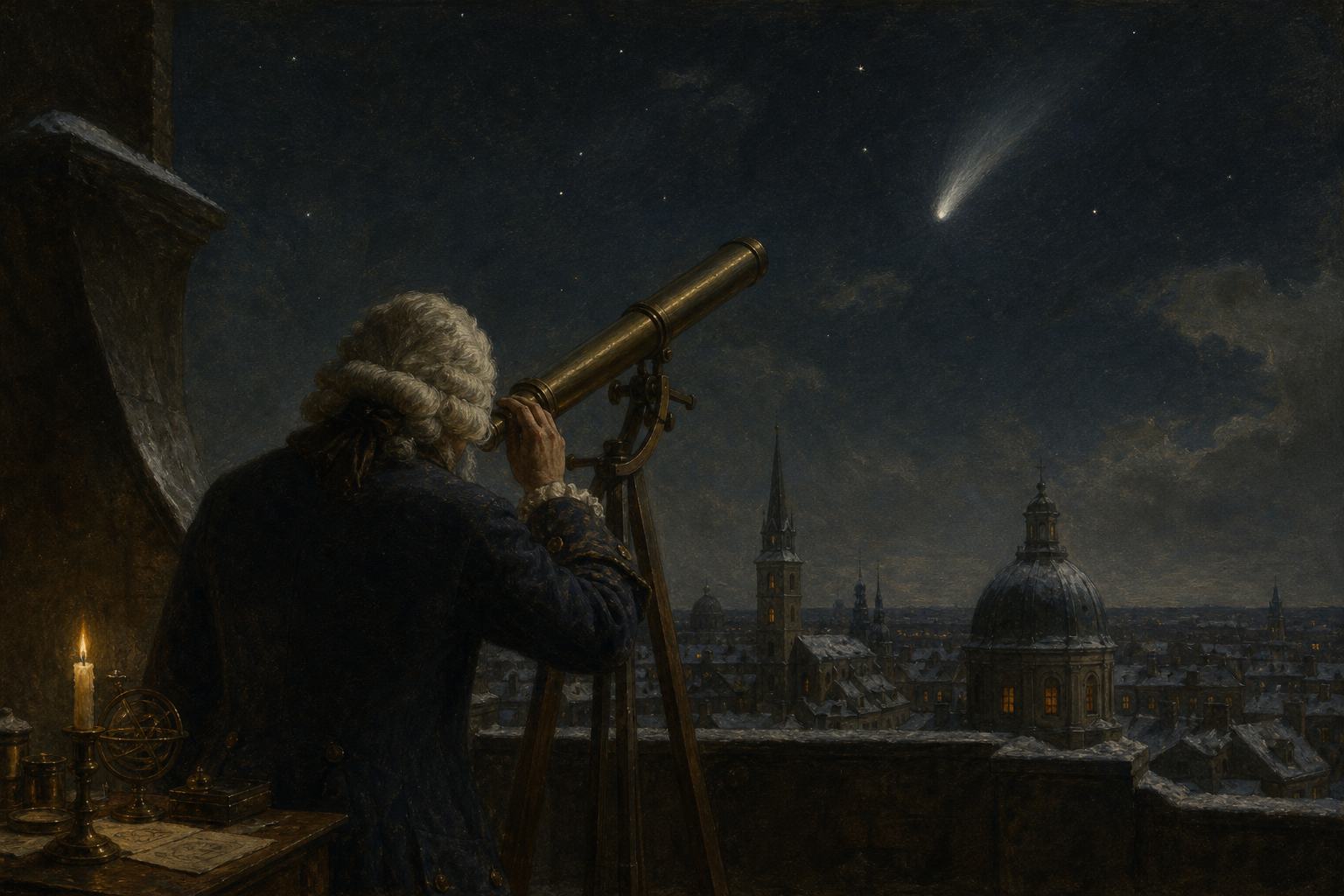
In 1705 Edmond Halley used Isaac Newton's theory of gravity to study the records of old comets.
Three bright comets, seen in 1531, 1607 and 1682, had paths so alike that he concluded they were one comet, coming back.
He predicted it would return in 1758. Halley died in 1742 and never saw it.
On Christmas evening 1758, Johann Georg Palitzsch in Germany saw it first. It became the first comet named after a person, and a striking confirmation of Newton's gravity.
1531 bright comet seen
1607 bright comet seen
1682 bright comet seen
1705 Halley: the same comet, back in 1758
1758 it returns on Christmas evening
One comet, many visitsWatching for the return Astronomers across Europe searched the winter sky of 1758 for the predicted comet. AI-generated illustration.
1742
Halley dies, 14 January, aged 85
1758
the predicted year of return
A prediction he never saw
~76 yr
average period
74.4–79.3 yr
range: the planets tug on it
1P/Halley (NASA)
Chapter III · Ellipses
Halley’s Comet
Britannica: in 1705 Halley published A Synopsis of the Astronomy of Comets, describing the orbits of 24 comets observed between 1337 and 1698; he concluded the comets of 1531, 1607 and 1682 were successive returns of the same one and predicted its return in 1758. He died on 14 January 1742. EBSCO: Johann Georg Palitzsch first saw it on Christmas evening 1758; it became the first comet named for a person, a “stunning confirmation” of Newton’s law of gravity. NASA: the period averages about 76 years and has varied from 74.42 to 79.25 years.
The film “How Meteor Showers Work” tells how Halley’s dust becomes the Orionids.
The 3D scenes are simplified teaching models: comets, tails, orbits and distances are drawn schematically and not to scale.
In 1619 Kepler linked an orbit's size to its period. In years and Earth–Sun distances, the period squared equals the average distance cubed.
Halley takes about seventy-six years. So its orbit must average about eighteen times Earth's distance from the Sun.
Comet 67P, at six and a half years, averages about three and a half times Earth's distance.
And a comet whose orbit averages twenty-five thousand times Earth's distance needs about four million years for a single lap.
P2=a3
P
period, in years
a
semi-major axis (average distance), in AU
Kepler’s third lawKepler’s geometry One astronomical unit, the Earth–Sun distance, is about 149.6 million kilometres. AI-generated illustration.a=P2/3a=762/3≈18AUHalley, worked out
Earth, 1 AU
1
67P, 3.5 AU
6.45
Halley, 18 AU
76
Period of one lap
25,000 AU
average distance
~4 million yr
for one lap: √(25,000³)
An Oort-cloud comet
Chapter III · Ellipses
Period from size
Space.com: Kepler’s third law, published in 1619, says the square of the orbital period is proportional to the cube of the semi-major axis; with P in years and a in astronomical units (1 AU ≈ 149.6 million km), P² = a³. The film works out: 76 years → a ≈ 18 AU for Halley (NASA period); 6.45 years → a ≈ 3.5 AU for 67P, which matches the average of ESA’s perihelion and aphelion; and a = 25,000 AU, typical of many long-period comets according to Britannica, gives P ≈ 4 million years.
Press a button to try an orbit, or “Bigger” and “Smaller” to change its size: the readout works out the period.
The 3D scenes are simplified teaching models: comets, tails, orbits and distances are drawn schematically and not to scale.
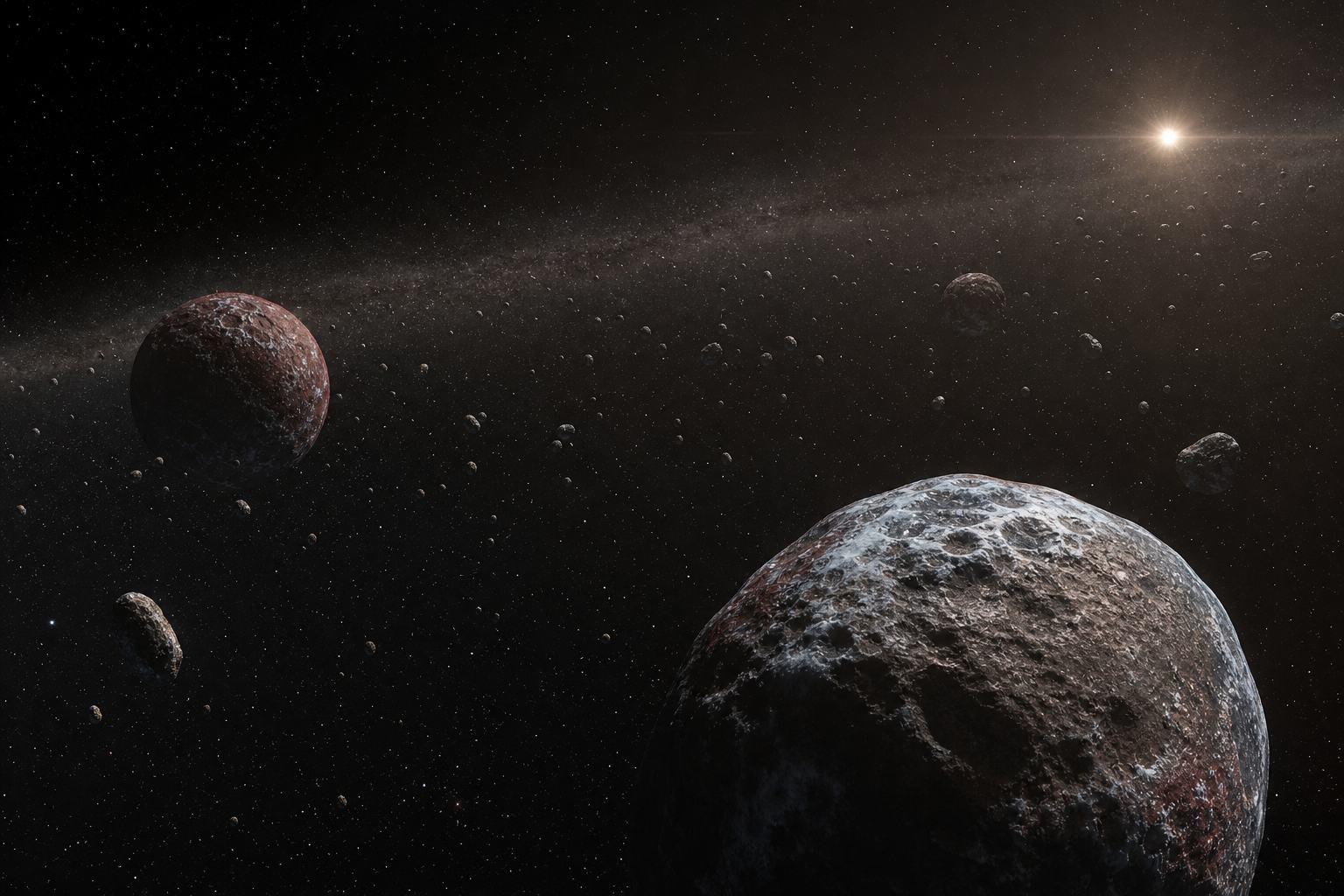
Where do comets come from? Short-period comets, the ones that return in under two hundred years, mostly start beyond Neptune.
In 1951 Gerard Kuiper proposed a belt of icy bodies there. The Kuiper belt is a flat disc reaching at least fifty times Earth's distance from the Sun.
Neptune's gravity scatters some inward. Those that end up circling in under twenty years, like 67P, are Jupiter-family comets, close to the plane of the planets.
Jupiter-family: under ~20 years
Halley-type: 20 to 200 years
long-period: over 200 years
Comets by period (Britannica)Icy worlds beyond Neptune Many Kuiper belt objects travel close to one shared plane, like the planets. AI-generated illustration.
≤ ~35°
tilt to the planets’ plane
≥ 50 AU
outer reach of the Kuiper belt
Jupiter-family comets
Chapter IV · Where comets live
The Kuiper belt
NASA: short-period comets take less than 200 years to orbit the Sun; Gerard Kuiper theorised an icy disc-like belt beyond Neptune in 1951. Britannica: Jupiter-family comets (periods under about 20 years) come from the scattered disk, fed by the Kuiper belt, a flattened disk extending to at least 50 AU; Neptune scatters them inward. They are modestly inclined, up to about 35°. Halley-type comets have periods of 20–200 years and their source is still debated. Wikipedia (Kuiper belt): Kenneth Edgeworth had suggested in 1943 that material beyond Neptune was too widely spaced to condense into planets and formed many smaller bodies instead.
The films “What Makes a Dwarf Planet” and “How the Solar System Formed” tell the Kuiper belt’s own story.
Press “Scatter one inward” to send a body toward the Sun.
The 3D scenes are simplified teaching models: comets, tails, orbits and distances are drawn schematically and not to scale.
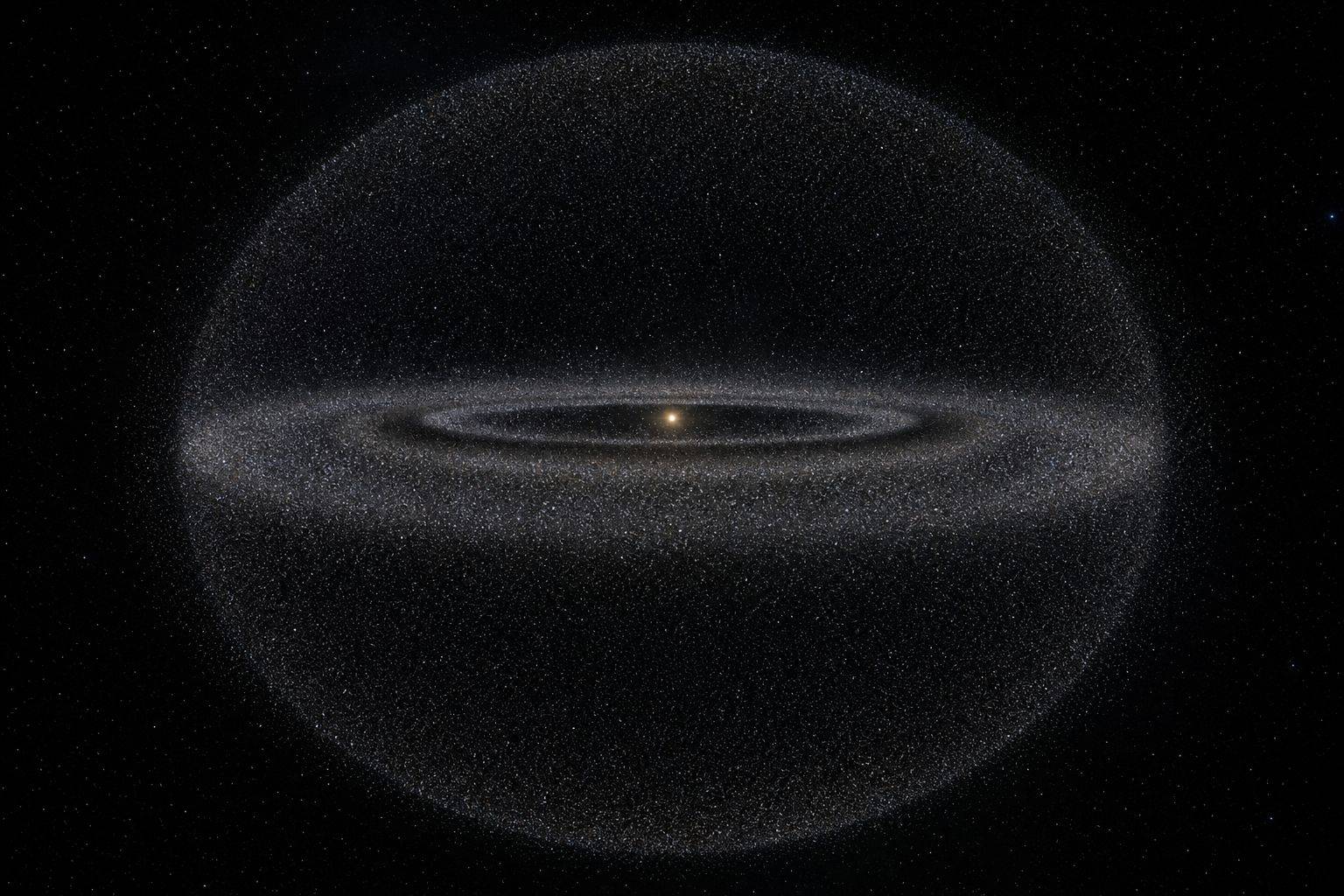
Long-period comets come from much farther away. In 1950 the astronomer Jan Oort proposed a vast shell of icy bodies surrounding the whole Solar System: the Oort cloud.
It may begin a few thousand times Earth's distance from the Sun and reach a hundred thousand, holding hundreds of billions of icy bodies, or more.
Voyager 1 will not reach it for about three hundred years.
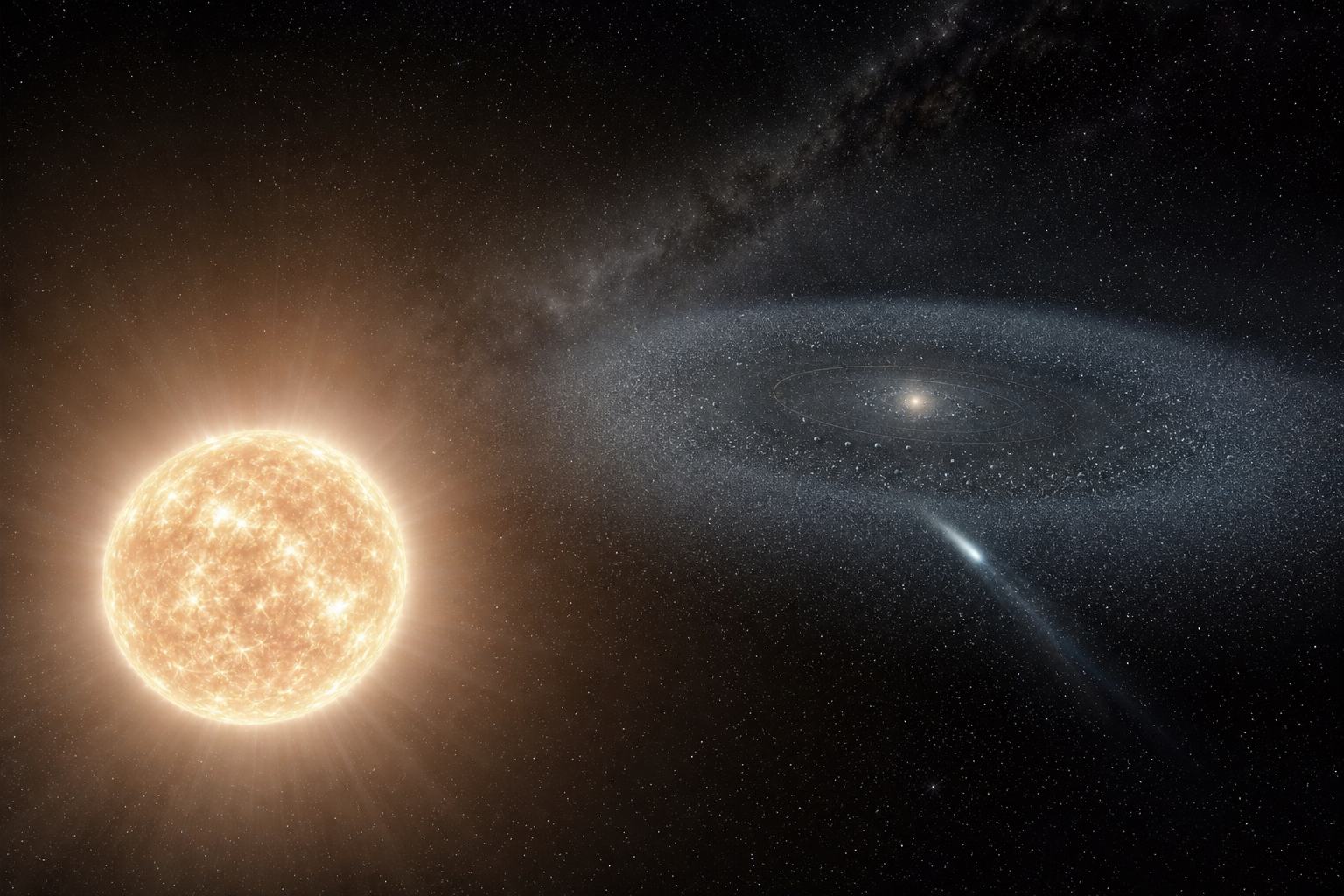
Passing stars and the Milky Way's pull nudge a few inward. The Oort cloud is a sphere, so long-period comets can come from any direction. A steep tilt like the Euclid comet's is nothing unusual for them.
Disc and shell The Kuiper belt is a flat disc; the Oort cloud is a thick bubble, its objects not sharing one plane. AI-generated illustration.
2,000–5,000 AU
inner edge, estimated
10,000–100,000 AU
outer edge, estimated
The Oort cloud (NASA)
~300 yr
to reach the cloud
~30,000 yr
to leave it
Voyager 1 (NASA)A nudge Most long-period comets have been seen only once in recorded history. AI-generated illustration.
Chapter IV · Where comets live
The Oort cloud
NASA describes the Oort cloud as a theorized group of icy objects. Jan Oort proposed in 1950 that some comets come from a vast, distant spherical shell of icy bodies. Its inner edge is thought to lie between 2,000 and 5,000 AU and its outer edge between 10,000 and 100,000 AU; it may hold hundreds of billions, even trillions, of icy bodies. Voyager 1 won’t enter it for about 300 years and may not leave it for 30,000. Most known long-period comets have been seen only once. Britannica: long-period comets come from the Oort cloud, many with semi-major axes of about 25,000 AU or more; passing stars and the galactic tide disturb their orbits, and their inclinations are essentially random, so a steeply tilted orbit is common among them.
Press “Nudge a comet” to send one in from the cloud.
The 3D scenes are simplified teaching models: comets, tails, orbits and distances are drawn schematically and not to scale.
Every new comet gets a code. P means periodic: it goes round in under two hundred years, or has been seen to come back. C is for the rest: comets with longer periods, seen on only one visit.
Then the year, and a letter for the half-month: S is the second half of September.
So C/2026 S1 is a long-period comet, the first announced for late September 2026. The name in brackets, Euclid, is the telescope that found it.
A periodic comet seen to return gets a number. Halley's is 1P/Halley: the first of them all.
P/ periodic: under 200 years, or seen to return
C/ the rest: longer periods, one visit seen
I/ interstellar, since 2017
The prefixesFound by a survey NASA: comets are named for their discoverer, a person or a spacecraft or survey such as LINEAR, SOHO or WISE. AI-generated illustration.
C/
long-period
2026
year
S
16–30 September
1
first that half-month
Reading C/2026 S1
C/2020 F3
NEOWISE: third comet of 16–31 March 2020
Another example
Chapter V · Reading the name
Comet designations
Minor Planet Center: under an IAU resolution adopted on 24 August 1994 and in force from 1995, a comet’s designation is a prefix, the year, the letter of the half-month and a number for the order of announcement in that half-month. P/ is a periodic comet (period under 200 years, or observed at more than one perihelion), C/ one that is not periodic in that sense, X/ one with no meaningful orbit, D/ a periodic comet that has disappeared, A/ an object that turned out to be a minor planet. MPC half-month table: I is omitted; S is 16–30 September. ESA: I/ marks interstellar objects (since 2017); C/2020 F3 (NEOWISE) was the third comet of the second half of March 2020; Halley is officially 1P/Halley.
The other prefixes: D/ is a periodic comet that has been lost or broken up, X/ one whose orbit cannot be worked out.
Press a name to decode it.
The 3D scenes are simplified teaching models: comets, tails, orbits and distances are drawn schematically and not to scale.
When Halley came back in 1986, five spacecraft were sent to meet it. Europe's Giotto went closest: 596 kilometres from the nucleus, on 14 March.
It saw a dark, rugged nucleus, with bright jets of gas and dust bursting from only part of its sunlit side.
Then a speck of dust weighing about a gram hit it. Giotto was sent spinning, and lost contact with Earth for about half an hour.
The Halley Armada Two Soviet, two Japanese and one European probe flew to Halley in 1986. AI-generated illustration.
596 km
closest approach, 14 March 1986
~30%
of the sunlit side was active (Britannica)
Giotto (ESA)A dark surface Giotto showed “mountain peaks” rising hundreds of metres from the nucleus. AI-generated illustration.
~32 min
until contact was restored
1992
Giotto went on to fly past comet Grigg–Skjellerup
One gram of dust
Chapter VI · Up close
Giotto at Halley
ESA: Giotto, launched on 2 July 1985, passed within 596 km of Halley’s nucleus on 14 March 1986, one of five probes sent to the comet (two Soviet, two Japanese, one European). It found a very dark surface and bright jets of gas and dust. A one-gram dust particle sent it spinning; contact was restored about 32 minutes later. It flew past comet Grigg-Skjellerup on 10 July 1992. Britannica: Giotto’s images showed rugged terrain with “mountain peaks” hundreds of metres high; only about 30 percent of the sunlit hemisphere was active.
Press “Replay the flyby” to watch it again.
The 3D scenes are simplified teaching models: comets, tails, orbits and distances are drawn schematically and not to scale.
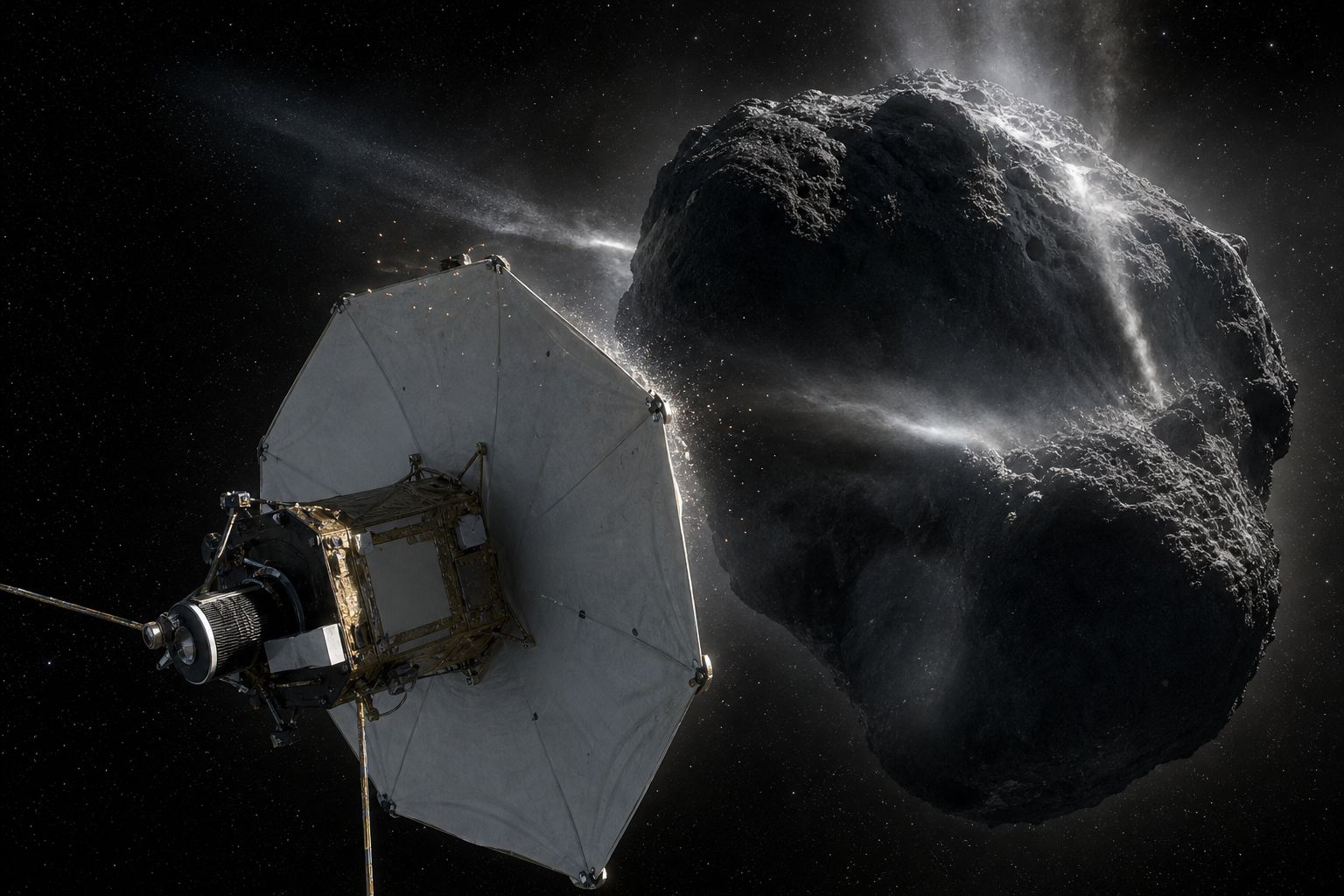
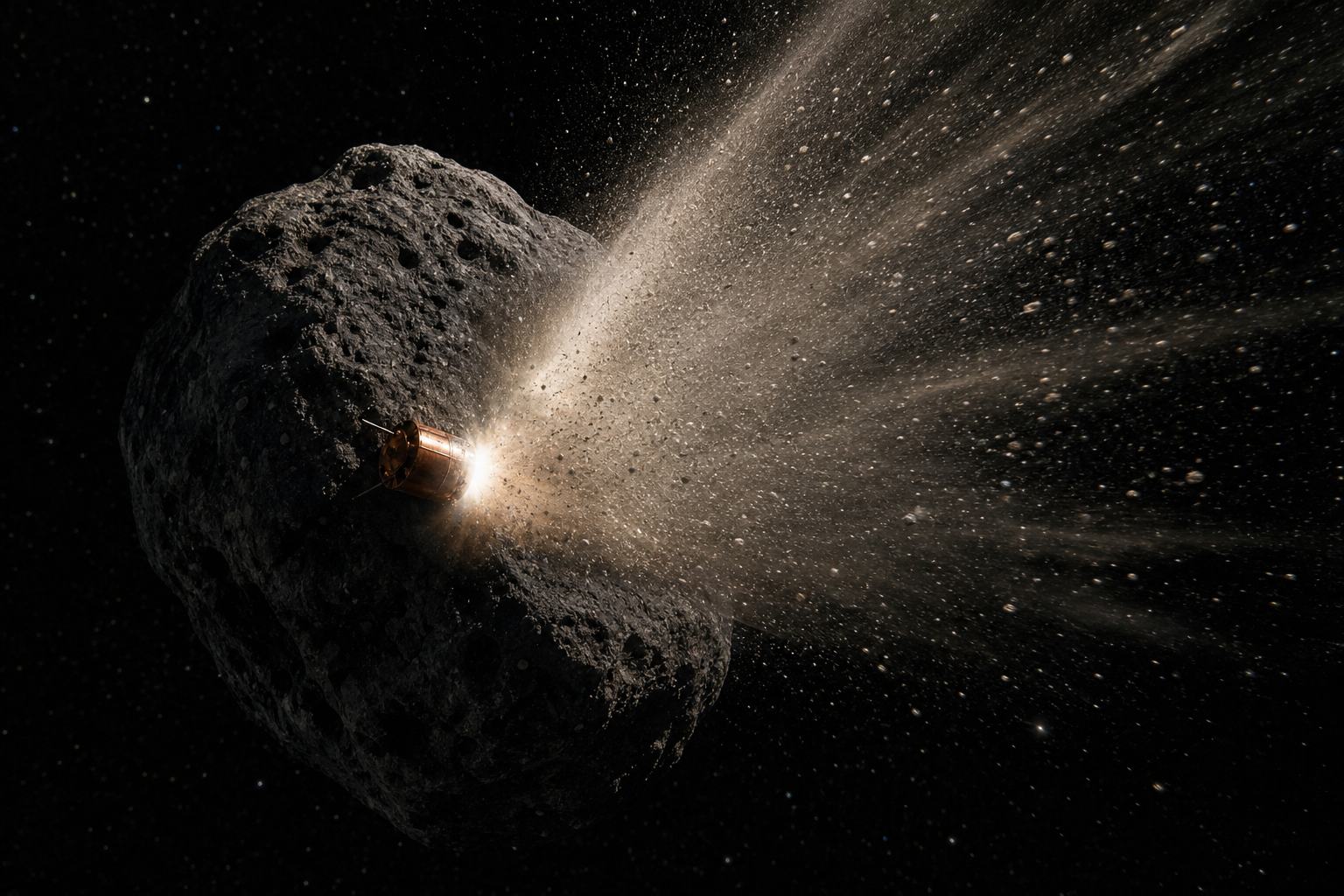
On 4 July 2005, NASA's Deep Impact went further. A day earlier it had released a 372-kilogram impactor, about half of it copper, into the path of Comet Tempel 1. The comet ran into it at about ten kilometres a second.
The blast threw up a huge cloud of fine powder, more like talcum powder than beach sand.
Whipple's dirty snowball had the ice and dust right. But its surface, it turned out, is nothing like a block of ice. It is a fluffy layer of fine dust.
372 kg
impactor, about half copper (NASA)
10.3 km/s
closing speed: the comet ran it over (NASA)
The impactor
1 day
before impact, the flyby spacecraft released the impactor
113 kg
of copper “cratering mass” (NASA)
A day aheadThe plume NASA’s own picture of the plume was taken 67 seconds after the hit, from the flyby spacecraft. AI-generated illustration.
More like talcum powder than beach sand.NASA press release on the Deep Impact plume, 8 July 2005
Chapter VI · Up close
Deep Impact
NASA (8 July 2005): on 4 July 2005 an 820-pound impactor hit Comet Tempel 1 at 6.3 miles per second; the large, opaque plume of fine material suggested the surface is covered in dust “more like talcum powder than beach sand”, not the “ice cube” people imagine. NASA/JPL encounter press kit: the impactor weighed 372 kg (820 lb), slightly less than half of it copper, including 113 kg of copper “cratering mass”; the flyby spacecraft released it one day before impact, and the comet ran it over at a closing speed of 10.3 km/s. NASA (comet facts): its image of Tempel 1 was taken 67 seconds after the hit.
The film “How Asteroid Deflection Works” tells how a similar hit was later used to nudge an asteroid.
Press “Replay the impact” to watch it again.
The 3D scenes are simplified teaching models: comets, tails, orbits and distances are drawn schematically and not to scale.
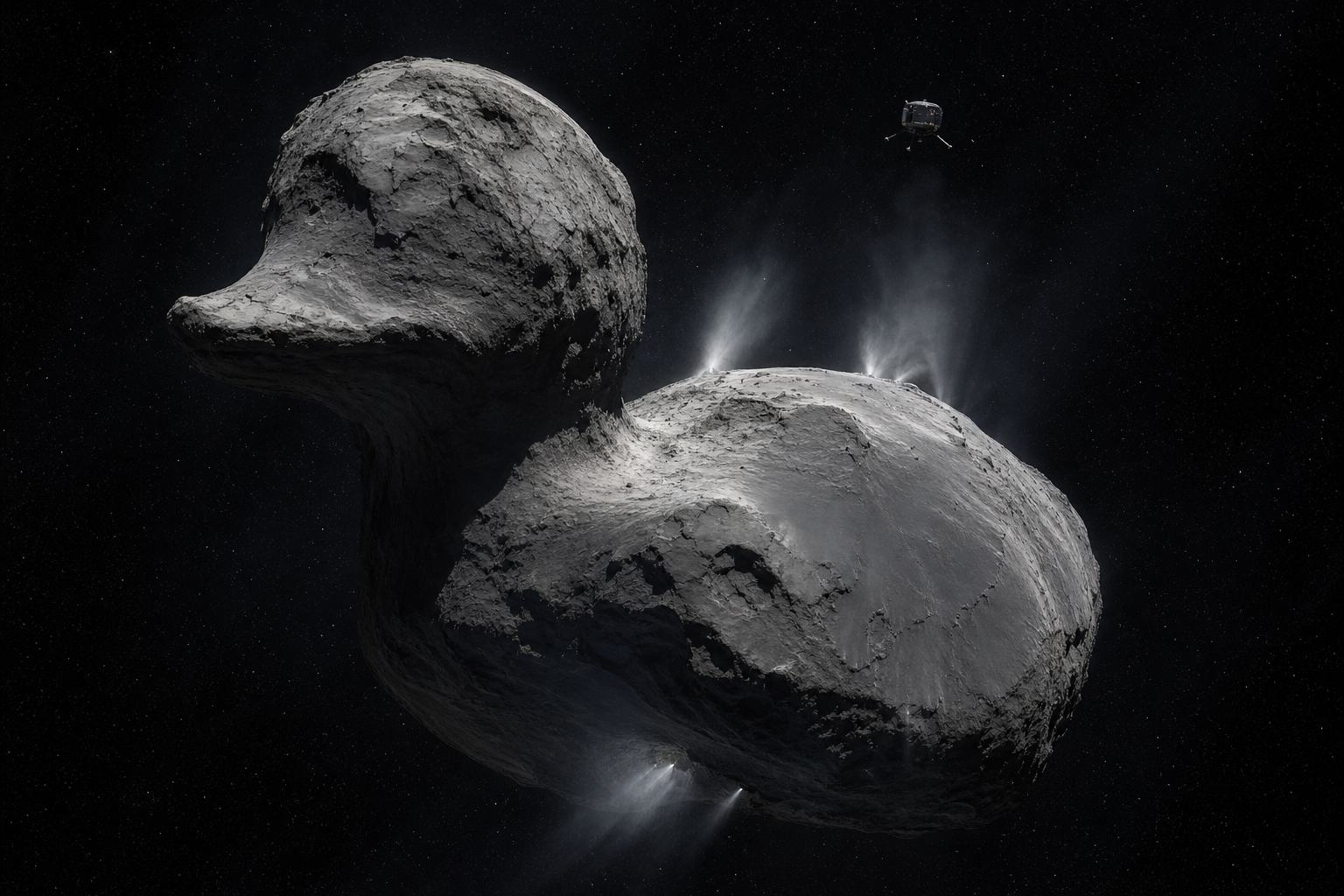
Europe's Rosetta reached Comet 67P on 6 August 2014, the first mission to orbit a comet. It found two lobes joined by a neck, like a rubber duck.
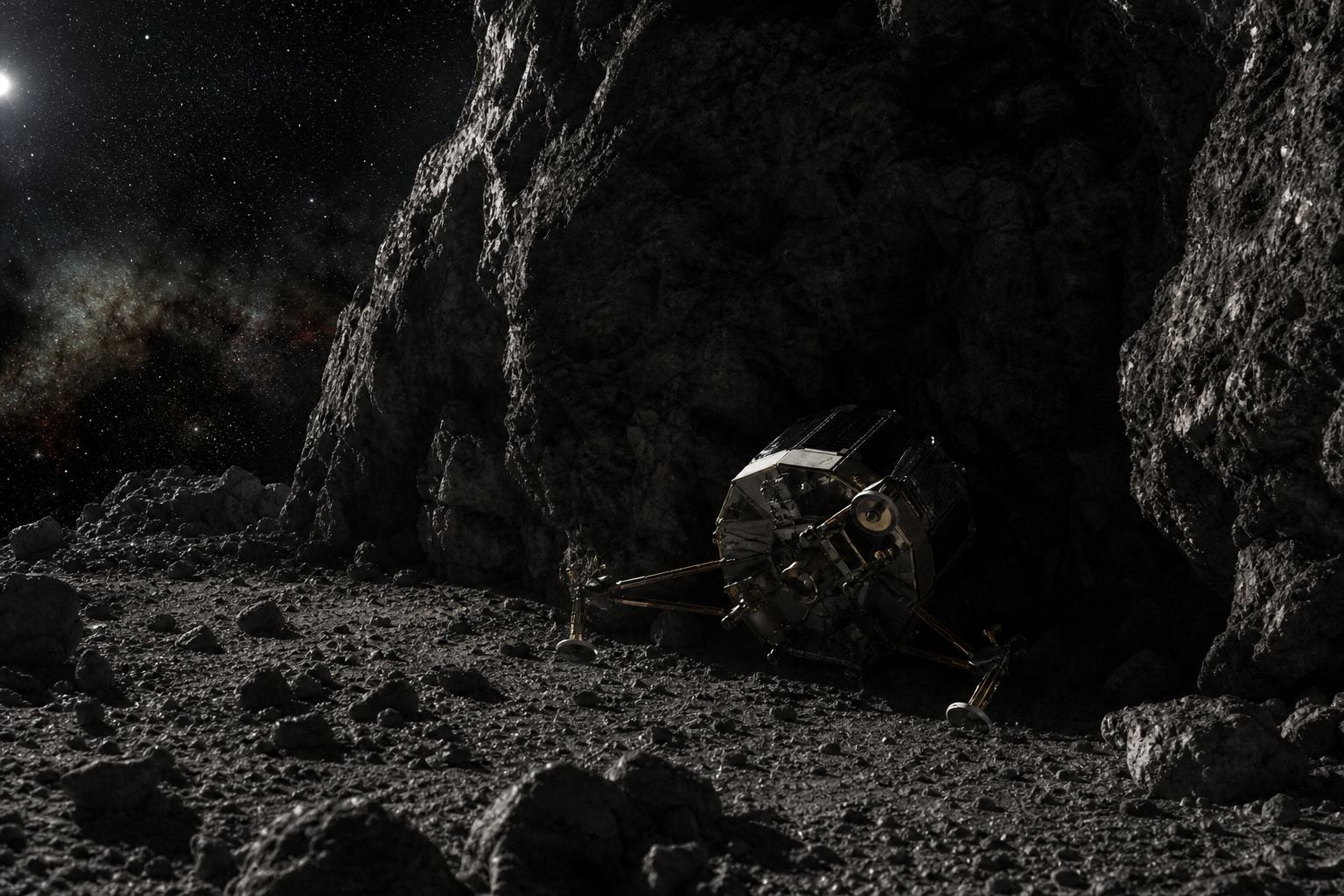
On 12 November its lander, Philae, touched down, but its harpoons failed. It bounced about a kilometre into a dark crevasse, and worked there for about sixty hours.
Rosetta followed the comet past the Sun. It found organic molecules, including the amino acid glycine, and water with three times Earth's share of heavy hydrogen: Earth's oceans are unlikely to have come from comets like this one.
The mission ended on 30 September 2016.
Comet 67P Scientists expected something shaped like an American football; a crack runs through the duck’s neck. AI-generated illustration.
2004
launch, 2 March
2014
arrival, 6 August
2015
perihelion, 13 August
Rosetta (ESA)Philae’s resting place Philae was finally spotted in Rosetta images taken on 2 September 2016, wedged in its crevasse. AI-generated illustration.
organic molecules, including the amino acid glycine
water with 3× Earth’s share of deuterium (heavy hydrogen)
oxygen gas that may be older than the Solar System
What Rosetta found
12 yr
in space, March 2004 to September 2016
~2 yr
beside the comet, August 2014 to September 2016
Rosetta, in all
Chapter VI · Up close
Rosetta and Philae
ESA factsheet: Rosetta launched on 2 March 2004, arrived at 67P on 6 August 2014, delivered Philae on 12 November 2014, followed the comet through perihelion on 13 August 2015 and ended its mission on 30 September 2016; among its findings were the amino acid glycine and water with a different “flavour” from Earth’s oceans. Britannica: it was the first mission to orbit and land on a cometary nucleus. DLR: Philae first touched down at Agilkia, drifted about a kilometre in about two hours to Abydos, worked for 60 hours, and was found lying sideways in a crevasse in images from 2 September 2016. Phys.org (AFP): the comet looked like a rubber bath duck; Philae’s harpoons failed to fire; its water has three times more deuterium than Earth’s, so Earth’s water is unlikely to have come from comets of 67P’s type; it has many organic molecules including amino acids; and its oxygen may be older than the Solar System.
Press “Land Philae” to replay the bouncing landing.
The 3D scenes are simplified teaching models: comets, tails, orbits and distances are drawn schematically and not to scale.
A few visitors do not belong to the Sun at all. Too fast for its gravity to hold, they follow open paths.
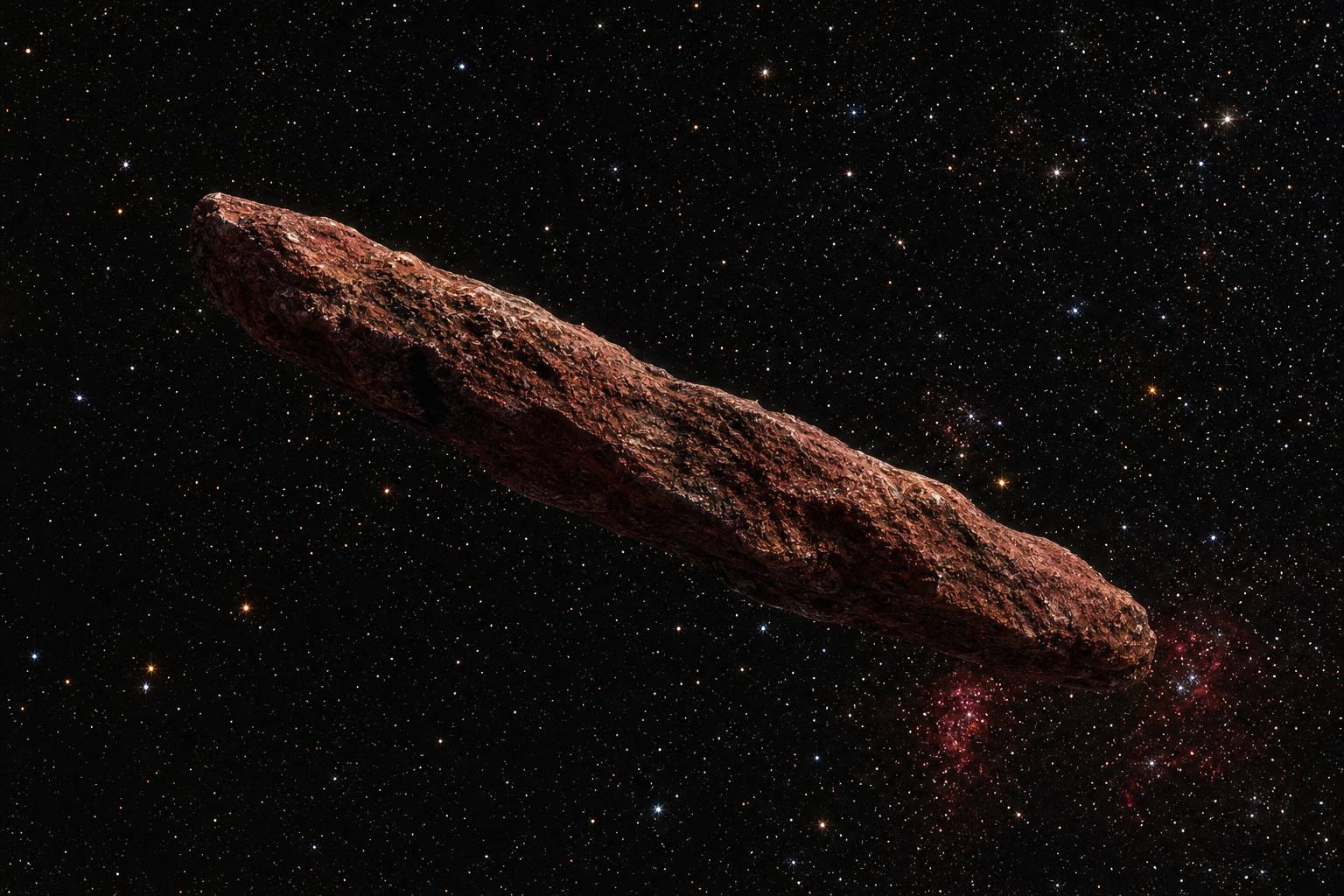
The first, 'Oumuamua, found in 2017, looked more like a bare rock than a comet, and scientists still debate what it was.
In 2019 Gennady Borisov, an amateur astronomer in Crimea, found 2I/Borisov: the first confirmed interstellar comet, active like our own.
In July 2025 the ATLAS survey in Chile found a third, 3I/ATLAS. It swung past the Sun that October, and never came close to Earth.
An open path An open, hyperbolic path means a single pass: the visitor never comes back. AI-generated illustration.1I/’Oumuamua, 2017 An artist’s impression: NASA says it appeared to be a rock, with no comet-like activity like Borisov’s. AI-generated illustration.2I/Borisov, 2019 NASA gives its speed as about 177,000 kilometres an hour. AI-generated illustration.
2017 1I/’Oumuamua: rock or comet?
2019 2I/Borisov: first interstellar comet
2025 3I/ATLAS: closest to the Sun 30 Oct, ~1.4 AU
Interstellar objects
Chapter VII · From other stars
Interstellar visitors
NASA (2I/Borisov): discovered on 30 August 2019 by Crimean amateur astronomer Gennady Borisov, it is the first confirmed interstellar comet, active like a normal comet, moving at about 177,000 km/h. ’Oumuamua (2017), the only earlier visitor, appeared to be a rock; scientists are unsure whether it was an asteroid, a comet or something in between. NASA (3I/ATLAS): found by the NASA-funded ATLAS survey telescope in Río Hurtado, Chile, reported on 1 July 2025; the third known interstellar object; on a hyperbolic path, too fast to be bound by the Sun; closest to the Sun on 30 October 2025 at about 1.4 AU; it never came closer to Earth than about 1.8 AU and posed no danger.
Press a name to draw its path; “Euclid comet” shows a closed orbit for comparison (its shape is illustrative).
The 3D scenes are simplified teaching models: comets, tails, orbits and distances are drawn schematically and not to scale.
A comet is a leftover from the birth of the Solar System, about 4.6 billion years ago, kept frozen far from the Sun.
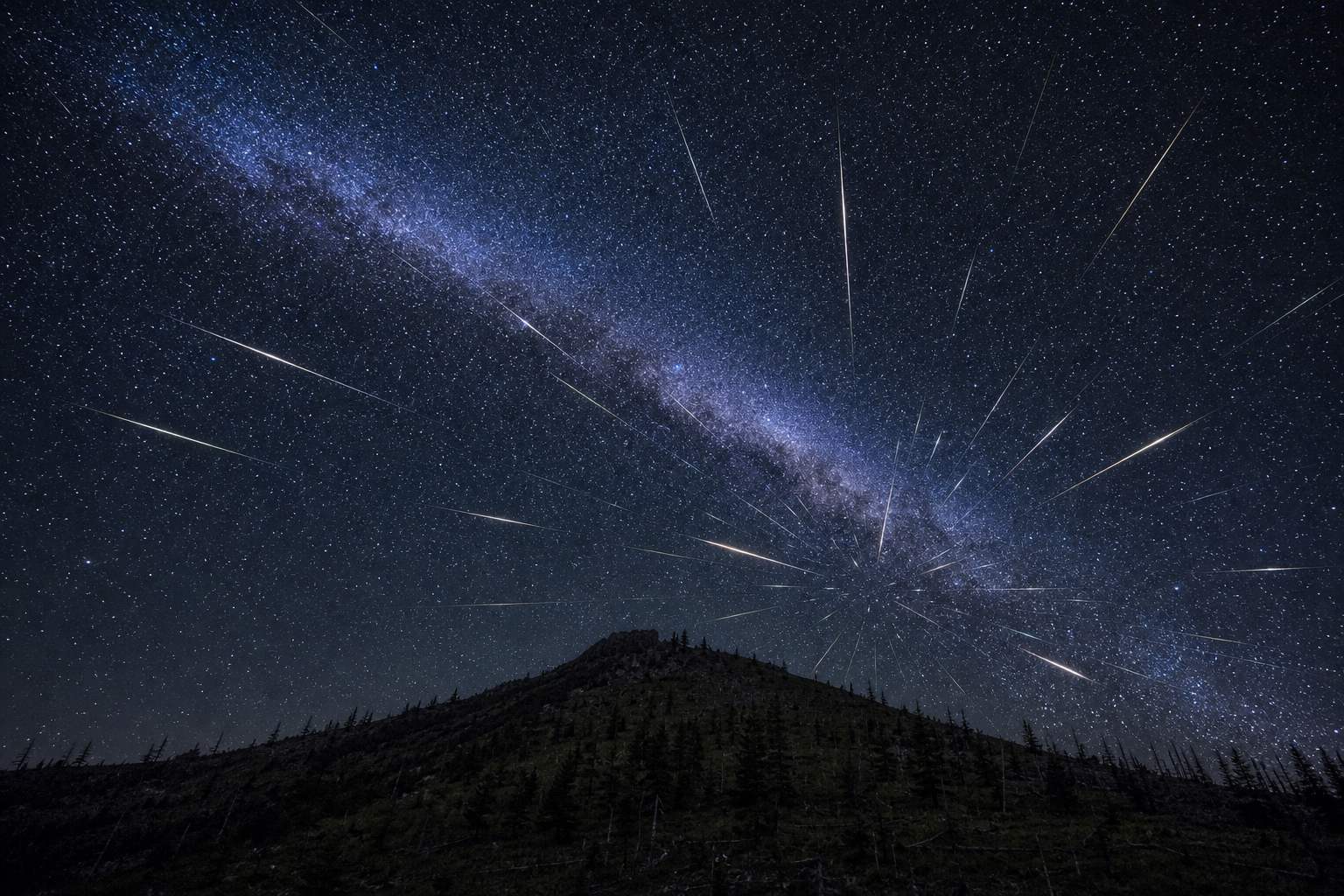
Each pass costs it some of itself. The dust it sheds stays along its orbit, and when Earth crosses it we see a meteor shower: Halley's gives us two a year.
Halley will be back in 2061. And somewhere high above the planets, C/2026 S1 is on its long way round, thousands of years from home and back.
Leftovers NASA dates comets to the dawn of the Solar System, about 4.6 billion years ago. AI-generated illustration.A comet’s crumbs Halley’s two showers are the Eta Aquariids in May and the Orionids in October. AI-generated illustration.
2061
Halley’s next return (NASA)
thousands of years
C/2026 S1’s orbit (ESA)
Coming back
Epilogue · Sources
Sources
Every fact in this film comes from the sources below. NASA: comets are leftovers from the dawn of the Solar System about 4.6 billion years ago; Halley’s debris makes the Eta Aquariids in May and the Orionids in October, and it returns in 2061. The news hook is reported as ESA states it: some outlets give a precise orbital period for C/2026 S1, but ESA says only “thousands of years”, and the film uses that. Where sources differ (the Oort cloud’s inner edge; Halley’s period), the film gives the range or the cautious figure. The 3D scenes are schematic teaching models, not to scale. The chapter stills and pictures are AI-generated illustrations, not photographs of real comets or spacecraft. The film “How Meteor Showers Work” tells the meteor half of this story.