In a 2025 study, reported again in October 2026, researchers described how a statin grips a calcium channel in muscle, a possible explanation for the muscle aches some users feel. To understand why more than 200 million people take these drugs, this film explains cholesterol itself: what the molecule is and why every cell needs it, how lipoproteins like LDL and HDL carry it, the LDL receptor that won a Nobel Prize, how plaque builds up in arteries, how a mould led to the first statin, and what we know so far about the side effect. Education only, not medical advice.
Interactive 3D film10 min1972 to 2026Published 23 October 2026
And the drugs that more than 200 million people take against it.
More than two hundred million people take a statin, a drug that lowers cholesterol. Some of them feel aching, weak muscles, and some stop taking it because of that.
In a study published in 2025 and reported again this October, a team at the University of British Columbia saw, almost atom by atom, a statin latch onto a calcium channel in muscle, called RyR1, and hold it open. Why that might hurt is a question we will come back to.
To see why so many people take a drug against a molecule their own body makes, we need to start with cholesterol itself.
200 million+
people take them (UBC)
7–29%
of users report muscle symptoms (McMaster)
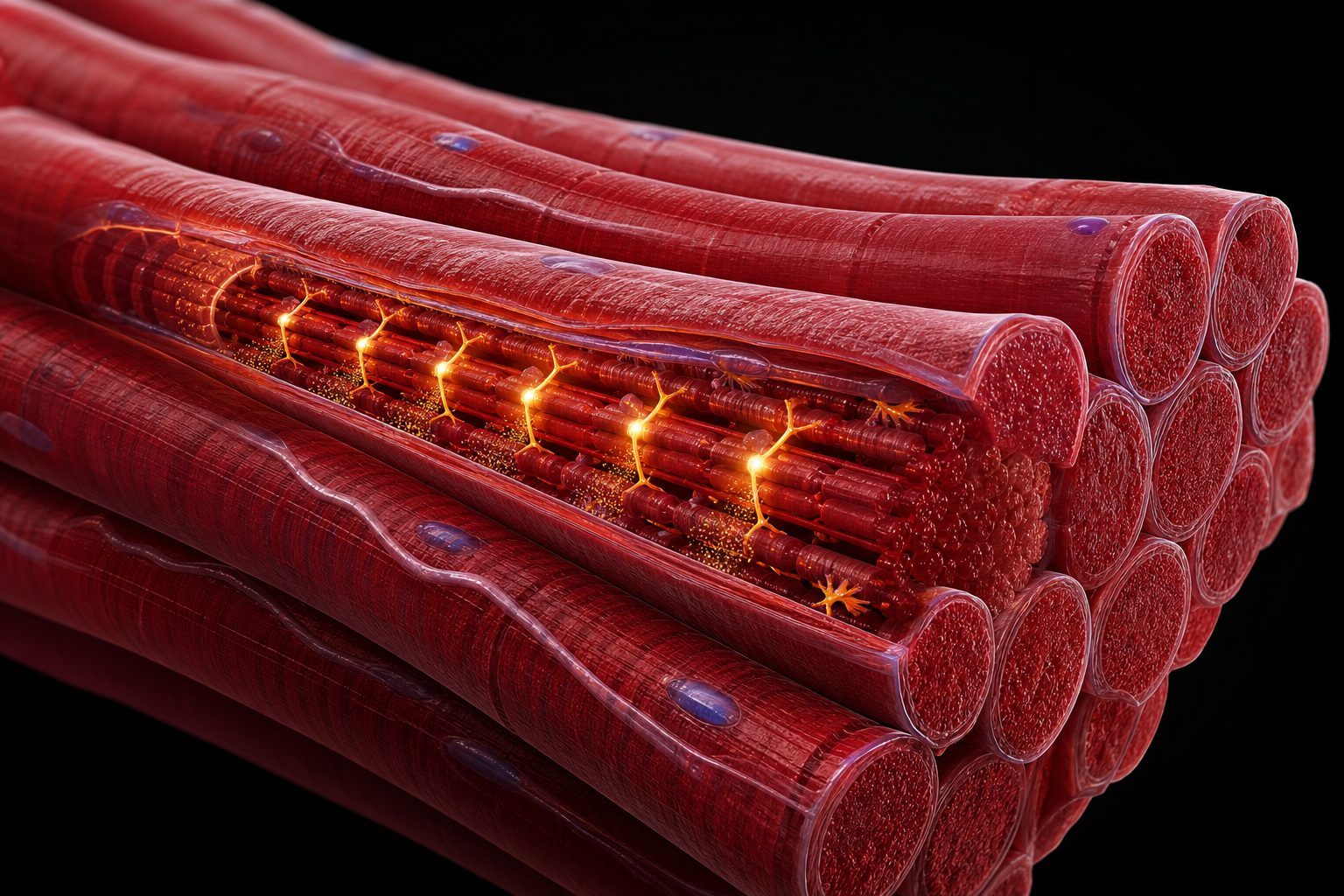
Statins worldwideMuscle fibres Calcium released inside a muscle fibre, as imagined. AI-generated still.
Frozen samples imaged with electrons (cryo-EM) to see the channel’s shape
One statin studied: atorvastatin
Shows a mechanism, not effects in patients
The study, in brief
Prologue
A statin caught in the act
ScienceDaily (20 October 2026), from the University of British Columbia with colleagues at the University of Wisconsin–Madison, reporting a study in Nature Communications (published in 2025; UBC’s own news release is dated 26 November 2025): using cryo-electron microscopy, the team saw atorvastatin bind to the ryanodine receptor RyR1, the muscle channel that controls calcium release; three statin molecules bind in sequence and hold the channel open, so calcium leaks. Only atorvastatin was studied directly, and the work does not show effects in patients. The article says more than 200 million people worldwide use statins. McMaster University estimates statin-associated muscle symptoms affect 7 to 29 per cent of users.
This film is education, not medical advice. Questions about cholesterol or medicines are for a doctor.
The 3D molecules, cells and vessels are simplified teaching models, not to scale.
Cholesterol is a waxy, fat-like substance, a lipid, found in every cell of your body. Its molecule has twenty-seven carbon atoms, forty-six hydrogens and one oxygen.
At its heart are four rings of carbon joined together, with a short hydrocarbon tail at one end and a hydroxyl group, an oxygen bonded to a hydrogen, at the other.
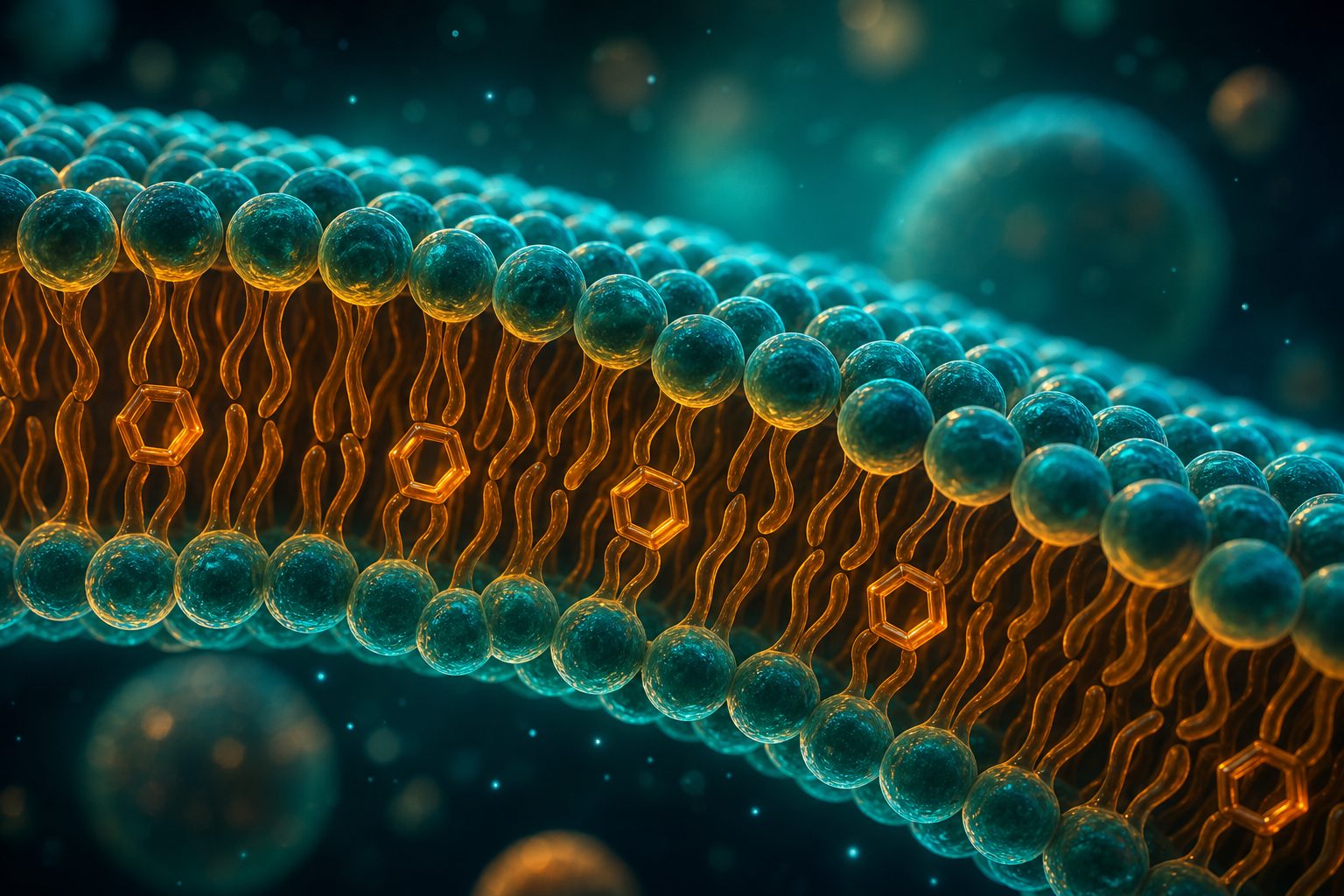
Slipped between the fats that make up a cell's outer membrane, it changes how fluid that membrane is.
C27H46O
C
27 carbon atoms
H
46 hydrogen atoms
O
1 oxygen atom
Its formula
Four fused carbon rings (the sterol core)
A hydrocarbon tail
A hydroxyl group: –OH
Three partsIn the membrane Rigid ring molecules tucked between membrane lipids. AI-generated still.
Chapter I · A molecule we need
What the molecule is
Cleveland Clinic: cholesterol is a waxy, fat-like substance (a lipid) found in every cell of the body. Medical News Today: its formula is C27H46O — 27 carbon, 46 hydrogen and one oxygen atom — built on a central sterol nucleus of four hydrocarbon rings, with a hydrocarbon tail at one end and a hydroxyl group at the other; it is an important part of cell-membrane structure and changes the fluidity of the membrane.
The 3D molecule is a simplified ball-and-stick model; hydrogen atoms are left out.
Your body could not do without it. Cholesterol helps build cell membranes, it is the starting material for hormones, including the sex hormones, and for vitamin D, and the liver uses it to make bile, which helps you digest food.
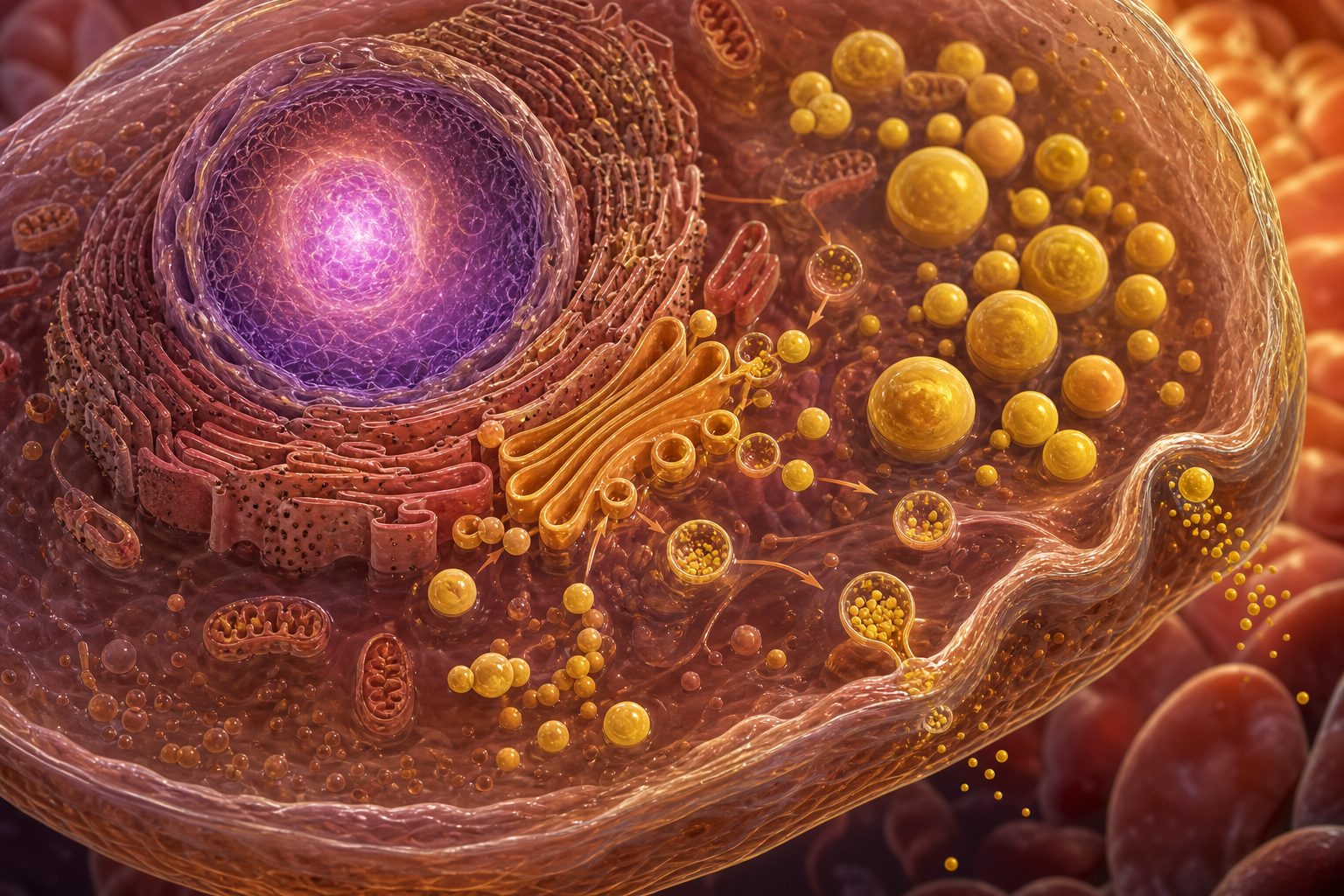
Most of it is home-made. The liver produces about eighty percent of the cholesterol in your body. The rest comes from food.
So cholesterol is not the enemy. The trouble is how it travels, and where it ends up.
Cell membranes
Hormones, including sex hormones
Vitamin D
Bile, for digestion
Four jobs
Made by the liver
~80%
From food
~20%
Where the body’s cholesterol comes from The 20% is simply what remains after the liver’s share.
The liver Inside a liver cell, where most cholesterol is made. AI-generated still.
Chapter I · A molecule we need
Why we need it
Cleveland Clinic: cholesterol helps form cell membranes, supports the production of bile for digestion, and is a building block for hormones, including sex hormones, and for vitamin D. The liver makes about 80% of all the cholesterol in the body; the rest comes from food.
This film is education, not medical advice. Questions about cholesterol or medicines are for a doctor.
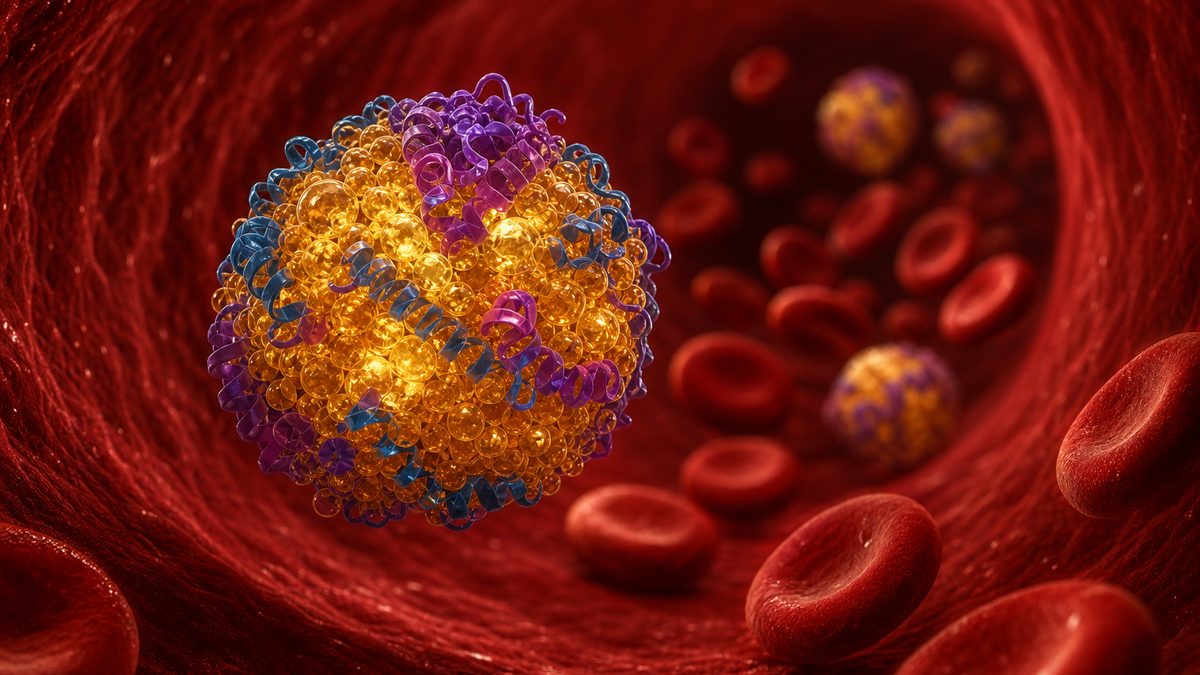
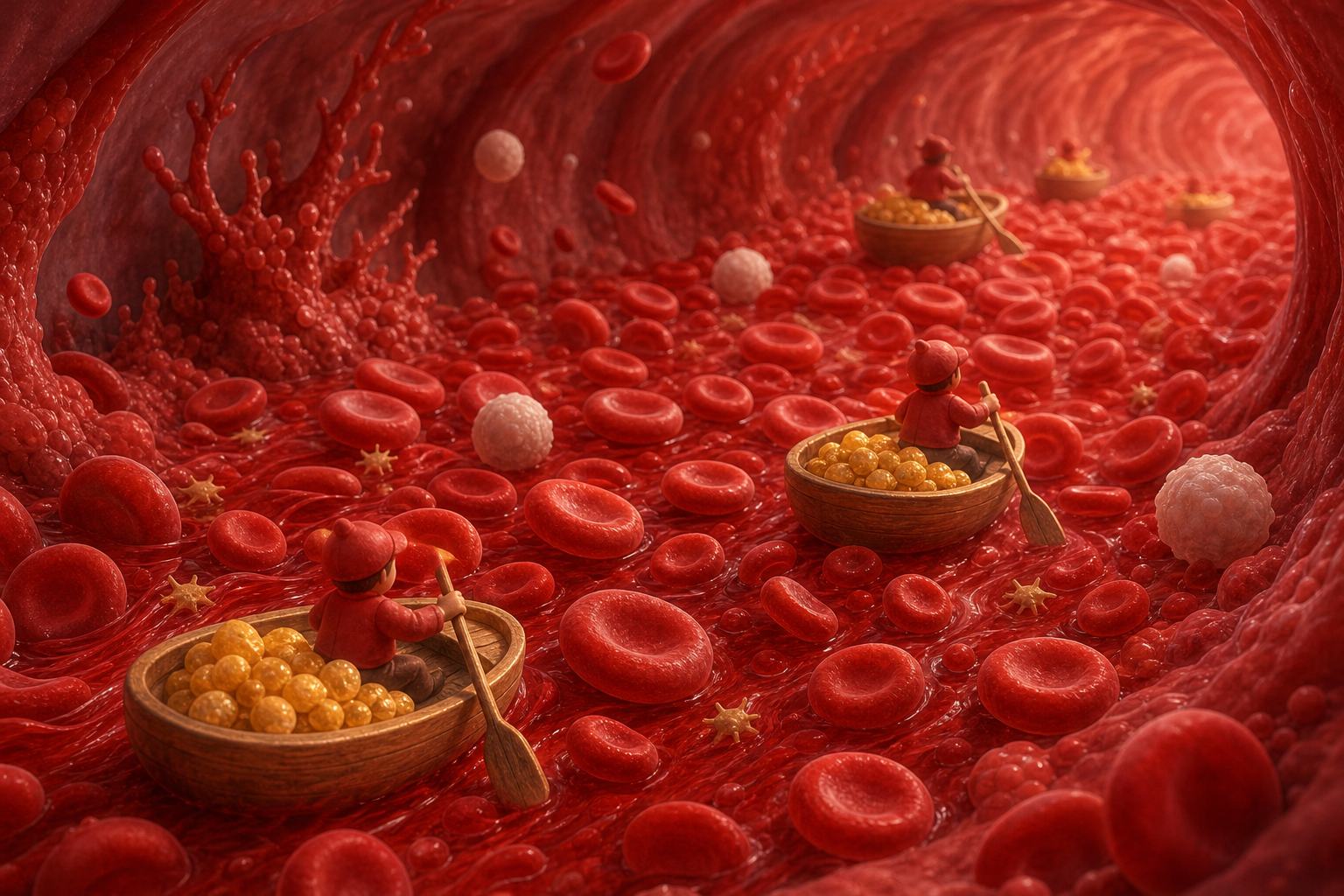
Blood is mostly water, and cholesterol, like oil, does not dissolve in it. So it cannot travel alone. It rides inside particles made of fats and proteins, called lipoproteins, like little boats.
Low-density lipoprotein, LDL, carries cholesterol out to the tissues, which is useful. But when too much of it is left in the blood, it can feed plaque in the arteries. That is why it is called bad cholesterol.
High-density lipoprotein, HDL, helps remove extra cholesterol from the blood, so it is called the good kind.
Little boats A metaphor: lipoproteins carry cholesterol through the watery blood. AI-generated still.
Low-density lipoprotein
The main carrier of cholesterol in the blood
Too much can contribute to plaque
LDL · “bad”
High-density lipoprotein
Helps remove extra cholesterol from the blood
HDL · “good”
Chapter II · Boats in the blood
LDL and HDL
Cleveland Clinic: cholesterol cannot travel through the blood on its own; it combines with proteins and triglycerides to form lipoproteins, “like little boats” carrying it to tissues. LDL is called “bad” cholesterol because it can contribute to plaque in the arteries; HDL is called “good” cholesterol because it removes excess cholesterol from the blood. The Nobel Prize press release (1985) describes LDL as the main cholesterol-carrying particle in the blood.
On screen: gold particles are LDL, blue are HDL; sizes are not to scale.
This film is education, not medical advice. Questions about cholesterol or medicines are for a doctor.
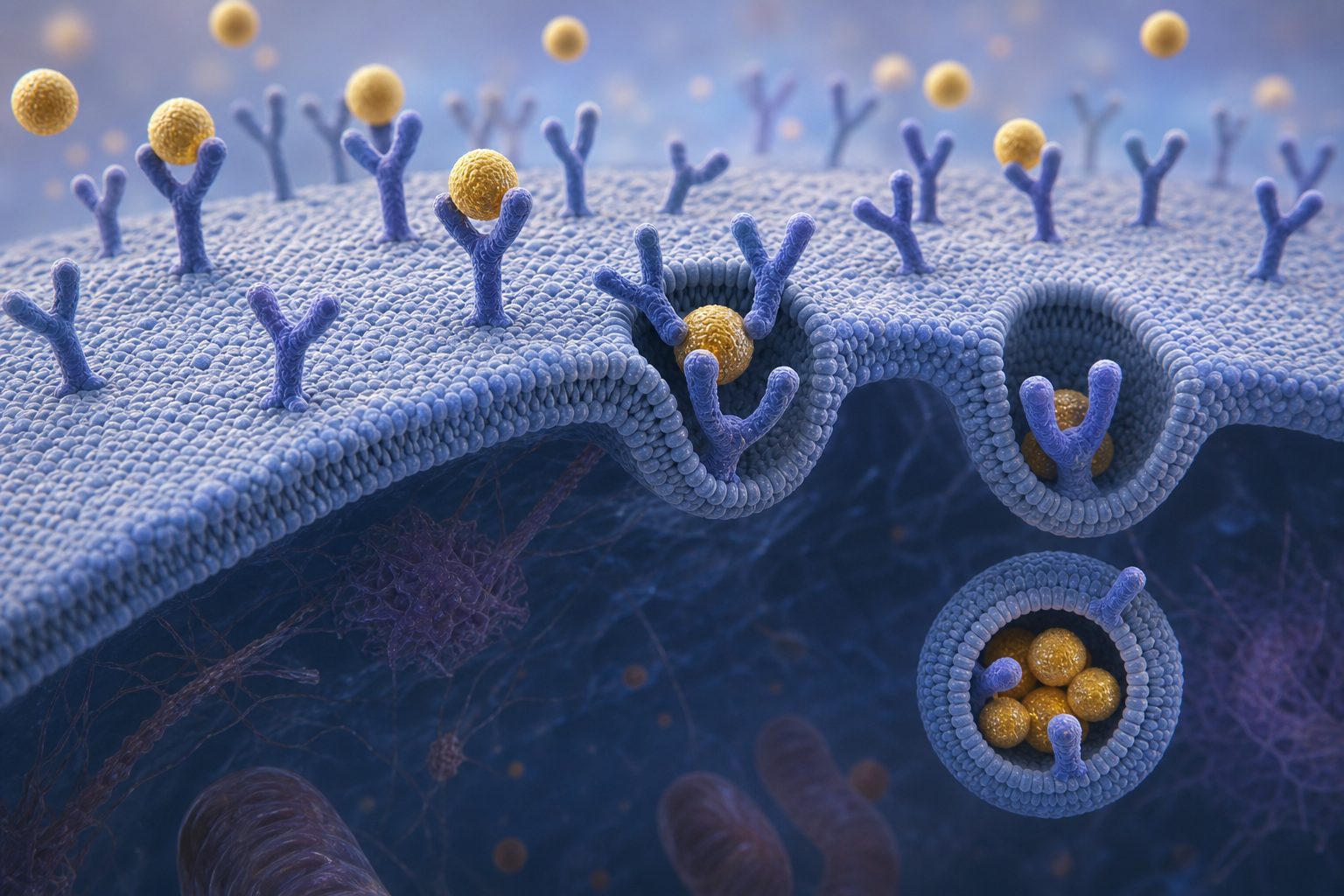
How does LDL leave the blood? In 1985, Michael Brown and Joseph Goldstein won the Nobel Prize for the answer: cells carry receptors on their surface that catch LDL particles.
The receptors gather in small pits that fold inward and pull the particle into the cell. The cholesterol is released, and the receptor goes back to the surface to catch another.
When a cell has enough cholesterol, it makes fewer receptors, and more LDL is left in the blood. Change the number of receptors and watch the blood level.
Brown & Goldstein
for discovering how cells regulate cholesterol
Nobel Prize 1985Catch and pull in Receptors gathering particles into a pit in the membrane. AI-generated still.
LDL brings cholesterol into the cell
The cell slows its own production
It also makes fewer receptors
More LDL stays in the blood
A feedback loop
Chapter II · Boats in the blood
Receptors and feedback
Nobel Prize press release, 1985 (Michael S. Brown and Joseph L. Goldstein): cells carry LDL receptors; LDL binds to receptors clustered in coated pits on the cell surface, which pinch inward; the cholesterol is released inside and the receptor is recycled. Cholesterol taken in this way slows the cell’s own cholesterol production and reduces the formation of new receptors; fewer receptors mean less LDL is cleared, so more stays in the blood and can be deposited in artery walls.
Try it: the blood level in the readout is illustrative, not a medical value.
The 3D molecules, cells and vessels are simplified teaching models, not to scale.
Some people inherit faulty receptors. We each carry two copies of the receptor gene, one from each parent, and the condition is called familial hypercholesterolemia.
According to the Nobel committee's 1985 account, about one person in two hundred to five hundred has one faulty copy, and two to three times the normal level of cholesterol, with heart symptoms often appearing between thirty-five and fifty-five.
About one in a million inherits two faulty copies, and can have a heart attack as a child. Without working receptors, LDL piles up in the blood, and the next chapter shows where it goes.
Inherited A family tree; the faulty gene is passed down in families. AI-generated still.
Typical
1×
One faulty copy
2–3×
Blood cholesterol, compared with normal As described in the 1985 Nobel press release.
1 in 200–500
one faulty copy
~1 in a million
two faulty copies
How common (1985 estimates)
Chapter II · Boats in the blood
Familial hypercholesterolemia
Nobel Prize press release, 1985: familial hypercholesterolemia results from missing or defective LDL receptors. People who inherit one faulty gene (about 1 in 200 to 500) have roughly two to three times the normal cholesterol level and usually develop symptoms between 35 and 55; those with two faulty genes (about 1 in a million) have very high cholesterol and may suffer heart attacks in childhood. Figures are as given in 1985.
This film is education, not medical advice. Questions about cholesterol or medicines are for a doctor.
The 3D molecules, cells and vessels are simplified teaching models, not to scale.
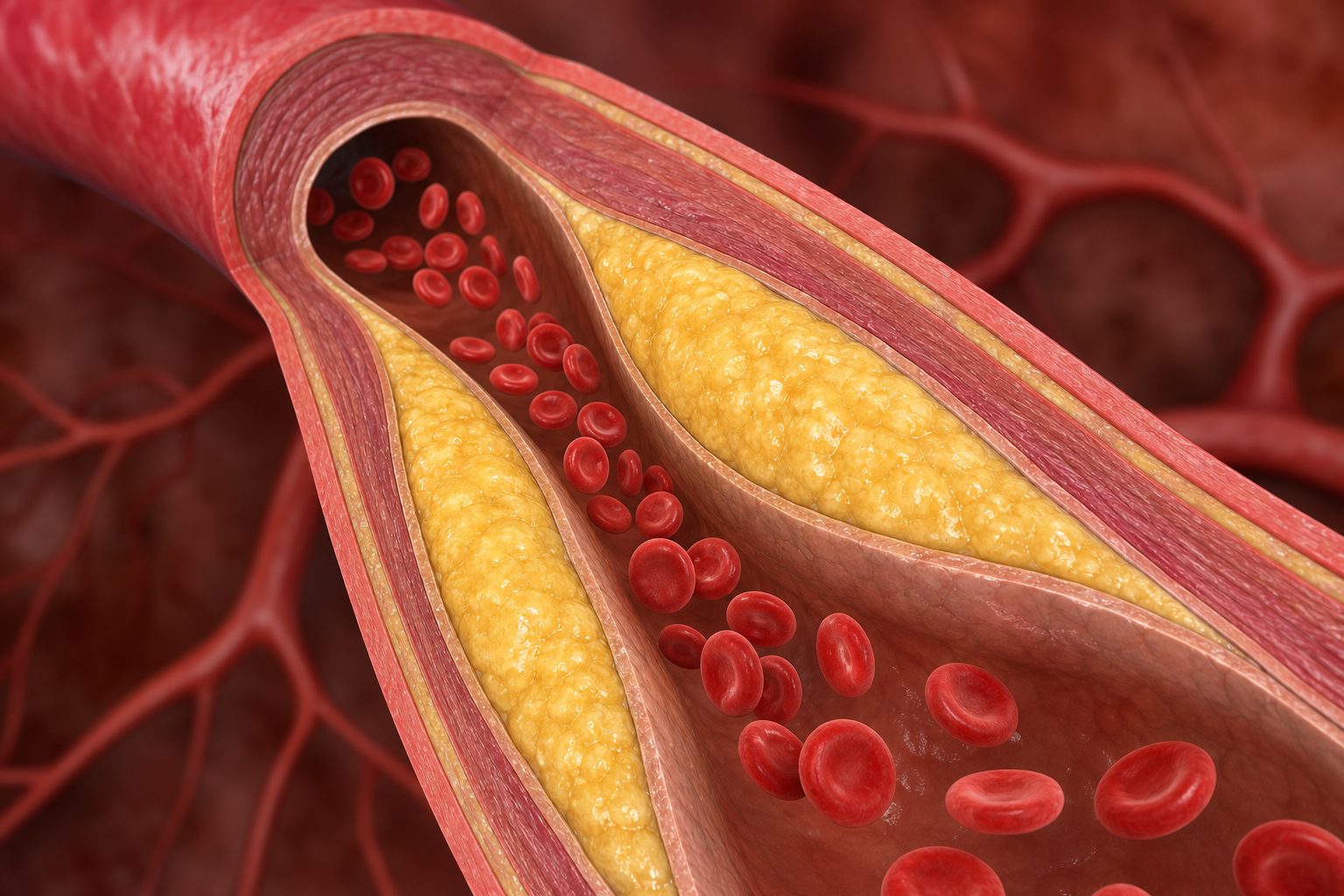
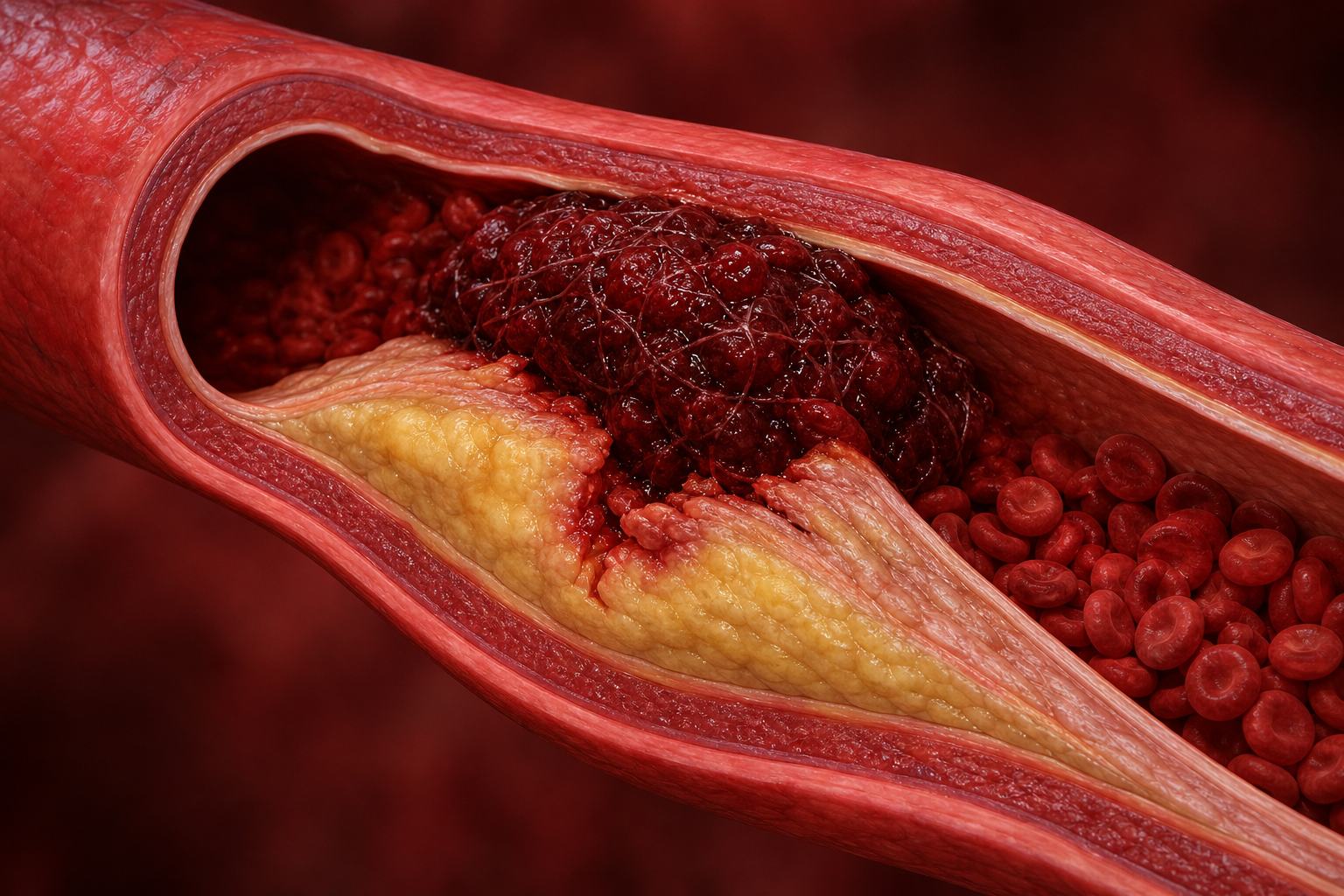
LDL that stays in the blood can be deposited in the walls of arteries. The trouble begins with small, repeated injuries to the smooth inner lining of an artery, which send out chemical signals that draw immune cells into the wall.
There they become foam cells, swollen with cholesterol and other fats. Over years, fibrous tissue, calcium and cholesterol crystals pile up into a plaque under a fibrous cap.
The plaque bulges into the channel and narrows it. High LDL is one of the main risks that can be changed.
1 · repeated injury to the lining
2 · immune cells drawn into the wall
3 · they become foam cells
4 · a plaque forms under a cap
How a plaque growsA plaque An artery narrowed by a fatty plaque. AI-generated still.
foam cells
immune cells full of fat
cap
fibrous tissue on top
Inside the plaque
Chapter III · When it builds up
Atherosclerosis
Merck Manual: atherosclerosis begins with repeated, slight injury to the artery’s inner lining (endothelium). The injured wall sends chemical signals that draw monocytes and T cells into the wall, where they transform into foam cells that collect cholesterol and other fatty materials. Smooth muscle cells, fibrous tissue, calcium and cholesterol crystals accumulate into a patchy deposit, an atheroma or plaque, covered by a fibrous cap, which can narrow or block an artery. High LDL cholesterol is a key modifiable risk factor.
This film is education, not medical advice. Questions about cholesterol or medicines are for a doctor.
The 3D molecules, cells and vessels are simplified teaching models, not to scale.
Narrowing is not always the most dangerous part. A plaque's cap can split open. Blood clots over the tear, and the clot can suddenly block the artery completely.
That is the main cause of heart attacks and strokes. According to the World Health Organization, an estimated 19.8 million people died of heart and blood vessel diseases in 2022, and eighty-five percent of those deaths were from heart attacks and strokes.
Crack the cap, and see what happens to the flow.
A clot A clot forming over a ruptured plaque. AI-generated still.
19.8 million
deaths in 2022, the leading cause worldwide
85%
of these were heart attacks and strokes
Cardiovascular disease (WHO)
Crack the cap: a clot forms and the flow stops
Restore: back to a narrowed but open artery
Try it
Chapter III · When it builds up
Heart attacks and strokes
Merck Manual: a plaque’s fibrous cap can rupture; a blood clot then forms and can suddenly block all blood flow through the artery, the main cause of heart attack or stroke. World Health Organization fact sheet (2025): cardiovascular diseases are the leading cause of death globally; an estimated 19.8 million people died from them in 2022, and 85% of these deaths were due to heart attack and stroke; raised blood lipids are among the risk factors.
A heart attack or stroke is an emergency: in real life, call emergency services.
This film is education, not medical advice. Questions about cholesterol or medicines are for a doctor.
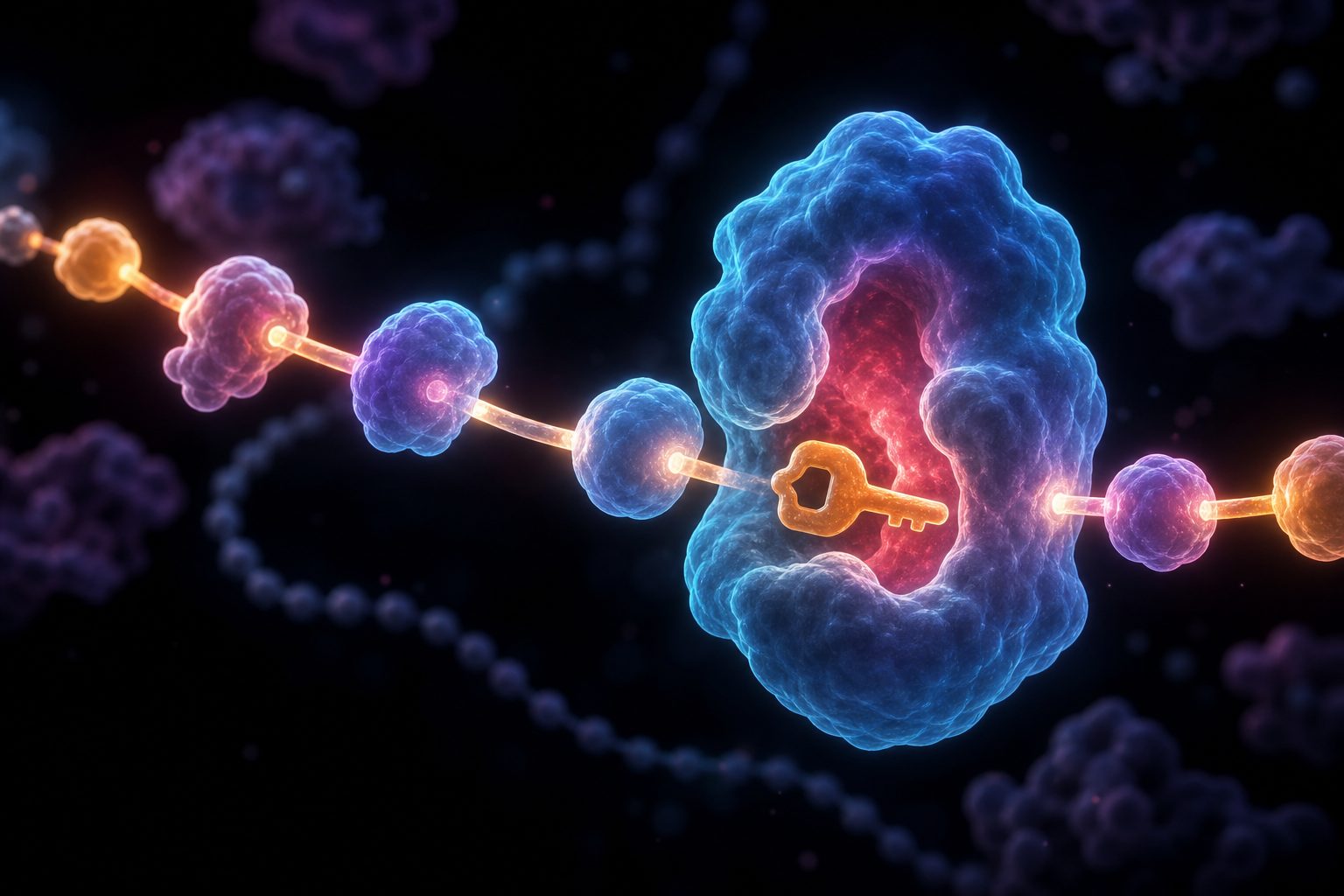
The liver builds cholesterol on an assembly line of many steps, each driven by an enzyme, a protein that speeds up one chemical reaction. One early step depends on an enzyme called HMG-CoA reductase.
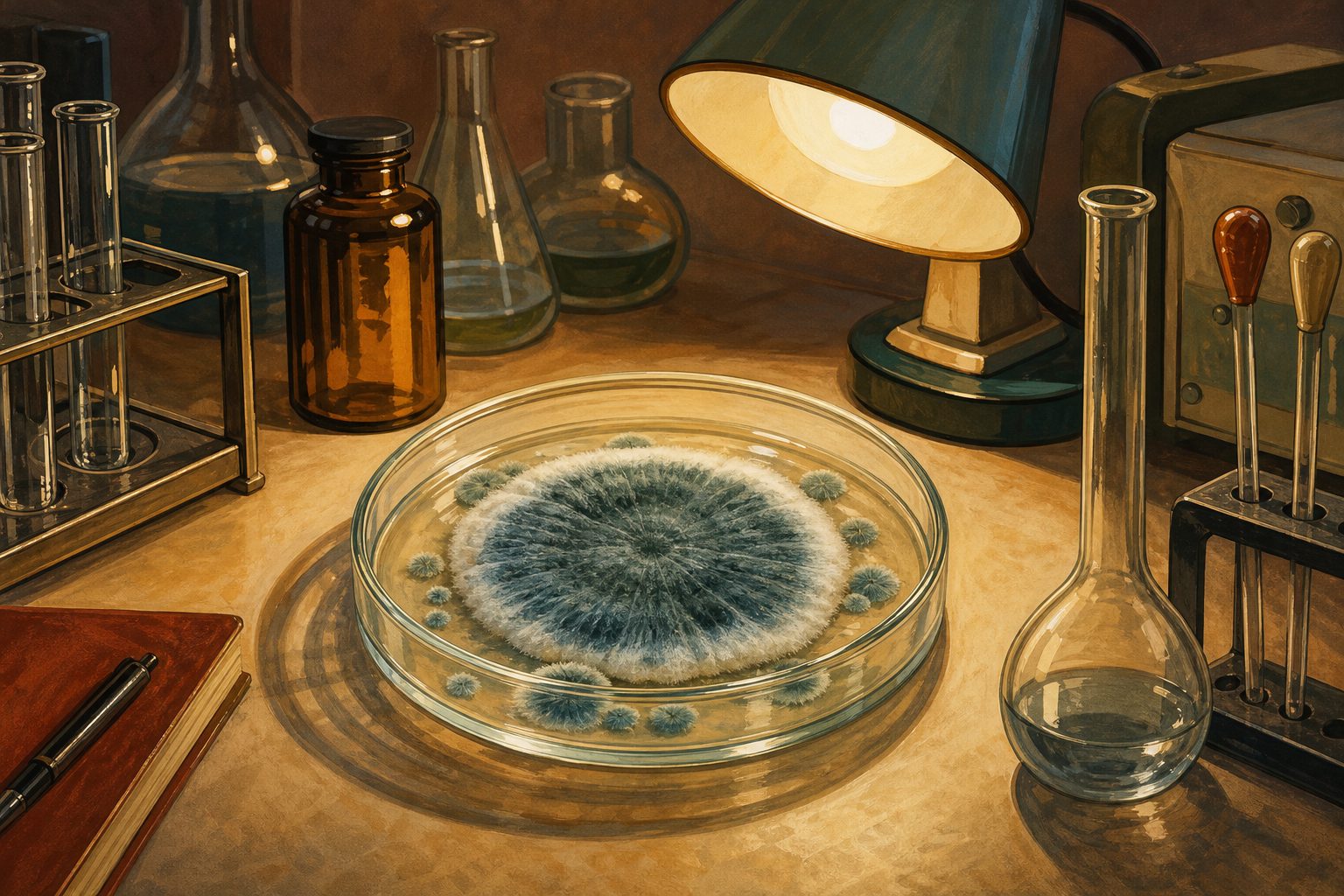
In Tokyo, at the company Sankyo, the biochemist Akira Endo looked for a natural substance that could block it. He tested more than six thousand strains of fungi.
In 1972 he found one: compactin, made by a mould called Penicillium citrinum. It lowered LDL, the bad cholesterol, but not HDL. It was the first statin.
An assembly line A chain of steps with one key enzyme, as a metaphor. AI-generated still.Searching moulds A mould in a dish on a 1970s lab bench, as imagined. AI-generated still.
1972 Endo finds compactin in Penicillium citrinum
1976 Compactin published
1987 Lovastatin, the first statin approved by the US FDA
2008 Endo receives the Lasker Award
From mould to medicine
Chapter IV · A mould and an enzyme
Akira Endo and compactin
Lasker Foundation (2008 award to Akira Endo): working at Sankyo in Tokyo, Endo tested more than 6,000 fungal strains and on 15 March 1972 found compactin (mevastatin), made by Penicillium citrinum, which blocks HMG-CoA reductase, a key enzyme in the pathway that makes cholesterol; it lowers LDL but not HDL. Compactin was published in 1976; lovastatin (Mevacor), developed by Merck, became the first statin approved by the US FDA in 1987.
The 3D molecules, cells and vessels are simplified teaching models, not to scale.
A statin slows the liver's own production line by blocking HMG-CoA reductase. Short of cholesterol, the liver cells do what Brown and Goldstein's work predicts: they make more LDL receptors.
More receptors pull more LDL out of the blood, so the level in the blood falls. The good kind, HDL, is left largely alone.
Switch the statin on and off, and follow the chain from the enzyme to the blood.
Statin blocks the enzyme
Liver makes less cholesterol
Liver cells make more LDL receptors
More LDL is cleared from the blood
The chain
it may one day be possible for many people to have their steak and live to enjoy it tooa scientists’ hope, Nobel Prize press release, 1985
Statin on: enzyme blocked, receptors up, LDL down
Statin off: back to the starting levels
Try it
Chapter IV · A mould and an enzyme
How statins work
Lasker Foundation: statins block HMG-CoA reductase and lower LDL but not HDL. Nobel Prize press release (1985): cholesterol inside cells suppresses the formation of new LDL receptors, and Brown and Goldstein’s work led to drugs that increase the number of LDL receptors, so that more LDL is removed from the blood. The press release ends with the hope that many people might one day “have their steak and live to enjoy it too”.
Try it: levels on screen are illustrative, not treatment results.
This film is education, not medical advice. Questions about cholesterol or medicines are for a doctor.
Lovastatin became the first statin approved in the United States in 1987. The big question was whether lowering LDL would actually save lives.
In 1994, the Scandinavian trial known as 4S found that simvastatin, taken for as little as five years, cut LDL by thirty-five percent and deaths from coronary heart disease by forty percent.
Across fourteen trials with about ninety thousand adults, statins lowered LDL by a quarter to a third, and heart attacks by a quarter or more.
A daily tablet Unmarked tablets; this film gives no dosing advice. AI-generated still.
LDL cholesterol
35%
Coronary heart disease deaths
40%
4S trial, 1994 (simvastatin) As summarised by the Lasker Foundation.
25–35%
lower LDL
25–30%
fewer heart attacks
14 trials, ~90,000 adults
Chapter IV · A mould and an enzyme
Does it save lives?
Lasker Foundation: lovastatin (Mevacor) was approved by the US FDA in 1987. In the 4S trial, reported in 1994, simvastatin taken for as little as five years lowered LDL by 35% and was associated with a 40% drop in deaths from coronary heart disease. Across 14 trials involving about 90,000 middle-aged adults, statins lowered LDL by 25–35% and reduced heart attacks by 25–30%. Whether a statin is right for a particular person is a decision for that person and their doctor.
This film is education, not medical advice. Questions about cholesterol or medicines are for a doctor.
Muscle aches are the best-known complaint. McMaster University estimates that seven to twenty-nine percent of users report muscle symptoms, while severe muscle injury is rare.
Muscles contract when calcium is released from stores inside each fibre, through a channel called the ryanodine receptor. The Vancouver team, at UBC, saw atorvastatin hold that channel open, letting calcium leak out.
An earlier study at Leeds found a similar calcium leak in rat muscle, backed by muscle samples from patients, and a 2026 study at McMaster found what appears to be a separate immune and metabolic route in mice.
How a leak turns into pain in people is still unproven.
These are laboratory, animal and tissue studies, not new treatments. The British Heart Foundation stresses that most people who take statins have no side effects, and that anyone with symptoms should talk to their doctor.
7–29%
of statin users (McMaster estimate)
rare
severe muscle injury (UBC)
Muscle symptomsCalcium inside a fibre Calcium released from stores inside a muscle fibre. AI-generated still.
UBC (2025): statin holds RyR1 open, by cryo-EM
Leeds (earlier): calcium leaks in rat muscle and patient tissue
McMaster (2026): immune and metabolic route in mice
Three lines of research
?
how a calcium leak turns into pain in people
Not yet known
Statins are life-saving drugs and most people who take them don’t experience side effects.British Heart Foundation spokesperson, quoted by the University of Leeds
Chapter V · The side effect
What we know about the muscle side effect
ScienceDaily / UBC: statins bind the ryanodine receptor RyR1 and hold it open, so calcium leaks; only atorvastatin was studied, and the work is structural, not clinical; severe muscle injury is rare while milder soreness, weakness and fatigue are more common. University of Leeds: statins caused irregular calcium leaks through ryanodine receptors in rat muscle, with human data from muscle biopsies of long-term statin patients; the link to pain in people is likely but unproven; a British Heart Foundation spokesperson said most people who take statins don’t experience side effects, and anyone with symptoms should speak with their doctor. McMaster University (Science Advances, July 2026): in muscle cells and mice, statins disrupted energy production and triggered an immune response that damaged muscle, a mechanism that appears to be separate from cholesterol lowering; more research is needed before any therapy.
Try it: a closed channel keeps calcium in its store; a statin-held channel leaks. Schematic.
This film is education, not medical advice. Questions about cholesterol or medicines are for a doctor.
Cholesterol holds our cells together and builds our hormones. The danger lies in how much LDL is left in the blood, and in what slowly happens inside an artery wall.
From a mould in a Tokyo lab to a channel seen almost atom by atom, the story of statins is still being written.
Why do most people feel nothing, while some ache? Do other statins grip the channel the same way? Those are open questions. For your own body, the questions belong with a doctor.
1972 Endo finds compactin
1985 Nobel Prize for the LDL receptor
1987 First statin approved in the US
1994 4S trial results
2025 Statin seen holding RyR1 open
Cholesterol and statins
Education, not medical advice
Stills are AI-generated
3D cells and molecules are schematic
About this film
Why do most users feel nothing?
Do other statins grip RyR1 the same way?
Can a safer statin be designed?
Open questions
Epilogue · Sources
Sources
Every fact in this film comes from the sources below. This film is education, not medical advice: it gives no doses, targets or diet plans, and questions about cholesterol or medicines are for a doctor. The chapter stills and pictures are AI-generated illustrations, and the 3D molecules, cells and vessels are simplified teaching models. The muscle studies are recent laboratory and animal work, not established treatments.