In October 2026 about $6.3 billion in cryptocurrency was taken from the Binance exchange; the FBI blames North Korea's TraderTraitor hackers, and North Korea denies it. This film explains the established technology behind that news: what a ledger is and why digital money needs protection from double-spending, how cryptographic hash functions fingerprint data and chain blocks together, how public and private keys sign payments, how a peer-to-peer network agrees on one history through proof of work or proof of stake, why blockchain payments are in practice irreversible, and why big thefts go after exchanges, keys, the systems allowed to use them, and people, rather than the blockchain's mathematics. It is an explanation, not investment advice.
Interactive 3D film8 min1991 to 2026Published 6 November 2026
Billions gone in minutes, and no blockchain broken.
On the twenty-ninth of October 2026, about six point three billion dollars in cryptocurrency was moved out of Binance, the world’s largest crypto exchange.
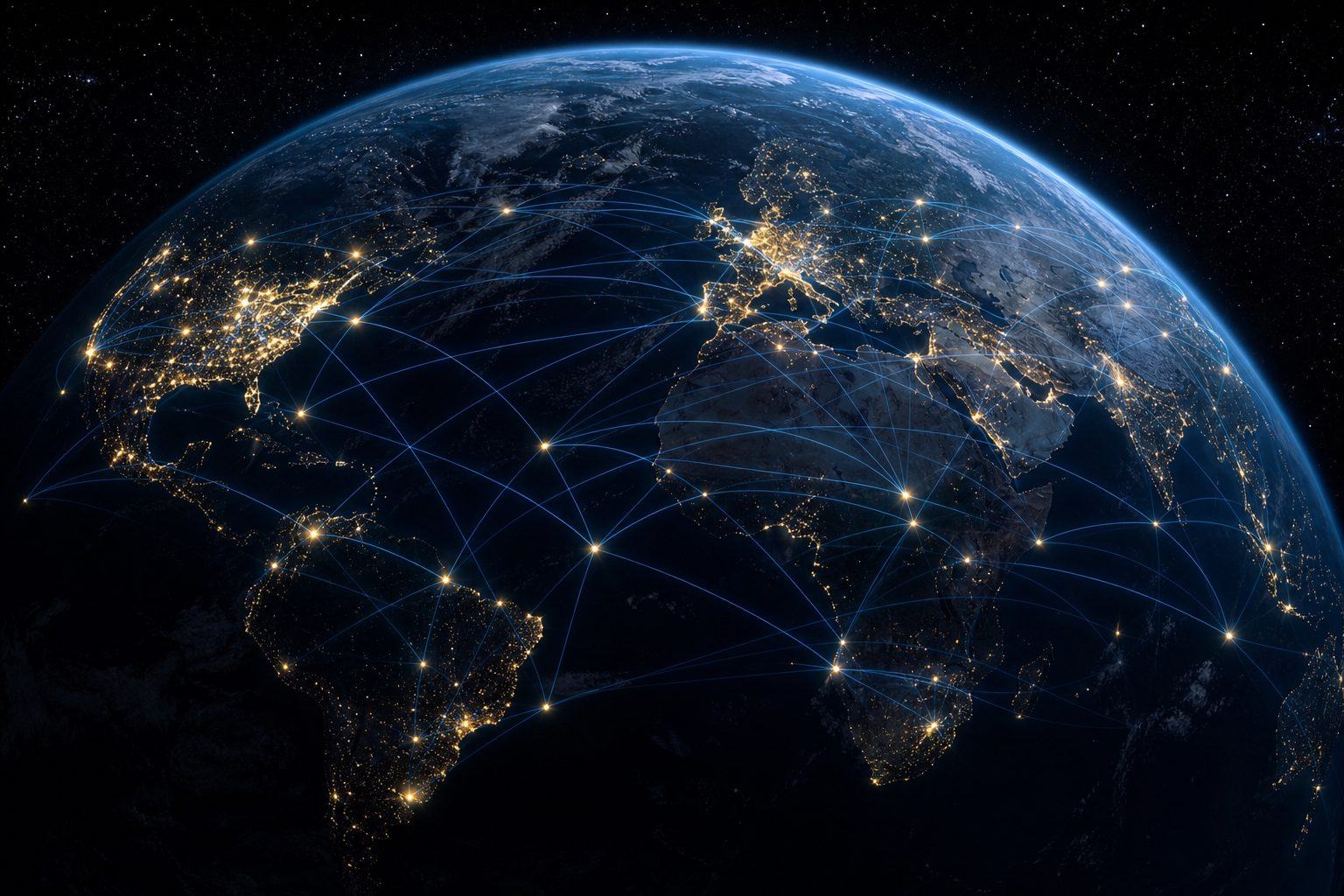
According to the analysis firm TRM, most of it went in about twenty minutes, on ten separate blockchains. There is not one blockchain but many, such as Bitcoin’s and Ethereum’s.
Yet nothing in the reports says a blockchain itself was broken. The attackers got inside the exchange.
The FBI says they were North Korean hackers, a group it calls TraderTraitor. North Korea rejects the accusation as absurd.
To see why the exchange, not the blockchain, was the weak point, we need to see how a blockchain works.
An exchange An exchange runs on servers like any bank or shop online. AI-generated illustration.
~$6.3 bn
moved out
~20 min
for most of it
10
blockchains involved
Binance, 29 October 2026 (AP, TRM)One laptop? Binance’s co-CEO said the attack “may have started” with an engineer’s compromised laptop. AI-generated illustration.
…absurd rhetoric and nothing new.Kim Yo Jong, sister of North Korea’s leader, reported by AFP
KCNA, 3 November 2026
Prologue
The news
AP (29 October 2026): Binance said “approximately $6.3 billion was impacted”; the blockchain analysis firm TRM said the attacker moved about $6.36 billion out of Binance wallets on ten blockchains, most of it in about 20 minutes, and attributed the attack “with high confidence” to TraderTraitor. ITPro: co-CEO Richard Teng said the incident “may have started with a compromised DevOps engineer’s laptop”, that “the attacker did not simply use one engineer’s permissions”, and Binance later reported “additional points of breach”. AP via PBS (1 November): the FBI tied the theft to TraderTraitor; President Trump said, “We don’t know if it’s North Korea.” TechRadar: the FBI dated the theft “on or about October 29, 2026”.
North Korea’s response (AFP via Arab News, 3 November 2026): Kim Yo Jong, in a statement carried by the state agency KCNA, called the FBI claim “absurd rhetoric and nothing new” and “a grave political provocation”, and said it is the government’s policy to oppose malicious acts in cyberspace.
This film explains a technology. It is not investment advice.
A ledger is simply a record of who paid whom. A bank keeps one for every account, and we trust it to keep that record honest.
Digital money has a special problem. A file can be copied, so what stops someone spending the same coin twice? This is called double-spending. A bank simply refuses the second payment.
On the thirty-first of October 2008, someone using the name Satoshi Nakamoto published a nine-page paper describing electronic cash with no middleman at all.
Its answer is a ledger that many computers keep together, built so that changing the past is extremely hard: a blockchain.
A ledger Before computers, ledgers were written in ink, page by page. AI-generated illustration.A perfect copy A digital coin is only data, and data copies without loss. AI-generated illustration.The middleman In the scene, the bright hub in the middle is the one trusted keeper. AI-generated illustration.
31 Oct 2008
published under the pseudonym “Satoshi Nakamoto”
9
pages
The Bitcoin paper
shared: many copies, no single keeper
linked: each block points to the one before
hard to rewrite: changing the past shows
A blockchain is
Chapter I · A shared notebook
Ledgers and double-spending
NIST IR 8202: blockchains are “distributed digital ledgers of cryptographically signed transactions that are grouped into blocks”. The Bitcoin paper describes the double-spending problem: “the payee can’t verify that one of the owners did not double-spend the coin”; “A common solution is to introduce a trusted central authority, or mint”; it proposes “a purely peer-to-peer version of electronic cash” instead. HISTORY.com: the nine-page paper was released on 31 October 2008. NIST: it was published pseudonymously, and the Bitcoin network began in 2009.
The 3D scenes are simplified teaching models. The fingerprints, mining and signatures in them are real computations run in your browser, but at toy sizes and with made-up payments.
The first tool is a cryptographic hash function. It turns any data, a word or a whole library, into a short code of fixed length: a digital fingerprint.
Bitcoin uses one called SHA-256. Its fingerprint is sixty-four characters of hexadecimal: the digits zero to nine, then a to f.
Change a single character of the input, and the whole fingerprint changes. Try the buttons.
And it only works one way. Nobody can work back from the fingerprint to the data, or find two inputs with the same fingerprint.
In: anything. Out: 64 characters. However long the input, the output is always the same length. AI-generated illustration.
256
bits in every output
64
hexadecimal characters, 4 bits each
SHA-256 (NIST)
1 bit
changed in the input gives a completely different output
NIST IR 8202
no way back from fingerprint to data
no two inputs with the same fingerprint
a tiny change gives a totally new fingerprint
A good hash (NIST, in plain words)Unique enough Like a fingerprint, the code identifies the data without containing it. AI-generated illustration.
Chapter II · Digital fingerprints
Hash functions
NIST: “A hash algorithm is used to map a message of arbitrary length to a fixed-length message digest”; approved hash functions are expected to be collision resistant (no two inputs with the same output can be found), preimage resistant (no input can be found for a given output) and second-preimage resistant. SHA-256 was specified in FIPS 180-2, published in August 2002 (now FIPS 180-4). NIST IR 8202: “Even the smallest change to the input (e.g., changing a single bit) will result in a completely different output digest.” The Bitcoin paper uses SHA-256.
The fingerprints in the scene are real SHA-256 values of the text shown, computed in your browser.
The 3D scenes are simplified teaching models. The fingerprints, mining and signatures in them are real computations run in your browser, but at toy sizes and with made-up payments.
Now group payments into blocks. Each new block stores the fingerprint of the block before it, so the blocks form a chain.
Suppose someone edits an old payment in block two, from five coins to fifty. Its fingerprint changes, and no longer matches the one stored in block three. The link breaks.
To hide it, they must rewrite every later block, and every later fingerprint changes too. The edit shows.
That makes a blockchain tamper-evident, an idea built on research into time-stamping documents from 1991.
Linked Each block points back to the one before, all the way to the first. AI-generated illustration.
block 3
stores the fingerprint of block 2
The link
the payments
the previous block’s fingerprint
its own fingerprint, from all of the above
Inside each block (schematic)
1 edit
in block 2
4 new hashes
blocks 2 to 5 all change
In the scene
1991 Haber and Stornetta: how to time-stamp a digital document
2008 the Bitcoin paper cites it
2009 the Bitcoin network begins
Chained records
Chapter II · Digital fingerprints
Chaining blocks
NIST IR 8202: each block header except the first “contains a cryptographic link to the previous block’s header”; if a published block is changed its hash changes, and so do the hashes of all later blocks, which makes blockchains “tamper evident and tamper resistant”. The Bitcoin paper’s reference list includes S. Haber and W. S. Stornetta, “How to time-stamp a digital document” (1991).
Try Tamper, then Fix the links, in the scene.
The 3D scenes are simplified teaching models. The fingerprints, mining and signatures in them are real computations run in your browser, but at toy sizes and with made-up payments.
The second tool is a pair of keys: a private key you keep secret, and a public key you share. The public one cannot reveal the private one.
To spend coins, you sign the payment with your private key. Anyone can check the signature with your public key, without seeing your secret.
Sign with the wrong key, or change the payment after signing, and the check fails. Try the buttons.
So coins belong to whoever holds the private key. There is no bank to call and no password reset. Lose the key, and the coins are gone for good.
Let someone steal it, or take over a system that holds it, and they can move the coins as if they were you.
Key and seal A digital signature does the job of a wax seal, but cannot be copied onto another letter. AI-generated illustration.
private key: kept secret, used to sign
public key: shared openly, used to verify
address: a hash of the public key
Two keys (ACM, NIST)
64 bytes
an ECDSA P-256 signature, new for every payment signed
In the sceneGone A lost private key cannot be regenerated: it is computationally infeasible. AI-generated illustration.
If you lose your private key, you permanently lose access to the crypto assets in your wallet.Office of Investor Education and Assistance
US SEC investor bulletin, Dec 2025
Chapter III · A pair of keys
Keys and signatures
ACM (2015 A.M. Turing Award, announced March 2016): Whitfield Diffie and Martin Hellman’s 1976 paper “New Directions in Cryptography” introduced public-key cryptography and digital signatures; the two keys are mathematically linked, but deriving the private key from the public key is computationally impractical, and any change to a signed message breaks the signature. NIST IR 8202: private keys sign transactions and public keys verify them; addresses are “derived from the blockchain network user’s public key using a cryptographic hash function”; “If a user loses a private key, then any digital asset associated with that key is lost”; a transaction of stolen funds “generally cannot be undone”. US SEC (December 2025): “If you lose your private key, you permanently lose access to the crypto assets in your wallet.”
The scene signs with ECDSA on the P-256 curve, built into your browser; Bitcoin and Ethereum use a different curve, secp256k1. Try Sign with another key and Edit after signing yourself.
This film explains a technology. It is not investment advice.
The 3D scenes are simplified teaching models. The fingerprints, mining and signatures in them are real computations run in your browser, but at toy sizes and with made-up payments.
So who keeps the ledger? Nobody in particular. Computers called nodes each keep a copy, and pass new payments to one another directly, peer to peer.
Each node checks the signature, and checks that the coins have not already been spent.
But messages arrive in different orders. Two payments of the same coins can split the network. It needs a way to agree on one history.
No centre In the scene, each node links to a few neighbours and passes every message on. AI-generated illustration.Identical copies Nodes accept a block only if every payment in it is valid and not already spent. AI-generated illustration.
amber
nodes that heard payment A first
violet
nodes that heard payment B first
In the scene
Chapter IV · Agreeing on one history
A peer-to-peer network
The Bitcoin paper: “New transactions are broadcast to all nodes”; nodes accept a block “only if all transactions in it are valid and not already spent”; and the network needs “a system for participants to agree on a single history of the order in which they were received”. NIST IR 8202: during a ledger conflict, “some cryptocurrency may both be spent and unspent, depending on which version of the blockchain is being viewed”; consensus models resolve which version is accepted.
Try Send, then Double-spend, then New block.
The 3D scenes are simplified teaching models. The fingerprints, mining and signatures in them are real computations run in your browser, but at toy sizes and with made-up payments.
Bitcoin’s answer is proof of work. To add the next block, a computer must find a number, called a nonce, that gives the block a fingerprint starting with enough zeros.
There is no shortcut: guess, hash, guess again. That is mining. Here, each extra zero makes it about sixteen times longer.
Whoever finds a valid block first adds the next page to the ledger, and anyone can check it with a single hash. The winning miner is paid in new coins.
Bitcoin adjusts the difficulty every two thousand and sixteen blocks, so that a block appears about every ten minutes.
That settles the argument: nodes follow the chain with the most work behind it, so our cheater from block two would have to redo all of that work.
A lottery of guesses Each guess is like one roll; only a rare result wins the block. AI-generated illustration.SHA-256(block∥nonce)<target
nonce
the number the miner keeps changing
target
lower target = more leading zeros = harder
The puzzle
2,016
blocks between difficulty changes
~10 min
target time per block
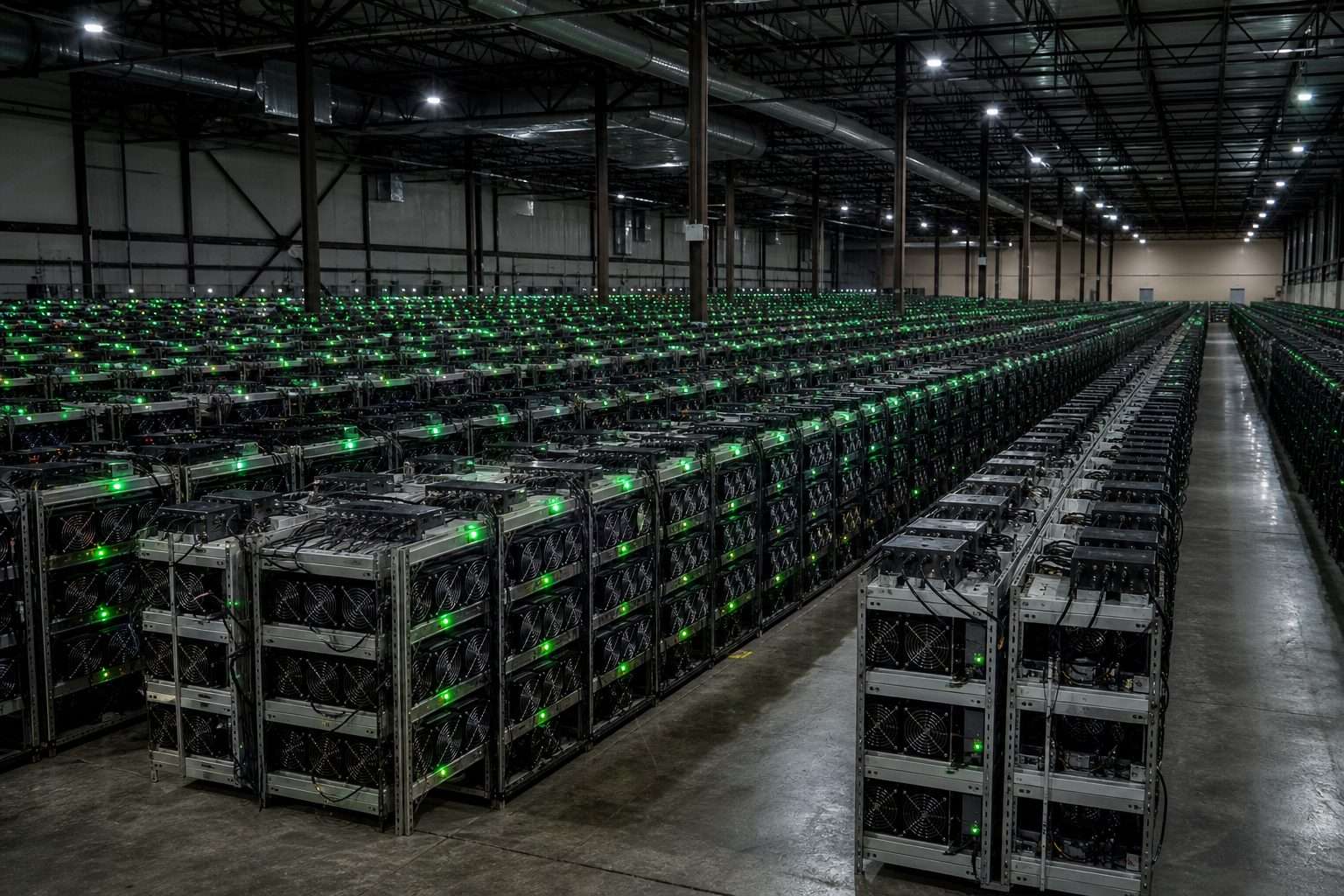
Bitcoin (NIST, Nakamoto)Work piled up Mining machines do one job: compute hashes, over and over. AI-generated illustration.
Chapter IV · Agreeing on one history
Proof of work
The Bitcoin paper: proof of work means “scanning for a value that when hashed, such as with SHA-256, the hash begins with a number of zero bits”, by “incrementing a nonce in the block until a value is found”; “The majority decision is represented by the longest chain, which has the greatest proof-of-work effort invested in it”; “By convention, the first transaction in a block is a special transaction that starts a new coin owned by the creator of the block.” NIST IR 8202: Bitcoin “adjusts the puzzle difficulty every 2016 blocks to influence the block publication rate to be around once every ten minutes”.
In the scene each zero is one hexadecimal digit, four zero bits, so each extra zero means about 16 times as many guesses. Real Bitcoin difficulty is vastly higher.
The 3D scenes are simplified teaching models. The fingerprints, mining and signatures in them are real computations run in your browser, but at toy sizes and with made-up payments.
To rewrite a payment, an attacker must redo its block and every block after it, then overtake the honest network.
With less than half the computing power, their chance of catching up falls exponentially with every block they are behind. Try changing the attacker’s share.
That is why blockchain payments are, in practice, irreversible. Only someone with more than half the power could rewrite recent history: a fifty-one percent attack.
The other main approach is proof of stake. Validators lock up coins as a deposit; the more they stake, the likelier they are to be picked to add a block, and cheaters lose part of their deposit.
Ethereum switched to it in September 2022, cutting its energy use by an estimated ninety-nine point nine five percent.
A fork The branch with more work grows longer and is kept; the other is abandoned. AI-generated illustration.qz=(pq)z(p>q)
q
attacker’s share of computing power
p
everyone else’s share, 1 − q
z
blocks the attacker is behind
Nakamoto, 2008, section 11
0.0002%
with 10% of the power
0.6%
with 30%
30%
with 45%
From 6 blocks behind, simple formula (q/p)^z, not the paper’s tableA deposit at risk In proof of stake the cost of cheating is coins put at risk, not electricity. AI-generated illustration.
15 Sep 2022
Ethereum moves to proof of stake
~99.95%
less energy, estimated
The Merge (ethereum.org)
Chapter IV · Agreeing on one history
Irreversible, in practice
The Bitcoin paper: “Nodes always consider the longest chain to be the correct one”; for an attacker with less of the power, “the probability drops exponentially as the number of blocks the attacker has to catch up with increases”; section 11 gives the simple gambler’s-ruin form q_z = (q/p)^z, and a fuller calculation in its tables (for q = 0.1 and z = 6 the table gives about 0.024%). The introduction: “Transactions that are computationally impractical to reverse would protect sellers from fraud.” NIST IR 8202: in proof of stake, “the likelihood of a blockchain network user publishing a new block is tied to the ratio of their stake” to all the stake in the network; both proof of work and proof of stake carry the potential for a “51% attack”. ethereum.org: “The Merge was executed on September 15, 2022”, replacing mining with staking validators and cutting energy use by an estimated 99.95%; validators that break the rules are penalised (“slashing”).
The percentages on the card are worked out from the simple formula with z = 6. The race in the scene is a toy model: each tick, the attacker finds the next block with chance q.
This film explains a technology. It is not investment advice.
The 3D scenes are simplified teaching models. The fingerprints, mining and signatures in them are real computations run in your browser, but at toy sizes and with made-up payments.
Most people never touch their own keys. They buy crypto on an exchange, which holds the keys for them, as a custodian.
Coins can sit in a hot wallet, online so that withdrawals are quick, or in a cold wallet, kept offline: harder to hack, but slower to use.
An exchange holding many people’s keys is a huge target. Attackers go for the keys, and for the systems allowed to use them.
Third-party custodians manage and control access to your crypto assets’ private keys.Investor bulletin on crypto custody
US SEC, December 2025Hot and cold Online is convenient but exposed; offline is safer from hackers but can be lost, damaged or stolen. AI-generated illustration.Offline A cold wallet is often a small device kept away from any network. AI-generated illustration.The target If a custodian is hacked, shuts down or goes bankrupt, customers may lose access (SEC). AI-generated illustration.
Chapter V · Where the thefts happen
Custodians and wallets
US SEC investor bulletin (12 December 2025): “A hot wallet is a crypto wallet connected to the internet”, convenient but more exposed to cyber threats; “A cold wallet is typically a physical device that is not connected to the internet”, more secure from hacking but able to be lost, damaged or stolen. “Third-party custodians manage and control access to your crypto assets’ private keys”, and “If the third-party custodian is hacked, shuts down, or goes bankrupt, you may lose access to your crypto assets.” AP (October 2026) describes hot wallets as wallets that hold private keys and are connected to the internet.
This film explains a technology. It is not investment advice.
The 3D scenes are simplified teaching models. The fingerprints, mining and signatures in them are real computations run in your browser, but at toy sizes and with made-up payments.
The easiest way in is often through a person. In 2022, US agencies warned that TraderTraitor sends staff at crypto companies fake job offers, to get them to install malicious software.
This is social engineering: tricking people, not breaking code.
At Binance, the company says the attack may have started with the laptop of an engineer who runs its systems, and reached the system that sends out withdrawals.
So the thieves did not need to copy a key. They had the exchange’s own system send the coins. Binance says it found no evidence its keys leaked, and later found other points of breach.
The blockchains cannot reverse those payments. But every move is public, so other companies can refuse the coins. Binance says industry partners froze about three billion dollars.
The lure The 2022 advisory describes fake recruiting messages that lead to “trading” or “price prediction” apps carrying malware. AI-generated illustration.
Apr 2022 FBI, CISA and Treasury advisory
Feb 2025 Bybit exchange, about $1.5 billion (FBI)
Oct 2026 Binance, about $6.3 billion (FBI)
TraderTraitor, in US government statementsWhere it may have started Binance has not published technical details of the attack. AI-generated illustration.
entry: may have started with an engineer’s laptop
then: unauthorised withdrawals sent from inside
“not a single one-click action”; more breach points found
about $3 billion frozen by industry partners
Binance’s account so farIn public view The FBI has asked exchanges to block transactions from the thieves’ addresses. AI-generated illustration.
Chapter V · Where the thefts happen
Social engineering
CISA, FBI and US Treasury (advisory AA22-108A, 18 April 2022): TraderTraitor intrusions “begin with a large number of spearphishing messages sent to employees of cryptocurrency companies”, often in system administration or DevOps roles (the engineers who run a company’s systems); “The messages often mimic a recruitment effort and offer high-paying jobs”, to get the victim to download trojanised cryptocurrency apps. FBI (26 February 2025): North Korea was responsible for the theft of “approximately $1.5 billion USD” from Bybit. ITPro: Binance co-CEO Richard Teng said the incident “may have started with a compromised DevOps engineer’s laptop” that “gave an attacker access to a service container, where they submitted unauthorized withdrawal transactions”; “the attacker did not simply use one engineer’s permissions, and this was not a single ‘one-click’ action”; a later probe found “additional points of breach”. CSO Online: Binance found “no evidence of wallet private-key leakage”. TechCrunch: “some $3 billion has been frozen by industry partners”; security researchers said about half was frozen as the funds moved across blockchains. AP via PBS: the FBI asked exchanges and blockchain analytics firms to block transactions tied to the thieves’ addresses. Reports that the engineer was lured by a fake job offer are speculation (TechRadar).
North Korea denies the FBI’s attribution (AFP, 3 November 2026).
The 3D scenes are simplified teaching models. The fingerprints, mining and signatures in them are real computations run in your browser, but at toy sizes and with made-up payments.
Nothing reported about the record Binance theft says a blockchain’s mathematics was broken. By Binance’s account, the attackers got into the systems allowed to move the coins.
On a blockchain, whoever holds the keys, or the systems that use them, holds the money.
1976 public keys and digital signatures
1991 time-stamping digital documents
2002 SHA-256 standard
Oct 2008 the Bitcoin paper
2009 the Bitcoin network begins
Sep 2022 Ethereum moves to proof of stake
Oct 2026 Binance theft, ~$6.3 billion
Blockchains: a timeline
a hash fingerprints data; one change, a new fingerprint
a private key signs; a public key checks
the chain with the most work wins
RememberStill standing Every new block adds to the work an attacker would have to redo. AI-generated illustration.
Epilogue · Sources
Sources
Every fact in this film comes from the sources below. News figures are given with their source and date; Binance’s own account of the breach is preliminary, and the attribution of the theft is the FBI’s, which North Korea denies. The chapter stills and pictures are AI-generated illustrations and show no real people. The 3D scenes are simplified teaching models: the fingerprints, mining and signatures in them are real computations at toy sizes, with made-up payments. This film explains a technology; it is not investment advice.