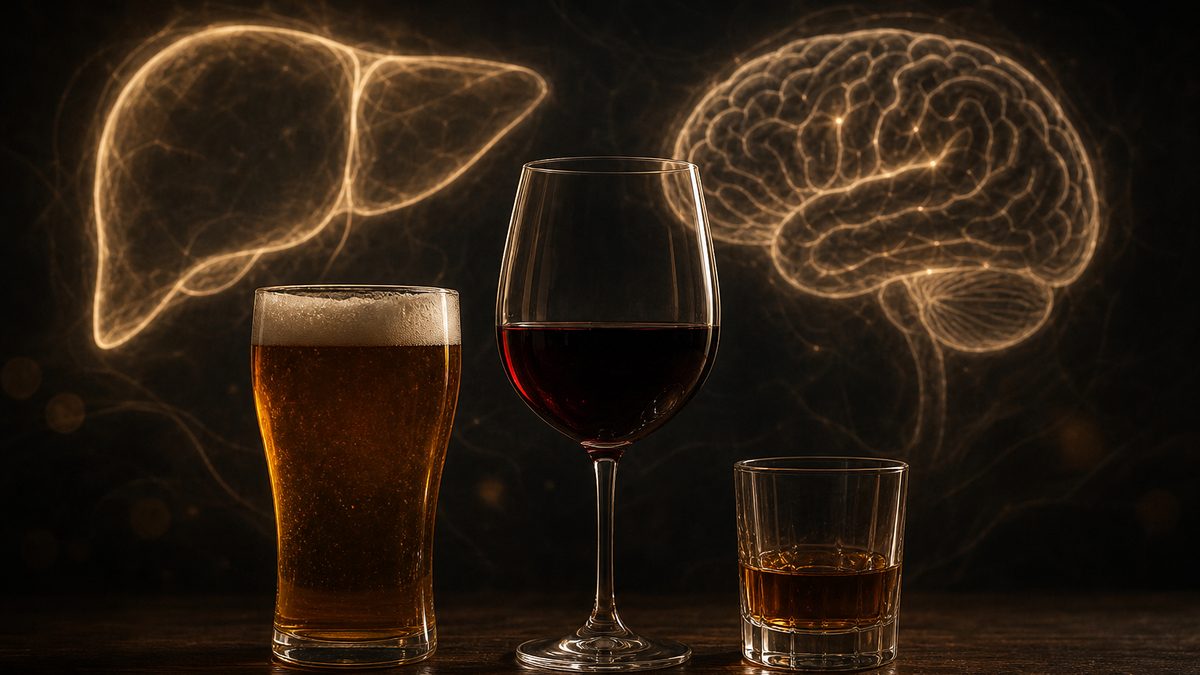
A study commissioned by the US government, reported by ScienceDaily in October 2026, reviewed more than 7,200 papers and found no overall protective effect of alcohol at any level, with a 1 in 25 lifetime risk of an alcohol-related death at 14 drinks a week. This film follows one drink through the body: what ethanol is, how it is absorbed, how the liver breaks it down with ADH and ALDH into toxic acetaldehyde and then acetate, why some people flush, how alcohol slows the brain, what it does over years to the liver, heart and pancreas, why it is a Group 1 carcinogen, and what the global figures from the World Health Organization show. It is health education, not medical advice.
Interactive 3D film10 min1988 to 2026Published 26 October 2026
A study commissioned by the United States government reviewed more than seven thousand two hundred scientific papers on alcohol and health.
Its conclusion: people who average fourteen standard drinks a week, a unit explained in a moment, face about a one in twenty-five lifetime risk of dying from alcohol-related causes.
And at no level of drinking did the researchers find an overall protective effect on health.
To see why, follow one drink through the body: what it is made of, where it goes, and what it leaves behind. This film is education, not medical advice.
7,200+
scientific publications reviewed
The Alcohol Intake and Health Study
1 in 25
lifetime risk of dying from alcohol-related causes
At 14 drinks a week
“We did not observe a significant protective effect of alcohol on health at any level of consumption.”Kevin Shield, University of Toronto, lead author
What a drink is made of
How the body breaks it down
The brain, liver, heart and more
What the risk numbers mean
In this film
Prologue
A study of 7,200 papers
ScienceDaily (25 October 2026): the Alcohol Intake and Health Study, commissioned by the US federal government to help shape dietary recommendations, reviewed more than 7,200 scientific publications. People averaging 14 drinks a week face a 1 in 25 lifetime risk of dying from alcohol-related causes, and no significant overall protective effect was seen at any level of consumption. Citation: Sinead George et al., Journal of Studies on Alcohol and Drugs, 2026; 87(4): 621.
The 3D scene is a teaching model: the body, organs, molecules and nerve signals are drawn schematically and not to scale. This film is health education, not medical advice.
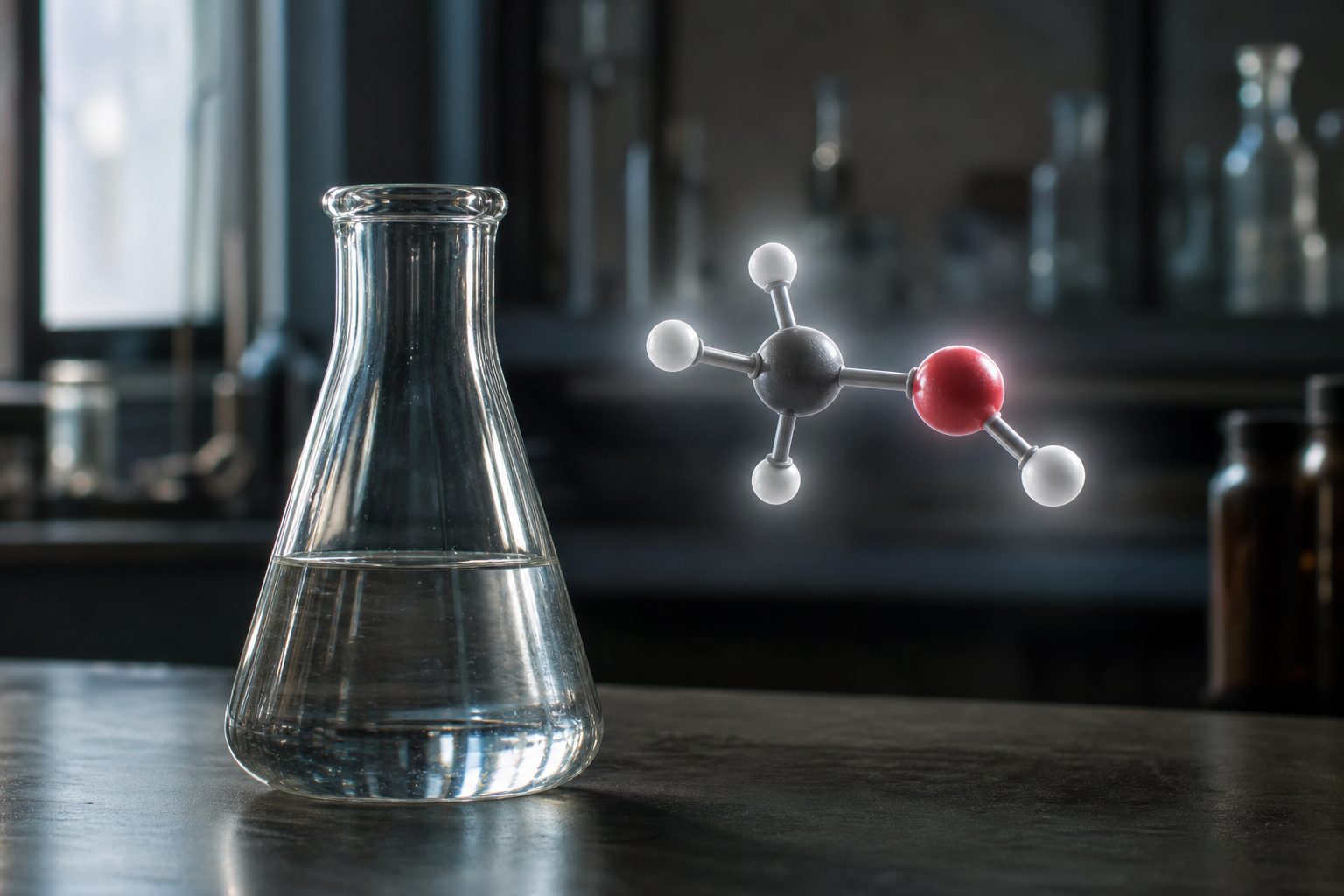
The alcohol in beer, wine and spirits is one molecule: ethanol. Two carbon atoms, six hydrogen atoms and one oxygen atom.
It is small, and it slips through cell membranes on its own, so it spreads through all the water in the body and reaches almost every tissue.
Drinks are compared in standard drinks. In the United States, one standard drink holds about fourteen grams of pure alcohol.
That is about three hundred and fifty millilitres of beer at five percent, a hundred and fifty of wine at twelve percent, or forty-five of spirits at forty percent.
CH3CH2OH
C
carbon, 2 atoms
H
hydrogen, 6 atoms
O
oxygen, 1 atom
EthanolA small molecule Clear liquid and a ball-and-stick model. AI-generated still.
14 g
pure alcohol, about 0.6 fl oz
One US standard drink
Beer, 5%
355 ml
Wine, 12%
148 ml
Spirits, 40%
44 ml
Same alcohol, different volumes
Chapter I · The journey
Ethanol and the standard drink
NIAAA: a US standard drink contains about 14 grams (0.6 fl oz) of pure alcohol: 12 fl oz of beer at about 5%, 5 fl oz of wine at about 12%, or 1.5 fl oz of distilled spirits at about 40% (here converted to about 355, 148 and 44 ml). Ethanol crosses membranes passively and distributes in proportion to total body water (Wikipedia, pharmacology of ethanol). This film uses the US definition (14 g); other countries define a standard drink differently.
Try it: Beer, Wine and Spirits show how much of each drink holds the same 14 grams of alcohol.
The 3D scene is a teaching model: the body, organs, molecules and nerve signals are drawn schematically and not to scale. This film is health education, not medical advice.
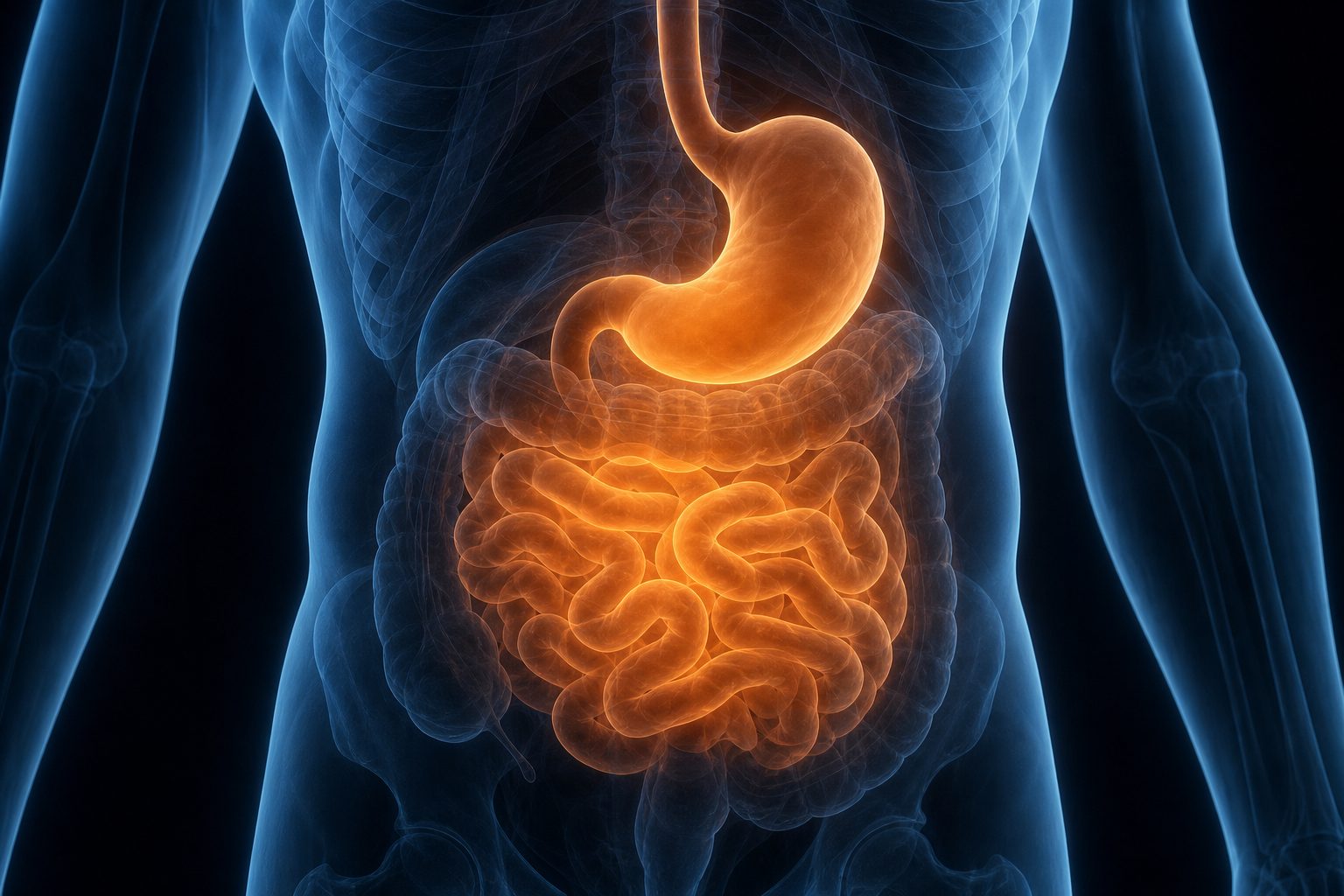
Once swallowed, about a fifth of the alcohol is absorbed through the wall of the stomach. The rest passes on to the small intestine, where absorption is faster.
Food in the stomach keeps the valve to the intestine, the pylorus, closed for longer, so the alcohol arrives more slowly.
From the gut, the alcohol enters the blood. The level in the blood usually peaks thirty to ninety minutes after drinking, sooner on an empty stomach.
The blood carries it everywhere: to the brain, the heart and every other organ.
~20%
stomach
~80%
small intestine, faster
Where alcohol is absorbedThe digestive tract Stomach and small intestine, schematic. AI-generated still.
30–90 min
after drinking; about 30 min on an empty stomach
Peak in the blood
the brain
the heart
the liver
every other tissue
Carried by the blood to
Chapter I · The journey
Absorption
California ABC: about 20% of alcohol enters the bloodstream through the stomach and the remaining 80% through the small intestine, where absorption is faster; food keeps the pyloric valve closed and slows intoxication. Wikipedia (pharmacology of ethanol): peak concentrations typically occur 30–90 minutes after drinking, faster (about 30 minutes) when fasting, and food slows absorption.
The 3D scene is a teaching model: the body, organs, molecules and nerve signals are drawn schematically and not to scale. This film is health education, not medical advice.
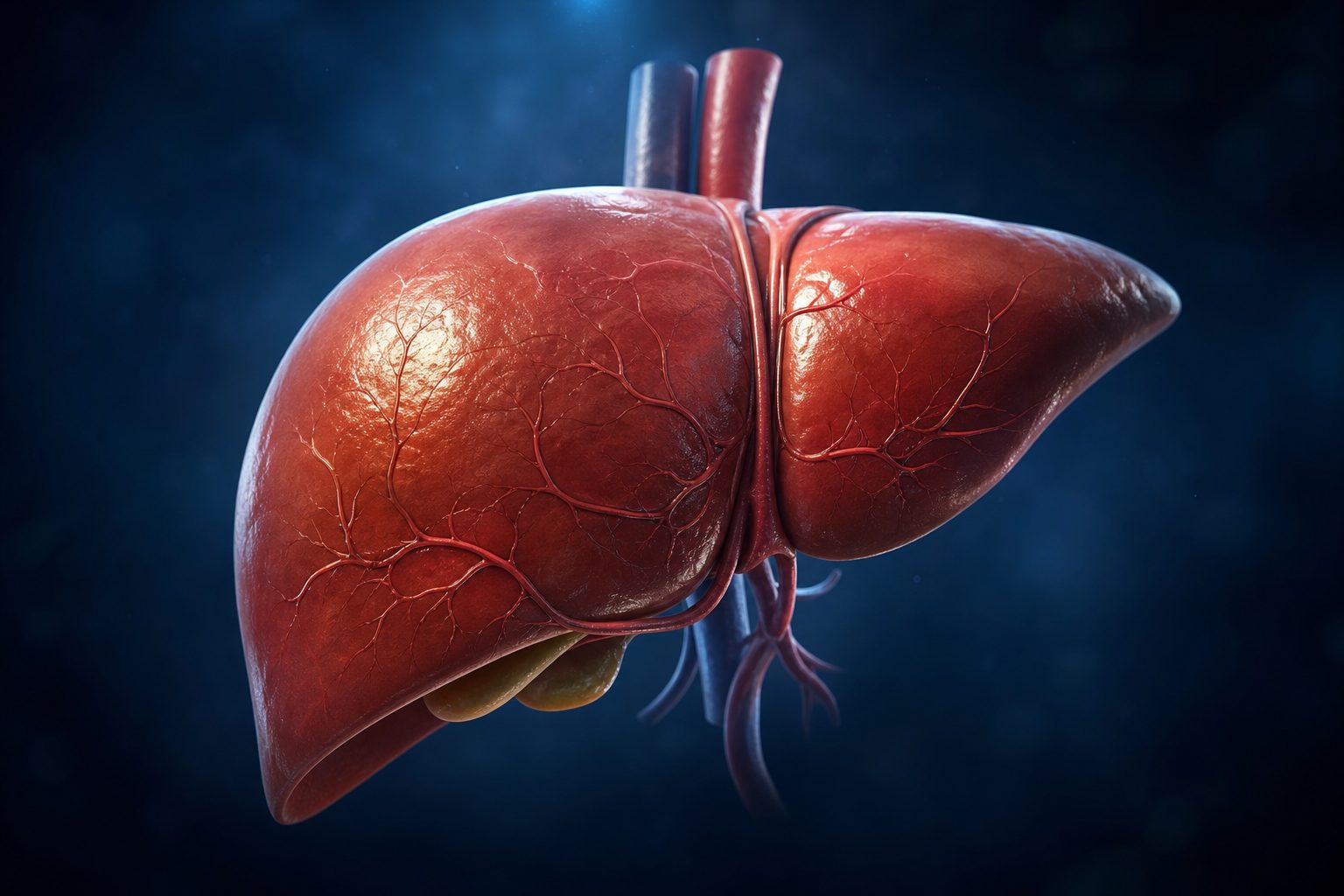
Removing alcohol falls mostly to one organ, the liver. About nine-tenths of it is broken down there.
A small share, about five to ten percent, leaves the body unchanged in the breath, urine and sweat. That is why a breath test works.
The liver works at a fairly steady pace, roughly one standard drink an hour, and it cannot be hurried. Only time clears alcohol from the blood.
While it deals with alcohol, the liver puts that job ahead of others, such as keeping blood sugar steady.
~90%
broken down in the liver
5–10%
out unchanged: breath, urine, sweat
Where alcohol goesThe liver The body’s main chemical processing plant. AI-generated still.
~1 drink/hour
roughly constant; it cannot be sped up
A fixed pace
Keeping blood sugar steady
Other routine liver work
Put on hold
Chapter I · The journey
Time is the only cure
Wikipedia (pharmacology of ethanol): about 90% of ethanol is metabolised in the liver and about 5–10% is excreted unchanged in breath, urine and sweat; at ordinary doses elimination runs at a roughly constant rate. California ABC: the liver breaks down alcohol at approximately one drink per hour, cannot speed this up, and time is the only way to remove it; while processing alcohol it puts that ahead of other functions such as maintaining blood sugar.
The 3D scene is a teaching model: the body, organs, molecules and nerve signals are drawn schematically and not to scale. This film is health education, not medical advice.
Inside liver cells, an enzyme, a protein that speeds up a chemical reaction, called alcohol dehydrogenase, or ADH, removes two hydrogen atoms from each ethanol molecule.
The result is acetaldehyde, a short-lived but highly toxic chemical.
A second enzyme, aldehyde dehydrogenase, or ALDH, turns acetaldehyde into acetate, which the body finally breaks down into carbon dioxide and water.
When someone has drunk a lot, a backup enzyme, CYP2E1, joins in and also makes acetaldehyde. A little ethanol is handled by a third enzyme, catalase.
CH3CH2OHADHCH3CHO
CH3CH2OH
ethanol
CH3CHO
acetaldehyde, toxic
Step 1: ADH
short-lived
quickly passed on to the next enzyme
carcinogen
known to cause cancer (NIAAA)
AcetaldehydeCH3CHOALDHCH3COO−→CO2+H2O
CH3COO−
acetate
CO2+H2O
carbon dioxide and water, mostly outside the liver
Step 2: ALDH
ADH: the main route
CYP2E1: after large amounts
Catalase: a small fraction
Enzymes that make acetaldehyde
Chapter II · The chemistry
Alcohol metabolism
NIAAA (alcohol metabolism): most ethanol is broken down in the liver by alcohol dehydrogenase (ADH) to acetaldehyde, a toxic compound and known carcinogen; aldehyde dehydrogenase (ALDH) then converts acetaldehyde to acetate, which is broken down into carbon dioxide and water, mainly in tissues other than the liver. CYP2E1 is active only after a person has consumed large amounts of alcohol; catalase metabolises only a small fraction.
Try it: the three buttons pick ethanol, acetaldehyde or acetate. The models show which atoms each step removes or adds.
The 3D scene is a teaching model: the body, organs, molecules and nerve signals are drawn schematically and not to scale. This film is health education, not medical advice.
Acetaldehyde is a big reason scientists worry. Breaking down alcohol, and acetaldehyde especially, can damage the liver, the brain and the gut, and acetaldehyde is a known cause of cancer.
The main ALDH enzyme is made from a gene called ALDH2. Some people carry a variant of it that makes the enzyme work poorly. In them, acetaldehyde builds up even after moderate drinking.
Their faces turn red, their hearts race and they may feel sick. About one in three people of Chinese, Japanese or Korean origin flush like this; worldwide, some five hundred and forty million people carry the weak enzyme.
In a large study of Chinese adults, men with the variant who drank every week had about three times the risk of oesophageal cancer of weekly drinkers without it.
the liver
the brain
the gut
DNA: a known cause of cancer
Alcohol’s breakdown can damage
17–38%
of normal, variant inherited from one parent
~0%
variant from both parents
ALDH2 activityThe alcohol flush Reddened cheeks and ears. AI-generated still.
×3.3
oesophageal cancer risk, variant from one parent
Male weekly drinkers, China Kadoorie Biobank
Chapter II · The chemistry
The ALDH2 variant
NIAAA: alcohol metabolism, and acetaldehyde in particular, can damage the liver, pancreas, brain and gastrointestinal tract; acetaldehyde is a known carcinogen. Yu et al. (International Journal of Cancer, 2018), China Kadoorie Biobank: the low-activity ALDH2 variant (rs671) is almost exclusive to East Asians; enzyme activity is 17–38% of normal with one copy and nearly 0% with two, so acetaldehyde accumulates even after moderate drinking, causing flushing, nausea and a fast heartbeat. Among male weekly drinkers, one copy was linked to a hazard ratio of 3.31 for oesophageal cancer; no excess was seen in people drinking less than weekly. ScienceDaily (2009), on Brooks et al. in PLoS Medicine: about one-third of East Asians show the flushing response, and about 540 million people worldwide are ALDH2-deficient.
Try it: Typical and Low-activity compare how fast acetaldehyde is cleared. The cloud of orange dots is schematic.
The 3D scene is a teaching model: the body, organs, molecules and nerve signals are drawn schematically and not to scale. This film is health education, not medical advice.
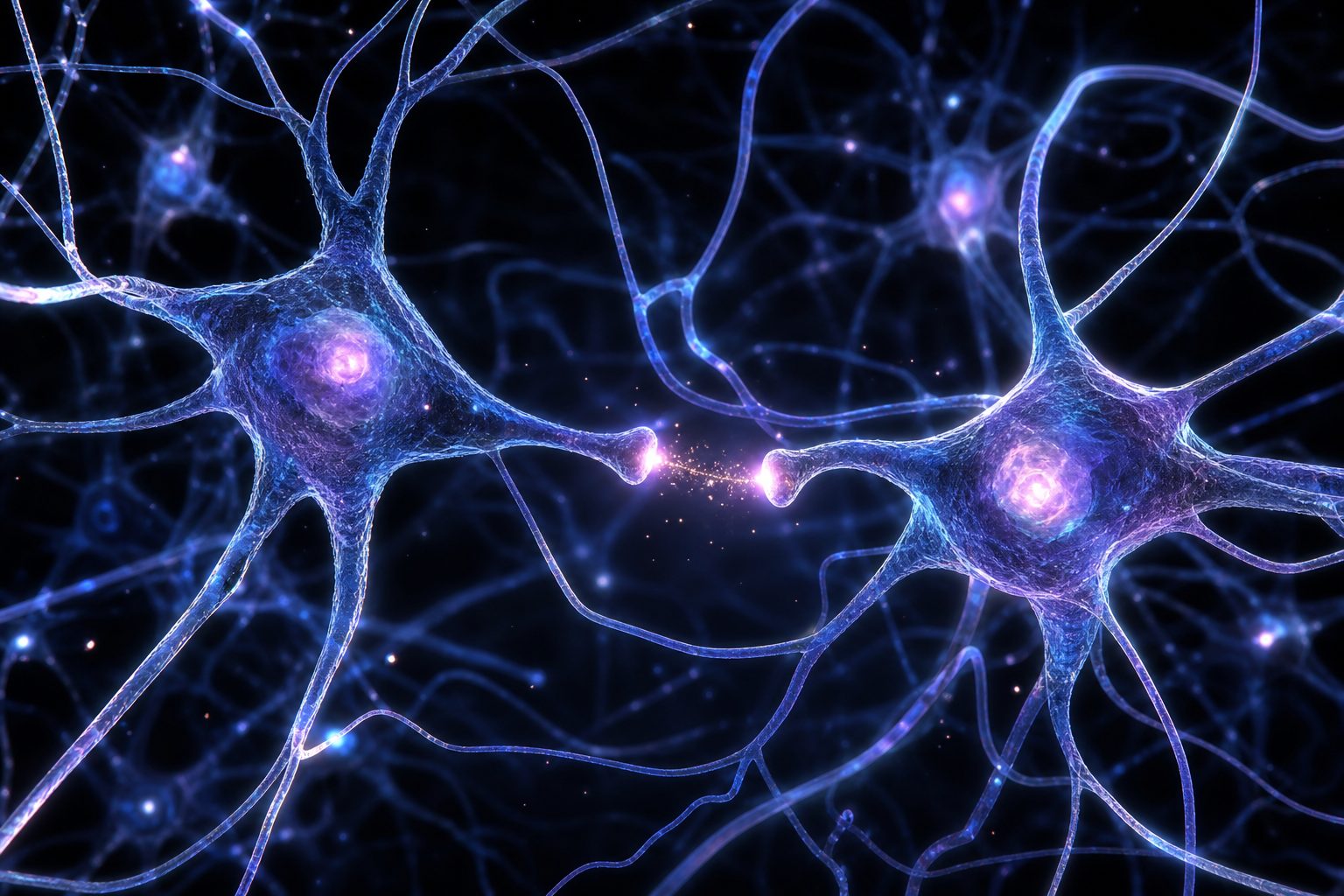
In the brain, alcohol interferes with the way nerve cells signal to each other.
It strengthens the effect of GABA, the brain's main braking signal, and it weakens signals carried by glutamate, a main accelerator.
So alcohol is a depressant, meaning it slows the brain down, not that it makes you sad: thinking slows, coordination slips and memory suffers. It also releases dopamine in the brain's reward system, part of why drinking can become a habit.
As the share of alcohol in the blood rises, the effects deepen: talkativeness at about 0.05 percent, loss of consciousness around 0.3 percent, and a risk of death beyond 0.4 percent.
Nerve cells Signals cross the gap between neurons. AI-generated still.
GABA ↑
braking signal strengthened
Glutamate ↓
accelerating signal weakened
Two signals, both changed
Slower thinking
Poorer coordination
Impaired memory
Dopamine in the reward system
A depressant
209 m
people with alcohol dependence worldwide, 2019 (WHO)
Dependence
0.05: relaxed, talkative
0.05 %
0.1: sedation, impaired
0.1 %
0.3: loss of consciousness
0.3 %
0.4+: possible death
0.4 %
Blood alcohol, % (typical effects)
Chapter III · The organs
Alcohol and the brain
NIAAA: alcohol interferes with the brain’s communication pathways, changing mood and behaviour and making it harder to think clearly and move with coordination. Wikipedia (pharmacology of ethanol): ethanol acts mainly as a positive allosteric modulator of GABA-A receptors and also inhibits glutamate (NMDA, AMPA, kainate) receptors; its depressant effects include sedation, poor coordination and impaired memory; it raises dopamine in the reward pathway. Typical effects listed: about 0.05% euphoria and talkativeness, 0.1% sedation and impaired function, 0.3% loss of consciousness, 0.4% possible alcohol poisoning or death. WHO: alcohol can cause dependence. “Brake” and “accelerator” are simplified descriptions.
Try it: Without alcohol and With alcohol show signals crossing between two nerve cells. Schematic.
The 3D scene is a teaching model: the body, organs, molecules and nerve signals are drawn schematically and not to scale. This film is health education, not medical advice.
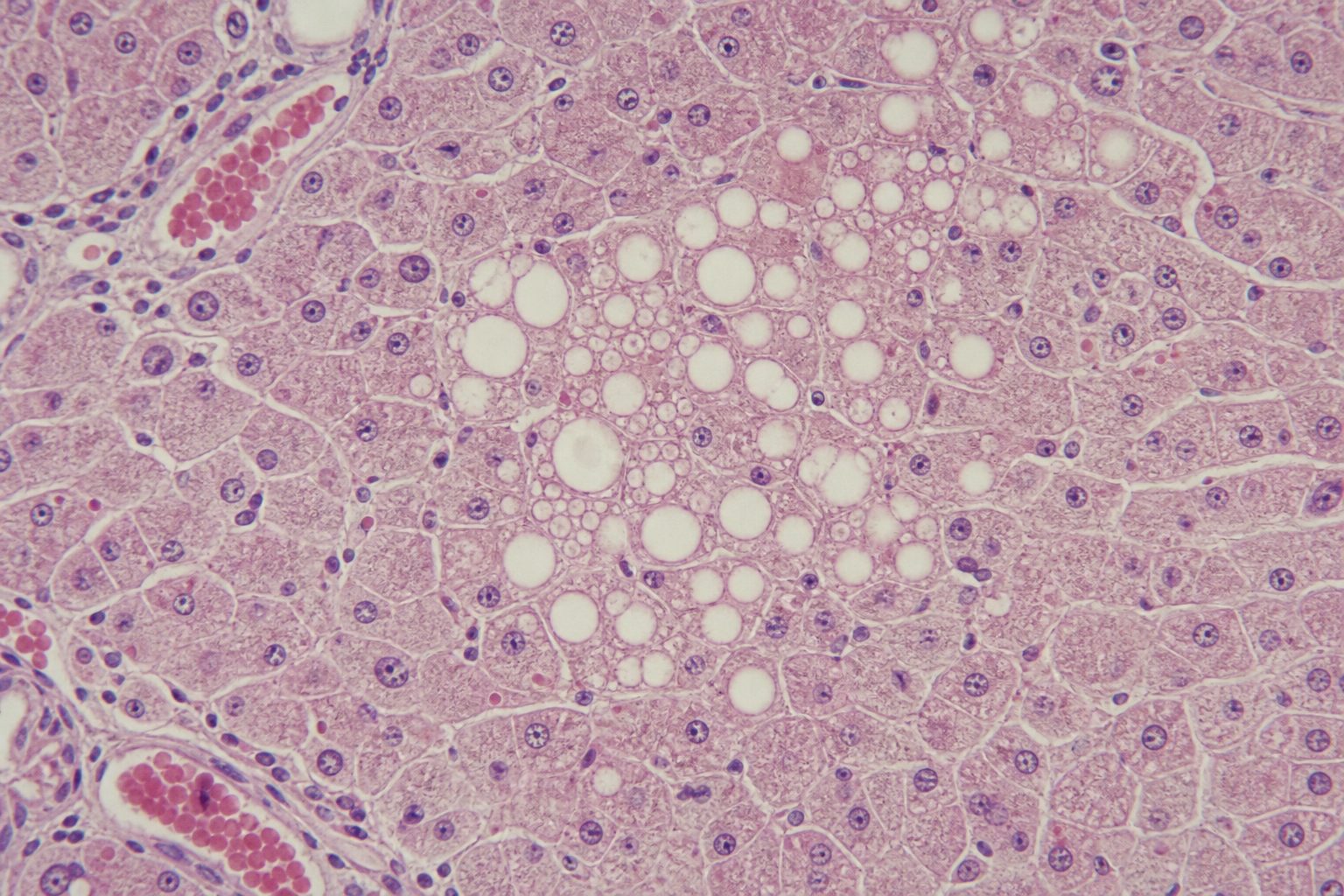
Breaking down alcohol also changes the chemistry inside liver cells, pushing them to make and store fat.
More than nine in ten heavy drinkers develop a fatty liver. It usually clears if they stop drinking.
After years of heavy drinking, some go on to alcoholic hepatitis, an inflammation of the liver not caused by a virus, and some to cirrhosis, where scar tissue replaces healthy tissue.
Cirrhosis tends to be permanent, and heavy drinking also raises the risk of liver cancer.
Fat in liver cells Pale droplets of fat inside liver cells. AI-generated still.
>90%
of heavy drinkers; usually reversible
Fatty liver
Fatty liver
90 %
Alcoholic hepatitis
25 %
Cirrhosis
15 %
Share of heavy drinkers affected (approximate)
Fatty liver: usually reversible
Hepatitis: inflammation
Cirrhosis: scarring, tends to be permanent
Three stages
Chapter III · The organs
Alcohol-associated liver disease
Wikipedia (alcoholic liver disease): breaking down alcohol raises the NADH/NAD⁺ ratio, which promotes fat synthesis and reduces fat breakdown, so fat accumulates. More than 90% of heavy drinkers develop fatty liver, which is usually reversible; about 10–35% develop alcoholic hepatitis and about 10–20% cirrhosis (the bars show the 25% and 15% figures the same article also gives). Fibrosis and cirrhosis tend to be irreversible. NIAAA: heavy drinking can cause fatty liver, hepatitis, fibrosis, cirrhosis and hepatocellular carcinoma.
Try it: Healthy, Fatty and Cirrhosis change the liver in the scene. Schematic, not a medical image.
The 3D scene is a teaching model: the body, organs, molecules and nerve signals are drawn schematically and not to scale. This film is health education, not medical advice.
The heart is affected too. Long-term heavy drinking can weaken the heart muscle, raise blood pressure and cause an irregular heartbeat.
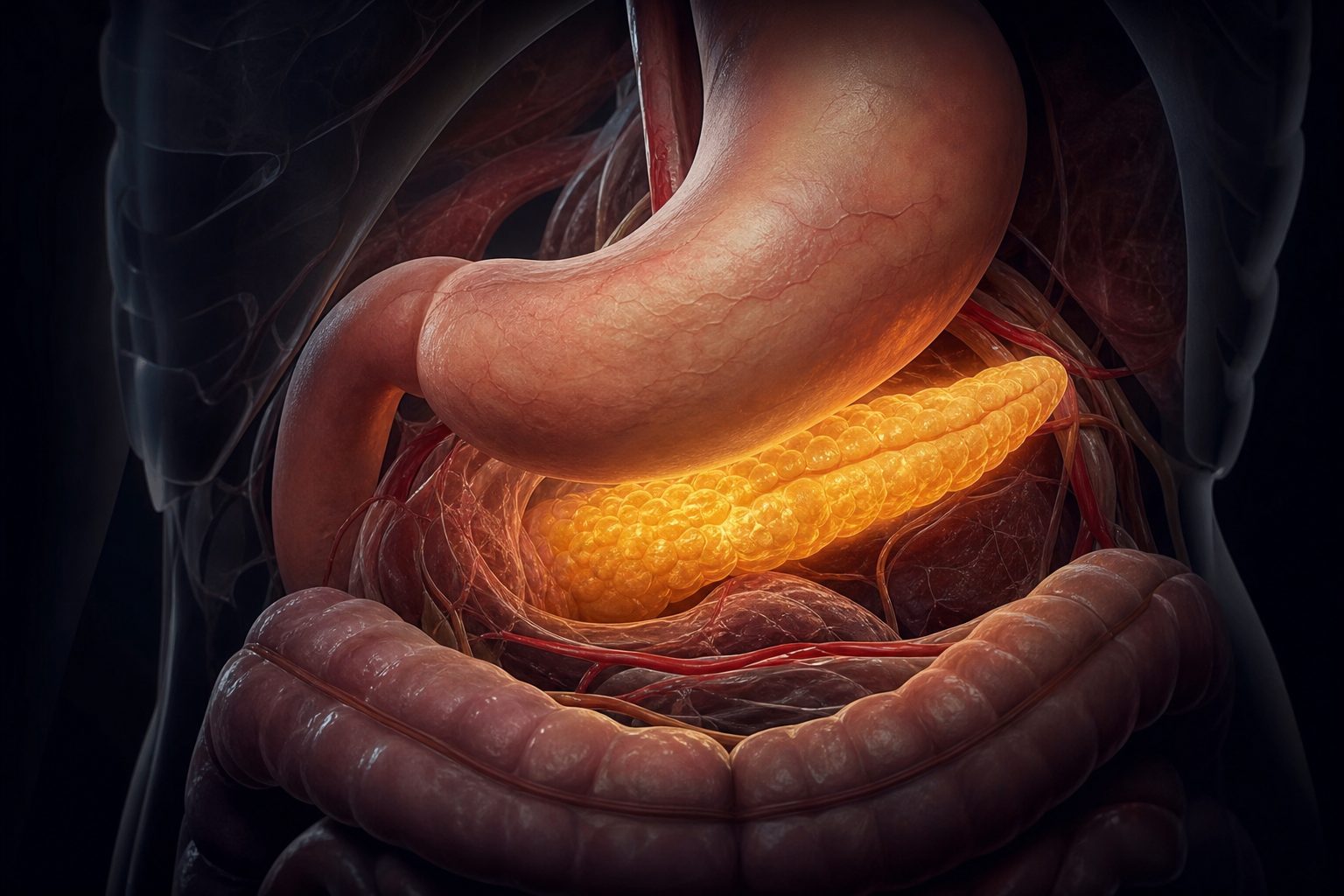
In the pancreas, which makes digestive enzymes and the hormones that control blood sugar, heavy drinking can cause an inflammation called pancreatitis.
And drinking a lot on a single occasion slows the body's defences against infection for up to a day afterwards.
Weakened muscle (cardiomyopathy)
High blood pressure
Irregular heartbeat
The heartThe pancreas It lies behind the stomach. AI-generated still.
up to 24 h
slower defences against infection
After one heavy session
Chapter III · The organs
Beyond the liver
NIAAA (alcohol’s effects on the body): long-term heavy drinking can weaken the heart muscle (cardiomyopathy); alcohol misuse can lead to high blood pressure and irregular heartbeat. Long-term misuse can cause pancreatitis, which can impair digestive enzymes and the hormones that regulate blood sugar; chronic pancreatitis is a risk factor for pancreatic cancer and diabetes. Drinking a lot on a single occasion slows the body’s ability to ward off infections, even up to 24 hours later.
The 3D scene is a teaching model: the body, organs, molecules and nerve signals are drawn schematically and not to scale. This film is health education, not medical advice.
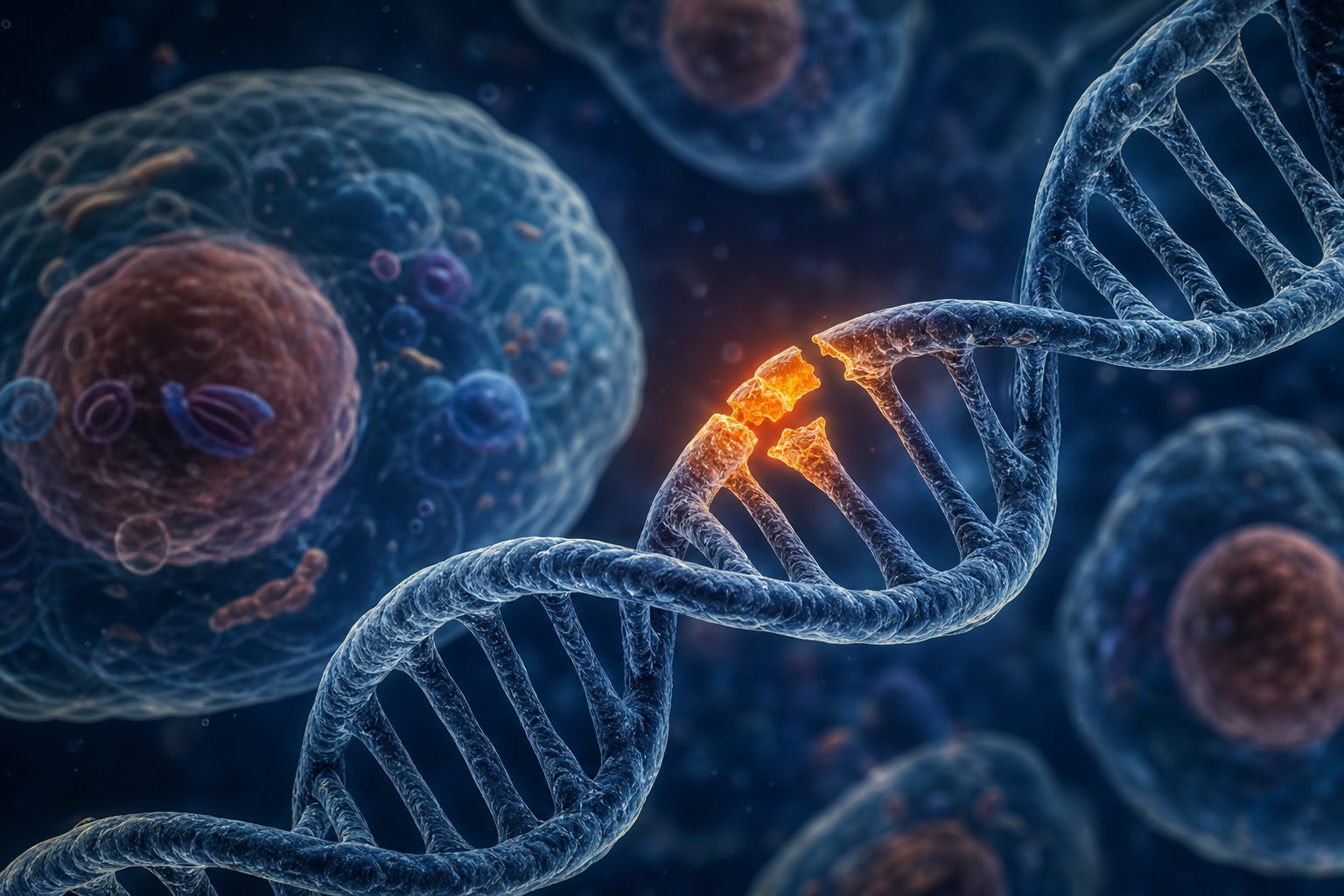
In 1988 the World Health Organization's cancer agency, IARC, placed alcoholic drinks in its top category, Group 1: known to cause cancer in humans.
Tobacco and asbestos are in the same group. The group describes how strong the evidence is, not how large the risk is.
Alcohol causes at least seven cancers: of the mouth, the throat, the voice box, the oesophagus, the bowel, the liver and the female breast.
In 2020, an estimated seven hundred and forty thousand new cancer cases worldwide were caused by alcohol, about four percent of all.
For breast cancer, the US National Institutes of Health says even one drink a day raises a woman's risk by five to fifteen percent compared with not drinking.
Group 1
carcinogenic to humans
IARC, 1988Damage to DNA Cells and a strand of DNA. AI-generated still.
Mouth · throat · voice box
Oesophagus
Bowel (colorectum)
Liver
Female breast
Seven cancer sites
~740,000
new cancer cases worldwide
4.1%
of all new cases
Caused by alcohol, 2020
+5–15%
risk at one drink a day vs none (NIAAA)
Breast cancer
Chapter IV · The risk
Alcohol and cancer
WHO Europe and IARC (2023): in 1988 alcoholic beverages were identified as a Group 1 carcinogen; alcohol is causally linked to cancers of the oral cavity, pharynx, larynx, oesophagus, colorectum, liver and female breast. In 2020 more than 740,000 new cancer cases worldwide, 4.1% of all, were estimated to be caused by alcohol. WHO Europe (2023): Group 1 also includes asbestos, radiation and tobacco. Hong Kong Centre for Food Safety: the classification is based on the strength of evidence, not on how dangerous a substance is. NIAAA: even one drink a day can raise a woman’s breast cancer risk by 5–15% compared with not drinking.
The glowing points in the scene mark the seven sites. Schematic.
The 3D scene is a teaching model: the body, organs, molecules and nerve signals are drawn schematically and not to scale. This film is health education, not medical advice.
Now, the new study, from a team including Kevin Shield at the University of Toronto.
Up to seven drinks a week was linked to only small increases in risk for most conditions. Above about one drink a day, for women and for men, the risks clearly rose.
At fourteen drinks a week, the lifetime risk of dying from alcohol-related causes reached about one in twenty-five, or four percent.
What about the heart? Light drinking may slightly lower the risk of some heart disease and stroke, but the higher risks of cancer and other diseases outweighed that, even at seven drinks a week. Overall, there was no benefit.
Like all population estimates, these numbers may not apply exactly to any one person, because genes, lifestyle and drinking patterns differ from person to person.
A review of the evidence Thousands of papers, pooled into one model. AI-generated still.
Up to 7 a week: small increases for most conditions
Above ~1 a day: risks rise, women and men
What the study found
1 in 25
at an average of 14 drinks a week
4%
like one pupil in a class of 25
Lifetime risk of an alcohol-related death
Ischaemic heart disease, stroke: possibly lower
Cancers, liver disease, injuries: higher
Net effect on health: no protection
Weighing it up, at 7 drinks a week
“Even low levels of alcohol use come with health risks.”Kevin Shield
Chapter IV · The risk
The Alcohol Intake and Health Study
ScienceDaily (25 October 2026) and The ASCO Post (9 June 2026): experts reviewed more than 7,200 articles and applied the risk estimates to national health data. Up to 7 drinks a week was linked to minimally elevated risks for most conditions; risks rise above one drink a day for both men and women; at 14 drinks a week the lifetime risk of alcohol-related death is 1 in 25. Low levels may be associated with reduced risk of ischaemic heart disease and stroke, but these were outweighed by risks from cancer and other diseases, even at 7 drinks a week. The ASCO Post notes that population-level estimates may not apply to individuals. Conditions assessed include oesophageal, oral and breast cancer, cardiovascular disease, liver disease and injuries.
In the scene, one figure in twenty-five is lit: the lifetime risk at 14 drinks a week. Schematic.
The 3D scene is a teaching model: the body, organs, molecules and nerve signals are drawn schematically and not to scale. This film is health education, not medical advice.
Worldwide, the World Health Organization estimates that alcohol was linked to about two point six million deaths in 2019, about two million of them men.
Among people aged twenty to thirty-nine, about thirteen in every hundred deaths were linked to alcohol, the highest share of any age group.
An estimated four hundred million people had an alcohol use disorder. The WHO describes ethanol as a toxic, psychoactive substance that can cause dependence.
Its European office puts it plainly: there is no safe amount that does not affect health, and the less you drink, the safer it is.
Noncommunicable diseases
1.6 million
Injuries
0.7 million
Communicable diseases
0.3 million
Alcohol-linked deaths, 2019
13%
of deaths linked to alcohol
Ages 20–39
400 m
people aged 15+, about 7%
209 m
with alcohol dependence
Alcohol use disorders, 2019
“The less you drink, the safer it is.”Carina Ferreira-Borges, WHO Europe
Chapter IV · The risk
Alcohol worldwide
WHO fact sheet (28 June 2024): in 2019 an estimated 2.6 million deaths were caused by alcohol consumption (about 2 million men and 600,000 women): 1.6 million from noncommunicable diseases, 700,000 from injuries and 300,000 from communicable diseases. The highest proportion of alcohol-attributable deaths, 13%, was among people aged 20–39. An estimated 400 million people aged 15 and older (about 7%) had alcohol use disorders and 209 million alcohol dependence. WHO describes ethanol as a toxic and psychoactive substance with dependence-producing properties. WHO Europe (2023): “there is no safe amount that does not affect health”; Dr Carina Ferreira-Borges: “the less you drink, the safer it is”.
In the scene, 13 of 100 figures are lit: the share of deaths at ages 20–39 linked to alcohol. Schematic.
The 3D scene is a teaching model: the body, organs, molecules and nerve signals are drawn schematically and not to scale. This film is health education, not medical advice.
The ethanol in one drink enters the blood, becomes acetaldehyde in the liver, and ends as carbon dioxide and water.
Along the way it reaches almost every organ. One of the study's authors, Timothy Naimi, says the newest US dietary guidelines carry a useful less-is-best message, but no numbers to go with it.
Anyone with questions about their own drinking can ask a doctor or a health service.
Gut Ethanol absorbed into the blood
Liver ADH: ethanol → acetaldehyde
Liver ALDH: acetaldehyde → acetate
Body Acetate → carbon dioxide and water
One drink, start to finish
“While the new U.S. Dietary Guidelines contain a useful ‘less-is-best’ message, they provide no quantitative framework.”Timothy Naimi, University of Victoria
This film is education, not medical advice
Risk numbers describe populations, not one person
Remember
Epilogue · Sources
Sources
Every fact in this film comes from the sources below. The chapter stills and pictures are AI-generated illustrations. The 3D body, organs, molecules and nerve signals are schematic teaching models, not to scale. This film is health education, not medical advice.