On 19 November 1863 Abraham Lincoln spoke for about two minutes at the dedication of a cemetery for the soldiers killed at Gettysburg. This film explains how the United States came to war over slavery and secession, each side in its own words; follows the three days of the Battle of Gettysburg on a 3D map of its ridges; sets Edward Everett’s two-hour oration beside Lincoln’s 272 words; takes the speech apart into past, present and future, down to why “four score and seven years” points to 1776; compares the five copies in Lincoln’s hand; and places the address between the Emancipation Proclamation and the 13th Amendment that ended slavery.
Interactive 3D film9 min1776 to 1865Published 19 November 2026
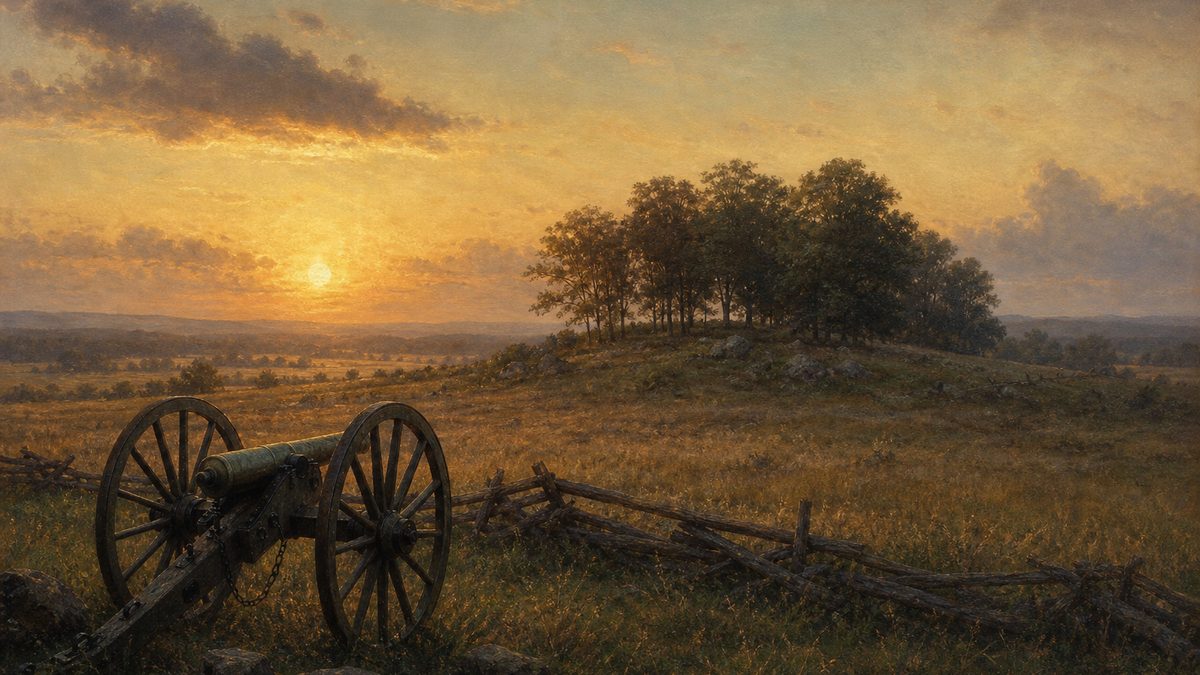
On the nineteenth of November 1863, more than ten thousand people stood on a hill outside Gettysburg, Pennsylvania.
They had come to open a cemetery for soldiers killed there four months earlier, in a great battle of the American Civil War.
The main speaker talked for about two hours. Then President Abraham Lincoln stood up and spoke for about two minutes.
On 19 November 2026, those two minutes turn 163. Here is how they came to be, and what they say.
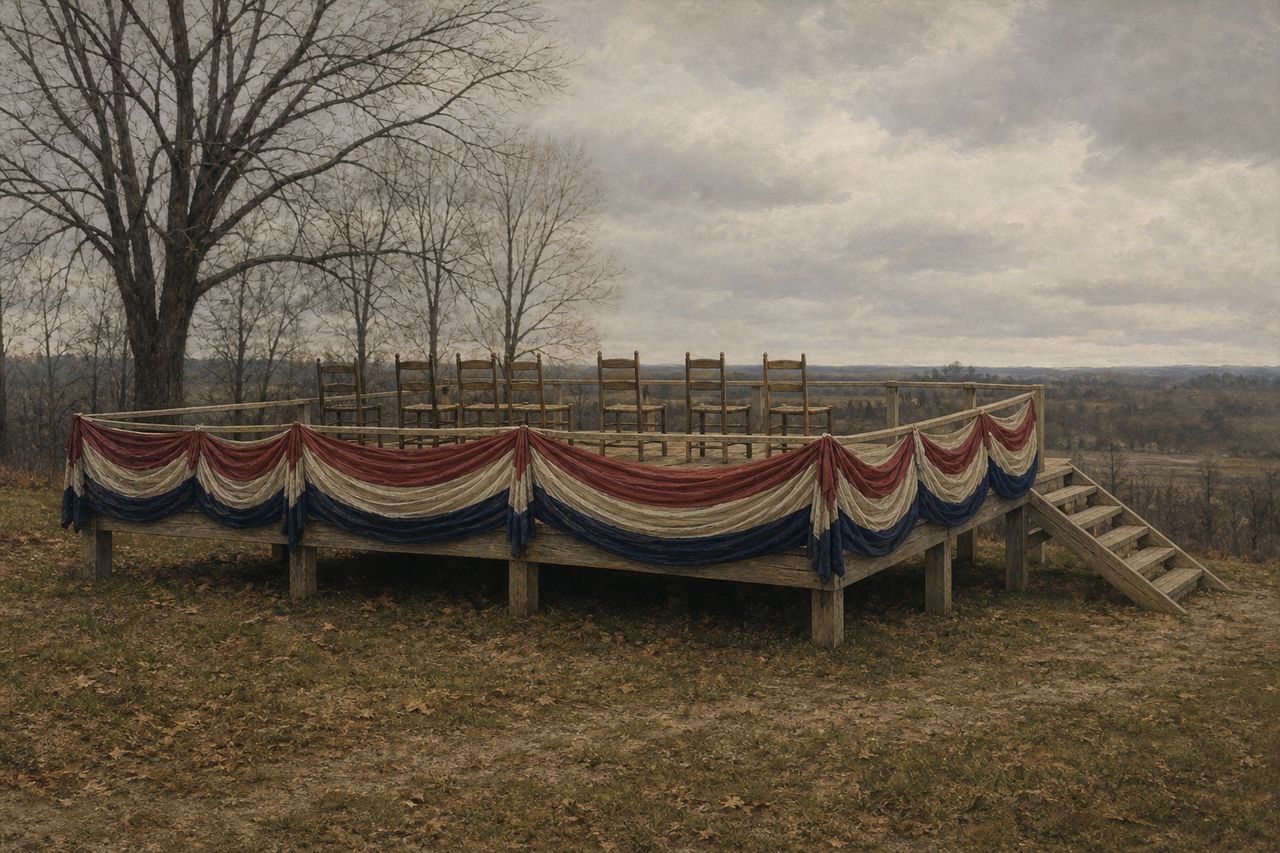
Cemetery Hill A speakers’ platform hung with bunting, of the kind built for the ceremony. AI-generated illustration.
1–3 July the Battle of Gettysburg
19 November the new cemetery is dedicated
1863
10,000+
in the crowd (National Park Service)
~2 h
Edward Everett’s oration
~2 min
Lincoln’s remarks
19 November 1863
…that government of the people, by the people, for the people, shall not perish from the earth.Abraham Lincoln, the last words of the address
Prologue
An anniversary
National Park Service: the Soldiers’ National Cemetery was dedicated on 19 November 1863 before a crowd of more than 10,000 people (the American Battlefield Trust puts it at nearly 15,000). Edward Everett gave the main oration, about two hours long; Lincoln, invited to offer “a few appropriate remarks”, spoke for about two minutes. 19 November 2026 is the 163rd anniversary.
The 3D battlefield is a simplified, schematic teaching map: heights are exaggerated and troop lines are drawn approximately, after the National Park Service and American Battlefield Trust accounts.
When the war began, the United States held more than four million people in slavery: the largest slaveholding country in the world, says the National Park Service.
The bitterest quarrel was whether slavery should spread into the new western territories.
That November Abraham Lincoln won the presidency. His Republican Party opposed the spread of slavery into those territories.
4 million+
people enslaved when the war began (National Park Service)
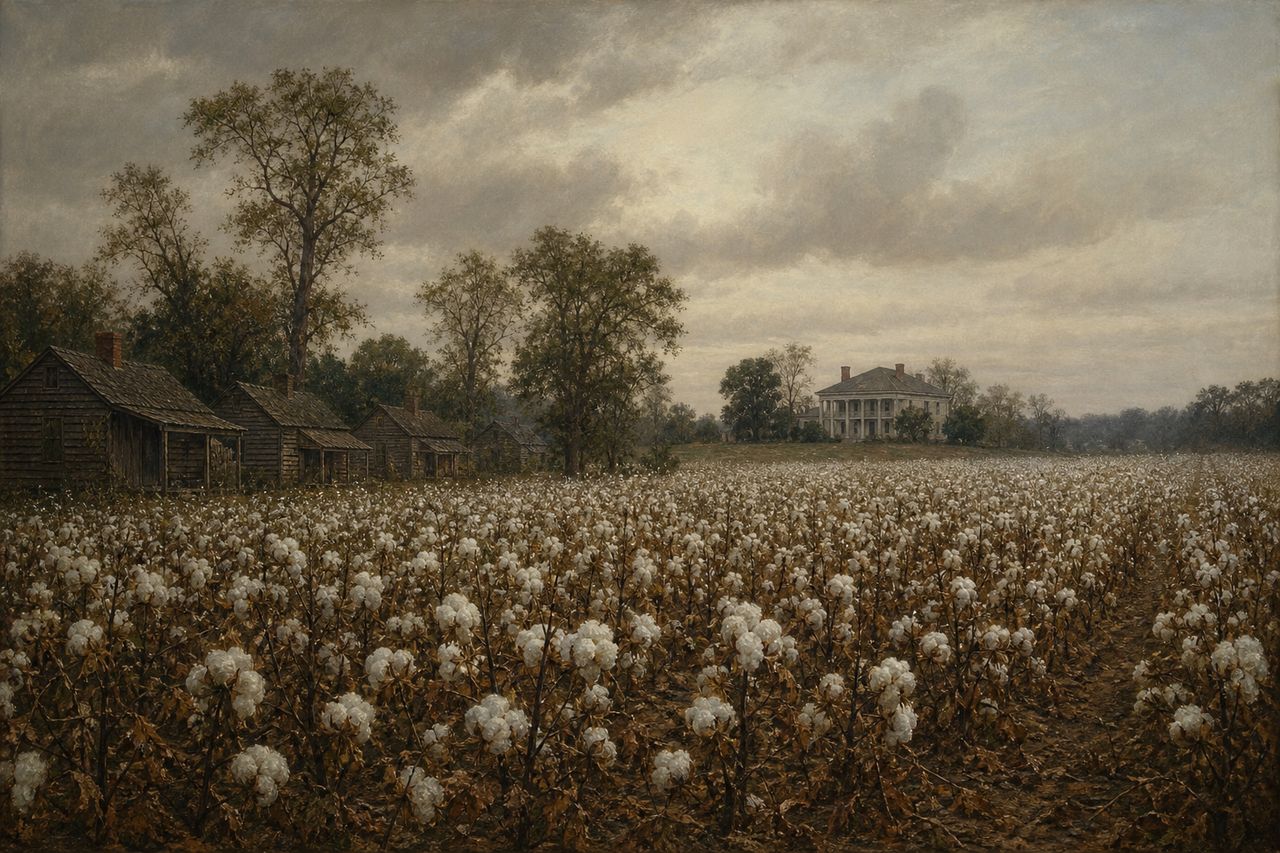
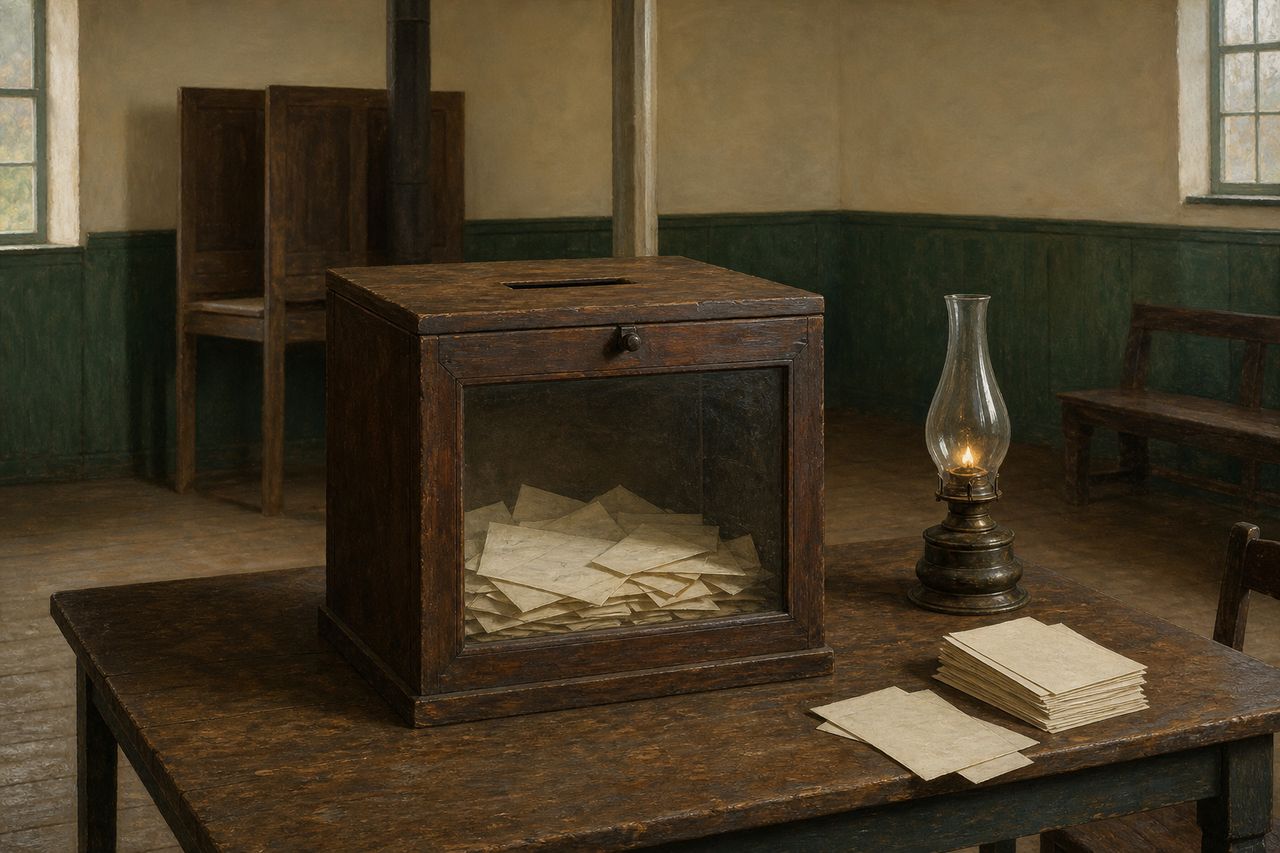
United States, 1861The cotton South A plantation estate of the kind whose wealth rested on enslaved labour. AI-generated illustration.November 1860 A ballot box of the period. Lincoln’s victory was, in South Carolina’s words, “the final straw”, says the National Park Service. AI-generated illustration.
One section of our country believes slavery is right, and ought to be extended, while the other believes it is wrong, and ought not to be extended.Abraham Lincoln, First Inaugural Address, 4 March 1861
Chapter I · A house divided
Why the country split
National Park Service: with more than four million enslaved African Americans, the United States was the largest slaveholding country in the world when the war began. Encyclopaedia Britannica: decades of conflict over slavery deepened the divide, and Northern opposition to the extension of slavery into the western territories made Southern states fear for their slaveholdings, the economic base of the South. Lincoln, whose Republican Party opposed the extension of slavery into the territories, was elected president in November 1860.
The road of year-blocks is schematic: one block per year from 1776 to 1865.
Why the Southern states left, and how Lincoln answered.
By the middle of 1861, eleven Southern states had declared that they had left the United States, and formed the Confederate States of America: the Confederacy. The states that stayed were called the Union.
South Carolina said Northern states had broken the Constitution, a compact between states, by not returning people who escaped slavery, and then Lincoln was elected.
Mississippi wrote: our position is thoroughly identified with the institution of slavery.
Lincoln replied that he would not touch slavery in the states where it already existed, but that no state could lawfully leave the Union.
In April 1861 Confederate guns fired on Fort Sumter, and the war began.
A state convention Each state voted to leave in a convention: South Carolina first, on 20 December 1860. AI-generated illustration.
Our position is thoroughly identified with the institution of slavery — the greatest material interest of the world.Mississippi’s declaration of the causes of secession, 1861
I have no purpose, directly or indirectly, to interfere with the institution of slavery in the States where it exists.Abraham Lincoln, First Inaugural Address, 4 March 1861
Charleston harbour An imagined harbour fort, 12 April 1861. Historians “have argued convincingly for the centrality of slavery” among the war’s causes, says the National Park Service. AI-generated illustration.
Chapter I · A house divided
Each side’s case
American Battlefield Trust (primary sources): South Carolina’s declaration (20 December 1860) argued that the Constitution is a compact between sovereign states, that Northern states had broken it by refusing to enforce the fugitive slave laws, and that a president hostile to slavery had been elected. Mississippi’s declaration: “Our position is thoroughly identified with the institution of slavery.” Georgia and Texas issued declarations in early 1861; Virginia passed its ordinance of secession on 17 April 1861. Lincoln’s First Inaugural (4 March 1861) said he had “no purpose” to interfere with slavery where it existed, and that “no State, upon its own mere motion, can lawfully get out of the Union”. Britannica: Confederate artillery fired on Fort Sumter on 12 April 1861. National Park Service: the best historical scholars have argued convincingly that slavery was central among the causes of the war.
Each side is quoted from its own documents. The split road is schematic.
By the summer of 1863 General Robert E. Lee had taken the Confederate army north, into Pennsylvania.
On the first of July it met the Union army of General George Meade at the small town of Gettysburg.
West of town runs Seminary Ridge. To the south, Cemetery Hill and Cemetery Ridge, ending at two rocky hills, the Round Tops.
The two ridges are nearly a mile apart. About ninety-four thousand Union and seventy-two thousand Confederate soldiers fought here.
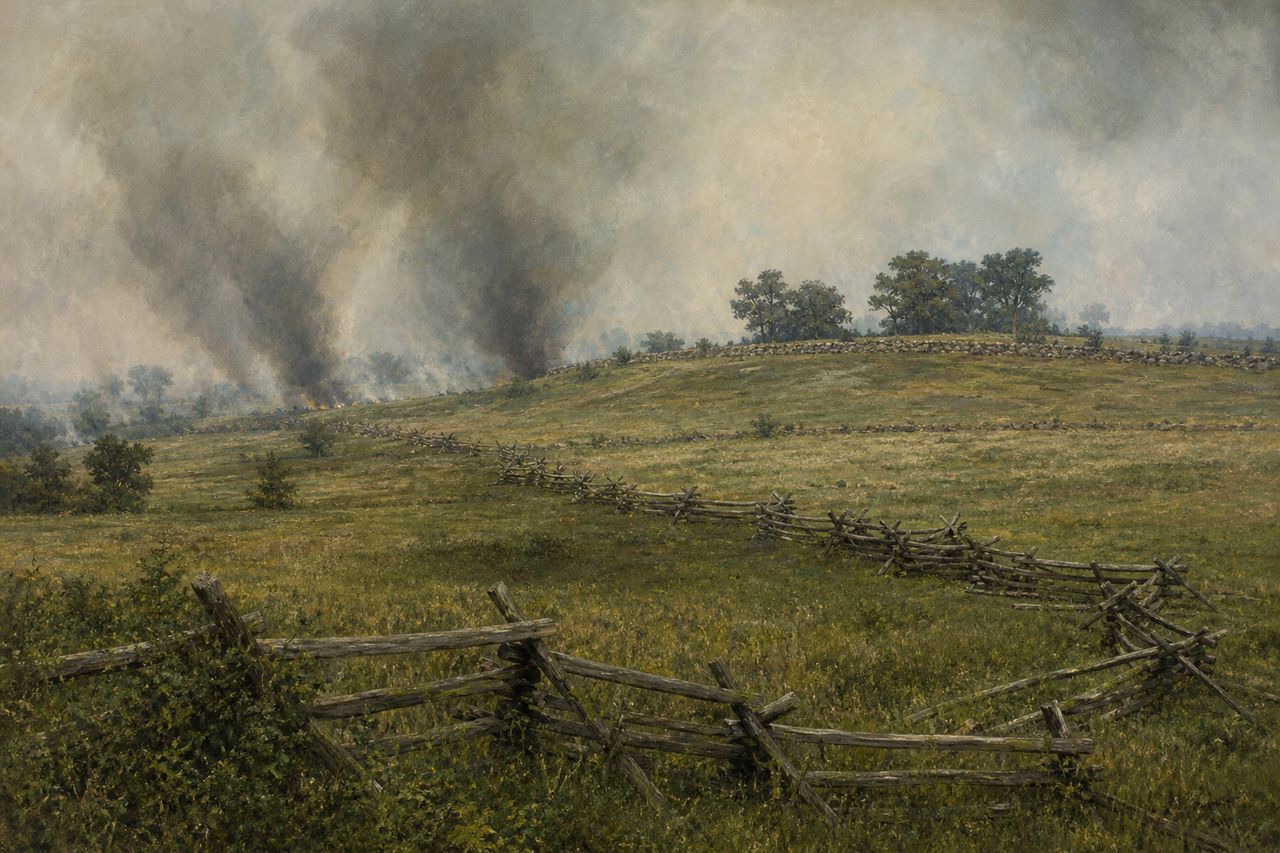
Looking east from Seminary Ridge Open farm fields, fences and stone walls lay between the two lines. AI-generated illustration.
Union: Army of the Potomac, Maj. Gen. George G. Meade (in command since 28 June)
Confederate: Army of Northern Virginia, Gen. Robert E. Lee
The two armies
93,921
Union
71,699
Confederate
Forces engaged (American Battlefield Trust)
Chapter II · Three days in July
The battlefield
National Park Service: Lee decided on an invasion of the North and moved into Maryland and Pennsylvania; Meade was named to command the Army of the Potomac on 28 June 1863. The main Union line was on Cemetery Ridge, the Confederate line on Seminary Ridge to the west, nearly a mile apart. American Battlefield Trust: forces engaged 165,620 (Union 93,921; Confederate 71,699).
Press Day 1, Day 2 and Day 3 to see each day’s lines.
The 3D battlefield is a simplified, schematic teaching map: heights are exaggerated and troop lines are drawn approximately, after the National Park Service and American Battlefield Trust accounts.
Day one. Confederate troops attacked Union soldiers on McPherson Ridge, west of town.
The Union line held until the afternoon. Then it was driven back through the town, to Cemetery Hill.
Overnight, the rest of the Union army arrived and took up positions on the high ground south of town.
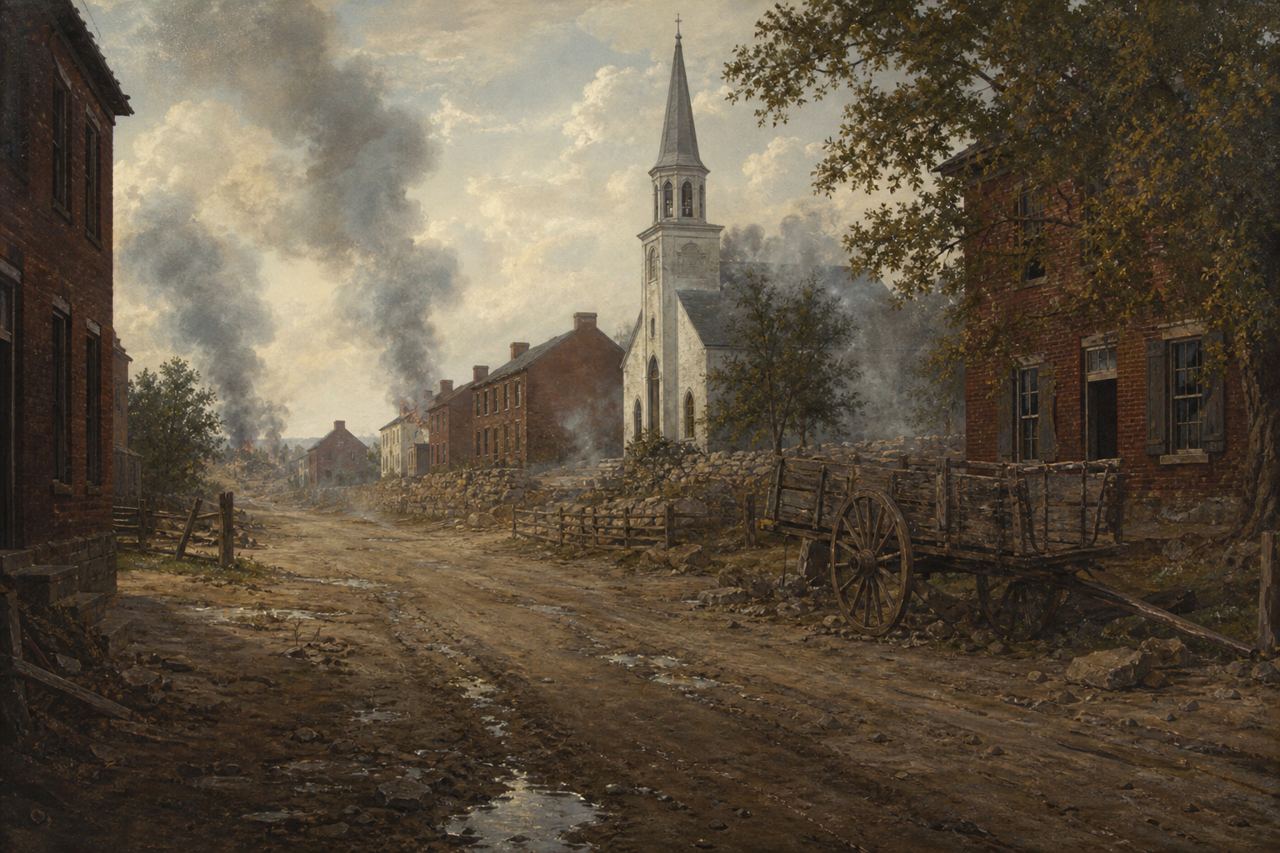
Gettysburg, 1863 A small market town; the Lutheran seminary that named Seminary Ridge stood on its western edge. AI-generated illustration.Through the town The retreating Union troops passed through the streets toward the hills south of town. AI-generated illustration.
Morning fighting on McPherson Ridge
Afternoon Union lines give way
Evening Union holds Cemetery Hill
Night main Union army arrives
1 July 1863
Chapter II · Three days in July
1 July
National Park Service: on 1 July Confederates attacked Federal troops on McPherson Ridge, west of town. The Federals held until afternoon, then were driven back to Cemetery Hill, south of town. The main Federal army arrived overnight and took up positions.
Union lines are blue, Confederate lines red. Moving dots show the direction of attacks and retreats.
The 3D battlefield is a simplified, schematic teaching map: heights are exaggerated and troop lines are drawn approximately, after the National Park Service and American Battlefield Trust accounts.
Day two. The Union line now curved like a fish hook along Cemetery Ridge. Lee attacked both ends.
At the southern end, Confederates overran the fields below a rocky hill, Little Round Top, but the Union line on the hill held.
At the northern end, an evening attack gained ground briefly, and was driven back.
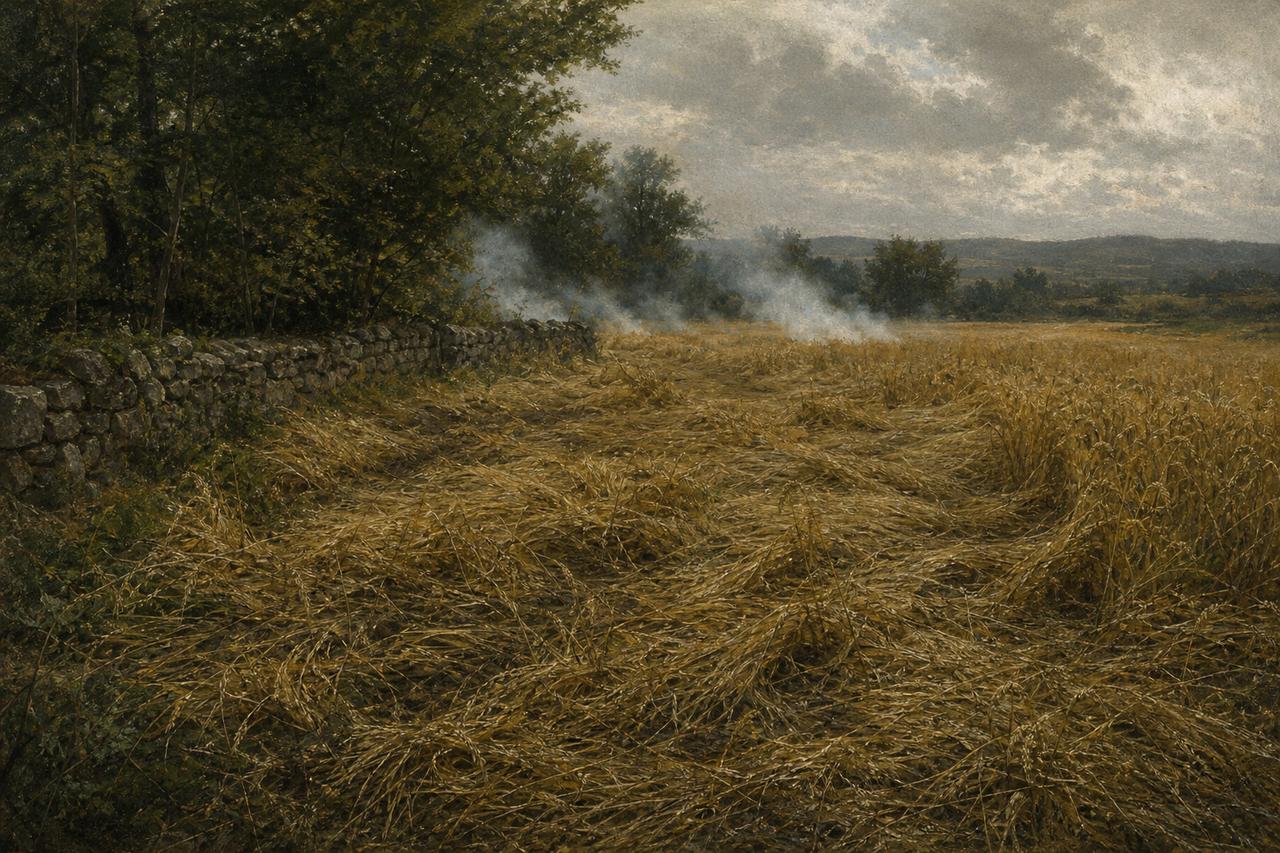
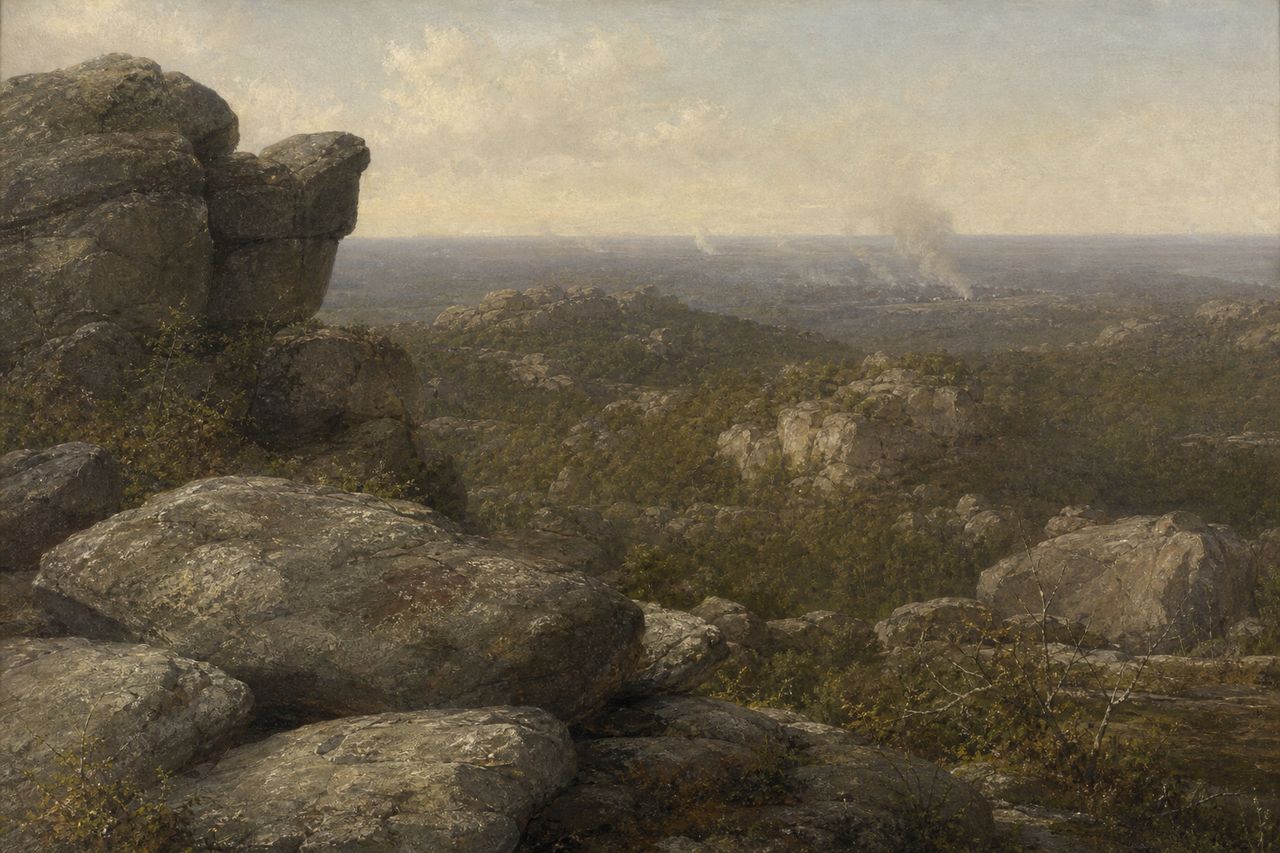
The Wheatfield Between the Peach Orchard and Little Round Top the fighting spread into a wheat field. AI-generated illustration.Little Round Top A boulder-strewn hill above Devil’s Den, at the southern end of the Union line. AI-generated illustration.
Peach Orchard, Devil’s Den: taken by Confederates
Little Round Top: Union line held
Culp’s Hill: defenders behind earthworks repulsed the attacks
2 July, by place
Chapter II · Three days in July
2 July
National Park Service: Lee ordered attacks on both Federal flanks. Longstreet’s assault on the Federal left turned the base of Little Round Top into a scene of destruction, left the Wheatfield strewn with dead and wounded and overran the Peach Orchard; Ewell’s evening attack on East Cemetery Hill and Culp’s Hill succeeded briefly but could not be exploited. American Battlefield Trust: the Union position “had assumed the shape of a fish hook” from Culp’s Hill around Cemetery Hill and down Cemetery Ridge; the Southerners captured Devil’s Den and the Peach Orchard; the line on Little Round Top “held firm”; on Culp’s Hill the defenders behind earthworks repulsed the attacks.
The 3D battlefield is a simplified, schematic teaching map: heights are exaggerated and troop lines are drawn approximately, after the National Park Service and American Battlefield Trust accounts.
Day three. Confederate cannon pounded the Union centre on Cemetery Ridge for about two hours, with little effect.
Then about twelve thousand Confederate soldiers advanced from Seminary Ridge, across the open fields, toward that centre.
This was Pickett's Charge. It failed, and cost Lee more than five thousand men in one hour.
On the fourth of July Lee retreated. The Union had won, and his invasion of the North was over. In three days, more than fifty-one thousand men had been killed, wounded or gone missing.
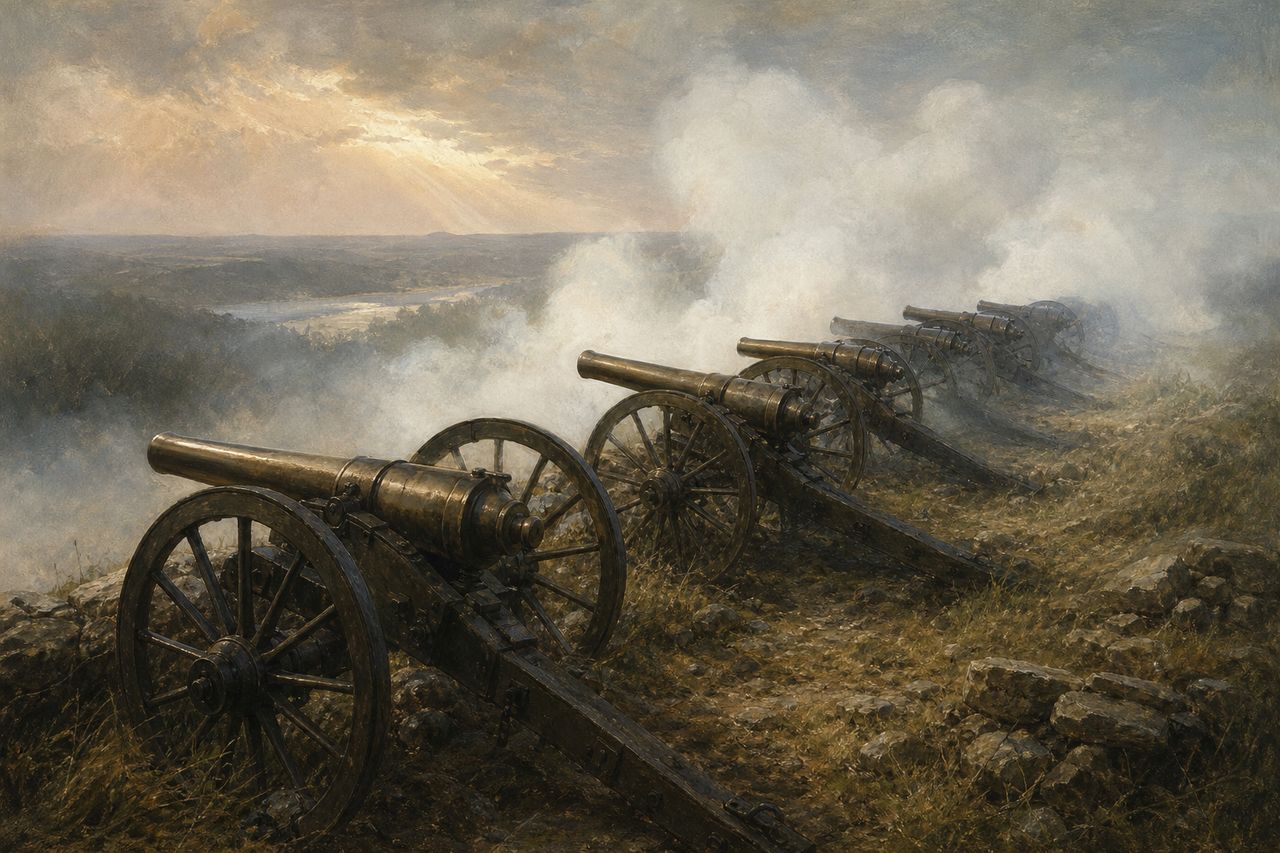
The bombardment Guns lined Seminary Ridge for the cannonade before the attack. AI-generated illustration.Toward the Union centre The attackers crossed fences and open ground toward a low stone wall on Cemetery Ridge. AI-generated illustration.
~12,000
Confederates in the advance
5,000+
lost by Lee within an hour
Pickett’s Charge (National Park Service)
Union
23,049
Confederate
28,063
Estimated casualties, 1–3 July
Chapter II · Three days in July
3 July
National Park Service: Lee’s artillery bombarded the Federal lines on Cemetery Ridge and Cemetery Hill for two hours but did little to weaken them. Some 12,000 Confederates then advanced across open fields toward the Federal centre in “Pickett’s Charge”; the attack failed and cost Lee over 5,000 soldiers in one hour. Lee began his retreat to Virginia on 4 July. American Battlefield Trust: a Union victory, which ended Lee’s second invasion of the North. The armies left over 51,000 soldiers dead, wounded or missing. American Battlefield Trust estimate: 51,112 casualties (Union 23,049; Confederate 28,063).
Press “Replay the charge” to watch the advance again.
The 3D battlefield is a simplified, schematic teaching map: heights are exaggerated and troop lines are drawn approximately, after the National Park Service and American Battlefield Trust accounts.
After the battle, the dead lay in hurried graves across the farms. Pennsylvania's governor, Andrew Curtin, provided state funds to establish a proper cemetery.
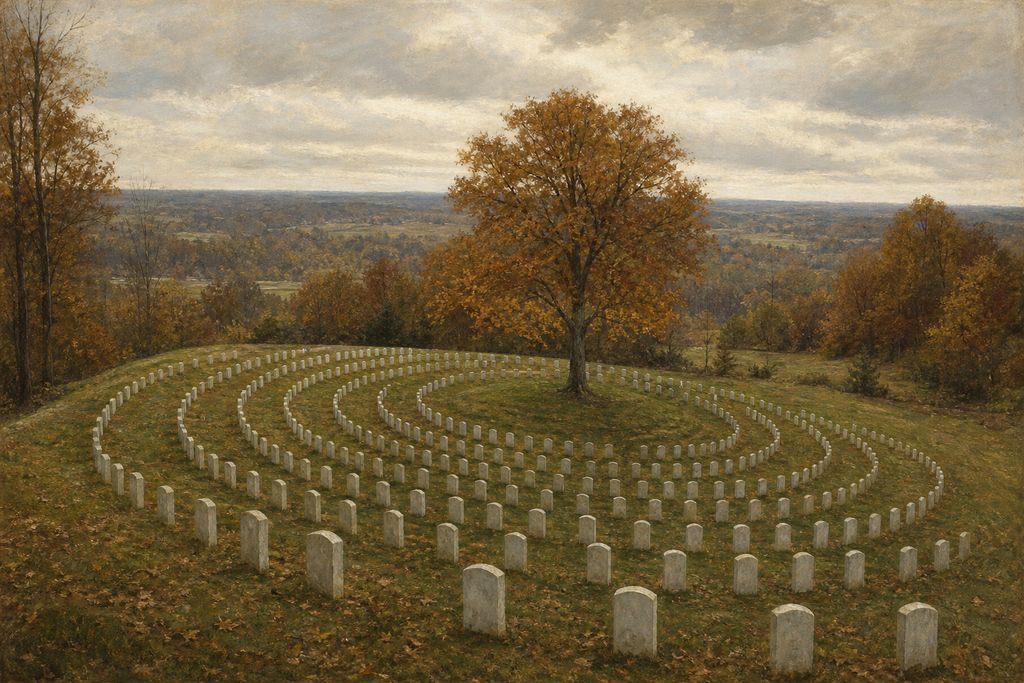
A local lawyer, David Wills, bought land on Cemetery Hill, and William Saunders laid out the graves in curved rows.
Reburials began that autumn. More than three thousand Union soldiers would lie here, nearly a thousand of them never identified.
Wills invited the president to add a few appropriate remarks. Lincoln arrived the evening before.
Curved rows The graves form semicircles on the hill, grouped by state. AI-generated illustration.
3,354
burials
979
unidentified
Soldiers’ National Cemetery (American Battlefield Trust)18 November 1863 A town house on the square. Lincoln reached Gettysburg at about 6 p.m. AI-generated illustration.
Chapter III · A cemetery on the hill
The Soldiers’ National Cemetery
National Park Service: Adams County citizens approached Governor Andrew Curtin, who provided funds to establish the cemetery; Curtin appointed the Gettysburg attorney David Wills to buy land on Cemetery Hill. The landscape architect William Saunders designed the cemetery; reinterments of an estimated 3,600 bodies began in autumn 1863. American Battlefield Trust: the cemetery holds 3,354 burials, 979 of them unidentified; Wills invited Lincoln to offer “a few appropriate remarks”; Lincoln reached Gettysburg at about 6 p.m. on 18 November and spent the night at Wills’s house.
The two sources count the burials differently: an estimate of 3,600 (NPS) and 3,354 (American Battlefield Trust).
The 3D battlefield is a simplified, schematic teaching map: heights are exaggerated and troop lines are drawn approximately, after the National Park Service and American Battlefield Trust accounts.
The main speaker, Edward Everett, was a famous orator. He spoke without notes for about two hours: roughly thirteen thousand words.
Lincoln followed. His final text has two hundred and seventy-two words.
Here both play sixty times faster. Lincoln is done in two seconds; Everett needs two minutes.
The next day Everett wrote to Lincoln, wishing he had come as near to the heart of the occasion in two hours as Lincoln had in two minutes.
A long oration Everett delivered his oration from memory. AI-generated illustration.
~13,000
words, Everett (Britannica)
272
words, Lincoln’s final copy
Same ceremony, two lengths
I should be glad, if I could flatter myself that I came as near to the central idea of the occasion, in two hours, as you did in two minutes.Edward Everett to Lincoln, 20 November 1863
Chapter III · A cemetery on the hill
Everett and Lincoln
Encyclopaedia Britannica: Everett’s oration lasted about two hours and ran to roughly 13,000 words, delivered without notes; Lincoln’s address is 272 words in the Bliss copy. Library of Congress: in his letter of 20 November Everett wrote, “I should be glad, if I could flatter myself that I came as near to the central idea of the occasion, in two hours, as you did in two minutes.”
Press “Speak” to race the two speeches at 60× speed, or 600× to watch Everett’s dots fill. The rates are averages: 13,000 words in 120 minutes, 272 words in 2 minutes.
The 3D scene is a schematic teaching model, not a facsimile.
Now the speech itself. It moves through time: past, present, future.
It begins: Four score and seven years ago our fathers brought forth on this continent, a new nation, conceived in Liberty, and dedicated to the proposition that all men are created equal.
A score is twenty. Four twenties and seven make eighty-seven.
Count back eighty-seven years from 1863 and you reach 1776, the year of the Declaration of Independence.
Philadelphia, 1776 The founding document Lincoln points back to. AI-generated illustration.
We hold these truths to be self-evident, that all men are created equal…Declaration of Independence, 4 July 1776
4×20+7=871863−87=1776A “score” is an old English word for twenty.
Chapter IV · 272 words
Four score and seven years
The address opens: “Four score and seven years ago our fathers brought forth on this continent, a new nation, conceived in Liberty, and dedicated to the proposition that all men are created equal” (Bliss copy, National Park Service and Abraham Lincoln Online). A score is twenty, so four score and seven is 87; 1863 − 87 = 1776, the year of the Declaration of Independence.
Press “Count back 87 years” to run the count again.
Then the present: Now we are engaged in a great civil war, testing whether that nation, or any nation so conceived and so dedicated, can long endure.
Any nation: the war tests whether a government built on liberty and equality can survive at all.
Then he says the crowd cannot make this ground holy. The brave men, living and dead, who struggled here, have already consecrated it.
And then: The world will little note, nor long remember what we say here, but it can never forget what they did here.
This ground The cemetery was set out on the ground where the Union line had held Cemetery Hill. AI-generated illustration.
30
words: the past
134
words: the present
108
words: the future
The final copy in three parts
But, in a larger sense, we can not dedicate — we can not consecrate — we can not hallow — this ground.Lincoln, the sentence before
The world will little note, nor long remember what we say here, but it can never forget what they did here.Lincoln, a prediction
Chapter IV · 272 words
Present
Bliss copy: “Now we are engaged in a great civil war, testing whether that nation, or any nation so conceived and so dedicated, can long endure. … But, in a larger sense, we can not dedicate — we can not consecrate — we can not hallow — this ground. The brave men, living and dead, who struggled here, have consecrated it, far above our poor power to add or detract. The world will little note, nor long remember what we say here, but it can never forget what they did here.” The split into past (the first sentence), present (to “what they did here”) and future (the rest) is a common way of teaching the speech; the word counts are this film’s own count of the Bliss text.
Press Past, Present or Future to light up each part of the text.
The 3D scene is a schematic teaching model, not a facsimile.
Last, the future. It is for the living, Lincoln says, to take up the unfinished work of those who fought here.
That these dead shall not have died in vain; that this nation, under God, shall have a new birth of freedom.
And it ends with the line that became a definition of democracy: and that government of the people, by the people, for the people, shall not perish from the earth.
A new birth of freedom The speech closes looking forward, past the war. AI-generated illustration.
It is for us the living, rather, to be dedicated here to the unfinished work which they who fought here have thus far so nobly advanced.Lincoln, the opening of the last part
of the people: the source of power
by the people: who does the governing
for the people: whom government serves
Of, by, for
Chapter IV · 272 words
Future
Bliss copy: “It is for us the living, rather, to be dedicated here to the unfinished work which they who fought here have thus far so nobly advanced. It is rather for us to be here dedicated to the great task remaining before us — that from these honored dead we take increased devotion to that cause for which they gave the last full measure of devotion — that we here highly resolve that these dead shall not have died in vain — that this nation, under God, shall have a new birth of freedom — and that government of the people, by the people, for the people, shall not perish from the earth.” The of/by/for reading is an interpretation, not Lincoln’s own gloss.
Press Past, Present or Future to light up each part; “of, by, for” lights the last line.
The 3D scene is a schematic teaching model, not a facsimile.
How was the speech heard at the time? Largely along party lines.
Republican newspapers praised it. The Democratic Chicago Times called it silly, flat and dishwatery.
A Harrisburg paper promised to pass over the silly remarks of the President.
In 2013, for the 150th anniversary, that paper's successor printed a retraction. It regrets the error.
The next morning’s papers Reporters telegraphed the text from Gettysburg the same day. AI-generated illustration.
We pass over the silly remarks of the President. For the credit of the nation we are willing that the veil of oblivion shall be dropped over them.Daily Patriot and Union, Harrisburg, November 1863
So flawed, so tainted by hubris… The Patriot-News regrets the error.The Patriot-News, retraction, November 2013
Chapter V · How it was heard
Reception
Smithsonian Magazine (2013): reactions in 1863 were “either worshipful or scornful, depending on one’s party affiliation”. The Democratic Chicago Times called the address “the silly flat dishwatery utterances” of the president; Harrisburg’s Daily Patriot and Union wrote, “We pass over the silly remarks of the President.” In November 2013 its successor, The Patriot-News, called that judgment “so flawed, so tainted by hubris” and ended: “The Patriot-News regrets the error.” American Battlefield Trust: Republican newspapers praised the address and Democratic papers criticised it. Britannica: despite criticism from his opponents, the speech was widely quoted and praised.
The 3D page shows the Bliss text in Lincoln’s original English.
The 3D scene is a schematic teaching model, not a facsimile.
Five copies survive in Lincoln's hand. The two earliest are named for his secretaries, Nicolay and Hay.
In 1864 he wrote out three more, for charity: the Everett, Bancroft and Bliss copies.
The wording differs slightly: the two earliest lack the words under God, though reporters' accounts of the day include them.
So what exactly did he say? Nobody knows for sure. The Bliss copy, the only one he signed and dated, is the standard: 272 words.
A copy for a cause The Bancroft copy was written on both sides of the paper, so it could not be reproduced; Lincoln wrote the Bliss copy to replace it. AI-generated illustration.
Nicolay Library of Congress
Hay Library of Congress
Everett Abraham Lincoln Presidential Library, Springfield
Bancroft Cornell University Library
Bliss Lincoln Room, the White House
The five copies and where they are
…that this nation, under God, shall have a new birth of freedom…Everett, Bancroft and Bliss copies; the Nicolay and Hay copies lack “under God”
238
Nicolay
267
Hay
273
Everett · Bancroft
272
Bliss
Words in each copy (this film’s count)
Chapter VI · Five copies
The five copies
Cornell University Library: five copies in Lincoln’s hand are known, named for Nicolay and Hay (his private secretaries; both at the Library of Congress), Everett (Illinois), Bancroft (Cornell) and Bliss (Bancroft’s stepson; Lincoln Room of the White House); the last three were written after the speech for charitable purposes, and the Nicolay copy lacks “under God”. American Battlefield Trust: neither the Nicolay nor the Hay copy contains “under God”, while the three later versions do, and three correspondents included the words in their telegraphed reports on 19 November. Abraham Lincoln Online: Everett asked for his copy in 1864 to benefit Union soldiers; Lincoln sent the Bancroft copy on 29 February 1864, written on both sides of the paper so that it could not be reproduced, and wrote the Bliss copy in 1864 to replace it. National Park Service: the Bliss copy is the only one Lincoln signed, the standard version, and the text carved on the south wall of the Lincoln Memorial. Scholars disagree about whether any surviving copy is the reading copy Lincoln used. Word counts here are this film’s own count of the texts printed by Abraham Lincoln Online; other counts differ by a word or two depending on hyphens.
Press a copy’s name to see its text; words that differ from the Bliss copy are lit in gold.
The 3D scene is a schematic teaching model, not a facsimile.
Lincoln had promised not to touch slavery where it existed. But in 1863, as a war measure, his Emancipation Proclamation declared enslaved people in the rebelling areas free.
It left out the border states, slave states loyal to the Union. Ending slavery everywhere took an amendment to the Constitution.
In January 1865 the House passed the 13th Amendment, 119 votes to 56.
Lincoln did not live to see it in force. He was shot on 14 April 1865, five days after Lee surrendered.
By 6 December 1865, three-quarters of the states had approved, or ratified, it. Slavery in the United States was over.
1 January 1863 The proclamation was printed and posted; it applied to the people of areas “in rebellion against the United States”. AI-generated illustration.
Neither slavery nor involuntary servitude, except as a punishment for crime whereof the party shall have been duly convicted, shall exist within the United States, or any place subject to their jurisdiction.13th Amendment, Section 1
The House, January 1865 The Senate had passed the amendment in April 1864. AI-generated illustration.
9 April Lee surrenders at Appomattox
14 April Lincoln is shot
15 April Lincoln dies
6 December 13th Amendment ratified
1865
Chapter VII · A new birth of freedom
Emancipation and the 13th Amendment
U.S. National Archives: the Emancipation Proclamation (1863) was a military measure (in its own words “a fit and necessary war measure for suppressing said rebellion”); it applied to areas whose people were “in rebellion against the United States”, left slavery untouched in the loyal border states and so did not end slavery nationwide. The Senate passed the 13th Amendment in April 1864 and the House in January 1865, by 119 to 56; the necessary number of states (three-fourths) had ratified it by 6 December 1865. Britannica: the proclamation was issued on 1 January 1863; Lee surrendered at Appomattox on 9 April 1865; Lincoln was shot by John Wilkes Booth on 14 April and died the next day.
Lincoln's prediction was wrong. The world did note, and it did remember.
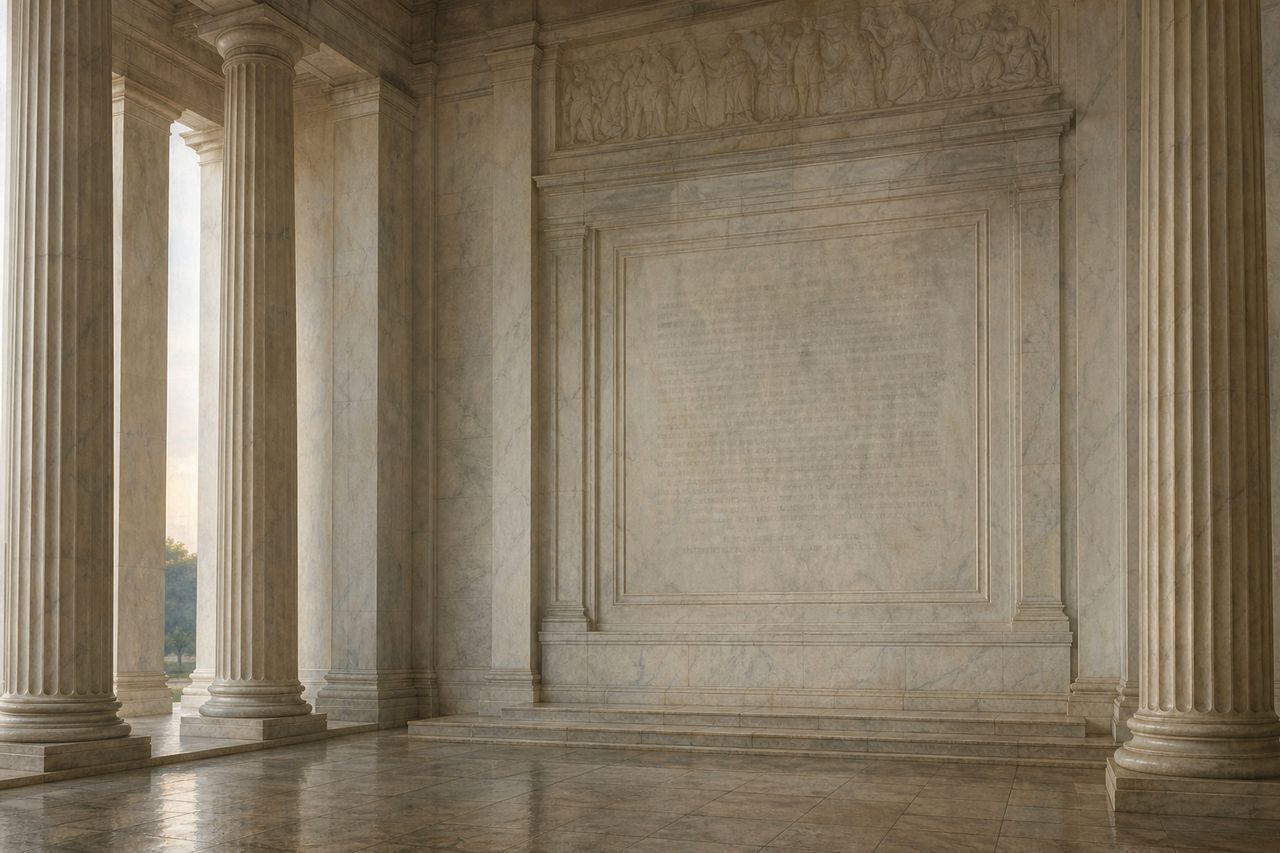
His words are carved on the wall of the Lincoln Memorial in Washington.
In 1963, at that memorial, Martin Luther King Junior echoed Lincoln's four score: five score years ago.
Two minutes, two hundred and seventy-two words, and a question every democracy must still answer: can government of the people, by the people, for the people endure?
The Lincoln Memorial The Bliss text is inscribed on the memorial’s south wall. AI-generated illustration.
1776 Declaration of Independence
1860 Lincoln elected; South Carolina secedes
1861 Fort Sumter: the war begins
Jan 1863 Emancipation Proclamation
Jul 1863 Battle of Gettysburg
Nov 1863 Gettysburg Address
1865 Lee surrenders; Lincoln killed; 13th Amendment ratified
From 1776 to 1865
Five score years ago, a great American, in whose symbolic shadow we stand today, signed the Emancipation Proclamation.Martin Luther King Jr., Lincoln Memorial, 28 August 1963
~2 min
spoken, 19 November 1863
272
words in the standard text
5
copies in Lincoln’s hand
The Gettysburg Address
Epilogue · Sources
Sources
Every fact in this film comes from the sources below. Where they differ (the size of the crowd: over 10,000 by the National Park Service, nearly 15,000 by the American Battlefield Trust; the burials: an estimated 3,600, or 3,354), both figures are given with their source. Casualty figures are estimates; the American Battlefield Trust’s are used. The causes of secession are given in each side’s own documents, and the scholarly judgement that slavery was central is attributed to the National Park Service. The speech is quoted from the Bliss copy, which is in the public domain; the word counts of the five copies are this film’s own count. The 3D battlefield, the year road and the word dots are schematic teaching models, not maps or facsimiles. The chapter stills and pictures are AI-generated illustrations, not photographs; no real person is depicted.