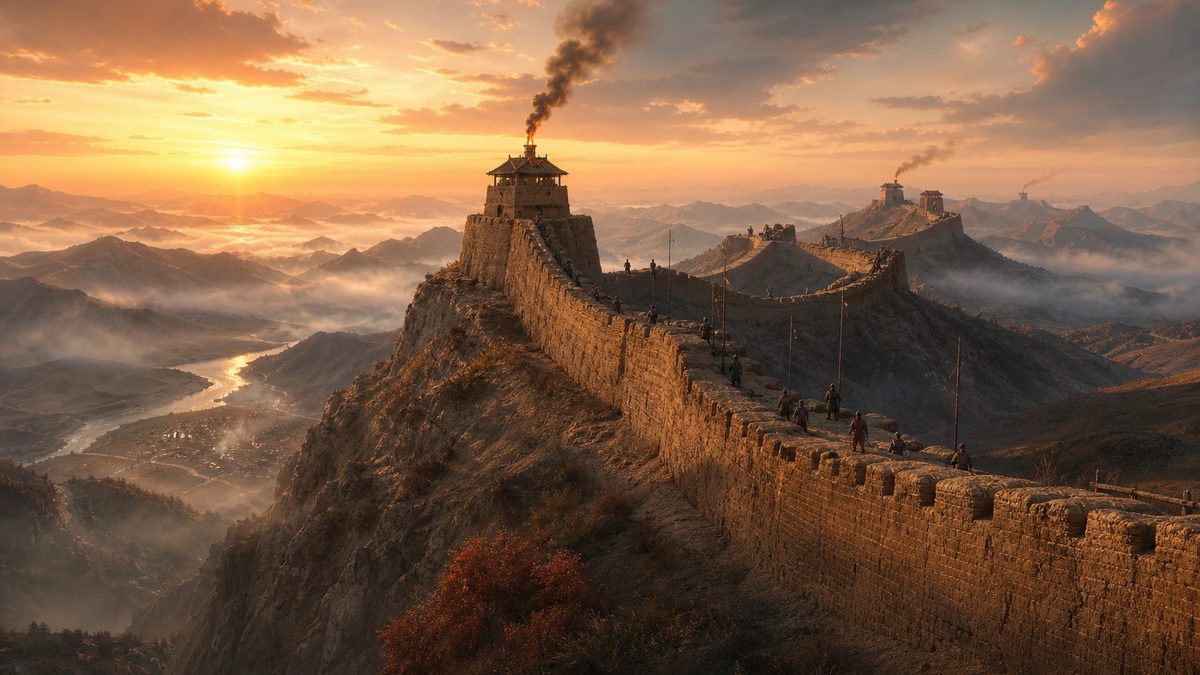
King Zheng of Qin conquers the six rival Warring States and becomes the First Emperor, standardising script, coins and measures; his dynasty falls in fifteen years, and the Han dynasty that follows fights the Xiongnu, sends Zhang Qian west to open the Silk Road, rules through Confucian officials for four centuries, then splits into the Three Kingdoms. Episode 05 of the World Empires series.
Interactive 3D film6 min221 BC to AD 220Published 2026-10-13
For more than two centuries, from about 475 BC, China was split into rival kingdoms. Historians call it the Warring States period.
By the 200s BC, seven big states remained. The one in the far west, Qin, in the Wei River valley, was about to swallow all the others.
Prologue · Episode 05 of the World Empires series
The Warring States
Seven states, Qin, Chu, Qi, Yan, Han, Zhao and Wei, fought with mass infantry armies, iron weapons and crossbows. Each still nominally served the old Zhou kings, who by now had almost no power.
The “Han” state here is a different name from the later Han dynasty. Grey outlines show other powers of the time. Outlines are approximate.
From 356 BC, the minister Shang Yang reshaped Qin. Land could be bought and sold, families were grouped to watch each other, and rank came from success in war, not birth.
Punishments were harsh and laws were applied to everyone. This approach was later called Legalism.
Qin also built canals and irrigation works, like the Zhengguo canal, that made it rich in grain.
King Zheng of Qin came to the throne as a boy in 246 BC. From 230 BC his armies conquered the other states one after another: Han, Zhao, Wei, Chu, Yan and finally Qi, in 221 BC.
For the first time, all of China’s heartland was under one ruler. He took a new title, Shi Huangdi, the First Emperor.
The general Meng Tian drove the northern nomads back and joined older walls into a long northern barrier, an ancestor of the Great Wall. The walls you can visit today are mostly much later, from the Ming dynasty.
Near his capital, workers built the First Emperor’s tomb. In 1974, farmers digging a well found part of its guard: thousands of life-size clay soldiers.
The emperor died in 210 BC while touring his empire. His burial mound itself has still not been opened.
Chapter I · Step 4
Walls and an army of clay
Terracotta Army found
1974
Figures
~8,000
estimated, not all excavated
The tomb is a UNESCO World Heritage site, listed in 1987.
North of the wall, the Xiongnu, a confederation of steppe peoples under Modu Chanyu, built a powerful empire of horse archers.
In 200 BC they surrounded Emperor Gaozu at Baideng. Afterwards the Han paid them silk, grain and princess brides, a policy called heqin, “peace through kinship”.
For sixty years the Han rebuilt their strength at home, keeping taxes low.
Chapter II · Step 6
The Xiongnu
The struggle between farming China and the steppe empires to its north runs through the rest of this series, to the Mongols in Episode 09.
Emperor Wu ruled from 141 to 87 BC. His generals Wei Qing and Huo Qubing drove the Xiongnu out of the Gansu corridor, opening the road west.
In 111 BC Han armies conquered Nanyue, in today’s southern China and northern Vietnam. In 108 BC they set up commanderies in the north of the Korean peninsula.
To pay for the wars, the state took over the trade in salt and iron.
Chapter II · Step 7
Emperor Wu
121 BC Hexi (Gansu) corridor taken from the Xiongnu
117 BC State monopolies on salt and iron
111 BC Nanyue conquered
108 BC Four commanderies in Korea
Northern Vietnam stayed under Chinese rule, with revolts such as the Trưng Sisters’ uprising in AD 40, until the 10th century.
In 138 BC Emperor Wu sent an envoy, Zhang Qian, west to find allies against the Xiongnu. He was captured and held for about ten years, but escaped and reached Bactria.
He returned in 126 BC with news of kingdoms, horses and markets no one in China had known about.
Han armies and caravans followed. Silk went west and horses, grapes and new ideas came east, along routes later called the Silk Road.
Chapter II · Step 8
Zhang Qian goes west
Journey
138–126 BC
Protectorate of the Western Regions
60 BC
“Silk Road” is a modern name, coined by the geographer Ferdinand von Richthofen in 1877.
Paper, a western general, and a visitor from Rome.
In AD 9 the minister Wang Mang seized the throne and founded his own Xin dynasty. It collapsed amid floods and revolts, and in AD 25 the Han returned, now ruling from Luoyang.
In AD 105 the official Cai Lun presented an improved method of making paper to the court. Paper was older, but his method helped it spread.
In AD 166, Chinese records say envoys from “Da Qin”, the Roman Empire, arrived by sea, perhaps merchants claiming to speak for the emperor.
Chapter III · Step 10
Interruption and revival
AD 9–23 Wang Mang’s Xin dynasty
AD 25 Eastern Han, capital Luoyang
AD 73–102 General Ban Chao restores Han control in the Western Regions
Qin lasted only fifteen years, but it created the idea of a single empire run by officials. Han lasted four hundred years and made that idea normal.
Later dynasties, from the Tang to the Qing, would fall apart and come back together around the same model. Most people in China still call themselves Han.
Next: Rome, the empire at the other end of the Silk Road.
Epilogue
The model for two thousand years
Han peak area
~6M km²
c. AD 100; estimates vary
Han Chinese today
over 90% of China’s people
The series
00The Rise and Fall of Empires (overview)
01The First Empires: Mesopotamia
02Egypt of the Pharaohs
03Persia and Alexander
04The Maurya Empire of India
05 China Unified: Qin and Han (this film)
06 Rome (coming soon)
07 The Islamic Caliphates (coming soon)
08 The Khmer Empire of Angkor (coming soon)
09 The Mongol Empire (coming soon)
10 The Ottoman Empire (coming soon)
11 The Aztec and Inca Empires (coming soon)
12 The Age of Sea Empires (coming soon)
13 The End of Empires (coming soon)
The still images on the chapter cards are AI-generated illustrations. Outlines are approximate.