Home › History › Persia and Alexander
World Empires · Episode 03 · 550–30 BC
Persia and Alexander
Cyrus the Great builds the first empire to stretch from Egypt to India, Darius organises it with satrapies, coins and the Royal Road, the Greeks resist at Marathon and Salamis, and Alexander conquers it all before his empire splits among his generals. Episode 03 of the World Empires series.
Interactive 3D film 6 min 550 to 30 BC Published 2026-10-13
อ่านภาษาไทย
Contents Prologue Chapter I · Cyrus Chapter II · Darius Chapter III · Greeks and Persians Chapter IV · Alexander Epilogue Prologue World Empires · Episode 03
Persia and Alexander A small kingdom in the south of Iran is about to change the world.
In the 550s BC, the Near East had four great powers: Media in Iran, Babylon, Lydia in Anatolia, and Egypt.
The Persians were a smaller people in the south-west of Iran, in a land called Persis, today’s Fars province, under Median rule.
Within thirty years, a Persian king would swallow all four powers, building the largest empire the world had yet seen.
Prologue · Episode 03 of the World Empires series
A small kingdom in Persis After Assyria fell in 609 BC, its lands were shared among the Medes, the Babylonians, the Lydians and Egypt. The Persians, related to the Medes and speaking an Iranian language, lived in Persis under Median overlordship.
Grey outlines show the other powers of the time. Outlines are approximate.
Sources:
Wikipedia: Achaemenid Empire Chapter I · Cyrus Chapter I · 550–546 BC
Cyrus the Great From vassal king to master of Iran and Anatolia.
Cyrus II, king of the Persians from 559 BC, rebelled against his Median overlord. In 550 BC he took the Median capital, Ecbatana.
Around 547 BC he marched west and captured Sardis, capital of the rich kingdom of Lydia.
He often kept local rulers, customs and religions in place. This made conquest easier to accept.
Chapter I · Step 1
Cyrus the Great 559 BC Cyrus becomes king of Anshan (Persis) 550 BC Ecbatana taken; the Median kingdom falls 547/546 BC Lydia conquered; Sardis taken Sources:
Wikipedia: Achaemenid Empire Chapter I · 539 BC
Babylon opens its gates The great city falls almost without a fight.
In 539 BC Cyrus defeated the Babylonian army at Opis. On 12 October, his forces entered Babylon without a battle.
A clay cylinder written for Cyrus presents him as chosen by Babylon’s god Marduk, restoring temples and returning displaced peoples to their homes.
Among them, according to the Bible, were the exiles of Judah, who were allowed to return to Jerusalem.
Chapter I · Step 2
Babylon opens its gates The Cyrus Cylinder (British Museum) is royal propaganda in Babylonian style. It is sometimes described as an early “charter of human rights”; most historians consider that a modern reading, but it does reflect a policy of tolerating local religions.
Sources:
Wikipedia: Achaemenid Empire Chapter I · 530–525 BC
Egypt joins the empire Cyrus’s son completes the conquest of the old powers.
Cyrus died in 530 BC, fighting in Central Asia. His son Cambyses II conquered Egypt in 525 BC.
Now one king ruled Iran, Mesopotamia, Anatolia, the Levant and Egypt: every old empire of the Near East at once.
Chapter II · Darius Chapter II · 522–486 BC
Darius organises an empire Provinces, taxes, coins and a road across the empire.
In 522 BC, after a disputed succession, Darius I seized the throne. He recorded his version of events on a cliff at Behistun, in three languages.
He divided the empire into provinces called satrapies, each with a governor, fixed taxes, and royal inspectors.
He introduced gold coins, the daric, and used Aramaic as a common language of administration.
The Royal Road ran about 2,500 kilometres from Sardis to Susa. Royal couriers, changing horses at relay stations, covered it in about a week or two.
Chapter II · Step 4
Darius organises an empire Satrapies 20–30 at different times Royal Road ~2,500 km Sardis to Susa, 111 stations (Herodotus) Travel time About 90 days on foot; royal couriers much faster courier estimates range from about 7 to 15 days Herodotus admired the couriers. His line about them, “neither snow nor rain nor heat nor gloom of night…”, is carved on New York’s main post office.
Sources:
Britannica: Darius I ;
Livius: the Royal Road ;
Wikipedia: Achaemenid Empire Chapter II · c. 500 BC
The largest empire yet Some 5.5 million square kilometres, from the Aegean to the Indus.
Around 500 BC the empire reached about 5.5 million square kilometres, from Libya and Thrace to the Indus valley.
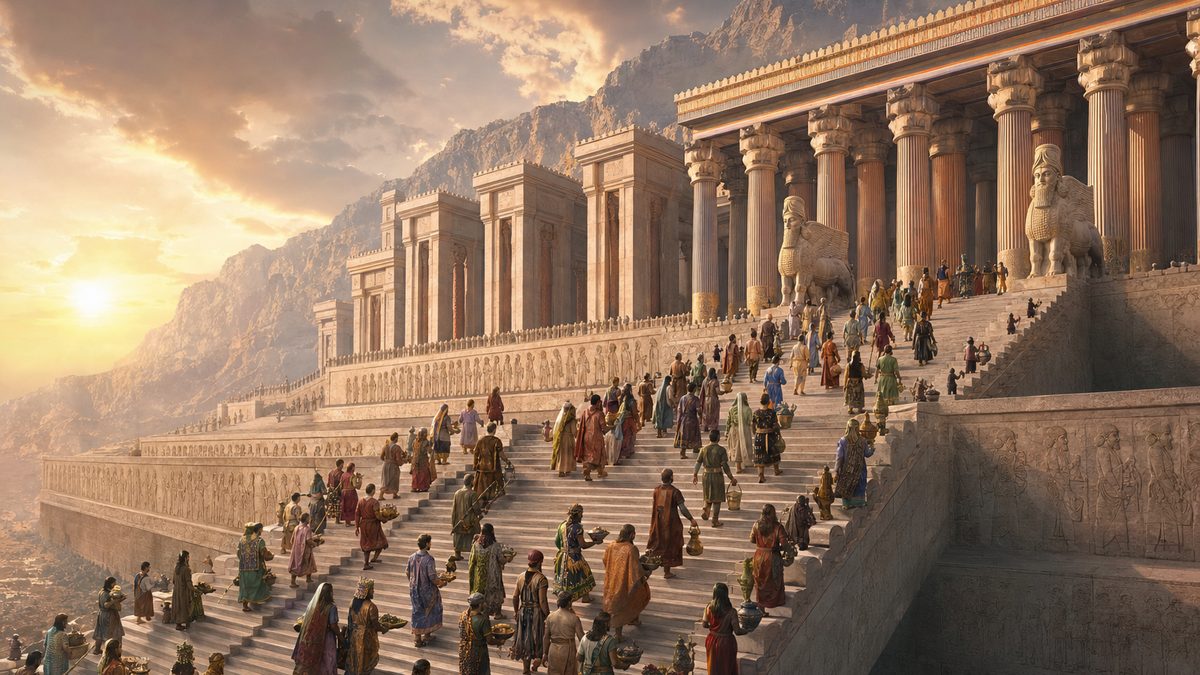
At Persepolis, carvings show delegations from over twenty peoples bringing gifts to the king: Babylonians, Egyptians, Indians, Lydians and many more.
Its population may have been 17 to 35 million people. Estimates vary widely.
Chapter III · Greeks and Persians Chapter III · 499–479 BC
The wars with Greece A small, divided people stops the great king.
In 499 BC, Greek cities in Ionia, on the Anatolian coast, revolted. Athens sent help, and Persia vowed revenge.
In 490 BC the Athenians defeated a Persian landing at Marathon.
In 480 BC Darius’s son Xerxes invaded with a huge force. After the stand at Thermopylae, the Greek fleet won at Salamis.
In 479 BC the Persians lost at Plataea and withdrew. For Persia it was a frontier setback. For the Greeks it became a founding story.
Chapter III · Step 6
The wars with Greece 499–493 BC Ionian Revolt 490 BC Marathon 480 BC Thermopylae and Salamis 479 BC Plataea Most of what we know comes from Greek writers, especially Herodotus. Persian records say little about these wars.
Sources:
Wikipedia: Achaemenid Empire Chapter III · 479–336 BC
A long middle age For 150 years, the empire held together.
After the Greek wars, Persia stayed the greatest power on Earth for a century and a half, using money and diplomacy to play the Greek cities against each other.
It faced revolts in Egypt and among its own governors, and murders at court. But it did not break.
Chapter III · Step 7
A long middle age 465 BC Xerxes assassinated 404 BC Egypt breaks away (retaken in 343 BC) 372–362 BC Great Satraps’ Revolt 336 BC Darius III becomes king Sources:
Wikipedia: Achaemenid Empire Chapter IV · Alexander Chapter IV · 334–330 BC
Alexander A 22-year-old king crosses into Asia.
In 334 BC Alexander, the 22-year-old king of Macedon, crossed into Asia. He won at the Granicus river, then at Issus in 333 BC.
Egypt surrendered, and he founded Alexandria. In 331 BC he defeated Darius III at Gaugamela, near today’s Mosul.
In 330 BC Persepolis was burned, and Darius was killed by one of his own nobles. The Achaemenid Empire had ended.
Chapter IV · Step 8
Alexander 334 BC Granicus 333 BC Issus 331 BC Alexandria founded; Gaugamela 330 BC Persepolis burned; Darius III killed by Bessus Sources:
Wikipedia: Achaemenid Empire Chapter IV · 330–323 BC
To the edge of India Alexander keeps marching, until his army refuses.
Alexander pushed on through Central Asia, founding cities and marrying a Bactrian noblewoman, Roxana.
In 326 BC he won a hard battle on the Hydaspes river, in today’s Pakistan. Then his exhausted army refused to go further.
He returned to Babylon, where he died in June 323 BC, aged 32. His empire covered about 5.2 million square kilometres.
Chapter IV · 322–30 BC
The successors Alexander’s generals carve up his world.
Alexander left no adult heir. His generals, the Diadochi, fought each other for forty years.
Three dynasties emerged: the Antigonids in Macedon, the Ptolemies in Egypt, and the Seleucids from Syria to Afghanistan.
Seleucus gave up his easternmost lands to India’s Chandragupta Maurya in exchange for 500 war elephants.
Greek language and cities spread across the East. This Hellenistic world lasted until Rome took Egypt in 30 BC.
Epilogue Epilogue
A model for empires Persian rule shaped empires that came long after it.
The Achaemenids showed that a vast, diverse empire could be ruled with provinces, roads, coins and a degree of tolerance.
Later empires, from the Parthians and Sasanians to the Romans and Islamic caliphs, borrowed from that model.
Alexander, meanwhile, spread Greek culture from Egypt to India. Next we go to India itself, and the Maurya Empire.
Epilogue
A model for empires Administration Satrapies, fixed taxes, royal roads and couriers Coinage Gold daric and silver siglos Heritage Persepolis and Pasargadae are UNESCO World Heritage sites The series 00 The Rise and Fall of Empires (overview)01 The First Empires: Mesopotamia02 Egypt of the Pharaohs03 Persia and Alexander (this film) 04 The Maurya Empire of India05 China Unified: Qin and Han06 Rome (coming soon) 07 The Islamic Caliphates (coming soon) 08 The Khmer Empire of Angkor (coming soon) 09 The Mongol Empire (coming soon) 10 The Ottoman Empire (coming soon) 11 The Aztec and Inca Empires (coming soon) 12 The Age of Sea Empires (coming soon) 13 The End of Empires (coming soon) The still images on the chapter cards are AI-generated illustrations. Outlines are approximate.
Sources:
Wikipedia: Achaemenid Empire ;
Britannica: Darius I ;
Livius: the Royal Road ;
Wikipedia: List of largest empires This is the full text of an interactive 3D film on PlanetPast: its narration and the notes beside each scene. Stills in the film are AI-generated illustrations.
Watch the interactive film