PlanetPast

World Empires · Episode 09 · AD 1206–1368

The Mongol Empire

Temüjin rises from an abandoned boy to Genghis Khan in 1206, organises the steppe into units of ten and a relay network, conquers northern China and Central Asia; his heirs reach Kyiv, Poland and Hungary, take Baghdad, build the largest contiguous land empire in history, split into four khanates, fail at sea against Japan, Đại Việt and Java, open the Silk Road under the Pax Mongolica, and fade as the Ming take China in 1368. Episode 09 of the World Empires series.

Interactive 3D film6 minAD 1206 to 1368Published 2026-10-13

Watch the interactive filmอ่านภาษาไทย

Prologue

World Empires · Episode 09

The Mongol Empire

The largest land empire in history.

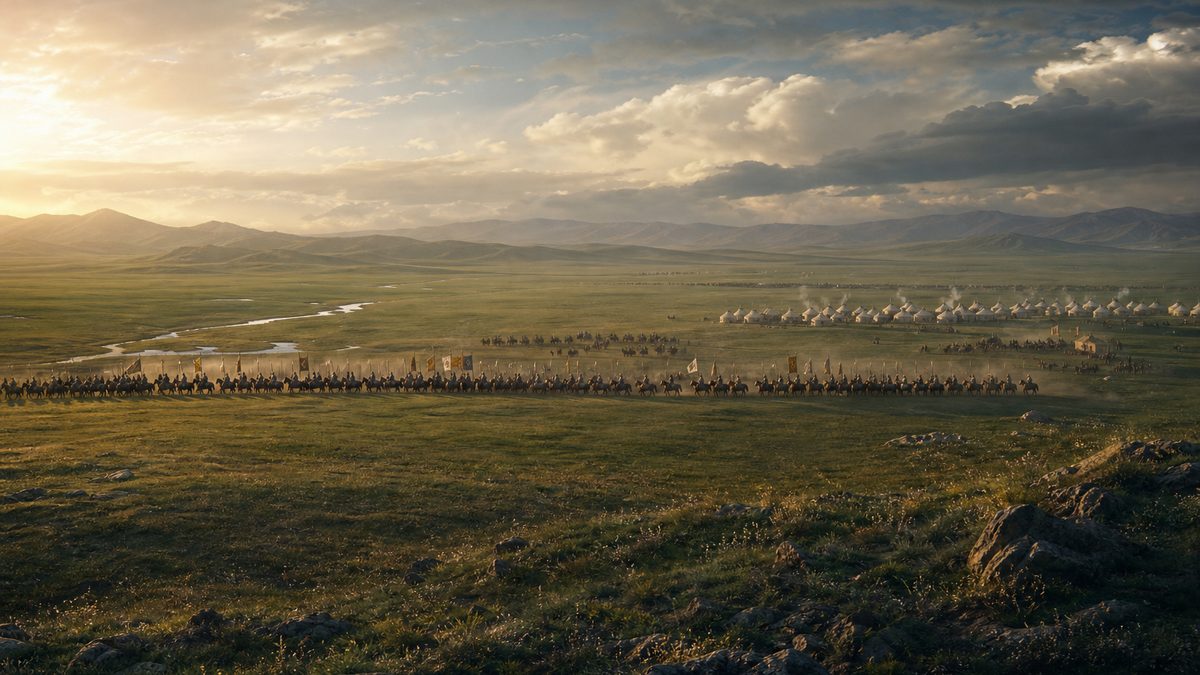
In the 1100s the grasslands of Mongolia were home to rival tribes of herders: Mongols, Tatars, Keraits, Naimans and others, who fought and allied with each other.

To the south, the Jin dynasty ruled northern China and played the tribes against one another. Further south was the Song dynasty, and to the west, the Khwarazmian Empire.

Prologue · Episode 09 of the World Empires series

The steppe

The steppe peoples lived from horses, sheep and trade. Every boy and girl learned to ride and shoot. Since the Xiongnu (Episode 05), steppe confederations had risen and fallen many times.

Grey outlines show other powers of the time. Outlines are approximate.

Sources: Wikipedia: Mongol Empire

Chapter I · Genghis Khan

Chapter I · 1162–1206

Temüjin becomes Genghis Khan

From outcast boy to ruler of all the felt-tent peoples.

Temüjin was born around 1162. After his father was poisoned, his family was abandoned by their clan and survived on roots and fish.

Through loyalty, alliances and war, he defeated rival tribes one by one, and broke up old clan loyalties by mixing their people.

In 1206 a great assembly, a kurultai, by the Onon river proclaimed him Chinggis Khan, Genghis Khan in English, ruler of “all the people of the felt tents”.

Chapter I · Step 1

Temüjin becomes Genghis Khan

Born
c. 1162
Kurultai
1206
by the Onon river

Most of what we know about his early life comes from the “Secret History of the Mongols”, written soon after his death.

Sources: Britannica: Genghis Khan; Wikipedia: Mongol Empire

Chapter I · 1206–1218

An army of tens

How the Mongols organised.

Genghis Khan organised his people in units of ten, a hundred, a thousand and ten thousand, led by men chosen for loyalty and skill, not birth.

A legal code, the Yassa, set rules. A Uyghur script was adopted to write Mongolian. A chain of relay stations, the yam, let messengers cross the empire on fresh horses.

Each soldier had several horses. A Mongol army could move faster than any army of the time.

Chapter I · Step 2

An army of tens

  • arban 10
  • jaghun 100
  • mingghan 1,000
  • tumen 10,000

The yam relay system was used for centuries, and travellers carried metal passes, paiza, to use it.

Sources: Wikipedia: Yam (route); Wikipedia: Mongol Empire

Chapter I · 1211–1221

North China and Central Asia

Two great campaigns.

From 1211 the Mongols attacked the Jin and in 1215 took their capital Zhongdu, today’s Beijing.

In 1218 a Mongol trade caravan was massacred at Otrar, in the Khwarazmian Empire. Genghis Khan’s response was total war.

Bukhara, Samarkand, Merv and other great cities of Central Asia were taken between 1219 and 1221. Many were destroyed and their people killed in huge numbers, though medieval figures in the millions are probably exaggerated.

Chapter I · Step 3

North China and Central Asia

  • 1215 Zhongdu (Beijing) falls
  • 1218 Otrar caravan massacre
  • 1219–1221 Khwarazmian Empire destroyed
Sources: Wikipedia: Mongol invasion of the Khwarazmian Empire

Chapter II · World conquest

Chapter II · 1227–1235

Karakorum

The sons take over.

Genghis Khan died in 1227. His lands were shared among his sons and grandsons, and his son Ögedei was chosen as Great Khan.

In 1234 the Mongols destroyed the Jin dynasty. In 1235 Ögedei built walls around a capital at Karakorum, in central Mongolia.

Visitors found merchants, craftsmen and religious leaders from across Asia and Europe there: Buddhists, Muslims, Christians and shamans.

Chapter II · Step 4

Karakorum

Death of Genghis Khan
1227
Jin destroyed
1234
Karakorum walled
1235
Sources: Wikipedia: Mongol Empire

Chapter II · 1236–1242

Into Europe

Russia, Poland and Hungary.

From 1236 a Mongol army led by Batu and the general Subutai conquered the Russian principalities. Kyiv fell in 1240.

In April 1241 they defeated a Polish and German army at Legnica, and a Hungarian army at Mohi, two days apart.

In 1242 they withdrew. News of Ögedei’s death may have been the reason; historians also point to supplies and pasture.

Chapter II · Step 5

Into Europe

  • 1240 Kyiv falls
  • 9 Apr 1241 Legnica
  • 11 Apr 1241 Mohi
  • 1242 Withdrawal from central Europe

The Russian lands paid tribute to the Golden Horde for over two centuries.

Sources: Wikipedia: Mongol invasion of Europe

Chapter II · 1258–1260

Baghdad and Ain Jalut

The Middle East.

Hulagu, a grandson of Genghis Khan, led an army west. In 1258 he took Baghdad and ended the Abbasid caliphate (Episode 07).

In 1260 the Mamluks of Egypt defeated a Mongol army at Ain Jalut, in today’s Israel.

It was one of the first major battles the Mongols lost, and it marked the western limit of their power in the Middle East.

Chapter II · Step 6

Baghdad and Ain Jalut

Baghdad
1258
Ain Jalut
3 Sep 1260
Sources: Wikipedia: Mongol Empire

Chapter II · c. 1270

The largest land empire

From the Pacific to the Danube.

At its height the Mongol Empire covered around 24 million square kilometres, about a sixth of the world’s land.

Only the British Empire, spread across the oceans, was ever larger. No other empire has controlled so much land in one continuous block.

But by then it was no longer one state.

Chapter II · Step 7

The largest land empire

Peak area
~24M km²
c. 1270–1309; estimates vary
Population ruled
perhaps 100 million or more
rough estimate

Compare: Umayyad Caliphate ~11M km² (Episode 07), Rome ~5M km² (Episode 06).

Sources: Wikipedia: List of largest empires; Wikipedia: Mongol Empire

Chapter III · Four khanates

Chapter III · 1260–1294

Four khanates

A family empire splits.

In 1260 two grandsons of Genghis Khan, Kublai and Ariq Böke, fought a civil war over the title of Great Khan. Kublai won.

The empire split into four khanates: the Yuan in China and Mongolia, the Golden Horde in the west, the Ilkhanate in Persia, and the Chagatai Khanate in Central Asia.

They sometimes fought each other. Over time the western khanates adopted Islam, and the Yuan court favoured Tibetan Buddhism.

Chapter III · Step 8

Four khanates

  • Yuan China, Mongolia; capital Dadu (Beijing)
  • Golden Horde Russian steppe; capital Sarai
  • Ilkhanate Persia, Iraq; capital Tabriz
  • Chagatai Central Asia
Sources: Wikipedia: Mongol Empire

Chapter III · 1271–1293

Kublai Khan’s China

Victory on land, defeat at sea.

Kublai named his dynasty Yuan in 1271 and ruled from Dadu, today’s Beijing. In 1279 he completed the conquest of the Song: all China was under Mongol rule.

His invasions of Japan in 1274 and 1281 failed; the second fleet was wrecked by a typhoon, the “kamikaze”. Đại Việt defeated his armies, at the Bạch Đằng river in 1288. A 1293 expedition to Java also failed.

Pagan in Burma was invaded in 1287. Sukhothai sent envoys to the Yuan court in the 1290s, keeping good relations with the great power.

Chapter III · Step 9

Kublai Khan’s China

  • 1271 Yuan dynasty named
  • 1274, 1281 Invasions of Japan fail
  • 1279 End of the Song
  • 1287 Invasion of Pagan
  • 1288 Bạch Đằng: Đại Việt victory
  • 1293 Java expedition fails
Sources: Wikipedia: Yuan dynasty; Wikipedia: Mongol invasions of Japan

Chapter III · 1271–1350

The Mongol peace

Open roads for goods, people and disease.

With one family ruling most of Asia, travel along the Silk Road became safer than ever. Historians call it the Pax Mongolica.

The Venetian Marco Polo said he served Kublai Khan for seventeen years. The Moroccan traveller Ibn Battuta reached China in the 1340s.

The same roads may have carried the Black Death. In 1346 it struck a Mongol army besieging Caffa in Crimea, and from there it reached Europe by ship.

Chapter III · Step 10

The Mongol peace

  • 1271–1295 Marco Polo’s journey (details debated)
  • 1340s Ibn Battuta in India and China
  • 1346–1353 Black Death reaches Europe
Sources: Wikipedia: Pax Mongolica

Chapter III · 1335–1502

The khanates fade

Plague, rebellion and new powers.

The Ilkhanate broke apart after 1335. In China, floods, famine and the Red Turban rebellion ended Yuan rule in 1368: the Ming dynasty took over, and the Mongols retreated to the steppe.

The Golden Horde lasted longest. In 1480 Moscow stopped paying it tribute, and its last remnant fell in 1502.

Rulers across Asia still claimed descent from Genghis Khan, including Babur, founder of the Mughal Empire in India.

Chapter III · Step 11

The khanates fade

  • 1335 Ilkhanate fragments
  • 1368 Ming replaces Yuan in China
  • 1480 Moscow ends tribute (stand on the Ugra)
  • 1502 End of the Great Horde
Sources: Wikipedia: Mongol Empire

Epilogue

Epilogue

Destroyers and connectors

How should we remember the Mongols?

For many peoples, from Persia to Russia to China, the Mongol conquest is remembered for massacres and ruined cities.

Historians also stress the trade, ideas and technologies that moved along Mongol roads, and the religious tolerance of the early khans. In Mongolia today, Genghis Khan is honoured as the founding father of the nation.

Next: the Ottoman Empire, which rose from the ruins of this world and took Constantinople in 1453.

Epilogue

Destroyers and connectors

  • 1206 Genghis Khan proclaimed
  • 1241 Legnica and Mohi
  • 1258 Baghdad
  • 1279 All of China under the Yuan
  • 1368 Yuan ends
The series
  1. 00The Rise and Fall of Empires (overview)
  2. 01The First Empires: Mesopotamia
  3. 02Egypt of the Pharaohs
  4. 03Persia and Alexander
  5. 04The Maurya Empire of India
  6. 05China Unified: Qin and Han
  7. 06Rome
  8. 07The Islamic Caliphates
  9. 08The Khmer Empire of Angkor
  10. 09 The Mongol Empire (this film)
  11. 10The Ottoman Empire
  12. 11The Aztec and Inca Empires
  13. 12The Age of Sea Empires
  14. 13The End of Empires

The still images on the chapter cards are AI-generated illustrations. Outlines are approximate.
Sources: Wikipedia: Mongol Empire; Wikipedia: Pax Mongolica; Wikipedia: List of largest empires