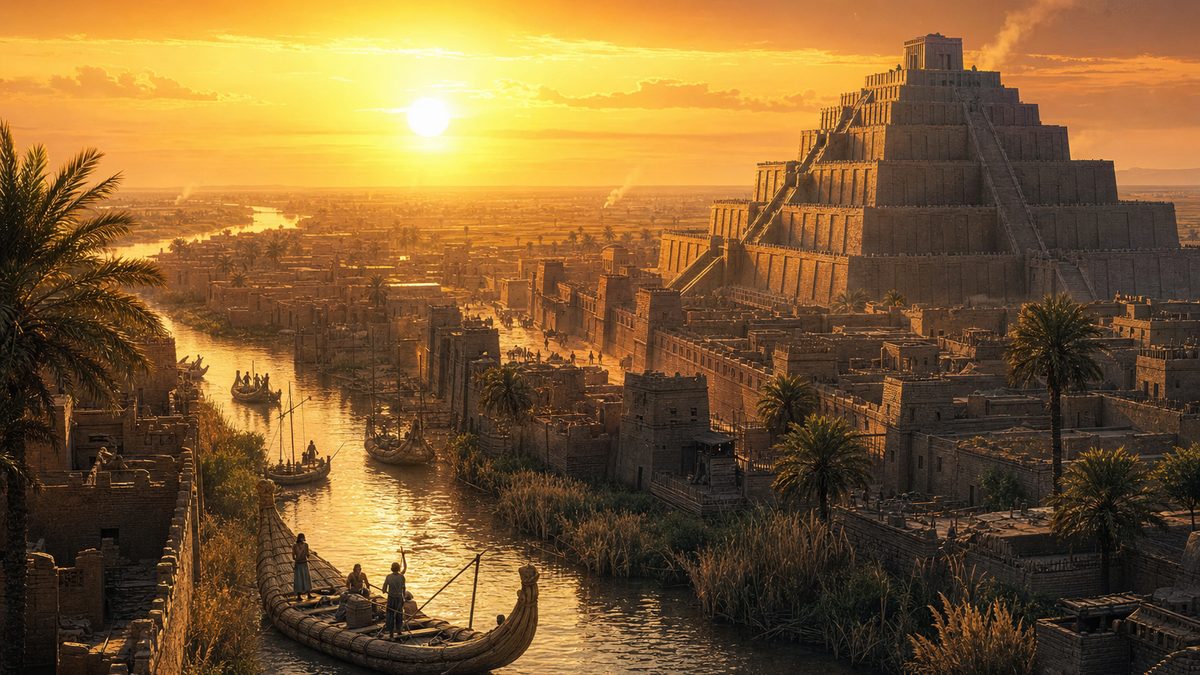
How the cities between the Tigris and the Euphrates invented writing and then the world's first empires: Sargon's Akkad, Ur, Hammurabi's Babylon, Assyria and Nebuchadnezzar's Babylon. Episode 01 of the World Empires series.
Interactive 3D film6 min3200 to 539 BCPublished 2026-10-13
Mesopotamia means “the land between the rivers”: the Tigris and the Euphrates, in what is now Iraq.
Here, by around 3200 BC, cities such as Uruk had grown to tens of thousands of people, and scribes began to write, pressing marks into clay.
Writing let rulers count grain, record taxes and send orders. Those tools would one day make empires possible.
Prologue · Episode 01 of the World Empires series
The land between the rivers
The flat floodplain of the Tigris and Euphrates had rich soil but little rain. Farming depended on canals, and canals needed organisation. Cities, temples and kings grew up to manage water, labour and food.
Irrigation produced grain surpluses.
Surpluses fed priests, craftsmen, soldiers and scribes.
Writing (cuneiform, from about 3200 BC) kept the accounts.
On the globe, the yellow area marks the Sumerian heartland in the far south. Outlines throughout are approximate.
Each Sumerian city had its own king, its own god and its own army.
For centuries Sumer was a patchwork of independent city-states: Uruk, Ur, Lagash, Kish, Umma and others.
They fought over fields and canals. Kings made treaties, built temple platforms, and boasted of their victories in stone.
Shortly before 2300 BC, King Lugalzagesi of Uruk brought many of these cities under his control. But his realm would not last long.
Prologue · Step 2
A land of rival cities
Early Dynastic Sumer (c. 2900–2350 BC) had perhaps a dozen major cities. A ruler of one city sometimes dominated others, but none built a lasting state that ruled many peoples.
The outline shows the area under Lugalzagesi of Uruk just before Sargon’s conquest (approximate).
A new kind of ruler: king not of one city, but of many.
Around 2334 BC, by the usual dating, a ruler called Sargon founded a new capital, Akkad. Later legend said he began as cupbearer to the king of Kish.
He defeated Lugalzagesi and conquered Ur, Umma and Lagash, “as far as the sea”.
Then he marched up the Euphrates to Mari and Ebla, toward the cedar forests and the silver mountains of the west.
An inscription claims that 5,400 men ate bread daily in his presence: a standing royal army, something new.
Chapter I · Step 3
Sargon of Akkad
Reign
c. 2334–2279 BC
Middle Chronology
Capital
Akkad
its site has never been found
Claim
“5,400 men ate bread daily before him”
Sargon’s inscription from Nippur
Dates for Akkad depend on which chronology scholars use; the “short chronology” puts everything about 64 years later. The story that Sargon was a cupbearer comes from later texts, not from his own time.
Sargon’s grandson Naram-Sin pushed the empire to its height.
Sargon’s grandson Naram-Sin ruled from about 2254 BC. He called himself “king of the four quarters” of the world.
He was even worshipped as a god while still alive, something new for a Mesopotamian king.
At its height the empire covered perhaps 800,000 square kilometres, from the Gulf to the Mediterranean.
Its language, Akkadian, became the common language of the Near East for some two thousand years.
Chapter I · Step 4
King of the four quarters
Naram-Sin
c. 2254–2218 BC
deified in his lifetime
Peak area
~0.8M km²
c. 2250 BC (Taagepera)
Akkadian, written in cuneiform, was used for diplomacy across the Near East into the 1st millennium BC, even by Egyptian pharaohs writing to foreign kings.
A small city becomes the centre of the Mesopotamian world.
In 1792 BC Hammurabi became king of Babylon, then a modest city. Late in his reign he conquered his rivals, including Larsa and Mari.
He is remembered for his law code: 282 laws carved on a black stone stele more than two metres tall.
Many laws set punishments that varied by social class: an eye for an eye, but only between equals.
The stele was found at Susa in 1901, probably carried off as war booty, and is now in the Louvre. His dynasty ended when the Hittites sacked Babylon in 1595 BC.
Chapter II · Step 7
Hammurabi’s Babylon
Reign
1792–1750 BC
Middle Chronology
Laws
282
in “if… then…” form
The stele
Diorite, about 2.25 m tall; found at Susa in 1901; now in the Louvre
From Hammurabi’s time, Babylon stayed a sacred and political centre for more than a thousand years.
Assyria’s armies used iron weapons, cavalry and siege engines. Conquered peoples were often deported, tens of thousands at a time, to break resistance.
In 722 BC Samaria fell and the kingdom of Israel ended. In 671 BC Esarhaddon invaded Egypt.
At about 1.4 million square kilometres, Assyria was the largest empire the world had yet seen.
At Nineveh, King Ashurbanipal gathered a great library of clay tablets, which preserved the Epic of Gilgamesh.
Chapter III · Step 9
From Iran to Egypt
Peak area
~1.4M km²
c. 670 BC (Taagepera)
Capital
Nineveh
from 705 BC
Assyria held Egypt only loosely and briefly (about 671–656 BC). Deportation figures in Assyrian records are large but debated.
Writing, written law, cities, and the hours of the clock.
For about 1,800 years, empires rose and fell between the rivers: Akkad, Ur, Babylon, Assyria and Babylon again.
Each fell to revolts, rival powers, and sometimes a changing climate. Yet their inventions spread far beyond them.
Writing, written law, kingship and imperial provinces were copied by later empires. Their counting in sixties survives in our sixty seconds and sixty minutes.
Next, we travel west to the Nile, and the pharaohs of Egypt.
Epilogue
What Mesopotamia left us
Writing Cuneiform, used for some 3,000 years
Law Written law codes (Ur-Nammu, Hammurabi)
Empire Provinces, governors, standing armies
Time Base-60 counting: 60 seconds, 60 minutes, 360 degrees
The series
00The Rise and Fall of Empires (overview)
01 The First Empires: Mesopotamia (this film)
02Egypt of the Pharaohs
03Persia and Alexander
04The Maurya Empire of India
05China Unified: Qin and Han
06 Rome (coming soon)
07 The Islamic Caliphates (coming soon)
08 The Khmer Empire of Angkor (coming soon)
09 The Mongol Empire (coming soon)
10 The Ottoman Empire (coming soon)
11 The Aztec and Inca Empires (coming soon)
12 The Age of Sea Empires (coming soon)
13 The End of Empires (coming soon)
All outlines shown here at once overlap in time only on the map, not in history. The still images on the chapter cards are AI-generated illustrations.