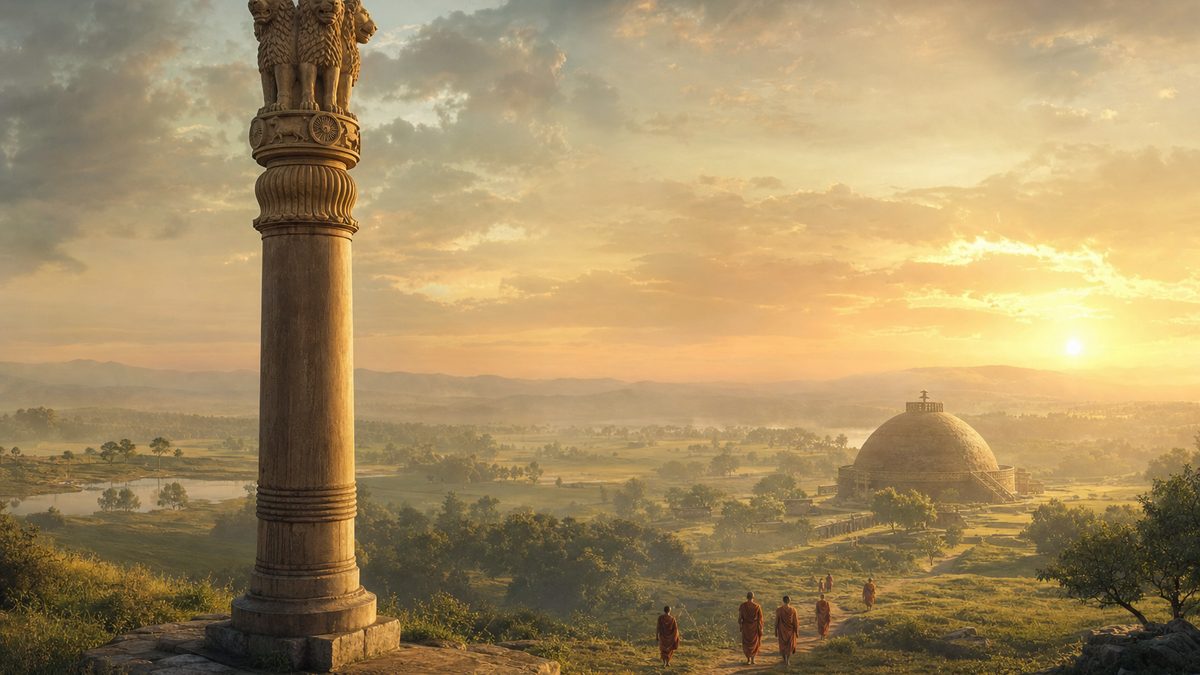
Chandragupta Maurya unites northern India in the power vacuum left by Alexander, makes peace with Seleucus for 500 elephants, and his grandson Ashoka conquers Kalinga, regrets it, and carves edicts of dhamma across the subcontinent while Buddhist missions travel abroad. Episode 04 of the World Empires series.
Interactive 3D film5 min322 to 185 BCPublished 2026-10-13
In the 300s BC, northern India was divided among many kingdoms. The richest was Magadha, on the Ganges, ruled by the Nanda dynasty from Pataliputra, today’s Patna.
In 326 BC, Alexander’s army reached the Indus and turned back. Into the power vacuum it left stepped a young man named Chandragupta.
Prologue · Episode 04 of the World Empires series
India before the Mauryas
The Ganges plain had fertile soil, iron and growing cities. Magadha, in today’s Bihar, had become the leading kingdom under the Nanda dynasty. In the north-west, Alexander’s brief invasion left Greek garrisons and local rulers in disarray.
Grey outlines show other powers of the time. Outlines are approximate.
Alexander’s general Seleucus tried to reclaim the Indus lands. Instead, around 303 BC, he made peace with Chandragupta.
The Mauryas gained Arachosia and Gandhara, in today’s Afghanistan and Pakistan. Seleucus received 500 war elephants, and the two families made a marriage alliance.
A Greek ambassador, Megasthenes, lived at Pataliputra and described a vast walled city and an enormous army, though his numbers may be exaggerated.
Chapter I · Step 2
Peace with Seleucus
Elephants to Seleucus
500
c. 303 BC
Army (Megasthenes)
600,000 infantry, 9,000 elephants
an ancient claim, probably inflated
The elephants helped Seleucus win the Battle of Ipsus in 301 BC (Episode 03).
Ashoka had his messages carved on rocks and tall polished pillars across the empire, in local languages and scripts, even Greek and Aramaic near Kandahar.
They urged honesty, kindness to animals, respect for all religious groups, and announced wells, rest houses and medical care for people and animals.
At its height the empire covered most of the subcontinent, by estimates between 3.4 and 5 million square kilometres.
Chapter II · Step 5
Rule by dhamma
Inscriptions
33
incl. 14 Major Rock Edicts
Peak area
~3.4–5M km²
c. 250 BC; estimates vary
Languages and scripts
Prakrit in Brahmi and Kharosthi; Greek and Aramaic at Kandahar
Missions from Ashoka’s court spread the Buddha’s teaching.
According to Buddhist chronicles, Ashoka supported a great council of monks, and sent missions to neighbouring lands.
His son Mahinda is said to have brought Buddhism to Sri Lanka. Sri Lankan chronicles also say monks named Sona and Uttara went to a “Golden Land”, Suvarnabhumi.
Thailand and Myanmar both claim that land. Historians note that no Southeast Asian record mentions the story before the second millennium AD, so it remains a tradition.
Chapter II · Step 6
Buddhism travels
Ashoka’s own edicts mention sending envoys of dhamma to Greek kings in the west and to the south. The detailed stories of missions to Sri Lanka and Suvarnabhumi come from later Sri Lankan chronicles such as the Mahavamsa (5th century AD).
Thai tradition links Suvarnabhumi with central Thailand (for example Nakhon Pathom); Myanmar tradition with Thaton in the Mon country. Its marker here is deliberately vague.
Within fifty years of Ashoka’s death, the empire was gone.
After Ashoka died around 232 BC, the empire was divided among weaker successors, and distant provinces broke away.
In 185 BC, according to later accounts, the general Pushyamitra Shunga killed the last Maurya king during a military review, and founded his own dynasty.
Some later writers blamed Ashoka’s pacifism. Most historians point instead to an over-centralised state that was hard to hold together.
Chapter III · Step 7
A swift decline
c. 232 BC Death of Ashoka
c. 200 BC Greco-Bactrian kings push into the north-west
185 BC Pushyamitra kills Brihadratha; Shunga dynasty