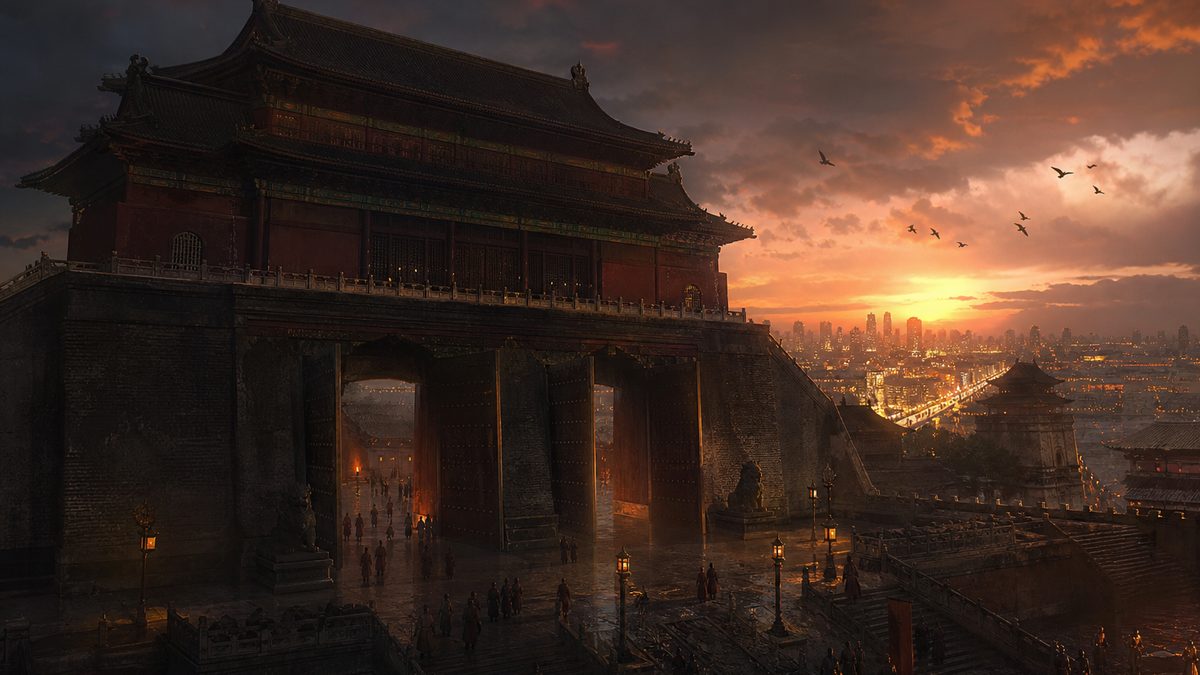
The First World War destroys the Russian, German, Austro-Hungarian and Ottoman empires, Siam joins the peace conference, Japan's empire rises and falls, India, Pakistan, Indonesia, Burma, Indochina, Malaya and Africa win independence, the United Nations grows from 51 to 193 members, the Soviet Union dissolves, Hong Kong and Macau are handed over, and a final replay shows four thousand years of empires on one globe. Episode 13, the final episode of the World Empires series.
Interactive 3D film6 min1914 to todayPublished 2026-10-13
In 1914, a handful of empires ruled most of the world’s land and people. Britain, France, Russia, the Ottomans, Austria-Hungary, Germany and Japan, plus older empires like Portugal’s.
In Asia, only a few states, among them Japan, China, Siam and Persia, were not ruled directly by a European power, and most of those were under heavy outside pressure.
Prologue · Episode 13 of the World Empires series
The world in 1914
Episode 12 ended with empires at their peak. This episode follows their end, in about eighty years.
The First World War destroyed four empires: the Russian in 1917, the German and Austro-Hungarian in 1918, and the Ottoman by 1922. New states appeared across Eastern Europe.
At Paris in 1919, the victors spoke of self-determination, but mostly applied it in Europe. Ottoman Arab lands and German colonies became “mandates” run by Britain and France.
Siam had joined the war on the Allied side in 1917. It sat at the peace conference and joined the League of Nations, and used that position to start renegotiating its unequal treaties.
Japan built an empire on the Western model: Taiwan in 1895, Korea in 1910, Manchuria in 1931, then war with China from 1937.
From December 1941 it overran Southeast Asia, from Burma to the Philippines and the Dutch East Indies, under the slogan of an Asia freed from Western rule. Its occupation was often brutal.
Its defeat in 1945 ended its empire. But European powers returning to Asia found that the old colonial order could not simply be restored.
Chapter I · Step 2
Japan’s empire
1895 Taiwan
1910 Korea annexed
1931–1932 Manchuria (Manchukuo)
1941–1945 War in Asia and the Pacific
Aug 1945 Surrender
Thailand, under military government, allied with Japan in 1941; a Free Thai resistance movement worked with the Allies.
Indonesia declared independence on 17 August 1945 and fought the Dutch until 1949. The Philippines became independent from the United States in 1946.
On 15 August 1947 British India became two states, India and Pakistan. Partition caused mass migration of perhaps 15 million people, and violence in which hundreds of thousands, perhaps over a million, died.
Burma and Ceylon, today’s Sri Lanka, became independent in 1948.
Chapter II · Step 3
Asia goes first
1945 Indonesia declares independence (recognised 1949)
In 1957 Ghana became the first colony in sub-Saharan Africa to win independence. In 1960, the “Year of Africa”, seventeen African countries became independent.
Some transitions were peaceful. Others came through long wars: Algeria fought France from 1954 to 1962, and Kenya saw the Mau Mau uprising against Britain.
Portugal held on longest. After a revolution in Lisbon in 1974, Angola, Mozambique and its other colonies became independent in 1975.
The Soviet Union was a federation of fifteen republics, and after 1945 it also dominated the communist states of Eastern Europe.
Some historians call it an empire, pointing to central control from Moscow and the use of force in Hungary in 1956 and Czechoslovakia in 1968. Others stress that it officially rejected empire and promoted its many nationalities.
In 1989 the Berlin Wall fell. On 26 December 1991 the Soviet Union was dissolved, and fifteen independent states took its place.
Chapter III · Step 7
The Soviet Union
1922 USSR founded
1956, 1968 Hungary, Czechoslovakia
1989 Fall of the Berlin Wall
26 Dec 1991 Dissolution: 15 states
Whether to call the USSR an empire remains a political as well as a historical question.
Many of today’s borders were drawn by empires, especially in Africa and the Middle East, where straight lines on maps cut across peoples.
English, Spanish, French, Portuguese, Russian and Arabic spread as world languages through empire. Fifty-six countries, most of them former British territories, belong to the Commonwealth.
Debates continue: about apologies and reparations, about museum objects taken in colonial times, and about how to teach this history.
Chapter IV · Step 9
What empires left behind
Borders Many drawn by imperial treaties
Languages English, Spanish, French, Portuguese, Russian, Arabic