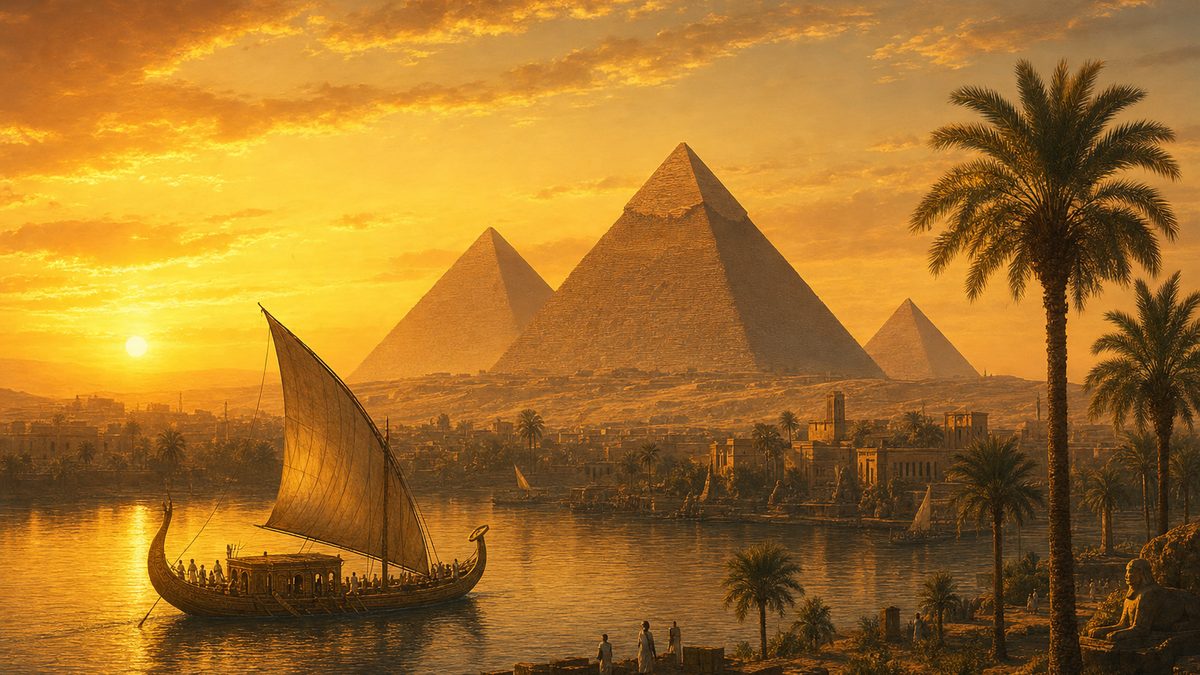
Three thousand years of the pharaohs: the unification of the Two Lands, the pyramids, the New Kingdom empire from Nubia to the Euphrates, Ramesses II, the Kushite pharaohs, the Ptolemies and Cleopatra. Episode 02 of the World Empires series.
Interactive 3D film6 min3100 to 30 BCPublished 2026-10-13
Seen from above, Egypt is a thin green ribbon along the Nile, with desert on both sides.
Every summer the river flooded, leaving fresh black silt on the fields. The Greek writer Herodotus called Egypt “the gift of the Nile”.
The desert protected the valley, and the river was a highway. It was the perfect place for a state to last.
Prologue · Episode 02 of the World Empires series
A green ribbon through the desert
Almost all of Egypt’s people lived within a few kilometres of the Nile. The yearly flood made farming easy and predictable, deserts kept most invaders away, and boats could sail north with the current and south with the wind.
Egyptian history is divided into “kingdoms” (times of unity) and “intermediate periods” (times of division). Exact dates differ between scholars by decades.
Kings who were gods, and tombs built to last forever.
In the Old Kingdom, the pharaoh was seen as a living god. His tomb was a gateway to eternal life.
Around 2650 BC, the architect Imhotep built a step pyramid for King Djoser at Saqqara, the first great building in stone.
Around 2560 BC, the Great Pyramid of Khufu at Giza rose about 146 metres, built from an estimated 2.3 million stone blocks.
It remained the tallest structure on Earth for more than 3,800 years. Building it took a state that could feed and organise tens of thousands of workers.
Chapter I · Step 3
The age of the pyramids
Step pyramid of Djoser
c. 2650 BC
architect Imhotep
Great Pyramid
~146.6 m
Khufu, finished c. 2560 BC
Blocks
~2.3 million
estimate
Tallest structure on Earth
3,800+ years
The pyramids were built by paid and conscripted Egyptian labour, not by slaves as once believed.
Around 1650 BC, rulers of Levantine origin, known as the Hyksos, took control of the delta from their capital at Avaris.
Egyptian kings held on at Thebes in the south. They learned new technology from their rivals: horse-drawn chariots and composite bows.
Around 1550 BC, Ahmose of Thebes drove the Hyksos out. Egypt would never again feel safe behind its deserts.
Chapter II · Step 5
Foreign kings and a war of liberation
The Hyksos (“rulers of foreign lands”) were not invaders on horseback, as once imagined, but mostly descendants of migrants from the Levant who had settled in the delta. Their rule was later remembered by Egyptians as a humiliation.
Around 1177 BC, Ramesses III fought off the “Sea Peoples”, raiders who were part of a wider collapse that destroyed the Hittite Empire and many cities.
Egypt survived, but grew weaker: low floods, rising grain prices, and the first recorded labour strike, by tomb builders.
By 1069 BC the land was split again, with priests ruling the south from Thebes, and kings ruling the north.
Chapter III · Step 9
The end of the New Kingdom
c. 1177 BC Ramesses III defeats the Sea Peoples
Year 29 Workers at Deir el-Medina strike over late rations
The longest-lasting civilisation of the ancient world.
From the first pharaoh to Cleopatra, about three thousand years passed. Cleopatra lived closer in time to us than to the building of the Great Pyramid.
Egypt lasted so long because the Nile fed it, the desert shielded it, and its kingship and religion gave every new ruler a ready-made role.
When Jean-François Champollion deciphered hieroglyphs in 1822, Egypt’s own voice could be read again after nearly 1,500 years.
Next: Persia, the empire that conquered Egypt, Babylon and everything between.
Epilogue
Three thousand years
c. 3100 BC Unification
c. 2560 BC Great Pyramid
c. 1550 BC New Kingdom empire begins
c. 728 BC Kushite pharaohs
30 BC Death of Cleopatra VII; Egypt becomes Roman
1822 Champollion deciphers hieroglyphs
The series
00The Rise and Fall of Empires (overview)
01The First Empires: Mesopotamia
02 Egypt of the Pharaohs (this film)
03Persia and Alexander
04The Maurya Empire of India
05China Unified: Qin and Han
06 Rome (coming soon)
07 The Islamic Caliphates (coming soon)
08 The Khmer Empire of Angkor (coming soon)
09 The Mongol Empire (coming soon)
10 The Ottoman Empire (coming soon)
11 The Aztec and Inca Empires (coming soon)
12 The Age of Sea Empires (coming soon)
13 The End of Empires (coming soon)
The still images on the chapter cards are AI-generated illustrations. Outlines are approximate.