The Mexica found Tenochtitlan in Lake Texcoco and build the Triple Alliance's tribute empire; Pachacuti turns the small kingdom of Cusco into Tawantinsuyu, linked by the Qhapaq Ñan road system and recorded on quipus; then Cortés and his Tlaxcalan allies take Tenochtitlan, smallpox and civil war weaken the Incas before Pizarro captures Atahualpa at Cajamarca, and the Great Dying reshapes the Americas. Episode 11 of the World Empires series.
Interactive 3D film6 min1428 to 1572Published 2026-10-13
For thousands of years, the peoples of the Americas built cities and states with no contact with Europe, Africa or Asia.
Before the Aztecs and Incas came the Olmecs, the Maya, the great city of Teotihuacan, and, in the Andes, Tiwanaku, Wari and the Chimú. The two last empires inherited their roads, gods and ideas.
Prologue · Episode 11 of the World Empires series
A separate world
Maize, potatoes, beans and squash fed these civilisations. There were no horses, iron tools or wheeled carts; in the Andes, llamas carried goods.
Grey outlines show other powers of the time; in 1300 none of them knew the Americas existed. Outlines are approximate.
The Mexica, who later came to be called Aztecs, were latecomers to the Valley of Mexico. Their legend says their god told them to settle where they saw an eagle on a cactus.
Traditionally in 1325, they founded Tenochtitlan on a swampy island in Lake Texcoco.
They built causeways, aqueducts, and chinampas: gardens on rich mud between canals, which could give several harvests a year.
In 1428 Tenochtitlan allied with two other cities, Texcoco and Tlacopan, and overthrew their overlords. Historians call their empire the Triple Alliance or the Aztec Empire.
Their armies conquered city-states from the Gulf coast to the Pacific. Conquered cities kept their own rulers, but sent regular tribute: cotton cloth, cacao, feathers, gold, maize.
Some neighbours were never conquered, such as Tlaxcala and the Purépecha state to the west. They stayed bitter enemies.
Moctezuma II ruled from 1502. Spanish visitors later said the market at Tlatelolco, beside Tenochtitlan, drew tens of thousands of people a day, with cacao beans used as small change.
At the centre of the city stood the Templo Mayor, a double pyramid for the rain god Tlaloc and the war god Huitzilopochtli.
Aztec religion held that the gods needed human blood to keep the sun moving. Prisoners of war were sacrificed there; how many is debated, but archaeology confirms the practice.
The Inca were a small kingdom around Cusco, in the Peruvian Andes. Around 1438, their ruler Pachacuti defeated the rival Chanka people and began a rapid expansion.
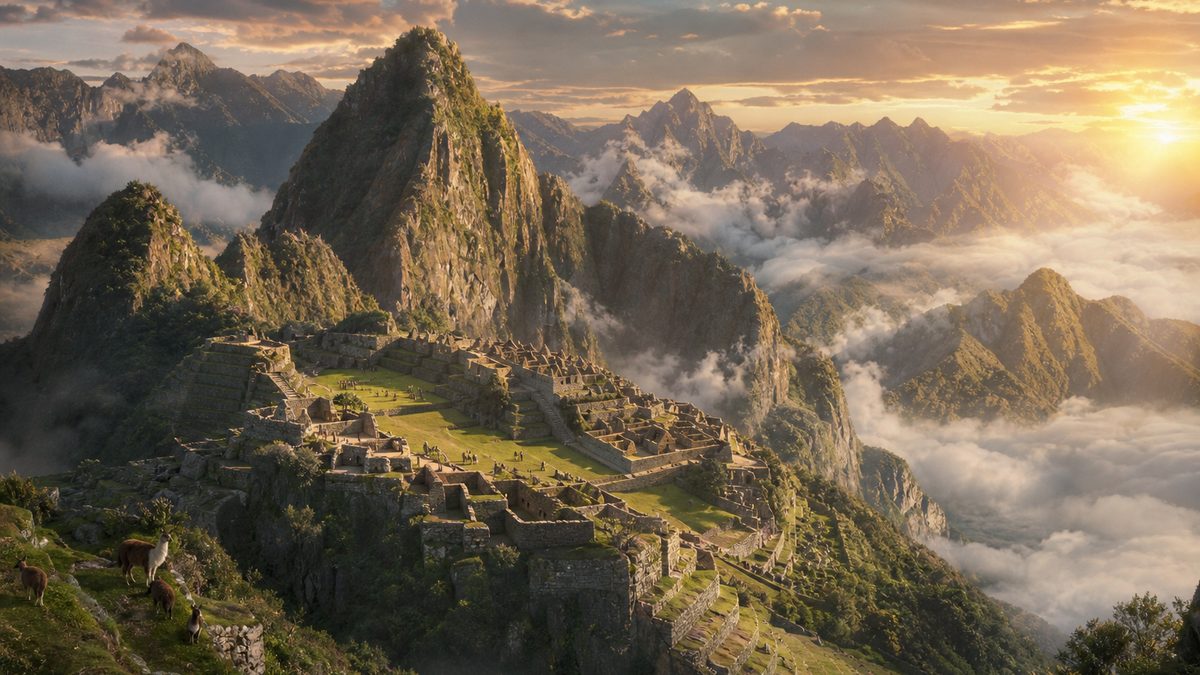
He rebuilt Cusco as a grand capital, and probably built Machu Picchu as a royal estate.
The Incas called their empire Tawantinsuyu, “the four parts together”.
Pachacuti’s son Topa Inca and grandson Huayna Capac pushed the empire north into Ecuador and south into Chile and Argentina.
A road system, the Qhapaq Ñan, ran more than 30,000 kilometres, with suspension bridges of woven grass and relay runners, chaskis, who could carry messages hundreds of kilometres a day.
At its height the empire ruled perhaps ten million people, over an area of about two million square kilometres.
The Inca state had no money and no markets on the Aztec scale. Instead, families owed labour, mit’a: farming state land, building roads, or serving in the army.
The state stored food, cloth and weapons in thousands of storehouses, and fed its workers and soldiers from them.
Records were kept on quipus, cords with knots that recorded numbers and perhaps more. Scholars still cannot fully read them.
In 1519 Hernán Cortés landed on the Gulf coast with about 500 Spanish soldiers. Many peoples who resented Aztec rule, above all the Tlaxcalans, joined him.
Moctezuma received the Spaniards in Tenochtitlan, then became their prisoner and died in 1520. In the same year, smallpox swept through the city.
In 1521, after a siege of about three months by Spanish ships and tens of thousands of Indigenous allies, Tenochtitlan fell on 13 August.
Chapter III · Step 7
The fall of Tenochtitlan
1519 Cortés lands; alliance with Tlaxcala
1520 Death of Moctezuma; smallpox epidemic
13 Aug 1521 Tenochtitlan falls
Historians now stress that this was in large part a war of Indigenous peoples against the Aztecs, with Spanish leadership.
European diseases spread south faster than the Spaniards themselves. Around 1527 an epidemic, probably smallpox, killed Huayna Capac and his chosen heir.
Two of his sons, Huáscar in Cusco and Atahualpa in Quito, fought a bitter civil war for the throne.
Atahualpa won in 1532. He was travelling south to take power when news came of strangers on the coast.
In November 1532 Francisco Pizarro, with 168 men, met Atahualpa at Cajamarca. In a surprise attack, the Spaniards killed many of his unarmed attendants and took him prisoner.
Atahualpa paid a ransom of a room filled with gold and silver. The Spaniards executed him anyway in 1533 and marched into Cusco.
Inca rulers held out in the jungle at Vilcabamba until 1572, when the last of them, Túpac Amaru, was captured and executed.
With no immunity to smallpox, measles, typhus and other diseases from Europe and Africa, Indigenous populations collapsed.
Combined with war, forced labour and famine, estimates suggest that the population of the Americas fell by 50 to 90 percent within a century.
Silver from Potosí and Mexico flowed to Spain and on to China. Spain built a new colonial empire on the ruins of the old ones, the subject of the next episode.