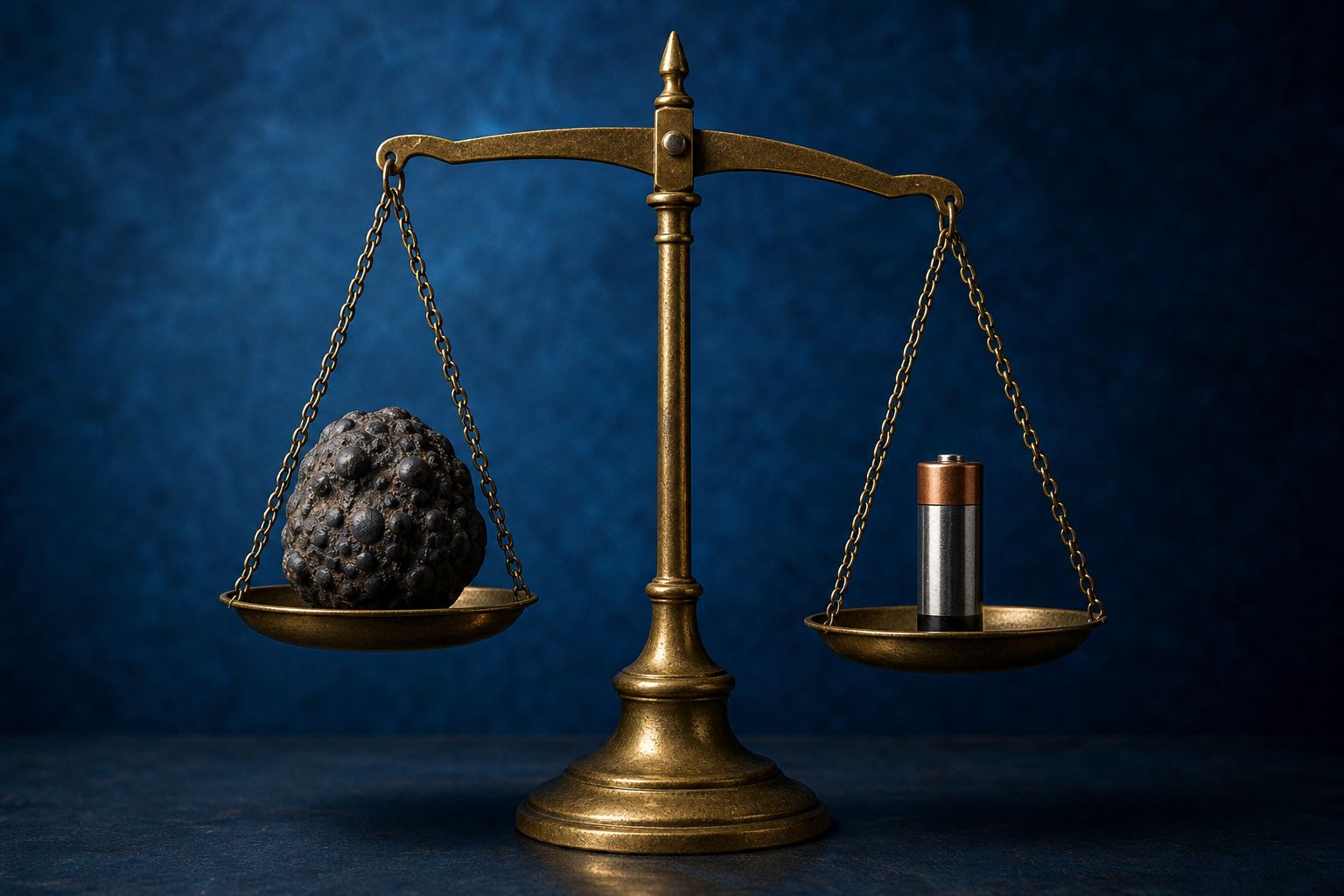
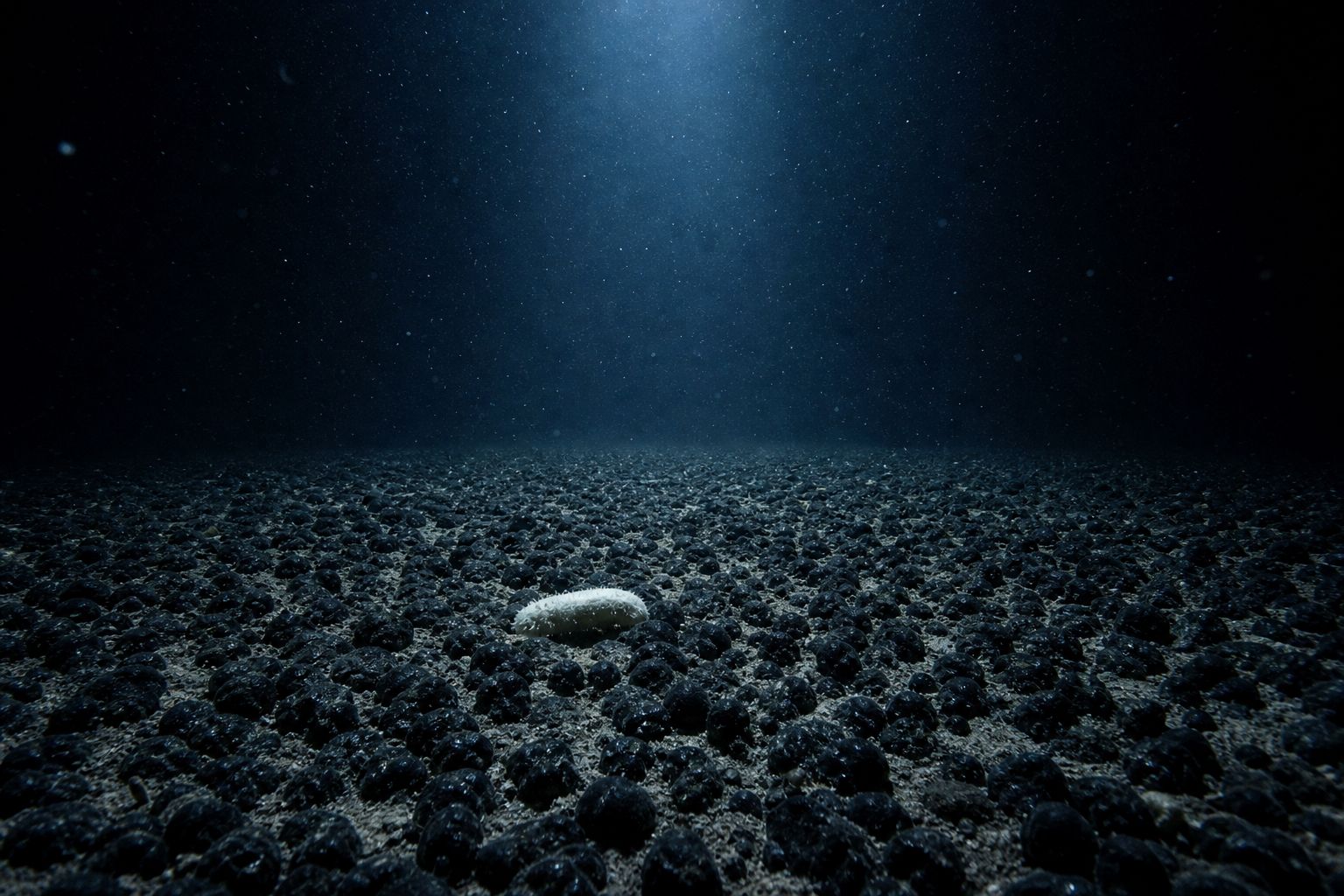
In November 2026 a study in Scientific Reports found up to 245 tiny animals living in the cracks of a single deep-sea nodule. This film explains what those nodules are: lumps of manganese and iron oxide that grow around a shark tooth or a shell over millions of years, four to six kilometres down in the cold and dark. It follows them from the HMS Challenger expedition of 1873 to the Clarion-Clipperton Zone between Hawaii and Mexico, explains the nickel, cobalt and copper they hold, the life that depends on them, the disputed “dark oxygen” finding, the tracks of a 1979 mining test still visible today, and how the International Seabed Authority, the United States and the two sides of the mining debate see the question.
Interactive 3D film10 min1873 to 2026Published 18 November 2026
In the cracks of a single fist-sized stone from the bottom of the Pacific lived as many as 245 animals, each smaller than a millimetre.
Marine scientists in Bremen, Germany, and in the Netherlands reported the count in November 2026.
The stones are polymetallic nodules: lumps of metal oxide, which is metal combined with oxygen, as in rust. They lie four to six kilometres down, by the billion.
Mining companies want their metals. Biologists want to know what lives on them. This is the story of both.
Split open The animals hide in cracks too narrow to see without a microscope. AI-generated illustration.
244
nodules split open
4,139
animals found
245
most in one nodule
The 2026 count
Hidden worlds in the deep oceanTitle of the press release from MARUM, the University of Bremen’s marine research centre, 11 November 2026
the cold, dark abyss
stones that grow millimetres in a million years
the metals inside, and the life outside
mining tracks that last decades
who decides, and the two sides
In this film
Prologue
The news
MARUM (University of Bremen) and NIOZ, press release of 11 November 2026, also reported by EurekAlert! and Ocean News & Technology: the study “Polymetallic nodules provide a distinct habitat for abyssal meiofauna” in Scientific Reports found 4,139 animals in 244 nodules from the Clarion-Clipperton Zone, 17 per nodule on average and up to 245 in one.
This is one new study; the film uses it as the starting point, not as settled science. NIOZ is the Royal Netherlands Institute for Sea Research.
Press the buttons to split the nodule or put it back together, and to count the animals.
The 3D scenes are simplified teaching models: the seafloor, nodules, machines and map are drawn schematically and not to scale.
To reach them, go down, into water that sunlight never reaches.
Every ten metres of water adds about one atmosphere of pressure. At five kilometres that is around five hundred times what we feel at the surface.
The water is close to freezing, between zero and four degrees. With no light, nothing here can photosynthesise.
Food falls from above: dead organic matter sinking from the sunlit waters.
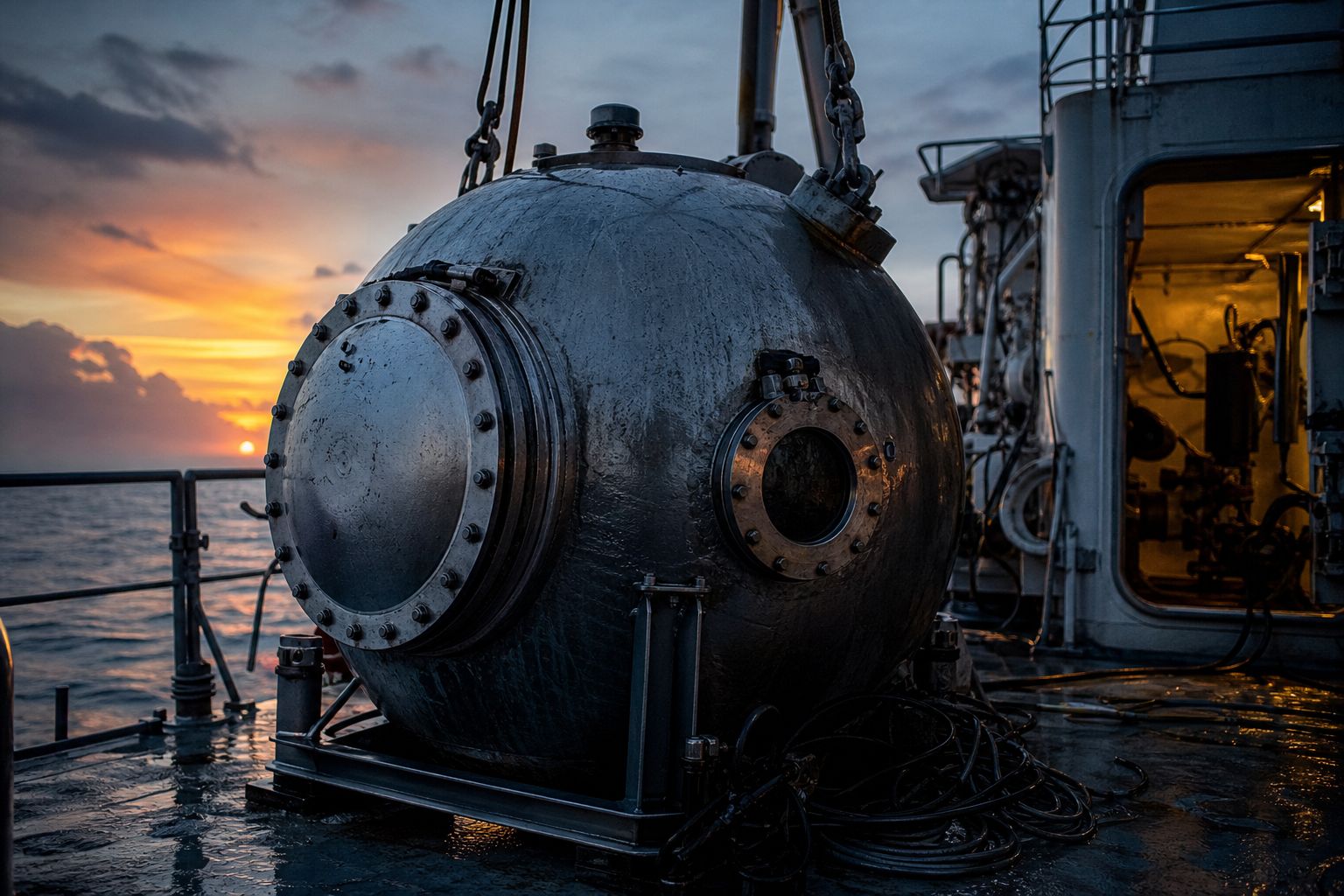
Built for the crush Instruments sent to the abyss travel in thick-walled housings. AI-generated illustration.
2–6 km
depth range
200–600 atm
pressure
0–4 °C
temperature
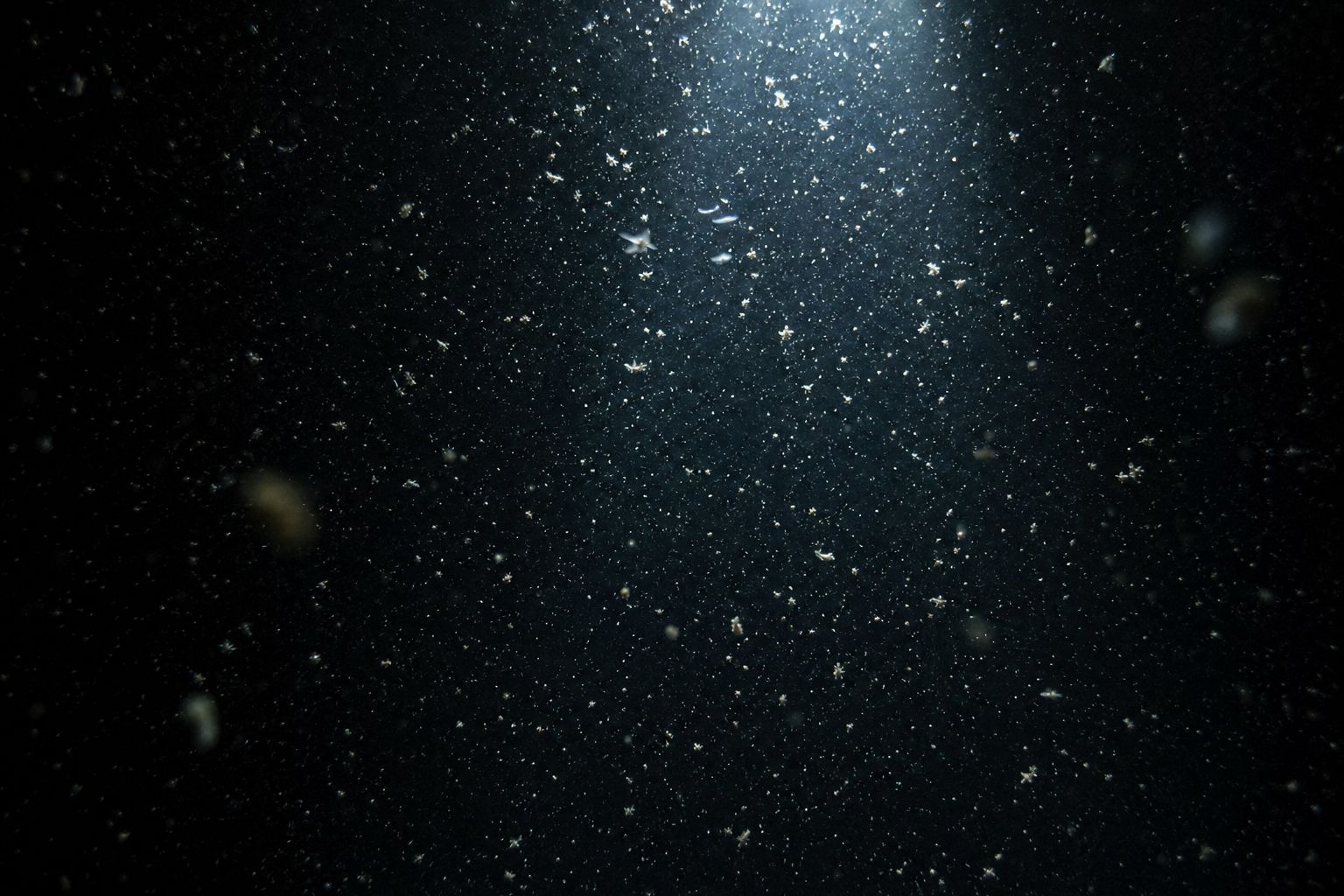
The abyssal zoneFalling food With no sunlight below, this slow fall of dead matter is what feeds the abyss. AI-generated illustration.
Chapter I · The abyss
The abyss
Britannica: the abyssal zone runs from about 2,000 to 6,000 metres. Temperatures are mostly 0–4 °C; pressure rises by about one atmosphere every 10 metres, giving roughly 200–600 atmospheres. There is no sunlight, so no photosynthesis: food is organic matter sinking from above.
Press a depth to send the probe there and read the pressure and temperature.
The 3D scenes are simplified teaching models: the seafloor, nodules, machines and map are drawn schematically and not to scale.
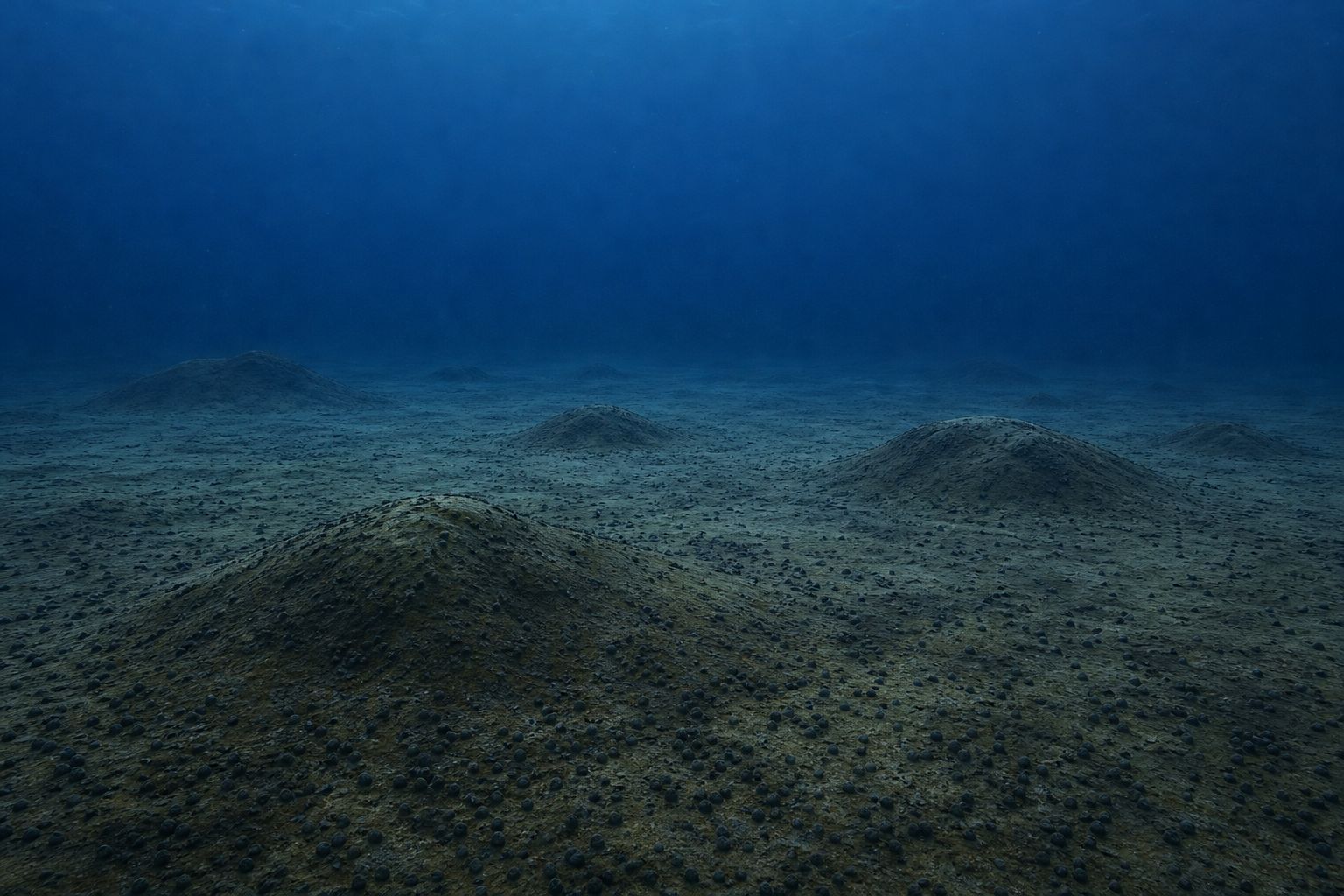
Down there lies the abyssal plain: flats of mud broken by low hills that rise up to a kilometre.
The richest nodule field is the Clarion-Clipperton Zone, a stretch of the Pacific about five thousand kilometres long, between Hawaii and Mexico.
Estimates of its area run from six to nine million square kilometres. GEOMAR, a German ocean research centre, estimates that about twenty-one billion tonnes of nodules lie there.
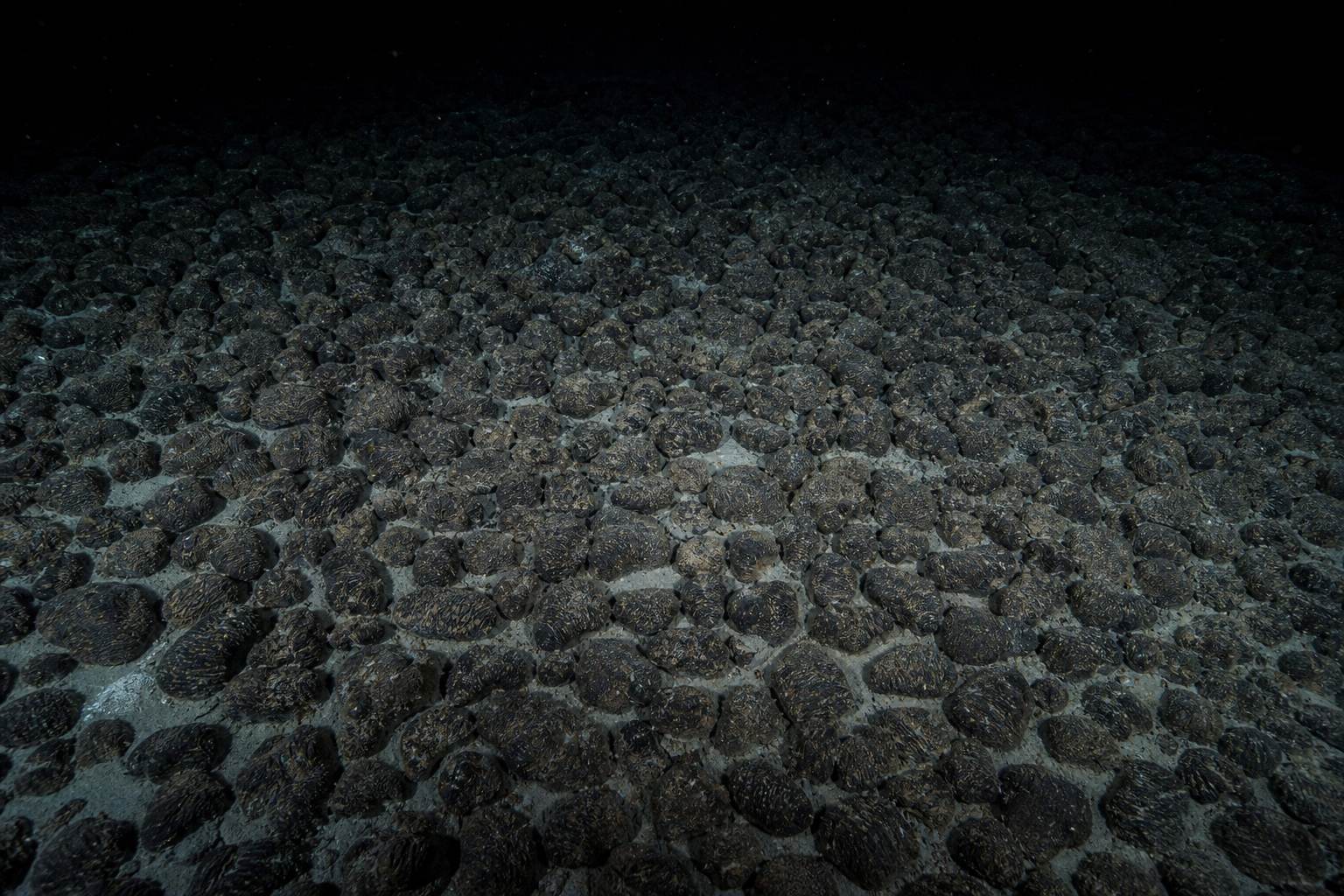
In the richest patches, up to seventy-five kilograms lie on every square metre.
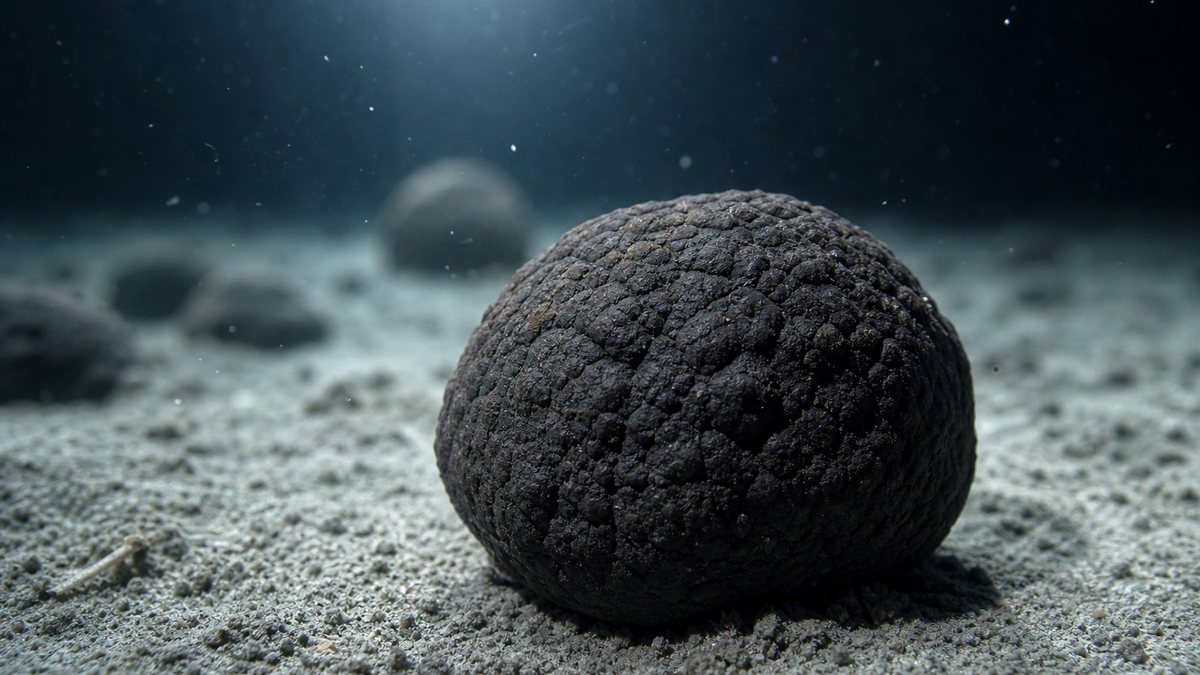
The abyssal plain Mud, low hills and a scatter of dark stones, mostly 4,000 to 6,000 metres down in this zone. AI-generated illustration.
~5,000 km
long (NOAA); it spans Hawaii to Mexico (NHM)
4–6 km
deep
Where it lies
6–9 million km²
area, by source
~21 billion t
of nodules (GEOMAR)
How much is thereStone after stone Across the whole zone the average is about 15 kilograms per square metre. AI-generated illustration.
Chapter I · The abyss
The Clarion-Clipperton Zone
NOAA Ocean Exploration: the zone runs about 5,000 km, with abyssal hills up to 1,000 m high; the Natural History Museum (via ScienceDaily and Al Jazeera, 2023) describes it as spanning the Pacific from Hawaii to Mexico. Its area is given as about 6 million km² (Natural History Museum, via ScienceDaily and Al Jazeera, 2023) or about 9 million km² (GEOMAR; World Ocean Review). GEOMAR estimates about 21 billion tonnes of nodules, averaging about 15 kg per m² and up to 75 kg per m².
The two area figures come from different sources and boundaries; the film gives both.
The 3D scenes are simplified teaching models: the seafloor, nodules, machines and map are drawn schematically and not to scale.
Pick one up and it looks like a lump of burnt coal, anywhere from the size of a potato to the size of a head of lettuce.
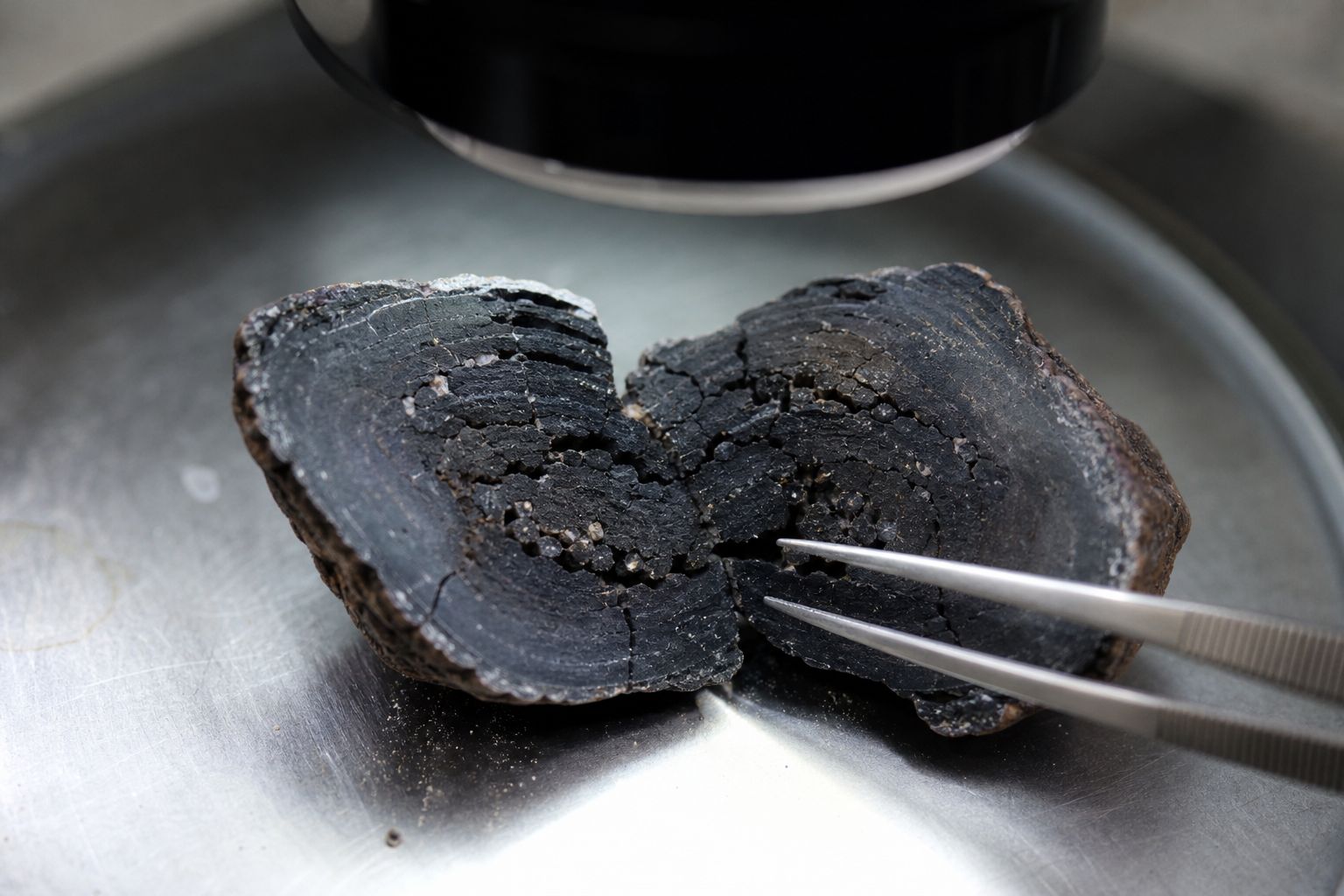
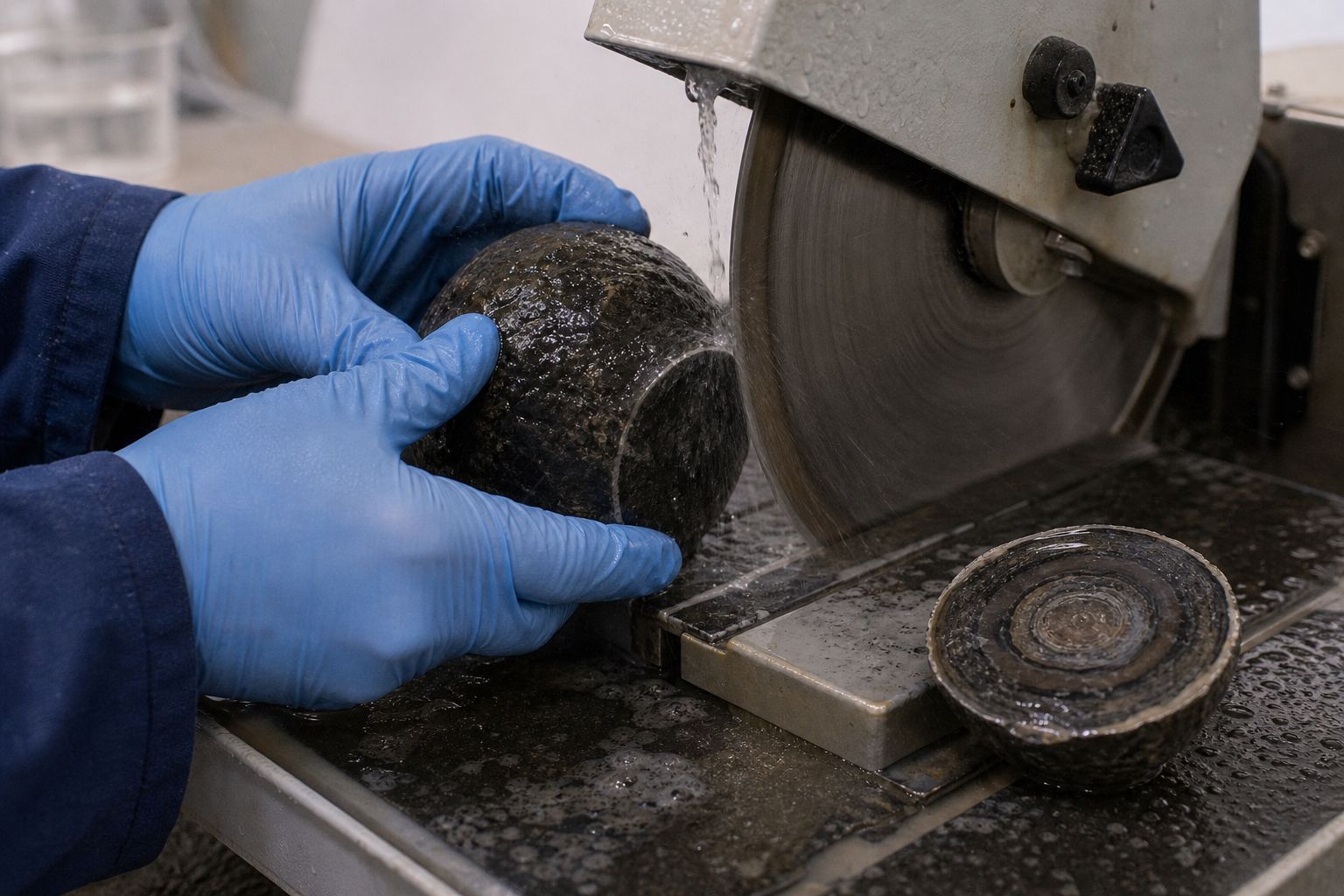
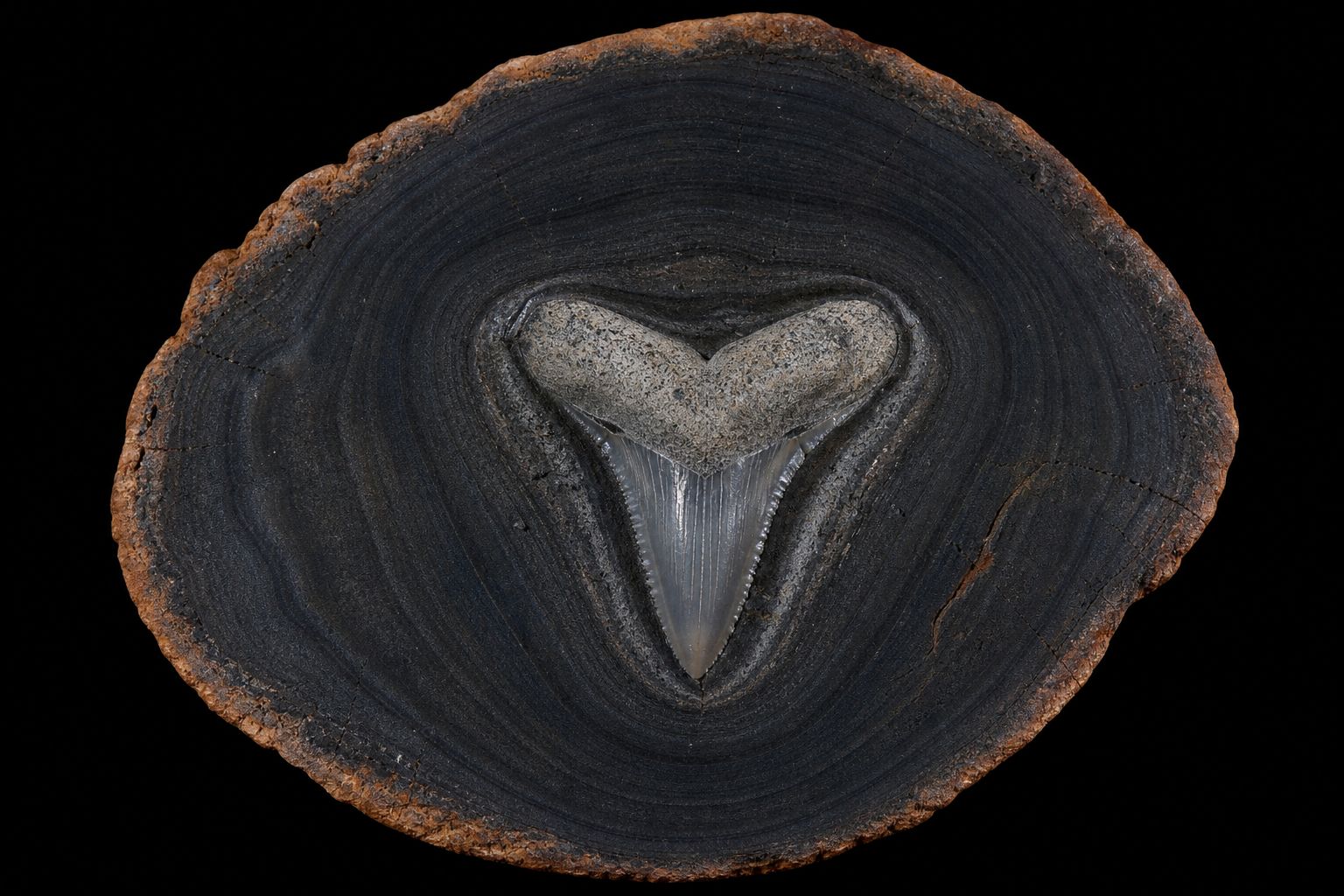
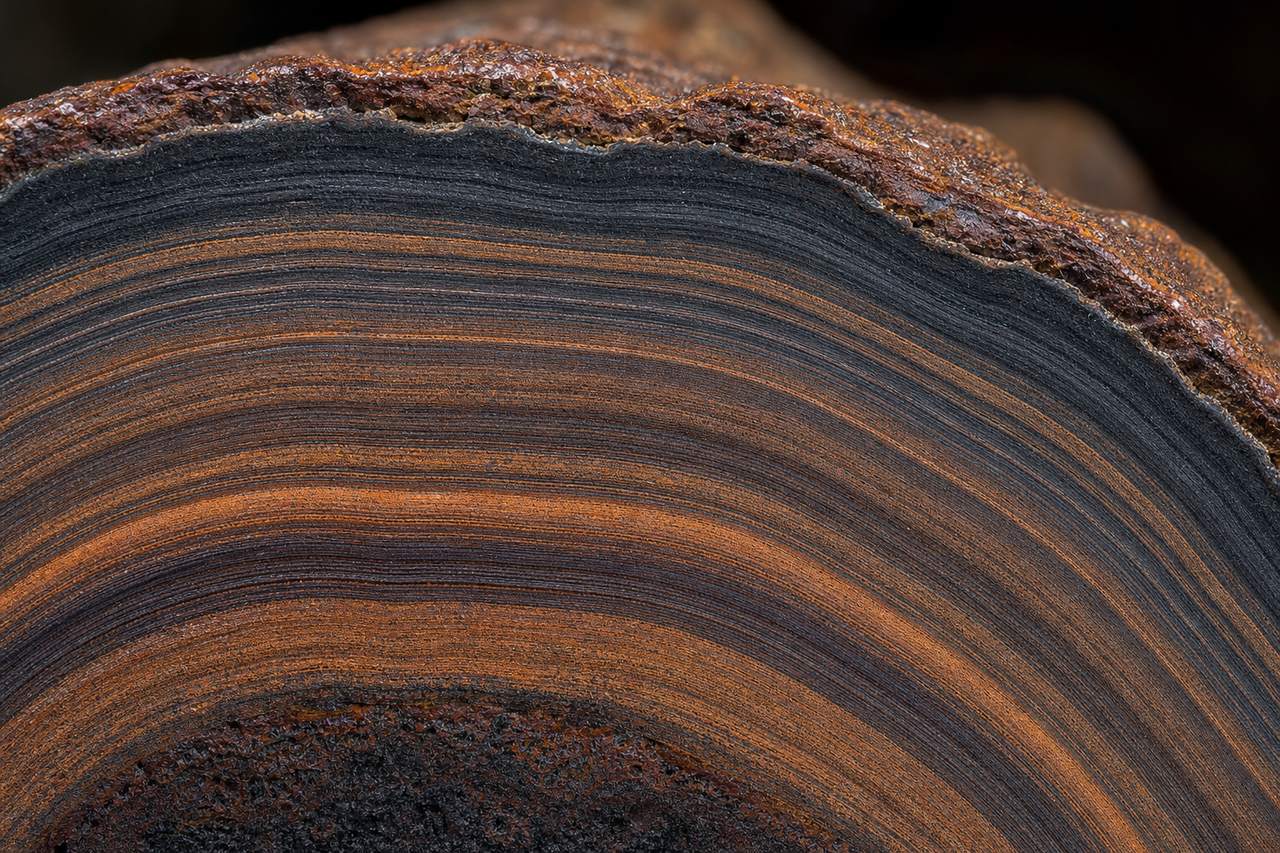
Saw it in half and you see rings, like a tree's. At the very centre there is a core: a fragment of rock, a piece of shell, sometimes a shark's tooth.
Around that core, layer after layer of manganese and iron oxides has built up, together with silicate minerals.
That is where the name comes from: polymetallic, many metals in one stone.
Cut in the lab A wet rock saw splits a nodule; each band in the cut face is a pause or change in growth. AI-generated illustration.The core Shark teeth last on the seafloor long after the rest of the skeleton has gone, so they often end up at the core. AI-generated illustration.
manganese oxides (most of it)
iron oxides
silicate minerals
a nucleus: rock, shell or tooth
What a nodule is made of
Chapter II · Stones that grow
What a nodule is
GEOMAR and World Ocean Review: nodules are lumps of manganese and iron oxides, plus silicates, lying loose on the deep seafloor. Each grows in concentric layers around a nucleus such as a rock fragment, a piece of shell or a shark tooth. They range from potato-sized to the size of a head of lettuce.
The caption on the shark tooth is an illustration of why teeth are common nuclei; the sources name teeth as one kind of nucleus.
Press the buttons to cut the nodule open or see it whole.
The 3D scenes are simplified teaching models: the seafloor, nodules, machines and map are drawn schematically and not to scale.
How fast do they grow? Almost unimaginably slowly.
Some take their metals from the seawater above. These hydrogenetic nodules grow up to about ten millimetres every million years.
Others take metals from below, from water trapped in the mud. These diagenetic nodules grow faster, ten to a hundred millimetres per million years. Most nodules grow both ways at once, top and bottom.
A nodule fifteen centimetres across can be around fifteen million years old.
≤ ~10 mm
per million years, from seawater
10–100 mm
per million years, from the mud
Two ways to growBands, close up The bands are thinner than paper; a whole human lifetime adds less than a millionth of a metre. AI-generated illustration.
15 cm
across
~15 million years
old (GEOMAR)
Age of a big one
Chapter II · Stones that grow
How nodules grow
World Ocean Review and GEOMAR: hydrogenetic nodules take metals from seawater (mostly as the mineral vernadite) and grow up to about 10 mm per million years; diagenetic nodules take metals from the water in the sediment’s pores (as todorokite and birnessite) and grow about 10–100 mm per million years. Most nodules grow both ways. Nodules up to 15 cm across can be about 15 million years old.
The lifetime comparison in the caption is arithmetic from 10 mm per million years: about 0.0008 mm in 80 years.
Press the buttons to grow the nodule for 1, 5 or 15 million years, and to show metals arriving from the seawater or from the mud.
The 3D scenes are simplified teaching models: the seafloor, nodules, machines and map are drawn schematically and not to scale.
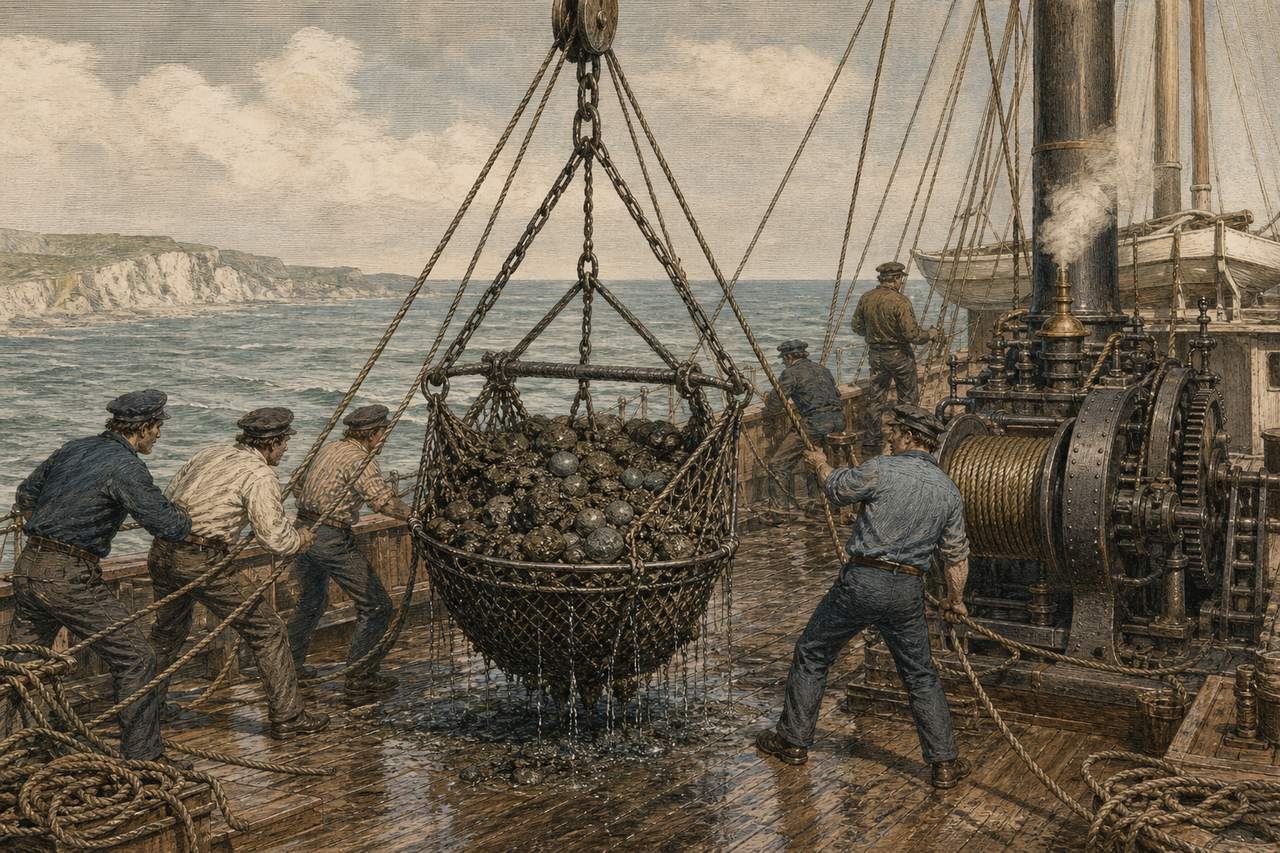
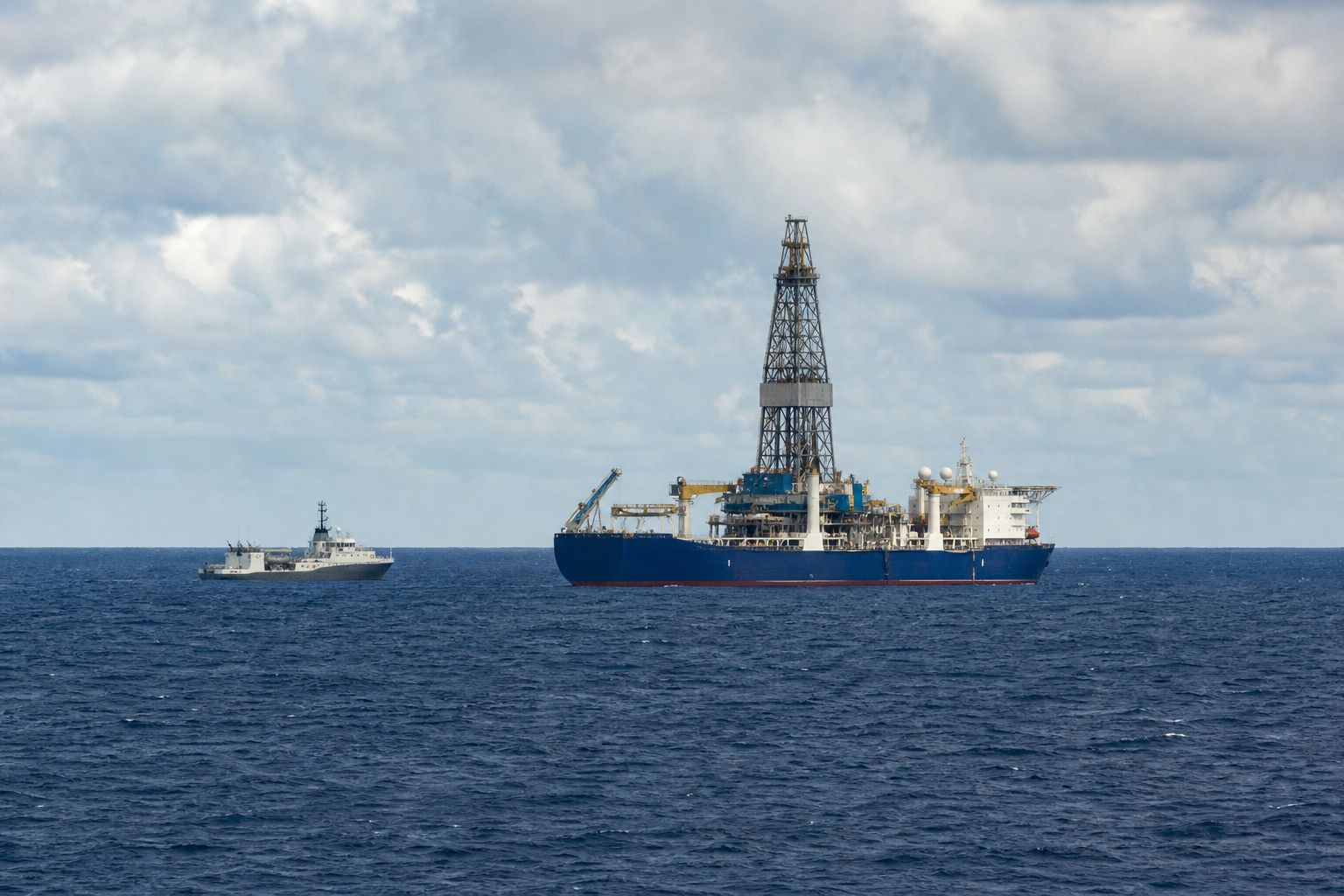
Humans first met these stones on HMS Challenger, a British ship that surveyed the world's oceans from 1872 to 1876.
Its crew dragged dredges along the seafloor, kilometres down, and hauled up mud, animals and strange black lumps.
Nodules lie in every ocean. One of the earliest hauls came up in February 1873, in the Atlantic, from two and a half kilometres down, southwest of the Canary Islands.
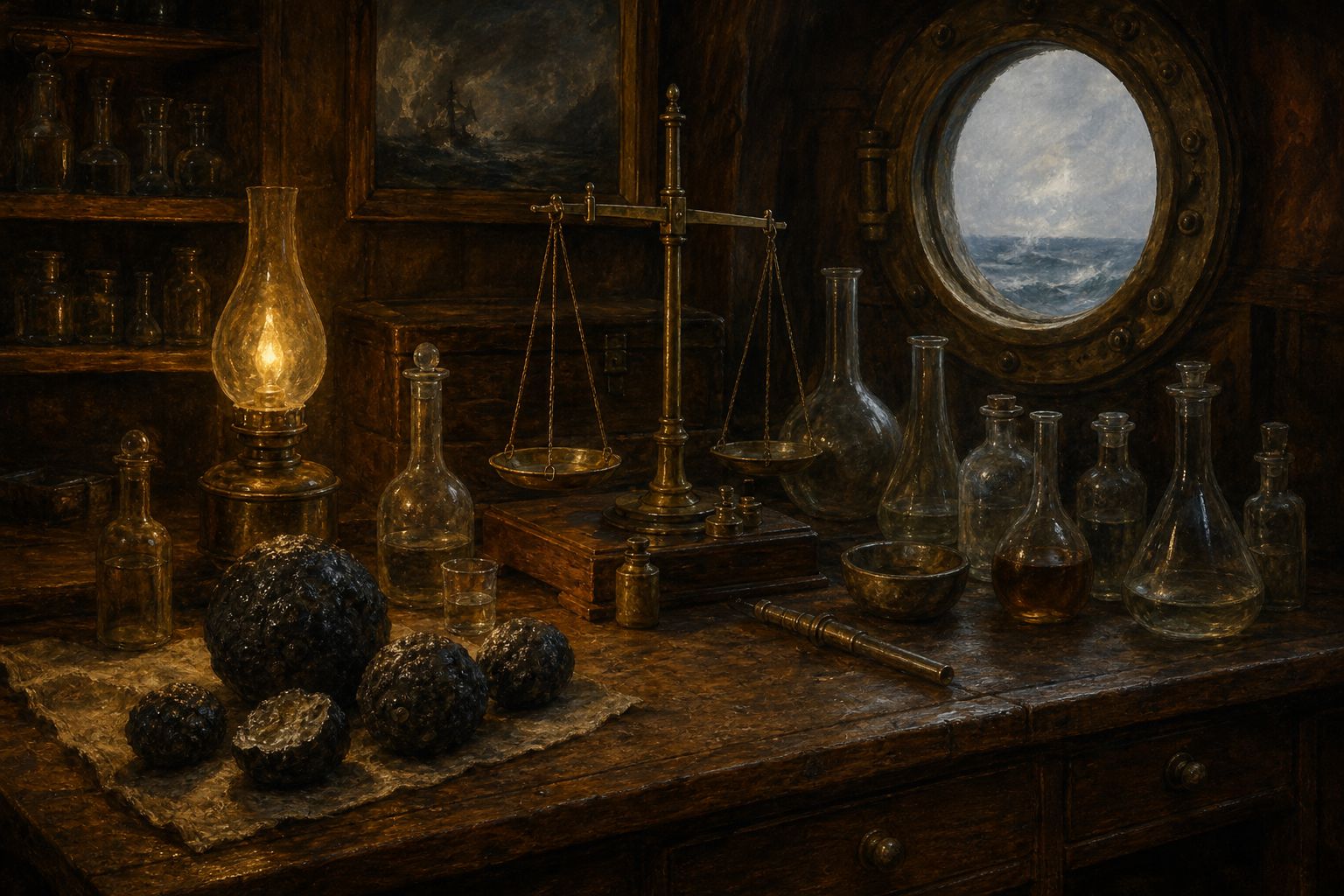
The expedition's chemist, J. Y. Buchanan, called them almost pure manganese peroxide.
Hauling the dredge A steam winch did the work of pulling kilometres of line back on board. AI-generated illustration.
1872 sets sail
18 Feb 1873 station 3: nodules from 2,504 m
1876 returns
1891 Murray and Renard describe the nodules
The Challenger voyage
Almost pure manganese peroxideJ. Y. Buchanan, chemist on HMS Challenger
On board The ship carried its own laboratory, so samples could be tested at sea. AI-generated illustration.
Chapter III · First haul
HMS Challenger
GEOMAR: the Challenger expedition (1872–76) first recorded nodules. Geological Society: they were collected in 1873; Murray and Renard described them in their 1891 report, and the chemist J. Y. Buchanan called them “almost pure manganese peroxide”. PANGAEA: the earliest station in the Murray and Renard nodule data is station 3, 18 February 1873, at 25.75°N 20.23°W, about 2,504 m deep, southwest of the Canary Islands.
World Ocean Review: manganese nodules occur in all oceans, but only in four regions are they dense enough for industrial interest, mainly in the Pacific and Indian Oceans.
Station 3 is the earliest in that dataset; whether it was the very first nodule haul is not confirmed, so the film says “one of the earliest”. The captions on the winch and the ship’s laboratory describe the illustrations.
Press “Lower the dredge” and “Haul it up”.
The 3D scenes are simplified teaching models: the seafloor, nodules, machines and map are drawn schematically and not to scale.
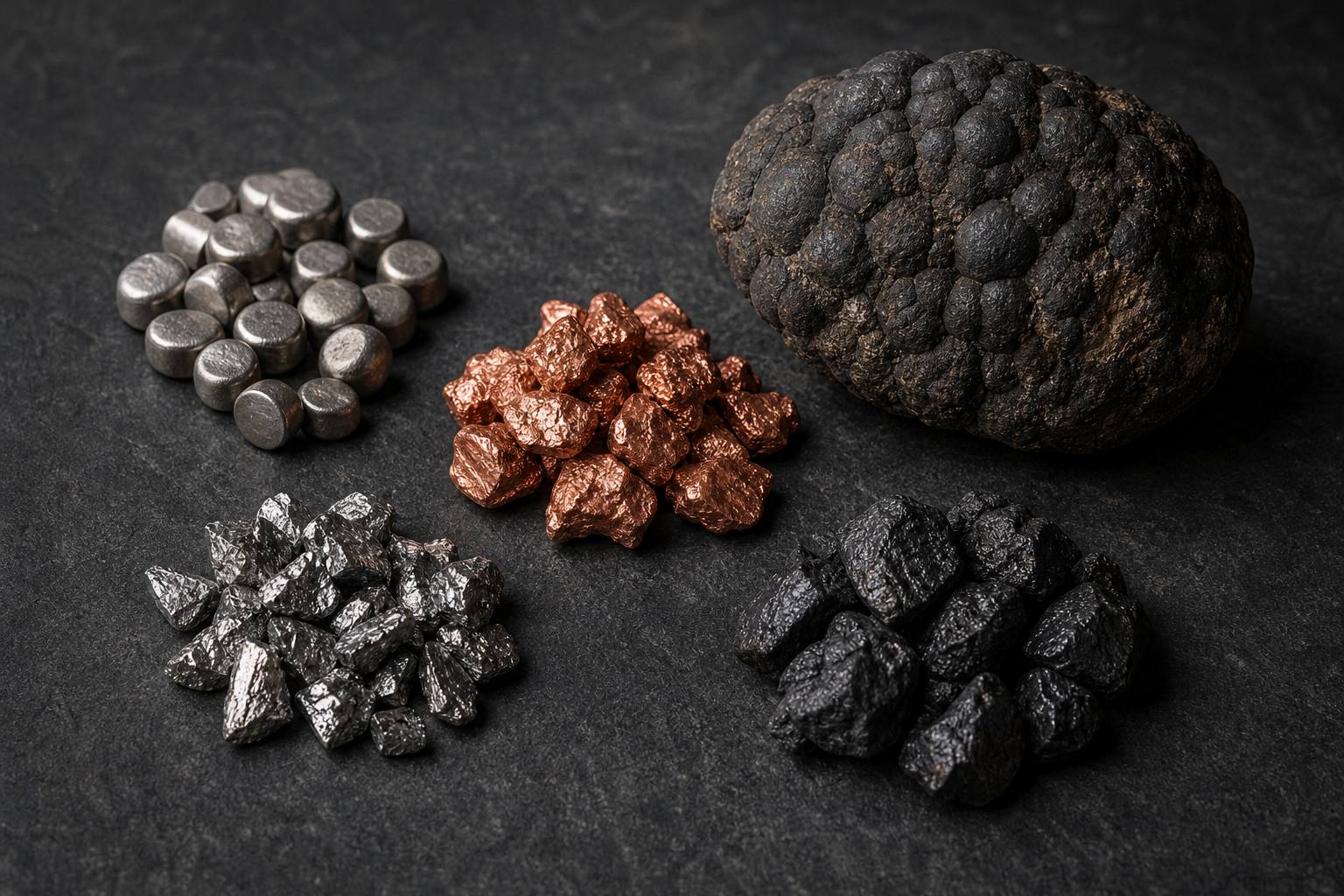
Most of a nodule is manganese and iron. But it also holds nickel, copper and cobalt: together, two to three percent of its weight.
There are traces too of molybdenum, lithium, titanium and the rare earth elements.
Across the whole zone, even a cautious estimate runs to billions of tonnes of manganese, and hundreds of millions of tonnes of nickel and copper.
The Metals Company, which wants to mine them, calls them battery metals, for electric cars.
Ores and metals Nickel, copper, cobalt and manganese, the four metals the mining case rests on. AI-generated illustration.
molybdenum
lithium
titanium
rare earth elements
Traces, too
manganese
6,000+
nickel
270
copper
230
cobalt
44
Metal in the zone, million tonnes (GEOMAR, conservative)
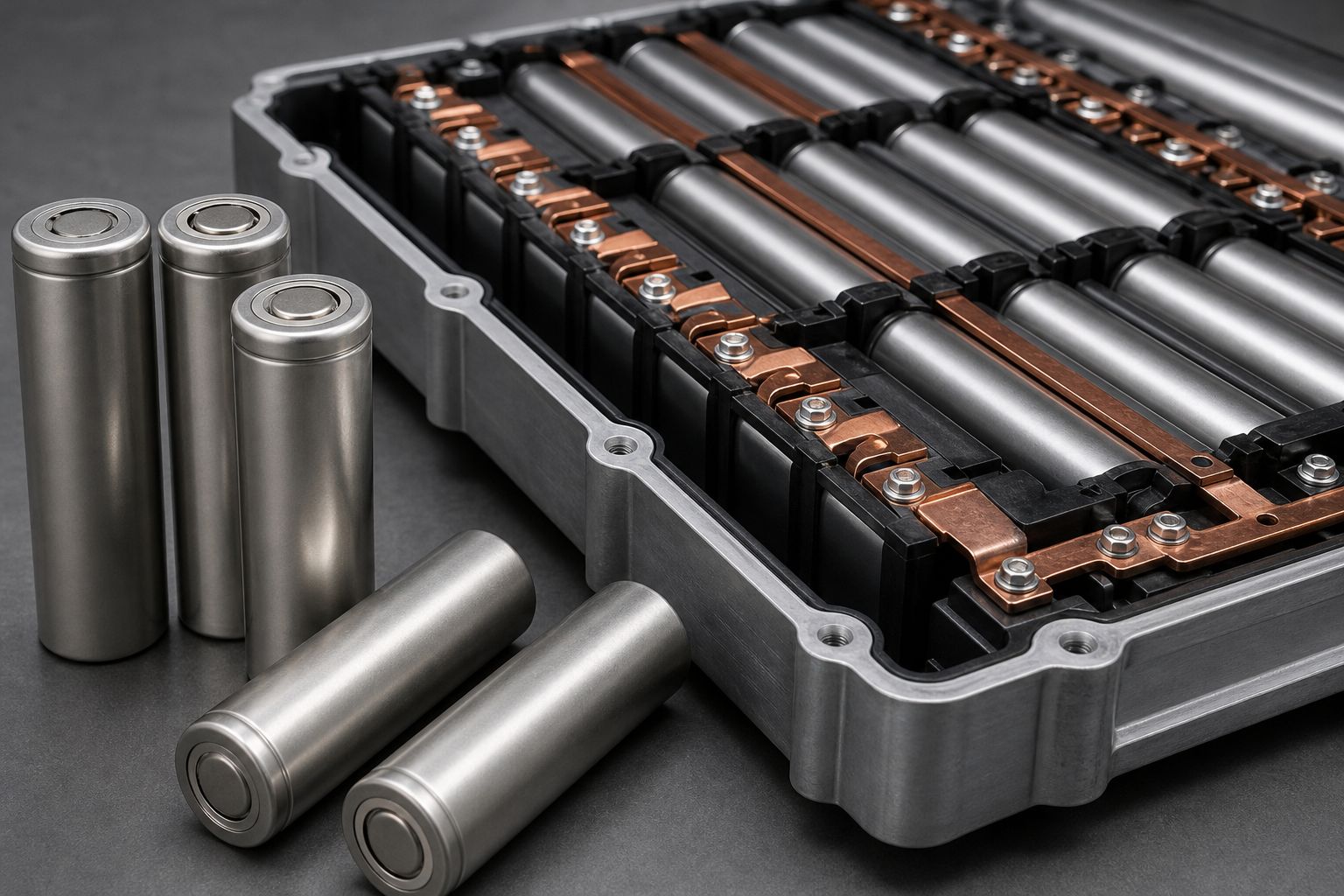
Where the metals would go An electric-car battery pack is built from hundreds or thousands of cells. AI-generated illustration.
Chapter III · First haul
The metals
GEOMAR: nodules are mostly manganese and iron; nickel, copper and cobalt together make up about 2–3% by weight, with traces of molybdenum, rare earths, lithium and titanium. Its conservative estimate for the zone: more than 6 billion t of manganese, 270 million t of nickel, 230 million t of copper and 44 million t of cobalt. The Metals Company describes nodules as holding nickel, cobalt, copper and manganese for electric-vehicle batteries (Just Auto).
The caption about cells in a battery pack describes the illustration in general terms.
Press the buttons to light up the main metals or the valuable minor ones.
The 3D scenes are simplified teaching models: the seafloor, nodules, machines and map are drawn schematically and not to scale.
In 2023, researchers led by London's Natural History Museum gathered every record of animals found in the Clarion-Clipperton Zone.
They counted 5,578 species. Between eighty-eight and ninety-two percent of them were new to science.
By then, seventeen exploration contracts already covered about 1.2 million square kilometres of the zone.
The researchers warned that mining could put species at risk before science has even described them.
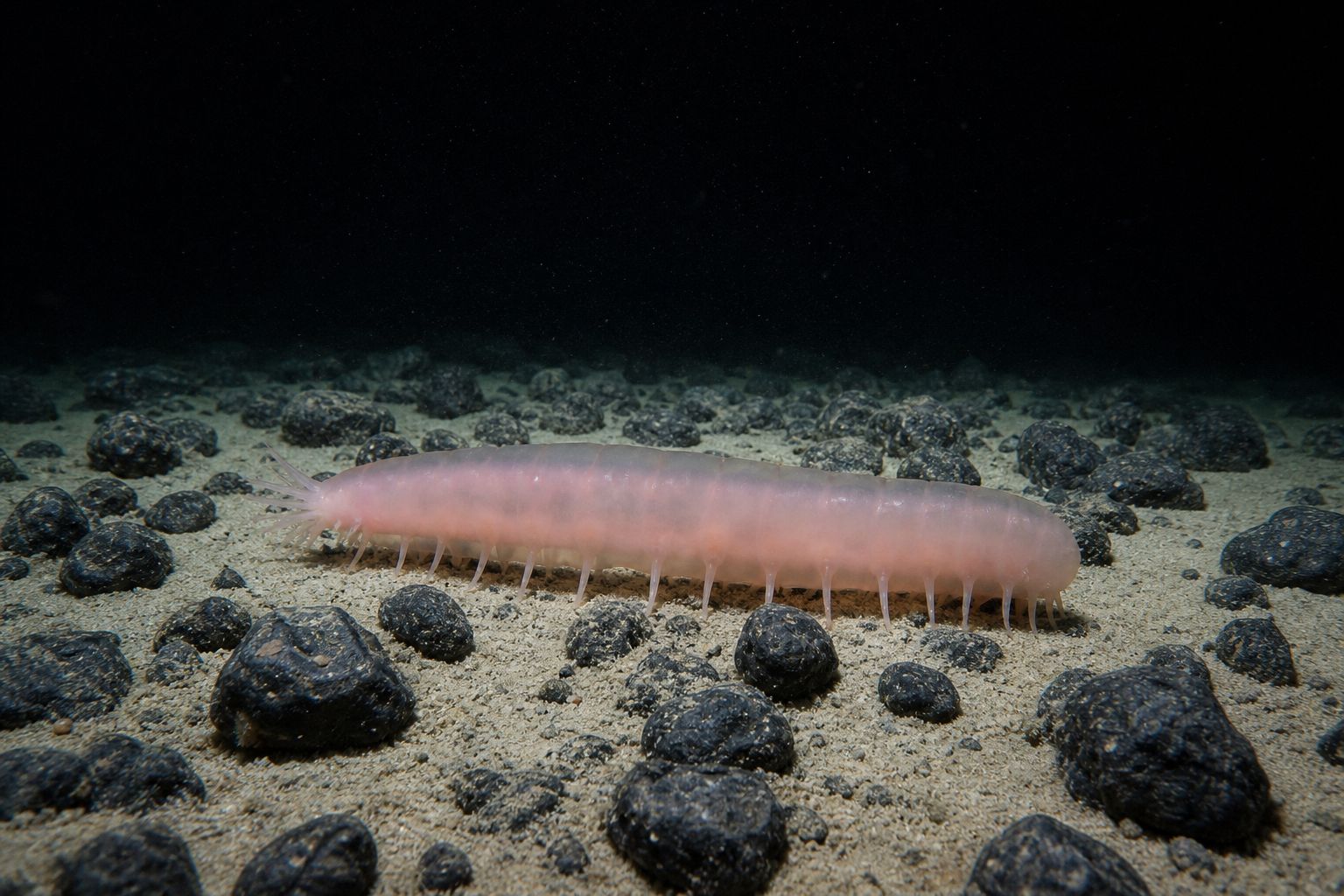
A sea cucumber Big enough to photograph from a robot: the few animals here a camera can see. AI-generated illustration.
5,578
species recorded
88–92%
new to science
The 2023 checklist
17
contracts in the zone
~1.2 million km²
of seabed covered
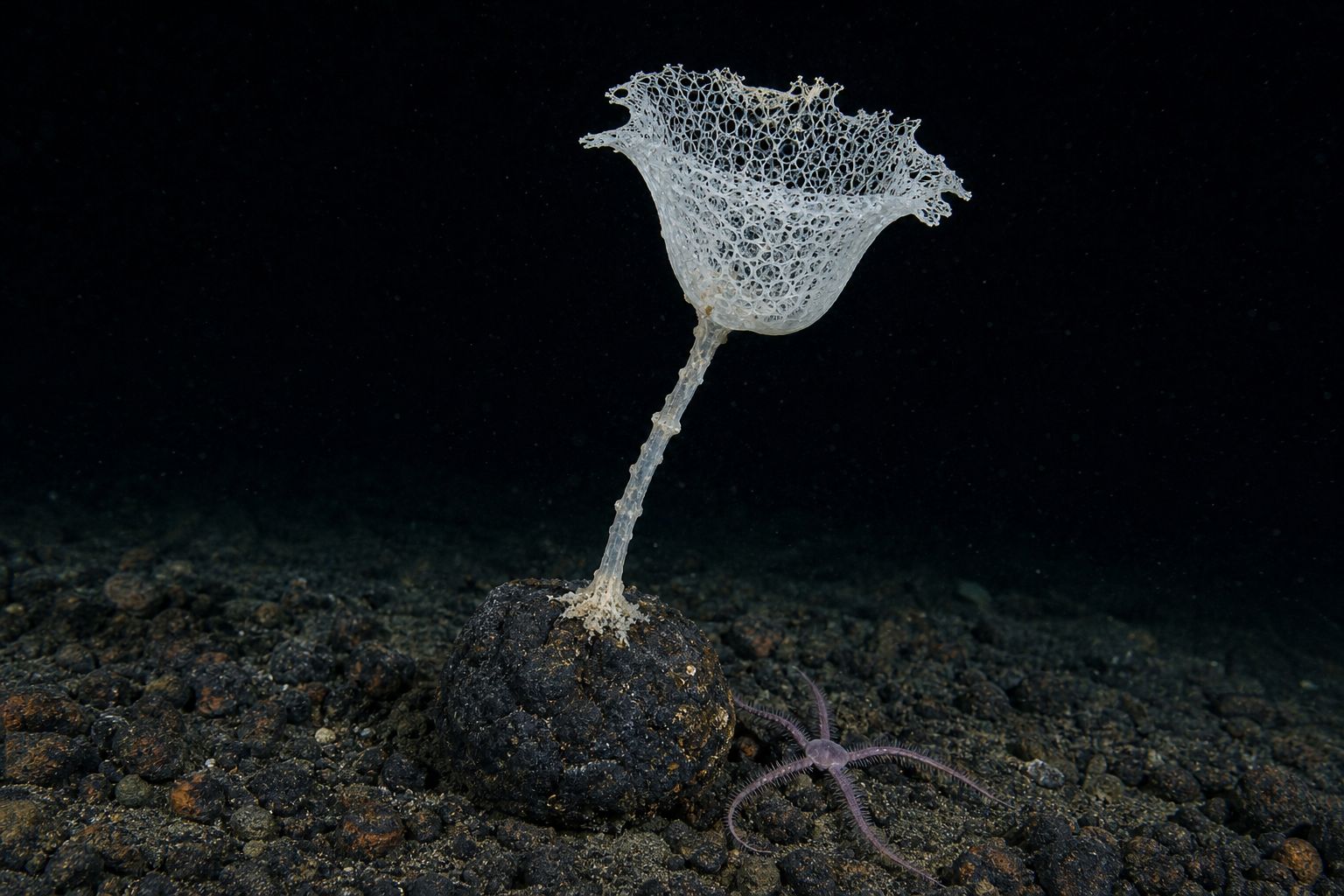
Exploration contracts, 2023Unnamed neighbours A sponge on a nodule: of every ten species found here, about nine have no scientific name. AI-generated illustration.
Chapter IV · Life on the stones
Life in the zone
ScienceDaily (25 May 2023, Natural History Museum London): Rabone and colleagues in Current Biology recorded 5,578 species in the Clarion-Clipperton Zone, an estimated 88–92% of them new to science. Al Jazeera (May 2023): 17 exploration contracts covered about 1.2 million km² of the zone.
The animals in the 3D scene and the illustrations are generic deep-sea forms, not identified species.
Press “Contract areas” to shade a share of the field like the share of the zone under contract (about 1.2 of 6–9 million km²; schematic).
The 3D scenes are simplified teaching models: the seafloor, nodules, machines and map are drawn schematically and not to scale.
The 2026 study looked even smaller. Teams from the University of Bremen and the Netherlands' sea research institute split open 244 nodules from the zone. Press Count to tally what they found.
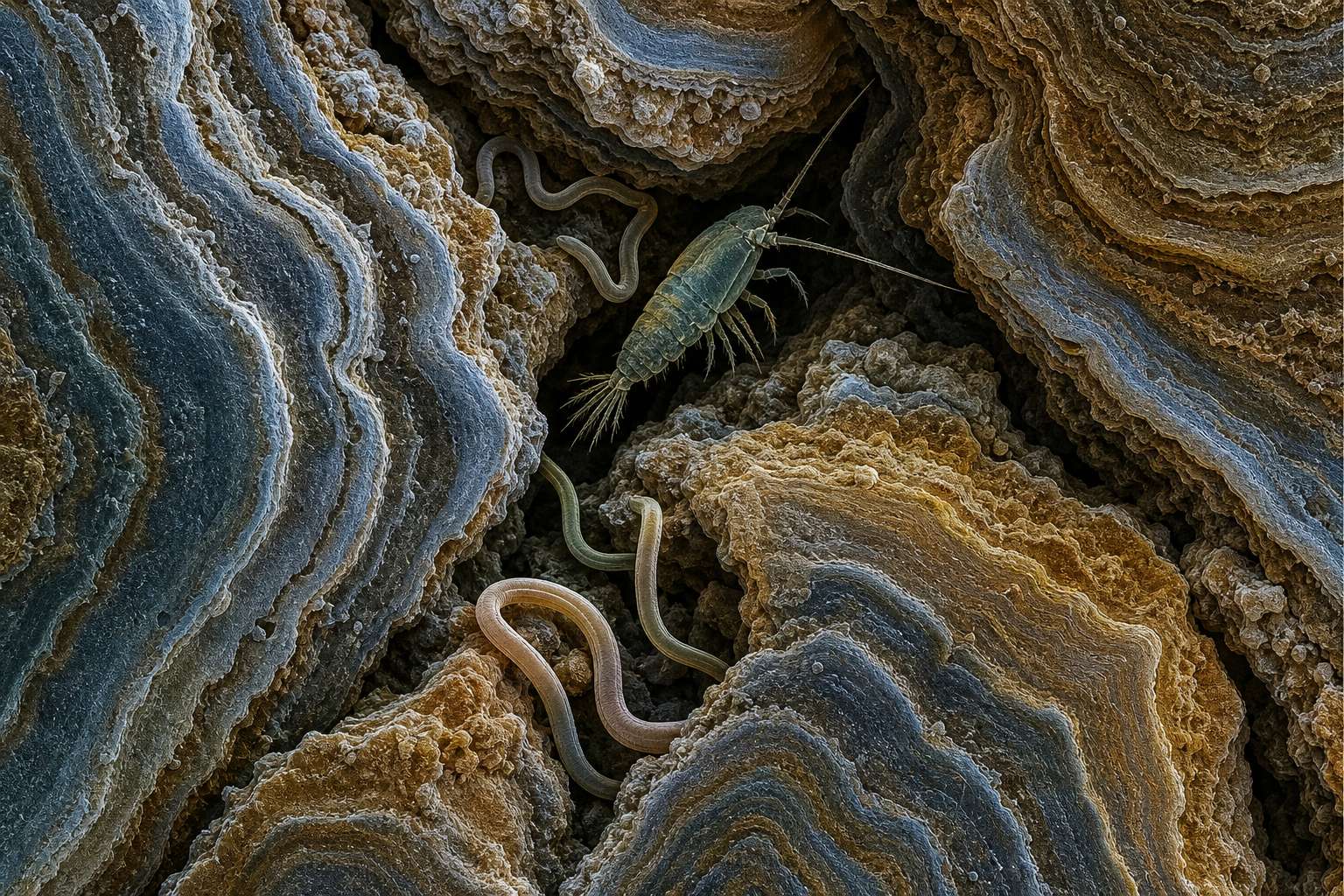
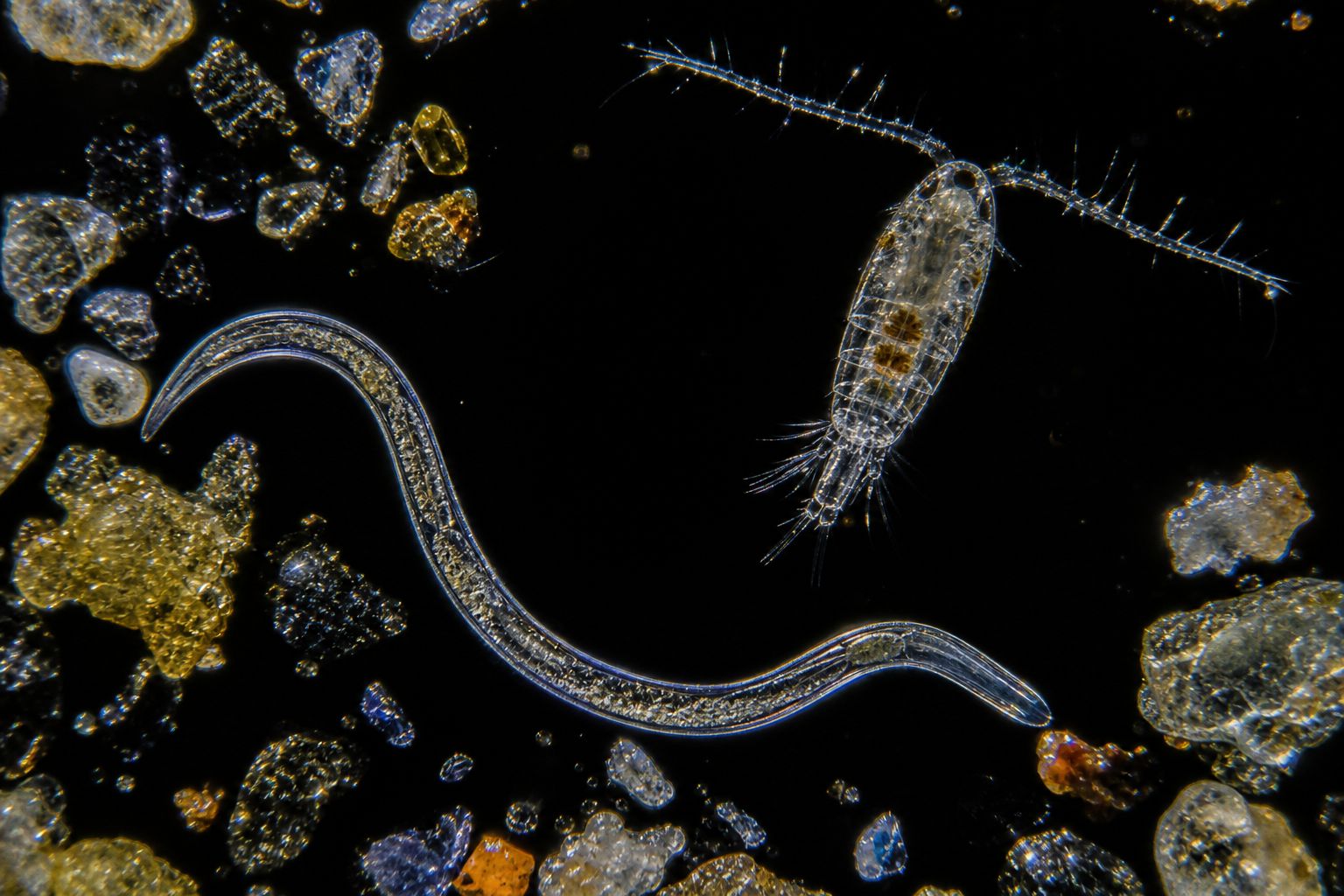
Inside lived 4,139 animals, about seventeen per nodule. All were meiofauna, animals smaller than a millimetre: nematode worms and tiny crustaceans called copepods, alongside single-celled foraminifera.
These communities differed from those in the surrounding mud, yet were strikingly alike across up to a thousand kilometres.
Because nodules take millions of years to form, the team warns that mining could mean losing this habitat for good.
244 nodules, split Labs broke each nodule open and identified the animals from their DNA. AI-generated illustration.Meiofauna A nematode and a copepod among mineral grains, as they look under a microscope. AI-generated illustration.
4,139
animals
17
per nodule, on average
< 1 mm
every one of them
Across 244 nodules
nematodes: about a tenth as many as in the mud
copepods: about a quarter as many as in the mud
a foraminiferan, Thurammina sp. 1, especially common
species identified with genetic analysis
What the team found
Commercial mining may result in an irreversible loss of undescribed and unique biodiversity.Sabine Gollner, NIOZ, co-leader of the study
Chapter IV · Life on the stones
Meiofauna in the cracks
MARUM press release and EurekAlert! (November 2026): 244 nodules held 4,139 animals, 17 per nodule on average and up to 245 in one, all meiofauna smaller than 1 mm. Nematodes in nodules were about 10% of the count in the sediment and copepods about 25%; the foraminiferan Thurammina sp. 1 was especially common. Nodule communities differed from those in the sediment and were very similar to each other across up to 1,000 km. Lead scientists: Tanja Stratmann (MARUM), Coral Diaz-Recio Lorenzo and Sabine Gollner (NIOZ).
One study, of one region. Foraminifera are single-celled organisms; the count of 4,139 refers to the animals.
Press “Split” and “Count” to open the nodule and tally what is inside. The creatures drawn are greatly enlarged.
The 3D scenes are simplified teaching models: the seafloor, nodules, machines and map are drawn schematically and not to scale.
In 2024, a team led by Andrew Sweetman reported a surprise in the journal Nature Geoscience: oxygen rising inside sealed chambers on the pitch-dark seafloor.
Without light there is no photosynthesis, so down there oxygen should only be used up. Their idea: nodules act like batteries, splitting water into hydrogen and oxygen. They measured up to 0.95 volts on single nodules; splitting seawater takes about 1.5.
Critics say air trapped in the equipment could explain the readings, and that no hydrogen was reported. A new expedition set out in 2026 to measure again. For now, dark oxygen is disputed.
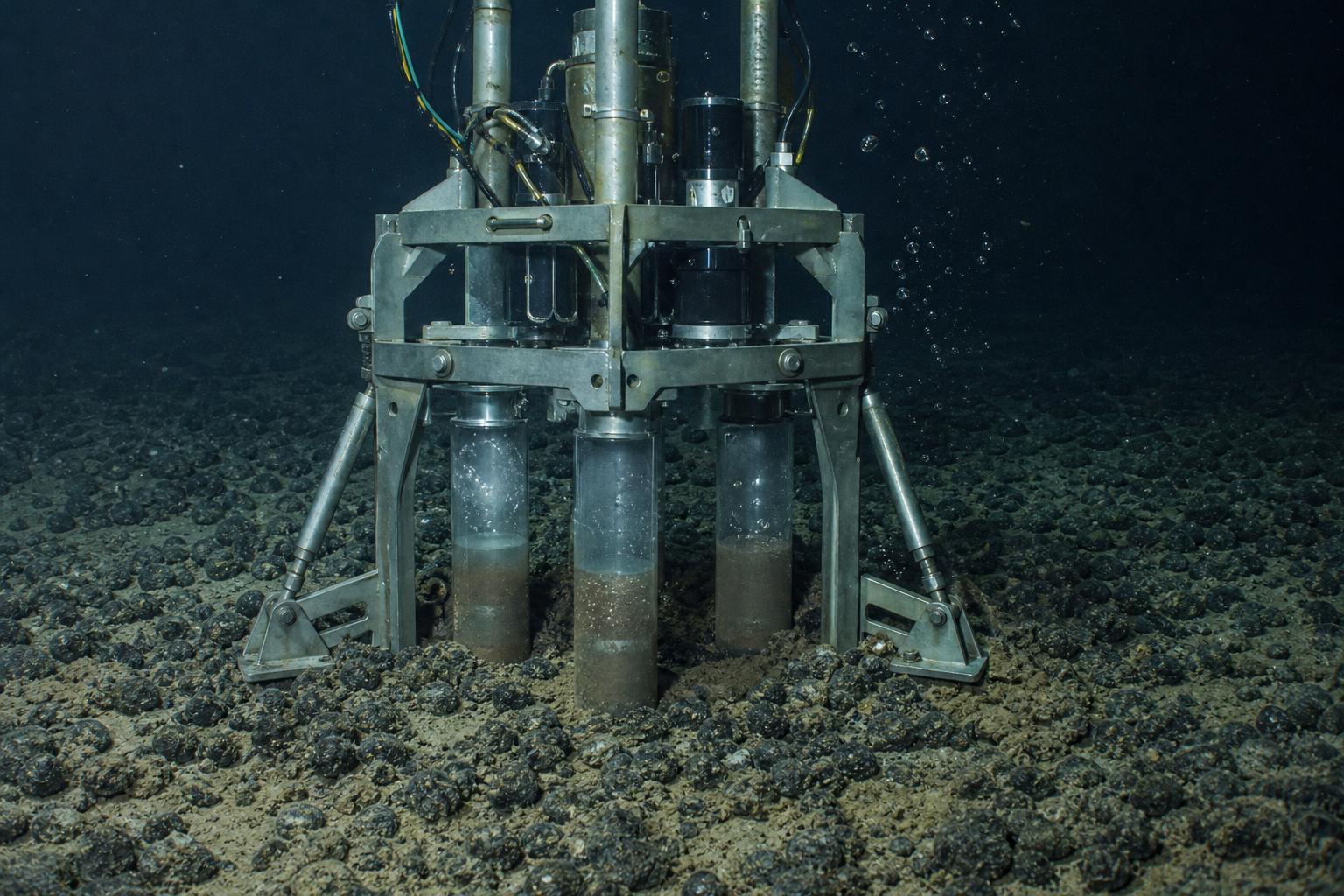
Chambers on the seafloor A lander pushes sealed chambers into the mud and tracks the water inside them. AI-generated illustration.
0.95 V
measured on a single nodule
~1.5 V
needed to split seawater
The voltage argument2H2O→2H2+O2
H2O
water
H2
hydrogen: critics say none was reported
O2
oxygen
Splitting water always makes two hydrogen molecules for each oxygen one.
trapped air in unventilated equipment
starting oxygen higher than normal
no hydrogen or control data reported
no adequate energy source
The critics’ points (Live Science, 2026)
Chapter IV · Life on the stones
A disputed finding
Northwestern University (22 July 2024): Sweetman (SAMS), Geiger (Northwestern) and colleagues reported “dark oxygen” production in the zone in Nature Geoscience, measuring up to 0.95 V on single nodules, against about 1.5 V needed to split seawater; clusters might produce more. Funding included Nauru Ocean Resources Inc., a subsidiary of The Metals Company. Live Science (19 March 2026): critics cite trapped air, high starting readings, no hydrogen data and no adequate energy source, and an opinion piece calls for retraction; Sweetman says supporting evidence is under review. Smithsonian: TMC filed a rebuttal, and its chief executive Gerard Barron said “extraordinary claims require extraordinary evidence”. The Nippon Foundation (May 2026): a follow-up expedition with new landers was to work in the zone in spring 2026, with results expected only after the ship’s return and months of lab work; Wikipedia (November 2026) still describes the finding as preliminary.
Presented as an open question, not a fact. Press “The claim” and “The critics” to see the two explanations drawn.
The 3D scenes are simplified teaching models: the seafloor, nodules, machines and map are drawn schematically and not to scale.
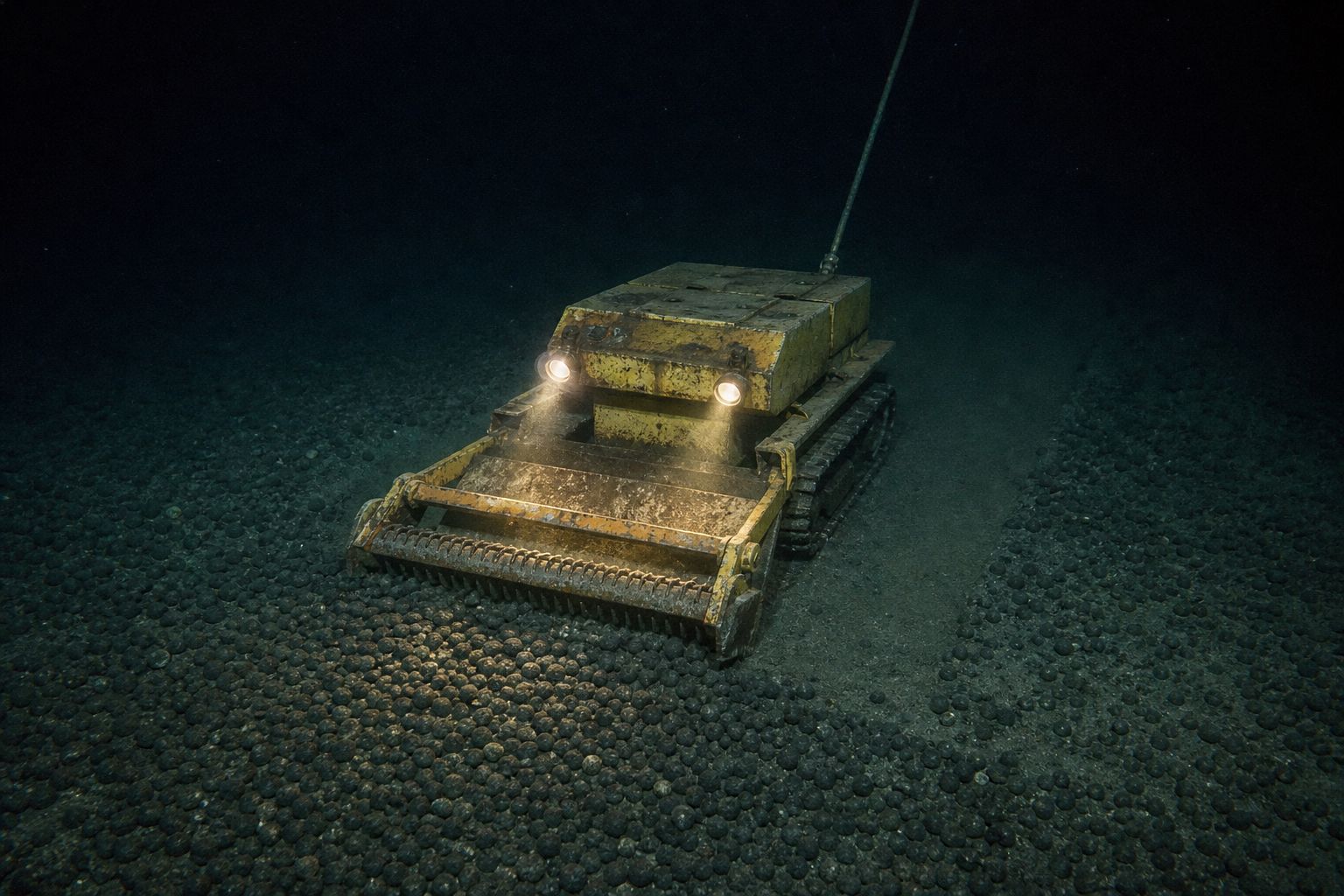
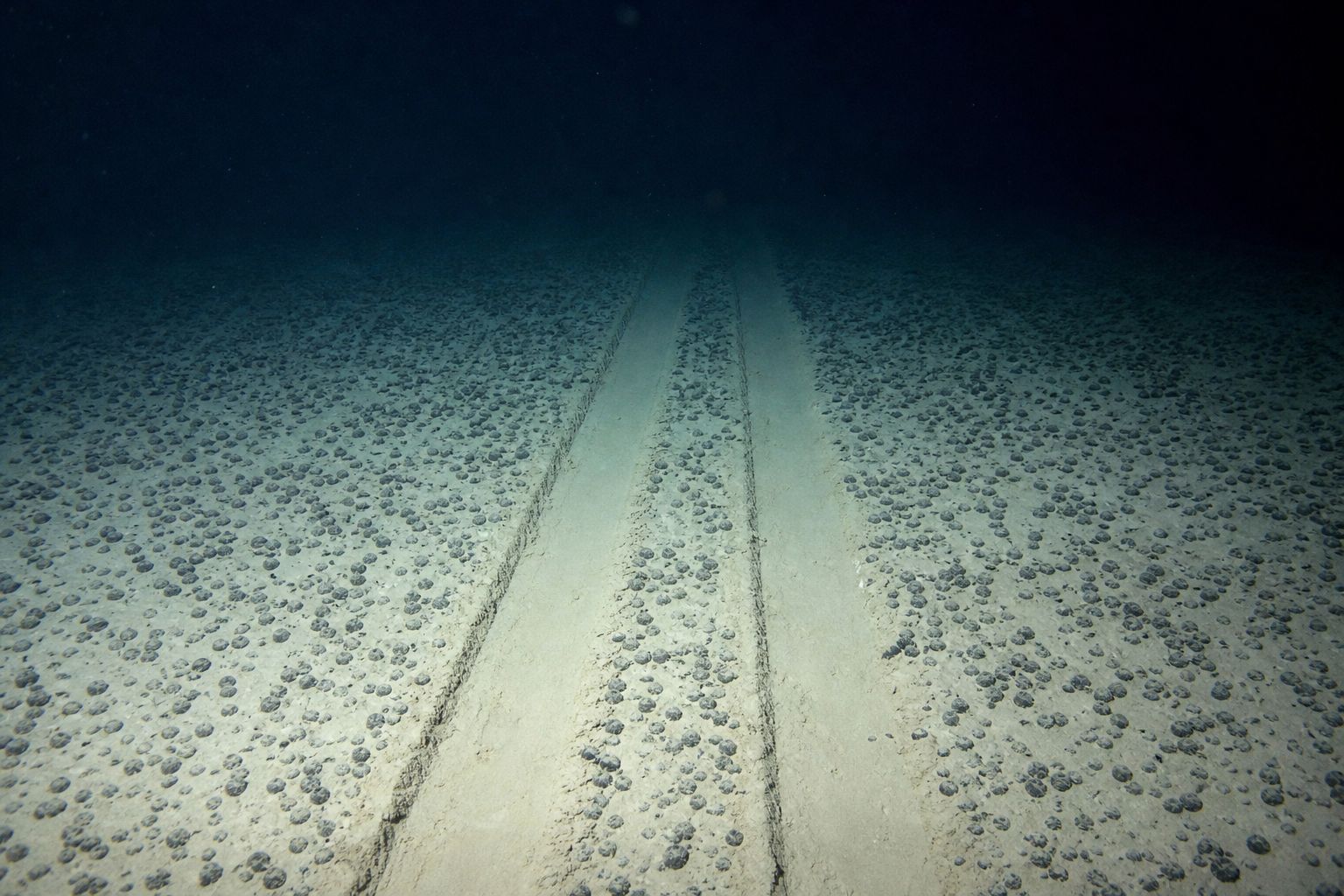
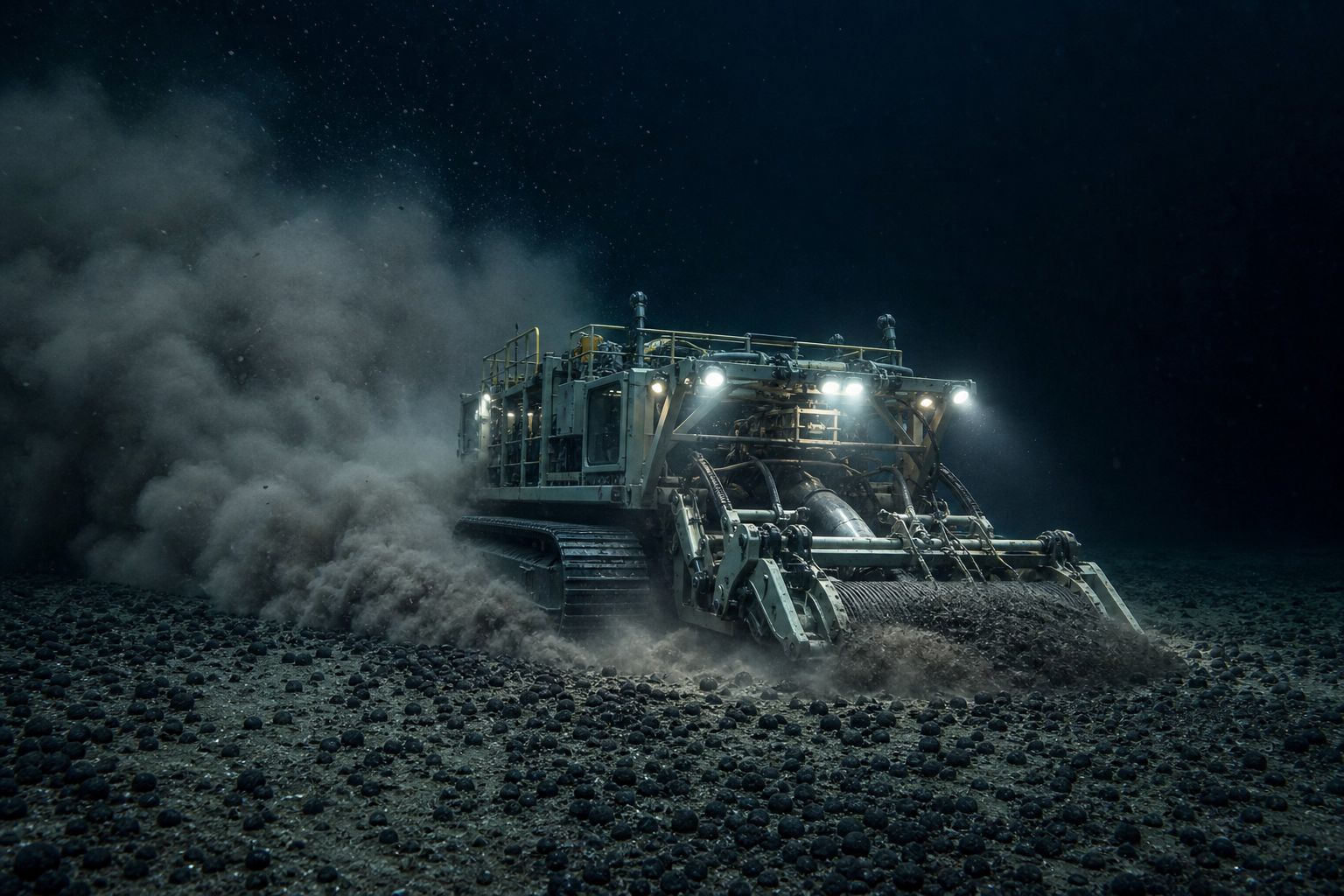
What happens when nodules are collected? In March 1979, a test mining machine ran for four days across the zone, about five kilometres down.
It left a strip eight metres wide with no nodules at all.
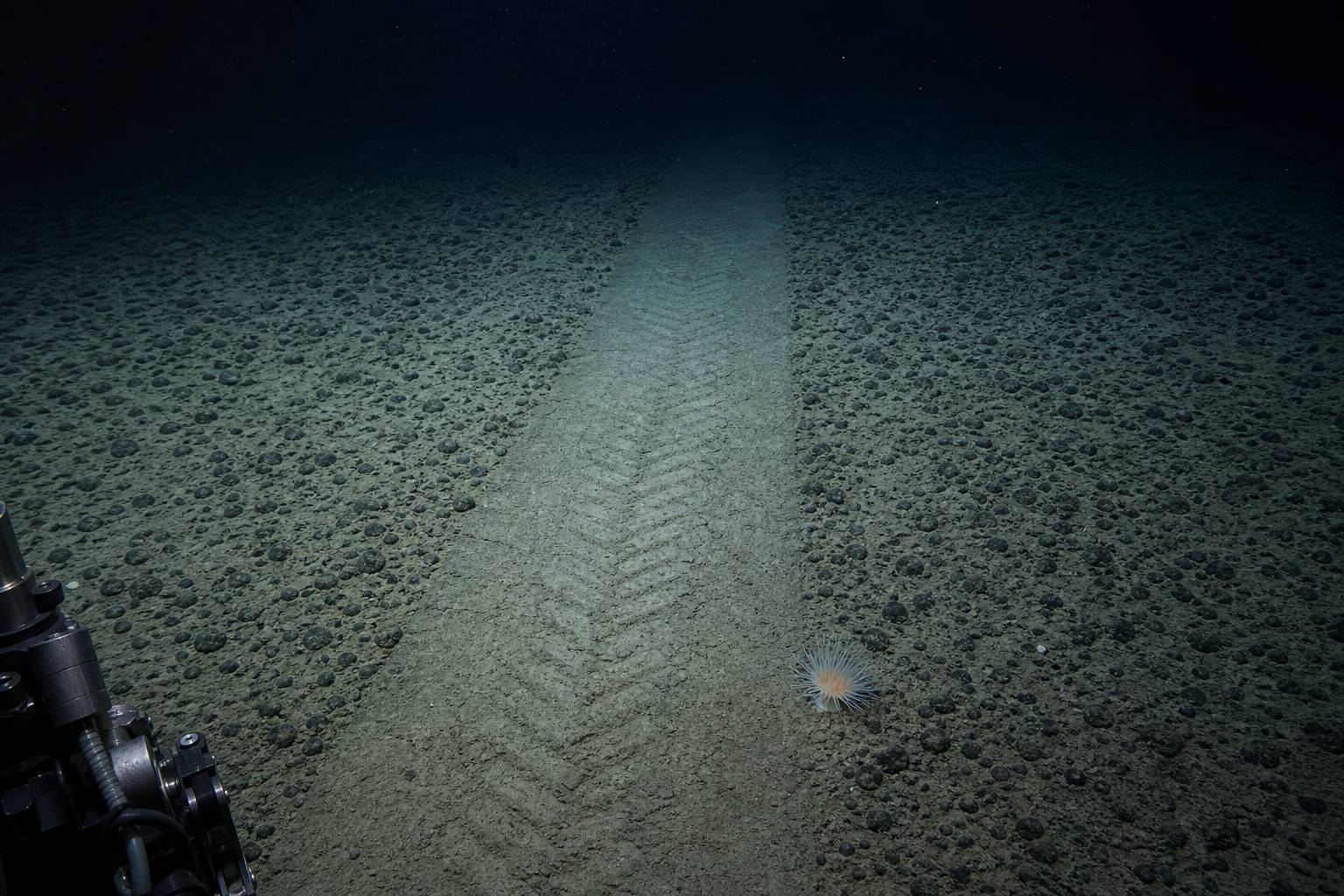
In 2023 and 2024, a team led by Britain's National Oceanography Centre went back. Forty-four years on, the tracks looked very similar to when they were made.
There were first signs of animals returning, but biodiversity was still lower than nearby. And at a few millimetres per million years, no nodules had grown back. Press “44 years later” to see the strip today.
March 1979 An illustration of a test collector like the one used in 1979; the real machine was fourteen metres across. AI-generated illustration.Still sharp Tread marks in the mud, kept for decades by the stillness of the deep. AI-generated illustration.
March 1979 a 14 m machine runs for 4 days
2023–24 a team returns to the tracks
March 2025 results published in Nature
One test, revisited
Our results don’t provide an answer to whether deep-sea mining is societally acceptable.Adrian Glover, Natural History Museum London
Chapter V · Tracks that stay
The 1979 test
Heriot-Watt University and EurekAlert!/NOC (26 March 2025, Nature): a 14 m mining machine ran for 4 days in March 1979 about 5,000 m deep in the zone, leaving an 8 m-wide strip with no nodules. Revisited in 2023–24, 44 years later, the tracks “look very similar to when they were first made”; biodiversity is still lower than nearby, with “first signs of biological recovery”.
Press “Run the collector” to clear a strip, and “44 years later” to see what is left.
The 3D scenes are simplified teaching models: the seafloor, nodules, machines and map are drawn schematically and not to scale.
Another experiment, called DISCOL, began in 1989 in the Peru Basin of the South Pacific, where scientists ploughed the seafloor to imitate mining.
Twenty-six years later, the ploughed tracks still held about thirty percent fewer microbes than untouched seafloor. Full recovery may take more than fifty years.
Collectors also stir up the mud, and the ship above would pump unwanted sediment and water back into the sea. A 2020 paper by nineteen scientists in the journal PNAS warned that these plumes could spread for tens to hundreds of kilometres.
Ploughed tracks DISCOL ploughed the seafloor rather than removing nodules, to mimic the disturbance. AI-generated illustration.
~30% fewer
microbes in old tracks
~50% fewer
in five-week-old tracks
50+ years
to recover fully, maybe
DISCOL, 26 years onA plume Plumes would form at the seafloor behind the collector, and in midwater where the ship returns what it does not keep. AI-generated illustration.
tens to hundreds of km
how far plumes could spread
19
scientists who wrote the paper
Plume reach (PNAS, 2020)
Chapter V · Tracks that stay
DISCOL and plumes
Science News (4 May 2020): the DISCOL experiment ploughed the Peru Basin seafloor in 1989 to imitate mining; in 2015 the 26-year-old tracks still had about 30% fewer microbes than undisturbed seafloor, five-week-old tracks about 50% fewer, and full recovery may take more than 50 years (Vonnahme et al., Science Advances, 2020). Mongabay (July 2020): a perspective by Drazen and 18 co-authors in PNAS warned that plumes at the seafloor and in midwater, where a ship discharges unwanted sediment and water, could spread over tens to hundreds of kilometres.
Press “Plough” and “Plume” to see the two kinds of disturbance.
The 3D scenes are simplified teaching models: the seafloor, nodules, machines and map are drawn schematically and not to scale.
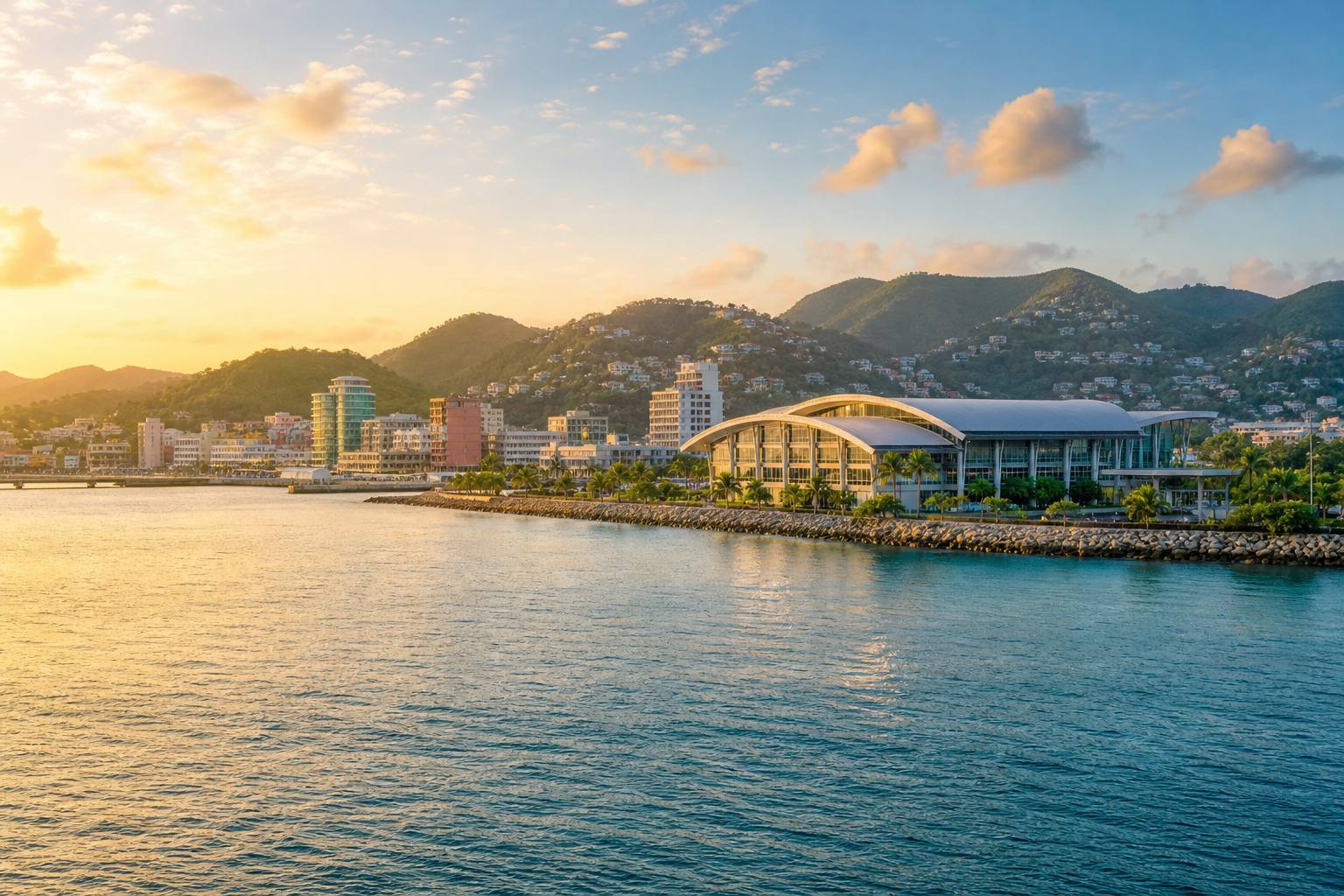
The zone lies in international waters. Under the UN Law of the Sea, signed in 1982, its seabed is run by the International Seabed Authority in Jamaica, which grants exploration contracts but has not agreed rules for commercial mining.
In March 2025 the Authority's secretary-general warned that any unilateral action would violate international law.
The United States never ratified the treaty. It reviews applications under its own law, the Deep Seabed Hard Mineral Resources Act, and says its notices so far are not approvals.
The Metals Company's US arm applied in 2025, and filed a combined application in February 2026. NOAA has not yet decided.
Kingston, Jamaica The Authority’s Council met here again in July 2026, with the mining code still unfinished. AI-generated illustration.
1994
set up, Kingston, Jamaica
172 + EU
members
0
commercial mining rules agreed
The Seabed Authority
Any unilateral action on deep-sea mining would constitute a violation of international law.Leticia Carvalho, ISA secretary-general, March 2025
Exploring, not yet mining Exploration contracts allow surveys and samples; commercial collection still needs rules that are not agreed. AI-generated illustration.
1982 UN Convention on the Law of the Sea signed
1994 the Seabed Authority is set up
Mar 2025 ISA warns against unilateral action
Apr 2025 US executive order on seabed minerals
2025 TMC USA applies under US law
Feb 2026 combined application to NOAA
Aug 2026 NOAA finds it complete; no decision yet
Two paths
Chapter VI · Who decides
Who decides
The ISA was set up on 16 November 1994, when UNCLOS (signed 10 December 1982) came into force; it is based in Kingston, Jamaica, and the US has not ratified UNCLOS (Wikipedia). ENB/IISD (July 2026): 172 member states plus the EU; the mining code was not adopted and talks continued on the third revised text; at the Council the US said Federal Register notices “are not approvals”. Eco-Business/Mongabay (7 April 2025): during the ISA’s 30th session in March 2025, Secretary-General Leticia Carvalho said any unilateral action would violate international law. The US executive order dates from April 2025 (TMC statement, 25 April 2025). North American Mining (30 May 2025): TMC USA had submitted applications to NOAA for two exploration licences and a commercial recovery permit. NOAA (August 2026): TMC USA filed a consolidated application on 6 February 2026 under the Deep Seabed Hard Mineral Resources Act; on 19 August NOAA found it met the information requirements; it has not been certified.
Press the buttons to show the international seabed or the exploration contract areas; the areas are drawn schematically.
The 3D scenes are simplified teaching models: the seafloor, nodules, machines and map are drawn schematically and not to scale.
The Metals Company, which wants to mine, says nodules hold battery metals together in one ore.
It says collecting them makes ninety-nine percent less solid waste than mining on land, from sites with far less life. Biologists point to the thousands of species recorded there, most still unnamed.
The US agency NOAA describes seabed minerals as critical for defence, electronics and renewable energy.
About a thousand marine scientists and policy experts call for a pause until the science is good enough, warning of losses irreversible on multi-generational timescales.
By August 2026, forty-six countries supported a moratorium or a precautionary pause.
Metals and life The question on the scales: battery metals against a habitat that takes millions of years to form. AI-generated illustration.
nickel, cobalt, copper and manganese in one ore
“99% less solid waste than on-land mining”
sites with “far less life” and less stored carbon
For mining: The Metals Company
defence
electronics
renewable energy
less reliance on foreign supply chains
The US government’s case (NOAA)
about 1,000 experts from 75+ countries
losses “irreversible on multi-generational timescales”
“large, persistent sediment plumes”
For a pause: the scientists’ statement
46
countries backing a moratorium or pause, Aug 2026
Governments
Chapter VI · Who decides
The debate
For: The Metals Company says nodules hold nickel, cobalt, copper and manganese in one ore (Just Auto, 2021). It claims collecting them makes “99% less solid waste than on-land mining” and that the sites “contain far less life and store less carbon than those on land” (Just Auto, 2021); Just Auto describes the method as needing no blasting or drilling. In its 2025 statement TMC calls its metals “lower-impact”. NOAA frames seabed minerals as critical for defence, electronics and renewable energy, and for less reliance on foreign supply chains. Biologists’ counter-evidence on life: 5,578 species recorded in the zone, 88–92% new to science (Natural History Museum, 2023). Against: the Deep-Sea Mining Science Statement, signed by about 1,000 experts from over 75 countries, calls for a pause and warns of losses “irreversible on multi-generational timescales” and “large, persistent sediment plumes”. Mongabay (13 August 2026): 46 countries back a moratorium or precautionary pause, including six African states that joined in 2026.
Each side is quoted in its own words and attributed; the film does not take a side. Press “For mining” and “For a pause” to see each case drawn on the field.
The 3D scenes are simplified teaching models: the seafloor, nodules, machines and map are drawn schematically and not to scale.
A nodule fifteen centimetres across may have been growing for up to fifteen million years.
Whether to collect them is a choice about metals, life and time, and it is being argued over now, in Kingston and in Washington.
Whatever is decided, the stones themselves will not grow back on any human timescale.
1873 HMS Challenger hauls up nodules
1979 a test collector runs for four days
1982 the Law of the Sea is signed
1989 DISCOL ploughs the Peru Basin
1994 the Seabed Authority is set up
2023 5,578 species listed in the zone
2024 the disputed “dark oxygen” claim
2026 245 animals in one nodule; first US application
Nodules in eight datesStill growing At ten millimetres per million years, a nodule adds about the thickness of a hair in ten thousand years. AI-generated illustration.
Epilogue · Sources
Sources
Every fact in this film comes from the sources below. Where they differ, as on the size of the Clarion-Clipperton Zone (about 6 or about 9 million km²), the film gives both. The 2026 meiofauna result and the 2024 “dark oxygen” result are single studies; the second is disputed, and both are presented that way. On mining, each side is quoted in its own words. The 3D scenes are schematic and not to scale. The chapter stills and pictures are AI-generated illustrations, not photographs of real places or specimens.
The hair comparison in the last caption is arithmetic: 10 mm per million years is 0.1 mm, about a hair’s width, in 10,000 years.