In late October 2026 astronomers reported radio images from the Very Large Array and ALMA suggesting that Betelgeuse's small companion star, Siwarha, probably disturbs the red supergiant's outer atmosphere as it orbits through it. This film uses Betelgeuse to explain the established science of massive stars: how gravity and pressure balance, why a star's mass sets its lifetime, how a star swells into a red supergiant and why Betelgeuse varies, what caused the Great Dimming of 2019 and 2020, how fusion builds an onion of elements up to iron, why iron ends it in a core-collapse supernova, what Supernova 1987A showed, and what Betelgeuse's own explosion, probably a hundred thousand years or more away, would look like from Earth.
Interactive 3D film9 min1836 to 2026Published 6 November 2026
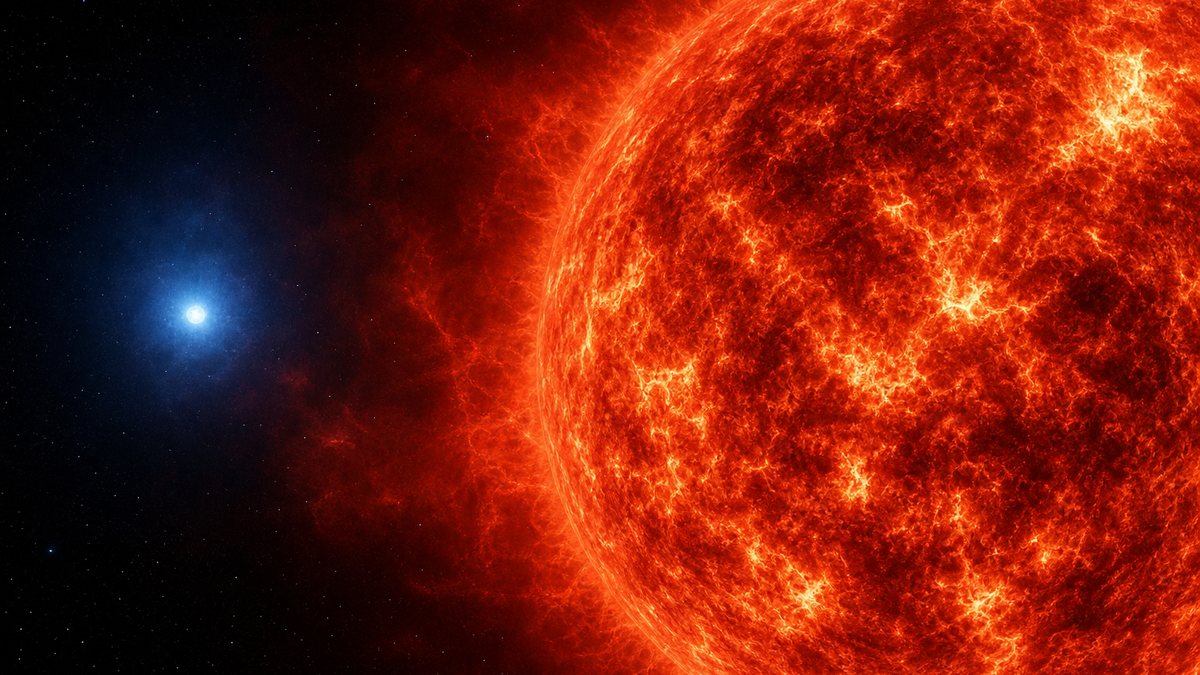
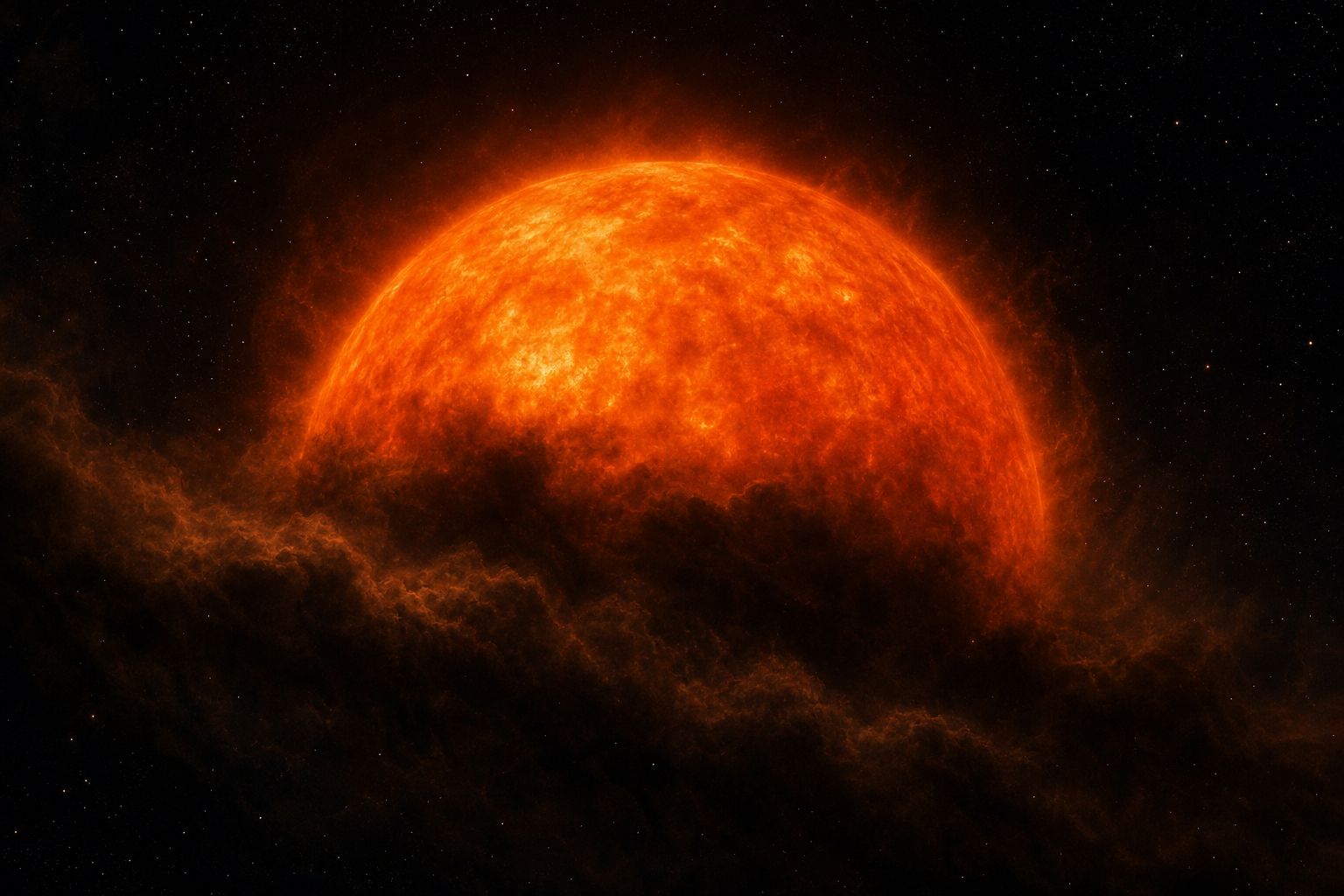
A red supergiant, and probably a small star inside its atmosphere.
Imagine a star orbiting inside another star's air. That may be happening on Orion's shoulder, at the red star Betelgeuse.
In October 2026, astronomers reported radio images of its outer atmosphere, from the Very Large Array and ALMA.
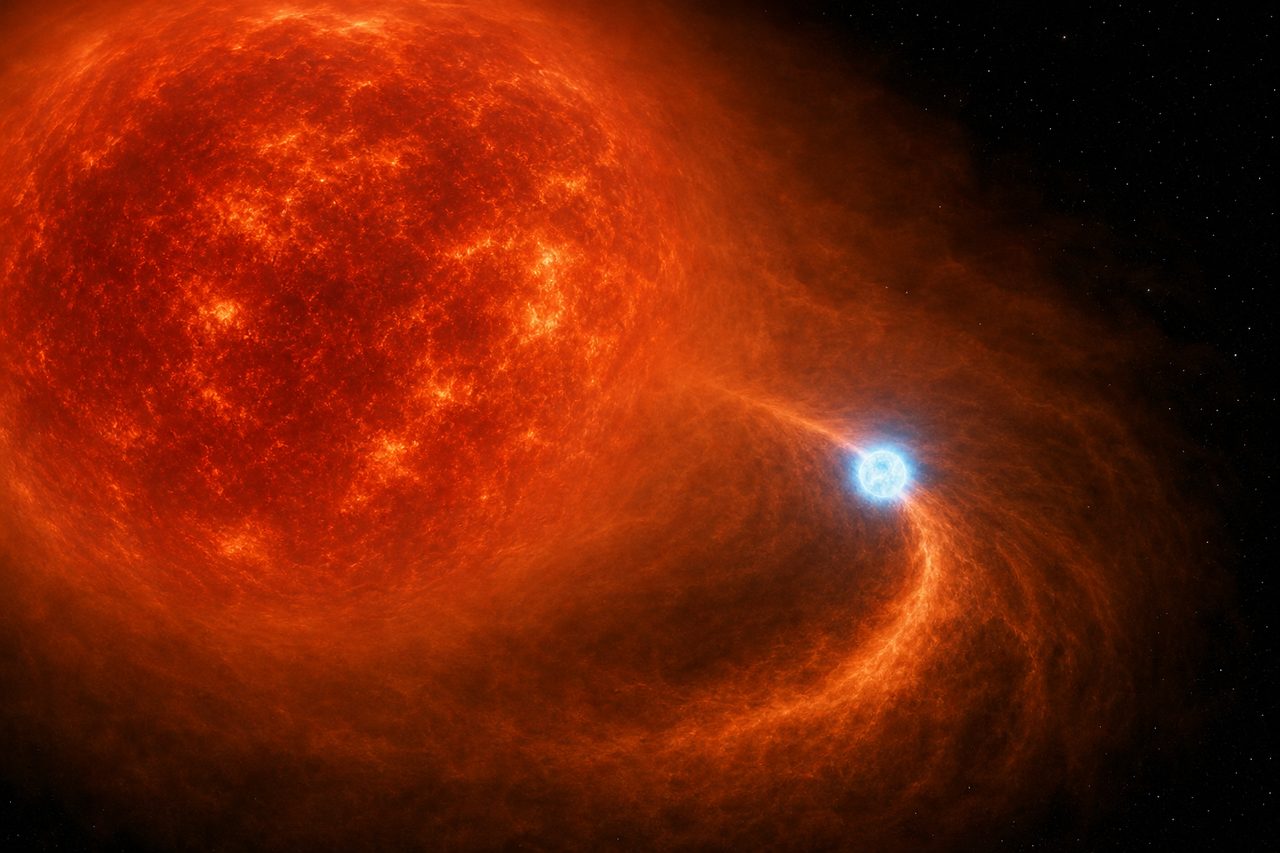
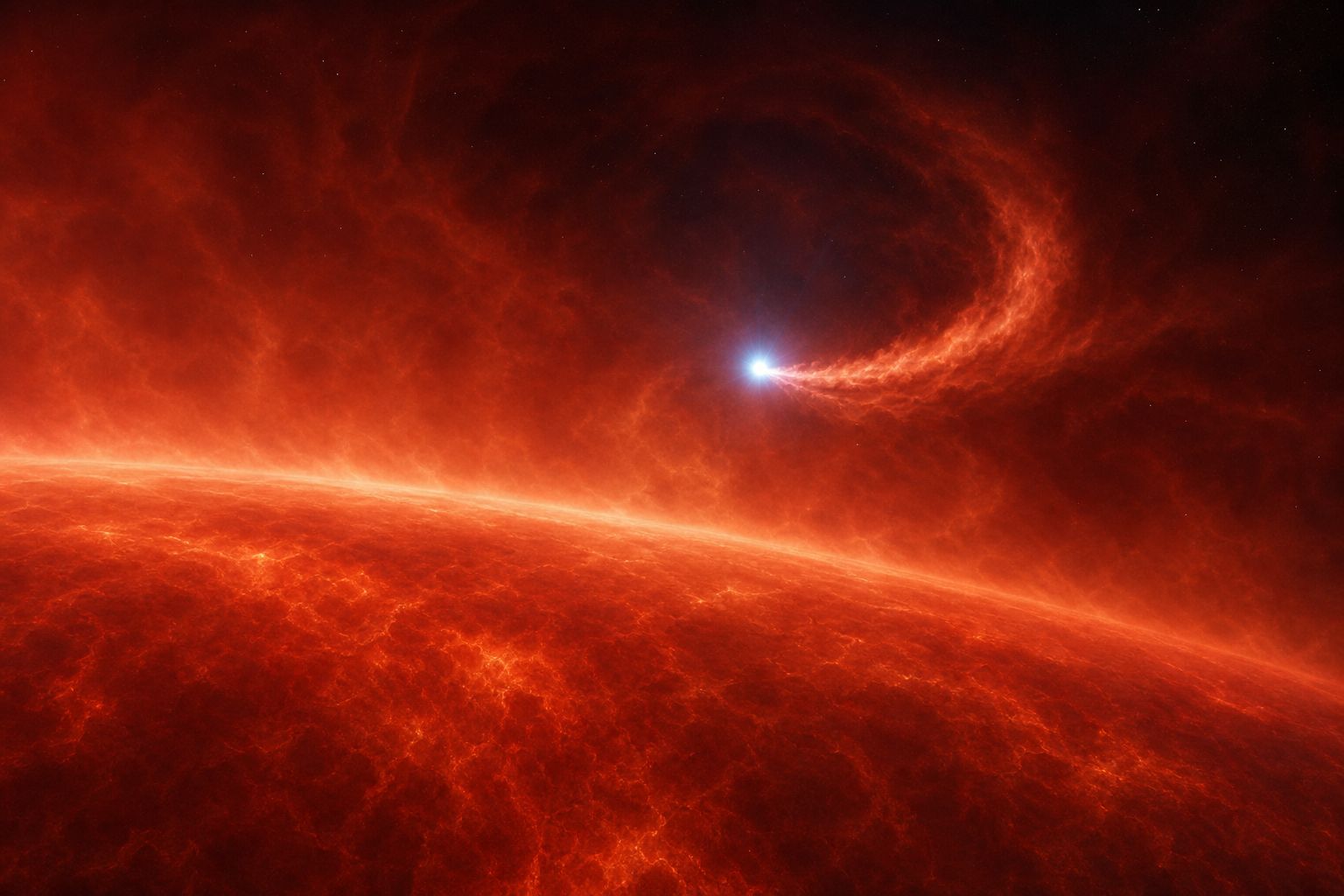
The atmosphere stretches and rounds out in step with a small companion star, Siwarha, which seems to be plowing through the giant's gas.
To see how that is possible, we need to know how giant stars live, and how they die.
A star inside a star’s air An artist’s impression: the small companion cuts through the giant’s gas like a boat through water. AI-generated illustration.
2021–2026
radio observations, at seven frequencies from 22 to 485 GHz
NRAO, October 2026
This companion is orbiting so close to the star that it actually passes through its extended atmosphere.Lynn Matthews, MIT Haystack Observatory, 2026
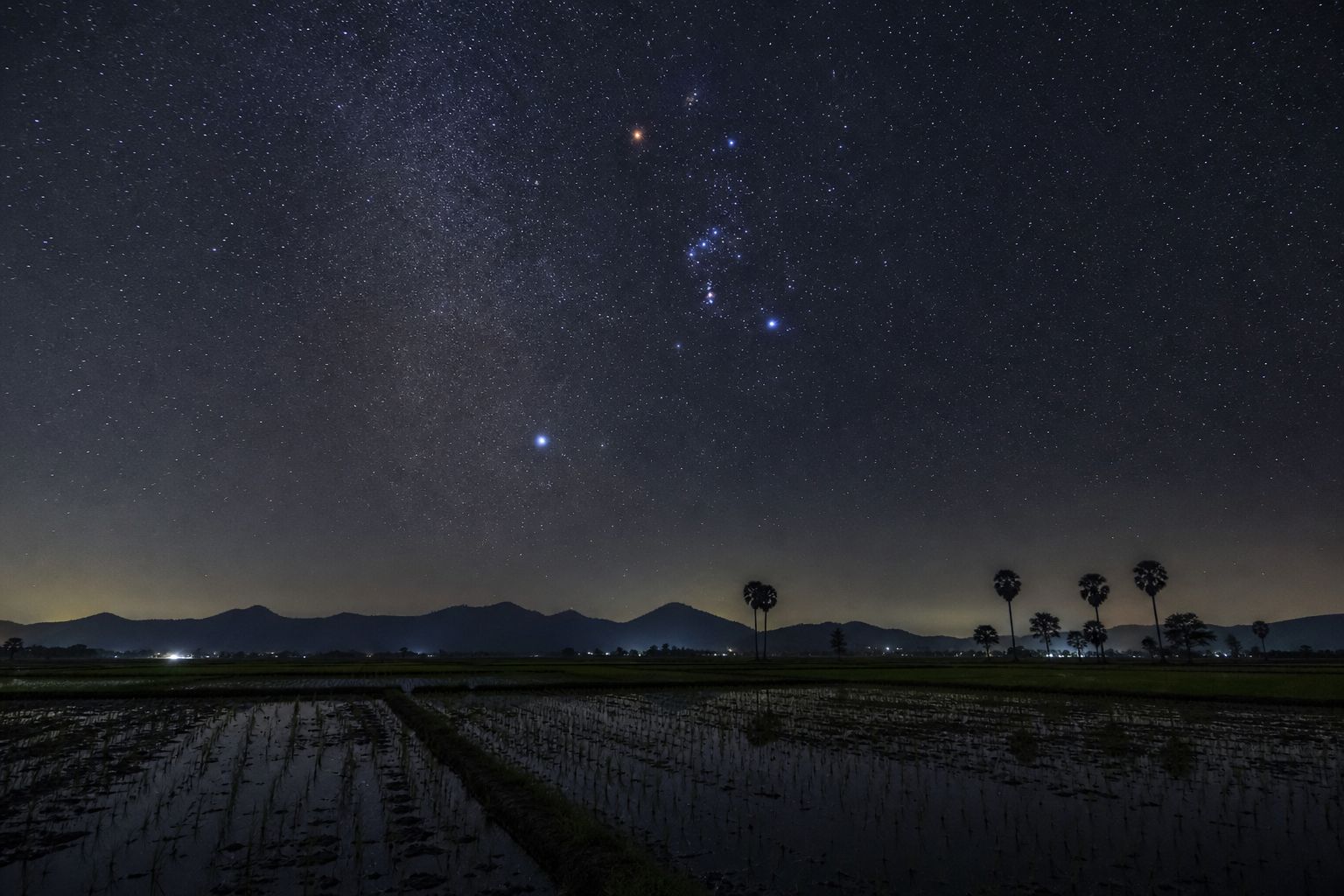
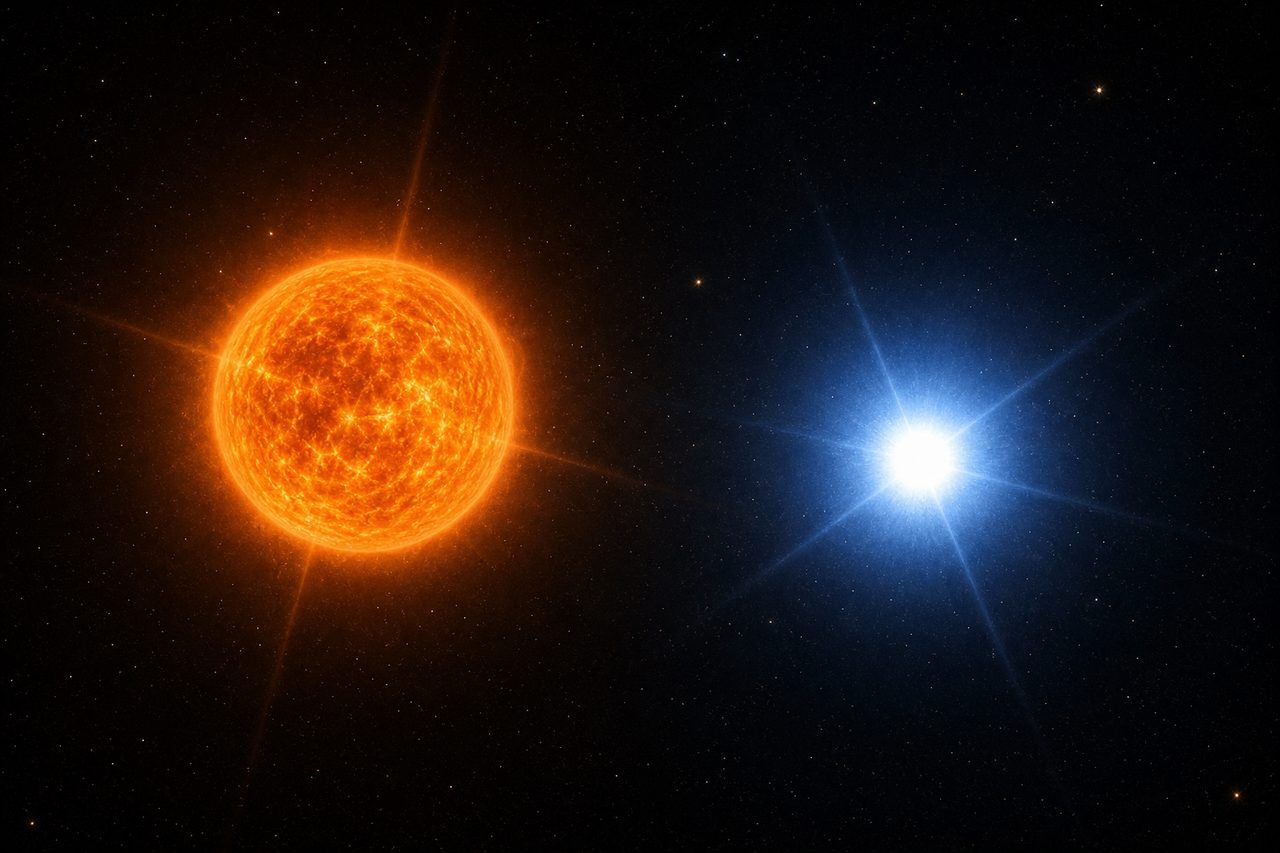
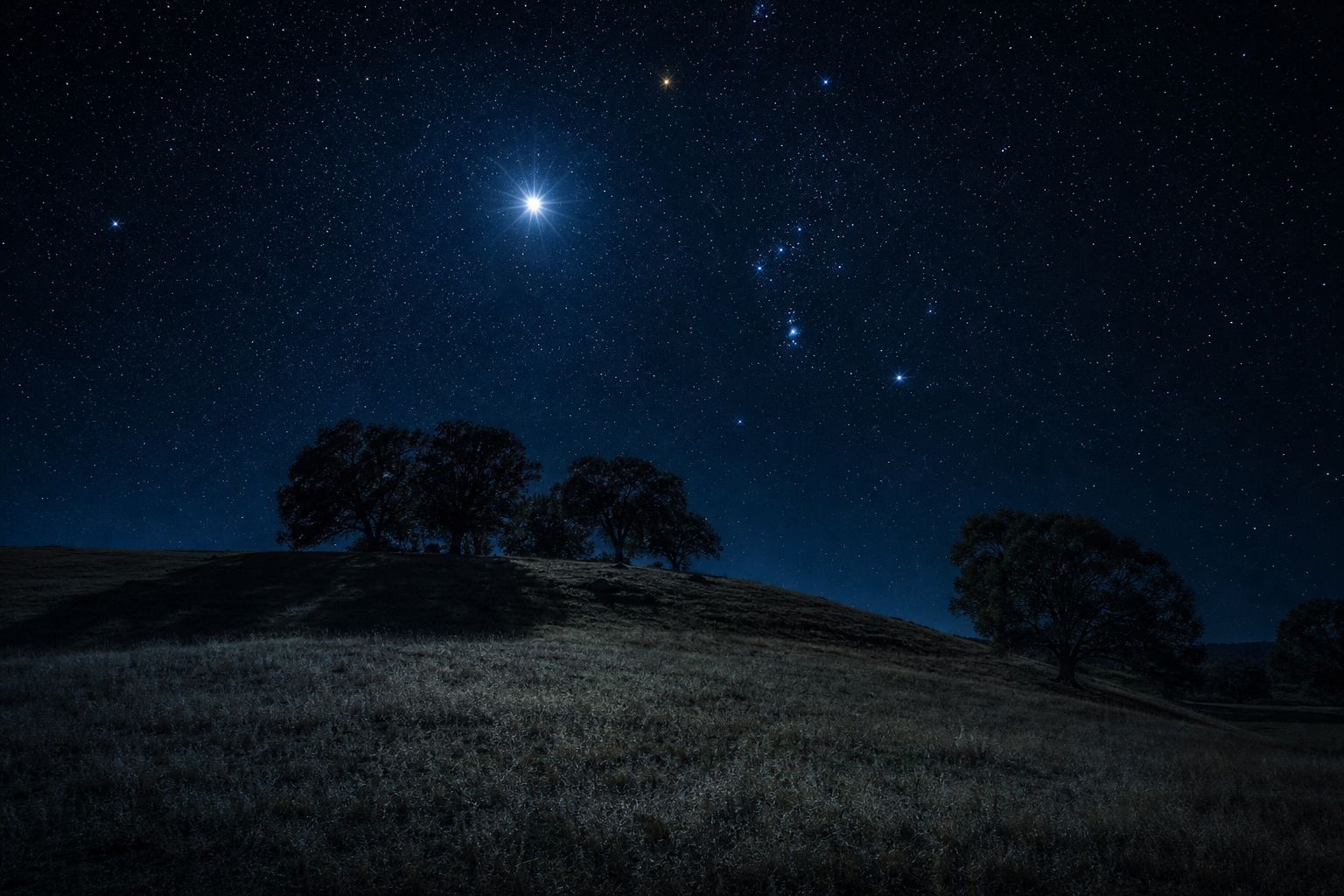
Orion Orion over rice fields: red Betelgeuse at upper left, blue-white Rigel at lower right. AI-generated illustration.
Prologue
The news
NRAO (26 October 2026): a team led by Lynn Matthews of MIT Haystack Observatory used the VLA and ALMA at seven frequencies, 22 to 485 GHz, from 2021 to 2026. Betelgeuse’s radio atmosphere looks more elongated when the companion Siwarha is at its greatest apparent separation and rounder when it passes in front of or behind the star, which the team reads as a wake-like disturbance. The companion is too faint to see directly at radio wavelengths, and the team says more observations are needed to confirm the result. ScienceDaily (3 November 2026) and Space.com (31 October 2026) report the same work.
This is recent work, not yet textbook. The rest of the film is the established science of massive stars.
The 3D scenes are simplified teaching models. Sizes, colours and speeds are not to scale unless a step says so.
Betelgeuse has never kept still. In 1836 John Herschel noticed its brightness changing; in some years it outshone Rigel, the blue-white star at Orion's foot.
Its colour is a clue. Betelgeuse is a red supergiant. Its surface is about three and a half thousand kelvin, much cooler than the Sun's, which is nearly six thousand, yet it gives out tens of thousands of times more light.
It lies roughly five hundred to seven hundred light-years away; studies still disagree.
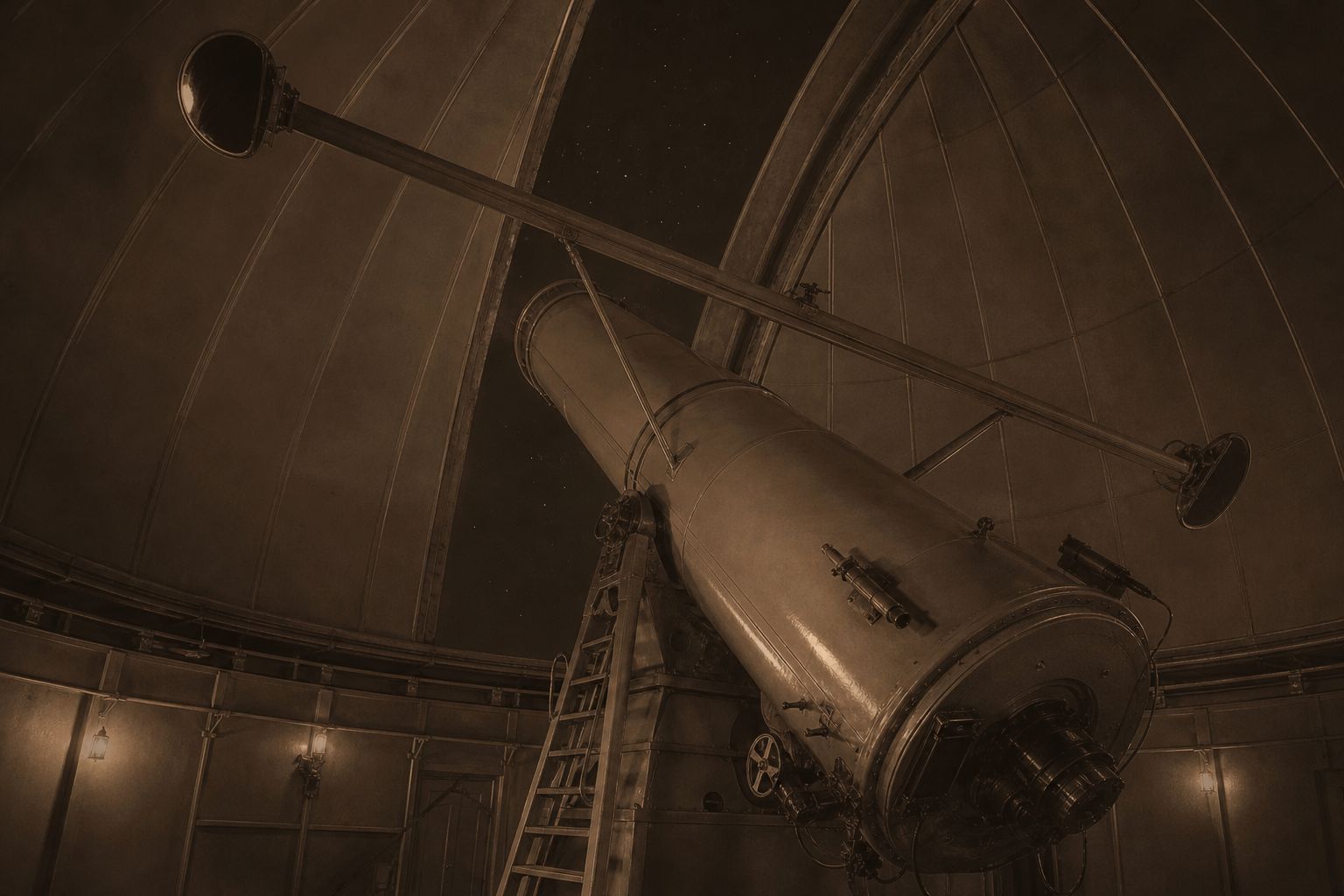
The 1830s A telescope and an observing log of the period. Herschel compared Betelgeuse with nearby stars by eye. AI-generated illustration.
1836 variation noticed
Oct 1837 brighter than Rigel
Nov 1839 brighter than Rigel again
Herschel’s watch (Wikipedia)Red and blue A star’s colour tells its surface temperature: red stars are cooler, blue-white stars hotter. AI-generated illustration.
~3,500 K
Betelgeuse (Wikipedia)
~5,800 K
the Sun (UCAR)
Surface temperature
~530
Joyce et al., 2020
~650
used by NASA, 2026
~724
ALMA and e-MERLIN, 2017
Distance estimates (light-years)
Chapter I · A star that flickers
A variable red star
Wikipedia (Betelgeuse): John Herschel described its variation in Outlines of Astronomy, after watching it from 1836 to 1840, when it at times outshone Rigel (October 1837, November 1839). Studies since 2001 give effective temperatures of about 3,250 to 3,690 K, and luminosity estimates are tens of thousands of times the Sun’s. UCAR: the Sun’s photosphere is around 5,500 °C, about 5,800 K. Distance estimates include about 530 light-years (Joyce et al. 2020, via ANU), about 650 (NASA, 2026) and about 724 (ALMA and e-MERLIN, 2017).
In Thailand, NARIT counts Orion among the best sights of the cool-season night sky.
The 3D scenes are simplified teaching models. Sizes, colours and speeds are not to scale unless a step says so.
The first star, other than the Sun, to be measured.
In 1920, Albert Michelson and Francis Pease combined Betelgeuse's light from two mirrors set wide apart, and from how the light waves mixed, measured its width: a first for any star beyond the Sun.
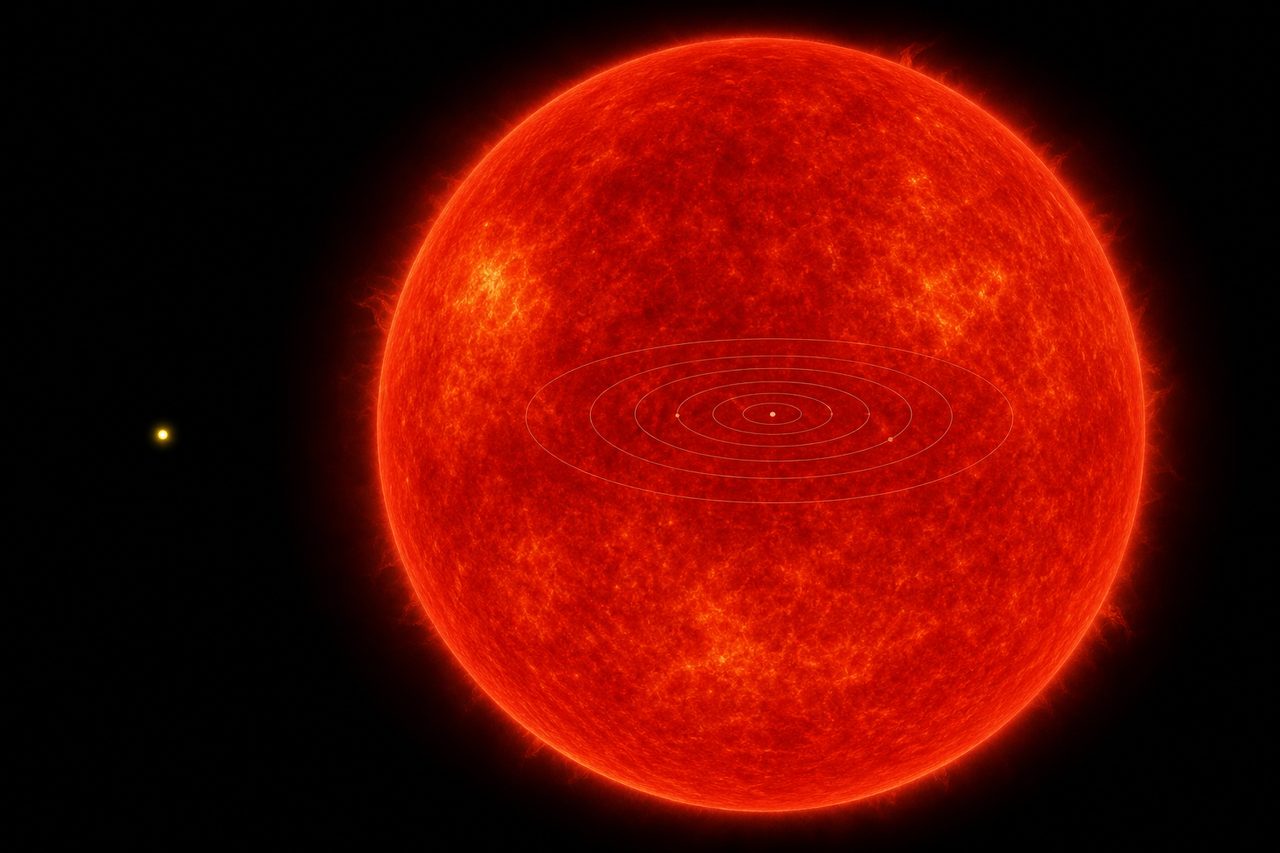
Modern estimates put its radius at about seven hundred to seven hundred and fifty Suns.
In place of the Sun, it would swallow the orbits of Mercury, Venus, Earth and Mars, and perhaps reach Jupiter's. Try the buttons.
Mount Wilson, 1920 A 20-foot beam with mirrors at each end, on the 100-inch Hooker telescope. AI-generated illustration.
13 Dec 1920
date of the measurement
0.047″
its apparent width, in arcseconds
Michelson and Pease (Wikipedia)
~700×
the Sun’s (Gemini, 2025)
~750×
the Sun’s (Joyce et al., 2020)
RadiusThe Sun beside it The small yellow dot is the Sun at the same scale. AI-generated illustration.
Chapter I · A star that flickers
The first measured star
Wikipedia (Betelgeuse; Michelson stellar interferometer): on 13 December 1920 Michelson and Pease used a 20-foot interferometer on the 100-inch Hooker telescope at Mount Wilson to make the first measurement of the angular diameter of a star outside the Solar System, about 0.047 arcseconds. An interferometer combines light collected at two separated points; the pattern the light waves make together depends on the star’s angular size. Gemini (2025) gives a radius of about 700 times the Sun’s; Joyce et al. (2020) about 750. Wikipedia: placed at the centre of the Solar System, its surface would lie beyond the asteroid belt, engulfing the orbits of Mercury, Venus, Earth and Mars. NASA (2022), using a larger size estimate, says it would reach out to the orbit of Jupiter.
In the scene, the planets’ orbits and the 750-Sun radius are drawn to the same scale; the Sun and planets are enlarged so they can be seen.
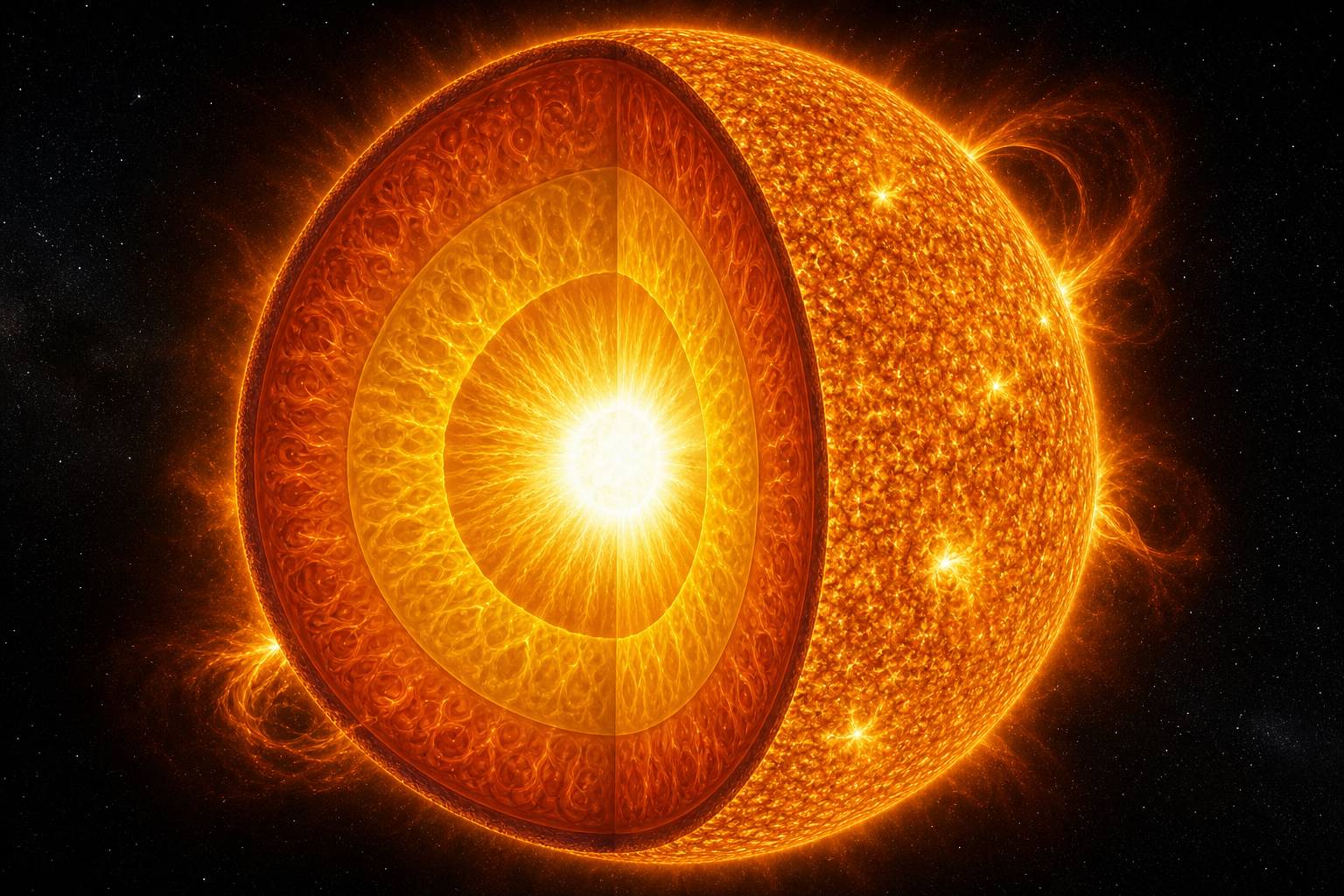
Every star is a contest between two forces. Gravity pulls its gas inward; the pressure of the hot interior pushes outward.
When the two balance, the star keeps its size: hydrostatic equilibrium.
The heat comes from the core. In 1938 Hans Bethe showed how: nuclear fusion, which joins hydrogen nuclei into helium and releases energy.
That long, steady stage of a star's life is called the main sequence.
Inside a star A cutaway: energy made in the core works its way out through the layers above. AI-generated illustration.
inward: gravity of the star’s own mass
outward: pressure from the hot core
balanced: the star neither shrinks nor swells
Hydrostatic equilibrium (NASA)41H→4He+energy
1H
a hydrogen nucleus (a proton)
4He
a helium nucleus
Hydrogen fusion, in sumThe Sun Our Sun is a main-sequence star, still fusing hydrogen in its core. AI-generated illustration.
Chapter II · How a star works
Why a star holds its shape
NASA (Webb, life cycles of stars): gravity pulls a star inward while heat from its core creates outward pressure; when they balance, the star is in hydrostatic equilibrium. For most of its life a star’s energy comes from nuclear reactions in its core, the main sequence. Nobel Prize (Hans Bethe, Physics 1967): in 1938 Bethe showed that fusion powers the energy stars emit.
The equation is the net result of a chain of reactions, simplified. Fusion is not burning in the everyday sense: nothing catches fire; nuclei join.
The 3D scenes are simplified teaching models. Sizes, colours and speeds are not to scale unless a step says so.
A star's whole life is set by its mass. Try the buttons as we go.
A heavier star has more fuel, but its core runs hotter, so it uses that fuel far faster.
The Sun gets about ten billion years on the main sequence. A star of sixteen Suns gets about ten million.
Betelgeuse holds about sixteen and a half to nineteen times the Sun's mass.
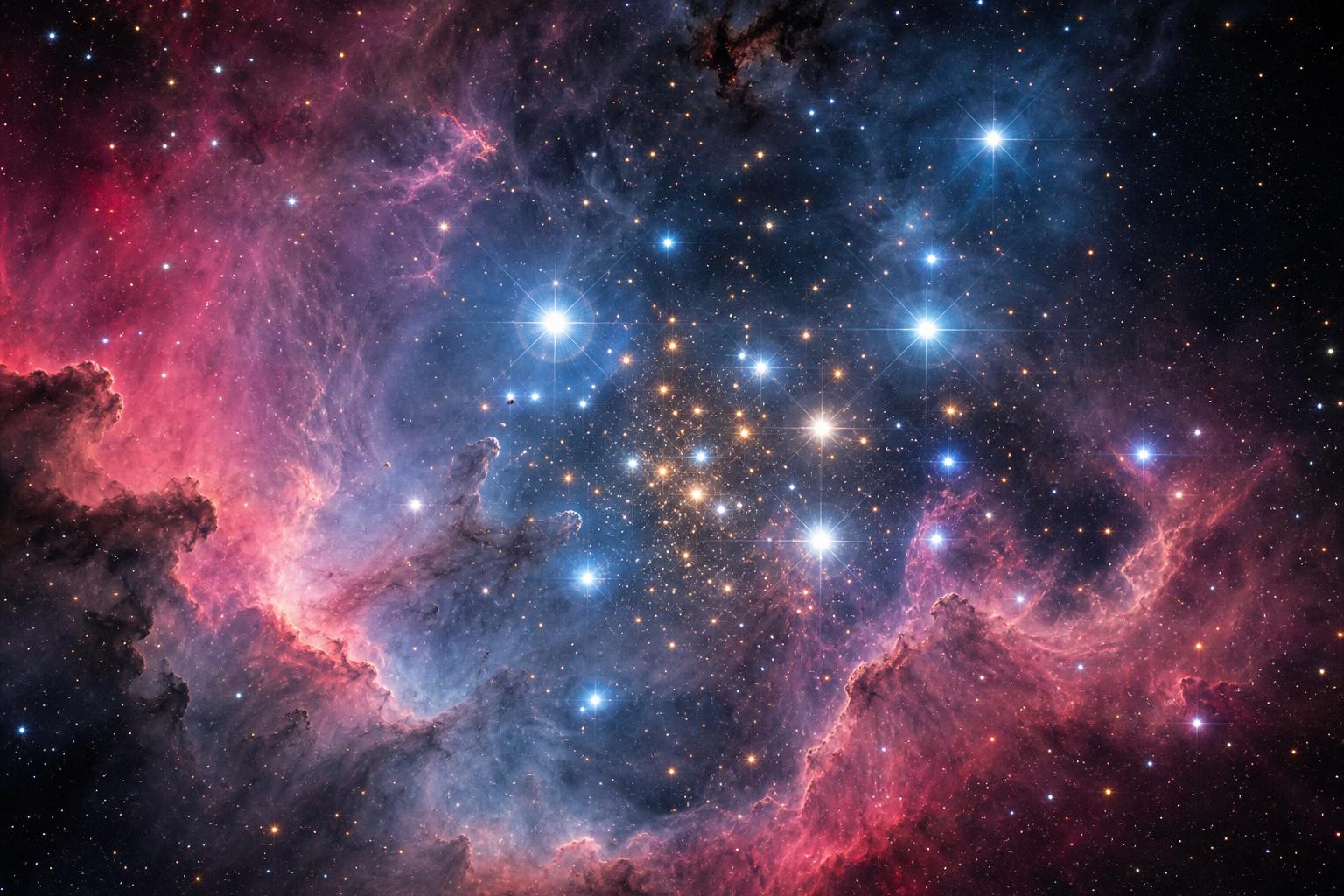
A young cluster Stars born together: the few big blue-white ones will be gone long before the small yellow ones. AI-generated illustration.
more mass: stronger squeeze
hotter core: much faster fusion
fuel used up sooner
Why heavy stars die young (OpenStax)
1.1 Suns
9,000
3.3 Suns
500
16 Suns
10
40 Suns
1
Time on the main sequence (OpenStax)
The gentle ending Stars below about 8 Suns shed their outer layers and leave a white dwarf. Betelgeuse is far above that line. AI-generated illustration.
Chapter II · How a star works
Mass sets the clock
OpenStax Astronomy 2e (Table 22.1): main-sequence lifetimes of about 9 billion years for 1.1 solar masses, 500 million for 3.3, 10 million for 16 and 1 million for 40; a 1-solar-mass star lasts about 10 billion years. More massive stars have more fuel but “burn it so prodigiously” because fusion depends strongly on core temperature. OpenStax 23.2: stars below about 8 solar masses end as white dwarfs; Table 23.1 gives neutron stars for about 10 to 40 and black holes above 40 (simplified). Kavli IPMU (Joyce et al. 2020): Betelgeuse’s present mass is 16.5 to 19 solar masses.
The fates in the scene follow the textbook table; real outcomes also depend on how much mass a star loses and on whether it has a companion.
The 3D scenes are simplified teaching models. Sizes, colours and speeds are not to scale unless a step says so.
When the hydrogen in the core runs out, fusion there stops. Gravity squeezes and heats the core, and hydrogen fusion moves to a shell around it.
The extra energy pushes the outer layers outward. They swell and cool, and a massive star becomes a red supergiant.
Squeezed and heated further, the core starts fusing helium. A 2020 study led by Meridith Joyce concluded that Betelgeuse is early in that stage now.
core: helium “ash”, contracting and heating
shell: hydrogen fusion around the core
envelope: expands, cools, turns red
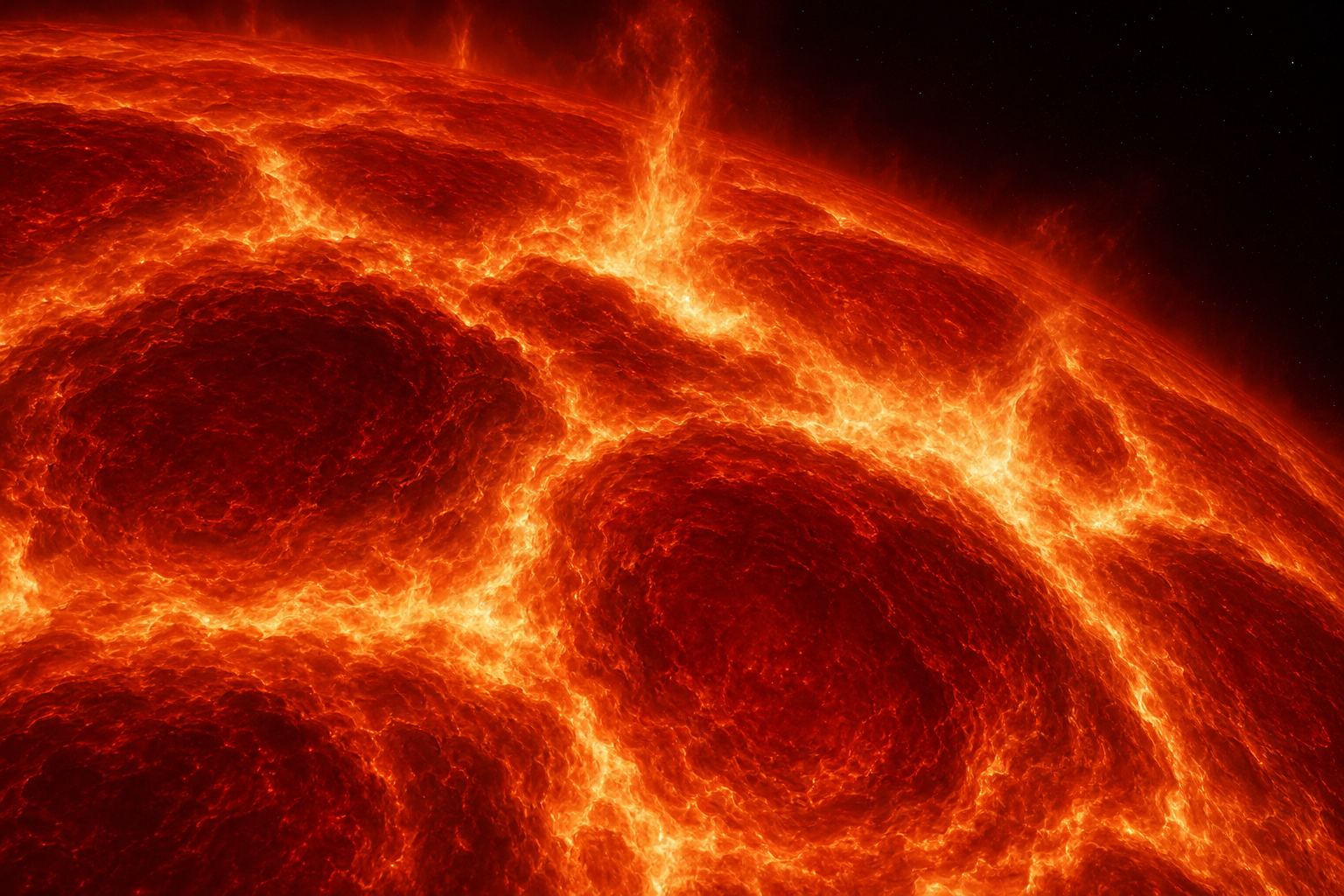
After the main sequence (OpenStax)A boiling surface A red supergiant’s surface is a few huge cells of rising and sinking gas. AI-generated illustration.
helium
now fusing in its core, at an early stage
~10 million years
its age
Betelgeuse today (Joyce et al. 2020; Gemini 2025)
Chapter III · A red supergiant
From main sequence to supergiant
OpenStax 22.1: when core hydrogen is used up, the core of helium ash contracts and heats; hydrogen fusion begins in a shell outside it; the energy makes the outer layers expand, and the star becomes more luminous and cooler. Massive stars become red supergiants. ANU and Kavli IPMU (Joyce et al. 2020): Betelgeuse is in the early core helium-burning phase. Gemini (2025): Betelgeuse is about ten million years old.
The 3D scenes are simplified teaching models. Sizes, colours and speeds are not to scale unless a step says so.
Why Betelgeuse faded, and why it was not about to explode.
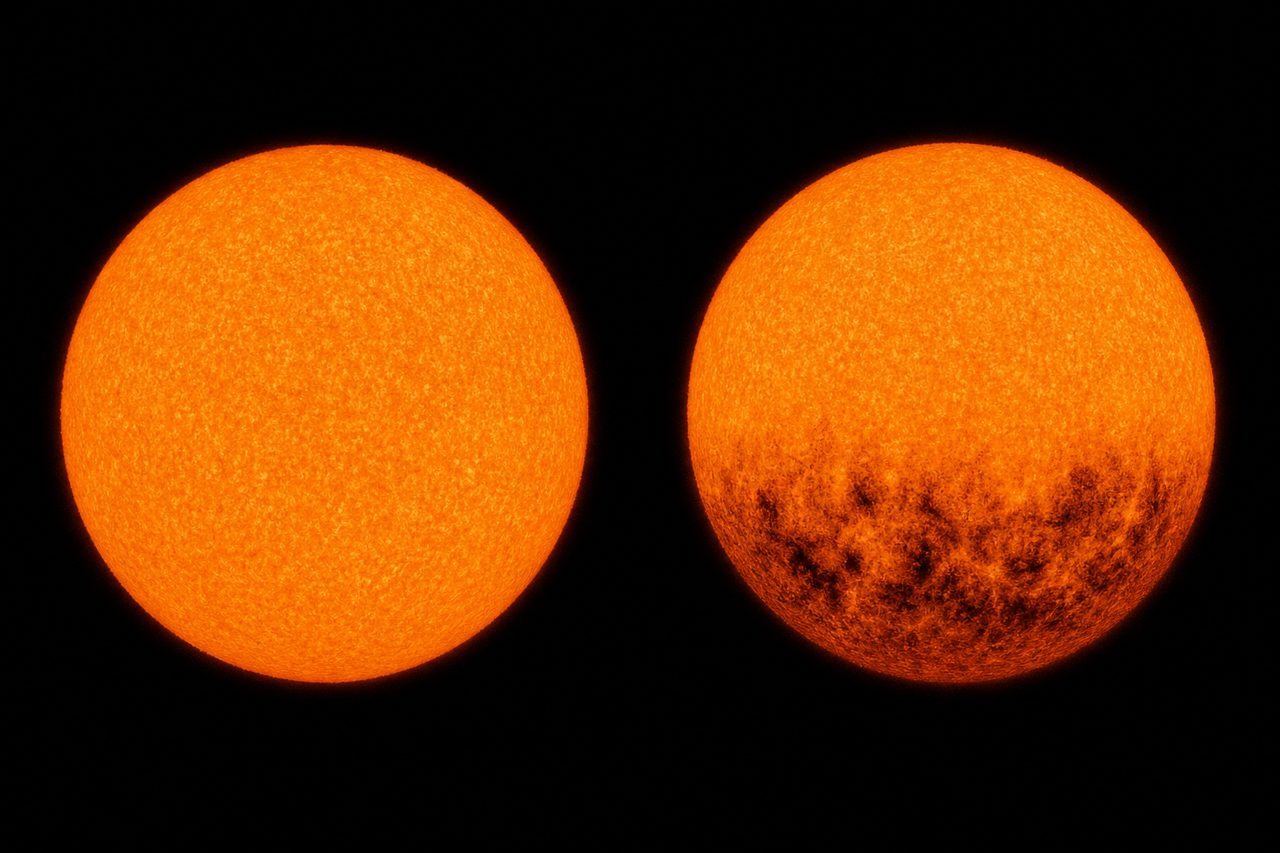
Late in 2019, Betelgeuse began to fade. By February 2020 it was at its dimmest in more than a century, and some wondered if it was about to explode.
Hubble data pointed to the cause: a huge eruption threw off a piece of the star's surface, with several times the mass of our Moon.
That gas cooled into dust, which veiled the lower, southern part of the star as seen from Earth, in images published in Nature in 2021.
By April 2020 it was back to normal brightness.
Jan 2019 normal, magnitude about 0.5
Dec 2019 southern part visibly darker
Feb 2020 faintest: magnitude about 1.6 (a bigger number means dimmer)
Apr 2020 back to normal
The Great Dimming (ESO, Wikipedia)A surface mass ejection Hubble data suggest a rising plume blew off part of the surface, which then cooled into dust. AI-generated illustration.Before and during An illustration in the style of ESO’s SPHERE images: the star in 2019, and dimmed. AI-generated illustration.
not a warning
the dimming was not an early sign of a supernova
ESO, 2021
Chapter IV · The Great Dimming
What dimmed Betelgeuse
ESO (16 June 2021; Montargès et al., Nature): images with the SPHERE instrument on the Very Large Telescope showed the southern part of the star much darker in December 2019, January and March 2020, and normal brightness by April 2020. The star ejected a large gas bubble; a nearby patch of its surface cooled, and the gas condensed into dust that partly hid the star. The study concludes the dimming was not an early sign of a supernova. NASA via ScienceDaily (2022; Andrea Dupree): Hubble and other data point to a surface mass ejection in 2019, a piece of the surface several times the Moon’s mass. Wikipedia: brightness fell from about magnitude 0.5 to a record minimum of about +1.6 in February 2020; Space.com: its dimmest in more than a century. Wikipedia (Magnitude): larger magnitudes mean fainter objects; five magnitudes are a factor of 100.
Use the buttons to bring the dust back or clear it.
The 3D scenes are simplified teaching models. Sizes, colours and speeds are not to scale unless a step says so.
A fast pulse, and a slow cycle nobody could explain.
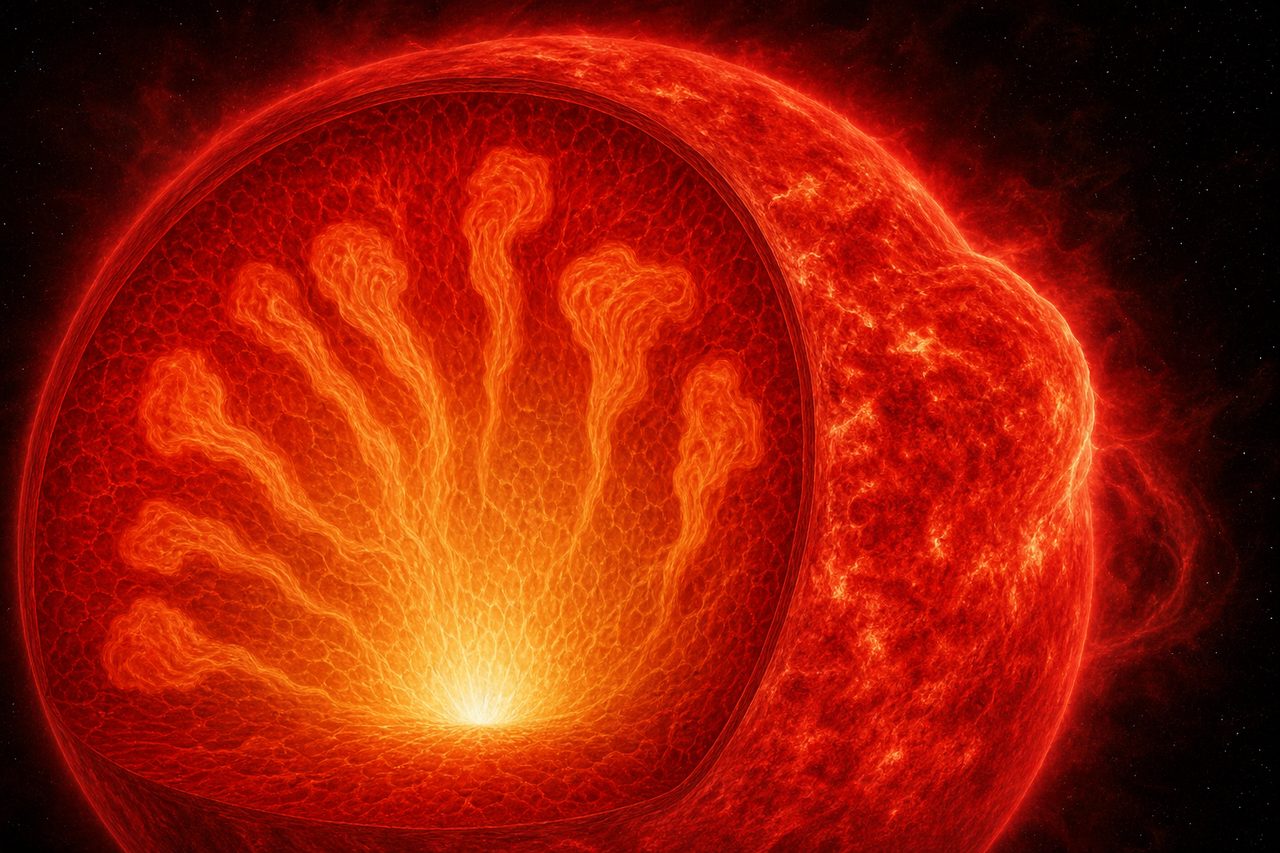
Betelgeuse also breathes. Its brightness rises and falls about every four hundred days, driven by pressure waves: sound waves inside the star.
There is a slower cycle too, of about two thousand one hundred days, nearly six years. It is called the long secondary period, and its cause long puzzled astronomers.
Inside a supergiant Huge plumes of hot gas rise through the star and make its surface bulge. AI-generated illustration.
Pressure waves – essentially, sound waves – were the cause of Betelgeuse’s pulsation.Shing-Chi Leung, co-author, ANU release, 2020
~400 days
the pulse
~2,100 days
the slow cycle: why?
Two rhythms (NASA, 2026)
Chapter V · A hidden companion
Pulsation
NASA (2026): Betelgeuse has a short cycle of about 400 days, recently attributed to pulsations within the star, and a long secondary period of about 2,100 days. ANU (2020): co-author Shing-Chi Leung said the analysis confirmed that pressure waves, essentially sound waves, cause the pulsation. Kavli IPMU also lists a second, shorter pulsation of about 185 days.
In the scene, the pulsing is hugely speeded up and exaggerated.
The 3D scenes are simplified teaching models. Sizes, colours and speeds are not to scale unless a step says so.
A second star, perhaps the answer to the six-year cycle.
In 2024, astronomers proposed that a companion star could explain that slow cycle.
In 2025, the Gemini North telescope imaged it: a star of about one and a half Suns, some two hundred and fifty times fainter than Betelgeuse.
How can it orbit inside the giant? Betelgeuse's outer layers are spread so thin that, on average, the whole star is thousands of times less dense than the air we breathe.
In 2026, Hubble saw signs of its wake. Astronomers named it Siwarha, from an Arabic phrase for 'her bracelet', and say more observations are needed.
Inside the haze An artist’s impression of the companion moving through the giant’s outer atmosphere. AI-generated illustration.
~1.5 Suns
mass, compared with the Sun
6 magnitudes
fainter: about 250 times, since each magnitude is about 2.5 times
~4 AU
from Betelgeuse: four Earth–Sun distances
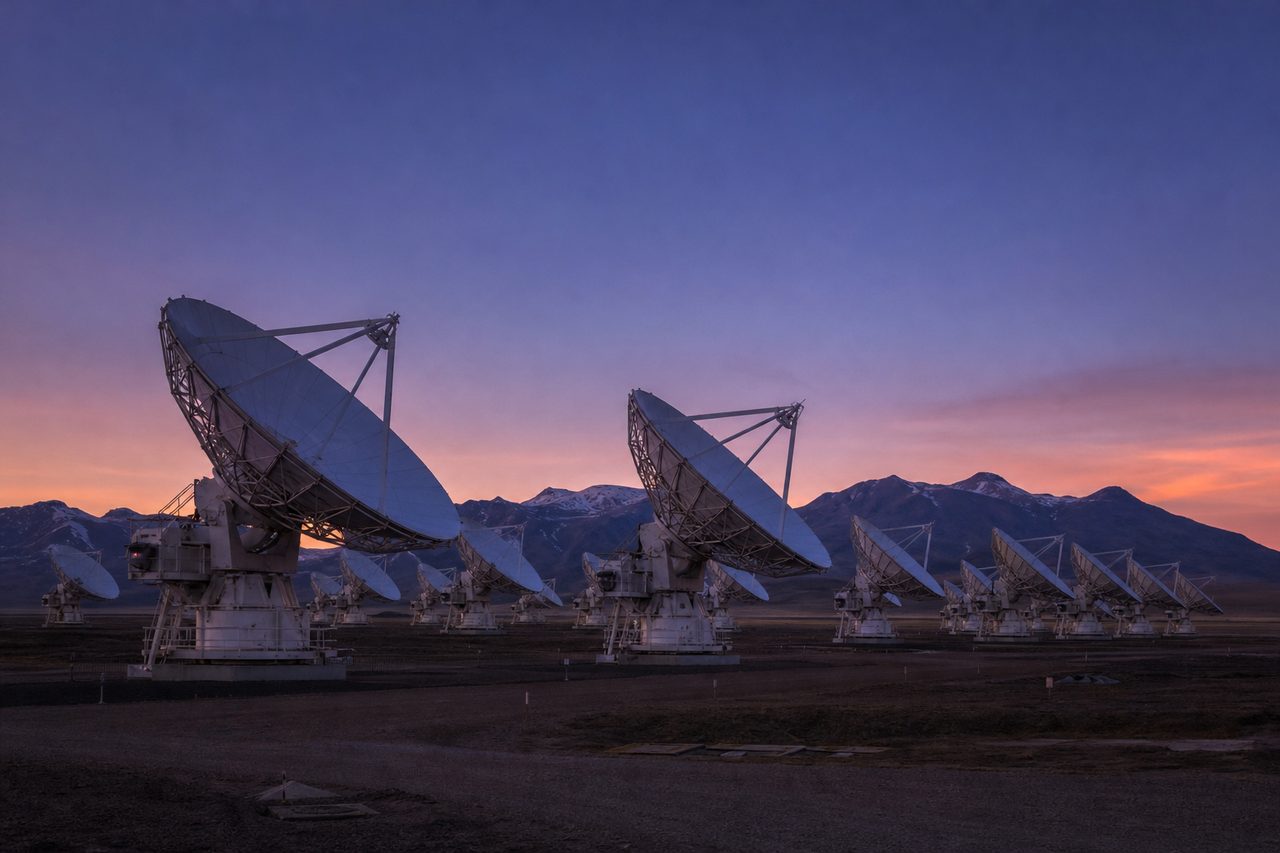
Siwarha (Gemini, July 2025)Radio eyes Arrays of radio dishes, like the VLA and ALMA, see the cool, thin gas around the star. AI-generated illustration.
2024 proposed, to explain the ~2,100-day cycle
Jul 2025 imaged by Gemini North
Jan 2026 Hubble: signs of its wake
Oct 2026 VLA and ALMA: a disturbed atmosphere
Nov 2027 next good chance to see it, at its farthest from the star
~10,000 yr it may spiral into Betelgeuse
The companion
Chapter V · A hidden companion
A hidden companion
NRAO (2026): the companion was proposed in 2024 to explain Betelgeuse’s roughly 2,100-day brightness cycle and has since been supported by imaging and spectroscopy; its name means “her bracelet”, and more observations are needed to confirm the radio results. Gemini (21 July 2025; Steve Howell, NASA Ames): the ‘Alopeke speckle imager on Gemini North found a companion of about 1.5 solar masses, six magnitudes fainter than Betelgeuse, about four times the Earth–Sun distance away, inside the outer atmosphere; it will be best seen again in November 2027, at its greatest separation; tidal forces are expected to make it spiral in within about 10,000 years. NASA (5 January 2026; Andrea Dupree): Hubble and ground telescopes found signs of a wake of dense gas that appears just after the companion passes in front of the star, every six years or so. Wikipedia (Magnitude): each magnitude is a factor of about 2.512, so six is about 250. Density: Brian Koberlein describes Betelgeuse as close to a vacuum on average; from 16.5–19 solar masses (Joyce et al.) spread through a radius of 750 Suns, the average density is a few hundred-millionths of a gram per cubic centimetre, thousands of times less than air at sea level (our calculation).
This is new and still being tested; the size and shape of the orbit in the scene are schematic.
The 3D scenes are simplified teaching models. Sizes, colours and speeds are not to scale unless a step says so.
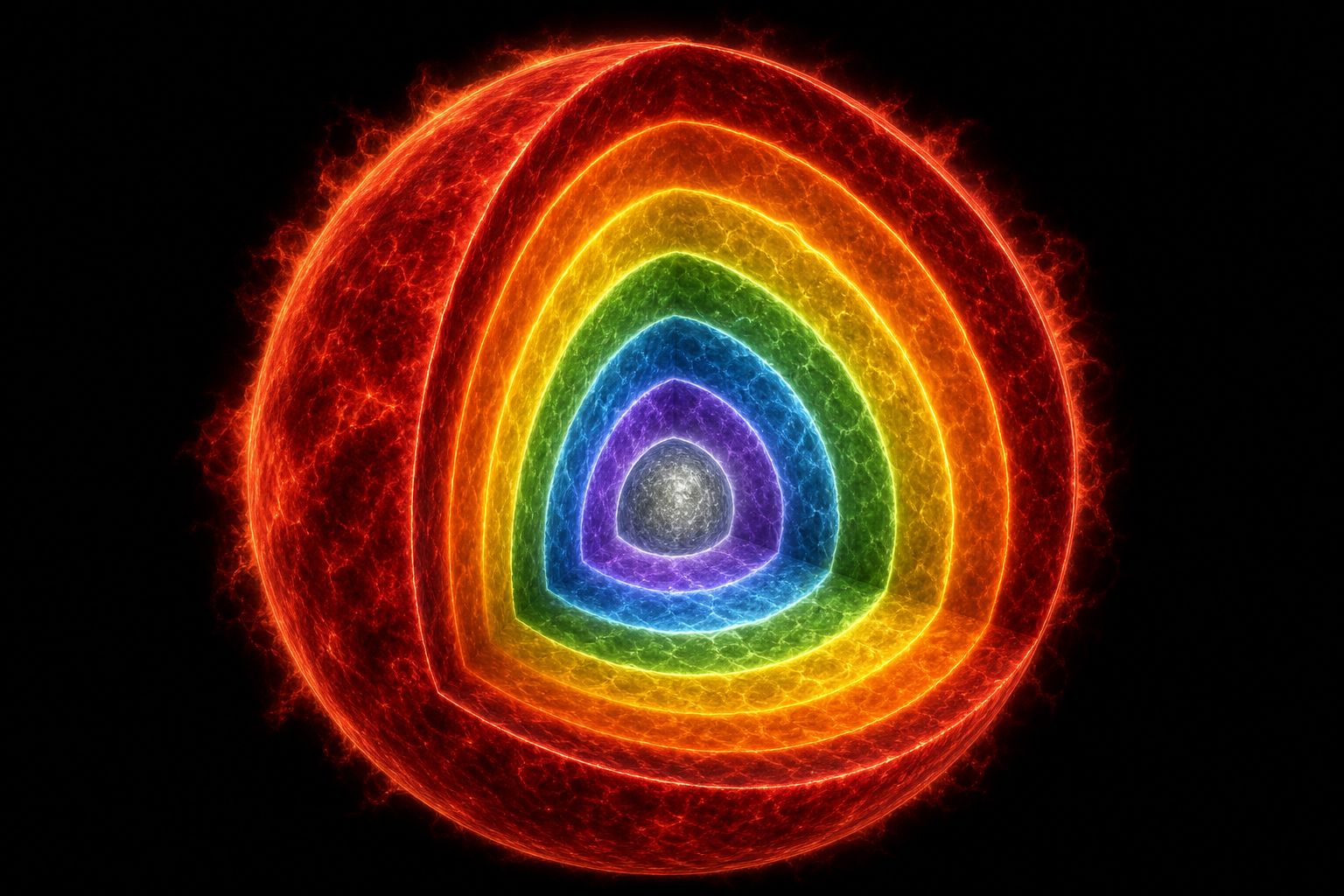
When the core runs out of helium, it shrinks and heats again and fuses carbon, then oxygen, neon and silicon. The last stages may take only days.
The core ends up like an onion: iron at the centre, wrapped in shells of lighter elements.
And there it stops. Fusing iron takes in energy instead of giving it out, so the core loses the support that held it up against gravity.
Shells Each shell fuses a different fuel; the colours are for teaching, not what the star looks like. AI-generated illustration.
hydrogen → helium
helium → carbon, oxygen
carbon → oxygen, neon, magnesium
oxygen, silicon → sulfur … iron
From the outside in (OpenStax)
iron
at the very centre
6 layers
from hydrogen outside to iron inside, simplified
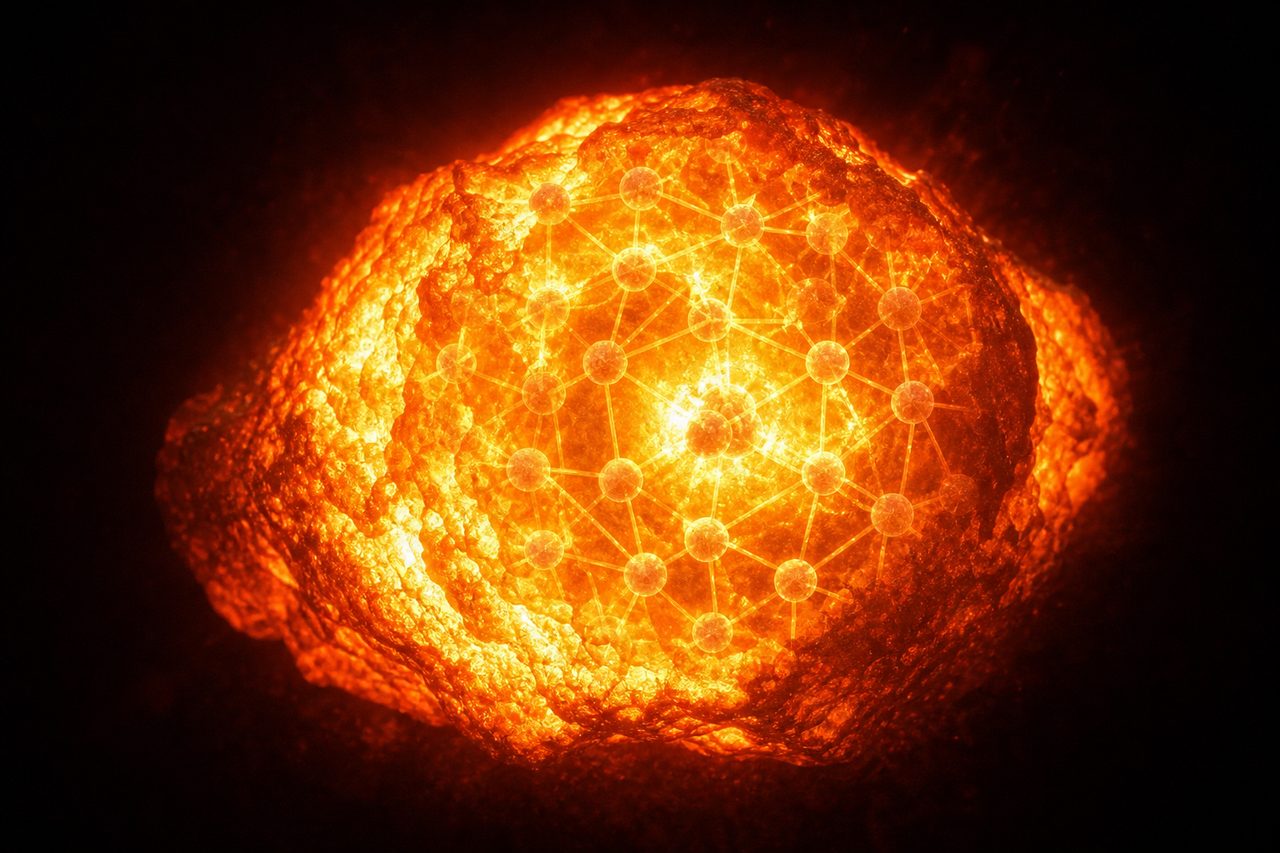
The onion (OpenStax)Iron, the dead end Iron’s nucleus is the most tightly bound of all, so nothing is gained by fusing it. AI-generated illustration.
Chapter VI · Collapse
Fusion up to iron
OpenStax 23.2: after helium is exhausted, the core contracts and heats until carbon fuses into oxygen, neon and magnesium; the cycle repeats, making silicon, sulfur, calcium, argon and then iron; in really massive stars some final stages may take only months or even days. The core becomes onion-like, with iron at the centre. Iron is the most tightly bound nucleus, so fusing it absorbs energy rather than releasing it. Wikipedia (B2FH paper): the 1957 paper by Margaret and Geoffrey Burbidge, William Fowler and Fred Hoyle, Synthesis of the Elements in Stars, established the theory that the elements are made in stars.
The shells are drawn far thicker than they really are; in a real red supergiant the whole onion is tiny compared with the star.
The 3D scenes are simplified teaching models. Sizes, colours and speeds are not to scale unless a step says so.
When the iron core grows too heavy, it collapses: in under a second, from the size of Earth to less than twenty kilometres.
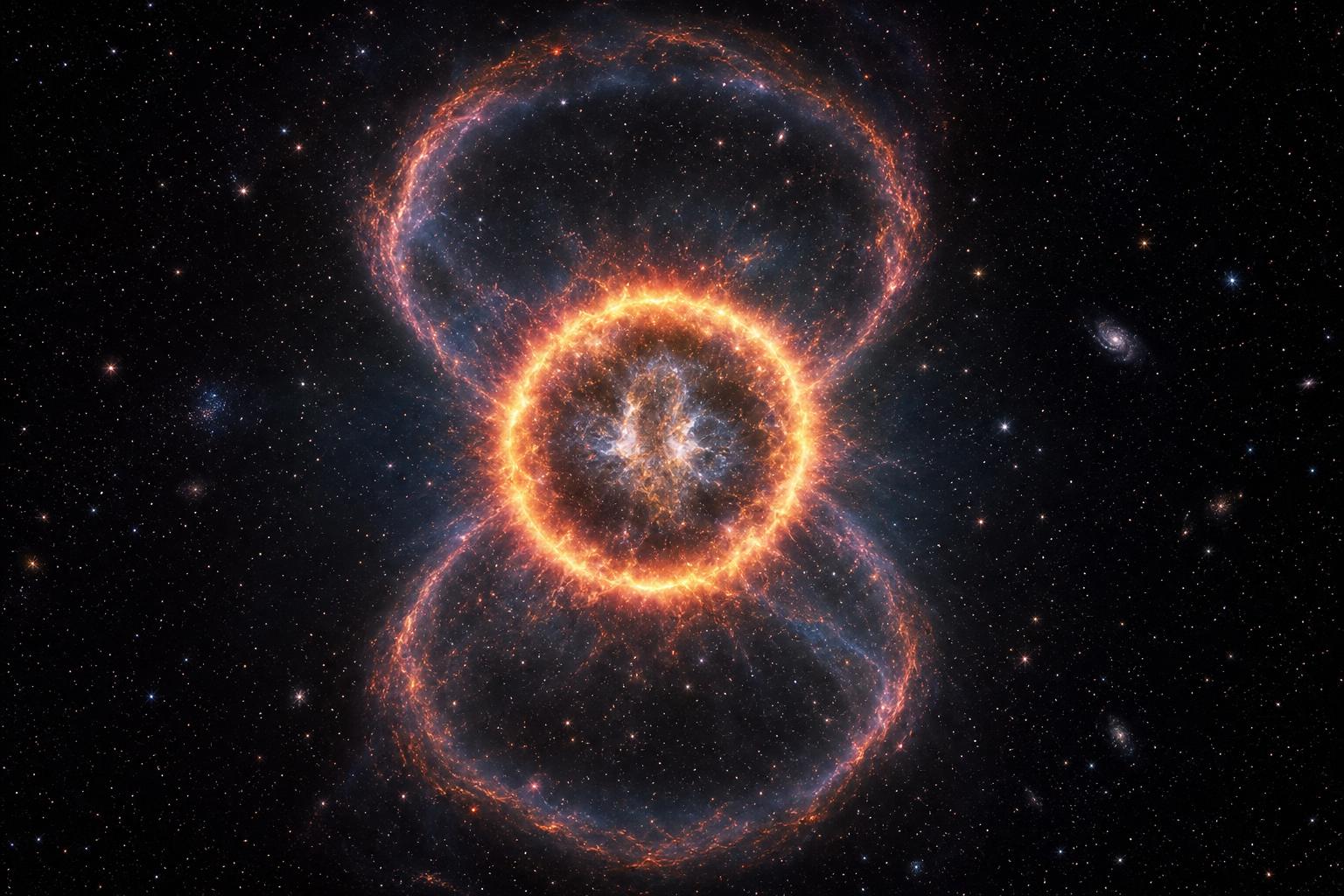
Electrons and protons are squeezed into neutrons, releasing a flood of neutrinos: tiny particles that pass through almost anything. A shock wave, helped by them, blasts the rest of the star into space: a core-collapse supernova.
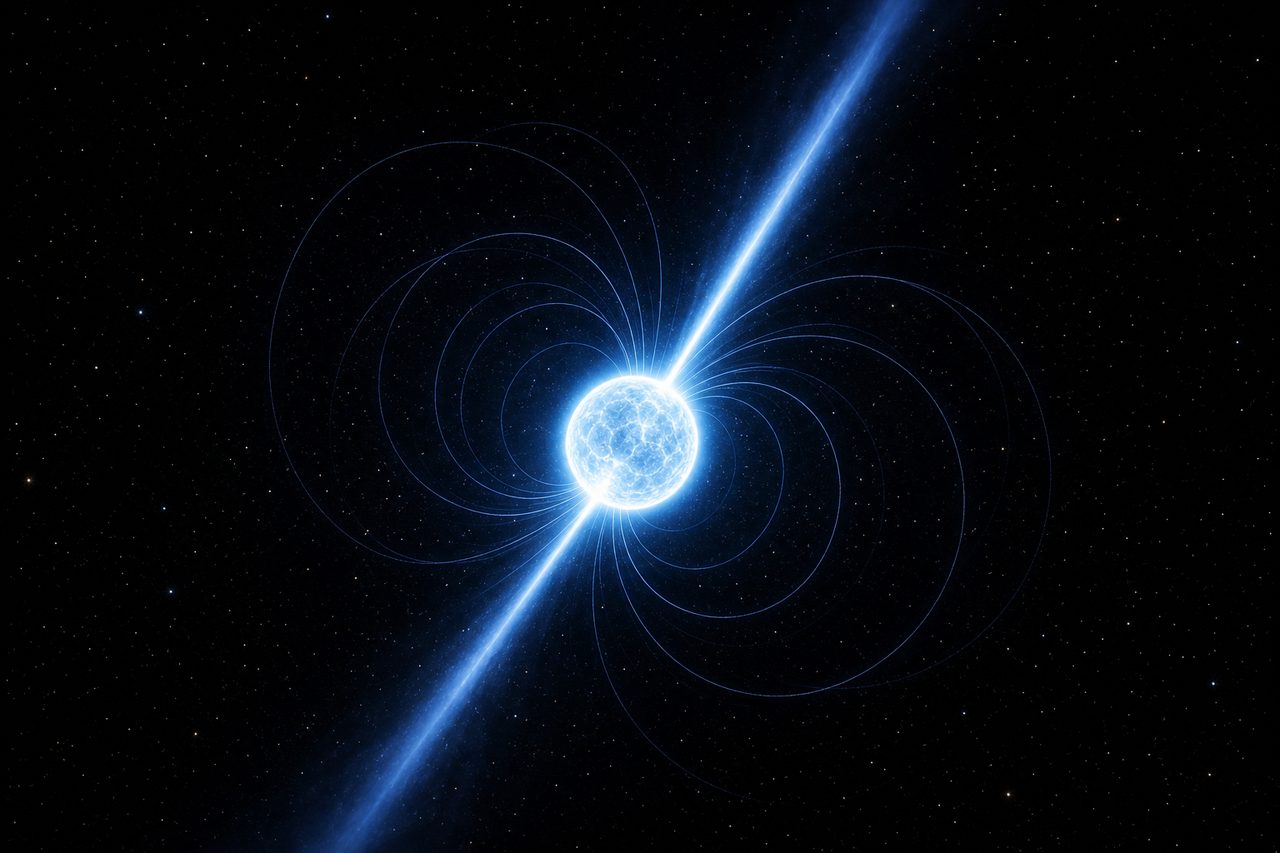
Left behind is a neutron star, as heavy as the Sun but the size of a city, or, if the core is heavier still, a black hole.
< 1 s
time for the collapse
~1 Sun
mass of the iron core
~¼ c
speed of the infalling gas
Core collapse (OpenStax)p+e−→n+νe
νe
an electron neutrino
Neutrons from protons, simplifiedThe shock In the first second, the neutrinos carry more power than all the stars in over a billion galaxies. AI-generated illustration.A neutron star A ball of neutrons under 20 km wide; neutron stars can weigh up to about 3 Suns. AI-generated illustration.
Chapter VI · Collapse
Core collapse
OpenStax 23.2: at about 4 × 10¹¹ g/cm³, electrons combine with protons to make neutrons and neutrinos; in less than a second a core of about one solar mass shrinks from about the size of Earth to under 20 km across, with infalling material reaching about a quarter of the speed of light. Degenerate neutrons halt the collapse; a shock wave forms, and neutrinos depositing energy just outside the core help drive the outer layers off. In the first second the neutrinos carry more power than all the stars in over a billion galaxies. The upper mass limit of a neutron star is about 3 solar masses; a heavier core becomes a black hole. Wikipedia (Neutrino): neutrinos have a very small mass and no charge and interact only through the weak force and gravity, so they pass through ordinary matter almost unaffected.
The equation is a simplification of electron capture; the full process involves many reactions and several kinds of neutrino. Press Collapse to run it again; the scene is slowed down enormously.
The 3D scenes are simplified teaching models. Sizes, colours and speeds are not to scale unless a step says so.
The time we saw it happen, and caught the neutrinos.
We have seen this happen. On the twenty-third of February 1987, light from an exploding star arrived from the Large Magellanic Cloud, after a journey of about one hundred and sixty-eight thousand years.
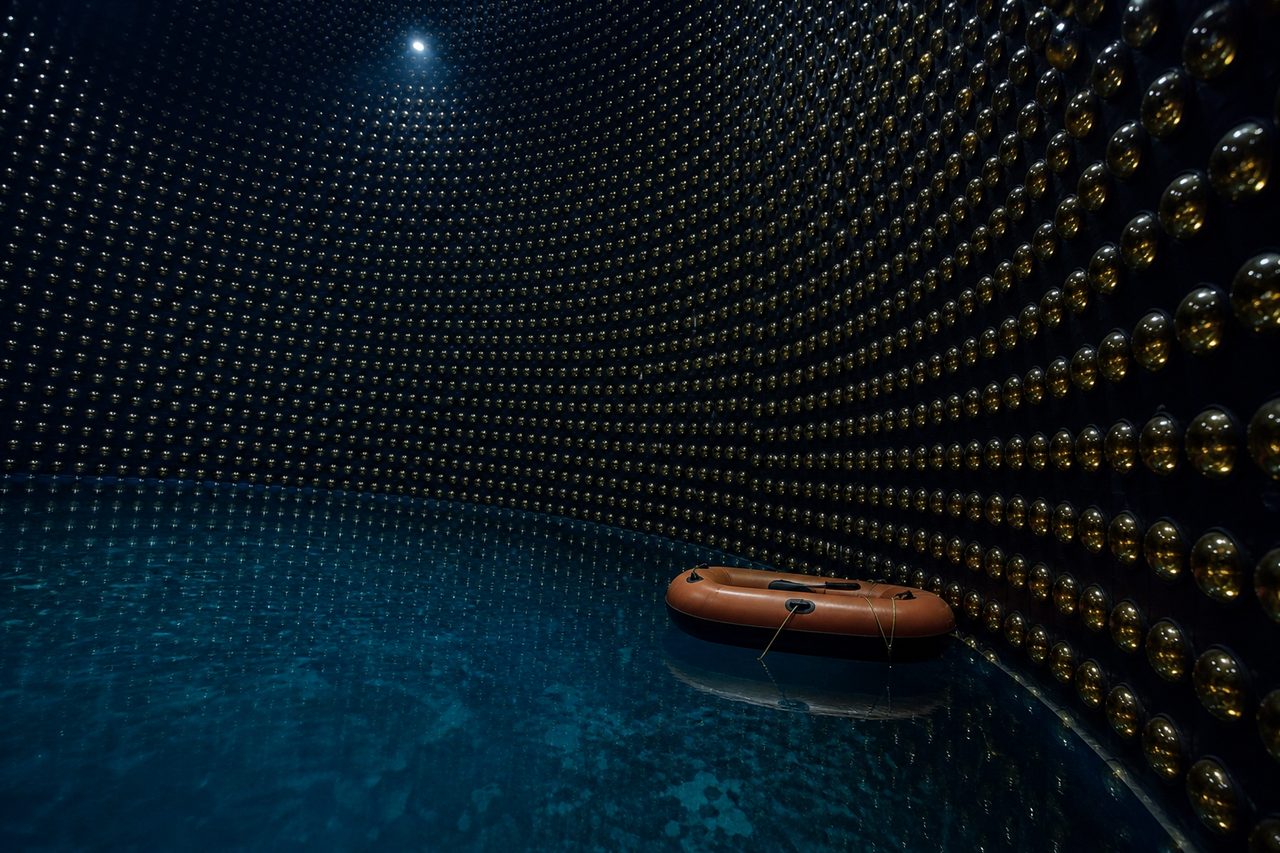
A few hours earlier, detectors in Japan, the United States and the Soviet Union caught about two dozen neutrinos. They slip straight out of a collapsing star, while light takes hours to escape.
It was the closest supernova seen since 1604, and in 2024 the Webb telescope found signs of a neutron star at its heart.
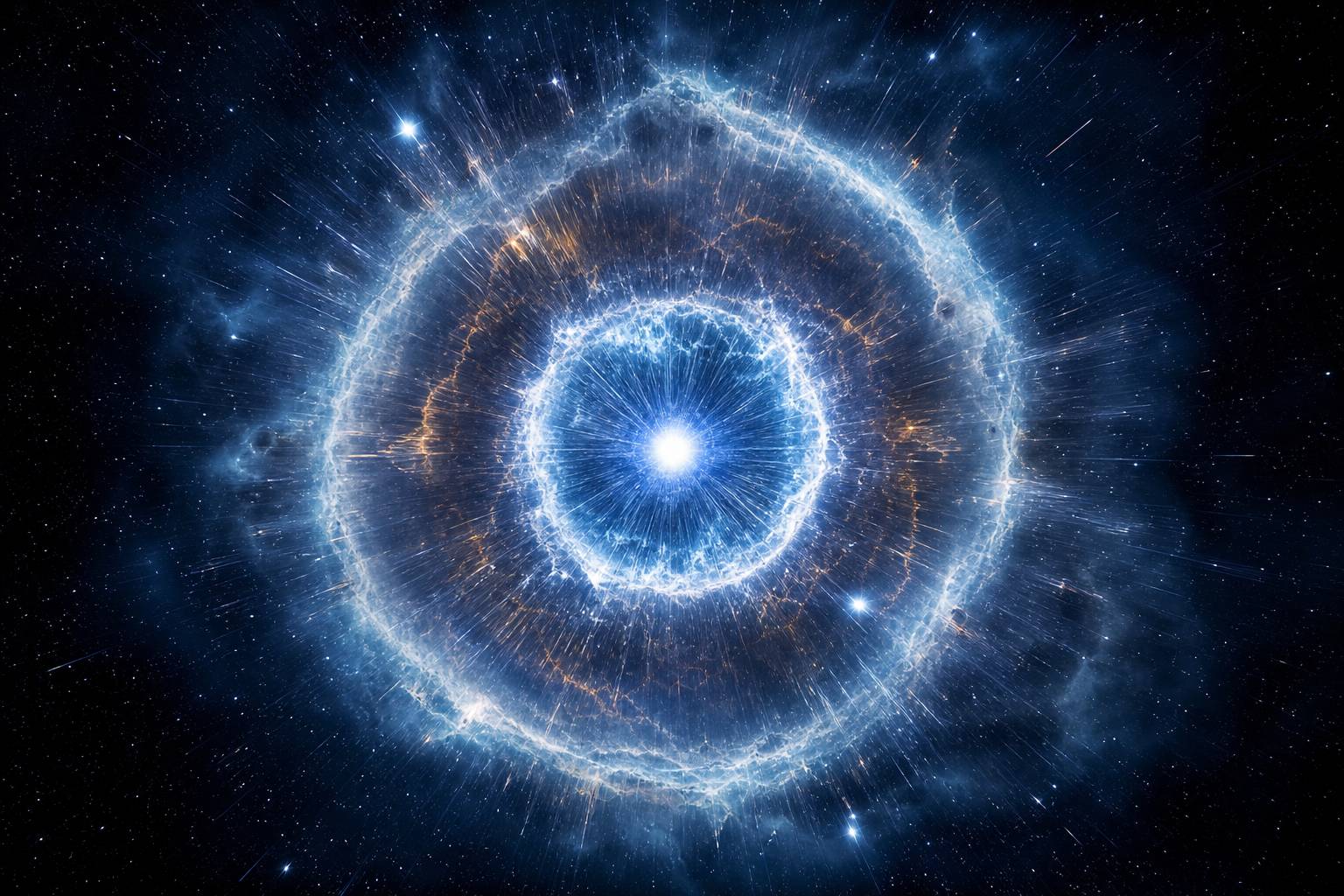
SN 1987A Glowing rings of gas the star shed before it died, lit up by the blast. AI-generated illustration.
~168,000 ly
distance: the light left long before 1987
Sk −69 202
the blue supergiant that exploded
SN 1987A (Wikipedia)
Kamiokande II, Japan
12 events
IMB, United States
8 events
Baksan, Soviet Union
5 events
Neutrinos caught, 23 Feb 1987
A neutrino detector A huge tank of water lined with light sensors catches the faint flash when a neutrino hits. AI-generated illustration.
Chapter VI · Collapse
The supernova we watched
Wikipedia (SN 1987A): seen first on 24 February 1987, with earlier photographs showing it brightening on 23 February; it lay in the Large Magellanic Cloud, about 168,000 light-years away, so the star exploded about 168,000 years before its light reached us; the progenitor, Sanduleak −69 202, was a blue supergiant. About two to three hours before the light arrived, a neutrino burst of under 13 seconds was recorded: 12 events at Kamiokande II, 8 at IMB and 5 at Baksan. It was the closest observed supernova since Kepler’s in 1604. In 2024 JWST found argon emission near the core that models explain with a neutron star. Wikipedia (Neutrino): Kamiokande II’s events were antineutrinos; light was delayed because it emerges with the shock wave and is scattered by the dense gas, while neutrinos pass straight through.
The 3D scenes are simplified teaching models. Sizes, colours and speeds are not to scale unless a step says so.
When will Betelgeuse explode? Probably not for a hundred thousand years or more, according to the 2020 study.
Its light also takes five to seven hundred years to reach us, so what we see tonight left it centuries ago.
When it does go, simulations suggest it will shine about as bright as a half Moon for more than three months, visible even by day for about a year.
It is too distant to harm us. Then it would fade, and Orion would lose its shoulder.
~100,000+ years
before it explodes, by this estimate
When? (Joyce et al. 2020)
500–700 years
one light-year is the distance light covers in a year
Light travel timeA second moon About as bright as a half Moon, but a single point of light. AI-generated illustration.A daytime star From simulations by Jared Goldberg and Evan Bauer at UC Santa Barbara, using models tuned with data from SN 1987A. AI-generated illustration.
Chapter VII · When Betelgeuse goes
What Earth would see
ANU (2020): Joyce said “we could be looking at around 100,000 years before an explosion happens”, and Betelgeuse is too far away for the explosion to have a significant impact here; Kavli IPMU: more than 100,000 years. Astronomy magazine (2020): simulations by Jared Goldberg and Evan Bauer, requested by Andy Howell, using the MESA and STELLA software and data from Supernova 1987A, suggest it would shine about as bright as a half Moon for more than three months and be visible in daytime for about a year; harm to life would need a supernova within perhaps several dozen light-years. A distance of 500–700 light-years means its light takes 500–700 years to reach us. ESO (2021): no supernova has been seen in our galaxy since the 17th century.
Press Explode to see it, schematically; the glow in the scene is not to scale.
The 3D scenes are simplified teaching models. Sizes, colours and speeds are not to scale unless a step says so.
Massive stars like Betelgeuse forge carbon, oxygen and iron, and their explosions scatter those elements, and heavier ones made in the blast, into space.
New stars, planets and, in time, people form from that material. As Carl Sagan put it in Cosmos: we are made of star-stuff.
On a cool-season evening, find the three stars of Orion's belt. The bright red star above them, to one side, is Betelgeuse, probably with a small companion hidden in its glow.
Scattered elements Debris from exploded stars mixes with gas clouds where new stars form. AI-generated illustration.A new solar system Hydrogen and helium date from the early universe; heavier elements were made in stars. AI-generated illustration.
1836 Herschel notices it varies
1920 first stellar diameter measured
1938 Bethe: fusion powers stars
1987 Supernova 1987A and its neutrinos
2019–20 the Great Dimming
2025–26 the probable companion Siwarha
~100,000 yr a supernova, by one estimate
Betelgeuse: a timeline
Epilogue · Sources
Sources
Every fact in this film comes from the sources below. The companion Siwarha and its wake are recent results that astronomers are still testing; the rest is established science. Estimates of Betelgeuse’s distance, size, mass and time to explosion differ between studies, so the film gives ranges with their sources. The Planetary Society: Carl Sagan’s words in Cosmos (1980) were “We are made of star-stuff”; hydrogen and helium come from the early universe, heavier elements from stars. The chapter stills and pictures are AI-generated illustrations, not photographs. The 3D scenes are simplified teaching models.
In the scene, press Find Betelgeuse to trace the way from Orion’s belt to the red star.