Why molecules come in mirror-image forms, why life uses only one hand, and how chemists found reactions that amplify a tiny imbalance: the story behind the 2026 Nobel Prize in Chemistry.
Interactive 3D film6 min1848 to 2026Published 2026-10-12
Your proteins are built from only one of two mirror-image kinds of building block. Chemists have wondered why since the 1850s.
On the seventh of October 2026, the Nobel Prize in Chemistry went to Henri Kagan and Kenso Soai.
They found reactions that can turn a tiny imbalance between two mirror-image molecules into an overwhelming majority.
That matters because life is lopsided. Almost every amino acid in your body is the left-handed form, and the sugars in your DNA are right-handed.
Nobody knows for certain how life came to choose. This is the story of how chemists learned to see molecular handedness, and to control it.
Prologue · Why the news matters
Why life is left-handed
On 7 October 2026 the Royal Swedish Academy of Sciences awarded the Nobel Prize in Chemistry to Henri B. Kagan and Kenso Soai “for the discovery of non-linear effects and autocatalysis in asymmetric organic synthesis”. Behind that dense phrase is a simple puzzle: many molecules come in two mirror-image forms, yet living things use only one of them. How could a world of evenly mixed molecules end up one-handed?
Henri B. Kagan
Born 1930, France
Professor emeritus, the then Université Paris-Sud
Kenso Soai
Born 1950, Japan
Professor emeritus, Tokyo University of Science
Prize
12 million Swedish kronor, shared equally
Announced in Stockholm on 7 October 2026
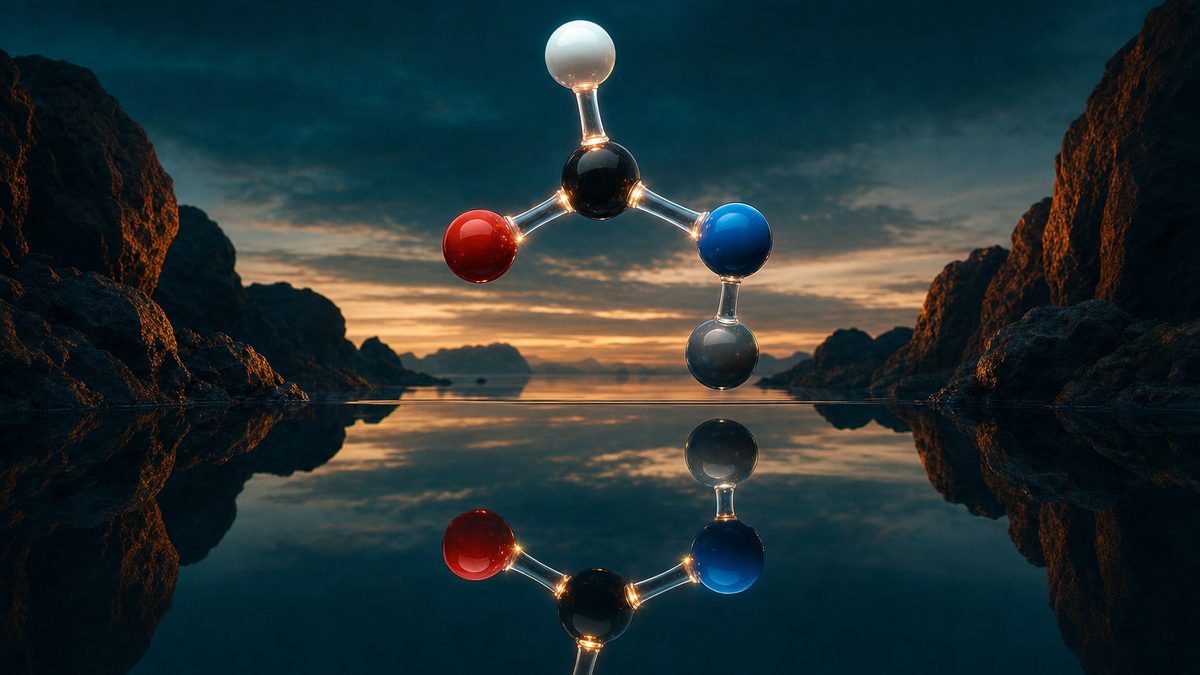
The scene shows alanine, a small amino acid, and its mirror image. Teal marks the left-handed (L) form and amber the right-handed (D) form throughout this story. Atoms: grey carbon, white hydrogen, blue nitrogen, red oxygen.
How to use: pick a chapter below the scene or press ← → to change step · ▶ plays the step · drag to rotate, scroll or pinch to zoom · buttons on the scene let you experiment · “Play the film” runs every step full-screen.
Your left hand is the mirror image of your right. Turn it any way you like: it will never fit a right-handed glove.
Hold up your hands. Each is the mirror image of the other, but you cannot lay one exactly on top of the other.
Many molecules have the same property. Here is alanine, one of the amino acids that build proteins, beside its reflection.
Rotate the reflection however you like. Two of its groups always end up in the wrong places.
Lord Kelvin named this property in 1894: chirality, from the Greek word for hand. The two forms are called enantiomers.
Chapter I · Step 1 · Handedness
Two hands that never match
An object is chiral if its mirror image cannot be made to coincide with it by turning or moving it. Hands are the classic example. Lord Kelvin coined the term in 1894, from the Greek cheir, hand. The two mirror-image forms of a chiral molecule are called enantiomers.
Alanine has a central carbon holding four different groups: H, NH₂ (amino), COOH (acid) and CH₃ (methyl).
Its mirror image has the same atoms and the same bonds, joined in the same order.
Yet no rotation makes the two coincide. Line up two groups and the other two are swapped.
Try it with the buttons on the scene. “Turn to match” rotates the reflection to sit on top of the original: two groups line up, two clash. “Swap two groups” exchanges H and CH₃ on the reflection, which turns it into an exact copy of the original.
A chemist looks at salt crystals under a microscope and sees two kinds: each the mirror image of the other.
In 1848, Louis Pasteur was studying salts of tartaric acid, a substance found in wine.
One form of the acid rotated polarised light. Another, chemically identical, did not. Nobody could explain why.
Under the microscope, Pasteur noticed that the crystals of a tartrate salt carried small extra faces, tilted one way on some crystals and the other way on the rest.
Patiently, with tweezers, he sorted them into two piles: left-handed crystals and right-handed crystals.
Chapter I · Step 2 · 1848
Pasteur’s tweezers
Tartaric acid from wine bends polarised light. A second form of the acid, with exactly the same composition, did not. In 1848 Louis Pasteur examined crystals of a tartrate salt (sodium ammonium tartrate) made from this puzzling form. They carried small facets that made each crystal either left- or right-handed. Half were one kind, half the other.
Grow crystals of the salt.
Look for the small slanted facets that make each crystal left- or right-handed.
Sort them by hand, with tweezers, into two piles.
In the scene, each crystal’s extra facet is coloured teal or amber so you can tell them apart. In reality the difference is only in the direction of the tiny facets, and it took sharp eyes and a microscope to see it.
Dissolved separately, the two piles twisted light in opposite directions. Mixed, they cancelled out.
Pasteur dissolved each pile in water and shone polarised light through the solutions.
One solution turned the plane of the light to the right. The other turned it by the same amount to the left.
An equal mixture of the two did nothing at all. That explained the puzzling form of tartaric acid: it was a fifty-fifty mix of two mirror-image molecules.
Pasteur concluded that the handedness of the crystals reflected a handedness of the molecules themselves.
Chapter I · Step 3 · 1848
One left, one right, together nothing
Polarised light vibrates in a single plane. Pasteur’s two solutions rotated that plane by equal amounts in opposite directions. Mixing them gave no rotation at all. The mysterious form of tartaric acid was simply a 50:50 mixture of the two mirror-image forms. Today such a 50:50 mixture is called a racemate, or racemic mixture.
Left pile
↺
rotates the light one way
Right pile
↻
rotates it by the same amount the other way
Racemic (50:50) mixture
No rotation
the two effects cancel exactly
Pasteur deduced in 1848 that this optical activity has a molecular basis. Nobody yet knew how a molecule could be built in two mirror-image ways. That answer came 26 years later. Rotation angles in the scene are exaggerated.
Two chemists, working separately, realised that carbon holds its four partners at the corners of a tetrahedron.
In 1874 Jacobus van ’t Hoff, aged 22, and Joseph Le Bel, independently of each other, proposed a solution.
A carbon atom’s four bonds point to the corners of a tetrahedron. If the four groups are all different, there are two ways to arrange them, and they are mirror images.
Now watch. Replace the methyl group with a second hydrogen. The molecule becomes glycine.
With two identical groups, a mirror plane cuts the molecule in half. Its reflection is itself. Glycine is the one protein amino acid that is not chiral.
Chapter I · Step 4 · 1874
Carbon in three dimensions
In September 1874 Jacobus Henricus van ’t Hoff published a pamphlet proposing that the four bonds of a carbon atom are “directed towards the corners of a regular tetrahedron”. Joseph Achille Le Bel reached a closely related idea the same year. Their insight founded stereochemistry, the study of molecules in three dimensions.
A carbon with four different groups is a stereocentre: it can exist in two mirror-image arrangements.
If two of the groups are the same, the molecule has a mirror plane and is not chiral.
That is why glycine (two hydrogens) has no left or right form, while alanine does.
Proteins are built from left-handed amino acids. DNA and RNA are built on right-handed sugars.
In 1857 Pasteur noticed that microbes fermenting tartaric acid consumed the form found in grapes and left its mirror image untouched. Life, it seemed, could tell left from right.
We now know that the amino acids in proteins are almost all of the left-handed, or L, form. The sugars in DNA and RNA are right-handed, or D.
Chemists call this homochirality: same-handedness.
It shapes everything built from them. Proteins coil into right-handed helices, and DNA twists to the right.
Chapter II · Step 5 · Inside every cell
Life uses one hand
Ordinary chemistry in a flask makes both mirror forms in equal amounts. Living things do not. Of the 20 amino acids coded by genes, 19 are chiral and are used only in the L form; the 20th, glycine, has no handedness. The sugars ribose and deoxyribose in RNA and DNA are D. This uniformity is called homochirality, from the Greek for “same hand”.
Protein α-helix
Right-handed
3.6 amino acids per turn · described in 1951
DNA (usual B form)
Right-handed
“like a normal screw”
Exceptions exist
D-alanine in bacterial cell walls
but the proteins made by ribosomes use L-amino acids
The L and D labels come from comparing a molecule with the two forms of a small reference sugar, glyceraldehyde. In the scene, teal marks L building blocks and amber marks D sugars.
The same molecule, carvone, smells of spearmint in one form and of caraway in the other.
Because our proteins are one-handed, the pockets in our receptors and enzymes are one-handed too.
A molecule that touches such a pocket at three points fits one way only. Its mirror image can match two contacts, never all three.
Your nose shows it. R-carvone smells of spearmint. Its mirror image, S-carvone, smells of caraway seeds.
Same atoms, same bonds, a different smell, because the receptors in your nose are chiral.
Chapter II · Step 6 · Smell
Your nose can tell left from right
Enzymes and receptors are built from L-amino acids, so their binding pockets are chiral. Two mirror-image molecules can therefore meet them very differently, like a right hand in a left glove. The scene shows the idea with a simple pocket that has three contact points.
R-(−)-carvone
Spearmint
50–80% of spearmint oil
S-(+)-carvone
Caraway
60–70% of caraway seed oil; also in dill
Use “Try the other hand” to drop the mirror-image molecule into the pocket. Two contacts can match, but the third always lands on the wrong group. Not every pair of enantiomers smells different, but carvone is a famous case. The pocket here is a simplified model, not a real receptor.
Many drugs are chiral. One form may treat a disease while its mirror image does nothing, or does harm.
Many medicines are chiral, and the body can treat the two forms very differently.
The most tragic lesson came from thalidomide, sold from 1957 as a sedative and withdrawn in 1961 after it caused severe birth defects in more than ten thousand children.
Studies later showed that one form is the sedative while its mirror image harms the developing embryo.
But in the body the two forms turn into each other, so a pure form would not have been safe either. The disaster showed why chemists need ways to make, and test, each form on its own.
Chapter II · Step 7 · Medicines
When the wrong hand matters
Pharmaceuticals often consist of chiral molecules. One enantiomer may have the therapeutic effect while the other has none, a different effect, or harmful side effects. Some drugs are now sold as a single enantiomer: escitalopram, for example, is the pure S form of the antidepressant citalopram.
Thalidomide on sale
1957
first in West Germany, without prescription
Withdrawn
Nov 1961
after severe birth defects were linked to it
Children severely affected
Estimated at over 10,000, possibly 20,000
The (R) form is the sedative; the (S) form harms the embryo. In the body each converts into the other, so giving pure (R) does not remove the risk.
Thalidomide is still used today, under medical supervision, to treat multiple myeloma and a painful complication of leprosy. The disaster pushed chemists to find ways of making just one enantiomer, and of testing each form separately.
A chiral catalyst tilts a reaction so that one mirror form is made more often than the other.
Make a chiral molecule from non-chiral ingredients and you always get a fifty-fifty mix. Nothing in the flask prefers one hand.
Unless you add something that is itself chiral. A chiral catalyst, a substance that speeds a reaction without being used up, can favour one hand.
The first such reaction, in the early 1900s, gave only a tiny excess. Later catalysts did far better.
In 2001, William Knowles, Ryoji Noyori and Barry Sharpless won the Nobel Prize for chiral catalysts. Knowles’s work quickly led to an industrial process for L-DOPA, a drug for Parkinson’s disease.
Chapter III · Step 8 · Asymmetric catalysis
Making only one hand
A reaction that builds a chiral molecule from non-chiral starting materials gives a racemate, unless something chiral steers it. In the early 1900s Willy Marckwald carried out the first asymmetric reaction, with a very small preference for one form. Later, chiral catalysts, often a metal atom paired with a chiral molecule, made the preference strong enough for industry.
Enantiomeric excess (ee)
ee = |L − D| ÷ (L + D) × 100%
a 90:10 mixture has ee 80%; a 50:50 racemate has ee 0%
Nobel 2001
Knowles & Noyori
chirally catalysed hydrogenation
Nobel 2001
Sharpless
chirally catalysed oxidation
In the scene, grey points are starting material. First the reaction runs with no chiral influence: teal and amber products form equally. Then a chiral catalyst (the bright core) is added and the reaction runs again. Proportions are illustrative.
A physicist writes down, on paper, how a small excess of one hand could grow until the other vanishes.
Even a good catalyst only passes on the handedness you give it. Could a mixture become one-handed on its own?
In 1953 the physicist Charles Frank proposed a recipe. Imagine a molecule that catalyses its own formation: each one helps make another of the same hand.
Add one more rule: when a left molecule meets a right one, they lock together and drop out.
Then a small majority wins. The minority is used up in pairs, and the survivors copy themselves. Frank ended with a challenge: a laboratory demonstration may not be impossible.
Chapter III · Step 9 · 1953
A recipe for a runaway
Charles Frank, a theoretical physicist at the University of Bristol, described a chemical substance “which is a catalyst for its own production and an anti-catalyst for the production of its optical antimer”. His mathematical model showed how a minuscule imbalance could grow into homochirality.
Autocatalysis: the product helps make more of itself.
Asymmetric catalysis: it makes its own hand, not the other.
Mutual antagonism: left and right forms cancel each other out.
The simulation in the flask follows Frank’s three rules. It starts with a slight majority of teal molecules. Purple points are left-right pairs that have dropped out. For decades, chemists treated the model as a puzzle: how could anyone build a real reaction that obeys it?
An impure catalyst gave a purer product than anyone thought possible.
Chemists assumed that a catalyst can only pass on as much handedness as it has: an impure catalyst should give a product that is no purer.
Henri Kagan doubted it. Many catalysts carry two chiral molecules on one metal atom. Mix left and right, and three kinds of catalyst form: left-left, right-right, and mixed.
If the mixed catalyst is sluggish, it quietly locks away much of the minority hand.
In 1986 Kagan showed the effect in real reactions. In the simplest picture, a three-to-one mix in the catalyst gives a product of about nine to one. Frank’s second rule had come true in a flask.
Chapter IV · Step 10 · 1986
Kagan’s non-linear effect
Until 1986 chemists expected a straight-line relationship: product purity equals catalyst purity multiplied by the best result possible. Kagan reasoned that if each metal holds two chiral partners, the minority hand would mostly end up in slow “mixed” catalysts. He reported three reactions that broke the straight line, including the Sharpless epoxidation of geraniol, where the product was purer than expected.
Catalyst mix
75 : 25
left : right chiral partner
Product
≈ 90 : 10
if the mixed catalyst barely works
A later striking case
Ligand ee 15% → product ee 98%
Noyori’s zinc reaction with the ligand DAIB
Try the buttons to change the catalyst mix. Each grey cluster is a metal atom with two chiral partners; mixed (teal + amber) catalysts dim because they barely work. The chart shows the straight line chemists expected and the curve this simple model gives: product ee = 2x ÷ (1 + x²) for catalyst ee x, assuming the best possible result is 100%.
A molecule that makes copies of itself, of its own hand, faster than the other hand can keep up.
Kenso Soai found the last ingredient: a chiral molecule that is the catalyst for its own formation.
In his reaction a zinc compound adds to an aldehyde and creates a pyrimidyl alkanol. That alkanol then catalyses the same reaction, favouring its own hand.
In 2003 his team began with an excess of just 0.00005 percent: about one extra molecule of one hand for every two million.
After the first run, the excess was 57 percent. After the second, 99. After the third, more than 99.5 percent. Press run and watch it happen.
Chapter IV · Step 11 · 1995 and 2003
The Soai reaction
In 1995 Soai reported in Nature that a 5-pyrimidyl alkanol with a small excess of one hand, treated with diisopropylzinc and an aldehyde, makes more of itself with a larger excess. It fulfilled all three of Frank’s conditions. Each run’s product becomes the catalyst for the next.
1995
2% → 87%
ee; repeated runs level off near 90%
2003 runs
0.00005% → 57% → 99% → >99.5%
three runs, improved molecule
Amplification
~630,000 times
increase in the ratio of one hand to the other
Press “Run” to add fresh aldehyde and zinc reagent; the product of the previous run seeds the next. Grey points are starting material. The percentages come from a simple model tuned to reproduce Soai’s published 2003 runs; 2,400 points stand in for trillions of molecules, so an excess of 0.00005% is far too small to see at first.
Start with no excess at all, and the reaction still picks a side. Which side is down to chance.
What if you start with no chiral molecules at all? Random fluctuations mean the two hands are never exactly equal for long.
The Soai reaction is sensitive enough to seize on that accident. In 37 experiments from non-chiral starting materials, 18 ended up with one hand and 19 with the other.
A tiny nudge decides it, too. Crystals of left- or right-handed quartz, circularly polarised light, even a molecule made chiral by one heavier carbon atom can steer the outcome.
For the first time outside life, chemistry had created strong one-handedness from a non-chiral start.
Chapter IV · Step 12 · 2003
Heads or tails
Soai and, independently, Daniel Singleton showed that the Soai reaction can start from non-chiral ingredients and still end strongly one-handed: absolute asymmetric synthesis. The winning hand changed at random from run to run, just as Frank’s model predicts for a perfectly balanced start.
Soai’s 37 runs
18 one hand · 19 the other
ee between 15% and 91%
Known triggers
Quartz, light, isotopes
d- or l-quartz, sodium chlorate, circularly polarised light, carbon-13 substitution, chiral crystals of cytosine
Press “Run from 50:50” several times and keep score. Each run in the model starts with an invisible random fluctuation. The crystal buttons give a small deliberate nudge instead. The Soai reaction is artificial: it uses zinc reagents in organic solvent and is not how life’s chemistry works in water. Its importance is as proof that Frank’s mechanism is chemically possible.
Some meteorites carry slightly more left-handed amino acids. Others do not. The debate continues.
So where did life’s first nudge come from? Nobody knows. Several ideas compete.
One clue fell near Murchison, Australia, in 1969. Its meteorite carries amino acids, and in 2009 NASA scientists reported up to eighteen percent more of the left-handed form of one of them, isovaline.
Another idea: circularly polarised light, which may arise when starlight scatters off dust in space, can create a slight bias in a mixture of molecules.
But samples brought back from the asteroid Bennu held an even mix. Perhaps the choice was simply chance, amplified as in Soai’s flask.
Chapter V · Step 13 · Open question
Did the first nudge come from space?
The origin of homochirality is still an unsolved problem. Most ideas need two parts: a small initial imbalance, and a way to amplify it. The amplifiers discovered by Kagan and Soai show that the second part is chemically possible. The first part is still debated.
Murchison (fell 28 Sep 1969)
18.5 ± 2.6%
excess of L-isovaline · Glavin & Dworkin, 2009
Orgueil meteorite
15.2 ± 4.0%
excess of L-isovaline, same study
Asteroid Bennu (OSIRIS-REx)
Even mixture
14 of the 20 protein amino acids found; no excess of either hand reported (2025)
Ideas on the table
Light short-wave circularly polarised light can induce a bias
Water meteorites richer in water-altered minerals show larger excesses
Physics the weak nuclear force is not mirror-symmetric, but no effect on molecules has been demonstrated
Chance a random fluctuation, amplified; many scientists favour this
The share of teal and amber points on the rock is illustrative of an 18% excess. All of these are hypotheses; the event happened some 3.5 to 4 billion years ago and may never be settled for certain.
From Pasteur’s tweezers to self-amplifying reactions: a question as old as modern chemistry, now within reach of the lab.
Somewhere on the early Earth, perhaps four billion years ago, chemistry tipped to one side and never tipped back.
Pasteur saw the handedness of molecules. Van ’t Hoff and Le Bel explained it. Frank imagined how it could run away.
Kagan and Soai showed, in real flasks, that a whisper of imbalance can become a single hand.
Chemists are now trying to do the same with amino acids and sugars. The mirror still holds one of life’s oldest secrets.
Epilogue · 1848 → 2026
A world in the mirror
1848 Pasteur separates mirror-image crystals
1857 Microbes ferment only one form of tartaric acid
1874 van ’t Hoff and Le Bel: the tetrahedral carbon
1894 Kelvin coins the word “chiral”
1953 Frank’s model for spontaneous homochirality
1961 Thalidomide withdrawn
1986 Kagan discovers non-linear effects
1995 Soai reports amplifying autocatalysis
2001 Nobel Prize for asymmetric catalysis
2003 0.00005% to over 99.5% in three runs
2026 Nobel Prize in Chemistry to Kagan and Soai
The non-linear effects Kagan discovered are now an everyday tool for chemists who design reactions for medicines, flavours, scents and agricultural chemicals. The Soai reaction remains the only known reaction that both amplifies one hand by copying itself and can start from a non-chiral mixture. Around the world, researchers are trying to repeat it with the real molecules of life.
All full-screen stills are AI-generated to help the imagination; they are not photographs and do not show real people or real laboratories. The 3D molecules use standard colours: grey carbon, white hydrogen, blue nitrogen, red oxygen. Reaction simulations are simplified models.