Dmitri Mendeleev sorted the known elements by weight, found that their properties repeat, and then did the dangerous thing: where the pattern demanded an element nobody had found, he left the square empty and published its predicted weight and density. Sort the cards, open the gaps, and check his 1871 numbers against the germanium found in 1886. Episode 06 of the Great Scientists series.
Interactive 3D film8 min1834 to 1907Published 2026-10-13
Anyone can spot a pattern. He bet on where it was missing.
By 1869 chemists knew about sixty-three elements, and several people had noticed that if you line them up by weight, their properties repeat.
Mendeleev did something more dangerous. Where his pattern demanded an element that nobody had ever seen, he refused to close the gap.
He left the hole open, wrote down what the missing element would weigh and how dense it would be, and published it. Within seventeen years, three of those holes were filled exactly as specified.
A deck of cards One card per element: name, weight, how it behaves. Then he sorted them.
~63
elements known in 1869
3
holes he left on purpose
17
years until all three were filled
The bet
I saw in a dream a table where all the elements fell into place as required.Mendeleev, recalling the night of 1869
Prologue · Why he matters
The gaps he left empty
Others saw the repetition. Mendeleev left holes where the pattern needed elements nobody had found, and published their predicted weights and densities. Gallium, scandium and germanium filled them.
Born
Siberia, 1834
8 February, the youngest of a very large family
Died
St Petersburg, 1907
2 February
The table
1869
written while making a textbook
How to use: pick a chapter below or press ← → to change step · ▶ plays the step · drag to rotate · three steps have buttons you can press.
Everybody had the ingredients. Nobody had the nerve.
Chemistry in the 1860s was a enormous catalogue with no index. Sixty-three elements, each with its own behaviour, and nothing saying why.
The pattern was half-visible. Döbereiner had found triads of similar elements. In 1865 John Newlands pointed out that properties repeat roughly every eighth element and called it the law of octaves.
The Chemical Society refused to publish it, and a fellow of the society asked him publicly whether he had tried arranging the elements alphabetically.
Lothar Meyer in Germany had a table very like Mendeleev’s at almost the same time. The difference was not the table. It was what Mendeleev was willing to say about things that did not exist yet.
Chemistry without a spine Sixty-three elements, each with its own list of reactions, and no reason why any of them should be related.
Döbereiner: elements come in triads
Newlands: properties repeat every eighth
He was asked if he had tried alphabetical order
Meyer had a similar table, published later
Others were close
1865
Newlands’ law of octaves, laughed at
Before 1869
Chapter I · Step 1
A heap of facts
Döbereiner’s triads and Newlands’ law of octaves (1865) were close — and Newlands was mocked for them. Lothar Meyer had a near-identical table at nearly the same time. The difference was the predictions.
His mother spent her last years getting him into a university.
Mendeleev was born in 1834 in a Siberian village, the youngest of a very large family. His father went blind and lost his job; his mother reopened a family glassworks to keep them fed, and then it burned down.
In 1849 she took her youngest child and travelled across the country, first to Moscow, which would not admit a Siberian, and then to St Petersburg, which did.
She died a few weeks later. He dedicated his first major work to her, and wrote that she had taught him to seek divine and scientific truth through patience and work.
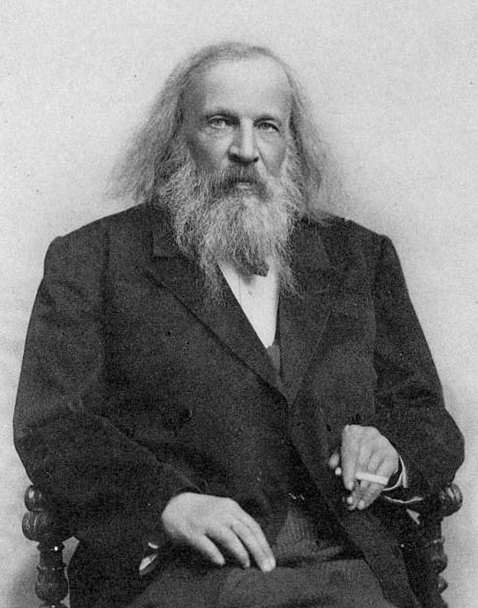
Dmitri Mendeleev He cut his hair and beard once a year, in spring, and refused to do it for the Tsar.Out of Siberia His mother took him thousands of kilometres to find a university that would take him.
1834 Born in Siberia, the youngest of many
1847 His father dies; the family glassworks burns down
1849–50 His mother takes him to Moscow, then St Petersburg
1850 Admitted to the Main Pedagogical Institute
The journey
Chapter I · Step 2
Out of Siberia
Born in a Siberian village in 1834, the youngest of a very large family. After his father went blind and the family glassworks burned, his mother took him across Russia to find a university that would admit him. She died weeks after he was accepted.
The table was not born in a flash of theory. It was born out of a teaching problem.
Mendeleev was writing a two-volume textbook and had reached the point where he had to decide which element to describe after which. There was no principled order.
So he made a card for each element with its weight and its usual compounds, and spent days laying them out on a table and moving them around.
Press the buttons to do the same thing: sort them by weight in one long row, then wrap the row.
The deadline He was writing Principles of Chemistry and needed an order to teach the elements in.
Write one card per element
Put its weight and its typical compounds on it
Lay them out and move them around
Look for an order that repeats
The method
1868–70
writing Principles of Chemistry
1869
the table is drafted
Why it happened then
Chapter II · Step 3 · Interactive
A textbook with a problem
The periodic table came out of writing Principles of Chemistry: Mendeleev needed a principled order in which to teach the elements, so he made a card for each and sorted them.
Press Sort by weight for one long line, then Wrap the row. Similar elements fall into columns. The cards here are the first thirty-odd elements with their 1869 weights.
Sort by weight and the chemistry lines up sideways.
Lay the cards out in order of increasing weight and something odd happens. Every so often you reach an element that behaves like one you have already passed.
Lithium, sodium and potassium are all soft metals that attack water. Fluorine, chlorine and bromine are all savagely reactive. Wrap the row at the right length and those families stack into columns.
That is the periodic law: the properties of the elements are a periodic function of their atomic weight.
But only if you are willing to leave the row ragged where it needs to be.
Lithium, sodium, potassium: soft, violent in water
Fluorine, chlorine, bromine: biting, reactive gases and liquids
Each family lands in one column
That is what periodic means
Families in columns
8
elements between repeats, in the light part of the table
The periodMoving the cards When a card did not fit, he preferred to move everything else rather than force it.
Chapter II · Step 4
Families fall into columns
Ordered by weight, chemical families recur: Li, Na, K in one column, F, Cl, Br in another. That is the periodic law — properties are a periodic function of atomic weight.
Here is where he differs from everyone else who saw the pattern.
Between zinc and arsenic the columns demand two elements that did not exist in any laboratory. The easy fix is to shuffle the known elements along and close the gap.
Mendeleev refused. He left the squares empty, gave the missing elements provisional names — eka-aluminium, eka-boron, eka-silicon — and then went further.
He said what each one would weigh, how dense it would be, what oxide it would form, how its chloride would behave. Press a gap and see the prediction.
Three empty jars Between zinc and arsenic the pattern needs two elements that nobody had ever isolated.
Zinc, then a hole, then another hole, then arsenic
He named them eka-aluminium and eka-silicon
Eka is Sanskrit for one — “one past aluminium”
And he said what they would weigh
Naming the absent
3
gaps left open in 1871
The prediction
Chapter III · Step 5 · Interactive
Leaving the hole open
Where the columns demanded elements nobody had found, Mendeleev left the squares empty and named the absentees eka-aluminium, eka-boron and eka-silicon — then specified their weights and densities.
Press Show the gaps, then pick one to see what he said would be found there.
Not “something will be found”. Four decimal numbers.
This is what makes it a scientific prediction rather than a hunch. He did not say an element would turn up. He said this element will have these values.
For eka-silicon in 1871: atomic mass about seventy-two point six. Density five point five. A refractory dioxide of density four point seven. A chloride boiling below one hundred degrees.
Fifteen years later Clemens Winkler isolated germanium and measured seventy-two point six three, five point three five, four point seven, and eighty-six degrees.
Press reveal and compare them yourself.
72.64
predicted atomic mass
72.63
germanium, measured
The headline number
Density predicted 5.5, measured 5.35
Oxide density predicted 4.7, measured 4.7
Chloride boiling point predicted under 100 °C, measured 86 °C
Chloride density predicted 1.9, measured 1.9
Prediction against measurement
15
years between the prediction and the element
1871 → 1886
Chapter III · Step 6 · Interactive
What a prediction looks like
Eka-silicon, 1871: mass 72.64, density 5.5, oxide density 4.7, chloride boiling under 100 °C. Germanium, 1886: 72.63, 5.35, 4.7, 86 °C.
Press Predict then Reveal to put the two columns side by side.
Mendeleev told the discoverer his measurement was wrong. It was.
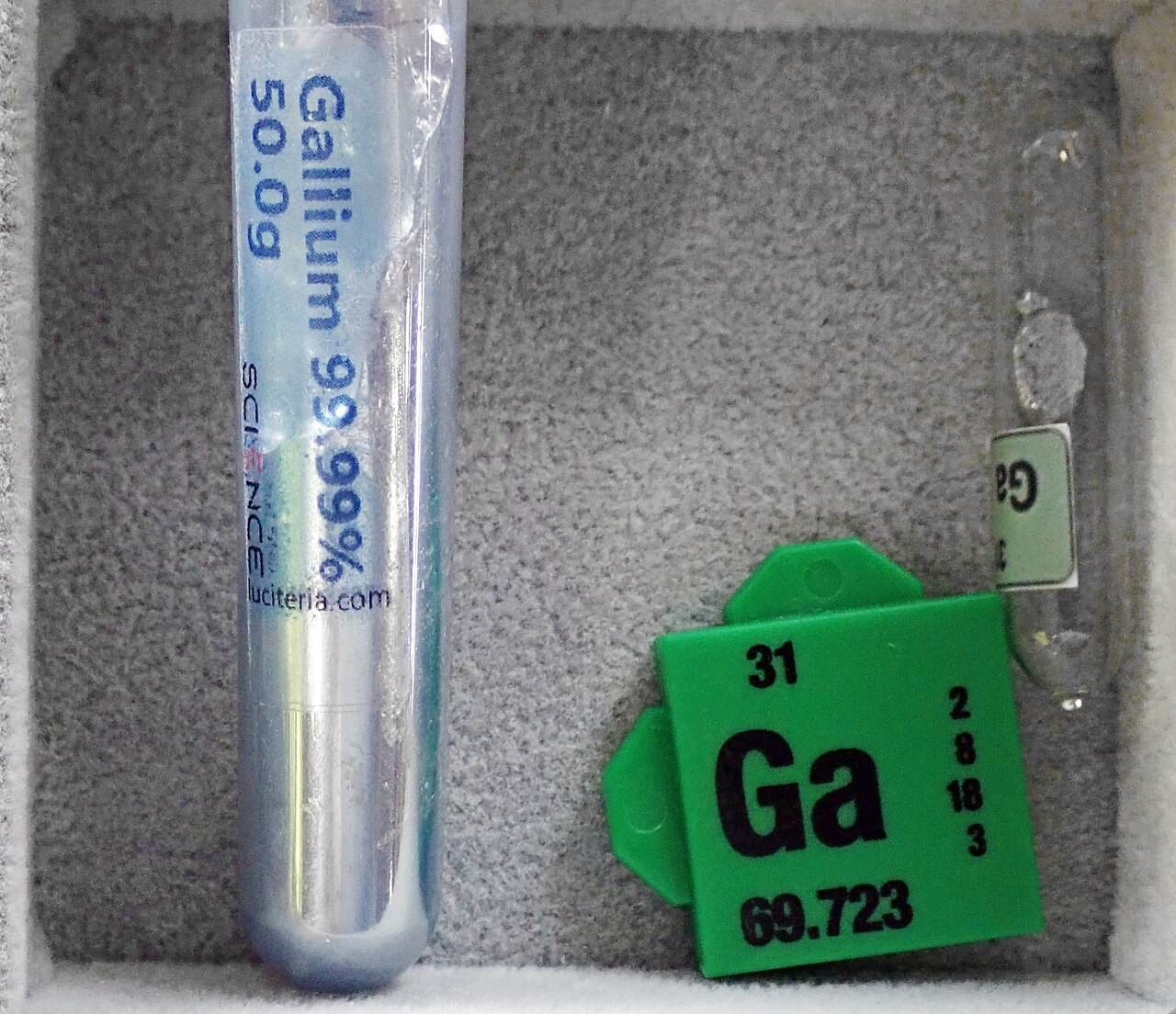
In 1875 Paul-Émile Lecoq de Boisbaudran found a new element by its spectrum and named it gallium.
Mendeleev read the paper and wrote to say that the density reported must be wrong: his table said eka-aluminium should be about five point nine, not four point seven.
Lecoq, who had the only sample in the world, repurified it and measured again. Five point nine.
That is the moment the periodic table stopped being a classification scheme and became a theory that could overrule a measurement.
Gallium A metal that melts in your hand, found by its spectral lines in 1875.
1875 Lecoq de Boisbaudran finds gallium
1879 Nilson finds scandium
1886 Winkler finds germanium
The gaps fill
Lecoq measured gallium’s density as 4.7
Mendeleev wrote from Russia: it should be 5.9
Lecoq purified his sample and remeasured: 5.9
The table corrected the experiment
The moment it became serious
Chapter IV · Step 7
The table corrects the chemist
Mendeleev told gallium’s discoverer that his measured density was wrong. Lecoq repurified his sample and the table was right. Scandium followed in 1879, germanium in 1886.
Different chemists, different countries, the same empty squares.
Clemens Winkler pulled a new element out of a silver ore in 1886 and called it germanium. Its properties matched eka-silicon almost line for line.
Three predictions, three hits, by three chemists in three countries, none of whom set out to prove a Russian right.
After that the table was no longer one chemist’s filing system. It was the shape of matter.
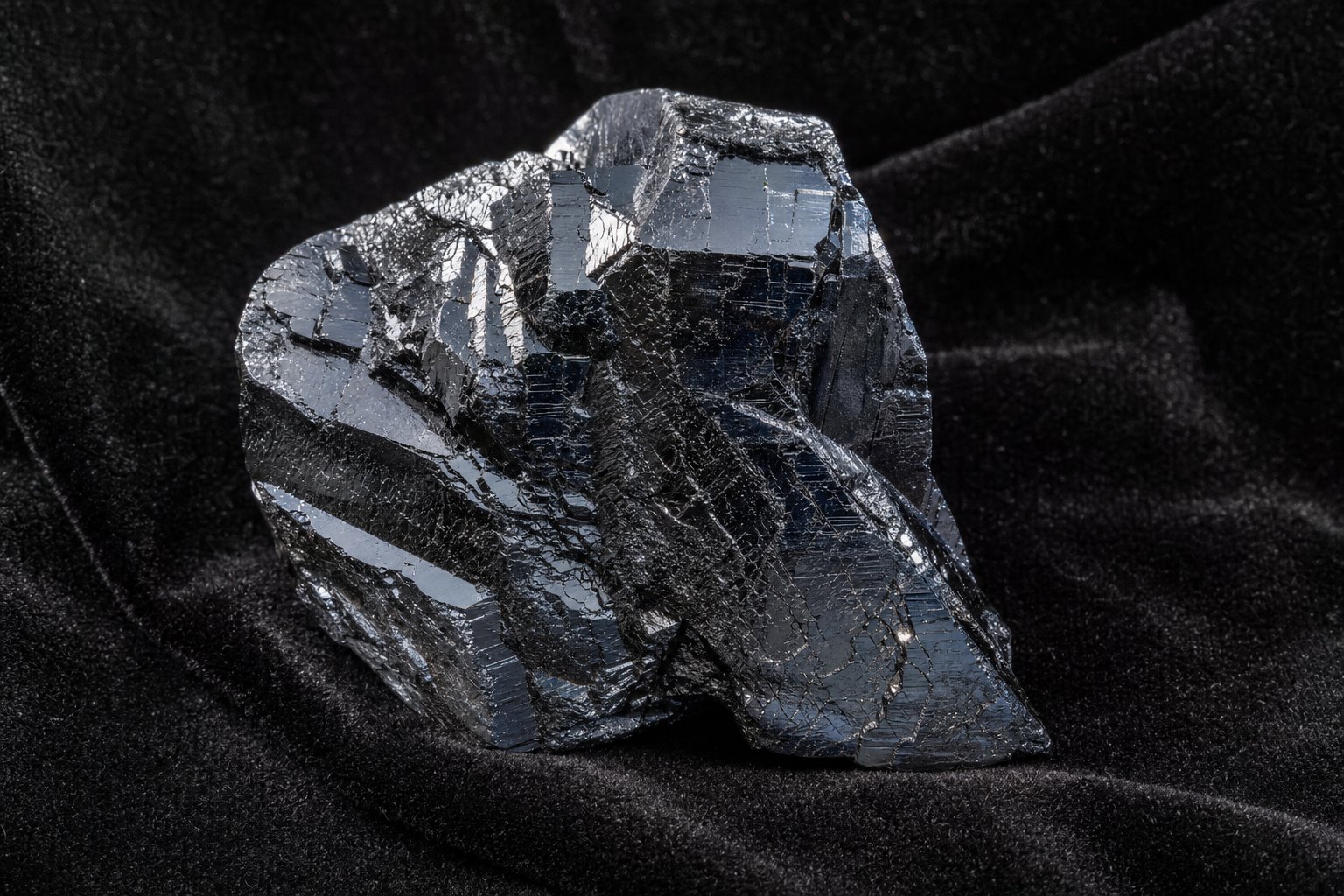
Germanium itself had a second life: the first working transistor, in 1947, was made of it.
Germanium A brittle grey semiconductor. Sixty years later it became the first transistor.
1886
Winkler isolates germanium
1947
the first transistor is made of it
The empty square
Three predictions, three hits
Each by a different chemist in a different country
None of them were looking for Mendeleev’s element
Why it convinced people
Chapter IV · Step 8
Three for three
Germanium, isolated by Winkler in 1886, matched eka-silicon almost line for line. Three independent discoveries filled three deliberately empty squares — and germanium later became the first transistor.
The law had a defect he could not explain. Tellurium weighs more than iodine, but tellurium belongs in the sulfur column and iodine in the chlorine column.
Ordering strictly by weight puts them both in the wrong family. Mendeleev put them in the chemically right order anyway, and announced that the measured atomic weights must be in error.
They were not. The weights were fine.
In 1913 Henry Moseley showed that the real ordering principle is the positive charge of the nucleus — the atomic number. By that measure iodine does come after tellurium, and the anomaly disappears.
Mendeleev was right to swap them, and wrong about why.
Tellurium weighs more than iodine
But tellurium behaves like sulfur, and iodine like chlorine
So he put them in the “wrong” order on purpose
And said the measured weights must be wrong
The anomaly
1913
Moseley: order by atomic number, not weight
The real answer Mendeleev was right to swap them, and wrong about why.Where the law bent Three pairs in the table sit in the wrong weight order. All three are right by atomic number.
Chapter V · Step 9
Right answer, wrong reason
Tellurium is heavier than iodine but belongs before it chemically. Mendeleev swapped them and blamed the measurements. Moseley (1913) showed the true order is by atomic number, which puts them in exactly the order Mendeleev had insisted on.
Then came a harder test. In 1894 Rayleigh and Ramsay isolated argon, a gas that will not combine with anything.
A table organised by how elements combine has no slot for an element that does not. Mendeleev’s first reaction was to doubt that argon was an element at all.
Within four years there were five more of them. Rather than break the table, they fitted into a new column at its edge, between the violently reactive halogens and the violently reactive alkali metals.
A classification that can absorb six unexpected elements without being rebuilt is telling you about reality, not about filing.
1894 Argon isolated — it fits nowhere
1895–98 Helium, neon, krypton, xenon follow
1900 A new group is added to the table
The noble gases
They react with nothing
So they had no place in a table built on combining power
Mendeleev first doubted argon was an element
The table absorbed them by growing a column
The test it passed
Chapter V · Step 10
A whole missing column
Argon (1894) reacts with nothing and had no place in a table built on combining power. Five more noble gases followed — and the table accommodated them by growing a new group rather than breaking.
He spent more of his life on Russian industry than on the table.
The table took a few years of a long and busy life. He spent far more of it on Russian industry: oil refining, coal, agriculture, tariffs, and running the national bureau of weights and measures.
In 1887 he went up alone in a hydrogen balloon to observe a solar eclipse, having pushed the pilot out to save weight.
In 1906 he was nominated for the Nobel Prize in Chemistry and lost by a single vote. He died the following year.
And the story that he defined vodka at forty per cent is false. That standard was set by the Russian government in 1843, when he was nine years old.
Director of the Bureau of Weights and Measures
Worked on Russian oil, coal and agriculture
Flew in a balloon alone to watch an eclipse
Lost the 1906 Nobel Prize by one vote
A crowded life
40%
vodka: not his doing
The myth The standard was set by the Russian government in 1843, when he was nine.
1907
he dies of influenza, aged 72
101
the element later named after him
The end
Chapter VI · Step 11
Balloons, oil and one lost vote
Mendeleev spent most of his career on Russian industry and metrology, flew a balloon alone to see an eclipse in 1887, and lost the 1906 Nobel Prize by one vote. Element 101, mendelevium, is named for him.
The famous claim that he set vodka’s strength at 40% is false: the standard dates from 1843, when he was nine.
Quantum mechanics explained the table forty years later.
Mendeleev had no idea why his pattern existed. Atoms were still controversial; electrons were thirty years away.
The reason is that chemical behaviour is set by the outermost electrons, and the number of those cycles as you add electrons shell by shell. The columns are electron configurations.
That explanation arrived in the 1920s. The table had already been working for fifty years.
It is a useful thing to remember about science: a reliable pattern is worth having even when nobody can yet say why it holds.
Columns repeat because outer electrons repeat
Which Mendeleev could not have known
The pattern was visible before its cause
That is how most science actually goes
What was underneath
118
elements in the table today
94
of them occur naturally
NowStill the map Every semiconductor, catalyst and battery chemistry is chosen by position in this grid.
Epilogue · Step 12
The pattern before the reason
The columns repeat because outer-electron configurations repeat — an explanation that arrived in the 1920s, fifty years after the table was already working.
The gaps are the reason we remember him and not the others.
Several people arranged the elements in 1869. We remember Mendeleev because he arranged them in a way that could be wrong.
The empty squares were not an admission of ignorance. They were a set of experiments he was asking other people to run, with the answers written down in advance.
Three of them came back right, from three different laboratories, within seventeen years.
The chapter stills in this film are AI-generated. The photograph of Mendeleev and the sample photographs are real. Sources are listed below.
1869 the cards are sorted
1871 three gaps, with numbers attached
1875 · 1879 · 1886 gallium, scandium, germanium
1913 atomic number replaces weight
1920s electrons explain the columns
From a textbook to a law
A classification you cannot test is just filing
He made his testable by leaving it incomplete
The empty squares were the experiment
The lesson
Epilogue · Step 13
What the empty squares were for
Several chemists arranged the elements in 1869. Mendeleev is remembered because he arranged them in a way that could have been proved wrong — and then wasn’t.
1869 the cards sorted into a periodic table
1871 three gaps with predicted properties
1875–1886 gallium, scandium, germanium
1913 atomic number replaces atomic weight
Chapter stills in this film are AI-generated illustrations. The photograph of Mendeleev and the photograph of gallium are real, credited where they appear.