Antoine Lavoisier weighed what everyone else only watched. Burn phosphorus in a sealed jar, run his twelve days with mercury, and split water into two gases — then follow the tax-farming job that paid for the laboratory and sent him to the guillotine at fifty. Episode 03 of the Great Scientists series.
Interactive 3D film8 min1743 to 1794Published 2026-10-13
He did not find a new fact. He found a new habit: weigh everything.
Chemistry before Lavoisier was a catalogue of things that happen. Metals rust, wood burns, candles go out in closed jars. Everyone watched. Almost nobody weighed.
Lavoisier weighed. He sealed the vessel first, so nothing could escape, and put the whole thing on a balance before and after.
That one habit killed a two-hundred-year-old theory, produced oxygen, renamed every substance in the laboratory, and showed that breathing is a slow fire. Then his other job killed him.
The instrument that mattered Not a furnace, not a flame. A balance good to a fraction of a grain.
1772
he starts sealing the vessel
1789
the first modern chemistry textbook
1794
executed, aged 50
Twenty-two years
Nothing is lost, nothing is created, everything is transformed.The principle Lavoisier made chemistry obey
Prologue · Why he matters
The balance and the blade
Lavoisier’s method was simple and merciless: seal the vessel, weigh it before and after. Applied for twenty years it produced oxygen, the modern names of the elements, and the law that matter is never lost.
Born
Paris, 1743
26 August
Executed
Paris, 1794
8 May, aged 50
Day job
tax collector
the Ferme générale
How to use: pick a chapter below or press ← → to change step · ▶ plays the step · drag to rotate, scroll or pinch to zoom · three steps have buttons you can press.
Burning meant losing something — except the ash was heavier.
The accepted theory said that anything flammable contains a substance called phlogiston, and burning is the act of letting it out.
It explained a lot. A candle in a closed jar goes out because the air fills up with phlogiston and can hold no more.
It had one embarrassment. When a metal burns, the powder left behind weighs more than the metal did. Something was being lost, and the remains got heavier.
Chemists patched it: perhaps phlogiston has negative weight. The patch held for a century because nobody insisted on the balance.
What burning was supposed to be Flammable things were thought to contain phlogiston and to release it as they burned.
Burning = losing phlogiston
So the ash should weigh less
But burnt metal weighs more
Answer: phlogiston has negative weight
A theory under strain
~1667
phlogiston proposed
100+
years as the standard theory
How settled it was
Chapter I · Step 1
The stuff that leaves a fire
Phlogiston was the substance supposedly released by burning. It explained why flames die in sealed jars — and failed to explain why burnt metal weighs more than the metal it came from.
The usual rescue was to give phlogiston negative weight. A theory that needs that kind of repair is a theory waiting for someone with a good balance.
The laboratory was paid for by the most hated company in France.
Lavoisier trained as a lawyer, and at twenty-six he bought a share in the Ferme générale, the private company that collected France’s taxes for a fee.
It made him very rich, and it paid for a laboratory with instruments no university could afford. It also attached his name to the most hated institution in the country.
In 1771 he married Marie-Anne Paulze, the daughter of a colleague. She was thirteen.
She learned English and Latin to translate the work he needed, took the laboratory notes, trained under David as an artist, and engraved the plates for his books. Much of what survives is in her hand.
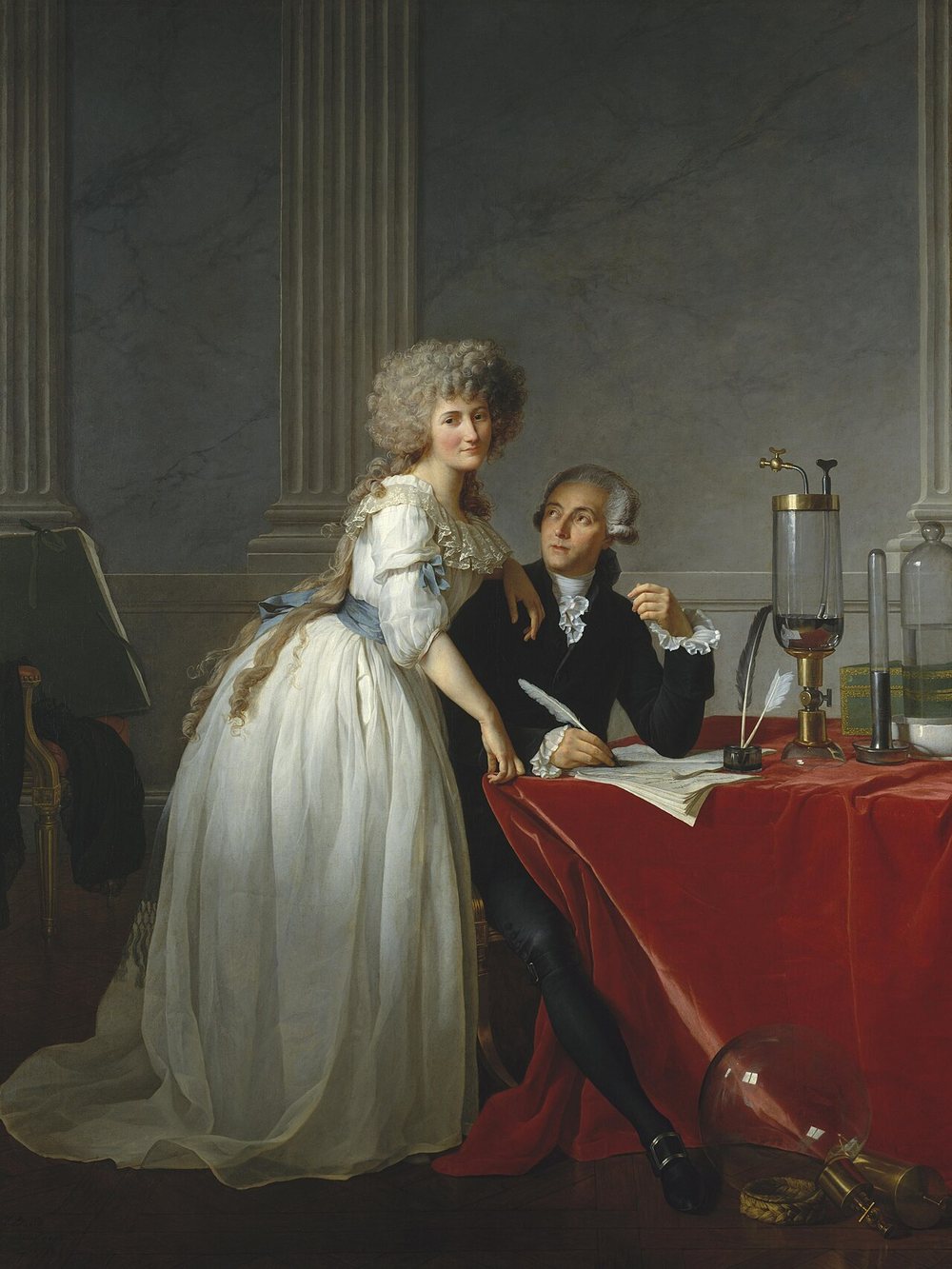
Antoine and Marie-Anne, 1788 Painted by Jacques-Louis David. The glassware on the table is the point of the portrait.
Lawyer by training, chemist by obsession
Bought a share in the tax farm at 26
Paid for the best laboratory in Europe
Married Marie-Anne Paulze in 1771
How the laboratory was funded
13
her age at the marriage
all of it
the lab notes, translations and engravings she made
Marie-Anne
Chapter I · Step 2
The chemist who collected taxes
A share in the Ferme générale bought at 26 made Lavoisier rich enough to build the best private laboratory in Europe — and marked him for the Revolution.
Marie-Anne Paulze Lavoisier translated Priestley and other English chemists for him, kept the laboratory records, and drew and engraved the plates of the Traité. She is in the David portrait because she was in the work.
If nothing can get in or out, the balance cannot be fooled.
In the autumn of 1772 Lavoisier burned phosphorus and then sulfur, and he did it inside a closed vessel standing on a balance.
Open to the room, the solid left behind weighs more than what you started with. Sealed, the total weight of jar, air and solid does not change at all.
That is the whole argument. The extra weight of the ash is not created. It is taken from the air inside the jar, which gets correspondingly lighter.
Burning is not losing something. It is combining with part of the air. Try it: seal the jar or leave it open, then light it and weigh.
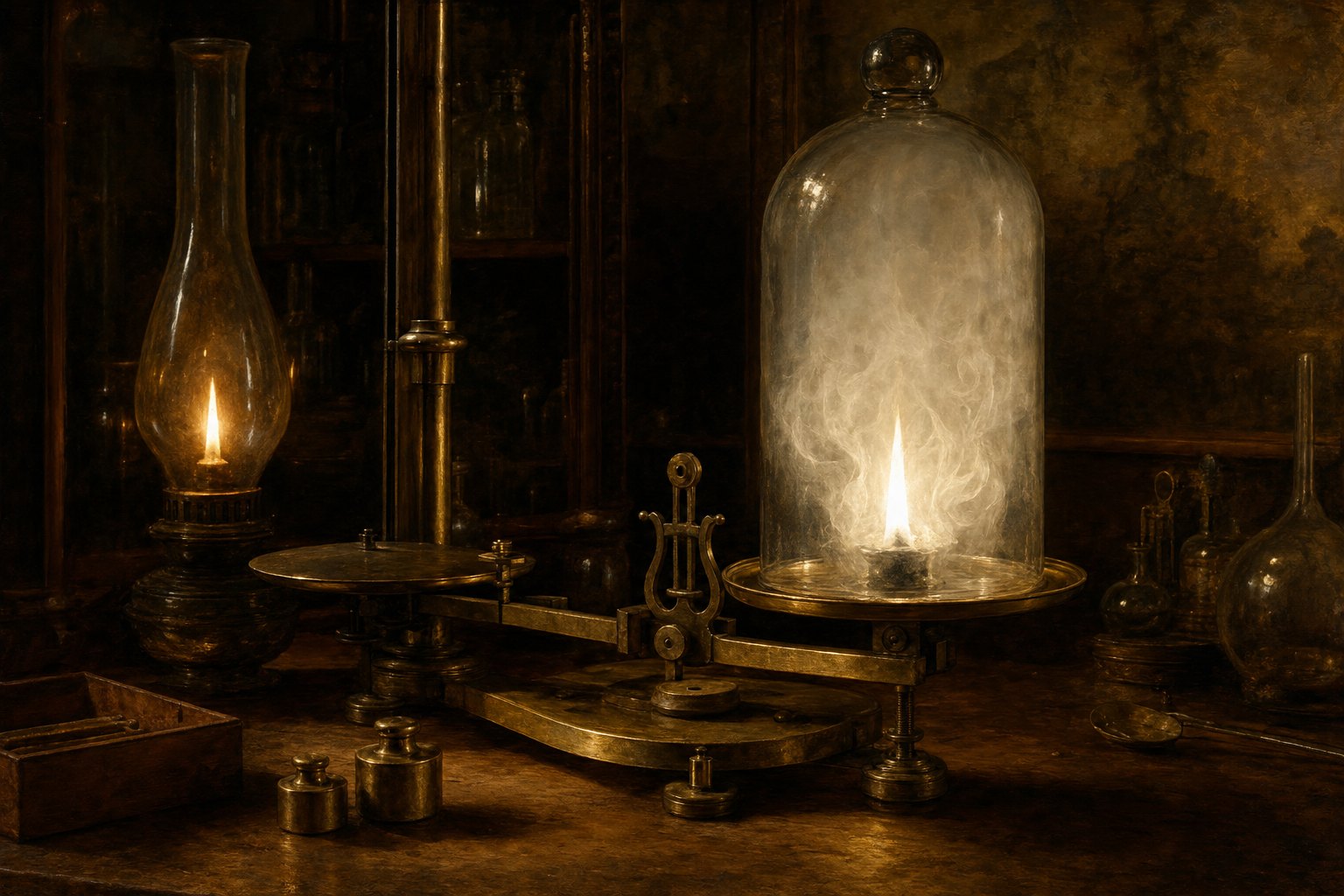
Seal it first Phosphorus burning under a closed bell jar standing on the balance.
= 0
change in total weight, sealed
+
weight gained by the solid
−
weight lost by the air
What the balance says
Burn phosphorus in the open: the ash weighs more
Burn it sealed: the jar weighs exactly the same
So the extra weight came out of the air
Nothing was released. Something was absorbed
The whole argument
Chapter II · Step 3 · Interactive
Weigh the whole jar
Burned in the open, phosphorus leaves a residue heavier than itself. Burned in a sealed vessel, the total weight does not move. The extra weight comes out of the air.
Press Sealed or Open, then Light it. Watch the balance and the air reading. Numbers here are schematic, chosen to show the proportions.
The decisive experiment is slow. Mercury in a sealed retort, its neck leading under a bell jar, heated just below boiling and left for twelve days.
A red crust creeps across the mercury. The air trapped in the jar shrinks: fifty cubic inches become about forty-two.
And the air that remains is dead. A candle goes out in it, a mouse suffocates. Air is not a single substance. One part of it has been eaten.
Run the days yourself and watch the volume fall.
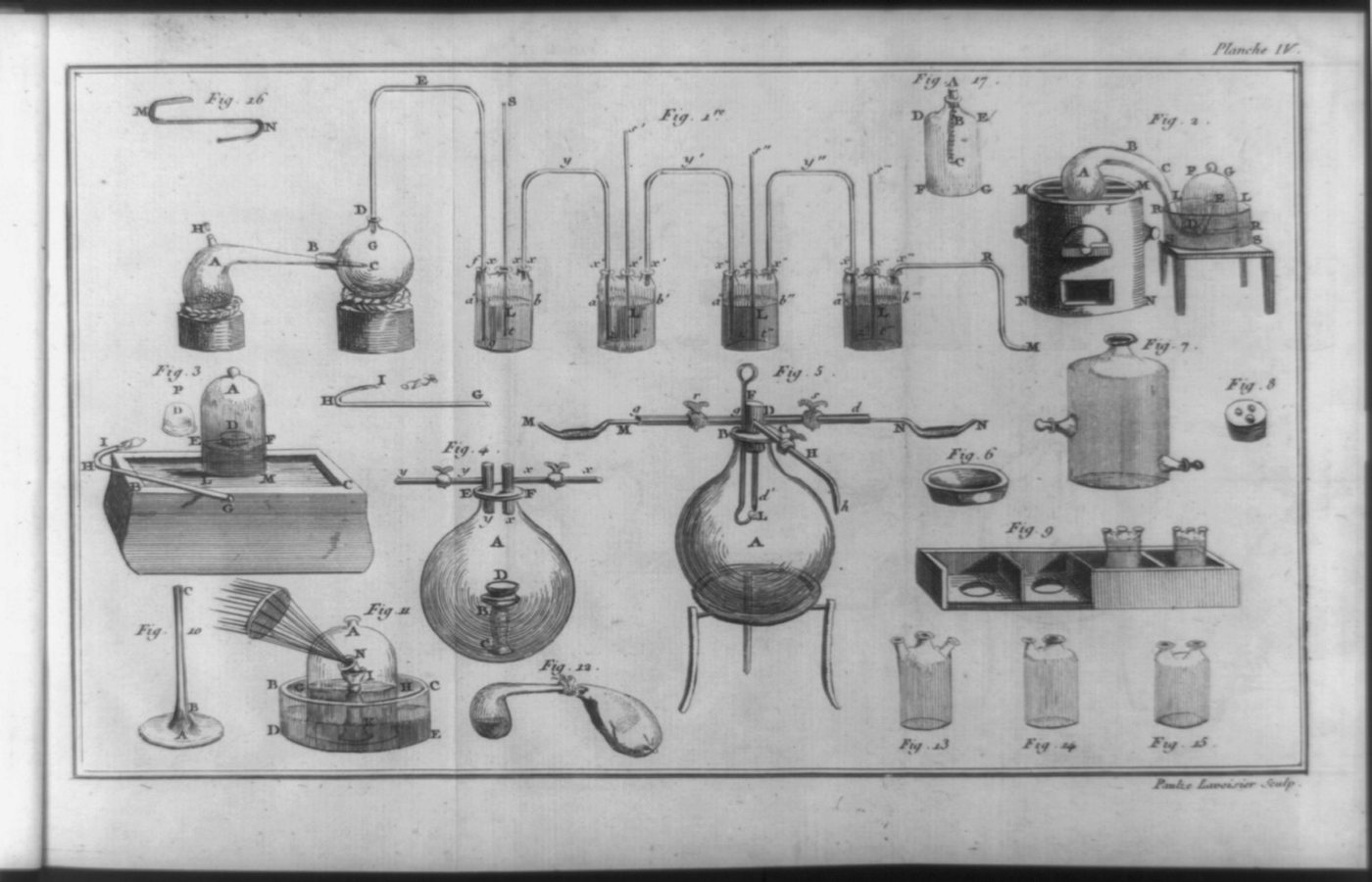
The apparatus, engraved by Marie-Anne Plates from the Traité showing the combustion and mercury apparatus.
12
days of gentle heat
50 → 42
cubic inches of air left
red
the calx forming on the mercury
The measurements
The residue could not keep a candle alight
Nor keep a mouse alive
So air is not one thing
What was left behind
Chapter III · Step 4 · Interactive
Twelve days with mercury
Mercury heated for twelve days in a sealed apparatus grew a red crust, and the trapped air shrank from about 50 to 42 cubic inches. What remained could not support a flame or an animal.
Press Next day or Run all twelve. Then heat the red calx and give the air back.
Now reverse it. Scrape off the red calx, heat it hard, and a gas comes off — and it is exactly the volume the air had lost.
A candle in that gas burns with a fierce white flame. A mouse in it lives longer than in ordinary air.
Carl Scheele had made the gas first and published late. Joseph Priestley made it in August 1774 and described it to Lavoisier in Paris that October. Both of them explained it as air stripped of phlogiston.
Lavoisier took the same gas and drew the opposite conclusion: it is a substance in its own right, one of the things air is made of. In 1777 he named it oxygène.
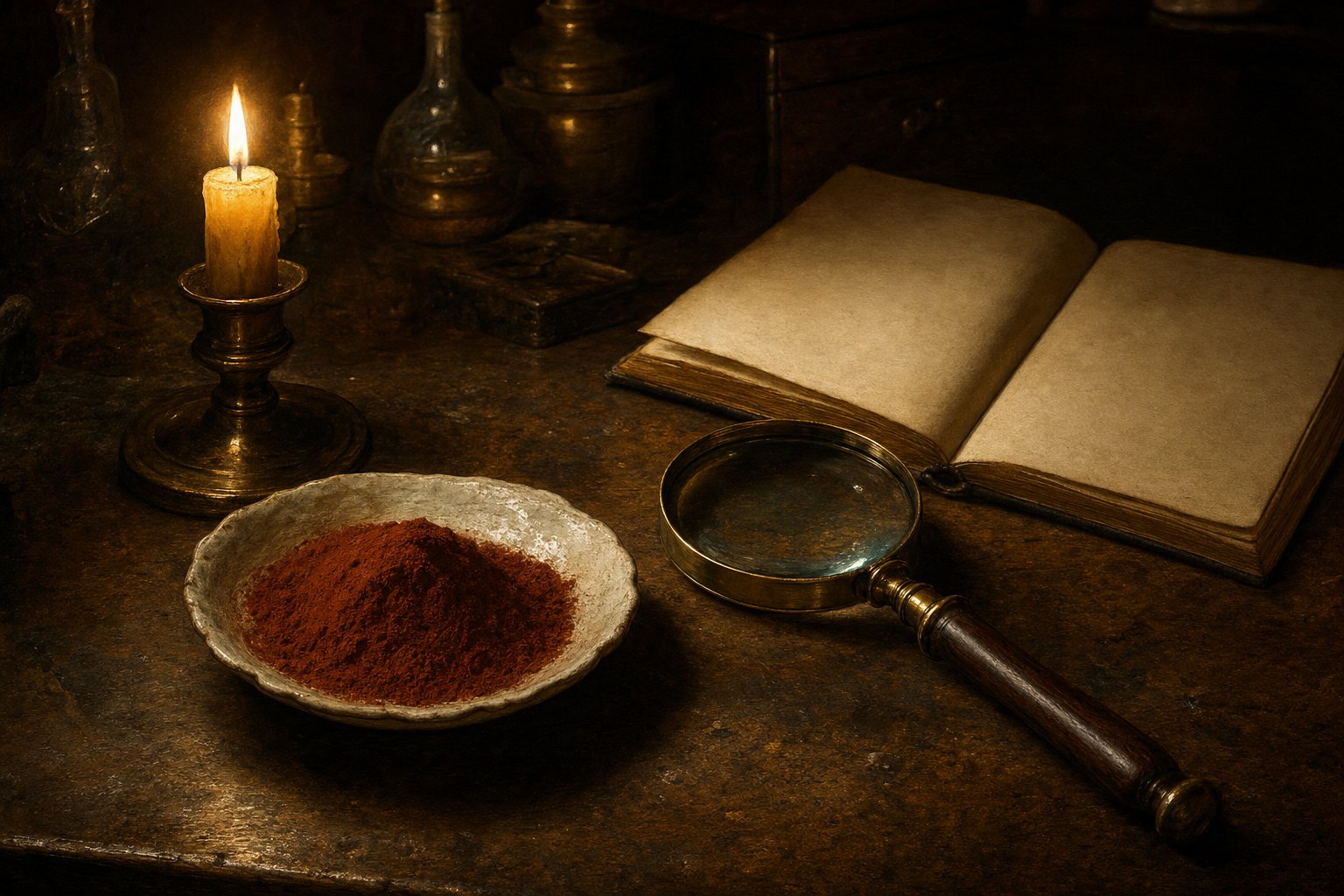
Heat the red powder The calx gives back exactly the air that went missing — and a candle burns fiercely in it.
1771–72 Scheele makes the gas first, publishes late
Aug 1774 Priestley releases it from red calx
Oct 1774 Priestley describes it to Lavoisier in Paris
1777 Lavoisier names it oxygène
Who found it
Scheele and Priestley made the gas
Both explained it with phlogiston
Lavoisier understood what it was
Discovery and understanding
Chapter III · Step 5
Giving the air back
Heating the red calx released a gas equal to the air that had vanished — one in which candles blaze and mice thrive. Scheele and Priestley made it first; Lavoisier named it oxygen in 1777 and said what it was.
Priestley called it “dephlogisticated air” to his death. The gas was the same; the theory was not. Lavoisier’s name for it stuck because his explanation did.
Water had been one of the four elements since the Greeks. Lavoisier took it apart and put it back together.
Pass steam through a red-hot iron tube and a light flammable gas comes out while the iron rusts. The iron has stolen something from the water.
Then do the reverse: burn that gas in oxygen, and water condenses on the glass. Two volumes of the one, one volume of the other.
He named the flammable gas hydrogen — water-former. Press the buttons to split the water and put it back.
Taking water apart Water run over red-hot iron comes out as a flammable gas, leaving the iron rusted.2H2+O2→2H2OTwo volumes of the flammable gas to one of oxygen. Lavoisier named the first hydrogen: water-former.
2 : 1
the volumes that make water
2,000+
years water had been an element
The end of an element
Chapter IV · Step 6 · Interactive
Water is not an element
Steam over red-hot iron yields a flammable gas and rust; burning that gas in oxygen yields water again, in the ratio two volumes to one. Lavoisier named the gas hydrogen, “water-former”.
Press Split and Recombine. Henry Cavendish had produced water by burning the gas in 1781; Lavoisier’s contribution was to say what the result meant.
A substance should be named for what it is made of.
Chemistry’s vocabulary was a junk drawer. Substances were named after their discoverer, their colour, their smell, or the alchemical planet they belonged to.
In 1787 Lavoisier and three colleagues threw it out and built a system: name a compound after the elements in it, and let the ending carry the proportion.
Oil of vitriol became sulfuric acid. Flowers of zinc became zinc oxide. Fixed air became carbonic acid gas.
It is the reason a chemistry student today can read a name and know the recipe. We still use it.
Naming by composition Out went oil of vitriol and flowers of zinc; in came sulfuric acid and zinc oxide.
Old: oil of vitriol → new: sulfuric acid
Old: flowers of zinc → new: zinc oxide
Old: fixed air → new: carbonic acid gas
The name now tells you what is inside
Before and after
1787
Méthode de nomenclature chimique
4
authors, one of them Lavoisier
The reform
Chapter V · Step 7
Renaming everything
The Méthode de nomenclature chimique (1787) replaced a thousand folk names with a system: compounds named for their constituents, with endings carrying the proportions. It is the naming scheme chemistry still uses.
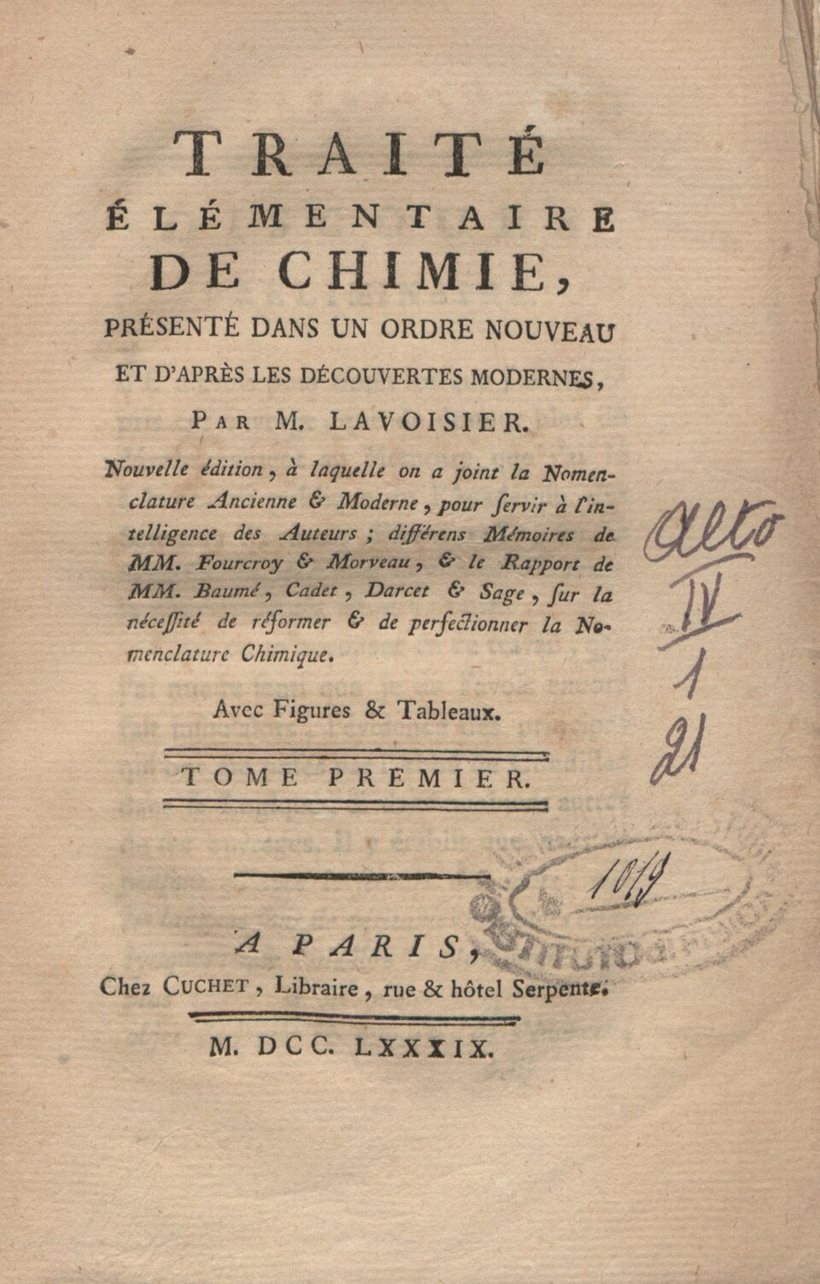
The Traité élémentaire de chimie appeared in 1789, the year the Bastille fell. It is the first chemistry book a modern reader can follow without a glossary.
It states the conservation of matter as a working rule: in every operation the quantity of matter before equals the quantity after, and you may use that as an equation.
And it gives a list of thirty-three substances that nobody had managed to break down. Most of them are elements. Two of them, light and caloric, are not.
That is the honest definition he chose: an element is whatever resists being taken apart, until someone takes it apart.
Traité élémentaire de chimie Published in 1789, the year the Bastille fell. The first chemistry textbook a modern reader can follow.
33
substances listed as elements
1789
the year it appeared
The list
Most of the 33 really are elements
Light and “caloric” are on the list too
An element is whatever you cannot break down — yet
Honest about the limits
Chapter V · Step 8
Thirty-three elements
The Traité élémentaire de chimie (1789) states conservation of matter as a rule you can calculate with, and lists 33 substances that had resisted decomposition — including, wrongly, light and “caloric”.
Marie-Anne drew and engraved its thirteen plates. The Traité’s definition of an element — whatever cannot yet be broken down — is still how the word works in practice.
Put an animal in the calorimeter and the numbers match a candle.
With Laplace he built a calorimeter: a chamber packed in ice, where the water that melts tells you how much heat came out.
They put a guinea pig in it. The animal used oxygen, gave off carbonic acid gas, and melted a measurable weight of ice.
Then they burned charcoal in the same apparatus. For the same amount of gas given off, almost the same amount of heat.
Respiration is a slow combustion. The fire in the lamp and the warmth of an animal are the same process, running at different speeds.
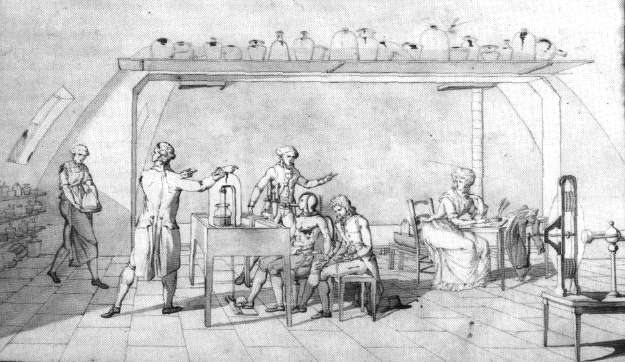
Measuring a breathing man A drawing from the Lavoisier laboratory notes of a respiration experiment on a human subject.
An animal in a sealed jar uses oxygen
It gives out carbonic acid gas and heat
A burning candle does exactly the same
So respiration is a slow combustion
The ice calorimeter
ice
the thermometer: melt water tells you the heat
How they measured heat
Chapter VI · Step 9
Breathing is burning
Lavoisier and Laplace measured the heat of a living animal with an ice calorimeter, and found it matched the heat of burning charcoal for the same gas produced. Respiration is a slow combustion.
It is the first quantitative link between chemistry and physiology — the beginning of metabolism as a measurable thing.
The money that built the laboratory came with a receipt.
Lavoisier welcomed the Revolution at first, and worked for it. He sat on the commission that designed the metric system, and wrote reports on taxation and public finance.
But he had spent twenty-five years in the Ferme générale, the company that collected taxes from people who hated paying them, and he had built the wall around Paris that made the duties collectable.
In 1793 the Farmers General were arrested. The charges included watering down tobacco and holding the state’s money.
On the eighth of May 1794 twenty-eight of them were tried, condemned and guillotined, in that order, in a single day.
The other ledger The tax farm he had joined at 26 became, in 1793, a capital charge.
1789 Revolution begins; he serves on public commissions
1790 Works on the committee that designs the metric system
1793 The Farmers General are arrested
8 May 1794 Tried, condemned and executed the same day
Five years
28
tax farmers executed with him
1 day
trial, sentence and execution
8 May 1794
Chapter VII · Step 10
The other ledger
Lavoisier served the Revolution on the metric system commission — and had spent 25 years in the Ferme générale. In 1793 the tax farmers were arrested; on 8 May 1794 twenty-eight of them were tried, condemned and executed in one day.
There is a story that the court told him the Republic has no need of scientists. It is probably not true, and it is repeated because it feels true.
What is documented is Lagrange, the next day: it took them an instant to cut off that head, and a hundred years may not produce another like it.
Marie-Anne was left with nothing, got his confiscated papers back by sheer persistence, and published his last memoirs herself.
A year later the government annulled the conviction and sent his widow a note saying he had been falsely convicted.
It took them only an instant to cut off that head, and a hundred years may not produce another like it.Joseph-Louis Lagrange, the day after the execution
His papers were confiscated
Marie-Anne recovered them and published his last memoirs
The conviction was annulled a year later
Too late to matter
After
Chapter VII · Step 11
An instant, and a hundred years
Lagrange, the day after: “It took them only an instant to cut off that head, and a hundred years may not produce another like it.” The conviction was annulled in 1795.
The line “the Republic has no need of scientists” is often attached to the trial. There is no good evidence it was said.
What Lavoisier left is not one discovery. It is a rule and a habit.
The rule: in any chemical change, the total mass before equals the total mass after. Every balanced equation in every chemistry class is that rule being used.
It has exactly one exception, found a century later: when mass turns into energy. In a chemical reaction the discrepancy is about one part in a billion, which no balance of his could see.
The habit is bigger. Measure the whole system, including the parts you cannot see, and do not accept an explanation the numbers refuse.
∑mbefore=∑mafterThe rule that turns chemistry into bookkeeping — and makes a balanced equation possible.
Every equation you balance uses this
Every yield calculation uses this
It holds except where mass becomes energy
Where it still runs
1905
Einstein shows mass and energy are convertible
~1 part in 10⁹
how much chemistry breaks the rule
The only exception
Epilogue · Step 12
The rule that survived
Mass in = mass out. Every balanced equation uses it. The single exception — mass converting to energy — is about one part in a billion in chemical reactions, far below any balance Lavoisier could build.
Three of the names on your periodic table are his.
Oxygen, hydrogen and nitrogen carry the names he gave them. So does almost every compound you can name from its formula.
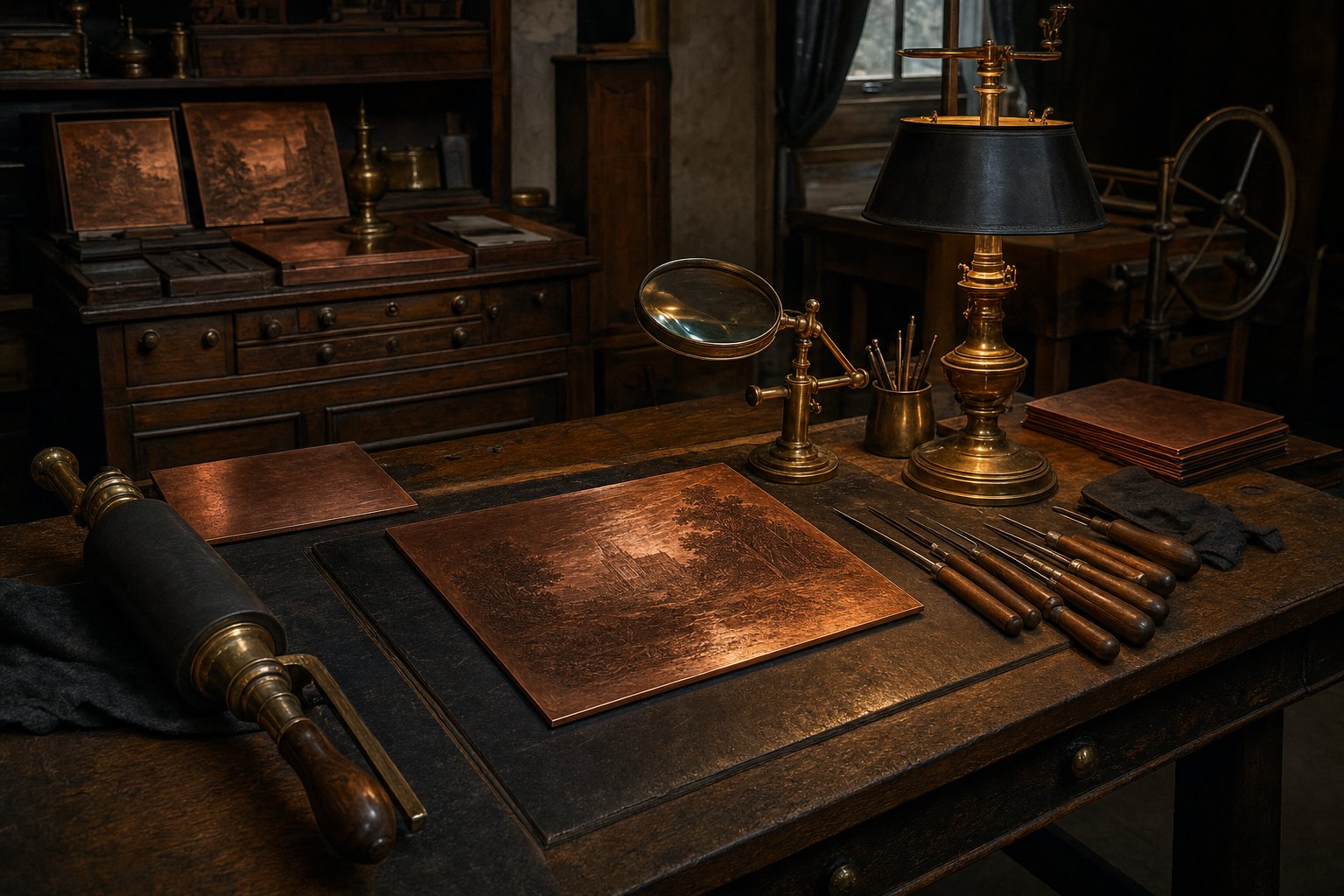
The chapter stills in this film are AI-generated. The David portrait, the engraved plates, the title page and the laboratory drawing are real.
There is a lesson in the ending that is worth keeping. Being right, and being useful, and being rich enough to fund your own laboratory, bought him no protection at all.
What survived was the method. Seal the vessel. Weigh it. Believe the balance.
1772 seals the vessel and weighs it
1777 names oxygen
1783 water taken apart
1787 chemistry renamed
1789 the Traité and the 33
1794 executed
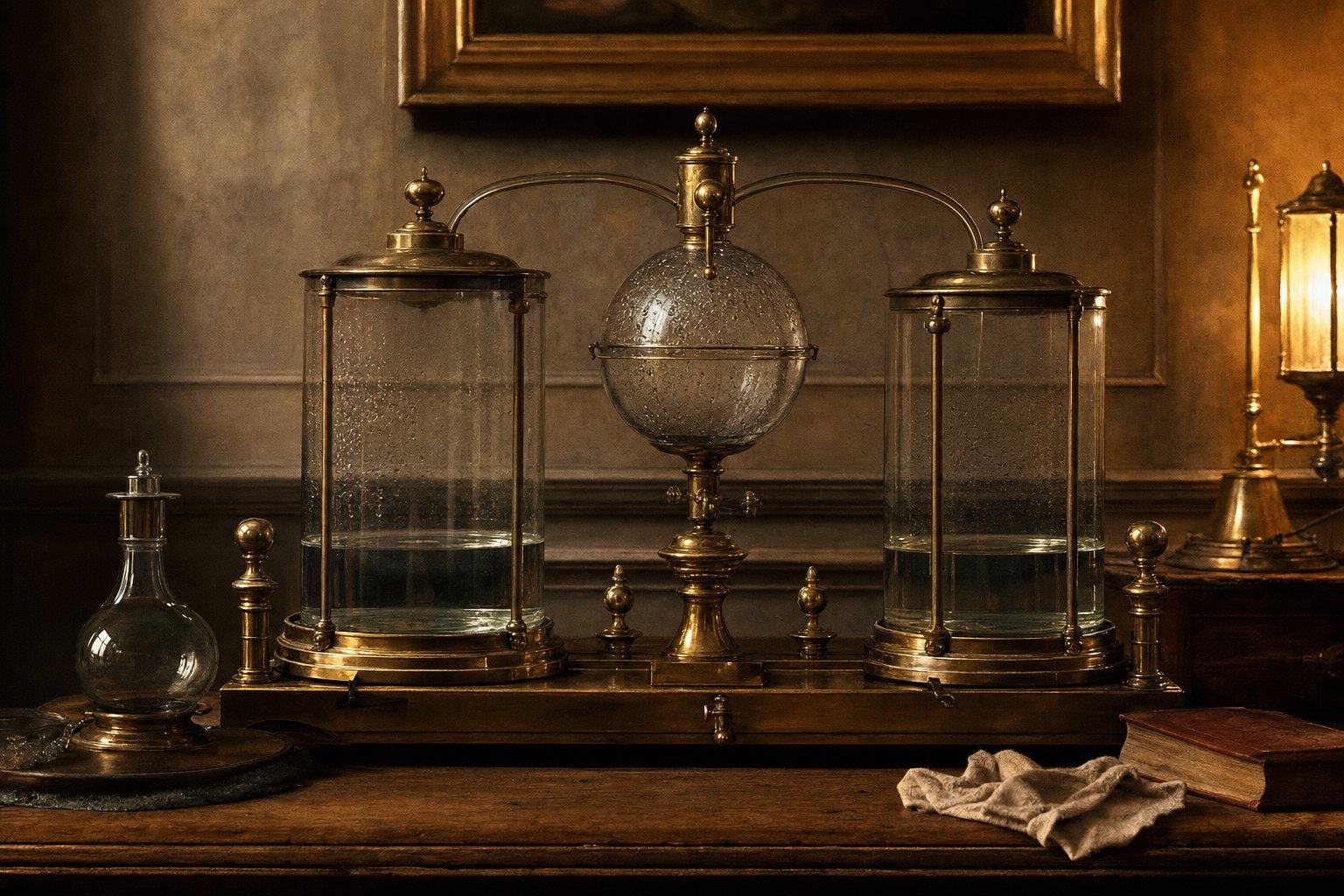
Twenty-two years of workThe portrait, again Look at the table: a gasometer, a flask, a balance case. David painted the laboratory, not the fortune.
Oxygen, hydrogen, nitrogen — his names
Conservation of mass — his rule
Metabolism as measurement — his experiment
Still in use
Epilogue · Step 13
What he is in every lab
His names are on the periodic table, his rule is in every balanced equation, and his calorimeter is the ancestor of every measurement of metabolism.
1772–1777 sealed-vessel combustion; oxygen named
1783 water shown to be a compound
1787–1789 chemical nomenclature and the first modern textbook
1794 executed at 50
Chapter stills in this film are AI-generated illustrations. David’s 1788 portrait, Marie-Anne’s engraved plates, the 1789 title page and the laboratory drawing of the respiration experiment are real historical images, credited where they appear.