In 1907 a patent clerk realised that a man falling off a roof feels no gravity at all, and called it the happiest thought of his life. Eight years later it was general relativity. Ride the lift that cannot tell gravity from acceleration, bend starlight past the Sun, and watch the clocks in your phone's satellites drift by 38 microseconds a day. Episode 08 of the Great Scientists series.
Interactive 3D film8 min1879 to 1955Published 2026-10-13
Gravity is not a force. It is the shape of what you are falling through.
In 1907 a patent clerk in Bern was writing a review article when something obvious occurred to him.
A man falling from a roof does not feel his own weight. While he falls, he is weightless — gravity has vanished for him completely.
Einstein called it the happiest thought of his life, because it suggested that gravity is not a force acting on things, but something about the frame you are in.
Eight years later that hunch had become a set of equations saying that mass bends space and time, and that light follows the bend.
A thought in an office A man falling from a roof feels no gravity. Everything else followed from that.
1905
four papers that changed physics
8
years from the thought to the equations
38 µs
a day: relativity in your phone
Three numbers
The happiest thought of my life.Einstein on realising that a falling observer feels no gravity
Prologue · Why he matters
The happiest thought
Einstein’s route to general relativity started with one observation: a falling observer feels no gravity. Eight years later that became equations in which mass curves spacetime and light follows the curve.
Born
Ulm, 1879
14 March
Died
Princeton, 1955
18 April
Nobel Prize
1921
for the photoelectric effect, not relativity
How to use: pick a chapter below or press ← → to change step · ▶ plays the step · drag to rotate · three steps have buttons you can press.
The most productive year in physics happened on an office clerk’s evenings.
Einstein finished his degree in 1900 and could not get an academic job. He applied across Europe and was refused.
A friend’s father found him a post at the Swiss patent office in Bern: technical expert, third class, assessing applications for electrical devices.
He was good at it, and it was undemanding enough to leave his mind free. He later called the office his worldly monastery.
In 1905 he published four papers in a single year: on the quantum nature of light, on Brownian motion, on special relativity, and the short one with the equation about energy and mass.
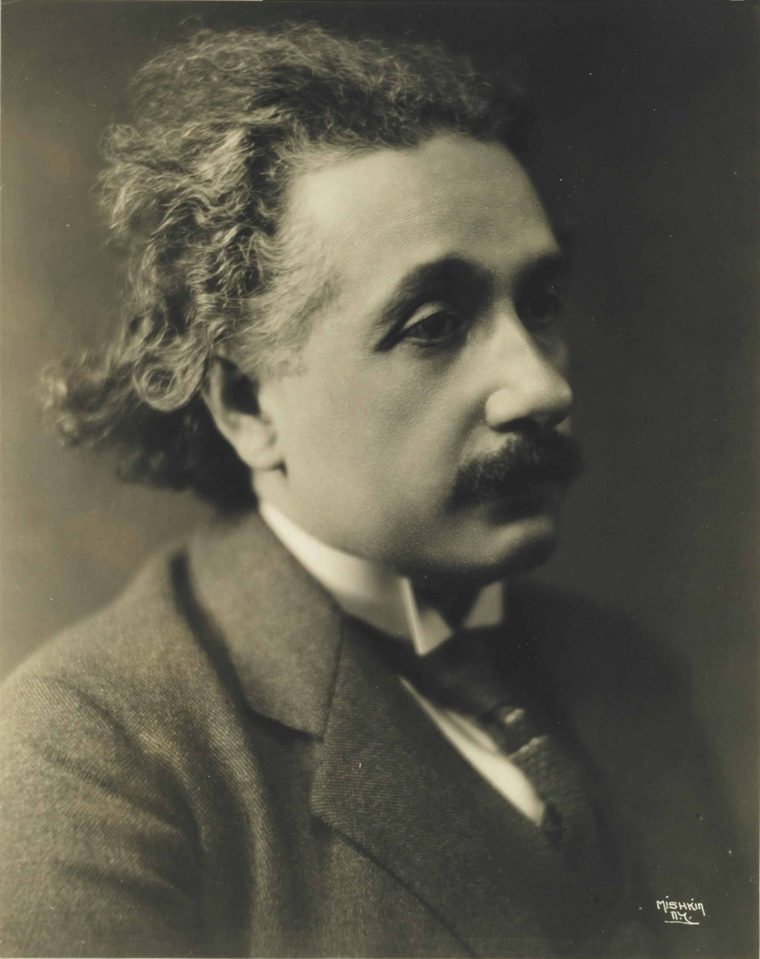
Einstein in 1921 By then he was the most famous scientist alive. Fourteen years earlier he was grading patent applications.
1879 Born in Ulm
1900 Graduates; cannot get an academic post
1902 Technical expert, third class, Swiss patent office
1905 Four papers, one of them his doctorate
Before he was Einstein
He applied for teaching jobs and was turned down
The patent job left his head free
He called the office his worldly monastery
The useful dead end
Chapter I · Step 1
Technical expert, third class
Rejected for every academic post he applied to, Einstein spent 1902–1909 assessing patents in Bern. In 1905 he published four papers — light quanta, Brownian motion, special relativity, and E = mc².
The first paper said light comes in discrete packets, which explained why shining light on metal knocks electrons out only above a certain colour. That is the paper that won him the Nobel Prize.
The second explained the jittering of pollen grains in water as the result of being hit by molecules, which settled the argument about whether atoms are real.
The third was special relativity: if the speed of light is the same for every observer, then time and distance cannot be.
The fourth was three pages long and pointed out a consequence: mass is a kind of energy, and the exchange rate is the speed of light squared.
E=mc2Mass is a form of energy. One gram holds about ninety thousand billion joules.
Light arrives in packets — the photoelectric effect
Pollen jitters because atoms are real
The speed of light is the same for everyone
Therefore time and length are not absolute
The four papers
1921
the Nobel Prize — for the first of those
Which one won Not relativity. The committee thought it too speculative.
Chapter I · Step 2
Four papers
1905: light quanta (his Nobel paper), Brownian motion (atoms are real), special relativity, and three pages on E = mc². He was 26, and working full time in an office.
Standing still on Earth and accelerating through space feel identical.
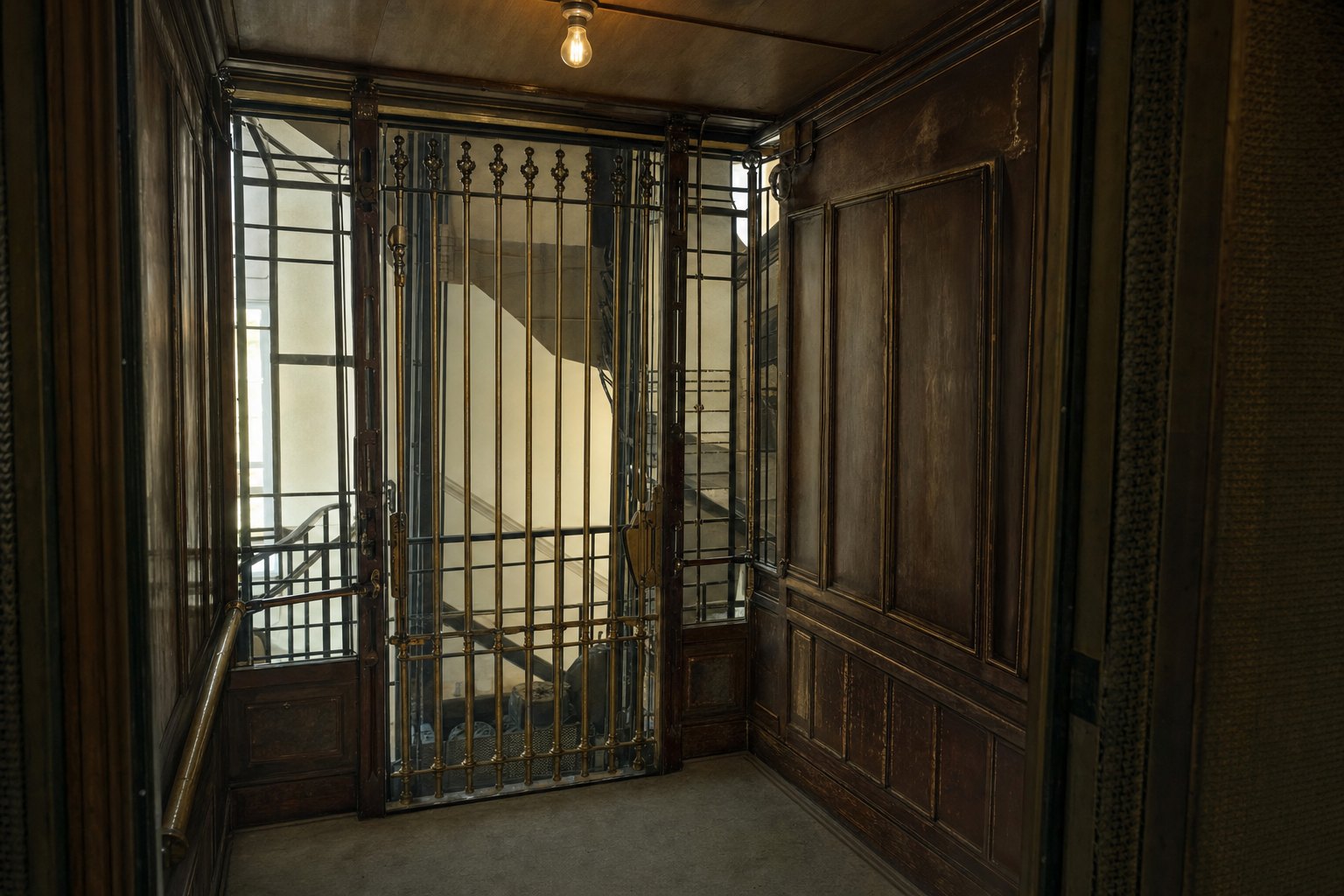
Put yourself in a windowless box. Everything you drop falls to the floor at the same rate.
You could be standing on the Earth. Or the box could be in deep space, with a rocket accelerating it upwards at nine point eight metres per second squared. From inside, there is no way to tell.
Now cut the cable. Everything in the box floats, including you. You could be falling towards the Earth, or drifting in empty space with no gravity at all. Again, no way to tell.
If no experiment can distinguish gravity from acceleration, then they are not two things. Press the buttons and try it.
Falling freely Inside a falling lift there is no experiment that can detect gravity.
Standing on Earth feels like accelerating in space
Falling freely feels like floating in deep space
No experiment inside the box can tell them apart
So gravity and acceleration are the same thing
The equivalence principle
1907
the thought
1915
the field equations
Eight years of work
Chapter II · Step 3 · Interactive
You cannot tell the difference
The equivalence principle: inside a sealed box, standing on Earth is indistinguishable from accelerating in deep space, and falling freely is indistinguishable from floating. Gravity and acceleration are the same thing.
Press a situation and drop the ball. Watch the box, the ball and the reading.
If you cannot tell gravity from acceleration, light has to bend.
The equivalence principle has consequences you can work out on the back of an envelope.
Shine a torch straight across an accelerating box. While the light crosses, the box moves up, so the beam hits the far wall slightly low. From inside, the light looks bent.
But the inside of an accelerating box is indistinguishable from a gravitational field. So gravity must bend light as well.
The same argument says clocks lower in a gravitational field run slow. Einstein published the light-bending prediction in 1911 with a value that was half of the right answer.
The full theory, in 1915, doubled it.
Shine a torch across an accelerating box
The far wall moves up while the light crosses
So the beam lands low — it has bent
If acceleration bends light, so must gravity
One line of reasoning
1911
he predicts light bending, with the wrong value
1915
the full theory doubles it
Two predictions
Clocks lower down run slower
Light climbing out of gravity loses energy
Both measured, both correct
And two more
Chapter II · Step 4
Light must fall too
Acceleration visibly bends a light beam inside the box; equivalence then forces gravity to bend light as well, and to slow clocks lower in the field. Einstein’s 1911 estimate was half the final 1915 value.
Not a force between objects. A shape that objects follow.
It took Einstein eight years and a crash course in differential geometry to turn the happiest thought into mathematics.
What came out in November 1915 is one equation with two sides. On one side, the curvature of spacetime. On the other, the matter and energy in it.
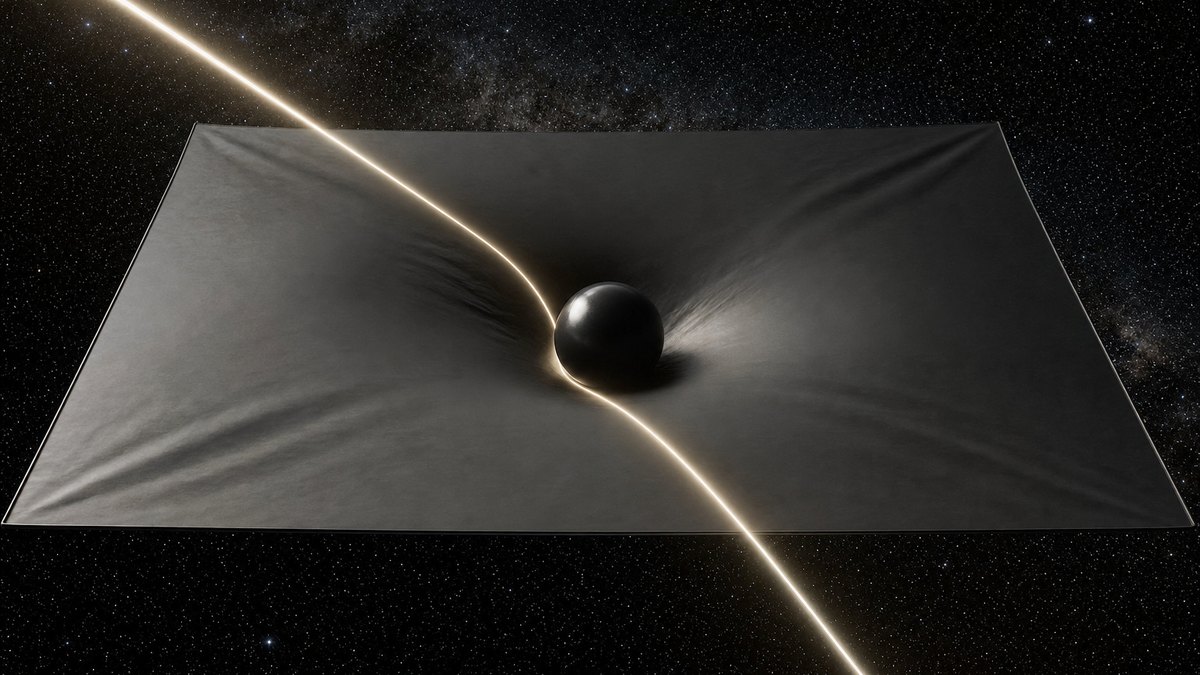
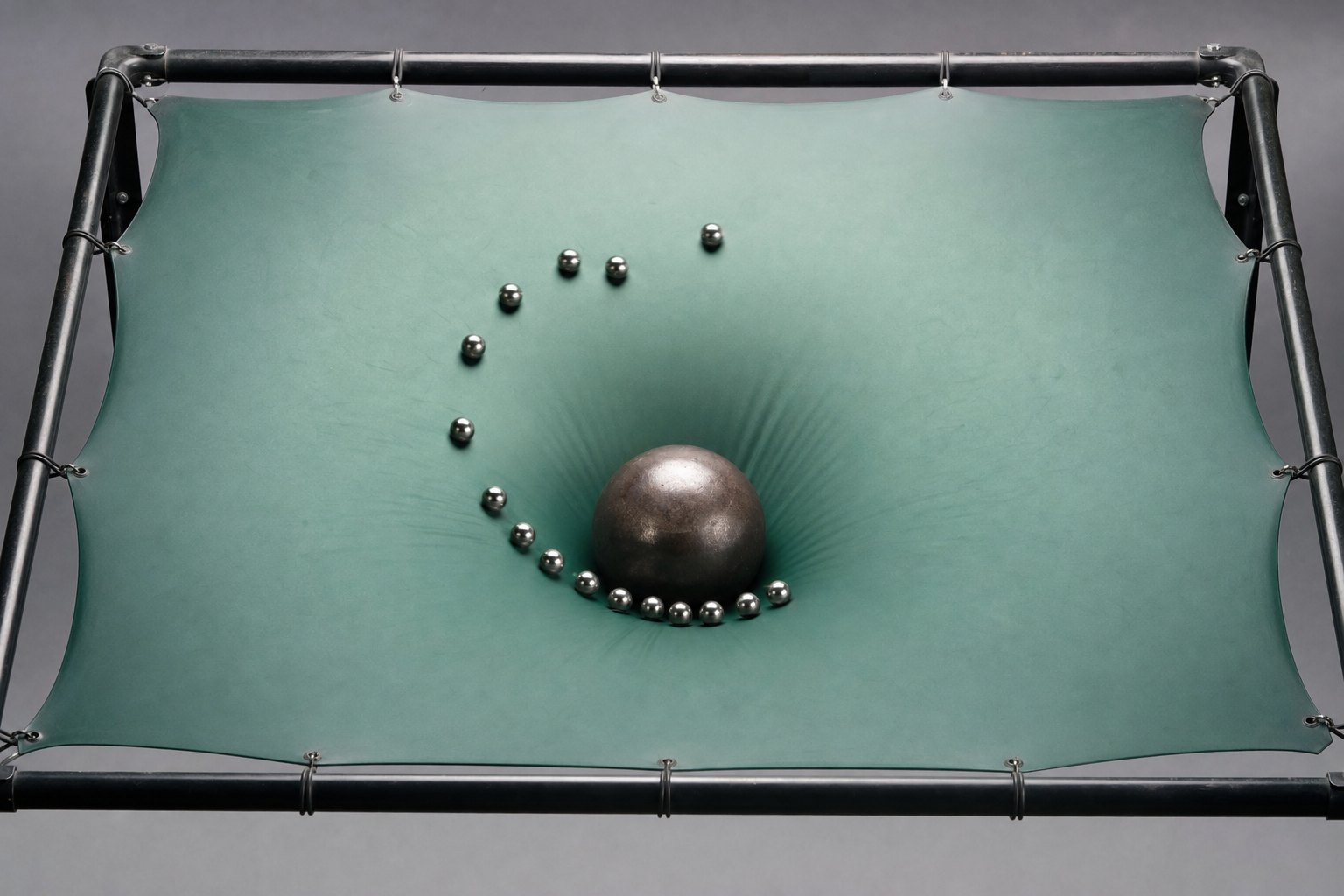
Matter tells spacetime how to curve, and the curve tells matter how to move. A planet in orbit is not being pulled. It is going as straight as it can through a region that is bent.
The first thing he checked was Mercury. Its orbit drifts by forty-three arcseconds a century more than Newton allows, and the new equations produced that number exactly. He said it gave him palpitations.
The rubber sheet A crude analogy — but the central idea is right: mass changes the geometry.Gμν=c48πGTμν
Gμν
the curvature of spacetime
Tμν
the matter and energy present
Matter tells spacetime how to curve; spacetime tells matter how to move.
43″
per century of Mercury, explained exactly
The first success
Chapter III · Step 5 · Interactive
Matter tells space how to bend
The 1915 field equations relate the curvature of spacetime to the matter and energy in it. Orbits are not pulled — they are straight lines through curved geometry. The first test: Mercury’s 43″ per century, produced exactly.
Drag the mass slider buttons to deepen the well and watch the passing light ray and the orbit respond.
A measurable difference, if you can find an eclipse.
A theory that only explains what is already known is doing half a job. General relativity made a prediction nobody had measured.
Starlight grazing the edge of the Sun should be deflected. Newtonian gravity, treating light as particles, gives about zero point eight seven arcseconds. Einstein’s theory gives one point seven five — exactly twice as much.
An arcsecond is the width of a coin seen from four kilometres away, so this needs careful photography. And you cannot photograph stars next to the Sun.
Unless the Moon gets in the way.
0.87″
Newton’s prediction for starlight at the Sun’s edge
1.75″
Einstein’s prediction
Two numbers that differ by a factor of two
Starlight passing the Sun is deflected
You cannot see stars next to the Sun
Unless there is a total eclipse
Then photograph the field and compare
How to test it
Chapter III · Step 6
Twice Newton’s answer
Starlight grazing the Sun: 0.87 arcseconds under Newtonian gravity, 1.75 under general relativity. A factor of two — measurable, if you can photograph stars beside the Sun during a total eclipse.
The measurement that made him famous was messier than the legend.
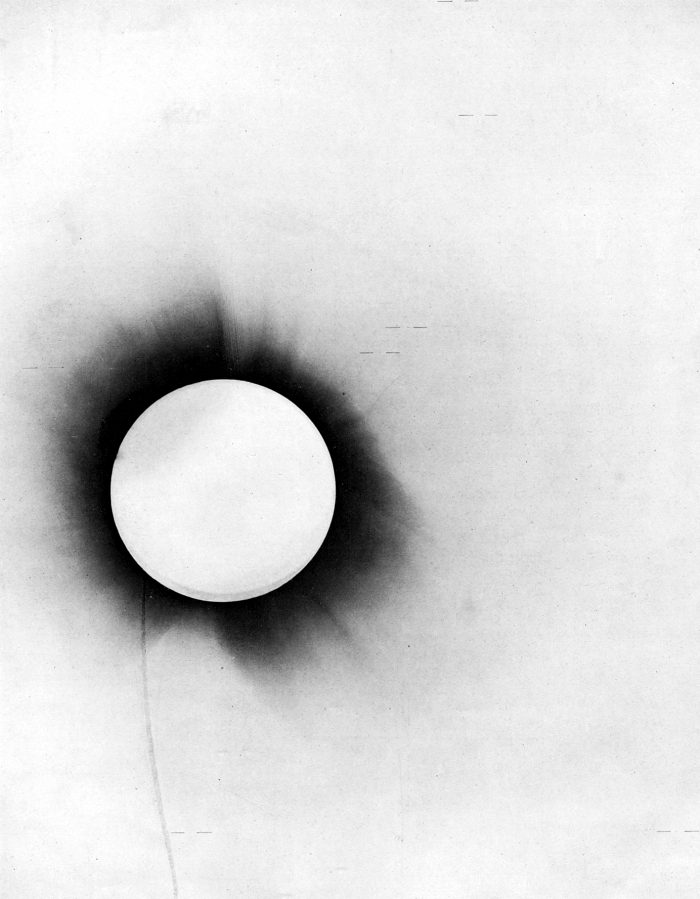
In 1919 Britain sent two expeditions to photograph a total eclipse: one to the island of Príncipe off West Africa, the other to Sobral in Brazil.
At Príncipe it rained, and cloud covered most of totality. Eddington got a usable result from one or two plates. At Sobral the main telescope produced blurred images, and the smaller backup instrument gave the better data.
On the sixth of November the Royal Society announced that the measurements favoured Einstein. The next morning he was world-famous, and he had not left Berlin.
The honest version is that it was a difficult measurement at the edge of what the equipment could do. Later eclipses, and then radio astronomy, confirmed it to far better precision.
The 1919 plate One of the eclipse negatives. The stars are the faint marks; the measurement is of how far they moved.
Mar 1919 Two expeditions sail from England
29 May 1919 Totality at Príncipe and at Sobral
6 Nov 1919 The results are announced in London
Eight months
Príncipe was clouded for most of totality
Sobral’s main telescope gave blurred images
The backup instrument saved the result
It was close, and it was contested for years
Not a clean experiment
Chapter IV · Step 7
Two expeditions and a lot of cloud
The 29 May 1919 eclipse was photographed from Príncipe and Sobral. Cloud and blurred plates made it marginal; the backup instrument carried the result. Announced in London on 6 November 1919, it made Einstein world-famous overnight.
Modern measurements, especially with radio sources, confirm the 1.75″ deflection to a fraction of a per cent. The 1919 data were weaker than the headlines suggested — and they pointed the right way.
A German theory, confirmed by an English telescope, a year after the war.
The story travelled because of its shape. A German physicist’s theory had been confirmed by a British expedition, one year after four years of war between those two countries.
Newspapers made it a parable about science crossing borders, and Einstein became the first scientist to be a global celebrity.
He was uncomfortable with it and used it, campaigning for pacifism, for Zionism, and later against the rise of the Nazis.
The Nobel Prize came in 1921, carefully awarded for the photoelectric effect. Relativity was still considered too speculative to honour.
Lights all askew in the heavens. Men of science more or less agog.The New York Times, 10 November 1919
A German theory confirmed by an English expedition
One year after the war ended
The press made it a story about peace
And made Einstein a celebrity
Why it exploded
1921
Nobel Prize — for the 1905 light paper
Not for this
Chapter IV · Step 8
Overnight
A German theory confirmed by a British expedition a year after the war made Einstein the first celebrity scientist. His 1921 Nobel Prize was awarded for the photoelectric effect — relativity was still thought too speculative.
He was on a lecture tour when the Nazis took power, and did not go back.
By the late 1920s Einstein was both the most famous scientist in the world and, in Germany, a target.
Nationalist physicists denounced relativity as Jewish physics. When the Nazis took power in 1933 he was abroad on a lecture tour. He resigned from the Prussian Academy, gave up his citizenship, and never returned.
His house was raided, his property seized, his books burned, and a Nazi magazine published his photograph with the caption not yet hanged.
He settled at the Institute for Advanced Study in Princeton and stayed for the rest of his life.
1922 Lectures across Asia, including Japan
1930s Attacked in Germany as “Jewish physics”
1933 Leaves Germany for good while abroad
1940 Becomes an American citizen
Leaving
His property was seized and his books burned
A bounty was published for his head
He never set foot in Germany again
He spent his last 22 years at Princeton
What exile meant
Chapter V · Step 9
Out
Denounced in Germany as “Jewish physics”, Einstein was abroad when the Nazis took power in 1933. He renounced his citizenship, never returned, and spent his last 22 years at Princeton.
He helped start quantum mechanics, then refused to accept it.
Einstein’s 1905 paper on light quanta is one of the founding documents of quantum theory. He then spent the rest of his life arguing that the theory was incomplete.
His objection was not that the mathematics failed — it worked perfectly — but that it describes only probabilities, and he believed physics should describe what is actually there.
In 1935 he and two colleagues published a thought experiment designed to show the theory was absurd. Experiments since the 1970s have shown that nature behaves exactly as the absurd version says, and that paper is now the foundation of research into entanglement.
He was wrong, and he was wrong in a way that produced a whole field.
God does not play dice.Einstein on quantum mechanics — Bohr’s reply: stop telling God what to do
He helped start quantum theory in 1905
Then spent thirty years objecting to it
The 1935 EPR paper was meant as a refutation
It became the foundation of quantum entanglement research
Wrong in a useful way
30
years spent on a unified theory that did not come
The last project
Chapter V · Step 10
God does not play dice
Einstein helped found quantum theory and then rejected its implications for thirty years. His 1935 EPR paper, written to show the theory was absurd, became the foundation of entanglement research — and experiment has sided against him.
He signed a letter, and spent the rest of his life regretting it.
In the summer of 1939 Leó Szilárd came to Einstein with a draft letter warning President Roosevelt that nuclear fission might make an extraordinarily powerful bomb, and that Germany was working on it.
Einstein signed. The letter helped start the American programme that became the Manhattan Project. He did no work on the bomb himself and was refused clearance to do so.
After Hiroshima he campaigned against nuclear weapons for the rest of his life and said that if he had known the Germans would fail, he would never have lifted a finger.
He died in Princeton in 1955, aged seventy-six, refusing surgery.
Szilárd drafted it; Einstein signed it
It warned Roosevelt that a uranium bomb was possible
He did no work on the bomb himself
He was denied security clearance
The letter
Had I known that the Germans would not succeed in producing an atomic bomb, I would never have lifted a finger.Einstein, 1947
1955
dies at 76; refuses surgery
The end
Chapter VI · Step 11
One signature
In 1939 Einstein signed a letter drafted by Leó Szilárd warning Roosevelt that a uranium bomb was possible. He did no work on it and was denied clearance; afterwards he campaigned against nuclear weapons and called the signature his one great mistake.
If nobody corrected for relativity, your map would be useless by lunchtime.
Here is the part that touches you. A GPS satellite carries an atomic clock in a weaker gravitational field than yours, so general relativity says it runs fast — by about forty-six microseconds a day.
It is also moving at fourteen thousand kilometres an hour, so special relativity says it runs slow, by about seven microseconds a day.
The two do not cancel. The net effect is a gain of roughly thirty-eight microseconds every day, which would put your position out by about eleven kilometres after twenty-four hours.
So the clocks are deliberately detuned before launch. Set the correction on and off and watch the error grow.
+45.9 µs
a day: clocks run fast, higher in the field
−7.2 µs
a day: clocks run slow, moving fast
+38 µs
a day net, and it must be corrected
A GPS satellite clock
Ignore relativity and positions drift
By roughly eleven kilometres a day
So the clocks are detuned before launch
Both of Einstein’s theories, running in your phone
Why it matters daily
Epilogue · Step 12 · Interactive
Eleven kilometres a day
A GPS clock gains about 45.9 µs/day from weaker gravity and loses about 7.2 µs/day from orbital speed — a net +38 µs. Uncorrected, positions drift roughly 11 km per day, so the clocks are detuned before launch.
Toggle the correction and run the clock to watch the error accumulate.
Waves in 2015, a photograph in 2019, and still no quantum version.
General relativity has now been tested for over a century and has not failed once.
In 2015 two detectors in America felt a ripple in spacetime from two black holes colliding more than a billion light years away, stretching a four-kilometre arm by less than the width of a proton.
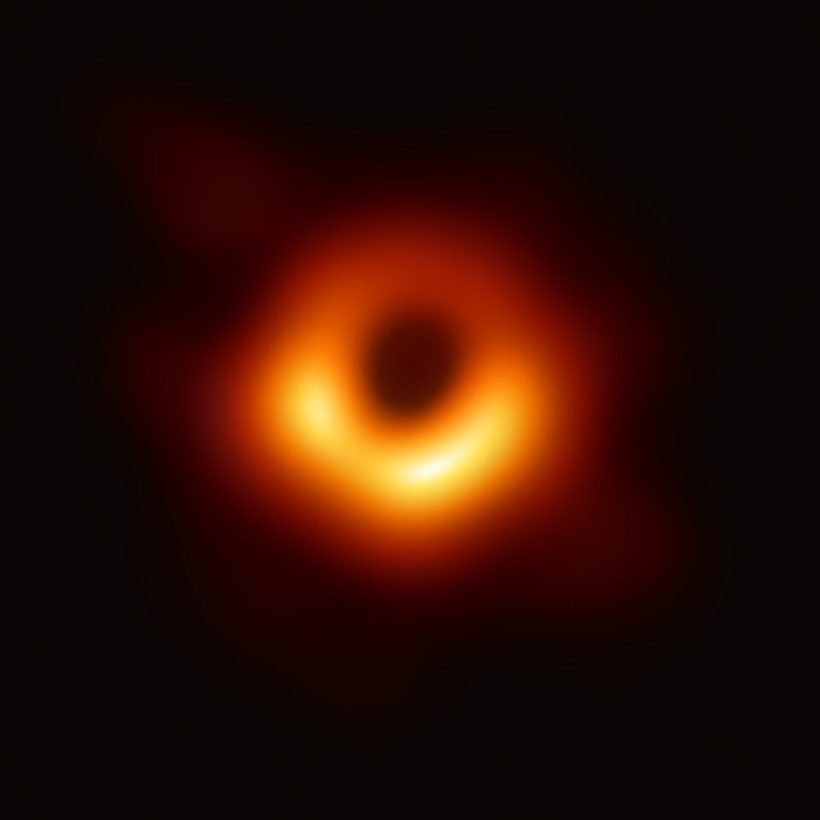
In 2019 a network of radio telescopes photographed the shadow of a black hole, and its size and shape matched the equations.
The one place it still fails is where it meets quantum mechanics. Joining them is the unfinished problem he was working on when he died.
The chapter stills here are AI-generated; the 1921 portrait, the eclipse plate and the black hole image are real. Sources are below.
A black hole, photographed M87’s shadow, imaged in 2019. The size and shape match the 1915 equations.
1919 starlight bends
1959 clocks confirmed to run slow lower down
2015 gravitational waves detected
2019 a black hole is photographed
A century of tests
Every test so far has agreed
It still does not fit with quantum mechanics
Which is the open problem he died working on
Where it stands
Epilogue · Step 13
A hundred years of passing
Light bending (1919), clocks slowing (1959), gravitational waves (2015), a photographed black hole (2019). General relativity has passed every test — and still does not join up with quantum mechanics.
1905 four papers, including special relativity
1915 general relativity
1919 the eclipse measurement
Today 38 µs a day of correction in every satellite
Chapter stills in this film are AI-generated illustrations. The 1921 photograph of Einstein, the 1919 eclipse negative and the Event Horizon Telescope image of M87 are real, credited where they appear.