1904–1906 · The mosquito war
Before the digging, the fevers
The Americans’ first great victory in Panama was not over rock, but over insects.
The United States took over the French works on the fourth of May 1904. Its chief medical officer was William Gorgas.
In Cuba, Carlos Finlay and Walter Reed had shown that one mosquito, Aedes aegypti, spreads yellow fever. Ronald Ross had linked malaria to Anopheles mosquitoes.
Gorgas’s teams drained and oiled standing water, screened windows, fumigated houses and built piped water so families no longer kept open barrels.
Many officials called it a waste of money. President Roosevelt backed Gorgas. By 1906 only one case of yellow fever was reported.
Chapter IV · Step 6 · 1904–1906
Defeating yellow fever
Colonel William C. Gorgas had already helped end yellow fever in Havana. His method rested on the work of the Cuban physician Carlos Finlay and the American pathologist Walter Reed, who showed that the Aedes aegypti mosquito carries the disease, and on Ronald Ross’s work linking malaria to Anopheles mosquitoes.
- Remove breeding water: drain ponds and ditches; spray oil and larvicide on the rest.
- Keep mosquitoes away from people: screens on windows and verandas, nets, quarantine of patients.
- Fumigate buildings, and build piped water systems to replace water barrels in homes.
- Yellow fever
- 1 case
reported in 1906; none in later years of construction
- Malaria
- Reduced, not ended
it remained a major cause of illness
The commission chairman, Theodore Shonts, asked President Theodore Roosevelt to remove Gorgas. After consulting doctors, Roosevelt gave Gorgas his full support.
The red haze on the map is an illustration of mosquito numbers falling, not measured data.
Sources:
Wikipedia: Health measures during the construction of the Panama Canal;
Wikipedia: History of the Panama Canal1906 · John Stevens
Lift the ships instead
Rather than dig down to the sea, build a lake in the sky and climb up to it.
In 1905 a railway engineer, John Stevens, took charge. He rebuilt the railroad and housing, and began recruiting workers by the thousands.
An expert panel voted eight to five for a sea-level canal. Stevens, who had seen the Chagres in flood, called that “an entirely untenable proposition”.
His alternative: dam the Chagres at Gatun to make a lake twenty-six metres above the sea. Locks at each end lift ships up to it and lower them down again.
The river becomes the canal’s water supply instead of its enemy, and far less rock must be dug. Congress agreed in 1906. Try both plans with the buttons.
Chapter IV · Step 7 · 1905–1906
The lock-and-lake design
The first American chief engineer, John Findley Wallace, resigned in 1905. His successor, John F. Stevens, argued for a canal whose locks raise ships to a large artificial lake about 26 m (85 ft) above sea level. Water to work the locks would flow down from the lake by gravity. Roosevelt and Congress accepted the plan in 1906.
Sea-leveldig the whole route below the sea; the Chagres must be diverted Lock-and-lakedam the Chagres; locks lift ships about 26 m; the cut stops 12 m above sea level Trade-offlocks limit ship size and need water from rain
Use the buttons on the scene to switch between the two plans. Red shows rock to excavate; blue is water.
Sources:
Wikipedia: History of the Panama Canal;
Wikipedia: Culebra Cut;
Wikipedia: Panama Canal1907–1913 · George Goethals
Moving mountains
Steam shovels, dynamite and 160 trains a day carved a canyon through the hills, while a dam turned a valley into a lake.
In 1907 an army engineer, George Goethals, took over. The hardest job was the Culebra Cut: about thirteen kilometres through the continental divide.
Around six thousand men drilled and blasted. Steam shovels loaded up to a hundred and sixty trains of rock a day. Landslides buried the work again and again.
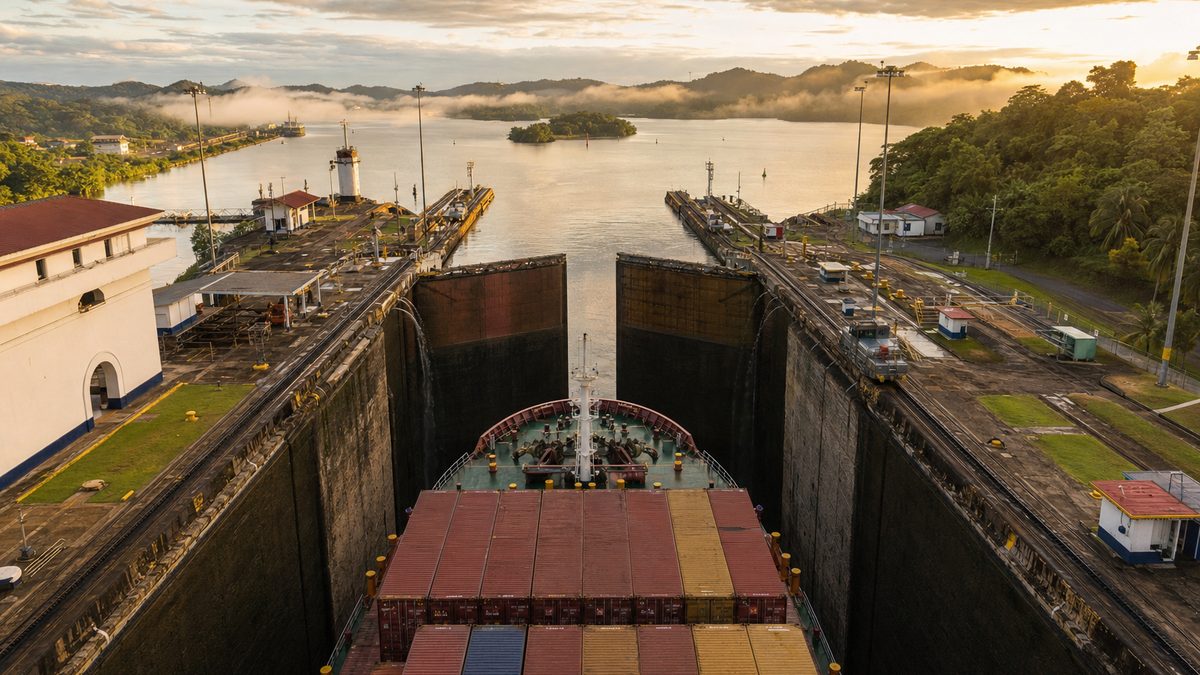
At Gatun, an earth dam two point three kilometres long blocked the Chagres. In June 1913 its spillway gates closed, and the valley began to fill.
Gatun Lake became the largest artificial lake in the world at the time. In October 1913 the last barrier in the cut was blown up, and water joined the two halves.
Chapter IV · Step 8 · 1907–1913
The Culebra Cut and Gatun Lake
Goethals divided the work into three divisions. The Central Division under Major David Gaillard dug the Culebra Cut (called the Gaillard Cut from 1915 to 2000) down to 12 m above sea level. Unstable shale caused repeated slides; the first big one, at Cucaracha in 1907, moved about 380,000 m³. On 26 May 1913 steam shovels met at the bottom of the cut.
- Dynamite in the cut
- ~27,000 t
with up to 160 spoil trains a day
- Gatun Dam
- 2.3 km long
640 m thick at the base; earth fill
- Lake begins filling
- 27 Jun 1913
spillway gates closed
- Gamboa dike blown
- 10 Oct 1913
by telegraph signal from Washington
- Excavated in the American era
- About 183 million m³
about 205 million m³ including the French work
On the map, watch the lake rise from the old river valley to about 26 m. The orange line marks the Culebra Cut. The valley floor under the lake is reconstructed approximately.
Sources:
Wikipedia: History of the Panama Canal;
Wikipedia: Culebra Cut;
Wikipedia: Gatun Lake;
Terrain Tiles (AWS Open Data; SRTM-based elevation)1904–1914
The people who built it
Most of the workers came from the Caribbean, and most of those who died were Caribbean too.
More than seventy-five thousand people worked on the American canal; at the peak, about forty thousand at once.
Most labourers came from the Caribbean, above all from Barbados. Many stayed, and their descendants are part of Panama today.
Pay and life were divided by the gold roll and the silver roll. Gold meant mostly white American staff, paid in US gold dollars. Silver meant mostly Black Caribbean labourers, paid less, in silver currency, with worse housing.
Records list between five thousand six hundred and five thousand nine hundred deaths in the American years. Most of the dead were Caribbean workers.
Chapter IV · Step 9 · 1904–1914
Gold roll, silver roll
John Stevens began recruiting thousands of workers, especially from the West Indies. The canal administration paid staff on two payrolls. The gold roll, paid in gold-backed US dollars, was mostly skilled white Americans. The silver roll, paid in silver-backed local currency, was mostly West Indian labourers. The system was tightened between 1905 and 1908 into a racial division of pay, housing, shops, schools and even post-office windows.
Deaths on the three projects (estimates)
- 1850–55 Railroad: about 5,000–12,000 (sources disagree)
- 1881–89 French canal: about 22,000
- 1904–14 American canal: 5,609–5,855 recorded, about 350 of them white Americans
In 1907–1913, the years when deaths were recorded by race, 4,668 employees died: 3,788 (81%) classed as “colored” and 900 (19%) as “white”. Worse housing and weaker mosquito protection for silver-roll workers help explain the gap.
All of these numbers are reported or estimated figures. Deaths among people who were not employees, or who left and died later, are not counted.
Sources:
Wikipedia: History of the Panama Canal;
Wikipedia: Gold roll;
Wikipedia: Panama Canal Railway