PlanetPast

Physics · Technology · Nuclear fusion

A Star in a Bottle

What nuclear fusion is and why making it work on Earth is so hard: E = mc², the binding-energy curve, the Coulomb barrier and quantum tunnelling, the Lawson criterion, tokamaks and stellarators, laser ignition at NIF, the private race, tritium breeding and a fair comparison with fission.

Interactive 3D film7 min1905 to 2039Published 2026-10-13

Watch the interactive filmอ่านภาษาไทย

Prologue

October 2026 · Southern France

A star in a bottle

The last giant piece of the world’s largest fusion experiment has been delivered. Making fusion work on Earth is still one of the hardest problems in physics.

In early October 2026, the last of the nine giant steel sectors of ITER’s vacuum vessel was delivered to the construction site in southern France.

Each one weighs about four hundred and forty tonnes. Together they form the doughnut-shaped chamber of the largest fusion experiment ever built.

Inside it, a gas far hotter than the centre of the Sun is meant to fuse atoms and release energy, the way every star does.

Physicists have chased this for seventy years. Why is it so hard to build a star on Earth?

Prologue · Why the news matters

A star in a bottle

In early October 2026 Fusion for Energy, the European Union’s ITER agency, delivered the last of the nine steel sectors that make up ITER’s vacuum vessel to the site at Cadarache in southern France. ITER says every major component of its core machine is now on site. The project itself is years late, and its first fusion of deuterium and tritium is not planned until 2039. To see why fusion is worth that effort, and why it is so hard, start with the atoms.

Vacuum vessel
9 sectors
Europe built five, South Korea four
Each sector
~440 t
more than 14 m tall
ITER members
China, EU, India, Japan, Russia, South Korea, United States
Thailand is among the countries with a cooperation agreement

The scene shows a simplified tokamak with its nine vessel sectors. The front one, the last to arrive, slides into place. Shapes and proportions are illustrative.

How to use: pick a chapter below the scene or press ← → to change step · ▶ plays the step · drag to rotate, scroll or pinch to zoom · the buttons in the box on the scene control each experiment · “Play the film” runs every step full-screen.

Sources: World Nuclear News: Europe delivers final ITER vacuum vessel sector (5 Oct 2026); American Nuclear Society, Nuclear Newswire: fusion news (Sep–Oct 2026); Wikipedia: ITER; ITER Organization: 2024 baseline press summary

Chapter I · Weighing atoms

1905 · Albert Einstein

Weighing atoms

Put the fuel on one side of a scale and the ash on the other. The ash is lighter.

Start with a pair of scales. On the left: one deuterium and one tritium nucleus, two heavy kinds of hydrogen.

On the right: what they become when they fuse, a helium nucleus and a free neutron. The same protons and neutrons, rearranged.

Yet the right side is lighter, by about four tenths of one percent. That missing mass has not vanished.

In 1905 Einstein showed that mass and energy are two forms of the same thing: E equals m c squared.

Multiply the missing mass by the speed of light squared, and you get the energy of a single fusion: 17.6 million electronvolts.

Chapter I · Step 1 · Mass defect

Weighing atoms

Measured precisely, the products of a fusion reaction weigh less than the fuel. The difference, called the mass defect, leaves as energy, according to Einstein’s mass–energy equivalence, E = mc².

²H + ³H → ⁴He + n
Before (deuterium + tritium)
5.030151 u
atomic masses, AME2020
After (helium-4 + neutron)
5.011268 u
u = atomic mass unit
Missing mass
0.018883 u
0.375% of the fuel
Energy released
17.59 MeV
0.018883 u × 931.494 MeV per u

Splitting uranium in a fission reactor turns only about 0.1% of the mass into energy. The US Department of Energy puts it this way: the fusion energy in 1 gram of deuterium–tritium fuel equals the energy of about 2,400 gallons (about 9,000 litres) of oil.

Press “Fuse them” to watch the reaction. The scale’s tilt is exaggerated: 0.4% would barely move a real balance.

Sources: Atomic Mass Evaluation 2020 (IAEA Nuclear Data Section); Wikipedia: Mass–energy equivalence; Wikipedia: Nuclear fusion; US Department of Energy: DOE Explains… Deuterium–Tritium Fusion Fuel

Nuclear physics · The curve of binding energy

Why stars shine and reactors split

Light nuclei gain by fusing. Heavy nuclei gain by splitting. Both roads lead towards iron.

Why does fusing lose mass? A nucleus is held together by the strong force, and when nucleons bind, energy is released.

This chart shows how tightly each kind of nucleus is bound: the binding energy per proton or neutron, in millions of electronvolts.

It climbs steeply from hydrogen, jumps at helium-4, and peaks around iron and nickel. Beyond that it slowly falls.

So joining light nuclei moves up the chart and releases energy. That is fusion.

Splitting the heaviest, like uranium, also moves up the chart, from the other side. That is fission, the energy of today’s nuclear power plants.

Kilogram for kilogram, fusing deuterium and tritium releases about four times more energy than splitting uranium.

Chapter I · Step 2 · The binding-energy curve

Why stars shine and reactors split

Each bar is one mass number, from hydrogen-2 to uranium. Its height is the most tightly bound nucleus with that number of protons and neutrons, measured as binding energy per nucleon. Moving up the curve, by fusing light nuclei or splitting heavy ones, releases the difference as energy.

Deuterium ²H
1.112 MeV
Helium-4
7.074 MeV
Iron-56
8.790 MeV
lowest mass per nucleon
Nickel-62
8.795 MeV
most tightly bound per nucleon
Uranium-235
7.591 MeV
Uranium-238
7.570 MeV
  1. Fusion: ²H + ³H → ⁴He + n releases 17.6 MeV, about 3.5 MeV for each nucleon of fuel.
  2. Fission: one example split, ²³⁵U + n → ¹⁴¹Ba + ⁹²Kr + 3n, releases about 173 MeV. On average a uranium-235 fission releases about 200 MeV, under 0.9 MeV per nucleon.

Use the buttons to follow each reaction on the curve. All values are from the 2020 Atomic Mass Evaluation; the “about four times” compares 17.6 MeV per 5 nucleons with 202.5 MeV per 236.

Sources: Atomic Mass Evaluation 2020 (IAEA Nuclear Data Section); Wikipedia: Nuclear binding energy; Wikipedia: Uranium-235

Chapter II · Stars and seawater

The Sun · and a recipe for Earth

Stars cheat with gravity

The Sun can afford a slow fire. On Earth we need the fastest-burning fuel there is.

The Sun fuses about six hundred million tonnes of hydrogen every second. About four million tonnes of that mass become sunlight.

Its core is close to sixteen million degrees, and gravity squeezes it to a hundred and fifty times the density of water.

Even so, its first reaction is so slow that a typical proton waits about nine billion years before it fuses.

We cannot wait that long, or borrow a star’s gravity. So fusion on Earth uses the easiest reaction known: deuterium plus tritium.

They fuse into helium and a neutron. The helium carries 3.5 million electronvolts; the fast neutron flies off with 14.1.

Deuterium is plentiful: about one hydrogen atom in 6,500 in seawater. Tritium is the problem. We will come back to it.

Chapter II · Step 3 · Stars and seawater

Stars cheat with gravity

The Sun runs mainly on the proton–proton chain, which turns four protons into one helium-4 nucleus. Its first step needs the weak nuclear force, so it is extremely slow. The Sun gets away with it because its core is enormous and crushed by gravity.

Sun’s core temperature
~15.7 million K
Core density
up to 150 g/cm³
150 × water
Hydrogen fused
~600 million t/s
~4 million t/s become energy
Average wait of a proton
~9 billion years
before its first fusion
The fuel for Earth
²H + ³H → ⁴He (3.5 MeV) + n (14.1 MeV)
Deuterium
1 in ~6,500
hydrogen atoms in seawater
Tritium
half-life 12.3 years
almost absent in nature

In the scene, the helium nucleus leaves with a fifth of the energy and the neutron with four fifths: the lighter particle takes most of it. Use the buttons to switch between the Sun and the D–T reaction.

Sources: Wikipedia: Sun; Wikipedia: Proton–proton chain; Wikipedia: Nuclear fusion; US Department of Energy: DOE Explains… Deuterium–Tritium Fusion Fuel; Wikipedia: Tritium

Chapter III · The wall

Electric repulsion · the Coulomb barrier

The wall between two nuclei

Both nuclei are positively charged. The closer they get, the harder they push apart.

Here is the real obstacle. Every nucleus is positively charged, and like charges repel.

The curve shows the energy needed to bring two nuclei together. It rises like a wall. Only very close in does the strong force take over and pull them in.

For deuterium and tritium the top of the wall is about a hundred thousand electronvolts. To climb it by brute force, the gas would need more than a billion degrees.

But nuclei obey quantum mechanics. A nucleus that hits the wall can sometimes appear on the other side: it tunnels through.

Try the temperature slider. The hotter the gas, the harder the collisions, the thinner the wall that is left, and the better the odds.

Chapter III · Step 4 · The Coulomb barrier

The wall between two nuclei

Two nuclei repel each other electrically until they are close enough for the strong nuclear force to grab them. The peak of this energy wall, the Coulomb barrier, is about 0.1 MeV for deuterium and tritium. Classically, only a gas hotter than about 1.2 billion kelvin would have collisions that energetic.

Quantum tunnelling, discovered by Friedrich Hund in 1927 and applied to nuclei by George Gamow in 1928, lets a nucleus pass through the wall with a small probability. The probability grows very quickly as the collision energy rises.

Barrier height (D–T)
~100 keV
1 keV of energy
≈ 11.6 million K
temperature equivalent

The readout uses a simplified Gamow estimate for a head-on collision at the typical energy kT: P ≈ exp(−√(EG/E)), with EG ≈ 1,180 keV for D–T. Real plasmas have a spread of energies (next step). The shape of the curve is drawn qualitatively.

Sources: Wikipedia: Nuclear fusion; Wikipedia: Gamow factor; Wikipedia: Electronvolt

Statistics · the Gamow peak

A few fast ones are enough

In a hot gas, speeds are spread out. Fusion comes from the rare fast particles that also get lucky.

In a hot gas, the particles do not all have the same energy. Most are slow; a few are much faster.

The blue curve shows how many particles have each energy. The orange curve is the chance of tunnelling, which rises steeply with energy.

Multiply the two and you get the white peak: the narrow window of energies where almost all fusions happen. It is called the Gamow peak.

At ten or twenty million degrees that window is tiny. That is why fusion machines aim for 100 to 150 million degrees and more, about ten times hotter than the centre of the Sun.

Chapter III · Step 5 · The Gamow peak

A few fast ones are enough

Most fusion reactions in a plasma come from the fast tail of the energy distribution. Combining the number of particles at each energy with their chance of tunnelling gives a narrow window of energies, the Gamow peak, where the reactions actually happen.

ITER’s plasma
150–300 million °C
ten times or more the Sun’s core
IAEA
above 100 million °C
needed for fusion on Earth
D–T reaction rate at 10 keV
1.1 × 10⁻¹⁶ cm³/s
Maxwell-averaged ⟨σv⟩
at 20 keV
4.2 × 10⁻¹⁶ cm³/s
almost 4 times higher

Drag the temperature slider. The relative reaction rate in the readout is interpolated from the NRL Plasma Formulary table of D–T reactivities quoted on Wikipedia. Curves are each scaled to fit; the white curve is magnified.

Sources: Wikipedia: Nuclear fusion; Wikipedia: Gamow factor; ITER: Hot, hotter, hottest; IAEA Bulletin: Safety in fusion

Chapter IV · The rule of three

1955 · John Lawson

The rule of three

Hot is not enough. The plasma must also be dense, and it must hold its heat long enough.

Heating a gas this hot costs energy, and the hot gas, now a plasma, loses heat all the time.

In 1955, John Lawson worked out the condition for fusion to pay its own way.

The helium nuclei made by fusion stay in the plasma and heat it. When that heating beats the losses, the plasma ignites and keeps itself hot.

That needs a big enough product of three numbers: the density, the temperature, and the confinement time, how long the plasma holds its heat.

For deuterium and tritium the target is lowest at about 14 kiloelectronvolts, some 160 million degrees. Use the sliders and see which plasmas would ignite.

Chapter IV · Step 6 · The Lawson criterion

The rule of three

John D. Lawson set out the condition in a classified paper in 1955, published in 1957. For a plasma to ignite, the heating by its own fusion products must exceed its losses. Neutrons escape, so only the 3.5 MeV helium nuclei heat a D–T plasma.

n · T · τE ≥ ~3 × 10²¹ keV·s/m³ (D–T)
Best temperature (D–T)
~14 keV
≈ 160 million K
JT-60’s reported triple product
1.53 × 10²¹
keV·s/m³: about half the target

The curve in the scene is computed from a simplified ignition condition, n·T·τ ≥ 12 T² / (Eα⟨σv⟩), with tabulated D–T reactivities; it ignores radiation losses. Its minimum lands near 3 × 10²¹ keV·s/m³ at about 14 keV, matching the published threshold. No experiment has yet reached it.

Sources: Wikipedia: Lawson criterion; EUROfusion: Wendelstein 7-X sets world record for long-plasma triple product (2025); Wikipedia: Nuclear fusion

Chapter V · Magnetic bottles

1968 · Novosibirsk

Twisting a magnetic bottle

No container can touch a plasma this hot. Soviet physicists found how to hold it in a twisted magnetic field.

No material wall survives touching such a plasma. But a plasma is made of charged particles, and charged particles spiral around magnetic field lines.

So bend the field lines into a ring. Coils around a doughnut-shaped vessel make this, the toroidal field.

On its own, it leaks. The field is weaker on the outside of the ring, and the particles drift across it, into the wall.

A tokamak drives a strong electric current through the plasma itself. That current adds a poloidal field, wrapping the short way around.

Together they twist the field lines into helices. A particle following one spends time on the inside and the outside of the ring, and the drifts cancel.

In 1968, the Soviet T-3 tokamak reported about ten million degrees. A British team checked it with lasers in 1969 and confirmed it. Tokamaks soon spread around the world.

Chapter V · Step 7 · The tokamak

Twisting a magnetic bottle

Charged particles gyrate around magnetic field lines and move freely along them. Bending the lines into a ring keeps particles from escaping along the ends, but in a simple torus the field is weaker on the outside, and particles drift across it. Twisting the field lines into helices makes each particle alternate between the inner and outer side, so the drifts largely cancel.

  1. Toroidal field: made by the coils wrapped around the vessel.
  2. Poloidal field: mostly made by a current of millions of amperes induced in the plasma, which acts as the secondary winding of a transformer.
  3. Helical field: the sum of the two.
Name
токамак
Russian acronym for a toroidal chamber with magnetic coils
T-3, August 1968
~1 keV
≈ 10 million K electron temperature
Confirmation
1969
Culham team, laser Thomson scattering

Use the buttons to switch each field on. With only the toroidal field the particle drifts vertically and strikes the wall; with the helical field it stays inside. The drift is greatly exaggerated and the particle drawn far larger than real.

Sources: Wikipedia: Tokamak

1983–2023 Culham, UK · Cadarache, France

From JET to ITER

Europe’s JET set the record for fusion energy. ITER is built to hold about eight times more plasma.

The record for fusion energy belongs to JET, a European tokamak in England that ran for forty years.

In its final experiments, in 2023, it released 69 megajoules over about five seconds, from just 0.2 milligrams of fuel.

But JET never produced more fusion power than it used to heat the plasma. Its best ratio, in 1997, was 0.67.

ITER is designed to reach ten: 500 megawatts of fusion heat from 50 megawatts of heating, in pulses of 400 seconds. It will not make electricity.

Its schedule has slipped by a decade. Under the 2024 plan, research starts in 2034, and deuterium–tritium fusion only in 2039.

Chapter V · Step 8 · JET and ITER

From JET to ITER

The Joint European Torus at Culham, England, made its first plasma on 25 June 1983 and its first deuterium–tritium experiments in 1991. Its final experiments ended in December 2023 after more than 105,000 pulses. ITER, under construction near Cadarache, France, is a much larger tokamak meant to show a fusion gain of ten.

JET record (2023)
69 MJ
about 5 s at high power, 0.2 mg of fuel
JET best gain (1997)
Q = 0.67
16 MW fusion from 24 MW heating
ITER goal
Q ≥ 10
500 MW from 50 MW, 400 s pulses
ITER plasma volume
840 m³
about 8 × JET
ITER 2024 baseline
2034 → 2039
research starts 2034, D–D 2035, full magnetic energy 2036, D–T 2039

The 2016 plan had a first plasma in 2025. In 2024 ITER blamed the new delay on the pandemic, manufacturing defects such as cracks in cooling pipes, extra component tests and a brief halt by the French safety regulator, and put the extra cost at about €5 billion. ITER will vent its heat; the DEMO reactors planned after it are meant to demonstrate net electricity.

Buttons: replay JET’s record pulse (energy counter) or the assembly of ITER’s nine vacuum vessel sectors.

Sources: UK Government: JET’s final tritium experiments yield new fusion energy record (2024); Wikipedia: Joint European Torus; Wikipedia: ITER; ITER Organization: 2024 baseline press summary; Physics World: ITER delay and €5bn cost increase (2024)

1951 Princeton → 2015 Greifswald

The twisted alternative

A stellarator twists the field with its coils alone, so it needs no current in the plasma.

There is another way to twist the field: build the twist into the coils. This is the stellarator, invented by Lyman Spitzer at Princeton in 1951.

Its strangely bent coils need no current in the plasma, so in principle it can run continuously, not in pulses.

The price is difficulty. Germany’s Wendelstein 7-X has fifty of these non-planar superconducting coils, and stellarator coils must be positioned to within about a millimetre and a half.

In 2025 it set a world record for the triple product in a plasma lasting forty-three seconds, and kept another plasma running for six minutes.

Chapter V · Step 9 · The stellarator

The twisted alternative

A stellarator shapes a twisted magnetic field with external coils alone. With no induced current in the plasma it is inherently a steady-state machine. The cost is complexity: the coils must be built and placed very precisely, and a US stellarator, NCSX, was cancelled in 2008 because its tolerances proved unachievable.

Wendelstein 7-X
Greifswald, Germany
run by the Max Planck Institute for Plasma Physics
First plasma
Dec 2015
first hydrogen plasma 3 Feb 2016
Coils
50 non-planar + 20 planar
superconducting
Plasma volume
30 m³
major radius 5.5 m
2025 records
43 s · 360 s
record long-pulse triple product (22 May 2025); 1.8 GJ energy turnover in a 6-minute plasma

In 2026 the German start-up Proxima Fusion raised €411 million towards Alpha, a planned demonstration stellarator.

The model is a simplified twisted ring of 50 bent coils, not an exact copy of W7-X. Toggle the coils, the plasma and its field lines with the buttons.

Sources: Wikipedia: Stellarator; Wikipedia: Wendelstein 7-X; EUROfusion: Wendelstein 7-X sets world record for long-plasma triple product (2025); Max Planck Institute for Plasma Physics: news releases 2026

Chapter VI · Lasers

Livermore, California · National Ignition Facility

Crushing a star

192 laser beams, a tiny gold can, and a fuel capsule about two millimetres across.

There is a second road to fusion: do not hold the plasma at all. Squeeze it so hard and so fast that it burns before it can fly apart.

At the National Ignition Facility in California, 192 laser beams fire into a tiny gold can called a hohlraum.

The gold glows with X-rays. They blast the surface off a fuel capsule about two millimetres across, and like a rocket in reverse, the capsule implodes.

At the centre a hot spot forms, at over a hundred million degrees. If its fusion heats the fuel around it faster than it cools, the burn spreads: ignition.

On the fifth of December 2022, it happened for the first time. 2.05 megajoules of laser light went in. 3.15 megajoules of fusion energy came out.

Chapter VI · Step 10 · Inertial confinement

Crushing a star

In inertial confinement fusion the fuel is held only by its own inertia. At NIF the laser beams heat the inside of a gold hohlraum, which fills with X-rays. The X-rays boil away the capsule’s outer layer, and the rocket-like blow-off drives the rest inwards, compressing the fuel to far above the density of lead.

  1. 192 beams enter the hohlraum through holes at both ends.
  2. X-rays heat the capsule: a diamond shell about 2 mm across, lined with deuterium–tritium ice at about 18 K.
  3. The shell implodes; a central hot spot passes 100 million °C.
  4. Fusion in the hot spot heats the surrounding fuel: the burn spreads.
5 Dec 2022
3.15 MJ out
from 2.05 MJ of laser energy
30 Jul 2023
3.88 MJ
Feb 2024
5.2 MJ
from 2.2 MJ
7 Apr 2025
8.6 MJ
from 2.08 MJ: target gain 4.13

Press “Fire the lasers”. The whole sequence really lasts a tiny fraction of a second; here it is slowed down enormously, and the proportions are illustrative. Rayleigh–Taylor instabilities, which mix the fuel if the squeeze is uneven, remain a major problem.

Sources: Wikipedia: National Ignition Facility; Lawrence Livermore National Laboratory: NIF in FY2025; Wikipedia: Inertial confinement fusion

What counts as “gain”?

More out than in, depending on what you count

NIF’s ignition was real. So is the electricity bill behind it.

So did fusion finally make more energy than it used? It depends on what you count.

Compared with the laser light that hit the target, yes: a gain of about one and a half. By April 2025, NIF had reached 8.6 megajoules, a gain of more than four.

But making those 2.05 megajoules of laser light took about 300 megajoules from the grid. Counted that way, the shot returned around one percent.

Tokamaks have the same trap. ITER’s gain of ten counts the heating power, not the more than 300 megawatts of electricity the plant will draw.

A power station needs more electricity out than the whole plant takes in, shot after shot or hour after hour. No fusion experiment has done that yet.

Chapter VI · Step 11 · Counting the gain

More out than in, depending on what you count

“Gain” is a ratio, and the answer depends on the denominator. NIF’s results are a real scientific milestone: more fusion energy out than laser energy in. They are not net energy for the facility.

Target gain, Dec 2022
≈ 1.5
3.15 MJ ÷ 2.05 MJ
Target gain, Apr 2025
4.13
8.6 MJ ÷ 2.08 MJ
Grid energy for the 2022 laser pulse
~300 MJ
about 1% returned as fusion energy
NIF’s laser amplification
~1–1.5% efficient
diode-pumped lasers have reached ~10%
ITER’s Q = 10
fusion heat ÷ heating power
the plant will use over 300 MW of electricity

Bars are drawn to scale in each view. Use the buttons to switch between the 2022 and 2025 shots and between counting laser light and counting electricity from the grid.

Sources: Wikipedia: National Ignition Facility; Lawrence Livermore National Laboratory: NIF in FY2025; Wikipedia: Inertial confinement fusion; Wikipedia: ITER

Chapter VII · The private race

The private race

Smaller, faster, sooner?

Dozens of companies promise fusion electricity in the 2030s. Their machines look very different.

Since 2021, private fusion companies have raised over fourteen billion dollars. In a 2026 survey, most said they expect to put power on the grid in the 2030s.

In the United States, Commonwealth Fusion Systems is building SPARC, a tokamak with magnets made of high-temperature superconductors.

Its magnetic field of 12.2 tesla is more than twice ITER’s, and the machine is a fraction of ITER’s size. The company aims for first plasma in 2027.

Another company, Helion, reported plasmas of 150 million degrees with deuterium–tritium fuel in 2026, and has a contract to sell electricity to Microsoft from 2028.

These are company targets. None of these machines has yet publicly shown more fusion energy out than energy in, and fusion timelines have slipped before.

Chapter VII · Step 12 · The private race

Smaller, faster, sooner?

The Fusion Industry Association’s July 2026 survey of 56 companies counted $14.24 billion raised since it began tracking in 2021, including a record $4.48 billion in the past year; 71% of companies said they expect a plant to deliver power to the grid by the 2030s. Two companies, TAE Technologies and General Fusion, now trade on Nasdaq.

SPARC (CFS)
R 1.85 m · 12.2 T
Devens, Massachusetts; first of 18 toroidal magnets completed Jan 2026; first plasma targeted 2027; aims for Q > 1, and predictions exceed 10
ARC (CFS)
~400 MWe
planned in Chesterfield County, Virginia, for the early 2030s; Google agreed to buy 200 MW
HTS magnet test
20 T
Sept 2021 prototype coil
Helion (Polaris)
D–T since Jan 2026
150 million °C; Orion plant under construction in Malaga, Washington, to supply Microsoft from 2028; has not said if it has reached breakeven
Helical Fusion (Japan)
tests from 2027
pilot device Helix HARUKA at Toki
Thailand Tokamak-1
R 0.65 m
TINT, Nakhon Nayok; operating since 25 July 2023

The scene compares tokamak plasmas to scale (major and minor radius; cross-sections simplified): ITER, JET, SPARC and Thailand’s small research tokamak TT-1. Use the buttons to compare them. Company plans are their own claims.

Sources: World Nuclear News: Fusion Industry Association report (Jul 2026); Wikipedia: SPARC (tokamak); Wikipedia: Commonwealth Fusion Systems; World Nuclear News: Assembly starts of SPARC (2025); Helion: new fusion energy milestones (Feb 2026, company statement); TechCrunch: Helion hits 150 million °C (Feb 2026); Reuters via Cyprus Mail: Japan’s Helical Fusion to begin power-on tests in 2027 (29 Sep 2026); Wikipedia: Thailand Tokamak-1; Wikipedia: List of fusion experiments

Chapter VIII · The hidden problems

The hidden problems

Fuel that does not exist, and neutrons that wreck walls

Tritium must be bred inside the machine, and the walls must survive a storm of neutrons.

Remember tritium? It decays with a half-life of about twelve years, so there is almost none in nature. A heavy-water fission reactor makes only about 130 grams a year.

A fusion power plant must make its own. The plan is a blanket containing lithium around the plasma: when a neutron hits lithium-6, it splits into tritium and helium.

Every fusion burns one tritium nucleus and releases one neutron, so the blanket must breed at least one new tritium nucleus for every neutron. ITER will test only small mock-up blankets.

And those neutrons carry 14.1 million electronvolts each. They knock atoms out of place in the walls, damaging them and making them radioactive.

Materials for a power plant may need to survive about 150 displacements per atom. A dedicated neutron source to test them, IFMIF-DONES, is planned in Granada, Spain.

Chapter VIII · Step 13 · Tritium, neutrons and materials

Fuel that does not exist, and neutrons that wreck walls

Deuterium–tritium fusion needs a fuel that barely exists and produces fast neutrons that damage everything they hit. Both problems are being worked on; neither is solved at power-plant scale.

⁶Li + n → ³H + ⁴He
Tritium half-life
12.3 years
CANDU reactor output
~130 g / year
tritium, as a by-product
Lithium-6
a small share of natural lithium
blankets would use enriched lithium
ITER test blanket modules
6
mock-ups of breeding blankets
Neutron energy
14.1 MeV
fission neutrons: ~1–2 MeV
Damage a power-plant wall must take
~150 dpa
displacements per atom

Press “Fire neutrons”. Green marks tritium bred in lithium pebbles, red marks damage in the first wall. The simulation is illustrative: its probabilities are not real ones.

Sources: Wikipedia: Tritium; Wikipedia: Breeding blanket; Wikipedia: ITER; IFMIF-DONES: Certifying the suitability of materials for fusion; IAEA Bulletin: Safety in fusion

A fair comparison

Fusion versus fission

Fusion cannot run away. It is not free of radioactivity either.

How does fusion compare with today’s nuclear power? Fission runs on a chain reaction: each split uranium nucleus releases neutrons that split more.

Fusion has no chain reaction. ITER holds less than four grams of fuel at any moment. Stop feeding it, and the reaction dies within seconds.

Its ash is helium, not long-lived fission products. But tritium is radioactive, and the neutrons make the walls radioactive too.

That waste is mostly short-lived and low-level, though there is more of it. Spent fission fuel stays hazardous for many thousands of years.

Fission is not the villain here. It supplies about nine percent of the world’s electricity, with one of the lowest death rates per unit of energy of any source. Fusion would add another option, if it can be made to work.

Chapter VIII · Step 14 · A fair comparison

Fusion versus fission

Fission (today)Chain reaction in a large core of uranium fuel. Spent fuel is high-level waste: its radioactivity falls 99.5% in 100 years, but it takes about 100,000 years to fall below that of natural uranium ore, because of long-lived isotopes such as technetium-99 and iodine-129. Fusion (planned)No chain reaction; under 4 g of fuel in ITER’s vessel; the reaction stops within seconds if fuelling stops. No high-level, long-lived waste, but more low-level waste, mostly short-lived; ITER says most activated parts could be recycled within about 100 years.
Nuclear share of world electricity
~9%
2024
Fission reactors in operation
416
November 2025
Death rate of nuclear power
~0.03 per TWh
second lowest after solar in historical data
Tritium
radioactive
weak beta emitter; cannot pass the outer layer of skin

Buttons: stop the fusion fuel, or move forward in time to compare how the two kinds of waste fade (glows are qualitative). Claims about ITER’s safety are ITER’s own; regulators review them.

Sources: IAEA Bulletin: Safety in fusion; ITER: Safety and the environment; Wikipedia: Radioactive waste; Wikipedia: Nuclear power; Wikipedia: Tritium

Epilogue

Epilogue

Still the hardest fire

Fusion works: every star proves it. The hard part is doing it cheaply, reliably and for decades.

Seventy years after the first tokamaks, the question is no longer whether fusion works. NIF has ignited fuel. JET released megajoules.

The open questions are engineering ones: magnets, materials, tritium, and a gain measured at the wall plug.

ITER’s last vessel sector has arrived, and dozens of companies are racing it. The next ten years will show which promises hold.

From giant ITER to small research machines like Thailand’s TT-1, the star in a bottle is still being built, by many hands.

Epilogue

Still the hardest fire

  • 1905 Einstein: mass and energy are equivalent
  • 1927–28 Quantum tunnelling (Hund), applied to nuclei (Gamow)
  • 1951 Spitzer invents the stellarator
  • 1955 Lawson’s criterion (published 1957)
  • 1968 Soviet T-3 tokamak reaches ~10 million K
  • 1983 JET’s first plasma
  • 1997 JET: 16 MW of fusion power, Q = 0.67
  • 2015 Wendelstein 7-X first plasma
  • 2022 NIF ignition: 3.15 MJ from 2.05 MJ
  • 2023 JET’s final record: 69 MJ; TT-1 starts work in Thailand
  • 2025 NIF 8.6 MJ; W7-X long-pulse records
  • 2026 ITER’s last vessel sector delivered
  • 2027 SPARC first plasma (company target)
  • 2034–39 ITER research, then D–T fusion (2024 baseline)

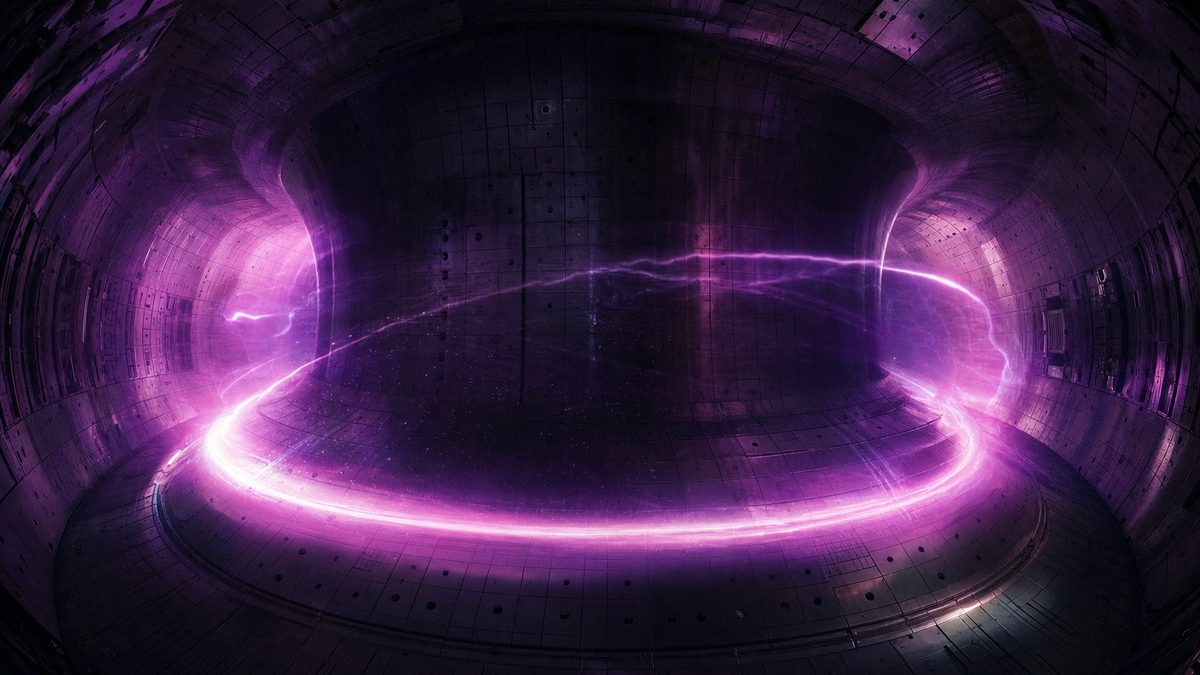
All full-screen stills are AI-generated illustrations, not photographs. 3D scenes are simplified models; where something is not to scale, the step says so. Company plans are their own claims.

Sources
World Nuclear News: Europe delivers final ITER vacuum vessel sector (5 Oct 2026)
American Nuclear Society, Nuclear Newswire: fusion news (Sep–Oct 2026)
ITER Organization: 2024 baseline press summary
Physics World: ITER delay and €5bn cost increase (2024)
Wikipedia: ITER
Atomic Mass Evaluation 2020 (IAEA Nuclear Data Section)
Wikipedia: Nuclear binding energy
Wikipedia: Mass–energy equivalence
Wikipedia: Nuclear fusion
Wikipedia: Uranium-235
Wikipedia: Sun
Wikipedia: Proton–proton chain
US Department of Energy: DOE Explains… Deuterium–Tritium Fusion Fuel
Wikipedia: Tritium
Wikipedia: Electronvolt
Wikipedia: Gamow factor
ITER: Hot, hotter, hottest
IAEA Bulletin: Safety in fusion
Wikipedia: Lawson criterion
EUROfusion: Wendelstein 7-X sets world record for long-plasma triple product (2025)
Wikipedia: Tokamak
UK Government: JET’s final tritium experiments yield new fusion energy record (2024)
Wikipedia: Joint European Torus
Wikipedia: List of fusion experiments
Wikipedia: Wendelstein 7-X
Wikipedia: Stellarator
Max Planck Institute for Plasma Physics: news releases 2026
Wikipedia: National Ignition Facility
Lawrence Livermore National Laboratory: NIF in FY2025
Wikipedia: Inertial confinement fusion
Wikipedia: SPARC (tokamak)
Wikipedia: Commonwealth Fusion Systems
World Nuclear News: Assembly starts of SPARC (2025)
Helion: new fusion energy milestones (Feb 2026, company statement)
TechCrunch: Helion hits 150 million °C (Feb 2026)
Reuters via Cyprus Mail: Japan’s Helical Fusion to begin power-on tests in 2027 (29 Sep 2026)
World Nuclear News: Fusion Industry Association report (Jul 2026)
Wikipedia: Thailand Tokamak-1
Wikipedia: Breeding blanket
IFMIF-DONES: Certifying the suitability of materials for fusion
ITER: Safety and the environment
Wikipedia: Radioactive waste
Wikipedia: Nuclear power