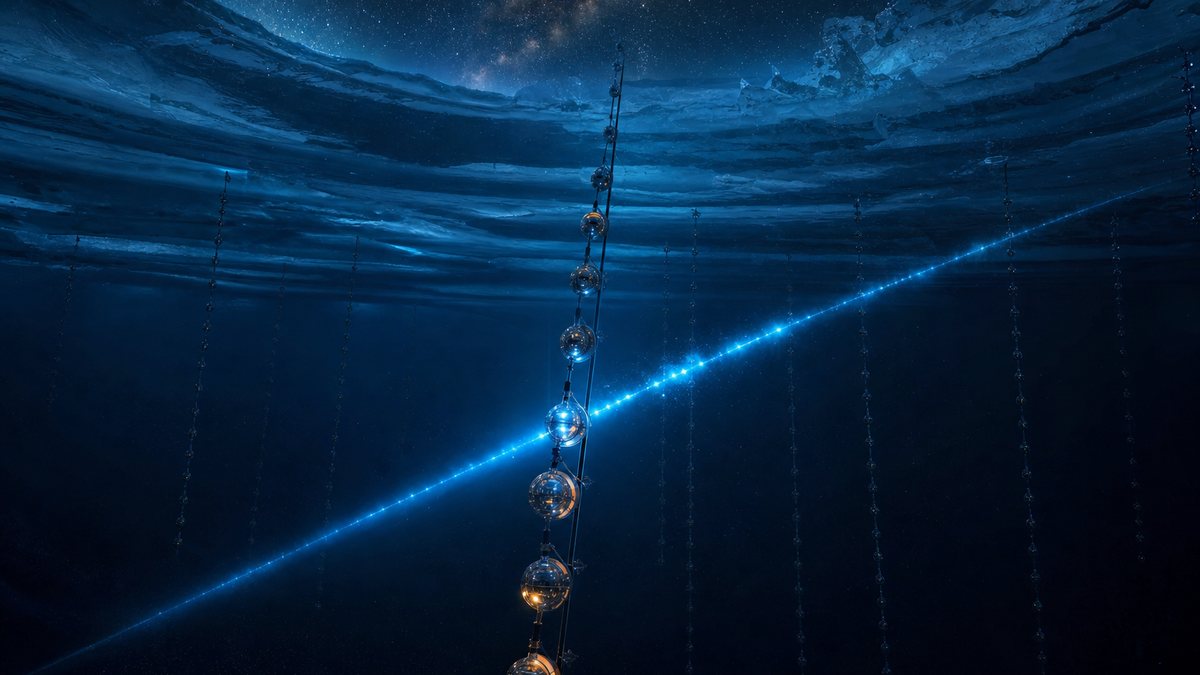
What neutrinos are, how physicists imagined and caught them, and how a cubic kilometre of Antarctic ice became the IceCube telescope behind the 2026 Nobel Prize in Physics.
Interactive 3D film6 min1930 to 2026Published 2026-10-12
Every second, hundreds of trillions of them pass through your body. Almost none of them ever touch you.
In October 2026, the Nobel Prize in Physics went to Francis Halzen, for building a telescope out of Antarctic ice.
It does not look at light. It looks for neutrinos: tiny particles with no electric charge and almost no mass.
The Sun makes them in vast numbers. Right now, about sixty-five billion cross every square centimetre of your skin each second.
They pass through you, through the planet, and out the other side, as if nothing were there. This is how we learned to catch them.
Prologue · Why the news matters
Ghost particles
On 6 October 2026 the Royal Swedish Academy of Sciences awarded the Nobel Prize in Physics to Francis Halzen for decisive contributions to the IceCube Neutrino Observatory and the discovery of high-energy neutrinos from outer space. To see why that matters, you need to know what a neutrino is, why it is so hard to catch, and why physicists buried a detector in the ice at the South Pole.
Solar neutrinos at Earth
~65 billion
per square centimetre, every second
Electric charge
0
so they ignore electric and magnetic fields
How easily they pass through matter
A typical solar neutrino could cross a light-year of lead without hitting anything
They feel only gravity and the weak nuclear force
The globe on the left shows neutrinos from the Sun streaming straight through the Earth. Real neutrinos are invisible; the streaks are drawn so you can follow them, and their number is reduced by many trillions.
How to use: pick a chapter below the scene or press ← → to change step · ▶ plays the step · drag to rotate, scroll or pinch to zoom · “Play the film” runs every step full-screen.
When an atomic nucleus spits out an electron, some energy seems to vanish. It nearly broke physics.
In the 1920s, physicists studied beta decay: a nucleus turns a neutron into a proton and shoots out an electron.
Energy must be conserved, so every electron should leave with the same energy. It did not. Each one came out with a different amount.
Some physicists were ready to give up conservation of energy itself.
In December 1930, Wolfgang Pauli proposed what he called a desperate remedy: a second, invisible particle carries off the missing energy.
Chapter I · Step 1 · 1930
The case of the missing energy
In beta decay a neutron inside a nucleus becomes a proton and an electron flies out. If only those two particles were involved, the electron would always carry the same energy. Experiments in the 1910s and 1920s showed instead a smooth spread of energies, from almost zero up to a maximum. Energy seemed to disappear.
Expected: one fixed electron energy for each kind of nucleus.
Measured: a continuous range of energies, almost always less than the maximum.
Pauli’s idea (1930): an unseen, electrically neutral, very light particle leaves at the same time and takes the rest.
Watch the energy bar in the scene. The full bar is the energy the decay releases. The electron takes a different share each time. In the first half of this step the rest is unexplained; in the second half the ghost particle carries it.
Fermi gave the particle its name and a theory. But he doubted anyone would ever detect it.
Enrico Fermi took the idea seriously. He called the particle the neutrino: Italian for little neutral one.
In 1934 he published a theory of beta decay, built around a new and very feeble force: what we now call the weak interaction.
The theory worked beautifully. It also predicted that neutrinos would almost never interact with anything.
Chapter I · Step 2 · 1932–1934
“The little neutral one”
Enrico Fermi used the name neutrino in 1932 and 1933 and in 1934 published a theory of beta decay. In it, a neutron turns into a proton, an electron and an antineutrino through a very short-range force, the weak interaction. The theory explained the shape of the measured electron energies.
Pauli’s proposal
1930
A letter to a physics meeting he could not attend
Fermi’s theory
1934
Beta decay through the weak force
The catch
The weak force is so weak that a neutrino could cross a light-year of solid lead
Detection looked hopeless for more than two decades
Strictly, the particle emitted in neutron decay is an antineutrino. For most of this story the difference does not matter.
The trick was not a better detector. It was a flood of neutrinos, and a signal nothing else could fake.
If a single neutrino almost never interacts, you need an enormous number of them. A nuclear reactor produces trillions every second.
Clyde Cowan and Frederick Reines placed tanks of water and liquid scintillator beside a reactor at Savannah River.
Very rarely, an antineutrino hits a proton. It makes a positron, which flashes at once, and a neutron, which is captured a few microseconds later with a second flash.
In June 1956 they sent Pauli a telegram. The ghost had been caught, twenty-six years after he imagined it.
Chapter II · Step 3 · 1956
Caught at a reactor
Clyde Cowan and Frederick Reines put their detector next to a nuclear reactor, which emits huge numbers of antineutrinos. Their signal was a double flash: an antineutrino hitting a proton creates a positron that annihilates at once, and a neutron that is captured a few microseconds later. Requiring both flashes in the right order filtered out almost all false alarms.
Antineutrino + proton → positron + neutron
The positron meets an electron: two gamma rays, flash number one
The neutron is captured by a nucleus microseconds later: flash number two
Neutrinos come in three “flavours”, each paired with a heavier cousin of the electron.
It soon turned out there is more than one kind. In 1962 a team at Brookhaven found a second neutrino, partner of the muon.
A third, partner of the heavy tau particle, was seen directly at Fermilab in 2000.
Electron, muon and tau neutrinos. Physicists call them flavours. Remember the word: it is the key to the next mystery.
Chapter II · Step 4 · 1962 and 2000
Three kinds of ghost
Each neutrino is paired with a charged particle. When a neutrino does interact, it usually turns into its partner, and that partner is what detectors see.
νe electron neutrino 1956 · reactor νμ muon neutrino 1962 · Brookhaven ντ tau neutrino 2000 · Fermilab (DONUT)
The 1962 discovery by Leon Lederman, Melvin Schwartz and Jack Steinberger won the 1988 Nobel Prize. For IceCube the muon neutrino matters most: it makes a muon, which can travel kilometres through ice and leaves a long straight track that points back towards the sky.
A tank of dry-cleaning fluid deep underground counted the Sun’s neutrinos. The count came up short.
The Sun shines by fusing hydrogen into helium. Every fusion reaction releases electron neutrinos, and theory says exactly how many.
From the 1960s, Raymond Davis counted them with a tank of about six hundred tonnes of cleaning fluid, almost one and a half kilometres down a gold mine.
He found only about a third to a half of the predicted number. Year after year, the gap would not go away.
Either our model of the Sun was wrong, or something was happening to the neutrinos on the way.
Chapter III · Step 5 · 1960s–1990s
The solar neutrino problem
Raymond Davis’s Homestake experiment used a huge tank of perchloroethylene, a dry-cleaning fluid. A solar electron neutrino can turn a chlorine atom into radioactive argon, and the few argon atoms were counted every few weeks. The result was consistently between one-third and one-half of what the Standard Solar Model predicted. The puzzle lasted about thirty years.
Detector
Homestake gold mine
South Dakota, USA, deep underground to block cosmic rays
Measured vs predicted
⅓ – ½
of the expected electron neutrinos
Nobel Prize
2002, Raymond Davis Jr. and Masatoshi Koshiba
for detecting cosmic neutrinos from the Sun and from Supernova 1987A
In February 1987 detectors in Japan, the USA and Russia caught about two dozen neutrinos from the exploding star Supernova 1987A in a burst lasting under 13 seconds, before its light was seen.
The neutrinos were not missing. They had changed flavour on the way to us.
The answer came from two giant detectors. In 1998 Japan’s Super-Kamiokande showed that muon neutrinos made in the atmosphere change as they travel.
In 2001 the Sudbury Neutrino Observatory in Canada counted all three flavours from the Sun. The total was exactly right.
Electron neutrinos leave the Sun and shift back and forth between flavours. Davis’s tank could only see one of them.
And a particle can only change flavour like this if it has mass. Tiny, but not zero.
Chapter III · Step 6 · 1998 and 2001
Neutrinos change flavour, so they have mass
A neutrino is a quantum mixture of three states with slightly different masses, which evolve at slightly different rates. As it flies, the mixture drifts, and the chance of finding it as an electron, muon or tau neutrino swings back and forth. This is neutrino oscillation. In the scene, colour shows the flavour each streak would be detected as.
νeelectron νμmuon ντtau
Nobel Prize
2015
Takaaki Kajita and Arthur B. McDonald
Mass limit (KATRIN)
< 0.45 eV
at least about a million times lighter than an electron (511,000 eV)
The original Standard Model of particle physics assumed neutrinos had zero mass. Oscillation proved it incomplete, and why neutrino masses are so small is still an open question.
To catch the rarest, highest-energy neutrinos you need a detector a kilometre across. The cheapest material that size is ice.
Neutrinos from deep space are far rarer than those from the Sun. To catch them you need a detector the size of a cubic kilometre.
Francis Halzen’s idea, tested with a smaller array called AMANDA, was to use the Antarctic ice itself: two and a half kilometres thick and, deep down, astonishingly clear.
Each southern summer a hot-water drill melted holes two and a half kilometres deep. A string of sensors was lowered into each one before the water froze around it.
Eighty-six strings over seven summer seasons. IceCube was finished in December 2010.
Chapter IV · Step 7 · 2005–2010
Why the South Pole?
A neutrino detector needs a huge volume of transparent material, deep enough to shield it from the surface and dark enough to see faint flashes. The ice sheet at the South Pole is about 2.8 km thick, and below 1.4 km it is extremely clear and bubble-free. Halzen began working on the idea in 1987 with the pilot project AMANDA, and has been IceCube’s principal investigator since 2001.
Construction
2005 – Dec 2010
drilling only in the southern summer, November to February
Cost
US$279 million
mostly funded by the US National Science Foundation
Basketball-sized glass spheres hang in the ice like beads on a necklace, waiting for a flash of light.
Here is the finished detector. Eighty-six strings, each carrying sixty glass spheres between one and a half and two and a half kilometres down.
Inside each sphere is a light sensor, a photomultiplier tube, sensitive enough to register a single photon.
In the centre, a denser cluster called DeepCore lowers the energy threshold. On the surface, a lab collects the data and a tank array called IceTop watches cosmic-ray showers.
For scale: the Eiffel Tower would fit three times into the instrumented depth. The whole array fills a cubic kilometre.
Chapter IV · Step 8 · The finished detector
A cubic kilometre of sensors
IceCube’s sensors are digital optical modules: pressure-resistant glass spheres, each holding a photomultiplier tube and its own electronics. They hang 17 m apart on strings spaced about 125 m apart, filling a cubic kilometre of ice. The IceCube Laboratory on the surface gathers the signals.
Optical modules
5,160
86 strings × 60 modules
Instrumented depth
1,450–2,450 m
below the ice surface
String spacing
~125 m
denser in DeepCore at the centre
Energy range
100 GeV – PeV
about 1011 to 1015 electronvolts and above
In the 3D view the modules are drawn far larger than life so you can see them. Strings in DeepCore are placed approximately.
A charged particle that outruns light in ice leaves a cone of blue glow behind it.
Very rarely, a neutrino strikes an atom in the ice. A muon neutrino turns into a muon, which keeps going in almost the same direction.
Light travels about a quarter slower in ice than in a vacuum. The muon is faster than that, so it drags a cone of blue light behind it, like a boat’s wake. This is Cherenkov light.
Sensors along the path light up one after another. The timing, from red for early to blue for late, gives the direction to within about a degree.
A different kind of hit, from an electron or tau neutrino, makes a round ball of light instead: a cascade. Try both in the panel.
Chapter V · Step 9 · Cherenkov light
Tracks and cascades
Nothing outruns light in a vacuum, but in ice light slows to about 76% of its vacuum speed. A high-energy charged particle can go faster than that, and it emits Cherenkov light in a cone at about 41° to its path, much as a supersonic jet makes a shock wave. The sensors record when and how much light arrives.
Trackmuon neutrino → muon crosses the array; points back to its source within about a degree Cascadeelectron or tau neutrino → compact ball of light; measures energy well, direction poorly Coloursred = light arrived first, blue = last; sphere size = amount of light
Use the buttons in the panel on the scene to fire a simulated event.
IceCube watches the northern sky through the whole Earth.
There is a problem. Cosmic rays hit the atmosphere above the pole and make muons that rain into the ice: about a million for every neutrino.
The solution is to look down. Nothing but a neutrino can pass through the entire planet.
So a track coming up from below, through the Earth, is almost certainly a neutrino, from the northern sky on the far side of the globe.
For the brightest events IceCube sends an alert within about a minute, so telescopes around the world can look where it points.
Chapter V · Step 10 · Up-going events
Using the Earth as a shield
Muons made by cosmic rays in the atmosphere reach the detector from above and outnumber neutrino events by about a million to one. IceCube therefore concentrates on tracks moving upward: only a neutrino could have crossed the Earth to make them. At the highest energies, where background is rare, it also uses events from above.
Background
~106 : 1
atmospheric muons per neutrino event
Sky through Earth
Northern sky
seen from the South Pole by looking down
Blue streaks: neutrinos crossing the planet from the north. Orange streaks: cosmic rays from the southern sky, stopped in the atmosphere and ice. Not to scale.
Two neutrinos carried a thousand times more energy than anything the atmosphere can easily make.
In 2011 and 2012 IceCube recorded two cascades so bright that their energy was about one petaelectronvolt each. The team nicknamed them Bert and Ernie.
That is far above what particle accelerators reach. In 2013 IceCube reported twenty-eight events like this, later joined by Big Bird at about two petaelectronvolts.
Too many, at too high an energy, to come from our atmosphere. For the first time, we had seen neutrinos from the distant universe.
Chapter VI · Step 11 · 2013
The first cosmic neutrinos
In 2013 IceCube announced 28 very high-energy events, including two of about 1 PeV (1015 electronvolts) nicknamed Bert and Ernie. Their number and energy could not be explained by neutrinos made in Earth’s atmosphere. The collection later grew to 37 candidates, including “Big Bird” at about 2,000 TeV.
Bert and Ernie
~1 PeV
each; recorded 2011–2012, reported 2013
Big Bird
~2 PeV
about 2,000 TeV
For comparison
The Large Hadron Collider collides protons at 13.6 TeV
Bert and Ernie each carried about 70 times more energy
Fire your own PeV cascade with the buttons on the scene.
For the first time a neutrino detector pointed at an object in space, and telescopes found it flaring.
On the twenty-second of September 2017, a single muon neutrino of about three hundred teraelectronvolts crossed IceCube.
An alert went out within a minute. NASA’s Fermi gamma-ray telescope found a known galaxy in that direction, flaring brightly.
It was a blazar called TXS 0506+056, about 3.7 billion light-years away: a giant black hole firing a jet of matter almost straight at us.
It was the first time a neutrino telescope had pointed to a likely source in space.
Chapter VI · Step 12 · 2017
TXS 0506+056: a blazar
A blazar is a galaxy whose central supermassive black hole launches a jet pointed nearly at Earth. The IceCube alert of 22 September 2017 led gamma-ray and optical telescopes to this one, which was in an unusually active state. The coincidence, published in 2018, was significant at about 3 sigma: strong evidence but not proof on its own.
Neutrino energy
~290 TeV
a single muon-neutrino track
Distance
~3.7 billion ly
light-years
Why it matters
“Multi-messenger” astronomy
neutrinos, gamma rays and light from the same object, together
Positions and sizes in the scene are not to scale.
A hidden galactic core, and then our own Milky Way, seen in neutrinos.
In 2022 IceCube found about eighty neutrinos from NGC 1068, a galaxy forty-seven million light-years away whose core is hidden behind thick dust.
Light cannot escape that core, but neutrinos can. They reveal what happens right next to its black hole.
In 2023, with the help of machine learning, IceCube produced the first image of our own galaxy, the Milky Way, made with neutrinos instead of light.
Chapter VI · Step 13 · 2022 and 2023
Seeing what light cannot
Light can be absorbed or scattered by gas and dust. Neutrinos fly straight out. In NGC 1068 (Messier 77), IceCube saw neutrinos from a galactic core that is dim in high-energy gamma rays, suggesting they are produced in a region so dense that light is trapped. Then a ten-year analysis using machine learning found neutrinos from the plane of the Milky Way.
NGC 1068
~80 neutrinos
47 million light-years away · Science, Nov 2022
Milky Way plane
4.5 σ
first neutrino view of our galaxy · Science, Jun 2023
Ninety-six years after Pauli’s letter, the ghost particle has become a way to see.
In early 2026 the IceCube Upgrade added five new strings and more than six hundred new sensors at the heart of the detector.
Others are joining the hunt. In the Mediterranean, the KM3NeT detector reported a neutrino of about two hundred and twenty petaelectronvolts, the most energetic ever seen.
The proposed IceCube-Gen2 would watch about eight cubic kilometres of ice.
What began as a desperate remedy for missing energy is now one of our sharpest tools for looking at the most violent places in the cosmos.
Epilogue · 2026 →
From missing energy to a new telescope
1930 Pauli proposes the neutrino
1956 Cowan and Reines detect it at a reactor
1998 Oscillation shows neutrinos have mass
2010 IceCube completed at the South Pole
2013 First neutrinos from beyond the galaxy
2017 First likely source: blazar TXS 0506+056
2023 The Milky Way seen in neutrinos
2026 Nobel Prize in Physics to Francis Halzen
IceCube Upgrade
Completed Feb 2026
5 new strings, 600+ new sensors
IceCube-Gen2
~8 km³
proposed; awaiting approval in 2026
Record neutrino
~220 PeV, KM3NeT (Mediterranean)
event KM3-230213A, recorded Feb 2023, published in Nature in Feb 2025
In the scene the outline of the proposed Gen2 volume is illustrative only. All full-screen stills are AI-generated to help the imagination and are not photographs. The globe uses NASA Blue Marble imagery.