The Kakeya needle problem asks how small an area a needle can sweep while turning to point in every direction. The surprising answer is an area as close to zero as you like, found by Besicovitch in 1919. That puzzle grew into the Kakeya conjecture: such a set has zero area yet must have the full dimension of its space. This is the story of the needle, the deltoid, Besicovitch sets, why dimension is the right measure, and the once-in-a-century 2025 proof in three dimensions by Hong Wang and Joshua Zahl, who built on Wolff, Guth and the method of grains. It ends with the tower of conjectures Kakeya holds up, and Hong Wang's 2026 Fields Medal.
Interactive 3D film8 min1917 to 2026Published 2026-10-13
How little room do you need to turn a needle all the way around?
Here is a simple-sounding question. You have a needle lying on a table. You want to turn it so that, at some moment, it has pointed in every single direction.
How small an area can the needle sweep while it does that? Spin it around its middle and it sweeps a whole disc. But you can be far cleverer.
In 1919 Abram Besicovitch found a shocking answer: you can do it inside an area as close to zero as you like. Almost nothing.
That puzzle turned out to hide one of the deepest questions in modern mathematics — and in 2025 it was finally answered in three dimensions.
A needle A unit needle, free to slide and turn on a table.
1917
Kakeya asks the question
→ 0
smallest possible area
2025
solved in three dimensions
A hundred-year arc
A once-in-a-century kind of result.Nets Katz, on the 2025 proof
Prologue · Why this matters
The needle and the nothing
The Kakeya needle problem asks: how small an area can a unit needle sweep while turning to point in every direction? The answer — as close to zero as you like — opened a century of mathematics that ended with a landmark 2025 proof.
Asked by
Sōichi Kakeya
1917
Smallest area
→ 0
Besicovitch, 1919
Solved in 3D
2025
Wang & Zahl
Fields Medal
2026
Hong Wang
How to use: pick a chapter below or press ← → to change step · ▶ plays the step · drag to rotate, scroll or pinch to zoom · “Play the film” runs every step full-screen.
Let the needle have length one. The simplest way to point it in every direction is to spin it around its centre.
Doing that, it sweeps out a disc of radius one-half. The area is pi over four, about 0.79.
That is the lazy answer. The real game is to do it in less area. And it turns out you can do much, much less.
Spin in place Spun about its centre, the needle sweeps a disc of radius ½.A=4π≈0.785The area swept by spinning the needle.
Chapter I · Step 1
The obvious way
A unit needle spun about its centre sweeps a disc of radius ½. Its area is π/4 ≈ 0.785
The needle is one unit long. “Pointing in every direction” means that, over the whole motion, the needle lies parallel to every line through the plane at least once.
Here is the trick: you are allowed to slide the needle, not just pivot it. Think of a three-point turn in a car.
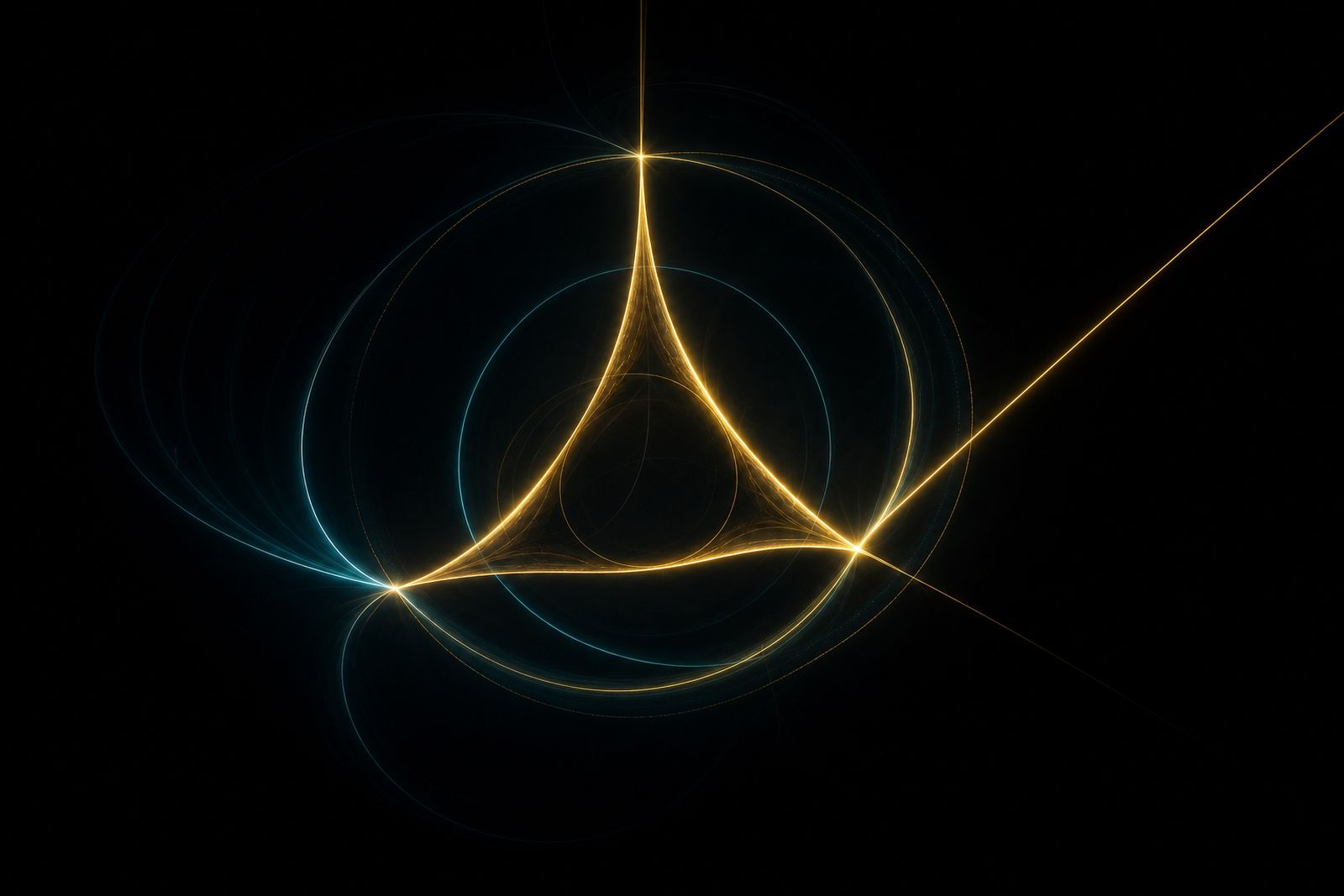
Using clever slides, the needle can make all its turns inside a triangle. An equilateral triangle of height one does the job.
Its area is one over the square root of three, about 0.58 — already smaller than the disc. Among all convex shapes, that triangle is the best you can do.
But who said the shape has to be convex? Drop that, and the floor falls out.
A=31≈0.577Area of an equilateral triangle of height 1 — smaller than the disc.
Allowed to slide, not only pivot
1920 · Pál: the triangle is the smallest convex answer
The three-point turn
Chapter I · Step 2
The three-point turn
Because the needle may slide as well as rotate, it can turn inside an equilateral triangle of height 1: area 1/√3 ≈ 0.577
1920 Pál: the triangle is the smallest convex answer
Abram Besicovitch was working on a different problem when he found the construction that would make him famous.
Start with a triangle. Cut it into thin slivers. Now slide the slivers so they overlap as much as possible, letting them poke out in a spray of fine spikes.
Each sliver still carries needles pointing in its own small range of directions, so together they still cover every direction. But the overlapping means the total area shrinks.
Repeat the cutting and sliding, and the area can be driven below any number you choose. You can cover every direction inside an area as close to zero as you like.
A Besicovitch set Thin slivers slid to overlap, spraying into fine spikes.
→ 0
total area
all
directions still covered
Besicovitch, 1919 Cover every direction inside an area as small as you like.
Chapter II · Step 4
Area almost zero
Cut a triangle into thin slivers and slide them to overlap. Repeat. The set still contains a needle in every direction, yet its area can be made smaller than any number.
Besicovitch set area
→ 0
can be made as small as you like
Directions covered
all of them
These spiky figures are called Besicovitch sets. In the limit a Besicovitch set of area exactly zero exists.
That was about covering directions. But can a needle actually turn continuously through all of them inside such a tiny area?
In 1928 Besicovitch showed: yes. You can connect the spikes with thin corridors, and shuffle the needle from one to the next.
A needle can make a full turn inside an area as small as you please. There is no smallest answer at all — only smaller and smaller.
Connect the spikes with thin corridors
Shuffle the needle from one to the next
A full turn in an area as small as you like
Besicovitch, 1928
→ 0
no smallest area — only smaller and smaller
No minimum at all
Chapter II · Step 5
Turning in nothing
In 1928 Besicovitch showed a needle can turn continuously through every direction inside an area as small as you like. There is no minimum — only an endless race toward zero.
So the original Kakeya question, taken literally, has a strange answer: “as little area as you want.” The interesting question had to be asked differently.
Mathematicians stopped thinking about one moving needle, and pictured every position at once: a set that contains a line segment pointing in every direction.
Such a set is called a Kakeya set, or a Besicovitch set. We have seen it can have zero area.
So if area cannot tell these sets apart from nothing, we need a sharper ruler. How “big” is a set that has zero area but still contains a needle in every direction?
A Kakeya set Every needle position at once: a segment in every direction.
Contains a unit segment in every direction
Can have zero area
So area is the wrong ruler
Kakeya / Besicovitch set
Chapter III · Step 6
Every direction at once
A Kakeya set contains a unit segment pointing in every direction. It can have zero area — so area is the wrong way to measure it. We need a sharper notion of size.
Each glowing line is the needle frozen in one of its directions. Together they point every way at once.
A single line has zero area, but it is clearly “one-dimensional”. A filled square is two-dimensional. Some sets sit in between, with a fractional dimension.
The right ruler is this dimension. Fatten the set into tubes of thickness delta, measure the volume, and watch how fast it shrinks as delta shrinks. That rate is the dimension.
A set that is nearly two-dimensional barely loses volume as the tubes get thinner. A thin, wispy set loses volume fast.
So the sharp question is: a Kakeya set has zero area, but can it be wispy — of dimension less than the space it lives in?
volume∼δn−d
δ
tube thickness
n
dimension of the space
d
dimension of the set
Fatten into tubes of thickness δ; how fast the volume shrinks gives the dimension d.
A line — dimension 1
A filled square — dimension 2
In between — fractional dimension
The right ruler
Chapter III · Step 7
Area zero, but how full?
Even with zero area, a set has a dimension. Fatten it into tubes of thickness δ and see how its volume shrinks as δ → 0: slow shrink means a full, near-solid set; fast shrink means a thin, wispy one.
This is the Kakeya conjecture: although a Kakeya set can have zero area, it can never be wispy. It must have the full dimension of the space it lives in.
In the plane, that means dimension exactly two. In three-dimensional space, dimension exactly three.
In 1971 Roy Davies proved it in the plane. The flat case was hard enough. Three dimensions resisted for another fifty years.
It sounds almost obvious — of course something pointing in all directions should be “full”. But the overlaps that make the area vanish are exactly what make it so hard to pin the dimension down.
dim(Kakeya set)=nThe conjecture: full dimension, even with zero area.
1971
proved in the plane (n = 2)
2025
proved in space (n = 3)
Davies, then Wang–Zahl
Chapter III · Step 8
It must be full
The Kakeya conjecture: a Kakeya set has zero area, yet must have the full dimension of its space — 2 in the plane, 3 in space.
1971 Davies proves it in the plane (dimension 2)
3D open for another half-century
The conjecture lies beneath a whole tower of problems in the study of waves and the Fourier transform — which is why so many wanted it true.
Nobody cracked three dimensions in one blow. They raised the floor, bit by bit.
In 1995 Tom Wolff showed a 3D Kakeya set must have dimension at least two-and-a-half. For years that was the record.
Nets Katz and Terence Tao laid out a plan of attack. In 2014 Larry Guth proved that any counterexample would have to be “grainy” — built from many tiny regions where lots of needles pile up.
In 2022 Hong Wang and Joshua Zahl handled the worst-behaved, “sticky” Kakeya sets. The final assault was now in reach.
Wolff · 1995
≥ 2.5
Katz–Łaba–Tao · 2000
> 2.5
Wang–Zahl · 2025
= 3
The dimension floor, rising Each result pushed the smallest possible dimension toward 3.
2014 · Guth: any counterexample is “grainy”
2022 · Wang–Zahl handle “sticky” sets
Toward the final assault
Chapter IV · Step 9
Inch by inch
Three dimensions fell only after fifty years of partial results, each raising the smallest possible dimension a little higher toward 3.
The breakthrough was to stop tracking individual needles and track the grains instead — the tiny blocks where many needles bundle together.
Grains are easier to count, and there is a firm limit on how many can crowd through any one point. That limit is the lever.
Wang and Zahl set up an induction: if no Kakeya set can be wispy up to some dimension, then none can be wispy a little beyond it either. Each turn of the argument pushes the bound higher.
Terence Tao described it as perfecting a perpetual-motion machine — the argument gives back a little more than you put in, again and again, until the bound reaches three.
Grains The small blocks where many needles bundle together.
They’re getting more out than they put in.Terence Tao, on the induction
A mathematical perpetual-motion machine, lifting the bound to 3.
Chapter IV · Step 10
Counting grains
Instead of needles, count the grains — the small blocks where many needles overlap. A limit on how many grains meet at a point drives an induction that lifts the dimension bound, step after step, up to 3.
“They’re getting more out than they put in,” said Terence Tao — a mathematical perpetual-motion machine.
In February 2025, Hong Wang of New York University and Joshua Zahl of the University of British Columbia posted their proof: every Kakeya set in three dimensions has full dimension three.
Nets Katz called it a once-in-a-century result. It was not just one problem solved — it was the foundation stone of a tower.
Above Kakeya sit the restriction conjecture, the Bochner–Riesz conjecture, the local smoothing conjecture — deep questions about how waves and the Fourier transform behave. Had Kakeya been false, the whole tower would have fallen.
Now, as one mathematician put it, all of those dreamed-about problems suddenly look approachable.
A tower of conjectures Kakeya is the base stone; above it, deep problems about waves.
base · the Kakeya conjecture
↑ the restriction conjecture
↑ Bochner–Riesz
↑ local smoothing
What Kakeya holds up
Chapter IV · Step 11
The proof, and the tower
In February 2025, Hong Wang (NYU) and Joshua Zahl (UBC) proved the three-dimensional Kakeya conjecture (arXiv:2502.17655). Kakeya is the base of a tower of problems about waves and the Fourier transform.
base the Kakeya conjecture
↑ the restriction conjecture
↑ Bochner–Riesz
↑ local smoothing
“A once-in-a-century kind of result,” said Nets Katz.
What began as a puzzle about turning a needle became a question about the hidden shape of sets that are invisible to area but full of direction.
In 2026, Hong Wang was awarded the Fields Medal, mathematics’ highest honour, in large part for this work.
And the game is not over. The Kakeya conjecture in four dimensions and above is still open — the same question, one dimension at a time.
From a needle on a table to the frontier of modern analysis: proof that the simplest questions can run the deepest.
1917 → 2025
from the question to the 3D proof
2026
Hong Wang, Fields Medal
n ≥ 4
still open
A needle, a century, a medal
The simplest questions can run the deepest.The Kakeya story
Epilogue
A needle, a century, a medal
A puzzle about turning a needle became a deep truth about the hidden dimension of direction. In 2026, Hong Wang received the Fields Medal for this and related work.
1917 → 2025 from Kakeya’s question to the 3D proof
2026 Hong Wang, Fields Medal
open dimension 4 and higher
The animations here are illustrations of the ideas, not exact mathematical constructions.