PlanetPast

1880s → 2026 · A history in maps

One Land, Two Peoples

How the Israeli–Palestinian conflict and the war in Gaza came to be: Ottoman rule, two national movements, wartime promises, the 1947 partition plan, 1948 and 1967, Oslo, Gaza and 7 October, told on a 3D map of changing borders with each side’s account in its own terms.

Interactive 3D film7 min1880s to 2026Published 2026-10-12

Watch the interactive filmอ่านภาษาไทย

Prologue

7 October 2026 · Third anniversary

One land, two peoples

A strip of coast, a century of conflict. How did we get here?

On the seventh of October 2026, three years after the Hamas-led attack on Israel, Israeli strikes hit Gaza again, despite a ceasefire a year old.

Israel said it targeted militants. Palestinian officials reported five people killed. Gaza’s health ministry counts more than seventy-four thousand dead since the war began.

To understand how it came to this, we have to go back more than a century, to a small land on the eastern Mediterranean.

Two peoples have deep ties to it, and each tells its own story of what happened. This film tries to tell both.

Prologue · 7 October 2026

Three years on

On the third anniversary of the 7 October 2023 attack, Israeli strikes in Gaza killed five people, according to Palestinian officials. The Israeli military said it had killed Hamas militants, including one it said had planted explosives near the “Yellow Line” that separates Israeli-held and Hamas-held parts of Gaza. A US-brokered ceasefire has been in force since 10 October 2025, but it has not stopped the strikes or brought Hamas’s disarmament.

Killed in Israel, 7 Oct 2023
~1,200
Israeli figures; 251 people taken hostage
Killed in Gaza since Oct 2023
74,200+
Gaza health ministry (under the Hamas-run government), whose figures the UN considers reliable · incl. 1,460+ since the ceasefire
Who holds Gaza now
Israel controls around two-thirds; Hamas the rest, a narrow coastal strip
Reuters, October 2026 · about 2 million people remain, mostly in tents and damaged buildings

This film is a history, not a news report. It follows the land from Ottoman times to today, and wherever Israelis and Palestinians remember events differently, it gives both accounts. Figures are attributed to whoever produced them.

How to use: pick a chapter below the map or press ← → · ▶ plays the step · drag to rotate, scroll or pinch to zoom · buttons on the map (or in this panel on phones) switch what the map shows · “Play the film” runs every step full-screen.

Sources: AFP via Malay Mail, 8 Oct 2026; Reuters via Al-Monitor, 7 Oct 2026; AP, 31 Jul 2026; Wikipedia: October 7 attacks

Chapter I · Ottoman land

1516 – 1917 · The Ottoman Empire

A land without a border

For four hundred years there was no country here, only Ottoman districts run from Istanbul and Beirut.

For four centuries, from 1516 to 1917, this land was part of the Ottoman Empire. There was no province called Palestine.

The south, around Jerusalem, was governed directly from Istanbul. The north belonged to the province of Beirut.

Ottoman records counted about seven hundred and twenty thousand people here by 1914, mostly Arabic-speaking Muslims, with Christian and Jewish minorities.

Jerusalem, holy to Jews, Christians and Muslims, stood at its heart.

Chapter I · Step 1 · 1516–1914

The land and its peoples

The Ottomans ruled the region from 1516 until British forces took Jerusalem in December 1917. From 1873 the south, from Jaffa down, formed the Mutasarrifate of Jerusalem, answerable directly to Istanbul; the north was split between the sanjaks of Acre and Nablus in the vilayet of Beirut. “Palestine” was a familiar regional name, not an administrative unit.

Ottoman count, 1877–78
440,850
386,320 Muslims · 40,588 Christians · 13,942 Jews
Ottoman count, 1914–15
722,143
602,377 Muslims · 81,012 Christians · 38,754 Jews
Historians disagree on the numbers
Other estimates for 1914 put the Jewish population at 59,000 (McCarthy) or 94,000 (DellaPergola)
Ottoman registers and later reconstructions give different totals

The shaded area is the Ottoman Empire on the eve of the First World War. Borders are simplified and approximate. Heights are exaggerated about seven times.

Sources: Wikipedia: Ottoman Palestine; Wikipedia: Demographic history of Palestine; Wikipedia: Balfour Declaration; OpenHistoricalMap (CC0)

1880s – 1914 · Two awakenings

Two national movements

Jewish nationalism arrived from Europe; Arab nationalism grew inside the empire. Both looked to the same land.

In the 1880s, after waves of pogroms in the Russian Empire, Jewish immigrants began founding farming colonies here.

In 1897 Theodor Herzl’s First Zionist Congress in Basel called for a home for the Jewish people in Palestine, secured by law.

At the same time, Arab nationalism was rising across the empire. In Jaffa, from 1911, the newspaper Falastin warned its readers against Zionism.

Two modern national movements, each with deep ties to the same land, were on course to meet.

Chapter I · Step 2 · 1881–1914

Zionism and Arab nationalism

Zionism, a national movement born in Central and Eastern Europe, sought a homeland for Jews in the land of their ancient history, partly in response to rising antisemitism. Theodor Herzl’s Der Judenstaat (1896) and the First Zionist Congress in Basel (1897) turned it into an organised movement. Arab nationalism was growing at the same time within the Ottoman Empire, and a distinct Palestinian Arab identity took shape alongside it.

  • 1881–1903 First Aliyah: about 25,000 immigrants, mostly from Eastern Europe and Yemen; colonies such as Rishon LeZion, Zikhron Ya’akov and Rosh Pinna (1882)
  • 1897 Basel Program: a home for the Jewish people in Palestine secured by law
  • 1909 Tel Aviv founded as a housing estate on the edge of Jaffa
  • 1911 Falastin founded in Jaffa, the most consistent early critic of Zionism; land purchases followed by evictions of tenant farmers sharpened tensions

When did a Palestinian national identity emerge? Historian Rashid Khalidi traces it to the late Ottoman period and warns against seeing it mainly as a reaction to Zionism; others, such as Daniel Pipes and Benny Morris, date a distinct Palestinian identity to around 1920, after Palestine was separated from Syria.

Sources: Wikipedia: Zionism; Wikipedia: First Aliyah; Wikipedia: Tel Aviv; Wikipedia: Palestinian nationalism; Wikipedia: Falastin (newspaper); Wikipedia: Ottoman Palestine

Chapter II · Wartime promises

1915 – 1918 · The First World War

Three promises

To win the war, Britain made commitments that pointed in different directions.

In the First World War the Ottomans fought on Germany’s side, and Britain made promises to win allies.

In 1915 it promised the Sharif of Mecca support for Arab independence. Whether Palestine was included is still argued over.

In 1916, in the secret Sykes–Picot agreement, Britain and France planned to divide the region, with Palestine under international rule.

In November 1917 the Balfour Declaration backed a national home for the Jewish people in Palestine, without prejudice to the rights of the non-Jewish communities, then about nine in ten of the population. Weeks later British troops took Jerusalem.

Chapter II · Step 3 · 1915–1918

Three promises

  1. McMahon–Hussein correspondence (July 1915 – March 1916). Ten letters in which Britain promised to support Arab independence in return for an Arab revolt against the Ottomans, excluding areas “west of the districts of Damascus, Homs, Hama and Aleppo”. Britain later said this excluded Palestine; Arab leaders said it did not. Historian Albert Hourani judged the letters “intended to bear more than one interpretation”.
  2. Sykes–Picot Agreement (16 May 1916). A secret British–French plan to divide the Ottoman Arab lands; most of Palestine would be under an international administration. The Bolsheviks published it in November 1917.
  3. Balfour Declaration (2 November 1917). Britain viewed “with favour the establishment in Palestine of a national home for the Jewish people”, provided “nothing shall be done which may prejudice the civil and religious rights of existing non-Jewish communities”.

On the map: the British advance from Egypt. Beersheba fell on 31 October 1917 and Jerusalem on 9 December 1917; the war with the Ottomans ended with an armistice on 30 October 1918. Use the buttons to read each promise.

Sources: Wikipedia: McMahon–Hussein correspondence; Wikipedia: Sykes–Picot Agreement; Wikipedia: Balfour Declaration; Wikipedia: Sinai and Palestine campaign; Wikipedia: Ottoman Palestine

Chapter III · The British Mandate

1920 – 1948 · Mandatory Palestine

A British mandate

For the first time, a territory called Palestine had borders, a capital and a government.

After the war, Britain was given a League of Nations mandate to govern Palestine, with the Balfour promise written into it.

Land east of the Jordan River was split off as Transjordan, where the Jewish national home clauses did not apply.

Jewish immigration grew, surging in the 1930s as Jews fled persecution in Europe.

Between 1922 and 1945 the Jewish share of the population rose from about one in nine to about one in three.

Chapter III · Step 4 · 1920–1945

The Mandate and immigration

The San Remo conference assigned the mandate to Britain in April 1920; a civilian administration began on 1 July 1920, and the League of Nations mandate took effect on 29 September 1923. It obliged Britain to put the Balfour Declaration into effect and recognised a Jewish agency to help build the national home. In September 1922 those clauses were withdrawn for Transjordan.

Census 1922
752,048
589,177 Muslims · 83,790 Jews · 71,464 Christians
Estimate 1945
1,764,520
1,061,270 Muslims · 553,600 Jews · 135,550 Christians
Jewish immigration 1920–45
367,845
legal, plus an estimated 50,000–60,000 without permits
Land owned by Jews, 1945
5.2%
of the total land area (official statistics)

For Zionists, immigration and land purchase were the building of a refuge and a nation. For most Palestinian Arabs, they were a threat of being displaced and outnumbered in their own country, under a foreign power they had not chosen.

Sources: Wikipedia: Mandatory Palestine; Wikipedia: Mandate for Palestine; OpenHistoricalMap (CC0)

1936 – 1945 · Revolt and war

Revolt, partition, refuge

An Arab uprising, the first partition plan, and a door closing as Europe’s Jews faced destruction.

In 1936 Arab anger turned into a general strike, then a three-year revolt against British rule and Jewish immigration.

British forces put it down. Around five thousand Arabs, several hundred Jews and more than two hundred and sixty British personnel were killed.

In 1937 a British commission proposed the first plan to partition the land. Arab leaders rejected it; the Zionist Congress rejected its borders but agreed to negotiate.

In 1939 Britain capped Jewish immigration. During the Second World War, Nazi Germany and its collaborators murdered six million European Jews.

Chapter III · Step 5 · 1936–1945

Revolt, partition, the White Paper

The Jewish population rose from 175,000 in 1931 to 370,000 in 1936. In April 1936 the new Arab Higher Committee called a general strike with three demands: stop Jewish immigration, ban land sales to Jews, and create a national government. The strike became an armed revolt that lasted until 1939.

  • 1936–39 Arab revolt. Estimates: about 5,000 Arabs killed, about 500 Jews, 262 British security personnel
  • Jul 1937 Peel Commission: a small Jewish state, a larger Arab state joined to Transjordan, a British zone; up to 225,000 Arabs to be moved. Rejected by Arab leaders; Britain dropped partition in 1938
  • May 1939 White Paper: 75,000 Jewish immigrants over five years, then only with Arab consent; land sales restricted; an independent Palestine within ten years. Zionists rejected it; the Arab Higher Committee also rejected it, demanding a complete halt to immigration
  • 1933–45 The Holocaust: six million European Jews murdered. After the war most Jewish survivors in displaced-persons camps hoped to go to Palestine
Sources: Wikipedia: 1936–39 Arab revolt; Wikipedia: Peel Commission; Wikipedia: White Paper of 1939; USHMM: Introduction to the Holocaust

Chapter IV · Partition and 1948

29 November 1947 · UN General Assembly

Resolution 181

The new United Nations voted to divide the land into two states.

Exhausted, Britain handed the problem to the new United Nations.

On the twenty-ninth of November 1947 the General Assembly voted, thirty-three to thirteen, to divide Palestine into a Jewish state and an Arab state, with Jerusalem under international rule.

The Jewish state would get about fifty-six percent of the land. Jews were then about a third of the population.

Jewish leaders accepted the plan. Arab leaders rejected it, arguing it denied the majority its right to decide its own future.

Chapter IV · Step 6 · 1947

The UN Partition Plan

A UN Special Committee (UNSCOP), created in May 1947, recommended partition with an economic union; a minority (India, Iran, Yugoslavia) proposed a federal state. General Assembly Resolution 181 passed on 29 November 1947 by 33 votes to 13, with 10 abstentions.

Proposed Jewish state
56.5%
15,264 km² · about 498,000 Jews and 407,000 Arabs and others
Proposed Arab state
42.9%
11,592 km² · about 725,000 Arabs and 10,000 Jews
Jerusalem and Bethlehem
An international zone (0.65%) under a special UN regime
about 105,000 Arabs and others and 100,000 Jews (UNSCOP, 1945 data)
Jewish AgencyAccepted, reluctantly, criticising some boundaries: it would allow a Jewish state with control of its own immigration. Arab Higher Committee and Arab statesRejected it: Arabs were two-thirds of the people and owned most of the land, and partition violated their right to self-determination.

Much of the land given to the Jewish state was the arid Negev. The boundaries here are traced from a public-domain CIA map and are approximate.

Sources: Wikipedia: UN Partition Plan for Palestine; Wikipedia: UNSCOP; CIA map of the 1947 plan (public domain)

1948 – 1949 · War

Independence and Nakba

The same war, remembered in two opposite ways.

Fighting broke out as soon as the vote was passed. On the fourteenth of May 1948, as British rule ended, David Ben-Gurion declared the State of Israel.

The next day, forces from Egypt, Transjordan, Syria and Iraq entered the war.

When the 1949 armistices were signed, Israel held about seventy-eight percent of the former Mandate. Jordan held the West Bank and East Jerusalem; Egypt held Gaza. No Arab state of Palestine emerged.

Israelis call it the War of Independence. Palestinians call it the Nakba: the catastrophe.

Chapter IV · Step 7 · 1948–1949

1948: one war, two names

Fighting broke out as soon as the vote was announced, with Arab attacks on Jewish areas and, from spring 1948, large Jewish offensives. On 14 May 1948 the State of Israel was proclaimed in Tel Aviv; the United States recognised it de facto that night, and the Soviet Union fully on 17 May. On 15 May, Egyptian, Transjordanian, Syrian and Iraqi forces entered the country. Armistices followed in 1949: Egypt (24 February), Lebanon (23 March), Jordan (3 April) and Syria (20 July).

For IsraelisThe War of Independence: a new state, three years after the Holocaust, survived an invasion by its neighbours. For PalestiniansThe Nakba, “the catastrophe”: the loss of their homeland and the scattering of their society.
Israel after the armistices
~78%
of Mandate Palestine, inside the “Green Line”
West Bank and East Jerusalem
Jordan
annexed in April 1950; recognised by very few states
Gaza Strip
Egypt
administered, not annexed
Arab state of 1947 plan
Never created

Compare the armistice lines with the 1947 plan using the button on the map.

Sources: Wikipedia: 1948 Arab–Israeli War; Britannica: 1948 Arab–Israeli War; Wikipedia: Israeli Declaration of Independence; Wikipedia: 1949 Armistice Agreements; Wikipedia: Jordanian annexation of the West Bank; OpenHistoricalMap (CC0)

1948 and after · Refugees

The people who left

Two exiles, in opposite directions, that still shape the region.

About seven hundred thousand Palestinians, roughly half the Arab population, fled or were driven out. More than five hundred villages were emptied, and Israel did not let the refugees return.

Why they left is fiercely debated. Israel long said most left of their own accord or on their leaders’ advice; Palestinians say they were expelled. Historians have documented both flight from the fighting and expulsions.

Camps grew in Gaza, the West Bank, Jordan, Lebanon and Syria. Today more than five point nine million Palestinians are registered as refugees with the UN.

Over the next two decades, some eight hundred and fifty thousand Jews left or were driven from Arab and Muslim countries. Most of them settled in Israel.

Chapter IV · Step 8 · 1948 and after

Refugees

In 1949 the UN Conciliation Commission estimated 711,000 Palestinian refugees outside Israel; other estimates run from about 700,000 to 800,000. UN General Assembly Resolution 194 (11 December 1948) said refugees wishing to return in peace “should be permitted to do so”. Israel refused, apart from a 1949 offer to take back about 100,000 as part of a peace deal, which Arab states rejected. Laws on “absentee” property transferred their land and homes to the state.

Traditional Israeli accountMost Arabs left voluntarily or at the urging of Arab leaders, in a war the Arab side started. Palestinian accountPeople were driven out by attacks, massacres and deliberate expulsions, and then prevented from returning.

Historian Benny Morris, using Israeli archives, concluded that Jewish military attacks were the most important single cause of flight, and documented expulsions such as Lydda and Ramle (50,000–70,000 people); some historians call it ethnic cleansing, others, including Morris and Yoav Gelber, dispute the term. From 1948 to the early 1970s about 850,000–900,000 Jews left or were expelled from Arab and Muslim-majority countries; about 650,000 of them settled in Israel. Historians also debate how far they were pushed or pulled.

UNRWA rolls, 1950
914,221
Jordan incl. West Bank 506,200 · Gaza 198,227 · Lebanon 127,600 · Syria 82,194
Registered today
5.9 million+
Palestine refugees registered with UNRWA, in 58 official camps and elsewhere
Sources: Wikipedia: 1948 Palestinian expulsion and flight; Wikipedia: Nakba; Wikipedia: Jewish exodus from the Muslim world; Wikipedia: UNRWA; UNRWA figures 1950–2020 (Jewish Virtual Library table)
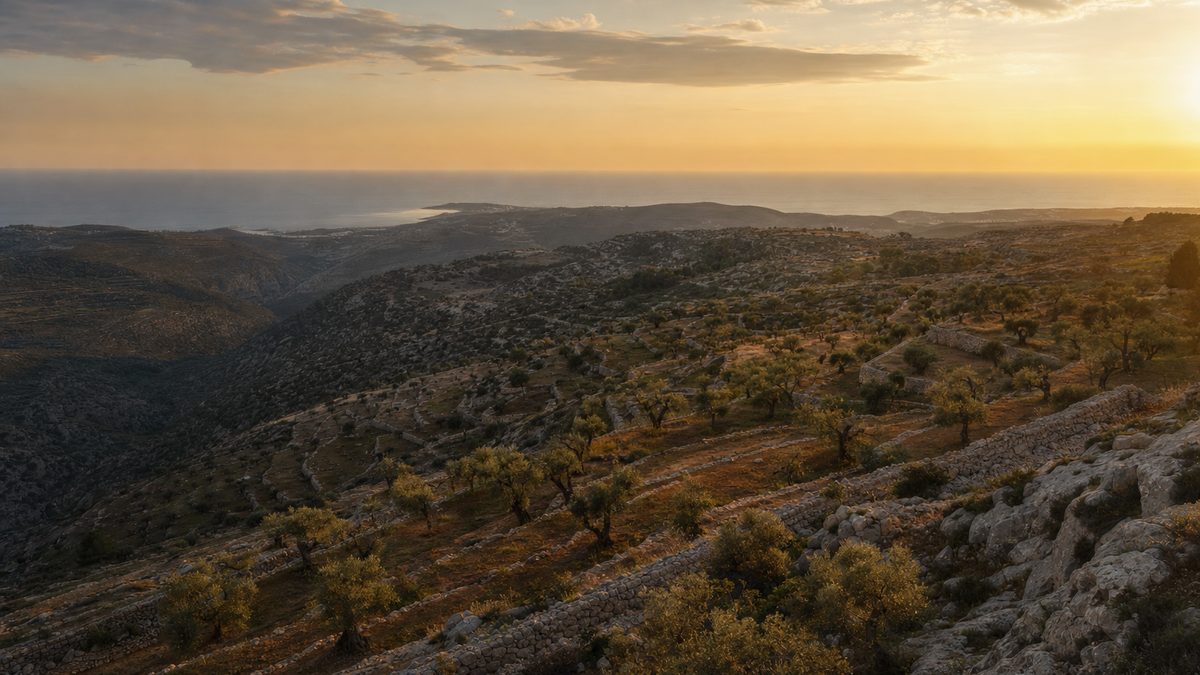
Chapter V · 1967 and after

5 – 10 June 1967 · The Six-Day War

Six days

A short war that redrew the map, and still defines it.

In May 1967 Egypt moved troops into Sinai, sent away UN peacekeepers and closed the Straits of Tiran to Israeli shipping, which Israel had called a cause for war.

On the fifth of June Israel struck first. In six days it took Sinai and Gaza from Egypt, the West Bank and East Jerusalem from Jordan, and the Golan Heights from Syria.

Between two hundred and eighty and three hundred and twenty-five thousand Palestinians fled or were expelled, most of them to Jordan. Palestinians call it the Naksa, the setback.

For the first time, all of the former Mandate was under Israeli control.

Chapter V · Step 9 · June 1967

The Six-Day War

In May 1967 Egypt massed troops in Sinai, ordered UN peacekeepers out and closed the Straits of Tiran to Israeli ships. Egypt and Jordan signed a defence pact on 30 May. Israel opened the war on 5 June with air strikes that destroyed most of Egypt’s air force, then fought Jordan and Syria.

Territory captured
~70,000 km²
Sinai, Gaza, West Bank incl. East Jerusalem, Golan Heights
Killed
Israel 776–983 · Arab states 15,000+
estimates
Displaced
280,000–325,000 Palestinians; about 100,000 Syrians from the Golan
By December 1967 about 245,000 had crossed to Jordan

Israelis remember a war of survival that reunited Jerusalem and returned Jews to the Old City. Palestinians call it the Naksa, “the setback”, the start of an occupation that continues. On the map, striped areas were captured in 1967; the UN and most states regard the West Bank, East Jerusalem, Gaza and the Golan as occupied territory.

Sources: Wikipedia: Six-Day War; Wikipedia: Naksa; Wikipedia: Israeli-occupied territories; OpenHistoricalMap (CC0)

1967 – 1987 · Land for peace?

Land for peace

A formula for peace, a peace treaty, and the start of settlements.

In November 1967 the UN Security Council passed Resolution 242: Israeli withdrawal from territories occupied in the war, in exchange for peace and secure borders. Land for peace.

Arab leaders meeting in Khartoum had just declared: no peace with Israel, no recognition, no negotiations.

After another war in 1973, Egypt made peace with Israel and got Sinai back. Israel extended its law to East Jerusalem and the Golan; the Security Council declared both moves null and void.

Israel also began building settlements in the occupied territories. Most of the world considers them illegal under international law; Israel disputes this.

Chapter V · Step 10 · 1967–1987

Land for peace, and settlements

  • Sep 1967 Khartoum summit: “no peace with Israel, no recognition of Israel, no negotiations with it”. Historians differ on how literally it was meant
  • Nov 1967 Resolution 242, unanimous: “inadmissibility of the acquisition of territory by war”; withdrawal “from territories occupied”, without “the”, a gap both sides still argue over; a “just settlement of the refugee problem”
  • Oct 1973 Egypt and Syria attack on Yom Kippur; the war paves the way to the Camp David Accords (1978)
  • 1979–82 Egypt–Israel peace treaty (26 March 1979); Israel completes its withdrawal from Sinai in April 1982
  • 1980–81 Jerusalem Law and Golan Heights Law; Security Council Resolutions 478 and 497 call them “null and void”

Under the Fourth Geneva Convention, “the Occupying Power shall not … transfer parts of its own civilian population into the territory it occupies”. The UN and most governments regard the settlements as illegal on that basis. Israel argues the Convention does not apply because the West Bank had no recognised sovereign before 1967, prefers to call it “disputed”, and cites historic Jewish ties to Judea and Samaria. By 1990 about 78,600 settlers lived in the West Bank outside East Jerusalem.

Sources: Wikipedia: UN Security Council Resolution 242; Wikipedia: Khartoum Resolution; Wikipedia: Yom Kippur War; Wikipedia: Egypt–Israel peace treaty; Wikipedia: Israeli occupation of the Sinai; Wikipedia: East Jerusalem; Wikipedia: Golan Heights Law; Wikipedia: Israeli settlement; Wikipedia: Israeli-occupied territories; Wikipedia: Settlement population statistics

Chapter VI · Uprising and Oslo

1964 – 1993 · The first intifada

The uprising

A generation born under occupation took to the streets.

Palestinians increasingly spoke for themselves. The Palestine Liberation Organization, founded in 1964 and led from 1969 by Yasser Arafat, fought from Jordan, then Lebanon, then exile in Tunis.

In December 1987, after a road crash at the Erez checkpoint killed four Palestinian workers, the occupied territories rose up: the first intifada.

Strikes, boycotts and stone-throwing were met by the Israeli army. In six years about eleven hundred Palestinians and almost two hundred Israelis were killed.

That December Hamas was founded; its charter rejected any two-state compromise. In 1988 the PLO declared a State of Palestine and signalled it would accept Resolution 242.

Chapter VI · Step 11 · 1964–1993

The PLO and the first intifada

The PLO was founded in 1964 with Arab League backing. Yasser Arafat of Fatah became chairman in 1969. Expelled from Jordan after the “Black September” fighting of 1970, the PLO moved to Lebanon, and after Israel’s 1982 invasion of Lebanon, to Tunis. In 1974 the Arab League recognised it as the “sole legitimate representative of the Palestinian people”, and the UN gave it observer status.

Intifada began
9 Dec 1987
“intifada” is Arabic for “uprising”
Killed, 1987–93
1,087–1,204 Palestinians · 179–200 Israelis
B’Tselem and Israeli figures; another 771–942 Palestinians killed by Palestinians as alleged collaborators
  • Dec 1987 Hamas founded by Ahmed Yassin; its 1988 charter rejected a two-state solution
  • Jul 1988 Jordan cuts its legal and administrative ties with the West Bank
  • 15 Nov 1988 In Algiers the Palestinian National Council declares a State of Palestine, citing Resolution 181, and calls for talks based on Resolution 242
Sources: Wikipedia: PLO; Wikipedia: Black September; Wikipedia: First Intifada; Wikipedia: Hamas; Wikipedia: Jordanian annexation of the West Bank; Wikipedia: Palestinian Declaration of Independence

1993 – 1995 · The Oslo Accords

A handshake

For the first time, Israel and the PLO recognised each other.

In secret talks in Norway, enemies became negotiating partners. In September 1993 the PLO recognised Israel’s right to exist, and Israel recognised the PLO as the representative of the Palestinian people.

The Oslo Accords created a Palestinian Authority and, in 1995, divided the West Bank into three kinds of area.

Area A: Palestinian control. Area B: Palestinian civil rule with Israeli security control. Area C, about sixty percent: full Israeli control, including the settlements.

The hardest questions, Jerusalem, refugees, settlements and borders, were left for a final deal within five years.

Chapter VI · Step 12 · 1993–1995

The Oslo Accords

Letters of mutual recognition were exchanged on 9 September 1993 and the Declaration of Principles was signed in Washington four days later. The Palestinian Authority was set up on 4 May 1994. Oslo II, signed on 28 September 1995, divided the West Bank into Areas A, B and C, an arrangement meant to last five years. Arafat, Yitzhak Rabin and Shimon Peres shared the 1994 Nobel Peace Prize, and Jordan signed a peace treaty with Israel in October 1994.

Area A ~18% Palestinian civil and security control: the main towns Area B ~22% Palestinian civil control, Israeli security control Area C ~60% Israeli civil and security control, incl. settlements

Left for “permanent status” talks: Jerusalem, refugees, settlements, security arrangements and borders. Area C was meant to pass gradually to Palestinian control; after the 1998 Wye River deal only a small part did. East Jerusalem, annexed by Israel, is outside the three areas. Try the buttons to highlight each area.

Sources: Wikipedia: Oslo Accords; Wikipedia: Oslo II Accord; Wikipedia: Area C; UN OCHA: Area C key humanitarian concerns; Wikipedia: Palestinian Authority; Wikipedia: Israel–Jordan peace treaty; OCHA oPt: Oslo areas (HDX)

1994 – 2005 · Collapse

Why Oslo stalled

Violence, settlements and mistrust ate away at the interim deal.

The final deal never came. Opponents on both sides struck: an Israeli settler shot dead twenty-nine Palestinians at prayer in Hebron, Hamas began suicide bombings, and in 1995 an Israeli extremist assassinated Prime Minister Rabin.

Settlements kept growing. Outside East Jerusalem, the number of settlers rose from about a hundred and sixteen thousand in 1993 to two hundred and three thousand in 2000.

A summit at Camp David in 2000 failed, each side blaming the other, and a second, far bloodier intifada broke out.

Israel built a barrier, mostly inside the West Bank. Israel says it stopped attacks; the International Court of Justice said its route breaks international law.

Chapter VI · Step 13 · 1994–2005

Why the peace process stalled

  • Feb 1994 Baruch Goldstein, a far-right settler, kills 29 Muslim worshippers in Hebron; Hamas suicide bombings in Israel follow
  • Nov 1995 Rabin assassinated in Tel Aviv by Yigal Amir, an opponent of Oslo
  • 1996–99 Withdrawals slow; the five-year interim period ends in May 1999 without a deal
  • Jul 2000 Camp David summit fails. Israel and the US said Arafat rejected a generous offer; Palestinians said it fell far short of a viable state
  • 2000–05 Second intifada: about 138 suicide bombings; B’Tselem counts 1,053 Israelis killed by Palestinians and 4,745 Palestinians killed by Israeli forces (to 2008)
  • 2002 → West Bank barrier: planned 708 km, about 85% inside the West Bank. ICJ (2004, 14–1): contrary to international law. Israel: a security barrier against attacks

On the map: the barrier route (solid: built; dashed: planned, as of January 2018) over the Oslo areas.

Sources: Wikipedia: Cave of the Patriarchs massacre; Wikipedia: Assassination of Yitzhak Rabin; Wikipedia: Oslo Accords; Wikipedia: 2000 Camp David Summit; Wikipedia: Second Intifada; Wikipedia: Israeli West Bank barrier; Wikipedia: ICJ advisory opinion on the wall (2004); Wikipedia: Settlement population statistics; OCHA oPt: barrier route, Jan 2018 (HDX)

Chapter VII · Gaza

2005 – 2022 · Gaza

The Strip

Forty-one kilometres of coast, two million people, and a closed border.

Gaza is a strip of land forty-one kilometres long, home to about two million people, most of them refugees from 1948 and their descendants.

In 2005 Israel removed its settlers and soldiers, but kept control of Gaza’s airspace, its sea and most of its crossings.

In 2006 Hamas won Palestinian elections. In 2007, after fighting with Fatah, it took over Gaza, and Israel and Egypt imposed a blockade.

Israel says the blockade keeps weapons from Hamas; critics call it collective punishment. Rocket fire and Israeli offensives in 2008, 2014 and 2021 killed nearly four thousand Palestinians and about a hundred Israelis.

Chapter VII · Step 14 · 2005–2022

Gaza: withdrawal, Hamas, blockade

The Gaza Strip covers 365 km², 41 km long and 6–12 km wide. Egypt administered it from 1948 to 1967. In August–September 2005 Israel dismantled its 21 settlements there and removed some 8,000–9,000 settlers. Hamas won 74 of 132 seats in the January 2006 legislative election, which observers judged professional; Israel and the Quartet of mediators (US, EU, UN, Russia) imposed sanctions when Hamas refused to recognise Israel, renounce violence and accept past agreements. In June 2007 Hamas took Gaza after fighting with Fatah, leaving the Palestinian Authority in charge only in parts of the West Bank.

Israel’s viewGaza is no longer occupied; the blockade stops weapons and pressures Hamas, which fires rockets at Israeli towns. UN, ICJ and Palestinian viewIsrael still controls Gaza’s borders, sea and air, so it remains an occupying power; the blockade is collective punishment.
Deaths in three Gaza wars (UN OCHA)
  • 2008–09 1,383 Palestinians · 13 Israelis (3 civilians, 10 soldiers)
  • 2014 2,251 Palestinians, incl. 1,462 civilians · 73 Israelis (6 civilians, 67 soldiers); 4,881 rockets fired at Israel
  • 2021 261 Palestinians, incl. 67 children · 13 in Israel
Sources: Wikipedia: Gaza Strip; Wikipedia: Israeli disengagement from Gaza; Wikipedia: 2006 Palestinian election; Wikipedia: Battle of Gaza (2007); Wikipedia: Blockade of the Gaza Strip; UN OCHA: 2008–09 conflict; UN OCHA: key figures, 2014; UN OCHA: 2021 situation report

7 October 2023 · And after

The war

The deadliest day in Israel’s history, and the most destructive war Gaza has known.

On the seventh of October 2023, Hamas-led gunmen broke through the Gaza fence. Israeli figures say about twelve hundred people were killed, most of them civilians, and two hundred and fifty-one taken hostage.

Israel went to war to destroy Hamas. Gaza’s health ministry, whose figures the UN considers reliable, now reports more than seventy-four thousand killed. It does not separate civilians from fighters.

Nearly the whole population was displaced, most buildings were damaged, and in August 2025 UN-backed experts confirmed famine around Gaza City. Israel denied it.

A ceasefire in October 2025 brought the last hostages home. But Israel still holds much of Gaza, Hamas has not disarmed, and strikes continue.

Chapter VII · Step 15 · 2023–2026

7 October and the war in Gaza

On 7 October 2023 Hamas and allied groups attacked southern Israel, killing about 1,200 people according to Israeli figures (at least 1,195 in later counts, roughly two-thirds of them civilians, including more than 360 at the Nova music festival), and taking 251 hostages. Hamas said it acted against the occupation, the blockade, settlements and the detention of Palestinians. Israel launched a war aimed at destroying Hamas’s military and governing capabilities.

Killed in Gaza (to Oct 2026)
74,200+
Gaza health ministry; the UN considers its figures reliable; no civilian/combatant split
Israeli military estimate
17,000+
militants killed, as of August 2024; not independently verified
Structures damaged
~81%
UNOSAT, October 2025
Living in displacement sites
~1.4 million
of about 2.1 million people (OCHA, Feb 2026)
  • Aug 2025 The IPC hunger monitor confirms famine in Gaza Governorate; Israel’s foreign ministry says there is “no famine in Gaza”. In December 2025, after the ceasefire, the IPC says famine is no longer detected but the situation remains “highly fragile”
  • 10 Oct 2025 US-brokered ceasefire under a 20-point plan; on 13 October Hamas frees the last 20 living hostages and Israel releases about 2,000 Palestinian prisoners and detainees
  • Nov 2025 UN Security Council Resolution 2803 backs a Board of Peace and an international stabilisation force
  • 2026 Talks on Hamas’s disarmament and further Israeli withdrawal stall; Israel controls around two-thirds of Gaza (Reuters)
Sources: Wikipedia: October 7 attacks; Wikipedia: Gaza war; Wikipedia: Casualties of the Gaza war; UN-Habitat note on Gaza, Mar 2026 (UNOSAT, OCHA data); Al Jazeera on the IPC famine finding, 22 Aug 2025; PA on the IPC update, 19 Dec 2025; Wikipedia: Gaza peace plan; AP, 31 Jul 2026; Reuters via Al-Monitor, 7 Oct 2026; AFP via Malay Mail, 8 Oct 2026

Chapter VIII · The debates today

Today · The debates

Law, words and two states

The conflict is now argued in courts and at the UN as well as on the ground.

Today the conflict is also argued in courts. The International Court of Justice has said Israel’s occupation is unlawful. Israel’s prime minister replied that Jews cannot be occupiers in their own land.

South Africa has accused Israel of genocide before the same court. Israel rejects the charge as baseless, and a ruling may take years. The International Criminal Court has issued arrest warrants for Israeli leaders and a Hamas commander.

Most countries, now including Britain and France, recognise a State of Palestine and back two states side by side. Israel’s government opposes a Palestinian state.

Borders, Jerusalem, settlements, refugees and security: the questions left open at Oslo are still open.

Chapter VIII · Step 16 · Today

The debates today

In the courts
  • Jul 2024 ICJ advisory opinion: Israel’s continued presence in the occupied territory is unlawful (11–4) and should end “as rapidly as possible”; new settlement activity must stop (14–1). Netanyahu: “The Jewish people are not occupiers in their own land.”
  • 2023 → South Africa v. Israel under the Genocide Convention. In January 2024 the Court found South Africa’s claimed rights “plausible” and ordered measures, without ruling on whether genocide occurred. Israel calls the charge baseless and says it acts in self-defence. Next filings are due in 2027 and 2029
  • Nov 2024 ICC arrest warrants for Benjamin Netanyahu and Yoav Gallant, and for Hamas commander Mohammed Deif (later confirmed dead). Israel rejects the court’s jurisdiction
  • Sep 2025 A UN commission of inquiry concludes genocide is occurring in Gaza; Israel “categorically rejects” it as “distorted and false”
At the UN
Recognise Palestine
157 / 193
UN members, Sept 2025, incl. UK, France, Canada, Australia
New York Declaration
142–10
12 abstentions; endorses a two-state solution (12 Sep 2025)

Israel’s Knesset voted 68–9 in July 2024 against a Palestinian state. Hamas’s 2017 document accepts a state on the 1967 lines without recognising Israel. Polls before the war found only about a third of Palestinians and of Israeli Jews backing two states (December 2022).

Sources: Just Security: synopsis of the 2024 ICJ opinion; Al Arabiya: Netanyahu’s response, 19 Jul 2024; Wikipedia: South Africa’s genocide case against Israel; SAnews: ICJ order of 21 May 2026; Wikipedia: ICC investigation in Palestine; AFP via Channels TV: UN inquiry and Israel’s response, 16 Sep 2025; Wikipedia: International recognition of Palestine; UNGA vote on the New York Declaration, 12 Sep 2025; Wikipedia: Two-state solution

Epilogue

1914 → 2026

Lines on a map

Every border here was drawn by a war, a vote or a negotiation.

A little over a century ago this was a single Ottoman land. Every line on this map since then was drawn by a war, a vote or a negotiation.

Each side carries its own memory. For Israelis: a refuge won after the Holocaust and defended in war after war. For Palestinians: a homeland lost, and an occupation that has not ended.

Use the time machine to move through the borders, and the sources to read further. Understanding both stories is where any future has to begin.

Epilogue · The border time machine

Lines on a map

Step through a century of borders. Each map is built from historical boundary data and is simplified.

  • 1897 First Zionist Congress
  • 1917 Balfour Declaration; British capture Jerusalem
  • 1936–39 Arab revolt
  • 1947 UN Partition Plan
  • 1948 Israel’s independence; the Nakba
  • 1967 Six-Day War; occupation begins
  • 1987 First intifada; Hamas founded
  • 1993–95 Oslo Accords
  • 2000 Camp David fails; second intifada
  • 2005–07 Gaza disengagement; Hamas takes Gaza; blockade
  • 2023 7 October attack; war in Gaza
  • 2025 Ceasefire; hostages freed

This story tries to give each side’s account in its own terms and to attribute every disputed figure. Where historians disagree, it says so. All full-screen stills are AI-generated illustrations, not photographs, and show no real people. Map data: OpenHistoricalMap (CC0), UN OCHA oPt via HDX, a public-domain CIA map of the 1947 plan, Natural Earth and AWS Terrain Tiles.

Sources
Wikipedia: Ottoman Palestine
Wikipedia: Demographic history of Palestine
Wikipedia: Zionism
Wikipedia: Palestinian nationalism
Wikipedia: First Aliyah
Wikipedia: Falastin (newspaper)
Wikipedia: Tel Aviv
Wikipedia: McMahon–Hussein correspondence
Wikipedia: Sykes–Picot Agreement
Wikipedia: Balfour Declaration
Wikipedia: Sinai and Palestine campaign
Wikipedia: Mandatory Palestine
Wikipedia: Mandate for Palestine
Wikipedia: 1936–39 Arab revolt
Wikipedia: Peel Commission
Wikipedia: White Paper of 1939
USHMM: Introduction to the Holocaust
Wikipedia: UN Partition Plan for Palestine
Wikipedia: UNSCOP
Wikipedia: 1948 Arab–Israeli War
Britannica: 1948 Arab–Israeli War
Wikipedia: Israeli Declaration of Independence
Wikipedia: 1949 Armistice Agreements
Wikipedia: Jordanian annexation of the West Bank
Wikipedia: Nakba
Wikipedia: 1948 Palestinian expulsion and flight
Wikipedia: Jewish exodus from the Muslim world
Wikipedia: UNRWA
UNRWA figures 1950–2020 (Jewish Virtual Library table)
Wikipedia: Six-Day War
Wikipedia: Naksa
Wikipedia: UN Security Council Resolution 242
Wikipedia: Khartoum Resolution
Wikipedia: Yom Kippur War
Wikipedia: Egypt–Israel peace treaty
Wikipedia: Israeli occupation of the Sinai
Wikipedia: East Jerusalem
Wikipedia: Golan Heights Law
Wikipedia: Israeli settlement
Wikipedia: Israeli-occupied territories
Wikipedia: Settlement population statistics
Wikipedia: PLO
Wikipedia: Black September
Wikipedia: First Intifada
Wikipedia: Hamas
Wikipedia: Palestinian Declaration of Independence
Wikipedia: Oslo Accords
Wikipedia: Oslo II Accord
Wikipedia: Area C
UN OCHA: Area C key humanitarian concerns
Wikipedia: Palestinian Authority
Wikipedia: Israel–Jordan peace treaty
Wikipedia: Cave of the Patriarchs massacre
Wikipedia: Assassination of Yitzhak Rabin
Wikipedia: 2000 Camp David Summit
Wikipedia: Second Intifada
Wikipedia: Israeli West Bank barrier
Wikipedia: ICJ advisory opinion on the wall (2004)
Wikipedia: Gaza Strip
Wikipedia: Israeli disengagement from Gaza
Wikipedia: 2006 Palestinian election
Wikipedia: Battle of Gaza (2007)
Wikipedia: Blockade of the Gaza Strip
UN OCHA: 2008–09 conflict
UN OCHA: key figures, 2014
UN OCHA: 2021 situation report
Wikipedia: October 7 attacks
Wikipedia: Gaza war
Wikipedia: Casualties of the Gaza war
UN-Habitat note on Gaza, Mar 2026 (UNOSAT, OCHA data)
Al Jazeera on the IPC famine finding, 22 Aug 2025
PA on the IPC update, 19 Dec 2025
Wikipedia: Gaza peace plan
Just Security: synopsis of the 2024 ICJ opinion
Al Arabiya: Netanyahu’s response, 19 Jul 2024
Wikipedia: South Africa’s genocide case against Israel
SAnews: ICJ order of 21 May 2026
Wikipedia: ICC investigation in Palestine
AFP via Channels TV: UN inquiry and Israel’s response, 16 Sep 2025
Wikipedia: International recognition of Palestine
UNGA vote on the New York Declaration, 12 Sep 2025
Wikipedia: Two-state solution
AFP via Malay Mail, 8 Oct 2026
Reuters via Al-Monitor, 7 Oct 2026
AP, 31 Jul 2026
OpenHistoricalMap (CC0)
OCHA oPt: Oslo areas (HDX)
OCHA oPt: barrier route, Jan 2018 (HDX)
CIA map of the 1947 plan (public domain)
Natural Earth
AWS Terrain Tiles (Mapzen)