Galileo was born in 1564; Turing died in 1954. In the 390 years between them, eleven people worked out how to settle an argument about the world: measure it, publish how, predict something new, and lose in public when the measurement disagrees. Scrub the timeline, see how long each idea waited to be believed, and trace who needed whom. The overview of the Great Scientists series.
Interactive 3D film8 min1564 to 1954Published 2026-10-13
Eleven people and the method they built between them.
Galileo was born in 1564. Turing died in 1954. Three hundred and ninety years.
In that time eleven people, who mostly never met, worked out a way of settling arguments about the world that does not depend on who is asking.
Measure it. Write down how you measured it. Predict something that has not happened yet. And when the measurement disagrees with you, say so in public.
This is the map of the whole series. Every bar on it is one episode.
Four centuries of paper Everything in this series was argued out in print, in public, and most of it was resisted.
11
people
390
years
1
method
The series
If I have seen further it is by standing on the shoulders of giants.Isaac Newton, 1675
Overview · Great Scientists
Four hundred years
Eleven lives, from 1564 to 1954. Each bar on the timeline is one episode of the series; this film is the map of all of them.
How to use: pick a chapter below or press ← → to change step · ▶ plays the step · drag to rotate · three steps have buttons you can press.
None of them is clever. Together they are the most powerful thing we have.
The method is not complicated, and no single person invented it.
Measure something and write the number down. Publish how you measured it, so a stranger can repeat it and disagree. Use it to predict something nobody has seen yet. And when the measurement contradicts you, lose the argument in public.
That last move is the hard one. It is also the one that makes the whole thing work.
Before about 1600, the usual way to settle a question about nature was to find out what an authority had said about it. After 1600, slowly, it became normal to go and look.
Instruments, not authorities A lens, a pendulum, a graduated scale. The argument moves from the library to the bench.
Measure, and write down the number
Publish how you did it, so others can repeat it
Predict something not yet observed
Let the measurement overrule you
The four moves
1543
Copernicus and Vesalius both publish
1660
the Royal Society is founded
Bookends
Chapter I · Step 1
Four moves
Measure it. Publish how. Predict something new. Lose in public when the measurement disagrees. The last move is the one that does the work.
Press the buttons and move the marker along the century.
The readout tells you who is alive at that moment and what has just happened.
Some of the overlaps are startling. Newton was born at the end of the year Galileo died, by the calendar England was still using.
Darwin and Mendel were alive at the same time for sixty years, three days’ travel apart, and neither ever read the other’s most important work.
Einstein was alive for every single day of Turing’s life.
Newton was born the year Galileo died
Darwin and Mendel were alive together for sixty years
Einstein was alive for every day of Turing’s life
Lavoisier is the only one killed by a government — until 1952
Overlaps
1642/3
Galileo dies, Newton is born
1900
Mendel is rediscovered
Two hinges
1564–1642 Galileo
1809–1882 Darwin
1879–1955 Einstein
1912–1954 Turing
Four of the eleven
Chapter I · Step 2 · Interactive
Move the year
Push the marker along the timeline and watch who is at work. Newton was born at the end of the year Galileo died; Darwin and Mendel overlapped for sixty years and never read each other.
Buttons move the year by ten or fifty; Run sweeps the whole four centuries.
Four points of light that did not go round the Earth.
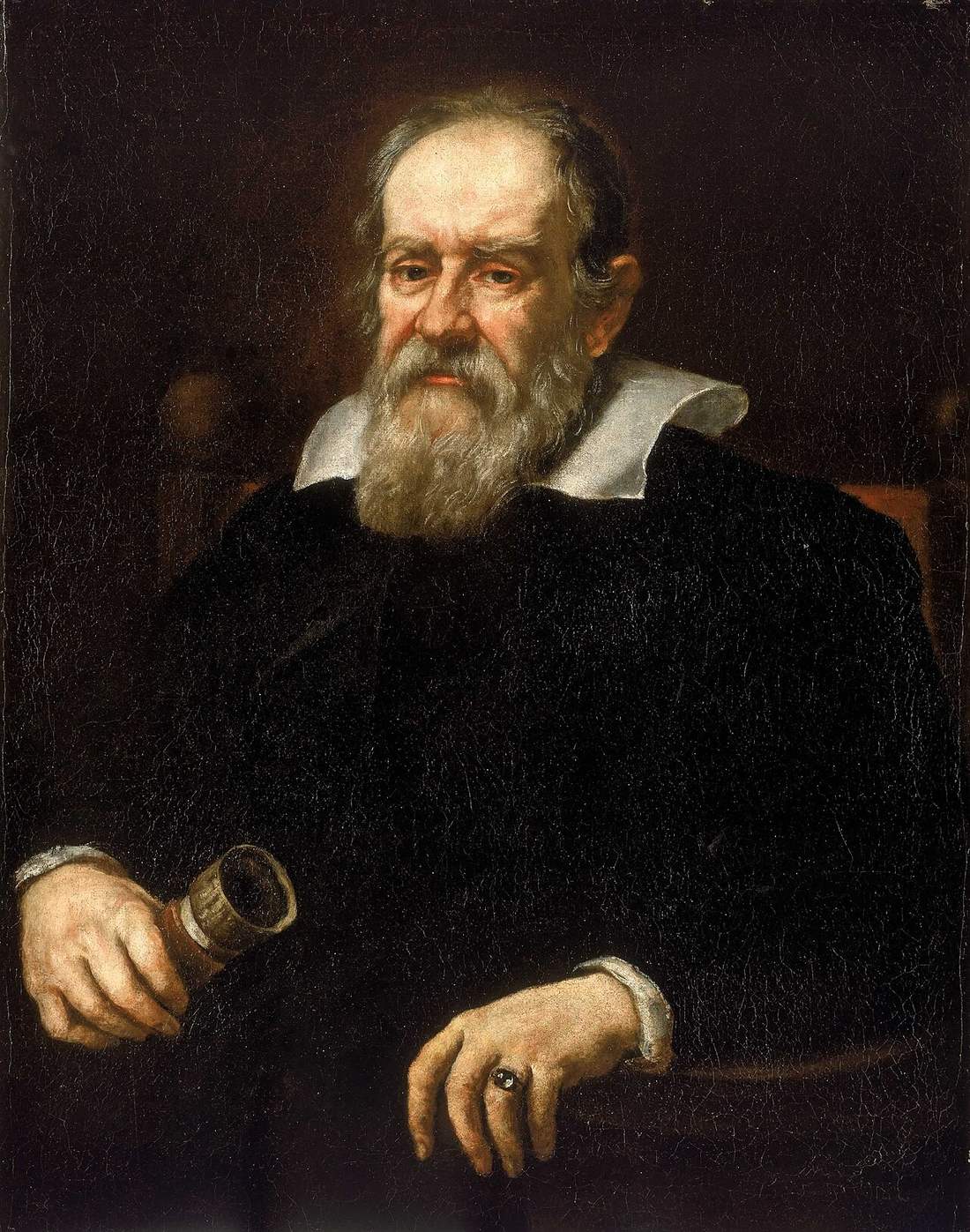
Galileo did not invent the telescope, but he built a much better one and pointed it at Jupiter.
Four points of light shifted position night after night. They were going round Jupiter, not round the Earth, and that was enough to show the Earth is not the only centre.
He also saw mountains on the Moon, spots on the Sun, and the phases of Venus, which Ptolemy’s system cannot produce.
For publishing it he was tried in 1633 and spent the rest of his life under house arrest.
Galileo Galilei He pointed a nine-power tube at Jupiter and found four things going round it.
1609 builds a telescope of about 20×
Jan 1610 four moons beside Jupiter
1632 the Dialogue
1633 tried, and under house arrest for life
The sky moves
4
moons
206
years before Rome gave way
The cost
Chapter II · Step 3
The sky is not perfect
Four moons beside Jupiter in January 1610, mountains on the Moon, and the phases of Venus. Tried in 1633, house arrest for life.
Falling is not a special case. It is the general case.
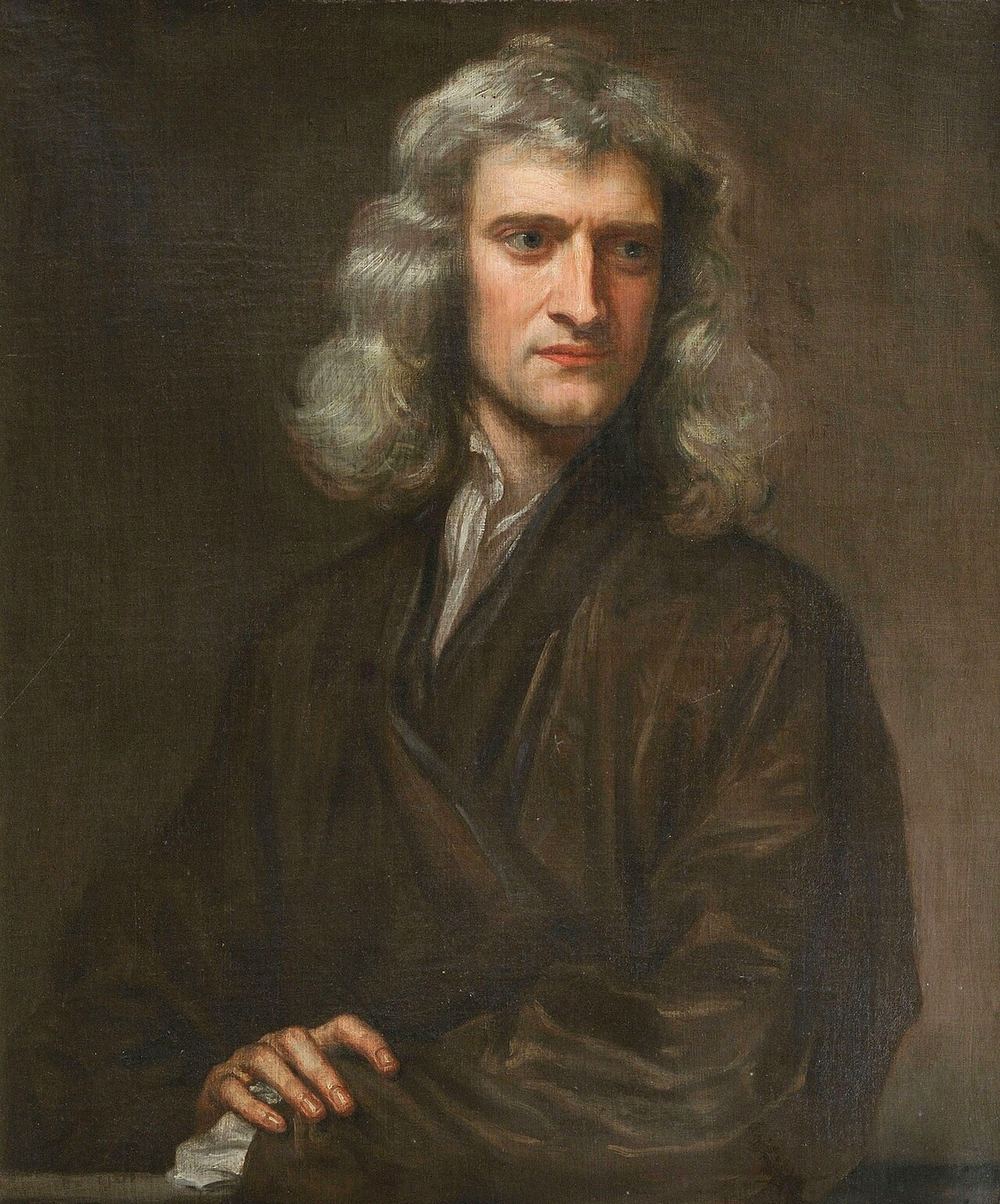
Newton was born at the end of 1642, the year Galileo died.
His move was to notice that the apple and the Moon are doing the same thing. The Moon is sixty Earth-radii away, so if the force weakens as the square of the distance, its acceleration should be three thousand six hundred times smaller than the apple’s.
He worked out what that acceleration actually is from the length of the month, and the numbers matched.
The Principia of 1687 turned the sky into arithmetic. It took Europe about fifty years to accept it.
Isaac Newton The same force that drops an apple holds the Moon in its orbit — and he checked the number.aMoon=602g≈0.0027m/s2The Moon is sixty Earth-radii away, so its acceleration should be 3,600 times smaller than an apple’s. It is.
1687
the Principia
1
law for everything that falls
One law
Chapter II · Step 4
One law for the apple and the Moon
The Moon is 60 Earth-radii out, so an inverse-square force makes its acceleration 1/3600 of an apple’s — about 0.0027 m/s², which is what the month gives. The Principia, 1687.
Weigh the vessel before and after. The number does not move.
Lavoisier’s instrument was the balance, and his contribution was to insist on it.
Burn something in a sealed vessel and weigh the whole vessel before and afterwards. The mass does not change. Burning is not something leaving the substance; it is something in the air joining it.
He named that something oxygen, and in 1789 published the first recognisably modern list of elements.
Five years later the Revolution executed him for having been a tax farmer. He was fifty.
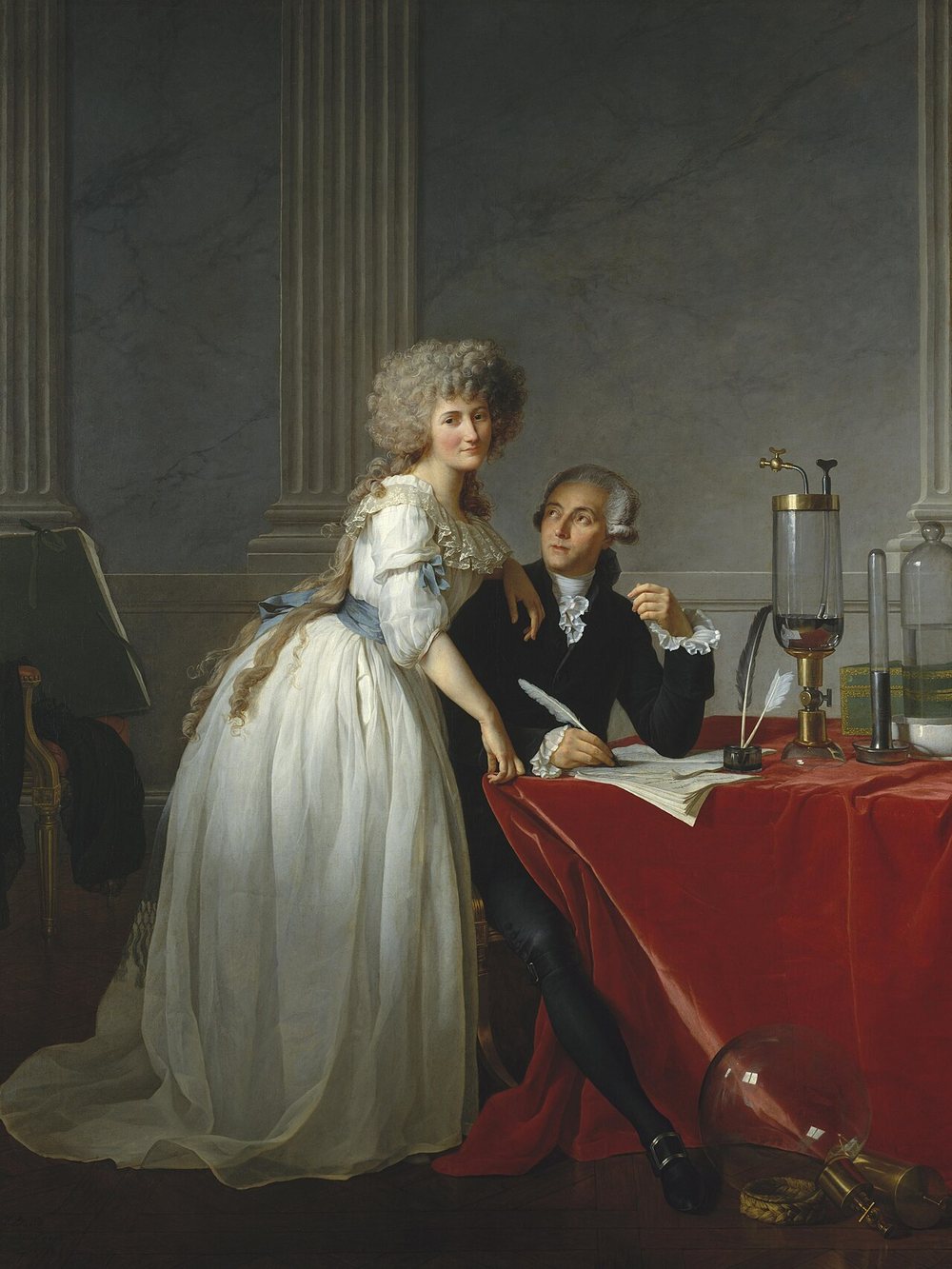
Antoine and Marie-Anne Lavoisier Her drawings and translations are part of the work; the instruments on the table are the argument.
40.0 g
in
40.0 g
out, in a sealed vessel
The balance
Burning is combination with a gas, not loss of phlogiston
He names oxygen and hydrogen
1789: the first modern list of elements
1794: guillotined, aged 50
Chemistry becomes arithmetic
Chapter III · Step 5
Nothing is created, nothing is lost
Weigh a sealed vessel before and after burning: the mass is unchanged. Burning is combination with oxygen, not loss of phlogiston. The Traité of 1789; the guillotine in 1794.
A classification that makes predictions is a theory.
Mendeleev lined up the sixty-odd known elements by atomic weight and found that their properties repeat.
The important decision was what to do when the pattern did not fit. Instead of forcing it, he left the square empty and described the element that would eventually fill it: its weight, its density, the colour of its oxide.
Gallium turned up in 1875, scandium in 1879, germanium in 1886. He had predicted a weight of 72.64 for the last one; the measured value is 72.63.
A classification that makes predictions has stopped being a filing system.
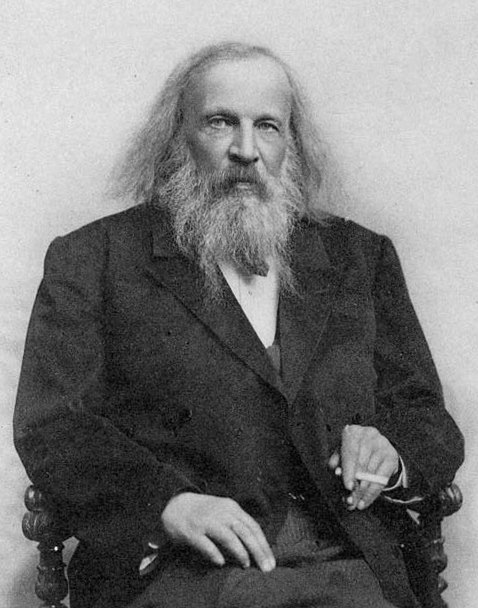
Dmitri Mendeleev He left holes in the table and said what would fit them.
72.64
his predicted weight for eka-silicon
72.63
germanium, found 1886
A prediction
1869: elements ordered by weight repeat in their properties
He leaves gaps rather than force the fit
Gallium 1875, scandium 1879, germanium 1886
A table that tells you what you have not found
The gaps
Chapter III · Step 6
The gaps predicted the elements
Ordered by weight, the elements’ properties repeat. Mendeleev left the misfits as gaps and described what would fill them — eka-silicon at 72.64, germanium measured at 72.63.
Three facts and a conclusion that is hard to escape.
Darwin’s argument needs only three observations.
More offspring are born than can possibly survive. Individuals differ from each other. Some of those differences are passed on.
If all three are true, then the variants that happen to survive will be over-represented in the next generation, and the species will drift. Nobody has to be steering.
He had the argument by 1838 and published in 1859, pushed into print by a letter from Alfred Russel Wallace with the same idea in it.
On the Galápagos today, average finch beak depth measurably shifts from one drought to the next.
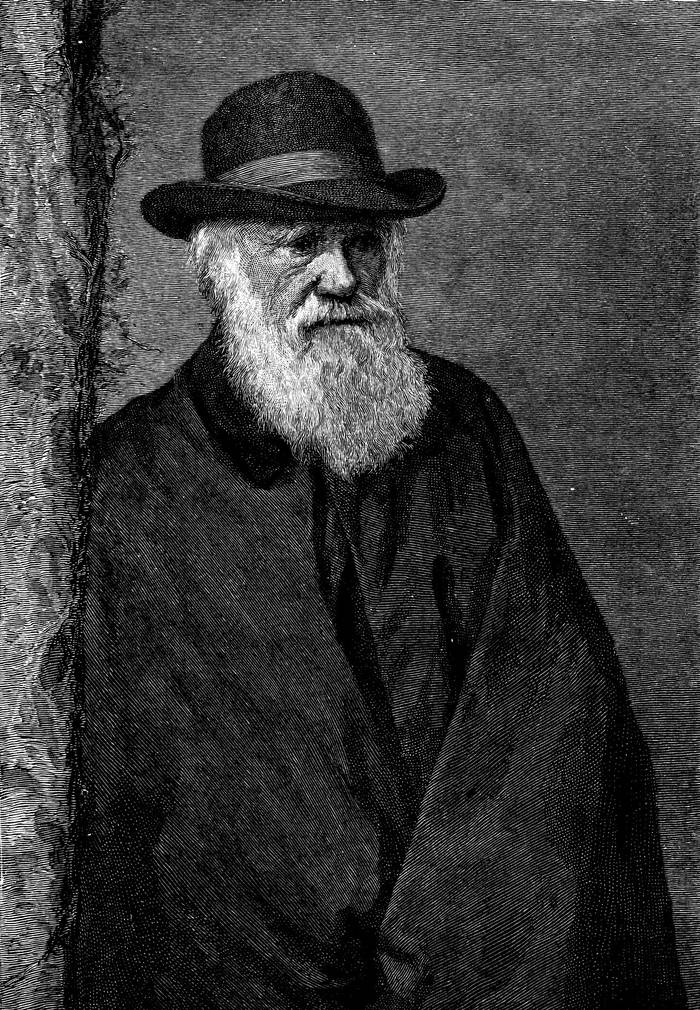
Charles Darwin He sat on the argument for twenty years and then had to publish in a hurry.
More are born than can survive
Individuals vary, and some variation is inherited
The variants that survive leave more offspring
Repeat for long enough and species change
The argument, in four lines
1859
On the Origin of Species
9.4 → 10.2 mm
finch beaks after one drought
Measured, not assumed
Chapter IV · Step 7
Descent with modification
More are born than survive; individuals vary; some variation is inherited. Everything else follows. Published in 1859 after twenty years, and only because Wallace had found the same idea.
The ratio is three to one, and it will not go away.
Darwin had a problem he could not solve: if inheritance blends, variation halves every generation and selection has nothing left to work on.
Three hundred kilometres away, a monk counting peas had the answer. Mendel grew about twenty-eight thousand plants and found that the second generation splits three to one.
That is what you get if inheritance comes in discrete particles that can hide in one generation and reappear in the next.
He published in 1866. It was read by almost nobody, and the result sat unused for thirty-four years.
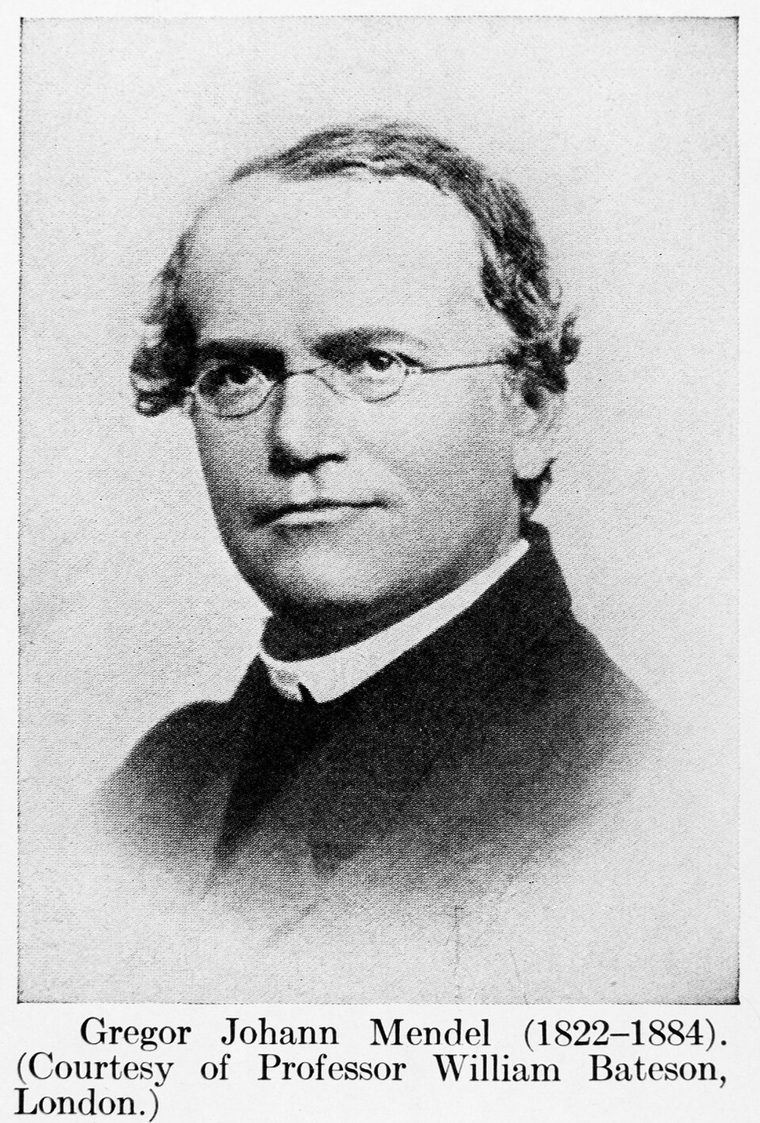
Gregor Mendel Twenty-eight thousand pea plants, counted one at a time.
3 : 1
the ratio in the second generation
34
years before anyone noticed
The number that mattered
Blending inheritance would halve variation every generation
Particles do not: they hide and reappear
Which is exactly what selection needs
Rediscovered in 1900 by three botanists at once
Why it saved Darwin
Chapter IV · Step 8
Inheritance comes in particles
Mendel’s peas split 3 : 1 in the second generation — the signature of discrete inherited factors, not blending. Published 1866, rediscovered 1900, and it is what makes Darwin’s mechanism work.
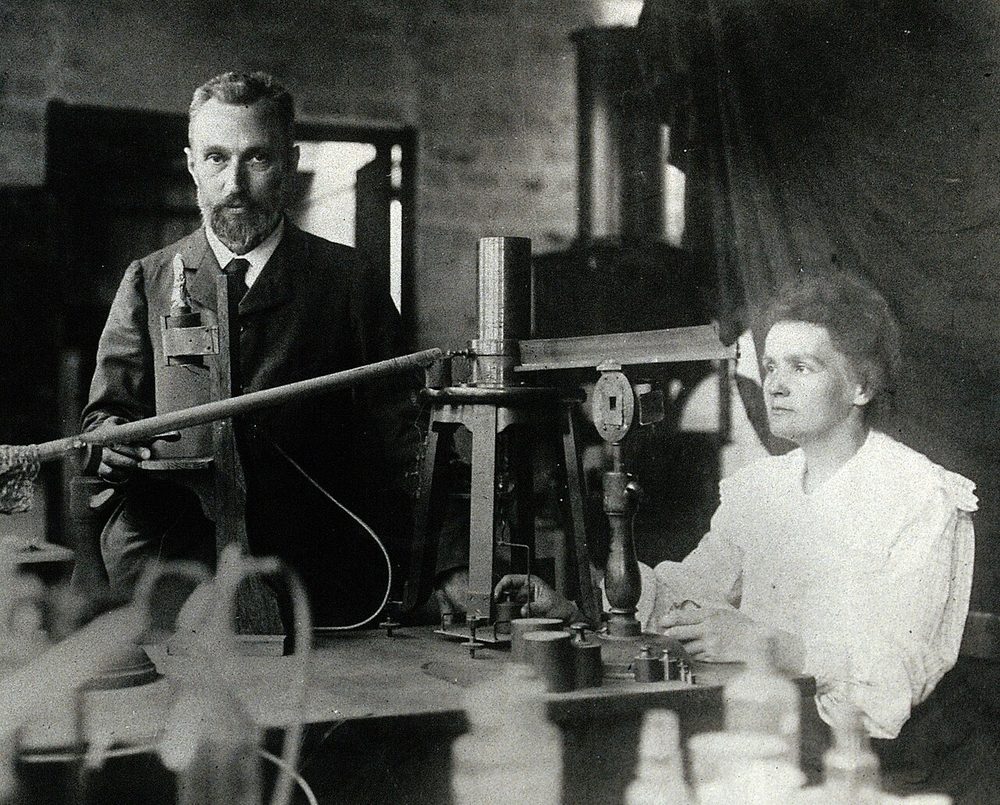
Marie Curie measured the activity of uranium ore with an electrometer and found it was stronger than the uranium in it could account for.
Something else was in there. She and Pierre spent four years processing tonnes of pitchblende to get a tenth of a gram of radium chloride, enough to measure an atomic weight.
Her real claim was not the new elements. It was that the radiation is a property of the atom itself — which means an atom can fall apart.
Two Nobel Prizes, in physics and in chemistry, and a dose that eventually killed her.
Marie and Pierre Curie Her instrument was an electrometer: radiation measured as a current, not guessed at.
0.1 g
of radium chloride from tonnes of ore
1903 · 1911
two Nobel Prizes, in two subjects
The proof
Pitchblende is more active than its uranium explains
So something else must be in it
Polonium and radium, 1898
Radioactivity is a property of the atom itself
The chain of reasoning
Chapter V · Step 9
Matter comes apart by itself
Pitchblende was too active for its uranium, so something else was in it: polonium and radium, 1898. The deeper claim was that radioactivity belongs to the atom — atoms are not permanent.
Falling is not being pulled. It is going straight in a bent place.
Einstein’s starting point was that a person in free fall does not feel their own weight, so gravity and acceleration cannot be told apart locally.
Follow that through and gravity stops being a force and becomes the shape of spacetime. Things in free fall go straight; the straight lines are bent.
The theory was finished in 1915 and made a prediction nobody could argue with: starlight passing the Sun should bend by a specific amount, twice the Newtonian value. The 1919 eclipse measured it.
The satellites above you apply the correction continuously. Without it, GPS would drift about eleven kilometres a day.
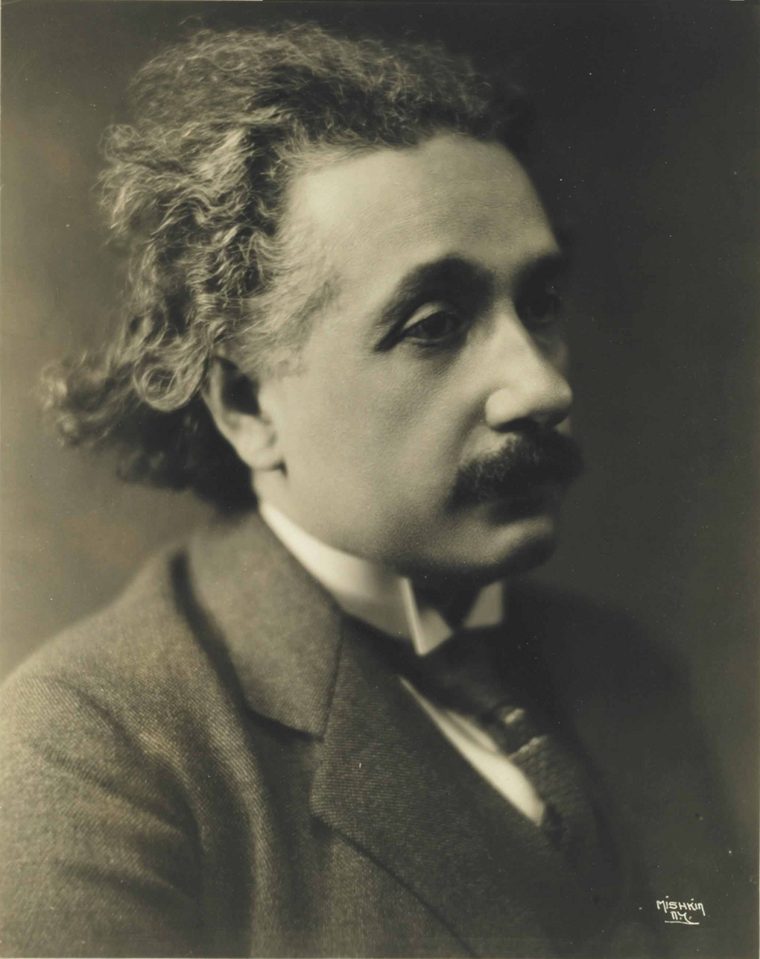
Albert Einstein A man in free fall does not feel his own weight. He called it the happiest thought of his life.Δt=38μs/day;⇒;11.4km/dayUncorrected, relativity would put GPS positions 11.4 km out after a single day.
1905
four papers in one year
1919
the eclipse measurement
Fourteen years
Chapter V · Step 10
Gravity is the shape of spacetime
Free fall feels like nothing, so gravity is not a force but geometry. Finished 1915, confirmed by the 1919 eclipse, and applied every second by GPS — uncorrected, it drifts about 11 km a day.
Right about the what, wrong about the how — and that was enough to bury it.
Wegener put together coastlines that fit, rock belts that continue across oceans, the same fossil plant on five continents, and coal in Antarctica.
The conclusion was that the continents were once joined and have moved apart. The evidence was strong and the reaction was hostile, because he could not say what force moves a continent.
He died on the Greenland ice in 1930, aged fifty, with the idea still rejected.
In the 1960s the sea floor turned out to be spreading, carrying the continents with it, and the magnetic stripes on either side of the ridges are mirror images. He had been right for half a century.
Alfred Wegener He was right about the fact and wrong about the mechanism, and the mechanism is what people judged.
The coastlines fit, and so do the rock belts across them
The same fossil plant lies on five separated continents
Coal in Antarctica; glacier scars in India
But he had no force that could move a continent
The evidence, and the hole
1912
he proposes it
~1965
the sea floor supplies the mechanism
Fifty years
Chapter VI · Step 11
The continents move
Fitting coastlines, continuous rock belts, one fossil plant on five continents, coal in Antarctica — and no mechanism, which is why it was rejected until sea-floor spreading supplied one around 1965.
Hardy had to decide whether it was a crank or a genius. It took him an evening.
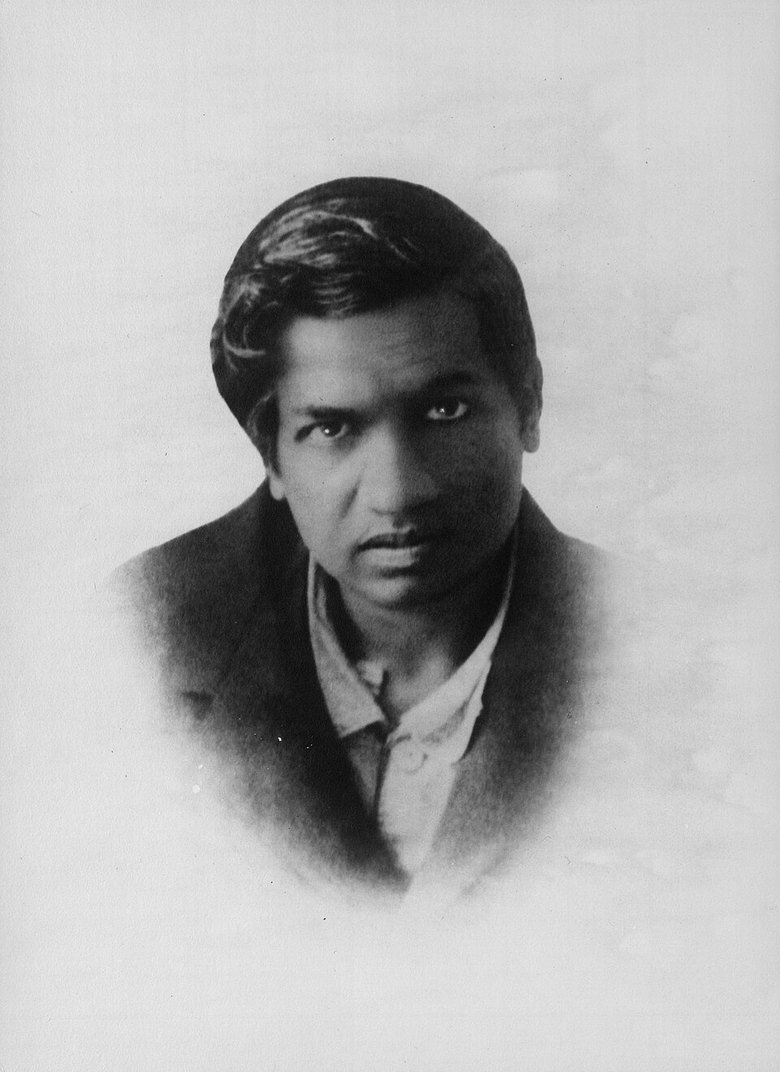
In January 1913 a clerk in Madras posted nine pages of formulas to a Cambridge mathematician he had never met, with no proofs attached.
Hardy later said they must be true, because nobody would have had the imagination to invent them.
Their joint work on partitions produced a formula that is accurate enough to pin down an exact integer: the number of ways to write a hundred as a sum of positive integers is one hundred and ninety million, five hundred and sixty-nine thousand, two hundred and ninety-two.
Ramanujan died in 1920 at thirty-two, leaving notebooks that mathematicians were still proving results from seventy years later.
The letter from Madras Nine pages of formulas with no proofs, from a shipping clerk, in January 1913.p(100)=190,569,292The Hardy–Ramanujan series gives 190,569,291.996 — round it and it is exact.
~3,900
results in his notebooks
32
years old when he died
The output
Chapter VI · Step 12
Formulas from nowhere
A letter from Madras in 1913, nine pages of unproved formulas. The Hardy–Ramanujan series for partitions gives 190,569,291.996 for p(100) — rounding to the exact 190,569,292.
Turing answered the last great question of the series, which was about the limits of proof itself.
To show that no fixed procedure can decide every mathematical statement, he first had to define a procedure — so he described a machine with a tape, a head and a table of rules.
Write a machine’s rules onto the tape as data, and one machine can imitate any other. That is a computer, and the description is software.
Then he showed that no machine can decide, in general, whether a program will stop.
Three years later he was at Bletchley Park. In 1952 his own government convicted him for being gay.
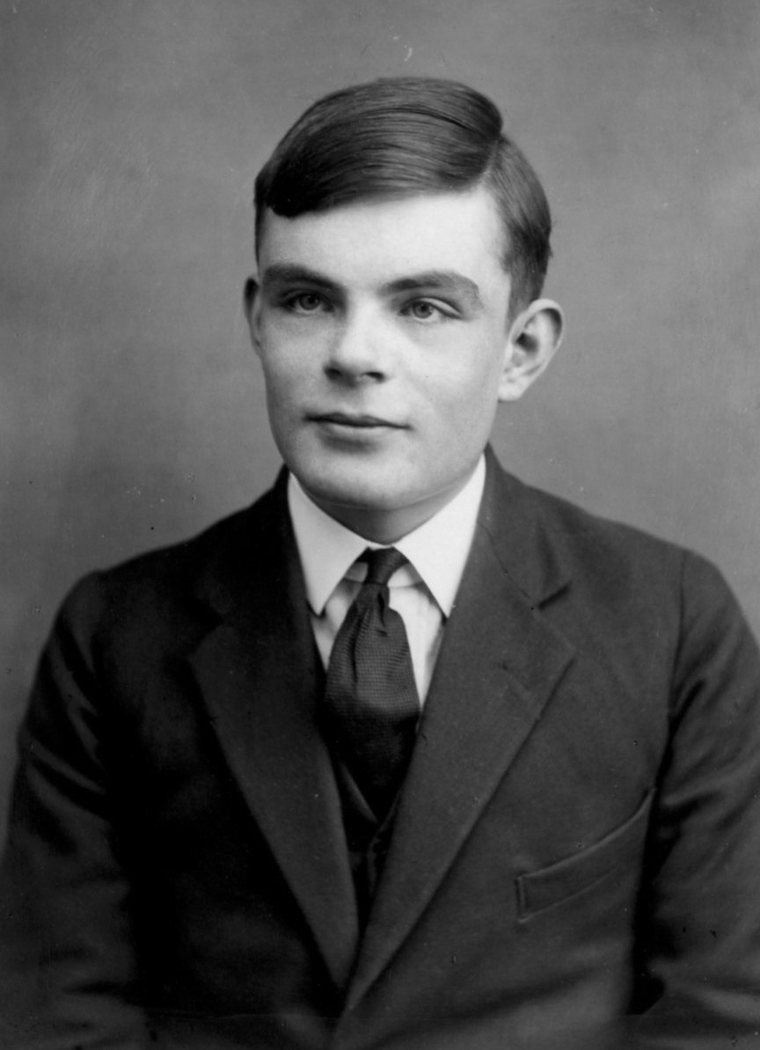
Alan Turing He invented the computer as a step in a proof about what proof cannot do.
1.59 × 10²⁰
Enigma settings
1
machine that can be any machine
Two numbers
A tape, a head, a state, a table of rules
Write the rules on the tape and one machine runs them all
No machine can decide whether a program halts
Bletchley Park, 1939–45, and a conviction in 1952
The last of the eleven
Chapter VII · Step 13
One machine can be any machine
A tape, a head, a table of rules — defined in 1936 to prove that no procedure decides every mathematical question. Rules written as data make one universal machine, which is every computer since.
Press a name. The bar is the years between the claim and the end of the argument.
Here is the same eleven, measured a different way: the years between making the claim and the argument being effectively over.
Einstein waited four years, because he had made a prediction that an eclipse could check. Mendeleev waited six, for gallium to be dug up.
Mendel waited thirty-four, because nobody read him. Wegener waited fifty, because he had no mechanism. Darwin’s natural selection waited roughly eighty for genetics to catch up with it.
And Galileo waited two hundred and six, because the question had stopped being about astronomy.
Press a name and the readout gives the two dates.
Galileo
206 years
Darwin
80 years
Newton
50 years
Wegener
50 years
Mendel
34 years
Turing
12 years
Lavoisier
11 years
Mendeleev
6 years
Curie
5 years
Einstein
4 years
Ramanujan
0 years
Years until the argument was over
Fast when there is a number to check
Slow when the claim has no mechanism
Slowest when somebody powerful has taken a side
Being right early is not the same as being believed
The pattern
4
years: Einstein
206
years: Galileo
The range
Epilogue · Step 14 · Interactive
How long they waited
Years from the published claim to the end of the argument: Einstein 4, Curie 5, Mendeleev 6, Lavoisier 11, Turing 12, Mendel 34, Newton ~50, Wegener ~50, Darwin ~80, Galileo 206.
“Over” is a judgement, so treat the long bars as approximate. The pattern is not: a checkable prediction ends an argument fast; a missing mechanism, or an authority with a position, makes it last.
The last thing worth saying is that none of these people worked alone, and none of them started from nothing.
Newton had Galileo’s falling bodies and Kepler’s orbits. Mendeleev had Lavoisier’s list of elements. The theory of evolution only became quantitative when Mendel’s peas were rediscovered thirty-four years after he published. Turing had Hilbert’s question and Gödel’s answer.
Press a name and the readout says what each of them was standing on.
Eleven episodes follow this one. The chapter stills are AI-generated; the portraits and documents are real, credited where they appear, and the sources are listed in every step.
Newton needed Galileo and Kepler
Mendeleev needed Lavoisier’s element list
Darwin needed Lyell’s deep time; the synthesis needed Mendel
Turing needed Hilbert’s question and Gödel’s answer
The debtsStill going The method outlived every one of them, which was the point of writing it all down.
11
episodes
1
argument, continued
Where to go next
Epilogue · Step 15 · Interactive
Nobody did it alone
Every one of them inherited a question, an instrument or a number from somebody else. Press a name to see what they were standing on.
II Galileo · Newton
III Lavoisier · Mendeleev
IV Darwin · Mendel
V Curie · Einstein
VI Wegener · Ramanujan
VII Turing
Chapter stills in this film are AI-generated illustrations. The portraits and the letter are real historical images, credited where they appear.