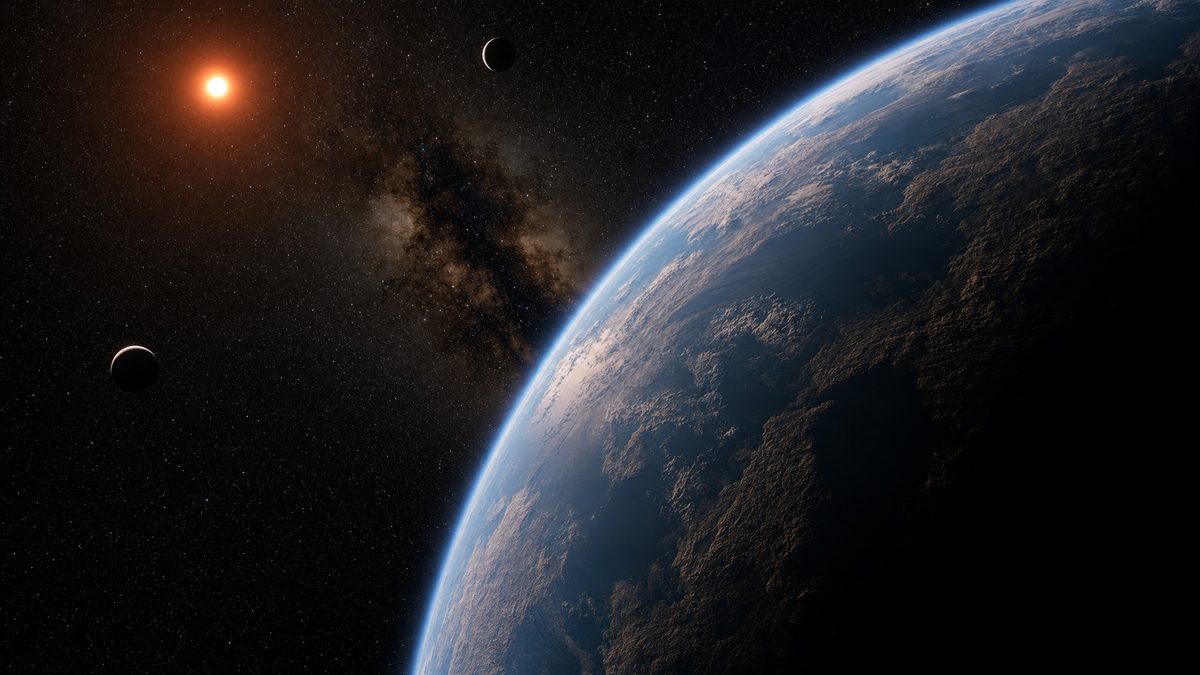
How astronomers find planets around other stars, from a star's tiny wobble to the shadow of a passing world, and how we would recognise life on one: in the colours of its air, in Martian rock, or in oceans under icy moons. With 6,445 confirmed exoplanets as of October 2026.
Interactive 3D film7 min1961 to 2026Published 2026-10-13
In 1991 we knew of no planets around other stars. Today the count stands at 6,445.
Last week, NASA’s catalogue of planets around other stars passed one thousand worlds found by the TESS telescope alone.
In all, six thousand four hundred and forty-five exoplanets are now confirmed. Each dot here is a star known to have planets.
Thirty-five years ago, the count was zero. How do you find a planet you cannot see? And could any of them hold life?
Prologue · Why now
Six thousand worlds and counting
On 8 October 2026 the NASA Exoplanet Archive added 70 newly confirmed planets. With them, the number of planets discovered with data from NASA’s TESS satellite passed 1,000, and the archive’s total of confirmed exoplanets reached 6,445. The first was confirmed in 1992.
Confirmed exoplanets
6,445
NASA Exoplanet Archive, 8 Oct 2026
Planetary systems
4,842
stars (or star pairs) known to host planets
Found with TESS
1,008
launched 2018
Found with Kepler and K2
3,337
2,787 Kepler + 550 K2
The scene shows every known planet host the archive gives a distance for, around the Sun at the centre. Directions are real; distances are squeezed on a logarithmic scale so that stars 4 and 8,000 light-years away fit in one view. Colour shows how each system’s first planet was found: transit , wobble , microlensing , imaging , other .
How to use: pick a chapter below the scene or press ← → to change step · ▶ plays the step · drag to rotate, scroll or pinch to zoom · the box on the scene (under the scene on phones) holds sliders and buttons · “Play the film” runs every step full-screen.
Frank Drake turned the question “are we alone?” into a chain of numbers, most of them unknown.
In 1961, the astronomer Frank Drake hosted the first scientific meeting on searching for signals from alien civilisations.
For its agenda he wrote an equation: how often stars form, how many have planets, how many of those could support life, and so on down the chain.
Multiply them and you get N, the number of civilisations we might hear. The first terms can now be measured. The rest are still guesses.
Chapter I · Step 1 · 1961
The Drake equation
In 1961 Frank Drake hosted the first scientific meeting on the search for extraterrestrial intelligence (SETI), at the radio observatory in Green Bank, West Virginia. He wrote the equation as an agenda for discussion, not to calculate a precise answer.
N = R* · fp · ne · fl · fi · fc · L
R* new stars per year in the Milky Way. Today: about 1 to 3.
fp fraction of stars with planets. Microlensing surveys suggest close to 1.
ne planets per system that could support life.
fl, fi, fc fractions that develop life, then intelligence, then detectable technology. Unknown.
L how many years such a civilisation keeps sending detectable signals. Unknown.
The calculator on the scene is a toy for exploring guesses. In 1961 the group’s “educated guesses” gave anywhere from about 20 to 50 million; they concluded N is roughly equal to L. Published modern guesses range from far less than one to millions. The dots that appear in the galaxy show N; they are not real places.
If the galaxy is old and big, someone should have spread across it long ago.
In 1950, over lunch, the physicist Enrico Fermi had asked: but where is everybody?
Our galaxy is over thirteen billion years old. Even travelling slowly, a spacefaring species could spread across it in five to fifty million years: a blink in cosmic time.
Yet decades of listening have found no clear signal. Maybe life is rare, maybe civilisations do not last, or maybe we have not looked well enough.
Chapter I · Step 2 · 1950 → today
The Fermi paradox
At lunch in Los Alamos in 1950, Enrico Fermi asked a question his colleague Emil Konopinski remembered as “But where is everybody?”. The paradox is the gap between how likely other civilisations seem and the lack of any evidence for them.
Age of the Milky Way
~13.6 billion yr
its oldest stars formed soon after the Big Bang
Stars in it
100–400 billion
and at least as many planets
Time to spread across the galaxy
about 5 to 50 million years, even with slow interstellar travel
a blink compared with the galaxy’s age
Rare Life, or intelligence, may be extremely rare.
Short Technological civilisations may not last long.
Unseen They may exist, but for many possible reasons we see no evidence.
The animation spreads one imaginary civilisation outward from a single star (illustration only). Press the button to start another one somewhere else.
The first worlds found beyond the Sun circle the corpse of an exploded star.
The first planets beyond the Sun turned up in 1992, around a pulsar: the spinning core of a dead star.
Aleksander Wolszczan and Dale Frail timed its radio pulses, which arrive about one hundred and sixty times a second, as steady as a clock.
The pulses came slightly early, then slightly late. Planets were tugging the pulsar to and fro. Bathed in radiation, they are no home for life.
Chapter II · Step 3 · 1992
Pulsar planets
PSR B1257+12 is a millisecond pulsar about 2,300 light-years away, a neutron star spinning 160.8 times a second. Aleksander Wolszczan found it in 1990 with the Arecibo radio telescope. In 1992 he and Dale Frail showed that the arrival times of its pulses shift in a repeating pattern: the pulsar is being pulled around by planets.
Planet c
4.3 Earths
orbit 66.5 days · found 1992
Planet d
3.9 Earths
orbit 98.2 days · found 1992
Planet b
0.02 Earths
orbit 25.3 days · found 1994; less than twice the Moon’s mass
Pulsar planets known
only a handful
they are rare
The plot shows how early or late each pulse arrives as the three planets pull the pulsar. The shape is computed from their real orbital periods and relative masses; the vertical scale is illustrative. The pulsar’s radiation and wind would likely strip any atmosphere.
A planet around a Sun-like star, found by the tiny back-and-forth motion it gives its star.
In 1995, Michel Mayor and Didier Queloz found a planet around 51 Pegasi, a star much like the Sun.
They did not see the planet. They saw the star wobble, as star and planet circle their shared centre of mass.
Moving towards us, the starlight shifts bluer; moving away, redder. The planet was half Jupiter’s mass, with a year of four days. It won the 2019 Nobel Prize.
Chapter II · Step 4 · 1995
51 Pegasi b and the wobble method
On 6 October 1995 Michel Mayor and Didier Queloz of the University of Geneva announced a planet around 51 Pegasi, a Sun-like star about 50 light-years away. They used the ELODIE spectrograph at the Haute-Provence Observatory in France to measure the star’s speed towards and away from us through the Doppler shift of its spectral lines.
Orbit
4.23 days
about 7 million km from its star, far closer than Mercury is to the Sun
Mass
≥ 0.47 Jupiter
the wobble gives a minimum mass
Star’s wobble
±56 m/s
NASA Exoplanet Archive
Nobel Prize
2019
half of the Physics prize to Mayor and Queloz
For comparison
Jupiter moves the Sun by about 13 m/s; Earth by about 9 cm/s
good spectrographs reach about 3 m/s or a little better
51 Pegasi b became the prototype “hot Jupiter”, a type of planet theory had not predicted. In the scene the star’s motion is greatly exaggerated and its colour shift is drawn far stronger than real. Use the sliders to change the planet; the speed is computed with Newton’s laws for an orbit seen edge-on.
When a planet passes in front of its star, the star dims by a tiny, measurable amount.
Another method watches for shadows. If a planet’s orbit is edge-on to us, it crosses its star and blocks a little light.
The dip gives its size: about one percent for a Jupiter, less than one part in ten thousand for an Earth.
NASA’s Kepler stared at about 150,000 stars from 2009 to 2018 and found thousands of planets this way. Since 2018, TESS has been scanning nearly the whole sky.
Chapter III · Step 5 · 2009 → today
The transit method
If a planet’s orbit is lined up edge-on from our point of view, it passes in front of its star once per orbit. The star dims by the fraction of its disc the planet covers, (planet radius ÷ star radius)². The depth gives the planet’s size, the spacing between dips its year. Combine it with the wobble and you get the planet’s mass and density.
Earth-size planet, Sun-like star
~0.008 %
about 80 parts per million
HD 209458 b (hot Jupiter)
1.7 %
dimming during transit
Kepler, 2009–2018
~150,000 stars
one patch of sky in Cygnus, Lyra and Draco · 2,787 planets confirmed (+550 from K2)
TESS, 2018 →
~85 % of sky
bright nearby stars · 1,008 planets confirmed so far
Only a small share of planets are aligned well enough to transit: about 10% of close-in planets, far fewer for wide orbits. Try the sliders: the light curve, duration and alignment chance are computed for a Sun-like star. The orbit drawing is not to scale.
Block the star to photograph its planets, or let gravity act as a magnifying glass.
Seeing a planet directly is harder: a star like the Sun outshines its planets about a billion times.
A mask called a coronagraph blocks the starlight. Young planets still glow with heat, and in 2008 this revealed giant planets around HR 8799.
Gravity can help too. When a star drifts in front of a more distant one, it bends and magnifies its light, and a planet adds a brief extra spike.
Chapter III · Step 6 · 2008 → today
Direct imaging and microlensing
Direct imaging. A star like the Sun is about a billion times brighter than the light its planets reflect. Coronagraphs block the star, and young giant planets, still hot from their formation, shine in infrared. On 13 November 2008 a team using the Keck and Gemini telescopes announced three planets around HR 8799, 133 light-years away; a fourth followed. They are each several times Jupiter’s mass.
Microlensing. When a foreground star passes almost exactly in front of a background star, its gravity bends and magnifies the background light for days or weeks. A planet around the foreground star adds a short extra blip. The alignment never repeats, but the method finds planets far from their stars and thousands of light-years away.
Found by imaging
97
NASA Exoplanet Archive
Found by microlensing
292
mostly towards the crowded centre of the galaxy
Nancy Grace Roman Space Telescope
launched 30 August 2026
a microlensing planet survey is one of its core projects
First half of the step: the HR 8799 system with the coronagraph switched on or off (orbits sped up enormously). Second half: a simplified lensing event. The two bright arcs are the two images of the background star that a point-like lens produces; their total brightness gives the plotted curve.
Most planets look nothing like ours, and the commonest kind is missing from the solar system.
Together, the planets paint a strange picture. Each dot is a confirmed world, placed by the length of its year and its size.
Hot Jupiters were the easiest to find. The most common are planets between Earth and Neptune in size, a kind our solar system lacks.
Surveys suggest the galaxy has at least as many planets as stars: hundreds of billions of worlds.
Chapter IV · Step 7 · The census
6,445 planets
Each dot is a confirmed exoplanet with a measured size and orbital period (6,045 of the 6,445). Big planets close to their stars are the easiest to find, so they are over-represented. Correcting for that bias, surveys find that planets between Earth and Neptune in size, super-Earths and sub-Neptunes, are the most common type, even though the solar system has none.
Transit4,781 planets
Wobble (radial velocity)1,203 planets
Microlensing292 planets
Imaging97 planets
Other methods72 planets (timing, astrometry…)
Total6,445 · 4,842 systems
The solar system’s planets are marked with rings for comparison. The year on the clock grows as the step plays, adding planets in the year they were discovered. Use the buttons to show one method at a time. Data: NASA Exoplanet Archive, composite parameters table, queried 13 October 2026.
The range of orbits where a planet like Earth could keep liquid water on its surface.
Life as we know it needs liquid water. Too close to its star, a planet’s oceans boil away; too far, they freeze.
Between lies the habitable zone. Around the Sun it runs from just inside Earth’s orbit to beyond Mars.
Around a cooler star the zone shrinks inwards; around a hotter one it moves out. Slide the star’s temperature and watch the planets change colour.
Chapter V · Step 8 · What “Earth-like” means
The habitable zone
The habitable zone (or “Goldilocks zone”) is the range of orbits where an Earth-like planet could keep liquid water on its surface. At the inner edge, sunlight trapped by greenhouse gases boils the oceans away (a runaway greenhouse). At the outer edge, even a thick carbon-dioxide atmosphere cannot keep the planet warm.
Sun’s zone (conservative)
~0.95–1.67 AU
Earth 1 AU · Mars 1.52 AU
Red dwarf like Proxima
~0.04–0.08 AU
a dim star’s zone hugs it closely
“Earth-like” usually means
roughly Earth-sized, probably rocky, and in the habitable zone
it does not mean the planet has water, air or life
The zone edges in the scene are computed from the formulas of Kopparapu and colleagues (2014) for an Earth-mass planet: green is the conservative zone, the faint band the more optimistic one. Distances are on a logarithmic scale. Real habitability also depends on the atmosphere, the planet’s mass, stellar flares and more, so being in the zone is only a first filter.
TRAPPIST-1 has seven Earth-sized planets. Our nearest stellar neighbour has one too.
In 2017 astronomers announced seven Earth-sized planets around TRAPPIST-1, a small cool star forty light-years away.
All seven would fit inside Mercury’s orbit, and three or four lie in the habitable zone. So far, none has shown an atmosphere.
The nearest star, Proxima Centauri, also has a planet in its habitable zone. But Proxima flares violently, which could strip a planet’s air.
Chapter V · Step 9 · 2016–2017
TRAPPIST-1 and Proxima b
TRAPPIST-1 is an ultracool red dwarf about 40 light-years away, only slightly larger than Jupiter. On 22 February 2017 astronomers announced that it has seven transiting, Earth-sized planets. They orbit in 1.5 to 19 days and are probably tidally locked, with permanent day on one side and night on the other.
In or near the habitable zone
d, e, f, g
three or four of the seven
Atmospheres
none found yet
Webb’s heat measurements ruled out a thick atmosphere on TRAPPIST-1 b
Proxima Centauri b
4.2 light-years
the closest known exoplanet; announced 24 Aug 2016 (wobble method, HARPS)
Proxima b orbit · mass
11.2 d · ≥1.06 Earths
a flare star’s bursts could strip its air
Red dwarfs are the commonest stars, so if their planets can keep atmospheres, they may be the commonest places to look for life. In the scene the orbits and planet speeds are to scale with each other (planets drawn larger); use the buttons to compare the two systems with the inner solar system.
During a transit, a sliver of starlight filters through the planet’s atmosphere and carries its fingerprints.
To look for life, we need to know what a planet’s air is made of. Transits make that possible.
As the planet crosses its star, a little starlight shines through its atmosphere. Each gas absorbs its own colours, so at those colours the planet looks slightly bigger.
Plot its size against colour and every gas leaves a fingerprint. Switch them on and see.
Chapter VI · Step 10 · Transmission spectroscopy
Reading an atmosphere in transit
During a transit most of the blocked light is stopped by the solid planet, but a thin ring of starlight passes through the edge of its atmosphere. Each molecule absorbs particular wavelengths, set by how it vibrates and rotates. At those wavelengths the atmosphere is opaque higher up, so the planet looks slightly larger. A plot of the planet’s apparent size against wavelength is its transmission spectrum.
Measure the transit depth separately at hundreds of wavelengths.
Where a gas absorbs, the depth rises: a bump in the spectrum.
Compare with models of many gases to find which ones are there and how much.
The strongest bands of water, carbon dioxide and methane are in infrared light, which the James Webb Space Telescope (launched 25 Dec 2021, 6.5 m mirror) was built to see. The spectrum in the scene is a simplified model: band positions follow measured molecular vibrations (for example CO₂ near 4.3 µm, CH₄ near 3.3 µm, O₃ near 9.6 µm), but heights and widths are illustrative.
Webb’s first exoplanet results showed what modern telescopes can read in alien air.
In 2022, the James Webb Space Telescope read the air of WASP-39 b, a hot gas giant seven hundred light-years away.
A clear bump near four point three microns revealed carbon dioxide, a first for any planet beyond the solar system.
Beside it was sulfur dioxide, made by starlight-driven chemistry, along with water vapour and sodium. Far too hot for life, but proof the method works.
Chapter VI · Step 11 · 2022
WASP-39 b: carbon dioxide and sulfur dioxide
WASP-39 b is a puffy gas giant with about the mass of Saturn, orbiting a Sun-like star every four days about 700 light-years away, at roughly 900 °C. Webb’s NIRSpec instrument observed a transit on 10 July 2022. A hill between 4.1 and 4.6 microns was the first clear evidence of carbon dioxide in an exoplanet’s atmosphere.
Carbon dioxide (CO₂)
~4.3 µm
first clear detection in an exoplanet
Sulfur dioxide (SO₂)
~4.05 µm
first evidence of photochemistry on an exoplanet
Also seen
water, sodium, potassium, carbon monoxide
Webb and earlier telescopes
Not obvious
methane, hydrogen sulfide
if present, at very low levels
Sulfur dioxide forms when high-energy starlight drives reactions high in the atmosphere, much as sunlight makes Earth’s ozone layer. The “WASP-39 b” button loads the gases reported for this planet into the simplified model on the scene.
A faint hint of a gas linked to life on Earth, and a scientific argument about how sure we can be.
What would count as a sign of life? Earth’s air holds both oxygen and methane, a mix that chemistry alone would not keep. Life keeps topping it up.
In 2025 a Cambridge-led team reported a hint of dimethyl sulfide, made on Earth mainly by sea plankton, on K2-18 b, a large planet in a habitable zone.
The signal was three sigma, short of the five a discovery needs. Other teams found the evidence weak, and newer data showed no clear sign of it.
Chapter VII · Step 12 · Biosignatures
Biosignatures and the K2-18 b debate
A biosignature is a substance or pattern that points to life. On Earth, photosynthesis fills the air with oxygen, and life keeps methane far above the level chemistry alone would allow; the two together are a strong clue. But every candidate gas also has non-living ways to form, so context matters.
K2-18 b orbits a red dwarf 124 light-years away in its habitable zone. It is about 2.6 times Earth’s width and 8.6 times its mass, a sub-Neptune, not a rocky Earth.
2023 Webb detects methane and carbon dioxide; a tentative hint of dimethyl sulfide (DMS).
Apr 2025 Madhusudhan and colleagues (Cambridge) report DMS and/or dimethyl disulfide (DMDS) at 3σ in mid-infrared data. On Earth DMS is made mainly by marine microbes such as phytoplankton.
2025 Independent reanalyses (e.g. Luque et al.) find insufficient evidence: other molecules fit as well, and results change with data processing.
2025 Four new Webb transits (Hu et al., with Madhusudhan as co-author) firmly confirm methane and CO₂ and a water-rich planet, but DMS stays marginal. Models also show DMS can form without life in such atmospheres.
Status: not accepted as evidence of life. The planet remains one of the most interesting temperate worlds to study, and more observations are planned.
“3σ” means about a 0.3% chance that noise alone would produce the signal; physicists normally ask for 5σ. The slider is a toy model: it shows how evidence grows only with the square root of the number of transits observed. Its numbers are illustrative, not the real K2-18 b analysis.
A Martian rock with the most intriguing hint of ancient life yet, and no way home.
Closer to home, Mars once had rivers. In July 2024 NASA’s Perseverance rover found a rock called Cheyava Falls, speckled with tiny leopard spots.
On Earth, similar spots often form where microbes feed on organic matter. In 2025 NASA called them a potential biosignature, though chemistry alone might explain them.
A sample now waits aboard the rover, but with the Mars sample return mission cancelled, nobody knows when it will reach Earth.
Chapter VIII · Step 13 · Mars
Cheyava Falls: a potential biosignature
Perseverance landed in Jezero Crater, an ancient lake bed, in February 2021. In July 2024 it reached an arrowhead-shaped rock about 1 metre long, nicknamed Cheyava Falls, in an old river valley called Neretva Vallis. The clay- and silt-rich rock contains organic carbon and is dotted with millimetre-sized “leopard spots”.
The spots are reaction fronts rich in two iron minerals: vivianite (iron phosphate) and greigite (iron sulfide).
On Earth, vivianite often forms around decaying organic matter, and some microbes produce greigite.
In a Nature paper in September 2025, NASA called this a “potential biosignature”: it might have a biological origin but needs more study. Non-biological chemistry cannot be ruled out.
Sample
“Sapphire Canyon”
one of 27 rock cores collected by the rover
Mars Sample Return (NASA–ESA)
cancelled in 2026
NASA says it is studying cheaper return options
Other plans
China’s Tianwen-3 sample-return mission targets the 2028–29 launch window
with its own samples, from a different site
The globe is a stylised Mars; the marker shows Jezero Crater (18.4° N, 77.6° E).
Two small moons hide liquid water oceans, and one of them is spraying its ocean into space.
Farther out, oceans hide beneath ice. Jupiter’s moon Europa has a salty sea under its frozen crust.
NASA’s Europa Clipper, launched in 2024, reaches Jupiter in 2030 and will fly past Europa forty-nine times.
At Saturn, Cassini flew through jets spraying from the moon Enceladus. It tasted salt, organic molecules and hydrogen: signs of hot vents on the seafloor.
Chapter VIII · Step 14 · Icy moons
Europa and Enceladus
Europa (Jupiter) has a subsurface ocean beneath its ice, first revealed by the Galileo spacecraft. Europa Clipper launched on 14 October 2024, swung past Mars in March 2025, will swing past Earth in December 2026, enters orbit around Jupiter in April 2030 and will make 49 close flybys of Europa from 2031. Its dust analyser could sample ocean material if plumes exist.
Enceladus (Saturn), only about 500 km across, has a global ocean 26 to 31 km deep under its crust. In 2005 Cassini discovered water-rich jets venting from cracks near its south pole and later flew through them.
In Enceladus’s plumes
salt, silica, organics, H₂
evidence of hydrothermal activity on the seafloor
2023
phosphates found
completing carbon, hydrogen, nitrogen, oxygen, sulfur and phosphorus
Sizes and distances in the scene are not to scale.
To photograph another Earth, we need giant mirrors and near-perfect darkness around a star.
To photograph an Earth twin, a telescope must pick out a faint dot beside a star a billion times brighter.
In Chile, the Extremely Large Telescope, with a mirror thirty-nine metres across, is due to see first light in 2029.
NASA’s proposed Habitable Worlds Observatory would block starlight well enough to image at least twenty-five Earth-like planets. Slide the starlight down and find the planet.
Chapter IX · Step 15 · The next telescopes
Bigger mirrors, darker skies
Extremely Large Telescope (ESO)
39.3 m
798 hexagonal segments · Cerro Armazones, Chile
ELT schedule
first light Mar 2029
first science planned Dec 2030
Habitable Worlds Observatory
6–8 m
proposed NASA flagship, launch in the 2040s
HWO goal
image ≥ 25 potentially habitable worlds
then search their spectra for gases such as oxygen and methane
The Habitable Worlds Observatory would use a coronagraph or a starshade to block a star’s light and photograph Earth-size planets in habitable zones. It is estimated to cost at least $11 billion, and its funding is uncertain: the 2027 budget proposal released in April 2026 requested $5 million, down from $150 million enacted for 2026.
The scene is a toy model of starlight suppression: lower the starlight with the slider and switch mirror sizes. A bigger mirror makes the star’s blur narrower, so the planet stands clear sooner. Mirror drawings are not to scale.
In one lifetime we went from no known planets beyond the Sun to thousands, and from guessing about alien air to measuring it.
We still do not know if anything lives out there. But the question is now an experiment: a rock on Mars, oceans under ice, and faint colours in distant starlight.
Epilogue · 1961 → 2026
From a guess to a measurement
1950 Fermi asks “Where is everybody?”
1961 Drake writes his equation for the first SETI meeting
1992 First exoplanets, around the pulsar PSR B1257+12
1995 51 Pegasi b, around a Sun-like star (Nobel 2019)
2005 Cassini finds water jets on Enceladus
2008 First images of a multi-planet system, HR 8799
2009–18 Kepler finds thousands of planets by transit
2016 Proxima b, around the nearest star
2017 Seven planets around TRAPPIST-1
2022 Webb detects CO₂ on WASP-39 b
2025 K2-18 b debate; Cheyava Falls called a potential biosignature
2026 6,445 confirmed planets; Roman launches
2029–30 ELT first light; Europa Clipper at Jupiter
All full-screen stills are AI-generated to help the imagination and are not photographs or real images of these worlds. The 3D scenes are simplified models. Planet data: NASA Exoplanet Archive, queried 13 October 2026.