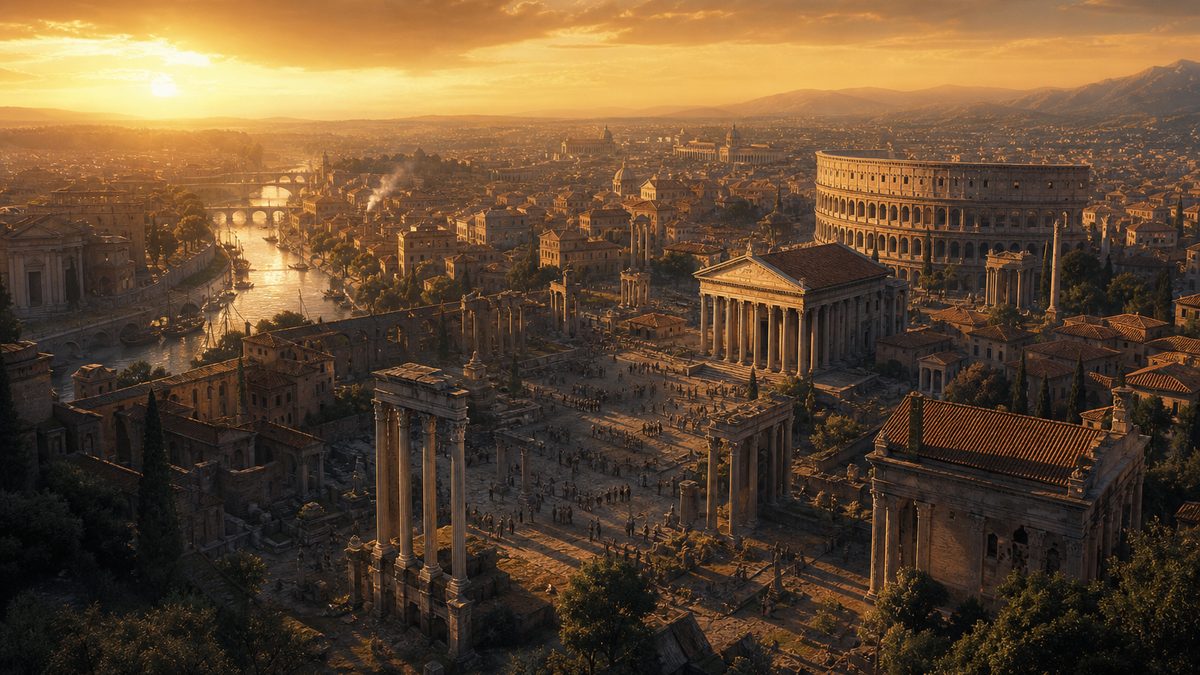
From a village on the Tiber to the Republic, the Punic Wars and Hannibal, Caesar and the Rubicon, Augustus and the Pax Romana, the peak under Trajan, the third-century crisis, Constantine and Constantinople, the fall of the West in 476, and the eastern Roman (Byzantine) empire until 1453. Episode 06 of the World Empires series.
Interactive 3D film6 min509 BC to AD 1453Published 2026-10-13
From a village on seven hills to an empire of three continents.
Roman legend says the city was founded in 753 BC by Romulus, raised by a she-wolf. Archaeology shows villages of huts on the Palatine hill around that time.
Rome sat at a river crossing in central Italy, between Etruscan cities to the north and Greek colonies to the south. For centuries it was just one small power among many.
Prologue · Episode 06 of the World Empires series
A village by the Tiber
When Rome was still a cluster of huts, Assyria (Episode 01) ruled the Near East. By the time Rome ruled the Mediterranean, the Han (Episode 05) ruled China.
Grey outlines show other powers of the time. Outlines are approximate.
According to tradition, in 509 BC the Romans expelled their last king and created a republic. Two consuls, elected every year, led the state, advised by the Senate.
Ordinary citizens, the plebeians, struggled for centuries with the noble patricians for a share of power, and won their own officials, the tribunes.
Through wars and alliances, by 264 BC Rome controlled most of the Italian peninsula.
Chapter I · Step 1
The Republic
Consuls
2 per year
Italy under Rome
by 264 BC
“SPQR”, the Senate and People of Rome, was the republic’s motto, and it still appears on Rome’s drain covers today.
Carthage, a trading city in today’s Tunisia, ruled the sea lanes of the west. Rome fought it in three Punic Wars.
In 218 BC the Carthaginian general Hannibal marched from Spain over the Alps with elephants, and in 216 BC destroyed a Roman army at Cannae.
Rome refused to make peace, attacked Africa, and defeated Hannibal at Zama in 202 BC. In 146 BC Rome destroyed Carthage, and the Greek city of Corinth too.
Chapter I · Step 2
Rome against Carthage
264–241 BC First Punic War: Rome takes Sicily
218–201 BC Second Punic War: Hannibal, Cannae, Zama
Conquest made Roman generals rich and their soldiers loyal to them, not to the state. In the 80s BC Romans fought Romans in civil wars.
Julius Caesar conquered Gaul, today’s France, between 58 and 50 BC. In 49 BC he led his army across the Rubicon river into Italy, starting a new civil war.
He won and was named dictator for life. In 44 BC, on the Ides of March, a group of senators stabbed him to death.
Chapter I · Step 3
Caesar crosses the Rubicon
58–50 BC Conquest of Gaul
49 BC Crossing the Rubicon
46 BC Julian calendar, the ancestor of today’s calendar
Caesar’s adopted heir Octavian defeated Mark Antony and Cleopatra at Actium in 31 BC. Egypt, the last of the Hellenistic kingdoms, became Roman.
In 27 BC the Senate gave Octavian the name Augustus. He kept the old republican offices, but real power was his. Historians date the Roman Empire from here.
He ruled for over forty years, and began two centuries of relative peace inside the empire, the Pax Romana.
Chapter II · Step 4
Augustus
Actium
31 BC
Augustus
27 BC – AD 14
Pax Romana
c. 27 BC – AD 180
This closes the story of Ptolemaic Egypt from Episodes 02 and 03.
Under the emperor Trajan, in AD 117, the empire reached its largest size, from Britain to Mesopotamia, around the whole Mediterranean, which Romans called “our sea”.
Paved roads, more than 80,000 kilometres of them, linked the provinces. Cities across the empire had baths, theatres, aqueducts and Latin or Greek inscriptions.
Perhaps 60 million people or more lived under Roman rule, about the same as in Han China at the other end of the Silk Road.
Trajan’s successor Hadrian gave up some eastern conquests and fortified the borders. In Britain, from AD 122, his soldiers built a stone wall 117 kilometres long.
In the east, Rome fought the Parthian Empire of Iran for centuries, without either side winning for good.
In AD 212, the emperor Caracalla gave Roman citizenship to almost all free people in the empire.
Chapter II · Step 6
Walls at the edge
Hadrian’s Wall
~117 km
begun AD 122
Citizenship for all free men
AD 212
The frontier forts along the Rhine, Danube and in Britain are now a UNESCO World Heritage site.
From 235 the empire fell into crisis. In fifty years there were more than twenty emperors, most killed by their own soldiers. Plague, inflation and invasions followed.
In 260 the Sasanian Persians even captured a Roman emperor, Valerian.
Diocletian restored order. From 293 he shared power among four rulers, the Tetrarchy, each with his own capital closer to the frontiers.
After 395 the empire was permanently divided into a western half and an eastern half, each with its own emperor.
Germanic peoples, many pushed west by the Huns, settled inside the western borders. The Visigoths sacked Rome in 410, and the Vandals in 455.
In 476 the general Odoacer deposed the last western emperor, a boy named Romulus Augustulus. Historians debate whether this was a sudden fall or a slow transformation.
Chapter III · Step 9
The West falls
395 Final division into East and West
410 Visigoths sack Rome
455 Vandals sack Rome
476 Romulus Augustulus deposed
The “why” of the fall is one of history’s great debates: hundreds of causes have been proposed, from overstretched armies to climate and plague.
In the 600s, the eastern empire lost Syria, Egypt and North Africa to the Arab caliphates, the subject of Episode 07. It survived, smaller, for eight more centuries.
Crusaders sacked Constantinople in 1204. Slowly, the Ottoman Turks surrounded what was left.
On 29 May 1453 the Ottoman sultan Mehmed II took Constantinople. The Roman Empire, in its last form, was over.
Rome’s languages became Italian, French, Spanish, Portuguese and Romanian. Its law shaped legal systems across Europe and Latin America. Its calendar is still ours.
Later rulers wanted its title: “Caesar” became the German “Kaiser” and the Russian “Tsar”.
Next: the Islamic caliphates, which in a single century spread from Arabia to Spain and Central Asia.
Epilogue
Still Roman
Language Latin → Italian, French, Spanish, Portuguese, Romanian
Law Roman law → civil law systems
Titles Caesar → Kaiser, Tsar
Calendar Julian → Gregorian
The series
00The Rise and Fall of Empires (overview)
01The First Empires: Mesopotamia
02Egypt of the Pharaohs
03Persia and Alexander
04The Maurya Empire of India
05China Unified: Qin and Han
06 Rome (this film)
07 The Islamic Caliphates (coming soon)
08 The Khmer Empire of Angkor (coming soon)
09 The Mongol Empire (coming soon)
10 The Ottoman Empire (coming soon)
11 The Aztec and Inca Empires (coming soon)
12 The Age of Sea Empires (coming soon)
13 The End of Empires (coming soon)
The still images on the chapter cards are AI-generated illustrations. Outlines are approximate.