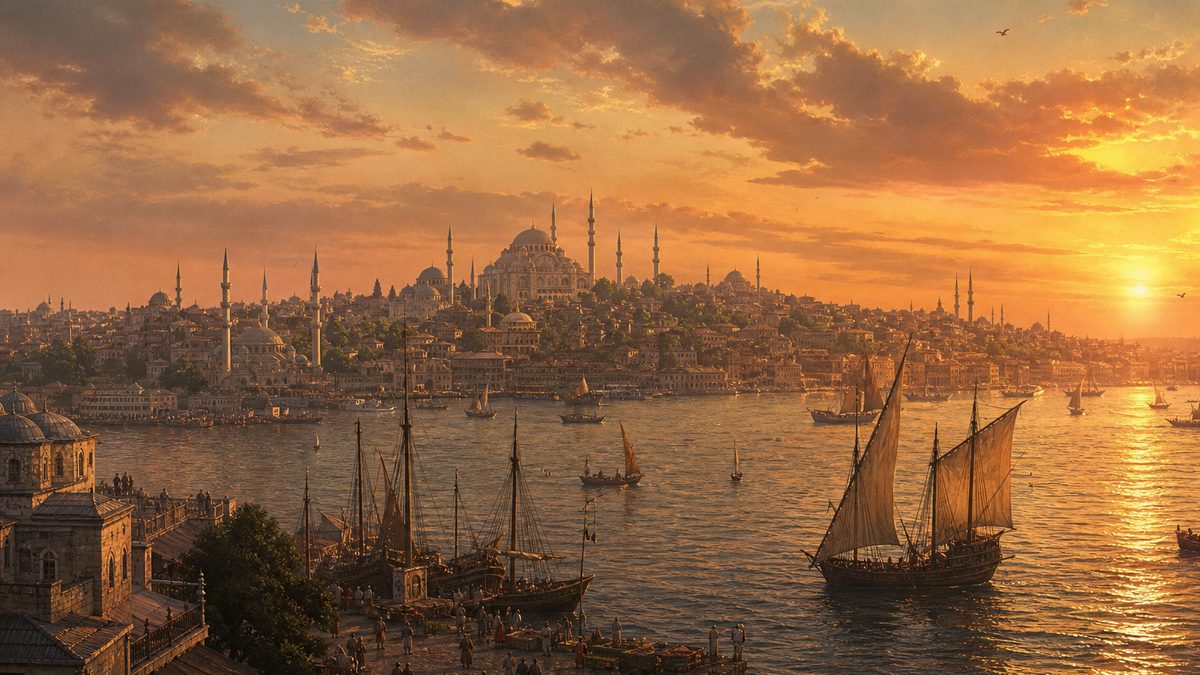
Osman's small frontier state grows into the Balkans, survives defeat by Timur, takes Constantinople in 1453, conquers Egypt and the holy cities under Selim, reaches Vienna under Suleiman, rules through the devshirme, Janissaries and millets, projects power from the Mediterranean to Aceh, turns back from Vienna in 1683, attempts Tanzimat reform, and ends after the First World War with the founding of the Republic of Turkey. Episode 10 of the World Empires series.
Interactive 3D film6 min1299 to 1922Published 2026-10-13
Around 1290, Anatolia was a patchwork. The Seljuk Turkish sultanate had been broken by the Mongols, and many small Turkish principalities, called beyliks, competed for land.
To the west lay what was left of the Byzantine Empire, still ruling from Constantinople.
Prologue · Episode 10 of the World Empires series
A frontier of many lords
Turkish-speaking peoples had moved into Anatolia from Central Asia since the 1000s. On the Byzantine frontier, warriors, dervishes and farmers mixed, and Greek and Turkish were both heard.
Grey outlines show other powers of the time. Outlines are approximate.
One beylik, led by a chief named Osman, lay right on the Byzantine border near Söğüt. Tradition dates its founding to 1299. The dynasty took his name: Osmanlı, in English, Ottoman.
His son Orhan took the Byzantine city of Bursa in 1326 and made it his capital.
In 1354, after an earthquake damaged its walls, the Ottomans took Gallipoli, their first foothold in Europe.
The Ottomans spread through the Balkans and moved their capital to Edirne. In 1389 they defeated a Serbian-led army at Kosovo.
By 1400 Constantinople was an island of Byzantine rule inside Ottoman lands.
Then in 1402 Timur, a conqueror from Central Asia, crushed the Ottoman army at Ankara and captured Sultan Bayezid. The state nearly broke apart, but recovered within twenty years.
Sultan Mehmed II, aged 21, besieged Constantinople in April 1453. Giant cannons pounded its thousand-year-old walls, and ships were hauled over land into the Golden Horn.
On 29 May the city fell. The last Byzantine emperor, Constantine XI, died in the fighting. The Hagia Sophia became a mosque.
Mehmed made the city his capital and brought in settlers of many faiths. For the Ottomans, he was now also “Caesar of Rome”.
Chapter I · Step 3
Constantinople
Siege
6 Apr – 29 May 1453
Mehmed II
“the Conqueror”
This is where Episode 06 ended: the last remnant of the Roman Empire.
Suleiman I took Belgrade in 1521 and Rhodes in 1522. In 1526 he destroyed the Hungarian army at Mohács, and in 1529 besieged Vienna, but failed to take it.
In the east he took Baghdad in 1534. Ottoman power now reached from Hungary to the Persian Gulf.
Ottomans remember him as Kanuni, the Lawgiver. His architect, Mimar Sinan, built the Süleymaniye mosque and hundreds of other buildings.
Slaves who ruled, and communities that governed themselves.
Through the devshirme, Christian boys from the Balkans were taken from their families, converted to Islam and trained as soldiers or officials. The best rose to become grand viziers.
The Janissaries, an elite infantry with firearms, were drawn from them. Cavalrymen were paid with the income of land grants called timars.
Religious communities, called millets, such as Orthodox Christians and Jews, ran their own courts, schools and charities under their own leaders.
Chapter II · Step 6
How the empire worked
devshirme Levy of Christian boys for state service
Janissaries Elite infantry with firearms
timar Land income in return for cavalry service
millet Self-governing religious communities
For many, the devshirme was a cruel separation; for some families it was also a path to power. Historians stress both.
Under the admiral Hayreddin Barbarossa, the Ottoman fleet beat a Christian alliance at Preveza in 1538 and dominated the Mediterranean.
In the Indian Ocean, the Ottomans competed with the Portuguese. In the 1560s, the Sultan of Aceh in Sumatra asked for help, and Ottoman gunners and cannon were sent.
In 1571 a Holy League fleet destroyed the Ottoman navy at Lepanto. The Ottomans rebuilt it within a year, but their naval expansion slowed.
Chapter II · Step 7
A sea power
1538 Preveza: Ottoman victory
1560s Ottoman aid to Aceh, Sumatra
1571 Lepanto: Ottoman defeat
Episode 07 told how Islam reached Southeast Asia through trade; the Ottoman link with Aceh came much later.
Russia defeated the Ottomans in 1774. Napoleon invaded Egypt in 1798. Greece won independence in 1830, and Egypt became autonomous under its governors.
Sultans tried to catch up. In 1826 the Janissaries were abolished. The Tanzimat reforms from 1839 promised equality for all subjects, new schools and new laws.
In 1876 the empire adopted its first constitution and parliament, though the sultan suspended them two years later.
In 1908 the Young Turks forced the sultan to restore the constitution. The empire then lost almost all its Balkan lands in the wars of 1912 and 1913.
In 1914 it entered the First World War on Germany’s side. It defeated an Allied landing at Gallipoli in 1915.
In 1915 and 1916 the government deported Armenians from Anatolia; hundreds of thousands, perhaps over a million, died. Most historians and many countries call this genocide; Turkey rejects the term.
An Arab revolt and British armies took the Arab provinces. In 1918 the empire surrendered.
Chapter III · Step 10
Revolution and world war
1908 Young Turk Revolution
1912–1913 Balkan Wars
1915 Gallipoli
1915–1916 Deportation and mass killing of Armenians
The Ottoman dynasty ruled for over six hundred years, longer than almost any other. Its lands now belong to dozens of countries, from Algeria to Iraq and from Hungary to Yemen.
Its food, music, architecture and words are shared across the Balkans, the Middle East and North Africa.
Next: the Americas, where the Aztec and Inca empires rose and fell just as the Ottomans reached their peak.
Epilogue
Six hundred years
1299 Osman
1453 Constantinople
1520–1566 Suleiman
1683 Vienna; peak size
1922 Sultanate abolished
The series
00The Rise and Fall of Empires (overview)
01The First Empires: Mesopotamia
02Egypt of the Pharaohs
03Persia and Alexander
04The Maurya Empire of India
05China Unified: Qin and Han
06Rome
07The Islamic Caliphates
08The Khmer Empire of Angkor
09The Mongol Empire
10 The Ottoman Empire (this film)
11The Aztec and Inca Empires
12The Age of Sea Empires
13The End of Empires
The still images on the chapter cards are AI-generated illustrations. Outlines are approximate.