PlanetPast

World Empires · Episode 07 · AD 632–1258

The Islamic Caliphates

From the Prophet Muhammad's community in Medina to the first four caliphs, the Umayyads of Damascus who reached Spain and the Indus, the Abbasids of Baghdad and the House of Wisdom, the three rival caliphates of Baghdad, Cairo and Córdoba, Islam's spread by sea to Southeast Asia, the Mongol sack of Baghdad in 1258 and the abolition of the caliphate in 1924. Episode 07 of the World Empires series.

Interactive 3D film6 minAD 632 to 1258Published 2026-10-13

Watch the interactive filmอ่านภาษาไทย

Prologue

World Empires · Episode 07

The Islamic Caliphates

From Arabia to Spain and Central Asia in a hundred years.

Around AD 600, two great empires faced each other across the Middle East: the eastern Roman Empire and Sasanian Persia.

From 602 to 628 they fought a long, exhausting war. To their south lay Arabia, a land of trading towns, oases and nomadic tribes that neither empire ruled.

Prologue · Episode 07 of the World Empires series

Between two empires

Mecca was a trading town and a pilgrimage centre. Arabic-speaking tribes traded, raided and made alliances, but had never been united under one state.

Grey outlines show other powers of the time. Outlines are approximate.

Sources: Wikipedia: Rashidun Caliphate; Wikipedia: Caliphate

Chapter I · Rise

Chapter I · 610–632

A new faith and a new community

The Prophet Muhammad unites Arabia.

According to Muslim tradition, around 610 Muhammad, a merchant of Mecca, began receiving the revelations that became the Quran.

Facing hostility in Mecca, he and his followers moved to Medina in 622, the Hijra. That year is year one of the Islamic calendar.

By his death in 632, most of Arabia had joined the new Muslim community, the umma, under one leadership for the first time.

Chapter I · Step 1

A new faith and a new community

  • c. 610 First revelations, by Muslim tradition
  • 622 The Hijra to Medina; year 1 AH
  • 630 Mecca joins the Muslim community
  • 632 Death of the Prophet Muhammad
Sources: Wikipedia: Rashidun Caliphate

Chapter I · 632–661

The first four caliphs

Two empires fall in twenty years.

The Prophet’s successors were called caliphs. Under the first four, Abu Bakr, Umar, Uthman and Ali, Arab armies took Syria and Egypt from the Romans and destroyed the Sasanian Empire by 651.

Many conquered Christians, Jews and Zoroastrians kept their faith as protected communities who paid a special tax. Conversion to Islam was gradual, over centuries.

A dispute over who should lead turned into civil war after 656. It is the root of the division between Sunni and Shia Muslims: Shia Muslims hold that Ali should have led from the start.

Chapter I · Step 2

The first four caliphs

  • 636 Yarmuk: Roman army defeated in Syria
  • 637 Ctesiphon, the Sasanian capital, taken
  • 641–642 Egypt conquered
  • 656–661 First civil war (fitna)

Sunni Muslims call these four the Rashidun, the “rightly guided” caliphs.

Sources: Wikipedia: Rashidun Caliphate

Chapter II · Umayyads

Chapter II · 661–705

The Umayyads of Damascus

A caliphate becomes a dynasty.

In 661 Muawiya, governor of Syria, became caliph and made Damascus his capital. Leadership now passed within his family, the Umayyads.

The caliph Abd al-Malik made Arabic the language of government and minted new gold coins with words instead of images.

In Jerusalem he built the Dome of the Rock, completed around 691, one of the oldest surviving Islamic monuments.

Chapter II · Step 3

The Umayyads of Damascus

Capital
Damascus
661–750
Dome of the Rock
c. 691
Reforms of Abd al-Malik
Arabic for government records; the gold dinar (696–697)
Sources: Wikipedia: Umayyad Caliphate

Chapter II · 711–732

From the Atlantic to the Indus

One of the largest empires the world had seen.

In 711 Umayyad forces crossed from North Africa into Spain. In the same years, armies reached Sindh on the Indus, and Samarkand in Central Asia.

In 732 a raid deep into France was stopped near Tours and Poitiers by the Frankish leader Charles Martel.

At its height the Umayyad Caliphate covered around 11 million square kilometres, larger than Rome at its peak.

Chapter II · Step 4

From the Atlantic to the Indus

Peak area
~11.1M km²
c. 720
Spain
711
Tours / Poitiers
732

Compare: Rome at its peak, ~5M km² (Episode 06).

Sources: Wikipedia: Umayyad Caliphate; Wikipedia: List of largest empires

Chapter III · Abbasids

Chapter III · 750–756

The Abbasid revolution

A new dynasty from the east.

Many non-Arab Muslims, especially in Persia, resented Umayyad favour for Arabs. A revolt that began in Khorasan, in the east, overthrew the Umayyads in 750.

The new caliphs, the Abbasids, descended from the Prophet’s uncle Abbas. Most of the Umayyad family were killed.

One prince, Abd al-Rahman, escaped to Spain and in 756 set up a separate Umayyad state at Córdoba. The Muslim world would never again be under one ruler.

Chapter III · Step 5

The Abbasid revolution

  • 747 Revolt begins in Khorasan
  • 750 Battle of the Zab; Umayyads overthrown
  • 756 Umayyad emirate of Córdoba
Sources: Wikipedia: Abbasid Caliphate; UNESCO: Historic Centre of Córdoba

Chapter III · 751–809

Baghdad, the round city

A new capital at the crossroads of the world.

In 751, at the Talas river in Central Asia, an Abbasid army defeated the forces of Tang China. Legend says captured Chinese papermakers taught their craft in Samarkand, though paper was probably already spreading.

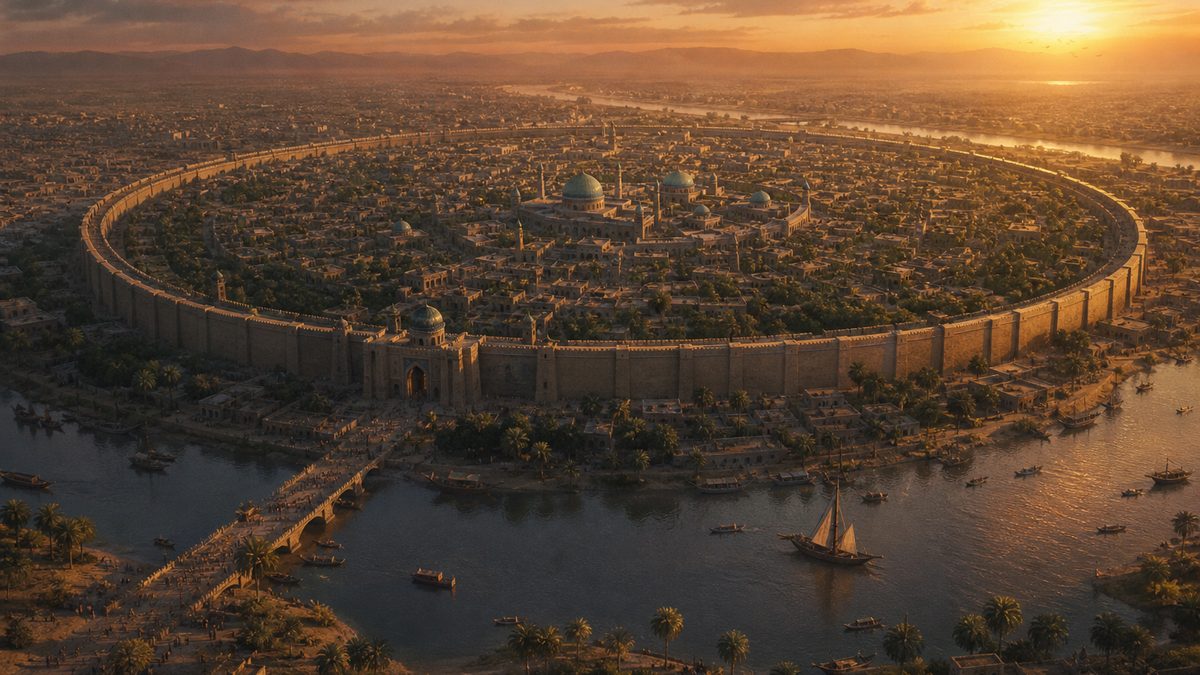
In 762 the caliph al-Mansur founded a new capital on the Tigris: Baghdad, a city built in a perfect circle.

Under Harun al-Rashid, around 800, it may have been the largest city in the world outside China.

Chapter III · Step 6

Baghdad, the round city

Talas
751
Baghdad founded
762
Harun al-Rashid
786–809
the caliph of many “Thousand and One Nights” tales
Sources: Wikipedia: Abbasid Caliphate

Chapter III · 800–1000

The House of Wisdom

Translating the world’s knowledge into Arabic.

Abbasid caliphs and rich patrons paid scholars to translate works of Greek philosophy and medicine, Persian literature and Indian mathematics into Arabic.

Around 820, al-Khwarizmi wrote a book on solving equations. Its title gave us the word “algebra”, and his own name gave us “algorithm”.

Scholars in Baghdad, Cairo and Córdoba advanced astronomy, optics and medicine. Many of their books were later translated into Latin and studied in Europe.

Chapter III · Step 7

The House of Wisdom

  • c. 820 al-Khwarizmi: algebra, and Indian numerals in Arabic
  • c. 1011–1021 Ibn al-Haytham’s Book of Optics
  • 1025 Ibn Sina’s Canon of Medicine

Historians debate whether the “House of Wisdom” was a great academy or mainly a palace library; the translation movement itself is well documented.

Sources: Wikipedia: House of Wisdom; Wikipedia: Abbasid Caliphate

Chapter III · 909–1055

Three caliphs at once

Unity breaks; culture flourishes.

From the 800s, provinces broke away under local dynasties. By the 900s there were three rival caliphs at once.

The Shia Fatimids ruled from Cairo, which they founded in 969. The Umayyad ruler of Córdoba declared himself caliph in 929. The Abbasids kept Baghdad.

In Baghdad, real power passed to soldiers and sultans, first Persian Buyids, then Seljuk Turks from 1055. The caliph remained a religious figurehead.

Chapter III · Step 8

Three caliphs at once

  • 909 Fatimid caliphate founded in North Africa
  • 929 Caliphate of Córdoba
  • 945 Buyids take control of Baghdad
  • 969 Fatimids found Cairo
  • 1055 Seljuk Turks in Baghdad
Sources: Wikipedia: Abbasid Caliphate; Wikipedia: Caliphate

Chapter IV · Afterwards

Chapter IV · c. 800–1500

By sea to Southeast Asia

A faith carried by merchants, not armies.

Arab and Persian merchants sailed the monsoon winds to India and China, and settled in ports along the way.

Islam reached Southeast Asia mostly through trade and teachers, not conquest. The kingdom of Samudera Pasai in Sumatra had a Muslim ruler by the late 1200s.

Over the next centuries Islam spread through the Malay world, including Pattani, Malaysia and Indonesia, today the country with the most Muslims in the world.

Chapter IV · Step 9

By sea to Southeast Asia

Samudera Pasai
late 1200s
early Muslim sultanate in Sumatra
Indonesia
largest Muslim population today

The caliphs never ruled Southeast Asia; this spread happened alongside, and long after, their empire.

Sources: Wikipedia: Spread of Islam in Indonesia

Chapter IV · 1258

The fall of Baghdad

The Mongols end the Abbasid caliphate.

In 1258 a Mongol army under Hulagu, grandson of Genghis Khan, besieged Baghdad.

The city fell after two weeks. The last Abbasid caliph in Baghdad was put to death, and a great part of the population was killed. Estimates range from tens of thousands to many more.

Libraries were destroyed. For many Muslims the date marks the end of a golden age.
Chapter IV · Step 10

The fall of Baghdad

Siege
29 Jan – 10 Feb 1258
Abbasid caliphate in Baghdad
750–1258

The Mongol Empire is the subject of Episode 09.

Sources: Wikipedia: Siege of Baghdad (1258)

Chapter IV · 1261–1924

A title that lived on

From Cairo to Istanbul, then abolished.

Surviving Abbasid princes were installed as caliphs in Cairo by the Mamluk sultans, with religious prestige but no real power.

After the Ottomans conquered Egypt in 1517, Ottoman sultans increasingly used the title of caliph themselves.

In 1924 the new Republic of Turkey abolished the caliphate. Since then, no caliphate has been widely recognised by Muslims.

Chapter IV · Step 11

A title that lived on

  • 1261–1517 Abbasid caliphs in Mamluk Cairo
  • 1517 Ottoman conquest of Egypt
  • 1924 Caliphate abolished by the Turkish Republic
Sources: Wikipedia: Caliphate

Epilogue

Epilogue

Empire, faith and language

What the caliphates left behind.

The caliphates’ political unity lasted barely a century. But they spread Arabic as a language of faith, law and science from Morocco to Iraq.

Words like algebra, algorithm, zero, coffee and sugar reached European languages through Arabic.

Next: the Khmer Empire of Angkor, in mainland Southeast Asia.

Epilogue

Empire, faith and language

  • 632–661 The first four caliphs
  • 661–750 Umayyads, Damascus
  • 750–1258 Abbasids, Baghdad
  • 909–1171 Fatimids, Cairo
  • 929–1031 Caliphate of Córdoba
The series
  1. 00The Rise and Fall of Empires (overview)
  2. 01The First Empires: Mesopotamia
  3. 02Egypt of the Pharaohs
  4. 03Persia and Alexander
  5. 04The Maurya Empire of India
  6. 05China Unified: Qin and Han
  7. 06Rome
  8. 07 The Islamic Caliphates (this film)
  9. 08 The Khmer Empire of Angkor (coming soon)
  10. 09 The Mongol Empire (coming soon)
  11. 10 The Ottoman Empire (coming soon)
  12. 11 The Aztec and Inca Empires (coming soon)
  13. 12 The Age of Sea Empires (coming soon)
  14. 13 The End of Empires (coming soon)

The still images on the chapter cards are AI-generated illustrations. Outlines are approximate.

Sources: Wikipedia: Caliphate; Wikipedia: Umayyad Caliphate; Wikipedia: Abbasid Caliphate