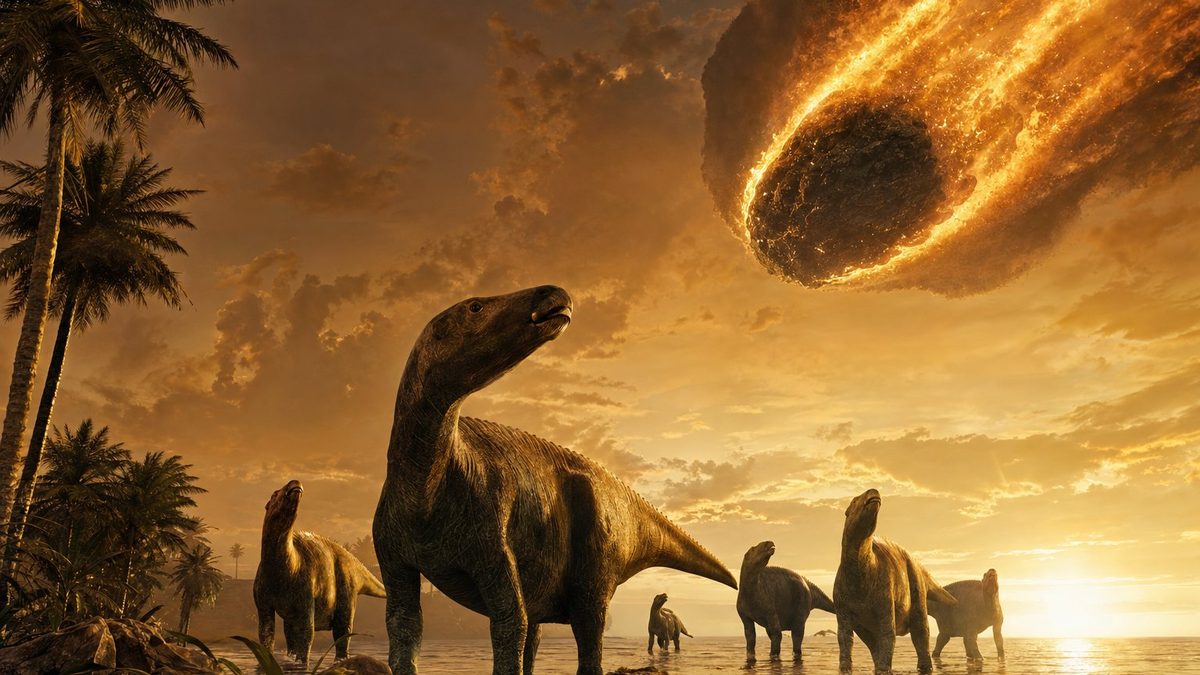
Late Cretaceous · 66.0 million years ago
The world before the last day
A warmer world with almost no polar ice, where dinosaurs had ruled the land for more than 160 million years.
Sixty-six million years ago. The end of the Cretaceous.
The planet is warmer than today, with almost no polar ice. Dinosaurs have ruled the land for more than 160 million years.
Nothing alive knows that an asteroid from beyond the orbit of Jupiter is heading straight for the shallow sea off Yucatán.
The world before the last day
The late Cretaceous world was warmer than today and sea levels were high. Dinosaurs had dominated life on land for more than 160 million years. The target was a shallow sea over what is now the Yucatán Peninsula in Mexico. The seafloor there was limestone and sulfur-rich evaporite rock, which later made the climate effects far worse.
- Impact site
- 21.3°N 89.5°W Beneath the village of Chicxulub, Yucatán Peninsula
- Age
- ~66.0 million yr The K–Pg boundary (Cretaceous–Paleogene)
- Geography that differed from today
- North and South America were not yet joined The Central American Seaway was open, so the tsunami could pass straight into the Pacific.
The globe uses NASA Blue Marble satellite imagery adjusted toward the Cretaceous: the polar ice is removed (Greenland and Antarctica are shown forested) and the Central American Seaway is opened. The continents are still in their present-day positions, which differed slightly 66 million years ago.
How to use: pick a step below the globe or press ← →. ▶ plays the events within a step. Drag the globe to move the camera yourself. “▶ Play full film” runs every step in sequence, full screen.