PlanetPast

1783 → 2026 · Space and physics

Black Holes

What black holes are and how we know they exist: from Michell’s dark stars and Einstein’s curved spacetime to Cygnus X-1, the stars orbiting Sagittarius A*, LIGO’s gravitational waves, the first black-hole images and Webb’s early giants.

Interactive 3D film6 min1783 to 2026Published 2026-10-13

Watch the interactive filmอ่านภาษาไทย

Prologue

September 2026 · Nature

Black holes

Where gravity wins completely, and even light cannot get out.

In September 2026, a study in Nature suggested that strange red dots seen by the James Webb Space Telescope are young black holes, growing astonishingly fast.

A black hole is a region of space where gravity is so strong that nothing, not even light, can escape.

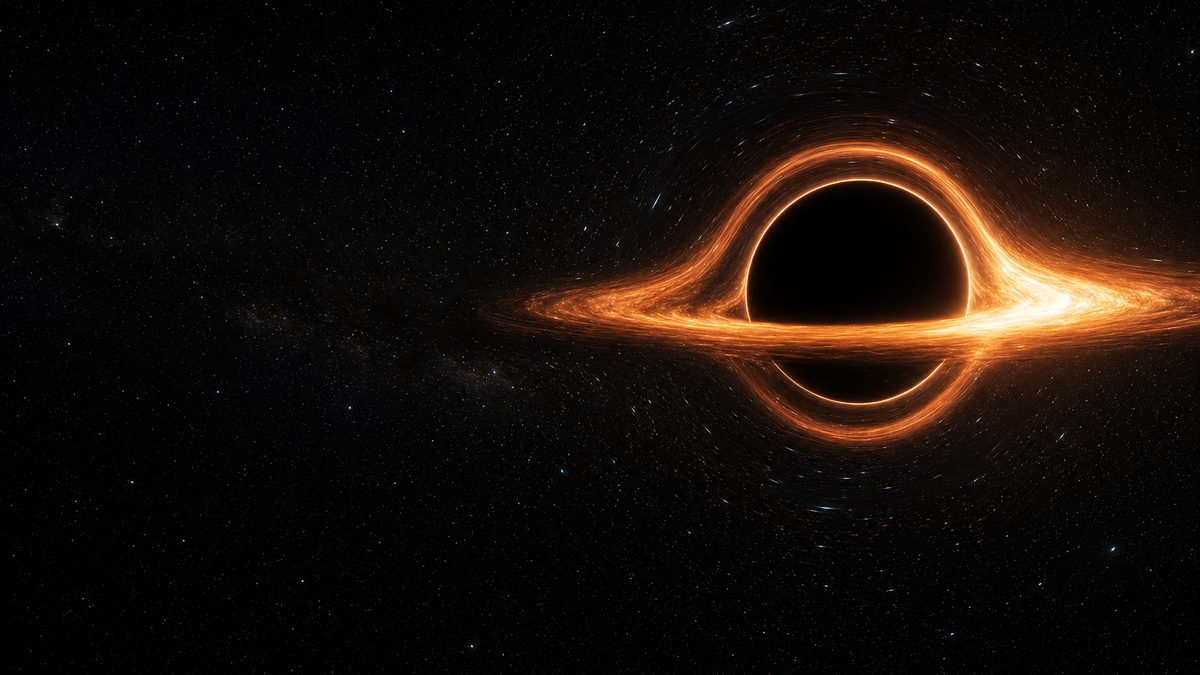
You cannot see the hole itself. You see what it does: hot gas swirling around it, and the light of stars behind it bent into arcs.

For two centuries it was only an idea. This is how it became something we can weigh, hear and photograph.

Prologue · What is a black hole?

Where even light is trapped

A black hole is a region of spacetime where gravity is so strong that nothing that crosses its boundary, the event horizon, can come back out. The idea goes back to 1783. Today we know black holes a few times heavier than the Sun and giants millions or billions of times heavier. In September 2026 a Nature study used supercomputer simulations to argue that the mysterious “little red dots” seen by the James Webb Space Telescope are young black holes growing fast in the early universe.

Event horizon
rs = 2GM/c²
the Schwarzschild radius, proportional to mass
Photon sphere
1.5 rs
where light can circle the hole
Innermost stable orbit
3 rs
inner edge of the glowing disk (non-spinning hole)
Shadow seen from afar
~2.6 rs
radius, enlarged by the bending of light

The scene is a visualisation computed in your browser: light rays are bent according to the curved space around a non-spinning black hole. That is why the far side of the disk of hot gas appears over the top and under the bottom of the dark shadow, and why stars behind it are smeared into arcs. One side of the disk is brighter because its gas moves towards you at a large fraction of the speed of light (relativistic beaming). The disk and its colours are illustrative.

How to use: pick a chapter below the scene or press ← → to change step · ▶ plays the step · drag to rotate, scroll or pinch to zoom · “Play the film” runs every step full-screen.

Sources: Wikipedia: Black hole; Wikipedia: Schwarzschild radius; Wikipedia: Schwarzschild metric; Wikipedia: Photon sphere; Wikipedia: Messier 87; Chon et al., Nature (16 Sep 2026)

Chapter I · Dark stars

27 November 1783 · The Royal Society, London

Dark stars

An English clergyman asked a simple question: what if a star’s gravity were too strong for its own light?

Throw a ball upwards and it falls back. Throw it fast enough and it never returns. From Earth’s surface that escape speed is about eleven kilometres per second.

In 1783 John Michell, an English clergyman and natural philosopher, pictured light as tiny particles that gravity could slow down.

He calculated that a star as dense as the Sun but five hundred times wider would need an escape speed faster than light. Its light would fall back.

Such a dark star would be invisible, he reasoned, but it might still be found by its pull on a visible companion. Hold on to that idea.

Chapter I · Step 1 · 1783

Michell’s dark stars

The escape speed from the surface of a body is v = √(2GM/r). Michell’s paper, read to the Royal Society on 27 November 1783 as a letter to Henry Cavendish and published in 1784, used Newton’s idea that light is made of particles. If a star had the Sun’s density but 500 times its radius, its escape speed would exceed the speed of light, and its light could not reach us.

Escape speed, Earth
11.2 km/s
from the surface
Escape speed, Sun
617.7 km/s
from the surface
Michell’s star: same density, 500 × wider
≈ 500 × 617.7 ≈ 309,000 km/s, faster than light (299,792 km/s)
At constant density, mass grows as radius cubed, so escape speed grows in proportion to radius

In the scene the star grows at constant density while particles of light are launched from its surface at light speed. Once its escape speed passes the speed of light they rise, stop and fall back. This is the old Newtonian picture, later replaced by Einstein’s theory. In 1796 Pierre-Simon Laplace independently suggested, in Exposition du Système du Monde, that a large enough star could be invisible.

Sources: Wikipedia: John Michell; Wikipedia: Black hole; Wikipedia: Escape velocity

Chapter II · Bent spacetime

25 November 1915 · Prussian Academy of Sciences, Berlin

Gravity is geometry

Einstein’s new theory said mass curves space and time, and everything, light included, follows the curves.

On the twenty-fifth of November 1915, Albert Einstein presented the final equations of his general theory of relativity.

In his theory gravity is not a force pulling across empty space. Mass and energy curve spacetime, and objects move along the straightest paths they can.

Light must follow those curves too. Rays passing close to a heavy star are bent towards it.

During the solar eclipse of May 1919, expeditions organised by Frank Dyson and Arthur Eddington measured starlight bending around the Sun, as Einstein had predicted.

Chapter II · Step 2 · 1915–1919

Mass tells space how to curve

General relativity describes gravity as the curvature of spacetime produced by mass and energy. Freely moving objects, and light, follow the straightest possible paths through that curved geometry. Near a compact mass those paths bend noticeably.

Field equations
25 Nov 1915
presented to the Prussian Academy of Sciences, Berlin
Eclipse test
29 May 1919
Sobral (Brazil) and Príncipe (off West Africa)
Predicted bending of starlight at the Sun’s edge
1.75 arcseconds
twice the value from Newtonian reasoning

The rubber-sheet grid is a common analogy, not a literal picture: real spacetime has four dimensions. Here the star is far more compact than the Sun so that the bending is large enough to see. The bending of the light rays is computed with general relativity.

Sources: Wikipedia: Einstein field equations; Wikipedia: Black hole; Wikipedia: Gravitational lens; Wikipedia: Eddington experiment

December 1915 · The Russian front

A point of no return

A soldier-astronomer found the first exact solution of Einstein’s equations within weeks of their publication.

Karl Schwarzschild was serving in the German army on the Russian front. In December 1915 he wrote to Einstein: he had solved the equations for the space around a single round mass.

His solution contains a special radius, now called the Schwarzschild radius. Squeeze any mass inside it and nothing can get out. That surface is the event horizon.

At one and a half times that radius, light can circle the hole. Rays that come closer are captured. Rays that pass farther out are flung off in new directions.

Schwarzschild died in May 1916, aged forty-two. Try the calculator: how small would Earth, the Sun or a giant black hole have to be?

Chapter II · Step 3 · 1916

The Schwarzschild radius

Schwarzschild’s solution, published in January 1916, describes spacetime outside any non-spinning, round mass. At the radius rs = 2GM/c² the equations behave strangely, and for decades nobody knew what that meant. In 1958 David Finkelstein identified this surface as an event horizon: a one-way membrane that can be crossed only inwards.

Earth squeezed into a black hole
8.87 mm
Schwarzschild radius
The Sun
2.95 km
Schwarzschild radius
Photon sphere
1.5 rs
an unstable circular orbit for light
Name “black hole”
1967
popularised by John Wheeler; used earlier by others

The funnel shows the shape of space around a black hole (Flamm’s paraboloid), down to the horizon (orange ring). The light rays bend as Schwarzschild’s solution predicts: rays aimed within about 2.6 rs of the centre fall in; slightly wider ones swing around before escaping.

Use the calculator on the scene to work out rs = 2GM/c² for different objects.

Sources: Wikipedia: Karl Schwarzschild; Wikipedia: Schwarzschild metric; Wikipedia: Schwarzschild radius; Wikipedia: Photon sphere; Wikipedia: Black hole

Chapter III · Collapse

1930s · Dead stars

How to make a black hole

When a star’s fuel runs out, gravity squeezes what is left. The only question is what can push back.

A star shines by fusion, and its heat pushes outwards against its own gravity. When the fuel runs out, the core is crushed.

In 1930 the young Subrahmanyan Chandrasekhar found a limit: above about 1.4 times the Sun’s mass, a dead core cannot survive as an Earth-sized white dwarf.

Heavier cores collapse further, into neutron stars only about twenty kilometres across. But these have a mass limit too, of a little over two Suns.

In 1939 Robert Oppenheimer and Hartland Snyder showed that a heavier core keeps collapsing until it disappears behind its own event horizon.

Chapter III · Step 4 · 1930–1939

Three ways for a star to die

What holds up a dead core is quantum pressure, not heat. Electrons resist being squeezed together, and so do neutrons, but only up to a point. Stars of more than about 8 solar masses end in core-collapse supernovae that leave a neutron star or a black hole.

White dwarfbelow ~1.4 M☉ (Chandrasekhar limit) · about a Sun’s mass in an Earth-sized ball Neutron starup to ~2.2–2.9 M☉ (TOV limit) · radius 10–12 km Black holeheavier · nothing known can stop the collapse
Chandrasekhar limit
~1.44 M☉
worked out from 1930; Nobel Prize 1983
Oppenheimer–Snyder
1939
seen from far away, the collapse appears to freeze at the horizon

M☉ is the mass of the Sun. Sizes in the scene are on a compressed scale; the thin orange ring around the right-hand core marks its Schwarzschild radius. In 1965 Roger Penrose proved that, in general relativity, such a collapse must end in a singularity, work recognised with half of the 2020 Nobel Prize.

Sources: Wikipedia: Chandrasekhar limit; Wikipedia: White dwarf; Wikipedia: Neutron star; Wikipedia: Oppenheimer–Snyder model; Wikipedia: Black hole; NobelPrize.org: Physics 2020 press release

1971–1973 · Cygnus X-1

The first suspect

A blue supergiant star circling something invisible, heavy and blazing in X-rays.

In 1964 a rocket carrying X-ray detectors found a strong X-ray source in the constellation Cygnus, the Swan: Cygnus X-1.

In 1971 its position was matched to a hot blue supergiant star. But the flickering X-rays came from something much smaller.

In 1972 two teams measured how the star wobbles. Every five and a half days it circles an invisible companion far too heavy to be a neutron star.

Gas pulled from the star heats up as it spirals in and glows in X-rays. Just as Michell suggested, the dark object was revealed by its visible partner.

Chapter III · Step 5 · 1964–1974

Cygnus X-1

X-ray observations by Riccardo Giacconi’s team in 1971 showed rapid flickering from a very compact source. Radio observations that year matched it with the star HDE 226868. In 1972 Louise Webster and Paul Murdin, and separately Charles Bolton, used Doppler shifts in the star’s light to show that its unseen companion is heavier than any neutron star can be. By the end of 1973 most astronomers accepted it as a black hole, the first ever identified.

Orbital period
5.6 days
around their common centre of mass
Distance
~7,300 ly
light-years
Black hole mass
~21 M☉
2021 estimate; a 2025 study suggests ~14–18
Companion
HDE 226868
blue supergiant

In 1974 Stephen Hawking bet Kip Thorne that Cygnus X-1 was not a black hole, hoping to lose. He conceded in 1990. The scene is not to scale: the gas stream and the disk are drawn so that the mechanism can be seen.

Sources: Wikipedia: Cygnus X-1; Wikipedia: Black hole

Chapter IV · Our giant

Since the early 1990s · The centre of the Milky Way

Weighing a giant with stars

For three decades two teams tracked stars racing around a dark point at the heart of our galaxy.

At the centre of our galaxy, about twenty-seven thousand light-years away, stars whirl around a point that gives out almost no light.

Since the early 1990s, teams led by Reinhard Genzel and Andrea Ghez have tracked those stars. The star S2 completes one orbit every sixteen years.

Its orbit reveals about four million solar masses packed into a region no larger than our solar system. Only a black hole fits. Genzel and Ghez shared the 2020 Nobel Prize.

In August 2026 astronomers reported the star S301, which swings in to about twelve times the Earth–Sun distance at more than eight per cent of the speed of light.

Chapter IV · Step 6 · 1990s–2026

Sagittarius A*

Kepler’s laws turn an orbit into a mass: the size and period of S2’s orbit tell us how much mass lies inside it. The answer is about 4.3 million times the mass of the Sun, in a region far too small to be a cluster of stars. In 2018 S2’s close pass also showed the gravitational redshift predicted by general relativity.

Mass
4.3 million M☉
Schwarzschild radius ~12 million km (0.08 AU)
Distance
~27,000 ly
from Earth
S2
16.05 years
closest approach ~120 AU at ~7,650 km/s (May 2018)
S301 (2026)
8.7 years
closest approach ~12 AU at ~25,000 km/s
Nobel Prize 2020
Reinhard Genzel and Andrea Ghez
“for the discovery of a supermassive compact object at the centre of our galaxy”; the other half went to Roger Penrose

S301 was found with the GRAVITY+ instrument on ESO’s Very Large Telescope Interferometer and published in Nature in August 2026. It passes so close that it feels the black hole’s spin; the team hopes to measure that spin within ten years, after its next close pass in 2031. The two orbits are drawn to scale relative to each other (1 AU is the Earth–Sun distance). The other stars, their tilt and the glow at the centre are illustrative.

Sources: NobelPrize.org: Physics 2020 press release; Wikipedia: Sagittarius A*; Wikipedia: S2 (star); ESO press release eso2612 on S301 (19 Aug 2026)

Chapter V · Ripples in spacetime

14 September 2015, 09:50:45 UTC · LIGO

The sound of two black holes

A ripple in spacetime, after travelling for more than a billion years, stretched two detectors in the USA by a thousandth of a proton.

In 1916 Einstein predicted that moving masses send out ripples in spacetime: gravitational waves. They stretch and squeeze everything they pass through.

Two black holes in a close orbit lose energy to these waves, so they spiral together, faster and faster, and merge.

On the fourteenth of September 2015 the two LIGO detectors caught such a signal. In about two tenths of a second its frequency rose from thirty-five to two hundred and fifty hertz: a chirp.

Two black holes of about thirty-five and thirty solar masses had merged. About three Suns’ worth of mass was turned into gravitational waves. Press a button on the scene to hear a chirp.

Chapter V · Step 7 · 2015

GW150914: the first chirp

LIGO has two L-shaped detectors with 4 km arms, at Hanford, Washington, and Livingston, Louisiana, about 3,000 km apart. Laser light measures the arm lengths. The wave from GW150914 changed them by about a thousandth of the width of a proton. It reached Livingston about 7 milliseconds before Hanford.

Masses
~35 + 30 M☉
merged into one black hole of ~62 M☉
Radiated
~3 M☉
of mass-energy, as gravitational waves
Distance
~1.4 billion ly
about 440 megaparsecs
Announced
11 Feb 2016
Nobel Prize 2017: Weiss, Barish, Thorne

The rippling grid is a visualisation; real waves are smaller by a factor of about 1020. The waveform on the scene is a simplified model (the textbook “chirp” of two orbiting masses, then a ringing-down) computed from the two masses with the chirp-mass formula. It is not detector data. Earlier, the Hulse–Taylor binary pulsar, found in 1974, gave indirect evidence for gravitational waves (Nobel Prize 1993).

Press an event button on the scene to replay the merger and hear its chirp, first at true speed and pitch, then slowed down four times at the same pitch.

Sources: Wikipedia: Gravitational wave; Wikipedia: GW150914; Wikipedia: LIGO; Wikipedia: Chirp mass

2015 → 2026 · LIGO, Virgo and KAGRA

A chorus of mergers

A decade on, detectors have heard hundreds of black-hole collisions.

Since 2015, LIGO, Virgo in Italy and KAGRA in Japan have kept listening. The catalogue published in May 2026 lists three hundred and ninety confirmed events.

In January 2025 came the clearest signal yet, GW250114. It confirmed a prediction Stephen Hawking made in 1971: when black holes merge, the total area of their horizons cannot shrink.

The heaviest merger so far, GW231123, made a black hole of about two hundred and twenty-five Suns. Black holes come in more sizes than astronomers expected.

Chapter V · Step 8 · 2015–2026

Hundreds of black-hole mergers

Each chirp carries the masses of the two black holes, measured from how quickly the frequency rises. Heavier pairs merge at lower frequencies, so their chirps are shorter and deeper. Compare them with the buttons on the scene.

GWTC-5.0 (26 May 2026)
390 events
confirmed since September 2015
GW250114
33.6 + 32.2 → 62.7 M☉
signal-to-noise ~80; tested Hawking’s area theorem
GW231123
~137 + 103 → 225 M☉
most massive binary black-hole merger known
Detectors
LIGO (USA) · Virgo (Italy) · KAGRA (Japan)
fourth observing run ended Nov 2025

The area theorem says the horizon area of the final black hole must be at least the sum of the two original areas. GW250114 was clear enough to measure both. The result was published in Physical Review Letters in September 2025.

Sources: GEO600: the GWTC-5.0 catalogue (26 May 2026); Wikipedia: GW250114; Wikipedia: GW231123; Wikipedia: LIGO

Chapter VI · The shadow

10 April 2019 · Event Horizon Telescope

A telescope the size of the Earth

To see a black hole’s shadow, astronomers linked radio dishes from Hawaii to the South Pole.

Even the nearest giant black holes look tiny from Earth. To resolve them you would need a telescope as big as the planet.

So in April 2017 the Event Horizon Telescope linked eight radio telescopes at six sites, from Hawaii and Arizona to Mexico, Chile, Spain and the South Pole.

Each recorded radio waves one point three millimetres long. The hard drives were flown to two centres, where computers combined the signals.

On the tenth of April 2019 the team showed the result: the first image of a black hole, at the heart of the galaxy M87.

Chapter VI · Step 9 · 2017–2019

The Event Horizon Telescope

Very-long-baseline interferometry combines telescopes thousands of kilometres apart so that they act like a single dish almost as wide as the Earth. At 1.3 mm wavelength this gives a resolution of about 25 microarcseconds, enough to see M87*’s ring, about 42 microarcseconds across.

The eight telescopes of April 2017
  • Chile ALMA and APEX, Chajnantor Plateau
  • Spain IRAM 30 m, Pico Veleta
  • Mexico Large Millimeter Telescope
  • Arizona Submillimeter Telescope
  • Hawaii James Clerk Maxwell Telescope and Submillimeter Array
  • Antarctica South Pole Telescope
M87*
6.5 billion M☉
~53.5 million light-years away
First image
10 Apr 2019
from data taken in April 2017

Arcs on the globe show baselines between the sites; positions are approximate. The globe uses NASA Blue Marble imagery.

Sources: Wikipedia: Event Horizon Telescope; EHT FAQ: the eight telescopes of April 2017; Wikipedia: Messier 87

2019 and 2022 · M87* and Sagittarius A*

The shadow

A dark centre inside a bright, lopsided ring: what general relativity predicted.

This is our computer model of a black hole, seen from high above its disk, roughly as we see M87*.

Now blur it to the sharpness of the Event Horizon Telescope. Fine detail disappears, but the dark shadow and the bright ring survive.

The ring is brighter on one side because gas moving towards us is beamed in our direction. The shadow is about two and a half times wider than the horizon itself, because light is bent around it.

In May 2022 the team released an image of Sagittarius A*, our own galaxy’s black hole. It is over a thousand times lighter than M87*, yet its ring looked strikingly similar.

Chapter VI · Step 10 · 2019–2024

What the image really shows

The EHT image is not a photograph of the hole itself. It shows radio light from hot gas just outside it, bent by gravity into a ring around a dark region. For M87* the shadow’s radius is about 2.6 times the Schwarzschild radius, as general relativity predicts.

M87* image
10 Apr 2019
ring ~42 μas across; brighter on one side from relativistic beaming
Sgr A* image
12 May 2022
from the same 2017 observations
Polarised light
M87*: 2021 · Sgr A*: 2024
maps of magnetic fields near the horizon
Mass ratio
~1,500 ×
M87* (6.5 billion M☉) vs Sgr A* (4.3 million M☉)

The blurred orange view is our own 3D model, softened to roughly EHT sharpness and coloured like the published images. It is a simulation, not EHT data.

Sources: Wikipedia: Event Horizon Telescope; Wikipedia: Messier 87; Wikipedia: Sagittarius A*

Chapter VII · At the edge

A thought experiment

Drop a probe

Near the horizon, time itself runs slow. From far away, you would watch your probe freeze and fade.

Imagine sending a probe with a clock towards a black hole of ten solar masses. Its rockets hold it still at each distance.

The closer it hovers, the slower its clock ticks compared with ours, by a factor from Schwarzschild’s solution: the square root of one minus the Schwarzschild radius divided by the distance.

Its radio signals arrive stretched and reddened. One per cent above the horizon, one hour on the probe takes about ten of ours.

Now let it fall. From far away we never see it cross: it seems to slow, redden and fade at the horizon. The probe itself crosses quickly, if tides have not already torn it apart.

Chapter VII · Step 11 · Time near a black hole

Gravitational time dilation

For a clock held at rest at distance r outside a non-spinning black hole, Schwarzschild’s solution gives its rate compared with a clock far away:

tprobe = tfar × √(1 − rs/r)

At 10 rs
0.949
about 5% slow
At 1.5 rs
0.577
1 h on the probe = 1.73 h far away
At 1.01 rs
0.0995
1 h on the probe ≈ 10 h far away
Earth’s surface
−0.0219 s
per year, compared with a distant clock

Spaghettification. Gravity pulls harder on the near end of a falling object than on the far end, stretching it. Near a black hole of a few solar masses this tide tears a probe apart before it reaches the horizon. A supermassive black hole’s horizon is so large that a probe could cross it intact; the destruction comes later, inside.

Use the buttons on the scene to hold the probe at different distances, or let it fall. The formula applies to a clock held at rest; a falling clock needs a different calculation.

Sources: Wikipedia: Gravitational time dilation; University of Maryland ASTR 350 lecture notes on black holes; Wikipedia: Spaghettification; Wikipedia: Oppenheimer–Snyder model

1974 · Stephen Hawking

Not completely black

Quantum theory says a black hole should glow, very faintly, and slowly evaporate.

In 1974 Stephen Hawking combined quantum theory with general relativity and found something startling: black holes should give off radiation.

The bigger the black hole, the colder its glow. A black hole with the Sun’s mass would be only about sixty billionths of a degree above absolute zero.

That is far colder than the leftover glow of the Big Bang, so today such black holes absorb more than they emit. Hawking radiation has never been observed.

It also raises a deep puzzle. If a black hole evaporates into featureless heat, what happens to the information about everything that fell in? Physicists are still debating.

Chapter VII · Step 12 · 1974 → today

Hawking radiation and the information paradox

Hawking showed that a black hole should radiate like a warm body, with a temperature inversely proportional to its mass: T = ħc³ / (8πGMkB). As it loses energy it loses mass, gets hotter, and in the end should vanish.

Sun-mass black hole
~6 × 10⁻⁸ K
from the formula above
Cosmic background
2.7 K
much warmer than any stellar black hole
Time to evaporate, Sun-mass black hole
more than 1067 years
the universe is about 1.4 × 10¹⁰ years old

The information paradox. In 1976 Hawking argued that the radiation carries no record of what fell in, which would break a basic rule of quantum mechanics. In 1993 Don Page described how the radiation’s information should behave if nothing is lost (the “Page curve”), and calculations since 2019 have supported that picture. Most physicists now think information survives, but there is no agreed full answer without a theory of quantum gravity. The sparks in the scene are schematic.

Sources: Wikipedia: Hawking radiation; Wikipedia: Black hole information paradox; Wikipedia: Black hole

Chapter VIII · The first giants

2022 → 2026 · James Webb Space Telescope

Giants at cosmic dawn

Webb is finding black holes that were already huge when the universe was young. How did they grow so fast?

The James Webb Space Telescope, launched on Christmas Day 2021, sees galaxies as they were more than thirteen billion years ago.

In 2023, X-rays from Chandra and data from Webb revealed UHZ1: a black hole of about forty million Suns, only about four hundred and seventy million years after the Big Bang.

Webb also found many compact, very red objects, nicknamed little red dots. In 2026 several studies argued that they are young black holes wrapped in thick cocoons of gas.

The September 2026 simulations suggest that seeds of about a million Suns could form early on, then grow rapidly while hidden in gas. The debate is far from settled.

Chapter VIII · Step 13 · 2022–2026

How did the first black holes grow so fast?

A black hole that starts as the remnant of one star needs time to feed. Finding giants only a few hundred million years after the Big Bang suggests either very fast growth or “heavy seeds” that started big. Webb’s observations of the early universe are testing both ideas.

UHZ1 (Nov 2023)
~4 × 10⁷ M☉
~470 million years after the Big Bang; Chandra + JWST
Little red dots (Jan 2026)
Young black holes in gas cocoons
University of Copenhagen, Nature: about 100 × lighter than first thought
MoM-BH*-1 (Aug 2026)
z ≈ 7.76
a black hole enshrouded and reddened by dense gas
Simulations (Sep 2026)
~10⁶ → 3 × 10⁷ M☉
heavy seeds growing in a short hidden phase (Chon et al.)

z is redshift: z ≈ 7.76 means we see the object as it was when the universe was well under a billion years old. The scene is an artistic field of distant galaxies; the red points stand for little red dots and are not real positions. How to interpret little red dots is still debated.

Sources: Wikipedia: James Webb Space Telescope; Wikipedia: UHZ1; University of Copenhagen news on little red dots (14 Jan 2026); Naidu et al., Nature (12 Aug 2026); Chon et al., Nature (16 Sep 2026)

Epilogue

1783 → 2026 and beyond

From an idea to an object

Two centuries ago a dark star was a thought experiment. Now we weigh black holes, hear them collide and see their shadows.

Michell imagined dark stars. Einstein and Schwarzschild gave them a precise shape. Chandrasekhar, Oppenheimer and Snyder showed how stars could make them.

Cygnus X-1 gave the first real suspect. Stars racing around the Milky Way’s centre weighed a giant. LIGO heard black holes merge, and the Event Horizon Telescope saw their shadows.

Next, the star S301 may reveal how fast our galaxy’s black hole spins, and new detector runs will catch more collisions.

At the edge of every black hole, gravity and quantum physics meet. What happens there is still one of the great open questions in science.

Epilogue · 2026 →

How we know black holes exist

  • 1783 Michell’s dark stars
  • 1915–16 General relativity; Schwarzschild’s solution
  • 1930–39 Chandrasekhar limit; Oppenheimer–Snyder collapse
  • 1965 Penrose: collapse must form a singularity
  • 1971–73 Cygnus X-1, the first black hole identified
  • 1974 Hawking radiation predicted
  • 1990s– Stars orbiting Sagittarius A* (Nobel 2020)
  • 2015 First gravitational waves, GW150914 (Nobel 2017)
  • 2019 First image: M87*
  • 2022 Image of Sagittarius A*
  • 2026 390 mergers catalogued; S301; Webb’s early giants
S301’s next close pass
2031
spin of Sgr A* hoped for within ten years
Next LIGO run
IR1, from about Nov 2026
O5 tentatively 2029 or later

All 3D scenes are visualisations computed in your browser. All full-screen stills are AI-generated to help the imagination; they are not photographs or real telescope images. The globe uses NASA Blue Marble imagery.

Sources
Wikipedia: Black hole
Wikipedia: John Michell
Wikipedia: Escape velocity
Wikipedia: Einstein field equations
Wikipedia: Gravitational lens
Wikipedia: Eddington experiment
Wikipedia: Karl Schwarzschild
Wikipedia: Schwarzschild radius
Wikipedia: Schwarzschild metric
Wikipedia: Photon sphere
Wikipedia: Chandrasekhar limit
Wikipedia: White dwarf
Wikipedia: Neutron star
Wikipedia: Oppenheimer–Snyder model
Wikipedia: Cygnus X-1
NobelPrize.org: Physics 2020 press release
Wikipedia: Sagittarius A*
Wikipedia: S2 (star)
ESO press release eso2612 on S301 (19 Aug 2026)
Wikipedia: Gravitational wave
Wikipedia: GW150914
Wikipedia: LIGO
Wikipedia: Chirp mass
GEO600: the GWTC-5.0 catalogue (26 May 2026)
Wikipedia: GW250114
Wikipedia: GW231123
Wikipedia: Event Horizon Telescope
EHT FAQ: the eight telescopes of April 2017
Wikipedia: Messier 87
Wikipedia: Gravitational time dilation
University of Maryland ASTR 350 lecture notes on black holes
Wikipedia: Spaghettification
Wikipedia: Hawking radiation
Wikipedia: Black hole information paradox
Wikipedia: James Webb Space Telescope
Wikipedia: UHZ1
University of Copenhagen news on little red dots (14 Jan 2026)
Naidu et al., Nature (12 Aug 2026)
Chon et al., Nature (16 Sep 2026)