PlanetPast

13.8 billion years · 1912 → 2026

The Expanding Universe

How we know the universe began hot and dense 13.8 billion years ago and is expanding, why that expansion seems to be speeding up, and what astronomers are still arguing about in 2026: dark matter, dark energy and the Hubble tension.

Interactive 3D film7 min13.8 billion years ago to todayPublished 2026-10-13

Watch the interactive filmอ่านภาษาไทย

Prologue

2026 · An argument about the universe

The expanding universe

Every distant galaxy is moving away from us. How do we know, and why is the expansion speeding up?

In June 2026, two papers in the same issue of a leading astronomy journal reached opposite conclusions.

One said the universe’s expansion may not be speeding up after all. The other said the evidence that it is speeding up still holds.

Behind that argument lies a century of discoveries: that the galaxies are rushing apart, that everything began hot and dense, and that something we call dark energy seems to push space apart.

To follow the argument, we start with a simple question. Why is the night sky dark?

Prologue · Why the news matters

Is the universe still speeding up?

On 11 June 2026 the Monthly Notices of the Royal Astronomical Society published two studies of the same kind of exploding star. One team, from the Tata Institute of Fundamental Research in Mumbai and the University of Oxford, argued that once the ages of the exploding stars are taken into account, the data no longer support an accelerating expansion, and the expansion may even be slowing. A second team, led from the University of Southampton, concluded that this effect is already handled by standard corrections and that the acceleration is real. Weeks later, in July, the DESI survey reported new results that sit closer to the simplest form of dark energy.

Age of the universe
13.8 billion years
Planck 2018: 13.787 ± 0.020 billion
Dark energy
~68%
of the universe’s total energy, in the standard model
What is not in doubt
The universe is expanding and was once hot and dense
The 2026 debate is about whether, and how, the expansion is speeding up today

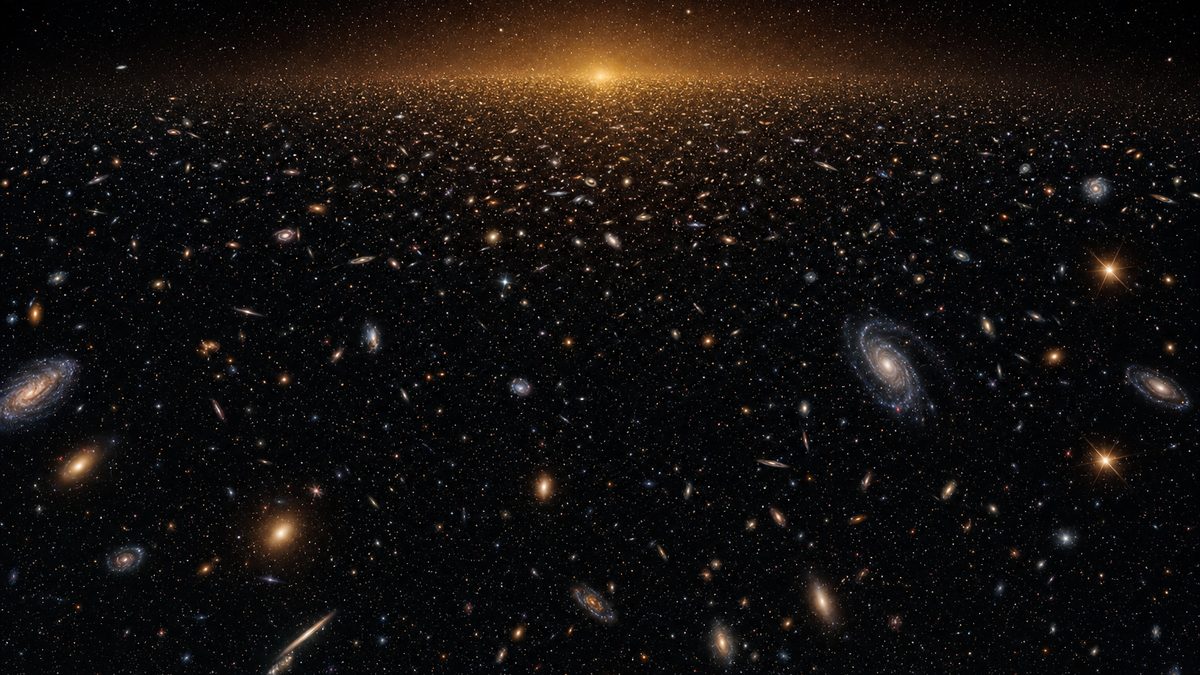
The scene on the left is a field of galaxies, drawn far closer together and brighter than real ones so you can see them.

How to use: pick a chapter below the scene or press ← → to change step · ▶ plays the step · drag to rotate, scroll or pinch to zoom · buttons in the box on the scene let you try things · “Play the film” runs every step full-screen.

Sources: Oxford Physics: analysis questions cosmic acceleration (11 Jun 2026); Oxford Physics: study confirms acceleration (11 Jun 2026); DESI: Lyman-alpha results, July 2026; Wikipedia: Lambda-CDM model

Chapter I · A dark sky

1610 → 1823 · Olbers’s paradox

Why is the night sky dark?

If space went on forever and was filled with stars forever, every direction would end on a star.

Imagine a universe that goes on forever, filled with stars, and that has always existed.

Look in any direction. Sooner or later your line of sight hits the surface of a star. The whole sky should blaze like the Sun.

It does not. Johannes Kepler raised this puzzle in 1610. Heinrich Olbers stated it in 1823, and it carries his name.

The answer is that the universe has a finite age. Light from very distant stars has not had time to reach us, and expansion stretches the rest of it into invisible wavelengths.

Chapter I · Step 1 · 1610–1823

Olbers’s paradox

In an infinite, eternal and unchanging universe filled evenly with stars, every line of sight would end on a star’s surface, and the whole night sky would be as bright as the Sun. The dark sky therefore tells us something about the universe as a whole.

  1. Finite age: we can only see light that has had time to reach us, so only a limited number of stars contribute.
  2. Finite speed of light: the farther you look, the further back in time you see.
  3. Expansion and redshift: light from far away is stretched to longer, invisible wavelengths.

Edgar Allan Poe suggested the finite-age answer in his 1848 essay Eureka. Lord Kelvin gave the first satisfactory calculation in 1901.

Use the buttons on the scene to switch between an eternal universe and one of finite age. Gold lines reach a star; blue lines run out into darkness.

Source: Wikipedia: Olbers’s paradox

Chapter II · Measuring the cosmos

1912 · Harvard College Observatory

The stars that measure the universe

Henrietta Swan Leavitt found a kind of star whose rhythm reveals how bright it really is.

To map the universe you need distances. A faint star could be dim and close, or bright and far away.

At Harvard, Henrietta Swan Leavitt studied thousands of variable stars on glass photographic plates of the Small Magellanic Cloud.

All its stars are about the same distance from us. So she could compare them fairly. In 1912 she showed that Cepheid stars that pulse more slowly are brighter.

Measure the rhythm, and you know the true brightness. Compare that with how bright the star looks, and you have its distance.

Chapter II · Step 2 · 1908–1912

Leavitt’s law

Henrietta Swan Leavitt worked as one of the Harvard College Observatory “computers”, measuring stars on photographic plates. In 1908 she published 1,777 variable stars in the Magellanic Clouds and noticed that the brighter ones had longer periods. In 1912 she studied 25 Cepheids in the Small Magellanic Cloud and established the period–luminosity relation.

Cepheids in the 1912 study
25
all in the Small Magellanic Cloud
Distance of the SMC
~200,000 ly
so all its stars are at about the same distance
Periods
Days to weeks
longer period = more luminous
Luminosity
~1,000 to 50,000 Suns
bright enough to see in other galaxies

In the scene, six Cepheids pulse with rhythms scaled from 3 to 34 days. Watch: the slow ones are the bright ones. The chart in the box shows the rule Leavitt found; it is drawn schematically. The Pole Star, Polaris, is the nearest Cepheid.

Sources: Wikipedia: Henrietta Swan Leavitt; Wikipedia: Classical Cepheid variable; Wikipedia: Small Magellanic Cloud

1924–1925 · Mount Wilson Observatory

Island universes

A Cepheid in the Andromeda “nebula” showed it lies far beyond the Milky Way.

In the early 1920s many astronomers believed the Milky Way was the whole universe, and the faint spiral “nebulae” were clouds inside it.

In 1924 Edwin Hubble used the 100-inch Hooker telescope to find Cepheids in the Andromeda nebula.

Their rhythm gave their true brightness. They looked so faint that Andromeda had to be far outside our galaxy.

Andromeda is a galaxy in its own right, about two and a half million light-years away. The universe had suddenly become enormous.

Chapter II · Step 3 · 1924–1925

Andromeda is another galaxy

Edwin Hubble identified Cepheid variables in the Andromeda and Triangulum “nebulae” with the 100-inch Hooker Telescope on Mount Wilson, California. Using Leavitt’s law he showed they were separate galaxies far outside the Milky Way. The result was reported in The New York Times on 23 November 1924 and presented to the American Astronomical Society on 1 January 1925.

  1. Period of a Cepheid → its true brightness (Leavitt’s law)
  2. True brightness vs how bright it looks → distance (light dims with the square of distance)
  3. Andromeda: about 2.5 million light-years away, far beyond the edge of the Milky Way

Hubble’s early distances were too small because of calibration errors, but the conclusion stood. The 21-day Cepheid in the Magellanic Cloud and a similar one in Andromeda are linked by the dashed line. Distances in the scene are not to scale.

Sources: Wikipedia: Edwin Hubble; Wikipedia: Andromeda Galaxy; Wikipedia: Henrietta Swan Leavitt

Chapter III · Everything recedes

1912 → today · Spectra of galaxies

Light that stretches

The lines in a galaxy’s spectrum are shifted towards red. The farther the galaxy, the bigger the shift.

Starlight split into a rainbow shows dark lines at exact colours, fingerprints of elements such as hydrogen.

From 1912, Vesto Slipher found that in almost every spiral nebula these lines were shifted towards the red end of the spectrum.

Here is what we now understand. While light crosses the universe, space itself expands, and the light wave is stretched along with it.

Astronomers call the stretch the redshift, z. One plus z tells you how much the universe has grown while the light was on its way.

Chapter III · Step 4 · Redshift

Stretched light

Vesto Slipher measured the first Doppler shift of a spiral nebula in 1912 and found that almost all of them were moving away. Today we describe the redshift of distant galaxies as the stretching of light by the expansion of space: 1 + z = (size of the universe when light arrives) ÷ (size when it left).

Definition
z = (λobserved − λemitted) ÷ λemitted
λ is the wavelength
Hydrogen-alpha line
656.3 nm
red light, in a laboratory at rest
CMB
z ≈ 1,100
light stretched about 1,100 times
Farthest galaxy confirmed
z = 14.44
MoM-z14, seen about 280 million years after the Big Bang

Choose a redshift with the buttons on the scene, then press ▶ or drag the slider. Watch the wave stretch, the tick marks of space spread apart, and the hydrogen lines in the spectrum slide towards red and out into the infrared.

Sources: Wikipedia: Hubble’s law; Wikipedia: Redshift; Wikipedia: Balmer series

1927 · 1929 · Lemaître and Hubble

Everything recedes from everything

The farther a galaxy is, the faster it moves away. That is exactly what an expanding universe looks like.

In 1927 the Belgian physicist and priest Georges Lemaître showed that Einstein’s equations allow an expanding universe, and that galaxies should recede at speeds proportional to their distance.

In 1929 Edwin Hubble combined his distances with redshifts and found that straight-line relation in the data.

Think of raisins in a rising loaf. Every raisin sees every other raisin move away, and the more dough between them, the faster they separate.

There is no centre. Choose any galaxy as home, and the view is the same. Today the law is called the Hubble–Lemaître law.

Chapter III · Step 5 · 1927–1929

The Hubble–Lemaître law

Alexander Friedmann showed in 1922 that Einstein’s equations allow a universe that changes size. Georges Lemaître published the first derivation of the velocity–distance law in 1927, with an estimate of the expansion rate, in a Belgian journal few people read. Edwin Hubble’s 1929 paper made the case with observations. In 2018 the International Astronomical Union recommended calling it the Hubble–Lemaître law.

The law
v = H0 × D
recession speed = Hubble constant × distance
Hubble’s 1929 value
~500
km/s per megaparsec, too high because of distance errors
Today
67–73
km/s per megaparsec, depending on the method (see Chapter VI)

1 megaparsec ≈ 3.26 million light-years. In the scene, the spacing between galaxies is 40 million light-years today. Arrows show each galaxy’s recession speed as seen from the chosen galaxy. Galaxies themselves do not grow: gravity holds them together.

Drag the slider to run cosmic time. Press “Pick another galaxy” to move home: the pattern of arrows, and the straight line on the chart, stay the same.

Sources: Wikipedia: Hubble’s law; Wikipedia: Georges Lemaître; Wikipedia: Edwin Hubble; Wikipedia: Expansion of the universe

Chapter IV · A hot beginning

1931 · 1948 · 1949

Run the film backwards

If the galaxies are flying apart, then long ago they were close together, and the universe was hot.

Run the expansion backwards. Galaxies crowd together, and the light that fills space is squeezed and heated.

In 1931 Lemaître proposed that the universe began from a “primeval atom”. This is the root of the Big Bang theory.

In 1948 Hermann Bondi, Thomas Gold and Fred Hoyle offered a rival: a steady-state universe that expands forever, with new matter quietly created to keep it looking the same.

On BBC radio in 1949 Hoyle called the rival idea the “Big Bang”. The name stuck. Deciding between the two needed evidence.

Chapter IV · Step 6 · 1931–1949

Big Bang or steady state?

Lemaître’s 1931 note in Nature proposed that the universe expanded from a single initial state he called the “primeval atom”. In 1948 Bondi, Gold and Hoyle proposed the steady-state model: the universe expands but never changes its appearance, because matter is continually created. Hoyle coined the phrase “Big Bang” on the BBC Third Programme in March 1949, though he later denied meaning it as an insult.

Big Bangfinite age; denser and hotter in the past; things far away (seen long ago) look different Steady stateno beginning; same density forever; matter created to fill the gaps The testlook far away, which means long ago: is the young universe different?

“Big Bang” is a misleading name. It was not an explosion at a point into empty space; the expansion happens everywhere at once, and there is no centre.

Use the buttons on the scene to compare the two models.

Sources: Wikipedia: Georges Lemaître; Wikipedia: Steady-state model; Wikipedia: Fred Hoyle; Wikipedia: Big Bang

1964–1965 · Holmdel, New Jersey

The afterglow of creation

A radio antenna picked up a faint hiss from every direction in the sky. It was the oldest light there is.

If the young universe was hot, its glow should still be around us, stretched by expansion into microwaves. Ralph Alpher and Robert Herman predicted it in 1948.

In 1964 Arno Penzias and Robert Wilson, testing a horn antenna at Bell Labs, found a faint hiss they could not get rid of, not even by evicting nesting pigeons.

It was the cosmic microwave background: light released about 380,000 years after the beginning, when the universe cooled enough to become transparent.

It reaches us from a shell all around us. Satellites have mapped it ever more sharply: COBE in 1992, then WMAP, then Planck. The tiny ripples are the seeds of every galaxy.

Chapter IV · Step 7 · 1964–2018

The cosmic microwave background

Before about 380,000 years, the universe was a glowing fog of charged particles that scattered light. When it cooled to about 3,000 K, electrons and nuclei joined into atoms and light could travel freely. That light has been stretched about 1,100 times since, and now arrives as microwaves at 2.725 K, almost exactly the same from every direction. The steady-state model struggled to explain it, and the Big Bang became the standard picture.

Temperature today
2.72548 K
a near-perfect blackbody
Ripples
~1 in 25,000
about 0.0001 K from place to place
Penzias & Wilson
Nobel 1978
discovered 1964, published 1965
COBE: Mather & Smoot
Nobel 2006
for its blackbody spectrum and first ripples
  • COBE launched 1989; ripples announced 23 April 1992
  • WMAP launched 2001; precise all-sky maps
  • Planck 2009–2013; final results 2018

The sky maps in the scene are simulated to show how resolution improved from mission to mission; they are not the real maps, and the colour contrast is hugely exaggerated.

Sources: Wikipedia: Cosmic microwave background; Wikipedia: Discovery of the CMB; Wikipedia: COBE; Wikipedia: Planck (spacecraft); Wikipedia: Steady-state model

The first 20 minutes

A cosmic furnace

For a few minutes the whole universe was hot enough to fuse nuclei, and it made a quarter of its matter into helium.

One second after the beginning, the universe was a soup of protons, neutrons, electrons and light, at about ten billion degrees.

There were about six protons for every neutron. Free neutrons slowly decay, so the clock was ticking.

After a few minutes it was cool enough for nuclei to survive. Almost every remaining neutron was swept into helium.

By about twenty minutes, fusion stopped. Result: roughly three-quarters hydrogen and one-quarter helium by mass, just as we measure in the oldest gas today.

Chapter IV · Step 8 · From 10 seconds to 20 minutes

Making the first elements

Big Bang nucleosynthesis lasted from roughly 10 seconds to about 20 minutes. When the reactions that swap neutrons and protons stopped, there was about one neutron for every six protons; free neutrons decay with a lifetime of about 15 minutes, so the ratio fell to about one in seven before almost all of them were locked into helium-4. The theory goes back to the 1948 Alpher–Bethe–Gamow paper.

Hydrogen
~75%
by mass
Helium-4
~25%
by mass; matches observations
Deuterium + helium-3
~1 in 100,000
nuclei
Lithium-7
~1 in 10⁹
observed 2–4× less than predicted: the “lithium problem”

The scene uses 128 particles: 18 neutrons (blue) and 110 protons (red). Two neutrons decay into protons; the other 16 pair up with 16 protons into 8 helium nuclei. 32 of 128 particles is exactly 25% of the mass. The clock follows the standard model’s cooling.

Sources: Wikipedia: Big Bang nucleosynthesis; Wikipedia: Chronology of the universe

Chapter V · The dark side

1933 · 1970s · Zwicky and Rubin

The missing mass

Galaxies spin as if they contain far more matter than we can see.

In 1933 Fritz Zwicky measured galaxies moving in the Coma Cluster. They were too fast to be held together by the matter he could see. He called the rest “dark matter”.

In the 1970s Vera Rubin and Kent Ford measured how fast stars orbit in spiral galaxies, starting with Andromeda.

With only the visible stars and gas, the outer parts should orbit slowly, like the outer planets of the Solar System. Instead they orbit just as fast as the inner parts.

Something unseen adds gravity: a vast halo of dark matter. It does not shine or absorb light, and no experiment has yet caught it directly.

Chapter V · Step 9 · 1933 and the 1970s

Flat rotation curves

Fritz Zwicky applied the virial theorem to the Coma Cluster in 1933 and concluded that it must contain far more mass than its luminous galaxies, which he called dunkle Materie, dark matter. Vera Rubin and Kent Ford’s measurements of spiral galaxies in the 1970s showed that orbital speeds stay high far from the centre, so galaxies must contain at least five to ten times more mass than is visible. Rubin’s results became some of the first persuasive evidence for dark matter.

Dark matter
~85%
of all the matter in the universe
Direct detection
None confirmed
as of 2026, despite decades of searches

Other lines of evidence, including the CMB ripples and gravitational lensing, point the same way. A minority of physicists explore modified gravity instead. Vera Rubin (1928–2016) is honoured by the Vera C. Rubin Observatory.

Use the buttons on the scene to switch the dark-matter halo on and off. The yellow probes show orbital speeds; the chart shows speed against distance from the centre.

Sources: Wikipedia: Fritz Zwicky; Wikipedia: Vera Rubin; Wikipedia: Dark matter

1998 · Two rival teams

The universe is speeding up

Distant exploding stars were fainter than anyone expected. The expansion is accelerating.

Gravity pulls everything together, so astronomers expected the expansion to be slowing down. In the 1990s two teams set out to measure by how much.

They used Type Ia supernovae: exploding white dwarfs that all reach almost the same peak brightness, so how faint they look tells you how far away they are.

In 1998 both teams found the distant supernovae were fainter, so farther away, than in a universe that is slowing down.

The expansion is speeding up. Something, now called dark energy, acts against gravity on the largest scales. The discovery won the 2011 Nobel Prize in Physics.

Chapter V · Step 10 · 1998

The accelerating universe

The Supernova Cosmology Project and the High-Z Supernova Search Team independently measured distant Type Ia supernovae. These explode when a white dwarf in a binary system approaches about 1.44 times the mass of the Sun, so their peak brightness, about five billion times the Sun’s, is nearly the same each time. Distant ones came out 10–15% farther than expected in a low-density universe without a cosmological constant.

Nobel Prize in Physics 2011
Saul Perlmutter (½), Brian P. Schmidt (¼), Adam G. Riess (¼)
“for the discovery of the accelerating expansion of the Universe through observations of distant supernovae”
Acceleration began
~5 billion yr ago
when dark energy began to dominate
Before that
Slowing down
matter’s gravity won while it was denser

In the scene, galaxies sit at their distances in the standard model. The faint ring marks where each supernova would be in a universe with the same matter but no dark energy. Distances on the axis are “luminosity distances”: how far away a supernova must be to look as faint as it does, in billions of light-years.

Press “Next supernova” to step through them; the box shows how much fainter each one looks than expected.

Sources: NobelPrize.org: Physics 2011; Wikipedia: Accelerating expansion of the universe; Wikipedia: Type Ia supernova; NASA: Dark energy

Planck 2018 · The cosmic budget

95% unknown

Everything we have ever seen, every star, planet and person, is about 5% of the universe.

Put the measurements together, from the CMB, galaxy maps and supernovae, and you get the universe’s budget.

Ordinary matter, the atoms of stars, gas, planets and us, is only about five per cent.

Dark matter, which pulls but does not shine, is about twenty-seven per cent.

And dark energy, which drives the acceleration, is about sixty-eight per cent. The simplest version is Einstein’s cosmological constant: an energy of empty space itself.

Chapter V · Step 11 · The standard model of cosmology

What the universe is made of

The standard model of cosmology, called Lambda-CDM (Λ for the cosmological constant, CDM for cold dark matter), is fitted to the Planck satellite’s CMB maps and other data. Its final 2018 results give the shares of the universe’s energy today:

Ordinary matter
4.9%
atoms: stars, gas, planets, people
Dark matter
26.6%
invisible, felt through gravity
Dark energy
68.5%
causes the expansion to accelerate

Einstein added a cosmological constant to his equations in 1917 to keep the universe static, and dropped it once the expansion was found. It returned in 1998. Quantum theory predicts an energy of empty space roughly 10120 times larger than what is observed; why it is so small is one of the deepest unsolved problems in physics.

Use the buttons on the scene to lift out each part.

Sources: Wikipedia: Planck (spacecraft); Wikipedia: Lambda-CDM model; Wikipedia: Cosmological constant

Chapter VI · Open questions

2019 → 2026 · The Hubble tension

Two answers to one question

Measure the expansion rate nearby, or infer it from the early universe: the numbers do not agree.

How fast is the universe expanding today? There are two main ways to find out.

One starts from the early universe. Feed the Planck satellite’s CMB maps into the standard model, and it predicts sixty-seven point four kilometres per second per megaparsec.

The other climbs a distance ladder: Cepheids, then supernovae in nearby galaxies. The SH0ES team gets about seventy-three.

The error bars no longer overlap, at more than five sigma. Either there is a hidden error somewhere, or the standard model is missing something.

Chapter VI · Step 12 · The Hubble tension

67 or 73?

The early-universe value of the Hubble constant comes from fitting the standard model to the CMB. The late-universe value comes from the distance ladder in today’s universe. The James Webb Space Telescope rechecked the Cepheids in 2023 and confirmed the Hubble Space Telescope measurements.

Planck 2018 (CMB)
67.4 ± 0.5
km/s per megaparsec
SH0ES (Cepheids + SNe)
73.04 ± 1.04
km/s per megaparsec
Other methods
Some fall in between
e.g. the Carnegie-Chicago team’s red-giant stars: 69.8 ± 1.9 (2019)

Proposed explanations include an unknown measurement error, extra “early dark energy” shortly before the CMB was released, dark energy that changes over time, or new kinds of particles. None is established.

Sources: Wikipedia: Hubble tension; Wikipedia: Hubble’s law; Wikipedia: Planck (spacecraft)

2021 → 2026 · DESI, Euclid, Rubin

Is dark energy changing?

The biggest 3D maps of the universe hint that dark energy may not be constant. The hint is still being tested.

Sound waves in the early universe left a preferred spacing between galaxies, about four hundred and ninety million light-years. It works as a cosmic ruler.

The DESI instrument in Arizona measured millions of galaxies with five thousand robotic fibres. In March 2025 it reported hints that dark energy may be weakening over time.

Since then the picture has become less clear. A recalibrated supernova sample weakened the hint, and in July 2026 a new DESI measurement moved closer to a constant dark energy.

DESI finished its main survey in April 2026. Its full results are expected in 2027, as Europe’s Euclid telescope and the new Vera C. Rubin Observatory join the hunt.

Chapter VI · Step 13 · 2021–2026

Measuring dark energy with a ruler

Baryon acoustic oscillations are the frozen imprint of sound waves in the hot early plasma. They give galaxies a slight preference to be about 150 megaparsecs (about 490 million light-years) apart. Measuring that spacing at different distances tracks the history of the expansion, first done in 2005 by the SDSS and 2dF surveys.

  • 2021 DESI begins its five-year survey on the 4-metre Mayall Telescope, Kitt Peak, Arizona
  • Mar 2025 Three years, nearly 15 million galaxies and quasars: evolving dark energy preferred at 2.8–4.2σ, depending on the data combined
  • 2025–26 A recalibrated Dark Energy Survey supernova sample lowers its preference from 4.2σ to 3.2σ, “only a weak preference”
  • Apr 2026 DESI completes its survey: more than 47 million galaxies and quasars; full results expected in 2027
  • Jul 2026 DESI’s new Lyman-alpha analysis shifts towards a constant dark energy
Euclid (ESA)
Launched 1 Jul 2023
first big data release planned for 12 Nov 2026 (tentative)
Rubin Observatory
Survey began mid-2026
10 years, 3,200-megapixel camera, Chile

Physicists usually call a result a discovery at 5σ. None of the dark-energy hints has reached that.

Press “Show the ruler” to highlight a ring of galaxies around one cluster. The web in the scene is a simplified illustration.

Sources: Wikipedia: Baryon acoustic oscillations; Wikipedia: DESI; UT Dallas: DESI results, March 2025; DES Collaboration: DES-Dovekie reanalysis (arXiv 2511.07517); Ohio State News: DESI completes its map, April 2026; DESI: Lyman-alpha results, July 2026; ESA: Euclid timeline; US DOE: Rubin Observatory begins its survey (30 Jun 2026)

Chapter VII · 13.8 billion years

From one second to today

13.8 billion years

What the age of the universe means, told on a logarithmic clock that stretches the first moments.

This slider is a logarithmic clock. It stretches out the first moments so that one second and fourteen billion years both fit.

At one second, everything is a hot, dense glow, at about ten billion degrees. Within twenty minutes the first nuclei have formed.

For hundreds of thousands of years after that, light is trapped in a glowing fog of charged particles.

At three hundred and eighty thousand years the fog clears. The light set free then is the cosmic microwave background.

Then come the dark ages, with no stars at all, until the first stars ignite a few hundred million years later.

Galaxies grow and merge. About nine billion years in, the Sun forms and the expansion starts to speed up. Today is 13.8 billion years after the hot, dense start.

Chapter VII · Step 14 · A log-time journey

What “13.8 billion years old” means

The age of the universe is the time since the hot, dense early phase, worked out by fitting the standard model to the CMB and other data: 13.787 ± 0.020 billion years. It is not the age of a point in space: the Big Bang happened everywhere. The model says nothing reliable about what came before, and the idea of a very rapid “inflation” in the first fraction of a second is widely used but still unresolved.

  • 1 s neutrinos decouple; about 10 billion K
  • 10 s–20 min the first nuclei: hydrogen, helium, traces of lithium
  • 47,000 yr matter starts to outweigh radiation
  • ~380,000 yr atoms form, the CMB is released
  • ~100s of Myr first stars and galaxies end the dark ages
  • 9.2 Gyr the Solar System forms
  • ~9 Gyr expansion begins to accelerate
  • 13.8 Gyr today: 2.7 K

Drag the slider under the scene to move through time; it runs on a logarithmic scale, with the first 380,000 years stretched across the first part. The box shows the time, the temperature of the background light, and how big the universe was compared with today, all computed from the standard model with Planck 2018 values. The visible universe today is about 93 billion light-years across.

Sources: Wikipedia: Chronology of the universe; Wikipedia: Lambda-CDM model; Wikipedia: Big Bang; NASA: Dark energy; Wikipedia: Observable universe

Epilogue

2026 and beyond

A century of surprises

The universe had a beginning, it is expanding, and most of it is something we have never seen.

A dark night sky, the rhythm of a star, the redshift of a galaxy: each small clue led to a bigger universe.

We know the universe was once hot and dense, that it has been expanding for 13.8 billion years, and what the first atoms were.

We do not know what dark matter is. We do not know what dark energy is, or whether it is changing. We do not know why two ways of measuring the expansion disagree.

The next answers will come from maps of billions of galaxies now being made. The story is not finished.

Epilogue · 2026 →

What we know, and what we do not

  • 1912 Leavitt’s law gives astronomers a way to measure distance
  • 1925 Hubble shows Andromeda is a separate galaxy
  • 1927–29 Lemaître and Hubble: the universe is expanding
  • 1965 The cosmic microwave background is reported
  • 1970s Rubin and Ford: galaxies need dark matter
  • 1998 Supernovae reveal accelerating expansion
  • 2018 Planck’s final results: 13.8 billion years
  • 2025–26 Hints that dark energy may change, now under test
Known
Hot, dense start; expansion; first elements
supported by many independent measurements
Unknown
Dark matter, dark energy, the Hubble tension
and what, if anything, came before

The 3D scenes are simplified and not to scale; sky maps and galaxy distributions are simulated. All full-screen stills are AI-generated to help the imagination and are not photographs. Numbers come from the sources below.

Sources
Wikipedia: Olbers’s paradox
Wikipedia: Henrietta Swan Leavitt
Wikipedia: Classical Cepheid variable
Wikipedia: Small Magellanic Cloud
Wikipedia: Edwin Hubble
Wikipedia: Andromeda Galaxy
Wikipedia: Hubble’s law
Wikipedia: Georges Lemaître
Wikipedia: Redshift
Wikipedia: Balmer series
Wikipedia: Expansion of the universe
Wikipedia: Big Bang
Wikipedia: Steady-state model
Wikipedia: Fred Hoyle
Wikipedia: Cosmic microwave background
Wikipedia: Discovery of the CMB
Wikipedia: COBE
Wikipedia: Planck (spacecraft)
Wikipedia: Big Bang nucleosynthesis
Wikipedia: Chronology of the universe
Wikipedia: Fritz Zwicky
Wikipedia: Vera Rubin
Wikipedia: Dark matter
NobelPrize.org: Physics 2011
Wikipedia: Accelerating expansion of the universe
Wikipedia: Type Ia supernova
NASA: Dark energy
Wikipedia: Lambda-CDM model
Wikipedia: Cosmological constant
Wikipedia: Hubble tension
Wikipedia: Baryon acoustic oscillations
Wikipedia: DESI
UT Dallas: DESI results, March 2025
Ohio State News: DESI completes its map, April 2026
DESI: Lyman-alpha results, July 2026
DES Collaboration: DES-Dovekie reanalysis (arXiv 2511.07517)
Oxford Physics: analysis questions cosmic acceleration (11 Jun 2026)
Oxford Physics: study confirms acceleration (11 Jun 2026)
Physics World (23 Jun 2026)
ESA: Euclid timeline
US DOE: Rubin Observatory begins its survey (30 Jun 2026)
Wikipedia: Observable universe